
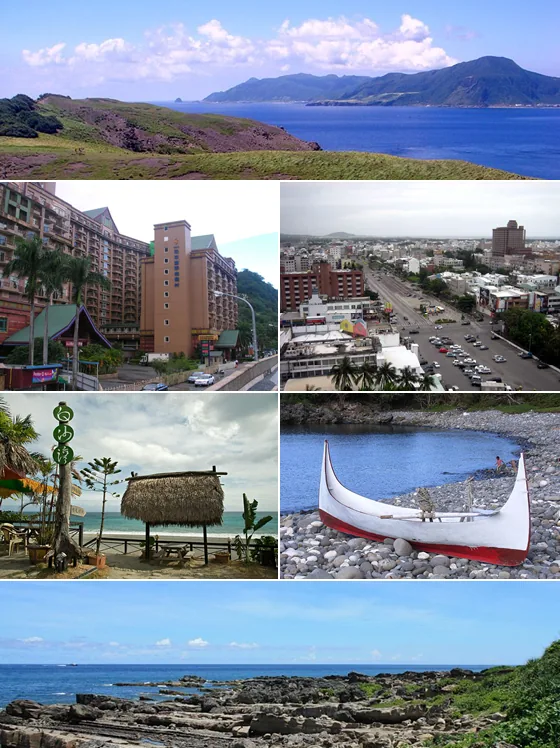
Taitung County: Two Islands, One Political Prisoner for Nearly Thirty Years, and Nuclear Waste Stored for Over Forty Years
30-Second Overview: Taitung County has an area of 3,515 square kilometers, making it the third largest in Taiwan. With a population of about 210,000 spread across this land, the density is approximately 60 people/km², which is the lowest in the nation and one-tenth that of Taipei City. The indigenous population accounts for about 37.5%, making it the county with the highest proportion nationally. It is home to six indigenous groups: Amis, Binan, Paiwan, Rukai, Bunun, and Atayal (Lanyu). In 1980, the construction of the Nanhuai Railway unearthed the Binan archaeological site, where 1,600 stone coffins were discovered, dating from 5,300 to 2,300 years ago, making it Taiwan's largest prehistoric settlement. From 1951 to 1965, approximately 2,000 White Terror political prisoners were detained at the Green Island Re-education Center; during a seven-year period, these prisoners were transferred from Green Island to Taiyuan in Taitung. From 1972 to 1987, they were again held at Lushou Farm. In 1975, Chiang Ching-kuo agreed to establish the Lanyu Dragon Gate nuclear waste storage facility; the first batch was transported there in May 1982. On February 20, 1988, the Atayal people launched the "Exorcising Evil Spirits" anti-nuclear waste movement, and as of 2026, 97,672 barrels remain unremoved. On August 25, 1968, seven Bunun children from Hongye Village defeated a Kansai minor league star team in Taitung with a score of 7-0 (not the world champion team later claimed by state media), sparking the myth of baseball becoming Taiwan's national sport. Of the 13 players who participated, 9 were imposters, and 8 of the young players passed away around age forty. This article aims to convey that Taitung is a microcosm of an entire island, where two islands have borne the cost of Taiwan's modernization.
From the South Loop Tunnel, First Seeing 3,515 Square Kilometers
If you drive along the South Loop Highway from Fenggang in Pingtung, crossing the tail end of the Central Mountain Range eastward, past the Dawu checkpoint, your entire view suddenly opens up.
On the left is the Coast Mountains, on the right are the Central Mountains, and in the middle are the rice paddies of the Hualien-Taitung Valley extending north to Hualien. Ahead is the Pacific Ocean. This highway was fully opened only in 19851, connecting the Pingtung Peninsula and the east coast by the shortest distance. Before that, getting from the west coast to Taitung required either taking the South Loop Mountain Road, taking a ferry, or driving the South Cross Island Highway, which opened in 1972, over Yushan2.
Upon entering Taitung County, the first thing one realizes is the low density.
With an area of 3,515 square kilometers, it is the third-largest administrative district in Taiwan, second only to Hualien and Nantou3. With a population of 208,000, it fell below 210,000 in July 2025, officially becoming the county with the fewest residents on the island4. Calculated this way, there are only 60 people per square kilometer, the lowest in the nation, one-tenth of the nearly 9,800 people per square kilometer in Taipei City4.
Behind these numbers is a physical reality: if you drive in this county, it takes two hours to get from Taitung City to the Bunun tribal village in Haidan Township; an additional half hour by plane to Green Island; and over two hours by boat from Fu-o Fishing Port in Taitung to Lanyu. The entire county has 1 city, 2 townships, and 13 villages, of which 5 are mountainous villages and 2 are located directly on outlying islands3.
📝 Curator's Note: "The last pristine land" is the most common label used for Taitung, but this label flattens the entire county into a backyard for tourists, ignoring the 210,000 people who live here. Another frequently heard description is "the most remote county," which measures Taitung's distance within a coordinate system centered on Taipei. However, from an oceanic perspective, Lanyu is closer to the Batanes Islands of the Philippines than it is to Taipei; the Atayal language has about 60% similarity with Ivatan in Batanes5. From a temporal perspective, the Binan site predates any Han settlements on Taiwan by 5,000 years. "Remoteness" is an issue of direction, not fact. Taitung is an entire island's timeline compressed into one county, encompassing the earliest people, the last outlying islands, and the deepest struggles.
5,000 Years Unearthed During South Loop Railway Construction in 1980
Stone coffins were discovered while constructing the Taitung Station.
In 1980, during underground construction at the new South Loop Railway Taitung Station, a large number of cultural relics were uncovered. The Taitung County government commissioned Professor Song Wen-xun and Professor Ren Chao-mei from the Anthropology Department of National Taiwan University to conduct rescue archaeology. This excavation spanned nine years, involving 13 digging campaigns across an area of 10,000 square meters6.
The final findings shocked academia:
1,600 stone coffins, representing the largest group of stone coffin burials in the Pacific Rim and Southeast Asia. Over 20,000 artifacts, including pottery, stone tools, and jade objects, were recovered, setting an unprecedented record in Taiwan's archaeological history6. The cultural period dates back approximately 5,300 to 2,300 years, covering a broad area of one million square meters, making it the largest prehistoric settlement discovered in Taiwan so far7.

Binan site stone coffin excavation site, February 28, 2012. Photo: Benson KC Fang. CC BY-SA 3.0 via Wikimedia.
The accompanying jade artifacts were so exquisite that they were registered as national treasures, including bi-zoomorphic jade jades (pendants), bell-shaped jade ornaments, trumpet-shaped jade rings, and jade pipes. The jade material originated from Fengtian Jade in Hualien, indicating that the Binan culture had long-distance exchange networks spanning over a hundred kilometers 5,000 years ago8.
The earliest records date back to the Japanese colonial period. In 1896, the surface stone pillars photographed by the Japanese anthropologist Torii Ryuzō are the oldest images from the Binan site7. At that time, Han Chinese had not yet excavated this land; from the perspective of modern intellectual history, the first person to disturb this land was Torii Ryuzō, who came from the Anthropology Department of the Imperial University of Japan in 1896.
The preparatory office for the National Museum of Prehistoric Culture in Taiwan was established in 1990, and it officially opened in August 2002, becoming the first prehistoric cultural heritage museum of international scale in Southeast Asia9. Four months later, the Binan Cultural Park Visitor Center opened to the public, marking the birth of Taiwan's first archaeological park. In 2003, the Binan site and Dulan Mountain were listed as the first potential World Heritage sites of Taiwan10.
"The Binan site is the largest in Taiwan, possessing the most complete prehistoric settlement pattern and data, and it is also the largest group of stone coffin burials in the Pacific Rim and Southeast Asia" (Official introduction from the National Museum of Prehistoric Culture in Taiwan9).
The county with the lowest population density, where the earliest people of Taiwan lived.
Six Indigenous Groups Coexist in One County
Official statistics for Taitung County always show one figure: the indigenous population accounts for approximately 37.5% of the total, which is the highest rate in Taiwan4.
However, this percentage masks a deeper reality. Taitung is a county where six indigenous groups coexist within the same administrative area, and there is no second such location among all 22 counties and cities in Taiwan.
Amis: This group has the largest population, about 40,000 people, concentrated in Changbin, Chenggong, Donghe, Binan Township, and Taitung City along the east coast11. The Harvest Festival (Ilisin) is held separately by each tribe every July. In 1911, the Malalau and Tuli tribes on the east coast launched the Ma-lao Incident against the Japanese after being humiliated and mistreated by Japanese police11. Today, the Harvest Festival of the Tuli tribe remains one of the most important annual festivals on the east coast.
Puyuma: With a population of about 14,000 people, this group is concentrated in Taitung City and Binan Township. The names of the Traditional Eight Clans vary slightly across different historical documents; the Indigenous Peoples Council's version includes Nanwang (Puyuma), Zhiben, Jianhe, Lijia, Tai'an, Xiabinlang, Alibai, and Chulu12. The Great Hunt Festival (Mangayaw), held from late December to early January each year, is the largest annual ceremony, encompassing two ritual stages: Monkey Sacrifice and the hunting of young men. The promotion structure of the age-set system is the most core social operating logic of this group.
Paiwan: The Eastern Paiwan primarily reside in Daren Township, Jinfeng Township, southern Taimali Township, and Dawu Township, with a population of over 14,000 people in Taitung County. The Tuhsan tribe in Daren Township is one of only two tribes in Taiwan that still continuously hold the Five-Year Festival (Maljeveq), the other being Gulu Village in Laiyi Township, Pingtung County13. The history of the Five-Year Festival can be traced back to records from the Dutch period, spanning at least 400 years. The entire ceremony lasts about 15 days, with the ball-throwing ritual as its core.
Rukai: The Eastern Rukai has a population of about 2,100 people, mainly in Dongxing Village, Binan Township (formerly known as Danan)11. The Eastern Rukai borders the Eastern Paiwan region, maintaining Rukai traditions while also interacting with the Paiwan. They are one of the smaller groups within Taitung County.
Bunun: This group is not native to Taitung. During the Japanese colonial period, the Bunun were widely distributed in various watersheds upstream of the Binan River, subsisting through scattered cultivation and hunting. Between 1931 (Showa 6) and 1941 (Showa 16), the Japanese colonial government implemented a group resettlement policy in Haidan Township and Yanping Township of present-day Taitung County, concentrating Bunun people from mountainous areas onto flat alluvial fans near the foothills, forming a village-based structure14.⚠️ This history is often simplified in oral memories of Taitung as "settling in 1934," but archives show it was an entire decade-long policy; 1934 may only refer to one batch of years. The group resettlement changed the Bunun's way of life, transforming them from forest hunters into settled farmers.
The most representative cultural heritage of the Bunun is Pasibutbut, the "Prayer for Rice Harvest Song." This polyphonic chorus was recorded by Japanese scholar Takashi Kizawa in the mountainous areas of Taiwan in 194315. The vocal arrangements are exquisite, and the choral sound is magnificent, developing astonishing harmonic techniques amidst waterfalls and rivers. Bunun tribes in Haidan Township still preserve this tradition today.
Tao: The six tribes in Lanyu Township (Langtau, Dongqing, Yining, Hongtou, Yoren, Yoluo) are the only indigenous group in Taiwan living on an outlying island, and they are the only group not belonging to the South Island language family of the Taiwanese mainland. The Tao language belongs to the Badan subgroup of the Austronesian languages spoken in the Philippines, showing 60% similarity to Ivatan in Badan Island, Philippines5. Archaeological and linguistic analyses suggest that Lanyu is an intermediary point on the southward expansion route of the South Island languages.
With six groups living in one county, each group has its own ritual calendar, its own taboo system, and its own historical memory. The plural term "indigenous people" here refers to six singular entities that cannot be mutually replaced.
Red Leaf 70, But the Opponent Wasn't a World Champion Team
Hongye Village in Yanping Township, Taitung County, is a small settlement of the Bunun people. In August 1968, seven children changed Taiwan's baseball history, though they did so using a method that has since been exposed.
The opponent in that game was not the "Yokohama team from Japan, the Little League World Series champion."
In July 1968, an amateur Japanese baseball league invited the National Baseball Committee of China to select a Little League star team to play in Taiwan16. They were not the world champions at the time. Although Japan had indeed won two consecutive championships at the William Porter Little League World Series, this particular team was different16. A reporter's in-depth report, "Bearing the Sins and Punishments of 50 Years," explicitly stated: "How did the 'Yokohama Little League World Champion team' come to be? This narrative only appeared later" 16.
The result of the game on August 25 was recorded by United Daily News on August 26, 1968, as follows:
"The scoreboard showed a score of seven-zero; Hongye defeated the world-famous Japanese youth baseball team with an overwhelming display." 16
7:0, not the 4:0 circulated in many later recollections.
Hongye won. Then something happened a year later.
A judgment from the Taitung District Court in 1969 revealed that of the 13 members of the Hongye Little League team, only four were listed with their real names; the other nine were imposters, and five of them lied about their age to be 12 years old 16. The principal, Hu Xue-li, the coach, Chiu Ching-cheng, and the manager, Tseng Chin-tung, were each sentenced to one year in prison with two years suspended for forging official documents. This was not Little League; this was using older children to play as younger ones to win an international game.
However, this scandal did not destroy Hongye's historical significance; instead, it became a cornerstone of the national ball myth. It directly led to the formation of the Golden Dragon Little League team in 1969 and their subsequent championship victory at the William Porter tournament in the United States 16. The era of third-tier baseball in Taiwan officially began here, with over 60 newly established Little League teams in Taitung alone 16. The beginning of Taiwanese baseball as a national sport was a celebration built upon deception.
⚠️ Controversial Viewpoint: Was the Hongye Little League "a victory for the national narrative" or "self-deception in collective memory"? These two answers are not mutually exclusive. A reporter wrote one sentence that might be the most accurate: "Of the 13 young members of Hongye back then, eight have passed away; they received no applause at the end of their lives." 16 The average lifespan of Indigenous peoples is seven years shorter than Han Chinese; poverty and alcoholism are major contributing factors, and most of the Hongye children passed away around age 40. The game they won was never against a world champion; they could not defeat that Japanese team even with their real ages, nor did they receive any care for changing baseball history. There are still about 500 residents in Hongye Village today 17 (⚠️ the circulating claim of "30 households" is unsubstantiated; the confirmed number is "about five hundred"). With fewer than 50 students in the school, the Little League team disbanded in 1999 and reformed in 2009.
Hongye Village still exists today. The Bunun people live alongside Han Chinese, farming corn for a living. In winter, tourists from the west drive into the village to visit the "Hongye Little League Memorial Hall," eat a meal, and leave. Of the seven children back then, Qiu Chun-guang 16 is the only one who remained in Hongye Village.
Lanyu, 1951 to 1987: Nearly Three Decades of Political Prisoners Imprisoned
33 kilometers east of Futao Port in Taitung is Green Island.
This volcanic island, covering an area of 15.09 square kilometers, is part of Lanyu Township in Taitung County. During the Japanese colonial period, it was called "Huo Shao Dao" (Fire Burning Island); after the war, it was temporarily renamed "Green Island." Its most famous geographical feature is Asahi Hot Spring, one of three submarine hot springs globally; the other two are near Kyushu, Japan, and Sicily, Italy18. It is a saltwater spring with sulfate chlorides, and its temperature ranges from 60–70°C. It was already listed as one of the four major hot springs during the Japanese colonial period.
However, Lanyu's deepest history is not about hot springs.

Green Island Human Rights Monument, August 28, 2022. Photo: S8321414. CC BY-SA 4.0 via Wikimedia.
In 1951, the Kuomintang government established the "Taiwan Provincial Security Command New Training and Guidance Center" on Lanyu, where a large number of political prisoners were exiled19. At its peak, the New Training and Guidance Center held about 2,000 political prisoners, divided into three battalions and twelve companies. In 1965, the New Training and Guidance Center was disbanded, and its barracks were handed over to the Military Security Command; the political prisoners were transferred to Taixuan Prison in Donghe Township, Taitung mainland20. After the Taixuan Incident in February 1970, authorities decided to concentrate the political prisoners back on Lanyu. In 1972, the "Ministry of National Defense Green Island Re-education Prison" was completed next to the former site of the New Training and Guidance Center, commonly known as "Green Island Resort," and in April of that year, political prisoners from Taixuan were transferred there2021.
From 1951 until martial law was lifted in 1987, political prisoners were imprisoned on this island for nearly three decades. During the seven years in between, they did not leave Taitung County; they were merely moved to Taixuan within the mountain range20.
When viewed against the timeline of Taiwan mainland, this period encompassed: the 823 Bombing, withdrawal from the United Nations, the Ten Major Construction Projects, the death of Chiang Ching-kuo, the美麗島 Incident (Beautiful Island Incident), the Lin family case, and the Chen Wen-cheng incident. The entire White Terror martial law era saw political prisoners housed in both Lanyu and Taixuan in Taitung County.
During the period of martial law, there were over 29,000 political prison cases across Taiwan, with 140,000 people suffering, and 3,000 to 4,000 people executed19. A significant proportion of these individuals were sent to this volcanic island, 33 kilometers from Taitung, living in wooden barracks at the New Training and Guidance Center or concrete cells at Green Island Resort, facing the waves of the Pacific Ocean daily while awaiting a notice of homecoming that might never come.
When martial law was lifted in 1987, the Ministry of National Defense Green Island Re-education Prison was abolished. The remaining 36 political prisoners did not leave Lanyu and were sent to the Ministry of Justice Green Island Prison in Zhongliao Village on the same island22. After the lifting of martial law, Green Island Resort also housed re-education troops; in 1992, the Military Command in the Lanyu area was disbanded, and this camp became vacant23. On International Human Rights Day, December 10, 1999, then-President Lee Teng-hui personally presided over the unveiling of the monument, which marked the first physical instance where Taiwan's president acknowledged the history of White Terror24. In 2002, the Green Island Human Rights Memorial Park was established (formally named "Green Island White Terror Memorial Park" in 2018). The park covers about 32 hectares and is located at the northeast corner of Lanyu, including the ruins of the New Training and Guidance Center and Green Island Resort.
Today, most tourists visiting Lanyu are engaged in diving, cycling around the island, or enjoying Asahi Hot Spring. Only a few visit the memorial park. The park is on the same road as the diving shops and bicycle rental stores. On one side are the ruins of the political prisoners' barracks; on the other is the "Green Island Star" tourist center. This island is simultaneously a physical witness to Taiwan's martial law memory and a popular scenic spot for eastern outlying island tourism; these two identities have never reconciled, they merely coexist.
The Land of Longmen Was Not Originally Meant for a Canned Food Factory
90 kilometers south from Futao Port in Taitung, which is 2.7 times farther than Green Island, is Lanyu.
This volcanic island is farther from the Taiwan main island but closer to the Batanes Islands of the Philippines. It is home to six Atayal villages with a total population of about 5,000 people. In 1975, an event occurred that continues to affect Lanyu today.
In that year, then Premier Chiang Ching-kuo agreed to establish a low-level radioactive waste storage site in the Longmen area of Lanyu25. The decision process did not consult the residents of Lanyu. Between 1977 and 1980, the Atomic Energy Commission and Taipower constructed facilities on Lanyu, and memories from local elders consistently point to deception. The government lured signatures by claiming it was building a "canned food factory" (some accounts say "pineapple canned food factory"), and the Atayal people did not know the true purpose of the construction site26. ⚠️ Official government statements deny using the term "canned food factory," but the 2018 Investigation into the Truth of Lanyu Nuclear Waste Storage Site Establishment Report confirmed that the tribes "were unaware," though the specific wording of the deception remains disputed; however, the Atayal memories consistently point to not being told it was a nuclear waste facility at the time.
In May 1982, the first phase of the Lanyu storage site was completed, and the first batch of low-level radioactive waste began to be transported in25. From this moment until the last shipment in 1996, a total of 97,672 barrels of low-level radioactive waste were received over 14 years25, sourced from Nuclear Power Plants No. 1, No. 2, and No. 3, as well as medical, agricultural, industrial, and academic institutions across Taiwan.
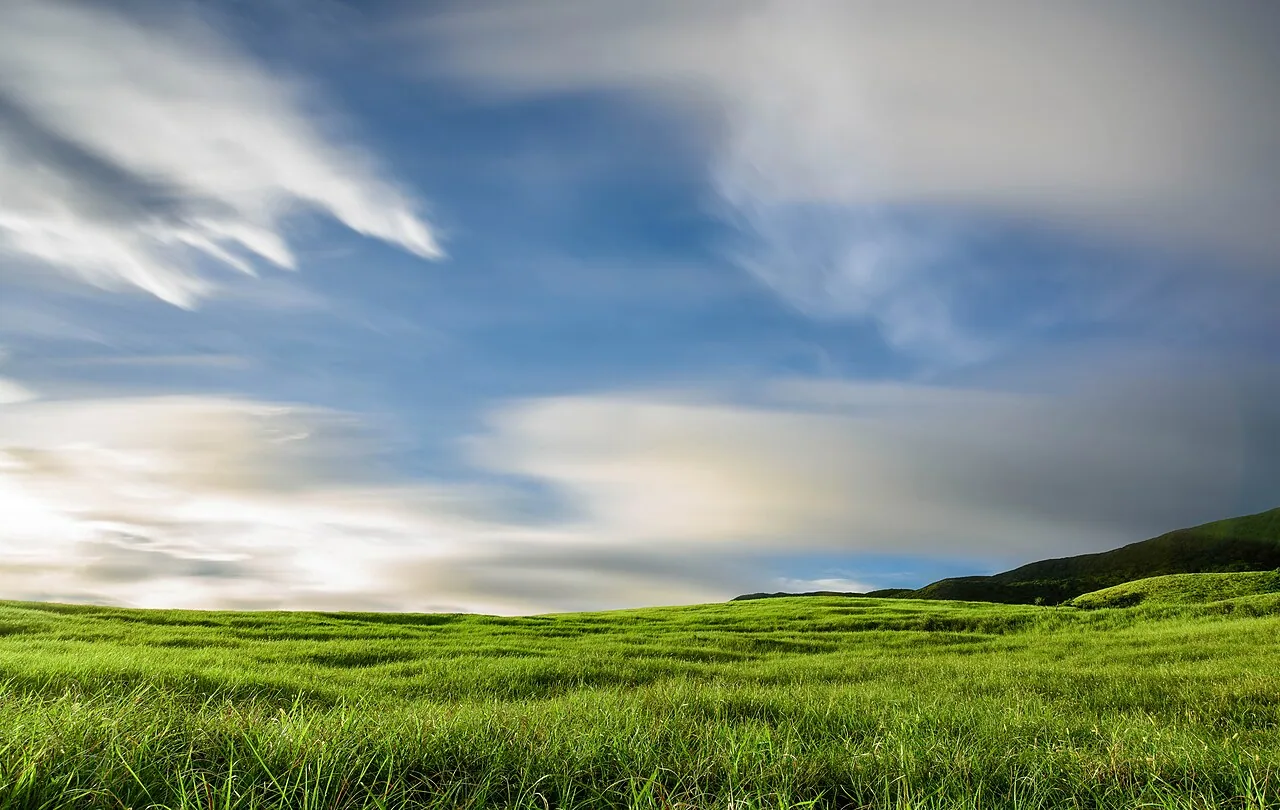
Lanyu landscape, July 21, 2017. Photo: Pai-Shih Lee (白士 李). CC BY 2.0 via Wikimedia.
In 1987, the Atayal protested Taipower hiring Lanyu local council members for tourism to Japan, and the anti-nuclear waste movement officially began27.
On February 20, 1988, the Atayal initiated the "Exorcising Evil Spirits" movement, circling the island while wearing traditional rattan helmets and armor and carrying spears and daggers. This was the first organized demonstration by Taiwan's indigenous peoples against nuclear waste28. The protest term "Exorcising Evil Spirits" was conceived during a meeting in January 1988 at Human Magazine in Anhe Road, Taipei City, hosted by Chen Ying-zhen28.
On that day, the tribes issued a joint statement, which is recorded verbatim as follows:
"This land has a soul; it has protected our people since ancient times. The toxins from nuclear waste are harming it now. The tribes wear traditional warrior attire with rattan helmets and armor, carrying daggers and spears to show their firm will to fight against the 'evil spirits.'"28
In 1995, the Lanyu Township Office launched a "One Person, One Stone" action. In April 1996, the Lanyu Township Head, village chiefs, and anti-nuclear waste activists gathered at Longmen Pier to protest Taipower transporting 168 barrels of nuclear waste from Nuclear Power Plant No. 2. The nuclear waste vessel "Dian Guang Yi Hao" was blocked by Lanyu residents, and after remaining in Lanyu waters for 4 days, it was forced to depart29. After 1996, Taipower did not transport any new nuclear waste.
But the 97,672 barrels remained. In Longmen.
✦ "From 1982 to 1996, over 100,000 barrels of nuclear waste entered the storage site, until the Atayal's blockade protest forced the nuclear waste ship back to the Mingguang Pier at Nuclear Power Plant No. 2." (Focus Event report30)
In traditional Atayal culture, the sea is the domain of men, and the mountain is the domain of women. The Flying Fish Season (which begins when they migrate north with the Kuroshio Current every February or March) is a covenant this people has made with the ocean. When the tribes catch flying fish, they sort by gender and age: women's fish, men's fish, and old men's fish, each type having different processing methods31. During the Flying Fish Season, reef fish are not caught (to allow coral reef fish to spawn); only after the season ends are reef fish caught (to allow flying fish to return home to spawn). This ecological wisdom has been in operation for thousands of years.
The plank-built boat (chinurikuran, 27 planks; tatara, 21 planks) is the pinnacle of Atayal craftsmanship, with traditional colors being red (red earth from the mountain), white (shell ash), and black (coal). The circular pattern on the boat's eye widely represents the cultural symbols of the Atayal32.
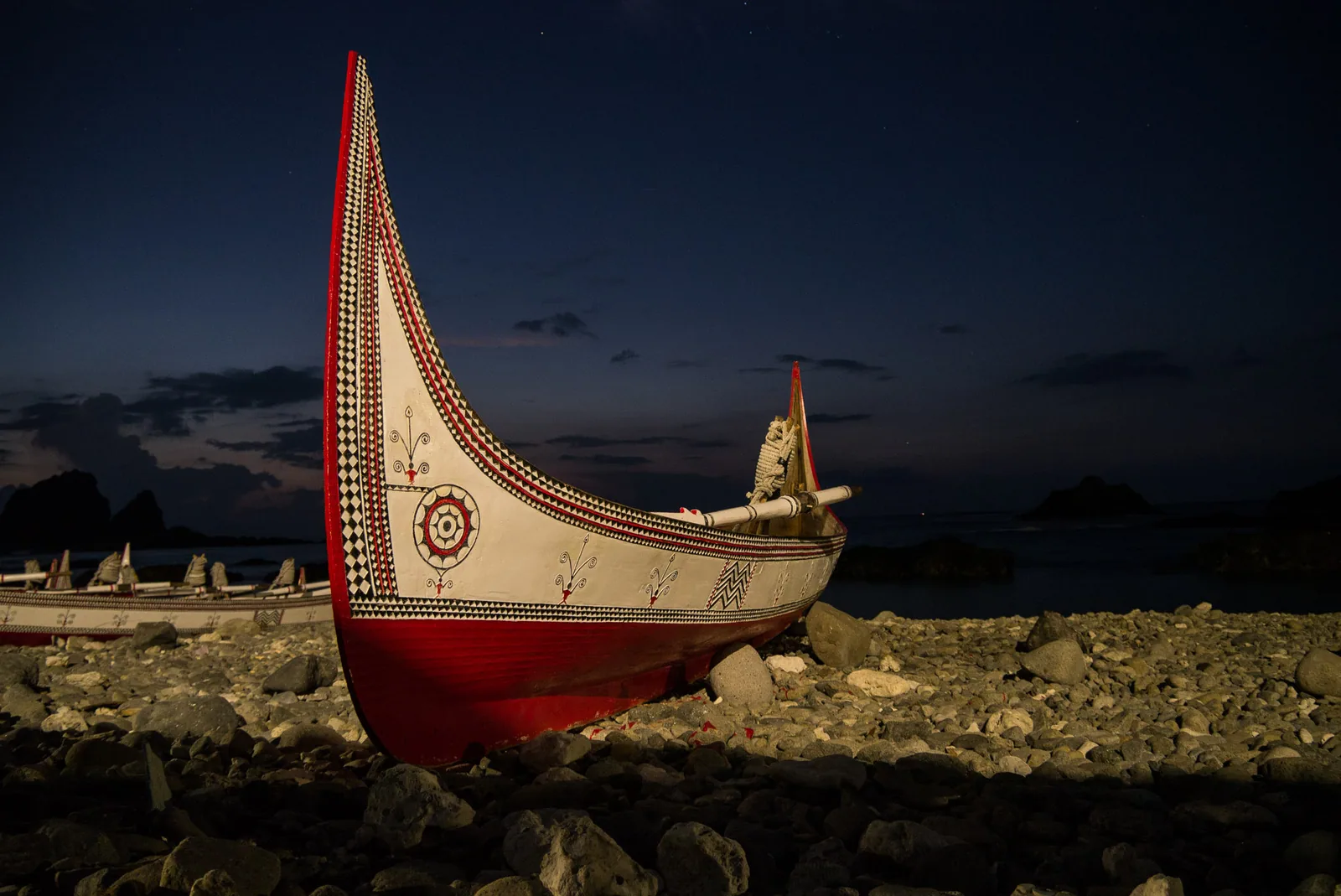
_Traditional Atayal plank-built boats. Photo: Cho Hsun Lu, CC BY 3.0 via Wikimedia._
Lanyu has a tropical oceanic climate, with annual rainfall exceeding 3,000 millimeters (far surpassing the approximately 1,900 millimeters in the Taitung City area of the Hualien-Taitung Valley and the 1,500 millimeters on the leeward side of the Coast Mountains), and strong northeast monsoons in winter. The traditional underground house (talakaval) of the Atayal was designed to cope with this climate; it is low-profile and semi-underground, insulated by surrounding earth walls, allowing the northeast monsoon to pass directly over the roof33. The Yěnyin village today preserves the most complete traditional underground settlement, making it the only old village form on Lanyu that is still inhabited.
More than forty years have passed.
On Indigenous Peoples' Day on August 1, 2016, President Tsai Ing-wen apologized to the indigenous peoples on behalf of the government, and on August 15, she became the first head of state to personally visit Lanyu and discuss the nuclear waste issue face-to-face with the Atayal people34. On November 22, 2019, the Ministry of Economic Affairs announced a retroactive compensation of NT$2.55 billion (covering 1974 to 1999)34.
The elder from the Atayal tribe, Lin Xin-yu, refused it on the spot. His original words verbatim were:
"I solemnly declare that we will not take a single cent! We have sweet potatoes, flying fish, and taro; please use this money to relocate!"35
He further stated:
"As long as nuclear waste is not moved out of Lanyu, this death, this extinction, will continue."35
Today, in 2026, the nuclear waste has not been moved. The 97,672 barrels remain stored in Longmen, Lanyu. The White Terror stopped around Green Island for nearly thirty years; the nuclear waste has been in Lanyu for over forty years. The two outlying islands of Taitung County have each borne the cost of a part of Taiwan's history, while the main island of Taiwan largely felt nothing about it.
Rice Waves in Chishang, Golden Melody's Signature Tune
Turning the lens from Lanyu back to the Hualien-Taitung Valley, the story takes on a different tone.
Chishang Township is located in the southern part of the valley, at an altitude of 250–280 meters, bordered by the Central Mountain Range to the west and the Coastal Mountains to the east. Its irrigation water comes from springs in the Central Mountain Range and seepage from the Da Po Pool36. During the Japanese colonial period, rice varieties from Yamagata Prefecture, Japan, were successfully cultivated, leading Chishang to win the national rice quality competition three times37, with its rice even being presented to the Japanese Emperor during that era.
Mr. Brown Avenue is a 2.2-kilometer straight country road without utility poles, famous because it was used for filming a Bear Brand coffee advertisement. Starting in 2009, the Chishang Autumn Rice Spike Art Festival has been held at the end of October every year, featuring performances by groups such as the Yunmen Dance Troupe, Youren Shengu, Jolin Tsai, and Qiezi Dan; the rice fields serve as the stage38.

_Mr. Brown Avenue, Chishang, 2016-09-03. Photo: Sinchen.Lin. CC BY 2.0 via Wikimedia._
However, the rice waves of Chishang are for tourists in Taitung. The local voice from Taitung comes from another source: Nanwang Village (Puyuma).
This Amis tribe village in Hualien City has a population of less than 1,500 people, yet it has won more than nine Golden Melody Awards, earning the title "the hometown of the Golden Melody Awards"39. Key figures, listed chronologically:
Hu De-fu (born in 1950; his father is Amis, and his mother is Paiwan), a pioneer of the Taiwanese folk song movement and "Father of Folk Songs," who promoted the "singing one's own songs" movement in the 1970s.
Chen Jian-nian (born August 1, 1967; Amis tribe), from Nanwang Village in Hualien City, and a successor to the Amis folk song master Lu Sen-bao. His profession is a grassroots police officer. He released his first original album, Ocean, in 1999, and won the Best Mandarin Male Singer at the 11th Golden Melody Awards in 2000—the only police officer to win an award. He defeated singers such as Jacky Cheung, Yu Cheng-ching, David Tao, and Jay Chou40.
Ocean is a significant event in the history of Taiwanese popular music. The producer moved the recording equipment to Taitung, stating that "the recording was done in Taitung, and the life and issues discussed are all closely related to the local area"41. The entire album uses Chen Jian-nian's guitar as the main, or even only, instrument, integrating the sounds of the valleys, streams, and coastal areas of Taitung into the recording. This was the first Golden Melody-level work based on the local perspective of the indigenous peoples of Taitung.
At the award ceremony in 2000, David Tao, Jay Chou, and Jacky Cheung shook Chen Jian-nian's hand to congratulate him—a grassroots police officer from a land where Bunun, Amis, and Paiwan live together in Taitung, gaining recognition in mainstream Mandarin music.
Nanwang Village is not just about Chen Jian-nian. Ji Xiao-jun (Chen Jian-nian's niece) has won the Golden Melody Award for Best Indigenous Language Singer. The Nanwang Sisters (Chen Hui-qin, Li Yu-qin, and Xu Mei-hua) won the Best Vocal Group at the 20th Golden Melody Awards39. The Amis tribe also includes Jolin Tsai (tribal name Gulilai Amit, from Amis Township), who debuted in 1996 with Sisters and became a queen of Mandarin pop music. Banae Kusu (his father is Amis, and his mother is Atayal), from Taitung, is known as "the most substantial voice in Taiwan," and released her first solo album, Mud Doll, in 200042.
💡 Did you know: The density of Nanwang Village—1,500 people winning more than nine Golden Melody Awards—has no second case in the world. When Chen Jian-nian won, the Ocean album was recorded deep in a mountain in Chiayi and brought to Taipei for post-production by the producer. But the soul of that album is in Taitung—he himself said "the recording was done in Taitung." The reason indigenous music from Taitung became a Taiwanese voice is because it grew directly out of the ritual songs of Nanwang Village, wrapped in lyrics written after finishing his police shift—this follows a completely different path than the mainstream Western pop covers or Mandarin pop lyric adaptations of that era.
Sunrise in Taimali: The First Light of 21st Century Taiwan
The story returns to the road at the beginning.
The South Loop Highway opened in 1985, running from Fenggang to Taitung. The South Loop Railway completed its full line from Fangliao to Taitung in October 1992 (98.2 kilometers). On December 23, 2020, the South Loop Railway was fully electrified, shortening the travel time from Kaohsiung to Taitung by 27 minutes43.
On the day of electrification completion, the Puyuma and Taroko trains entered Taitung Station. This station is located next to the Binan site, where 1,600 stone coffins were excavated 40 years prior. Every day, travelers from the west walk out of this station toward Chishang, Zhiben, Taimali, Nanheng, and onward to Green Island and Lanyu. Under their feet lies a human settlement dating back 5,300 years.
In the Paiwan language, Taimali is called "Ja.Bau.Li," meaning "the place where the sun rises" 44. On January 1, 2000, the Taimali Township Office organized a Millennium Sunrise Concert, which was broadcast live by English and American television stations to 25 countries, marking a significant moment in Taiwan's welcome of the 21st century 45. That morning, there was a ray of light over the Pacific Ocean that people in the west could not see, but people in the east could.
Framings such as "lowest density," "last pristine land," and "most remote" are all misguided from this perspective. Looking out the window from the electrified South Loop train, the sunrise of Taimali on the millennium is viewed alongside a Binan pottery shard dating back 5,300 years. Taitung is where Taiwan's deepest timeline and earliest memories reside in an area of low density.
Next time you visit Taitung, do not only go to Chishang to photograph rice paddies, nor only go to Lanyu for snorkeling. Try walking from Taitung Station for ten minutes to the Prehistoric Culture Museum to see the jade pendants excavated from the 1,600 stone coffins. Then take a boat to Green Island and stand before the wall of the Human Rights Memorial Park, finding a name you recognize. Then take another boat to Lanyu and stand outside the fence of the Longmen Storage Facility for three minutes.
The county with the lowest density is where the earliest people lived. The jade pendants left by those early people are in the museum. The deepest political oppression remains on Green Island. The deepest environmental justice struggle is still ongoing in Lanyu. These four things are not coincidences; they are the unfolding of the same history across different dimensions. Taitung is a microcosm of this island.
Further Reading
- Lanyu Ecosystem — The biogeographical basis of the unique flora and fauna of Lanyu volcanic island coexisting with traditional Atayal culture.
- Green Island Prison — A history of political prisoner detention at New Life Guidance Center + Green Oasis Resort from 1951 to 1987; an extension of the Fire Island segment.
- Keelung City — Another fault line city in the series of 22 counties and municipalities, overlooked by the capital's scale like Taitung, but following a path of "declining port" rather than "lowest density county."
- Penghu County — A choice of island sovereignty that refused games twice in the series of 22 counties and municipalities; like Taitung, it is the farthest from the main island, but inhabited by Han immigrants, not indigenous peoples.
- Lienchiang County — An island with 36 years of wartime administration in the series of 22 counties and municipalities, almost parallel to the timeline of political prisoners on Green Island from 1951 to 1987.
- Taiwan's White Terror — The context of nationwide political oppression after 1949; Green Island is one of the physical witnesses.
- Indigenous Peoples' Land Justice and Traditional Territories in Taiwan — A view of land, traditional territories, and contemporary disputes from the perspective of indigenous peoples; the location of the six tribes in Taitung on this map.
- Contemporary Indigenous Singers — From Hudev to Chen Jian-nian to Ai-mei Chang, the context of Nanwang Village as a hometown for Golden Melody Awards.
- Taiwan's Coastal Topography and Marine Landscape — The geological formation of the Central Mountain Range, Coast Mountain Range, and Hualien-Taitung Valley.
- Miaoli County — A paradox in the series of 22 counties and municipalities: Hakka stubbornness vs. five-star county mayor; like Taitung, it is a county misunderstood by the capital's scale.
- Yilan County — Two Yilans before and after the Snow Mountain Tunnel in the series of 22 counties and municipalities; like Taitung, it faces the tourism pressure of being "the last pure land in the east."
- Chiayi City — A county that was bestowed a name by an emperor but is easily overlooked in the series of 22 counties and municipalities; like Taitung, it has a historical depth that is often ignored.
Image Sources
This article uses 5 images licensed under Wikimedia Commons CC, caching the hero image in public/article-images/geography/ to avoid hotlinking from source servers; the other 4 are hotlinked:
- Hero (frontmatter): Taitung County Montage — Sleepingstar, 2012-07-06, CC BY-SA 3.0. A montage of Taitung County scenery, including Taitung City, Baisha Bay, Zhiben Hot Spring, Green Island, and Lanyu.
- Scene §Peinan Site: Excavation of the Peinan Site — Benson KC Fang, 2012-02-28, CC BY-SA 3.0. The excavation site of the Peinan stone coffin.
- Scene §Green Island: Taiwan GreenIsland Human Rights Memorial Monument — S8321414, 2022-08-28, CC BY-SA 4.0. The Green Island Human Rights Memorial Monument.
- Scene §Lanyu Landscape: Lanyu landscape - Taiwan — Pai-Shih Lee (白士 李), 2017-07-21, CC BY 2.0. An overview of Lanyu.
- Scene §Paiwan Boat: The Traditional Boat Of Tao People — Cho Hsun Lu, 2015-08-02, CC BY 3.0. The traditional pīnbǎn zhōu (plank boat) of the Atayal people.
- Scene §Chishang Rice Fields: Borlang Road — Sinchen.Lin, 2016-09-03, CC BY 2.0. The Jincheng Wu tree on Borlang Road in Chishang Township.
License terms: CC BY 2.0 / CC BY 3.0 / CC BY-SA 3.0 / CC BY-SA 4.0.
References
- Nanhu Highway — Wikipedia — The Nanhu Highway opened in 1985 (Fenggang to Taitung), completing the last section of Taiwan Provincial Highway 9. It is a historical achievement that connected the Pingtung Peninsula and the East Coast by the shortest land route.↩
- Nanheng Highway — Wikipedia — The Nanheng Highway opened in 1972, running from Yujing, Tainan, through Taoyuan, Kaohsiung, to the city center of Taitung County. It is one of Taiwan's three cross-island highways.↩
- Taitung County — Wikipedia — Administrative structure: 3,515.2526 square kilometers in area, the third largest administrative division in Taiwan, consisting of 1 city, 2 townships, 13 villages, 5 mountainous villages, and 2 outlying island villages.↩2
- Taitung County Government Civil Affairs Department Household Statistics — In July 2025, the population dropped below 210,000 with a density of about 60 people/km², which is the lowest in the nation. The indigenous proportion is about 37.5%, the highest in Taiwan's household records.↩23
- Tagbanwa Language and Austronesian Migration Routes — Indigenous Peoples Culture Park, Taiwan — A linguistic analysis showing that Tagbanwa belongs to the Malay-Polynesian subgroup of the Austronesian language family, sharing 60% similarity with Ivatan in Palawan, Philippines.↩2
- Binan Site — National Museum of Taiwan History and Cultural Heritage — A massive excavation conducted during the construction of the Nanhu Railway's Hsin-Taitung Station in 1980. The team from NTU's Song Wenxun and American professors excavated 1,600 stone coffins over an area of 10,000 square meters across 13 years and 9 expeditions, setting a record for complete archaeological excavation in Taiwan.↩2
- Binan Culture — Education Encyclopedia — The Binan site culture dates back approximately 5,300 to 2,300 years. The period of greatest prosperity was 3,500–2,300 years ago, covering an area of roughly 1 million square meters. The earliest record is from a surface stone pillar photographed by Torii Ryuzo in 1896.↩2
- Jade Artifacts and Long-Distance Exchange at the Binan Site — National Museum of Taiwan History and Cultural Heritage — The jade artifacts found with the stone coffins, such as zoomorphic jade bi discs, bell-shaped jade ornaments, trumpet-shaped jade rings, and jade pipes, are national treasures of Taiwan. The source material is Fengtian Jade from Hualien, indicating the long-distance exchange capabilities of Binan culture people 5,000 years ago.↩
- Official Website of the National Museum of Taiwan History and Cultural Heritage — The preparatory office was established in February 1990, and the museum officially opened in August 2002. It is the first international-scale prehistoric cultural heritage museum in Southeast Asia, with the official description stating that 'the Binan site is the largest in Taiwan.'↩2
- Taiwan's Potential World Heritage Sites — Cultural Affairs Bureau, Ministry of Culture — The Binan site was officially listed alongside Dulan Mountain in the first batch of potential sites announced in 2003.↩
- Amis Tribe and Chen Guang'ao Incident in Taitung County — Indigenous Peoples Commission — The Amis population in Taitung County is about 40,000. Major settlements include Changbin in Donghe, Taitung City, and Hsinchu Village, which are related to the anti-Japanese resistance during the Chen Guang'ao Incident in 1911.↩23
- Traditional Eight Villages of the Binan Tribe — Indigenous Peoples Commission — This provides an official version of the traditional eight villages (Nanwang, Zhiben, Jianhe, Lijia, Taian, Xiabinlang, Alibai, Chulu) and explains the structure of the festival held at the end of December for the Great Hunt Festival.↩
- Pawan Tribe Five-Year Festival — Taren Township Office, Taitung County — Tuoan Village in Taren Township is one of only two villages in Taiwan that still holds a five-year festival. It has a documented history spanning at least 400 years, alongside Gulu Village in Laiyi Township, Pingtung County.↩
- Abani Group Migration Policy — National Archives of Taiwan — This details the process of the Japanese administration implementing a migration policy for the Abani group in Haidan and Yanping townships from 1931 (Showa 6) to 1941 (Showa 16), transitioning them from scattered farming and hunting to settled village life.↩
- Abani Eight-Part Harmony — Culture and Life Museum of Haidan Township — This provides a verifiable historical record, including the polyphonic singing techniques of the Abani 'Prayer for Rice Harvest' (Pasibutbut), recorded by Japanese scholar Takashi Kurosawa in 1943.↩
- Carrying 50 Years of Sin and Punishment—The Red Leaf Minor League that Ignited Taiwanese Baseball — Reporter — A comprehensive in-depth report from August 25, 1968, where the Red Leaf team defeated a Japanese Kansai minor league star team (not a world champion team) by a score of 7-0. Nine out of the 13 players involved were imposters, five lied about their age, and in 1969, 13 players were implicated, eight of whom have since passed away. The report includes verbatim quotes such as 'The record on the scoreboard was seven to zero,' 'How did the 'World Minor League Champion Wakayama minor league team' come about? This claim only appeared later,' and 'Eight of the 13 Red Leaf young players from that time are deceased.'↩23456789
- Current Status of Hongye Village — Yanping Township Office, Taitung County — Hongye Village has about 500 residents, comprising a mixed population of Abani and Han Chinese. They farm corn. Hongye Elementary School has fewer than 50 students. This is a contemporary record detailing the dissolution of the minor league team in 1999 and its reorganization in 2009.↩
- Asahi Hot Spring — Taitung Tourism Website — A geological record noting that it is one of the three sea hot springs globally (the other two are in Kyushu, Japan, and Sicily, Italy). It is a saline spring containing sulfates and chlorides, with a temperature of 60–70°C, and was one of the four famous hot springs during Japanese rule.↩
- Green Island White Terror Memorial Park — National Human Rights Museum — A complete history dating back to the establishment of the New Training Office in 1951, which detained about 2,000 political prisoners at its peak. The Oasis Villa was activated in 1972. During martial law, over 29,000 cases of political imprisonment occurred across Taiwan, with 3,000 to 4,000 people executed.↩2
- Green Island Tears Monument Witnesses the History of Blood and Tears — Central News Agency — A report from May 16, 2018: The New Training Office detained political prisoners from ROC Year 40 to 54 (1951–1965), numbering about 2,000 people across 12 platoons plus one female squad. After its dissolution in ROC Year 54, the political prisoners were transferred to Taiyuan Prison in Taitung; after the Taiyuan Incident in ROC Year 59, Oasis Villa was built and completed in ROC Year 61 (1972).↩23
- Green Island Training Prison of the Ministry of National Defense — Wikipedia — After the Taiyuan Incident in 1970, authorities decided to concentrate political prisoners on Green Island. The new prison was completed in 1972, and 170 political prisoners were transferred from Taiyuan Training Prison starting April 23. It was closed down after democratization in 1987.↩
- Green Island Training Prison of the Ministry of National Defense — National Human Rights Memory Bank — The National Human Rights Museum entry states that the training prison was decommissioned on July 15, 1987, after martial law ended and civilians were no longer subject to military jurisdiction. The remaining 36 political prisoners were transferred from Oasis Villa to Taiwan Green Island Prison in Zhongliao Village (externally known as Chongde Mountain Villa, now the Green Island Prison of the Ministry of Justice).↩
- Historical Building 'Oasis Villa' (Ministry of National Defense Green Island Training Prison) Management and Maintenance Plan — National Human Rights Museum — The first section of the November 2025 edition notes that after democratization, the building was still used to detain and train personnel, according to interviews with relevant personnel. The Security Command of the Military Police in the Green Island area was disbanded in 1992, leaving both the camp and Oasis Villa vacant. Later, the Ministry of Justice allocated it as a sub-prison for Green Island Prison, but construction was halted at the request of Shi Mingde during renovations in 1998, leading to a shift toward preserving the ruins.↩
- Green Island Human Rights Monument — National Human Rights Museum — The Human Rights Monument was unveiled by President Lee Teng-hui on International Human Rights Day, December 10, 1999. The Green Island Human Rights Park was established in 2002 and officially named the 'Green Island White Terror Memorial Park' in 2018. The park covers an area of approximately 32 hectares.↩
- Lanyu Waste Storage Facility — Wikipedia — In 1975, Chiang Ching-kuo agreed to establish a low-level radioactive waste storage facility. Phase one was completed in May 1982 and began receiving waste. From 1982 to 1996, a total of 97,672 barrels of low-level nuclear waste were received, sourced from Nuclear Power Plants I, II, and III, as well as various medical, agricultural, industrial, and academic institutions across Taiwan.↩23
- Investigation into the Truth of Lanyu Nuclear Waste Disposal — 2018 Report by the Atomic Energy Commission of the Executive Yuan — The official investigation concluded in 2018 that the indigenous people 'were unaware,' and while the government denied using the term 'canned factory,' there remains controversy over specific deceptive wording used.↩
- Timeline of Tagbanwa Anti-Nuclear Waste Movement — Environmental Information Center — This records the beginning of the movement, which started when the Tagbanwa protested at the airport against Taiwan Power Company bribing local representatives to travel to Japan for tourism.↩
- Tagbanwa 'Expulsion of Evil Spirits' Movement in Lanyu — Practice Online — The protest vocabulary 'expelling evil spirits' was formulated by Chen Yingzhen at the Human Magazine office in Anhe Road, Taipei City, in January 1988. On February 20, 1988, the Tagbanwa initiated a circum-island anti-nuclear demonstration—the first organized indigenous protest against nuclear waste in Taiwan—including the joint declaration 'This land has a soul.'↩23
- Lanyu Stone Throwing Port Blockade Incident of 1996 — Focal Event — In 1995, there was the 'One Person, One Stone' action. In April 1996, Lanyu villagers gathered at Longmen Pier to protest Taiwan Power Company transporting 168 barrels of nuclear waste from Nuclear Plant II. After being blocked for four days by the 'Electric Light No. 1,' it was forced to depart. This marked a turning point as no new nuclear waste has been transported there since 1996.↩
- Nuclear Waste Lanyu — Focal Event — The verbatim source states: 'From 1982 to 1996, over 100,000 barrels of nuclear waste entered the storage facility until the blockade resistance by the Wotu people.'↩
- Tagbanwa Fish Season — WellMedia Culture Column — The fish (migratory species) migrates north with the Kuroshio Current every February and March. The Tagbanwa calendar is based on this fish season, which follows rules such as 'the sea belongs to men, the mountain belongs to women,' and classifications like 'woman's fish, man's fish, elder's fish,' demonstrating ecological wisdom that does not catch reef fish.↩
- Tagbanwa Plank Boat Craftsmanship — Lansi Gate — The large boat (chinurikuran) is made of 27 planks to carry 8–10 people, and the small boat (tatara) uses 21 planks. The traditional colors are red, white, and black, with circular patterns on the boat's eye. This provides a complete record of the craftsmanship and taboos against outsiders arbitrarily photographing or touching the plank boats.↩
- Lanyu Underground House talakaval — Cultural Assets of Lansi Township — The Lanyu underground house is designed to withstand strong northeast monsoons, with low semi-underground structures and surrounding earth walls for insulation. The Wild Silver Village preserves the most complete form of this architectural culture in Lanyu, making it the only old village still inhabited on Lanyu.↩
- President Tsai Ing-wen's Apology and Compensation to Lanyu — Presidential Office News — On August 1, 2016, President Tsai Ing-wen apologized on Indigenous Peoples' Day. On August 15, she was the first head of state to visit Lanyu and discuss the nuclear waste issue face-to-face with the Tagbanwa people. A complete timeline of apology and compensation was released by the Ministry of Economic Affairs in Taitung on November 22, 2019, offering 2.55 billion NTD (covering 1974–1999).↩2
- Tagbanwa Elders Reject 2.55 Billion Nuclear Waste Compensation: 'We solemnly declare we will not take a single cent!' — Environmental Information Center — Two verbatim quotes from Tagbanwa elder Lin Xin-yu in November 2019, rejecting the compensation: 'I solemnly declare that we will not take a single cent! We have sweet potatoes, fish, and yams; please use this money to relocate!' and 'As long as nuclear waste is not moved off Lanyu, such death and ethnic extinction will continue.'↩2
- Chishang Township Nature and Irrigation — Chishang Township Office — Chishang Township is located in the southern part of the Hualinzhong Valley at an altitude of 250–280 meters. It borders the eastern coastal mountain range of the Central Mountain Range. The irrigation water comes from springs in the Central Mountains and faults near Dapo Pond. This records a geographical condition with no pollution but large day-night temperature differences.↩
- Chishang Rice Quality — Taitung Agricultural Research Center — Chishang rice has won the national rice quality competition three times. It is historically significant for successfully cultivating and presenting rice varieties introduced from Yamagata Prefecture, Japan during the Japanese colonial period to the Japanese Emperor.↩
- Chishang Autumn Harvest Rice Ear Art Festival — Taiwan Good Foundation — Held annually at the end of October since 2009. It has featured performances by groups such as Yunmen Dance, Yuren Shengu, Jolin Tsai, and Qiezidan. This is a curatorial record where the rice field itself serves as the stage.↩
- Special Exhibition of Taitung Indigenous Musicians | A Tour Through the Hometown of Golden Melody Awards — Taitung Manufacturing — Puyuma Village (Nanwang), with fewer than 1,500 residents, earned the reputation of 'the hometown of the Golden Melody Awards' for winning over nine awards. This provides a complete musical lineage of representative figures such as Hu Defu, Chen Jiannian, Ji Xiaojun, the Nanwang sisters, Haoen, and Jiajia. Verbatim quote: 'Puyuma Village has the reputation of being the 'hometown of the Golden Melody Awards,' with only over a thousand people but winning more than ten awards.'↩2
- Chen Jiannian's 'Ocean' Defeats Taiwanese and Hong Kong Heavenly Kings to Win — Fangyan Fount Media — In 1999, Chen Jiannian released his first original album, Ocean. In 2000, he won the Best Mandarin Male Singer award at the 11th Golden Melody Awards. He is the only police officer in history to win such an award, having defeated singers like Jacky Cheung, Yu Cheng-ching, David Tao, and Jay Chou.↩
- Recording Location of Chen Jiannian's 'Ocean' — Fangyan Fount Media — The quote: 'The recording was done in Taitung, and the life and issues discussed are all closely related to the local area,' comments on the locality and themes of the Ocean album.↩
- Banae. Kusu — Taitung Manufacturing — Banae's father was Binan, and his mother was Amis. He is from Taitung and is known as 'the most weighty voice in Taiwan.' This provides a complete musical and activist record of the indigenous rights advocate who released her first solo album, Clay Doll, in 2000.↩
- Nanhu Railway Electrification Completed Across All Lines — Press Release from the Ministry of Transportation's Taiwan Railways Administration — On December 23, 2020, the Nanhu Railway was fully electrified. The travel time from Kaohsiung to Taitung was reduced by 27 minutes, marking the completion of the Puyuma and Taroko trains arriving at Taitung Station.↩
- Origin of the Place Name Taimali — Taimali Township Office — The place name 'Taimali' comes from the Pawan language, meaning 'Ja.Bau.Li,' which translates to 'where the sun rises,' also known as 'the land where the sun ascends.'↩
- Taimali Millennium Sunrise Memorial Park — Taitung Tourism Website — On January 1, 2000, Taimali Township Office organized a Millennium Sunrise Concert. It was broadcast live by UK and US television stations to 25 countries worldwide, marking the complete record of Taiwan greeting the first dawn of the 21st century.↩