
30-second overview: The Lanyang Plain is an equilateral triangle of 330 square kilometers, with Toucheng, Sanxing, and Su'ao as its three vertices. Shaped like a dustpan opening eastward, it receives the northeast monsoon directly. In 1796, Wu Sha led migrants from Zhangzhou, Quanzhou, and Guangdong ashore at Wushi Harbor. In 1812, the Qing court established Kavalan Subprefecture. In 1875, Shen Baozhen renamed Kavalan Subprefecture as Yilan County. On December 13, 1987, Chen Ting-nan blocked the Sixth Naphtha Cracker in a public debate inside a CTS studio, and Wang Yung-ching eventually moved the plant to Mailiao, Yunlin. Nineteen years later, on June 16, 2006, the Hsuehshan Tunnel opened, cutting the trip from Taipei to Yilan from at least two hours to 40 minutes. Then, within ten years of its opening, 6,137 farmhouses rose across this rice granary, farmland prices jumped from NT$4,000 to NT$20,000 per ping, and in 2023 Yilan County alone issued 35% of all farmhouse building permits in Taiwan. This article argues that Yilan made two choices at critical moments in history, and the Lanyang Plain accepted the costs together with the gifts.
Three in the afternoon, on a field ridge in Sanxing
If you ask an old farmer in Sanxing Township where you can most clearly see how Yilan has changed, he will not take you to the entrance of the Children’s Folklore and Folkgame Festival, nor to the lobby of a Jiaoxi hot spring hotel. He will take you to stand on a field ridge.
At your feet is the green of Sanxing scallions. The white stalks measure 20 to 25 centimeters; the fibers are fine; the water is clear; the difference between day and night temperatures is large; the soil is fertile. Farmers developed the “rice-straw scallion cultivation technique,” translating the land upstream of the Lanyang River completely into these scallions1. The Sanxing Scallion Culture Museum is Taiwan’s only industry museum devoted to scallions.
But in the same field of view, the distance is marked by the abrupt outlines of farmhouses. They vary in height and design, like symbols inserted at random onto a rural map. These are some of the 6,137 farmhouses that rose across the Lanyang Plain within ten years after the Hsuehshan Tunnel opened in 20062.
A Yilan County councilor obtained the data: in 2002, the county issued only 231 farmhouse use permits; by 2010, the number had climbed to 720, more than tripling2. One ping of farmland rose from NT$4,000 to NT$20,000, a fivefold increase2. In 2023 alone, Yilan issued 201 farmhouse building permits, accounting for nearly one-third of Taiwan’s total issuance of 565 permits3. A county of 450,000 people used up 35% of Taiwan’s new farmhouse permits.
The old farmer Wang De-li once said on PTS’s Our Island: “When old farmers pass away, the land goes to their descendants. If they do not farm, they simply sell the land. If this continues, the countryside will be completely transformed.”4 He paused, then added: “Once our generation is too old to keep working, Taiwan’s agriculture will be gone.”4
This article begins from that field ridge. Because hidden in this view are Yilan’s two critical moments: one prevented the Lanyang Plain from becoming a petrochemical industrial zone; the other turned the Lanyang Plain into Taipei’s backyard villa district. Both choices were made by Yilan itself.
By the year Wu Sha entered through Wushi Harbor, half the Lanyang Plain had already been reclaimed
Han Chinese development of the Lanyang Plain began sixteen years before the Qing court formally recognized it.
In 1796, the first year of the Jiaqing reign, Wu Sha of Zhangpu led roughly more than one thousand migrants from Zhangzhou, Quanzhou, and Guangdong ashore at Wushi Harbor in Toucheng, marking the first step in large-scale Han Chinese reclamation of the Lanyang Plain5. ⚠️ As to the route of entry, whether overland or by sea through Wushi Harbor, primary sources do not directly confirm one single version; most literature adopts the Wushi Harbor landing account.
The Lanyang Plain was not empty. The Kavalan people had lived here for thousands of years. They were a Plains Indigenous people speaking Kavalan, an Austronesian language, and for generations their settlements spanned the entire alluvial plain from mountain to sea6.
Wu Sha initially gained the Kavalan people’s trust by driving off pirates and treating illness. But the subsequent large-scale migration of Han settlers caused Kavalan land to be lost piece by piece. By 1810, before the Qing court formally incorporated Yilan into its territory, more than 4,500 jia of cultivable wasteland north of the Lanyang River existed, and about 2,500 jia had already been fully reclaimed by Han settlers5. The homeland of the Kavalan people had already been taken halfway by newcomers before it was recognized as Qing territory.
In February 1812, the seventeenth year of the Jiaqing reign, the Qing court formally approved the establishment of “Kavalan Subprefecture,” with its seat at Wuwei, present-day Yilan City. This marked the beginning of Yilan’s formal entry into the Qing administrative map7. From the 1830s onward, Kavalan people led by the Karewan community began leaving their homeland, first moving within Yilan, then south to Hualien, where they formed a large community of more than 2,000 people, “Karewan,” in present-day Jiali Village, Xincheng Township6. After defeat in the 1878 Karewan Incident, a joint Kavalan and Sakizaya uprising against the Qing, they were again forced to disperse, spreading to Hualien’s east coast, including Xinshe and Lide, and to Taitung, including Zhangyuan and Dafengfeng. In 1896, Japanese authorities counted only 2,903 Kavalan people remaining on the Lanyang Plain. Because their “way of life was almost no different from that of Han people,” Japan classified them as ordinary plains residents6.
In 1875, the first year of the Guangxu reign, Shen Baozhen petitioned to establish Taipei Prefecture, upgrading Kavalan Subprefecture and renaming it Yilan County; the county was actually established in 18767. At the same time, Shen Baozhen renamed Tamsui Subprefecture as Hsinchu County and established Tamsui County, all under the newly created Taipei Prefecture. This was part of the same wave of administrative reform: the Qing court was finally taking northern Taiwan seriously.
📝 Curator’s note: On December 25, 2002, the Kavalan people were officially recognized by the Taiwan government as Taiwan’s eleventh Indigenous people, after tribal representatives submitted a petition with 1,705 signatures and after years of name-rectification efforts8. But the outcome of this rectification contained a fracture that has not been widely reported: Kavalan people in Hualien County, about 1,500 registered individuals, enjoy full Indigenous status, while most Kavalan descendants within Yilan County remain unrecognized by the state as Indigenous people8, because as early as 1896 they had already been categorized by the Japanese as “plains people,” and their household registration status had long since been severed. The recognized communities preserve their culture most fully in Xinshe Village, Hualien. Yet people in the original homeland who seek to prove they are Kavalan must rely on individual applications, most of which fail. The rectification of a people’s name became, in their earliest homeland, an expired ticket.
The Lanyang Plain is shaped like a dustpan opening eastward
To understand why Yilan’s two critical moments both revolved around the Lanyang Plain, one must first look at the shape of the plain.
The Lanyang Plain covers about 330 square kilometers and approximates an equilateral triangle, with Toucheng, Sanxing, and Su'ao as its three vertices, each side measuring about 30 kilometers9. It is a combined alluvial plain formed by the alluvial action of the Lanyang River, together with the Yilan River, Dongshan River, and others. It is surrounded by mountains on three sides: the Xueshan Range to the west, the Central Mountain Range to the south, and a branch of the Xueshan Range to the north. To the east lies the Pacific Ocean, or Philippine Sea.
Walking from west to east, the terrain descends layer by layer: mountains, river valleys, piedmont alluvial fans, spring-fed alluvial plains, low wetlands, marshes, dunes, and coastal zones9. Every layer is an ecology.
What truly makes Yilan distinctive, however, is that this triangle is shaped like a dustpan opening eastward. The northeast monsoon pours in through the eastern opening, and with mountains on three sides, produces large amounts of orographic rain in winter. Annual rainfall on the plain reaches 2,500 to 3,000 millimeters, and in the mountains as much as 5,500 millimeters; the number of rainy days exceeds 200 per year9. Western Taiwan has a clear division between wet and dry seasons. Yilan does not: even its dry season is wet. The autumn and winter rainy season dominated by the northeast monsoon is Yilan’s cultural ground tone.
Yilan County as a whole covers 2,143.6251 square kilometers and administers 1 city, Yilan City; 3 urban townships, Luodong, Su'ao, and Toucheng; and 8 rural townships, Jiaoxi, Zhuangwei, Yuanshan, Dongshan, Wujie, Sanxing, Datong, and Nan'ao, for a total of 12 municipalities and townships10. Mountains account for 85% of the county’s area. The plain accounts for only 15%. The population is pressed onto that 15%: as of April 2026, the registered population was 448,76310.
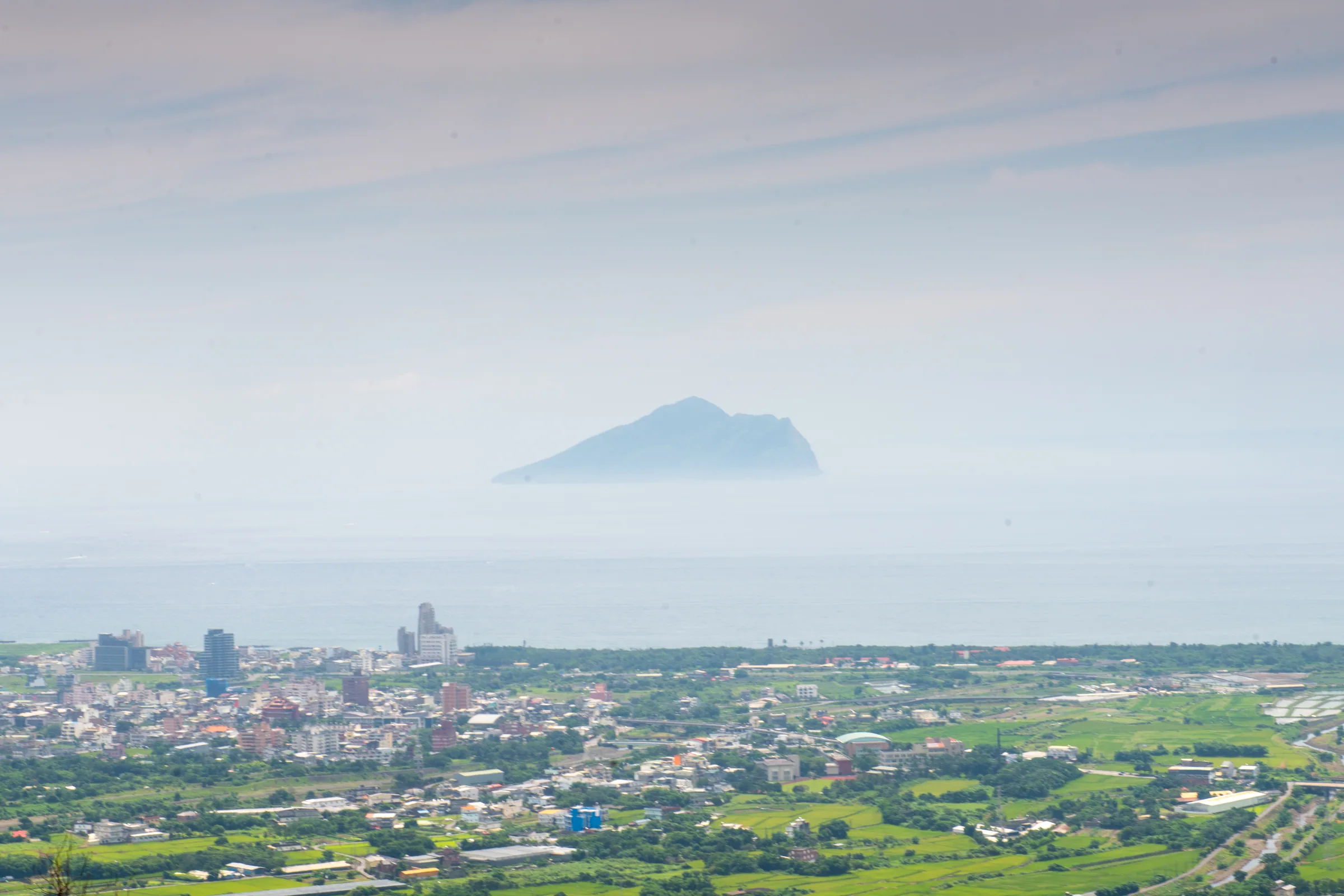
_The Lanyang Plain and Guishan Island, 2019. Photo: 曾成訓 Tseng, CC BY 2.0 via Wikimedia._
The small island floating in the Pacific is Guishan Island. It lies about 10 kilometers from Wushi Harbor in Toucheng, measures 3.1 kilometers east to west and 1.6 kilometers north to south, and covers 2.841 square kilometers11. It remains an active volcano, with at least four recorded eruptions over the past 7,000 years. Hot springs and fumaroles are still active, and its main body consists of andesite lava flows and pyroclastic rocks11.
Before 1977, Guishan Island had residents. In 1977, the Ministry of National Defense closed the island for military purposes, relocating the original 106 households, about 530 people, to “Renze Community” in Daxi Village11. In December 1999, the Executive Yuan announced a partial reopening, and on August 1, 2000, the island formally opened for tourism. Today, daily landings are capped at 1,800 people, or 500 on Wednesdays. It is a genuine example of capacity-controlled ecological tourism in Taiwan.
Seen from the Lanyang Plain, Guishan Island is the one element in the landscape that cannot be changed. The Hsuehshan Tunnel opened, farmhouses were built, Wang Yung-ching came and left, Lin Tzu-miao was elected and reelected, but Guishan Island remains in the same place. Geography preserved for the people of Yilan a coordinate that needs no debate.
The night Chen Ting-nan brought Wang Yung-ching into a CTS studio
In 1981, the 38-year-old Chen Ting-nan was elected the ninth Yilan County magistrate as a dark horse, breaking the Kuomintang’s thirty-year monopoly in Yilan. In 1985, he was reelected with 70% of the vote12. His eight years as county magistrate, from 1981 to 1989, laid the foundation for what would later be called the “Yilan Experience.”
Upon taking office, Chen Ting-nan announced the “three noes” policy: “No red envelopes, no kickbacks, no land speculation”12. Violators’ names were publicly disclosed. Personnel promotion was handled through open recruitment. Personnel Second Offices across departments were abolished and security files destroyed. Portraits of Chiang Kai-shek were removed from public venues. The practice of playing the national anthem in movie theaters was abolished. Memorial events for the February 28 Incident were held. A local government head in 1980s Taiwan carried out each of these measures publicly.
In September 1983, several cement companies in the Su'ao area made the sky “gray all day.” Chen Ting-nan launched the “Blue Sky Plan”: contracted inspectors were stationed at factories around the clock in three shifts, and every violation of emissions standards brought a NT$60,000 fine, imposed repeatedly by the day13. The Chen Ting-nan Education Foundation records it this way: “In September 1983, the ‘Blue Sky Plan’ that he pioneered allowed the Lanyang Plain to ‘restore clear springs and again reveal blue skies,’ earning him the reputation of the ‘Blue Sky Magistrate.’”13
But what truly placed Chen Ting-nan in the history of postwar local politics in Taiwan was the debate of 1987.
On November 6, 1986, Wang Yung-ching announced a plan to establish the Sixth Naphtha Cracker at Yilan’s Lize Industrial Zone14. On April 8, 1987, Chen Ting-nan initially expressed “conditional agreement”; by October 5 of the same year, his position had shifted to “a very firm statement that the county government did not welcome the Sixth Naphtha Cracker plant”14.
On December 13, 1987, Chen Ting-nan and Wang Yung-ching held a public televised debate on CTS News Square, drawing national attention14. The debate was divided into five segments: in the first three, the two men debated directly; in the last two, they responded to audience questions. The Chen Ting-nan Education Foundation records: “To preserve Yilan’s pure land and to be responsible to the ‘450,000 county-citizen bosses,’ Chen Ting-nan decided to reject the Sixth Naphtha Cracker’s entry.”14 Footage of this debate can still be replayed in full on YouTube today15.
October 3, 1988: “Formosa Plastics Group announced that it would abandon the plan to build the Sixth Naphtha Cracker plant in Yilan County’s Lize Industrial Zone.”14 This is the Chen Ting-nan Education Foundation’s sentence verbatim. On December 1, 1990, about 14,000 people took part in the Luodong anti-Sixth Naphtha Cracker march, setting a historical record14. In June 1991, the Executive Yuan formally approved locating the Sixth Naphtha Cracker in the Yunlin Offshore Industrial Park, now the Mailiao Sixth Naphtha Cracker complex.
Chen Ting-nan’s response to Lee Teng-hui in December 1990, quoted verbatim by the Chen Ting-nan Education Foundation, was: “Yilan’s terrain is special. The Northern Region Plan was set by the government itself. If the government does not obey the law, how can it teach the people to obey the law?”14
✦ “To preserve Yilan’s pure land and to be responsible to the ‘450,000 county-citizen bosses,’ Chen Ting-nan decided to reject the Sixth Naphtha Cracker’s entry.” (Chen Ting-nan Education Foundation14)
Wang Yung-ching eventually went to Mailiao, Yunlin, to build the plant. Local politics pushed a capital giant 200 kilometers away. The cost paid by Yunlin is now known to all Taiwanese: the residents south of the Zhuoshui River and the cancer villages. That came later. But on that night in 1987, Yilan made a choice: the Lanyang Plain would not become a petrochemical industrial zone.
12:10 on Taipei’s Xinyi Road, Section 3
This story has another line. It involves the same 1980s and the same group of democracy activists, but the scene is Taipei.
Lin Yi-hsiung was born on August 24, 1941, in Wujie Township, Yilan County. He was a lawyer and a graduate of National Taiwan University’s Department of Law16. In 1977, he was elected to the Taiwan Provincial Assembly as an independent, winning more than 73,000 votes in Yilan County, the highest vote total there, inheriting Kuo Yu-hsin’s base of public support in Yilan16.
On December 13, 1979, Lin Yi-hsiung was arrested by the government for participating in the Kaohsiung Incident and detained at the Jingmei Military Detention Center. During the Kaohsiung Incident military trial, his family home was at No. 16, Lane 31, Section 3, Xinyi Road, Taipei City17.
At around 12:10 noon on February 28, 1980, the Lin family massacre occurred. The location was Lin Yi-hsiung’s Taipei residence at No. 16, Lane 31, Section 3, Xinyi Road, Taipei City17. The physical scene was in Taipei, not Yilan.
Wikipedia records the details of that day verbatim: Lin Yi-hsiung’s mother, You A-mei, age 60, “suffered fourteen stab wounds, six to the front chest, three to the back, one to the right hand, three to the left arm, and one to the neck, and died beside the basement stairs”17. His twin daughters Lin Liang-chun and Lin Ting-chun, age seven, were each stabbed once, with the wounds penetrating from the back through the front chest, and died at the scene17. His eldest daughter Lin Huan-chun, age nine, was stabbed six times, once in the front chest reaching the lung and five times in the back, and miraculously survived because her schoolbag protected her vital areas17.
At the time of the incident, Lin Yi-hsiung was in the Jingmei Military Detention Center awaiting trial. Wikipedia records verbatim: “Because the maximum 25-year statute of limitations for criminal prosecution has already passed, even if the true perpetrator is found, no conviction can be obtained,” and “This case remains unsolved to this day”17.
Lin Yi-hsiung’s home telephone and front door were both under intelligence surveillance, known as the Rainbow Project, yet the killer was still able to enter and leave freely, prompting widespread public suspicion of a “political murder”17. The Control Yuan’s 2023 closing report identified six major failures: the intelligence system led by the Taiwan Garrison Command intervened in the judicial investigation, misdirected it, obstructed inquiries, manipulated the media, shielded suspects, and used organized crime figures.
Lin Yi-hsiung was an opposition movement figure from Yilan, but the physical scene of the massacre was Taipei. What he did in his Yilan homeland was to turn this memory into something else. On March 31, 1991, Lin Yi-hsiung and his wife Fang Su-min jointly founded the Chilin Education Foundation, using family assets18. Lin Yi-hsiung’s former home, his birthplace in Wujie Township, Yilan County, was reused and converted into the Chilin Memorial Hall, which opened in 1994 and was registered as a Yilan County historic building in 200118. Nearby are the Chilin Academy and the Taiwan Democracy Movement Museum.
From 12:10 on February 28, 1980, on Taipei’s Xinyi Road, to the 1994 opening of the new Chilin Hall in Wujie Township, fourteen years passed. Those fourteen years were the time Lin Yi-hsiung needed to turn private trauma into public memory. The massacre did not occur in Yilan, but a person who came from Yilan decided to bring the memory back, and the Lanyang Plain thus accepted this memory.
The day the Hsuehshan Tunnel opened
When Chen Ting-nan left office as county magistrate in 1989, the Hsuehshan Tunnel had not yet begun construction.
The Hsuehshan Tunnel lies between Pinglin District, New Taipei City, and Toucheng Township, Yilan County. At 12.9 kilometers long, it is Taiwan’s longest road tunnel, the second longest in Asia, and the ninth longest in the world19. The pilot tunnel began construction in July 1991; the main tunnel began construction in July 1993; and it opened to traffic on June 16, 2006. The work took fifteen years.
The total budget for the Taipei-Yilan Expressway, National Freeway No. 5 including the Hsuehshan Tunnel, was NT$59.815 billion, or about NT$60.1 billion. The civil engineering portion of the Hsuehshan Tunnel cost more than NT$26 billion, and the construction cost of the tunnel itself was NT$18.555 billion19. ⚠️ “NT$60 billion” is the colloquial figure for the entire Taipei-Yilan Expressway; the single Hsuehshan Tunnel was NT$18.5 billion. Both figures coexist.
Wikipedia’s engineering data records verbatim: “six seismic fault zones, 98 shear zones, and 36 underground springs”19. The westbound tunnel contained a 3,671-meter section of Szeleng sandstone, with strength of 1,200 to 2,785 kg/cm², quartz content of 82%, and Mohs hardness of 6 to 7, harder than reinforcing steel at 5.519. Progress averaged only slightly more than one meter per day, and the Szeleng sandstone section took a total of 3,027 days.
The estimate for groundwater inflow was: “It was estimated that during construction, total groundwater seepage along the entire line would reach 3,000 liters per second, with maximum instantaneous water inflow possibly exceeding 1,000 liters per second”19. Construction workers jokingly called it a “tunnel raised in water.”
Across the National Freeway No. 5 project, 25 construction workers died; the Hsuehshan Tunnel portion accounted for 13 of those deaths19. In Rhythms Monthly’s feature on the Hsuehshan Tunnel, an engineer left this statement verbatim: “We went through 64 earth-shaking collapses in the Hsuehshan Tunnel, 36 eruptions of high-pressure groundwater like mountain torrents, and the deaths of 13 tunnel workers whose ambitions were left unfulfilled.”20 The same engineer said: “As a design and supervision engineer, if you cannot break through the engineering bottleneck, then no matter how many reasons or explanations you have, they cannot change the fate of being scolded.”20
At the opening ceremony on June 16, 2006, then-Premier Su Tseng-chang attended, paid tribute and offered flowers to the families of the 25 engineers and workers who had died, including the 13 from the Hsuehshan Tunnel, as well as to the families of Thai workers who had died, and “specially served as driver, driving former premiers through the tunnel”19. ⚠️ In this round of research, no direct verbatim quotation from Su Tseng-chang at the opening ceremony was found; accounts are multi-source indirect descriptions.

Hsuehshan Tunnel, 2008-06-25. Photo: pacificmorningpost, CC BY 2.0 via Wikimedia.
Travel time before the opening: going one way from Taipei to Yilan via the Northern Cross-Island Highway, Provincial Highway 9, took at least two hours; from Banqiao or during peak periods it could take three hours. The mountain road’s “nine bends and eighteen turns” had poor sightlines and frequent major accidents in earlier years, and supernatural stories circulated for decades21.
Travel time after the opening: the New Taiwan Peace Foundation records verbatim: “The time needed to travel between Taipei and Yilan was shortened to as fast as only 40 minutes. Did you know that before the Hsuehshan Tunnel opened, a one-way trip took at least 2 hours?”21 “Yilan was therefore incorporated into the ‘Greater Taipei living sphere’ and became a backyard for Taipei residents’ holiday leisure.”21
On the day the Hsuehshan Tunnel opened, the Lanyang Plain changed from Taipei’s “eastern backyard” into a “satellite city.” A 43-minute drive compressed Yilan into Taipei’s one-day living sphere21. But behind those 43 minutes were fifteen years of engineering, 25 lives, a NT$60 billion budget, 64 large collapses, and 36 groundwater surges.
6,137 farmhouses: the cost of the first ten years after opening
In the first ten years after the Hsuehshan Tunnel opened, 6,137 farmhouses rose across the Lanyang Plain2. This is a county government statistic obtained by a councilor, not an empty adjective.
After the Agricultural Development Act was amended in 2000, about 7,600 farmhouses were built in Yilan County, causing the loss of about 1,900 hectares of farmland, roughly 7% of Yilan County’s farmland area, and an estimated loss of about 12% of its high-quality farmland2. The latest annual growth statistic for farmhouses: the Lanyang Plain adds about 300 farmhouses every year. Each occupies about 250 ping, or 0.25 hectares, meaning 75 hectares of farmland are lost annually, “equivalent to three Daan Forest Parks”3.
PTS’s Our Island described the scene directly and verbatim: “Large numbers of Taipei people came to Yilan to buy property, purchasing farmland and building farmhouses. Large stretches of farmland disappeared, and luxurious high-end mansions worth tens of millions rose among the fields.”4
Homestays surged at the same time. In 2024, Yilan County had 205 illegal lodging operators, the most in Taiwan; out of 1,596 nationwide, Yilan accounted for about 12.8%22. There were about 2,390 legal homestays, and with illegal ones included, the estimate exceeded 2,595. Illegal operators do not pay business taxes, labor insurance, or fire-safety inspection costs, creating unfair competition against legal operators.
The New Taiwan Peace Foundation records verbatim: “In the more than ten years after opening, it brought not only crowds of people and traffic to Yilan; Yilan’s tourist numbers grew by more than 2.5 times, and restaurants and homestays sprang up like bamboo shoots after rain.”21 Yet during the same period, Yilan’s registered population declined, falling from its 2014 peak of 460,486 to 448,763 in April 202610. Tourists came, locals left.
📝 Curator’s note: A common misunderstanding is that “the Hsuehshan Tunnel brought prosperity, so the cost was worth it.” But when this account is recalculated ten years after opening, what the Lanyang Plain lost was not only farmland. It lost the right to decide its own speed. In 1987, Chen Ting-nan spent eight years accumulating public support to block Wang Yung-ching. After the Hsuehshan Tunnel opened in 2006, it took less than two years to transform the Lanyang Plain. People who bought farmland to build luxury houses did not need to ask local old farmers. They only needed to obtain the title deed to a plot of land. Behind the rise from NT$4,000 to NT$20,000 per ping2 was the old farmers’ gradual loss of decision-making power. The opponent in that 1987 debate was Wang Yung-ching, a visible figure. After 2006, the opponents were anonymous, dispersed buyers who came from Taipei every Thursday to see farmhouse model homes. Chen Ting-nan’s method could not stop this group, because they did not need to debate you in a CTS studio.
In August 2023, a woman named Song Ruo-zhen launched the “One-Ping Landlord Project.” The farmland she had cultivated in an environmentally friendly way for seven years had been put up for sale, so she launched an online crowdfunding effort to buy the farmland23. In the end, 534 landlords purchased 791 ping of land, raising more than NT$15 million, and established a 20-year agricultural cultivation right to ensure that for at least 20 years, the land would grow rice, not houses. A strategy to confront the loss of 1,900 hectares began with 791 ping.

Rice paddies on the Lanyang Plain, 2011. Photo: Bernard Gagnon (Bgag), CC BY-SA 3.0 via Wikimedia.
Not only farmland: logging stopped at Taipingshan, and hotels multiplied in Jiaoxi
The story of the Lanyang Plain cannot be told only through farmland. To understand Yilan’s contemporary landscape, one must push the gaze slightly into the mountains and toward the coast.
Taipingshan was one of Taiwan’s three major logging areas during the Japanese period, alongside Alishan in Chiayi and Basianshan in Taichung24. The Japanese surveyed the area in 1914, and formally began developing Taipingshan forestry in 1915. In 1921, construction began on the Taipingshan Forest Railway, starting from Tuchang and running to Luodong. ⚠️ The end date of Taipingshan forestry must be distinguished: logging formally ended in June 1982; Taipingshan National Forest Recreation Area was formally established in 198924, seven years later.
Cuifeng Lake sits at an elevation of 1,840 meters; during the rainy season, its surface reaches 25 hectares. It is Taiwan’s largest alpine lake and is known as “Taipingshan’s sapphire”24. The Bong Bong Train is a tourist remnant of the Taipingshan Forest Railway. The Maoxing Line from Taipingshan Station to Maoxing Station is its most representative timber-transport rail relic, named after the “bong bong” sound the train makes while running. The Jancing Historic Trail was originally a railway for transporting timber. The trail is 900 meters long and preserves old tracks and workers’ shed remains; in the clouds and mist, one can see a turntable.

Taipingshan sunrise. Photo: Pai-Shih Lee, CC BY 2.0 via Wikimedia.
By the year logging stopped at Taipingshan, the Yilan railway line had been open for 58 years. Construction of the Yilan line began simultaneously from north and south on December 1, 1917; the southern section from Su'ao to Yilan opened in March 1919; the northern Caoling Tunnel, 2,166.52 meters long, was completed in December 1924; and the entire line opened on December 1, 192425. The project cost 12.63 million yen and included 102 bridges and 19 tunnels. During the Japanese period, a railway tied Yilan to Taipei. What the Hsuehshan Tunnel did 82 years later, the railway had already done once in 1924, except that at the time the trip took five hours, later railway improvements brought it down to two hours, and then the Hsuehshan Tunnel cut it to 40 minutes.
Jiaoxi Hot Spring is a neutral sodium bicarbonate spring, with water temperatures around 50–60°C. The water is clear, odorless, and lacks a sulfur smell, earning it the name “beauty spring”26. In Taisho 4, or 1915, the Yilan administration allocated 10,000 yen in public health funds to build a public bathhouse in Yuanshan Park, which began formal operations in December of the same year. This was Jiaoxi’s first public hot spring facility26.
After the Hsuehshan Tunnel opened, visits to Jiaoxi multiplied. Small and medium-sized hotels moved in one after another, and star-rated hotels were also developed in succession, making it northern Taiwan’s most popular hot spring tourism area26. This was the most direct tourism-economy result of that 12.9-kilometer tunnel opened in 2006. The “Yilan” seen by outsiders is mostly that hot spring street in Jiaoxi. The northeast monsoon of local winters and the Lanyang Plain’s 200 rainy days a year cannot be felt by outsiders in the heated lobby of a hotel.
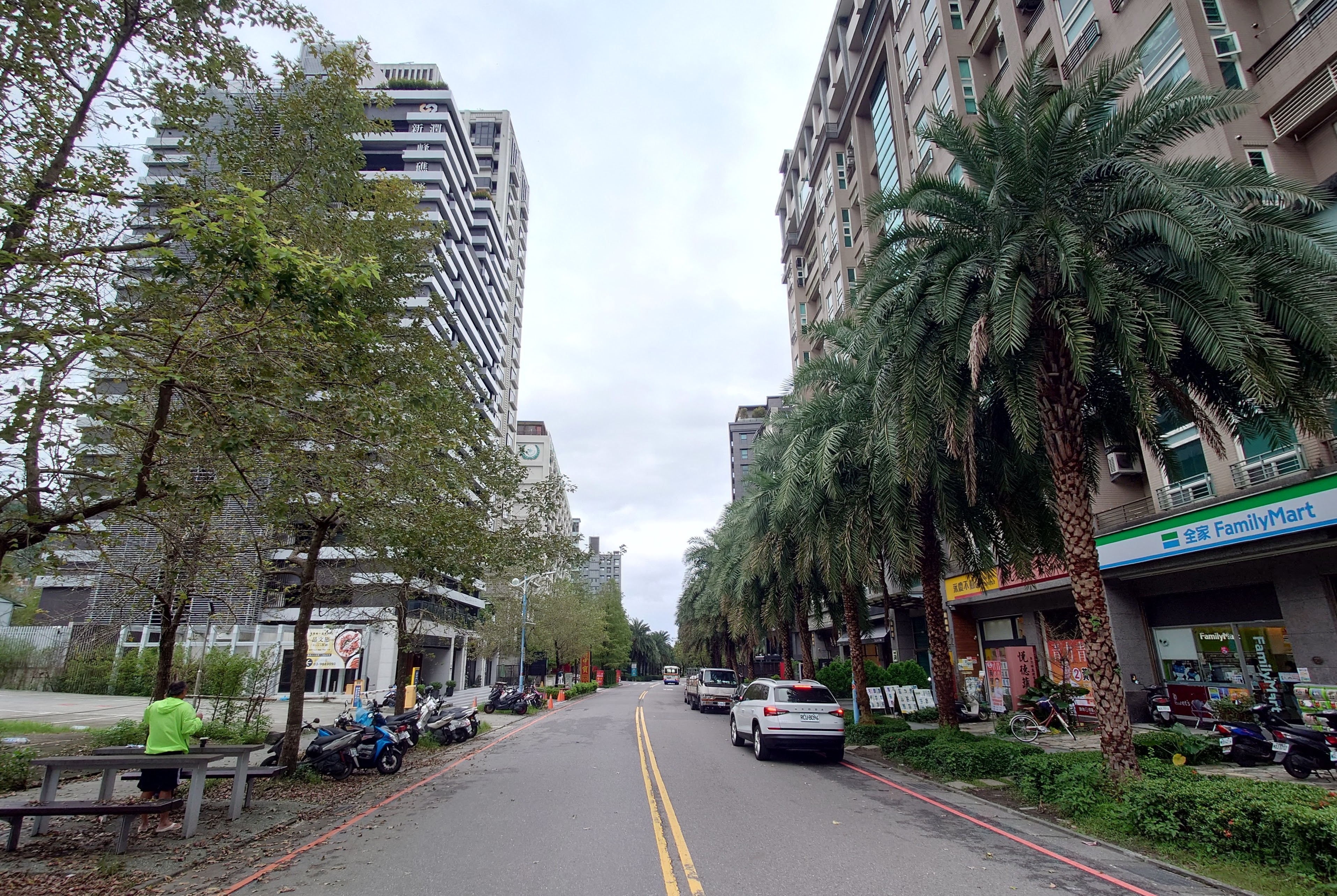
Street view of the Jiaoxi Health Redevelopment Zone, 2022-11-05. Photo: Yu tptw, CC BY-SA 4.0 via Wikimedia.
The story of the Yilan International Children’s Folklore and Folkgame Festival is another side of this. The festival was founded in 1996 by County Magistrate Yu Shyi-kun to commemorate the 200th anniversary of Han Chinese reclamation of Lanyang27. Magistrate Yu announced the plan at the end of 1992 and led a delegation to visit the Festival d’Avignon for inspiration. The first festival in 1996 featured 10 performing groups from 9 countries, tickets cost NT$250, and attendance approached 200,000. It is “the only festival event in Asia invited and certified by the UNESCO A-level organization, the International Council of Organizations of Folklore Festivals and Folk Arts (C.I.O.F.F.)”27. The venue was Dongshan River Water Park, Taiwan’s first spatial structure designed around a waterfront theme. It opened in June 1993 and was formally completed in June 199428.
In 2007, festival attendance was only 325,000, with losses of NT$67 million, the most severe loss since the festival began27. In 2007, the Yilan County Government announced suspension of the festival on the grounds of “declining attendance and serious losses.” On November 24, 2010, County Magistrate Lin Tsung-hsien announced the restoration of the festival after two years of suspension27.

Dongshan River Water Park, 2015-11-14. Photo: Gpdprince, CC BY-SA 4.0 via Wikimedia.
Yilan is also the birthplace of Taiwan’s gezaixi, or Taiwanese opera: “Gezaixi is one of the only traditional Han theatrical forms originating in Taiwan itself,” and its birthplace was beneath the kadam tree, the “great tree deity,” in Jietoufen Village, Yuanshan Township, Yilan County29. In the early Japanese period, around the 1900s, Ou Lai-zhu, known as “Gezaizhu,” of Jietoufen in Yuanshan Township built a shed beneath the great tree deity and taught “local gezaixi” singing. This was the earliest form of gezaixi performance. In 1992, the Yilan County Government established the Lanyang Opera Troupe, Taiwan’s only gezaixi troupe with a public status.
And Huang Chun-ming brought the Lanyang Plain into the core of Taiwanese nativist literature. He was born on February 13, 1935, in Luodong Township, Yilan County30. His first short-story collection, The Sandwich Man, was published in 1969 and adapted into a film of the same name directed by Hou Hsiao-hsien in 1983. The Days of Looking at the Sea and Sayonara, Goodbye were also adapted into films of the same titles. In 1999, The Gong was selected for the fiction category of “Thirty Classics of Taiwanese Literature.” In 1993, Huang Chun-ming returned to Yilan and founded “Jixiang Lane Studio,” working to rescue disappearing local culture through local-language teaching materials, field interviews, and innovative gezaixi writing and directing. That same year, he launched the Huang Da-yu Children’s Theatre Troupe to perform in schools.
In an interview with The Reporter, Huang Chun-ming explained his literary position verbatim: “This is not some kind of literary patent. Many people create from a theoretical foundation; I create from a foundation in life.”31 He also said: “You cannot let theory kill you! Life requires using both your hands and your brain; you cannot use only your brain.”31 These were still the words he was saying in 2023, at age 88.
Evidence that the brand of “democratic holy land” has been worn down
The line of Yilan county magistrates since Chen Ting-nan’s election in 1981 runs as follows: Chen Ting-nan, Democratic Progressive Party, 1981–1989; Yu Shyi-kun, DPP, 1989–1997; Liu Shou-cheng, DPP, 1997–2005; Lu Kuo-hua, Kuomintang, 2005–2009, breaking 24 years of green rule; Lin Tsung-hsien, DPP, 2009–2017, two terms; and Lin Tzu-miao, KMT, 2018–present12.
In 2018, Lin Tzu-miao was elected with about 50% of the vote, becoming Yilan’s first female county magistrate and breaking the DPP’s continuous rule. She was also the Kuomintang county-magistrate candidate with the highest vote total in more than 30 years, 123,767 votes12.
The brand of “democratic holy land” was never Yilan’s legal identity. It was accumulated stroke by stroke: Chen Ting-nan’s vote in 1981, that night in the CTS studio in 1987, the 14,000-person Luodong march in 1990, and the opening of the new Chilin Hall in 1994. But the vote in 2018 proved one thing: what is accumulated can also be worn down.
✦ “Once our generation is too old to keep working, Taiwan’s agriculture will be gone.” (Old farmer Wang De-li, PTS’s Our Island4)
Pull the camera back a little. King Car Kavalan Distillery is located at No. 326, Section 2, Yuanshan Road, Yuanshan Township. It was completed in December 2005, began producing spirits in March 2006, and released its first bottled product in December 2008, Kavalan Classic Single Malt Whisky, Taiwan’s first self-distilled whisky32. Its annual output exceeds 10 million bottles, making it one of the world’s top ten malt whisky distilleries, and it is the world’s most visited whisky distillery, with about 800,000 visitors per year. In 2012, Jim Murray’s Whisky Bible named Kavalan Solist Fino Sherry Cask the “best new whisky of the year”; in 2015, the World Whiskies Awards named Kavalan Solist Vinho Barrique the “world’s best single malt whisky”; and the distillery has accumulated more than 900 international gold medals32.
Kavalan Whisky began producing spirits in 2006, the year the Hsuehshan Tunnel opened, and released its first bottles in December 2008. The same geographic conditions of the Lanyang Plain, a subtropical climate that accelerates maturation, gave Yilan a coordinate on the world whisky map. This is the story on the other side of the Hsuehshan Tunnel: convenient transportation also allowed international visitors to enter, lifting tourist flows in Yuanshan Township.
And when the first Children’s Folklore and Folkgame Festival drew 200,000 visitors in 1996, Yilan did not yet have the Hsuehshan Tunnel. Yu Shyi-kun relied on the Yilan railway line and the Northern Cross-Island Highway to bring people in. After the Hsuehshan Tunnel opened, the festival lost NT$67 million in 2007, but that did not have a direct causal relationship with convenient transportation. The deeper reason was that children’s entertainment options in Taiwan had multiplied. Yet that cultural investment by the Yilan County Government has continued for 28 years.
Conclusion: Guishan Island is still there
Return to that field ridge in Sanxing Township.
Old Mr. Wang De-li points to the outlines of farmhouses in the distance and shakes his head. The water of the Lanyang River is still the same water; the white stalk of the scallion is still the same white stalk; Sanxing Township’s rice-straw scallion cultivation technique remains the same craft1. But he knows that once his generation can no longer work, this field will be left with only the outlines of farmhouses. From the moment in 1987 when Chen Ting-nan blocked Wang Yung-ching to the moment in 2006 when the Hsuehshan Tunnel opened, Yilan made two choices, and the Lanyang Plain accepted the costs together with the gifts.
Looking out from the Lanyang Plain, that island in the Pacific is still there. Guishan Island, an active volcano with at least four recorded eruptions over the past 7,000 years11, closed in 1977, opened in 2000, and capped at 1,800 landings per day. It belongs under no one’s control. Chen Ting-nan could not govern it. Wang Yung-ching would not build a factory there. The Hsuehshan Tunnel engineering crews could not reach that volcanic island 10 kilometers offshore. It is the only landscape of the Lanyang Plain that human choices cannot change.
From Taipei, Yilan is the backyard at the end of the Hsuehshan Tunnel, a 40-minute drive away. From the Lanyang Plain, Yilan is the home the Kavalan people lost in 1796; the land where the Qing established a subprefecture in 1812; the county Shen Baozhen renamed in 1875; the city connected by the full opening of the Yilan railway line in 1924; the homeland from which the 1980 massacre prompted Lin Yi-hsiung to begin again; the stage where Chen Ting-nan sent Wang Yung-ching out of the studio in 1987; the entrance where the Hsuehshan Tunnel cut away two hours in 2006; and the evidence, in 2018, that the brand of “democratic holy land” had been worn down.
From Guishan Island, Yilan is simply the illuminated plain on the shore. Humans made choices, and geography preserved for Yilan a coordinate that needs no debate.
Next time you go to Yilan, do not only go to Jiaoxi hot springs, and do not only see the Children’s Folklore and Folkgame Festival. Try driving to Sanxing Township in late November, and from a field ridge, look at the view where scallion whites and farmhouse silhouettes stand side by side. Then go to the great tree deity in Jietoufen Village, Yuanshan Township, and listen for how gezaixi was born here in the 1900s. Finally, go to the new Chilin Hall in Wujie Township, and see how Lin Yi-hsiung brought memory back to Yilan from Taipei’s Xinyi Road on February 28, 1980. You will remember one thing: Taiwan is an island always making choices, and Yilan has simply made that fact the most public, the most painful, and the most remembered.
Further reading
- Administrative divisions of Taiwan — The administrative history of the 1812 establishment of Kavalan Subprefecture, the 1875 renaming as Yilan County, and the Japanese colonial system after 1895
- Taiwan’s coastal landforms and marine landscapes — The geological context of the volcanic island of Guishan Island, the alluvial fan of the Lanyang River, and the Suhua coastal zone
- Taiwan’s agricultural landscapes and industrial distribution — The position of farmland fragmentation on the Lanyang Plain within Taiwan’s agricultural landscape
- Taiwan’s urban development and urban-rural divide — The satellite-city effect after the Hsuehshan Tunnel incorporated Yilan into Taipei’s one-day living sphere
- Taiwan’s hot spring landscapes — The special position of Jiaoxi Hot Spring within Taiwan’s hot spring geography
- Keelung City — A companion article in the 22 counties and cities series, on a northeastern county-city that, like Yilan, is “invisible to Taipei”
Image sources
This article uses six Wikimedia Commons CC-licensed images. The hero image is Yilan Plain and Gueishan Island 2019 (cropped) by 曾成訓 Tseng, CC BY 2.0, an aerial photograph of the Lanyang Plain and Guishan Island.
The inline scene images, in order, are: June 25, 2008 Hsuehshan Tunnel by pacificmorningpost, CC BY 2.0, Hsuehshan Tunnel entrance; Paddy field, Yilan 01 by Bernard Gagnon / Bgag, CC BY-SA 3.0, rice paddies on the Lanyang Plain; Sunrise over Taipingshan National Forest Recreation Area by Pai-Shih Lee, CC BY 2.0, sunrise over Taipingshan; Jiaoxi 20221105 by Yu tptw, CC BY-SA 4.0, street view of the Jiaoxi Health Redevelopment Zone; and Dongshan River Water Park (Yilan, Taiwan) by Gpdprince, CC BY-SA 4.0, Dongshan River Water Park.
Video material
The full December 13, 1987 CTS News Square broadcast, “Anti-Sixth Naphtha Cracker Debate: Chen Ting-nan Battles Wang Yung-ching,” can be seen in a full replay on YouTube, a primary video source for a classic televised debate in which postwar local politics in Taiwan confronted a capital giant.
References
- Sanxing Scallion Culture Museum — Sanxing District Farmers’ Association, Yilan County — Official industry record of Sanxing Township’s geographic conditions, including the upper Lanyang River, clear water, large day-night temperature difference, and fertile soil; the “rice-straw scallion cultivation technique”; and the 20–25-centimeter standard for scallion whites.↩2
- Ten years of rise and decline after the Hsuehshan Tunnel opening — Liberty Times — Key data on the 6,137 farmhouses that rose on Yilan farmland in the ten years after the Hsuehshan Tunnel opened; the total of 7,600 farmhouses since the amendment of the Agricultural Development Act; the loss of 1,900 hectares of farmland, 7% of farmland; the increase in farmhouse use permits from 231 in 2002 to 720 in 2010; and the rise in farmland prices from NT$4,000 to NT$20,000 per ping.↩23456
- Yilan grows 300 farmhouses every year — Business Today — Latest statistics on the Lanyang Plain adding about 300 farmhouses every year, each occupying about 250 ping; the annual loss of 75 hectares of farmland, equivalent to three Daan Forest Parks; and Yilan’s 201 farmhouse building permits in 2023, nearly one-third of Taiwan’s total of 565.↩2
- Disappearing Yilan farmland — PTS Our Island — Verbatim interview record of old farmer Wang De-li saying, “When old farmers pass away, the land goes to their descendants. If they do not farm, they simply sell the land. If this continues, the countryside will be completely transformed,” and “Once our generation is too old to keep working, Taiwan’s agriculture will be gone,” along with the description of “large numbers of Taipei people coming to Yilan to buy property, purchasing farmland and building farmhouses.”↩234
- History of Yilan County — Wikipedia — Historical account of Wu Sha leading migrants from Zhangzhou, Quanzhou, and Guangdong ashore at Wushi Harbor in Toucheng in 1796, the first year of the Jiaqing reign; and the record that by the time the Qing court incorporated the area in 1810, more than 4,500 jia of cultivable wasteland north of the Lanyang River existed and 2,500 jia had already been fully reclaimed.↩2
- Kavalan people — Wikipedia — The trajectory of population loss, including the Kavalan people’s status as a Plains Indigenous people, their Austronesian Kavalan language, the 1830s southward migration of the Karewan community to Hualien, dispersal after defeat in the 1878 Karewan Incident to Hualien’s east coast, including Xinshe and Lide, and Taitung, including Zhangyuan and Dafengfeng, and the 1896 Japanese count of only 2,903 Kavalan people remaining on the Lanyang Plain.↩23
- Yilan County — Wikipedia — Administrative history of the Qing court’s 1812 approval of Kavalan Subprefecture, with its seat at Wuwei, present-day Yilan City; and Shen Baozhen’s 1875 petition in the first year of the Guangxu reign to establish Taipei Prefecture and rename Kavalan Subprefecture as Yilan County.↩2
- Kavalan name-rectification movement — Council of Indigenous Peoples — The reality of “split recognition”: on December 25, 2002, the Taiwan government officially recognized the Kavalan people as Taiwan’s eleventh Indigenous people after a petition with 1,705 signatures; Kavalan people in Hualien County, about 1,500 registered individuals, enjoy full Indigenous status, while most descendants within Yilan County remain unrecognized.↩2
- Lanyang Plain — Wikipedia — Complete geographic data: the Lanyang Plain’s area of 330 square kilometers; near-equilateral triangular shape with Toucheng, Sanxing, and Su'ao as vertices and sides of about 30 kilometers; formation by alluvial action of the Lanyang, Yilan, and Dongshan rivers; east-opening dustpan terrain; subtropical monsoon climate; annual rainfall of 2,500–3,000 millimeters on the plain and up to 5,500 millimeters in the mountains; and more than 200 rainy days per year.↩23
- Yilan County population statistics — Department of Civil Affairs, Yilan County Government — Official statistics for April 2026 registered population of 448,763; 1 city, 3 urban townships, and 8 rural townships, for a total of 12 municipalities and townships; county area of 2,143.6251 square kilometers; and the plain accounting for only 15% of the county’s area.↩23
- Guishan Island — Wikipedia — Complete data: 10 kilometers from Wushi Harbor in Toucheng; 3.1 kilometers east-west, 1.6 kilometers north-south, and 2.841 square kilometers in area; at least four eruption records over the past 7,000 years; closure by the Ministry of National Defense in 1977, with 106 households and about 530 people relocated to Renze Community in Daxi Village; formal opening to tourism on August 1, 2000; and daily landing cap of 1,800 people, or 500 on Wednesdays.↩234
- Chen Ting-nan — Wikipedia — Election data including Chen Ting-nan’s 1981 election as Yilan County magistrate at age 38, breaking the Kuomintang’s thirty-year monopoly; his 1985 reelection with 70% of the vote; the “no red envelopes, no kickbacks, no land speculation” three-noes policy; the succession of Yilan county magistrates from Chen Ting-nan to Yu Shyi-kun, Liu Shou-cheng, Lu Kuo-hua, Lin Tsung-hsien, and Lin Tzu-miao; and Lin Tzu-miao’s 2018 election with 123,767 votes, breaking the DPP’s continuous rule.↩234
- The origin of Mr. Chen Ting-nan’s “Blue Sky” — Chen Ting-nan Education Foundation — Primary source on the September 1983 Su'ao cement plant pollution incident, the launch of the “Blue Sky Plan,” including contracted inspectors stationed around the clock in three shifts, the foundation’s verbatim phrase “restore clear springs and again reveal blue skies,” and the origin of the title “Blue Sky Magistrate.”↩2
- Yilan Experience — Chen Ting-nan Education Foundation — Complete anti-Sixth Naphtha Cracker chronology: Wang Yung-ching’s November 6, 1986 announcement of plans to locate the Sixth Naphtha Cracker in Yilan’s Lize Industrial Zone; the December 13, 1987 CTS News Square debate; the October 3, 1988 verbatim statement, “Formosa Plastics Group announced that it would abandon the plan to build the Sixth Naphtha Cracker plant in Yilan County’s Lize Industrial Zone”; the December 1, 1990 Luodong march of 14,000 people; the Executive Yuan’s June 1991 approval of the Yunlin Offshore Industrial Park site; and Chen Ting-nan’s verbatim statement to Lee Teng-hui, “Yilan’s terrain is special. The Northern Region Plan was set by the government itself. If the government does not obey the law, how can it teach the people to obey the law?”↩2345678
- Anti-Sixth Naphtha Cracker Debate: Chen Ting-nan Battles Wang Yung-ching, full version — CTS News Square YouTube — Full video replay of the December 13, 1987 CTS News Square anti-Sixth Naphtha Cracker debate, with five debate segments, the first three direct exchanges between the two men and the final two responses to audience questions; a primary video source for a classic televised debate between postwar local politics in Taiwan and a capital giant.↩
- Lin Yi-hsiung — Wikipedia — Complete biographical information: born August 24, 1941, in Wujie Township, Yilan County; lawyer; graduate of National Taiwan University’s Department of Law; elected to the Taiwan Provincial Assembly as an independent in 1977, with the highest vote total in Yilan County of more than 73,000, inheriting Kuo Yu-hsin’s public support base; and arrested and detained at the Jingmei Military Detention Center after the 1979 Kaohsiung Incident.↩2
- Lin family massacre — Wikipedia — Complete verbatim data on the February 28, 1980 incident at around 12:10 noon at No. 16, Lane 31, Section 3, Xinyi Road, Taipei City, Lin Yi-hsiung’s Taipei residence; You A-mei, age 60, sustaining 14 stab wounds, six to the front chest, three to the back, one to the right hand, three to the left arm, and one to the neck; twins Lin Liang-chun and Lin Ting-chun, age 7, each stabbed once through from back to front chest; Lin Huan-chun, age 9, stabbed six times and miraculously surviving because her schoolbag protected vital areas; “This case remains unsolved to this day”; Rainbow Project intelligence surveillance; and the Control Yuan’s 2023 closing report identifying six major failures. ⚠️ The massacre occurred in Taipei, not Yilan; Lin Yi-hsiung’s Yilan origins must be clearly distinguished from the physical scene of the incident.↩234567
- Chilin Education Foundation — Official foundation information: founded by Lin Yi-hsiung and Fang Su-min on March 31, 1991, using family assets; Lin Yi-hsiung’s former home, his birthplace in Wujie Township, Yilan County, converted into the Chilin Memorial Hall, opened in 1994 and registered as a Yilan County historic building in 2001; and the attached Chilin Academy and Taiwan Democracy Movement Museum.↩2
- Hsuehshan Tunnel — Wikipedia — Complete engineering record: total length of 12.9 kilometers, Taiwan’s longest, Asia’s second longest, and the world’s ninth longest; pilot tunnel construction begun in July 1991, main tunnel construction begun in July 1993, and opening on June 16, 2006; total Taipei-Yilan Expressway budget of NT$59.815 billion, with NT$18.555 billion for the Hsuehshan Tunnel itself; verbatim “six seismic fault zones, 98 shear zones, and 36 underground springs”; Szeleng sandstone section of 3,671 meters, strength of 1,200–2,785 kg/cm², quartz content of 82%, Mohs hardness of 6–7, and total duration of 3,027 days; 13 deaths on the Hsuehshan Tunnel; and Su Tseng-chang serving as driver at the opening ceremony.↩234567
- Hsuehshan curse vs. Taiwan spirit — Rhythms Monthly — In-depth feature on the Hsuehshan Tunnel, including the engineer’s verbatim statements: “We went through 64 earth-shaking collapses in the Hsuehshan Tunnel, 36 eruptions of high-pressure groundwater like mountain torrents, and the deaths of 13 tunnel workers whose ambitions were left unfulfilled,” and “As a design and supervision engineer, if you cannot break through the engineering bottleneck, then no matter how many reasons or explanations you have, they cannot change the fate of being scolded.”↩2
- Today in history: National Freeway No. 5 and the Hsuehshan Tunnel officially open — New Taiwan Peace Foundation — Three verbatim evaluations of the tunnel’s impact: “The time needed to travel between Taipei and Yilan was shortened to as fast as only 40 minutes. Did you know that before the Hsuehshan Tunnel opened, a one-way trip took at least 2 hours?”; “Yilan was therefore incorporated into the ‘Greater Taipei living sphere’ and became a backyard for Taipei residents’ holiday leisure”; and “In the more than ten years after opening, it brought not only crowds of people and traffic to Yilan; Yilan’s tourist numbers grew by more than 2.5 times, and restaurants and homestays sprang up like bamboo shoots after rain.”↩2345
- Yilan County spatial plan — Environmental Information Center — Overall statistics on Yilan’s post-Hsuehshan Tunnel tourism and lodging boom, including 205 illegal lodging operators in Yilan County in 2024, the most in Taiwan and 12.8% of the national total of 1,596; about 2,390 legal homestays; and the unfair competition structure in which illegal operators do not pay business taxes, labor insurance, or fire-safety inspection costs.↩
- One-Ping Landlord Project — Yilan Friendly Farming Association — Record of the crowdfunding land-purchase action launched by Song Ruo-zhen in August 2023 after the farmland she had cultivated in an environmentally friendly way for seven years was put up for sale; in the end, 534 landlords bought 791 ping of land, raising more than NT$15 million, with a 20-year agricultural cultivation right set to ensure rice, not houses.↩
- Taipingshan National Forest Recreation Area — Forestry and Nature Conservation Agency — Complete forestry heritage information: one of Taiwan’s three major logging areas, alongside Alishan and Basianshan; Japanese survey in 1914; formal development in 1915; construction of the Taipingshan Forest Railway from Tuchang to Luodong in 1921; formal end of logging in June 1982; formal establishment of the national forest recreation area in 1989; Cuifeng Lake, elevation 1,840 meters, rainy-season area of 25 hectares, Taiwan’s largest alpine lake; the Bong Bong Train’s Maoxing Line; and the 900-meter Jancing Historic Trail.↩23
- Yilan railway line — Wikipedia — Japanese-period railway construction history: simultaneous start of construction from north and south on December 1, 1917; opening of the southern section, Su'ao to Yilan, in March 1919; completion of the northern Caoling Tunnel, 2,166.52 meters, in December 1924; opening of the entire line on December 1, 1924; project cost of 12.63 million yen; and 102 bridges and 19 tunnels.↩
- Jiaoxi Hot Spring — Wikipedia — Hot spring industry history: neutral sodium bicarbonate spring, water temperature of about 50–60°C, no sulfur smell, known as “beauty spring”; in Taisho 4, 1915, the Yilan administration allocated 10,000 yen in public health funds to build a public bathhouse in Yuanshan Park, which formally began operations in December of that year; and after the Hsuehshan Tunnel opened, visitor numbers grew significantly and star-rated hotels were successively developed.↩23
- Yilan International Children’s Folklore and Folkgame Festival — Wikipedia — Complete history: founded in 1996 by County Magistrate Yu Shyi-kun to commemorate the 200th anniversary of Han Chinese reclamation of Lanyang; first festival with 10 performing groups from 9 countries and nearly 200,000 visitors; verbatim “the only festival event in Asia invited and certified by the UNESCO A-level organization, the International Council of Organizations of Folklore Festivals and Folk Arts (C.I.O.F.F.)”; 2007 losses of NT$67 million with attendance of 325,000; suspension from 2007 to 2009; and County Magistrate Lin Tsung-hsien’s November 24, 2010 announcement of revival.↩234
- Dongshan River Water Park — Yilan County Government — Official record of Taiwan’s first spatial structure designed around a waterfront theme; opening in June 1993; formal completion in June 1994; integration of water recreation, folk arts, and international exchange; and role as the main venue of the Children’s Folklore and Folkgame Festival.↩
- Gezaixi — Wikipedia — Theater history: verbatim “Gezaixi is one of the only traditional Han theatrical forms originating in Taiwan itself”; birthplace beneath the kadam tree, the great tree deity, in Jietoufen Village, Yuanshan Township, Yilan County; in the early Japanese period, around the 1900s, Ou Lai-zhu, “Gezaizhu,” building a shed beneath the great tree deity to teach “local gezaixi”; and the Yilan County Government’s 1992 establishment of the Lanyang Opera Troupe, Taiwan’s only publicly affiliated gezaixi troupe.↩
- Huang Chun-ming — Wikipedia — Information on the representative figure of Taiwanese nativist literature: born February 13, 1935, in Luodong Township, Yilan County; publication of the first short-story collection The Sandwich Man in 1969, adapted into a film by Hou Hsiao-hsien in 1983; film adaptations of The Days of Looking at the Sea and Sayonara, Goodbye; selection of The Gong for “Thirty Classics of Taiwanese Literature” in 1999; and his 1993 return to Yilan to found Jixiang Lane Studio and launch the Huang Da-yu Children’s Theatre Troupe.↩
- Huang Chun-ming: Do not lose your own things in your own place — The Reporter — Firsthand interview quotations from Huang Chun-ming: “This is not some kind of literary patent. Many people create from a theoretical foundation; I create from a foundation in life”; “You cannot let theory kill you! Life requires using both your hands and your brain; you cannot use only your brain”; and “Dissertations are written by educated people for educated people. Educated people simply do not have life. No one says they are moved after reading a dissertation. Novels are for ordinary people, and they are real life.”↩2
- Kavalan Distillery — King Car Kavalan Whisky Distillery — Official distillery information: No. 326, Section 2, Yuanshan Road, Yuanshan Township, Yilan County; completion in December 2005; production of spirits beginning in March 2006; release of Kavalan Classic Single Malt Whisky in December 2008, Taiwan’s first self-distilled whisky; annual output exceeding 10 million bottles, among the world’s top ten malt whisky distilleries; about 800,000 annual visitors, the world’s most visited whisky distillery; Jim Murray’s Whisky Bible naming the 2012 Kavalan Solist Fino Sherry Cask “best new whisky of the year”; 2015 World Whiskies Awards recognition as “world’s best single malt whisky”; and more than 900 international gold medals.↩2