
30-second overview: In 1626, the Spaniards built Fort San Salvador on Heping Island. In 1875, Shen Baozhen renamed "Keelung" (Chicken Coop) to "Keelung" (Base of Prosperity). In 1884, French forces occupied the city for eight months during the Sino-French War. In 1984, this port ranked as the world's seventh-largest container port. Then three things happened at once: Kaohsiung's container terminal opened in the 1960s, Taoyuan Airport replaced the passenger gateway in 1979, and the Jinguashi mining economy collapsed in the 1980s. Today 360,000 people live here, 39% commute to work in Taipei, and the vacancy rate is 26%. But at 4 a.m., the Kanzaiteng fish market is still alive with the sound of auctions, and the black kite population has grown from 272 in 2013 back to 800. What this article wants to say is: Keelung is Taipei's home port.
4 a.m., Kanzaiteng
If you ask a person from Keelung "when is Keelung most charming," they won't tell you the nights at Miaokou (Miaokou nights are for tourists). They'll tell you 4 a.m. at Kanzaiteng.
The Kanzaiteng fish market sits on Xiao 1st Road, along the stretch where the Xuchuan River flows. "Kan" means stone steps in Hokkien, because fishermen used to have to carry their catch up stone staircases to the street — that's how the market got its name. Every day from 2 a.m. to 6 a.m. is its busiest period: a night-only, Taiwanese version of Tsukiji, the largest fish trade market in northern Taiwan1.
The auctioneer (tiau-siu) is the soul of this market. They stand on wooden crates, chanting numbers for each fish in rapid Hokkien. Wholesalers form a circle around them — hand gestures, eye contact, a furrowed brow, a nod — and within seconds a crate of fish moves from fishing boats in Hualien, Yilan, and Badouzi to stalls in Taipei, New Taipei, and Taoyuan. Before dawn, the tuna destined for a Japanese restaurant in Taipei's Eastern District is already on its way.
This is the most contemporary evidence of Keelung as a port. The glory of being the world's seventh-largest container port in 1984 is in the past, but the logistics node that transforms ocean labor into the capital's dinner table still operates every day. While the capital is still asleep, Keelung has already started working for the capital.
Four Hundred Years Ago, the Spaniards Planted a Flag on Heping Island
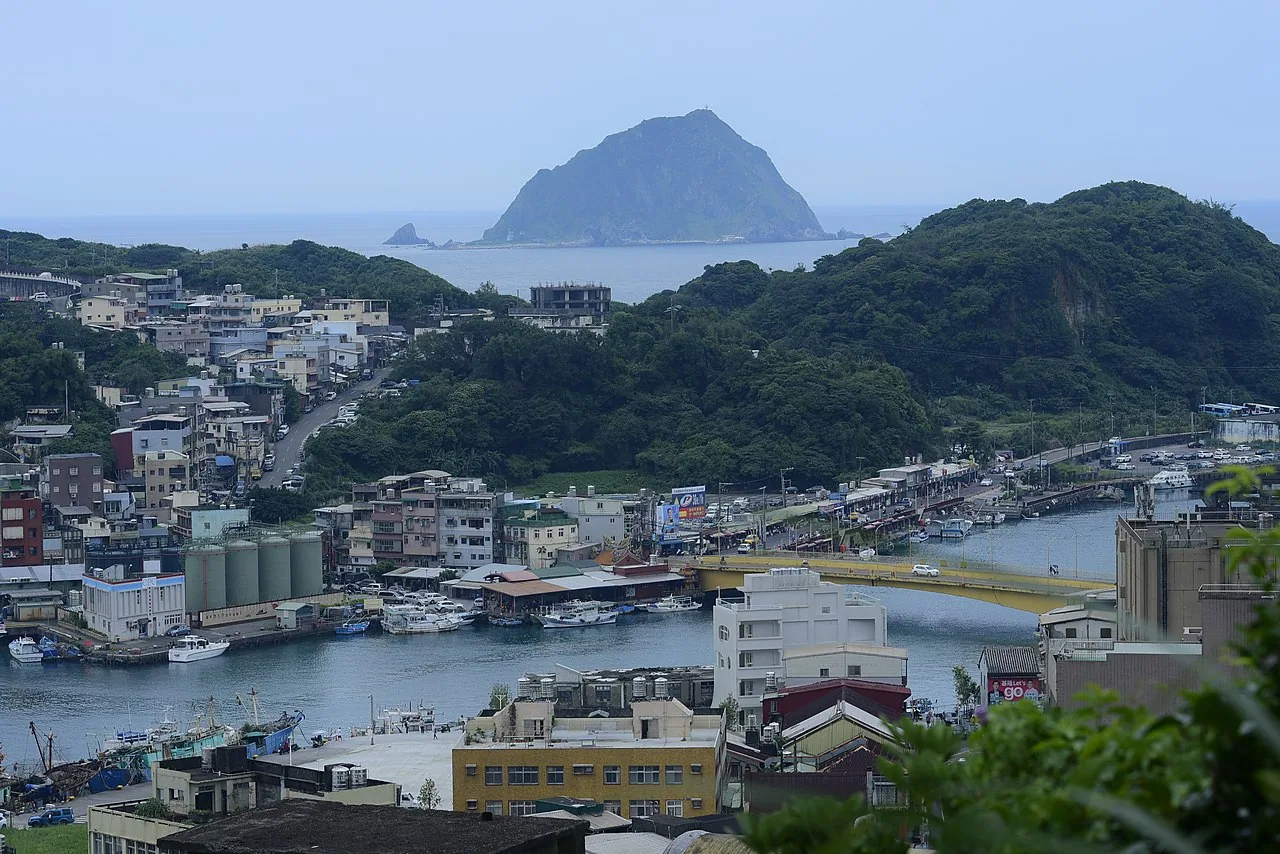
Heping Island, only 75 meters from the Taiwan mainland, was called "Sheliao Island" in the Spanish era. Before that, it was a settlement of the Ketagalan Basay people, called "tuman" in the Basay language2.
On May 5, 1626, a Spanish fleet sailed north from Manila, Philippines, occupied Sheliao Island, and built Fort San Salvador on the island, standing in distant opposition to the Dutch Fort Zeelandia in Tainan3. This was a proxy war between world empires — a contest over North Asian shipping routes in the Age of Exploration, with Taiwan as a buffer between two European maritime powers.
The Spaniards stayed on this island for 16 years. In 1642, the Dutch East India Company launched the Battle of Keelung. Outnumbered, the Spaniards held out for only six days before surrendering4. The Dutch renamed the fort Fort Noord Holland, scaled down its operations, and continued controlling northern Taiwan. But the Dutch didn't stay long either. In 1668, due to indigenous harassment and disappointing trade with the Qing, they also withdrew.
📝 Curator's note: Taiwanese history textbooks often compress the "Spanish era" into a single line: "1626–1642, Spain occupied northern Taiwan." But these 16 years left behind a piece of evidence buried in the earth for 400 years: the ruins of the Church of All Saints at Fort San Salvador. Starting in 2011, NTU Institute of Anthropology director臧振華 (Zang Zhenhua) collaborated with Spanish scholars on trial excavations. In 2016, they uncovered a corner of the Church of All Saints and four burials. In 2019, the NTU team continued the excavation5. The interior of the church covers more than 200 square meters, with a total footprint exceeding 350 square meters. Twenty-one sets of remains were unearthed, including Europeans (believed to be missionaries who came to Taiwan at the time) and indigenous Pingpu children in urn burials. The archaeological team summarized the significance of this site in one sentence: "The Heping Island archaeological site is the only evidence left behind by Spanish colonization in Taiwan."6 Taiwan's 400 years of global connection are physically buried in the soil of this island, 75 meters from the mainland.
"Base of Prosperity": The Year Shen Baozhen Renamed It
In 1875 (the first year of the Guangxu reign, Qing dynasty), Shen Baozhen submitted a memorial establishing "Taipei Prefecture." In his report, he changed the name from "Keelung" (Chicken Coop) to "Keelung" (Base of Prosperity), using near-homophones in Mandarin to replace it with an auspicious meaning7. On January 16 of the following year (the 20th day of the 12th month of the first year of Guangxu), the administrative redistricting was announced: Keelung Subprefecture became Keelung Hall.
This renaming was part of the Qing court's administrative reforms in Taiwan. From Shen Baozhen's perspective, Keelung was Taipei's maritime gateway. To strengthen northern Taiwan's strategic value to the Qing court, one had to start with this port. "Chicken Coop" was too rustic; "Keelung" sounded like a proper city.
Zhangzhou immigrants had arrived earlier. In the 12th year of the Tongzhi reign (1873), Lin Benyuan, a wealthy Zhangzhou-native magnate from Banqiao, donated land, and construction of Dianji Temple began. It was completed in the first year of the Guangxu reign (1875), dedicated to Kaijun Saint-King Chen Yuanguang, serving as the spiritual center for Keelung's Zhangzhou immigrants8. Today, the "temple" in "Miaokou Night Market" refers to Dianji Temple, but 150 years ago it was first an immigrant clan temple, later surrounded by the night market.
August 1884: The French Army Arrived
Only ten years after Shen Baozhen's renaming, Keelung faced a war.
On the evening of August 3, 1884, the French fleet arrived off the coast of Keelung. On the morning of August 5, the French opened fire. Liu Mingchuan commanded the defense, and his officers attacked from both sides. The Battle of Keelung during the Sino-French War lasted nearly a year9.
The French occupied Keelung for eight months, but they soon found themselves trapped in this rain port. Cholera and typhus broke out starting in November 1884. By December 23, 83 French soldiers had died of disease. On December 1, only 1,100 French troops were still fit for duty — half the number from two months earlier. Tropical diseases were more lethal than Liu Mingchuan's forces10. On June 9, 1885, the Sino-French New Treaty was signed, and the French withdrew. The war claimed the lives of more than 700 French soldiers.
What did they leave behind? Besides the French military cemetery on the waterfront (the National Martyrs' Cemetery), they left a question that Keelungers would later have to decide how to handle: what to do with the more than 700 unburied French war dead?
The Mid-Autumn Festival of Zhangtou and Xuwei
The way Keelung residents dealt with the dead must be traced back even further.
In August 1851 (the first year of Xianfeng), conflicts between the Zhang and Quanzhou communities continued. In 1853, a large-scale fight occurred in Qanding (now Nanrong Cemetery), resulting in over a hundred casualties. Elders and leaders from the Zhang and Quanzhou communities intervened to mediate, naming the remains of those who died in the conflict as "Old Masters" ($\text{Lao Da Gong}$), burying them together for worship, and establishing the "Old Master Temple."
The result of this negotiation was: the rotation of ritual leadership based on surnames, replacing the concept of ancestral place of origin with kinship ties11. It officially began in 1855 (the fifth year of Xianfeng), with the order of the eleven surnames determined by lot, running from Zhang ($\text{Zhangtou}$) to Xu ($\text{Xuwei}$): Zhang, Liao, Jian, Wu, Liu, Tangdu, Chen, Huyao, Xie, Lin, Jiang, Zheng, He, Lanhan, Lai, and Xu.
✦ "To replace the bloodshed of factional fights with a competition of ceremonial arrays, in order to achieve a great harmony and coexistence." (National Cultural Memory Bank, Ji-long Mid-Autumn Festival Ritual Text12)
This is the core spirit of the Ji-long Mid-Autumn Festival. It is not merely a general ghost appeasement ceremony ($\text{Zhongyuan Pudu}$). While all of Taiwan holds ceremonies for unclaimed wandering souls during the Mid-Autumn Festival, only the Ji-long Mid-Autumn Festival institutionalized the memory of a factional fight into a surname rotation ritual that has continued for 170 years. The array competition is a ritualized version of the fighting: you still compete, but without violence, by showcasing which group has the grander display using elaborately decorated deities, formations, and drumming.
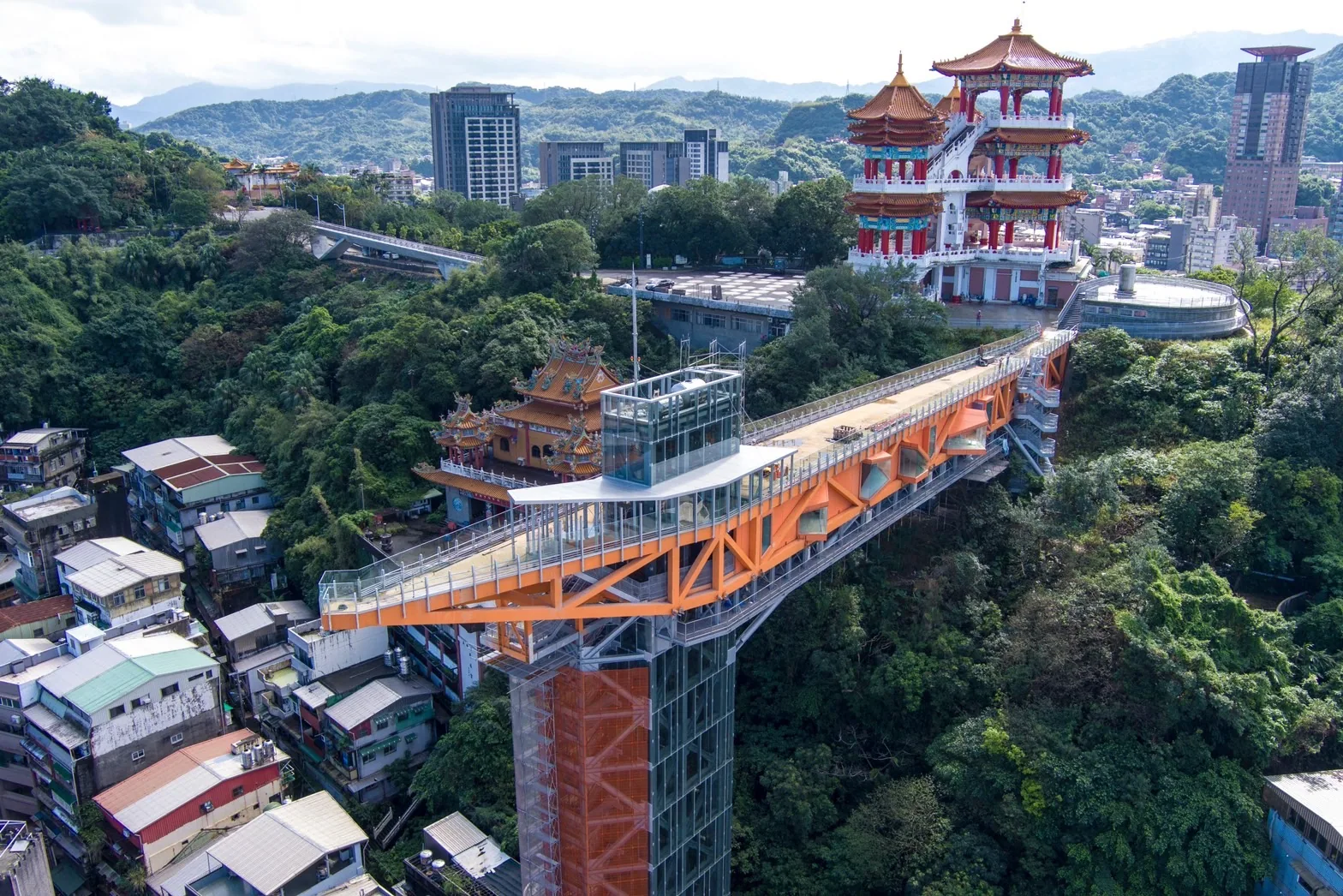
The main altar and the Keelung Tower, 2023-10-23. Photo: Wikimedia Commons contributor, CC BY-SA via Wikimedia.
After the Sino-French War in 1884, this set of ceremonies was elevated again. The souls of those over 700 French soldiers were incorporated into the appeasement. "Compassionate Han immigrants initiated empathy to worship these unburied departed."12 A reconciliation ritual from a Zhang-Quanzhou factional fight evolved into a ceremony that even accommodated enemy soldiers from wars. From 1855 to today, it is held annually in the main altar at Zhongzheng Park during the lunar July. The new main altar, an octagonal tower completed in the mid-1970s, has a museum of Mid-Autumn Festival artifacts on the first floor13.
Five Phases of Port Construction, the World's Seventh-Largest Port in 1984
After the Japanese arrived, Keelung's fate was completely transformed.
From 1899 to 1935, the Japanese colonial period's port construction project ran five phases, more intensive than all Qing-era development combined14. Phase 1 (1899–1906) involved initial port consolidation and basic equipment. Phase 2 (1906–1912) expanded the inner harbor, with total vessel arrivals and departures reaching 42% of all of Taiwan. Phase 3 (1912–1929) deepened the docks, built warehouses, and added cranes, with total trade volume reaching more than half of all of Taiwan. Phase 4 (1929–1935) extended the port from the inner harbor outward. Phase 5 continued up to the prewar period15.
In 1916, Keelung Port's trade volume surpassed Tamsui Port and at one point also overtook Kaohsiung Port, becoming Taiwan's most important commercial port. It was upgraded to "city" status in 1924 and became the third-largest city in Taiwan in 1930, after Taipei and Tainan16. The West 2nd Pier Warehouse, still standing by the harbor today, was built in 1932, and the West 3rd Pier Warehouse in 1934 — the upper level for passenger facilities, the lower level for cargo. The Japanese built this port on two levels because they knew goods would move, and so would people.
In the early postwar period, Keelung continued to lead. Coal mining peaked in 1968, and the entire Keelung area, along with Ruifang, Jiufen, and Jinguashi, was the core region of Taiwan's economic engine.
Then came 1984.
"In 1984, (Keelung Port) rose to become the world's 7th largest container port."17 This was the historical peak of Keelung as a port. A small port receiving 3,000 mm of rainfall was once the seventh node in the global shipping network.
Then Three Things Happened at Once
Starting in the late 1960s, Kaohsiung Port, leveraging its vast hinterland and container terminal expansion, overtook Keelung Port — constrained by its limited hinterland — beginning in 196918. In 1979, Taoyuan Chiang Kai-shek International Airport opened, and Taiwan's passenger gateway shifted from Keelung Port to Taoyuan. No one came to Taiwan by ship anymore. In the 1980s, the mining economy of Jinguashi, Jiufen, and Ruifang collapsed, and Keelung Port's largest hinterland industry vanished.
Three things happened at once, and Keelung Port fell from seventh in the world to 113th in the world and the 4th largest commercial port in Taiwan in 201819. "From 2.09 million TEU in 2005, it declined to 1.45 million TEU in 2015, a reduction of 30%" (The Reporter, "130 Years of Keelung Port Construction"17).
✦ "The port industry is Keelung's locomotive industry — when it moves, there is boundless vitality; once it stops, it is as listless as it is now." (The Reporter, quoting a Keelung port worker17)
The Fuzhou Pot-Border Porridge of Miaokou, the Mung Bean Pastry of 1882
People from Keelung don't really believe in the "decline" narrative. Ask them, and they'll counter: "Have you tried the鼎邊銼 (ding-bian-cuo) at Miaokou?"
The stall of century-old Wu Family Ding-Bian-Cuo is numbered 27-2, to the left of Dianji Temple. Established in 1919, it has been passed down through three generations20. Founder Wu Tianfu (1903–1986) was especially famous for his meat geng (thick soup), earning the nickname "Meat Geng Shun." In the 1960s, the Wu family took over the neighboring Fuzhou stall and incorporated Keelung's seafood ingredients into the ding-bian-cuo (the name "ding-bian-cuo" itself is a Fuzhou snack; "da ding" in the Eastern Fujian dialect means "big pot").
This bowl of something that looks like flat rice noodles compresses three layers of history into a single bowl: the pot-border cooking method brought by Fuzhou people + Keelung's seafood ingredients + the market integration of Miaokou stalls in the 1960s, ultimately becoming a dish that "only Keelung can make."
A few steps away is Li Ku Pastry. No. 90, Ren 3rd Road, Ren'ai District, opened in the 8th year of the Guangxu reign (1882), and by 2026 it has been in business for over 140 years21. The first-generation founder Li Yuanxiang made mung bean pastries; the second-generation Li Xianwen made curry puffs; the third-generation Li Zongzong improved the pineapple cake. In an interview, he recounted his grandfather's explanation of the shop's name: "The 'ku' is a type of bird that flies high and far."22 A port in decline somehow opened a pastry shop that has lasted longer than the entire history of the Republic of China in Taiwan.
And the Kanzaiteng fish market (mentioned earlier) is actually the true engine of Miaokou Night Market. Without Kanzaiteng's midnight fish auctions, the tempura at Miaokou (what Keelungers call tempura is actually tianbula — fish cake — completely different from Japanese tempura), bubble ice, braised eel, and shrimp geng couldn't be made at all. Keelung's food culture is "harbor flavor": the auction sounds at 4 a.m. become the umami that tourists chew in their mouths at 6 p.m.
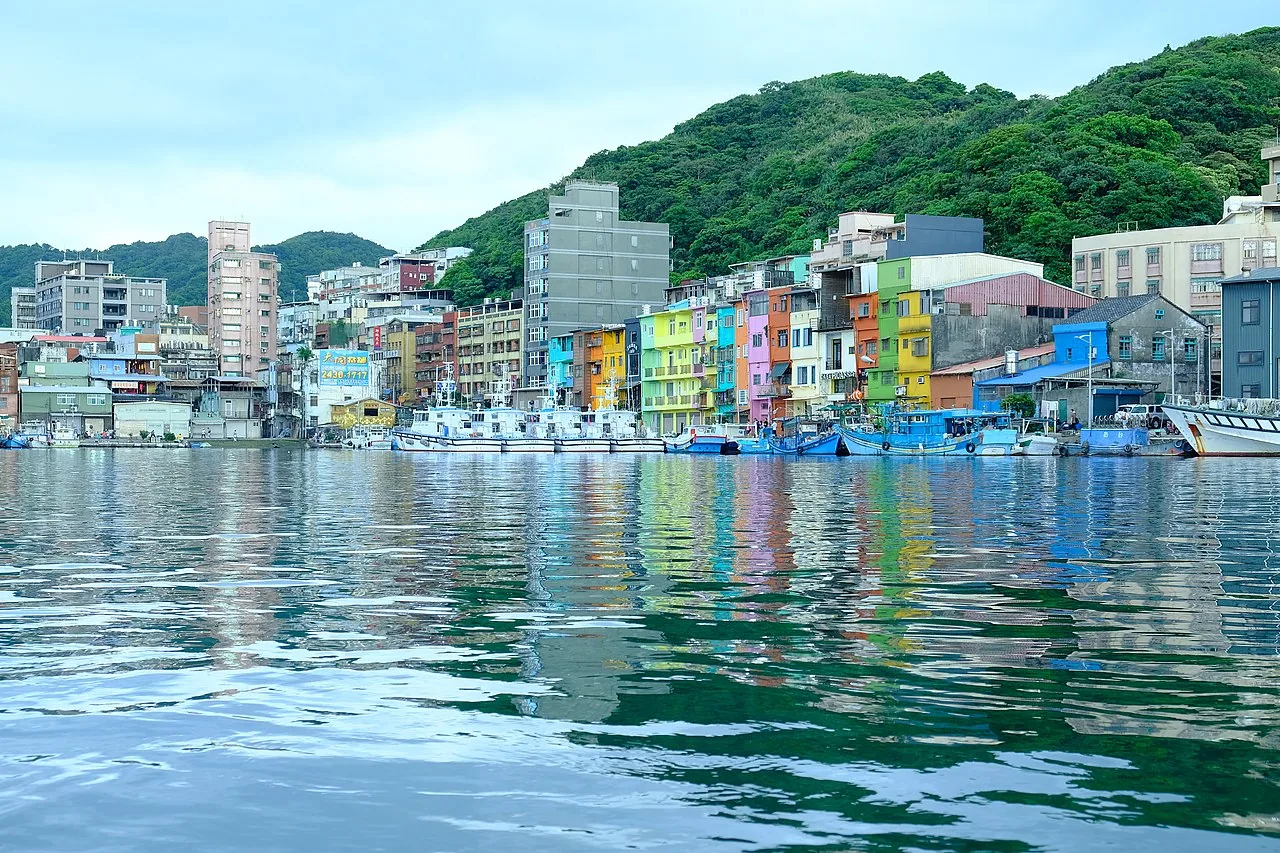
Across from the Colorful Houses of Zhengbin are the Ruins of Argenna
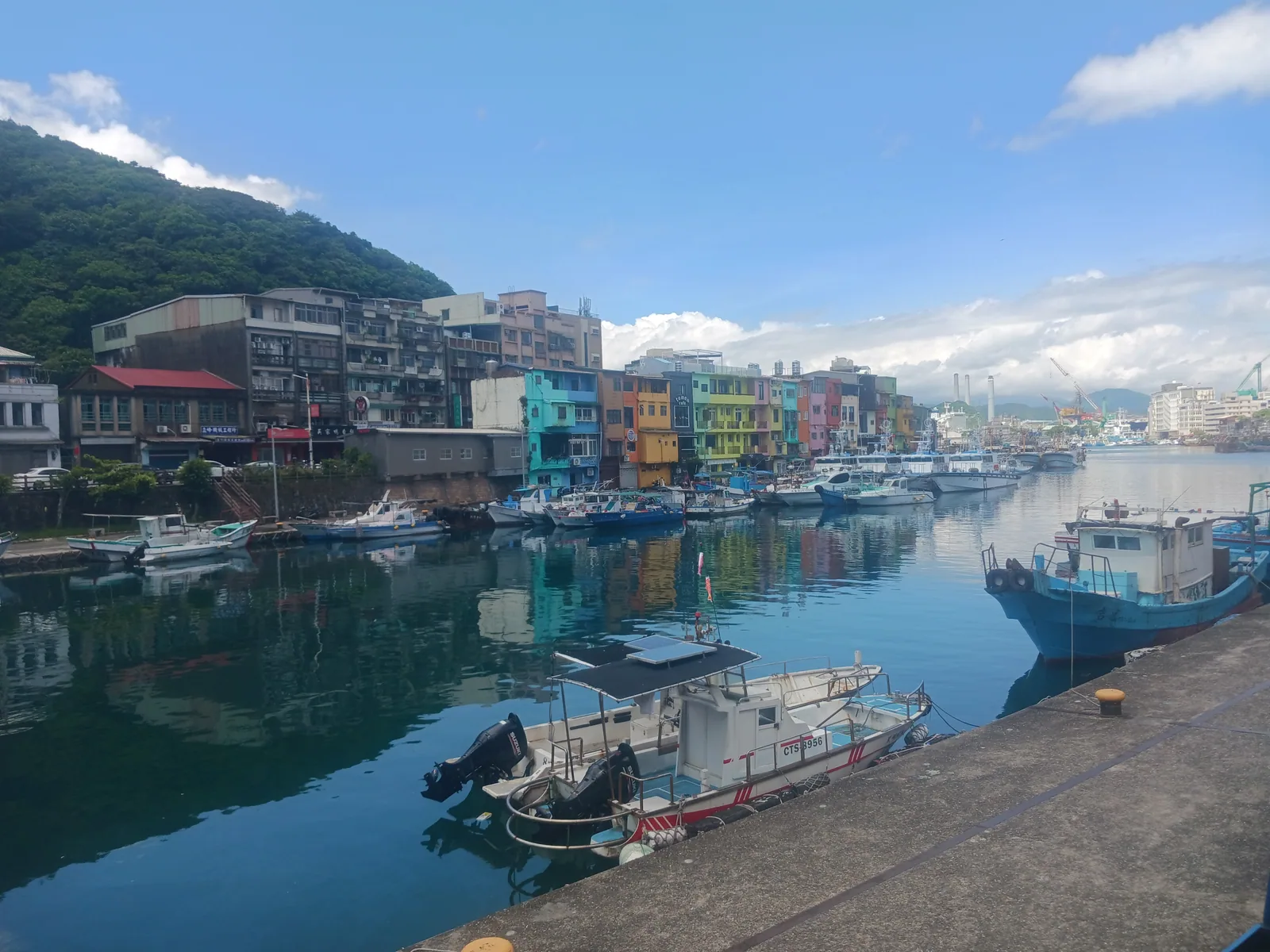
Colorful houses of Zhengbin Fishing Port, August 12, 2025. Photo: Saimmx, CC0 via Wikimedia.
If you want to see how a city deals with its ruins, go to Zhengbin Fishing Port.
Zhengbin Fishing Port is on the east side of Keelung Harbor and was a major fishing port in northern Taiwan during the Japanese colonial period. During Mayor Lin Yu-chang's tenure (2014–2022), he collaborated with Professor Kuo Ch'ing-ying from the Department of Landscape Architecture at National Taiwan University, "after two years of working with local residents to awaken public participation awareness," painting the old houses along the harbor into colorful houses. Locals dubbed the 55 colors as "Zhengbin Colors" 23. Today, it is a popular spot for Instagram check-ins, but this is not its most moving aspect.
The most moving aspect is: turn around, and you see the ruins of Argenna Shipyard directly opposite.
Argenna has a history like this: in 1919, it was a coal storage facility operated by Huang Tung-mao; in 1937, it was converted into a pier for transporting sand. Gold mined from Kinguin Mining was first transported via cableway to Shuinan Cave, then to Badu, and finally to Niu-chou Port, from where ships were loaded and sent to Japan 24. From 1966 to 1987, it became the Argenna Shipyard, operated by Xue Kuo-hang, which manufactured sailboats and yachts, making it a pioneer of Taiwan's sailing movement. It went bankrupt and was abandoned in 1987. In July 2016, it was registered as a historical building of Keelung City.
Next to the gray-black cement ruins are the colorful houses of Zhengbin. One dark, one bright; less than 100 meters apart. This is two sides of Keelung's modernization process, compressed within the view of a tourist taking a photo with their phone. From this scene, one can read an entire contemporary narrative of Keelung: we are not demolishing the ruins and rebuilding; we are building colorful houses next to the ruins.
Lin Yu-chang, Hsieh Kuo-liang, and the Recall Vote
Lin Yu-chang's transformation can be summarized in one sentence: "The most important thing is that this city must have an issue to re-unify citizens' identity and cohesion, and gain a voice regarding this harbor for Keelung City." 17 His work included: preventing the demolition of West 2 and West 3 piers warehouses in 2014 (supported by Minister Lung Ying-tai’s site inspection and designated as a historical building by the Bureau of Culture); the "International Night" exhibition area at Zhengbin Fishing Port in 2021; the "Design Changing Starting Point City: Keelung" city expo in 2022; changing the city logo, with the new version interpreting it in five colors: green representing a mountain city, yellow symbolizing vitality, black because Keelung was historically rich in coal mining, red representing passion, and blue representing Keelung Harbor and the ocean 25.
In 2022, Hsieh Kuo-liang (Kuomintang) was elected mayor. Two years later, on October 13, 2024, the people of Keelung held a recall vote. The dissenting votes were 86,014 (55.16%), and the agreeing votes were 69,934 (44.84%), with a voter turnout of 50.44% 26. The recall failed, and Hsieh Kuo-liang retained his mayoral position, which legally prevents him from being recalled again. Keelung is the second local elected official to face a recall proposal after Kaohsiung's Han Kuo-yu, and it is the first of a secondary administrative district to do so.
The recall was not the focus of this article. The focus is why the people of Keelung went to vote in that election. Li Yan-rong, a young person who returned to her hometown, said in an interview with reporters: "My hometown is Keelung; I did not lose my sense of belonging just because I drifted away to another place." She tattooed the latitude and longitude of Keelung on herself and explained: "I want to remember what it was like when I left." 27
This is a small city of 360,000 people. But among these 360,000 people, some came back to vote.
39% of People Work in Taipei
In April 2026, Keelung's population was 359,102, having fallen below 360,00028.
Cross-county commuting rate: highest in the nation at 39.2%17. Vacancy rate: 26%. The Reporter's "130 Years of Keelung Port Construction" wrote it plainly: "Keelung claims two national number-ones: a cross-county commuting rate of 39.2% for those aged 15 and over, and a vacancy rate of 26%"17. From another The Reporter article on the recall vote, the most common sentiment from citizens interviewed was exhaustion: "It doesn't matter who's in charge" (village chief Dai Xueli, recall coverage)27.
In 2025, the Keelung City Government raised the childbirth subsidy from NT$20,000 to NT$30,000, but "compared to Taipei and New Taipei, it is still insufficient." Keelung has no MRT. The Keelung terminal of Kuo-Kuang Bus operates 24 hours a day, the most physical link between this city and the capital.
The deeper number is this: "People have very little confidence in this city — it feels a bit embarrassing to say you're from Keelung."17 This quote comes from a Keelung resident interviewed in The Reporter's "130 Years of Keelung Port Construction." A port that was seventh in the world in 1984, and in 2026 its residents "feel a bit embarrassed to say they're from Keelung." This gap falls on every one of the 39% of Keelungers who commute across county lines.
But if you actually talk to people from Keelung, you'll find they don't really believe this narrative themselves. They know Taipei doesn't see them, but they don't particularly need Taipei to see them. They have the auction sounds at Kanzaiteng in the middle of the night, the surreal landscape of Argenna and the colorful houses side by side, the clan-rotation Ghost Festival that has continued since 1885, and the mung bean pastry shop from 1882. These things don't need Taipei's validation.
📝 Curator's note: The prevailing online narrative is "Keelung has declined." But this narrative reverses cause and effect. The real reason for Keelung's decline is that after Taiwan's modernization power center shifted to the Taipei-Taoyuan-Hsinchu corridor, all the logistics that once passed through Keelung (international passenger shipping, mining, containers) were redirected to other nodes. The decline of Keelung Port is a side effect of the nation's development path, unrelated to efforts within the city. The word "decline" places Keelung in a coordinate system measured against Taipei. But from the ocean's perspective, Keelung has never left its position. It has always been the port closest to Taipei. The question was never about Keelung — it was about whether Taipei could see.
At 4 a.m., the Black Kites Are Waiting
Return to the opening scene.
At 4 a.m. at Kanzaiteng, the auctioneer's chanting, the fishermen's footsteps carrying crates, the sound of rain on canvas canopies — all mixed together under the orange glow of auction lights. Wholesalers, restaurant buyers, fishermen, delivery drivers — everyone is in motion.
Two kilometers away, at the mouth of the Xuchuan River flowing into Keelung Port, black kites circle.
The black kite is Keelung's city bird. In 2013, only 272 remained across all of Taiwan. By 2023, the number had recovered to 80829. Their food source is this fish market and the adjacent produce market: "processed poultry and fish scraps, offal, discharged through the sewer from the Xuchuan River mouth into the harbor area."29 A declining port city has, paradoxically, given raptors a space to survive. When humans feel forgotten, the black kites have found food here.
Xie Bingying wrote in Rain Port Keelung: "When everyone on shore is being drenched by the rain and can barely lift their heads, when everyone is cursing the heavens for their cruelty, I am secretly delighted."30 Keelungers' view of rain is different from outsiders'. Outsiders see rain as a nuisance; Keelungers see rain as part of their body. Taiwan Panorama quoted a Keelunger: "For old Keelungers, no matter the weather, they always carry an umbrella when they go out."31 The editor of Keelung For A Walk put it even more precisely: Keelungers describe an overcast day by saying, "Today is good weather."32
This city's relationship with the capital depends on where you're looking from. From Taipei, Keelung is a declining satellite city. From the ocean, Keelung is a port that hasn't moved in 400 years. From 4 a.m. at Kanzaiteng, Keelung is a city that starts working for the capital while the capital is still asleep.
Next time you go to Keelung, don't just visit Miaokou. Try leaving Taipei at 3:30 a.m. and arriving at Kanzaiteng at 5. Listen to the auctioneer's chants. Watch the black kites circling above the port. And then you'll remember one thing: Taiwan is a maritime nation. And Keelung, since the Spaniards planted that flag in 1626, has been receiving what comes across the sea for this island.
Further Reading
- Taiwan Urban Development and Urban-Rural Disparities — Keelung's position as a "declining port city" within Taiwan's broader urban structure
- Taiwan Administrative Divisions — The administrative evolution: Shen Baozhen's renaming in 1875, upgrade to city status in 1924, reclassification as a provincial city in 1945
- Urban Characteristics and Regional Culture — Keelung in comparative context with other counties and cities
- Jinguashi — Keelung Port's largest hinterland industry: in 1932, the Shuiandong tramway carried gold to Zhengbin Fishing Port for shipment to Japan
- Yehliu — Part of the same North Coast geological landscape belt
- Taiwan Coastal Terrain and Marine Landscapes — The formation of Keelung Islet and the Keelung Volcanic Group
- Chiayi City — Another medium-sized provincial city in the 22 Counties and Cities Series, also a city suppressed by the capital framework — comparing two different fault lines
- Lienchiang County — 22 Counties and Cities Series: the Taiwan-Matsu ferry rocks from Keelung Port to Nangan for 8 to 10 hours; Keelung is the physical link between Matsu and the Taiwan mainland
- Miaoli County — 22 Counties and Cities Series: Hakka stubbornness vs. the five-star county magistrate paradox — placed alongside Keelung's "invisible to the capital" as two local political portraits
- Penghu County — 22 Counties and Cities Series: an outlying island that twice rejected gambling sovereignty choices — like Keelung, a forgotten port of departure
- Yilan County — 22 Counties and Cities Series: two Yilans, before and after the Hsuehshan Tunnel — like Keelung, facing the fate of being "too close to the capital"
- Pingtung County — 22 Counties and Cities Series: the 1874 Mudan Incident that changed Taiwan's fate / the 2009 Typhoon Morakot disaster where Linbian was submerged for a month — like Keelung, "a key node the center's narrative misses"
- Kinmen County — 22 Counties and Cities Series: the 56 hours of the 1949 Battle of Guningtou that determined Kinmen's 75-year fate and Taiwan's too / the 44 days of the August 23 Artillery Bombardment in 1958 with 474,910 shells fired — like Keelung, two versions of a "Cold War and hot war frontline"
Image Credits
This article uses 3 Wikimedia Commons CC BY-SA 4.0 licensed images, all photographed by Taiwankengo:
- Hero (frontmatter): 2020 Zhengbin Fishing Port — Panoramic view of the colorful houses at Zhengbin Fishing Port, the result of the color plan promoted during You Chang Lin's mayoralty, 55 "Zhengbin Colors."
- Scene §Four Hundred Years Ago: 2022 Hoping Island Keelung TAIWAN — Sea-eroded formations at Heping Island Geopark, site of the Church of All Saints ruins.
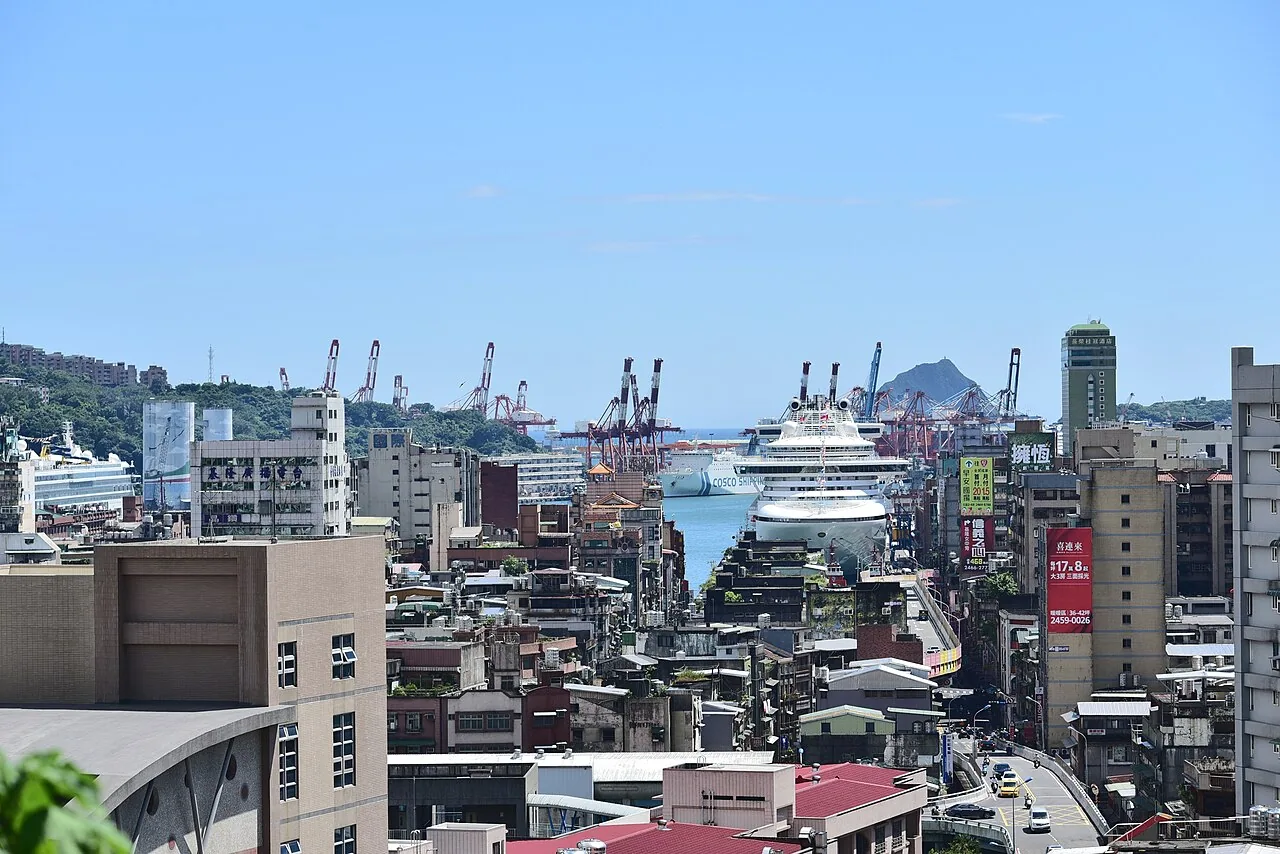
- Scene §Five Phases of Port Construction: 2017 Port of Keelung — Aerial view of Keelung Port, the contemporary appearance of what was the world's 7th largest container port in 1984.
License: CC BY-SA 4.0.
References
- Kanzaiteng Fish Market Report — Smile Taiwan "Keelung Style" series, documenting the Kanzaiteng early-morning auction scene and tiau-siu (auctioneer) culture.↩
- Heping Island Geopark Official Website §History and Culture — Complete history: Heping Island was originally a Ketagalan Basay settlement, called "tuman" in Basay; Han settlers later renamed it "Da Ji Long Yu" (Big Chicken Cage Island); renamed "Heping Island" in 1947.↩
- Fort San Salvador Ruins — Great Keelung Historical Scene Reproduction — Official historical record of the Spanish fleet arriving at Heping Island from Manila on May 5, 1626, and building Fort San Salvador as a base for colonizing Taiwan.↩
- Spanish Colonial Period in Taiwan — Wikipedia — Detailed account of the Dutch East India Company's six-day capture of Fort San Salvador in 1642 and its renaming to Fort Noord Holland.↩
- Spanish Memories of Heping Island — Our Island — PTS documentary report on the archaeological project led by NTU's Zang Zhenhua team in collaboration with Spanish scholars, trial-excavating the Church of All Saints starting in 2011.↩
- Church of All Saints Archaeological Project Team Statement — La Vie — Source of the quote "The Heping Island archaeological site is the only evidence left behind by Spanish colonization in Taiwan," including church area and detailed data on unearthed remains.↩
- Keelung City Historical Development — Keelung City Government Official Website — Official historical record of Shen Baozhen's 1875 memorial establishing Taipei Prefecture, the appointment of a sub-prefectural magistrate at Keelung, and the renaming to "Keelung" (Base of Prosperity).↩
- Keelung Dianji Temple — Wikipedia — Temple construction history: Lin Benyuan donated land in the 12th year of Tongzhi (1873), completed in the first year of Guangxu (1875), dedicated to Kaijun Saint-King Chen Yuanguang.↩
- Keelung City History — Wikipedia — Complete timeline of the Battle of Keelung during the Sino-French War: French fleet arrived off Keelung on August 3, 1884; bombardment on August 5; Liu Mingchuan commanded the defense.↩
- Battle of Keelung — Wikipedia — Cholera and typhus outbreak from November 1884; 83 French soldiers dead by December 23; total of over 700 French casualties.↩
- Keelung Ghost Festival — Wikipedia — 1851 Zhangzhou-Quanzhou feuds; 1853 large-scale battle at Fongding with over 100 casualties; 1855 clan-based Zhu Pu rotation "Zhang Head, Xu Tail" — complete list of 11 surnames and origins.↩
- Keelung Ghost Festival — National Cultural Memory Bank — Ministry of Culture National Cultural Memory Bank entry, original text: "Replacing feuds that break heads with competitive parade formations, in order to achieve social harmony, coexistence, and a great unity of the world" + record of French war dead being incorporated into the universal salvation rites.↩2
- Keelung Ghost Festival Zhu Pu Altar — Keelung City Bureau of Culture and Tourism — Architectural details of the Zhongzheng Park Zhu Pu altar: completed in the mid-1970s, octagonal tower, first floor houses the Ghost Festival Cultural Relics Museum.↩
- Keelung Port — Wikipedia — Complete engineering history of the five phases of Japanese-era port construction (1899–1935): Phase 3 trade volume reaching more than half of all of Taiwan; Phase 4 extending the inner harbor outward.↩
- 130 Years of Keelung Port Construction — The Reporter — In-depth report documenting the five phases of port construction, surpassing Tamsui Port in 1916, upgrade to city status in 1924, and becoming the third-largest city in Taiwan in 1930 — the port's golden age.↩
- Keyboard Keelung Mini Trip — Story StoryStudio — Keelung's modernization history from port construction to the underground Xuchuan River, including the passenger-cargo layered design of the 1932 West 2nd Pier and 1934 West 3rd Pier warehouses.↩
- 130 Years of Keelung Port Construction, a Marginal City's Transformation Promise — The Reporter — The Reporter's in-depth long-form article on Keelung, including "7th largest container port in the world in 1984," "2.09 million TEU in 2005 declining to 1.45 million TEU in 2015," "cross-county commuting rate of 39.2%, vacancy rate of 26%," core quotes from You Chang Lin's transformation policies, and other key data.↩234567
- Kaohsiung Port — Wikipedia — History of Kaohsiung Port expansion: the first container terminal at Chungtao Commercial Harbor Area opened in 1969, gradually overtaking Keelung Port from the 1960s.↩
- Keelung Port ranked 113th in the world and 4th largest commercial port in Taiwan in 2018 — cited from the same article in The Reporter, "130 Years of Keelung Port Construction"[^17], linked to the aforementioned 30% container volume decline data.↩
- Century-Old Wu Family Ding-Bian-Cuo — Smile Taiwan — Established at Miaokou in 1919; founder Wu Tianfu (1903–1986), nickname "Meat Geng Shun"; took over the Fuzhou stall in the 1960s; stall number 27-2; three-generation heritage.↩
- Li Ku Pastry History — Keelung Tourism Network — Opened in the 8th year of the Guangxu reign (1882); No. 90, Ren 3rd Road, Ren'ai District; three-generation specialties (mung bean pastry → curry puff → pineapple cake) of this century-old pastry shop.↩
- Li Ku Pastry Third-Generation Interview — Li Ku Official Website — Third-generation proprietor Li Zongzong's interview recounting his grandfather's explanation of the character "ku" in the shop name: "The 'ku' is a type of bird that flies high and far."↩
- Zhengbin Fishing Port Color Plan — Chinese Culture University Department of Landscape Architecture Report — During You Chang Lin's tenure, in collaboration with Chair Guo Qiongying, "spent two years grinding away before awakening residents' awareness of participation"; 55 colors named "Zhengbin Colors."↩
- Argenna Shipyard History — Keelung City Bureau of Culture and Tourism — 1919 Huang Dongmou coal storage yard → 1937 ore transport dock (Jinguashi gold sent by aerial tramway to Shuiandong → Badou → Niudu Harbor → shipped to Japan) → 1966–1987 Argenna Shipyard → registered as historic building in 2016; complete factory history.↩
- Keelung City New Logo Five-Color Design Concept — Keelung City Government — You Chang Lin's explanation on his 7th anniversary in office: "Green represents the mountain city, yellow symbolizes vitality, black because Keelung once produced abundant coal, red represents passion, and blue is Keelung Port and the ocean."↩
- Keelung City Mayor Kuo Liang Hsieh Recall Case — Wikipedia — Complete results of the October 13, 2024 recall vote: against 86,014 (55.16%), in favor 69,934 (44.84%), turnout 50.44%, recall failed.↩
- Wanting to See the Sea Again: After the Kuo Liang Hsieh Recall Vote — The Reporter — The Reporter's in-depth report on three types of citizen voices in the recall case, including village chief Dai Xueli's "It doesn't matter who's in charge" and returnee youth Li Yanrong's "My hometown is Keelung" and "I hope to remember what I looked like when I left."↩2
- Keelung City Population Statistics — Keelung City Government Department of Civil Affairs — Population of 359,102 in April 2026, having fallen below 360,000. Monthly statistics also updated on the Wikipedia Keelung City entry.↩
- Black Kites and the Ecology of the Xuchuan River Mouth at Keelung Port — Our Island — Black kites grew from 272 in 2013 to 808 in 2023; poultry and fish scraps and offal from the Xuchuan River mouth at Keelung Port became their food source.↩2
- Taiwan Panorama: The Charming Allure of Rain Port Keelung — Xie Bingying, Rain Port Keelung, original text: "When everyone on shore is being drenched by the rain and can barely lift their heads, when everyone is cursing the heavens for their cruelty, I am secretly delighted" — cited from.↩
- The Charming Allure of Rain Port Keelung — Taiwan Panorama — Original text: "For old Keelungers, no matter the weather, they always carry an umbrella when they go out," documenting Keelungers' everyday relationship with rain.↩
- Keelung For A Walk — Local media documenting how Keelungers describe an overcast day: "Today is good weather."↩