
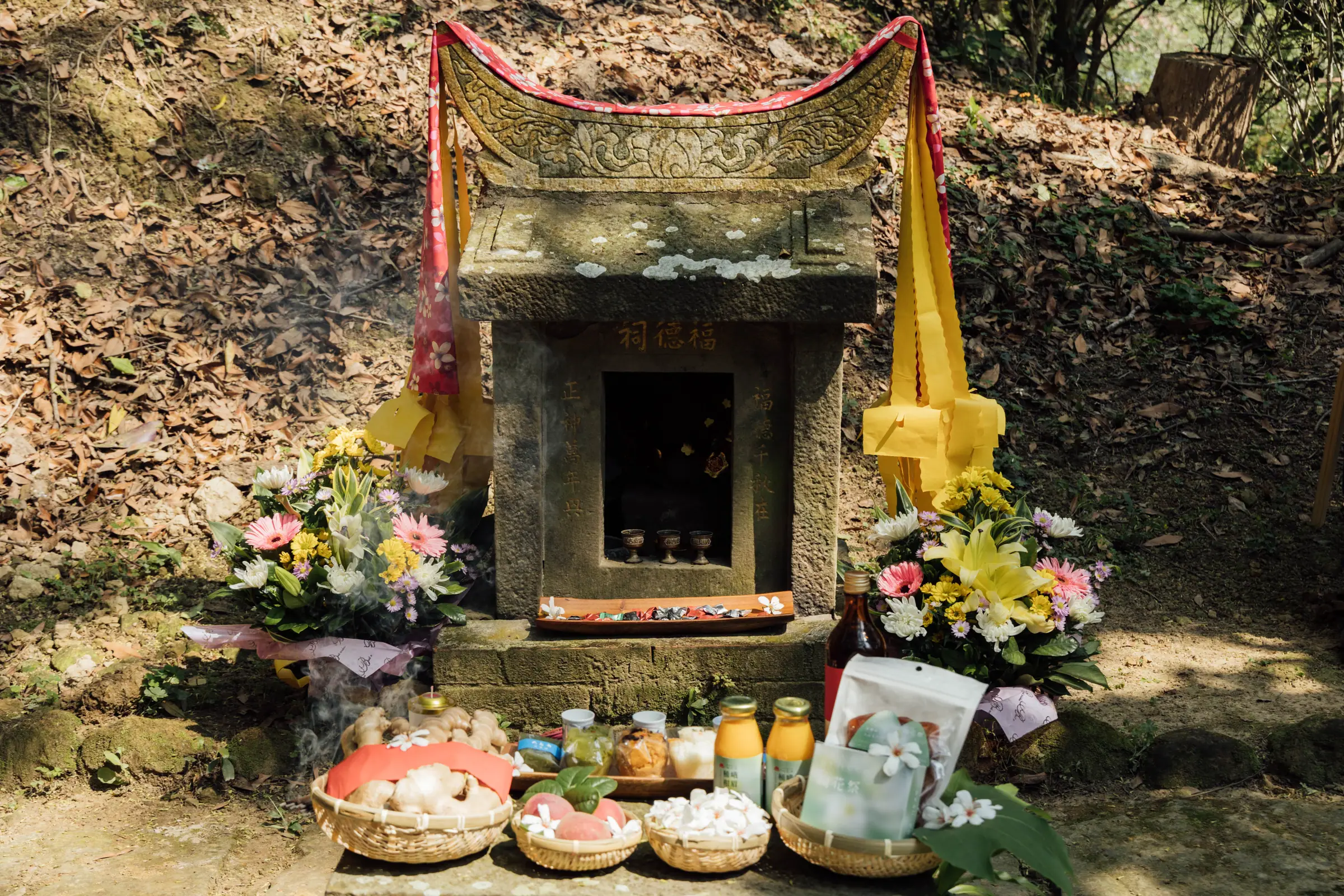
Miaoli County: A Hakka Stubborn-Spirited County That Elected a Magistrate Who More Than Doubled Its Debt in Eight Years
30-second overview: In 1889, the Qing court changed the Taokas name “Mao-li” into “Miaoli.” During the Japanese period, camphor output here once accounted for 95% of Taiwan’s total, and Sanyi built its woodcarving industry from the roots left after camphor refining. In 1958, three Dahu residents carried strawberry seedlings back from Luzhou; in 1979, the Dahu Farmers’ Association opened Taiwan’s first tourist fruit farm. In 2002, Beihe Village in Gongguan held the first Tung Blossom Festival. In 2008, Liu Cheng-hung took over a county with roughly NT$20.2 billion in debt; by the time he stepped down in 2014, the books showed NT$67.6 billion. Between 20.2 and 67.6 billion were Zhu Feng-min, age 73, drinking pesticide; Chang Pharmacy being flattened by excavators on July 18; and the NT$120 million Hakka Round House becoming a mosquito hall. Today, 530,000 people live in this county, whose 62.5% Hakka population share is Taiwan’s second highest. This article asks how the spirit of “Hakka stubbornness” elected someone who bankrupted the county, and how it is still alive.
Beihe, Gongguan, the Year the May Snow Fell
Every May, snow falls on Gongguan’s hills.
It is not real snow. It is tung blossom. During the Japanese period, the Japanese introduced the tung tree from China, valuing tung oil for its industrial uses: pressing oil, making matchsticks, coating furniture, and painting ship bottoms. It was planted widely across Miaoli, Hsinchu, and Taoyuan. After the war, the tung oil industry declined, and these trees were left on the slopes of Hakka villages as unmanaged relics of an old industry1.
In April 2002, the first “Hakka Tung Blossom Festival,” promoted by Yeh Chu-lan, the inaugural minister of the Council for Hakka Affairs under the Executive Yuan, opened in Beihe Village, Gongguan Township, Miaoli County2. The council, established on June 14, 2001, was Taiwan’s first central-level agency dedicated to Hakka affairs3. Its calculation was that the tung blossom season could be linked with Hakka yimin faith, food, and crafts into a tourism route. Along Provincial Highway 3, from Sanwan, Tongluo, Sanyi, Nanzhuang, to Gongguan, every township had tung blossoms, Hakka villages, and temple plazas where stalls could be set up.
Behind the existence of the Hakka council was the fourteen years of political pressure accumulated after the “Restore My Mother Tongue Movement” of December 28, 1988. That march went from Taipei’s Sun Yat-sen Memorial Hall to the Legislative Yuan. Hakka communities in Taoyuan, Hsinchu, and Miaoli formed its largest base of support4, with busloads of people coming north from Miaoli. By the 2010s, the Tung Blossom Festival had become an annual spring cultural event mobilized by nine counties and cities along Highway 3. But its zero point was that April in Beihe Village, Gongguan, Miaoli. Tung blossoms became Miaoli’s calling card, but this county has stories that predate the flowers by more than a century.
1889, the Year “Mao-li” Became “Miaoli”

2023 Hakka Tung Blossom Festival. Photo: Council for Hakka Affairs, Republic of China. CC BY 4.0 via Wikimedia Commons.
Miaoli’s Indigenous inhabitants were the Taokas. They called this place “Mao-li” (Pali), meaning “plain” or “flat terrain”5. “Mao-li Community,” also known as “Ma-li Community,” was a core Taokas settlement on the western plains, distributed around today’s Miaoli City, Houlong, Tongxiao, and Yuanli. The mountain areas were the territory of the Saisiyat in Nanzhuang and Wufeng, and the Atayal in Nanzhuang and Tai’an.
Han Chinese entry at greater scale began under the Kingdom of Tungning. In 1670, Liu Guoxuan led troops to cultivate the “Eight Pengshan Communities” and “Five Houlong Communities,” today’s Tongxiao, Yuanli, Houlong, and Zhunan6. The real mass migration came during the Qianlong reign of the Qing: in 1737, Hakka people from Guangdong began entering the area, and in 1748 this turned into large-scale migration, mainly from Huizhou, Jiayingzhou, and Chaozhou in Guangdong. They transliterated “Mao-li” into Chinese characters and used that form for more than a century.
Administratively, Miaoli had long been someone else’s appendage: under Tamsui Subprefecture in 1731, and under Hsinchu County in 1875. Only in the 15th year of the Guangxu reign, 1889, did the Qing court formally carve out Miaoli, Yuanli, Tongxiao, and other areas from Hsinchu County to establish “Miaoli County”7. The Taokas-language “Mao-li” was changed into the auspicious-sounding “Miaoli.”
📝 Curator’s note: The renaming in 1889 was a miniature colonial pattern. “Mao-li” was the Taokas name for their own land; “Miaoli” was the Han Chinese rewriting of this place. More than 130 years after the name was changed, the Miaoli County Government website still places “Mao-li” in the first line of its historical overview. But today, the name “Mao-li” is mostly used by tourist restaurants and specialty foods. The name of a place records who came, who remained, and who was rewritten. The name Miaoli itself is a layered record of four ethnic groups in the western foothills: the Taokas covered over, the Hakka becoming the mainstream, the Saisiyat remaining in Nanzhuang, and the Atayal remaining in Tai’an.
In 1895, the Japanese arrived, and the Qing-era Miaoli County was abolished. During the Japanese period, Miaoli became a chō and then a district system: from 1901 to 1908 it was Miaoli Chō; in 1920, the chō system was abolished and prefectural districts established, with the Miaoli area divided into Miaoli, Zhunan, and Dahu districts under Shinchiku Prefecture8. Only in 1950, with the implementation of postwar local self-government, did Miaoli County reappear in its present territory, combining the original 18 townships, towns, and cities. In 2015, Toufen Township was upgraded to Toufen City, producing today’s structure of 2 cities, 5 towns, and 11 townships9.
The Mountain Line Opened in 1903: Camphor, Tree Roots, Longteng Bridge
In May 1903, the Zhonggang-to-Miaoli section of the Taiwan Railways Mountain Line opened. That year, Miaoli had its own railway station for the first time.
Over the next five years, the Mountain Line continued south. In 1908, the full Western Trunk Line opened, with trains passing through Sanyi, then called Sanchakou, and climbing to Shengxing Station at 402.3 meters above sea level, the highest point on the trunk line. The entire Old Mountain Line set four records: steepest grade, sharpest curve, longest steel truss bridge, and longest tunnel cluster10. The Coast Line opened on October 10, 1922, running from Zhunan through Houlong, Baishatun, Tongxiao, and Yuanli, relieving freight pressure from the Mountain Line.
Once trains could enter, camphor could be shipped out.
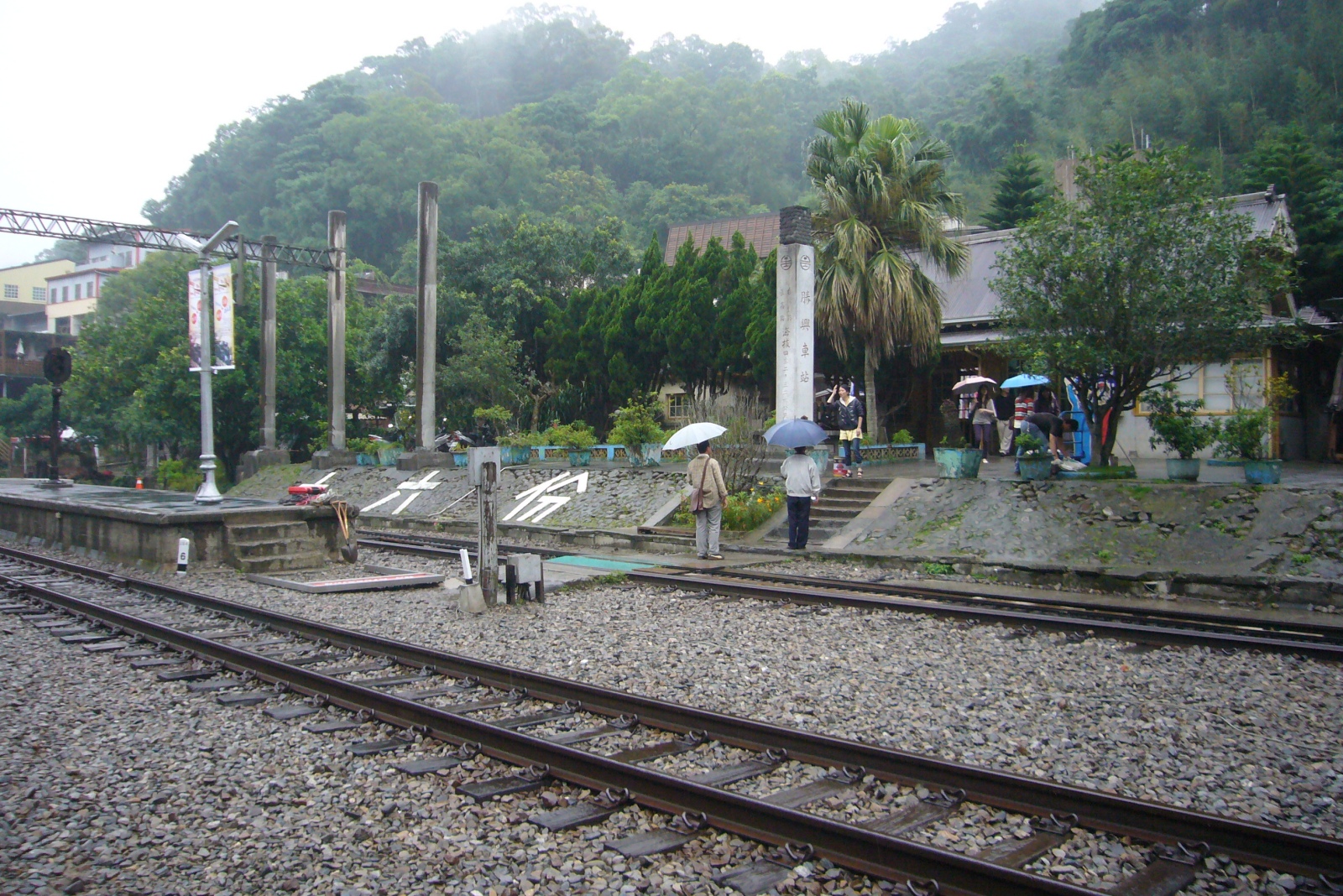
Shengxing Station, 2010-06-02. Photo: Cheng-en Cheng. CC BY-SA 2.0 via Wikimedia Commons.
During the Japanese period, Miaoli’s mountains were a paradise for camphor trees. The climate was humid and foggy, the forests dense, and the western foothills of the Xueshan Range were full of camphor. Camphor was a key industrial raw material of the time, used in celluloid, an early plastic, smokeless gunpowder, insect repellent, and medicine. The Taiwan Cultural Memory Bank states it plainly: “During the Japanese period, Miaoli’s camphor output reached 95 percent of Taiwan’s total output, and 85 percent of the world’s total output”11. This figure refers to the industry’s Japanese-period peak, around the 1930s, when the Sanyi area was Taiwan’s most important camphor-producing center and distribution hub. A small mountain town in Miaoli virtually determined global camphor supply and demand for those years.
The waste left by the camphor industry unexpectedly nourished another industry: Sanyi woodcarving.
Camphor refining required felling camphor trees, trimming branches, and distilling the oil; the remaining stumps and roots piled up in the mountains as waste. Local Hakka people used the material at hand. In 1918, Sanyi resident Wu Jin-bao (1886–1931) and Japanese merchant Okazaki Masataro jointly founded “Toda Bussan Co., Ltd.”12, Sanyi’s first formal woodcarving factory. Wu registered the company under his son Wu Luo-song’s name, laying the foundation for Sanyi’s factory system for woodcarving. By 1929, Sanyi already had five woodcarving factories.
After the war, the camphor industry declined: celluloid was replaced by synthetic plastics, and smokeless gunpowder by new compounds. But Sanyi’s woodcarving masters remained. The wood shifted from camphor to hinoki, longan, and sandalwood; longan became widely used only after the war, because the mountains that produced camphor had largely been cut out13. After the Korean War broke out in 1950, U.S. troops stationed in Taiwan brought orders, and Sanyi woodcarving was exported to the United States. From 1966 to 1973, Sanyi woodcarving reached its golden age, with craftsmen from neighboring counties moving in14. Today, Shuimei Street still has more than 200 woodcarving shops, and the Miaoli County Sanyi Wood Sculpture Museum opened in 1995.
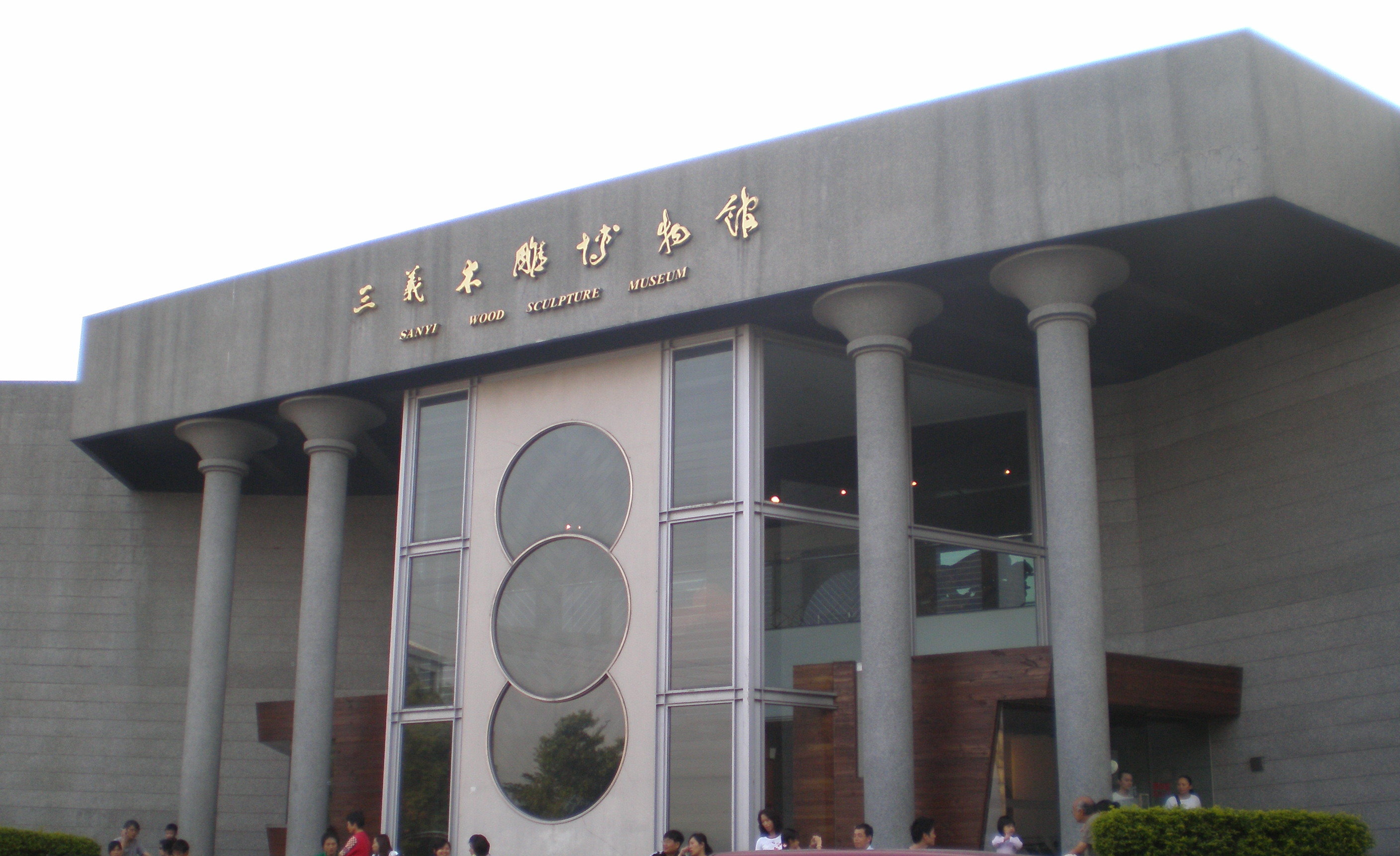
Sanyi Wood Sculpture Museum, 2010-05-01. Photo: SSR2000. CC BY-SA 3.0 via Wikimedia Commons.
The Old Mountain Line ceased service in 1998, but its railway remains stayed behind. Longteng Broken Bridge, or Yutengping Bridge, consists of bridge piers destroyed in the 1935 Shinchiku-Taichū earthquake; its brick-red broken columns now stand isolated in a valley, a popular Instagram spot. Shengxing Station was built without a single nail and still stands after a century15. Since 2018, the Old Mountain Line from Shengxing to Liyutan has been converted into a rail bike route, and the Ministry of Culture has listed this section as a potential World Heritage site. From camphor to woodcarving to rail bikes, the same Sanyi mountains have sustained three generations, each using the waste left by the previous one.
Dahu in 1958: Strawberry Seedlings Carried Back from Luzhou
Dahu lies in south-central Miaoli. Its basin terrain, large day-night temperature differences, and elevation of 200 to 400 meters make its climate suitable for something Taiwan originally did not have: strawberries.
In 1958, three Dahu residents, Lai Yun-tian, Chen Shi-yuan, and Wu Shi-jin, introduced strawberry seedlings from Luzhou in Taipei and planted them on Dahu’s slopes. The Taiwan Cultural Memory Bank records: “In 1958, Dahu residents Lai Yun-tian, Chen Shi-yuan, Wu Shi-jin, and others introduced the crop from Luzhou, Taipei; this marked the beginning of strawberry cultivation in Dahu Township, Miaoli County”16. Dahu Basin’s microclimate was more suitable than Taipei’s plains, and its large temperature differences allowed strawberries to accumulate sugar.

Dahu strawberry farm, 2017-03-24. Photo: Taiwankengo. CC BY-SA 4.0 via Wikimedia Commons.
In 1976, Dahu farmers including Wu Zhao-qian opened farms along Provincial Highway 3 for tourist fruit picking, the starting point of Taiwan’s tourist fruit farms. In 1979, the Dahu Farmers’ Association formalized the system by opening the first tourist strawberry farm. In 1996, Dahu Winery was established, producing Taiwan’s first strawberry fruit wine17. Today, Dahu’s strawberry cultivation area is about 350 hectares, with more than one hundred derivative products.
✦ “In the early days, most houses in Dahu Township were brick houses, bamboo houses, or thatched huts. Now everyone grows strawberries, and almost everyone has built a Western-style house; very few people live in those single-story houses anymore.” Local resident memory, Taiwan Cultural Memory Bank16
Next to Dahu, Gongguan Township is Taiwan’s only red date-producing area. In 1875, a friend of Chen Huan-nan brought back two red date trees from China and planted them in Gongguan’s Houlong River valley. After the flood of the Xinhai year, 1911, the Houlong River changed course, and the exposed riverbed soil turned out to be especially suitable for red dates18. Cold winds blowing down from the Xueshan Range along the river valley help suppress fruit fly reproduction. In Taiwan, red dates can be grown only in this valley.
Zhuolan Township, at Miaoli’s southern edge bordering Taichung, is known as the “Fruit Kingdom”: grapes, starfruit, top-grafted pears, and citrus. In the early 1970s, it transformed from a rice-growing area into a fruit-producing region19. Zhuolan is also a special case in Taiwan Hakka studies, with Sixian, Hailu, Dabu, and Raoping accents coexisting, something extremely rare in Hakka villages20. Miaoli’s mountains have produced three things: Japanese-period camphor, postwar woodcarving, and postwar-to-present fruit. Each generation used the conditions left by the previous one, exhausting one side of the land and turning it into something new.
Xiangtian Lake, Nanzhuang: More Than Two Centuries of paSta’ay
In Miaoli’s eastern mountains, Nanzhuang Township is home to the “southern Saisiyat” (Say walo’), while Wufeng in Hsinchu is home to the “northern Saisiyat” (Say kilapa:). The two branches live separately on either side of Mount Egongji and meet by the Nanzhuang River only once every two years to discuss one thing: when to hold this year’s paSta’ay, known in Chinese as the Ritual to the Short Spirits.

Nanzhuang Saisiyat paSta’ay ceremony, 2006. Photo: CenkX. CC BY-SA 3.0 via Wikimedia Commons.
The Miaoli County Government website describes paSta’ay this way: “The paSta’ay ceremony is held as a minor ritual every two years and a major ritual every ten years. The ceremony lasts more than a month, and the rituals are highly complex... The formal ceremony lasts six days and five nights. The first two days are not open to outsiders, followed by three consecutive nights of all-night singing and dancing.”21 It takes place around the fifteenth day of the tenth lunar month at Xiangtian Lake in Nanzhuang.
At the story’s core is the Saisiyat memory of the “short people.” According to legend, a group of short, dark-skinned people once lived near the Saisiyat, teaching them agriculture, song, and dance, and intermarrying with them. Later, after a dispute, the short people were killed by Saisiyat people. The two survivors fled into the mountains, but before leaving they passed ritual songs to the Saisiyat and instructed them to remember the event in a ceremony every two years. The Miaoli County Government summarizes the emotion this way: “The Ritual to the Short Spirits is an expression of Saisiyat remorse toward the ‘short people.’ Its uniqueness lies in the Saisiyat people’s dual psychology of gratitude and resentment toward the short people, which generated a ceremony of ‘atonement.’”22
Saisiyat ritual songs and dances are transmitted orally, without written records. They have continued from the Qing period to the present, for at least more than two centuries. In 2008, the ritual was registered as a Miaoli County intangible cultural asset; in 2013, the Ministry of Culture designated it an Important National Folklore23.
Nanzhuang is a space where Saisiyat, Atayal, and Hakka communities coexist. Hakka people account for about 83% of the population, and Saisiyat people number about 1,300. Saisiyat-Hakka mixed residence produced linguistic mixing: “The Saisiyat people in Nanzhuang Township are influenced by Hakka people and mostly speak Hakka; they are called the ‘southern Saisiyat.’ The people of Wufeng Township are influenced by the Atayal and mostly speak Atayal; they are called the ‘northern Saisiyat’”24. The same people speak Hakka in Miaoli and Atayal in Hsinchu.
Nanzhuang also carries a layer of mining history. After the Japanese government lifted its ban on coal mining in 1911, coal mines opened in Nanzhuang. “In the 1950s and 1960s, coal mining was at its height. There were once more than 20 mining companies, more than 10,000 miners, and a population of 20,000 to 30,000. The streets were lined with hotels, taverns, and teahouses”25. In 1995, the last mine, Xinxietong, closed; today Nanzhuang’s population is just over 8,000. The scent of osmanthus egg rolls drifting from Osmanthus Alley in the old street covers over the footsteps of miners and taverns from 70 years ago. Saisiyat, Hakka, and mining history: three layers pressed onto the same old street.
2008 to 2014: The Eight Years Liu Cheng-hung Emptied the County Treasury
In December 2005, Liu Cheng-hung was elected Miaoli county magistrate for the first time. Business Today wrote: “At the end of 2005, when former county magistrate Fu Hsueh-peng handed over office to Liu Cheng-hung, the Miaoli County Government’s debt was about NT$20.2 billion”26.
By the time Liu left office in December 2014, the county’s recorded debt had reached NT$67.6 billion. The Wikipedia entry on the 2015 Miaoli County fiscal crisis states: “By the end of 2015, the county’s debt reached NT$67.6 billion, including NT$39.28 billion in outstanding public debt of more than one year and less than one year combined, both exceeding legal ceilings; NT$16.73 billion borrowed from centrally allocated tax revenues, special accounts, and funds; and NT$11.61 billion in retained payables from previous fiscal years and other hidden liabilities”27. Another Business Today estimate of NT$64.8 billion excluded all hidden debt26; both figures are valid.
In eight years, Miaoli County’s debt rose from NT$20.2 billion to NT$67.6 billion.
Liu did not spend this money quietly. He spent it very publicly. The 2011 Taiwan Lantern Festival was held in Miaoli. Business Today wrote: “The 2011 Taiwan Lantern Festival cost more than NT$500 million; the next year’s National Day fireworks were launched continuously over 22 sessions, costing NT$180 million... The Hakka Courtyard, whose function overlapped with the Hakka Culture Park, cost NT$80 million... The Hakka Round House, located in the Miaoli High-Speed Rail special district, was completed and opened one month before Liu Cheng-hung left office, at a cost of NT$120 million”26. The same report recorded NT$220 million in spending on international arts festivals over the years, with Sarah Brightman appearing as a guest at one event. In 2012 alone, the annual deficit reached NT$5.8 billion26.
During the same period, Liu’s personal reputation: “From 2009 to 2012, Liu Cheng-hung was selected by Global Views Monthly as a five-star county magistrate for four consecutive years”26. On one side, lantern festivals and fireworks were happily staged; on another, polls gave five stars; on another, the county treasury leaked deficits like water.
On July 10, 2015, the newly inaugurated county magistrate Hsu Yao-chang, in office for less than a year, went north to the Executive Yuan to ask for help: the county could not pay its employees’ July salaries27. The Executive Yuan’s measure was to advance NT$2.1 billion in general subsidies so the county government could pay wages. A county NT$67.6 billion in debt could not even produce NT$2.1 billion for salaries.
In 2015, Taipei Times interviewed Miaoli resident Alice Wang about the Hakka Round House and recorded her words verbatim:
✦ "It's mostly just a place for retirees to sit in an air-conditioned building for an hour. There's nothing else there to do." Mosquito halls: “They are totally empty, and all they're good for is raising mosquitoes”28
On October 6, 2016, the Control Yuan voted 11 to 1 to impeach Liu Cheng-hung29. The core accusations in the impeachment document were that at the end of 2006, short-term public debt reached 31.55%, exceeding the legal debt ceiling; that from 2008 to 2014 the county ran deficits year after year while falsely listing central subsidies; and that it illegally withheld NT$210 million in disaster relief funds owed to township and city offices. But the impeachment had no substantive legal effect. Liu had already left office.
2010–2014: The Dapu Incident, a Documentary Timeline
The Dapu Incident occurred during Liu Cheng-hung's second term. It was a series of events on a timeline; laying them out clearly matters more than commenting on them.
9 June 2010, early morning. To accommodate the expansion of the Hsinchu Science Park's Zhunan campus, the Miaoli County Government deployed police and excavators to block roads and clear land, bulldozing rice paddies in the expropriation zone that were days from harvest30. Farmers of the Dapu Self-Help Association were woken from sleep and ran to their fields to watch their rice crops flattened.
3 August 2010. Dapu Self-Help Association member Chu Feng-min, a 73-year-old woman, distraught over the government's forced expropriation of farmland, drank pesticide and took her own life30.
17 July 2013. The Dapu Self-Help Association and supporting groups traveled north to Taipei to protest.
18 July 2013. "While the protesting households and supporting social-movement groups were in Taipei demonstrating, the Miaoli County Government mobilized police to carry out demolitions"30. Four households — Chang Pharmacy, Huang Fu-chi, Chu Shu, and Ko Cheng-fu — were forcibly demolished. Footage of an excavator flattening the sheet-metal structure of Chang Pharmacy looped on the evening news that day.
19 July 2013. The day after the demolitions, Magistrate Liu Cheng-hung gave a media interview. Asked why he chose that day to act, he replied: "A heaven-sent opportunity"30.
18 August 2013. The "Demolish the Government" movement assembled on Ketagalan Boulevard. Protest slogan: "Today Miaoli is demolished, tomorrow we demolish the government." (今天拆大埔,明天拆政府)31. This line would be shouted again during the 2014 Sunflower Movement.

2013-08-18 Demolish the Government protest site. Photo: Chung-tsen Fan-chiang. CC BY-SA 2.0 via Wikimedia Commons.
18 September 2013. Chang Pharmacy owner Chang Sen-wen (1953–2013) went missing in the morning; his body was found that afternoon in a drainage ditch near his home. Prosecutors ruled it a suicide30. Chang was a retired Health Bureau civil servant; his monthly pension of twenty-odd thousand NT dollars plus pharmacy income supported the family. Relatives said he had not slept since the day of the forced demolition.
3 January 2014. The Taichung High Administrative Court, in its second remand ruling, declared: "The original disposition is confirmed illegal; the appeals decision and the original disposition regarding the expropriation of land improvements belonging to plaintiffs Peng Hsiu-chun, Chu Shu, Ko Cheng-fu, and Huang Fu-chi are all revoked"30. Three and a half years later, the court finally ruled the demolitions illegal. 28 January 2014, the Ministry of the Interior decided not to appeal.
11 June 2018. The Miaoli County Government issued a building permit allowing Chang Pharmacy to be rebuilt on its original site32. 17 June 2020. Five years after the forced demolition, Chang Pharmacy's reconstruction on the original site was completed32.
📝 Curator's Note: Framing the Dapu Incident as a binary "government bad vs. citizens good" narrative is giving up on understanding. The full story: behind the Science Park expansion lay central-government industrial policy; the Miaoli County Government executed expropriation under the existing Urban Planning Act; Chu Feng-min and Chang Sen-wen were two concrete names who bore the suffering in that process; the court acknowledged the illegality in 2014; Chang Pharmacy was rebuilt in 2020. A single event can simultaneously be "county government over-enforcement," "procedural problems in the Urban Planning Act," "the formation of a civic movement," "the judicial system's delayed correction," and "two people who died inside this mechanism." All facets exist at once. The most violent chapter in Taiwan's history of compulsory land expropriation unfolded beneath the four characters "Hakka Cultural Capital" — that contradiction itself is worth remembering more than any one-sided narrative.
Liu Cheng-hung's "heaven-sent opportunity" remark later became an emblematic sentence in Taiwan's land-expropriation controversies.
530,000 People, Chung Tung-chin, and the Houlong Great Silicon Valley
After Liu Cheng-hung, the fiscal crisis, and the Dapu Incident, Miaoli set a record in the 2022 local elections: the 70-year pattern of rule divided between the Liu and Huang factions was broken. Since the postwar period, local factions had been divided along two axes: the Liu faction, from Liu Kuo-tsai to Liu Cheng-hung, and the Huang faction, from Huang Wen-fa to Huang Chien-ting. For 70 years, they took turns in power. In 2022, independent Chung Tung-chin was elected county magistrate and later joined the Kuomintang. In 2023, CommonWealth Magazine described him as “Miaoli people’s Santa Claus,” because he was skilled at putting Lunar New Year cash gifts, childbirth subsidies, and education allowances directly into people’s hands33.
In 2026, Miaoli County had 532,682 people34. Since 1996, its social increase rate has been negative every year, with young people moving to Hsinchu, Taichung, and Taoyuan. Shitan Township has only 3,993 people, fewer than a single large building in New Taipei City. But Toufen City has grown against the trend to 107,500 people, absorbing Hsinchu’s spillover, while Zhunan Township has 90,700, supported by the science park. The inland Hakka villages along the Mountain Line are losing population, while the Coast Line and the science park hinterland are growing.
The new momentum comes from the “Taoyuan-Hsinchu-Miaoli Great Silicon Valley” plan. Beginning in 2025, Miaoli will add 960 hectares of industrial land, and Houlong Science Park, at 330 hectares, is positioned as the final piece of the western technology corridor. Over the past three years, Miaoli has attracted more than NT$360 billion in investment, with Powerchip, MediaTek, and King Yuan Electronics among the companies entering35. Around Miaoli HSR Station, which opened in December 2015, the population of Xiaoyi Village in the high-speed rail special district increased against the trend by 564 people over four years.
If Liu Cheng-hung’s era used Hakka cultural buildings to prop up a political theater, Chung Tung-chin’s era uses the Houlong Great Silicon Valley to build a new round of hope. But some things are inherited: the Hakka Round House is still there, and the mosquito hall is still a mosquito hall; the Hakka Courtyard is still there, with scattered weekend visitors. The Hakka population share of 62.5% is still Taiwan’s second highest, behind only Hsinchu County’s 67.8%36.
Miaoli’s Two Selves
Every May, tung blossoms still fall on Gongguan’s hills. The strawberry seedlings Lai Yun-tian carried back from Luzhou in 1958 still bear fruit every year from November to April in Dahu. In the more than 200 woodcarving shops on Sanyi’s Shuimei Street, masters cut longan wood brought in from elsewhere after the war. The camphor trees were cut long ago, but what has been passed down is the craft left by Wu Jin-bao in 1918. Every two years, around the fifteenth day of the tenth lunar month at Xiangtian Lake in Nanzhuang, the Saisiyat still sing ritual songs handed down by the short people more than two centuries ago.
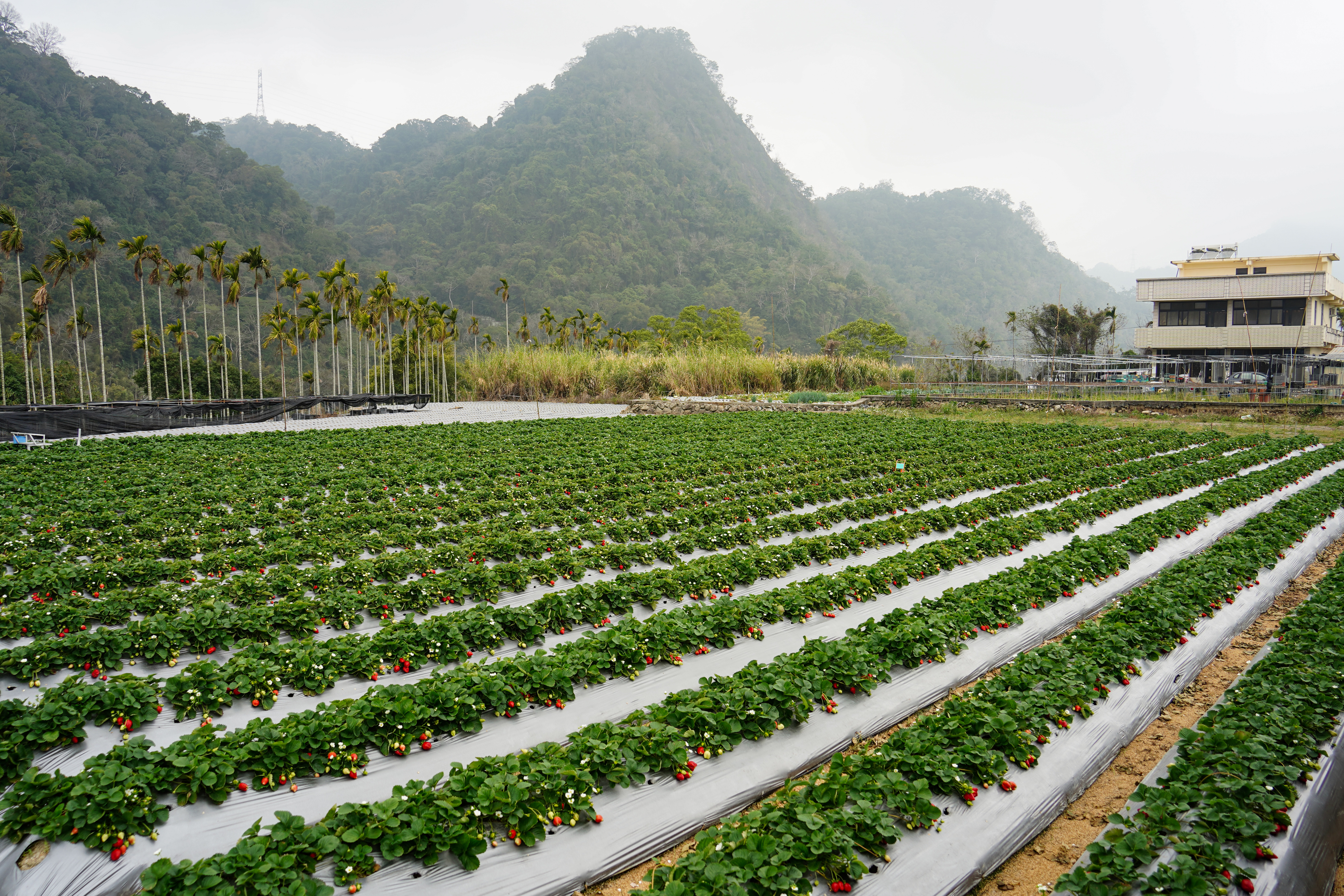
Dahu strawberry tourist farm, 2021-01-28. Photo: Rick888chen. CC BY-SA 4.0 via Wikimedia Commons.
But the NT$120 million Hakka Round House still stands there without orders beside it. The Hakka Courtyard was built for NT$80 million, with scattered weekend visitors. Liu Cheng-hung’s impeachment document sits in the Control Yuan archives, and Liu himself was still appearing at local political events in 2025. August 3, 2010, when Zhu Feng-min drank pesticide at age 73, and the afternoon of September 18, 2013, when Chang Sen-wen fell into a drainage ditch, remain two undeletable points in the history of compulsory expropriation in Miaoli.
Miaoli has two selves alive at the same time.
One is the Miaoli of “Hakka stubbornness”: tung blossoms, strawberry wine, osmanthus egg rolls, Saisiyat ritual songs, Sanyi woodcarving, and Provincial Highway 3. This Miaoli is the protagonist of tourist brochures and Council for Hakka Affairs publicity. Many people come every May to see the flowers.
The other is the Miaoli of “political theater”: NT$67.6 billion in debt, mosquito halls, impeachment documents, images of forced demolition, and “a heaven-sent opportunity.” This Miaoli is a negative case study in Taiwan’s local finance textbooks, the historical scene of compulsory expropriation at its most violent, and a political specimen of 70 years of Liu-Huang factional rule.
Asking “which one is the real Miaoli” is the wrong question. Both are. They are two faces of the same county, with its 62.5% Hakka population share, existing at the same time in the same period.
The next time you go to Miaoli, do not only go to Sanyi to see woodcarving, Dahu to pick strawberries, or Gongguan to see tung blossoms. Try going to Beihe Village in Gongguan in May, the zero point of the first Tung Blossom Festival in 2002, then drive around to Dapu and look at Chang Pharmacy, rebuilt in 2020. It is not far from the Miaoli City Government. Then you will remember one thing: Hakka stubbornness is a group of people still growing strawberries, carving wood, singing ritual songs, and rebuilding a sheet-metal house on the original site after a county magistrate they elected emptied the county treasury.
Stubbornness is this: you do not leave the land. Even if suffocating things have happened on it.
Further Reading
- Hakka Culture and Language — The Taiwan-wide distribution of the Hakka Sixian accent, Miaoli’s main accent, alongside Hailu, Dabu, and Raoping, and the background to Miaoli’s 62.5% Hakka share
- Hakka Food Culture — The Hakka village table context of flat rice noodles, stir-fried pork intestines with shredded ginger, Hakka stir-fry, and lei cha
- Cultural Map of Taiwan’s 16 Indigenous Peoples — The Saisiyat’s place in Taiwan’s Indigenous genealogy, and the branches of southern Saisiyat in Nanzhuang and northern Saisiyat in Wufeng
- Zhong Lihe — A representative figure in Miaoli Hakka literature; although Zhong Lihe was from Meinong, Kaohsiung, the context of Hakka writing is connected
- Taiwanese Traditional Crafts and Intangible Cultural Assets — Sanyi woodcarving as a representative Taiwanese woodcarving craft, and the Saisiyat Ritual to the Short Spirits as an Important National Folklore
- Keelung City — A sibling in the same batch of the 22 counties and cities series, another county-level city left behind by historical turns
- Hsinchu County — Batch 2 of the 22 counties and cities series; the county with the highest Hakka share, 67.8%, placed alongside Miaoli’s “Hakka character” as another Hakka experience: TSMC’s Baoshan Phase II beside yimin faith
- Taiwan’s Administrative Divisions — Administrative history from Miaoli’s establishment as a county in 1889, postwar reorganization in 1950, and Toufen’s upgrade in 2015
- Taiwan’s Urban Development and Urban-Rural Divide — A larger-scale view of Miaoli’s position in Taiwan’s urban-rural structure as an inland Hakka county with population outflow
Image Sources
This article uses 7 images from Wikimedia Commons (the hero image is licensed under government open data and has been incorporated into this site's gallery; the other 6 are CC licensed):
- Hero: 2023 Tung Blossom Festival — Photo: ROC Council for Hakka Affairs, April 14, 2023, OGDL-Taiwan-1.0 (Government open data license, compatible with CC BY 4.0). This is an official record photo from the Sanyi Township Hundred Stone Blessing and Worship ceremony, announcing the opening of the Tung Blossom Festival, and has been incorporated into this site's gallery.
- Scene §1903 Train Line: Shengxing Station 2010-06-02 — Photo: Cheng-en Cheng, June 2, 2010, CC BY-SA 2.0. Shengxing Station, the highest point of the longitudinal line.
- Scene §Sanyi Wood Carving: Sanyi Wood Sculpture Museum 20100501 — Photo: SSR2000, May 1, 2010, CC BY-SA 3.0. Sanyi Wood Sculpture Museum.
- Scene §Dahu Strawberries: Strawberry farm, Dahu Township2017 — Photo: Taiwankengo, March 24, 2017, CC BY-SA 4.0. Dahu strawberry farm.
- Scene §Short Spirit Ritual: Saisiat pastaai — Photo: CenkX, 2006, CC BY-SA 3.0. Nanzhuang Saisiyat paSta'ay ritual.
- Scene §Dapu Incident: 2013-08-18 Dismantling Government — Photo: Zhongcen Fan Jiang, August 18, 2013, CC BY-SA 2.0. Scene from the Dismantling Government movement.
- Scene §53 Ten Thousand People: Miaoli Dahu Strawberry Farm 1 — Photo: Rick888chen, January 28, 2021, CC BY-SA 4.0. Dahu strawberry tourist orchard.
License terms: OGDL-Taiwan-1.0 / CC BY 4.0 / CC BY-SA 2.0 / CC BY-SA 3.0 / CC BY-SA 4.0.
References
- Hakka Tung Blossom Festival — Taiwan Cultural Memory Bank — Ministry of Culture Taiwan Cultural Memory Bank entry recording when tung trees were introduced to Taiwan by Japan, the origins of the Tung Blossom Festival, and the distribution of Hakka villages along Provincial Highway 3.↩
- Origins of the Hakka Tung Blossom Festival — Council for Hakka Affairs — The first “Hakka Tung Blossom Festival” opened in Beihe Village, Gongguan Township, Miaoli County, in 2002. The organizer was the Council for Hakka Affairs under the Executive Yuan, with Yeh Chu-lan then serving as minister.↩
- History of the Council for Hakka Affairs — Council for Hakka Affairs — The Council for Hakka Affairs under the Executive Yuan was established on June 14, 2001. It was the Republic of China’s first central-level agency dedicated to Hakka affairs.↩
- Restore My Mother Tongue Movement — Wikipedia — The December 28, 1988 Taipei march was led mainly by Hakka intellectuals from Taoyuan, Hsinchu, and Miaoli. More than ten thousand people marched from Sun Yat-sen Memorial Hall to the Legislative Yuan, calling for Hakka-language radio and television programming, bilingual education, and revision of the Radio and Television Act.↩
- Historical Overview of Miaoli County — Miaoli County Government — Official historical overview from the Miaoli County Government. Original text: “Miaoli, formerly called ‘Mao-li,’ derives from a transliteration in Taiwanese Hokkien of the Plains Indigenous Taokas ‘Mao-li Community’ or ‘Ma-li Community’ (Pali), meaning ‘plain’ or ‘flat terrain.’”↩
- Historical Overview of Miaoli County — Miaoli County Government — Liu Guoxuan cultivated the Eight Pengshan Communities and Five Houlong Communities in 1670, today’s Tongxiao, Yuanli, Houlong, and Zhunan, marking the beginning of early Han Chinese development in Miaoli. The same page includes details on Guangdong Hakka settlement in 1737 and large-scale migration in 1748.↩
- Historical Overview of Miaoli County — Miaoli County Government — Original text: “Miaoli was first established as a county in 1889, the 15th year of the Guangxu reign.” Miaoli, Yuanli, Tongxiao, and other areas were carved out of Hsinchu County, and “Mao-li” was changed to the similar-sounding “Miaoli.”↩
- Historical Overview of Miaoli County — Miaoli County Government — Administrative changes during the Japanese period: the Qing-era Miaoli County was abolished in 1895; Miaoli Chō existed from 1901 to 1908; in 1920, the chō system was abolished and prefectural districts established, with Miaoli, Zhunan, and Dahu districts placed under Shinchiku Prefecture.↩
- Administrative Divisions of Miaoli County — Miaoli County Government — The county was established after the war in 1950 by combining 18 townships, towns, and cities. Toufen Township was upgraded to Toufen City in 2015. Today’s structure is 2 cities, Miaoli and Toufen, plus 5 towns and 11 townships.↩
- Old Mountain Line Railway — Bureau of Cultural Heritage — The Zhonggang-Miaoli section opened in 1903; the full Western Trunk Line opened in 1908; Shengxing Station, at 402.3 meters above sea level, was the highest point on the trunk line. The line set four records: steepest grade, sharpest curve, longest steel truss bridge, and longest tunnel cluster.↩
- The Rise and Fall of Miaoli’s Camphor Industry — Taiwan Cultural Memory Bank — Ministry of Culture Taiwan Cultural Memory Bank entry. Original text: “During the Japanese period, Miaoli’s camphor output reached 95 percent of Taiwan’s total output, and 85 percent of the world’s total output,” referring to the Japanese-period peak around the 1930s.↩
- Origins and Evolution of Sanyi Woodcarving Style — Hakka Cultural Assets Digital Network — Council for Hakka Affairs Hakka cultural asset database. Original text: “Sanyi’s first woodcarving factory was called ‘Toda Bussan,’ a woodcarving company jointly founded by Sanyi resident Wu Jin-bao (1886–1931) and Japanese merchant Esaki, Okazaki Masataro.” In 1918, Wu registered the company under his son Wu Luo-song’s name; by 1929, Sanyi had five woodcarving factories.↩
- Changes in Sanyi Woodcarving Materials — Hakka Cultural Assets Digital Network — Sanyi woodcarving materials shifted from camphor during the Japanese period to hinoki, longan, and sandalwood after the war because the camphor-producing mountains had been largely cut out. Longan became widely used as a woodcarving material only after the war.↩
- History of the Sanyi Woodcarving Industry — Hakka Cultural Assets Digital Network — Postwar development of Sanyi woodcarving: in 1945, Liu De-chun took over the woodcraft company left by Japanese merchant Okazaki; in 1946, Liu De-de founded Xingye Bussan, later renamed Baijixing; after the Korean War in 1950, U.S. military orders brought exports; 1966–1973 was Sanyi woodcarving’s peak. The Miaoli County Sanyi Wood Sculpture Museum was established in 1995.↩
- Old Mountain Line Railway — Bureau of Cultural Heritage — Longteng Broken Bridge, or Yutengping Bridge, was destroyed in the 1935 Shinchiku-Taichū earthquake, and the abandoned broken bridge became a tourist attraction. The Old Mountain Line ceased service on September 24, 1998, after the Taichung Line double-track project rerouted the line. The Ministry of Culture has identified it as a potential World Heritage site. Since 2018, it has been transformed into the “Old Mountain Line Rail Bike.”↩
- Miaoli Dahu: The Birth of the Strawberry Homeland — Taiwan Cultural Memory Bank — Ministry of Culture Taiwan Cultural Memory Bank entry. Original text: “In 1958, Dahu residents Lai Yun-tian, Chen Shi-yuan, Wu Shi-jin, and others introduced the crop from Luzhou, Taipei; this marked the beginning of strawberry cultivation in Dahu Township, Miaoli County.” Includes the 1976 opening of tourist fruit picking, the 1979 Dahu Farmers’ Association tourist fruit farm, and local residents’ memories of thatched houses and Western-style houses.↩2
- Dahu Winery — Dahu Farmers’ Association — In 1996, the Dahu Farmers’ Association established Dahu Winery, Taiwan’s first strawberry fruit wine producer and Asia’s only strawberry wine-producing site. Today, Dahu strawberries cover 350 hectares and have generated more than one hundred derivative products.↩
- Gongguan Township Red Dates — Food and Agricultural Education Information Integration Platform / Ministry of Agriculture — Gongguan Township is currently Taiwan’s only red date-producing area. In 1875, a friend of Chen Huan-nan brought two red date trees from mainland China to Taiwan; after the 1911 Xinhai flood, the Houlong River changed course, exposing riverbed soil suitable for red date growth. Cold winds from the Xueshan Range along the Houlong River valley reduce fruit fly damage.↩
- Agricultural Development in Zhuolan Township — Miaoli District Agricultural Research and Extension Station — Zhuolan is the “Fruit Kingdom,” producing mainly grapes, starfruit, top-grafted pears, and citrus. In the early 1970s, it transformed from a rice-growing area into a fruit-producing region.↩
- Coexistence of Multiple Hakka Accents in Zhuolan — Council for Hakka Affairs — Zhuolan Township is a special case in Taiwan Hakka studies, with Sixian, Hailu, Dabu, and Raoping accents coexisting. This is extremely rare among Hakka townships.↩
- Saisiyat paSta’ay Ritual to the Short Spirits — Miaoli County Government — Official Miaoli County Government description of the Saisiyat paSta’ay ceremony. Original text: “The paSta’ay ceremony is held as a minor ritual every two years and a major ritual every ten years. The ceremony lasts more than a month, and the rituals are highly complex. They are broadly divided into pre-ritual preparation, the formal ceremony, and post-ritual thanksgiving. The formal ceremony lasts six days and five nights. The first two days are not open to outsiders, followed by three consecutive nights of all-night singing and dancing.”↩
- Cultural Meaning of the Saisiyat paSta’ay Ritual to the Short Spirits — Miaoli County Government — Same page. Original text: “The Ritual to the Short Spirits is an expression of Saisiyat remorse toward the ‘short people.’ Its uniqueness lies in the Saisiyat people’s dual psychology of gratitude and resentment toward the short people, which generated a ceremony of ‘atonement.’”↩
- Cultural Asset Status of the Saisiyat Ritual to the Short Spirits — Ministry of Culture — Registered as a Miaoli County intangible cultural asset in 2008 and designated an Important National Folklore by the Ministry of Culture in 2013.↩
- Northern and Southern Branches of the Saisiyat — Wikipedia — “The Saisiyat people in Nanzhuang Township are influenced by Hakka people and mostly speak Hakka; they are called the ‘southern Saisiyat.’ The people of Wufeng Township are influenced by the Atayal and mostly speak Atayal; they are called the ‘northern Saisiyat.’”↩
- Rise and Fall of the Coal Mining Industry in Nanzhuang Township — Taiwan Cultural Memory Bank — Ministry of Culture Taiwan Cultural Memory Bank entry. After the Japanese government lifted its ban on coal mining in 1911, coal mining rose in Nanzhuang. “In the 1950s and 1960s, coal mining was at its height. There were once more than 20 mining companies, more than 10,000 miners, and a population of 20,000 to 30,000. The streets were lined with hotels, taverns, and teahouses.” In 1995, the last mine, “Xinxietong,” closed.↩
- A Five-Star County Magistrate Nearly Bankrupted Miaoli — Business Today — 2015 Business Today in-depth report. Includes: “At the end of 2005, when former county magistrate Fu Hsueh-peng handed over office to Liu Cheng-hung, the Miaoli County Government’s debt was about NT$20.2 billion”; “By the time Liu Cheng-hung left office in 2014, although the National Treasury Administration had not yet published figures, Miaoli County’s debt could be estimated at NT$64.8 billion”; “The budget should have had a surplus of NT$200 million, but ultimately lost nearly NT$5.6 billion, equivalent to a deficit of NT$5.8 billion”; “The 2011 Taiwan Lantern Festival cost more than NT$500 million, and the following year’s National Day fireworks were launched continuously over 22 sessions, costing NT$180 million”; “Sarah Brightman performed... costing about NT$220 million”; “The Hakka Courtyard cost NT$80 million”; “The Hakka Round House cost NT$120 million”; “From 2009 to 2012, Liu Cheng-hung was selected by Global Views Monthly as a five-star county magistrate for four consecutive years.”↩2345
- 2015 Miaoli County Fiscal Crisis — Wikipedia — Original text: “By the end of 2015, the county’s debt reached NT$67.6 billion, including NT$39.28 billion in outstanding public debt of more than one year and less than one year combined, both exceeding legal ceilings; NT$16.73 billion borrowed from centrally allocated tax revenues, special accounts, and funds; and NT$11.61 billion in retained payables from previous fiscal years and other hidden liabilities,” plus “On July 10, 2015, Miaoli County Magistrate Hsu Yao-chang, newly in office for less than a year, went north to Taipei to request assistance from the Executive Yuan to resolve the problem of being unable to pay employees’ July salaries.”↩2
- Miaoli: The county that debt built — Taipei Times — 2015 Taipei Times in-depth report. Verbatim comments by Miaoli resident Alice Wang on the Hakka Round House: “It's mostly just a place for retirees to sit in an air-conditioned building for an hour” and “They call most of these new tourist attractions mosquito ‘蚊子館’ buildings.”↩
- Control Yuan Impeaches Liu Cheng-hung — SET News — On October 6, 2016, the Control Yuan voted 11 to 1 to impeach Liu Cheng-hung. Grounds for impeachment included exceeding the legal debt ceiling for short-term public debt in 2006, deficits from 2008 to 2014, falsely listing central subsidies, and illegally withholding NT$210 million in disaster relief funds owed to township and city offices.↩
- Dapu Incident — Wikipedia — Full timeline of the Dapu Incident. Includes: before dawn on June 9, 2010, the Miaoli County Government destroyed rice paddies in the expropriation area; on August 3, 2010, Zhu Feng-min, age 73, died by suicide after drinking pesticide; on July 18, 2013, “the Miaoli County Government took advantage of the fact that protesting households and supporting social movement groups had gone north to protest, mobilized police, and carried out demolitions”; on July 19, 2013, Liu Cheng-hung made the “heaven-sent opportunity” remark; on September 18, 2013, Chang Sen-wen (1953–2013) was found dead in a drainage ditch; and on January 3, 2014, the Taichung High Administrative Court in a retrial “confirmed the original disposition to be illegal.”↩23456
- From Dapu to Sunflower: The Continuation of a Protest Slogan — New Bloom — “Today Miaoli is demolished, tomorrow we demolish the government” was a Dapu protest slogan on August 16, 2013, and later became one of the main slogans of the 2014 Sunflower Movement.↩
- Dapu Chang Pharmacy Rebuilt on Its Original Site — ETtoday — On June 11, 2018, the Miaoli County Government issued a building permit allowing Chang Pharmacy to be rebuilt on its original site. On June 17, 2020, five years after the forced demolition, Chang Pharmacy was rebuilt on its original site.↩2
- Miaoli’s 70-Year Liu-Huang Factional Pattern Broken — CommonWealth Magazine — 2023 CommonWealth Magazine report. Chung Tung-chin was elected as an independent in 2022 and later joined the Kuomintang. He was called “Miaoli people’s Santa Claus.” Miaoli County’s 70-year tradition of rule divided between the Liu and Huang factions was broken for the first time by an outsider.↩
- Miaoli County Population Statistics — Miaoli County Department of Civil Affairs — At the end of January 2025, Miaoli County’s population was 532,682, including 273,700 men and 258,900 women. Toufen City had the largest population at 107,500, followed by Zhunan Township at 90,700, while Shitan Township had the smallest at 3,993. Since 1996, the social increase rate has been negative every year.↩
- Taoyuan-Hsinchu-Miaoli Great Silicon Valley and Houlong Science Park — Economic Daily News — The government is promoting the Taoyuan-Hsinchu-Miaoli Great Silicon Valley plan. Miaoli will add 960 hectares of industrial land, with Houlong Science Park, 330 hectares, positioned as the final piece of the western technology corridor. Over the past three years, Miaoli has attracted more than NT$360 billion in investment, including Powerchip, MediaTek, and King Yuan Electronics. Miaoli HSR Station opened in December 2015.↩
- 2021 National Hakka Population Survey Report — Hakka Public Communication Foundation — 2021 national Hakka population survey by the Executive Yuan’s Council for Hakka Affairs. Taiwan’s Hakka population was 4.669 million, or 19.8%. The top five counties and cities by Hakka population share were Hsinchu County, 67.8%; Miaoli County, 62.5%; Taoyuan City, 39.9%; Hualien County, 34.2%; and Hsinchu City, 30.3%. Miaoli was 64.3% in the 2016 survey and fell to 62.5% in 2021.↩