
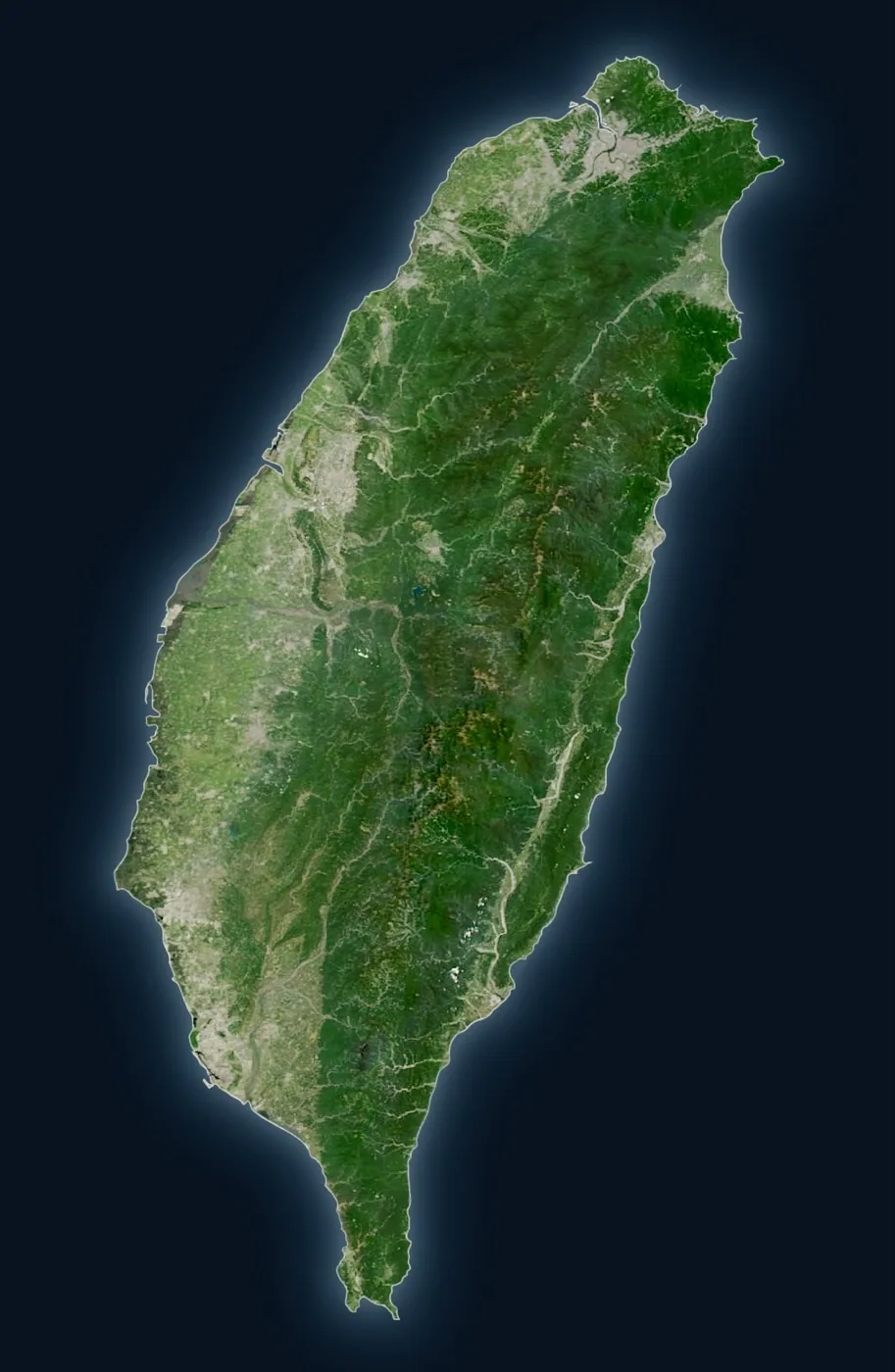
Drive from Taipei's Xinyi District, south and east all the way to Taitung City. Navigation shows 300-plus kilometers, under a day's drive. But if you watch a different gauge — how many people live in each square kilometer — that journey feels like crossing two countries. Xinyi's home, Taipei City, crams 8,975 people into every square kilometer. Taitung City's home, Taitung County, has just 59. Same island, same passport, density differs by a full 151 times.
This number isn't a cherry-picked extreme. It's Taiwan's real internal gap. We're used to talking about "Taiwan" as a monolith — its economy, its elections, its low fertility — but when you spread out the Ministry of the Interior's full 2025 year-end county-level dataset, you find there is no homogeneous Taiwan. Some queue at red lights in concrete jungles; others drive ten minutes without seeing a second car. Some jurisdictions are still growing; most are shrinking. In the youngest corners, elderly and children are roughly equal. In the oldest, one child faces nearly three elders.
This article does one thing: use official data to draw a scaled, verifiable portrait of the whole island. When finished, you'll see a face deeply divided and rapidly aging. 1
30-second overview: Taiwan's total population at 2025 year-end was 23,299,132 (approx. 23.3 million), declining for 23 consecutive months, with newborns falling below 110,000 for the first time. That same year Taiwan officially entered "super-aged society" status — one in five people over 65. But the national average masks massive internal gaps: population density between highest and lowest jurisdictions differs by 151×, population scale by 297×, elderly-to-children ratio from 1:1 to nearly 3:1. People concentrate in the six special municipalities, yet aging doesn't follow density: the highest elderly share is in the densest Taipei City, the highest elderly-to-children ratio in Chiayi County, the youngest places are Hsinchu County and City propped up by Hsinchu Science Park. This is a divided, and together-aging, Taiwan. 2
Seven-Tenths of People, Three-Tenths of Land
Start with an easily overlooked fact: Taiwan's people actually live extremely concentrated.
At 2025 year-end, the six special municipalities (Taipei, New Taipei, Taoyuan, Taichung, Tainan, Kaohsiung) together housed 16,278,931 people, 69.87% of the national total. In other words, nearly seven of every ten Taiwan residents live in the six special municipalities. Yet these six municipalities' combined land area accounts for only 30.12% of Taiwan's total. Seven-tenths of people, squeezed into three-tenths of land. The remaining three-tenths of people scattered across the other seven-tenths of land. This is the first structural feature of Taiwan's population distribution.
Source: Ministry of the Interior Department of Household Registration population statistics (2025 year-end total population, 65+ share, six special municipalities population share) and special municipality upgrade data 13
This 70-30 pattern didn't form naturally; it has a clear institutional starting point. On December 25, 2010, Taiwan rewrote its administrative map in one stroke: Taipei County upgraded to New Taipei City, Taichung County and City merged, Tainan County and City merged, Kaohsiung County and City merged, joining the existing Taipei City — five special municipalities born simultaneously. Four years later on December 25, 2014, Taoyuan upgraded to become the sixth. In just four years, Taiwan went from two special municipalities to six, and the balance of resources, budgets, and construction tilted accordingly. 3
Upgrading was never just a name change. Special municipalities receive far higher general grants, personnel quotas, and autonomous financial resources than ordinary counties and cities. Where construction goes, job opportunities grow, and young people move. Institutions drew a line first; population flowed along it afterward. Today's six-municipality concentration is, to some extent, the fruit borne a dozen-plus years after that 2010 restructuring.
The chart below breaks down "where Taiwan's people live" more clearly. New Taipei City alone holds 17.4% of the national population, Taichung 12.3%, Kaohsiung 11.7%, Taipei 10.5%, Taoyuan 10.1%, Tainan 7.9% — the six special municipalities sum to nearly seven-tenths. The other 16 counties and cities scattered across the island, from north to the outlying islands, together account for just 30.1%.
Source: Ministry of the Interior Department of Household Registration, 2025 year-end
Stare at this waffle chart a bit longer and a question emerges: what kind of life do that 30% scattered across 70% of the land live? The answer hides in density.
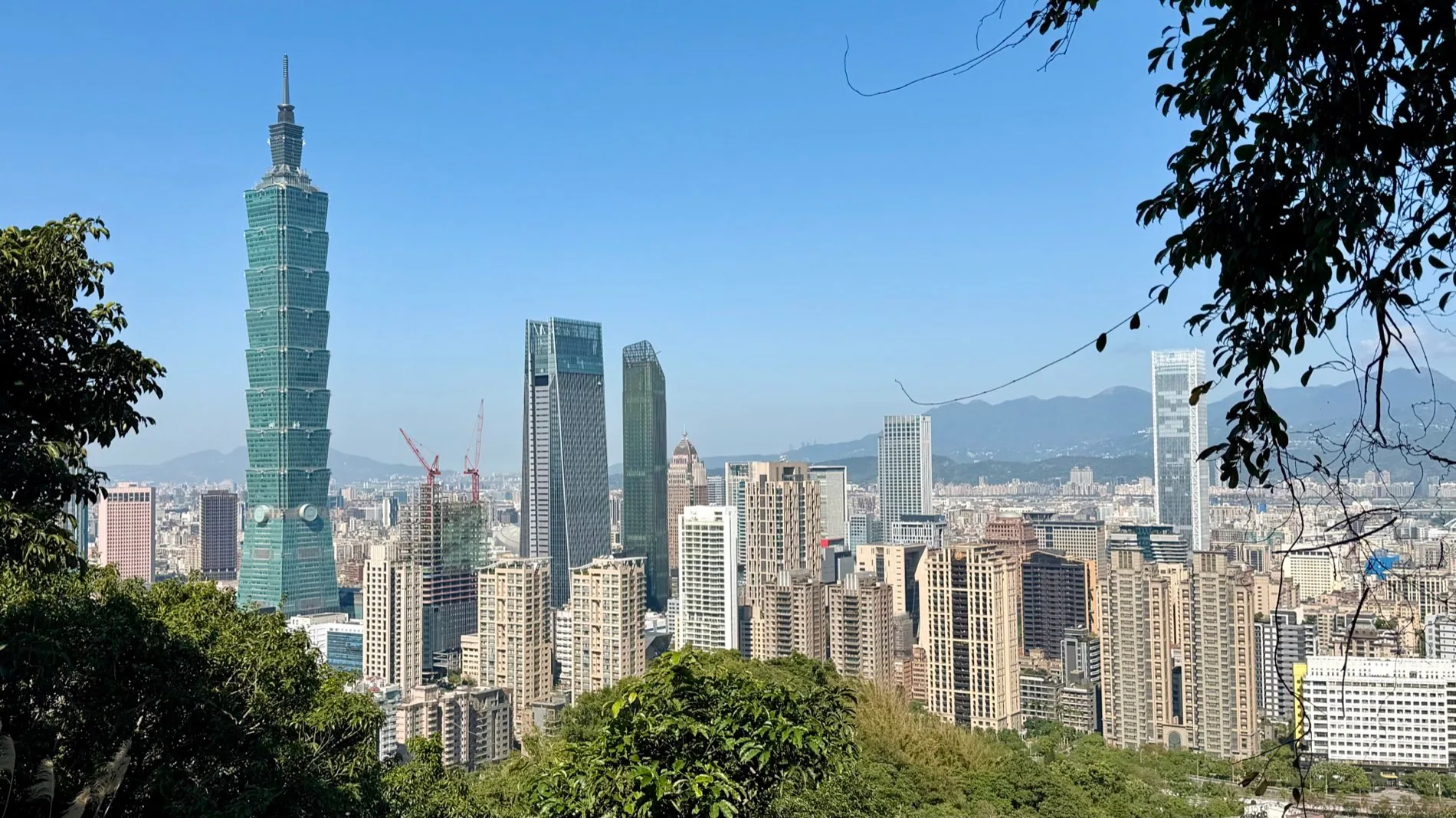
Taipei City's skyline. The densest jurisdiction in Taiwan, packing 8,975 people into every square kilometer. Photo: Heeheemalu, CC BY-SA 4.0 via Wikimedia Commons.
From Most Crowded to Most Empty, a 151× Gap
Population concentration speaks to "how many people"; density speaks to "how crowded." The latter lets you feel the distance between two Taiwans more viscerally.
Taipei City's 8,975 people/km² makes it Taiwan's most crowded place. Taipei's crowding is daily life: MRT packed at rush hour, waiting two light cycles at intersections, buildings tall and narrow. Next, Hsinchu City at 4,376 people/km², not even half of Taipei. Then Keelung City at 2,710. Just among these three most crowded cities, density already drops off a cliff.
Source: Ministry of the Interior Department of Household Registration, 2025 year-end
Shift your gaze to the other end of this bar chart, and the gap truly takes shape. Changhua County at 1,126 people/km² is already relatively dense for an agricultural county. By Hualien County, the number falls to 68. At the very bottom, Taitung County has just 59 people per square kilometer. The number of people Taipei fits in one km² would take 151 km² in Taitung to match. This is the true face of the 151× gap — you drive from Xinyi all the way to Taitung, watching the population thin out outside your window.
Behind this lies a geographic fact propping it up. Taiwan's largest county by area is Hualien County, 4,628 km², nearly the entire eastern flank of the Central Mountain Range. Large area, few people, many mountains — Hualien and Taitung's densities are naturally diluted to the national lowest. Meanwhile the smallest, Lienchiang County (Matsu), is only 28.8 km². Density is half human choice, half terrain's prior determination.
Conventional talk often equates "high population density" with progress and "low density" with backwardness, but this correspondence actually reverses cause and effect. Taitung's low density isn't because it failed to develop; it's because it backs onto great mountains and faces the Pacific, inherently a geographically vast, sparsely populated condition. Hualien's "emptiness" contains Taroko, the Coastal Mountain Range, Taiwan's most intact hinterland landscapes. Density numbers only tell you how crowded people are; they don't tell you the land's value. Line up all 22 jurisdictions from crowded to empty and you see an island growing different ways of life on different terrains.

_Taitung Chishang's Brown Boulevard. The island's emptiest county, 59 people/km², one-151st of Taipei. Photo: Sinchen.Lin, CC BY 2.0 via Wikimedia Commons._
Giants and Specks
If density compares "how crowded," population scale compares "how big." The gap on this dimension is even more staggering.
Taiwan's most populous is New Taipei City at 4,044,831 — a single city rivaling many countries. The least populous is Lienchiang County (Matsu) at just 13,621. New Taipei's population is 297× Lienchiang's. Move all of Lienchiang's people into New Taipei and they wouldn't even fill a rounding error. Same Republic of China passport, but one county's "whole" is a mere speck in another's eye.
This scale gap directly becomes a governance challenge. New Taipei must handle transport, housing, long-term care, and waste for four million; Lienchiang must figure out how to keep a 13,000-person outlying island from continuing to lose population, how to maintain a single hospital, how to keep the last ferry sailing. The same laws, the same central policies, applied across a 297× population gap, land completely differently. When we say "local government," we instinctively picture urban scale, but a fair number of Taiwan's counties and cities run an entire government machinery at speck-scale.
But watch for an intuitive trap: small scale doesn't mean young population. You might think outlying islands and small counties, losing young people and left with elders, are both small and old; and that big cities, with resources and opportunities, are both big and young. Real data overturns both assumptions. Lienchiang County has the smallest population, yet its aging rate is 17.14%, lower than several large counties; while Taipei City, fourth most populous and bustling beyond words, has the highest aging rate in Taiwan at 24.18%. Between scale and aging, there is simply no clean correspondence. To understand how Taiwan ages, you need a different map.
The Two Oldest Places: Taipei City and Chiayi County
In 2025, Taiwan crossed a threshold: national 65+ population share reached 20.06%, officially becoming a "super-aged society" per WHO definition. That translates to 4.67 million people over 65 — one in five Taiwan residents is an elder. And among the 22 jurisdictions, 14 already have aging rates above 20%. Old has become the shared base color of the whole island.
But this national 20.06% average flattens violent internal differences entirely. The table below lays out all 22 jurisdictions' aging rates and aging indices side by side — the one table in this article most worth pausing to study. First, how to read "aging index": it equals 65+ population divided by 0–14 population times 100. A value of 100 means equal numbers of elders and children; the higher the number, the more "top-heavy" the place — more elders above, fewer children below.
| County/City | Aging Rate 65+ (%) | Aging Index |
|---|---|---|
| Taipei City | 24.18 | 202.06 |
| New Taipei City | 19.95 | 185.54 |
| Taoyuan City | 16.72 | 127.33 |
| Taichung City | 17.40 | 136.45 |
| Tainan City | 20.48 | 184.96 |
| Kaohsiung City | 20.79 | 192.10 |
| Keelung City | 22.28 | 240.21 |
| Hsinchu City | 16.16 | 106.59 |
| Chiayi City | 19.90 | 164.47 |
| Hsinchu County | 15.08 | 101.88 |
| Miaoli County | 20.23 | 179.56 |
| Changhua County | 20.37 | 178.35 |
| Nantou County | 22.66 | 224.64 |
| Yunlin County | 21.76 | 206.78 |
| Chiayi County | 24.11 | 291.69 |
| Pingtung County | 21.84 | 218.72 |
| Yilan County | 20.77 | 189.67 |
| Hualien County | 21.52 | 200.53 |
| Taitung County | 20.93 | 194.71 |
| Penghu County | 21.03 | 223.65 |
| Kinmen County | 19.69 | 255.57 |
| Lienchiang County | 17.14 | 180.23 |
Source: Ministry of the Interior Department of Household Registration, 2025 year-end
By 65+ share, the oldest nationally is Taipei City at 24.18%, with Chiayi County at 24.11% just 0.07 percentage points behind. Switch to aging index and first place becomes Chiayi County at 291.69 — nearly three elders per child — followed by Kinmen County at 255.57, Keelung City at 240.21, while Taipei City's 202.06 drops to eighth. The two columns differ in denominator: aging index compares elders to children; Taipei's elderly share is high but its child share is also higher than Chiayi County's or Kinmen County's, pulling its index down.
The five jurisdictions ranking in the top seven on both columns are Chiayi County, Nantou County, Yunlin County, Pingtung County — four agricultural counties — plus Keelung City, an old port city where industry moved out. All five are losing population: young people leave for work and study, those left behind slowly age, newborns can't replenish, and both columns surge together.
So where is the island's youngest corner? The answer surprises many: not in some paradise, but beside tech fabs. Hsinchu County's aging rate is only 15.08%, lowest in Taiwan; aging index 101.88, nearly a 1:1 elder-child balance, strikingly exceptional amid island-wide aging. Hsinchu City at 16.16% and Taoyuan City at 16.72% follow close behind. These three places' youth share almost a single cause: Hsinchu Science Park. Semiconductor and tech industries draw large numbers of engineers and technical staff in prime childbearing years; they settle, have children, and forcibly pull these jurisdictions' population structures toward the young end. Hsinchu Science Park props up not just Taiwan's export figures, but the island's youngest demographic map.
Place the youngest Hsinchu County beside the highest-aging-index Chiayi County and the gap becomes more glaring.
Source: Ministry of the Interior Department of Household Registration, 2025 year-end
Hsinchu County 15.08% vs. Chiayi County 24.11% — aging rate differs by 9 percentage points; aging index 101.88 vs. 291.69 — nearly 3× difference. One still growing, population flowing in; the other continuously shrinking, population flowing out. Two counties on the same island: one where elders and children are roughly equal, another where every child has nearly three elders behind them. In Hsinchu's parks you might see young parents pushing strollers; in Chiayi's countryside, entire streets of slow-walking elders. Both Taiwans are calculated from the same household registration numbers.
Many think aging is a rural and outlying-island specialty, that big cities with many young people and opportunities should be immune. Taipei City's numbers say otherwise: this most prosperous, most resource-concentrated city in Taiwan has the highest elderly share nationally, and the highest aging index among the six special municipalities. The common explanation is housing prices — young families pushed to New Taipei and Taoyuan to marry and have children, leaving behind the generation that settled early and is now gradually aging. Urban prosperity doesn't block aging; it just ages in a different way. Aging is the shared condition of the whole island; the difference is only in timing and speed.
One Island, Aging Together
Pull the lens from counties and cities to the national level, and Taiwan's aging story has another more alarming dimension: speed.
Taiwan didn't just start aging now. In 1993, national 65+ share exceeded 7%, entering "aging society" per international definition. In 2018, it reached 14.05%, entering "aged society." In 2025, it broke 20%, becoming "super-aged society." Three milestones look like just three years, but inside hides a slope getting steeper.
Source: Ministry of the Interior population statistics and international aging threshold definitions (1993 7%, 2018 14.05%, 2025 20%) 1
Look at the two intervals on this timeline. From 7% to 14%, Taiwan took 25 years; but from 14% to 20%, only 7 years. This latter segment took less than one-third the time of the former. Taiwan is aging, and accelerating. This is precipitous even globally — other countries had decades to slowly adjust long-term care, pensions, medical systems; Taiwan is compressed into a mere seven years, forced to build an entire elder-care system in a very short window.
| Year | 65+ Share |
|---|---|
| 2000 | 8.6 |
| 2010 | 10.7 |
| 2020 | 16.1 |
| 2025 | 20.06 |
Source: Ministry of the Interior, National Development Council
This rising polyline shows the acceleration more clearly. 2000 national 65+ share was 8.6%, 2010 10.7% — ten years for just over 2 percentage points; but 2010 to 2020, the figure surged from 10.7% to 16.1%, and on to 20.06% in 2025. The line's tail is distinctly steeper than its head. Taiwan's aging curve is bending upward.
The flip side of aging is birth-end collapse. In 2025, Taiwan's newborns fell below 110,000 for the first time — just 107,812. Low fertility and high aging are two sides of the same coin: more elders above, fewer children entering below, the whole population structure grows relentlessly top-heavy. This is why those counties' and cities' aging indices are so high: elders multiplying above, children dwindling too far below.
📝 Curator's Note
We easily understand "population decline" as "young people move from countryside to city, so countryside shrinks and cities grow" — as if it's just an intra-island move. But 2025 data reveals something more fundamental: every single one of Taiwan's 22 jurisdictions has negative "natural increase." That is, in every Taiwan county and city, regardless of urban or rural, large or small, deaths exceed births. This is no longer about where people flow; it's about the whole island dying faster than it's born. In-migration and out-migration merely redistribute an already-shrinking population; they create no new people.
This fact deserves pause. In 2025, only four jurisdictions still grew: Taoyuan, Hsinchu County, Taichung, Hsinchu City. And their growth came entirely from "social increase" — in-migration from elsewhere, absorbing other jurisdictions' people, not from their own births. Beyond these four, the other 18 all shrank. The steepest declines: Kinmen County, Lienchiang County, Taipei City — note, even the most prosperous Taipei City is on this loss list. When births can't cover deaths in every corner of the nation, those four still-growing jurisdictions are merely standing temporarily on others' losses.
This is why total population has declined 23 consecutive months, falling to 23,299,132. It's synchronous contraction across the whole island, every jurisdiction shrinking. The difference is only that some places prop up the scene temporarily with in-migration, while others don't even have that buffer.
The Portrait Data Draws
Return to that opening drive. From Taipei Xinyi to Taitung, people per km² drop from 8,975 to 59, like crossing two countries. Now you know that's not just a density gap. Along that route, population scale shifts from giant to speck. Aging doesn't follow density either: departure point Taipei has the highest elderly share nationally; arrival point Taitung sits in the middle on both columns. The only constant: wherever you stop in any jurisdiction, local deaths already exceed births.
This is Taiwan's 2025 portrait: a face highly divided, yet aging together. Internal gaps are staggering — density 151×, scale 297×, elder-to-child ratio from 1:1 to nearly 3:1 — yet the fundamental predicament is strangely consistent: the whole island dies faster than it's born, total population shrinking 23 straight months, crashing from aged to super-aged society in seven years. The National Development Council's projection says, under medium variant, by 2070 Taiwan's total population will drop to 14.97 million, 65+ share reaching 46.5%; 2028, the demographic dividend ends. This portrait won't improve on its own. 4
Acknowledging Taiwan's internal heterogeneity this deeply is to see the island's true challenge: a place with such vast internal differences must use one policy set to simultaneously care for four million squeezed in a basin and 13,000 guarding an outlying island, while facing both the youngest Hsinchu County and the highest-elderly-share Taipei City and Chiayi County. It's divided, yet must act as a whole; it's aging, yet must find ways together. Data has drawn this face; how to respond to this face is the question the island must answer together.
Further Reading
- Taipei City — Taiwan's densest (8,975 people/km²), also highest 65+ share (24.18%), protagonist on both density and aging tables in this article.
- Taitung County — Taiwan's emptiest (59 people/km²), 3,515 km² third largest nationally, includes Green Island and Orchid Island.
- Chiayi County — Aging index 291.69 highest nationally, nearly three elders per child, 65+ share 24.11% second only to Taipei City.
- Hsinchu County — Aging rate 15.08% youngest nationally, Hsinchu Science Park pulling population structure toward youth.
- Taiwan Low Fertility Crisis — The birth-end of this portrait: newborns below 110,000, the other side of island-wide deaths exceeding births.
Image Sources
This article uses 3 images: hero is NASA public domain satellite imagery (cached in public/article-images/), two inline are Creative Commons licensed (Wikimedia Commons), all attributed:
- Taiwan Main Island Satellite Imagery (NASA 2020 mosaic) (hero) — NASA, Public domain.
- Taipei City Skyline (densest section) — Photo: Heeheemalu, 2026, CC BY-SA 4.0.
- Taitung Chishang Brown Boulevard (emptiest section) — Photo: Sinchen.Lin, 2016, CC BY 2.0.
References
- Ministry of the Interior Department of Household Registration, Population Statistics Data (114 year-end / 2025-12-31, each county/city population, land area, population density, 65+ population ratio, aging index). Sum of 22 jurisdictions' populations 23,299,132 matches official total exactly. https://www.ris.gov.tw/app/portal/346↩23
- Central News Agency / Ministry of the Interior, "Taiwan Officially Enters Super-Aged Society," 2026-01-09. Reports 2025 year-end total population 23,299,132, 65+ share 20.06% (4.67 million), Taipei City highest at 24.18%, Hsinchu County lowest at 15.08%, 2025 newborns 107,812. https://www.cna.com.tw/news/ahel/202601090098.aspx↩
- Ministry of the Interior, 2010 Five Special Municipalities Upgrade (Taipei County upgraded to New Taipei City, Taichung County-City merged, Tainan County-City merged, Kaohsiung County-City merged, effective 2010-12-25); Central News Agency, "Taoyuan County Upgrades to Special Municipality, Inauguration December 25," 2014-12-15. https://www.cna.com.tw/news/firstnews/201412150027.aspx↩2
- National Development Council, "Republic of China Population Projections (2024–2070)," released 2024-10-17. Under medium variant, Taiwan enters super-aged society in 2025, demographic dividend ends in 2028 (working-age population below 2/3 of total), 2070 total population falls to 14.97 million, 65+ share 46.5%. https://www.ndc.gov.tw/nc_27_38548↩