
30-second overview: At five in the morning, the oyster racks off Dongshi are still in the water; half of the nation's oysters come from this stretch of sea. A hundred kilometers away on Alishan, the tourist train leaves Chiayi Station and climbs the 66.6-kilometer mountain railway that opened in 1912 toward Erwanping. In between, beside Taibao's high-speed rail station, the Southern Branch of the National Palace Museum took 15 years to open in 2015; three years later, annual visitors had fallen from 1.47 million to 760,000. In 1991, the Chiayi County seat moved from Chiayi City to Taibao. Thirty-five years later, when people across Taiwan hear "Chiayi," they still think of turkey rice in Chiayi City. This county of 490,000 people surrounds a city of 270,000 that was carved out of it, with an aging index of 174%, the highest in Taiwan. The Tsou are in the mountains, oyster farmers are by the sea, and the high-speed rail is in the middle. None of them is the protagonist of this county.
At Five in the Morning, No One Is Yet at the Oyster Racks off Dongshi
If you ask someone from Chiayi County when Chiayi County most resembles itself, he will not tell you about the sunrise over Alishan. The sunrise over Alishan belongs to tourists. He will tell you about the sea off Dongshi at five in the morning.
Dongshi Fishing Harbor sits at the mouth of the Puzi River. Beyond it lies a calm, shallow sea enclosed by Waisanding Sandbar. Bamboo poles tied with strings of oyster shells float on the waves; from a distance, they look like rows of combs stuck upside down in the water. Oyster farmers set out on rubber rafts at 4:30 in the morning, arrive beside the oyster racks at five, pull up the strings they tied the day before to inspect them, and pry off a few oysters into plastic buckets along the way1.
Dongshi Township is Taiwan's largest oyster-producing area, accounting for about 49% of national annual output2. Oyster shells come from nearby aquaculture farms in Luermen; roughly 90,000 tons of discarded oyster shells are produced each year, decomposed, reused, and returned to the next cycle of cultivation. The racks rely on Waisanding Sandbar to block the waves of the northeast monsoon, and on nutrients washed down by the Beigang River and Bazhang River to feed every oyster. The labor of one stretch of sea becomes half of Taiwan's grilled oysters, oyster omelets, and oyster fritters. When these dishes reach night market stalls, no one can say which sea they came from.
This is Chiayi County's most contemporary evidence of itself as a county. It is not Alishan. It is the plain and coast below Alishan. What the nation knows is the mountain; what lives by the sea is this county.

_Oyster racks at Dongshi Fishing Harbor, 2015-10-10. Photo: Malcolm Koo (Mk2010), CC BY-SA 4.0 via Wikimedia._
Zhuluo City Is Chiayi County's Ancestral Home, but It Was Never in the County
Chiayi County truly entered the historical record as a geographic unit in 1684, when the Qing court established Zhuluo County under Taiwan Prefecture.
That year, the 23rd year of the Kangxi reign, came one year after the Kingdom of Tungning had fallen. The Qing court divided Taiwan into one prefecture and three counties. Zhuluo County covered today's Chiayi County, Chiayi City, Yunlin County, and even areas farther north. The name "Zhuluo" came from the Chinese phonetic rendering of "Zhuluoshan Society," a settlement of the Hoanya, a Plains Indigenous group, located in what is now downtown Chiayi City and recorded in Dutch documents as Tirosen3. A century before Han settlers arrived in larger numbers, Yan Siqi had already led people ashore in 1621 at Benkang, between today's Xingang Township in Chiayi County and Beigang in Yunlin County, establishing "ten stockades" for reclamation. This was the earliest organized Han development in the Chiayi region4.
In 1786, the 51st year of Qianlong, Lin Shuangwen rose in revolt, and forces from north and south encircled Zhuluo City. During the two-month defense, Lian Heng's General History of Taiwan preserved a verbatim record of the siege: "Zhuluo was surrounded ever more tightly, with no food to be had; people dug up tree roots and boiled bean pulp to stave off hunger, yet their resolve to defend the city grew firmer"5. A year later, in 1787, Qianlong issued an edict conferring a new name, changing "Zhuluo" to "Chiayi" in recognition of "the loyalty and righteousness with which they defended the city to the death"6.
The problem is that the battle took place in what is now downtown Chiayi City, and the city was what the emperor named. Before Chiayi County and Chiayi City were divided in 1950, the Chiayi County seat was also in Chiayi City. In other words, Chiayi County's historical origin was never inside the county. Its ancestral address was the city later carved out of it.
From Qianlong's renaming to the county-city division of 1950, Chiayi County and Chiayi City shared a name, a memory, and a city wall. But in 1950, the grandparents of this symbiotic relationship split the household.
In 1912, Alishan's Timber Came Down from the Mountains of This County
In 1899, the Japanese discovered extensive old-growth cypress forests on Alishan. In 1906, the private Fujita-gumi received approval to begin construction, but on February 11, 1908, it announced suspension because of insufficient funds. In February 1910, the Imperial Diet of Japan approved state operation, compensating Fujita-gumi 1.2 million yen and taking the project back. In 1912, the line from Chiayi to Erwanping officially opened, running 66.6 kilometers. In 1914, it was extended to Zhaoping, near today's Alishan Station, completing the main line7.

Sunrise over Tashan, 2014-01. Photo: Peellden, CC BY-SA 4.0 via Wikimedia.
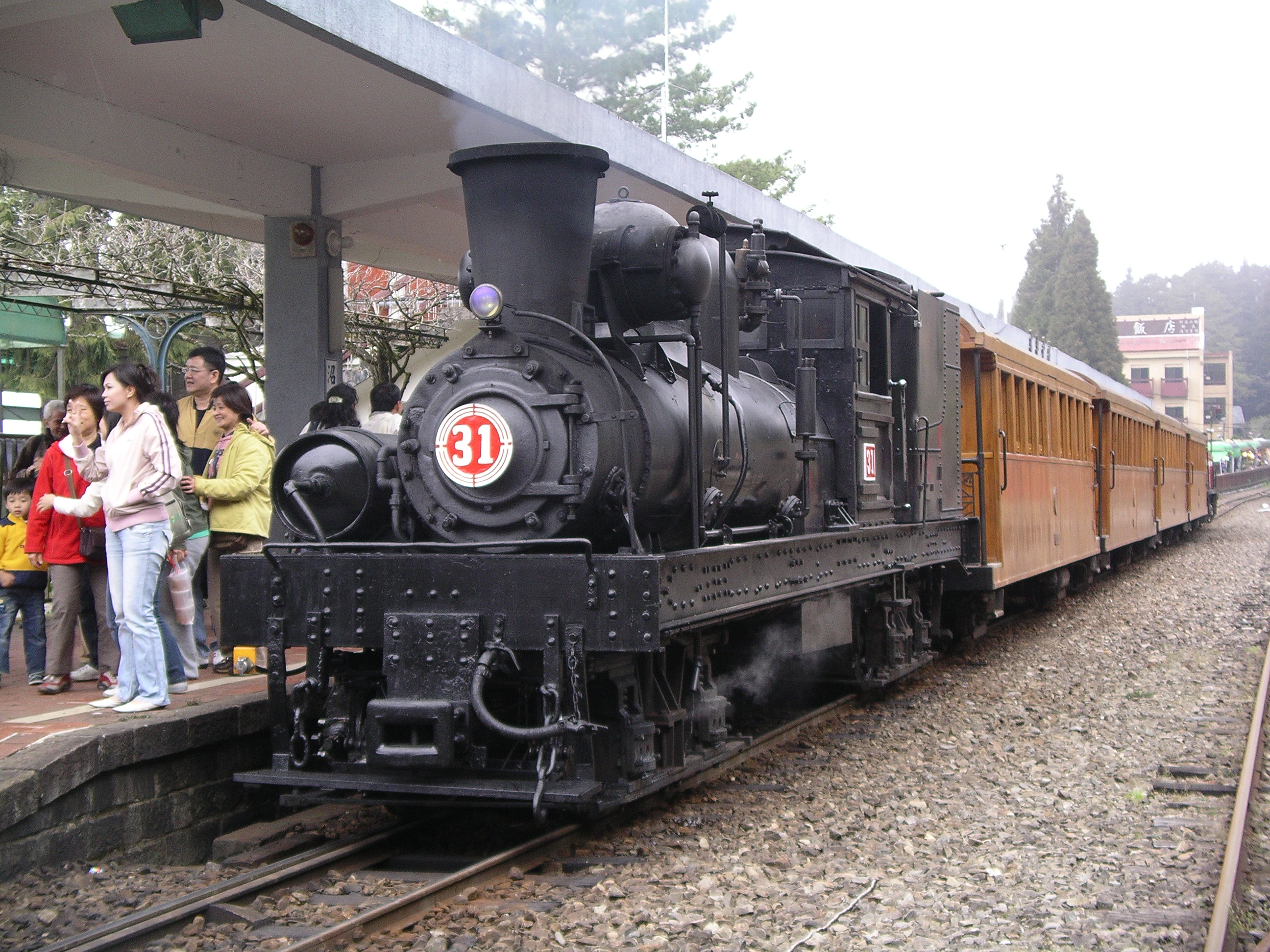
Steam locomotive at Zhaoping Station, 2008-03-23. Photo: Nils Öberg (Klockarnils), CC BY-SA 3.0 via Wikimedia.
This railway has two records found nowhere else in the world. First, it climbs from Chiayi City, at 30 meters above sea level, to Alishan, at 2,216 meters, an elevation difference of 2,186 meters. It uses four of the five major mountain railway techniques: spiral routing, zigzag switchbacks, omega-shaped loops, and specialized steam locomotives. It is "Asia's highest narrow-gauge mountain railway, and the railway with the greatest elevation gain in the world among 762mm-gauge lines"7. Second, the Dulishan spiral is certified by Guinness World Records as the world's longest railway spiral: around three loops of the mountain, covering about 5 kilometers and climbing 200 meters8.
The problem is that the railway's starting station, Beimen Station, is in Chiayi City, but nearly all of the mountains through which the tracks pass are in Chiayi County. Zhaoping Station, today's Alishan Station, is in Alishan Township; Erwanping and Fenqihu are in Zhuqi Township; and most logging sites, forestry dormitories, and transfer stations were located in the mountains of today's Chiayi County. In 1935, Chiayi City had 70,000 people, and "one-tenth of its population worked in the timber industry, making it Taiwan's fifth most populous and prosperous city at the time"9. But the mountain crews, forest police, and transfer-station workers who depended on this railway mostly lived in mountain settlements inside the county.
After the war, cypress exports remained at their peak until 1963. That year, the government announced a halt to large-scale logging in Alishan's forests, and the forestry era began turning toward tourism. On December 31, 1984, the Zhudong Forest District Office carried out its final timber harvest. In 1989, the central government banned logging in primary natural forests; in 1991, logging in natural forests was prohibited entirely9. In 2009, Typhoon Morakot devastated the main line of the Alishan Forest Railway, causing damage at 421 points and suspending full-line service for 15 years. Only on July 6, 2024, after repairs, did the Chiayi-to-Alishan line fully resume service, with a full fare of NT$600 and a total travel time of 4 hours and 56 minutes10.
From its opening in 1912 to its reopening in 2024, this railway carried Chiayi County's mountains down the slope, turned them into the great torii gate of Meiji Shrine in Tokyo, and then transformed them again into tourists' morning sunrise. But in those 112 years, one thing never changed: outsiders remember Alishan, not the county in which Alishan sits.
The Kuba in Tapangu Still Keeps Its Fire Burning; at Ankeng in 1954, There Were No Bodies to Bring Home
Alishan Township is the only mountain Indigenous township among Chiayi County's 18 townships, towns, and cities. Its main residents are the Tsou.
Traditional Tsou society centers on the hosa, or major community. Dutch colonial records from 1621 already noted the existence of the two major communities of Tapangu and Tfuya, giving them a history of more than 300 years11. At the center of each major community stands a kuba, a men's meeting house and the center of religious, political, and economic activity. Only two kuba remain in Taiwan, at Tapangu and Tfuya. At their center is a hearth whose fire never goes out, symbolizing the enduring vitality of the people, and their gates face east toward the rising sun11.
Among the three major Tsou rituals, the war ritual Mayasvi ranks highest. Held at the Kuba, it asks the war god for martial strength. Tapangu's war ritual takes place around August to October, while Tfuya's is held around January to March. The two communities do not hold it at the same time, and the ritual has been listed as a nationally designated important folk custom11.

_Photographed by Torii Ryuzo, Tapangu, 1900. Photo: Torii Ryuzo (1870-1953), Public Domain via Wikimedia._
The name that brought the Tsou into Taiwan's modern history was Uyongu Yatauyungana, known in Chinese as Gao Yisheng.
Gao Yisheng, whose Tsou name was Uyongu Yatauyungana, was born on July 5, 1908, in Tapangu, Alishan12. In 1924, he entered Tainan Normal School. After graduating in 1930, he returned to teach at the Tapangu education office in Alishan, while also serving in a police role. During Japanese rule, he was already one of the few Tsou elites to have received a full modern education: he composed music, wrote poetry, and spoke Japanese and Mandarin. In October 1945, after the war, he became the first township chief of Wufeng Township, today's Alishan Township, while also serving as head of the Tapangu police post. He was the first to propose a vision of "high mountain autonomy"12.
After the February 28 Incident broke out in 1947, Chiayi gentry figure Lu Bingqin requested Tsou support on March 5. Gao decided to send Tang Shouren, Yapasuyongu Yulunana, born in 1924 and formerly an officer in Japan's Kwantung Army before the war, down the mountain with 100 Tsou youths. They were stationed at Horyuji, today's Chiayi Buddhist Hall13. These Tsou youths assisted Chiayi militia forces in confronting government troops at Shuishang Airport and the Hongmaopi arsenal. On March 10, as negotiations dragged on and reinforcements kept arriving, Tang led the group back to Alishan. After the incident, Gao was arrested, then later released after efforts by Atayal leader Los Watan and others13.
Five years later, the Nationalist government came for him again. On September 10, 1952, the Taiwan Garrison Command arrested Gao Yisheng, Tang Shouren, Du Xiaosheng, and others on charges of espionage for the communists and corruption. The charge was "attempting to overthrow the government by illegal means and beginning to carry it out"14. On February 8, 1954, President Chiang Kai-shek approved the death sentences. The Reporter's "Echoes from a Distant Valley" preserved the verbatim record: "At 2:30 p.m. on April 17, 1954, they and the Atayal Lin Ruichang and Gao Zezhao, defendants in the same case, were bound by the Taipei Military Police and taken to the Ankeng execution ground, now the Third Public Cemetery in Xindian District, where they were executed by firing squad"14.
In prison, Gao wrote a song called "Princess Saho of Spring" (Haru no Saho-hime) for his wife, Yukawa Haruko. "Haru," meaning spring, was his wife's name; in Japanese, "Saho-hime" is a protective goddess of spring. ⚠️ There are two accounts of when it was composed: one says he wrote it for his wife before his imprisonment in the 1940s; another says he wrote it in 1952, after imprisonment, while longing for his wife. Mata Taiwan presents both accounts on the same page15. At the end of a prison farewell letter, he wrote: "My spirit is always watching over the fields and mountains. Do not sell the paddy fields"14. In old age, his wife Yukawa Haruko had dementia, but when their daughter sang "Princess Saho of Spring," she immediately became lucid and hummed the entire song along with her.
📝 Curator's Note: In Chiayi County, the Tsou are geographically one township. In Taiwanese history, they are among the groups most thoroughly silenced. The Tsou youths who came down the mountain in 1947 to help Chiayi's plains militia appeared seven years later on a death list personally signed by Chiang Kai-shek. What Gao Yisheng left behind was not a political manifesto, but a Japanese song for his wife. It is hard to find a quieter form of resistance. Today, tourists go up Alishan on a railway laid by the Japanese in 1912, watch the high-mountain sunrise at 2,216 meters, and eat Fenqihu railway lunchboxes. But they are not told that this mountain's ancestral address is the Kuba of Tapangu, and that down in the county there are still 6,600 Tsou living by their own ritual calendar. The mountain belongs to tourists; the mountain's memory belongs to the Tsou.
The County Seat Is in Taibao, but No One Has Been to Taibao
In October 1950, the Nationalist government changed Chiayi City into a county-administered city, established the Chiayi County Government, and provisionally placed the county seat in the former Chiayi City16. Thirty-two years later, in July 1982, Chiayi City was upgraded to a provincial city, formally separating the county and city. Former county magistrate Tu Deqi left one comment on this division: "What was originally a modestly comfortable household has now become two poor households"17.
After the county-city division, the Chiayi County Government remained suspended for nine years in an office building inside Chiayi City, because the new county seat had not yet been built. In December 1981, the Chiayi County Council voted to approve Dongshiliao Farm in Taibao Township, former Taiwan Sugar Corporation land, as the site of the new county seat. During the process, "coastal-district councilors temporarily introduced an added proposal for Taibao Township"; in the end, Taibao won with 27 votes, exceeding a majority and defeating competitors such as Minxiong and Puzi17.
From resolution to relocation took a full ten years.
In July 1991, Taibao Township was reorganized as Taibao City. In November of the same year, the Chiayi County Government officially moved to Xianghe New Village in Taibao City. The official history page of the Chiayi County Government preserves this first-hand record: "In July of the 80th year [1991], Taibao Township was reorganized as Taibao City; in November, the county government moved to Xianghe New Village in Taibao City"18.
Note the year. It was 1991, not 1995. The latter was the year Chiayi City Government renovated the former Chiayi County Government building for use as its city hall, and it is often confused with the year the county seat moved out18.
After moving the county seat, Chiayi County made another unusual decision: it placed the county council in a different city. In September 1992, Puzi Township was reorganized as Puzi City because the county council moved there. The county council is in Puzi, the county government is in Taibao, and the two are about 3 kilometers apart. This is Chiayi County's distinctive structure of a "split county seat"17.
To outsiders, this structure is almost nonexistent. Ask where the Chiayi County seat is, and most passersby will answer, "Chiayi City, right?" Ask about Taibao, and most people think of the high-speed rail station, not the county government. Ask about Puzi, and anyone who knows it has Peitian Temple enshrining Mazu, and that the place name comes from a story of Lin Ma bringing a Mazu statue from Meizhou in 1682 and passing beneath a thousand-year-old pu tree by Niuchou Creek, is already a Chiayi local expert19.
Taibao City currently has about 38,000 people as of 2023, and its 10-year population growth rate is 5.1%, making it one of the few areas among Chiayi County's 18 townships, towns, and cities with positive population growth, in contrast to the county's overall population decline20. But 38,000 people cannot sustain the feeling of a city. Taibao's urban area is nothing like the mid-sized city people usually imagine. Along the roads are mostly low houses and farmland; beside the high-speed rail station are newly built science-park factory buildings, with the Southern Branch of the National Palace Museum wedged in between. It is not a city; it is a three-piece set: a high-speed rail station, the Southern Branch of the National Palace Museum, and a TSMC plant.
The Southern Branch of the National Palace Museum Took Fifteen Years to Build; After Opening in 2015, Its Visitors Fell by Half
In 2001, the National Palace Museum proposed a central-southern branch plan and received 20 applications from 14 agencies. Eight sites entered the preliminary selection, and three were shortlisted: Zuoying in Kaohsiung, Taibao in Chiayi, and Xitun in Taichung21.
In January 2003, Premier Yu Shyi-kun announced that Taibao City, Chiayi County, had been selected21. There were three reasons: the land had originally belonged to Taiwan Sugar Corporation and was easy to acquire; it aligned with the nearby high-speed rail special district; and it would "balance north and south, and share cultural resources more equitably." ⚠️ Two dates must be distinguished: the Southern Branch's official website states that "the Executive Yuan approved it on December 15, 2004," whereas the January 2003 date was the "announcement of site selection." The difference is between "announcing the site" and "formal approval"21. During those 22 months, local politics, budget review, and land acquisition were still in contest.
What followed was 15 years of political tug-of-war.
During the Chen Shui-bian administration, from 2003 to 2008, Kuomintang legislators froze the budget. "In October 2006, multiple legislators planned to freeze the Southern Branch's 2007 budget, exceeding NT$440 million"22. The project, originally expected to open in 2008, was delayed because of the budget freeze. During the Ma Ying-jeou administration, from 2008 to 2016, the Chiayi County Government set up a countdown timer outside the planned site reading, "Countdown of XXX days to President Ma Ying-jeou's promised spring 2012 completion and opening." After the promise was missed, the timer counted negative days22. In 2009, Typhoon Morakot caused the Puzi River to swell, flooding parts of the planned Southern Branch site and requiring a reassessment of flood control. That same year, Ma administration museum director Chou Kung-shin announced that the Southern Branch would be repositioned as a "museum of floral culture," provoking strong protests from County Magistrate Chen Ming-wen and others. The "Asian art and culture museum" positioning was eventually restored22.
On December 28, 2015, the Southern Branch of the National Palace Museum formally opened during trial operations. It officially opened to the public on April 15 the following year21.

Southern Branch of the National Palace Museum, 2015-12-29. Photo: B2322858, Public Domain via Wikimedia.
Crowds surged in the opening year. In 2016, visitors numbered about 1.47 million. But the next three years formed a downward curve: about 970,000 in 2017, a 34% decline; about 760,000 in 2018; and, according to a 2019 Central News Agency report, "the Southern Branch of the National Palace Museum had more than 1.04 million admissions in 2019"23. ⚠️ Because of the pandemic, complete verbatim annual report figures from 2020 to 2023 have not been fully made public across multiple sources23.
✦ "What was originally a modestly comfortable household has now become two poor households" (former county magistrate Tu Deqi on the 1982 division of Chiayi County and Chiayi City)17
The controversies during the opening period piled up one after another: a bowl of beef noodles at the museum restaurant priced at NT$500 was criticized as excessive; replicas of the twelve zodiac animal heads from the Old Summer Palace donated by Hong Kong actor Jackie Chan were displayed in the atrium, causing controversy, with former Government Information Office minister Hsieh Chih-wei criticizing them as "insulting all the people of Taiwan," and they were removed and placed in storage after the Tsai Ing-wen administration took office in 2016; there were water leakage problems in the building; and the BOT case, signed with Huaxi Corporation for a cultural and creative experience hall plus hotel, ended amid controversy22.
The Southern Branch's architecture itself is a handsome design. Architect Kris Yao, of Artech Architects, transformed three techniques of Chinese calligraphy, dense ink, flying white, and ink wash, into three streamlined volumes: a solid volume for exhibition spaces, a void volume for glass public spaces, and an ink-wash volume for connecting spaces. In 2021, it was selected by ArchDaily as one of the world's 100 most influential buildings24.
But attractive architecture and visitor memory are different things. This complex, produced by 15 years of political tug-of-war and built in Taibao, Chiayi County, stands alongside the Alishan train, from 1912, and THSR Chiayi Station, from 2007, as the county's tourism strategy across three eras. Three layers of tourism landscape are stacked together, but none was built for "Chiayi County itself." The little train is Chiayi City's brand, the Southern Branch is the state's brand, and high-speed rail is the mass-transit brand. Chiayi County's 490,000 people live among these three brands, without one of their own.
Dongshi Oyster Fields, Budai Salt Fields, Puzi Peitian Temple: Three Other Worlds of 490,000 People
What outsiders do not know is that the coastal half of Chiayi County exists entirely outside the Alishan narrative.
The history of salt fields in Budai Township can be traced to 1824, the fourth year of Daoguang. Zhounan Salt Field was opened that year and later became one of Taiwan's six major postwar salt fields, operated by the Taiwan Salt Works. In 2001, Budai Salt Field ceased salt production entirely. In 2007, the abandoned salt fields were designated by the Ministry of the Interior as "Budai Salt Fields Wetland," a nationally important wetland25.
After production ended, salt workers dispersed. But in 2008, the Budai Mouth Cultural Association brought veteran salt workers back to the fields and promoted the "Zhounan Salt Field" brand, including handmade salts such as fleur de sel, frost salt, and algae salt, turning a vanished occupation into preservable memory25. From 2017 onward, large numbers of solar panels were installed on the abandoned salt fields, triggering controversy over coastal landscape change. Today, looking inland from Budai Fishing Harbor, rows of blue photovoltaic panels on the horizon have replaced the white glare of the former salt fields. It is one of the most direct traces of Taiwan's energy transition on the landscape.

Budai Salt Mountain, 2013-08-27. Photo: Pbdragonwang, CC BY-SA 3.0 via Wikimedia.
Puzi City's memory is older still. Puzi Peitian Temple was founded in 1682. The place name comes from the story of Lin Ma, who brought a Mazu statue from Meizhou, passed beneath a thousand-year-old pu tree by Niuchou Creek, today's Puzi River, and received Mazu's indication that she wished to remain there. After the temple was built, "Puzijiao Street" formed around it19. For 330 years, Puzi's temple square and city center expanded outward in concentric circles, and it has remained an important node in the Yunlin-Chiayi-Tainan Mazu religious network. In 1992, Puzi Township was upgraded to Puzi City because the county council moved there, making it the other end of the "split county seat" formed with the Taibao city government.
Minxiong Township has a story with a darker air. The Liu Family Mansion, known as the Minxiong Ghost House, was built in 1929 by local gentry figure Liu Rongru, great-grandson of Liu Yugang, as a three-story Western-style red-brick residence in Yiqiao, Minxiong, in a "Taiwanese-Western eclectic" style. After the owner died in old age, his descendants did not live there; long abandoned, it later became the legend of "Taiwan's most famous haunted house." Today it has been transformed into Ghost House Cafe, a cultural and creative tourism site and landmark of Minxiong. Minxiong's Dapumei Precision Machinery Park is Chiayi County's main industrial settlement, located beside the Meishan Interchange of National Freeway No. 3 in Dalin Township and covering about 86 hectares26.
The geographic structure of Chiayi County can be divided like this:
- Western coast, saline lands: Dongshi Township, Budai Township, Yizhu Township; oyster fields, salt fields, fishing harbors, Mazu
- Chianan Plain, rice farming plus sugar industry plus high-speed rail: Taibao City, Shuishang Township, Minxiong Township, Xingang Township, Liujiao Township, Puzi City; county seat, science park, Peitian Temple, ghost house
- Western foothills of the Alishan Range, mountain areas: Alishan Township, Fanlu Township, Zhuqi Township, Meishan Township, Dapu Township, Zhongpu Township; Tsou, forestry, high-mountain tea, hot springs
Between these three geographic belts, dialects, livelihoods, seasonal rhythms, and religious networks scarcely overlap. Oyster farmers by the sea watch typhoon tracks and the tides at Waisanding Sandbar each year; the Tsou in the mountains watch the clouds over Tashan and the ritual calendar; Taibao in the middle of the plain watches the high-speed rail timetable and the progress of TSMC's P1 plant27. Three worlds are squeezed inside a county boundary of 1,901 square kilometers, and no one has given them a shared name except the administrative phrase "Chiayi County."
From the 1991 Move of the County Seat to Taibao to a 2026 Aging Index of 174%
Chiayi County is Taiwan's most severely aging county or city.
According to Department of Household Registration statistics from August 2024, Chiayi County had about 480,000 people28. ⚠️ The latest monthly report as of 2026 still requires separate verification, but the downward trend is clear: 543,000 people in 2009, 503,000 in 2019, and 480,000 in 2024. Over 15 years, the county lost about 60,000 people, equivalent to an entire mid-sized township disappearing28. Its aging index reached 174.29% in 2016, compared with a national average of around 100%, making it the most severely aging county or city in Taiwan28.
The population problem is not just a matter of numbers.
The rate of social increase has been negative year after year. Young and working-age adults move to Taipei and Taichung, and cross-county commuting is high. Agricultural employment accounts for 23.62% of jobs in Chiayi County, compared with a national average of 5.4%, making it one of the counties with the highest agricultural employment shares in Taiwan27. In other words, among those who remain in the county for work, nearly one in three is a farmer. But agriculture's share of GDP has long failed to keep pace with industry and services. A county where 23.62% of employment is agricultural is destined to face the twin curves of "farmers getting older" and "young people getting fewer."
Weng Chang-liang was elected county magistrate in 2018 and reelected in 2022. His governing slogan is "a major agricultural and industrial county": bringing in TSMC's advanced packaging plants at Chiayi Science Park, developing a national drone team, and encouraging agricultural technology29. TSMC announced two CoWoS advanced packaging plants at Chiayi Science Park. The P1 plant is expected to complete equipment installation in Q3 2025; P2 is expected to be completed in 2026; both plants are expected to enter mass production in 2028 and create 3,000 jobs27. In 2024, Weng's administrative satisfaction score was 84, according to CommonWealth Magazine, one of the highest among county and city leaders29.
The problem is this: Can 3,000 jobs in a county of 480,000 draw back the young and working-age people who have left? TSMC offers high-paying jobs with high technical thresholds, but the distance between those jobs and Dongshi oyster farmers, old salt workers in Budai, and Alishan tribal residents is much greater than 3,000 positions can bridge. Chiayi County's greatest problem is not a lack of jobs. It is that the three worlds inside the same county, coast, plain, and mountains, define "work" differently, while the new industry recognizes only one of them.
The county seat is in Taibao. The Southern Branch of the National Palace Museum is in Taibao. THSR Chiayi Station is in Taibao. TSMC's science park is also in Taibao. For 35 years, this county has concentrated every external force into this small city of 38,000 people, hoping it will grow a new core. But Taibao still does not feel like a city. It has a city's signboard and the minimum population threshold of a city, but not the lived texture of one: no crowds out shopping, no shops still lit at night, no identity marker of "I grew up in Taibao."
📝 Curator's Note: For 35 years, Chiayi County has actually been doing something very large: it has been "building itself a new county center." The county seat moved in 1991; THSR Chiayi Station opened in 2007; the Southern Branch of the National Palace Museum opened in 2015; Chiayi Science Park launched in 2022; TSMC's P1 plant is scheduled to move in equipment in 2025. Each step is a national-level investment of resources, but the benefits of each step are absorbed by foreign tourists, northern commuters, and people paying into central government policy. When a Taibao resident drives past the Southern Branch of the National Palace Museum at dawn, what he is most likely thinking is, "The nation's Southern Branch of the National Palace Museum just happens to be next to my house." The identity marker "our representative building of Chiayi County" has never truly attached itself. Giving a piece of capital-city power to a locality is 21st-century Taiwan's political goodwill. But where goodwill lands does not necessarily become the texture of life in that place. The fate of 490,000 people does not lie in 3,000 CoWoS jobs. It lies in whether this county can find its own face again.
Those 490,000 People Did Not Go Up the Mountain
Return to the oyster racks off Dongshi with which this began.
At 5:30 in the morning, the first rubber raft comes ashore, and oyster farmers carry today's buckets of oysters to the washing area on land. At the same time, 70 kilometers away on the Fenqihu platform, the first tourist train bound for Alishan Station is loading passengers; most of the carriages are filled with tour groups from Japan and Korea, and student groups from northern Taiwan. Another 30 kilometers north, beside THSR Chiayi Station in Taibao, cleaners at the Southern Branch of the National Palace Museum have already swept away yesterday's footprints, preparing for today's opening.
Three places, three groups of people, three ways of life, one morning in the same county.
Dongshi oyster farmers say they are "working the sea" in Taiwanese Hokkien; Tsou elders on Alishan say they are "guarding the hosa," maintaining the major community in Tsou; engineers in Taibao's science park say they are "doing the packaging fab," in a mix of Mandarin and English. The three groups speak three languages and live no more than 60 kilometers apart each day, yet the stories they belong to are independent and do not intersect. Chiayi County is the container for these three stories, but it is not the protagonist of any one of them.
Thirty-five years of the county seat in Taibao. Thirty years of planning for the Southern Branch of the National Palace Museum. Eighteen years of THSR Chiayi Station. One hundred and twelve years of the Alishan train. Each of these dates has lasted longer than the time this county itself has been noticed. Each narrative has more SEO power than the three words "Chiayi County."
Next time you go to Chiayi, do not hurry into a taxi for Chiayi City after arriving at THSR Chiayi Station. Walk ten minutes out of the station to the Southern Branch of the National Palace Museum, and stand before its three streamlined volumes while considering one thing: this building is not in Taipei or Taichung. It was built on a piece of former Taiwan Sugar Corporation land in this county. Then turn back and look at the skyline of Taibao City: low houses, scattered factory buildings, no Taipei 101, no Grand Hotel, no landmark that would let a stranger glance at a Google Maps screenshot and recognize, "Ah, this is Taibao."
This is the face of Chiayi County. It has lent the nation's face to Alishan, yet cannot find a face of its own. But that is all right. Dongshi's oysters still belong to this county, Tapangu's Kuba still belongs to this county, and Puzi's Mazu still belongs to this county. They do not need to be recognized by the whole nation in order to continue existing.
Counting from Qianlong's renaming in 1787, 239 years have passed. Chiayi County's ancestral address has never truly moved away from Chiayi City, but this county's 490,000 people still live through their mornings every day.
Further Reading
Internal contexts of Chiayi County:
- Alishan: An Imperial Forest and the Mountain of Uyongu Yatauyungana — The forest railway that opened in 1912 and Gao Yisheng at the Ankeng execution ground in 1954: two stories of this mountain
- National Palace Museum — The larger context of the Southern Branch as an attempt to "balance north and south"
- Chen Cheng-po — The painter who died in front of Chiayi Railway Station in 1947, another side of the Chiayi episode of the February 28 Incident
- Hatta Yoichi — The 1920-1930 Chianan Irrigation工程 that turned this county into Taiwan's granary
Larger historical coordinates:
- February 28 Incident — Taiwan's island-wide political tragedy of 1947; the Tsou coming down the mountain to help maintain order is among its least-told chapters
- Taiwan's White Terror — The place of Gao Yisheng and Tang Shouren at the Ankeng execution ground in Xindian in 1954
- History of Railways in Taiwan — The special position of the Alishan Forest Railway in Taiwan's railway development
- Chiayi City — The provincial city completely surrounded by Chiayi County, and the mirror image of 76 years of separation from this county
- Keelung City — The first article in the 22 Counties and Cities series, another city "pressed down by the capital framework," useful for comparing two different fault lines
Image Sources
This article uses six Wikimedia Commons images, under a mix of CC BY-SA and Public Domain licenses, all hot-linked from commons.wikimedia.org:
- Hero, frontmatter: Tashan in morning glow — Sunrise over Tashan, a traditional sacred mountain of the Tsou at 2,663 meters inside the Alishan National Forest Recreation Area. Photo: Peellden, 2014-01. CC BY-SA 4.0.
- Scene §Dongshi oyster racks: Oyster Trellis at Dongshi fishing habour — Oyster racks and tourist boat at Dongshi Fishing Harbor. Photo: Malcolm Koo (Mk2010), 2015-10-10. CC BY-SA 4.0.
- Scene §Alishan Forest Railway: Alishan station with Steam train — SHAY steam locomotive and cypress carriages, the Cypress Train, at Zhaoping Station. Photo: Nils Öberg (Klockarnils), 2008-03-23. CC BY-SA 3.0.
- Scene §Tsou: Tsou, Alishan, Taiwan 1900 (No.7425) — A pottery-making woman in Tapangu, photographed by Torii Ryuzo in 1900, one of the earliest photographic records of Taiwan's Indigenous peoples. Public Domain (Torii Ryuzo, 1870-1953; copyright expired).
- Scene §Southern Branch of the National Palace Museum: Southern Branch of the National Palace Museum main building and zhimei bridge — Main building of the Southern Branch of the National Palace Museum and Zhimei Bridge. Photo: B2322858, 2015-12-29. Public Domain.
- Scene §Budai salt fields: 嘉義布袋鹽山 — Salt mountain accumulated from the evaporation ponds of Budai Salt Field. Photo: Pbdragonwang, 2013-08-27. CC BY-SA 3.0.
References
- Introduction to oyster cultivation at Dongshi Fishing Harbor — Chiayi County Aquaculture Fisheries Development Association — Distribution of oyster racks from the Puzi River mouth to Waisanding Sandbar; the aquaculture workflow of setting out on rubber rafts at 4:30 a.m.; and an introduction to the natural advantages of Waisanding Sandbar as a barrier against the northeast monsoon.↩
- Overview of Taiwan's oyster industry — Fisheries Agency, Ministry of Agriculture — Official statistics showing Dongshi Township, Chiayi County, accounts for about 49% of Taiwan's annual oyster production; analysis of cultivation conditions including the Waisanding Sandbar barrier, nutrient transport from the Beigang and Bazhang rivers, and clean water quality without heavy industry.↩
- Establishment of Zhuluo County and the Hoanya Zhuluoshan Society — Cultural and Tourism Bureau, Chiayi County Government — Official historical account of the Qing court's establishment of Taiwan Prefecture and Zhuluo County in 1684, the 23rd year of Kangxi, covering today's Chiayi County and City plus parts of Yunlin; the origin of the county name "Zhuluo" as the Chinese phonetic rendering of the Hoanya "Zhuluoshan Society"; and Dutch records of Tirosen.↩
- Yan Siqi's 1621 landing at Benkang — Xingang Township Office, Chiayi County — Official historical record of Yan Siqi leading people ashore at Benkang, between today's Xingang Township in Chiayi County and Beigang in Yunlin County, establishing "ten stockades" for reclamation, and serving as the earliest organized Han development in the Chiayi region.↩
- The Lin Shuangwen Rebellion — StoryStudio — Lian Heng, General History of Taiwan, juan 33, "Biography of Lin Shuangwen" — Original text on the hardship of defending Zhuluo, "with no food to be had, people dug up tree roots and boiled bean pulp to stave off hunger, yet their resolve to defend the city grew firmer," cited from.↩
- Historical edict changing Zhuluo's name to Chiayi — Official website of Chiayi City Government — Official version of the edict issued on the third day of the 11th month of the 52nd year of Qianlong, 1787, changing "Zhuluo" to "Chiayi" in recognition of "the loyalty and righteousness with which they defended the city to the death," a naming history inherited by Chiayi County.↩
- Historical development of the Alishan Forest Railway — Alishan Forest Railway and Cultural Heritage Office — Complete construction history: the discovery of old-growth cypress forest in 1899; Fujita-gumi's 1906 construction; the February 11, 1908 suspension for financial reasons; the 1910 Imperial Diet state-operation case with 1.2 million yen compensation; the 1912 opening of the 66.6-kilometer Chiayi-to-Erwanping section; and the 1914 extension to Zhaoping.↩2
- Dulishan spiral line Guinness record — Alishan Forest Railway official materials — Official information on the Dulishan three-loop spiral line, climbing 200 meters over about 5 kilometers; its Guinness World Records certification as the world's longest railway spiral; and its status as Asia's highest 762mm-gauge mountain railway.↩
- Chiayi Wood City, 1914-1963 — Smile Taiwan — In-depth report on the Wood City era: the 1914 opening of the Chiayi sawmill; one-tenth of the city's 70,000 people working in timber in 1935; the 1963 halt to large-scale logging in Alishan forests; the 1989 ban on logging in primary natural forests; the 1991 full ban on logging in natural forests; and cypress used for the great torii of Meiji Shrine.↩2
- Full-line reopening of the Alishan Forest Railway in 2024 — Forestry and Nature Conservation Agency — Official press release on Typhoon Morakot's 2009 devastation of 421 points along the line; the 15-year suspension; the July 6, 2024 full-line reopening from Chiayi to Alishan; a full fare of NT$600; and a total travel time of 4 hours and 56 minutes.↩
- Tsou major communities and Kuba culture — Council of Indigenous Peoples — Official Tsou cultural information on the two major communities of Tapangu and Tfuya; the Kuba men's meeting house; the ever-burning hearth; east-facing gate; Mayasvi war ritual held in Tapangu from August to October and in Tfuya from January to March; and the two Kuba as the only remaining examples in Taiwan.↩23
- Biography of Gao Yisheng (Uyongu Yatauyungana) — Encyclopedia of Taiwan Indigenous Peoples' History, Language, and Culture — Full biographical record: born July 5, 1908, in Tapangu, Alishan; entered Tainan Normal School in 1924; graduated in 1930 and returned to teach at the Tapangu education office; became first township chief of Wufeng Township in October 1945; and first proposed the idea of "high mountain autonomy."↩2
- Tsou Tang Shouren and the Chiayi episode of the February 28 Incident — Taiwan Historica — Official historical materials on Lu Bingqin's March 5, 1947 request for Tsou support; Tang Shouren leading 100 Tsou youths down the mountain to station at Horyuji; their assistance to Chiayi militia against government troops at Shuishang Airport and Hongmaopi arsenal; and their March 10 return to Alishan as negotiations dragged on.↩2
- Echoes from a Distant Valley: Tsou Without Choice and Forgotten Victims — The Reporter — Verbatim record of the September 10, 1952 arrest by the Taiwan Garrison Command of Gao Yisheng, Tang Shouren, and Du Xiaosheng on charges of espionage and corruption; Chiang Kai-shek's February 8, 1954 approval of the death sentences; the execution chronology of "2:30 p.m. on April 17, 1954"; and the farewell-letter text, "My spirit is always watching over the fields and mountains. Do not sell the paddy fields."↩23
- Dating Gao Yisheng's composition of "Princess Saho of Spring" — Mata Taiwan — Parallel record of two accounts of when "Princess Saho of Spring" (Haru no Saho-hime) was composed: before imprisonment in the 1940s for his wife, or after imprisonment in 1952 while longing for her; "Haru" as the name of his wife, Yukawa Haruko; Saho-hime as Japanese for "protective goddess of spring"; and related prison letters and final words.↩
- History of Chiayi County — Official website of Chiayi County Government — Official history recording the October 1950 change of Chiayi City into a county-administered city, the establishment of the Chiayi County Government with a provisional county seat in Chiayi City, the December 1981 county council vote selecting Dongshiliao Farm in Taibao Township as the new county seat, and the July 1982 upgrade of Chiayi City to a provincial city.↩
- The Fight over the Chiayi County Seat: 1982 Taibao vs. Minxiong — Medium, Yutaida Miscellany — Record of the 1982 county council vote, in which Taibao won with 27 votes; the temporary added proposal by coastal-district councilors for Taibao; former county magistrate Tu Deqi's original phrase, "What was originally a modestly comfortable household has now become two poor households"; and the split county-seat structure created by Puzi's 1992 upgrade to city status as the county council seat.↩234
- Timeline of the Chiayi County Government's move to Taibao — Official website of Chiayi County Government — First-hand source for the verbatim passage: "In July of the 80th year [1991], Taibao Township was reorganized as Taibao City; in November, the county government moved to Xianghe New Village in Taibao City"; and official correction of the confusion with "1995," the year Chiayi City Government renovated the former county government building for office use.↩2
- Puzi Peitian Temple and the Mazu religious network — Official website of Puzi Peitian Temple, Chiayi County — Official founding history: in 1682, the 21st year of Kangxi, settler Lin Ma brought a Mazu statue from Meizhou; passing beneath a thousand-year-old pu tree by Niuchou Creek, Mazu chose to stay; the temple was built; Puzijiao Street formed; and the temple became a node in the Yunlin-Chiayi-Tainan Mazu religious network over more than 330 years.↩2
- Taibao City population statistics — Taibao City Office, Chiayi County — Official population data showing Taibao City had about 38,000 people in 2023; a 10-year population growth rate of 5.1%; status as one of the few areas among Chiayi County's 18 townships, towns, and cities with positive population growth; and the influence of THSR Chiayi Station and the Southern Branch of the National Palace Museum.↩
- Decision-making and planning chronology of the Southern Branch of the National Palace Museum — Southern Branch, National Palace Museum — Official timeline: the 2001 proposal for a central-southern branch; 20 applications from 14 agencies; the January 2003 announcement by Premier Yu Shyi-kun selecting Taibao, Chiayi; the principle of "balancing north and south and sharing cultural resources equitably"; Executive Yuan approval on December 15, 2004; the December 28, 2015 trial-operation opening; and the April 15, 2016 official public opening.↩234
- The Southern Branch of the National Palace Museum Adrift among Taiwan, China, and Asia — Initium Media — In-depth political commentary on legislators freezing the 2007 budget of NT$440 million in October 2006; the Ma administration countdown timer and broken promise; the post-Morakot flood-control reassessment in 2009; the Chou Kung-shin "floral museum" controversy; the NT$500 beef noodles after opening; the Jackie Chan twelve zodiac animal heads dispute; the termination of the BOT case; and leakage problems.↩234
- Southern Branch of the National Palace Museum 2019 admission numbers — Central News Agency, 2020/1/4 — Official statistics reporting that "the Southern Branch of the National Palace Museum had more than 1.04 million admissions in 2019"; multi-year comparison of visitor trends: about 1.47 million in 2016, about 970,000 in 2017, a 34% decline, about 760,000 in 2018, and about 1.04 million in 2019.↩2
- Architectural design of the Southern Branch of the National Palace Museum — Kris Yao, Artech Architects — Design concept: architect Kris Yao transformed three Chinese calligraphy techniques, dense ink, flying white, and ink wash, into three streamlined volumes, with the solid volume for exhibition spaces, void volume for glass public spaces, and ink-wash volume for connecting spaces interwoven; selected in 2021 by ArchDaily as one of the world's 100 most influential buildings.↩
- Budai Zhounan Salt Field, 1824-2001 — Cultural and Tourism Bureau, Chiayi County — Complete salt-field history: Zhounan Salt Field opened in 1824, the fourth year of Daoguang; ceased production in 2001; was one of Taiwan's six major postwar salt fields; was designated by the Ministry of the Interior in 2007 as Budai Salt Fields Wetland, a nationally important wetland; the Budai Mouth Cultural Association launched the "Zhounan Salt Field" brand in 2008, including fleur de sel, frost salt, and algae salt; and solar photovoltaic controversies began in 2017.↩2
- Minxiong Ghost House and Dapumei Precision Machinery Park — Minxiong Township Office, Chiayi County — Official information: the Minxiong Ghost House, or Liu Family Mansion, was built in 1929 by Liu Rongru as a three-story Western-style red-brick residence in Taiwanese-Western eclectic style and has now become Ghost House Cafe, a cultural and creative tourism site; Dapumei Precision Machinery Park is located beside the Meishan Interchange of National Freeway No. 3 in Dalin Township, covers about 86 hectares, and is Chiayi County's main industrial settlement.↩
- Chiayi Science Park and TSMC CoWoS plants — Ministry of Economic Affairs press release, 2022 — Official plan: Chiayi Science Park formally launched in 2022 beside the high-speed rail station in Taibao City, covering 88 hectares and focusing on precision health, smart vehicles, and smart agriculture; TSMC P1 plant equipment installation in Q3 2025, P2 completion in 2026, mass production at both plants in 2028, and an expected 3,000 jobs. Chiayi County's agricultural employment share of 23.62% is cited from the same source's county government press release.↩23
- Chiayi County population statistics and aging index — Department of Household Registration, Ministry of the Interior — Household registration monthly statistics: Chiayi County population of about 480,000 in August 2024; 543,000 in 2009; 503,000 in 2019; a loss of about 60,000 over 15 years; aging index reaching 174.29% in 2016, compared with a national average of about 100%; and status as Taiwan's most severely aging county or city.↩23
- Weng Chang-liang administrative satisfaction — CommonWealth Magazine 2024 County and City Leader Administrative Satisfaction Survey — CommonWealth Magazine survey results covering Weng Chang-liang's first election as county magistrate in 2018 and reelection in 2022; the governing slogan "a major agricultural and industrial county"; TSMC's advanced packaging plants at Chiayi Science Park; the national drone team; agricultural technology; and a 2024 administrative satisfaction score of 84, among the highest for county and city leaders.↩2