
30-Second Overview: In 1994, Taiwan had 58 colleges and universities; fewer than 20% of eighteen-year-olds could attend a four-year university. The April 10 March called for the "broad establishment of high schools and universities," and the government opened the doors using the easiest method: allowing existing junior colleges to upgrade their status. Twenty years later, the number of institutions surged to 148, with net enrollment rates exceeding 70%, allowing women, disadvantaged students, and first-generation college students to enter. Then came the wall of a declining birthrate: student numbers peaked in 2012, but withdrawal regulations were not enacted until 2022. This experiment was designed only for opening; the rules for closing arrived ten years late. Today, as Gaofeng, Yongda, and Dijiang shut down, the bill falls on students and teachers with the fewest choices.
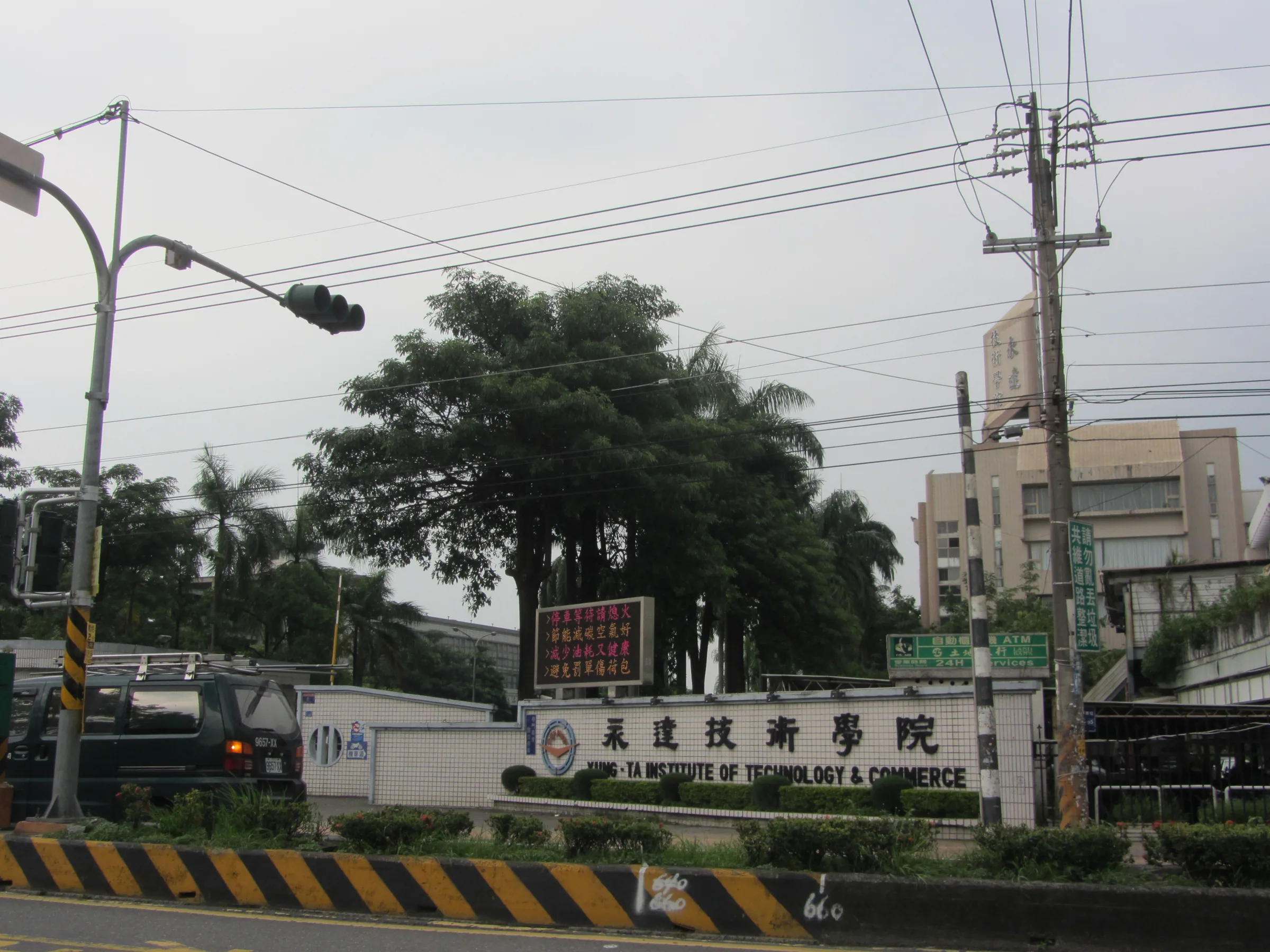
In the summer of 2009, a massive recruitment billboard stood in front of the Pingtung Railway Station, featuring the Yongda Institute of Technology. It was a common scene during Taiwan's era of mass expansion: private schools placed billboards in high-traffic areas, waiting to turn every young person walking out of the ticket gate into a new student. Five years later, Yongda ceased operations. The billboard was taken down, but the school gate remained, and the campus in Linlu Township fell silent.
One billboard opened the door with fanfare; one school closed it in silence. These thirty years tell the story of how Taiwan built an entire system of higher education on a foundation of goodwill, only to begin dismantling it when faced with the wall of a declining birthrate.
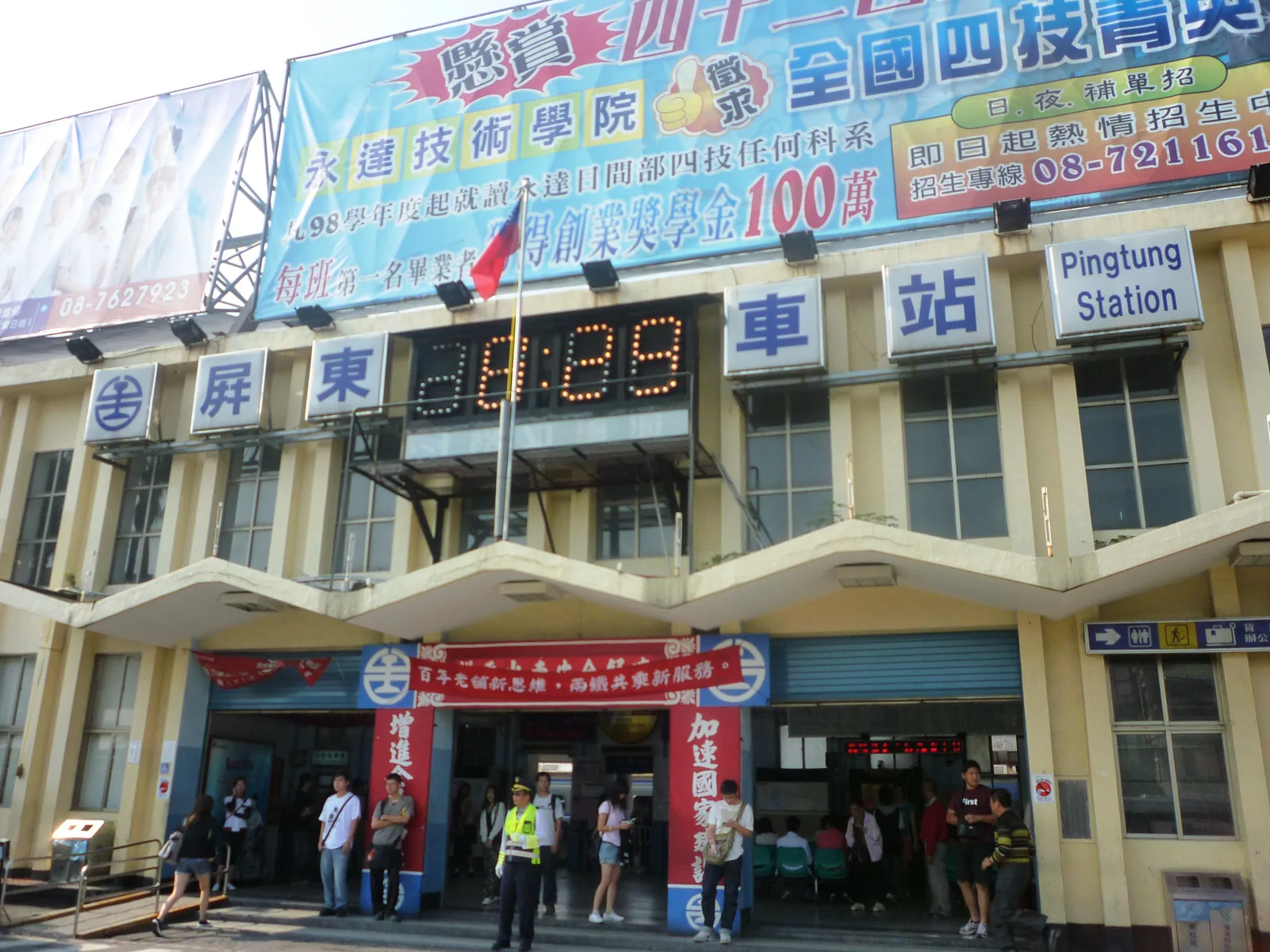
A recruitment billboard for Yongda Institute of Technology in 2009. During the expansion era, private schools competing for students was a common sight.
What the March Demanded vs. What the Report Provided
On April 10, 1994, over two hundred civil organizations took to the streets of Taipei. This march, later known as "April 10," demanded four goals: implementing small-class/small-school models, expanding the establishment of high schools and universities, promoting education modernization, and establishing a Basic Education Act 1. The "expansion of high schools and universities" was particularly striking because, in that era, university admission was an extremely narrow gate. Mathematician Huang Wu-hsiung, a key advocate, later recalled that in 1994, fewer than 18% of eighteen-year-olds in Taiwan could enter a four-year university 2. Most people were funneled into society after taking the joint entrance exams; a university degree was a privilege for the few.
The march demanded "expansion," but no one pinned down the specifics. When Huang Rong-chun, who took over the Ministry of Education later, was interviewed, he stated that the original intent of April 10 was actually for the government to establish more "public" universities 3. However, two years later, the Report on the General Consultation of Education Reform submitted by the Executive Yuan's Education Reform Committee explicitly stated a different direction: "The growth of public schools should be slowed, while private schools can be expanded significantly." 4
In one sentence, the direction of the door changed. The streets called for public doors; the report opened private ones. This was not a conspiracy, but a shift in policy discourse over two years. The "Nuclear-Style Reform Reporting System" (核定制改報備制) that circulated in rumors does not exist in official records; what remained in the documents was the phrase: "private schools can be expanded significantly." 4
📝 Curator's Note
The expansion of universities is often told as a story of "idealism vs. greed": idealists wanted to give children opportunities, while private school owners wanted to make money. However, looking at the original texts reveals that the true fork in the road wasn't between good and evil, but an unspoken choice: whether the door should be opened by the public or private sector. The streets chose public; the report chose private—the latter being the path that required the least government expenditure. Thirty years later, almost all of the costs are being settled at this junction that was never seriously debated back then.
When the direction changed, the first unsolvable problem emerged: who decided this direction? Li Yuan-che was the chairman of the Education Reform Committee at the time; in 2005, he apologized to the Legislative Yuan for the reforms, but his scope was narrow, stating that the committee could only submit reports and had no further influence. By 2024, he changed his stance, claiming the expansion was Huang Wu-hsiung's suggestion, saying it "ended up being blamed on me." Former President of Dongwu University, Liu Yuan-jun, rejected this claim, pointing out that all thirty-one members of the Education Reform Committee were selected by Li Yuan-che, and "not a single education scholar" was among them 5. Huang Wu-hsiung has defended "expansion" for years, insisting the concept itself wasn't wrong; rather, it was the subsequent unchecked upgrades and lack of supporting infrastructure that failed 2. Responsibility became like a ball passed between different people for twenty years, never landing. And whether the ball landed or not did not affect the truth of the next event.
The report described how higher education should expand, encouraging private initiatives and opening doors for private institutions. Yet, in the entire report, not a single page stated who would take over if they had to be closed one day. Years later, education scholar Li Feng-jü, looking back from the perspective of critical pedagogy, argued that this reform was dominated by market logic from the start, pushing higher education toward becoming a commodity 6. This is one interpretation. But to truly understand what happened to that door later, one must first see how it was opened. The answer was convenient: "Upgrading."
Universities Weren't Built; They Were Upgraded
To multiply the number of universities within a decade, the fastest method was not building new schools. Building a university requires land acquisition, construction, and hiring sufficient faculty—a time-consuming and costly process. Taiwan chose another path: allowing existing junior colleges and technical institutes to "upgrade" [^1]: junior colleges became technical institutes, which then became technology universities; the signs were changed once, and the status was raised by one level.
From 1994 to 2023, while many institutions appeared in Taiwan, only 36 were actually newly established; as many as 108 came from upgrades and restructuring, a ratio of roughly three-to-one 1. Some schools underwent three consecutive jumps: Xingwu Vocational School first became Xingwu Technical Institute, then Xingwu Technology University 1. A single diploma changed its name three times on the same campus.
| Academic Year | Universities | Junior Colleges |
|---|---|---|
| 83 | 58 | 72 |
| 85 | 67 | 70 |
| 90 | 135 | 19 |
| 100 | 148 | 15 |
| 108 | 140 | 12 |
| 112 | 133 | 12 |
Source: Ministry of Education Statistics, Written Report to the Legislative Yuan Education and Culture Committee (2024)
The flip side of the upgrade wave was the disappearance of junior colleges. In 1994, there were still 72 junior colleges in Taiwan; by 2023, only 12 remained 1. This disappearance began long before the withdrawal wave—it was a byproduct of expansion. Every junior college that upgraded to a technology university meant one less place in Taiwan for training skilled laborers and technicians. The vocational education system wasn't knocked down by the declining birthrate; it was diluted away in the tide of "university-fication."
Yan Chang-shou, Chairman of the Public Welfare Platform Culture Foundation, has strong views on this. He cited catering schools as an example: to upgrade to a university, a school must have at least three colleges. Schools forced themselves to add departments just to qualify for the upgrade, diverting resources that should have been invested in their core business: "Schools thought adding departments would help recruitment, but they ended up becoming their own worst enemies." 7 Students graduating from catering majors often switched careers, while the industry cried out for labor. This old question regarding education culture and technical value actually began earlier than the expansion of universities—it is tied to [education system and admission culture].
Upgrading was the cheapest way to open the door. It made opening fast, cost-effective, and politically easy; no one would oppose a local junior college "upgrading" to a university. However, after thirty years on this path, it was only when they had to turn back that they realized no one had built a road for the return trip. Vocational education paid the first bill, and when it was taken away, almost no one noticed.
Women, Disadvanted Students, and First-Generation College Students Truly Walked In
If the story ended here by saying "the door was opened incorrectly," it would miss something more important: the door did open, and people truly walked through it.
The group that benefited first from this door might differ from intuition. The fact that Taiwan's female higher education enrollment rate exceeded that of males is not a recent phenomenon. The Ministry of Education’s gender statistics analysis states clearly that "the trend of females exceeding males has continued since the 83rd academic year." 8 The 83rd academic year was 1995. It has been common for thirty years in Taiwan for women to enter universities and, more often than not, perform better than men. Many people mistakenly mark this intersection as 2015—a full twenty years too late.
📝 Curator's Note
Why is a fact from 1995 collectively remembered as 2015? Perhaps because "women surpassing men" sounds like news, and news always belongs to the "recent." But by placing it back in 1995, the significance changes: it happened even before the expansion of universities. The momentum for Taiwanese women to squeeze into the narrow gate of higher education existed before the door was pushed wide open. Expansion did not create this trend; it merely provided more space for it.
The net enrollment rate is another line. In 1991, only about twenty percent of the eligible population in Taiwan were attending university—a hallmark of elite education. In 2004, this figure crossed 50%, officially entering the "massification" stage defined internationally; by 2016, 46% of the population aged 25 to 64 held a degree higher than high school 9. The thirty years during which enrollment rose from under twenty percent to over seventy percent also meant that an entire generation became the first in their families to enter university.
The "Star Program" (Fen-xing) is a specific outlet of this door. In 2016, Hsuan Jun-yao from Miaoli's Zhuolan High School used a score of 48 on the General Scholastic Ability Test to gain admission to National Taiwan University’s Department of Forest Environment and Resources, setting a record for the lowest entry score for NTU via the Star Program. He said his thought at the time was "just to prove it to them—I can actually handle the studies." 10 Only after entering NTU did he realize, "At first, I really thought that because I came in with a label, everyone would look at me differently, but after some time, I realized no one cared." 10 When the door opens, the labels fade.
This is the most honest defense of this experiment. Because opening the door truly changed lives, "keeping the door open" looked like the rational choice every year. No Education Minister or parent would have been willing to take away the ladder for their own generation.
But honesty has another side. The door being open does not mean that what lies behind it was distributed equally to everyone. Lin Ming-ren, a professor of economics at NTU, found by correlating tax data and student records that children from households in the top 70th percentile had about a 1% chance of entering NTU; for those above the 90th percentile, the probability jumped to 5% or 6% 11. The door was open for everyone, but when standing before the best doors, family wealth still decided. The market value of the degree itself also changed: Ministry of Labor statistics show that in 2023, the starting salary for those with a university degree was about 33,000 TWD, only 5,000 more than those with a high school or vocational diploma 12. The dividends were distributed, but they became thinner.
Even if it was thin and unevenly distributed, the door still truly changed lives—this is precisely why it became so difficult later. Because the benefits were so real and widespread, when the wall of population finally appeared, no one was willing to shut the door first.
After Students Began to Decrease, the Withdrawal Rules Waited Ten Years
The door remained open, but the number of people in the classrooms began to dwindle.
The number of students in higher education followed a bell-shaped curve. In 1994, there were 720,000; it climbed steadily until peaking at approximately 1.355 million in 2012, and then began to fall, leaving only 1.095 million in 2023. The Ministry of Education estimates that by 2039 (the 128th academic year), there will be only 905,000 13. From the peak to now, this is equivalent to losing the entire student body of one NTU plus over a dozen medium-sized universities.
| Academic Year | Number of Students (10k) |
|---|---|
| 83 | 72 |
| 90 | 124 |
| 96 | 132.6 |
| 101 | 135.5 |
| 108 | 121.3 |
| 112 | 109.5 |
| 128 | 90.5 |
Source: Ministry of Education Statistics, Forecast Report on Students in Each Education Stage (128th academic year is an estimate)
The problem was not that no one saw this wall. It was seen very early. As early as 2003, the government followed a resolution from the National Education Development Conference to "temporarily suspend applications for new private universities" 1. This was the first brake, though it was pressed lightly and quietly. While late-stage private schools were failing to recruit students, the government simultaneously concentrated large amounts of competitive funding into top-tier universities; this competition for resources pushed weaker institutions further toward the margins 14. It wasn't until 2009 that the Ministry of Education officially acknowledged to the Legislative Yuan that "excessive number of schools and over-high admission rates" were major problems; in 2015, they produced the "Higher Education Innovation and Transformation Plan" 15. The Private Higher Secondary School Withdrawal Ordinance, which finally had legal status, was not passed until 2022. By that time, student numbers had been falling from their peak for a full decade.
Source: Ministry of Education, Legislative Yuan reports, Higher Education Evaluation Center, Central News Agency
The moment the threshold hit rock bottom was visible in the headlines. In 2007, during university placement based on the entrance exam, the Information Technology department at Dijiang Institute of Technology and Management had a minimum weighted score of 18.47; converted to the original total score, it was about 11.2 points—meaning one could be admitted with an average of 2.8 points per subject. They expected to recruit 66 people but only recruited 46 16. The following year in 2008, the Resource and Environment department at Lide University had a minimum score of 7.69; in the same report, Dijiang's Environmental and Occupational Health department "failed to attract any" (抱鴨蛋) students. That year, the university admission rate soared to 97.1%, hitting a historic high 16. "Getting into college with just a few points" became a joke for everyone.
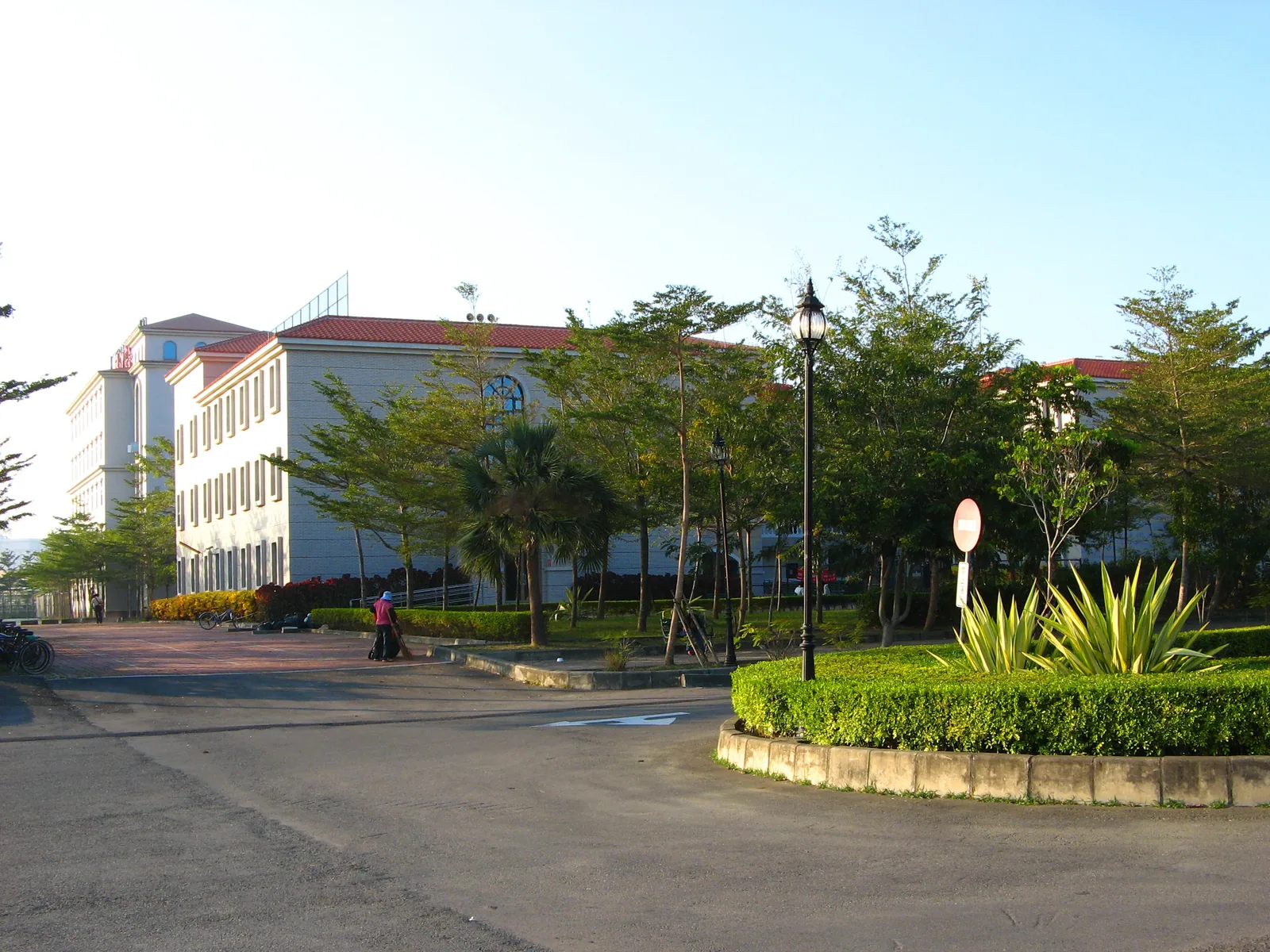
Dijiang Institute of Technology and Management campus (2008, Puzi, Chiayi). Due to its low-score admissions in 2007, it made headlines; it closed and transitioned into a long-term care institution in 2021.
Facing this joke, Huang Wu-hsiung's reaction differed from most. He wrote: "The phrase 'you can get into university with eighteen points on the exam' once became a popular joke. But what is there to laugh about? As an educator, what I see is: getting into university with 18 points means these children did not receive a good education in elementary and middle schools." 2 The same set of numbers can be read as "devaluation of degrees" or as "children let down by primary and secondary education." This debate has never stopped.
It is worth noting that the schools under the joke had different fates. Lide University did not simply "collapse." In 2011, it changed its name to Kaning University; in 2015, it merged with Kaning Nursing College; and in 2020, the Tainan campus stopped admitting students. The Taipei campus currently operating under the "Kaning University" sign is actually the lineage of the original Kaning Nursing College 17. Where the legend of getting into university with low scores went after that is far more complex than the phrase "the 7-point school closed."
Looking back at that series of policies, every brake was one beat slower than the population shift. No policy could stop the wall of the declining birthrate [Taiwan's low birth rate crisis]; the wall was always visible, but the problem was that this vehicle was designed without a brake pedal from the start—it only had an accelerator. The doors were not closed in time, and they eventually had to be closed in the most painful way: letting the schools fall while people were crushed underneath.
498 Were Relocated, but Only 339 Graduated
To understand "withdrawal," one must first understand where private school funding comes from. The vast majority of revenue for Taiwan's private universities comes from tuition fees. More students mean more tuition; schools can then pay teachers' salaries, repay bank loans, and maintain the campus. However, as the declining birthrate caused student numbers to drop year by year, this cash flow began to dry up: failing to recruit students meant being unable to pay salaries; once the cash flow was cut, the school could no longer sustain itself. Withdrawal is, ultimately, a situation where a school's cash flow reaches its end.
Pan Kun-zheng stood at that very end. In 2014, he was a senior student at Gaofeng Digital Content College, only one semester away from graduating. In February of that year, Gaofeng became the first higher education institution in Taiwan to close due to the declining birthrate. "I was just one semester away from graduating, and then the school ended. I was quite stunned when I found out," he later recalled 18.
In the policy dictionary, what happens next is called "relocation": students are transferred to other schools to continue their studies. But in a person's life, the word "relocation" looks different. Pan Kun-zheng was moved to Shude Technology University; he described those days of transferring: "Riding a motorcycle on mountain roads, and the bike wasn't very reliable at the time. The speed on the mountain road could only reach 30 or 40 kilometers per hour; it was very slow." 18 Two words lightly stated in a policy document became for one person a struggling motorcycle, a mountain road, and a semester that had to be retaken.
✦ There is no standard operating procedure (SOP) for closing. Doors do not close gently on their own; therefore, the cost is borne by humans as a buffer.
Furthermore, "relocation" does not equal "graduation." When Yongda Institute of Technology withdrew, there were 625 students across the school; 498 were relocated, but according to a 2017 Ministry of Education survey, only 339 actually received their diplomas. Nearly one-third of those who were relocated did not reach the finish line 19. This was not an issue unique to Yongda: for six private schools that closed between academic years 107 and 111, the dropout rate among relocated students was as high as 16.42%, compared to only 7.30% in general higher education institutions 20.
Source: PTS, Ministry of Education (via media reports)
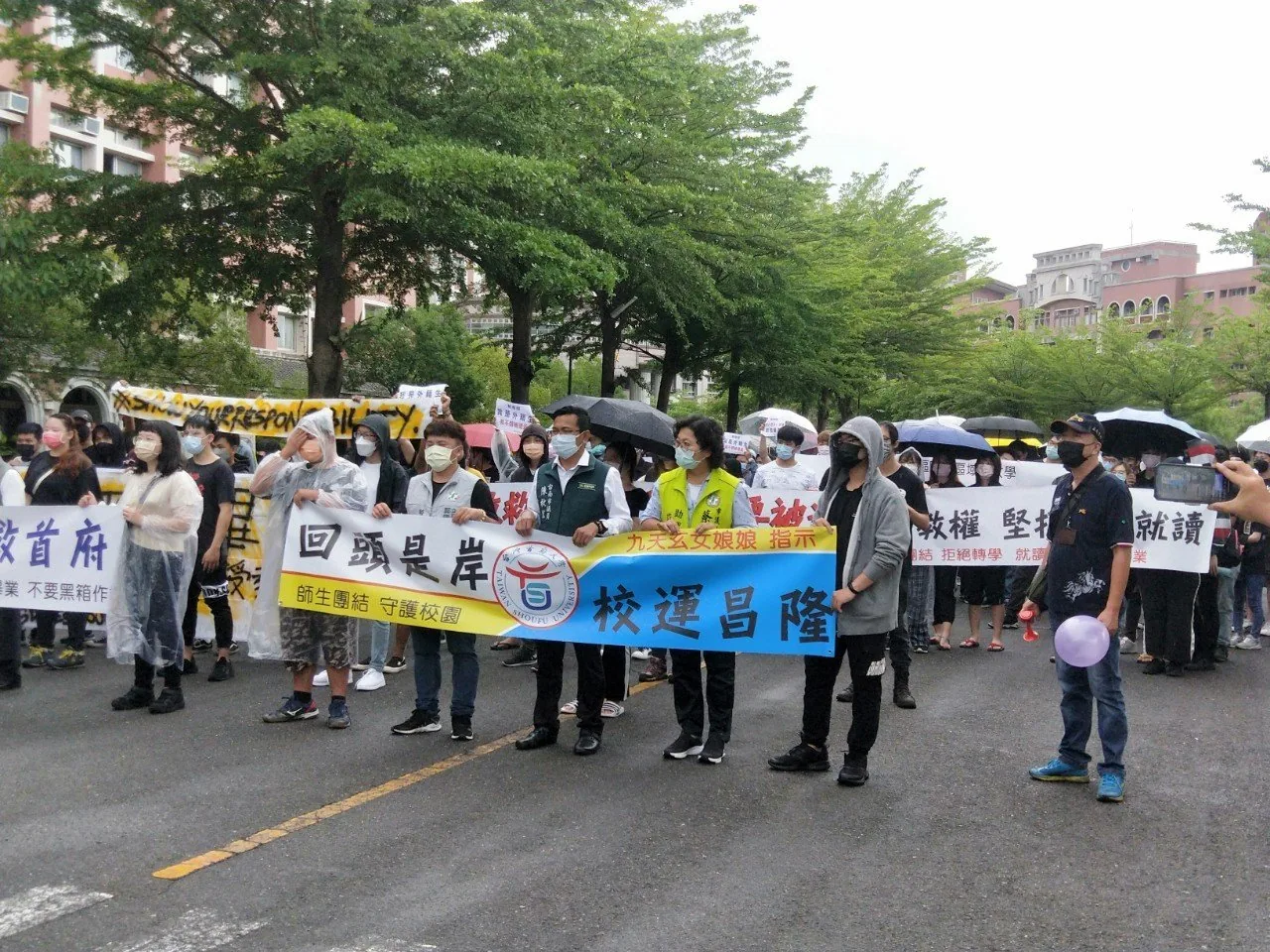
The Student Union of Taiwan Capital University organized a campus protest in 2022. In schools on the edge of withdrawal, students took action for their right to education.
Yang Dong-shou, a student at Global College of Technology, attributed his alma mater's closure to "failing to curb spending despite clearly being hit by the declining birthrate," and noted that promised housing subsidies and credit transfers were never fulfilled 21. Furthermore, the nature of withdrawal is not just about "not being able to hold on." During an investigation by the Control Yuan into Dahan Technical Institute, it was found that before its closure, the school in Hualien still had approximately 500 students, 26 teachers, and over 80 million TWD in campus funds. It did not run out of resources but still applied for closure—if withdrawal regulations cannot control these "running away while there is still room" situations, it becomes a moral hazard 22.
Beyond the students are the teachers. Of the 1,700 staff members from 17 recently closed private schools, only 14% successfully transitioned to new positions through the Ministry of Education's matching platform 20. Chen Po-hien, a researcher at the Higher Education Workers Union, put it more bluntly: "The number who can actually move to other schools as full-time faculty is likely in the single digits." 20 The rest of the 14% had to find their own paths. Zhang Yi-chung, a professor who left Taiwan Capital University, simply started his own business, arguing that departing professors should not be over-sympathized with 23; however, the figures from the matching platform show that only a few are able to walk away like that.
A deeper layer of the bill lies outside the walls of the withdrawing schools. In order to ensure there were enough classes for more than a hundred universities, Taiwan worked hard to cultivate PhDs during its expansion period; by the contraction period, this capacity became an excess in the entire system: among 3,000 to 4,000 new doctoral graduates each year, many could not find full-time faculty positions, and the proportion of part-time lecturers once approached ten percent, becoming "temporary workers" in the academic world 24. The people raised during expansion had nowhere to go during withdrawal. There has never been an SOP for closing; the human bill comes first, followed by the financial bill.
The 200 Billion That Still Haven't Been Calculated
When a university withdraws, many things are left behind: empty classrooms, land, buildings, and equipment. To whom these assets ultimately belong is one of the least calculated parts of this experiment.
The figures themselves are suspicious. In 2015, the Taiwan Higher Education Industry Union targeted sixty private institutions with the fewest teachers and, based on audits by certified public accountants, estimated that if these schools were all withdrawn, the total value of campus assets would reach as much as 200 billion TWD 25. However, when four schools actually withdrew in 2024, the actual inventory of asset values was approximately 7.7 billion 26. Between 200 billion and 7.7 billion lies a gap that no one has looked back to recalculate: "200 billion" was an estimate from ten years ago, not a current audit, yet it continues to circulate as if it were a present-tense fact.
Where did the assets go? Each case is different. The 2.368 billion TWD in assets of Zhongzhou Institute of Technology were all transferred to the Ministry of the Interior; the 2.483 billion TWD worth of assets from Oriental Design University were handed over to Kaohsiung Institute of Technology for a joint industrial-academic zone 26. The properties of withdrawing schools are either turned into public property or repurposed; there is no unified answer. In contrast, when Yongda withdrew, the withdrawal fund only covered 51.58 million TWD for the overdue civil service pensions and retirement benefits of 141 staff members 27. Assets in the hundreds of millions versus labor rights in the tens of millions are two different scales of accounts within the same withdrawal.
The operators of private schools on the front lines of withdrawal have their own arguments. In 2018, Tang Yen-po, Chairman of the Association of Private Technology Universities, called for Taiwan to "follow Korea's example," allowing a portion of the assets of withdrawn schools to return to their original foundations to be reinvested in other private schools or social welfare institutions 28. This claim is worth serious consideration, but it must be placed in its proper tense: Tang himself said that Korea was also "discussing" how to formulate withdrawal regulations. He cited a proposal under discussion, not an existing system; according to Korean media reports, it wasn't until 2023 that Korea moved toward amending laws to relax dissolution conditions and allow some remaining assets to return to original entities 29. Removing the "Korea" packaging, the core issue of this proposal remains unanswered today: would allowing a portion of assets to return to the original foundation provide a dignified incentive for withdrawal, or open a side door for the privatization of campus assets? The Higher Education Workers Union and the Association each hold one end, while Taiwan's legislators have yet to accept his version.
Are there specific cases of "stripping" foundations? This is a matter of fact that can be verified, not a question of stance where both sides are just arguing for their own interests.
⚠️ Controversial View
In 2015, CTBC Financial Holding used its Taiwan Lottery subsidiary to donate and take over the endangered Xingguo Management Institute, restructuring it into CTBC Financial Management Institute, allowing the school to survive. CTBC stated they "invested over 20 million in education public interest and never sought profit from it." However, a later ruling by the Tainan District Court determined that after CTBC took over, all 28 full-time teachers of the original Xingguo resigned; the school used an opaque "relocation plan" and misled teachers into signing early resignation contracts. The court ruled that the Higher Education Workers Union's criticism that "campus assets became a windfall" was a reasonable comment. The investment was a fact, and the lack of information identified by the court was also a fact. The most honest way to state this case is to separate the "facts found by the court" from the "qualitative judgments still being debated." 30
Returning to that 200-billion-dollar bill, the truth is only half of the story: no one recalculated the total, and the judiciary only confirmed the lack of transparency in specific cases; whether there was a systematic stripping of assets remains a matter of debate. This is the deepest layer of "not designing the closing": even after the doors closed, they were still arguing over who owned what while they were closing them.
💡 Did You Know?
Taiwan is not the only place dismantling universities. Korean media uses the term "Cherry Blossoms Fading in Order" (벚꽃엔딩) to describe how local universities in lower-latitude areas, where cherry blossoms bloom earlier, were the first to close due to the declining birthrate. According to Korean media statistics, between 2000 and 2024, Korea closed 22 universities 29. Across the Pacific, the United States is similar: between 2008 and 2023, nearly 300 higher education institutions closed, of which sixty percent were for-profit schools 31. The declining birthrate does not discriminate by country; it's just that Taiwan opened its doors much faster and more widely, so the collision with the wall was particularly loud.
When opening the doors, no one asked: "If these schools have to close one day, who do these lands and assets belong to?" That silence of the past is now being answered by every withdrawing school. So, after thirty years, what has this society learned?
The Report Cards are Kept, but Teachers and Students are Still Looking for Places
Looking at the report cards again: Has this society learned how to close? The answer is half-truth.
One half was indeed caught by the system. Article 20 of the Withdrawal Ordinance clearly stipulates that when a school closes, student records must be permanently preserved and transferred to designated schools. Since 2018, the Ministry of Education has commissioned National Kaohsiung University of Education to establish a "database for student records of withdrawn schools." Graduates of closed schools can apply for transcripts online for 20 TWD and degree certificates for 100 TWD 32. The alma mater disappeared, but the paper proving you studied there remains. This is a genuine design that ensures people are caught; withdrawal does not equal a vacuum of records.
Chong-hua Elementary School is another way of "catching." After Gaofeng's withdrawal, the land was taken over by the Yiguan Road Tian-Huang Foundation and became Chong-hua Elementary School in 2016—the first "university turned into an elementary school" in Taiwan. The declining birthrate killed the university with one hand and required primary schools with the other; a different set of younger children now occupies the same campus. Dijiang Institute of Technology and Management transformed into a long-term care foundation, and the vacated campus welcomed older people.
But the other half is where people are still finding their own places. That 16.42% dropout rate and that 14% teacher transition rate speak to the same thing: while someone keeps the documents, people are still looking for positions. And the collision with the wall isn't over yet. The Ministry of Education estimates that by 2040 (the 129th academic year), only 146,000 freshmen will remain 33; starting in 2028, the selection ratio for university applications will be adjusted from 3 to 4 to allow more candidates to make it to the second stage 33. As for further ahead, since 135,000 were born in 2024 and only 108,000 in 2025, this cohort of children will hit the ceiling of new university students in eighteen years (around 2042-2043). However, this is beyond the scope of official Ministry estimates and can only be inferred from birth rates 13.
If you are a parent trying to check if the school your child applies to is safe, you will find one thing: the Ministry of Education does not proactively disclose a complete list of warning signs or schools requiring special guidance 20. You want to check, but you can't. This in itself is a silent answer regarding "who universities exist for."
The story returns to Pan Kun-zheng. Ten years have passed, and he is 33 years old, working as a real estate agent. When others ask about his education, he used to mention Gaofeng, but "many people don't know what Gaofeng is, and it takes a long time to explain, so later he stopped mentioning it proactively and just says he graduated from Shude Technology University" 18.
Gaofeng, as an institution, left two positions in the world. One is in the database managed by National Kaohsiung University of Education, where a transcript costs 20 TWD and can be retrieved at any time. The other is in Pan Kun-zheng's self-introduction—a name he no longer speaks out loud.
Opening the doors took Taiwan ten years. Learning how to close them has taken thirty years—and it is still being learned. That recruitment billboard in front of Pingtung Railway Station was long ago torn down, but the gates of Yongda still stand on the side of the road in Linlu Township. Between opening and closing, what remains are always the people.
Further Reading:
- Taiwan's low birth rate crisis — The demographic wall that knocked over universities: how it formed and where it is headed
- Education system and admission culture — The narrow gate of joint exams and the culture of academic competition; what the expansion of universities sought to loosen was exactly this.
- Learning Poverty — After the popularization of degrees, where does the real gap in learning hide?
Image Sources
- Hero: Yongda Institute of Technology Gate (2013), Photo by SSR2000, Wikimedia Commons, CC BY-SA 3.0
- Yongda Recruitment Billboard at Pingtung Station (2009), Photo by Neeson Hsu, Wikimedia Commons, CC BY 2.0
- Dijiang Institute of Technology and Management Campus (2008), Photo by Mk2010, Wikimedia Commons, CC BY-SA 3.0
- Student Union of Taiwan Capital University campus protest (2022), Wikimedia Commons, CC BY-SA 4.0
References
- Issues and Countermeasures for the Expansion of Universities and Upgrading of Vocational Schools over 30 Years — Ministry of Education written report to the Legislative Yuan Education and Culture Committee on April 17, 2024; Appendices 1–8 include lists of new/upgraded/withdrawn schools from academic years 83–112, providing the basis for the school counts, the 108 upgrades vs. 36 new builds, the decline of junior colleges, and the three-stage management timeline.↩2345
- The Argument for Expanding Universities is Not Wrong — (Huang Wu-hsiung, Liberty Times Review, 2015) and Huang Wu-hsiung's Education Submission (Commercial Education Online, 2015-12-28) — The former contains the first-hand account of "less than 18% of eighteen-year-olds in 1994 had a chance to enter a four-year university"; the latter's section on "entering university with 18 points means they were not well educated in primary and secondary schools" is Huang's own words (the widely circulated "you see a joke" was an editor's headline, not his original quote).↩23
- The 28-Year-Old Education Reform Claim for "Expanding Universities" — (ETtoday, 2022-07-30) — Huang Rong-chun’s interview stated the original intent of April 10 was to add "public" universities; the discrepancy with the 1996 report's direction of "expanding private schools significantly" serves as evidence for this narrative shift.↩
- Report on the General Consultation of Education Reform (Cited via Ministry of Education Report to Legislative Yuan) — The 1996 report verbatim states: "the growth of public schools should be slowed, while private schools can be expanded significantly." Verification of other sections shows that the phrase "Nuclear-style reporting system" does not exist in this document; thus, the original text is used here.↩2
- Li Yuan-che Apologizes for Education Reform — (Liberty Times, 2005), Interview with Li Yuan-che and Huang Kuang-chin (Commercial Times, 2024-07-09), Interview with Liu Yuan-jun (Meihua News, 2024-04-05) — These three pieces present Li's narrow apology in 2005, his 2024 claim that "it was Huang Wu-hsiung's suggestion," and Liu's opposing critique; this article maintains a neutral record without adjudicating responsibility.↩
- A Review of 30 Years of Higher Education Reform in Taiwan: The Impact and Critical Reflections of Neoliberalism — Li Feng-jü (2023), Education Research Journal 69(4), 1-39, TSSCI. Analyzes the marketization of education reform from a neoliberal and critical pedagogy framework; this article cites it as one interpretation rather than its primary backbone.↩
- Yan Chang-shu on Vocational Education — (Commoner, 2018-05-31) — Yan’s 2018 interview quotes: "Schools thought adding departments would help recruitment, but they ended up becoming their own worst enemies," criticizing catering schools for diluting core resources to meet upgrade requirements.↩
- Gender Statistics Analysis — (Ministry of Education Statistics, 2013) — The official report states "the trend of females exceeding males has continued since the 84th academic year," confirming that the shift occurred around 1995, not in 2015 as commonly misreported.↩
- Overview of Number and Scale of Higher Education Institutions — (Ministry of Education Statistics) and Taiwan: Higher Education under Pressure (Xue Jia-ming, International Higher Education No. 98, 2019) — Both sources align on the fact that in 1991, only about 20% of eligible people were in higher education; by 2004, it crossed 50%, entering "massification." The Ministry's report specifically notes: "exceeded 60% in academic year 96, broke 70% in 102, and was 70.9% in 104," providing the basis for "surpassing 70%." (Note: Gross enrollment rate differs from the net enrollment rate mentioned in Note 8).↩
- 48 Points to NTU via Star Program — (Reporter, 2021-04-11) — Includes Hsuan Jun-yan's name and quotes regarding being a disadvantaged student entering NTU.↩2
- Research on Reverse Redistribution in Higher Education — (Commoner, 2023) — Lin Ming-ren’s study of household income vs. university admission; the probability for households in the top 70% was ~1%, while it jumped to 5-6% for those above 90%.↩
- 2023 Initial Salary Statistics — (Central News Agency citing Ministry of Labor, 2024) — University graduates: 33k; Master's: 49k; High school/Vocational: 28k.↩
- Report on Students in Each Education Stage — (Ministry of Education Statistics) and Appendix 6 student numbers (see Note 1). Peak at 101 (1.355M), 109.5 in 112, and estimated 905k in 128. Official projections only go to 129; for 2042-43, the author uses birth rates as a proxy.↩2
- Report on Distribution of Competition Funding — (Liberty Times, 2011-04-02) and 50 Billion Spent, Is Taiwan's Higher Education More Elite? (Chung-Hsing University News, 2010) — Huang Huang-jung’s quote on the unequal distribution of resources favoring schools north of Hsinchu.↩
- Private Higher Secondary School Withdrawal Ordinance — (National Government Gazette, 2022-05-11, Code H0030067) and Trends in Number of Higher Education Institutions over 25 Years (Higher Education Evaluation Center, 2015).↩
- 7.69 Points to Get into University — (Liberty Times, 2008-08-09) and Dijiang's Low Score Admission Report (Original report from United Daily News).↩2
- Kaning University Tainan Campus Transition — (Wikipedia via news cross-reference).↩
- Private School Withdrawal 10 Years / Gaofeng Chapter — (United Daily News, 2024-10-16) and Chong-hua Elementary Opening (Liberty Times, 2016).↩23
- Yongda Withdrawal: Only 339 Graduated — (PTS News) - Official statistics on the gap between "relocation" and "graduation."↩
- Private School Withdrawal 10-Year Series — and Effectiveness of Teacher Matching Platform (United Daily News, 2024-2025)↩234
- Private School Withdrawal 10 Years / Global Chapter — (United Daily News, 2024-10-16).↩
- Old University "Funds Exceeding 80 Million" Sudden Closure — and Investigation of Private School Impact on Students/Teachers (The Epoch Times, 2024-10-28)↩
- Self-Reflection of a Departing Professor — (Zhang Yi-chung's blog).↩
- When Will the Song of PhDs End? — (Huang Han-yu, Thinking Tank, 2023-04-26).↩
- Private School Withdrawal: 200 Billion in Assets, Who Benefits? — (Taiwan Higher Education Industry Union, 2015-01-21).↩
- Four Schools Closing Today; Oriental Design's Assets Estimated at 2.48B — (United Daily News, 2024), Four Schools Just Closed "Assets Over 7.7 Billion" (Feng-Chuan Media, 2024), and Zhongzhou Institute's 2.368B Assets Transferred (Commoner, 2024)↩2
- Yongda Withdrawal Fund for Staff — (Key Opinion Network, 2022-07-28).↩
- Association of Private Technology Universities Calls for Asset Return — (Evaluation Monthly, 2018-03).↩
- Korea Lowers Conditions for Closing Local Universities — (Asia Economy, 2023-09-20) and Korean University Withdrawal Statistics (E-Today)↩2
- CTBC Case Judgment — and CTBC Response (Liberty Times)↩
- Tracking of US College Closures — (Hechinger Report)↩
- Management of Student Records for Withdrawn Schools — and Article 20 of Withdrawal Ordinance↩
- Only 146,000 Freshmen in 2028 — and Adjustment of Selection Ratios (Central News Agency, 2025)↩2
🧬 What Semiont was thinking while writing this