
30-second overview: On October 29, 2011, after 13 years of preparation, the National Museum of Taiwan History opened in Annan District, Tainan. It turned Ts'ao Yung-ho's 1990 "Taiwan island historical perspective" into a physical exhibition space: the permanent exhibition "Our Land, Our People: The Story of Taiwan" has eight major galleries, from the arrival of Austronesian peoples to the contemporary "You, Too, Are Someone Who Writes History." The museum has released 140,000 collection items under the Open Government Data License, version 1.0 (equivalent to CC BY 4.0). After being elevated to a third-level agency in 2021, Director Chang Lung-chih positioned the museum as "an action platform for co-writing and co-creation by all"1. When this national museum meets a community-driven open-source knowledge base in the age of AI, collective memory gains a second curatorial form.
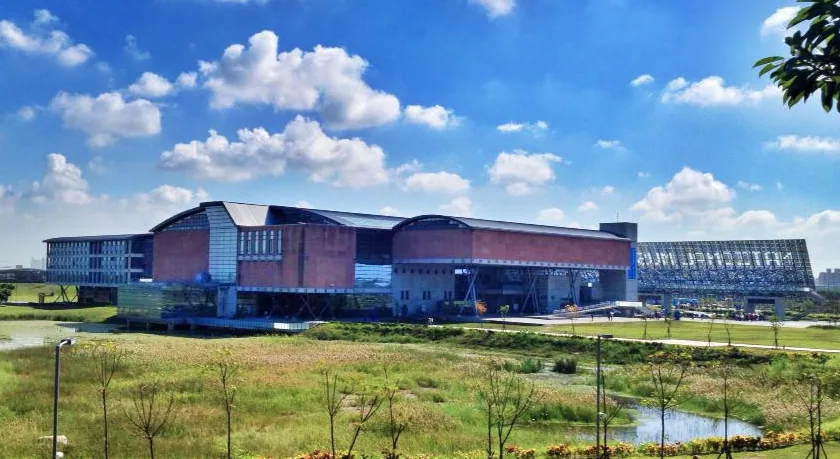
The main building of the National Museum of Taiwan History, opened on October 29, 2011, at No. 250, Section 1, Changhe Road, Annan District, Tainan City. Photo: Fcuk1203, Wikimedia Commons CC BY-SA 3.0.
1. The eighth gallery is called "You, Too, Are Someone Who Writes History"
When the National Museum of Taiwan History's permanent exhibition reaches the eighth gallery, a passage appears:
"What is history? History is a process, a feeling; it is different people standing in their own positions."2
This gallery is called "You, Too, Are Someone Who Writes History." A national third-level agency reopened in January 2021 and placed these six Chinese characters at the final stop of the exhibition, for every visitor who has walked through the eight major galleries.
The seventh gallery is titled "Everyone's Museum." Its introduction reads: "'The future' is pieced together by all kinds of 'us,' and is therefore full of tension and uncertainty."2 By the time visitors reach this point, they have already passed through the arrival of Austronesian peoples, the mountain-and-sea competition of the Ming-Zheng kingdom and Qing rule, Japanese colonial modernization, and postwar democratic transition. At the end, NMTH returns the microphone to the person standing in the final space.
This curatorial logic has an institutional basis. When the special exhibition "Savory Moments: A Special Exhibition on Taiwan's Food Memories" opened in March 2025, Director Chang Lung-chih publicly said that NMTH uses the "National Cultural Memory Bank" platform to practice a dual role: "the collection and preservation of precious cultural artifacts" and "an action platform for co-writing and co-creation by all, revitalizing historical memory"1. When the six Chinese characters for "co-writing and co-creation by all" are spoken by the director of a national third-level agency, they amount to a formal commitment to expand the museum's role from collection keeper to co-writing platform.
NMTH places "visitors participating in writing history" into the discourse of the final two galleries of its permanent exhibition. When Taiwan.md approaches from the other end, as a community-driven open-source Holobiont in the age of AI, licensed under CC0 and still only a few hundred entries in 2026, the two recognize each other in the invitation issued by the eighth gallery: to write history with Taiwan island as the subject. This island needs more than one curator.
📝 Curator's note
NMTH's seventh and eighth galleries redefine the mission of a national museum. The museum returns the question of "who gets to write history" to the people who come to see it. When Taiwan.md places the same invitation on a fork-friendly open-source track, two curatorial mechanisms meet on the same mission. The difference lies in scale, licensing, and institutionality; the overlap lies in historical perspective and purpose.
II. Thirteen Years to Build a Museum, Built on Tsao Yung-ho's 1990 Paper
In 1992, Lee Teng-hui and Lien Chan visited the Taiwan Provincial Museum and instructed the establishment of the "Taiwan Provincial Museum of History"3. This was the beginning of NMTH.
Wu Mi-cha, a graduate of NTU's Department of History, led the preparatory work at the time, and formally became NMTH's first director in 20073. Two years before he initiated the preparations, in 1990, Tsao Yung-ho of the NTU Library published a paper that shook the historical community: "Another Approach to the Study of Taiwan Island History." Tsao argued that the subject of Taiwan's history is "Taiwan Island" itself; regimes appear like actors in succession, but the island is the stage that has always existed. NMTH has existed within this academic lineage from the very beginning.
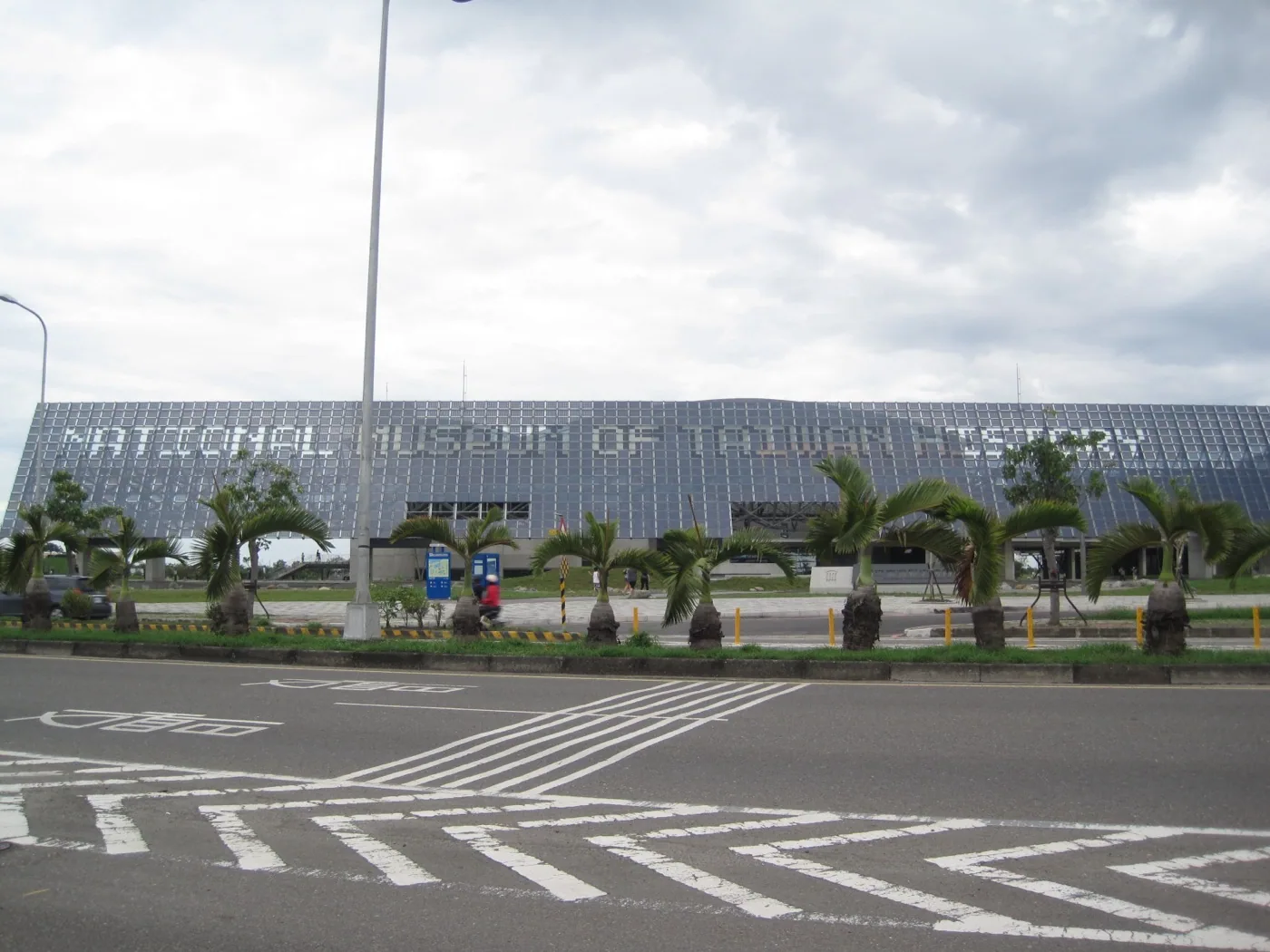
Exhibition and Education Building side view: The Cloud Wall is assembled from over a thousand solar panels and fritted glass, with annual power generation reaching 170,000 kWh. Photo: Wikimedia Commons contributor, CC BY-SA 3.0.
The appointment order for the preparatory office director was issued in 1997; the "Taiwan Provincial Museum of History Preparatory Office" was formally established in July 19983. Construction of the Administration and Collections Building began in 20034, designed by Chien Hsueh-yi, principal of Chujian Architects & Associates, at a total cost of over NT$1.5 billion. The four key architectural vocabularies were "Crossing the Sea, Kun Body, Cloud Wall, Fusion"5. "Crossing the Sea" is a zigzag boardwalk traversing water pools on both sides, symbolizing ancestors crossing the Black Ditch6; the "Cloud Wall" is assembled from over a thousand solar panels and fritted glass, with annual power generation reaching 170,000 kWh6. This is one of the few cases in Asia where photovoltaic infrastructure is integrated into museum architectural vocabulary.
On March 15, 2007, the National Museum of Taiwan History was formally established37. However, the full museum did not open until October 29, 201183 — a full 13 years from the preparatory office in 1998 to the opening in 2011. During this period, Taiwan saw two Chen Shui-bian terms and Ma Ying-jeou's inauguration; the National Palace Museum built a second building in Taipei, and the National Taiwan Museum of Fine Arts completed its expansion. NMTH, by contrast, built a history museum centered on Taiwan Island, and chose Tainan as its location, not Taipei.
The location itself is curation. Tainan was the earliest Han settlement in Taiwan, the intersection of the Zheng dynasty, Qing rule, and Japanese colonial history. NMTH did not choose the capital; it chose the land where Taiwan's island history began.
2021 was NMTH's second key milestone. On January 8, the permanent exhibition "This Land, These People: The Story of Taiwan" reopened after renovation, having been closed for 15 months of reorganization and planned for 5 years9. On April 1, former Academia Sinica Institute of Taiwan History Deputy Director Chang Lung-chih assumed office as the fifth director710; he was the chief editor of the 2020 volume In Search of Island History: Collected Essays on Taiwan History — Historiography (published by NTU Press), which is the latest scholarly compilation of Tsao Yung-ho's Taiwan island history perspective10. On October 17, after the Legislative Yuan passed the Organization Act of the National Museum of Taiwan History on third reading, NMTH was upgraded from a fourth-level agency to a third-level agency1112, confirming its national-level status.
From Tsao Yung-ho's 1990 paper, to the 2011 opening, to the 2021 upgrade, 31 years traced a path from academic discourse to exhibition objects, and then to national-level institutionalization.
3. Our Land, Our People: land as stage, people as protagonists
NMTH's permanent exhibition is called "Our Land, Our People: The Story of Taiwan." The curatorial statement on the homepage of the online museum, the.nmth.gov.tw, is very clear:
"With the land as the stage and people as the protagonists, it tells the rich stories of the encounters among diverse peoples and cultures in Taiwan history."2
These 24 Chinese characters correspond directly to Ts'ao Yung-ho's island historical perspective: the island as stage, and the people living together on this island as protagonists. NMTH concretizes it into three core propositions:
"To establish the collection and writing of a subject-centered history from the perspective of the Taiwanese people." (subjective perspective)2
"There are no standard answers in the museum. Accounts of history should not have only one version; memory and narrative have always been multiple and open." (multiple perspectives)2
"To understand Taiwan history through 'encounter'; history is not a 'finished result,' but a series of unfinished processes of interaction." (encounter perspective)2
"There are no standard answers in the museum." When these 11 Chinese characters appear in the curatorial discourse of a national third-level agency, they mark a clear choice: this museum gives up the curatorial authority of a "definitive text" and instead adopts a curatorial mechanism of juxtaposition.
The structure of the eight major galleries after the 2021 reopening:
| Gallery | Name | Core introduction |
|---|---|---|
| 1 | Taiwan, Island of Encounters | "The story of different groups colliding, exploring, and sharing the same land." |
| 2 | The First Arrivals | "Who were the oldest Taiwanese? Where did they come from? And why did they come to Taiwan?" |
| 3 | An Island and People Living by the Sea | "In the mid-sixteenth century, Taiwan gradually became a point of convergence and transshipment in East Asian trade." |
| 4 | Coexistence and Competition Between Mountain and Sea | "In 1684, it was incorporated into the territory of the Qing dynasty, its western neighbor across the sea." |
| 5 | Anguish and Dreams Under a New Order | "After the Meiji Restoration, Japan imitated Europe and the United States in establishing a modern state system." |
| 6 | The Road Toward Democracy | "After World War II, the Republic of China took over Taiwan, and Taiwanese people generally felt that they had left colonial rule and 'returned to the motherland.'" |
| 7 | Everyone's Museum | "'The future' is pieced together by all kinds of 'us.'" |
| 8 | You, Too, Are Someone Who Writes History | "History is a process, a feeling." |
From the arrival of Austronesian peoples (Gallery 2), to Qing rule in 1684 (Gallery 4), to colonial modernization in 1895 (Gallery 5), to the February 28 Incident and martial law (Gallery 6), and finally to "Everyone's Museum" (Gallery 7) and "You, Too, Are Someone Who Writes History" (Gallery 8). This is the exhibitionary practice of Ts'ao Yung-ho's 1990 essay: the island as subject, political regimes as actors.
Interactive installations reinforce the curatorial position of multiple perspectives: a choice-based interactive machine simulating the 1920s lets visitors enter the circumstances of people at the time and make decisions9; seven touchable exhibits are available for visually impaired visitors11; an interactive exhibit simulating a World War II air-raid siren lets visitors turn a loudspeaker6; and the VR gallery screens three VR films, including 1895 Taipei in Crisis, Why Is My Neighbor So Annoying? (the Madou flood), and Paliljaw 1874 (the Mudan Incident)6.
In December 2023, the visitor blog Story Circle wrote: "Entering the main exhibition hall felt like passing through a time tunnel, allowing one to take in the abundant stories of Taiwan history." The two exhibits that left the deepest impression were a "photograph of Charles Le Gendre, John Dodd, and Indigenous people" and a Tokyo Nichinichi Shimbun account of an Indigenous girl named "A-tai" being taken to Japan to receive a "civilized education"; the latter led the writer to "reflect on the deeper question of what civilization means"13.
The curation weaves contradictions into space and lets visitors pass through them themselves.
4. Open Government Data License, version 1.0
Open collections.nmth.gov.tw, the collections website, and click the high-resolution image file for any one of the 140,000 collection items. The webpage tells you:
"No restriction on use, no fee required; it can be downloaded and used directly"14
This is law. The National Museum of Taiwan History releases its collections under the Open Government Data License, version 1.0, and the Ministry of Culture clearly states that this license is equivalent to Creative Commons BY 4.0 International14. Commercial use is permitted, derivative works are permitted, and only attribution is required.
NMTH is a national third-level agency, with an annual budget of about NT$270 million, one level smaller than the National Palace Museum, which is a Yuan-level agency directly under the Executive Yuan. But on the track of open data, its choice is more aggressive than the National Palace Museum's. It has built six parallel open databases[^7]:
- NMTH Collections: 140,000+ collection items, 3D digitization, downloadable original files
- Taiwan Modern Newspapers and Periodicals Collection: digitized materials including Tainan Shinpo and Taiwan Minpao from the Japanese colonial period
- School Life and Memory Database: school publications and photographs from the Japanese colonial period to the postwar era, with geographic search
- Tainan Studies Database: scholarly publications including Tainan Culture from the 1950s
- A Century of Taiwan Sound: digitized shellac records and musician features (restricted for academic research)
- Taiwan Women's History Database: artifacts, images, and oral histories
Another is "Taiwan History Village" (ilhaformosa.nmth.gov.tw), a chapter-based popular education website on Taiwan history. From the arrival of Austronesian peoples, through the Ming-Zheng period and Qing rule, Japanese colonial modernization, and postwar democratic transition, each chapter includes primary sources, high-resolution images of collection objects, and scholarly annotations. Multiple Taiwan.md history entries, including the sections "2-5 Little Prefecture of Taiwan" and "2-1 Landmark on the Sea Route" in "The Dutch, Spanish, and Ming-Zheng Periods," have already cited it directly as a primary-source reference15.
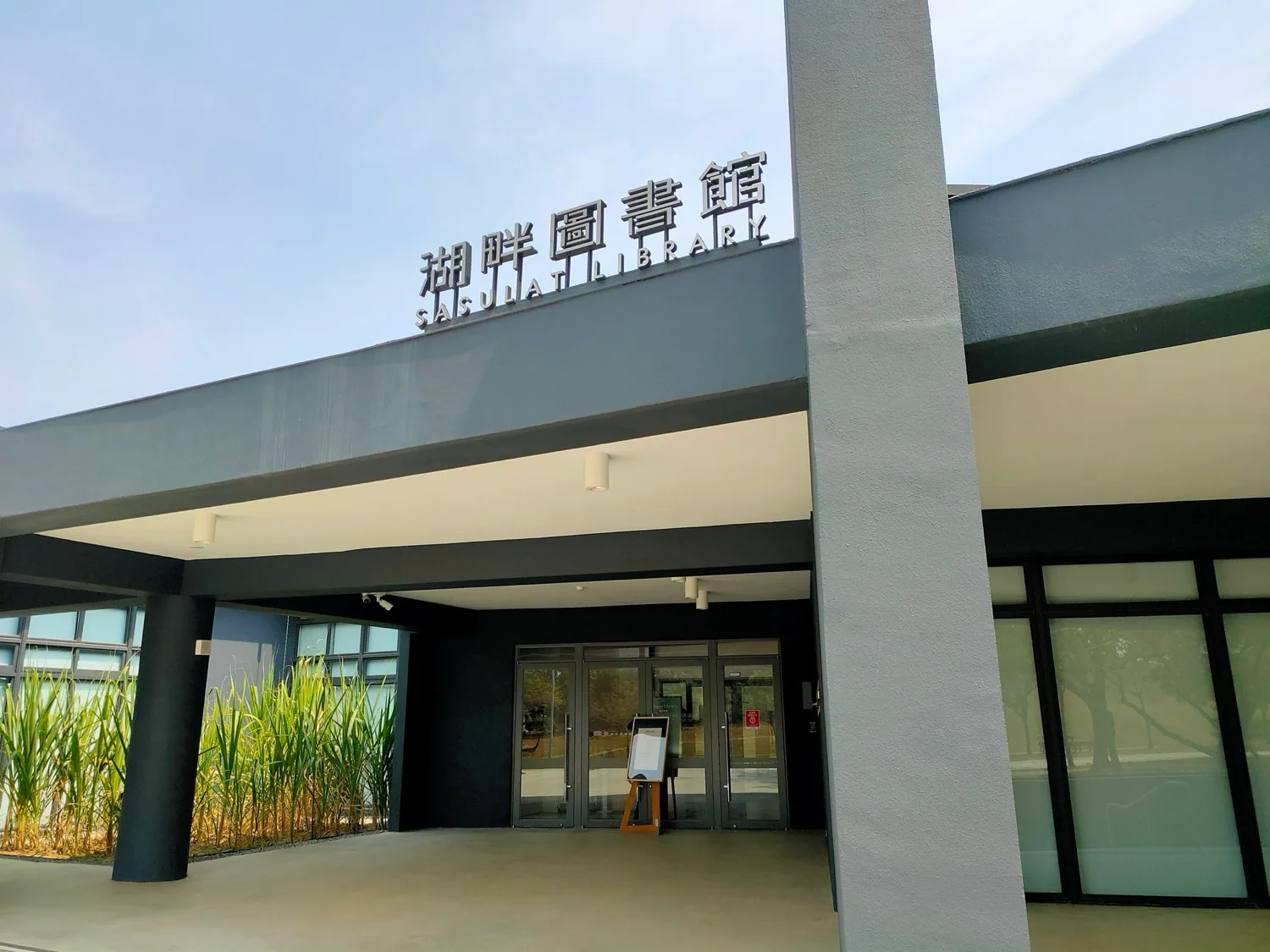
Sasulat Library, the lakeside library opened in 2022, is NMTH's reading space for printed overseas historical materials. Photo: Wikimedia Commons contributor, CC BY-SA 3.0.
There is also the "Overseas Historical Materials on Taiwan Database" (taiwanoverseas.nmth.gov.tw). NMTH describes it this way: "Since the preparatory office period, we have continuously collected and surveyed Taiwan memories dispersed overseas. As of 2022, we had accumulated at least 20 project results and published at least 21 sets of historical-source books."16 Its sources come from "archives, museums, and research institutions in Japan, the Netherlands, the United Kingdom, the United States, Germany, France, and other countries"16. This is the work of a small country retrieving its own history, item by item, from archives scattered around the world. Sasulat Library, the lakeside library opened in 2022, is the physical reading space for this project: printed historical materials returned from overseas are placed alongside the online database, responding to a single mission through the dual track of "printed classics vs. digital openness."
The larger project is the "National Cultural Memory Bank." This platform was originally built by the Ministry of Culture and has been operated by NMTH since 2021, accumulating more than 2 million materials17. NMTH describes it this way: "Through a collection system and cross-unit data integration, the National Cultural Memory Bank integrates cultural materials collected by central and local government agencies, civil organizations, and communities."17 Two types of licensing coexist: the Open Government Data License (equivalent to CC BY 4.0) and Creative Commons licenses. It also provides OpenAPI services17. The three letters OpenAPI mean that any developer, any AI training-data pipeline, and any third-party platform can legally connect to the database.
💡 Did you know
The National Cultural Memory Bank's 2 million materials include content provided by central and local governments, civil organizations, and communities. The essence of this database is "collective": it is co-constructed by central and local governments, civil organizations, and communities. Since 2021, NMTH has operated it, shifting the museum's role from owner of collections to bridge for historical memory. When the memories of communities and government agencies are juxtaposed in the same database, the question of "who owns history" is rewritten at the institutional level.
For a community-driven open-source knowledge base in the age of AI, this legal foundation is crucial. Taiwan.md is licensed entirely under CC0, looser than NMTH, so any fork can use it with zero friction. Materials released by NMTH require attribution when cited, but commercial use and derivative works are permitted. The two licenses occupy different positions on the spectrum of openness, yet they stand on the same track.
When a national museum chooses to tell you through law that "the collections can be taken and used," that choice connects to the curatorial statement that "history is everyone's memory." Copyright is an extension of curatorial position.
5. "Co-writing and co-creation by all": the curatorial mechanism shift acknowledged by the director himself
In March 2025, when the special exhibition "Savory Moments: A Special Exhibition on Taiwan's Food Memories" opened, Director Chang Lung-chih publicly said that NMTH plays a dual role in "the collection and preservation of precious cultural artifacts" and as "an action platform for co-writing and co-creation by all, revitalizing historical memory"1. The six Chinese characters for "co-writing and co-creation by all" are a formal acknowledgement by the director of a national third-level agency that the museum's role has expanded into a platform.
Before Chang Lung-chih took office in April 2021, he was deputy director of the Institute of Taiwan History at Academia Sinica7. In 2020, he edited Exploring Island History: Essays on the Historiography of Taiwan History, published by National Taiwan University Press, the latest scholarly consolidation of Ts'ao Yung-ho's Taiwan island historical perspective. As someone who moved from academia into a national museum, his governance philosophy is clear in an interview with StoryStudio:
"Because there was first 'Taiwan' before there was 'Taiwan history,' when Taiwan changes, the way we look at Taiwan also changes."10
"You must first be an interesting person, and then be a historian."10
"A very important core concept of public history is co-construction and collaboration."10
Public History, as a field, emerged in the United States in the 1970s. It emphasizes the ways museums, archives, memorial sites, and other institutions co-construct historical memory with the public. Chang Lung-chih has written it into NMTH's governance framework. This is a redefinition of the mission of a national museum.
When the international special exhibition "Transcending 1624: Taiwan as a World Island" opened in February 2024, Chang said: "From 'Everyone's Museum' to 'the world's NMTH,' we hope to become an international-level museum representing Taiwan's connection with the world."1819 The special exhibition was co-organized with the National Museum of Japanese History and brought together "new currents of thought such as Taiwan island history, maritime history, postcolonial history, and contemporary global and environmental history"19.
The four Chinese characters for "world island Taiwan" are themselves a discourse. From Ts'ao Yung-ho's "Taiwan island history" (the island as subject) to Chang Lung-chih's "world island Taiwan" (the island's position in global networks), NMTH extends the discourse of the island historical perspective toward global history. Taiwan.md's goal is to let the world understand Taiwan from Taiwanese people's own perspective. This path complements NMTH's mission: the museum is responsible for collection and institution-level testimony, while the community knowledge base is responsible for covering reader touchpoints in the age of AI.
6. Transcending 1624: when the Taiwan island historical perspective leaves Tainan
On February 1, 2024, the international special exhibition "Transcending 1624: Taiwan as a World Island" opened at NMTH and closed on June 3018.
The exhibition was co-organized with the National Museum of Japanese History (Rekihaku, opened in 1983). NMTH explains that the two museums "have jointly researched and planned three special exhibitions over the past 10 years"18. The year 1624 was not chosen casually. It was the year the Dutch East India Company built Fort Zeelandia in Tayouan, now Anping, Tainan, and the year Taiwan formally entered the network of early global capitalism.
Transcending 1624 writes Taiwan island history into the context of world networks: the Dutch East India Company, Japanese red-seal ships, Chinese maritime merchants, Indigenous communities, and Spain and Portugal from the Iberian Peninsula. Seventeenth-century Taiwan was a node where these forces met in the western Pacific. The idea in Ts'ao Yung-ho's 1990 essay of "looking at Taiwan through maritime networks" became, in Transcending 1624, a cross-institutional, cross-national collaborative exhibition.
⚠️ Contested view
The title "Transcending 1624" is itself a discourse. 1624 was the year the Dutch East India Company came to Taiwan, but Taiwan island history began earlier than 1624; Austronesian peoples were already on this island 6,000 years ago. Choosing 1624 as the exhibition year means choosing to begin Taiwan's story from its "entry into the network of global capitalism." That choice is itself a curatorial position, not a neutral fact. NMTH is also very clear that the discourse of Transcending 1624 must maintain tension between the two axes of "global history" and "island history."
By measuring itself against Japan's Rekihaku (a national-level museum not directly under the central government, comparable to NMTH's third-level agency status), NMTH cooperates with a counterpart museum in Japan and places Taiwan within East Asia's shared historical geography, avoiding an isolated national-level narrative of Taiwan history. Compared with the National Museum of Korea and the National Museum of Korean Contemporary History (NMKH, opened in 2012), NMTH follows a track of encounter, plurality, and subjectivity. The different approaches to historical framing taken by these contemporary Asian museums form a useful comparison.
7. The "Base for Counterattack and National Recovery" section directly says "authoritarian system"
In NMTH's sixth gallery, "The Road Toward Democracy," one subsection is called "Base for Counterattack and National Recovery." The online museum's gallery page writes:
"In 1950, the Korean War broke out. The two major international camps led by the United States and the Soviet Union, capitalism and communism, began confronting each other in East Asia. Taiwan, occupying a key position in the western Pacific's 'First Island Chain,' was long governed by the Chinese Nationalist Party and became the Republic of China's base for 'counterattack and national recovery' and the fortress of 'Free China.' As the Beijing government expanded diplomatically, the Republic of China's international status suffered successive defeats: withdrawal from the United Nations in 1971 and the severing of diplomatic relations with the United States in 1978. Yet the government continued to advocate the political slogan of 'unifying China under the Three Principles of the People,' forming an authoritarian system of one-party dominance and party leadership over government."20
"Authoritarian system," "one-party dominance and party leadership over government," and "unifying China under the Three Principles of the People" are terms used by a national third-level agency in its permanent exhibition to identify the postwar Kuomintang government.
The "Approaching February 28" section writes elsewhere:
"After Japan announced its unconditional surrender, the Nationalist government established the Office of the Chief Executive ... unprecedented political abuses then appeared one after another: soaring prices, factories unable to recover ... hoarding merchants pursuing huge profits, the Trade Bureau and Monopoly Bureau reselling large quantities of supplies ... corruption and malpractice, undisciplined military police and other law-enforcement personnel, frequent abuses of violence ... outspoken councilors, newspapers, judges, lawyers, and other local social elites repeatedly clashed with unscrupulous party, government, and military officials, planting undercurrents that would later lead to purges."21
The verb "purged" marks a clear narrative position: it identifies state violence, not a neutral event.
In November 2017, NMTH hosted "The Challengers: The 30th Anniversary of the Lifting of Martial Law Special Exhibition" (running through June 24, 2018). Its co-organizers included the Taiwan Green Team Documentary Association, Wu San-lien Taiwan Historical Materials Foundation, Nylon Cheng Liberty Foundation, and Peng Ming-min Cultural and Educational Foundation22, all institutions that carry the legacy of the Tangwai and democracy movements. For a national third-level agency, this list of co-organizers is a choice of political position.
The resilience of the curatorial position is also worth noting. Across three administrations, Ma Ying-jeou from 2008 to 2016, Tsai Ing-wen from 2016 to 2024, and Lai Ching-te from 2024 onward, NMTH has maintained the curatorial position of the Taiwan island historical perspective. When the permanent exhibition was updated in 2021, Taiwan's ruling party had already changed several times, but the curatorial discourse was essentially the same as at the 2011 opening. "Our Land, Our People" is an institutional choice decoupled from political cycles.
For Indigenous peoples and multiple ethnic groups, the second gallery, "The First Arrivals," is directly anchored in Austronesian peoples; the permanent exhibition introduces Indigenous artists' interpretations of legends, oral stories, and songs. The 2013-2014 special exhibition "Seeing the Pingpu" placed the Pingpu peoples, long marginalized by Han perspectives, onto the main stage of the exhibition space and published a special volume23.
Can a state-established museum insist on a Taiwan island historical perspective? From 2011 to 2026, NMTH has answered through 15 years of curatorial practice: yes.
8. Two Taiwan island historical perspectives, beyond 140,000 collection items
You stand under the Cloud Wall in Annan District, Tainan, beneath an exhibition and education building assembled from more than 1,000 solar panels generating 170,000 kWh per year. Behind it is the museum opened in 2011. You think of the essay Ts'ao Yung-ho wrote in 1990: the subject of history is this island itself, and political regimes are the actors.
NMTH built that idea into a physical exhibition space. 140,000 collection items + 2 million National Cultural Memory Bank materials are all open for download under the Open Government Data License, version 1.0 (equivalent to CC BY 4.0)1417. The eighth stop of the eight major galleries is called "You, Too, Are Someone Who Writes History"2, and the seventh is called "Everyone's Museum"2. The director has personally acknowledged that the museum is "an action platform for co-writing and co-creation by all"1.
Taiwan.md approaches from the other end. A community-driven open-source Holobiont in the age of AI, licensed under CC0, still only a few hundred entries in 2026. When the creator of Taiwan.md visits NMTH and introduces this museum to those who may fork Taiwan.md in the future, the open datasets that the museum has built over the years place national-level collections and community co-writing on the same track.
The two finally meet under the compass drawn by Ts'ao Yung-ho in 1990: writing Taiwan with the island as subject.
✦ When a national museum and a community knowledge base tell stories about the same island, that is the moment when two curatorial mechanisms finally recognize each other.
NMTH provides institutional weight: legislatively authorized collection authority, the discipline of scholarly research, international cooperation across institutions, and the tactile experience of physical space. Taiwan.md provides open-source lightness: coverage of reader touchpoints for each entry in the age of AI, the reproductive capacity of community forks, and the zero-friction circulation of CC0. The two do not replace each other. They are the two hands of collective memory.
If one day the Taiwan island historical perspective becomes the default historical framework for the next generation of readers, it will be because national-level institutions, community-driven projects, the age of AI, and physical exhibition spaces each tell the story of the same island from their own angle. The shape they assemble will be more three-dimensional than any single account.
Further reading:
- Taiwan island historical perspective — Ts'ao Yung-ho's 1990 essay defined a historical framework with "the island as subject"; NMTH is the exhibitionary practice of this historical perspective
- Three Foreigners on 1895 — historical materials from Davidson, Endo Makoto, and Hosokawa Ryu in 1895, included in NMTH's three-volume publication on the 1895 war
- The Camphor War of the Nineteenth Century — Robert Swinhoe's 1864 camphor investigation report; NMTH Collections holds the primary source
- The Dutch, Spanish, and Ming-Zheng Periods — the motif of NMTH's third permanent gallery, "An Island and People Living by the Sea," and the Transcending 1624 special exhibition
- Formosa — the Chinese translation of Davidson's The Island of Formosa, Past and Present was published by NMTH
Image Sources
This article uses three CC-licensed images, all cached in public/article-images/society/ to avoid hotlinking to source servers:
- National Museum of Taiwan History (main building exterior, hero) — Photo: Fcuk1203, Wikimedia Commons, CC BY-SA 3.0
- Side view of the exhibition and education building and Cloud Wall photovoltaic panels (inline scene §2) — Photo: Wikimedia Commons contributor, CC BY-SA 3.0
- Sasulat Library, the lakeside library (inline scene §4) — Photo: Wikimedia Commons contributor, CC BY-SA 3.0
References
- udn report on the opening of "Savory Moments: A Special Exhibition on Taiwan's Food Memories" — March 2025 special exhibition opening, including Chang Lung-chih's dual-role statement about "an action platform for co-writing and co-creation by all, revitalizing historical memory."↩234
- Online Museum, "Our Land, Our People: The Story of Taiwan" — Full online exhibition text for the National Museum of Taiwan History's permanent exhibition after its 2021 update, including curatorial discourse for the eight major galleries, exhibit introductions, and interactive experiences.↩23456789
- Wikipedia, "National Museum of Taiwan History" — Chinese Wikipedia entry, including the complete timeline from preparations in 1992 to the 2011 opening and the list of past directors.↩2345
- FAM TALK / Chien Architects forum — Record of Chien Hsueh-yi's design concept for the National Museum of Taiwan History, including the four thematic vocabularies of "crossing the sea, kunshen sandbanks, cloud wall, and fusion."↩
- Taiwan Architecture magazine, "National Museum of Taiwan History" — Chien Hsueh-yi of Chien Architects & Associates as designer; construction schedule from 2003.11.27 to 2011.11.15; total cost of more than NT$1.5 billion.↩
- FUNIT visitor reflection — Family travel blog, including impressions of the Cloud Wall photovoltaic panels, zigzag sea-crossing path, and simulated air-raid siren interactive exhibit.↩234
- National Museum of Taiwan History, "Current Director" official page — NMTH's official introduction to fifth director Chang Lung-chih, who took office on April 1, 2021, including his education, experience, and governance philosophy.↩23
- National Museum of Taiwan History official website — Institutional official entrance, including opening date (2011-10-29), organizational structure, and press releases.↩
- La Vie report on NMTH's 2021 reopening — Design report on the January 8, 2021 reopening after the permanent exhibition update, including an introduction to exhibits such as the 1920s choice-based interactive machine.↩2
- StoryStudio interview with Chang Lung-chih — In-depth interview by a history media outlet with Director Chang Lung-chih, including his governance ideas on "public history" and "co-construction and collaboration."↩2345
- National Museum of Taiwan History accessibility services website — Ministry of Culture museum cultural equity project website, including NMTH's Easy Read project since 2015, touchable exhibits for visually impaired visitors, and cultural equity facilities.↩2
- Laws & Regulations Database of the Republic of China, Organization Act of the National Museum of Taiwan History — Full text of the organization act passed on the third reading by the Legislative Yuan on May 11, 2021, including Article 1's establishment purpose: "The Ministry of Culture establishes the National Museum of Taiwan History to handle the collection, organization, preservation, research, exhibition, and promotional education of cultural artifacts and historical materials related to Taiwan history and folk culture."↩
- Story Circle visitor reflection — December 2023 visitor blog post, including personal reflections on the "photograph of Charles Le Gendre, John Dodd, and Indigenous people" and the Tokyo Nichinichi Shimbun exhibit about "A-tai."↩
- NMTH Collections Open Data licensing statement — Verbatim statement of the Open Government Data License, version 1.0: "No restriction on use, no fee required; it can be downloaded and used directly."↩23
- Taiwan History Village — Popular education website on Taiwan history built by the National Museum of Taiwan History, organized by chapter, such as 02-1 "Landmark on the Sea Route: Formosa Emerging on Nautical Charts" and 02-5 "Little Prefecture of Taiwan: The Beginning of Qing Imperial Rule." It includes primary sources, high-resolution images of collection objects, and scholarly annotations, and has been cited by multiple Taiwan.md history entries as a primary-source reference.↩
- National Museum of Taiwan History, Overseas Historical Materials on Taiwan — At least 20 project results and 21 sets of historical-source books accumulated since the preparatory office period, with materials collected from archives and museums in Japan, the Netherlands, the United Kingdom, the United States, Germany, and France.↩2
- National Cultural Memory Bank page — More than 2 million materials; operated by NMTH since 2021; version 2.0 launched in 2022; provides OpenAPI and Creative Commons licensing.↩234
- Transcending 1624: Taiwan as a World Island international special exhibition website — Website for the flagship special exhibition co-organized by NMTH and the National Museum of Japanese History, February 1 to June 30, 2024.↩23
- udn report on the opening of "Transcending 1624: Taiwan as a World Island" — Includes Chang Lung-chih's opening remarks, "from 'Everyone's Museum' to 'the world's NMTH.'"↩2
- Online Museum, "Base for Counterattack and National Recovery" gallery page — Online page for a subsection of the permanent exhibition, including the terms "authoritarian system," "one-party dominance and party leadership over government," and "unifying China under the Three Principles of the People" in its identification of the Kuomintang government during the martial-law period.↩
- Online Museum, "Approaching February 28" gallery page — Online page for a subsection of the permanent exhibition, including discourse on political abuses and currents of purge under the Nationalist government's postwar takeover.↩
- The Challengers: The 30th Anniversary of the Lifting of Martial Law Special Exhibition — Special exhibition hosted by the National Museum of Taiwan History from November 28, 2017 to June 24, 2018. Co-organizers were the Taiwan Green Team Documentary Association, Wu San-lien Taiwan Historical Materials Foundation, Nylon Cheng Liberty Foundation, and Peng Ming-min Cultural and Educational Foundation. Exhibition topics covered postwar democratic transition themes including the Tangwai movement, labor movement, women's movement, Indigenous name rectification, farmers' movement, environmental movement, mother-tongue revitalization, and debates over unification and independence.↩
- National Museum of Taiwan History organization and members page — Includes the organizational structure of the Research Division, Exhibition Division, Public Service and Education Division, Collections Access Division, Digital Innovation Center, Secretariat, Personnel Office, and Accounting Office; includes context on the "Seeing the Pingpu" special exhibition and related Pingpu collections projects.↩
🧬 What Semiont was thinking while writing this