
30-Second Overview: If we only ask "Who has ruled Taiwan?", Taiwanese history becomes a mere roster of regime transitions: the Dutch, the Spanish, Koxinga's forces, the Qing Empire, the Empire of Japan, and the Republic of China. The "Taiwanese Island Historiography" (臺灣島史觀) reframes the question: Amidst the coming and going of these regimes, what happened to the people on this island? How did they migrate, trade, be governed, resist, love, endure disasters, and reconstruct—ultimately turning foreign systems and multiple memories into their own way of life? In 1990, historian Tsao Yung-ho (曹永和) proposed the concept of "Taiwan Island History." Since then, scholars, museums, education, and public culture have transformed it into a more common intuition: identity stems not only from lineage or a motherland but also from the experience of living and surviving on the same island. 12
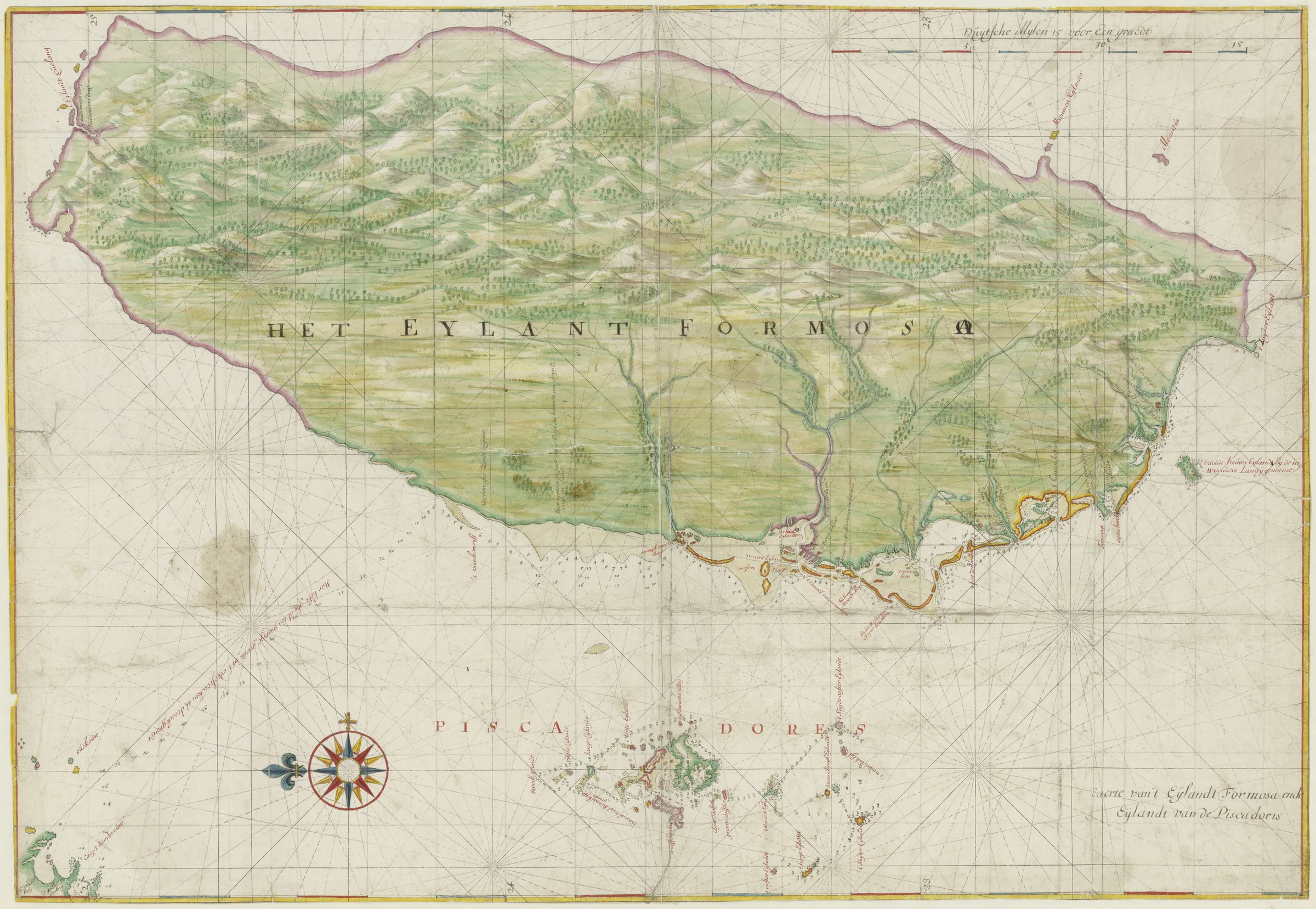
A map of Formosa drawn by the Dutch in 1640. When Taiwan is placed within a maritime network, it is no longer just someone's periphery.
For a long time, Taiwanese history resembled a form filled out by others.
The left side of the form lists dates; the right side lists rulers. In 1624, the Dutch arrived in Tainan; in 1626, the Spanish reached northern Taiwan; in 1662, Koxinga's forces replaced the Dutch; in 1683, the Qing Empire took over; in 1895, the Empire of Japan colonized it; and in 1945, the government of the Republic of China arrived. Writing it this way is not incorrect; regime changes are indeed a significant part of Taiwan's history. But if Taiwanese history consists only of this table, the people on the island easily become mere background figures. The protagonists become the regimes, while Taiwan is simply a place that was received, governed, ceded, recovered, or represented.
The most important shift in the "Taiwanese Island Historiography" is turning this table over.
It does not first ask "Who does Taiwan belong to?" but asks "What happened in Taiwan?" It does not first ask which regime is legitimate, but asks how different groups of people lived, clashed, exchanged, were injured, and left their marks on this island. This shift ensures that Taiwan is no longer just an episode in Chinese history, Japanese history, the history of the Dutch East India Company, or Cold War history; it becomes a historical stage that can be understood from its own position.
I. The Lost Subjectivity
For the people of Taiwan, historical narratives have never been purely academic questions.
Who is legitimate? To whom does Taiwan belong? Is Taiwan the periphery of China, a colony of the Empire of Japan, the front line of anti-communism in the Cold War, or a community in the Pacific? These questions do not only appear in textbooks; they appear in family memories, language usage, campaign slogans, international news, and daily self-introductions.
From the perspective of Chinese history, Taiwan is easily written as a frontier, a local history, or a history of migration and reclamation. From the perspective of Japanese imperial history, it is a case study of colonial rule and modernization. From the perspective of the Cold War, it becomes a "base for recovery" or "Free China." While these perspectives each have value for research, they share one common problem: the lived experiences of the Taiwanese people are often placed beneath the historical objectives of others.
What the "Taiwanese Island Historiography" addresses is precisely this loss of subjectivity.
It does not seek to deny the power of external regimes, nor does it pretend that Taiwan can be detached from China, Japan, Southeast Asia, the United States, or world history. What it seeks to do is change the vantage point: moving away from the perspectives of rulers, motherlands, and empires toward the island itself. It shifts from "who came to rule" to "how people survived here."
📝 Curator's Note: The first step of the Taiwanese Island Historiography is to refuse to let Taiwan always serve as a mere footnote in someone else's history.
II. Tsao Yung-ho Places the Island at the Center of History
In 1990, Tsao Yung-ho proposed the concept of "Taiwan Island History" (臺灣島史) in his work Another Path for Researching Taiwan Island History. Chen Weizhi later reflected that this concept both summarized Tsao’s long-term research into 17th-century Taiwan, the Dutch-Spanish period, and East Asian maritime history, and responded to the demands of the post-democratization era regarding "how to think about Taiwanese history." 2
Tsao's key contribution was not simply declaring that "Taiwan is important," but providing a methodology. He viewed history as the result of the interaction between "people, time, and space." Taiwan is no longer just a location passively enduring the arrival and departure of regimes; it is a historical stage with its own geographical conditions, maritime position, movement of people, and social structures. 12
While this idea might seem easy to grasp today, it addresses very specific old problems: past research on Taiwanese history often leaned toward Han Chinese migration, regime changes, and political history, frequently placing Taiwan within the framework of Chinese local history or ruling histories. By proposing "Taiwan Island History," Tsao effectively placed "the land" at the center of historiography: beyond seeing what systems certain groups brought, one must also look at how this island's mountains, seas, plains, ports, monsoons, shipping routes, and social boundaries shaped history.
Tsao’s personal journey is fascinating: he held no university degree, worked for many years in the National Central Library, taught himself multiple languages, eventually became a fellow of the Academia Sinica, and gained international recognition for his research on Dutch East India Company records. 3 However, this legend should not obscure his position in historiography: he provided a name that later generations could adopt for an emerging consciousness regarding Taiwanese history.
III. Island History in the Ocean
The word "island" is easily mistaken for something closed off.
However, the island in "Taiwanese Island Historiography" is not an isolated microcosm. It has a coastline, and thus it has boundaries. Because it is surrounded by sea, it possesses shipping routes, ports, migration, trade, missionary work, military activity, smuggling, colonization, war, and refuge. Taiwan is not the end of a continent, nor is it a blank spot in the Pacific. It has been repeatedly touched by different forces within the East Asian maritime sphere.
This is why the Austronesian peoples, the Dutch-Spanish period, Han Chinese migration, Japanese colonization, and the Cold War order cannot be viewed as external events outside of island history. They all entered Taiwan in different ways, altering the relationships between groups on the island, land systems, linguistic orders, religious lives, and international positions.
The "maritime" nature of Taiwanese Island Historiography does not equate to a romantic claim that "Taiwan is naturally facing the world." More accurately, it means that Taiwan can never be explained by a single motherland alone. At many historical moments, it was integrated into larger networks: East Asian maritime trade, competition between Dutch and Spanish colonization, the governance of the Qing Empire's frontier regions, the Japanese Empire’s southward expansion, the post-war American Cold War system, and the contemporary global supply chain. These forces are not mere backdrops to Taiwanese history; they actively transformed life on the island.
IV. Changing the Question Changes the History
The power of historiography lies not in the answers, but in how it changes the questions.
If we ask "When did Han Chinese develop Taiwan?", indigenous peoples easily become a backdrop before the arrival of the Han. If we ask "How did different groups establish worlds of living on this island?", indigenous peoples become one of the primary subjects of long-term Taiwanese history. Taiwanese history no longer begins only in 1624 or 1662, but goes back to earlier movements of people, archaeological evidence, linguistic distribution, and life among mountains and seas.
If we ask "Where did the Dutch and Spanish go?", the Dutch-Spanish period is merely a brief presence of European powers. If we ask "How did Taiwan enter the 17th-century East Asian maritime sphere?", then Tainan, Keelung, Tamsui, deerskins, sugar, missionary work, and military activities emerge simultaneously. When the Dutch entered Taiwan, they faced a field where indigenous peoples, Han Chinese maritime merchants, Japanese trade, and regional powers were already interacting.
If we ask "When did the Qing Empire incorporate Taiwan into its territory?", the Qing period is a chapter of imperial governance. If we ask "How did a migrant society form on the island?", you will see sea-crossing restrictions, factional conflicts, the classification of "familiar" and "foreign" Chinese (熟番/生番), local temples, land reclamation contracts, irrigation systems, port markets, and highland boundaries. At this time, Taiwan was a site where a migrant society was constantly reorganizing within the framework of frontier governance.
If we ask "What modernization did Japanese rule bring?", Japanese rule is often reduced to a binary choice between progress or oppression. If we ask "How did colonial systems change life on the island," then railways, household registration, education, policing, public health, land surveys, the sugar industry, Japanization (皇民化), and war mobilization would all exist simultaneously. Modernity was not a gift, nor can oppression be summarized as the sole outcome; people on the island learned to navigate these brought-in things amidst systems, violence, and the demands of daily life.
If we ask "Was 1945 'liberation'?", it looks like a return of government after the war; if we ask "How did the new regime enter the society of the island," then the February 28 Incident, White Terror, martial law, language policies, military family housing (眷村), the Cold War, state-led education, and democratization all enter the field of vision. Island historiography does not allow the words "liberation" to stamp over the entire post-war experience, nor does it let suffering end at being a victim. It asks: how were traumas suppressed, and how did they return to public memory after the lifting of martial law?
📝 Curator's Note: Given the same period of history, changing the question changes who becomes the protagonist. Taiwanese Island Historiography rearranges who is qualified to stand at the center of history.
V. From Academia to Public Intuition
After Tsao Yung-ho proposed the concept, "Taiwanese Island Historiography" did not stop in a single thesis.
Chiu Wan-yao, through The Illustrated History of Taiwan and discussions on "mountains, seas, and plains," placed Taiwanese history within more specific spatial dimensions: highlands, oceans, and plains are all stages for human activity, with different spaces carrying different historical experiences. 4 Scholars like Chang Lung-chih have situated the changes in Taiwanese history research since the 1980s within the context of a "Taiwan-centered perspective" and the "democratization of historical knowledge": as Taiwanese history entered academia, it also opened questions about who can write history and how historical knowledge circulates. 25
Institutions changed accordingly. The establishment of the Institute of Taiwan History at Academia Sinica can be traced back to the 1986 field research project planned by Chang Kuang-chih and others, the 1988 "Taiwan History Field Research Office," the 1993 authorization for a preparation office, and its official founding in 2004. This signifies that Taiwanese history evolved from local history, material compilation, and individual scholarly research into an academic field supported by institutions, journals, archives, oral histories, and research communities. 6
Moving further into the public sphere, the permanent exhibition at the National Museum of Taiwan History turned this historiography into a gallery space. The "Taiwan: An Island of Confluence" opening of the museum's "Gathering the Points of Taiwan History" exhibition describes Taiwan as a story of different people colliding, exploring, and sharing the same piece of land; "The Path Toward Democracy" places post-war transition, February 28, martial law, local elections, the lifting of martial law, and direct presidential elections into the life experiences of Taiwanese people over the last two or three generations who cared for one another and engaged in diverse dialogues. 7 This is a crucial step: it is no longer just a theory read by history majors, but a method used by a national-level museum to tell the story of Taiwan to the general public.
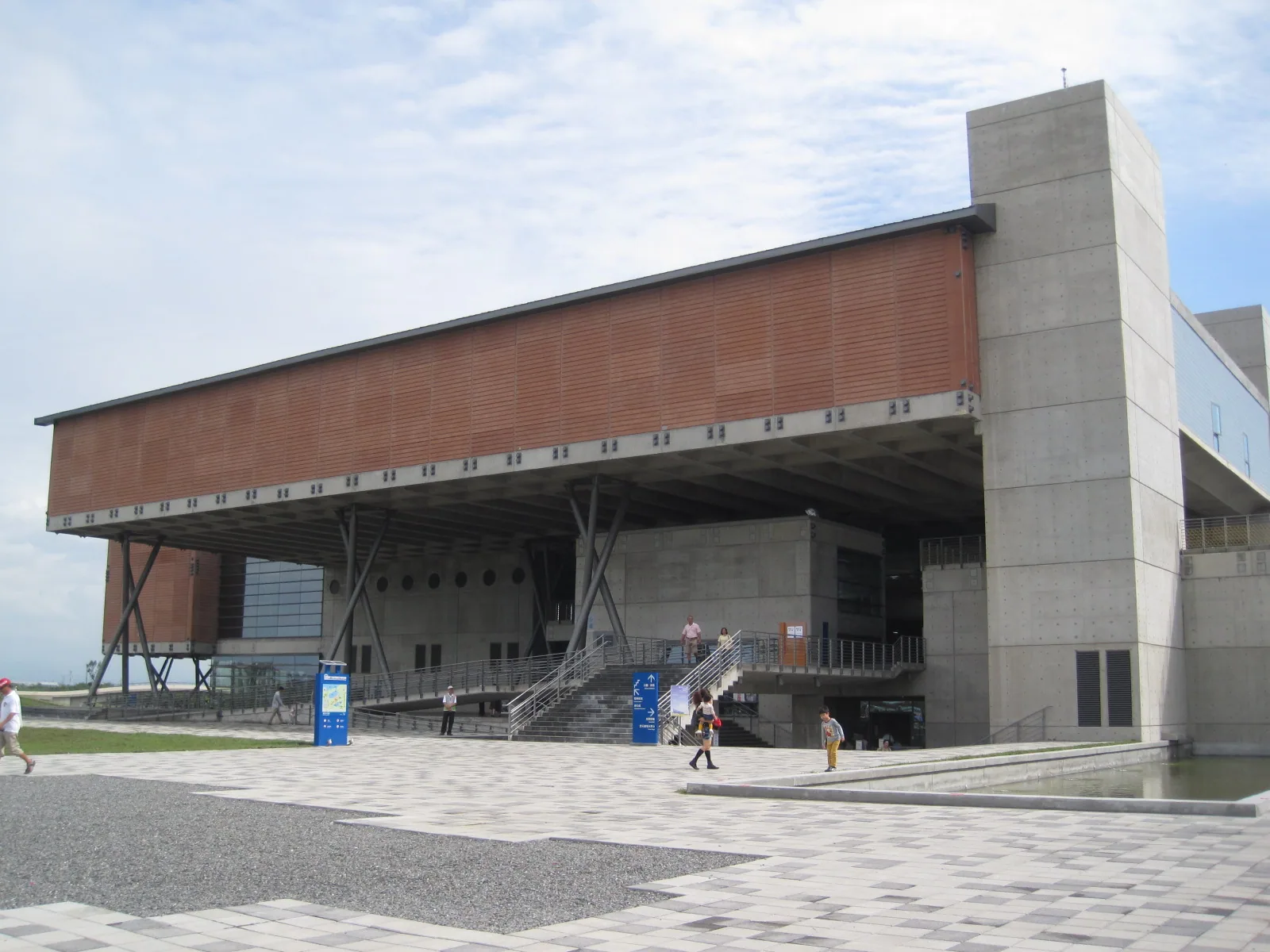
The National Museum of Taiwan History. Taiwanese Island Historiography has evolved from a thesis into a method for a national museum to tell Taiwan's story to the general public.
Later, many people might not say the words "Taiwanese Island Historiography," but they are already using its intuition. In local history, museums, documentaries, public historical writing, community building, school curricula, and social movements, one can often see the same shift: do not just ask who ruled Taiwan, but ask how the people living together on this land collectively made it what it is today.
VI. How "One Fate, One Island" Becomes Tangible
For an academic concept to survive, it must eventually leave the thesis.
The reason why "Taiwanese Island Historiography" can be understood by the general public is not only because it explains the Dutch-Spanish, Qing, Japanese, and post-war periods. More deeply, it gives voice to many things that Taiwanese people have felt in their lives but haven't always had the language to describe: identity comes not just from bloodline, motherland, or ancestral home, but also from the experience of living on the same island.
Care must be taken here. Not everyone has the same "Taiwanese experience," and not all emotions can be explained by island historiography. However, certain moments of public culture do allow people to see how Taiwanese people turn an abstract nation into a concrete geography.
Qi Bolin's documentary Seeing Taiwan is one such example. This 2013 aerial documentary captured mountains, rivers, coastlines, farmland, industrial zones, and environmental damage from a high-altitude perspective, winning the Best Documentary at the 50th Golden Horse Awards. 8 The feeling it evoked was not just "Taiwan is beautiful," but also "the place where we live together is being harmed." Seeing Taiwan from the air made the nation no longer just a flag, a regime, or a legal term, but an island with height, riverbeds, coastlines, and scars.
Memories of disasters have similar power. Earthquakes, typhoons, landslides, road closures, and post-disaster reconstruction often more directly inform people that they live on the same island than textbooks do. Events like the 921 earthquake or the Morakot typhoon are not just natural disasters; they also reveal how highlands, plains, rivers, villages, cities, rescue systems, and national governance are interconnected. "Living together" is not a romantic term; sometimes it is facing the storm together and sharing the burden of loss.
Shadows of island historiography also exist in daily life. The blend of languages in night markets, Japanese-era houses near temple entrances, the side-by-side presence of military housing snacks and Taiwanese songs, and the distinct traces left by Hakka villages, indigenous lands, ports, industrial zones, and metro stations. These things do not need to be organized into a single bloodline narrative. They are more like historical strata: some came first, some arrived later, some were forced to move, some were assimilated, some remained, some changed others, and were in turn changed by others.
This argument does not prove that every detail of life stems directly from "Taiwanese Island Historiography." A more cautious understanding is that island historiography provides a language for people to articulate the sense of mixture that has long existed in daily life. The temple at the corner, the irrigation channels from the Japanese period, the food brought by post-war migrants, and the land memories still fought for by indigenous peoples all existed independently; the historiography ensures they do not have to be forced into a single "orthodox" narrative but can be seen as traces left on the same island at different times.
Therefore, if "One Fate, One Island" is to have meaning, it cannot just be an election slogan or emotional mobilization. It must acknowledge: we are not together because we are identical; rather, different groups of people on the same piece of land are linked by the same systems, disasters, languages, roads, schools, rivers, and coastlines. Island historiography turns this interconnectedness into a historical question.
VII. It Cannot Become an "Island Destiny" Myth
Taiwanese Island Historiography is powerful, and because of that, it can be overused.
If all Taiwanese achievements are described as the natural result of "island-ness," the historiography will be turned into a myth. Semiconductors, democratization, social movements, and cultural diversity can all be inspired by island historiography, but they cannot be simplified to "because Taiwan is an island, it naturally became so." Behind every event are specific systems, global capital, international situations, social movements, education, technology, and human choices.
In his article memorializing Tsao Yung-ho, Chen Weizhi also warned that the proposal of "Taiwanese Island" has its limits. While it opposes over-politicized, nationalist, and state-centered historical narratives, it might also underestimate the critical roles played by the state, nationalism, capitalism, and different historical actors at certain moments. By emphasizing circulation, transportation, and space, it may not be nuanced enough to handle production relations, class differences, and the plural temporal experiences of different groups. 2
This warning is important. A truly mature island historiography does not crush everyone into a single "Taiwanese" story. Indigenous people, Han immigrants, residents from the mainland, Hakka communities, new residents, migrant workers, people of different genders, different classes, and from different regions do not necessarily have identical historical experiences on the same island. Common destiny cannot flatten differences; it only holds when those differences remain interconnected.
⚠️ Boundaries of Use
Island historiography is not a universal key. It helps us break away from mainland-centric and regime-centric views, but it cannot provide a single answer to all historical questions. When it begins to make differences sound too uniform, we must return to the specific people, places, and systems.
VIII. Writing Taiwan Back to Taiwan
The ultimate goal of Taiwanese Island Historiography is not to portray Taiwan as an island that is "born special."
What it truly does is change the vantage point. It moves from "Who does Taiwan belong to?" to "Who lives in Taiwan"; from "Which regime came here?" to "What did these regimes and people leave behind on the island"; from "What did the motherland give?" to "How did the people on the island rearrange the foreign systems, languages, and memories."
When we say "us on this island," it is not a bloodline myth or a single ethnic narrative. It is closer to a historical acknowledgment: different groups of people on the same piece of land were governed, sought survival, clashed, cooperated, were injured, left things behind, and together bear the future of this island.
This is where Taiwanese Island Historiography is most useful for general readers. It does not require everyone to read a set of historiographical theories before they are qualified to understand Taiwan. It only asks that when we look at history, we first place our feet on this island. Starting from here, regimes remain important, but they no longer occupy the entire stage; the people on the land, the paths, the wounds, and the daily lives begin to possess their own historical position.
Further Reading:
- Formosa — Returning from Western "discovery" narratives to how Taiwan was named, imagined, and reinterpreted.
- Dutch-Spanish and Koxinga Periods — See how 17th-century Taiwan entered the East Asian maritime sphere through interaction with European colonization and local society.
- February 28 Incident — How the post-war regime transition became one of the deepest ruptures in the layers of Taiwanese memory.
- National Museum of Taiwan History — How a national museum turned "Taiwanese Island Historiography" into a public exhibition space.
- Archipelago Thinking — Looking beyond a single island to understand the relationship between Taiwan and neighboring islands and the maritime world.
Image Sources
- Hero: 1640 map of Formosa by Dutch, Wikimedia Commons, Public Domain. Original file: 1640 Map of Formosa-Taiwan by Dutch.
- 1880 Taiwan map: Stanford's / Library of Congress, Wikimedia Commons, Public Domain. Original file: Map of Taiwan (Formosa) in 1880 (LOC).
- National Museum of Taiwan History exterior: Pbdragonwang, Wikimedia Commons, CC BY-SA 3.0. Original file: 國立臺灣歷史博物館 01.
References
- Taiwanese Island Historiography, Wikipedia — Entry summarizing Tsao Yung-ho's 1990 proposal of "Taiwan Island History," understanding Taiwan history through the interaction of people, time, and space, as well as related literature indices; used here as a source reference and basic definition.↩2
- Chen Weizhi, "Reflections on Taiwanese Island Historiography after Twenty Years: In Memory of Teacher Tsao Yung-ho" — A 2014 article from Thinking Taiwan discussing the concept of Taiwanese Island History in the context of democratization, people's perspectives, spatialized history, and historiographical limitations.↩2345
- Tsao Yung-ho, Wikipedia — Entry summarizing Tsao's self-taught multilingualism, research into the Dutch-Spanish period and East Asian maritime history, proposal of Taiwanese Island Historiography, and his academic honors.↩
- Chiu Wan-yan, Wikipedia — Entry summarizing Chiu's The Illustrated History of Taiwan, and the "mountains, seas, plains" approach to Taiwanese history research; used here to trace subsequent academic transitions.↩
- History of Taiwanese historiography, Wikipedia — English Wikipedia entry including a section on the "Scholarship of Ts'ao Yung-ho," explaining how Tsao viewed Taiwan as an "independent historical stage" rather than just from Han-centric or regime perspectives, and summarizing the academic significance of Taiwanese historiography in East Asian and world history contexts.↩
- Institute of Taiwan History (Academia Sinica) "About Us" — Official page of the Institute, recording the institutional process from the 1986 field research project to the establishment of the institute in 2004.↩
- National Museum of Taiwan History "Gathering the Points of Taiwan History" Permanent Exhibition — Official online exhibition site presenting narratives of shared land, post-war democratization, and diverse dialogue.↩
- Seeing Taiwan, Wikipedia — Entry summarizing the production background, environmental issues, Golden Horse Award win, and public impact of Qi Bolin's 2013 aerial documentary Seeing Taiwan.↩