
30-second overview: The National Human Rights Museum was inaugurated on Green Island on May 17, 2018, ending a six-year preparatory period and formally becoming a third-level agency under the Ministry of Culture. It describes itself as “Asia’s first museum that combines historic sites, interprets authoritarian rule, and foregrounds the history of human rights.” It administers two White Terror memorial parks: Jingmei (the former Taiwan Garrison Command Military Law Division Detention Center, where the first courtroom of the 1980 Kaohsiung Incident major trial was located) and Green Island (where the New Life Correction Center opened in 1951, and Oasis Villa was built in 1972 in response to the Taiyuan Incident). It has also built three databases, the National Human Rights Memory Database, the Taiwan Transitional Justice Database with records on 9,915 persons tried by military courts, and the “Memories on the Island” White Terror literary catalogue, as memory infrastructure. But this state-built museum has two unfinished tasks: on perpetrator accountability, in the 39 years since martial law was lifted, 0 perpetrators have faced judicial trial; in January 2025, the blue-white majority in the Legislative Yuan froze 30% of operating expenses for all Ministry of Culture affiliated agencies, including the NHRM, individually cut NT$5.225 million in NHRM grants to civil society groups, and in the same period passed measures demanding a halt to the transformation of Chiang Kai-shek Memorial Hall and cutting NT$100 million in White Terror compensation funds. The fact that it can be frozen is itself the answer.
📝 Curator’s Note
The political heirs of the perpetrator system remain the largest opposition party in the Legislative Yuan today, and Chiang Kai-shek’s portrait still circulates on the ten-dollar coin. The legitimacy problem of this museum is not in the past. It is in the present.
Hoping That One Day We Will Know Who Killed My Friend
On the morning of May 17, 2018, on Green Island, 88-year-old Tsai Kun-lin stood at the podium.1
On the same day 67 years earlier, May 17, 1951, he and nearly a thousand political victims first set foot on the island.2 It was the first boatload of political prisoners escorted from Taipei to the Green Island “New Life Correction Center” by the Security Office of the Taiwan Garrison Command. Tsai Kun-lin was 21 that year, from Qingshui, Taichung. The year before, in 1950, because a visitor he did not know wrote his name in a confession, he was imprisoned without trial and sentenced to 10 years.3
In prison, he witnessed friends being executed by firing squad. He was released after completing his sentence on September 9, 1960. In 1966, he founded Prince Biweekly, Taiwan’s first children’s comics magazine; in 1968, he funded the Hongye Little League baseball team’s trip north to compete. For a person who had been imprisoned for 10 years, the first thing he did on returning to society was to make sure children had something to read.
And on that day in 2018, on an island transformed from a prison into a museum, he said:
“I hope that one day we will know who killed his friend.”
“The first thing the Transitional Justice Commission must do is figure out how to open political archives and pursue the truth.”1
Five years later, on September 3, 2023, Tsai Kun-lin died at the venerable age of 93. President Tsai Ing-wen issued a presidential citation, presented on behalf of the government by the Ministry of Culture’s deputy minister.4 Until the day he died, he still did not know the answer.
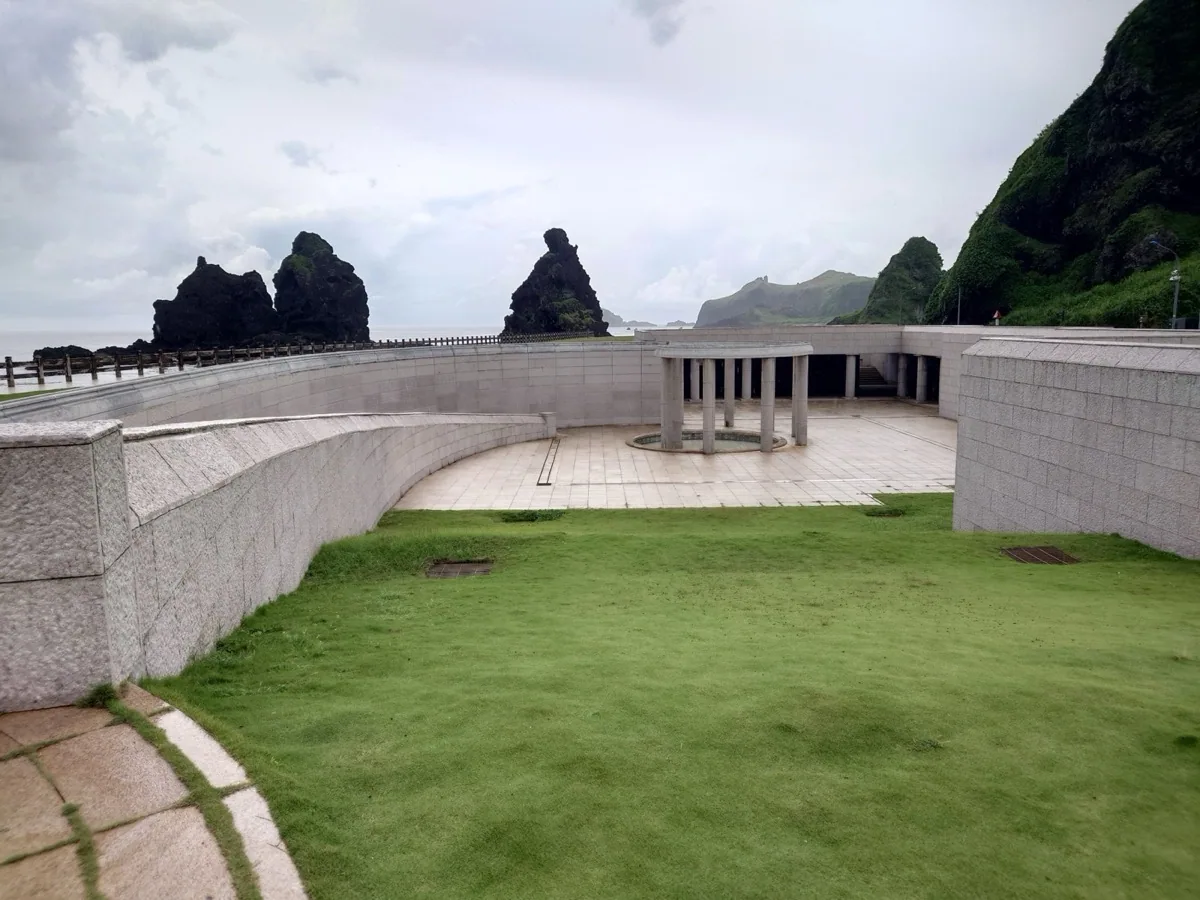
Taken in 2022. Photo: S8321414. CC BY-SA 4.0 via Wikimedia Commons.
On the same day as the Green Island inauguration, less than a kilometer from the podium, stood a “Human Rights Memorial Monument” completed on International Human Rights Day, December 10, 1999, commonly known among the public as the “Tearful Monument.”5 Its body is a spiral structure. When it rains, water flows along collection channels on both sides into the central point like tears. The inscription written by Bo Yang contains only 28 Chinese characters:
“In that era, how many mothers wept through the long nights for the children they had imprisoned on this island.”5
Lee Teng-hui personally unveiled the monument at the time, apologizing to political victims on behalf of the government. But the inscription wrote of mothers’ tears. It did not write the names of the perpetrators.
✦ One island: renamed from “Fire-Burned Island” to “Green Island” in 1949; the first boat escorting political prisoners arrived in 1951; the high-walled, closed Oasis Villa was built in 1972 for concentrated detention; prisoners ceased being admitted after martial law was lifted in 1987; the monument was erected in 1999; the Human Rights Memorial Park opened in 2002; and it was elevated into the National Human Rights Museum in 2018.
From the New Life Correction Center (1951-1965, thought reform), to the Ministry of National Defense’s Green Island Reform Prison (1965-1972, the Fire-Burned Island period), to Oasis Villa (opened in 1972, concentrating political prisoners from across Taiwan after the Taiyuan Incident),6 the prison institutions on this island changed names three times. Their function did not change until they were closed after martial law was lifted in 1987.
On February 8, 1970, an escape incident occurred at Taiyuan Prison in Taitung. Five pro-independence political prisoners, Cheng Chin-ho, Chen Liang, Chan Tien-tseng, Hsieh Tung-jung, and Chiang Ping-hsing, planned to occupy Taiyuan Prison, win over Taiwanese officers and soldiers in the prison guard company and Indigenous youth, seize weapons, and then broadcast the “Declaration of Taiwan Independence” to launch an island-wide revolution, answering Chiang Kai-shek’s external claim that “Taiwan has no political prisoners.”6 The plan failed. On May 30, 1970, the five men were executed by firing squad. Cheng Cheng-cheng, because the other five all said he had been abducted, was sentenced to 15 years and 6 months.
On October 2, 2021, the Transitional Justice Commission announced the revocation of all treason convictions against the five men in the Taiyuan Incident. Fifty-one years after these five people were shot, the state finally said they were “not rebels.”7 But the people who ordered their execution that year remain nameless.
The Detention Center Beside That MRT Line in Xindian
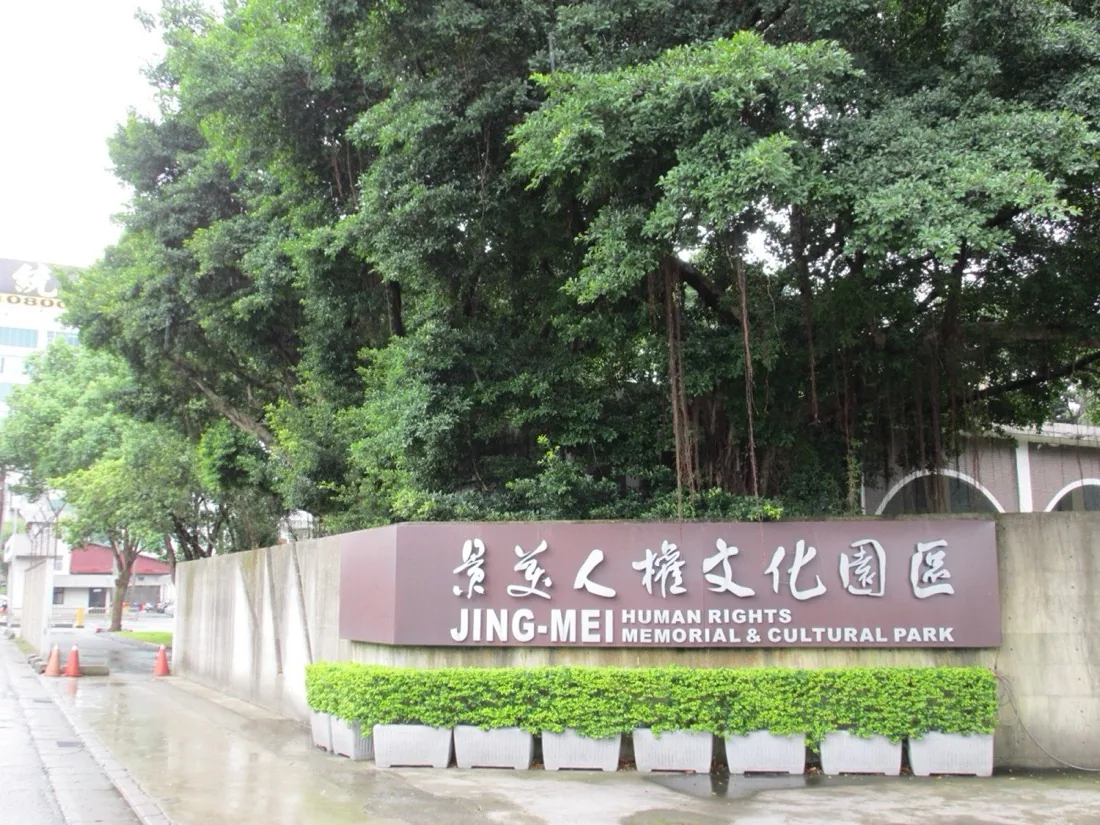
Jingmei Human Rights Cultural Park. Photo: Chang Yung-tai. Public Domain (Voice of America) via Wikimedia Commons.
No. 131, Fuxing Road, Xindian District, New Taipei City. A 10-minute walk from Shisizhang MRT Station on the Circular Line.8
Large numbers of commuters pass this wall every day, but do not necessarily know what once existed inside it.
In June 1957, the Ministry of National Defense Military Law School was established here. In 1968, the Taiwan Garrison Command Military Law Division and the Ministry of National Defense Military Law Bureau moved from Qingdao East Road in Taipei to Jingmei.9 In 1977, the First Courtroom was built on the site of the former basketball court: an 81.7-ping single-story building, the largest courtroom of the Garrison Command at the time.
On International Human Rights Day, December 10, 1979, the Kaohsiung Incident took place. The following year, in the early morning of March 18, 1980, at the First Courtroom of the Garrison Command Military Law Division, a nine-day proceeding began: what history remembers as the “major trial of the Kaohsiung Incident.” Eight principal defendants sat here: Huang Hsin-chieh, Shih Ming-teh, Yao Chia-wen, Chang Chun-hung, Lin Yi-hsiung, Lin Hung-hsuan, Annette Lu, and Chen Chu.10
💡 Did You Know
Chen Shui-bian, one of the defense lawyers in the Kaohsiung Incident major trial, became Taiwan’s first non-Kuomintang president 20 years later, in 2000. In the military court that prosecuted them, at least three defendants later became: Shih Ming-teh, chair of the Democratic Progressive Party; Annette Lu, vice president; and Chen Chu, president of the Control Yuan and the first chair of the National Human Rights Commission. That year’s defendants later moved into positions overseeing the state’s human rights institutions.
The verdicts were announced on March 27: Huang Hsin-chieh received 14 years, Shih Ming-teh life imprisonment, and each of the other 6 defendants 12 years.10
The daily reality of the Jingmei Military Law Division was in fact the Ren’ai Building detention cells. Completed in 1968, it was a two-story building with a total floor area of 1,673.1 ping, built at a cost of NT$8 million, with walls covered in barbed wire.11 The detention area occupied about one-third of the Ren’ai Building and was divided into three specifications:
- Solitary cells (for 1 person, with padding installed on the surrounding walls, added in the 1980s to prevent self-harm11)
- Small cells (for 3-4 people)
- Large cells (for 6-10 people)
Female political prisoners were confined in the double-row sealed cells on the left side of the second floor of the Ren’ai Building.11 A decision about placement left gender governance embedded in the architecture. Tsui Hsiao-ping and Chen Chu both spent time on this floor.
📊 Political victims once held in the Ren’ai Building: Yu Teng-fa, Huang Hsin-chieh, Bo Yang, Annette Lu, Shih Ming-teh, Li Ao, and Chen Chu. From this list alone, some later became DPP chair, vice president, Control Yuan president, and literary giant.11
At the main entrance of the Ren’ai Building is a pond. At its center stands the divine beast xiezhi, a legendary creature that, when seeing people in dispute, uses its single horn to strike the party who does not tell the truth. It is a symbol of “justice,” and ancient judges’ caps were named after it.12 But the designer of this xiezhi pond was Lin Chi, a political victim imprisoned in the Ren’ai Building at the time.12 A person deprived of liberty was called upon to design a sculpture symbolizing justice, standing before the entrance of the detention center that deprived him of liberty.
✦ Not every ironic structure needs the author to spell it out. The xiezhi stands there by itself, already turning the entrance to the most absurd legal machinery of the White Terror into a silent accusation.
The Jingmei park also contains a smaller building: the military courtroom next to the First Courtroom. Built in 1967 when the Garrison Command Military Law Division moved in, it had a floor area of 53.2 ping, with three courtrooms in a row, the middle one larger than the others.13 Cases such as Bo Yang’s “Popeye” case, Tsui Hsiao-ping’s “broadcasting communist spy” case, Chen Chung-tung’s “returned from study in Japan” case, the Tainan United States Information Service bombing case, and the Taipei Citibank bombing case were all secretly tried here.11 They were “secret” because military trials used a two-instance system. Those sentenced to death would immediately be shackled, sent back to their cells, and wait to be transported to the Ankang execution ground for execution by firing squad.13 From sentencing, to shackling, to being sent to the execution ground, time was compressed into the word “immediately.”
Political prisoners in the cells, and only those with good behavior, could take turns being let out for 15 minutes of exercise each week, which was often canceled because of Jingmei’s rainy weather.11 After indictment, family members were permitted to visit once a week, speaking by telephone through glass, limited to 10 minutes, required to speak Mandarin, with secret agents monitoring and recording throughout, and prohibited from discussing the case or conditions inside the detention center.9 In the NHRM introductory video, a child of a political prisoner recalls the first time visiting their father:
“The first time I came, I was in sixth grade. Back then, as a family member, my mother would hold my hand and my younger brother’s hand and bring us in. Then my mother spoke first. After my mother finished speaking, my father pointed at me with his hand, meaning it was my turn. But every time I picked up the phone, I couldn’t say anything. I wanted to see him, and I was afraid to see him.”14
How did the White Terror enter ordinary family life? The instant when this sixth-grade child picked up the phone but could not speak is the answer.
In October 1984, the writer Jiang Nan, whose real name was Henry Liu, was murdered at his home in Daly City, California. Jiang Nan was a Taiwanese American citizen who was then writing a biography of Chiang Ching-kuo. The case broke open in early 1985, and subsequent investigation found that the Ministry of National Defense Military Intelligence Bureau had dispatched members of the Bamboo Union gang to carry out the killing.9 Military Intelligence Bureau director Wang Hsi-ling and deputy director Hu Yi-min were convicted because of the case, and Wang Hsi-ling was sentenced to life imprisonment in 1985.14 But they were not sent into the Ren’ai Building’s large cells packed with 20 people. The authorities instead built a separate “Wang Hsi-ling Special Zone” in a corner of the park, a 37.8-ping compound of two single-story reinforced brick buildings enclosed by concrete walls on all sides, with a study, living room, bedroom, and small courtyard. “In fact, it was only a form of house arrest,” as the NHRM’s own official introductory video puts it.14
The Control Yuan later censured the Council for Cultural Affairs: why preserve a perpetrator’s house-arrest zone inside a human rights park as an exhibit?15 The response from the Council for Cultural Affairs, later the Ministry of Culture, was that placing the two kinds of detention spaces side by side is itself education.
The divine beast of justice, xiezhi, stands at the entrance, looking at two kinds of detention spaces: political prisoners crowded 20 to a cell in the Ren’ai Building, and a perpetrator in the Wang Hsi-ling Special Zone with a building that had a study. In the same park, one corridor is two worlds.
Martial law was lifted on July 15, 1987. The Garrison Command was abolished on July 31, 1992. In 1999, the military law organization was restructured into local, high, and supreme military courts.16 In 2002, the Council for Cultural Affairs registered the park as a historic building and planned it as a human rights memorial park. In 2007, the park was transferred to the Council for Cultural Affairs for management and opened to visitors. On May 18, 2018, International Museum Day, the “White Terror Jingmei Memorial Park” was inaugurated by Premier Lai Ching-te and Minister of Culture Cheng Li-chiun. Tsai Ing-wen attended the Green Island inauguration the previous day, May 17.4
A Museum Six Years in Preparation
But the phrase “preparatory period” is incomplete. The real preparation began in 2002. It simply broke off once in the middle.
On May 19, 2002, the Chen Shui-bian administration established the “Preparatory Office for the National Human Rights Memorial Hall” under the Presidential Office. On July 9, Presidential Office Secretary-General Chen Shih-meng issued temporary organizational regulations. On International Human Rights Day, December 10, the Green Island Human Rights Memorial Park formally opened.17
But on December 11, 2003, the Legislative Yuan resolved not to approve the regulations for future reference and abolished the preparatory office regulations; the draft organic act did not pass its third reading; and the legislature resolved to freeze about NT$150 million in related budgets. On February 13, 2004, the Presidential Office announced that the legal basis had expired. The first round of preparation died in the womb.17
On July 22, 2010, the Ma Ying-jeou administration restarted the process, announcing the establishment of a National Human Rights Museum.17 On October 19, 2011, the “Preparatory Office of the National Human Rights Museum” was established as a third-level agency under the Council for Cultural Affairs, and it began operating under its signboard on International Human Rights Day, December 10, 2011. In 2012, the Council for Cultural Affairs was upgraded into the Ministry of Culture, and the preparatory office was transferred under the ministry.
The Tsai Ing-wen administration accelerated the process after taking office. On November 28, 2017, the Legislative Yuan passed the Organic Act of the National Human Rights Museum on third reading.18 It was promulgated by presidential order on December 13, 2017. On March 15, 2018, the museum was formally established.
From the first preparation in 2002 to formal establishment in 2018, it took 16 years, three presidents, and two changes in ruling party between blue and green. Chen Shui-bian began it, Ma Ying-jeou continued it, and Tsai Ing-wen brought it to completion. In these 16 years, Taiwan’s transitional justice work at least established an institution called the “National Human Rights Museum.”
Its organizational structure consists of 2 divisions and 3 centers: the Comprehensive Planning Division, Exhibition and Education Division, Collections, Research, and Archives Center, White Terror Jingmei Memorial Park Management Center, and White Terror Green Island Memorial Park Management Center.18 Its directors and museum heads have included: Wang Yi-chun (April 2012-July 2017), Chen Chun-hung (became director of the preparatory office in August 2017, then first museum director from March 2018 to July 2021), and Hung Shih-fang (promoted from director of the Ministry of Culture’s Bureau of Cultural Heritage in July 2022, incumbent).19
Chen Chun-hung was seconded from his post as associate professor in the Department of Political Science at Soochow University. After leaving office, he said in a 2018 interview:
“Taiwan’s mainstream society demands rapid execution in major criminal cases, but when facing transitional justice that requires accountability, it says, ‘Let us look forward, and stop looking back.’”20
The museum director himself was also criticizing the limits of the work.
The 300 Names in an Outside-Work Doctor’s Medical Records
Chen Chung-tung was born in Changhua in 1937. After graduating from Kaohsiung Medical College, he pursued graduate study at Okayama University Medical School in Japan, specializing in cancer treatment and hematology. In early 1966, while studying in Tokyo, he met Hou Chi-pang, head of the organization department of the World United Formosans for Independence, and gradually developed pro-Taiwan independence ideas under his influence.21
He was arrested in early 1969. On July 12 of the same year, the authorities sentenced him to 15 years, stating that he had “intended to overthrow the government by illegal means and had commenced implementation.” After being held by the Garrison Command for nearly 4 months, in January 1970 he was transferred to the Taiwan Garrison Command Military Law Division Detention Center, namely the Ren’ai Building.21
During his sentence, because of his medical expertise, he mainly saw patients in the outside-work area of the Ren’ai Building infirmary. From 1969 to 1979, during those 10 years, he did something the NHRM would only later learn about:
“At the time, when I was serving as an outside-work doctor in the infirmary from 1969 to 1979, I used the information from each person’s physical examination and wrote it into our medical records. For example, where he was from, how old he was, what crime he had committed, or the rough details of the case. At that time we had roughly more than 300 entries of information, from fellow inmates who went outside to collect clothing to foreign inspectors who came in from outside. So when we wanted to transmit these materials abroad, they were extremely helpful.”14
More than 300 entries of political prisoner names, including names, native places, ages, and case grounds, were copied by him into medical records and carried through outside-work personnel, foreign inspectors, Li Ao’s younger brother, and Japanese friends, eventually reaching Japan and then Amnesty International.21 In the 1970s, multiple “political prisoner list leak incidents” occurred at the Jingmei Detention Center, and public pressure at home and abroad became great enough to pressure the government authorities, who were then claiming externally that “Taiwan has no political prisoners.” A large part of that came from what Chen Chung-tung smuggled out in medical records.14
After Chiang Kai-shek’s death in 1975, Chen’s sentence was reduced. On February 22, 1979, Chen Chung-tung was released from prison, having served a total of 10 years.
Forty years later, in 2021, the NHRM filmed an introductory video on the Jingmei park and invited Chen Chung-tung to be interviewed in front of the infirmary where he had once worked. Sitting before the camera at age 85, he described word by word how he copied names into medical records.14 From the “forerunner of a database inside the prison” to an “official NHRM interviewee”: the same person, across half a century, transformed the act of secretly carrying memory out of prison into audiovisual historical material collected by the NHRM.
National Human Rights Museum official 14:20 documentary on the Jingmei park, uploaded in 2021. Chen Chung-tung’s personal account of the list leak begins at 11:23, the recollection of a political prisoner’s child visiting begins at 9:38, and the closing montage of four interviewees’ wishes begins at 14:10.
Chen Chung-tung was not the only one. Ou-yang Wen, from Chiayi, was sentenced to 12 years in 1950 for involvement in the “Yang Hsi-wen case” and imprisoned at the Green Island New Life Correction Center. He was selected as a political section orderly responsible for photographing officers and foreign dignitaries visiting Green Island. Using the same camera, he secretly photographed Green Island’s tribes, folk customs, and human landscape in the 1950s, risking his safety to hide and bring the photos back.22 These photographs were first revealed in 1994, when Chen Shui-bian was elected mayor of Taipei. The main visual for the 2011 Green Island Human Rights Art Festival used his photograph Return, showing a Green Island woman leading an oxcart. Half a century later, the camera originally used to promote authoritarian rule became evidence exposing authoritarian rule.
The NHRM is a set of memory infrastructure:
- National Human Rights Memory Database (memory.nhrm.gov.tw): Its six major thematic categories are people, events, spaces, artifacts, historical materials, and oral records. It collects historical materials related to the period of authoritarian rule, from August 15, 1945 to November 6, 1992, and invites victims and their families to participate in co-creation, providing spatial and event-based image memories related to victims. Recommended text length is about 800 Chinese characters or fewer, with submissions reviewed by the NHRM.23
- Taiwan Transitional Justice Database (twtjdb.nhrm.gov.tw): It contains 9,915 military trial cases and can be searched by the name of the person tried, gender, year of birth, native place, prosecuting or trial agency, sentence, defense counsel, judgment number, occupational category, and other fields.24
- Memories on the Island (wtl.nhrm.gov.tw): A White Terror literary catalogue database that structures the correspondence between “political case → literary work,” allowing readers to move from specific cases to adapted works, such as the Deng Nan-jung case or Lin Hwai-min’s choreography, and also from literary works back to the original cases.25
These databases do not write history on behalf of victims. They let victims write it themselves. The 300 names in Chen Chung-tung’s medical records can now be searched on twtjdb.
Literary works have also become an extension of memory infrastructure. Wan Jen’s 1995 film Super Citizen Ko portrayed a political prisoner from a 1950s study-group case seeking atonement after release.26 John Hsu’s 2019 film Detention, adapted from the Red Candle game, brought White Terror imagery into a high school campus. Zero Chou’s 2022 film Untold Herstory, adapted from Cao Qinrong’s original work, tells the story of the women’s unit at the Green Island New Life Correction Center in the 1950s. Singing Chen’s 2022 VR film The Man Who Couldn’t Leave has screened regularly since August 2023 in the VR experience space at Jingmei Barracks No. 4 and won the Best Experience Award in the immersive content section at the 79th Venice Film Festival.27
The NHRM is simultaneously conducting spatial politics. On April 7, 2022, Freedom of Speech Day, the NHRM opened the permanent exhibition “A Soul of Freedom vs. the Dictator: The Journey of Taiwan’s Freedom of Speech” in the permanent exhibition hall on the first floor of Chiang Kai-shek Memorial Hall. The curator was Hsueh Hua-yuan, adjunct research fellow at the Institute of Modern History, Academia Sinica.28 Minister of Culture Lee Yung-te described the strategy at the time as: “If we cannot tear it down, then move in.”28 If the giant bronze statue in Chiang Kai-shek Memorial Hall cannot be removed, then place a permanent exhibition on the White Terror inside it, so that the commemorative space of the perpetrator system and the memorial exhibition of victims negate each other within the same building. Cheng Chu-mei, daughter of Deng Nan-jung, said in her opening ceremony remarks: “How a country’s culture remembers the past represents how a country regards its future.”28
From May 17, 2025, the 7th anniversary of the NHRM’s inauguration, to September 21, the 6th Green Island Human Rights Art Festival Biennial opened on Green Island with the theme “The Time of 149 Nautical Miles: Against Forgetting.” “149 nautical miles” refers to the distance from Taitung to Green Island. Among 23 artist groups, 7 came from overseas: Malaysia’s Pangrok Sulap, Vietnam’s Bui Cong Khanh, Hong Kong’s Ms. Bench, as well as Haiti, Croatia, and Indonesia.29 Chief curator Takamori Nobuo wrote:
“The separation of geography and time may make history forgotten, while art can become the hilt of a sword against time.”29
2025 Green Island Human Rights Art Festival Biennial promotional video, NHRM official YouTube. The 23 artist groups include 7 international groups, with Takamori Nobuo as chief curator. From the boat escorting political prisoners in 1951 to transnational artists crossing the same sea in 2025.
From the first boat escorting political prisoners landing on Green Island in 1951, to 23 artist groups from 7 countries crossing 149 nautical miles to reach the same shore in 2025: the same sea, 74 years, in the opposite direction.
Cambodia Imprisoned One Duch. Taiwan Imprisoned Zero.
In December 1995, South Korean prosecutors indicted former presidents Chun Doo-hwan and Roh Tae-woo on charges including the December 12, 1979 coup, the suppression of the 1980 Gwangju Uprising, and bribery. On August 26, 1996, both were convicted of rebellion, insurrection, and corruption.30 Although they were later pardoned, the fact that Chun Doo-hwan and Roh Tae-woo “had been convicted” is a legal fact.
In 2009, the Extraordinary Chambers in the Courts of Cambodia, or ECCC, a hybrid UN-Cambodian tribunal, tried Duch, also known as Kang Kek Iew, the former chief of S-21 Security Prison. S-21 was originally a secondary school in Phnom Penh. During the Khmer Rouge period from 1975 to 1979, it was turned into a security prison, where about 20,000 people were tortured and killed.31 In 2010, Duch was sentenced to life imprisonment, becoming the first senior Khmer Rouge figure to face judicial trial. Exhibits at the Tuol Sleng Genocide Museum are trial evidence displayed directly from the ECCC evidence archives.
On December 29, 1991, Germany’s Stasi Records Act took effect, establishing the Federal Commissioner for the Stasi Records, or BStU, and allowing 1.5 million people to apply to view the East German Ministry for State Security’s surveillance files on themselves. Poland and the Czech Republic successively enacted lustration laws in the 1990s, excluding former communist party officials from public office.32
Chile’s Museo de la Memoria y los Derechos Humanos was inaugurated by President Bachelet in 2010 to commemorate human rights violations under the Pinochet military government from 1973 to 1990. But Pinochet had enacted his own Amnesty Law in 1978 to exempt military government personnel. Although Pinochet was arrested in Britain in 1998, he died in 2006 without being tried in Chile.33
Argentina’s ESMA museum, the former Navy Mechanics School, was established in 2004. During the military dictatorship from 1976 to 1983, ESMA was the largest clandestine detention center; more than 5,000 people were held there, most of them thrown alive from military aircraft into the Río de la Plata, in what became known as the “death flights.” But Argentina had the 1985 Trial of the Juntas plus the reopening of human rights trials in 2004, so the museum’s content mainly comes from survivors’ testimony in those two waves of trials.31
The exhibitions in these four countries all have named perpetrators.
Return to Taiwan.
The Transitional Justice Commission was established on May 31, 2018, dissolved when its term ended on May 30, 2022, and submitted a Final Mission Report of 1.77 million Chinese characters, with appendices exceeding one million Chinese characters. On February 25, 2021, the commission announced an analysis of the review mechanism for military trials during the White Terror period: during martial law, 1,153 people were sentenced to death by final judgment, of whom 970 were personally reviewed by Chiang Kai-shek, and 259 cases that originally had not received the death penalty were ultimately changed by Chiang Kai-shek into death sentences.34
Hu Shih told Chiang Kai-shek to his face in 1953: “The Constitution permits the president only the powers of commutation and pardon, and absolutely no power to increase punishment. Yet the president has repeatedly increased punishments, which is plainly unconstitutional.”34 Article 133 of the Military Trial Act of 1956 also stipulated that the president “may not directly alter the original judgment” and should “refer it back for reconsideration.” But Chiang Kai-shek directly wrote comments in brush on official memoranda such as “sentence to death,” “should be sentenced to death,” “execution by firing squad is permissible,” and “why was this person not shot?”34 Among cases reviewed by Chiang, 31.4% resulted in sentences of more than 10 years, and 29.2% resulted in death sentences. By comparison, among cases not reviewed by Chiang, final death sentences accounted for less than 4%. Chiang was the final valve in the death-penalty machine.
But after the Transitional Justice Commission dissolved, the work of “identifying and disposing of perpetrators” was transferred to the Ministry of Justice. In the 39 years since martial law was lifted in 1987, 0 perpetrators have faced judicial trial.30
Yeh Hung-ling, former deputy chair of the Transitional Justice Commission, and Huang Cheng-yi wrote in a 2016 transitional justice memorandum to President Tsai Ing-wen a question that still has no answer:
“How was the oppressive system maintained and operated, and what responsibilities should participants at different levels bear?”
“Has anyone thought about the victims who died in political prisons, and who should be responsible for their misfortune?”35
Lin Chia-ho, professor in the Department of Law at National Chengchi University, wrote even more directly in a 2023 opinion piece for The Reporter:
“To this day, Taiwan still lacks an operable ‘profile of agents who assisted in carrying out state unlawful acts during the period of authoritarian rule.’”
“Some people have made up their minds to firmly resist and stigmatize such demands, preventing the public from discovering facts, and even finding discussion intolerable.”30
The NHRM’s exhibition discourse still describes the perpetrator system using the unnamed collective term “authoritarian government,” while the large bronze statue in Chiang Kai-shek Memorial Hall remains in the main hall, and Chiang Kai-shek’s portrait still circulates on the ten-dollar coin.36
⚠️ Contested Viewpoint
Victim-centered narrative is the default standard for international human rights museums, and the main materials in exhibitions in Chile, Argentina, Cambodia, and Germany also come from survivor testimony. But perpetrator accountability has two kinds of mechanisms: judicial trial, as in Cambodia’s ECCC and South Korea in 1996, and archive opening plus lustration, as in Germany, Poland, and the Czech Republic. Taiwan has accomplished neither. The museum’s gap lies upstream from it: political will. And the museum itself has had to bear all the downstream consequences of that gap.
Receiving a Budget Book Full of Bullet Holes
On January 14, 2025, in Taipei, the Dr. Chen Wen-chen Memorial Foundation, Nylon Cheng Liberty Foundation, Taiwan 228 Care Association, Association for Promoting Justice for 1950s White Terror Cases, Taiwan Association for the Care of Political Victims of the Martial Law Period, Taiwan Association for Human Rights, and 33 other civil society groups issued a joint statement:37
“We are unwilling to see Taiwan’s democracy retreat, and we express our solemn protest to the Kuomintang and Taiwan People’s Party. We call on all people to speak out and act together to resist the Kuomintang and Taiwan People’s Party as they use Congress to rescue improperly acquired party assets and delete budgets related to transitional justice!”37
The target of the protest was the central government general budget for fiscal year 114, or 2025, then under review in the Legislative Yuan. Most of the 33 signatory groups were part of a victim-centered narrative network that had long collaborated with the NHRM. The object pushed onto the budget battlefield in January 2025 was therefore far more than the NHRM as one institution. It was the entire network of transitional justice work.
In the early morning of January 20, the blue-white majority in the Legislative Yuan passed the 2025 central government general budget. After 20 uninterrupted hours of voting, a total of roughly NT$207.5 billion was cut, the highest in history.38 The specific situation for the Ministry of Culture’s budget:
- Originally allocated NT$29 billion
- NT$1.1 billion cut
- NT$3.4 billion frozen: 30% of regular operating expenses for all Ministry of Culture venues and institutions was frozen, to be released only after special reports to the Legislative Yuan’s Education and Culture Committee within three months
The institutions subjected to comprehensive freezes included the NHRM, Bureau of Cultural Heritage, Bureau of Audiovisual and Music Industry Development, National Center for Traditional Arts, National Taiwan Museum of Fine Arts, National Taiwan Craft Research and Development Institute, National Taiwan Museum, National Museum of Prehistory, and National Museum of Taiwan Literature. The NHRM was one institution swept into this. But at the level of individual items, the NHRM and the victim-centered narrative work chain were singled out for deletion:
- NT$5.225 million deleted from the “Human Rights Education Exhibition and Promotion Program — Grants to Domestic Organizations”39
- Legislator Lai Shyh-bao proposed deleting NT$100 million in Ministry of the Interior subsidies for transitional justice compensation to White Terror victims’ families, 2.9% of that budget item38
- Ill-Gotten Party Assets Settlement Committee: 90% of budget deleted
- Transitional Justice Promotion Fund: cut in half from NT$160 million to NT$80 million
- Executive Yuan Department of Human Rights and Transitional Justice: operating budget of NT$13.15 million deleted in full
- A demand to halt transitional justice work at Chiang Kai-shek Memorial Hall was passed38
A Ministry of Culture press release said:
“Proposals demanding a halt to transitional justice work at Chiang Kai-shek Memorial Hall and deleting budgets for activities such as National Human Rights Museum subsidies to civic groups are a major reversal of democracy.”38
The stated reason for the proposal to freeze operating expenses, put forward by the opposition caucuses without naming a specific legislator, was:
“It has not kept pace with the times in strengthening the connection between Taiwan’s social culture and the local, and most venues have not yet established Taiwanese-language guided tours or translations, leaving room for improvement.”39
Minister of Culture Li Yuan wrote on social media:
“After endless humiliation, we accepted this budget book filled everywhere with bullet holes. We originally thought we had rescued something, but in fact what we received was still a letter of surrender.”40
At the Executive Yuan meeting, he choked up and said:
“Taiwanese culture at this moment is like an embryo. At the critical moment when it is about to successfully establish its subjectivity, it has instead been dealt a vicious blow by massive budget cuts and freezes.”40
There was later a turn. At noon on May 7, 2025, the Legislative Yuan’s Education and Culture Committee reviewed and approved the full unfreezing of all 49 Ministry of Culture cases totaling NT$3.4 billion, making it the first among central government ministries and agencies. Li Yuan said that if the budgets were not unfrozen, many museums and venues would have been unable to continue operating after about August, including signing international contracts and paying salaries.40
But what happened during those 107 days of freezing? Construction of the new collections building at the Jingmei park began on February 18, 2025, with a total budget of NT$1.1 billion and expected opening in 2028. It is the park’s largest hardware expansion since its 2018 elevation.19 And from May 17 to September 21 that year, the 2025 Green Island Human Rights Art Festival Biennial opened under the theme “The Time of 149 Nautical Miles: Against Forgetting.”4
Both things proceeded. But the fact that “it could be frozen” had already happened. It can happen again next time.
The Names Not Written on the Tearful Monument
Bo Yang wrote 28 characters on Green Island’s Tearful Monument. He wrote of all mothers’ long nights of weeping. He did not write a single perpetrator’s name.
In the early morning of March 18, 1980, at the First Courtroom of the Jingmei Military Law Division, an 81.7-ping space, 8 defendants sat here for nine consecutive days. Forty-five years later, in the early morning of January 20, 2025, the Legislative Yuan passed a measure freezing 30% of the operating expenses of the museum to which this courtroom belongs. Minister of Culture Li Yuan described what he received as “a budget book filled everywhere with bullet holes” and “a letter of surrender.” After 107 days, on May 7, 2025, all 49 Ministry of Culture budget cases totaling NT$3.4 billion were unfrozen, the first such case among central government ministries and agencies.
The First Courtroom remains open to visitors today. Any traveler walking out of Shisizhang MRT Station can stand where the defendants once sat. The xiezhi pond at the entrance of the Ren’ai Building still stands there. The divine beast of justice designed by Lin Chi looks at the people who walk back in 30 years later.
On the day 88-year-old Tsai Kun-lin spoke on Green Island, he said: “I hope that one day we will know who killed my friend.” On September 3, 2023, he died with that question still unanswered.
At the end of the NHRM introductory video on the Jingmei park, four interviewees are edited together, each saying one sentence. No names, no accusations, only ordinary wishes:14
“I hope my child can grow up safely and healthily.”
“I want to become a model in the future.”
“After retirement, I want to travel around the world.”
“Although I am 85 years old, I still want to keep studying.”
Growing up safely and healthily, becoming a model, traveling around the world, continuing to study at 85. These are only the small wishes that anyone might have.
What the White Terror deprived people of was precisely these things.
In the 39 years since martial law was lifted, no one has had to answer who killed Tsai Kun-lin’s friend. But this museum, built by the state itself to commemorate what the state itself had done, continues asking this unanswered question with the 300 names Chen Chung-tung secretly smuggled out, the Green Island folk customs Ou-yang Wen secretly photographed, the xiezhi pond Lin Chi was ordered to design, the 28 characters Bo Yang wrote on Green Island, and the oral histories of 300,000 people scattered across society.
What can be frozen is not this museum. It is this unfinished memory infrastructure.
Where this story traveled
Further Reading:
- Green Island Prison — The layered memory of the same island, from political black jail to “hometown of big brothers.” This article focuses on the museum as an institution; that article addresses spatial memory
- Martial Law Period — The 38 years of martial law from 1949 to 1987, the legal foundation of the history displayed by this museum
- Taiwan White Terror — 29,407 military law cases and 140,000 victimized families, the concrete scale memorialized by the Tearful Monument
- Taiwan Transitional Justice — The struggle of revoking six thousand judgments without managing to hold perpetrators accountable; this article is one institutional slice of that struggle
- February 28 Incident — Postwar Taiwan’s largest civil uprising, the starting point that gave rise to 38 years of martial law
References
Image Sources
This article uses 3 public domain or CC-licensed images, all cached under public/article-images/history/ to avoid hotlinking source servers:
- President Tsai Ing-wen attending the “National Human Rights Museum Inauguration Ceremony” on May 17, 2018 — Photo: Presidential Office, 2018-05-17, CC BY 2.0 (Flickr standard license)
- Green Island Human Rights Memorial Monument, the Tearful Monument — Photo: S8321414, 2022, CC BY-SA 4.0
- Jingmei Human Rights Cultural Park — Photo: Chang Yung-tai, Public Domain (Voice of America) + CC Public Domain Mark 1.0
- Newtalk: Tsai Kun-lin’s May 17, 2018 speech at the NHRM Green Island inauguration — Full speech record including the verbatim quotation “I hope that one day we will know who killed his friend,” delivered by the 88-year-old victim representative on the day of the inauguration.↩
- Glean Taiwan: Green Island from Fire-Burned Island to the first boat of political victims — Historical verification of the Taiwan Garrison Command escorting nearly a thousand political prisoners from Taipei to Green Island’s “New Life Correction Center” on May 17, 1951.↩
- Wikipedia: Tsai Kun-lin — Complete biography of political victim Tsai Kun-lin: born April 11, 1930; implicated in a study-group case in 1950; sentenced to 10 years; founded Prince Biweekly in 1966; funded the Hongye Little League team in 1968; died on September 3, 2023 at the venerable age of 93. Note: TNL reports age 92, inconsistent with Wikipedia and the official presidential citation’s 93; this article follows Wikipedia and the citation.↩
- Ministry of Culture press release: National Human Rights Museum Green Island inauguration, May 17, 2018 — President Tsai Ing-wen personally attended and presided over the inauguration ceremony; includes Minister of Culture Cheng Li-chiun’s verbatim statement, “This step of history has waited sixty-seven years.”↩
- Human Rights Education Foundation: Green Island Human Rights Memorial Monument, the Tearful Monument — Unveiled by President Lee Teng-hui on International Human Rights Day, December 10, 1999; includes the original text and design concept of Bo Yang’s 28-character inscription: “In that era, how many mothers wept through the long nights for the children they had imprisoned on this island.”↩
- Wikipedia: White Terror Green Island Memorial Park — Covers the three institutional stages: New Life Correction Center (1951-1965), Ministry of National Defense Green Island Reform Prison, and Oasis Villa, opened in 1972 in response to the 1970 Taiyuan Incident.↩
- China Times News: Transitional Justice Commission revokes treason convictions against the five Taiyuan Incident participants on October 2, 2021 — Cheng Chin-ho, Chen Liang, Chan Tien-tseng, Hsieh Tung-jung, and Chiang Ping-hsing were executed by firing squad on May 30, 1970; their treason convictions were revoked 51 years later.↩
- National Human Rights Museum: White Terror Jingmei Memorial Park transportation information — Official park information: No. 131, Fuxing Road, Xindian District, New Taipei City, a 10-minute walk from MRT Shisizhang Station.↩
- Wikipedia: White Terror Jingmei Memorial Park — Complete record of building history, including the 1957 establishment of the Military Law School, the 1968 move-in of the Garrison Command Military Law Division, the 1977 construction of the First Courtroom, and the 1985 construction of the Wang Hsi-ling Special Zone after the Jiang Nan case.↩
- Wikipedia: Kaohsiung Incident — Records the outbreak of the Kaohsiung Incident on December 10, 1979; the nine-day military trial at Jingmei’s First Courtroom from March 18 to 27, 1980; and the full verdicts of 14 years for Huang Hsin-chieh, life imprisonment for Shih Ming-teh, and 12 years each for the other 6 defendants.↩
- National Human Rights Museum: White Terror Jingmei Memorial Park — Ren’ai Building — The Ren’ai Building was completed in 1968, a two-story building with a total floor area of 1,673.1 ping and construction cost of NT$8 million. Includes detention area structure (double-row sealed type, single-row narcotics rehabilitation type, single-row iron grille type, upper new iron railing, solitary cell padding added in the 1980s, three cell specifications, double-row sealed female prisoner cells on the second floor left side), 15-minute exercise, outside-work area commissary infirmary library, and former detainees Yu Teng-fa, Huang Hsin-chieh, Bo Yang, Annette Lu, Shih Ming-teh, Li Ao, and Chen Chu.↩
- National Human Rights Museum: divine beast xiezhi pond — The pond in front of the Ren’ai Building was designed and produced by political victim Lin Chi, then imprisoned there, with the “xiezhi” as its main design spirit. The xiezhi is a legendary divine beast with a single horn on its head; when it sees people in dispute, it uses its horn to strike the party who does not tell the truth or act reasonably. Ancient judges wore “xiezhi caps,” and the xiezhi also appears on the insignia of Taiwan’s Military Police.↩
- National Human Rights Museum: White Terror Jingmei Memorial Park — Military Courtroom — Built in 1967 when the Garrison Command Military Law Division moved in, with a floor area of 53.2 ping and three courtrooms arranged side by side, the middle one larger. Military trials used a two-instance system; those sentenced to death would immediately be shackled and sent back to their cells to await transport to the Ankang execution ground for execution by firing squad.↩
- White Terror Jingmei Memorial Park Introductory Video | Mandarin (NHRM official YouTube) — Uploaded August 10, 2021, a 14:20 official documentary. Includes NHRM’s self-description as “Asia’s first museum that combines historic sites, interprets authoritarian rule, and foregrounds the history of human rights”; the verbatim childhood recollection of a political prisoner’s child visiting in sixth grade; Chen Chung-tung’s personal account of leaking 300+ names while serving as an outside-work doctor in the infirmary from 1969 to 1979; Wang Hsi-ling’s 1985 life sentence and “form of house arrest”; and the closing four-interviewee montage of wishes. The transcript used in this article was fully transcribed through yt-dlp and faster-whisper, with STT errors corrected, and stored at
reports/research/2026-05/transcripts/nhrm-L-qcP5M9rQU/transcript-analysis.md.↩ - Control Yuan censure of the Council for Cultural Affairs: exhibition controversy over the “Wang Hsi-ling Special Zone” at Jingmei Human Rights Park — Control Yuan censure case questioning why a perpetrator’s house-arrest zone was preserved as an exhibit inside a human rights park, resulting in censure of the Council for Cultural Affairs, later the Ministry of Culture. The Ministry of Culture’s response was the counter-framing that “placing the two kinds of detention spaces side by side is itself education.”↩
- Wikipedia: Military law organization restructuring after the lifting of martial law — Timeline and legal basis for the July 15, 1987 lifting of martial law, the 1992 abolition of the Garrison Command, and the 1999 restructuring of military law organizations into three levels of military courts.↩
- Wikipedia: Preparatory Office of the National Human Rights Museum, Chen Shui-bian period — History of the first round of preparation: establishment of the Preparatory Office for the National Human Rights Memorial Hall on May 19, 2002; Legislative Yuan abolition of the preparatory regulations on December 11, 2003; and expiration of the legal basis on February 13, 2004.↩
- Organic Act of the National Human Rights Museum, promulgated by presidential order on December 13, 2017 — Passed by the Legislative Yuan on third reading on November 28, 2017 and promulgated by presidential order on December 13 of the same year. Article 4 of the Organic Act establishes the structure of 2 divisions and 3 centers.↩
- National Human Rights Museum: Former directors and museum introduction — Official personnel information for Wang Yi-chun (2012-2017), Chen Chun-hung (first museum director, 2018-2021), and Hung Shih-fang (2022-present), as well as information on the 2025 start of construction of the Jingmei collections building expansion.↩
- The News Lens: 2018 interview with director Chen Chun-hung — Verbatim quotation from NHRM’s first director: “Taiwan’s mainstream society demands rapid execution in major criminal cases, but when facing transitional justice that requires accountability, it says, let us look forward,” revealing the director’s own criticism of the limits of museum work.↩
- National Human Rights Memory Database: Mr. Chen Chung-tung — Born in Changhua in 1937, graduate of Kaohsiung Medical College, pursued graduate study at Okayama University Medical School in Japan, met Hou Chi-pang of the World United Formosans for Independence in 1966, sentenced to 15 years in 1969 for involvement in the “World United Formosans for Independence case,” served as an outside-work doctor at Jingmei from 1969 to 1979, and was released on February 22, 1979 after serving 10 years. The 300+ political prisoner names were transmitted to Amnesty International through Li Ao’s younger brother and Japanese friends.↩
- National Human Rights Museum: oral history of Mr. Ou-yang Wen — 1924-2012, Chiayi native, Western-style painter and photographer. Sentenced to 12 years in 1950 for involvement in the “Yang Hsi-wen case” and imprisoned at the Green Island New Life Correction Center. Selected as a political section orderly responsible for photographing officers and foreign dignitaries, he took the opportunity to secretly photograph Green Island folk customs and human landscape in the 1950s. The photographs were first revealed in 1994 during Chen Shui-bian’s Taipei mayoralty, and Return became the main visual of the 2011 Green Island Art Festival.↩
- National Human Rights Memory Database official website — NHRM-built memory platform with six major thematic categories: people, events, spaces, artifacts, historical materials, oral records, and background knowledge. It collects historical materials related to the authoritarian rule period from August 15, 1945 to November 6, 1992. Victims and families participate in co-creation, providing experiences of persecution and post-release life, with recommended text length within 800 Chinese characters.↩
- Taiwan Transitional Justice Database official website — Database taken over by the NHRM from the Transitional Justice Commission. Contains 9,915 military trial cases, continuously expanding, searchable by name of the person tried, gender, year of birth, native place, prosecuting agency, trial agency, sentence sought, defense counsel, trial judge, judgment year, final judgment, actual sentence carried out, judgment number, occupational category, and other fields.↩
- Memories on the Island — White Terror Literary Catalogue Database — Collects bibliographic information on literary works and recollective interviews about political incidents and the White Terror under authoritarian rule from Taiwan’s postwar period to the lifting of martial law in Kinmen and Matsu in 1992. Genres include fiction (short, novella, long), poetry (classical, modern, lyrics, haiku, waka), and prose (general prose, diaries, memoirs, letters, reportage, biography). It structures two-way traversal between “political case → literary work.”↩
- Wikipedia: Super Citizen Ko — A 1995 Taiwanese political film directed by Wan Jen and starring Lin Yang. It tells the story of Hsu Yi-sheng, a former 1950s political prisoner seeking atonement after release; Chen Cheng-yi’s silent protest by raising a “21” hand sign before execution, referring to Article 2, Paragraph 1 of the Statute for the Punishment of Rebellion; and the Liuzhangli mass graves as a core scene. Seven nominations at the 32nd Golden Horse Awards, with Lin Yang winning Best Leading Actor.↩
- National Human Rights Museum: VR film The Man Who Couldn’t Leave — A 2022 VR film directed by Singing Chen, winner of the Best Experience Award in the immersive content section at the 79th Venice Film Festival. Shot in 3D 8K VR360, it has screened regularly four times per day since August 5, 2023 in the VR experience space at Jingmei Barracks No. 4. It incorporates the experiences of multiple Green Island White Terror political prisoners.↩
- National Human Rights Museum: permanent exhibition “A Soul of Freedom vs. the Dictator: The Journey of Taiwan’s Freedom of Speech” — Opened on Freedom of Speech Day, April 7, 2022, in the permanent exhibition hall on the first floor of Chiang Kai-shek Memorial Hall. Curated by Hsueh Hua-yuan of Academia Sinica’s Institute of Modern History. Minister of Culture Lee Yung-te’s dialogic strategy: “If we cannot tear it down, then move in.” Verbatim opening ceremony remarks by Cheng Chu-mei, daughter of Deng Nan-jung: “How a country’s culture remembers the past represents how a country regards its future.”↩
- National Human Rights Museum: 2025 Green Island Human Rights Art Festival Biennial, “The Time of 149 Nautical Miles: Against Forgetting” — May 17 to September 21, 2025. Chief curator Takamori Nobuo’s verbatim statement: “The separation of geography and time may make history forgotten, while art can become the hilt of a sword against time.” The 23 artist groups include 7 international groups: Malaysia’s Pangrok Sulap, Vietnam’s Bui Cong Khanh, Hong Kong’s Ms. Bench, Haiti, Croatia, and Indonesia. “149 nautical miles” refers to the distance from Taitung to Green Island.↩
- The Reporter: Lin Chia-ho, “How Transitional Justice Handles Perpetrators” — September 19, 2023 opinion piece by the National Chengchi University law professor, including the verbatim quotation “To this day, Taiwan still lacks an operable profile of agents who assisted in carrying out state unlawful acts during the period of authoritarian rule,” and international comparative analysis.↩
- Wikipedia: Tuol Sleng Genocide Museum (English) — International comparison case for perpetrator accountability: historical facts on Cambodia’s S-21 Security Prison during the Khmer Rouge period, 1975-1979, and the ECCC special tribunal’s 2010 life sentence for Duch.↩
- Wikipedia: Stasi Records Act (English) — The Stasi Records Act took effect in Germany on December 29, 1991; includes the BStU federal archives authority and the transitional justice model of opening 1.5 million files for application and review.↩
- Wikipedia: Museo de la Memoria y los Derechos Humanos (English) — Institutional case of the museum inaugurated by Chilean President Bachelet in 2010 to commemorate human rights violations under the Pinochet military government from 1973 to 1990; includes background on Pinochet’s 1978 self-amnesty law.↩
- Transitional Justice Commission February 25, 2021 announcement: analysis of the military trial review mechanism during martial law — A total of 1,153 people were sentenced to death by final judgment; Chiang Kai-shek intervened in 970 cases; of these, 259 were changed into death sentences. Includes Hu Shih’s 1953 verbatim statement to Chiang: “The Constitution permits the president only the powers of commutation and pardon, and absolutely no power to increase punishment,” as well as Chiang Kai-shek’s handwritten comments such as “sentence to death,” “should be sentenced to death,” “execution by firing squad is permissible,” and “why was this person not shot?” Used together with Article 133 of the 1956 Military Trial Act, which states that “the president may not directly alter the original judgment,” as the legal basis for illegality.↩
- The Reporter: Yeh Hung-ling and Huang Cheng-yi, “A Transitional Justice Memorandum to President Tsai Ing-wen” — May 16, 2016 opinion piece by a former Transitional Justice Commission deputy chair and a scholar, including the verbatim quotation: “How was the oppressive system maintained and operated, and what responsibilities should participants at different levels bear?”↩
- United Daily News: Controversy over permanent exhibition at Chiang Kai-shek Memorial Hall — Status of transitional work for the April 7, 2022 permanent exhibition “A Soul of Freedom vs. the Dictator,” where only the small bronze statue at the entrance was moved to the office exhibition room, while the large bronze statue in the main hall remains.↩
- Taiwan Association for Human Rights: Joint statement by 33 civil society groups, January 17, 2025 — Full statement titled “Protesting the Blue-White Destruction of Taiwan’s Democratic Foundations and Jointly Blocking the Return of Improperly Acquired Party Assets to All Citizens,” with the complete list of 33 signatory groups.↩
- The Reporter: 2025 general budget cut by NT$207.5 billion — Legislative Yuan passage of the 2025 central government general budget on January 20, 2025; 20 hours of continuous voting by the blue-white majority; full figures for the Ministry of Culture’s NT$1.1 billion cut and NT$3.4 billion freeze.↩
- ARTouch: Ministry of Culture budget frozen and cut — Detailed report on the deletion of NT$5.225 million from the NHRM’s “Human Rights Education Exhibition and Promotion Program — Grants to Domestic Organizations,” and the opposition caucuses’ “has not kept pace with the times” stated reason for the freeze proposal.↩
- United Daily News: Ministry of Culture’s 49 budget cases fully unfrozen on May 7 — On May 7, 2025, the Legislative Yuan Education and Culture Committee passed the unfreezing of all 49 Ministry of Culture budget cases totaling NT$3.4 billion, the first such case among central government ministries and agencies. Includes Li Yuan’s verbatim quotations: “letter of surrender,” “filled everywhere with bullet holes,” and “embryo.”↩