
30-second overview: The National Central Library’s most important work is not about storing the most books in a single building, but ensuring that what Taiwan has published, forgotten, or rediscovered leaves a verifiable trail. Legal deposit connects publishers’ acts of issuance to national document preservation; Taiwan Memory transforms local gazetteers, old photos, postcards, ancient deeds, and biographical data into searchable digital resources; e-books and theses push preservation into the difficult terrain of formats, licensing, and long-term management. 1 2 3
In Taiwan, books are typically treated first as commodities, then as reading material, and only potentially as historical evidence. A local publication records a street that has since been renamed; a thesis preserves a debate that has not yet reached consensus; a government statistic allows later generations to understand how a policy described itself at the time. These publications may not become bestsellers, but they may be the only clues that allow future generations to reconnect with a specific social experience.
The National Central Library’s mission, therefore, cannot be measured solely by “how many books were borrowed.” It functions more like an adapter that transforms private publishing acts into public memory. Authors, publishers, government agencies, universities, and researchers generate various texts daily. Legal deposit and bibliographic control hand over a portion of these to a national preservation system. Preservation is not about locking items in a warehouse; it is about ensuring that future generations have the opportunity to know they exist, understand how they were described, and know under what conditions they can be read.
From Publications to National Documents
The National Central Library’s explanation of legal deposit frames this system as a crucial method for comprehensively collecting national documents. Its logic is straightforward: if preservation relies entirely on librarians’ proactive selection, what remains for the nation may only be works deemed important by the people of that era. Legal deposit shifts the responsibility toward the publishing end, requiring publishers to provide a copy upon issuance, which the National Central Library then integrates into the public knowledge infrastructure through cataloging, preservation, and service. 1
Taiwan’s legal deposit system has not been stable from the beginning. The National Central Library’s institutional description notes that early regulations were placed within the Publication Law. After the Publication Law was abolished in January 1999 (Republic of China Year 88), the collection of domestic book and information resources was temporarily interrupted. Relevant provisions were later incorporated into the Library Law, which was promulgated and implemented in January 2001 (Republic of China Year 90). This transition is significant because it demonstrates that document preservation is not merely a benevolent function automatically operating within the cultural sector, but requires law to connect publishers, the National Central Library, and public users. 1
The scope of legal deposit under the Library Law is not limited to traditional books. The National Central Library explains that books, journals, newspapers, audiovisual materials, and electronic media publications all fall within the scope of relevant legal deposit regulations; one copy should be submitted to the National Central Library and the Legislative Yuan National Library upon publication. After the 2015 (Republic of China Year 104) amendment, the central competent authority was also required to encourage publishers to submit publications to all national libraries. 1 This “one copy” is not a symbolic souvenir; it is the minimum institutional unit that allows the state to establish stable bibliographic and preservation work.
Publishers might feel that depositing is merely sending an extra book. For the national document system, the difference lies in whether this book will have an official bibliographic record, whether it can be found by researchers, and whether it remains accessible after the publisher goes out of business, the website closes, or the market forgets it. The value of legal deposit lies not in every book being read, but in making “having been published” a traceable public fact.
A Library Is Not Just a Bookshelf
The services listed on the National Central Library’s collection resource page have long surpassed traditional bookshelves. The Collection Discovery System integrates the library’s own catalog, special collections, and various electronic resources. The National Bibliographic Information Network integrates the bibliographic and collection data of the NCL and cooperating libraries. The Journal Literature Information Network, Taiwan Humanities and Social Sciences Citation Index, National Newspaper Images, and the Taiwan Master’s and Doctoral Dissertations Knowledge Value-Added System place different forms of research materials into searchable portals. 3
The common work of these systems is to establish relationships for data. A book has a title, author, publisher, publication date, subject headings, and classification. A thesis has a school, degree, advisor, and keywords. A newspaper image has a date and page position. Without these relationships, even if the collection exists, it may resemble paper piled in a warehouse. Cataloging may seem like backend technology, but it actually determines whether readers can access the data.
The National Central Library also collects statistical yearbooks, monographs, survey reports, and gazettes published by central and local governments. These materials typically do not enter the market as bestsellers, yet they are primary materials for researching how policies describe population, industry, education, transportation, and local governance. They leave not just a set of numbers, but also record how the government chose to name issues in a specific era. 3
Therefore, the public nature of the National Central Library lies not only in “anyone can come to read.” It also lies in whether different resources can be connected. A researcher can trace from a local gazetteer to a government statistic, and then find social reactions of the time through newspaper images. When data is placed in the same knowledge environment, history does not consist solely of a few names that have been repeatedly told.
Taiwan Memory: Transforming Local Experience into Searchable History
“Taiwan Memory” pushes the National Central Library’s preservation task into another spatial dimension. The system description states that Taiwan Memory collects precious materials such as book documents, historical sources, images, and historical figures. After digitization and standardized interpretation, these materials present Taiwan’s history through geographical location, timelines, and themes. 2
This design changes the way readers access data. Traditional collections usually start from a book title or author; Taiwan Memory also allows readers to enter from location, time, or person. Someone wanting to know how a port has changed can cross-read old photos, local documents, and biographical data. Those researching a local family, industry, or street do not need to know the complete title of a specific book first. Digital archives partially transform what was previously an entry point relying on professional retrieval experience into an exploratory path for general users.
The materials collected in Taiwan Memory also demonstrate that “Taiwan history” is not constituted solely by central government archives. Postcards from the Japanese colonial period, old photos from various regions, old books, local gazetteers, ancient deeds, genealogies, and rubbing copies of steles preserve how different people lived, traded, moved, and remembered on the land. They may not provide a complete story, but they allow local experiences to exist without waiting to be written into a grand narrative. 2
Digitization does not end with placing paper into a scanner. Each object requires image specifications, file management, metadata, rights assessment, and long-term preservation strategies. An old photo on a page, if lacking time, location, source, and theme information, shows users only a pretty image. What digital archives truly add is not just the number of files, but the possibility for objects to be understood, compared, and re-placed in historical context.
The number of digital objects displayed on the Taiwan Memory homepage continues to change because the system is still adding, adjusting, and maintaining. This dynamism itself is noteworthy. Digital national memory is not a finished monument, but a continuous work of selecting partners, organizing data, refining descriptions, and handling rights issues. The datasets seen today do not represent that new local memories will not be added tomorrow, nor do they imply that all yet-to-be-digitized materials do not exist.
Different Timelines for Ancient Books, Manuscripts, and E-books
The National Central Library’s special collection resources include Ancient Book Image Retrieval, Stone and Bronze Rubbings Database, Joint Catalog of Chinese Ancient Books and Taiwan Region Genealogies, Online Special Collections Exhibition Hall, Contemporary Celebrity Manuscript Collection System, and Universal Ancient Book Digital Humanities Research Platform. These resources extend preservation from “protecting an ancient book” to “enabling materials to be read through different methods.” 3
Ancient book images allow researchers to compare versions without frequently touching the originals. Manuscript preservation captures not just the final published text, but also deletions, rewrites, marginal notes, and the time traces left on paper. The joint genealogy catalog places data scattered across different collection units into a common retrieval framework, allowing family history and local history to transcend the vision of a single collector.
E-books complicate the issue further. The National Central Library’s English legal deposit description states that formally published e-books are also within the scope of Taiwan’s legal deposit policy. This means the object of publication preservation is no longer just fixed paper, but includes file formats, reading software, version changes, digital rights management, and future compatibility. 4
Electronic publications may not suffer from paper wear and tear, but that does not mean they are naturally permanent. File formats may cease to be supported, platforms may close, licensing conditions may restrict reader use, and digital rights management may leave conservators with files they cannot freely provide for reading. Research on national digital publications notes that digital technology has changed how knowledge is accessed and managed, also imposing tasks on the National Central Library such as international coding for digital publications, permanent archiving, and increasing the population of digital readers. 5
Thus, e-book deposit is not a simple copy of paper book deposit. The core of paper book preservation is space, temperature/humidity control, and restoration. E-books must also handle verification, format conversion, backup, licensing, and reading environments. The real difficulty is not collecting files into servers, but ensuring future researchers know how this file was originally published, which version is the true release, and under what rights conditions it can be used.
Preservation and Access Are Not the Same Thing
“Preservation” and “access” are often conflated. The National Central Library preserving a publication means it has been integrated into the national document system, not that everyone can immediately download the full text. The collection resource page lists different methods simultaneously: public query, in-library use, database licensing, e-book services, and full-text thesis access. 3
This distinction is crucial for researchers. A bibliographic record tells you a book exists; collection location tells you where to find it; digital images may allow you to read directly; copyright conditions determine whether you can download, reproduce, republish, or publicly display it. Search results in databases do not equal full openness of original content. The National Central Library must maintain a boundary between cultural preservation and copyright protection that cannot be replaced by a simple slogan.
The legal deposit system hands publications over to the state for preservation, but does not automatically eliminate the rights of authors, publishers, photographers, translators, and other rights holders. For digital archives, rights inventory may be slower than scanning. A local publication may have multiple authors; photos may be provided by different photographers; the publisher may have dissolved; heirs may not be easy to find. These obstacles create a persistent gap between “we have digitized it” and “we can freely make it public.”
After a Book Leaves the Market
The most noteworthy moment for the National Central Library may not be the launch of a new book, but what happens after a book leaves the market. When publishers stop printing, publishers reorganize, websites close, or local groups dissolve, data may disappear from the commercial system. As long as it was legally deposited, future researchers may still find entry points through bibliographic records, collections, images, or related materials.
This does not mean the National Central Library can preserve all voices, nor that being preserved equals being correctly understood. Bibliographic classification may use terminology from a specific era; digital interpretation may be limited by existing fields; local communities may offer different opinions on official names or historical descriptions. Preservation leaves materials behind, but it cannot decide a single interpretation for society. After data is preserved, it still requires researchers, local groups, and readers to re-read it.
There is a political dimension easily ignored: what is published, what is deposited, what is digitized, and what is marked as searchable are all choices of the knowledge system. Legal deposit reduces the risk of loss, but does not guarantee that small publishers have the capacity to complete deposit. Digital archives expand entry points, but do not guarantee that all local languages, private archives, and unformally published oral memories are included. The public nature of the National Central Library lies not in claiming completeness, but in continuously revealing where it is still incomplete.
A Building, and the Network Beyond It
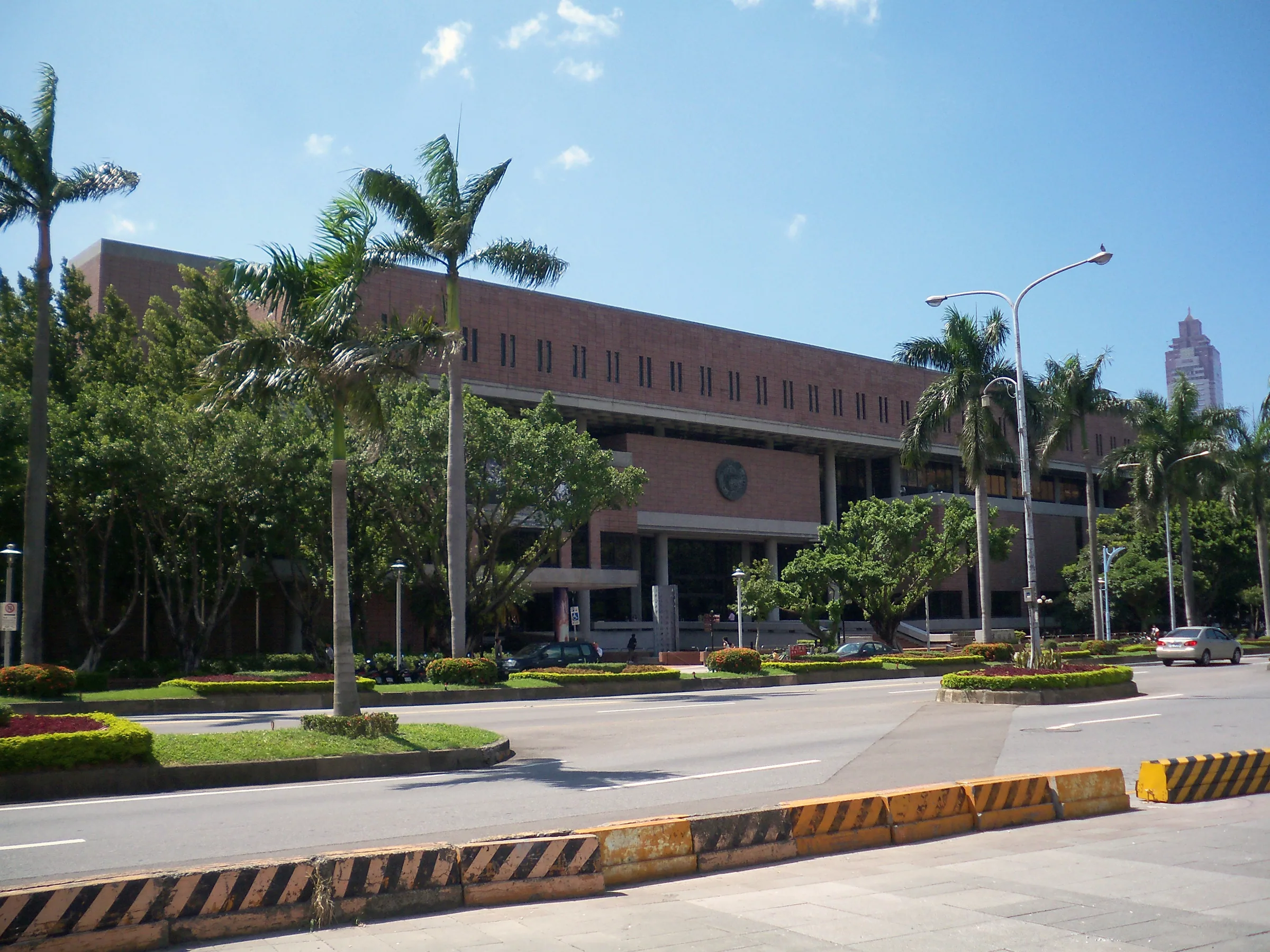
The National Central Library headquarters is a building that can be photographed, but its most important parts often lie outside the facade. Wikimedia Commons’ photo of the headquarters records the building on Zhongshan South Road, Zhongzheng District, Taipei. The author, Xuan Shi-sheng, released it under CC BY-SA 3.0 Unported. The photo allows readers to locate this institution, but cannot alone explain how it works. 6
What truly supports the National Central Library is the publisher deposit system, ISBN and CIP, bibliographic databases, journal indexes, thesis systems, newspaper images, government publications, Taiwan Memory, ancient book digitization, thesis alliances, and the Overseas Sinology Resource Center. The building is the entrance; data standards and cooperative networks are the skeleton that allows it to operate long-term. 3 7
The National Central Library also uses the Sinology Research Center, the Overseas Taiwan Sinology Resource Center, and Chinese literature resource cooperation to ensure Taiwan’s publishing and Chinese literature do not remain confined to a single Taipei building. This international cooperation is not about packaging Taiwan culture as an export commodity, but about sharing bibliographic, image, and research entry points across different collection units. The scale of national-level archiving is therefore determined not only by collection volume, but by its ability to mutually find and correct other institutions.
Reader Services as the Exit of Preservation
Preservation systems ultimately return to how readers access data. The control gates and card-issuing counters in the National Central Library headquarters reading hall are, on the surface, the most mundane parts of the building, but they actually connect the backend system of national documents to users. Readers first obtain access qualifications, then approach a publication that may have left the market years ago through collection queries, bibliographic data, and reading rules. 3 8
This entrance also reminds us that digitization cannot replace all physical services. Electronic resources allow remote searching, but librarians still need to handle version identification, special collection use, copyright restrictions, and data context. The 2025 Library News highlighted the rise of digital reading literacy and the parallel operation of library services, which does not mean paper books are disappearing; rather, readers simultaneously need online discovery and physical confirmation. 9

Figure: National Central Library Headquarters Reading Hall. Photo by Adao, 2024-01-11, CC BY-SA 4.0. See image source page for details.
From Deposit Lists to Publisher Interfaces
The latest institutional changes make legal deposit more like a publisher interface, rather than just sending a cardboard box. The National Central Library’s 2025 Library News records that the publication deposit system has gone live and is integrated with the application services of the National New Book Information Network. This means the process publishers face includes data entry, bibliographic information, deposit lists, and subsequent management; deposit is no longer just administrative paperwork after the publishing process ends. 10 9
The National Central Library’s 2025 Library News also places digital reading literacy, cross-border Chinese ancient book digitization cooperation, and the international dissemination of Taiwan studies research results in the same issue. Viewing these matters together reveals two simultaneous lines of work for the National Central Library: one line collects Taiwan publications into the national system; the other delivers already preserved materials to broader research networks. Preservation and dissemination are not sequential; they are services that must be designed simultaneously. 9
The deposit system’s licensing management operation manual, along with forms for delaying public access, replacing, and licensing theses, more clearly exposes the institutional gaps between preservation and access. Publications can be deposited and cataloged first; full-text public access must then be handled according to author, publisher, or thesis licensing conditions. This is not a lack of system efficiency, but a result of the preserver respecting different rights statuses. 1
The Taiwan Memory county-city co-construction and sharing symposiums bring the issue from the central library to the local level. The National Central Library once invited the Ministry of Culture, the National Taiwan History Museum, twenty-two county/city cultural bureaus, and local libraries to discuss cooperation, explicitly addressing audiovisual resources, original context, and Creative Commons licensing terms. For local digital archives to enter a common platform, they cannot simply move files over; they must explain who provided them, how they are described, and what can be reused. 11

Figure: National Central Library Reading Room. Photo by Adao, 2024-01-11, CC BY-SA 4.0. See image source page for details.
The Next Question for Taiwan’s Publishing Memory
Paper publishing continues; e-books, audio-visual content, websites, social media posts, and interactive data are constantly increasing. Traditional legal deposit systems can answer “who published what and when,” but require new tools to face rapid version changes, platform dependency, and multimedia content. A paper book has a clear publication date; online publications may update daily. A book can be placed in a library stack; an interactive webpage requires preserving code, databases, and usage environments.
What the National Central Library will need to preserve in the future may not just be a file, but a system of how content is generated, modified, disseminated, and read. This will raise preservation costs and make copyright and privacy issues harder to avoid. For publishers, deposit should not be understood as handing over a work and ending the process. For the National Central Library, archiving should not be understood as receiving it and finishing the job. Both sides must clarify data formats, rights scope, long-term maintenance, and reader usage.
The best national library does not seal the past into a neat answer, but leaves enough evidence for the future to cross-reference. A local gazetteer, a government statistic, an old photo, a thesis, an e-book file—they may not agree with each other, but together they prove how an era lived, how it named issues, and how it imagined its future.
Taiwan publishes a new version of itself every day. What the National Central Library truly preserves is not just finished books, but which experiences an island was willing to write down, and handing them over to people not yet born to re-read.
Image Sources
Figure: Xuan Shi-sheng, 2009-08-01, Wikimedia Commons, CC BY-SA 3.0 Unported. Original file page: https://commons.wikimedia.org/wiki/File:ROC_National_Central_Library_headquarters_20090801.jpg. This article uses the Wikimedia Commons free license hotlink; images are not downloaded.
Figure: Adao, 2024-01-11, Wikimedia Commons, CC BY-SA 4.0. Original file page: https://commons.wikimedia.org/wiki/File:Interior_of_National_Central_Library_ROC_-_04._2024_-_01_-_11.jpg. This article uses the free license hotlink; images are not downloaded.
Figure: Adao, 2024-01-11, Wikimedia Commons, CC BY-SA 4.0. Original file page: https://commons.wikimedia.org/wiki/File:Interior_of_National_Central_Library_ROC_-_01._2024_-_01_-_11.jpg. This article uses the free license hotlink; images are not downloaded.
References
— Taiwan.md Contributors
- Legal Deposit of Publications — The National Central Library explains the evolution, legal basis, scope of deposit, and purpose of national document preservation for legal deposit.↩2345
- About Taiwan Memory — The National Central Library explains the types of digitized data, interpretation methods, and retrieval portals for Taiwan Memory.↩23
- Collection Resources — The National Central Library lists collection discovery, bibliographic, journal, newspaper, thesis, government information, Taiwan Memory, ancient book, and Sinology services.↩234567
- Legal Depository — The National Central Library’s English Q&A states that formally published e-books are also within the scope of Taiwan’s legal deposit policy.↩
- Preservation Management and Knowledge Services for National Digital Publications — Gu Min, 2010, Research and Development Quarterly, discussing coding, permanent archiving, and digital knowledge services for digital publications.↩
- File: ROC National Central Library headquarters 20090801.jpg — Photo by Xuan Shi-sheng, CC BY-SA 3.0 Unported, providing a free-license image of the National Central Library headquarters building.↩
- History of Our Library — The National Central Library’s official library history detail page, recording the library’s founding, wartime relocation, and subsequent development.↩
- File: Interior of National Central Library ROC - 01. 2024 - 01 - 11.jpg — Photo by Adao, CC BY-SA 4.0, providing a free-license image of the National Central Library headquarters reading hall and card service entrance.↩
- National Central Library Library News, Vol. 114, No. 2 — The 2025 Library News detail page, recording the launch of the publication deposit system, digital reading, cross-border ancient book digitization, and international exchange.↩23
- National Central Library Annual Report — The National Central Library Annual Report detail page, stating that the annual report records annual performance, statistics, and major events, and lists the 2025 report published in 2026.↩
- NCL "Taiwan Memory—County-City Memory Co-construction and Sharing Symposium" — The National Central Library’s detail page on discussions with the Ministry of Culture, county/city cultural bureaus, and local libraries regarding digital resource cooperation, original context, and Creative Commons licensing.↩

