
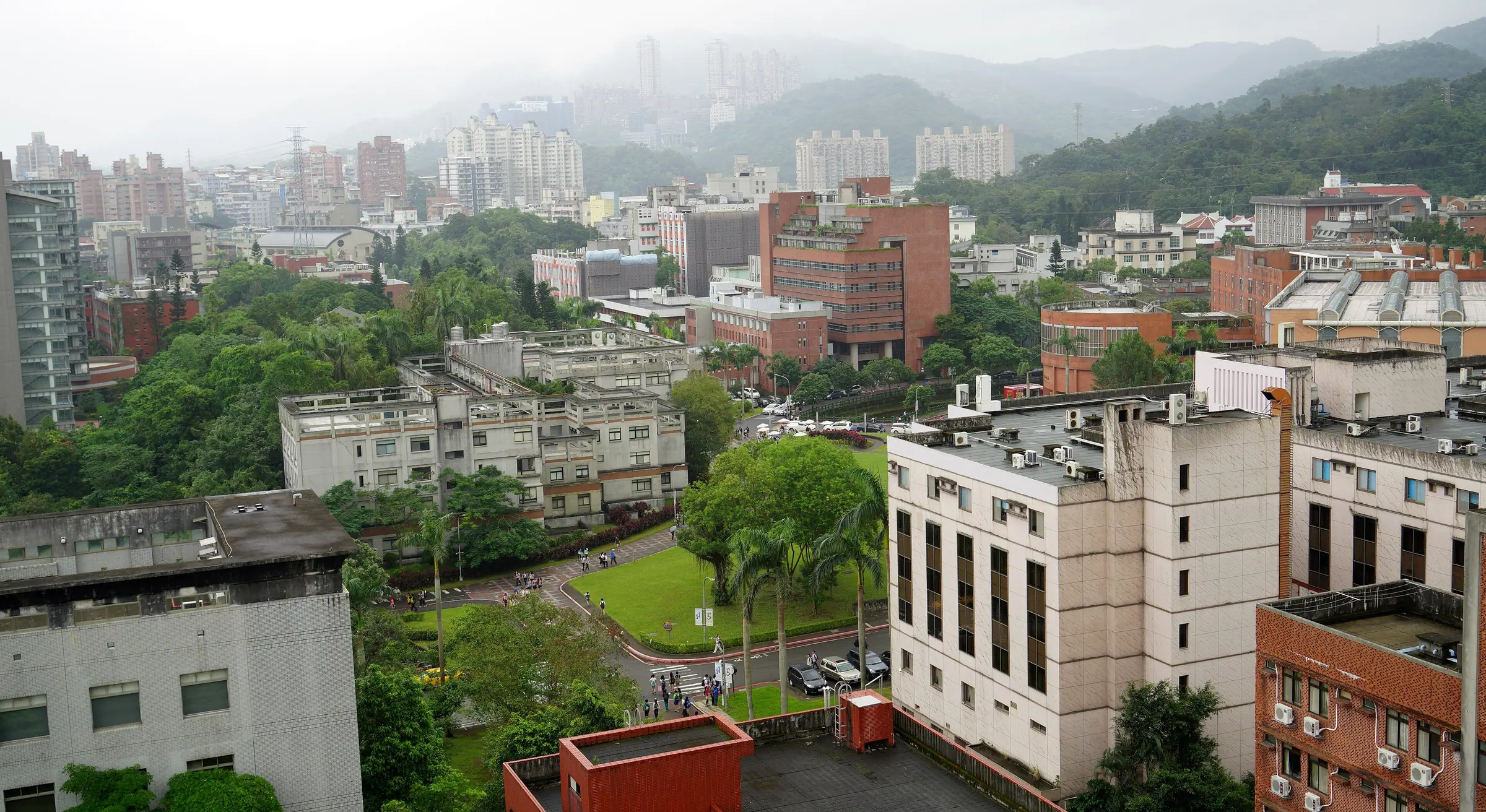
Academia Sinica
In the winter of 1948, a shipment of wooden crates arrived in Yangmei, Taoyuan, and was stacked in a warehouse beside the train station.
The crates belonged to the Institute of History and Philology of Academia Sinica. The institute's founding director, Fu Ssu-nien, had earned the nickname "the Moving Man"1 after transporting the entire institute's materials across wartime China—from Nanjing and Changsha all the way to Kunming in Yunnan and Lizhang in Sichuan during the anti-Japanese war. This winter shipment in 1948 was yet another relocation of the same collection. Among the crates from various government agencies that arrived in Taiwan around the same time, only those from the Institute of History and Philology remained in Yangmei; the rest were transferred to a sugar factory warehouse in Taichung2.
Few people crossed the sea with the crates. Academia Sinica's own institutional history records that year with striking brevity: "Only the General Affairs Office, the Institute of History and Philology, the Institute of Mathematics, and a few other units—some fifty-odd people in total—relocated to Taiwan with the government in 1948–1949"3. Fifty-some people, a handful of units, and a borrowed warehouse: this was the first foothold in Taiwan for an institution whose charter designated it as "the highest academic research organ of the Republic of China"4.
30-second overview: Academia Sinica was founded in Shanghai in 1928 and arrived in Taiwan around 1949 with only fifty-odd staff members. Today it operates 24 research institutes, 9 research centers, and nearly a thousand researchers. Its legal authority derives directly from the Presidential Office Organization Act; it neither grants degrees nor admits students. The advantage of this institutional position is "duration": the Yinxu oracle bone excavations spanned fifteen campaigns over a decade, and the Institute of Taiwan History took eleven years to progress from planning to full establishment. Yet this same position also means the president is selected by the sitting president from a slate of three candidates, the annual budget is scrutinized line-by-line in the Legislative Yuan, and even whether to change the English name requires first answering "Is this a question of national positioning?"
The First Belongings to Land in Taiwan, Temporarily Stored in a Train Station Warehouse
Rewind twenty years: the institution's first meeting also did not take place in any grand hall. In 1927, the establishment of Academia Sinica was approved at a Kuomintang Central Political Conference. The Academia Sinica institutional history website attributes the initiative to a group led by Cai Yuanpei, while Wikipedia records that Li Shih-tseng presented the establishment proposal at the 74th meeting on April 17 of that year—both accounts have coexisted5. The Organization Act was promulgated on November 9 of the same year. On April 23, 1928, the Nationalist Government appointed Cai Yuanpei as President. On June 9, the first board meeting was held at the East Asia Hotel in Shanghai, marking the official founding5. A private dining room—that was the venue where the nation's highest academic institution opened its doors. According to the institutional history website, in the founding period, "with extremely limited funding, a total of ten research units were established"3.
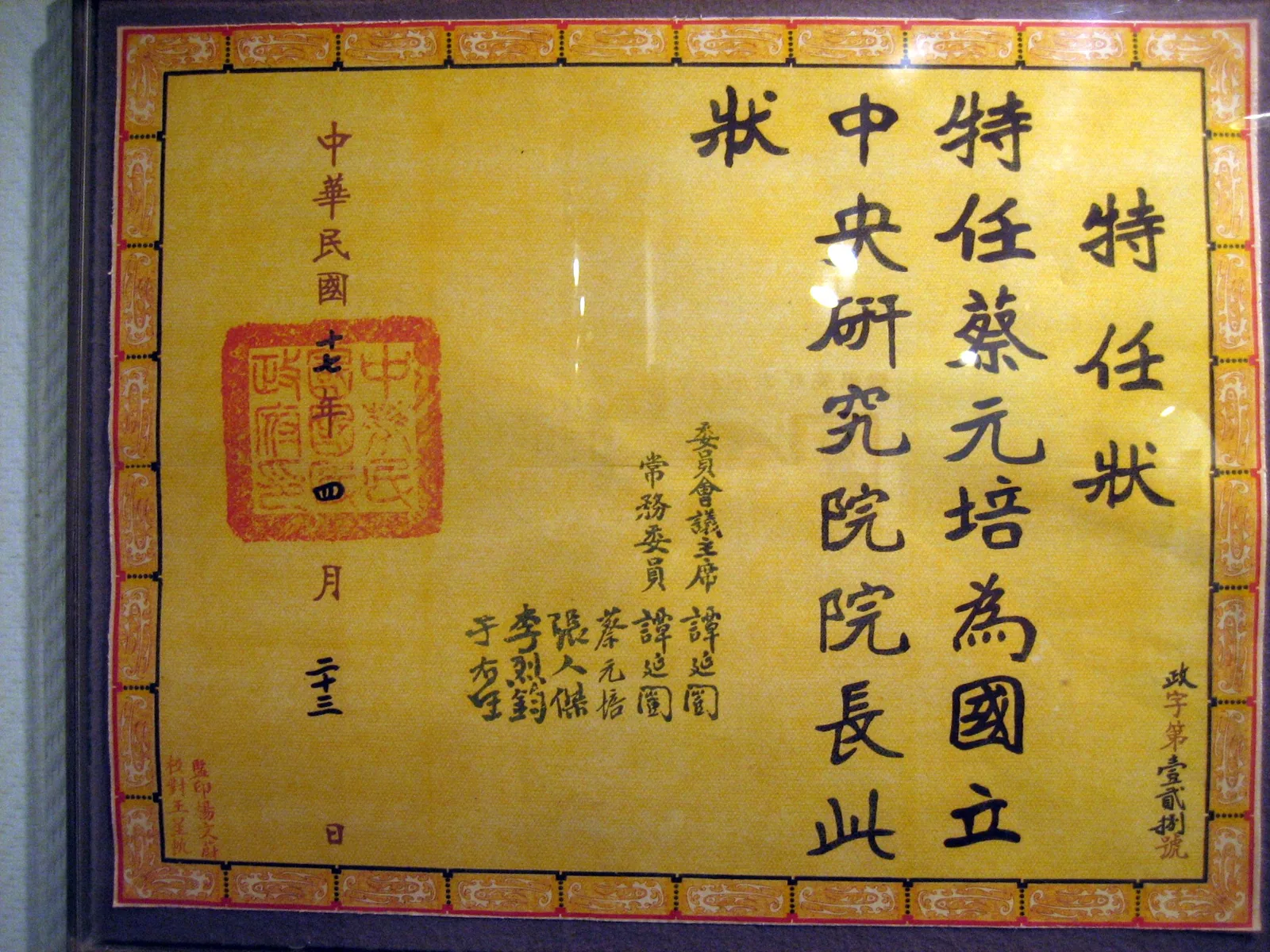
The appointment document of April 23, 1928, naming Cai Yuanpei as President of Academia Sinica. Photographed at Cai Yuanpei's former residence in Shanghai. Photo: Mountain / Wikimedia Commons, Public domain
Among the luggage brought by these fifty-odd people, one thing was not packed in a box. Article 1 of the Academia Sinica Organization Act states: "This Act is enacted in accordance with Article 17 of the Organization Act of the Office of the President of the Republic of China." Article 2 states: "Academia Sinica is the highest academic research institution of the Republic of China, with the following missions: 1. Research in humanities and sciences. 2. To guide, coordinate, and encourage academic research. 3. To cultivate high-level academic research talent."4
Like other state-funded institutions, the National Applied Research Laboratories falls under the Ministry of Economic Affairs, while Academia Sinica's legal basis derives from the Organization Act of the Office of the President. It is not a university: it has no degree-granting authority, does not admit undergraduate students, and its researchers are not required to teach. To establish doctoral programs, it relies on the Taiwan International Graduate Program (TIGP), launched in 2002, jointly operated with ten universities including National Taiwan University, National Tsing Hua University, and National Yang Ming Chiao Tung University. Students receive degrees from the partner universities plus a TIGP completion certificate6. Today its scale is stated on its English official website: "24 research institutes and 9 research centers, with almost 1,000 researchers"7.
In March 1948, Academia Sinica elected its first class of Academicians, totaling 81 people, divided into 28 in mathematics and physics, 25 in biology, and 28 in humanities. The first Academician Conference was held in Nanjing in September of the same year8. That roster represented the pinnacle of China's academic circles at the time, but it scattered little more than a year later. Wikipedia's summary is that "most of the various units of Academia Sinica and the first class of Academicians remained on the mainland or chose to go abroad, with very few following the relocation to Taiwan"5. Exactly how many relocated to Taiwan varies across accounts, ranging from 6 to 12 people, with no consensus to this day. What can be confirmed is that Wang Chonghui arrived in Taiwan via Hong Kong in 1949 and died in Taipei in 1958; Wu Zhihui passed away in Taipei in 1953; and Lin Kesheng on the roster went to the United States in 1949 and never came to Taiwan9.
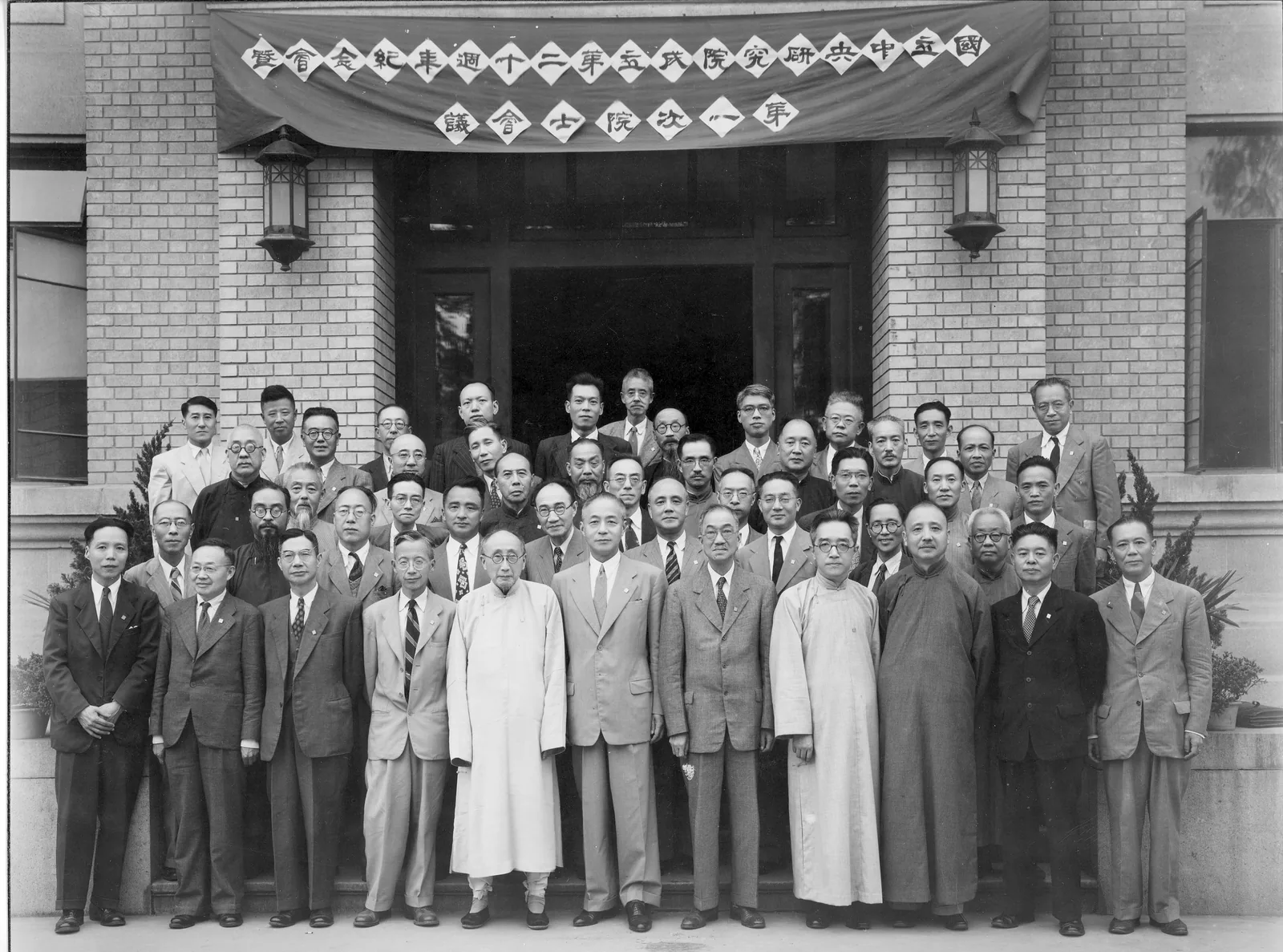
September 1948: the first class of Academicians photographed in Nanjing. Of these 81 people, only a tiny handful followed the relocation to Taiwan a little more than a year later. Photo: Author unknown / Wikimedia Commons, Public domain
The warehouse period did not last long. In the summer of 1954, the first buildings of the Nangang campus were completed, and the institution had its own address in Taiwan3. The second Academician Conference was held in Taipei in 1957, and the third in 1958, when the second class of Academicians was elected8.
The presidency also passed on. Hu Shi took office in April 1958 and on February 24, 1962, presided over the fifth Academician Conference. That afternoon, the institution held a welcome reception for newly elected Academicians including Ren Zhigong; at 6:35 p.m., he suffered a fatal heart attack at the reception10. His burial site was later developed into Hu Shi Park according to the natural topography of the area, and elderly residents in Nangang still practice tai chi there today.
Source: Academia Sinica Institutional History Website, Academia Sinica Official Press Releases, Institute of Taiwan History Overview
One Pit Yielded More Oracle Bones Than Eleven Published Catalogs Combined
The most famous items in those boxes came from Xiaotun Village in Anyang, Henan.
Between 1928 and 1937, the Institute of History and Philology conducted fifteen large-scale archaeological excavations in the Yinxu area11. Fifteen excavations in ten years, by a single institution.
On June 12, 1936 (Republic of China year 25), the thirteenth excavation uncovered a pit in the western palace district of Xiaotun, cataloged as YH12711. This pit yielded 17,096 inscribed oracle bones—whereas before that, the eleven published catalogs including 《Tieyu Cang Gui》 combined contained only 9,913 pieces12. One pit produced more than the total of eleven books of records.
Eight years, twelve excavations, before reaching that one pit. This pace barely fits into the calendar of an institution that must recruit students, teach courses, and deliver results annually. Digging for eight years without finding the most important material would be marked as failure on most evaluation forms, yet it was precisely the precondition for this pit's existence.
📝 Curator's Note
The conventional explanation for Academia Sinica's achievements points to talent and funding: recruiting the best people, providing the best conditions. This explanation is not wrong, but it omits a third factor—one that the institution's structure provides. An institution that need not recruit students, need not teach courses, and receives its budget from the state rather than tuition can treat "we found nothing for ten years" as process rather than accident. Funding can buy equipment, talent can be recruited, but only "the ability to wait" is issued by the system. This is why every controversy in the sections below circles back to the same question: why is it this institution that can afford to wait.
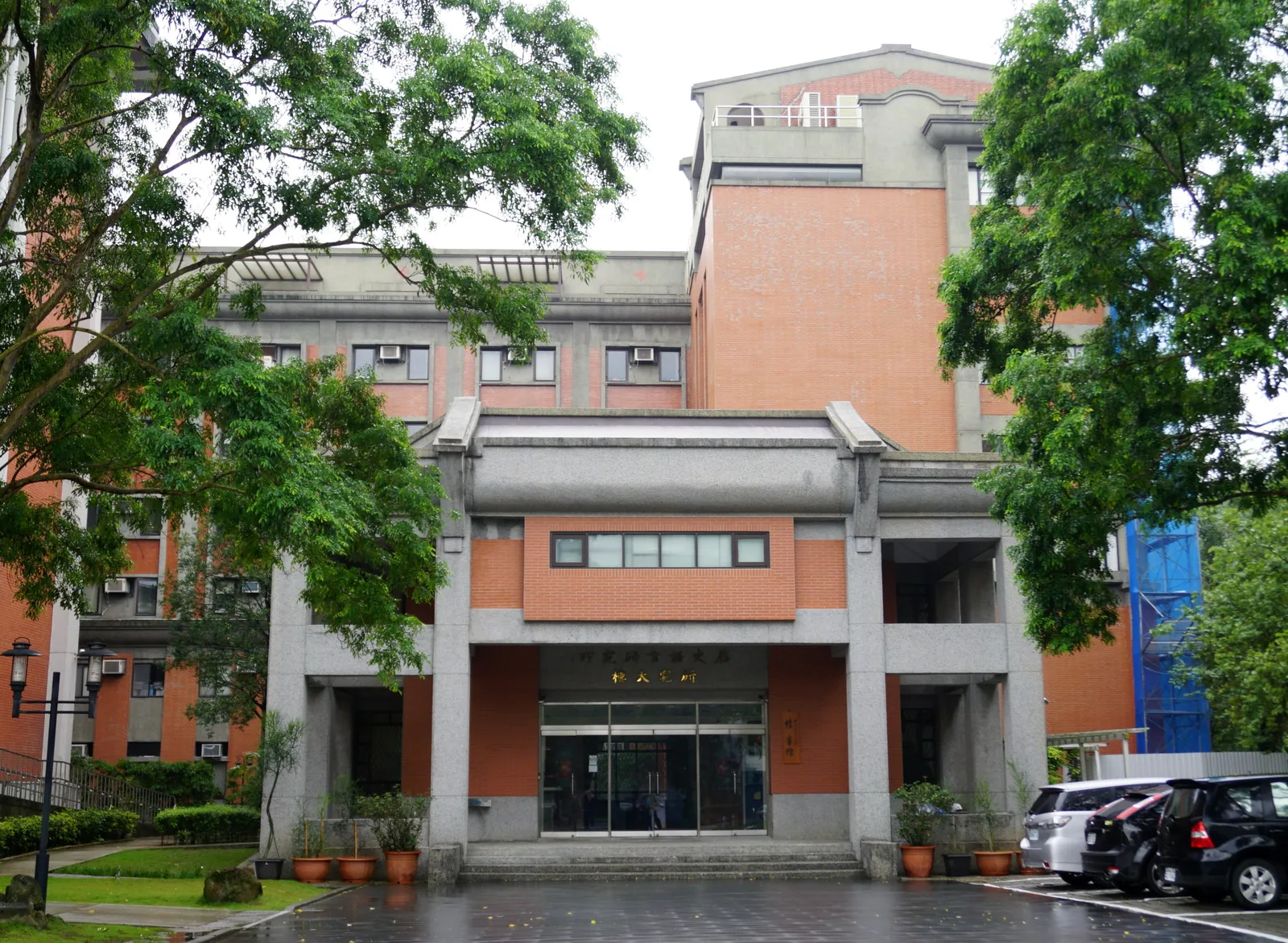
The Institute of History and Philology research building in the Nankang campus. After the oracle bones, rubbings, and archives from Yinxu crossed the sea in the winter of 1948, they ultimately found their home here. Photo: Ahao823 / Wikimedia Commons, CC BY-SA 4.0
Within the same institution, another group was looking further afield. In 2011, the U.S. National Science Foundation transferred a 12-meter ALMA North American prototype telescope to "a team led by the ASIAA and the Smithsonian Astrophysical Observatory (SAO)"—that is, a team jointly led by Academia Sinica's Institute of Astronomy and Astrophysics and the Smithsonian Astrophysical Observatory13. After modification, the telescope was relocated to Greenland, becoming the Greenland Telescope. The Event Horizon Telescope (EHT) officially positions it as the only submillimeter-wave astronomical observatory in the Arctic Circle14. Academia Sinica's Institute of Astronomy and Astrophysics is one of thirteen member institutions of the EHT consortium; when humanity's first image of a black hole was released on April 10, 2019, one of six simultaneous global press conference locations was Taipei15.
There are also times when things move very quickly. On March 9, 2020, Academia Sinica released a press statement: Yang An-sui's research team "produced the first batch of 46 monoclonal antibodies (IgG) at milligram scale against nucleocapsid protein antigens of seven human coronavirus species in just nineteen days"16. According to Research Matters, this compressed research originally estimated to take two months into nineteen days17. The results were subsequently delivered to nine manufacturers, moving toward diagnostic test kits—among the most urgently needed items in the first year of the pandemic, and the point at which the epidemic prevention system came closest to the laboratory at that time.
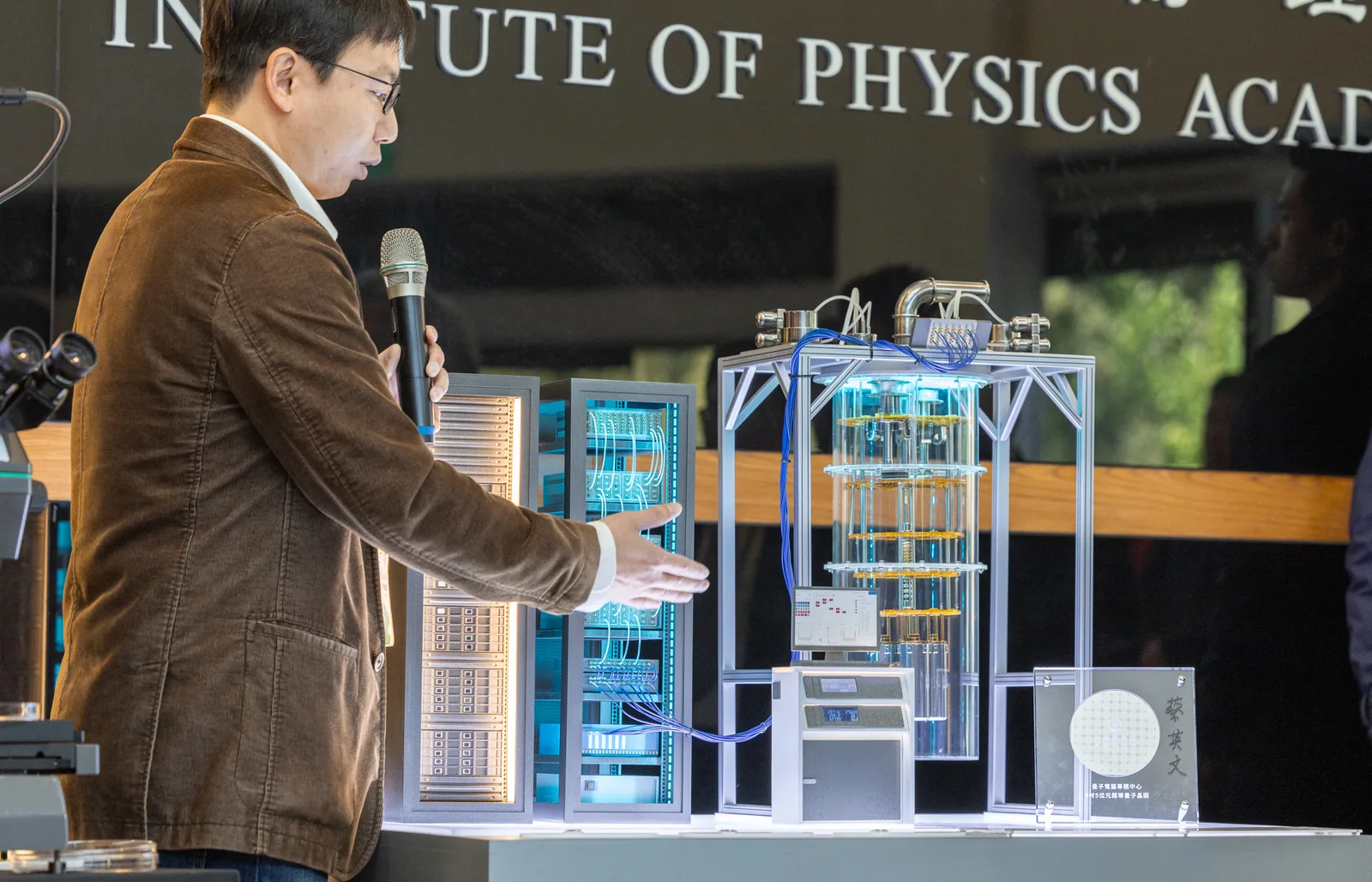
On January 29, 2024, the president visited Nankang to inspect research results at Academia Sinica's Quantum Computer Thematic Center. Oracle bones, black holes, antibodies—all hanging under the same institution. Photo: Office of the President / Official Photo by Wang Yu Ching, CC BY 2.0
One pit excavated over ten years, one telescope from transfer to installation in the Arctic Circle also measured in years, one batch of antibodies made in nineteen days. Three things appearing in the same annual report might look contradictory, but they are actually three uses of the same kind of margin: because one can move slowly, there is something to produce when speed is needed. What Yang An-sui's team produced in nineteen days was the realization of "decades of accumulated results and techniques"17.
An Institution Born to Study China Begins to Study the Island It Stands On
When it was founded in 1928, this institution's mission was to study China. It took a very long time before it began to study the place where it stood.
The turning point is recorded on the Taiwan History Research Institute's history page: "In January of the 82nd year of the Republic of China (1993), Academician Chang Kuang-chih, convener of the Taiwan History Field Research Office, returned to Taiwan. Recognizing that the time had come to establish the institute, he convened relevant parties to discuss the matter of its founding."18 That same June 26, the Presidential Office approved the establishment of the Taiwan History Research Institute Preparatory Office, and on July 10, Huang Fu-san, a professor of history at National Taiwan University, was appointed director of the preparatory office. The institute was formally established on July 1, 2004, with Chuang Ying-chang as its first director.18 From preparatory office to research institute, it took eleven years.
This is another use of the same length of time: the previous one was spent on an excavation that yielded no returns for eight years; this one was spent turning an institution's research focus around—from "we study that continent" to "we study the island beneath our feet." Turning around is slower than digging, because what needs to change is the organizational structure, budget, and personnel—far slower than moving a shovel.
Academia Sinica's 2025 official image video, titled "Finding Who We Are Through Research." An institution founded in Shanghai in 1928 putting "who we are" in its promotional video's title is itself a footnote to this section.
This reorientation is also written into one person's biography. On Cao Yonghe's official academician CV, the education section contains just one line: "Graduated from Taipei Prefectural Taipei Second Middle School (1939)." The employment section reads "Adjunct Research Fellow, Institute of Sun Yat-sen Humanities and Social Sciences, Academia Sinica (1984–)," an institute whose predecessor was the Institute of Three Principles of the People.19 In 1990, he published "Another Approach to Taiwan History Research: The Concept of 'Taiwan Island History'" in issue 15 of the Taiwan History Field Research Newsletter, proposing to view this history with the island itself as the unit of analysis and the people living on it as the subject.20 In 1998, he was elected as an Academician of Academia Sinica in the 22nd class.19 A person whose highest education was middle school made that list.
There is another line of inquiry that goes even further in treating this island as a subject—far enough to place it within the origins of an entire language family. The classification system widely used in linguistics, developed by Robert Blust, divides the Austronesian language family into ten major branches, nine of which have languages distributed across Taiwan. The comparative research on Austronesian languages that Academician Li Jen-kuei of the Academia Sinica Institute of Linguistics has long been conducting is built on this classification.21 In 2015, Chung Kuo-fang of the Academia Sinica Biodiversity Research Center served as corresponding author on a phylogeographic study of breadfruit trees published in the Proceedings of the National Academy of Sciences: breadfruit trees in the Pacific are overwhelmingly dominated by haplotype cp-17, which evolved from Taiwan-endemic haplotypes cp-9 and cp-16.22 This is evidence put forward by linguistics and genetics respectively, with both the researchers and the evidence laid out in the papers. As for how these pieces of evidence should be woven into a story about ancestors, that is for the people being studied to decide—and it is the position that Indigenous language revitalization has been contesting for decades.
There is also a more recent turn. The Taiwan History Research Institute published White Memory: Oral History Records of Political Victims and Their Families, containing interviews with 29 subjects, totaling approximately 480,000 words.23 An institution that once only studied distant lands is today compiling oral records of the wounds of this island itself.
Academician Elections Every Two Years: The System Moves Slower Than the Questions It Faces
The institutional framework evolves more slowly than awareness of the problems it creates—and this lag is written into law.
Article 5 of the Organization Act states: "Academicians of Academia Sinica shall be elected once every two years by the Academician Conference, with a maximum of forty positions per election." Article 6 requires candidates to be nominated first by universities, professional societies, research institutions, or five or more academicians and evaluators, then vetted by the Evaluation Council4. Article 2 of the Academician Election Regulations divides the positions into four groups, with a maximum of ten per group24. Once every two years, at most forty names—a rhythm that has continued from the 1948 list of 81 to the present day.
Academician is not a job. After election, one need not relocate to Nangang to work; most continue at their original universities or overseas research institutions. The Organization Act grants academicians the authority to attend Academician Conferences, elect new academicians, and elect candidates for president—but no desk on the payroll comes with it4. Taiwanese treat "Academia Sinica Academician" as a rank, and that intuition is correct; the rank simply has nothing to do with whether one is employed by Academia Sinica.
💡 Did you know?
"The Nth Academician Conference" and "the Nth cohort of academicians" use two separate numbering systems, often conflated. The 1957 Taipei meeting mentioned earlier is an example: the conference was held, but no election took place—the official website's exact wording: "The 2nd Academician Conference was held in Taipei in 1957, and no academician election was held at that time. The 2nd cohort of academicians was elected at the 3rd Academician Conference in 1958" (Academia Sinica Academician Section). The same trap appears with presidents: the official list of past presidents names 10 people without numbering them by term, yet the official press release calls Chen Chien-jen the "13th President," because "term" counts by tenure count, and consecutive reelection advances the number.
The 35th election in July 2026 elected 19 new academicians and 3 honorary academicians. After the election, the total number of academicians rose to 302: 253 men and 49 women, with 18 honorary academicians25. The gender composition of this cohort diverges from the overall total: of the 19 new academicians, 8 are women; all 3 honorary academicians are women, for a combined 11—the highest in history. All 4 new academicians in the Life Sciences group are women26.
Source: China Times, United Daily News, Liberty Times reporting on the 35th Academician Election, July 2026
The system's temporal scale becomes inertia. Electing once every two years, with at most forty positions per election, means new members dilute the total at an inherently slow rate: the newly elected cohort is nearly half women, yet women remain only one-sixth of the total roster. No one is blocking anyone. A list accumulated over seventy-eight years naturally requires the same order of magnitude to shift.
One more point is often read as contradiction. The research institutes are organized into three divisions: Mathematical Sciences, Life Sciences, and Humanities and Social Sciences. Academician elections, under Article 7 of the Organization Act, are divided into four groups: Mathematical Sciences, Engineering Sciences, Life Sciences, and Humanities and Social Sciences4. The additional Engineering Sciences group was added by an amendment to the Organization Act effective January 15, 2014; the Executive Yuan's press release on the draft was direct: "Add an Academician division for 'Engineering Sciences,' revising the maximum number of academician positions to forty"27. It has no corresponding research institute; engineering-field academicians are affiliated with research units under the existing three divisions. The two classification systems each serve their own purpose: one governs how physical units are organized, the other how academician positions are allocated.
| Division | Research Institutes | Research Centers |
|---|---|---|
| Mathematical Sciences | 8 | 3 |
| Life Sciences | 5 | 3 |
| Humanities and Social Sciences | 11 | 1 |
Source: Academia Sinica Research Institute Organization Chart
Two additional research centers (Biomedical Translation Research Center, Critical Issues Research Center) are established across divisions and do not fall under a single division; together they make up the official website's statement of 24 institutes plus 9 centers28. The Organization Act also governs how the president is selected. Article 3 states: "The President shall be elected by the Evaluation Council from among the academicians as one of three candidates, submitted to the President of the Republic for selection and appointment…. The President serves a five-year term and may be reelected for one consecutive term." The Evaluation Council comprises ex officio evaluators and 30 to 50 appointed evaluators; appointed evaluators are elected by academicians and submitted to the President of the Republic for appointment29. The President's discretion is narrowed to those three names: he selects, he does not nominate. The current president, Chen Chien-jen, was appointed by President Lai Ching-te on January 2, 2026, with a term from June 21, 2026, to June 20, 2031, and took office on June 2130.
For Twenty-Six Consecutive Years, One Day Open Each October
An institution that admits no students, offers no public classes, and keeps only a handful of buildings open on fixed schedules opens itself entirely once a year.
The Academia Sinica campus open house has been held annually since 1998, once each October. The official account describes it as "held consecutively for 26 years."31 At the 2022 event, a Central News Agency reporter documented the scene as "packed with visitors despite the rain, with an estimated ten thousand people."32 Academia Sinica Road Section 2 was congested all day, with laboratories, specimen rooms, and server rooms all conducting tours. Queues stretched from the main gate down to the base of the research building.
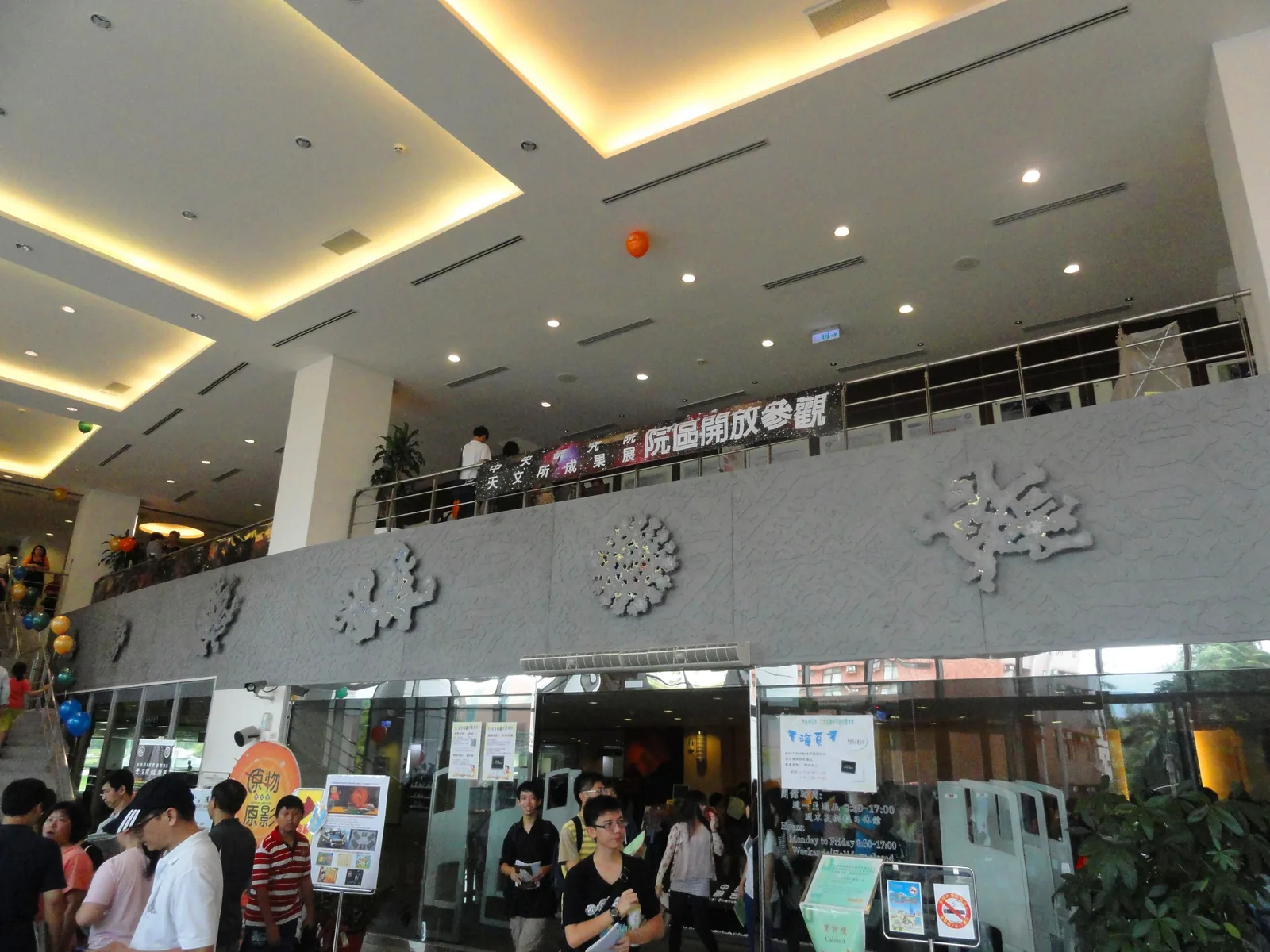
The Institute of Astronomy and Astrophysics during the 2012 campus open day. Once a year, instruments that normally appear only in paper acknowledgments are moved onto the lawn. Photo: BreakdownDiode / Wikimedia Commons, CC BY-SA 4.0
In 2017, Academia Sinica also launched its own science communication media outlet. Research Matters went online on April 6, 2017, its name a play on the Chinese phrase for "substance in speech," publishing research from the institution in illustrated articles accessible to general readers.33 One year and two months after launch, it won an Excellence Award in the Government Communication category at the 11th Outstanding PR Awards.34 That Taiwan's highest academic institution needed to open a separate channel to explain what it does speaks volumes about the distance between it and the public. In the same ecological niche, Taiwan's independent science communication community had already been active for years.
Some things are available every day. The Taiwan Centennial Historical Maps were developed by the GIS Thematic Center of the Humanities and Social Sciences Center, collecting multiple map layers from Japanese colonial cadastral maps (1898–1904) through recent topographic maps. Users can select and overlay two or three layers, adjust transparency, and access a mobile app and WMTS service for integration with other systems.35 Anyone opening it can see what their neighborhood looked like a hundred years ago. This is the accumulated result of decades of digital archiving, laid out on a webpage.
The campus also houses two free museums: the Hu Shi Memorial Hall, comprising Hu Shi's late-life residence in Taiwan, exhibition rooms, and Hu Shi Park, open Tuesday through Saturday.36 The Institute of History and Philology Historical Artifacts Exhibition Hall is open Wednesday, Saturday, and Sunday, offering guided tours in Chinese and English.37 Groups wishing to visit can arrange tours by advance reservation. Some of the materials stacked in the Yangmei warehouse in the winter of 1948 are now displayed in the exhibition hall's cases, free to view.
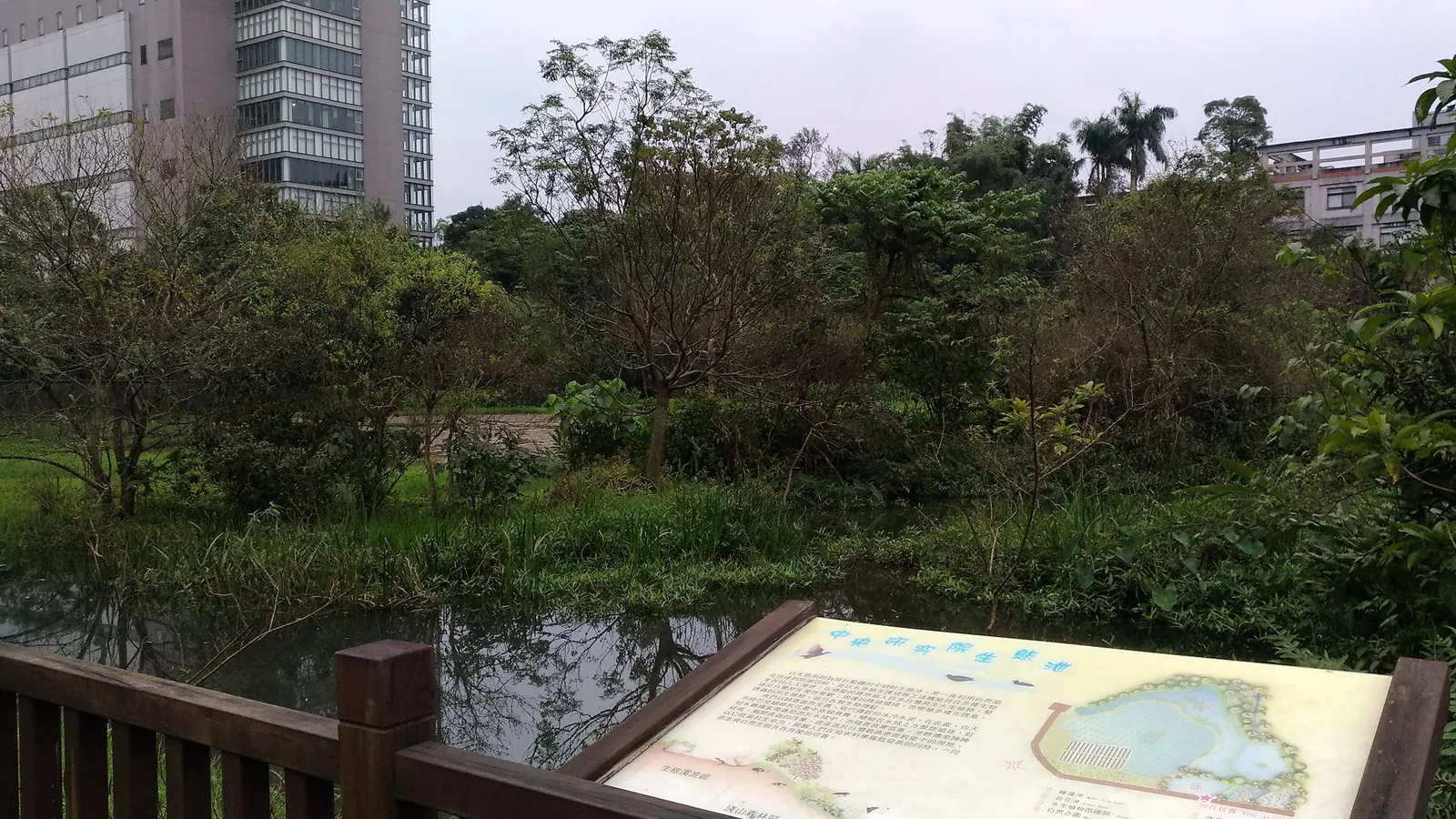
The ecological pond on the Nangang campus. For residents nearby, Academia Sinica is first a place, then an institution. Photo: Lysimachi / Wikimedia Commons, CC BY-SA 4.0
For Nangang residents, all of this is even more everyday. Sihfen Creek flows down from the Nangang hills and winds around the campus perimeter. Since 2011, the Taipei City Government has designated it a stream closure for fish protection—Taipei's first such closure—maintained by a community river patrol team.38 In Hu Shi Park, people practice tai chi; by the ecological pond, people push strollers. What accumulates over time is unveiled once a year. The rest of the days, it remains in place as a stretch of green, a stream, a webpage.
Seen Does Not Mean Trusted
Being visible is not the same as being trusted. The same campus that people queue to enter every October is also the place that has been repeatedly asked "on what grounds?" over the past decade. The position that allows it to wait also gives it two things at once. Without teaching or recruiting students, it cannot produce ready-made metrics like student numbers and teaching hours; it can only answer "what did these funds buy?" with the research itself. Its legal authority is written into the Presidential Office Organization Act; its personnel and budget are not absorbed by any ministry, but laid before the President and the Legislative Yuan. The Legislative Yuan issues a unit budget evaluation report for it every year, commenting item by item: the 114 fiscal year report listed ten items, one of which scrutinized the newly added "Natural Gas Decarbonization Hydrogen-Fueled MW-Scale Hydrogen Blending Power Generation System Construction and Testing Plan"39. Being able to wait and having to explain itself year by year, item by item, are two sides of the same position.
In March 2016, OBI Pharma's breast cancer vaccine unblinding failed to meet expectations, and the fact that then-President Chi-Huey Wong's daughter held OBI Pharma stock sparked public concern. On March 28, he requested resignation by overseas phone call; on March 29, he submitted a written resignation letter. President Ma Ying-jeou asked him to return to Taiwan first to explain; approval came only on May 10, accompanied by a letter: "Various circles hold the view that your president should resign regarding the questions raised by the OBI Pharma case—the prosecutor's questioning and search of your office"40. Official records mark his tenure ending in May 201641.
The judicial part needs to be split into two matters, because they are often discussed as one. The first is the corruption case. The Shilin District Prosecutors Office indicted Chi-Huey Wong and OBI Pharma board chairman Zhang Nian-tzu on January 9, 2017, under the Anti-Corruption Act. The Shilin District Court acquitted both on December 28, 2018, on the grounds that the prosecution failed to prove the parties reached a meeting of minds on the specific content of bribery. On January 21, 2019, the Shilin District Prosecutors Office announced it would not appeal; the case was finalized as acquittal42. The second is the insider trading case, with defendants including Zhang Nian-tzu and four others; Chi-Huey Wong was not among them. That case was decided at first instance on June 21, 2019; the appeal court upheld acquittal on January 26, 2021; the High Prosecutors Office did not appeal on February 24, 202143. The public narrative of "the OBI Pharma case dragging on for five years" splices two timelines into one.
Beyond criminal acquittal, there is another line. The Control Yuan passed an impeachment case against Chi-Huey Wong in July 2017, proposed by Control Yuan members Tang Kuei-mei, Pao Tsung-ho, Liu Te-hsun, and Wang Mei-yu. The impeachment cited three grounds, one of which pointed out that as president, he oversaw the adoption of Academia Sinica's own conflict-of-interest avoidance principles, yet led by example in violating them44. The Disciplinary Court found him guilty of failing to accurately declare assets and failing to disclose his daughter's receipt of OBI Pharma stock, and imposed a reprimand. After the reprimand, two paths diverged. Chi-Huey Wong himself filed three requests for retrial, all rejected. On April 6, 2022, the Control Yuan that originally proposed his impeachment filed a retrial request on his behalf with the Disciplinary Court—this matter has not yielded a public outcome to this day45.
Another publicly handled case within the institution is an academic ethics matter. Portions of papers by Chen Ching-shih, a specially appointed research fellow at the Institute of Biochemistry, were found to be fabricated after investigation. Academia Sinica published an investigation report on March 30, 2018, and announced disciplinary action on January 17, 2020: ineligibility to apply for or participate in any academic activities and research projects within the institution for ten years, prohibition from using institutional academic administrative resources, and recovery of related awards totaling NT$1.86 million46. This case differs from the OBI Pharma case in that it was an internal procedure the institution itself identified and completed; the public record contains no documentation of his objection or appeal.
📝 Curator's Note
Public memory's resolution of this matter stops at the 2016–2017 frame. "Academia Sinica President Indicted" entered everyone's mind; "January 21, 2019, Acquittal Finalized" did not. This is not malice, merely the physics of news cycles: the indictment day had images, searches, resignation; the acquittal day had only a decision not to appeal. An institution that uses ten years to conduct one research project; the public forms an impression in two weeks, and that impression stays in place unmoved. An institution that trades "length" for results is, in matters of reputation, defined by the shortest unit of time.
The land line moves more slowly. The National Biotechnology Research Park was built on the site of the former Nangang 202 Munitions Factory, occupying only one corner of the land. In May 2010, writer Chang Hsiao-feng knelt before President Ma Ying-jeou in front of reporters, requesting preservation of the old trees and ponds there; the originally scheduled June 1 groundbreaking was halted by the Executive Yuan47. On June 10, 2011, environmental review passed conditionally, with conditions including green building certification and environmental education facility accreditation48. The park opened on October 15, 2018, eight years after the kneeling. Today the park's official website states it is "committed to maintaining a 14.19-hectare ecological protection area and reconstructing a 4-hectare early Sanchongpu wetland restoration area"49. Public Television's documentary Our Island records "25 hectares of land, with actual development area of 9.6 hectares"50.
Looking inside the institution, there is a different sense of time. Postdoctoral researchers' appointments are in principle for two years; upon completion, reapplication is required, with a maximum total of four years. Applicants must submit within six years of obtaining a doctorate and must first obtain consent from an Academia Sinica researcher to serve as academic advisor; annual research funds are capped at NT$500,00051. An institution that can spend ten years excavating one archaeological site gives its most junior researchers a time scale of two-year terms, maximum four years.
Going down another layer, the sense of time differs again. In July 2022, a telephone interviewer (pseudonym "A-hsiang") at the Research Center for Humanities and Social Sciences' Survey Research Division told media that the center had for years contracted with part-time telephone interviewers without providing labor insurance under the Labor Standards Act; employees had to bear labor insurance, 6% labor pension contributions, and health insurance themselves. The background she described was: in 2006, under President Lee Yuan-tseh, a meeting decided to grant telephone survey specialists labor insurance benefits; in 2014, an institutional affairs meeting resolved to adopt a contracting system instead. At that time, nearly 15 telephone interviewers were preparing to seek compensation from the institution for overtime and unpaid pension contributions. The center's response was: "Our center is actively addressing this... and will do its utmost to consider their interests and handle the matter appropriately and legally."52 After this statement, the matter has not received public follow-up.
The name is another line that has not been completed in four years. On March 9, 2020, legislator Fan Yun raised questions in the Legislative Yuan and submitted an emergency proposal, demanding that Academia Sinica devise a plan to change its English name within three months and report to the Legislative Yuan, on the grounds that "Academia Sinica" on English Google searches redirects to the Chinese Academy of Sciences53. Then-President James C. Liao responded on the spot: "Academia Sinica's name involves national positioning and policy; it is not something Academia Sinica can change unilaterally," and "discussion can be opened, but it is not easy to make a unilateral decision"53. In March 2024, Academia Sinica's Secretary-General Tseng Kuo-hsiang told media: "This 'shelving' resolution represents the view of the majority of Academia Sinica members that there is no need for Academia Sinica to change its name."54 Civil society's Free Society suggested the English name be changed to National Academy of Taiwan55.
Academia Sinica's name involves national positioning and policy; it is not something Academia Sinica can change unilaterally.
After the presidential appointment was finalized on January 2, 2026, there were also voices in the Legislative Yuan. KMT legislator Wan Mei-ling raised concerns by name about generational succession: "Academia Sinica's three most recent presidents... all took office at age fifty-eight, yet now Chen Chien-jen, who is about to turn seventy-five, is taking the position, which may run counter to 'forward-looking, generational succession' practice"—Lee Yuan-tseh, Chi-Huey Wong, and James C. Liao were indeed all fifty-eight when they took office. Fellow KMT legislator Lee Yen-hsiu believed Chen Chien-jen's academic standing and administrative experience were sufficient for the role, but "Chen Chien-jen's future challenge remains 'political'"56. Being repeatedly asked "on what grounds?" is also running on a yearly scale: the OBI Pharma case from indictment to finalization took two years, the 202 site from kneeling to opening took eight years, the name from proposal to shelving took four years.
⚠️ Contested Perspective
National Taiwan University professor and Academia Sinica academician Chen Pei-jer argues that Academia Sinica should be "virtualized," or even that its continued existence itself should be reconsidered. His reasoning is: this institution was founded in the early Republic of China era and belongs to a system left over from the authoritarian period; it receives stable government funding and abundant resources, yet still competes with major universities for National Science and Technology Council research funds, creating an uneven starting line. He advocates preserving the academician honor while returning research functions to national universities. One phrase in his original remarks is "Academia Sinica should still be abolished!"; he also criticized Chen Chien-jen and outgoing President James C. Liao for lacking "moral integrity in facing power" (Storm Media reprint of China Times interview). In another interview, he placed the president's identity after the question of existence itself, believing the latter is what Taiwan's society and academic community should discuss more57. Public voices speaking to the level of "existence" are currently concentrated in him alone. The sense of relative deprivation from the university sector—"on what grounds is it the one that can wait"—has always existed, yet lacks a named representative voice, which makes this fault line appear smaller on the surface than it actually is.
A Place That Can Make Decades a Unit of Planning
In the winter of 1948, stacked in a warehouse in Yangmei were dozens of boxes and more than fifty people. From there to today's twenty-four research institutes in Nangang, nine research centers, and nearly a thousand researchers, seventy-eight years have passed.
What was gained in that span of time is a luxury: the ability to make "decades" the unit of a single research plan. The Yinxu excavations lasted ten years, the Institute of Taiwan History spent eleven years in preparation, and evidence for Austronesian language families stretched from linguistics all the way to the 2015 breadfruit paper. The way to buy this length of time is to place yourself in a position that requires no teaching, no student recruitment, and whose legal foundation is written directly into the Presidential Office Organization Act. That same position lets its president be selected by the President from three names, lets its budget be itemized and reviewed line by line in the Legislative Yuan each year, and even requires it to answer questions about national identity before changing its English name. The ability to wait, and the necessity of constantly answering "on what grounds"—they are two sides of the same design.
On that Saturday in October, crowds still walk through the gate on Research Academy Road Section 2. For the remaining three hundred-plus days, the facilities open on fixed schedules, and group tours require advance reservation. Most of what is happening behind that gate will not be judged for its worth until years later—and whether it is worth it, in the end, is decided by those who walk through.
Further Reading
- Taiwan White Terror — The oral history records that Academia Sinica's Institute of Taiwan History is organizing today document this period of history.
- Taiwan's Higher Education Expansion and Institutional Closure — The other half of "why should it be the one that can wait," which requires looking at the resource situation from the university side.
- Taiwan Design Research Institute — Another state-funded institution; what it can accomplish differs greatly depending on whether it operates under a ministry or directly under the Office of the President.
- PanSci — Before "Research and You," science communication in Taiwan was pioneered by the private sector.
- The Intersection of Taiwan Indigenous Education and Language Revitalization — Who researches and who narrates the evidence of Austronesian languages are two different questions.
Image Sources
All images in this article are cached in public/article-images/society/ and do not hotlink to source servers:
- Ahao823 — CC BY-SA 4.0
- Author unknown, photographed 1948 — Public domain
- Mountain — Public domain
- Ahao823 — CC BY-SA 4.0
- Office of the President / Official Photo by Wang Yu Ching — CC BY 2.0
- BreakdownDiode — CC BY-SA 4.0
- Lysimachi — CC BY-SA 4.0
References
- Research Yields Insights: Contradictory Intellectual Youth, the Moving Man, and Fu Dapao—Fu Ssu-nien, Founding Director of Academia Sinica's Institute of History and Philology — A biographical series on the Academia Sinica official science communication platform, documenting Fu Ssu-nien's multiple relocations of the Institute of History and Philology from Nanjing, Changsha, Kunming to Lizhuan in Sichuan, and the origin of the nickname "the Moving Man."↩
- Wikipedia: Yangmei Station — Entry documenting the distribution of institutional artifacts and boxes that arrived in Taiwan in late 1948: boxes from the Institute of History and Philology were stored in Yangmei, while others were placed in the warehouse of the Taiwan Sugar Corporation's Taichung Sugar Factory.↩
- Academia Sinica Institutional History Website — Official digital platform of Academia Sinica's institutional history, containing self-descriptions from the founding, migration, and Nangang periods; both the phrase "more than 50 people" for the relocation to Taiwan and the completion of the first buildings in Nangang in 1954 are sourced from here.↩23
- National Laws and Regulations Database: Academia Sinica Organization Act — Official text of the regulation, with the most recent amendment published on January 15, 2014; Article 1 on legal basis, Article 2 on institutional positioning and three missions, Article 3 on the selection of the President, and Articles 5-7 on the Academician system are all contained herein.↩2345
- Wikipedia: Academia Sinica — The history section of the entry documents the April 17, 1927 proposal by Li Shih-tseng at the 74th meeting of the KMT Central Political Conference to establish the institution, the November 9 publication of the Organization Act, the April 23, 1928 appointment of Cai Yuanpei, the June 9 first Academy Affairs Conference at the East Asia Hotel in Shanghai, and the general statement that very few of the first cohort of Academicians followed to Taiwan.↩23
- Academia Sinica: Taiwan International Graduate Program (TIGP) — Official introductory page explaining that TIGP has jointly operated doctoral programs with ten universities since 2002 with all-English instruction, with degrees awarded by the partner universities and a separate TIGP completion certificate issued.↩
- Academia Sinica English Official Website Publications Page — English official page verbatim stating "24 research institutes and 9 research centers, with almost 1,000 researchers," serving as a first-hand English self-description of the institution's scale.↩
- Academia Sinica Academician Section — Official page verbatim recording that the 1st cohort of Academicians was elected in March 1948, the 1st Academician Conference was held in Nanjing in September 1948, the 2nd Conference in Taipei in 1957 held no elections, and the 3rd Conference in 1958 elected the 2nd cohort of Academicians.↩2
- Wikipedia: First Cohort of Academia Sinica Academicians — Contains a complete roster of 81 founding Academicians and their distribution by division (Mathematics and Physics 28, Biology 25, Humanities 28); various sources report the number who came to Taiwan ranging from 6 to 12, with no single authoritative consensus to date.↩
- Academia Sinica Newsletter: (Anniversary Special) In Memory of Our Eternal President—Hu Shi's Tomb — Official Academia Sinica e-newsletter documenting that Hu Shi presided over the 5th Academician Conference on February 24, 1962, and died suddenly at 6:35 p.m. that evening during a reception welcoming newly elected Academicians, and the subsequent conversion of the tomb area into Hu Shi Park.↩
- Academia Sinica Institute of History and Philology Historical Relics Exhibition Hall: YH127 Seventieth Anniversary of Excavation Commemorative Exhibition — Official website of the Institute of History and Philology museum, documenting the thirteenth excavation of the YH127 oracle bone pit on June 12, 1936 (Republic Year 25), and noting that the pit was "approximately 2 meters in diameter and approximately 4.8 meters deep." A comprehensive overview of the fifteen Yinxu excavations from 1928 to 1937 is also found on the same museum's exhibition page.↩2
- Academia Sinica Institute of History and Philology Historical Relics Exhibition Hall: YH127 Pit Oracle Bones and Cataloging Comparison — Primary source resource page verbatim stating "17,096 oracle bone pieces excavated from the YH127 pit" and "9,913 total oracle bone pieces from eleven works including the Tieyun Collection of Tortoise Shells"; the pit's location in the "western part of the Xiaotun Palace Area" is found on the same museum's Royal Archive Cabinet. The commonly circulated figure of "24,918 pieces from fifteen excavations" and the percentages calculated from it cannot be found on any of these three official pages of the Institute of History and Philology.↩
- Academia Sinica Institute of Astronomy and Astrophysics: VLBI Facility Page — Official English facility description from the Institute of Astronomy and Astrophysics verbatim stating that in 2011 the U.S. National Science Foundation transferred the 12-meter ALMA North American prototype telescope to a team jointly led by Academia Sinica's Institute of Astronomy and Astrophysics and the Smithsonian Astrophysical Observatory.↩
- Event Horizon Telescope: Greenland Telescope Official Press Release — EHT official characterization of the Greenland Telescope as "the only submillimeter-wave astronomical observatory in the Arctic Circle"; the official page does not use the commonly circulated phrase "the world's northernmost radio telescope."↩
- Event Horizon Telescope: First Black Hole Image Press Release, April 10, 2019 — Official press release stating that the EHT Collaboration consists of 13 member institutions and lists six global simultaneous press conference locations (Washington, Brussels, Santiago, Taipei, Tokyo, Shanghai).↩
- Academia Sinica Press Release: Academia Sinica Develops Monoclonal Antibodies to Identify Novel Coronavirus (2020-03-09) — Official press release documenting verbatim that the Yang An-sui team "produced the first batch of 46 monoclonal antibodies at milligram-scale production levels targeting 7 types of human coronavirus nucleoprotein antigens in just 19 days."↩
- Research Matters: How Academia Sinica Developed COVID-19 Antibodies in 19 Days — Report from Academia Sinica's official science communication platform explaining how the 19-day timeline compressed an originally estimated two-month research schedule and documenting the delivery of results to nine manufacturers for subsequent certification.↩2
- Institute of Taiwan History, Academia Sinica: Institute Overview — Official institute history page documenting verbatim that on January 1993 Chang Kwang-chih returned to Taiwan to convene discussions on establishing the institute, on June 26 of the same year the Presidential Office approved the establishment of a preparatory office, on July 10 Huang Fu-san was appointed director of the preparatory office, and on July 1, 2004 the institute was formally established with Chuang Ying-chang as its first director.↩2
- Academia Sinica Fellow Biography: Cao Yonghe — Official fellow database documenting verbatim "graduated from Taipei Prefectural Taipei Second Middle School (1939)," "concurrent research fellow at the Sun Yat-sen Center for Humanities and Social Sciences, Academia Sinica (1984–)," and election class "22nd Class (1998)."↩2
- Wikipedia: Taiwan Island History Perspective — Entry documenting that Cao Yonghe's 1990 proposal of the "Taiwan Island History" concept originated from Taiwan Historical Research Newsletter, Issue 15, article "Another Approach to Taiwan History Research: The Concept of 'Taiwan Island History'," pages 7–9.↩
- Humanistic Island: Interview with Li Jen-kuei — Interview conducted by National Chengchi University's digital platform with Academia Sinica linguist and fellow Li Jen-kuei, explaining that nine of the ten major branches in the Robert Blust classification commonly used in linguistics are distributed in Taiwan, a classification proposed by Blust and cited and extended by Academia Sinica scholars.↩
- Research Matters: The DNA of Breadfruit Trees Holds the Migration History of Austronesian Peoples — Academia Sinica's official science communication platform introducing a 2015 Proceedings of the National Academy of Sciences paper with Chung Kuo-fang as corresponding author, explaining that Pacific breadfruit is dominated by haplotype cp-17, which evolved from Taiwan-endemic haplotypes cp-9 and cp-16.↩
- Institute of Taiwan History, Academia Sinica Publication: White Memory: Oral History Records of Political Victims and Their Families — Official publication page of the Institute of Taiwan History collecting oral history interviews of 29 interviewees regarding the White Terror, totaling approximately 480,000 characters.↩
- National Laws and Regulations Database: Academia Sinica Fellow Election Regulations — Organizational law regulation specifying in Article 2 that fellows are elected every two years at the fellows' conference, divided into four groups, with at most forty fellows per election and at most ten per group, and Article 4 specifying nomination qualifications.↩
- China Times: 35th Class of Academia Sinica Fellows Announced (2026-07-10) — Report documenting verbatim the election results "Academia Sinica fellows increased to 302 people, honorary fellows reached 18, with 253 male and 49 female fellows," and that among the newly elected fellows 8 are female and all honorary fellows are female.↩
- UDN News: 35th Class of Academia Sinica Fellows List — Cross-verification with China Times and Liberty Times of 19 newly elected fellows, 3 honorary fellows, and a total of 302 fellows, listing the elected members by group.↩
- Executive Yuan Press Release: Approved Amendments to Partial Articles of the Academia Sinica Organization Act (2013-10-17) — Official press release documenting verbatim the amendment highlights "adding the 'Engineering Sciences Group' to fellow divisions, revising the maximum number of fellows to forty," with the amendment promulgated and taking effect on January 15, 2014.↩
- Academia Sinica Research Institute Organization Chart — Official organization page listing research institutes and centers under the three major academic divisions, manually verified as 24 research institutes and 9 research centers, with two additional interdisciplinary integration project centers not included in this core count.↩
- Academia Sinica: Organization Act and Academic Review Board — Official page containing the composition and authority provisions of the Academic Review Board, explaining the appointment of ex officio members and 30 to 50 appointed members, and the procedure for electing three candidates when the presidency becomes vacant.↩
- Academia Sinica Press Release: President Lai Ching-te Appoints Chen Chien-jen as the 13th President (2026-01-02) — Official press release documenting verbatim the appointment date and "term of office from June 21, 2026 to June 20, 2031," serving as the primary source for the current president (the official website biography page still displays the previous president, representing an unsynchronized outdated page).↩
- Academia Sinica: Science Outreach and Promotion — The official website states verbatim that "Since 1998, the 'Campus Open House' activity has been held, with this activity held every October," and records "26 consecutive years of hosting."↩
- CNA: Academia Sinica Campus Physical Opening Returns, Attracting Ten Thousand Visitors (2022-10-29) — On-site report verbatim noting 'despite rain, crowded with visitors, estimated at over ten thousand people,' marking the 25th year of campus opening. For annual single-day visitor numbers, neither Academia Sinica's official website nor CNA reports have published year-by-year statistical figures.↩
- Academia Sinica News: "Research and You" Goes Online — Official news page records that Academia Sinica's science communication media "Research and You" officially launched on April 6, 2017, with the name being a homophone of "言之有物" (words with substance).↩
- Academia Sinica News: "Research and You" Wins Excellence Award in Government Communication Category of Outstanding PR Awards — Official news page records that "Research and You" won the Excellence Award in the Government Communication category at the 11th Outstanding PR Awards from the Public Relations Foundation, not the Gold Award or Grand Prize.↩
- Academia Sinica Humanities and Social Sciences Center GIS Thematic Center: Taiwan Centennial Historical Maps — System portal page collecting multiple time-period layers from Japanese colonial period maps (1898–1904) to recent economic construction topographic maps, providing overlay comparison, transparency adjustment, mobile APP, and WMTS connection services.↩
- Academia Sinica Institute of Modern History: Hu Shi Memorial Hall — Memorial hall official website explaining that the facility consists of Hu Shi's late-life residence in Taiwan, exhibition rooms, and Hu Shi Park, open free of charge Tuesday through Saturday, with group tours requiring advance online reservation.↩
- Academia Sinica Institute of History and Philology Historical Artifacts Exhibition Hall: Visiting Information — Exhibition hall official website stating that it is open Wednesday, Saturday, and Sunday, with free admission and Chinese and English guided tour services provided.↩
- Taipei City Government Public Works Department Geotechnical Engineering Division: Sihfen Creek Remediation—Taipei's First Stream Closure for Fish Protection — Official announcement from the responsible agency recording that Sihfen Creek has implemented stream closure for fish protection since 2011, making it Taipei's first stream closure for fish protection, maintained by a river patrol team composed of community residents.↩
- Legislative Yuan: Academia Sinica Fiscal Year 114 Unit Budget Assessment Report — Legislative Yuan Budget Center issues annual assessment reports for Academia Sinica's unit budget; the fiscal year 114 report lists ten assessment opinions, one addressing the newly added 'Natural Gas Decarbonization Hydrogen-Fueled MW-Class Hydrogen Blending Power Generation System Installation and Testing Plan.' This list page does not disclose total budget amount.↩
- The News Lens: Full Text of Ma Ying-jeou's Letter to Chi-Huey Wong (2016-05-10) — Report containing the full text of the letter issued on the day the president approved the resignation, verbatim including "Various circles hold the view that the院長 should resign due to the OBI Pharma case in which the prosecutor questioned and searched the院長, raising questions about his position," and records the timeline of requesting resignation on March 28 and submitting the resignation letter on March 29.↩
- Academia Sinica: Past Presidents — Official page listing ten presidents' names and terms in chronological order (Chi-Huey Wong recorded as Oct. 2006–May 2016), with the entire page not marking the ordinal "number," while the "13th" ordinal comes from official press releases.↩
- Storm Media Reprint of Central News Agency: OBI Pharma Case Acquittal Finalized — Report organizing the timeline of Chi-Huey Wong's corruption case, verbatim recording "On January 21, 2019, the District Prosecutors Office announced that it would not appeal the corruption charges in the OBI Pharma case, and the acquittals of Chi-Huey Wong and Zhang Nian-tzu were finalized," and lists another timeline for the insider trading case (five defendants not including Chi-Huey Wong, finalized February 24, 2021).↩
- Follaw: OBI Pharma Insider Trading Case Verdict Summary — Legal media summary organizing the names of five defendants in the insider trading case (Zhang Nian-tzu, Xu You-gong, Huang Xiu-mei, You Cheng-de, etc.), confirming that Chi-Huey Wong was not a defendant in this case, serving as a key source for distinguishing between the two cases.↩
- Control Yuan: Impeachment of Chi-Huey Wong Announcement — Official announcement from the Control Yuan stating that in July 2017, Control Yuan members Zang Gui-mei, Bao Zong-he, Liu De-xun, and Wang Mei-yu proposed impeachment. The announcement title summarizes as "abusing authority during tenure to pursue personal and others' interests, seriously damaging the government's reputation"; the impeachment reasons section states three points, one of which verbatim reads "should have disclosed potential conflicts of interest but failed to do so; as president of Academia Sinica, Chi-Huey Wong supervised the formulation of Academia Sinica's Principles for Handling Conflicts of Interest in Technology Transfer, and knowingly led the violation of the aforementioned regulations."↩
- China Times: Chi-Huey Wong's Three Requests for Retrial Rejected (2022-01-22) — Report recording that Chi-Huey Wong's three petitions for retrial in the disciplinary case were all rejected. The Control Yuan, however, on April 6, 2022, citing discovery of new evidence, filed a retrial petition on his behalf with the Disciplinary Court; the subsequent outcomes of both parties have not been publicly confirmed.↩
- Liberty Times: Chen Qing-shi Thesis Fabrication Case—Academia Sinica Recovers 1.86 Million and Bans for 10 Years — Report recording that Academia Sinica published its investigation report on March 30, 2018, and announced disciplinary measures and recovered award amounts on January 17, 2020. The number of papers involved varies between 4 and 8 in different reports, with the difference in statistical methodology remaining unclarified.↩
- CTS News: Chang Hsiao-feng Kneels to Plead for 202 Munitions Factory (2010-05) — Report recording that writer Chang Hsiao-feng knelt before President Ma Ying-jeou in front of media reporters in May 2010 to petition for preserving old trees and wetland ecology; the planned groundbreaking on June 1 was consequently halted by the Executive Yuan.↩
- Wikipedia: National Biotechnology Research Park — Entry organizing environmental assessment approval conditions and opening timeline. Environmental assessment passed conditionally on June 10, 2011, with conditions including Academia Sinica submitting biotech R&D wastewater standards and screening methods before park operation, park buildings obtaining at least 5 indicators of silver-level green building certification, artificial wetland restoration and ecological conservation areas obtaining environmental education facility certification, with the park opening on October 15, 2018.↩
- National Biotechnology Research Park Official Website: Park Environment — Official park page states verbatim 'committed to maintaining 14.19 hectares of ecological conservation area and restoring 4 hectares of early Sanchongpu wetland restoration area,' where the 4 hectares refers to the wetland restoration area rather than the development area.↩
- PTS Our Island: Preserving This Green Lung — PTS environmental program documentation of the 202 Munitions Factory development case, stating '25 hectares of land with actual development area of 9.6 hectares,' which comes from different sources than the park's official website zoning explanation, with the two sets of figures having different statistical scopes.↩
- Academia Sinica: Operational Guidelines for Hiring Postdoctoral Research Scholars — Official personnel regulations specifying appointment term of two years in principle with possibility of reapplication upon completion, maximum total of four years, applicants must apply within 6 years of obtaining doctorate and first secure an academic advisor from Academy researchers, with annual research funding of up to 500,000 yuan available.↩
- ETtoday: Academia Sinica Telephone Surveyors Angry! Overtime Pay and 6% Labor Pension Not Provided (2022-07-25) — Report documenting a telephone surveyor using pseudonym 'A-Hsiang' exposing contractor system and labor insurance disputes, background of system changes from 2006 to 2016, nearly 15 telephone surveyors preparing claims, and verbatim response from the Humanities and Social Sciences Research Center that it is 'actively addressing' the matter.↩
- Newtalk: Legislator Fan Yun Requests Academia Sinica Consider Changing English Name (2020-03-09) — Report documenting legislator Fan Yun's interpellation and emergency proposal in the Legislative Yuan, and then-President Liao Chun-chieh's verbatim on-the-spot response: 'Academia Sinica's name involves national positioning and policy, which cannot be changed unilaterally by Academia Sinica alone' and 'discussion can be opened but it is not easy to make a unilateral decision.'↩2
- UDN: Academia Sinica Name Change Case Shelved (2024-03-20) — Report citing Academia Sinica Secretary-General Tseng Kuo-hsiang's verbatim statement: 'this 'shelving' resolution represents that the majority of Academia Sinica members do not believe Academia Sinica has the necessity to change its name.'↩
- Liberty Times: Civil Groups Suggest Academia Sinica's English Name Be Changed to National Academy of Taiwan — Report documenting civil group Free Society's specific alternative proposal for the English name.↩
- UDN: Legislators' Comments on Chen Chien-jen Taking Office as Academia Sinica President (2026-01-03) — Report collecting verbatim named doubts from KMT legislator Wan Mei-ling regarding generational transition, and legislator Lee Yen-hsiu's assessment that his academic standing and administrative experience are sufficient for the role, but 'Chen Chien-jen's future challenge remains in the 'political' aspect.'↩
- China Times: Chen Pei-zhe—Whether Academia Sinica Should Exist Is the Question (2025-12-14) — His direct quote from that interview: 'the third level concerns whether the president is who is not important, rather it is the existence or abolition of Academia Sinica that should be more valued and discussed by Taiwan's society and academic circles.'↩