
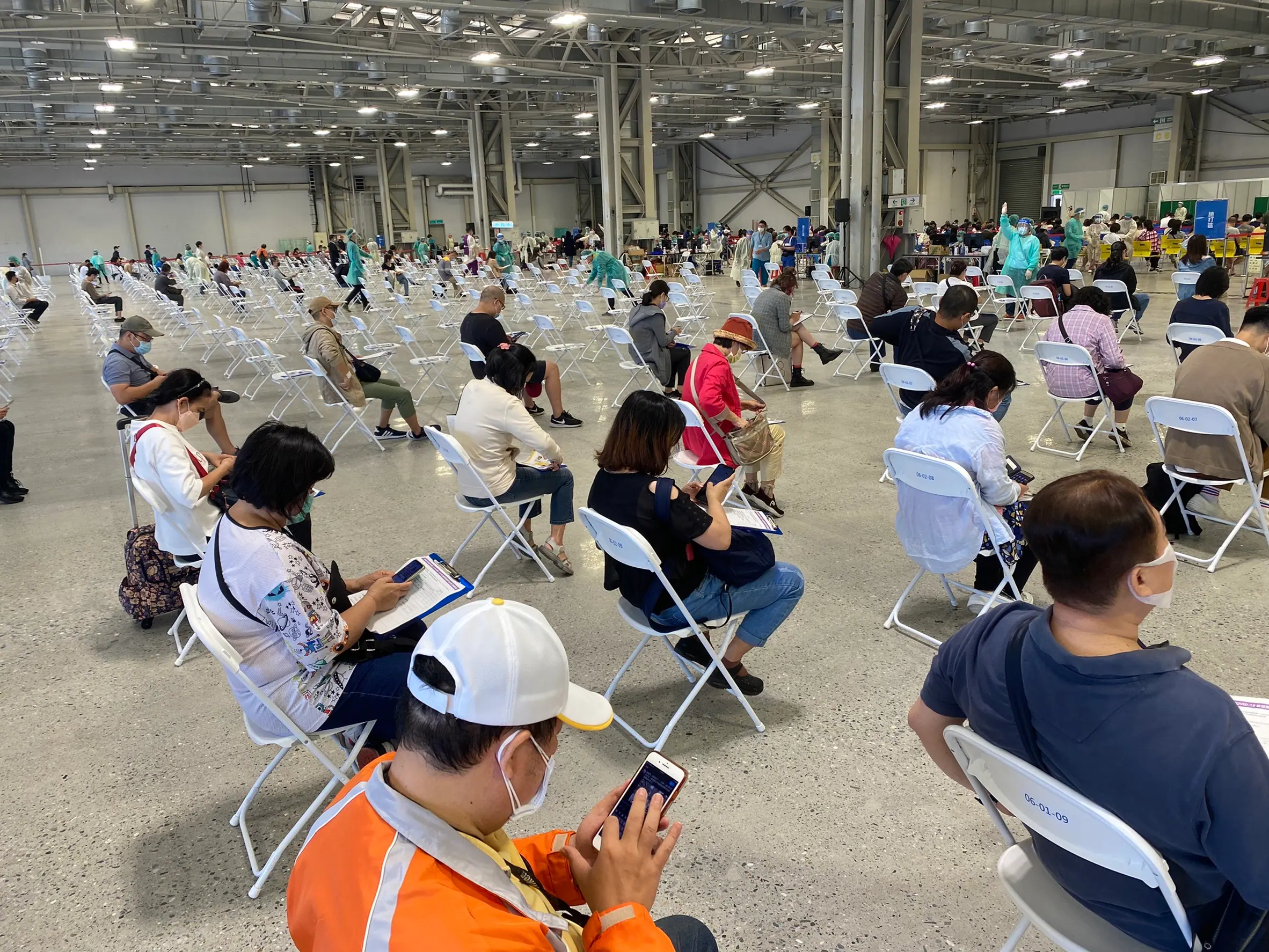
On February 15, 2020, an unlicensed taxi driver died in hospital. He had never left Taiwan; he had been infected by a Taiwanese businessman he had once driven as a passenger. This was Taiwan's first COVID-19 death, and its first confirmed case of local transmission.1
For that entire year, Taiwan reported 799 confirmed cases and 7 deaths nationwide.2
Two years later, in 2022, the same virus took 14,667 lives in Taiwan. People 65 and older accounted for 86% of them, and the median age of death was 82 — a full ten years older than the year before.3
A driver who had never left the country, and two years later, an entire cohort with a median age of 82. Between these two images lie two years — and eighteen months that one system bought for Taiwan.
Those eighteen months really were bought: through border controls, the name-based mask rationing system, and a National Health Insurance card, Taiwan kept the pandemic outside its doors for nearly a year and a half. This period was later written into a review paper in a European public health journal, in a sentence that read: "Taiwan's early containment measures might have delayed the epidemic curve, allowing time for better preparation and proactive responses."4
The key is in the second half of that sentence. The time was bought, but the preparation didn't keep pace with it. On May 19, 2021, the day Taiwan raised its nationwide epidemic alert to Level 3, the government's self-procured vaccines had reached a grand total of only one batch of 117,000 doses.5 By the time Omicron arrived in 2022, the senior citizens who needed that shot most still had their third doses lagging behind their own first and second.6
30-Second Overview: At eight in the morning on December 31, 2019, Taiwan's Centers for Disease Control (CDC) emailed China and the World Health Organization to verify reports of an unexplained pneumonia in Wuhan, and that same day began boarding-gate quarantine checks on flights arriving direct from Wuhan. Through border controls, the name-based mask rationing system, and a National Health Insurance card, Taiwan kept the pandemic outside for nearly eighteen months, recording only 799 confirmed cases and 7 deaths in all of 2020. The first AstraZeneca vaccines didn't arrive until March 3, 2021, and only 117,000 doses at that. By mid-July that year, government-purchased doses from the two major brands combined had reached about 2.45 million, against a total contracted volume of 15.05 million. When Omicron arrived in 2022, senior citizens' third doses still lagged behind. That year, 14,667 people died of COVID-19, with a median age of death of 82. Who bore the costs beyond death is a separate ledger that has never been fully tallied.
Eight A.M. Email, Same-Day Flight Checks
In the early morning of December 31, 2019, Lo Yi-chun, then deputy director-general and spokesperson of Taiwan's Centers for Disease Control (CDC), saw online reports of at least seven cases of atypical pneumonia in Wuhan. At eight in the morning, the CDC confirmed this with China's Center for Disease Control and Prevention and notified the World Health Organization's International Health Regulations (IHR) contact point by email. That same day, flights arriving in Taiwan direct from Wuhan were intercepted for boarding-gate quarantine inspection.7
Ask first, then act without waiting for an answer. That sequence would repeat itself for the next eighteen months.
That email later became material for international debate, yet the CDC has never released its full text. Officials separately added an explanation: the email had mentioned that "patients have been isolated for treatment," from which public health professionals could infer the possibility of human-to-human transmission. That clarifying line was added in April 2020 — it was not part of the text sent on December 31.7 In many later retellings, the two have been merged into a single statement.
On January 20, 2020, the Central Epidemic Command Center (CECC) was established under Article 17, Paragraph 2 of the Communicable Disease Control Act, opening at Level 3, with CDC Director-General Chou Chih-hao as commander. The next day, Taiwan recorded its first confirmed case — a Taiwanese businessman who had returned from Wuhan. On January 23, the command level was raised to Level 2, with Minister of Health and Welfare Chen Shih-chung taking over as commander. On February 27, it was raised again to Level 1.8
Source: Ministry of Health and Welfare, successive Taiwan CDC announcements
📝 Curator's Note
The "Level 3 alert" that Taiwanese people remember and the CECC's own "Level 1 activation" are two completely different systems. The former governs restrictions on people's daily lives; the latter governs the command center's own organizational tier. Once the CECC was raised to Level 1 on February 27, 2020, it was never downgraded again until it disbanded on May 1, 2023 — through the takeout-only, empty-streets summer of 2021, the command center's own tier never changed at all. Reading "Level 3 alert" as "the CECC dropped back to Level 3" is exactly where the two systems are most easily conflated. The severity people felt and the bureaucracy's own tier are two curves that never moved in sync.
At nine in the morning on February 6, 2020, the name-based mask rationing system went into effect. People could buy masks at NHI-contracted pharmacies using their National Health Insurance card: odd-numbered national ID numbers could buy on Monday, Wednesday, and Friday, even-numbered ones on Tuesday, Thursday, and Saturday, and anyone at all on Sunday.9 The lines Taiwanese people stood in that spring, the numbers they memorized, the pharmacy doors they stared at — that was the most physical form this system ever took.
What eventually shortened that line wasn't in the government's hands. Wu Chan-wei (吳展瑋), founder of the Tainan-based "Howdy Studio," wrote his own map of convenience-store mask stock during the mask-buying chaos; a prototype had already appeared at a Tainan hackathon in late 2019, and the g0v community gradually joined in. Then-Digital Minister Audrey Tang noticed it and reached out, coordinating data openness between g0v and the government; the government later turned pharmacies' remaining mask counts into an open API.10 The step most often left out of this chain is the first one: the map's first version came from one engineer's own hands, and only afterward did the government step in to feed it data.
That same year, the "electronic fence" system launched in early February, using cell tower signals from a person's mobile phone number to determine whether someone under home quarantine had left their quarantine location.11 This system would later become a constitutional-level controversy — but that was still three years away.
By the end of 2020, Taiwan's report card read: 799 confirmed cases, 7 deaths.2
Except the claim of "eighteen months with zero community transmission" doesn't hold up — two counterexamples fall within that very period. The unlicensed taxi driver who died on February 15 was a confirmed case of local community transmission.1 A hospital-acquired cluster at Taoyuan General Hospital in January 2021 produced 11 cases of community spread.12 The accurate version is this: breaches did occur, and each time one did, Taiwan poured enormous resources into containing it.
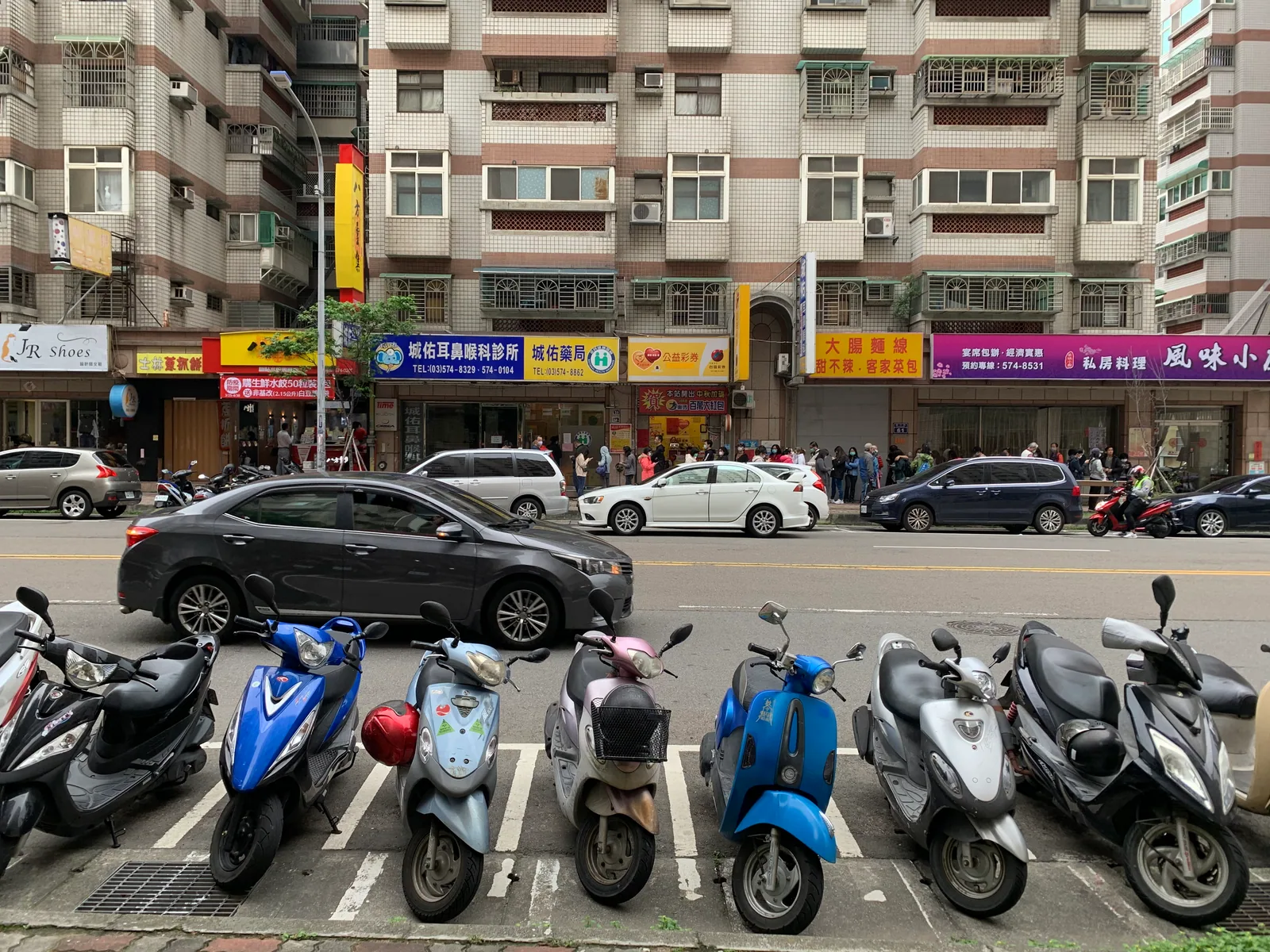
March 30, 2020, Hsinchu City. The line for the name-based mask rationing system, buying with a National Health Insurance card. Photo: Tbatb / Wikimedia Commons, CC BY-SA 4.0
The April 13 Meeting That Left No Record
On April 13, 2021, the CECC held an expert meeting to discuss relaxing quarantine rules for the crews of national-flag airlines. The next day, it announced a switch to "3+11" — three days of centralized quarantine plus eleven days of self-health management — effective from April 15 onward, based on each flight's arrival time in Taiwan. On May 31, the CDC stated that this adjustment had been discussed across the CECC's divisions but that no meeting minutes had been produced. On June 12, the crew rule was rolled back again: unvaccinated crew members on long-haul flights were switched to "7+7."13
By late April, the outbreak in Wanhua was already spreading. The index case identified in retrospect (Case 1424) had an onset date of April 23. On May 11, seven new local cases were reported and the alert was raised to Level 2. On May 15, Taipei and New Taipei were raised to Level 3; on May 19, the whole country followed.14
The Level 3 rules were written in fine detail. All private gatherings not required for work were suspended — indoors above 5 people, outdoors above 10 — and masks had to be worn at all times outside the home. Aside from businesses essential to daily life, public order, necessary services, medical care, or government functions, all other businesses and public venues were closed, with karaoke halls, dance halls, bars, gyms, and arcades all on the list. Restaurants that couldn't enforce the rules switched to takeout only; religious pilgrimages and temple processions were suspended; and elementary and secondary schools nationwide were closed to outside access.15 The phrase "not required for work" is rarely remembered along with the rest — most people still went to their jobs as usual that summer.
At a press conference at two in the afternoon on May 22, the CECC announced two numbers: 321 new local cases, plus another 400 cases under xiàozhèng huíguī ("recalibration"), backdated across May 16 to 21. The technical cause was a bottleneck in local reporting: more than ten thousand test results were stuck at local hospitals, unable to be reported upward, and after the CECC simplified its reporting form from more than twenty fields down to eight, it processed more than fourteen thousand of them in a single batch.16 The term "recalibration" was coined on the spot at that press conference — it wasn't an existing epidemic-prevention term — and it later became everyday slang Taiwanese people use to mock anyone submitting overdue work.
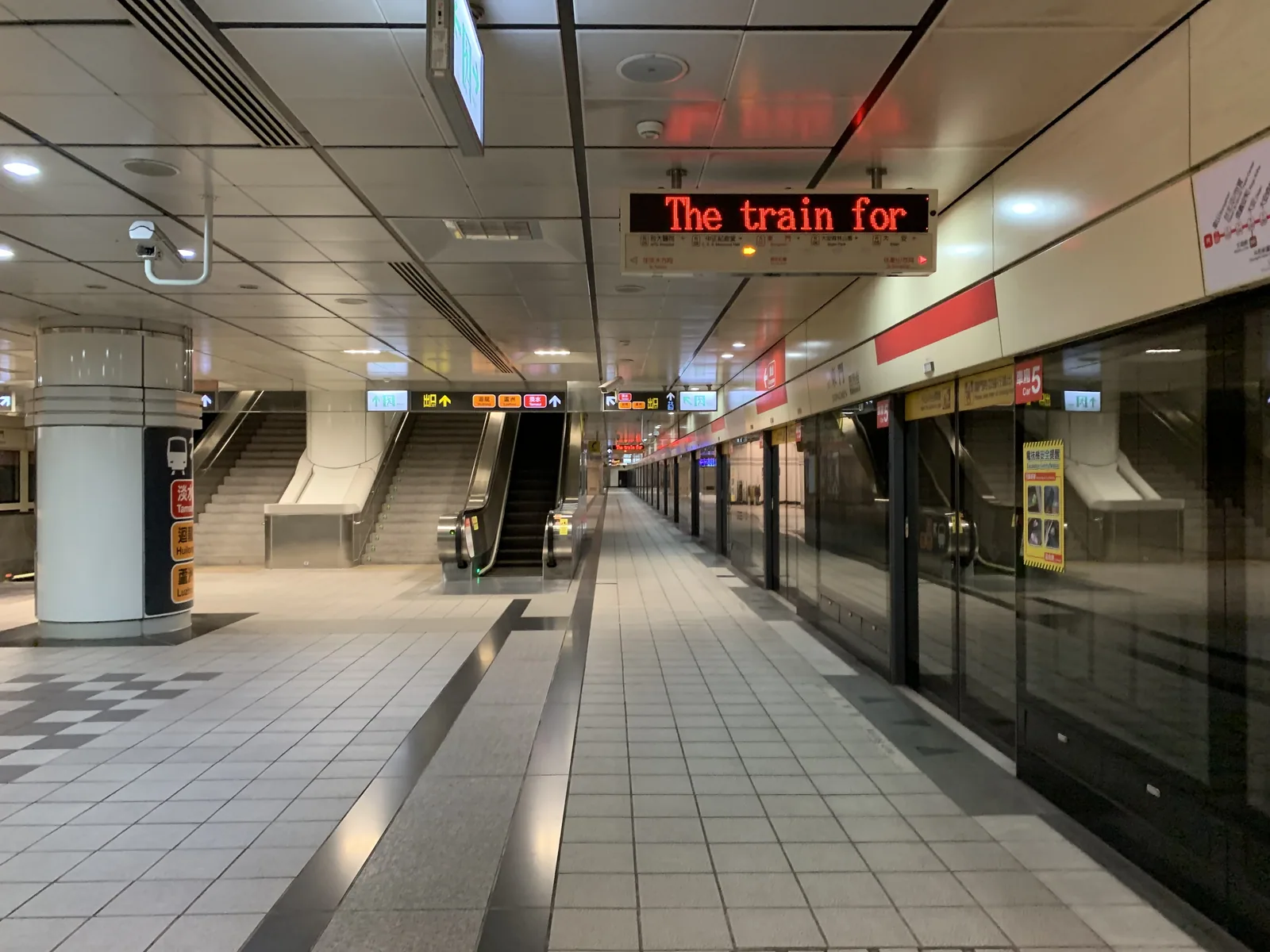
May 25, 2021, Dongmen Station, Taipei MRT. A platform under the Level 3 alert. Photo: 稜光映像_Brian / Wikimedia Commons, CC BY 3.0
PTS News report from May 22, 2021: the CECC announced "recalibration" for the first time, with 321 new local cases and 400 recalibrated cases that day.
For the next year and a half, society poured its energy into the same question: who should be held responsible for that May. In August 2021, Chen Shih-chung told English-language media, "There was no three-plus-11 loophole," noting that the CECC's three-month investigation had found no link between the crew cluster and the May outbreak.17
The Control Yuan investigated for nearly a year and a half, and its report, released in August 2022, reached a far more measured conclusion than the simplified version that circulated publicly. The Control Yuan found that before deciding to implement the strengthened protocol, the CECC had already comprehensively weighed factors including the local outbreak situation at the time, the airlines' management responsibilities, crew members' PCR test results, and the physical and mental stress they were under — it had not acted arbitrarily without evaluation. The criticism centered on the CECC's failure to fully explain its decision to the public, and its failure to proactively communicate when media and legislators raised questions. No violation of law was found, and no corrective measure was issued. The Control Yuan simultaneously recommended amending the law to specify whether major epidemic-prevention decisions should be documented in minutes and made public.18
That legislative recommendation reveals something: current regulations don't actually require meeting minutes to be kept. So "no record was left of the April 13 meeting" is both true and not a violation of law. It is a gap in the system, not one person's negligence. Follow the question of responsibility all the way to the end, and this is the answer you get.
That same May, Wanhua was hunted by media and the internet for a long time afterward. The shops in Wanhua bearing "tea house" signs were actually two different kinds of business that are often confused with each other: tê-toh-á ("tea-table" parlors) sold only tea and simple snacks, entirely different in nature from venues with female hostesses. The people who visited weren't necessarily socially disadvantaged — what they had in common was loneliness. A pot of tea there cost NT$200, a song on the sound system NT$10.19
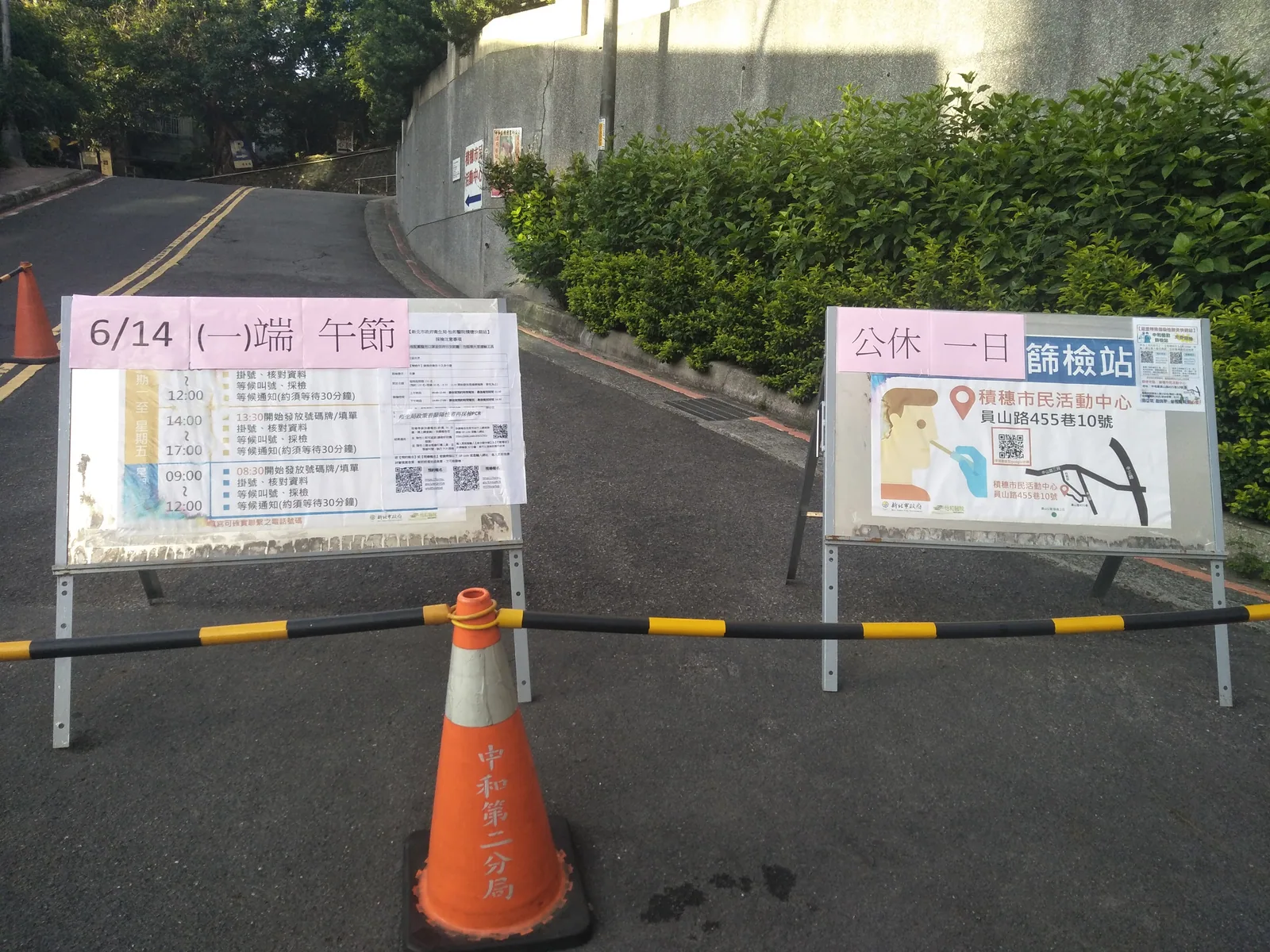
June 12, 2021, outside a rapid-testing station in the Jisui area of Zhonghe District, New Taipei City. Intersection signage and barricades. Photo: Tsuna Lu (Adsa562) / Wikimedia Commons, CC BY-SA 4.0
The truly scarce thing was nowhere in this debate: on May 19, the day of the nationwide Level 3 alert, the government's self-procured vaccines still amounted to nothing more than the single batch of 117,000 doses that had arrived on March 35, plus the 199,200 doses COVAX had delivered on April 420 — roughly 320,000 doses in all of Taiwan, for 23 million people.
Contracted for 15.05 Million Doses, With 2.45 Million Delivered by Mid-July
At the end of 2020, the government announced it would procure about 20 million doses of vaccine from abroad, plus advance orders for 10 million domestically made doses (5 million each from Medigen and United Biomedical (UBI)).21 The 20 million doses from abroad broke down as 10 million from AstraZeneca (AZ) and about 5.05 million from Moderna, plus 4.76 million ordered through the global vaccine-sharing platform COVAX, for which Taiwan had already paid a deposit in October 2020.20
The first batch of 117,000 AZ doses arrived at Taoyuan International Airport at 10:21 a.m. on March 3, 2021, aboard Korean Air flight KE691.5
By July 15, 2021, the CECC's own announced figures for self-procured deliveries were: three AZ shipments totaling 1.303 million doses, and four Moderna shipments totaling 1.15 million doses.22 Combined, the two brands came to about 2.45 million doses — less than a fifth of the total contracted volume of 15.05 million.
Source: Ministry of Health and Welfare, Taiwan CDC / CECC Decision Hub, Legislative Yuan
Contracted doses, delivered doses, and doses that could actually go into an arm are three different numbers. The shape of the wait was exactly the gap between them.
⚠️ Contested View
The most common rebuttal to "the vaccines arrived late" is that the whole world was scrambling for doses in the first half of 2021, and the slow deliveries were a supply-chain problem, not a choice Taiwan made. Half of that claim holds up — global manufacturing capacity that half-year really was consumed by a handful of countries that had signed contracts early. The other half can be checked against the timeline: by July 15, 2021, Japan had donated 3.34 million doses across three shipments and the United States had donated 2.5 million doses on June 20. The 5.84 million doses donated by just these two countries already amounted to more than double the government's own procured deliveries (2.45 million).2223 Those donations were carved out of the very same global supply. The shortage was real. It just doesn't explain everything.
Japan ultimately donated a total of 4.204 million doses across six shipments, making it the largest single-country donor to Taiwan worldwide. The United States' 2.5 million Moderna doses arrived on June 20; Poland's 400,000 doses arrived on September 5; the Czech Republic gave 30,000 and Slovakia 10,000; Lithuania's 20,000 doses can only be confirmed through secondhand sources.23
Source: Ministry of Foreign Affairs, Taiwan CDC / CECC Decision Hub, UDN Health
The most fiercely debated thread that summer was BNT. There were three different accounts of how the deal fell apart, each with primary sourcing, and they don't agree on why Taiwan couldn't get the vaccine.
In November 2020, TTY Biopharm's bid to become the distributor fell through. The official account is that the two sides couldn't agree on quantity and price — the government's initial procurement scale fell far short of what the manufacturer expected.24
In December 2020, the government's direct negotiations with BNT reached the final stage before contract signing. The CDC's own account is that BNT asked for the words "our country" to be deleted from the Chinese-language version of the press release; the Ministry of Health and Welfare changed it to "Taiwan" and sent it out the next day, after which the negotiations quietly died.25
In February 2021, Chen Shih-chung revealed that Taiwan had already agreed to purchase 5 million doses from BNT, but that the deal changed due to "external interference" just as it was about to be announced in December 2020 — he did not name who was responsible. BNT's own statement at the time read: "BioNTech is committed to helping end the pandemic around the world, and our intention to supply vaccines to Taiwan is part of that global commitment. Relevant discussions are still ongoing, and BioNTech will provide updates."26
Shanghai Fosun Pharmaceutical asserted at its shareholders' meeting that it held the Taiwan distribution rights to the BNT vaccine, and that any procurement — official or private — would have to go through it; the Ministry of Health and Welfare's position was to ask the manufacturer to formally submit an import application.27 Later that year, Taiwanese officials publicly accused China, for the first time, of directly obstructing the deal with BNT; China denied this throughout and said it was willing to supply vaccines to the people of Taiwan.28 The only thing all three accounts agree on is that the direct negotiations at the end of 2020 really did collapse.
It was the private sector that untangled this knot. TSMC submitted its application on June 10; Foxconn founder Terry Gou's Yonglin Foundation announced its contract completed on June 12; Tzu Chi Foundation CEO Yen Po-wen went to the Taiwan Food and Drug Administration (TFDA) on June 23 to file an emergency import application and confirmed the purchase of 5 million doses on July 2; and Pegatron chairman Tung Tzu-hsien personally donated NT$500 million to help fund Tzu Chi's purchase.29
Each of the three parties contracted for 5 million doses, 15 million in total, under a model of "manufactured by the original plant, packaged by the original plant, shipped direct to Taiwan" — bypassing Fosun entirely, with the CECC handling unified distribution after arrival. The first batch of 932,400 doses arrived on September 2, 2021, and the last batch on January 27, 2022; actual deliveries reached 15.2076 million doses, 207,600 more than promised.30
The contract terms themselves were also debated for a long time, with two key phrases often conflated. "Sealed for thirty years" refers to the document retention period — the Ministry of Health and Welfare clarified that this was the Archives Act's rule that documents "may not be destroyed before thirty years," not a declassification deadline.31 Commercial confidentiality periods are a separate matter: then-Minister of Health and Welfare Hsueh Jui-yuan was explicit about this before the Legislative Yuan: "AZ and Medigen are both five years, BNT required ten years of confidentiality, and Moderna does not agree to declassification at all — never."32
Another widely circulated claim — that "the Novavax contract has a seven-year confidentiality period" — was a misattribution. What CDC Director-General Chuang Jen-hsiang actually said was that "the Novartis contract's confidentiality clause runs seven years," referring to the 2009 H1N1 flu vaccine contract signed with Novartis — a different company, a different vaccine, and a different era from the 2021 Novavax deal.33 The Medigen contract was ultimately made public early, on January 16, 2024, more than a year ahead of the five years originally agreed.34
Five years later, what actually ended up in court was the donated money itself. On August 6, 2026, the Taichung District Prosecutors Office in Taiwan indicted seventeen people. According to the prosecution's indictment, a lawyer and a vaccine broker who claimed to be a major shareholder of Shanghai Fosun used lines such as "Foxconn and TSMC both went through Mr. Li to help procure their vaccines" to get the Tzu Chi Foundation to pay out NT$1,061,981,295. Investigators separately seized large quantities of gold and cash, and prosecutors have asked the court to confiscate more than NT$1.1 billion in criminal proceeds.35 The defendants are presumed innocent until convicted.
Tzu Chi issued a statement the same day, saying that its 2021 procurement process had upheld strict principles for the use of donated funds, adhered to open-market benchmarks, and was carried out within the scope of public information, and that it had been certified by an accounting firm and reviewed by the Ministry of Health and Welfare. A lawful procurement application process and a broker's fee fraud are two different things; it is the latter that the indictment targets.
During that half-year while the shipments were still on their way, the argument at home was over something else entirely.
The Same Ruler: Medigen Passed, United Biomedical Failed Both
The legal instrument Taiwan used to approve Medigen is often called an EUA, but its actual name is "special approval for manufacture or import," under Article 48-2 of the Pharmaceutical Affairs Act — a different mechanism from what's internationally known as an EUA. The statute is explicit: the central health authority may grant special approval "to prevent, treat life-threatening or severely disabling diseases for which no appropriate drug or suitable alternative therapy exists domestically," or "to respond to an emergency or a matter that significantly affects public health." The same article's second paragraph also lays out the conditions for revocation, one of which is that "the emergency or matter significantly affecting public health has ended," and it allows authorities to order applicants to dispose of or recall unused product within a set period.36
This sits at a different tier from a formal drug license. The later batch of vaccines destroyed after expiring had its legal basis written into this very article from the start.
On May 28, 2021, a TFDA expert meeting set the efficacy-evaluation benchmark for domestically made vaccines37; that same day, the CDC signed contracts for 5 million doses each with Medigen and United Biomedical.34 On June 10, the standard was formally announced: clinical trial reports needed at least 3,000 participants followed for at least one month after their final dose38, and efficacy would be judged on two immunobridging indicators — the lower bound of the 95% confidence interval for the neutralizing-antibody geometric mean titer ratio had to reach at least 0.67 times that of the AZ control group, and the lower bound of the 95% confidence interval for the seroconversion rate had to reach at least 50%.39
On July 18, Medigen's expert review meeting convened; 21 people attended, the chair did not vote, and the outcome was 3 votes to approve, 15 to approve with conditions, 1 to resubmit for further review, and 1 against — approval followed the next day, July 19.40 Medigen's measured results were a GMT ratio lower bound of 3.4 and a seroconversion-rate lower bound of 95.5%, both far above the threshold.39
At ten in the morning on Sunday, August 15, the same standard was applied to measure United Biomedical. The venue was Meeting Room F327, third floor, Building F, of the TFDA's National Biotechnology Research Park; 22 people attended, the chair did not vote, and the outcome was 4 votes to resubmit for further review and 17 against. The meeting resolution read: "Given that the CDC has already determined that Taiwan's epidemic situation and vaccine needs constitute a genuine public health emergency, after evaluating the overall benefits and risks of the United Biomedical vaccine, its safety is acceptable and it shows a trend toward cellular immune response; however, compared with the external control group of Taiwanese recipients of the AZ vaccine, its neutralizing-antibody data failed to meet the efficacy-evaluation benchmark for COVID-19 vaccines that the expert meeting on May 28, 2021 established."37
Source: TFDA meeting minutes, Vaccines (Basel) 2022;10(5):655, Liberty Times
📝 Curator's Note
The common claim is that "the standard was custom-tailored for Medigen." For that accusation to hold up, one thing needs explaining first: measured against the very same benchmark set on May 28 — the same one Medigen passed — United Biomedical failed on both counts. If the standard had really been calibrated for one company, a second company wouldn't have been stopped by the same ruler. The real technical disputes have nothing to do with Taiwan's blue-green political divide — they're about whether neutralizing antibodies, as a surrogate endpoint, can stand in for clinical protection, how comparable an external control group is to a head-to-head trial, and whether numbers measured against the original strain can be extrapolated to Delta. These were live debates across the international regulatory-science community in 2021, running on a track entirely parallel to Taiwan's political battles.
What makes those meeting minutes so compelling is the way each of the twenty-one experts who spoke stated their own position. Some wrote a single sentence; others filled a page with the details of animal studies. One expert was extremely specific about the data on participants 65 and older: "Among older (65 and up) participants, UB-612's seroconversion rate was only 89%, meaning that for every 9 people who received the United Biomedical vaccine, one failed to achieve even a basic immune response; combined with the fact that neutralizing-antibody GMT was lower among older participants than among the overall trial population, the United Biomedical vaccine's protection for the 65-and-older group is likely insufficient."37
Another expert wrote, in that very same document: "Using immunogenicity (neutralizing antibodies) as a surrogate efficacy indicator has increasingly been discussed internationally."37 That sentence undercuts the simplified narrative that "the review committee rejected immunobridging as a method." The committee voted against United Biomedical because its data didn't meet the threshold — not because of the method.
Immunobridging wasn't some sidedoor method Taiwan invented on its own, either. The International Coalition of Medicines Regulatory Authorities (ICMRA) held a workshop on June 24, 2021, co-chaired by Japan's PMDA and the UK's MHRA, with the FDA, EMA, and COVAX's advisory group all present; one of its conclusions was: "Immunogenicity bridging studies may be needed if an assessment of effectiveness of 2nd generation COVID-19 vaccines in clinical endpoint efficacy studies are no longer feasible."41
On September 15 that same year, the Access Consortium — made up of Australia's TGA, Health Canada, Singapore's HSA, Switzerland's Swissmedic, and the UK's MHRA — issued a statement: "Access Consortium members agree that well-justified and appropriately designed immunobridging studies are an acceptable approach for authorizing COVID-19 vaccines."42 Taiwan had set its own standard (on June 10) a full two weeks before that ICMRA workshop even took place.
The dissenting voices were just as specific. Academia Sinica academician Chen Pei-jer resigned from the TFDA's vaccine-efficacy expert review panel in late May, giving his reason as: "The biggest difficulty for the review is President Tsai — she has already said she'll get the domestic vaccine at the end of July. Under these circumstances, can the TFDA hold up against that pressure from the Presidential Office? It's a very simple point." He also said, "The review committee faces a great many difficulties; it can no longer maintain its independence and professionalism."43 His concerns were about the political context surrounding the review's independence, not about the scientific basis of immunobridging itself.
Physician Lin Chin-chia's criticism targeted the method itself: "Medigen's 'immunobridging' approach is just a comparison between the Medigen vaccine group and the AZ vaccine group of neutralizing-antibody titers against live virus of the 'original strain' — this is nothing more than 'reinventing the wheel behind closed doors' in a laboratory." He also cited Germany's CureVac, whose Phase 3 trial of 40,000 participants showed only 47% efficacy, to illustrate that good immunogenicity doesn't equal high protection.44 Some on the supporting side put it just as bluntly. Chang Hung-jen, former Deputy Director-General of the Department of Health, said: "The golden age of Phase 3 clinical trials for COVID-19 vaccines has already passed. Using traditional clinical trials to test the efficacy of next-generation vaccines will become increasingly unfeasible — immunobridging is bound to become vaccines' 'new Phase 3 trial.'"45
Medigen did eventually run a Phase 3 trial, in Paraguay, in partnership with the medical school of the National University of Asunción; a 2022 interim analysis showed neutralizing-antibody titers reaching 3.7 times the AZ control group, and Paraguay's drug regulator, DINAVISA, approved an EUA on February 14, 2022. The sample size was only about 1,000 people, far smaller than the tens of thousands typical of a COVID vaccine Phase 3 trial, and the design was still immunobridging.46 It happened, but its scale and design remained the focus of criticism.
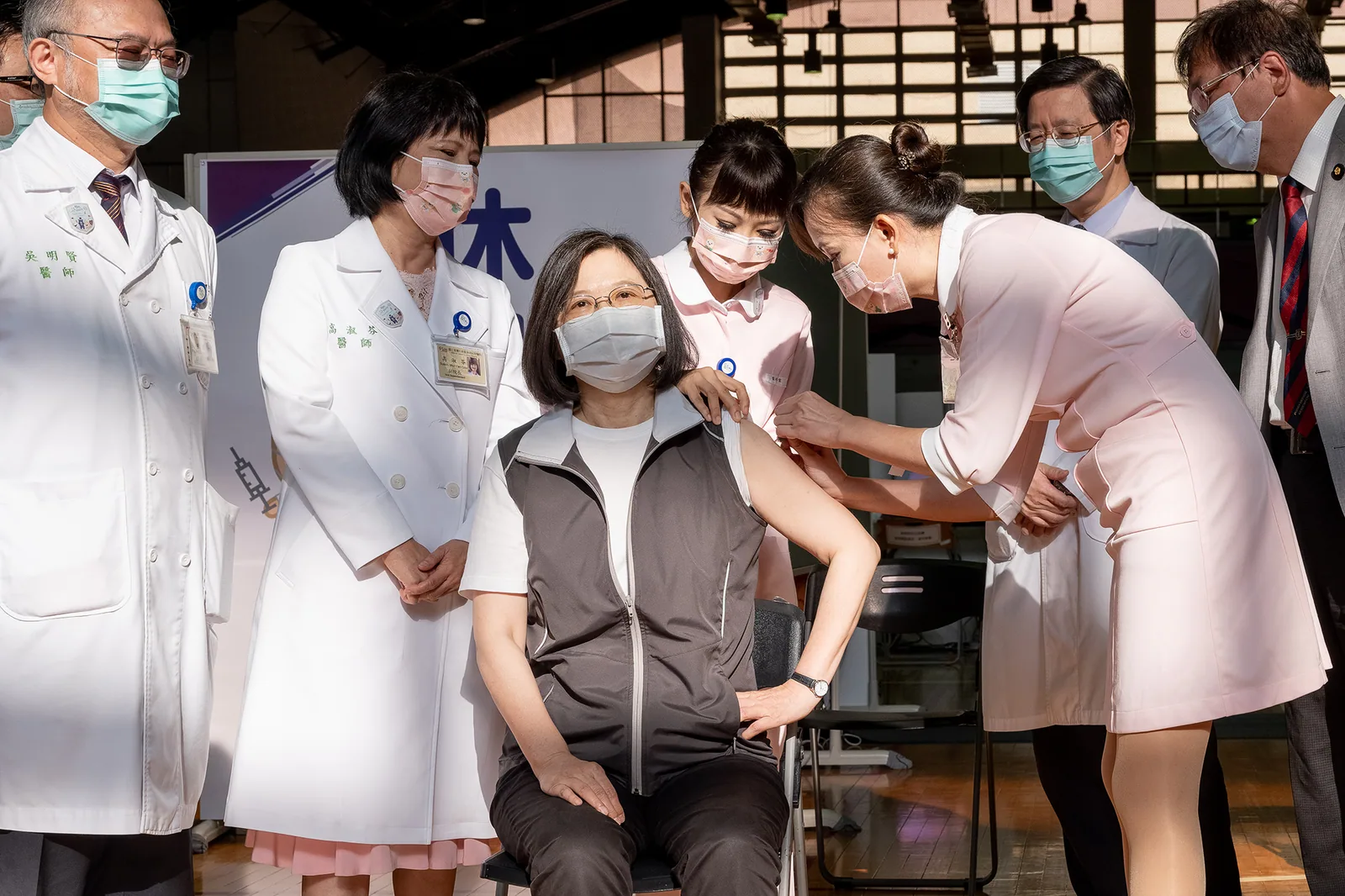
August 23, 2021. President Tsai Ing-wen receives a dose of the domestically made Medigen vaccine. Photo: Makoto Lin / Office of the President, ROC (Taiwan) / Wikimedia Commons, CC BY 2.0
Of the 5 million Medigen doses the CECC procured, about 3.4 million were actually used, and roughly 1.6 million were destroyed after expiring.47 In March 2026, the company obtained marketing approval in Vietnam for an Enterovirus 71 vaccine; its first shipment has already arrived in Vietnam, and it is simultaneously advancing development of a second-generation, multivalent enterovirus vaccine.48 The same name that sparked street protests five years ago now makes headlines for exporting children's vaccines.
This fight burned from June through August, consuming the entire summer. It wasn't until fall that shipments really began arriving in volume — later than the fight ended, later than the virus had entered the community, and later than the time the people who needed it most could actually afford to wait.
The Shipments Arrived; Senior Citizens' Third Doses Still Lagged Behind
The memory of 2022 is two lines on a rapid test. Entire classes tested positive one after another; a few desks at the office emptied out every week; a few old neighbors in the village passed away. Testing positive went from being a major event to simply being your turn. Starting May 12, a rapid-test-positive result confirmed by a medical professional counted as a confirmed case for anyone already under home isolation or quarantine; this was expanded to everyone on May 26.49 The single-day case peak was 94,808, announced by the CDC on May 27.50 (Many retellings misremember the peak as occurring in June — that was a projection made in late April; the actual peak arrived earlier than expected.)
Premier Su Tseng-chang proposed the "New Taiwan Model" in April, with official goals set as zero deaths, a shift toward mild illness, and keeping the economy running normally.51 On October 13, entry quarantine rules changed to "0+7," waiving home quarantine entirely.52 Policy had turned decisively toward coexistence with the virus.
Supply was no longer the problem: by the end of August 2022, the government's cumulative procurement had reached 68.41 million doses, with NT$43.375 billion spent, including 41.05 million doses of Moderna and 7.6 million doses of BNT purchased directly by the government.53
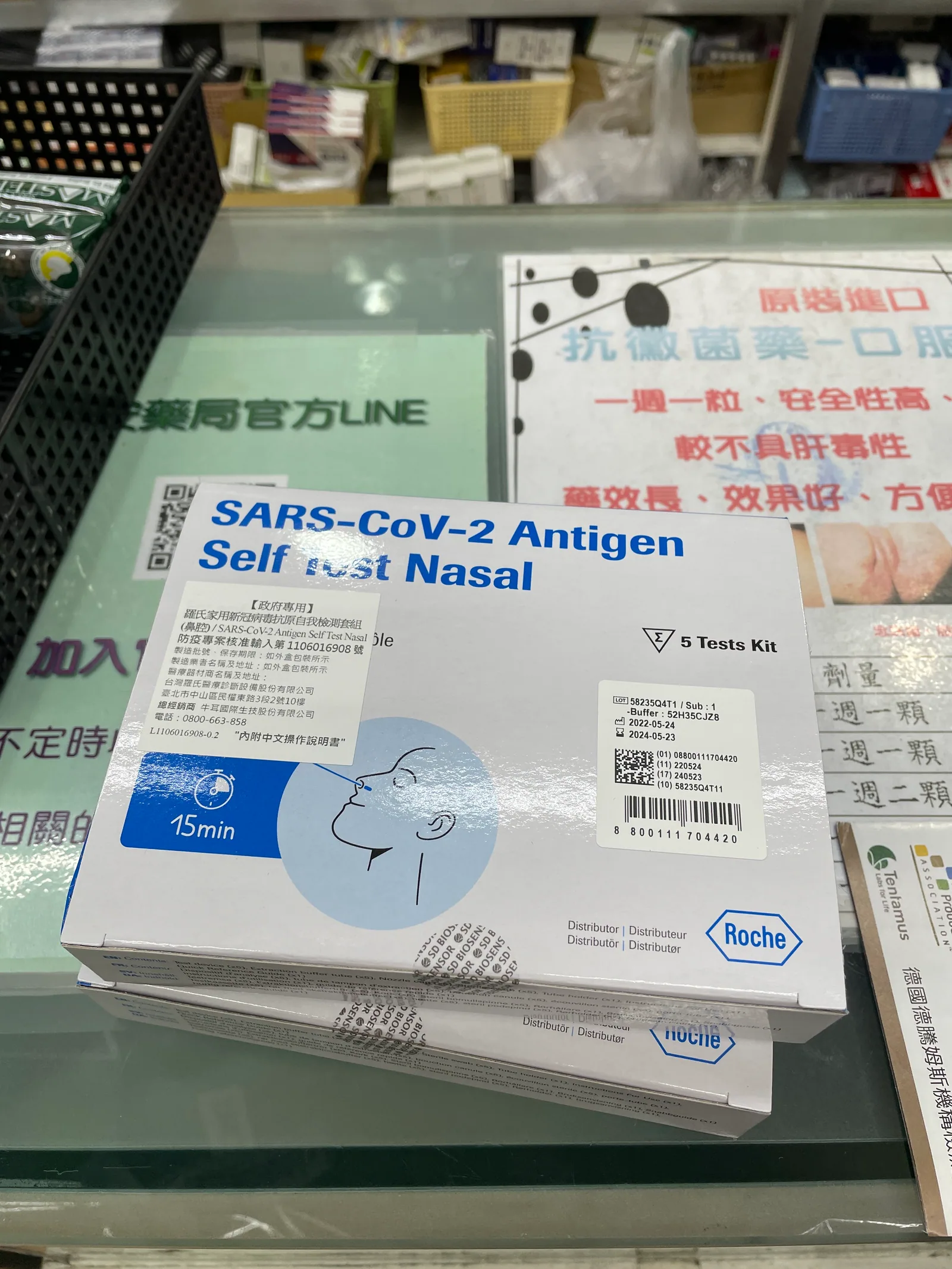
2022. Free at-home rapid test kits that National Health Insurance provided to people 65 and older. That year, two lines became an everyday verdict. Photo: ThomasYehYeh / Wikimedia Commons, CC BY-SA 4.0
What was missing was the final stretch. When the wave of deaths hit, the third-dose vaccination rate among people 75 and older still lagged behind their own first and second doses.6 Two years earlier, when doses couldn't be secured, the gap was at the docks. Two years later, with doses piled up in warehouses, the gap had moved to the last few miles: the front door of an elderly person living alone, a consent form at a long-term care facility, a booking phone call that no one was there to help make.
The tally for that year reads like this: Ministry of Health and Welfare mortality statistics show 14,667 COVID-19 deaths in 2022, with COVID-19's rank among causes of death jumping from 19th in 2021 to 3rd; the age distribution was concentrated among people 65 and older, at 86%, with a median age of death of 82 — ten years older than the year before.3 The Reporter used a different set of figures: 14,699 reported local deaths, with fatalities "concentrated almost entirely among the population 70 and older, at about 77%."54 Two numbers, two different cutoffs, each internally consistent.
Chan Chang-chuan, a professor at National Taiwan University's College of Public Health, calculated the pace of that period: from May to December 2022, at least 25 people were confirmed positive every minute on average, and 5 people died of COVID every two hours on average.54
| 2021 | 2022 | |
|---|---|---|
| Total nationwide deaths | 183732 | 207230 |
| Of which, COVID-19 deaths | 896 | 14667 |
Source: Ministry of the Interior household registration statistics, Ministry of Health and Welfare mortality statistics, The Reporter
Total nationwide deaths in 2022 came to 207,230, up 23,498 from 183,732 in 2021 — the first time the figure had topped 200,000 in the Ministry of the Interior's forty-six years of record-keeping.55 There's another way to calculate "how many more people died that year," called excess mortality, and public health researchers have produced figures four to five times apart depending on which baseline they use.565758
Source: Taiwan Journal of Public Health 2024;43(2), Heho Health citing Hsueh Cheng-tai, Commercial Times citing Chen Yi-hua's team
📝 Curator's Note
The common claim is "Taiwan's death rate was the lowest in the world, so the cost was small." That sentence quietly swaps two different statistics into one. Cumulative mortality rate has population or confirmed cases as its denominator; it needs no counterfactual baseline, and it was pulled down by the extremely low base from 2020–2021. Excess mortality looks at the gap between a single year and a pre-pandemic baseline, and it needs a model. It's like a person who was healthy for two years and then came down with a bad flu in the third: "average sick days over three years was low" and "this year felt awful" can both be true at once. The cumulative mortality rate the CECC announced in February 2023 was 742.2 per million people, the sixth-lowest in a comparison of 38 OECD countries plus Taiwan and Singapore.59 In October 2022, CECC commander Wang Pi-sheng's figure was that excess mortality was the third-lowest in the world.60 Both were official announcements — but the set of countries being compared was different each time.
The eighteen months that were bought were not, in the end, fully spent on the people who needed them most. There's no conspiracy in that sentence, and it doesn't require anyone to have been derelict for it to be true — it's simply written into the median age of death.
Nearly Nine in Ten Applicants Received a Single Word: "Unrelated"
The cost didn't fall only on people who missed that one shot. People whose bodies reacted badly after getting the shot walked a different path altogether.
"I wasn't consulted at any point during the whole review process, and my medical history is very straightforward — how can they conclude, just from my health-checkup records, that the vaccine had nothing to do with my heart attack?" The person who said this is Chen Shih-chin, 51, who suffered a heart attack after receiving the AZ vaccine.61
On paper, the system isn't strict at all. A written report the Ministry of Health and Welfare submitted to the Legislative Yuan states plainly: under Article 6 of the Regulations on the Collection and Review of the Vaccination Injury Compensation Fund, members of the public need only submit an application — they bear no additional burden of proof, which instead falls on the administrative agency — and causation is determined primarily with reference to the World Health Organization's 2018-updated guidelines for causality assessment of adverse events following immunization.62
A paper comparing the compensation systems of South Korea, Japan, and Taiwan grouped Taiwan together with Japan, describing both places' causation standards as "relatively lenient" — Taiwan's approach pays out compensation whenever causation is determined to be either "related" or "indeterminate."63
"Compensation even when causation is indeterminate" is a design unique to Taiwan. As of a snapshot on February 17, 2022, there had been 4,485 cumulative applications, of which 351 had completed review: 47 received compensation (18 ruled "related," 29 ruled "indeterminate"), while 304 were ruled "unrelated" — nearly 87% ruled unrelated, with the review-completion rate under 8% of all applications.64 Even with Taiwan compensating "indeterminate" cases, nearly nine in ten completed cases were still ruled unrelated to the vaccine.
Source: The Reporter, citing Vaccine Injury Compensation Program review records, as of 2022.02.17
By June 8, 2023, 2,689 cases had completed review, of which 303 were compensated (11.26%) and 2,386 were denied.65
The review side has its own account, too. Chiu Nan-chang, a pediatric infectious disease physician at Mackay Memorial Hospital and convener of the review panel, explained the logic behind these rulings: "Data from around the world shows that mRNA vaccines can cause myocarditis, occurring mostly in young people after their second dose… but cancer and coronary artery blockage both develop over years, not as sudden events, so it doesn't make sense to attribute them to the vaccine."66
The source of the money is also squeezing this system. Taiwan's compensation fund is financed by a NT$1.5 levy on every dose of vaccine administered, whereas Japan and South Korea fund theirs directly from the national treasury.63 Lin Hsin-jou, an associate professor at Chang Gung University and a member of the review panel, used a metaphor: "Say the compensation fund was originally meant to handle measles vaccines, but now COVID-19 vaccines have been added into it… that shrinks the size of the original pool!"61
Compensation and subsidy payouts for COVID-19 vaccines reached a cumulative NT$153,025,000 by September 2023, already surpassing the NT$129,625,000 total paid out for all other vaccines combined over the thirty years from 1989 to 2020. In 2023, an average of 235 cases were reviewed per month — nearly eighteen times the 13 cases reviewed per month in 2020.67 The single largest payout in one case was NT$6 million, to a 47-year-old woman who suffered cerebellar hemorrhage combined with cerebral venous sinus thrombosis and severe thrombocytopenia after receiving the AZ vaccine.64
The second group bearing the cost was inside the hospitals. The nursing vacancy rate rose from 4.52% in fiscal year 2019 to 4.7% in 2021 and 6.53% in 2022; the turnover rate went from 11.12% to 10.13% and then to 11.73%.68 In 2023, after the pandemic, the turnover rate hit 12.61% and the vacancy rate 9.05% — both the highest in nearly a decade.69
On May 25, 2022, the CECC held a forum called "Listening to Nurses' Voices." Anonymous remarks from the floor included lines like: "If you think you can do it, come do it yourself," and "Would another NT$2,000 really buy us an extra pair of hands?" One nursing manager at a medical center demanded that the CECC specify a formula for how much general medical capacity should be cut for every increase in dedicated COVID wards, explaining: "Otherwise the hospital director just says to open more beds and we open them. We're just lowly nursing supervisors — how could we possibly tell the director that the nurses can't carry this much workload?"70
Kao Ching-chiu, former chair of the National Union of Nurses Associations, took a longer view: "Between the falling birth rate and an industry environment that hasn't improved, the workforce isn't coming back — a shortage of staff may just become the new normal."69
Mandated nurse-to-patient ratios across all three shifts were first implemented on March 1, 2024, through an incentive-based system; the Legislative Yuan passed an amendment to the Medical Care Act formally writing it into law on May 8, 2026, to be phased in starting May 20, 2027.71 Four years passed between that forum and the law taking effect.
The third group didn't even get to choose whether they were exposed — that was assigned to them. On June 2, 2021, a cluster broke out at the King Yuan Electronics plant in Miaoli; the large majority of the 500-plus confirmed cases were migrant workers. On June 7, the Miaoli County Government announced a ban on all foreign migrant workers countywide leaving their residences, with no exceptions besides commuting to and from work; the ban was lifted on June 29.72 Taiwanese employees at the very same plant faced no restriction of comparable severity.
The CECC's own legal opinion at the time was already unambiguous: the ban "raised concerns of differential treatment in violation of the principle of equality," and under the intent of the Constitution, international human rights covenants, and the Communicable Disease Control Act, it "should carry no binding legal force."73 The Taiwan Association for Human Rights sent a letter to central government agencies on June 18 demanding an explanation. The ban nonetheless remained in effect until June 29.
A year later, the Control Yuan issued a formal corrective measure against both the Miaoli County Government and the Ministry of Labor. The corrective measure stated that "the Miaoli County Government issued a lockdown order restricting all migrant workers from leaving home — including those with no history of exposure to the disease — without clear legal authorization," and noted that the CECC had failed to clearly demand its immediate withdrawal, which "gave rise to discriminatory treatment of migrant workers and constitutes a major dereliction of duty." This incident was written into the annual human rights reports of both Amnesty International and the U.S. State Department.74
✦ "I felt like I was some kind of criminal."
The person who said this was Emma, an Indonesian migrant worker, in an interview with The Reporter on June 22, 2021. She also said: "We're afraid of getting infected too, you know."75
The losses in insurance and dining were on a different scale entirely. The paired "pandemic" and "vaccine-injury" insurance policies together paid out a combined NT$264.983 billion in claims from 2022 through the end of March 2023 — wiping out roughly two decades of the property-and-casualty insurance industry's profits.76 In May 2021, the month of the nationwide Level 3 alert and the ban on dine-in service, restaurant industry revenue fell to NT$50.2 billion, down 23.7% month-on-month and 19.1% year-on-year; everyday-dining restaurants fell 30.8% year-on-year, the steepest drop of any category, while Western-style fast food actually grew 5.4%, thanks to its more takeout-oriented customer base.77
There are still other groups who were never counted separately, from beginning to end. The number of deaths that year among long-term care facility residents and elderly people living alone was never published by any single agency on its own. There is no official survey of how delivery riders' and day-wage workers' incomes changed during the Level 3 alert. There are no figures for migrant workers' vaccination coverage, or for wage compensation after those three weeks of lockdown. There is no public tally of how many people pursued an appeal or administrative litigation after being ruled "unrelated." These groups' circumstances have never been entered into any table at all.
No Illegality Found; Not Yet Thorough Enough; Causation Not Established
After it was all over, three different agencies each conducted a review and arrived at three seemingly contradictory conclusions.
The Taipei District Prosecutors Office accepted more than sixty vaccine-related complaints between June 2021 and February 2023, covering allegations ranging from inadequate procurement and refusal of private donations to the Medigen procurement policy and pricing and the special-approval process. In April 2023, it issued a press release stating that all of them had been closed with a finding of "no illegality found."78
The Control Yuan released its investigative report on vaccine procurement on March 1, 2023, demanding that the Executive Yuan direct the Ministry of Health and Welfare to review and improve areas where vaccine preparedness, procurement decisions, and operating procedures had "not yet reached full adequacy," along with incomplete relevant regulations and insufficient information disclosure. One item concerned the limited international recognition of the domestic vaccine: Control Yuan members noted that, at the time, only ten countries recognized the Medigen vaccine internationally, and the main reason was likely the absence of traditional Phase 3 clinical trial results demonstrating efficacy.79
On the courts' side, a two-year-old boy died after contracting the virus, and his father, questioning delays in the emergency-response process, sought NT$1 in state compensation from the New Taipei City Government. The court ruled that it was "difficult to establish substantial causation with the actions of public officials," and the second-instance ruling in November 2023 rejected the appeal, finalizing the case.80
The three agencies were asking three different questions. The prosecutors asked whether anyone had committed a criminal offense. The Control Yuan asked whether administrative procedures had been adequate and information disclosure sufficient. The courts asked whether there was substantial causation between a specific death and a specific official's actions. "Illegality," "inadequacy," and "no substantial causation" are three different legal standards; each of the three tracks answered its own question, and each left its own share of questions unanswered. Reading them as contradicting one another means mistaking three different rulers for a single one.
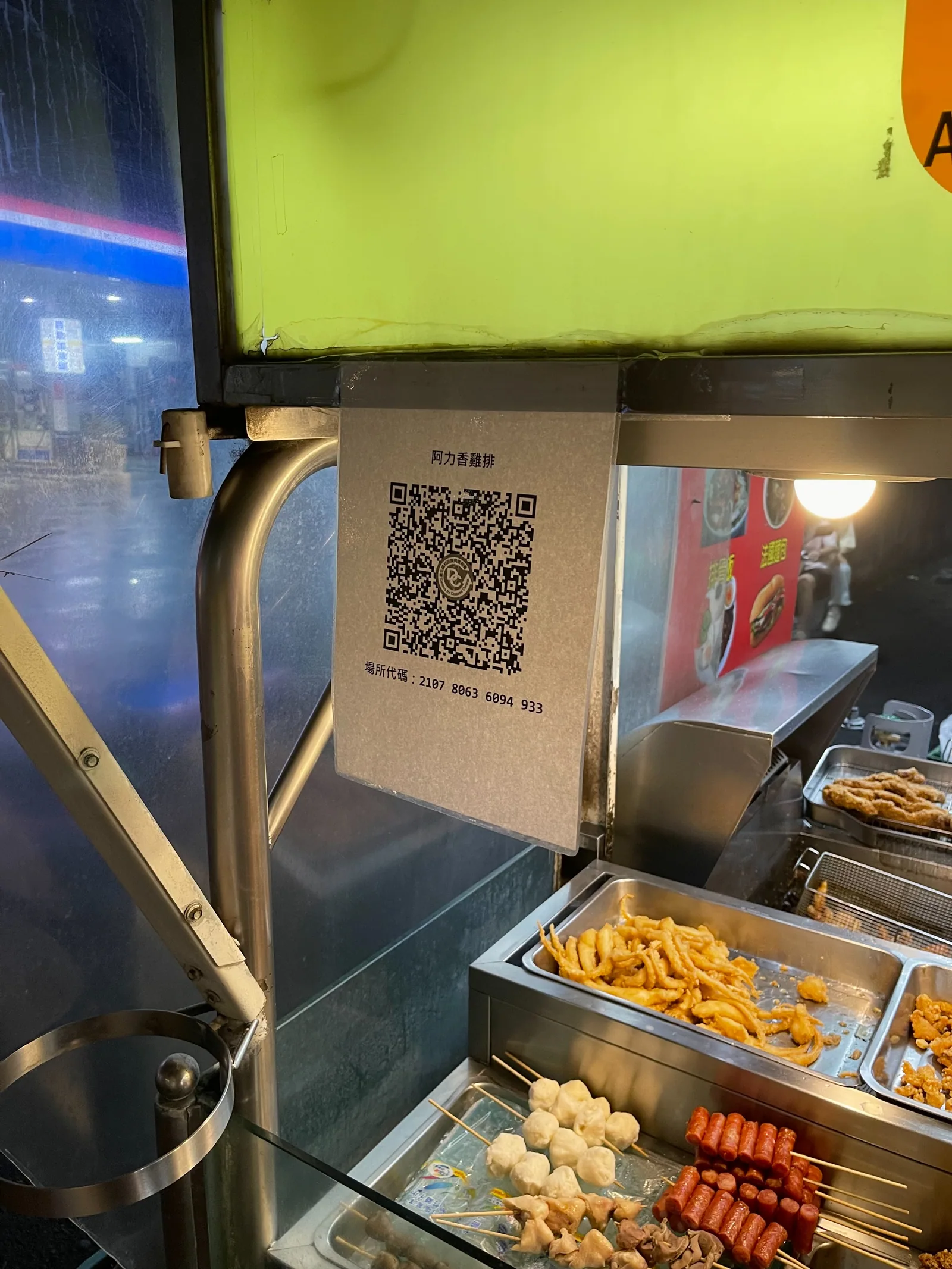
Scan the QR code before entering, send the text message to 1922. An action Taiwanese people performed billions of times — not one record of it exists anymore. Photo: IiTheCavalryiI / Wikimedia Commons, CC BY-SA 4.0
The one thing none of the three rulers could measure is the same thing: in a state of emergency, who sets the rules, and when.
The first rule concerns whether decisions leave a paper trail. The April 13, 2021 meeting left no minutes, and after its investigation, the Control Yuan acknowledged that existing regulations didn't actually require any — which is exactly why it recommended amending the law to specify whether major epidemic-prevention decisions should be documented and made public.18 This rule wasn't proposed until after the fact.
The second rule concerns whether the scope of authorization was written clearly enough. Article 7 of the Special Act for Prevention, Relief and Revitalization Measures for Severe Pneumonia with Novel Pathogens, passed on its third reading on February 25, 2020, consists of a single sentence in its entirety: "The commander of the Central Epidemic Command Center may implement necessary emergency response measures as needed to prevent and control the epidemic." This act remained in effect until it automatically expired on June 30, 2023.81
Lin Ming-shin, a professor at National Taiwan University's College of Law, wrote a dedicated study in a legal journal examining this article's constitutionality, approaching it from three angles — the constitutional mandate of clarity, the clarity of legislative authorization, and the separation of powers — and stressed that even though this article had not yet been abused in practice, the question of its constitutionality still warranted examination.82 The Control Yuan used a different vocabulary, noting that the current legal system "relies heavily on general clauses within the law" and that "turning ordinary law into emergency law" risked expanding executive power.11 The scholar's terms differ from the Control Yuan's, but they're pointing at the same thing.
The third rule concerns how data is collected and deleted. Technology-driven epidemic prevention wasn't without a legal basis: the electronic fence cited Article 48, Paragraph 1 of the Communicable Disease Control Act — "the competent authority may detain for observation any person who has been in contact with, or is suspected of having been infected by, a communicable disease patient; and where necessary, may order such person to relocate to a designated location for examination, vaccination, medication, or other necessary measures such as designating control or isolation in a specific area" — together with Article 58, Paragraph 1, Item 4, and Article 20 of the Personal Data Protection Act.83 None of these provisions ever mentions mobile phone numbers or cell tower positioning. The dispute is over whether the authorization was clearly defined, not over whether a legal basis existed at all.
The Control Yuan's investigation into the electronic fence found shortcomings across all four dimensions of procedure, administrative transparency, personal data protection, and legal framework: the system went live in early February 2020, but the official document formalizing its operating procedures wasn't issued until March 8, and the contract for the system's service platform didn't take effect until March 26.
High-risk groups in Wanhua District were placed under National Health Insurance card flagging starting May 15, 2021, yet this wasn't announced at a press conference until May 28 — just as the flagging period was about to end. The "maximum 28 days" limit on data retention wasn't put in writing until four months after the system had already gone live, and telecom carriers separately operated under a one-year retention rule.11
The rules for the SMS-based real-name contact-tracing system were likewise made up as they went. From its launch on May 19, 2021, to the system going offline on April 27, 2022, the National Communications Commission reported nearly 4.8 billion messages sent in total; the data was completely deleted on May 26, 2022.84
Chang Yuan-sen, a judge at the Taichung District Court, pointed out while this system was still in operation that police using contact-tracing SMS data as grounds for search-warrant applications was troubling — members of the public might have been compelled to participate simply to buy daily necessities, and criminal investigations fell outside the authorized scope of "for epidemiological investigation use only." The CECC responded that the data could not be used for criminal investigations; the Criminal Investigation Bureau clarified that it had not directly accessed the Ministry of Health and Welfare's 1922 SMS data but had instead obtained the full message contents through the procedures of the Communication Security and Surveillance Act; and the Judicial Yuan stated that the matter should either be judged case by case by individual judges or clearly regulated through more precise legislation.85
💡 Did You Know
Taiwan's contact tracing followed the path of cell tower positioning plus SMS reporting, while many other countries in the same period chose decentralized Bluetooth-based exposure notification — two phones exchange random codes when they come near each other, and the codes stay on the phone rather than uploading any location. The privacy costs of the two paths are very different. Why Taiwan chose the former was never part of any public debate at the time; what left behind a large paper trail was the legal controversy that came later, not the choice of technical architecture.
The CECC wound itself down step by step in 2023. Indoor mask requirements ended on February 20; on March 20, mild cases no longer had to be reported and shifted to self-health management instead; on May 1, COVID-19 was downgraded from a Category 5 to a Category 4 notifiable disease, and the CECC disbanded that same day.86 The press conference held on April 27 was its 960th, and its last. Over three years, it had held 960 press conferences, issued 2,199 press releases, produced nearly seven thousand briefing boards, and drawn more than twenty thousand reporter attendances in total, with as many as 220,000 people in quarantine at the same time at its peak.87
Over more than three years, more than ten million people in Taiwan were infected in total. The cumulative death toll doesn't reconcile across different official figures: on the eve of the CECC's disbandment, the Central News Agency cited a figure of more than 19,00087, while a snapshot from an open data platform that September gave cumulative confirmed cases as 10,239,510 and cumulative deaths as 17,668.88
PTS News report from April 27, 2023: the Central Epidemic Command Center's 960th and final press conference.
On the stage beyond its own shores, Taiwan's situation was a different story altogether: it was invited to attend the World Health Assembly as an observer under the name "Chinese Taipei" from 2009 to 2016, and has not been invited again since 2017.
Then-Minister of Health and Welfare Hsueh Jui-yuan said in Geneva in 2023: "Without WHO membership, Taiwan is also unable to provide various surveillance data to the global influenza surveillance and the response system, which could alert the world to the next pandemic. Taiwan is willing and it should also be included in the pandemic accord that is under negotiation."89
On May 27, 2025, the 78th World Health Assembly adopted the Pandemic Agreement and the Pathogen Access and Benefit Sharing (PABS) system; eleven of Taiwan's diplomatic allies proposed inviting Taiwan to attend as an observer, but Taiwan still was not invited.90
The world did write Taiwan's pandemic response into its academic record. That European public health journal article also noted that Taiwan avoided a nationwide lockdown in favor of targeted restrictions, while also pointing out that the vulnerability of its elderly population led to higher mortality and case rates, and that it lacked a clear transition plan.4 During that same period, Taiwan's surveillance data still couldn't get into the global system.
On August 4, 2026, the CDC announced the previous week's numbers: 18,990 outpatient and emergency-room visits for COVID, up 74% from the week before, along with 62 new severe local cases and 3 new local deaths. Director-General Lo Yi-chun estimated the peak would land around August 16, with that week's visits potentially reaching 51,000.91 The person who, seven years earlier, saw the reports of an unexplained pneumonia in Wuhan on that early morning was then deputy director-general and spokesperson of the CDC. He is now its director-general. The same virus, the same person, seven years apart.
In those eighteen months, Taiwan really did buy time. Whether that time was ultimately spent on the people who needed it most is a separate question — and the answer is written into the median age of death.
The threads still left hanging are just as clear. The Tzu Chi fraud case was indicted on August 6, 2026, and has not yet gone to trial. No real-world effectiveness studies following the immunobridging approvals can be found in the public literature. There is no public tally of appeals or administrative litigation pursued after a ruling of "unrelated." No agency has left behind figures on the situation of long-term care residents, elderly people living alone, or migrant workers over those three years. Publicly funded vaccination is still ongoing in 2026, and outpatient visit numbers are still climbing. These are the facts as they stood as of August 8, 2026.
Further Reading
- Taiwan's Public Health and Epidemic Prevention System — How the trauma of SARS grew into an entire system, and what that system looked like before 2020
- Taiwan's Healthcare and National Health Insurance — The health insurance card that let the mask rationing system stand up within two weeks, and the system underneath it
- Migrant Workers — The structural background behind the Miaoli lockdown order: the labor and living conditions of 700,000 people in Taiwan
- Audrey Tang — The digital minister in that mask-map coordination chain, and the relationship between civic tech and open government data
- Taiwan's Disaster Medicine System — The institutional background behind dedicated COVID wards and emergency-room congestion
- Academia Sinica — The institution that produced a monoclonal antibody able to identify the COVID-19 virus in nineteen days, and the system that let it move that fast
Image Sources
This article uses 7 images (1 CC0, 6 Creative Commons licensed), all cached at public/article-images/society/ to avoid hotlinking source servers; it also embeds 2 videos from PTS News's official channel. Neither video's captions were extracted, so the body text does not quote anything said in either video.
- Large-scale COVID-19 vaccination site at Taipei Expo Dome — Photo: 玄史生, 2021-10-27, CC0 1.0 (hero)
- Lining up to buy rationed masks outside a pharmacy in Hsinchu City — Photo: Tbatb, 2020-03-30, CC BY-SA 4.0
- Taipei MRT's Dongmen Station during the Level 3 alert — Photo: 稜光映像_Brian, 2021-05-25, CC BY 3.0
- Intersection signage outside a rapid-testing station in Zhonghe District, New Taipei City — Photo: Tsuna Lu (Adsa562), 2021-06-12, CC BY-SA 4.0
- President Tsai Ing-wen receives a dose of the domestically made Medigen vaccine — Photo: Makoto Lin / Office of the President, ROC (Taiwan), 2021-08-23, CC BY 2.0
- Free at-home rapid test kits provided by National Health Insurance to people 65 and older — Photo: ThomasYehYeh, 2022-11-07, CC BY-SA 4.0
- SMS-based contact-tracing QR code notice at a shop entrance — Photo: IiTheCavalryiI, 2022-05-23, CC BY-SA 4.0
- Videos: PTS News, "Recalibration" report, 2021-05-22; PTS News, "CECC's Final Press Conference" report, 2023-04-27 (official YouTube channel)
References
- 白牌車司機病逝為台灣首例死亡(中央社) — Died February 15, 2020, with no travel history abroad; the infection source was a Taiwanese-businessman passenger he had driven. This was Taiwan's first death and also its first confirmed case of local community transmission, falling within the eighteen-month window that the popular narrative calls "zero community transmission."↩2
- 2020 年全年疫情統計(NOW 健康彙整) — 799 confirmed cases reported for all of 2020 (56 local, 704 imported, 36 from the Navy's Goodwill Fleet cluster, 2 from aircraft, 1 unclear), and 7 deaths. An authoritative secondary compilation; the CDC's own annual statistics page could not be obtained verbatim.↩2
- 111 年國人死因統計結果(衛生福利部) — Primary official source: in 2022, COVID-19 caused 14,667 deaths, with its rank among causes of death rising from 19th in 2021 to 3rd; the age distribution was concentrated among people 65 and older, at 86%, with a median age of death of 82 — up 10 years from 2021.↩2
- Lessons learned from Taiwan's response to the COVID-19 pandemic(European Journal of Public Health) — By Hsieh, Tsai, Chiang, and Weng, Volume 35, Issue 1, pp. 153–162, DOI 10.1093/eurpub/ckae185. Verbatim text includes "Taiwan's early containment measures might have delayed the epidemic curve" and "Taiwan avoided nationwide lockdowns and relied on targeted restrictions"; the same article also notes that the vulnerability of the elderly population led to higher mortality and case rates and a lack of a clear transition plan, and records that the weekly mortality rate at the two 2022 peaks reached as high as 5.15 per 100,000 people.↩2
- 首批 11.7 萬劑 AZ 疫苗抵台(中央社) — Records verbatim: "The first batch of 117,000 doses of the Oxford-AZ vaccine arrived at 10:21 a.m. on the 3rd, delivered by Korean Air (flight KE691) to Taoyuan Airport." Cross-confirmed by an official Ministry of Health and Welfare announcement (https://www.mohw.gov.tw/cp-5014-58437-1.html). The second self-procured AZ batch (626,000 doses) arrived on July 7, 2021, so as of the nationwide Level 3 alert on May 19, the only self-procured AZ delivery was this March 3 batch (see [^23]).↩23
- Before the wave of deaths, the third-dose vaccination rate among people 75 and older was already lagging behind their first and second doses — a gap that was measurable even before the wave of deaths occurred. A set of precise coverage figures that has circulated (first dose 80.4%, second dose 73.9%, third dose 62.3%) traces to a source link (heho.com.tw/archives/261518) whose current content no longer matches those figures, and no reliable primary source could be found to support them, so no precise percentage is given here. A separate, roughly contemporaneous figure exists — "61.05% third-dose coverage among those 65 and older" (March 2022) — but its age base and point in time both differ, so the two figures cannot substitute for one another.↩2
- 我國通報世界衛生組織電郵內容事實陳述之聲明(疾病管制署) — Official statement from the CDC; the full text of this statement contains no specific time, and the exact start time of the boarding-gate quarantine checks is likewise unspecified. The "8 a.m." detail comes from a separate official document — the Epidemic Prevention Key Decisions website (https://covid19.mohw.gov.tw/ch/cp-4822-53399-205.html) — which states verbatim: "In the early morning, the Centers for Disease Control learned online that at least seven cases of atypical pneumonia had occurred in Wuhan, China; at 8 a.m. it confirmed the outbreak information with the China CDC and notified the World Health Organization's International Health Regulations (IHR) contact point by email." That page likewise does not record a specific time for the boarding-gate quarantine checks. The English-language version of the same statement (https://www.cdc.gov.tw/En/Bulletin/Detail/PAD-lbwDHeN_bLa-viBOuw?typeid=158) contains a more detailed account of the email's content. The CDC has never released the original full text of the email; "patients have already been isolated for treatment, from which human-to-human transmission could be inferred as possible" is an official clarification added in April 2020, not text from the letter sent on December 31. Lo Yi-chun's title at the time was Deputy Director-General and spokesperson of the CDC.↩2
- 疾管署宣布成立嚴重特殊傳染性肺炎中央流行疫情指揮中心(衛生福利部) — Official press release dated January 20, 2020; its legal basis was Article 17, Paragraph 2 of the Communicable Disease Control Act. For the timeline of command-level changes (Level 3 on 01.20 under Chou Chih-hao, Level 2 on 01.23 under Chen Shih-chung, Level 1 on 02.27, commander changed to Wang Pi-sheng on 2022.07.16 with no change in level, disbanded 2023.05.01), see also UDN's explainer on the distinction between the "CECC activation level" and the "epidemic alert level" as two separate systems (https://udn.com/news/story/120940/6121459). The first confirmed case (a 55-year-old Taiwanese businesswoman who returned from Wuhan, confirmed January 21, 2020) is documented by ETtoday Health (https://health.ettoday.net/news/1630646), an authoritative secondary source.↩
- 口罩販售實名制 2 月 6 日上路(衛生福利部) — Official announcement: the system took effect at 9 a.m. on February 6, 2020; the public could buy masks at NHI-contracted pharmacies with their National Health Insurance card, split by odd/even national ID number.↩
- 口罩地圖背後的團隊(科技新報) — An in-depth interview confirming that the original developer was Wu Chan-wei (吳展瑋), founder of the Tainan-based "Howdy Studio"; a prototype already existed at a Tainan hackathon in late 2019; the g0v community contributed collectively; and Audrey Tang's role was coordinating data openness between g0v and the government. The claimed Google API billing amount is sourced only to a Liberty Times headline paraphrase and cannot be verified against a verbatim primary source.↩
- 防疫兼顧人權 監察院促請指揮中心正視電子圍籬隱私權及法制疑慮(監察院) — Official investigative report press release, with verbatim conclusions across four dimensions: on the legal-framework dimension, "relies heavily on general clauses within the law" and "turning ordinary law into emergency law"; on the procedural dimension, it failed to follow the "procedure first, substance second" principle, began operating just 4 days after the decision to implement it, and its operating-procedure document wasn't officially announced until March 8, with the system's service-platform contract not taking effect until March 26; on the administrative-transparency dimension, high-risk groups in Wanhua District were placed under National Health Insurance card flagging from May 15 to 29, 2021, yet this wasn't announced at a press conference until the 28th; and on the personal-data-protection dimension, the "maximum 28 days" limit wasn't explicitly written into guidelines until 4 months after implementation, while telecom carriers were separately required to follow a 1-year retention rule. The electronic fence's launch can only be confirmed as "early February 2020" — no official announcement giving the exact date could be found.↩23
- 衛生福利部桃園醫院嚴重特殊傳染性肺炎群聚感染事件(維基百科彙整) — The January 2021 nosocomial infection at Taoyuan General Hospital produced 11 cases of community spread, the second counterexample to the "zero community transmission" narrative. A compiled secondary source, used here as an indexing starting point.↩
- 國籍航空機組員檢疫「3+11」日爭議事件(維基百科) — Verbatim on the "3+11" decision timeline: "On April 14, with national-flag airlines guaranteeing proper controls, the CECC announced a relaxation of crew members' return-quarantine measures effective the 15th," implemented from April 15 based on each flight's arrival time in Taiwan; the date of the April 13 expert meeting is established by cross-referencing that same page's timeline with Chen Shih-chung's clarification at his May 29, 2021 press conference (that clarification — that "Chen Tsung-yen did not attend the April 13 meeting" — confirms, in passing, the meeting's date itself); "On May 31, the Ministry of Health and Welfare's CDC stated that the 3+11 adjustment had been discussed across the CECC's divisions but that no meeting minutes had been produced"; "On June 12, after China Airlines was criticized for vaccinating its crews far slower than other national carriers, the CECC announced that from July, unvaccinated crew flying long-haul routes would switch from the original '3+11' to '7+7' after returning to Taiwan," while crew who had received 2 doses and had full protection saw their restrictions relaxed. On September 24, the Executive Yuan submitted a supplementary report to the Legislative Yuan (https://www.ey.gov.tw/File/230C9C0EF2413BBE), a scanned PDF from which text could not be extracted. Mirror Media's "Asking a hundred times still turns up no minutes for the 3+11 meeting" (https://www.mirrormedia.mg/story/20210922edi026) records Chen Shih-chung's related remarks; that piece was published September 22 and does not cover the rest of this passage's timeline details, so it is not used as the primary source for the timeline.↩
- 萬華茶藝館嚴重特殊傳染性肺炎群聚衍生感染事件(維基百科) — Timeline: the index case (Case 1424) had an onset date of April 23, 2021; 7 new local cases were reported on May 11; Taipei and New Taipei were raised to Level 3 on May 15. As of June 2, 2021, there were 877 cases linked to tea houses, 640 cases in Wanhua District, and 1,772 cases in total linked to activity history in Wanhua. Case 1424's background is described, across multiple cross-referenced reports, as a woman who ran a street stall in Wanhua; her connection to the tea houses was limited to being classified as a "Wanhua tea-house-linked case" — she was not a customer of one. The official announcement of the nationwide Level 3 alert on May 19 (extended multiple times) and its downgrade to Level 2 on 07.27 (per a CDC announcement on 07.23) is also documented by the Central News Agency (https://www.cna.com.tw/news/firstnews/202105195009.aspx); this report's date has been cross-verified against the CDC's English-language announcement and confirmed accurate, but it covers only the May 19 item — the rest of the timeline details are sourced from the Wikipedia timeline.↩
- 三級警戒管制內容逐條(疾病管制署公告,機構轉載版) — The May 19, 2021 version's item-by-item list, including the cap on private gatherings not required for work (5 people indoors / 10 outdoors, explicitly excluding work-related necessary gatherings), the scope of business closures, dine-in/takeout rules for restaurants, and restrictions on religious activities and school campuses.↩
- 3 天前發現通報數有異 陳時中曝「校正回歸」始末(中央社) — Report on the May 22, 2021 press conference: 321 new local cases and 400 "recalibrated" cases (backdated to May 16–21) were announced that day; the technical cause was a bottleneck in local reporting, with more than ten thousand test results stuck at local hospitals, and the CECC processed more than fourteen thousand of them at once after simplifying its reporting form from more than twenty fields down to eight. "Recalibration" was a term coined on the spot at that day's press conference.↩
- Chen denies 3+11 loophole(Taipei Times) — English-language report from August 14, 2021, quoting Chen Shih-chung verbatim: "There was no three-plus-11 loophole" and "A three-month investigation led by the CECC did not find a connection between the air crew cluster and the outbreak in May."↩
- 監察院指「3+11」決策考量有所本、未對外積極溝通應檢討改進(ETtoday) — The August 2022 report as cited by media, including report language such as "not acted arbitrarily without evaluation" and "failed to fully discharge its duty to explain in detail to the public," and recording the Control Yuan's recommendation to amend the law to specify whether major epidemic-prevention decisions should be documented in minutes and made public. The report's full text is available only through media citation, so the body text presents it as paraphrase rather than direct quotation. A same-day PTS News report (https://news.pts.org.tw/article/596352) cross-confirms the framing.↩2
- 萬華茶室的汙名與復原(風傳媒) — An in-depth report by journalist Hsieh Meng-ying documenting the media's and the internet's hunting and stigmatizing of tea-house patrons, and clarifying that tê-toh-á ("tea-table" parlors) were different in nature from venues with female hostesses, that visitors' common trait was loneliness, and that a pot of tea cost NT$200 and a song NT$10. The case counts (877 tea-house-linked cases, 640 in Wanhua District, 1,772 total linked to Wanhua activity history, as of 2021.06.02) are drawn from Wikipedia's compilation of the incident; the Taipei City Government's formation of a task force in August 2021 to help businesses reopen is documented by Newtalk (https://newtalk.tw/news/view/2021-08-05/615765).↩
- COVAX 公布第一批疫苗配送數量、我國亦將獲配(疾病管制署) — Official announcement: a deposit was paid in October 2020 to order 4.76 million doses; the first-round allocation announced on February 3, 2021 was 1,303,200 doses, and the first batch of 199,200 doses arrived on April 4.↩2
- 已向國外採購 2,000 萬劑及預採購國產 1,000 萬劑 COVID-19 疫苗(衛生福利部) — The original title of the official announcement from late 2020. The roughly 20 million doses from abroad broke down as 10 million AZ, about 5.05 million Moderna, and about 4.76 million COVAX; the 10 million domestic doses were 5 million each from Medigen and United Biomedical, contracted on May 28, 2021. This is the early 2020–2021 figure and should not be conflated with later cumulative procurement numbers.↩
- 日本捐贈第三批與我國採購第三、四批疫苗抵臺(指揮中心決策網) — Official announcement from July 15, 2021, verbatim: "Self-procured AstraZeneca vaccine: 117,000 doses on March 3, 626,000 on July 7, and 560,000 in this batch, for a total of 1.303 million doses delivered"; "Self-procured Moderna vaccine: 150,000 doses on May 28, 240,000 on June 18, 410,000 on June 30, and 350,000 in this batch, for a total of 1.15 million doses delivered." This is the primary-source basis for the gap between the "15.05 million doses contracted" and "about 2.45 million doses delivered." The same announcement lists Japan's donations to date across three shipments totaling 3.34 million doses (1.24 million on 06.04, 1.13 million on 07.08, 970,000 on 07.15).↩2
- 日本贈台疫苗累計超過 420 萬劑(外交部) — Japan's six shipments totaled 4.204 million doses (1.24 million on 06.04, 1.13 million on 07.08, 970,000 on 07.15, 64,000 on 09.07, 500,000 on 09.25, 300,000 on 10.27), the largest donation to Taiwan from any single country worldwide. The United States' 2.5 million Moderna doses arriving on June 20, 2021 are documented by a CDC announcement (https://www.cdc.gov.tw/Bulletin/Detail/k9iJeEl5uPkgkCmCWtGZDg?typeid=9); Poland's 400,000 doses arriving September 5 are documented by the Central News Agency (https://www.cna.com.tw/news/firstnews/202109050008.aspx); the Czech Republic's 30,000 doses and Slovakia's 10,000 are documented by the Central News Agency and Ministry of Foreign Affairs announcements; Lithuania's 20,000 doses are known only through secondhand accounts, with no verbatim primary announcement obtained, so the figure is flagged as uncertain.↩2
- 東洋代理疫苗破局 數量價格無法達共識(中央社) — Reported November 2020: the official account attributes the collapse primarily to the government being unwilling to bet on a single company, and to the two sides failing to agree on quantity and price (the government's initial procurement scale fell far short of the manufacturer's expectations). No direct official evidence links this stage to a Chinese factor.↩
- 疾管署說明 BNT 談判卡在「我國」改「台灣」(公視新聞網) — The CDC's own account: when negotiations reached the final stage of contract signing in December 2020, BNT requested that the words "our country" be deleted from the Chinese-language version of the press release; the Ministry of Health and Welfare sent it out the next day with "Taiwan" substituted, after which the negotiations quietly died. This account does not specify whether Chinese pressure was involved.↩
- 陳時中稱 BNT 採購因「外部干預」生變、BNT 發表聲明(中央社) — Reported February 18, 2021, including Chen Shih-chung's characterization of "external interference" and BioNTech's official statement verbatim: "BioNTech is committed to helping end the pandemic around the world, and our intention to supply vaccines to Taiwan is part of that global commitment. Relevant discussions are still ongoing, and BioNTech will provide updates."↩
- 復星稱 BNT 台灣代理權在其手上(中央社) — Remarks at Shanghai Fosun Pharmaceutical's shareholders' meeting asserting exclusive distribution rights across Greater China (including Taiwan), such that any procurement, official or private, would have to go through Fosun; the Ministry of Health and Welfare's position was to ask the manufacturer to formally submit an import application. The scope of Fosun's distribution contract cannot be verified against the original manufacturer's contract text, and this remains a one-sided commercial claim.↩
- Taiwan says China blocked deal with BioNTech(Inquirer 轉載 Reuters/CNA) — Documents Taiwanese officials' first public, direct accusation that China obstructed the deal with BioNTech, along with: "China has denied trying to block vaccines for Taiwan and has offered to provide them itself." The official position's escalation from the vague phrase "external interference" to a direct accusation is a verifiable progression.↩
- 慈濟採購 BNT 疫苗申請時序(文化部國家文化記憶庫) — Tzu Chi Foundation CEO Yen Po-wen, accompanied by a lawyer, filed an emergency import application with the TFDA on June 23, 2021, and confirmed the purchase of 5 million doses on July 2. TSMC's application on June 10, Foxconn's Yonglin Foundation announcing its contract completed on June 12, and Tsai Ing-wen's meeting with Mark Liu and Terry Gou on June 18 to reach consensus on "manufactured by the original plant, packaged by the original plant, shipped direct to Taiwan" are documented on the CECC Decision Hub (https://covid19.mohw.gov.tw/ch/cp-4822-63493-205.html); Tung Tzu-hsien's personal donation of NT$500 million is documented by Business Next (https://www.bnext.com.tw/article/63441/covid-19-vaccine-tsmc-foxconn); the exact date of that donation could not be found.↩
- 三方捐贈 BNT 疫苗實際到貨 1,520.76 萬劑(udn 元氣網) — TSMC, Foxconn's Yonglin Foundation, and Tzu Chi each contracted for 5 million doses, 15 million in total; actual deliveries reached 15.2076 million doses (207,600 more than pledged), with the first batch of 932,400 doses arriving September 2, 2021, and the last batch of 918,400 doses arriving January 27, 2022. Distribution after arrival was coordinated centrally by the CECC.↩
- 公文「保存年限」30 年並非解密年限(衛生福利部) — Official clarification, verbatim: "The maximum 'retention period' for official documents is set at 30 years — they may not be destroyed before then; this is not a declassification deadline." This is a retention rule under the Archives Act, a separate matter from a contract's commercial confidentiality period.↩
- 薛瑞元說明各廠牌疫苗合約保密期限(自由時報) — Then-Minister of Health and Welfare Hsueh Jui-yuan, verbatim, before the Legislative Yuan: "AZ and Medigen are both five years, BNT required ten years of confidentiality, and Moderna does not agree to declassification at all — never."↩
- 莊人祥說明諾華 H1N1 合約保密 7 年(中央社) — CDC Director-General Chuang Jen-hsiang, verbatim: "the H1N1 novel influenza vaccine procurement contract signed with Novartis in October 2009" and "the Novartis contract's confidentiality clause runs seven years." This confirms that the widely circulated claim of "Novavax, seven years of confidentiality" was a misattribution caused by name confusion — Taiwan never signed directly with Novavax's manufacturer, but obtained its vaccine through COVAX (see the CDC's announcement of Novavax's first delivery, https://www.cdc.gov.tw/Bulletin/Detail/AuE4SwGevmumTCopn150NA?typeid=9).↩
- 高端疫苗合約提前公開(中央社) — Reported January 16, 2024. Chuang Jen-hsiang, verbatim: "The originally agreed confidentiality period was five years from the date of contract signing; today both parties have agreed to make it public early." The report also confirms that the CDC's procurement contracts with both Medigen and United Biomedical were signed on May 28, 2021.↩2
- 調查局偵破律師陳○瑄等人藉採購新冠疫苗詐騙慈濟基金會 10 億餘元(法務部調查局) — Primary-source press release from August 6, 2026, recording verbatim the defendants' alleged identities: "lawyer Chen ○-hsuan and vaccine broker Li ○-ju… falsely claimed that Li ○-ju was a major shareholder of Shanghai Fosun" (the body text uses the more neutral "claimed," since the defendants have not been convicted), the broker's pitch that "Foxconn and TSMC both went through Mr. Li to help procure their vaccines," victim losses of NT$1,061,981,295, seized gold of 158 kg 800.125 g (market value NT$659,179,319) and cash of NT$93,081,100, with prosecutors Huang Yu-feng, Lin Szu-tzu, and Weng Chia-lung handling the case. The press release names both lawyer Chen ○-hsuan and vaccine broker Li ○-ju as defendants without specifying which is the principal suspect. The count of 17 people indicted comes from the Central News Agency and the Taipei Times; the amount sought for confiscation, per the Taipei Times' English edition, was given as "More than NT$1.12 billion," which does not fully align with the total donated sum of just over NT$1.06 billion (https://focustaiwan.tw/society/202608060007). The Tzu Chi Foundation's August 6, 2026 statement can be found on the Tzu Chi Global website (https://www.tcnews.com.tw/column/item/30250.html); it is a one-sided statement that has not been judicially confirmed.↩
- 藥事法第 48 條之 2(全國法規資料庫) — Primary-source statutory text, verbatim. Paragraph 1 sets out the two circumstances for special approval of manufacture or import; Paragraph 2 sets out three circumstances for revoking approval, of which the second is "the emergency or matter significantly affecting public health has ended," with authority to order applicants to dispose of or recall unused product within a set period. This is the legal instrument behind Taiwan's approval of Medigen, sitting at a different tier from a formal drug license, and it is also the legal basis for the later dispute over handling of expired doses.↩
- 新冠肺炎(COVID-19)疫苗專家審查會議會議紀錄,110 年 8 月 15 日(食品藥物管理署) — Primary-source official PDF, 15 pages in full; the meeting was held in Meeting Room F327, third floor, Building F, of the National Biotechnology Research Park. The minutes state verbatim that United Biomedical was measured against the same benchmark "set by the expert meeting of May 28, 2021" — the shared basis for both this article's claim that "the benchmark was set on May 28" and its claim of "the same ruler." The three verbatim excerpts quoted (the full text of the meeting resolution, Expert P's comment on the 65-and-older participants' seroconversion rate of only 89%, and Expert T's comment that "using immunogenicity (neutralizing antibodies) as a surrogate efficacy indicator has increasingly been discussed internationally") are all drawn from this document (the original uses half-width parentheses; they have been converted to full-width here per Chinese punctuation convention, with not a single word altered). 22 people attended; the chair did not vote; 4 voted to resubmit for further review and 17 against. Technews's paraphrase of the official rationale (https://technews.tw/2021/08/16/ub-612-eua-no/) is nearly identical to the wording of the PDF resolution.↩234
- 食藥署訂定國產 COVID-19 疫苗療效評估基準(衛生福利部) — Official press release filed June 10, 2021, including: "the attached clinical trial report must include at least 3,000 participants who received the trial vaccine, followed for at least one month after their final dose." The two immunobridging indicators (neutralizing-antibody geometric mean titer ratio, 95% CI lower bound ≥ 0.67x the AZ control group; seroconversion rate, 95% CI lower bound ≥ 50%) are supplied by a PubMed paper abstract (see [^40]).↩
- An Immunobridging Study to Evaluate the Neutralizing Antibody Titer in Adults Immunized with Two Doses of Either ChAdOx1-nCov-19 or MVC-COV1901(PubMed) — Published in Vaccines (Basel), April 21, 2022, Volume 10, Issue 5, p. 655. Medigen group's per-protocol immunogenicity subset, n=903; AZ external control group, n=200. GMT ratio 95% CI lower bound of 3.4; seroconversion rate 95% CI lower bound of 95.5%. Fully consistent with the figures in The Reporter's in-depth report (https://www.twreporter.org/a/covid-19-medigen-vaccines-eua).↩2
- 高端 EUA 會議記錄公開 多位專家質疑對 Delta 保護力(自由時報) — Records verbatim: "21 experts attended the review meeting; the chair did not vote; 3 voted to approve, 15 to approve with conditions, 1 to resubmit for further review, and 1 against." GeneOnline News (https://geneonline.news/eua-medigen-vaccine/) and the Wikipedia entry give matching figures, forming a three-source cross-check. July 18 was the meeting date and July 19 the approval date — two separate events — confirmed by a Ministry of Health and Welfare page (https://www.mohw.gov.tw/cp-16-62468-1.html). The official PDF of Medigen's meeting minutes is served as a dynamic page on the TFDA website and could not be directly retrieved, so the vote counts are treated as an authoritative secondary source.↩
- ICMRA COVID-19 workshop, 24 June 2021(International Coalition of Medicines Regulatory Authorities) — Primary-source official page, verbatim: "Immunogenicity bridging studies may be needed if an assessment of effectiveness of 2nd generation COVID-19 vaccines in clinical endpoint efficacy studies are no longer feasible." The workshop was co-chaired by Yasuhiro Fujiwara of Japan's PMDA and June Raine of the UK's MHRA, with participating bodies including the FDA, EMA, and the COVAX Regulatory Advisory Group. Taiwan set its own standard (2021.06.10) before this workshop took place.↩
- Access Consortium alignment with ICMRA consensus on immunobridging(Swissmedic) — Primary source, from the official site of Switzerland's national drug regulator; a statement dated September 15, 2021, verbatim: "Access Consortium members agree that well-justified and appropriately designed immunobridging studies are an acceptable approach for authorizing COVID-19 vaccines." The Access Consortium's publicly known members include Australia's TGA, Health Canada, Singapore's HSA, Switzerland's Swissmedic, and the UK's MHRA.↩
- 中研院院士陳培哲證實 5 月已請辭國產疫苗審查委員(自由時報) — Verbatim, including: "The biggest difficulty for the review is President Tsai — she has already said she'll get the domestic vaccine at the end of July. Under these circumstances, can the TFDA hold up against that pressure from the Presidential Office? It's a very simple point"; "The review committee faces a great many difficulties; it can no longer maintain its independence and professionalism"; and "I don't regret speaking the truth." A same-day Central News Agency report (https://www.cna.com.tw/news/aipl/202106070355.aspx) matches verbatim. The exact resignation date could only be confirmed as "late May." Chen Pei-jer's specialty is virology and hepatitis research.↩
- 騙人的高端第三期臨床試驗(風傳媒,林進嘉投書) — Physician Lin Chin-chia's op-ed, verbatim, including: "Medigen's 'immunobridging' approach is just a comparison between the Medigen vaccine group and the AZ vaccine group of neutralizing-antibody titers against live virus of the 'original strain' — this is nothing more than 'reinventing the wheel behind closed doors' in a laboratory," and "Phase 2 is Phase 2 — it lacks the most important thing, clinical protection." He also cites Germany's CureVac, whose Phase 3 trial of 40,000 participants showed only 47% efficacy, to illustrate that good immunogenicity doesn't equal high protection. This is a one-sided opinion from someone with a technical background, not a peer-reviewed source.↩
- 張鴻仁:免疫橋接勢必成為疫苗的新三期臨床試驗(中央社) — Reported July 17, 2021. Chang Hung-jen, former Deputy Director-General of the Department of Health, verbatim: "The golden age of Phase 3 clinical trials for COVID-19 vaccines has already passed. Using traditional clinical trials to test the efficacy of next-generation vaccines will become increasingly unfeasible — immunobridging is bound to become vaccines' 'new Phase 3 trial.'"↩
- 高端疫苗巴拉圭三期試驗與 DINAVISA 核准(中央社) — Medigen conducted its Phase 3 trial in partnership with the medical school of Paraguay's National University of Asunción, again using an immunobridging design; a 2022 interim analysis showed neutralizing-antibody titers reaching 3.7 times the AZ control group, and Paraguay's drug regulator, DINAVISA, approved an EUA on February 14, 2022. The sample size was about 1,000 people, far smaller than the tens of thousands typical of a COVID vaccine Phase 3 trial — one focus of the criticism against it.↩
- 高端疫苗使用與過期銷毀(聯合報系報導彙整) — The CECC procured 5 million doses of Medigen vaccine; about 3.4 million were actually used, and about 1.6 to 1.7 million were destroyed after expiring. Different reports give slightly different destroyed-dose figures, and none has been verified verbatim against a primary official announcement, so the body text uses an approximate figure.↩
- 高端腸病毒 71 型疫苗取得越南上市許可(財經媒體彙整) — Marketing approval in Vietnam was obtained in March 2026, and the first shipment has already arrived there; the company is simultaneously advancing development of a second-generation, multivalent enterovirus vaccine. The financial media's language suggests the company remains at a critical juncture in turning a profit.↩
- 快篩陽性即確診之確診定義修訂(疾病管制署) — Official announcement. Phase one took effect May 12, 2022 (a rapid-test-positive result confirmed by a medical professional counted as a confirmed case for anyone under home isolation or quarantine); phase two took effect May 26 (expanded to everyone, see https://www.cdc.gov.tw/Bulletin/Detail/OOmMjOKDtJhCzUZ1urpOfg?typeid=9). The denominator behind the case-count definition changed partway through, which affects the consistency of later international comparisons.↩
- 2022 年新型冠狀病毒疫情流行病學簡要分析(疾病管制署) — Official original article confirming that the single-day case peak was 94,808, a new high announced by the CDC on May 27, 2022; the following day (May 28) saw 80,835 new cases, lower than the day before. The "mid-June peak" mentioned in many reports was a projection made in late April — the actual peak arrived earlier than expected.↩
- 疫情新名詞?府院拋出「新台灣模式」(TVBS) — The "New Taiwan Model" was proposed by Premier Su Tseng-chang in April 2022, with President Tsai Ing-wen offering further explanation at an epidemic-prevention strategy meeting; the official goals were framed as "zero deaths, a shift toward mild illness, and keeping the economy running normally." No complete verbatim statement was ever made public, and multiple reports only paraphrase this common official framing.↩
- 自 10 月 13 日起入境人員免除居家檢疫、改須 7 天自主防疫(疾病管制署) — Official announcement: the day of entry counted as Day 0, home quarantine was eliminated, electronic monitoring and National Health Insurance flagging were discontinued, and weekly total arrivals were capped in principle at 150,000.↩
- COVID-19 疫苗採購及接種相關經費執行情形(立法院) — As of the end of August 2022, NT$43.375 billion had been spent on vaccine procurement and vaccination, with cumulative procurement of 68.41 million doses, comprising 4.76 million COVAX, 10 million AZ, 41.05 million Moderna, 7.6 million BNT, and 5 million Medigen. This is the cumulative 2022 figure and belongs to a different stage from the initial "30 million doses" plan from 2020.↩
- 疫情 3 年了,你好嗎?──7 大關鍵數據(報導者) — An in-depth investigative report including data such as 14,699 reported local deaths in 2022, deaths "concentrated almost entirely among the population 70 and older, at about 77%," three-dose completion rates, and third-dose coverage among people 65 and older; National Taiwan University College of Public Health professor Chan Chang-chuan's calculation for May–December 2022 (at least 25 confirmed cases per minute on average, 5 deaths every 2 hours on average), and his estimate of "COVID-19 excess deaths of just over 6,000," calculated by taking the year's total increase in deaths (23,498), subtracting COVID-19 deaths (14,699), and further subtracting an estimated 1,000–2,000 deaths from ordinary annual population aging. This report's death-count basis (reported local death cases) differs from the Ministry of Health and Welfare's mortality statistics, and its cutoff (70) differs from the mortality statistics' cutoff (65) — the two should not be conflated.↩2
- 2022 年總死亡人數首破 20 萬(工商時報) — Citing Ministry of the Interior household registration statistics: total nationwide deaths in 2022 reached 207,230, up 23,498 from 183,732 in 2021 — the first time the figure had surpassed 200,000 in the Ministry of the Interior's 46 years of record-keeping.↩
- 台灣 COVID-19 疫情流行期間之超額死亡估計(《台灣公共衛生雜誌》2024;43(2)) — Authors: Chang-Xi Kung, Li-Lin Liang (corresponding author), and Tsung Hsueh Lu. Methodology: monthly death counts by county/city from 2010 to 2019 were collected and analyzed using quasi-Poisson regression, accounting for monthly effects, population aging, and total population. Findings: no excess mortality in any county/city in 2020; no excess mortality nationwide in 2021 (except in Taipei and New Taipei during the Level 3 alert); 20,702 excess deaths nationwide after May 2022, with indirect (non-COVID-19) excess deaths accounting for 29.9%. This figure is often mistakenly attributed to Chan Chang-chuan; a comparison of romanized names confirms he is not a credited author of this paper.↩
- 「超額死亡」統計揭露:2022 年台灣多死了多少人?(Heho 健康) — Hsueh Cheng-tai, adjunct professor at National Taiwan University's Graduate Institute of National Development, verbatim: "After subtracting the fixed annual aging population, an estimated 27,500 people fall under excess mortality; of those, 14,000 died of COVID-19 that year, and the remaining 13,500 are mainly deaths that were not officially counted, or deaths caused by displaced medical capacity." Hsueh Cheng-tai's column, originally published in United Daily News's "Hall of Fame" opinion section (udn.com/news/story/7340/6411176), no longer matches these figures in its current form, so this verbatim-quoting media report is cited instead, as a secondary citation. The author's background is in sociology and demography; his method compares crude death counts and subjectively subtracts a fixed aging-population effect without providing a precise formula — this is a current-affairs commentary estimate, not peer-reviewed research.↩
- 台灣近四年平均年超額死亡率約 3.3%(工商時報) — Presented by a team led by Chen Yi-hua, dean of the College of Public Health at Taipei Medical University, at the 2024 Public Health Summit Forum; the method extrapolated from the previous decade's (2010–2019) death trends. Broken down by year: the two years before the pandemic ran 4.85% below the expected value, 2022 ran 10.77% above it, and 2023 ran 7.2% above it. An ETtoday report (https://health.ettoday.net/news/2732317) confirms Chen Yi-hua led the study, with associate professor Kao Chih-wen and vice dean Pai Chi-hui as its main spokespeople. The 3.3% figure is a four-year average and is not on the same scale as the year-by-year figures. The original paper or full research report could not be found publicly online, so methodological details — whether population aging was adjusted for, whether indirect deaths were included — could not be verified.↩
- Taiwan's COVID-19 mortality rate sixth lowest among OECD nations(Taipei Times) — Reported February 21, 2023, citing CECC data from February 18: Taiwan's cumulative mortality rate was 742.2 per million people, the sixth-lowest in a comparison of 38 OECD countries plus Taiwan and Singapore; its case fatality rate was 0.18%, higher only than Australia, New Zealand, South Korea, Iceland, and Singapore.↩
- 王必勝:台灣超額死亡率全球第三低(自由時報) — Remarks by commander Wang Pi-sheng in October 2022. This is a different set of comparison countries from the CECC's February 2023 statement of "sixth-lowest among 38 OECD countries plus Taiwan and Singapore" (see [^3]) — both were official announcements. The CECC separately released a three-way comparison on September 24, 2022 (Taiwan's case fatality rate at 0.17%, 457.3 deaths per million people); see the Ministry of Health and Welfare's clarification, https://www.mohw.gov.tw/cp-5272-71714-1.html.↩
- 疫苗受害救濟的三層落差(報導者) — An in-depth investigative report. Includes the injured applicant Chen Shih-chin (51, heart attack after AZ vaccination), verbatim: "I wasn't consulted at any point during the whole review process, and my medical history is very straightforward — how can they conclude, just from my health-checkup records, that the vaccine had nothing to do with my heart attack?"; the "reservoir" metaphor, verbatim, from Lin Hsin-jou, associate professor at Chang Gung University and a member of the review panel; and an explanation from Liu Hung-en, associate professor of law at National Chengchi University, of the program's framing as "compensation, not damages."↩2
- 現行預防接種受害救濟制度如何因應 COVID-19 疫苗不良反應案件數劇增(衛生福利部致立法院書面報告) — Primary-source official PDF; the file is in a compressed binary-stream format from which the original text could not be extracted, so the body text presents this as paraphrase rather than direct quotation. Its content covers Article 6 of the Regulations on the Collection and Review of the Vaccination Injury Compensation Fund, under which applicants need only submit an application form and bear no additional burden of proof, with causation determined primarily by reference to the WHO's 2018-updated "Guidelines for Causality Assessment of Adverse Events Following Immunization"; it also records a cumulative total of 2,776 applications as of December 10, 2021 (that cumulative figure likewise could not be verified verbatim).↩
- Comparison of vaccine injury compensation programs in Korea, Japan and Taiwan(Osong Public Health and Research Perspectives) — States verbatim that Taiwan's funding mechanism differs from Japan's and South Korea's ("Korea and Japan fund compensation through the national treasury, while Taiwan uses a fund generated by premiums collected on vaccines," Taiwan's being a NT$1.5 levy per dose); the original text groups Japan and Taiwan together as "Japan and Taiwan employ relatively lenient standards," while the word "relaxed" appears in a separate sentence describing South Korea's COVID-19-specific standard, not Taiwan's. Taiwan's approach is described as "Awards compensation when causality is 'associated' or 'indeterminate'" — compensation is paid whenever causation is ruled either related or indeterminate. A separate paper comparing approval rates across 14 countries (ScienceDirect S0264410X25001276) could not be accessed on two attempts; its figure for Taiwan's approval rate exists only in a search-result abstract snippet.↩2
- 疫苗救濟審議完成 351 件的分布(報導者) — Snapshot as of February 17, 2022: 4,485 cumulative applications, with review completed for 351 — 47 compensated (18 ruled related, 29 ruled indeterminate) and 304 ruled unrelated (39 of which separately received medical or funeral subsidies) — nearly 87% ruled unrelated, with the review-completion rate under 8% of all applications. The same report also notes that more than 15 million doses of AZ had been administered, that 37 cases in total were ruled related or indeterminate, and that total compensation came to about NT$10.59 million. The largest single payout on record, NT$6 million (a 47-year-old woman with cerebellar hemorrhage combined with cerebral venous sinus thrombosis and severe thrombocytopenia after AZ vaccination), is documented by Heho Health (https://heho.com.tw/archives/249277).↩2
- 從證據法角度討論 COVID-19 疫苗傷害因果關係之證據種類與證據力爭議(華藝/《醫藥、科技與法律》) — As of June 8, 2023, review of COVID-19 vaccine injury compensation claims had been completed for 2,689 cases, of which 303 (11.26%) were compensated and 2,386 (88.73%) were denied. The Ministry of Health and Welfare's written report to the Legislative Yuan hearing (see [^64]) and the CDC's September 2023 press release (see [^77]) are official documents concerning this same program.↩
- 邱南昌說明 mRNA 疫苗心肌炎的因果判定(Heho 健康) — Chiu Nan-chang, convener of the Vaccine Injury Compensation review panel and a pediatric infectious disease physician at Mackay Memorial Hospital, verbatim: "Data from around the world shows that mRNA vaccines can cause myocarditis, occurring mostly in young people after their second dose… but cancer and coronary artery blockage both develop over years, not as sudden events, so it doesn't make sense to attribute them to the vaccine."↩
- COVID-19 疫苗救濟給付累計金額與審議量(衛生福利部) — Press release dated September 7, 2023, verbatim: "The average number of cases reviewed per month in 2023 was 235, compared with an average of 13 per month in 2020 — an increase of nearly 18-fold in review volume"; "The amount currently approved for COVID-19 vaccine injury compensation and subsidies totals NT$153,025,000, already exceeding the combined total of compensation and subsidies for all other vaccine types over the past 30 years [1989–2020] (NT$129,625,000)." The official release gives the cumulative compensation amount and the growth multiple in review volume, but not the compensation rate or the number of denied cases; the CDC's VICP page contains only program Q&A, no statistical figures.↩
- 護理人員離職率與空缺率逐年統計(立法院) — Official report, verbatim: "Taiwan's nursing vacancy rate rose from 4.52% in fiscal year 2019 to 4.7% in fiscal year 2021 and 6.53% in fiscal year 2022; the nursing turnover rate likewise rose from 11.12% in fiscal year 2019 and 10.13% in fiscal year 2021 to 11.73% in fiscal year 2022." A separately circulated claim that "net growth in headcount was cut in half to 2,500 people" could not be traced to a source.↩
- 護理人力缺口創近十年新高(報導者) — After the pandemic in 2023, the nurse turnover rate hit 12.61% and the vacancy rate 9.05%, both the highest in nearly a decade; the average practicing age rose from 36.33 in 2019 to over 39 by June 2024; the share of nurses under 40 fell from more than 70% in 2017 to close to 50%. Includes Kao Ching-chiu, former chair of the National Union of Nurses Associations, verbatim: "Between the falling birth rate and an industry environment that hasn't improved, the workforce isn't coming back — a shortage of staff may just become the new normal."↩2
- 護病比與護理人力的現場聲音(報導者投書) — A record of remarks from the floor at the CECC's "Listening to Nurses' Voices" forum on May 25, 2022, including an anonymous nurse's "If you think you can do it, come do it yourself" and "Would another NT$2,000 really buy us an extra pair of hands?" and a medical-center nursing manager's "We're asking the CECC to specify: for every 30% increase in dedicated wards, how much should general medical capacity be cut?" and "Otherwise the hospital director just says to open more beds and we open them. We're just lowly nursing supervisors — how could we possibly tell the director that the nurses can't carry this much workload?"↩
- 三班護病比入法時程(端傳媒) — The Ministry of Health and Welfare implemented nurse-to-patient ratios across all three shifts on March 1, 2024, but only through an incentive system, not yet in law; the Legislative Yuan passed an amendment to the Medical Care Act formally writing it into law on May 8, 2026. Implementation was originally set for May 1, 2028, later changed to a phased rollout starting May 20, 2027.↩
- 苗栗移工禁足令解除(中央社) — On June 7, 2021, the Miaoli County Government announced a ban on all foreign migrant workers countywide leaving their residences (except to commute to and from work); the ban was lifted June 29. It was triggered by a cluster among migrant workers at the King Yuan Electronics plant in Miaoli on June 2; this report mentions only that the cluster occurred, without a precise breakdown of case numbers. Two other versions circulate elsewhere — "569 total (466 migrant workers + 103 Taiwanese nationals)" and "567/101" — but no primary source for the precise breakdown could be found.↩
- 指揮中心對苗栗移工禁足令的法律意見(台灣人權促進會) — The Taiwan Association for Human Rights's official website reproduces the government document's own language: the CECC stated that the ban "raised concerns of differential treatment in violation of the principle of equality," and that under the intent of the Constitution, international human rights covenants, and the Communicable Disease Control Act, it "should carry no binding legal force." TAHR sent a letter to central government agencies on June 18, 2021, demanding an explanation.↩
- 監察院糾正苗栗縣政府與勞動部(監察院) — Approved for review on July 27, 2022 and announced July 28, proposed by Control Yuan members Wang Yu-ling and Wang Mei-yu. The corrective measure's text includes, verbatim: "the Miaoli County Government issued a lockdown order restricting all migrant workers from leaving home — including those with no history of exposure to the disease — without clear legal authorization"; that Taiwanese nationals working at the very same plant faced no restriction of comparable severity; and that the CECC had failed to clearly demand its immediate withdrawal, which "gave rise to discriminatory treatment of migrant workers and constitutes a major dereliction of duty." A Liberty Times report (https://news.ltn.com.tw/news/politics/breakingnews/4007141) separately notes that this incident was included in the annual human rights reports of both Amnesty International and the U.S. State Department.↩
- 我好像一個犯人──從移工禁足令、違法切結書看疫情加重的歧視爭議(報導者) — Reported by Yang Chih-chiang, photographed by Yang Tzu-lei, published June 22, 2021. Indonesian migrant worker Emma, verbatim: "I felt like I was some kind of criminal." "We're afraid of getting infected too, you know." Other interviewed migrant workers' accounts are mostly paraphrased in the third person rather than quoted verbatim.↩
- 疫情 3 年防疫雙險商機變危機 產險業理賠近 3000 億賠光 20 年獲利(中央社) — From 2022 through the end of March 2023, the paired "pandemic" and "vaccine-injury" insurance policies paid out a combined NT$264.983 billion in claims. A Global Views Monthly report from December 2022 (https://www.gvm.com.tw/article/97581) separately records, as of December 12: 7.31 million policies underwritten, NT$5.556 billion in premium income, 6.099 million claims filed, and about NT$188.7 billion paid out, along with six property-and-casualty insurers completing capital increases. A single company's loss figures appear in multiple versions at different cutoff dates (Fubon Insurance's cumulative loss was NT$30.91 billion as of end-November and NT$40.414 billion for the full year), so the cutoff date must be specified whenever cited.↩
- 三級警戒下 5 月餐飲業營業額(經濟部統計處經媒體轉引) — After the nationwide Level 3 alert and dine-in ban began May 19, 2021, restaurant industry revenue for May fell to NT$50.2 billion, down 23.7% month-on-month and 19.1% year-on-year; everyday-dining restaurants were hit hardest, down 30.8% year-on-year, while Western-style fast food grew 5.4% thanks to its more takeout-oriented customer base. Corresponding figures for the tourism industry could not be found in public statistics from the Ministry of Economic Affairs or the Ministry of Labor.↩
- 疫苗相關告發案全部查無不法簽結(中央社) — All vaccine-related complaints accepted by the Taipei District Prosecutors Office between June 2021 and February 2023 (covering allegations of inadequate procurement, refusal of private donations, the Medigen procurement policy and pricing, the special-approval process, and more) were closed with a finding of no illegality. The Central News Agency's report is dated April 14, 2023; the exact release date of the Prosecutors Office's own press release could not be independently confirmed, so the body text gives only "April 2023." Different sources give the case count as either 62 or 63 (possibly depending on whether the count covers all vaccine-related cases or only the Medigen subset); the Prosecutors Office's original press-release PDF is in a binary format from which text could not be extracted verbatim, so the body text uses "more than sixty."↩
- 監察院疫苗採購調查報告(監察院) — Approved for review by the Committee on Social Welfare and Environmental Hygiene on February 22, 2023 and announced March 1, proposed by Control Yuan members Lin Yu-jung, Wang Li-chen, Su Li-chiung, and Hsiao Tzu-yu. It called on the Executive Yuan to direct the Ministry of Health and Welfare to review and improve areas where vaccine preparedness, procurement decisions, and operating procedures had fallen short, along with incomplete regulations and insufficient information disclosure. A Mirror Media report (https://www.mirrormedia.mg/story/20230301edi044) organizes eight key points, including the Control Yuan members' explanation that only ten countries internationally recognized the Medigen vaccine. The correspondence among these eight points exists only as a media summary; the investigative report's full text could not be obtained verbatim.↩
- 請求新北國賠 1 元敗訴確定(中央社) — The New Taipei District Court's first-instance ruling on July 21, 2023 included the reasoning that it was "difficult to establish substantial causation with the actions of public officials"; the second-instance ruling in November 2023 rejected the appeal, finalizing the case. The family's claim of an "81-minute delay in the emergency response" is a one-sided assertion — the court did not make any finding on causation in its ruling. Neither the full text of the ruling nor the original Control Yuan investigative report could be obtained.↩
- 嚴重特殊傳染性肺炎防治及紓困振興特別條例第 7 條(全國法規資料庫) — Primary-source statutory text, verbatim, in full: "The commander of the Central Epidemic Command Center may implement necessary emergency response measures as needed to prevent and control the epidemic." Enacted February 25, 2020, and remained in effect until it automatically expired on June 30, 2023; see the Legislative Yuan's official website (https://www.ly.gov.tw/Pages/Detail.aspx?nodeid=33324&pid=192086).↩
- 再論嚴重特殊傳染性肺炎防治及紓困振興特別條例第 7 條之合憲性爭議(林明昕,《台灣法學雜誌》第 407 期) — Published January 14, 2021, examining the article's constitutionality from three angles — the constitutional mandate of clarity, the clarity of legislative authorization, and the separation of powers — and stressing that even though the article had not yet been abused in practice, the question of its constitutionality still warranted examination. lawbank.com.tw provides only an abstract page, with the full text behind a paywall, so the author's argument is presented here in paraphrase.↩
- 傳染病防治法第 48 條(全國法規資料庫) — Paragraph 1, verbatim: "The competent authority may detain for observation any person who has been in contact with, or is suspected of having been infected by, a communicable disease patient; and where necessary, may order such person to relocate to a designated location for examination, vaccination, medication, or other necessary measures such as designating control or isolation in a specific area." Article 58 (https://law.moj.gov.tw/LawClass/LawSingle.aspx?pcode=L0050001&flno=58), Paragraph 1, Item 4, governs quarantine measures for people entering or leaving the country. The citation of Article 20, Paragraph 1, Items 2 and 4 of the Personal Data Protection Act is documented by a CommonWealth Future City legal analysis (https://futurecity.cw.com.tw/article/1855), an authoritative secondary source. Both the Control Yuan and practicing lawyers' analyses agree: these provisions do not authorize obtaining a quarantined person's mobile phone number or tracking their location — the dispute is over the clarity of authorization, not over whether a legal basis exists at all.↩
- The National Communications Commission announced the total volume of SMS-based real-name contact-tracing messages sent between May 19, 2021 and April 27, 2022; this was cited by UDN as 4,708,024,465 messages, but the original link (udn.com/news/story/7314/6345951) is now dead, so the exact figure could not be re-verified, and the body text gives "nearly 4.8 billion" instead. The system's shutdown date (April 27, 2022) and the date all data was fully deleted (May 26, 2022) are two different points in time. An observational note from Academia Sinica's AI Mobility Network project (https://ai.iias.sinica.edu.tw/sms-contact-tracing-1/) cross-confirms the launch date and the trend in daily message volume during the second half of 2021 (for example, nearly 19 million per day in mid-July), but does not record a cumulative total, so it cannot independently corroborate the 4.78 billion figure.↩
- 法官張淵森質疑簡訊實聯制資料用於刑案偵查(聯合新聞網) — Taichung District Court judge Chang Yuan-sen pointed out that using contact-tracing SMS data as grounds for search-warrant applications was troubling, since members of the public might have been compelled to participate in the system simply to buy daily necessities, and criminal investigations fell outside the authorized scope of "for epidemiological investigation use only." The CECC responded that the data could not be used for criminal investigations; the Criminal Investigation Bureau clarified that it had obtained the full message contents through the procedures of the Communication Security and Surveillance Act; and the Judicial Yuan stated that the matter should be judged case by case by individual judges, or regulated through more precise legislation (see Central News Agency, https://www.cna.com.tw/news/asoc/202106220122.aspx).↩
- COVID-19 自第五類降為第四類法定傳染病、指揮中心解編(衛生福利部防疫關鍵決策網) — Official downgrade announcement. Two other dates: indoor mask requirements ended February 20, 2023 (masks remained required at all times in healthcare facilities and on public transit, see https://www.mohw.gov.tw/cp-6567-73551-1.html); and mild cases no longer requiring reporting or isolation, shifting to self-health management, took effect March 20 (see https://www.cdc.gov.tw/Bulletin/Detail/rZc7LPu4cH_vI0BDNF5nVw?typeid=9).↩
- 指揮中心記者會最終場 成立 1194 天共開 960 場(公視新聞網) — Report on the final press conference, April 27, 2023, with official statistics verbatim: "A total of 960 press conferences held, 2,199 press releases issued, nearly 7,000 briefing boards produced, and more than 20,000 reporter attendances." There are two versions of the day count: the Central News Agency (https://www.cna.com.tw/news/ahel/202304250234.aspx) uses 1,197 days and records that "over the past 1,197 days, as many as 220,000 people were in quarantine at the same time at the peak"; PTS News and the Office of the President's press release use 1,194 days. The 1,197-day count spans from the CECC's establishment on January 20, 2020, to its disbandment on May 1, 2023. The same Central News Agency report also records that, on the eve of disbandment, more than 10.23 million people had been infected in total and more than 19,000 had died.↩2
- COVID-19 疫情資訊(政府資料開放平臺) — A historical snapshot on the open-data platform (dated September 7, 2023) records cumulative confirmed cases of 10,239,510 and cumulative deaths of 17,668. This figure is a citation of the platform's historical snapshot value, not the result of a verbatim check against the open dataset's actual content on that date. Compared with the Central News Agency's report of "more than 19,000 deaths" on the eve of disbandment (see [^88]), this snapshot's point in time is later, yet its death toll is lower — a discrepancy between two official sources.↩
- Taiwan excluded as World Health Assembly opening focuses on pandemic preparedness(Health Policy Watch) — By reporter Disha Shetty, May 22, 2023. Then-Minister of Health and Welfare Hsueh Jui-yuan, verbatim: "Without WHO membership, Taiwan is also unable to provide various surveillance data to the global influenza surveillance and the response system, which could alert the world to the next pandemic. Taiwan is willing and it should also be included in the pandemic accord that is under negotiation." Taiwan was invited to attend the WHA as an observer under the name "Chinese Taipei" from 2009 to 2016, and has not been invited again since 2017.↩
- 第 78 屆世界衛生大會通過《大流行協定》(外交部) — On May 27, 2025, the WHO Pandemic Agreement and the Pathogen Access and Benefit Sharing (PABS) system were adopted. The Ministry of Foreign Affairs notes that this session saw expressions of support from the G7, more than 50 countries' executive and legislative branches, the EU, the European Parliament, and like-minded countries' representative offices in Taiwan; eleven of Taiwan's diplomatic allies with WHO member status submitted a proposal to the secretariat to invite Taiwan to attend as an observer, but Taiwan was ultimately still not invited.↩
- 新冠門急診就診人次升溫、預估 8 月中達高峰(疾病管制署新聞稿與聯合新聞網) — Figures from a CDC press release dated August 4, 2026: in week 30 (July 26–August 1), outpatient and ER visits reached 18,990, up 74.8% from the previous week, with 62 new severe local cases and 3 new local deaths; at the press conference, Director-General Lo Yi-chun projected the peak would arrive earlier, around August 16, with weekly visits potentially reaching 51,000. Lo Yi-chun's remarks are reported by journalists rather than from an official verbatim transcript.↩