
The waiting area at the Xizhi health center doesn't look like a health center anymore. The old setup—fluorescent lights, plastic chairs, and crowded dispensing windows—is gone, replaced by modular units that are designed to be assembled and disassembled, with versions for municipal, new town, and rural settings1. The New Taipei City Health Bureau spent thirteen months starting these changes at two demonstration sites: Xizhi and Yingge. You probably didn't notice this. When you go get vaccinated, check your blood pressure, or pick up medication for chronic illnesses, the flow is a little smoother than before, the waiting isn't as stressful, and then you leave.
You probably also didn't pay attention to the ballot in your hand. The typeface used on the 2024 presidential election ballots is called "Siyuan Black," an open-source font derived from Siyuan Black with rounded corners, and candidates' names are printed using a full-character Song typeface2. Before this, the ballots used "Biao Kai Ti" (Standard Script)3. Among the nearly twenty million voters, few people stopped to think, "Why does this ballot look different from before?"
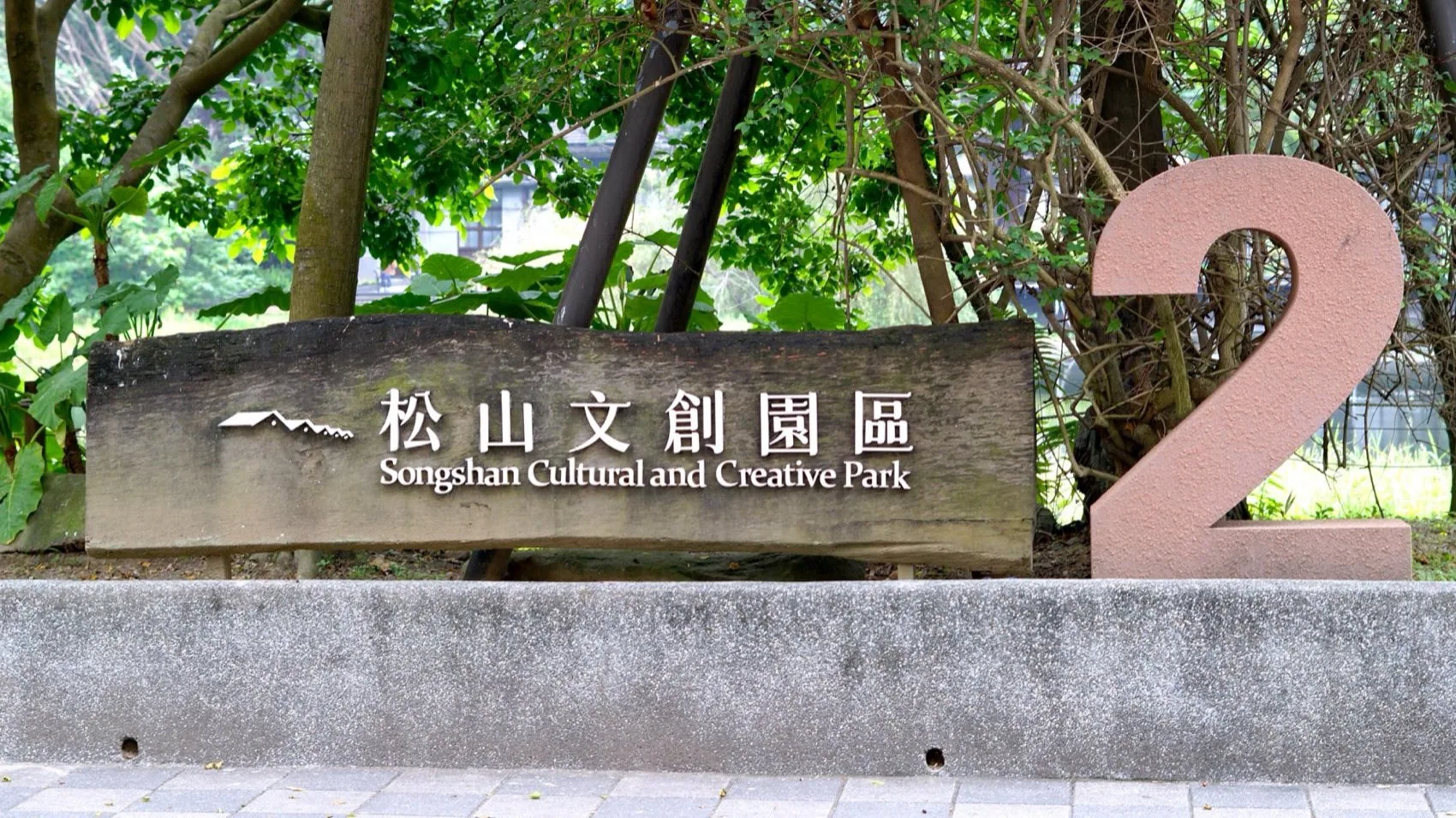
What connects these two unnoticed things is an organization whose full name many people cannot state: the Taiwan Design Institute (TDRI). Its address is in the Songshan Cultural and Creative Park, that old tobacco factory built in the Japanese era4. It hosts the Golden Dot Design Awards annually, organizes Taiwan Design Exhibitions attended by millions, and has appointed its director, Chang Chi-yi, as a council member of international design organizations5. But where it truly focuses is on the corners you walk past without looking up.
30-Second Overview: The Taiwan Design Institute (TDRI) is an established public enterprise under the Ministry of Economic Affairs, having been upgraded from the Taiwan Creative Design Center in 20206. Its most visible achievements are the Golden Dot Design Awards, the Taiwan Design Exhibitions, and its global ranking reaching seventh place7; but it places its biggest bets on the areas you "don't feel"—health centers, ballots, and campus redesigns. This represents a half-century journey for Taiwan: from an assembly island where "Made in Taiwan" meant imitation goods, to when Tsai Ing-wen proclaimed that "design power is national power"8. The renovation of Zhongshan Station by the MRT in 2022 perfectly demonstrated how dangerous visibility can be.
The Island Whose Own Cups Are Designed by Others
To understand why the Industrial Design Institute exists, one must first look back at the period that Taiwan least wants to remember.
In the 1960s and 70s, Taiwan relied on OEM (Original Equipment Manufacturing) orders. Foreign brands would send over blueprints, and Taiwanese factories would produce them, affixing someone else's label. By the 1980s and 90s, this evolved into ODM (Original Design Manufacturing); Taiwan didn't just make things—it could help redesign them. Acer's Shih-ching-rong created the famous "smile curve" in 1992, telling the entire industry: only R&D at both ends—the designer and the brand—is valuable; assembly in the middle is the least valuable9. After the 2000s, Taiwan began attempting OBM (Original Brand Manufacturing), creating its own brands.
However, during that era, the global image of "Made in Taiwan" was quite poor. A 1994 English article in Taiwan Guanghua Magazine was titled 〈Remade in Taiwan〉, which mentioned how a bicycle shop in the United States would directly display signs saying, "We do not repair bikes from Taiwan"; some manufacturers would simply rip off labels when exporting10. David Lightle, an American design consultant invited by the Export Promotion Association, made a very pointed statement: "Taiwan's problem does not lie in its reality... The problem lies in its image."10
The Export Promotion Association established a Product Design Promotion Office in 1979, which was the earliest origin of this national design effort, with Zheng Yuan-ching as the first director11. It later became the Design Promotion Center, and in 2003, the Foundation for Taiwan Creative Design Center (TDC) was officially established, with Chang Guang-min as its first executive director12. TDC's work is focused on promotion, exhibitions, and awards.
📝 Curator's Note
The common narrative is that Taiwan "transitioned from manufacturing to branding" through the efforts of private enterprises, which is true, but it misses a piece. Companies can decide what their products look like, but they cannot decide what an election ballot, a public restroom, or a train station looks like; those are government matters. What the Industrial Design Institute truly aims for is much larger than just making a good cup: whether this island can even determine "the way the government interacts with the people." The deepest scar left by the manufacturing-focused era is the long-term outsourcing of the appearance of public life to mere "compromise."
In the 2010s, the discourse began to rise to the national level. In 2011, when the International Design Association held its conference in Taipei, hosted by TDC, Vice President Hsiao Wan-chang stated, "Designed in Taiwan, rather than Made in Taiwan,"13. This statement predates that of Tsai Ing-wen.
The Year of Elevation: A Shift in Mission
The period from 2019 to 2020 was what truly elevated "design" to a national strategy.
On October 23, 2019, President Tsai Ing-wen announced that the Taiwan Creative Design Center would be upgraded to the "Design Institute of Taiwan." She stated, "Taiwan was famous for MIT; in the future, we must have DIT, Designed in Taiwan."14 On September 30 of the following year, she publicly declared, "Design power is national power," emphasizing that Taiwan needed not only Made in Taiwan but also to let the world know Designed in Taiwan15. On December 5 of that year, Premier Su Tseng-chang approved the elevation project16, and the Institute officially launched in early 2020.
The upgrade was more than just a name change. The Creative Design Center primarily focused on promotion and hosting exhibitions; the Institute's five official functions expanded to: establishing design policy, driving industrial design innovation, promoting public service innovation, developing social design innovation, and advancing international design diplomacy17. The newly added keywords—"policy," "public service," "social," and "diplomacy"—all pointed in one direction: design was no longer just serving manufacturers; it needed to start serving the government and the people.
The torchbearer for this mission is Chang Chi-yi. His background is in architecture. He holds a Bachelor of Architecture from Tamkang University, a Master of Architecture from Ohio State University, and a Master of Design from Harvard Graduate School of Design in 199418. After working at the firm of architectural master Peter Eisenman in New York, he returned to Taiwan where he ran his own architecture firm, served as a professor and director of the Graduate Institute of Architecture at National Chiao Tung University, and also served as a deputy county magistrate of Taitung County for over three years18. In 2018, he became the chairman of the Creative Design Center, and in 2020, he became the first director of the Institute, a position he still holds today18.
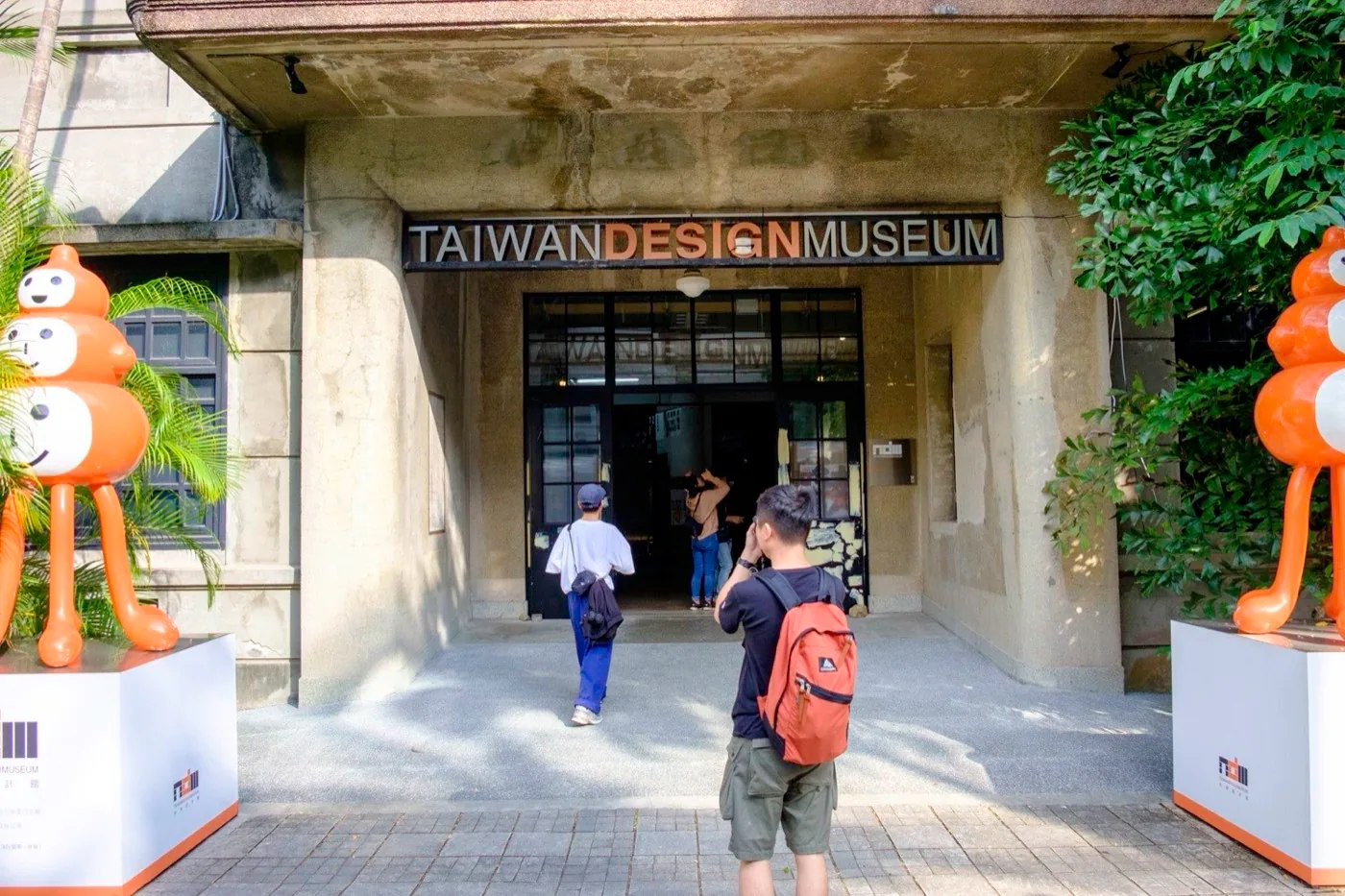
The Taiwan Design Museum was established in 2011 and operated by the Institute. The Golden Dot Design Awards are often held here. It is a window into the "visible" side of the Institute. Photo: Hsien Shi-sheng / Wikimedia Commons, CC0
Chang Chi-yi is very clear about this matter. He states that the difference between the Creative Design Center and the Institute lies in: "The Creative Design Center focuses on realizing value; the Institute focuses on creating value—creation is proactive."19 What he seeks is a task harder than hosting exhibitions: "We hope design can become fundamental DNA within public sectors."20
Making design the DNA of the public sector sounds smooth, but it remains one of the toughest bones in Taiwan's public governance.
Embedding Design in Health Centers, Ballots, and Campuses
The true battleground for the Institute of Design and Technology (IDT) lies in three places you might not think about proactively: where you see a doctor, where you vote, and where you study.
Health centers are one such area. The New Taipei City government commissioned IDT to redesign the flow—including waiting, dispensing medicine, and measurement—into three types that could be modularly assembled, starting in Xizhi and Yingge1. The design team included designers, researchers, and consultants1; you won't remember their names, but this is the key: good public space design makes you completely unaware that it was designed.
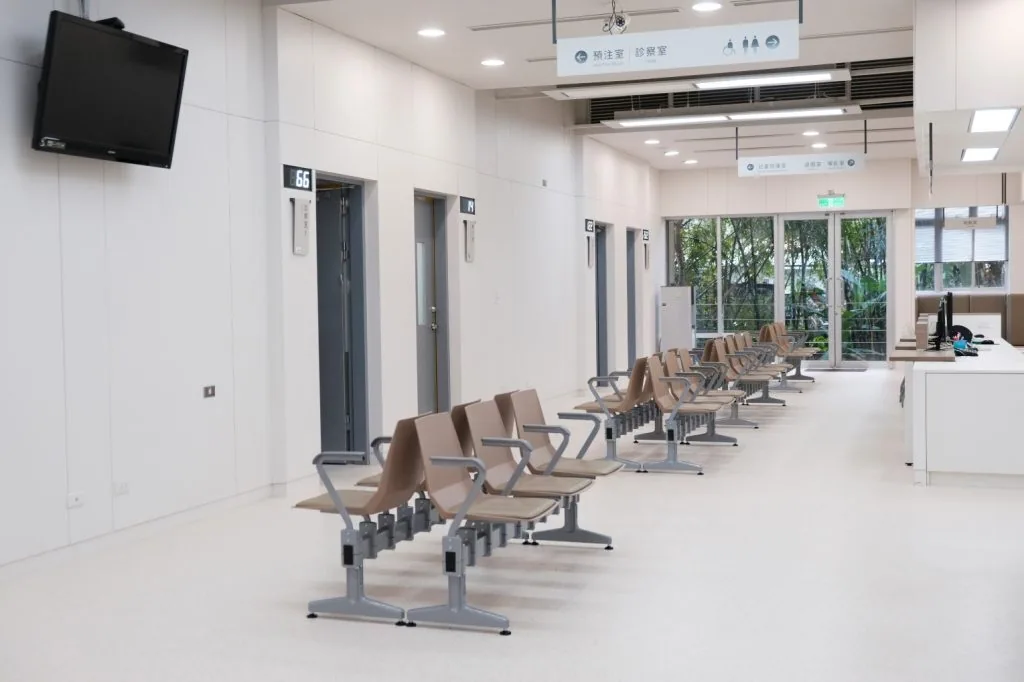
Redesigned health center space by IDT: warm white tones, modular wall panels, and accessible armrest seating. Photo: Taiwan Design Institute (for fair use editorial commentary on health center redesign).
Schools are another area. The Ministry of Education commissioned IDT to execute the "Aesthetic School" campus aesthetic design practice project, which started in 2019, completing nine schools in the first round21. This focused on spaces used daily by hundreds of students—classrooms, hallways, and lockers—bringing aesthetics from exterior paint down to everyday details. IDT claims it has completed over 112 renovation cases and collaborated with more than 200 schools21.
The most sensitive area is elections. The Central Election Commission (CEC) tasked IDT with electoral aesthetics across four years in three phases, resulting in twelve design projects: from referendum bulletins and election pamphlets to ballots, political forums, the central election monitoring center, indicators at polling places, voting notifications, screens for marking votes, and certificates of election22. The referendum bulletin from December 2021 used a redesigned version, sending about 8.95 million copies, and later won the Gold Dot Design Award in the communication design category in 202222. The font for ballots was also changed to Siyuan Black as part of this framework2.
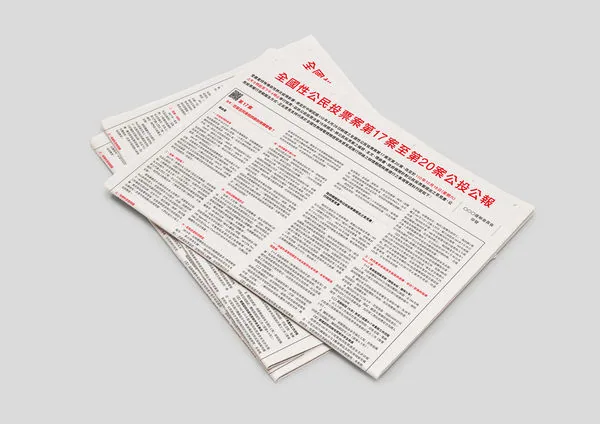
Referendum bulletin redesigned in collaboration with the CEC by IDT; the multi-column block layout reduces reading fatigue and won the Gold Dot communication design award in 2022. This addresses the reading experience of nearly 20 million voters across Taiwan. Photo: Provided by Taiwan Design Institute (for fair use editorial commentary on electoral aesthetics).
Chi Yi Chang described the difficulty of electoral aesthetics quite plainly. Quoting her, the Liberty Times reported that with nearly 19 million voters in Taiwan, changing electoral aesthetics through design requires "gradual innovation within existing regulations and budget constraints"23. This sentence encapsulates the biggest limitation of public service design: you cannot make sweeping changes like in a commercial project; instead, you must push forward piece by piece within a regulatory and budgetary structure that has remained unchanged for decades.
💡 Did You Know
The screen used at marking stations—the panel that blocks the view of others while you are stamping—was only demonstrated in one school (Lu Gong Junior High School, Classroom 804) as part of the electoral aesthetics project22. The reason it was limited to a single demonstration point is that the diffusion of public design is often stalled by procurement mechanisms and budgets; turning one demonstration point into a national standard requires a long process of persuasion and compilation. IDT stated in an online questionnaire that about 97% of voters approved these renovations24, but that survey did not disclose sample size or sampling methods, making it more like a signal of support than a rigorous public opinion poll.
IDT later extended this logic to a more fundamental level: together with the Bureau of Standards, Metrology and Inspection (BSMI), the Ministry of Transportation, the Ministry of Health and Welfare, and the National Land Administration, they announced the national standard "Public Service Icon" CNS16282 in March 2026, defining 253 icons across eight major categories with CC BY 4.0 open licensing25. Signs for restrooms, accessibility, and emergency exits now have a national design standard.
Design Introduction into Bureaucracy: A Battle of Persuasion
Placing design within government sounds like a good thing, but in practice, it is almost like guerrilla warfare.
The most direct resistance comes from the system itself. The Institute of Industrial Design's own Taiwan Design Power Report acknowledges that design "is difficult to incorporate into standardized budget evaluation mechanisms" 26. In plain terms, public agencies must have objective metrics for budgeting, but the value of design is hard to prove with a single number, so it always remains at a disadvantage during budget reviews.
Resistance on the local level is more concrete. The Institute of Industrial Design promoted T22 local industry revitalization, starting with ceramics in Yingge 27. Chang Chi-yi recounted the initial encounters: the chairman of the ceramics association confronted the Institute's staff face-to-face, saying, "You are all bookworms!" 27, meaning, you people who study design and read books don't understand business. The first hurdle for design to enter real industry sites is often trust.
⚠️ Controversial Viewpoints
A difficult truth about introducing design into public service is that its effectiveness is hard to prove. A commentary on Taiwan's design policy from the PDR Design Research Institute in Scotland was very direct: "Visions are not enough, there have to be tangible metrics and evaluation indicators." This commentary also pointed out that a design policy ignoring environmental sustainability is "way off the mark" 28. In some academic papers published by the Institute of Industrial Design in recent years, the authors themselves were members of the Institute 29, meaning many arguments about "effective design governance" are self-referential to the institution and cannot easily be considered independent third-party evaluations.
Sharper criticisms date back before its elevation. When ARTouch, an art media archive, discussed the promotion of Taiwan Creative Design Institute (TCDI) into an institute, it mentioned several long-standing issues questioned about TCDI: "competing with the public," unclear organizational hierarchy, and difficulty retaining talent 30. "Competing with the public" refers to whether a government-funded institution holding exhibitions, awarding prizes, or providing design services might crowd out private design firms; "unclear organizational hierarchy" points to its awkward position between government and private sectors. The elevation to an institute was partly intended to respond to these criticisms, shifting its positioning from an "implementing unit" toward "policy research."
Within the design community, there are also opinions that "design as a political achievement" is problematic, and a storm in 2026 just pointed the finger at the Institute of Industrial Design. The well-known designer Nie Yongzhen undertook a series of government branding projects for the Institute of Industrial Design. The most scrutinized was Taipower's "Brand System Optimization Design," with a contract value of approximately NT$969,000, which readjusted the corporate logotype 31. Criticism focused on two things: whether a state-owned enterprise that has been running at a loss deserves to spend this money "just changing some characters"; and whether the Institute of Industrial Design, as the allocator of government design projects, allowed certain designers to become so-called "beneficiaries" 32. The Ministry of Economic Affairs responded by stating they "trust the professionalism of the institute," emphasizing that the Institute selected partners only after "surveying at least three design teams with relevant execution experience and track records," and clarified that the branding system for the Trade Bureau was done by another company, not solely contracted by a single vendor 32. This controversy brought the most awkward position of the Institute of Industrial Design into the sunlight: it holds both the budget and the decision-making power to "make the government look better," and this power, once seen, is subjected to the strictest magnifying glass examination.
The Visible Side: Golden Dot Awards, Millions of Visitors, and Seventh Place Globally
After discussing so many intangible things, we must look back at what the Industrial Design Institute (IDI) does best and needs most: being seen.
The IDI's biggest signature is the Golden Dot Design Award. It has a long lineage: starting with the Excellent Product Selection in 1981, renaming to Golden Dot in 2009, and beginning international submissions in 201433. The event is hosted by the Industrial Development Bureau of the Ministry of Economic Affairs, with the IDI as the implementing unit33. The scale has certainly grown: the 2023 iteration received nearly eight thousand entries from twenty-three regions, ultimately selecting twenty-five annual best designs34.
Another signature event is the Taiwan Design Exhibition. It tours different cities every year, turning a city into an exhibition space for design. The number of visitors grows astonishingly each year: 2.45 million in Pingtung in 2019, 2.8 million in Hsinchu in 2020, 6 million in Kaohsiung in 2022, and 6.58 million in New Taipei in 2023, which is the highest ever35. For many young people, the autumn Taiwan Design Exhibition is a staple on Instagram.
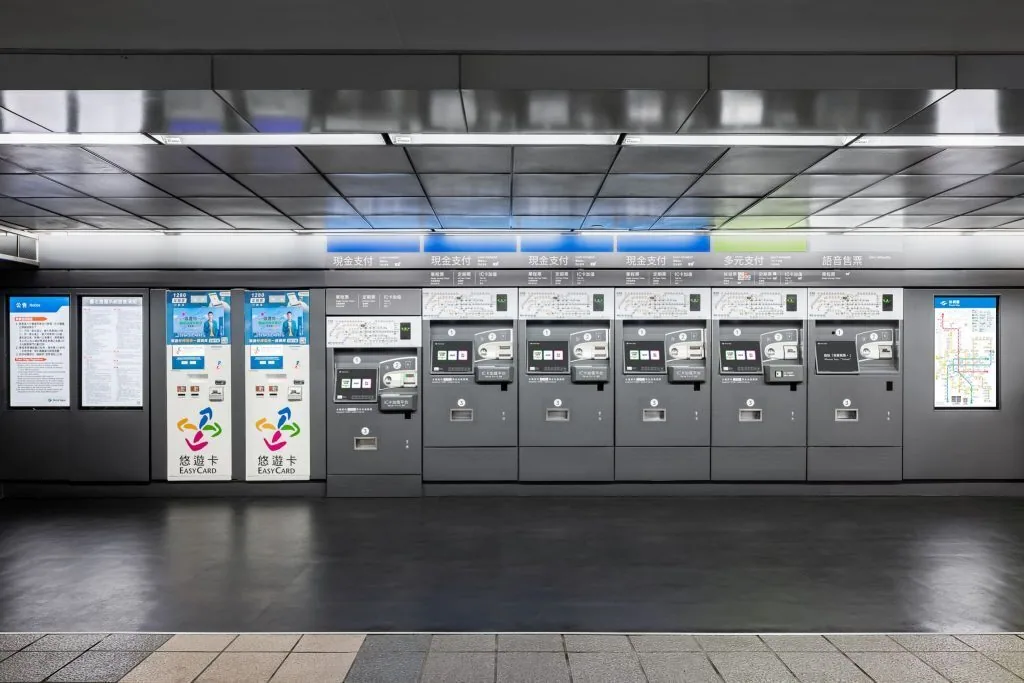
The ticketing area at Zhongshan Station, renovated by the IDI, integrates facilities under the concept of "containing services in a box." This is the same case that sparked controversy over user experience after its public release in 2022 but won the Golden Dot Annual Best Design Award in 2024. Photo: Taiwan Design Institute (Zhongshan Station Redesign, fair use editorial commentary).
International rankings are also metrics the IDI frequently cites. In the World Design Rankings, Taiwan climbed from 38th globally in 2013 to 8th in 2019, and reached 7th in 2023–202436. Chang Chi-yi was elected as a council member of the World Design Organization (WDO) representing Taiwan in 2019 and re-elected in 202237. He refers to this approach as "design diplomacy": "When these ecosystems mature, they become Taiwanese experience, which can communicate with the world through design diplomacy."38
✦ "We hope that design becomes a basic DNA within public sectors." — Chang Chi-yi
Being seen is not always positive. An organization reliant on government budgets and constantly questioned about "what exactly you have done" needs awards like the Golden Dot, millions of visitors, and international rankings to prove that the money spent was worthwhile. However, being visible also has its downsides.
Zhongshan Station: Seen, Then Attacked
In 2021, the Industrial Design Institute (IDI) began redesigning the Zhongshan Station of the Taipei Metro. The first phase results, primarily focusing on the ticketing area, were unveiled on October 19, 202239. Different teams handled the spatial form design, visuals, and product design, and this proposal later won the Golden Dot Design Award for Best Annual Design in the Integrated Design category in 202440.
From an awards perspective, it is a success story. However, from the station's on-site reality, it was IDI's most public instance of criticism.
After the results were released, numerous negative comments flooded the internet. Among the sharp remarks compiled by Huashi were: "It's not bad, but don't do it again," "Are you designing a station or a traveler?" and "The UI was redesigned, but the UX hasn't changed at all?"41. Criticism focused on user experience: the height of the ticket machines did not adequately consider wheelchair users and children. While the visuals were appealing, the ease of actual operation had not improved41. IDI responded that "optimization is ongoing and will be continuously revised with various co-creation units,"41 stating that adjustments were also made to details like the route map height later39.
📝 Curator's Note
The Zhongshan Station case condenses the contradiction of this entire article into one ticketing area. The reason why projects like health clinics, voting booths, and classrooms haven't been criticized is partly because they are inconspicuous; you don't feel that they were designed, so naturally, you won't nitpick their design. Zhongshan Station is different; it is a central city station where tens of thousands of people pass daily, loudly announcing, "We redesigned this place." Once you invite everyone to look, they will examine it with the strictest eyes. Being seen is IDI's survival strategy, but what is seen is also the easiest target. A malfunctioning dispensing window at a health clinic won't trend on Twitter; a criticized ticket machine at a metro station will go viral across the web.
This is IDI's deepest dilemma. It must be visible to survive; without Golden Dot awards, design exhibitions, or rankings, it cannot stand in budget meetings. Yet, the work it should be most proud of is precisely that which should remain unseen: when a health clinic, a ballot, or a classroom is designed well enough that your reaction is "no feeling," and you just use it and leave. Visibility earns it a reason to exist; having no feeling is its true measure of success. These two things are forever pulling in opposite directions.
When You Didn't Notice Them
Back at the health clinic in Xizhi.
The next time you go to check your blood pressure or pick up medication for a chronic condition, you might not notice that the waiting area has been redesigned. You would just think the flow of movement was supposed to be like this, the chairs were meant to be arranged this way, and the signage was supposed to be this clear. You wouldn't think that someone spent thirteen months transforming it from "just good enough" into "seamless."
This is precisely the state that the Taiwan Design Institute most wants to achieve—a state for which they rarely receive applause. A good public service design eventually disappears into a seamless experience; if you don't feel it, then it has succeeded. From "Made in Taiwan means imitation goods" to "Designed in Taiwan," this island spent half a century learning how to decide what things should look like. The hardest step is learning to do this so that you don't have to think about it at all.
The font on the ballot you hold is Siyuan Black. You probably didn't know that until just now. And that, in essence, is the point.
Further Reading
- Nie Yongzhen — One of Taiwan's most representative graphic designers, the central figure in the Taipower identity optimization controversy, and an unavoidable name in discussions about "design as achievement."
- Taiwanese Industrial Transformation and Upgrading — The entire story of moving from a contract manufacturing island to high added value; what the Institute of Design was betting on is one thread less often discussed along this path.
- Public Television — Also a public corporation, an institution that walks a tightrope between "publicness" and "scrutiny."
- Taiwanese Architecture — The field of Chang Chi-yi; understanding why an architect believes that spatial design can change the distance between government and the people.
- Academia Sinica — Also a research institution funded by the state, but one placed under the Presidential Office versus one under a ministry, with different capabilities and different questions being asked of it.
Image Sources
The images in this article are divided into two categories and are all cached in public/article-images/society/, without linking to external source servers:
CC / Public Domain Licenses (Contextual Images)
- Songshan Cultural and Creative Park Entrance (hero) — Solomon203, CC BY-SA 4.0, Wikimedia Commons.
- Taiwan Design Museum — Xuan Shi Sheng, CC0 Public Domain, Wikimedia Commons.
Fair Use Editorial Commentary (TDRI Redesign Case Study Images)
The following three images are design project records publicly released by the Institute of Industrial Design and Technology (IDIT) and are used as editorial commentary referencing IDIT's work, based on Article 65 of the Copyright Act and the four factors of fair use in 17 U.S.C. § 107 (non-commercial educational nature, published status, small proportion quoted, no substantial market replacement). All images are locally cached and sourced:
- Redesigned Health Clinic Space — © Taiwan Design Institute (Redesign of Health Clinic). Fair use editorial commentary on TDRI's work.
- Redesigned Election Ballot — © Provided by the Taiwan Design Institute (reported in ETtoday). Fair use editorial commentary on TDRI's work.
- Redesigned MRT Zhongshan Station Ticketing Area — © Taiwan Design Institute (Redesign of MRT Zhongshan Station). Fair use editorial commentary on TDRI's work.
References
- Institute of Design and Technology Redesign (fundesign.tv) — Reports on the redesign of health centers in Xizhi and Yingge commissioned by the New Taipei City Health Bureau, detailing a thirteen-month project with three modular types and design teams.↩23
- Election Ballot Font Changed to Siyuan Black (ETtoday) — Reports that the 2024 election ballots use the open-source Siyuan Black font for printing, while candidate names use a full-character Song typeface, noting differences from previous usage of Baiti.↩2
- Election Ballot Font Changed to Siyuan Black (ETtoday) — Similar to above, explaining the context of changing the election ballot font from Baiti to the current version.↩
- Industrial Design Institute About (Official) — The official introduction states that the Industrial Design Institute is a public foundation managed by the Ministry of Economic Affairs, with its registered address in Songshan Cultural and Creative Park.↩
- Industrial Design Institute About (Official) — The official description mentions that the Institute handles awards like the Golden Point Design Award, Taiwan Design Exhibition, and international design diplomacy.↩
- Taiwan Creative Design Institute (Central News Agency) — Reports on the Executive Yuan's decision on December 5, 2019, to upgrade the Taiwan Creative Design Center to the Industrial Design Institute.↩
- Industrial Design Institute About (Official) — The official listing highlights the Golden Point Design Award, Taiwan Design Exhibition, and design diplomacy as major external functions.↩
- Presidential Office Press Release 25611 (Presidential Office) — A primary source of President Tsai Ing-wen's speech mentioning 'design power is national power' and Designed in Taiwan.↩
- Remade in Taiwan (Taiwan Guanghua Magazine) — A review of Taiwan's OEM/ODM/OBM transformation history, including the background of the Smile Curve concept.↩
- Remade in Taiwan (Taiwan Guanghua Magazine) — An English report from 1994 detailing incidents like US car dealerships affixing labels and peeling them off, along with comments by consultant David Lightle on Taiwan's image problem.↩2
- Industrial Design Institute About (Official) — The official history states that the Trade Fair Association established a Product Design Promotion Office in 1979 as the origin of design promotion.↩
- Industrial Design Institute About (Official) — The official history mentions the establishment of the Taiwan Creative Design Center (TDC) as a foundation in 2003.↩
- 2011 IDA Conference in Taipei (Taipei Times) — Reports on the International Design Association conference held in Taipei in 2011, hosted by TDC, and Xiao Wan-chang's speech on Designed in Taiwan.↩
- Presidential Office Press Release 24937 (Presidential Office) — The primary press release from President Tsai Ing-wen on October 23, 2019, announcing the upgrade of the Industrial Design Institute and proposing DIT, Designed in Taiwan.↩
- Presidential Office Press Release 25611 (Presidential Office) — A primary source of President Tsai Ing-wen's speech on September 30, 2020, regarding 'design power is national power'.↩
- Taiwan Design Institute Promoted (Central News Agency) — Reports on Director Su Tseng-chang's decision regarding the promotion and the background of the promotion.↩
- Taiwan Design Institute About (Official) — The official site lists five major functions of the institute: design policy, industrial design innovation, public service innovation, social design innovation, and international design diplomacy.↩
- Chi-Yi Chang Entry (votetw wiki) — Organizes Chi-Yi Chang's academic career: Tamkang Architecture, Ohio State, Harvard MDes, Eisenman firm, NTU professor, Taitung Deputy County Magistrate, and roles at TAIC and TDI.↩23
- Interview with Chi-Yi Chang (La Vie) — Chi-Yi Chang's verbatim quote distinguishing between TAIC and the Institute: 'TAIC is realizing value, while the Institute is creating value.'↩
- Interview with Chi-Yi Chang (500 Series) — The source of Chi-Yi Chang's verbatim quote: 'I hope design in the public sector becomes a basic DNA.'↩
- Taiwan Design Institute About (Official) — The official description of the Education Ministry commissioned and executed the Aesthetics Program for Schools, including cumulative renovation cases and cooperating schools.↩2
- Electoral Aesthetics Design (Liberty Times) — Reports on the election aesthetics project commissioned by the election committee: four phases over four years, twelve items, distribution of referendum publications, and Gold Point Award recognition.↩23
- Electoral Aesthetics Design (Liberty Times) — A reporter quotes Chi-Yi Chang discussing innovation within existing regulations and budget constraints for nearly nineteen million voters.↩
- Electoral Aesthetics Design (Liberty Times) — The report mentions that the Institute's self-reported online questionnaire showed about 97% approval, but sample size and sampling method were not disclosed.↩
- Public Service Icon CNS16282 (Institute Official) — The official announcement of the national standard for public service icons released in March 2026, featuring 253 icons, eight categories, CC BY 4.0 licensing, and cross-ministerial co-creation.↩
- Taiwan Design Institute About (Official) — The official report acknowledges the limitation that design is difficult to incorporate into standardized budget evaluation mechanisms.↩
- Interview with Chi-Yi Chang (500 Series) — Chi-Yi Chang recounts a scene where local guild chairmen resisted the early promotion of Yingge ceramics, saying, 'You are all academics!'↩2
- Taiwan Design Policy Commentary (PDR Research) — A critique of Taiwan's design policy by the Scottish PDR design research organization, criticizing the lack of measurable indicators and ignoring environmental sustainability as being way off the mark.↩
- New Member Taiwan Design Institute (ICoD) — The International Council of Design introduces the Institute, which can be cross-referenced for its characteristic of academic publications often being written by internal staff rather than independent third parties.↩
- Design Power is National Power: The Rise of the Design Institute (Collection ARTouch) — A commentary from March 2020 discussing the promotion of TAIC to the Design Institute, mentioning issues such as being constantly questioned by public interests, unclear organizational hierarchy, and having a budget that is only about 40% self-managed.↩
- What is Taipower arguing about? The NT$960,000 Logo Bidding Controversy (Digital Age) — An analysis of the Taipower 'Identity System Optimization Design' tender worth approximately NT$968,940, designed by the Nie Yongzhen team, focusing on five controversial themes: aesthetics, history, and design value.↩
- Questions Raised Over Multiple Government LOGO Projects Given to Nie Yongzhen by Industrial Design Institute; Ministry of Economic Affairs States Trust in Professionalism (Yahoo Finance/UDN) — Reports the questioning regarding 'resource allocation/benefit sharing' caused by Nie Yongzhen undertaking government identity projects through the Industrial Design Institute, alongside responses from the Ministry of Economic Affairs ('trusting the institute's professionalism'), the Industrial Design Institute listing at least three teams, and the Trade Bureau's logo being designed by Selected Research.↩2
- Golden Dot Design Award About (Official Golden Dot) — The official description detailing the history of the Golden Dot Award, its organizer, the Ministry of Economic Affairs Industrial Development Administration, the implementing unit, the Industrial Design Institute, and its internationalization in 2014.↩2
- Golden Dot Design Award About (Official Golden Dot) — Official data detailing the scale of submissions for the 2023 awards cycle and the number of annual best designs.↩
- Industrial Design Institute About (Official) — The official site compiles visitor numbers from past Taiwan Design Exhibitions with various reports, noting that 6.58 million visitors in New Taipei City in 2023 was the highest ever.↩
- Industrial Design Institute About (Official) — The Industrial Design Institute cites changes in Taiwan's ranking in World Design Rankings, reaching seventh globally in 2023–24.↩
- New Member: Industrial Design Institute (ICoD) — An introduction by the International Council of Design regarding the international participation of the Industrial Design Institute, including background information on Chang Chi-yi's role as a council member in world design organizations.↩
- Interview with Chang Chi-yi (La Vie) — A verbatim quote from Chang Chi-yi: 'When these ecosystems mature, they will become Taiwanese experience that can communicate with the world and engage in design diplomacy.'↩
- Zhongshan Station Redesign (Golden Dot Award Page / Industrial Design Institute) — Describes the launch of the Zhongshan Station redesign in 2021, the public release of the first phase ticketing area in 2022, and subsequent optimization adjustments.↩2
- Zhongshan Station Redesign Golden Dot Annual Best (Golden Dot Award Page) — The official award page stating that the Zhongshan Station form design proposal won the 2024 Golden Dot Design Award for Annual Best Design (Integrated Design category).↩
- Zhongshan Station Renovation Sparks Discussion (C-News) — Reports online negative feedback after the public unveiling of the Zhongshan Station ticketing area renovation in October 2022, and the Industrial Design Institute's response: 'optimization in progress.'↩23