
30-Second Overview: Established in 1930 and opened in 1935, the Taipei Railway Workshop was once responsible for the maintenance, assembly, and upkeep of Taiwan’s railway rolling stock. After relocating in 2012, the trains moved on, but this nearly 17-hectare industrial site did not disappear. Designated a National Monument in 2015, it opened its first phase as the National Railway Museum in 2025. What to see here is not just old trains, but how the factory buildings, tools, bathhouses, and labor technologies together preserve the memory of an island in motion.
In 1930, construction began on the Taipei Railway Workshop in Songshan. It officially opened in 1935. It was not an architecture designed for an audience, but a factory that existed to ensure trains returned to the tracks on time. The site’s core functions were maintenance, assembly, upkeep, and repair, eventually becoming one of the largest and oldest surviving railway rolling stock repair workshops in Taiwan. 1
After 2012, the Taipei Railway Workshop gradually exited its original mission. The official English historical page records that the relocation was completed by the end of 2013. Researchers contextualize this move within the modernization of Taiwan Railways Administration (TRA) and the opening of the Fugang Rolling Stock Depot. 2 The trains left behind, leaving a nearly 17-hectare industrial site, along with decades of wear, oil stains, tracks, machinery, and living facilities. 3
📝 Curator’s Note: In a train museum, the most visible element is the locomotive, but the most easily forgotten is the person who keeps the locomotive running. The Taipei Railway Workshop reverses this order of viewing: it starts with the workshop, then helps us understand the train.
Not Putting Trains in a Display Case
When it was still a workshop, the railway facility was not preserved for the sake of preservation. Its mission was to disassemble vehicles, identify faults, manufacture parts, reassemble them, and return the cars to daily transport. A 2021 museum exhibition planning study noted that the Taipei Railway Workshop was not originally built as a museum; therefore, many documents, objects, and files were not centrally preserved, and the collection’s rolling stock was scattered across Taiwan. Turning a factory into a museum first requires not hanging exhibition panels, but retracing a production system that had already dispersed. 4
This difference defines the exhibition approach of the National Railway Museum. It does not only display “which trains once ran in Taiwan,” but also helps people understand how a train was maintained, how specific springs were forged, how workers divided labor under high temperatures and noise, and how a workshop connected with the city’s energy, transportation, and labor systems. A 2020 study on industrial heritage used the forging and metallurgy workshop as a case study, placing machinery, part manufacturing processes, worker workspaces, and exhibition planning within the same analytical framework. 5
The 1935 Architecture Solved Workers’ Problems First
The architectural language of the Taipei Railway Workshop did not rely on decoration to persuade. Data from the National Cultural Heritage Network indicates that the site’s structures and附属 facilities largely followed 1930s planning, with construction methods and spatial configurations prioritizing function. High-ceilinged factory halls, tracks, and work areas were all designed to allow vehicles to enter, disassemble, move, and reassemble. 1
A 2017 report in Taiwan Panorama recorded the specific scale before restoration: the entire site covered approximately 17 hectares, with the Assembly Hall measuring 167 meters long, 20.4 meters high, and 23.8 meters wide. Large-span steel trusses and high windows allowed the vast space to receive natural light and ventilation. These dimensions were not architectural showmanship, but necessary conditions for train maintenance work. 6
Even the floors had a work logic. Parts of the factory floor were paved with large cypress planks, with gaps filled with asphalt to absorb oil stains, reduce vibration, and minimize damage when heavy parts fell. The high-pressure steam generated by the boilers not only drove machinery, but its waste heat was also sent to heat the employee bathhouse. Industrial efficiency and worker life were not two separate stories; they once shared the same set of pipelines. 6

Figure: Front view of the Taipei Railway Workshop and the distant Taipei 101 skyline. Author Solomon203, CC BY 3.0, Wikimedia Commons image page.
📝 Curator’s Note: To read the architecture of the Taipei Railway Workshop, one cannot only ask “what style does it resemble?” A more useful question is: which door was designed to let vehicles pass? Which wall was for heat dissipation? Which pipeline eventually flowed into the workers’ bathhouse?
From the Machinery Bureau to the Railway Workshop
The Taipei Railway Workshop was not the starting point of Taiwan’s railway industry. Data from the National Taiwan Museum’s Railway Department Park traces its distant origins to the Taipei Machinery Bureau during the Liu Mingchuan era in 1884. That machinery bureau set up iron smelting and forging facilities along the Tamsui Riverbank, later undergoing conversions through military workshops, railway workshops, and other uses. In 1900, the Japanese Army Ministry transferred related facilities to the Railway Department, renaming it the Taipei Railway Workshop. 7
In 1909, the Taipei Railway Workshop expanded its vehicle repair and painting facilities. In 1934, the original workshop relocated to Songshan, forming the direct predecessor of today’s Taipei Railway Workshop. This path means an industrial heritage site carries multi-layered time: Qing dynasty Self-Strengthening Movement, Japanese colonial railway modernization, post-war TRA systems, and contemporary cultural preservation. 7
Thus, the Taipei Railway Workshop is not a place that can be explained by a single regime or a single industry. Its walls, machinery, and tracks witness how Taiwan transformed foreign equipment, technology, and systems into daily operations on the island. They also witness how different eras re-named, took over, and used the same workshop.
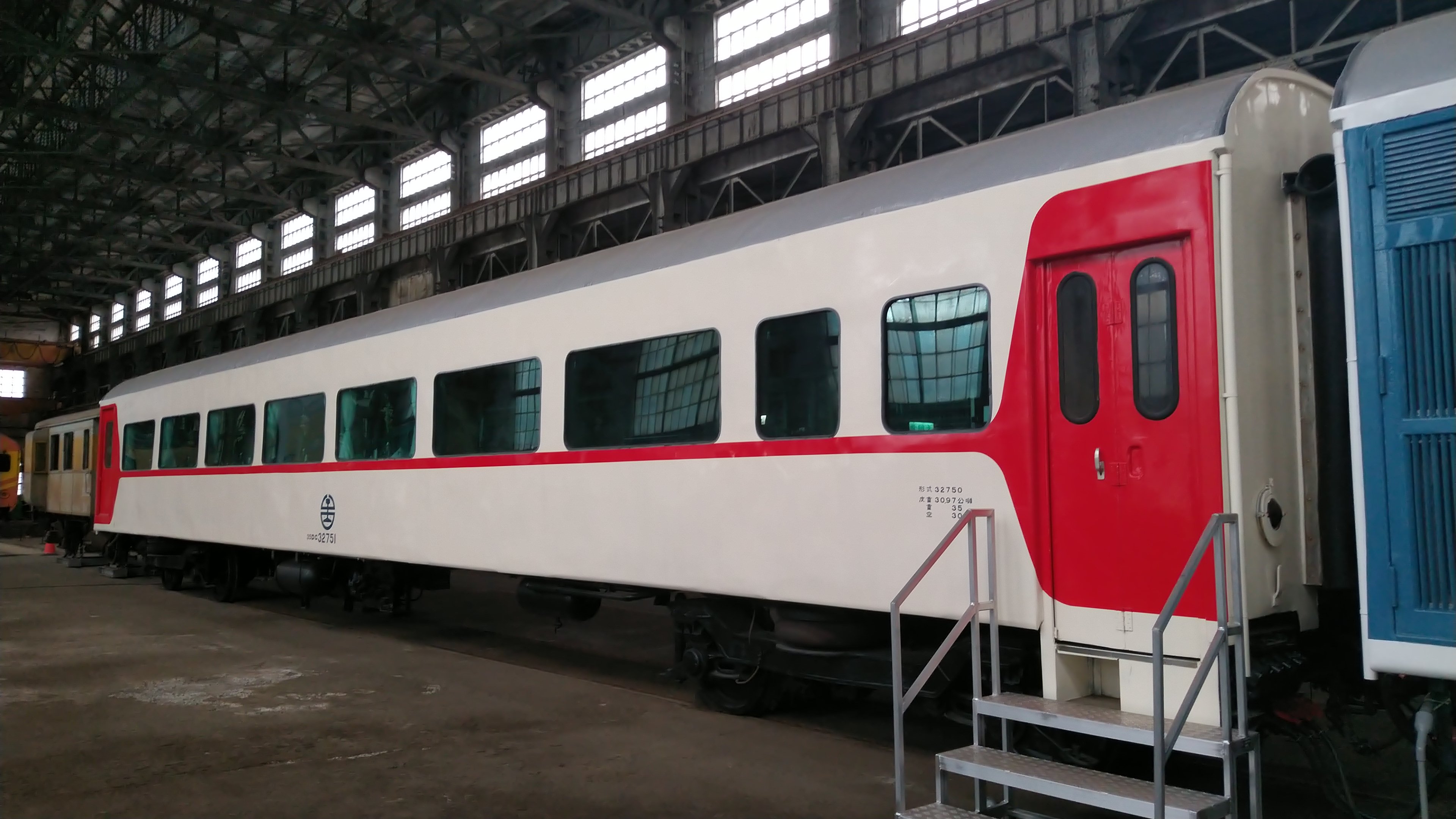
Figure: Taiwan Railways Administration 35DC32751 Sightseeing Passenger Car at the Taipei Railway Workshop. Author 鐵路1, CC BY-SA 4.0, Wikimedia Commons image page.
The Era of Trains Written in Maintenance Methods
The National Railway Museum’s official historical page connects the maintenance history of the Taipei Railway Workshop with the development history of Taiwan’s railways: during the Japanese colonial period, it mainly maintained steam locomotives; after the 1960s, it shifted to diesel-electric locomotives; after Taiwan Railways became electrified in 1979, it faced maintenance needs for various electric locomotives. Starting in 1997, the workshop also repaired some steam locomotives, allowing them to resume operation. 2
This is not merely equipment substitution. Every power transition rearranged workers’ skills, machinery, parts supply, and inspection systems. A 2020 study noted that the forging workshop once had a production line for making helical springs and leaf springs. After the introduction of British-made electric multiple units in 1978, TRA trains gradually switched to air springs, but early trains still retained the need for helical spring maintenance. 5
The study also identified steam hammers, heating and forming equipment, material storage, finished product inspection areas, and worker rest zones in the forging area. These objects make “technological progress” no longer an abstract upward line: when a new vehicle technology arrived, old machinery did not necessarily disappear immediately; it might continue to serve the still-operating Chukuo, freight cars, or Fuxing trains. 5
Worker Life in a Workshop
The preservation value of the Taipei Railway Workshop also includes welfare facilities and work memories. The 2015 announcement designating it a National Monument specifically noted that the site not only preserved architecture, landscapes, and machine objects, but also left intangible cultural assets such as casting, forging, machine operation, and vehicle maintenance, as well as welfare facilities related to employees. 1
A 2017 on-site report recorded that workers inside the factory once made a humorous “TRA Robot” using parts. The diesel-electric locomotive workshop and internal combustion engine workshop also retained murals created by workers. Retired supervisor Chen Wu-chang recalled that a single steam locomotive had thousands of parts, and workers could manufacture each one. This capability was not just a skill listed on a job title, but knowledge shared by an entire work community. 6
The Taipei Railway Workshop was previously difficult for the general public to enter. Researchers noted that before relocation, the workshop remained an important TRA train repair base; public guided tours only began in 2018 via online reservation. The Ministry of Culture’s 2019 railway-themed lectures also served as preparation for transforming into a museum. 8

Figure: Entrance gate of the Taipei Railway Workshop of the Taiwan Railways Administration. Author Shih-Han Lin, CC BY 2.0, Wikimedia Commons image page.
📝 Curator’s Note: “Opening” is not complete just by opening the main gate. True openness is making the sounds, tools, and work rhythms that only professional workers understood into public knowledge that ordinary people can comprehend.
The Integrity Almost Demolished
On March 15, 2015, the Ministry of Culture’s Monument and Historic Building Review Committee resolved to designate the Taipei Railway Workshop as a National Monument. The reason was not that a single building was particularly beautiful, but to preserve the overall appearance of the entire site’s railway industrial heritage. The official announcement stated that the architectural history, transportation development, economic industry history, labor culture, and industrial heritage value of the Taipei Railway Workshop are interconnected, possessing irreplaceable site significance. 9
The importance of this decision lies in its refusal to cut industrial heritage into a main building and several movable display items. The worker bathhouse, Materials Testing Laboratory, Technician Training Institute, Grand Hall, General Office, and Diesel-Electric Workshop must be understood together with tracks, factory scale, and work circulation. Missing any part, the rest might become merely a visually complete shell that has lost its work context.
However, preservation does not equal restoring to a controversial “original state.” Taiwan Railway Cultural Heritage Preservation Research notes that many railway vehicles and objects were demolished in the past due to regulatory recognition issues and insufficient preservation awareness. The museumification of the Taipei Railway Workshop relies on collaboration between the Ministry of Culture, TRA, researchers, civil groups, old employees, and visitors. 8
2025: The Factory Begins Receiving Visitors
On July 31, 2025, the first phase of the National Railway Museum officially opened. The Ministry of Culture stated that this project underwent nearly nine years of monument restoration and preparation. The first phase opens six historic buildings: the Diesel-Electric Workshop, General Office, Technician Training Institute, Materials Testing Laboratory, Grand Hall, and Bathhouse. 3
The exhibitions also deliberately do not only talk about vehicles. Power. Trains — Diesel-Electric Workshop handles machinery and vehicles. Movement and Emotion — Culture and Memory on the Rails places literature, film, folk songs, and fine arts into railway history. Misty Era — Employee Bathhouse retains worker life within the museum’s narrative. The first phase also features static displays of 24 collection vehicles, with plans for dynamic riding experiences on weekends. 3
This concept of a “living museum” is not complete just by starting trains. The Ministry of Culture’s opening data mentions that the park uses original tracks for vehicle rotation, allowing collections to move between different exhibition themes. A 335-meter-long passage crossing the park north to south also opened simultaneously, ensuring the museum is not merely a closed park one buys tickets to enter, but a public circulation connecting Minsheng East Road, Keelung Road, and surrounding neighborhoods. 3
An English report by CNA described this opening as the revival of a place “where trains still run and memories also run.” This phrasing captures a key point: the museum preserves not a past that has stopped, but opportunities for the past to continue walking, viewing, and questioning in the contemporary city. 10
“Living” Also Means Unfinished
The National Railway Museum currently operates in phases. Official visitor information clearly lists that the park still has construction work and unopened areas. This is not merely a visitor reminder, but part of the museum’s state: a nearly century-old, once continuously working industrial site cannot be organized into a seamless product on a single opening day. 11
A 2021 exhibition planning study also reminded that the Taipei Railway Workshop’s transformation still faced issues of dispersed data, objects, landscapes, and vehicles. Research, surveying, interviewing old employees, restoring buildings, collecting objects, deciding functional zones, and arranging exhibitions are all tasks that must be advanced simultaneously. 4
Thus, the museum’s challenge is not only preserving the “visible old.” It must also preserve invisible technologies, handle institutional memories from different eras, explain which parts are still under research, acknowledge which objects have been lost, and let visitors know how a workshop was preserved amidst the speed of railway modernization.
What the City Gained Is Not a Nostalgic Attraction
A 2017 special report once described the Taipei Railway Workshop as one of Taiwan’s earliest “science industrial parks,” because it concentrated equipment, manufacturing processes, precision, and time management in one place. The value of this statement lies not in adding a flashy title to it, but in reminding us: Taiwan’s modernization did not only happen in offices or industrial zones; it also happened when workers used tools to turn individual parts into trains ready for the road. 6
From the Machinery Bureau on the Tamsui Riverbank, to the railway workshop during the Japanese colonial period, from the post-war TRA repair base, to the National Railway Museum opened in 2025, this line has no simple starting point, nor an endpoint that can consolidate all questions. It records how Taiwan received technology, adjusted systems, cultivated workers, and turned a set of modern tools originally not belonging to the island into their own daily routine.
📝 Curator’s Note: The most moving aspect of the Taipei Railway Workshop is not that it finally became a museum, but that it was not forced to forget it was once a factory. Visitors walking in see not the end of railways, but the work that still demands our understanding.
The National Railway Museum is therefore worth viewing as an ongoing public project, not a completed nostalgic attraction. It places trains, architecture, technology, labor, and the city in the same space, prompting people to ask a very practical question: after a factory no longer produces trains, can it still produce understanding?
The answer is not on an exhibition label. The answer lies in the large-span roof trusses of the Assembly Hall, the machinery left in the forging workshop, the steam from the bathhouse, the memories of old employees, and every vehicle that still moves along old tracks.
References
- Taipei Railway Workshop (National Monument) — Overview of the monument from the National Cultural Heritage Network, verifying the Taipei Railway Workshop’s establishment, 1935 opening, architectural planning, labor culture, and industrial heritage value.↩23
- National Railway Museum—History — Official history page of the National Railway Museum, verifying post-war maintenance systems, power technology changes, relocation, National Monument status, and museum transformation process.↩2
- National Railway Museum Phase 1 Officially Opens on July 31, "Rail Museum. Moving Forward" Creates a New Cultural Landmark — Ministry of Culture press release dated July 30, 2025, verifying the Phase 1 opening date, restoration period, opened buildings, exhibitions, collection vehicles, and 335-meter passage.↩234
- Optimal Planning Method for Large-Scale Historical Exhibits in the Taiwan Railway Museum — 2021 Applied Sciences study, verifying challenges in data, objects, vehicle dispersion, and exhibition planning during the Taipei Railway Workshop’s transformation into a museum.↩2
- Object Investigation of Industrial Heritage: The Forging and Metallurgy Shop in Taipei Railway Workshop — 2020 Applied Sciences study, verifying the forging workshop, spring manufacturing, steam hammers, worker workspaces, and technical exhibition content.↩23
- A "Living" Museum of Trains: The Transformation of an Industrial Relic — Taiwan Panorama 2017 special report, verifying site scale, architecture and environmental design, worker creations, labor memories, and preservation concepts.↩234
- Railway Department Park — Official park history of the National Taiwan Museum, verifying the historical context of the Taipei Machinery Bureau, Taipei Railway Workshop, 1909 expansion, and 1934 relocation to Songshan.↩2
- Exploring the Preservation of Taipei Railway Workshop and the Early Preparation Process of the National Railway Museum: A Case Analysis of Cultural Heritage Regeneration from the Perspective of Actor-Network Theory — Thesis abstract, verifying railway cultural heritage preservation dilemmas, 2015 designation, 2018 tours, and 2019 museum preparation context.↩2
- Taipei Railway Workshop Designated as National Monument, Fully Preserving Railway Industrial Heritage — 2015 announcement from the Taipei Railway Workshop Preparation Office, verifying the resolution to designate as a National Monument and the reasons for preserving the entire site’s industrial heritage.↩
- Taiwan National Railway Museum to open after nine years of restoration work — CNA English cultural news article page, verifying the 2025 Phase 1 opening and the context of nine-year restoration reporting.↩
- Park Information — Official visitor information page of the National Railway Museum, verifying phased operation, opening hours, ticket prices, unopened areas under construction, and monument visitor regulations.↩