30-Second Overview: Of the 113 seats in the Legislative Yuan, 34 are at-large seats determined by party votes; a political party must receive over 5% of the vote to qualify for these seats1. Based on the 34 seats, approximately 2.94% of the vote would be enough to secure one seat. Votes falling between 2.94% and 5% are excluded, and the remaining seats are redistributed among the parties that passed the threshold. In 2020, 13.69% of party votes did not translate into seats; in 2024, it was 7.18%23. In 2014, the Constitutional Court ruled this threshold constitutional via Interpretation No. 721, but the concurring and dissenting opinions within that same ruling disagreed on how many people it actually blocked4.
On the evening of January 13, 2024, the Central Election Commission announced the results of the 11th Legislative Yuan election: for the 34 national at-large seats, the Kuomintang (KMT) won 13, the Democratic Progressive Party (DPP) won 13, and the Taiwan People's Party (TPP) won 8, concluding the list5. That day, the New Power Party (NPP) received 353,412 party votes—a 2.57% vote share—and failed to secure a single seat2. Four years earlier in 2020, the same party received 1,098,100 party votes and secured 3 at-large seats3.
As votes dropped by two-thirds, seats fell to zero. The factor determining this outcome is a single number in Article 4 of the Additional Articles of the Constitution: 5%.
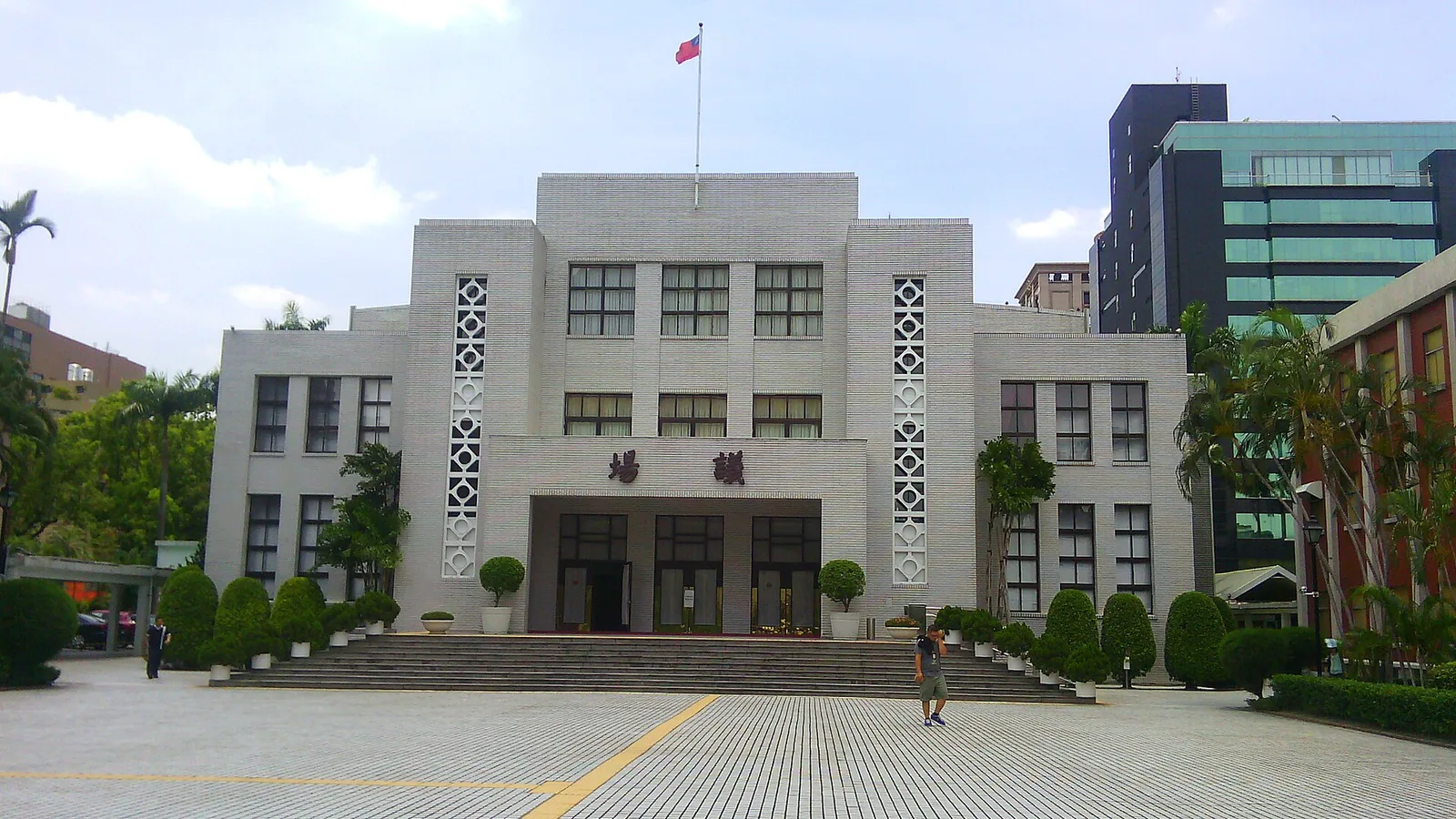
Main entrance of the Legislative Yuan chamber, where 113 legislators hold plenary sessions and vote on bills behind these doors. (Chou Lung / Wikimedia Commons, CC BY-SA 4.0)
The Constitution divides the 113 seats into three parts; only 34 are distributed by party proportion
The number of legislators has been 113 since the 7th Legislative Yuan, first implemented in the 2008 election; the previous term had 225 seats6. The Additional Articles of the Constitution divide these 113 seats into three categories: 73 elected from special municipalities and counties/cities (with at least one per municipality), 3 for Plains Indigenous peoples, 3 for Mountain Indigenous peoples, and 34 for national at-large seats and citizens residing abroad1.
The 73 regional seats use a single-member district system, where only one person is elected per district—the candidate with the most votes takes the seat. It is difficult for small parties to win regional seats under this rule, making the 34 at-large seats the primary channel for small parties to enter the legislature. Each voter has two ballots: one for a regional candidate and one for a political party; this is known as the "single-member district two-vote system." The seats for both parts are calculated independently, a method academically referred to as a "parallel system"4.
The rules for at-large distribution are written in the second paragraph of the same article: "At-large members shall be elected from political parties that have obtained five percent or more of the party votes, according to their proportion of the votes. In the list of candidates of each party, women shall not constitute less than one-half."1 This single sentence contains two distinct designs. The first half is a threshold, and the second half is a gender quota; among the 113 seats, only these 34 are subject to constitutional-level gender protection.
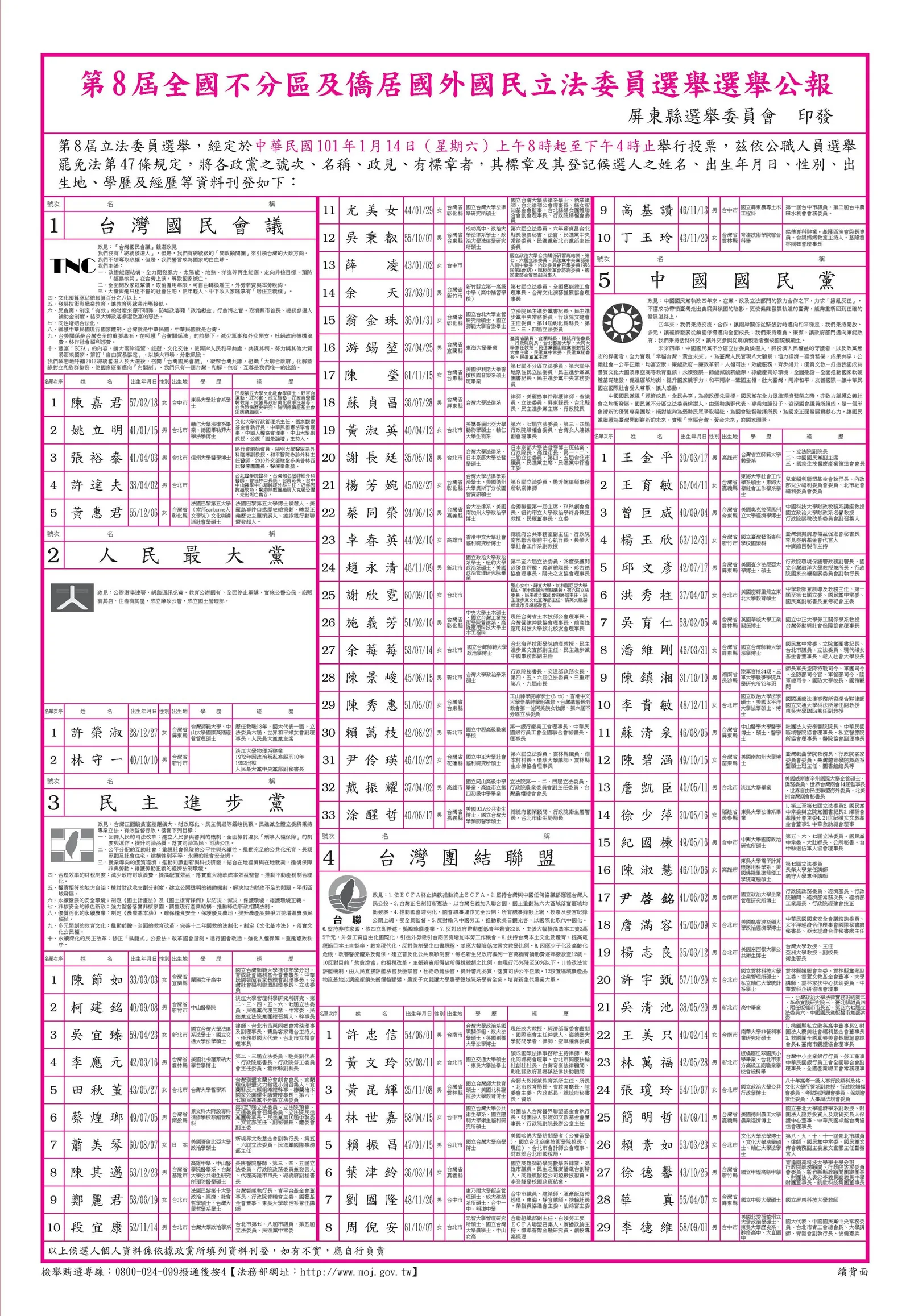
2012 8th National At-large and Overseas Citizen Legislator Election Bulletin. Parties list their platforms and candidate rankings by number; voters only mark the party on the party vote ballot, and the order of election is determined by the list. (Central Election Commission / Wikimedia Commons, Public Domain)
The 5% threshold is nearly double the vote share required for a single seat
If the 34 seats were distributed purely proportionally, each seat would represent 2.94% of the total party votes. Without a threshold, a party receiving around 3% would have a chance at one seat. The 5% threshold pushes this line up by about 2 percentage points; any party falling between 2.94% and 5% has its votes entirely excluded from the distribution.
These votes do not disappear; rather, their effect is transferred to the parties that pass the threshold. In 2024, the DPP, KMT, and TPP combined for 92.82% of the party votes, leaving 7.18% distributed among 13 parties that failed to meet the threshold2. The 34 seats were divided only among those three parties; consequently, the DPP's 36.16% vote share was recalculated to 38.96%, and the KMT's 34.58% became 37.26%2.
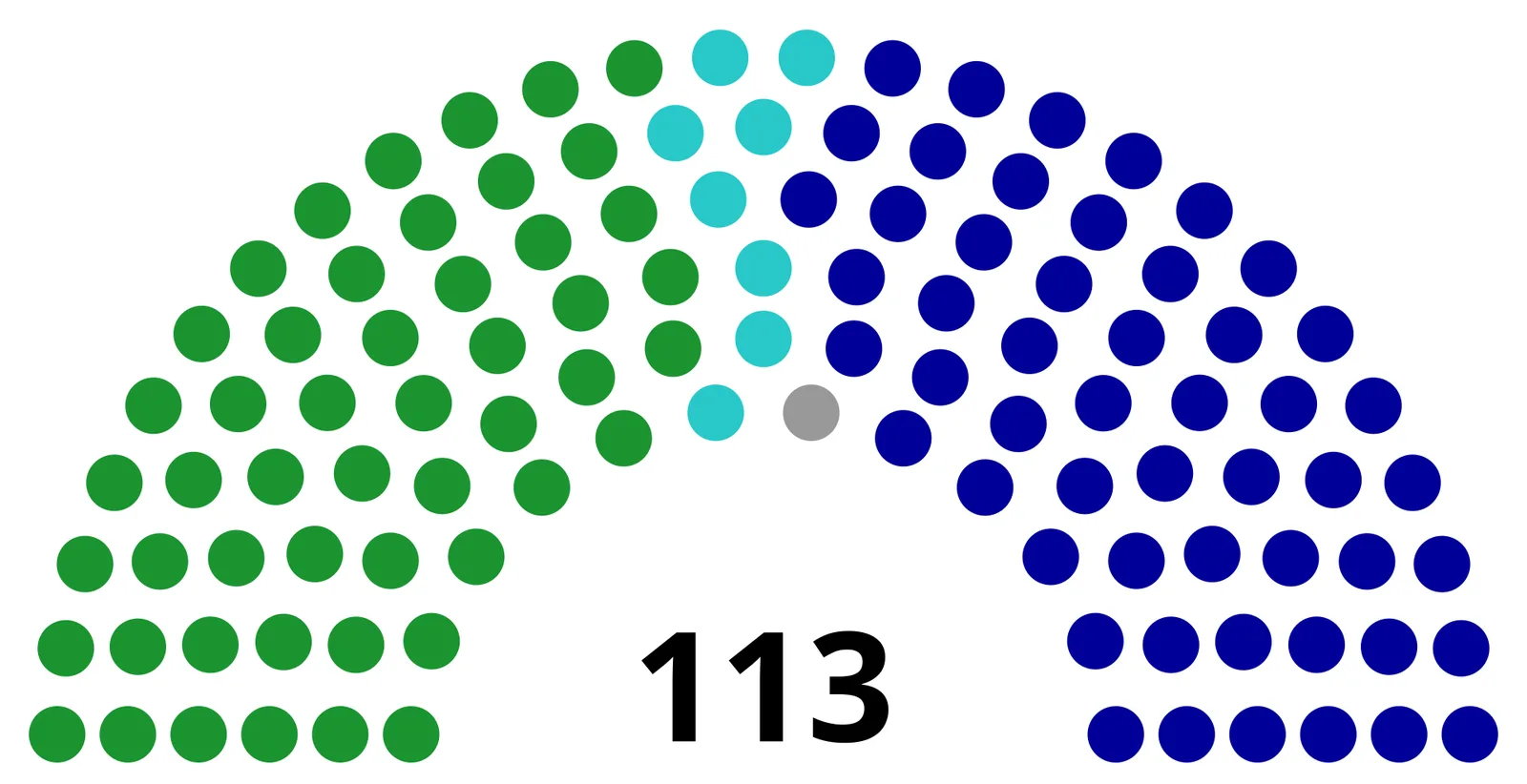
Seat distribution map for the 11th Legislative Yuan elected in 2024. Green represents the DPP, dark blue the KMT, and light blue the TPP. All 8 TPP seats come from the at-large list. (Ericliu1912 / Wikimedia Commons, Public Domain)
The proportion excluded in 2020 was even higher. While the DPP, KMT, TPP, and NPP passed the threshold, 13.69% of party votes did not translate into seats3. The Taiwan Advance Party (TAP) received 447,286 votes (3.16%) that year; under a system without a threshold, they would have had a chance at one seat, but their sole seat actually came from the regional election3.
📝 Curator's Note: The effect of the 5% threshold depends on how votes are distributed in a given election. In years when small parties are highly fragmented and mostly stuck between 3% and 5%, the number of excluded votes is high. If small parties consolidate into one or two larger "third forces," the impact of the threshold diminishes. Under the same constitutional provision, the threshold excluded over 10% of votes in 2020, but less than 10% in 2024.
From 3 seats to 0: The New Power Party's fall between two elections
The NPP first ran for the legislature in 2016, winning 5 seats (3 regional, 2 at-large) with a 6.10% party vote share7. In 2020, they lost all regional seats but increased their party votes to 1,098,100, allowing them to retain 3 seats via the at-large system3.
Before the 2024 election, researcher Jonathan Leung analyzed on the English commentary site Taiwan Insight that after founding chairman Huang Kuo-chang left, it would be extremely difficult for the NPP to defend its 5% party vote share; if they failed to cross the threshold, the party might disappear from the legislature8. The result was 2.57%2. Their vote count dropped to 32% of what it was four years ago, and their seats went from 3 to 0.
The party vote share plummeted from 7.75% to 2.57%. Without a threshold, calculating purely by proportion, 2.57% would equal approximately 0.87 seats. The threshold turned that 0.87 into zero; the change in seats was far more drastic than the change in votes.
In 2014, Justices ruled the threshold constitutional, but debated the numbers in their opinions
The Constitution Alliance and the Green Party once petitioned for a constitutional review of this electoral system. On June 6, 2014, the Judicial Yuan released Interpretation No. 721, stating: "The provisions regarding the parallel system of the single-member district two-vote system, party proportional representation seats, and the party threshold in Article 4, Paragraphs 1 and 2 of the Additional Articles of the Constitution do not violate the current liberal democratic constitutional order upon which the Constitution relies."4
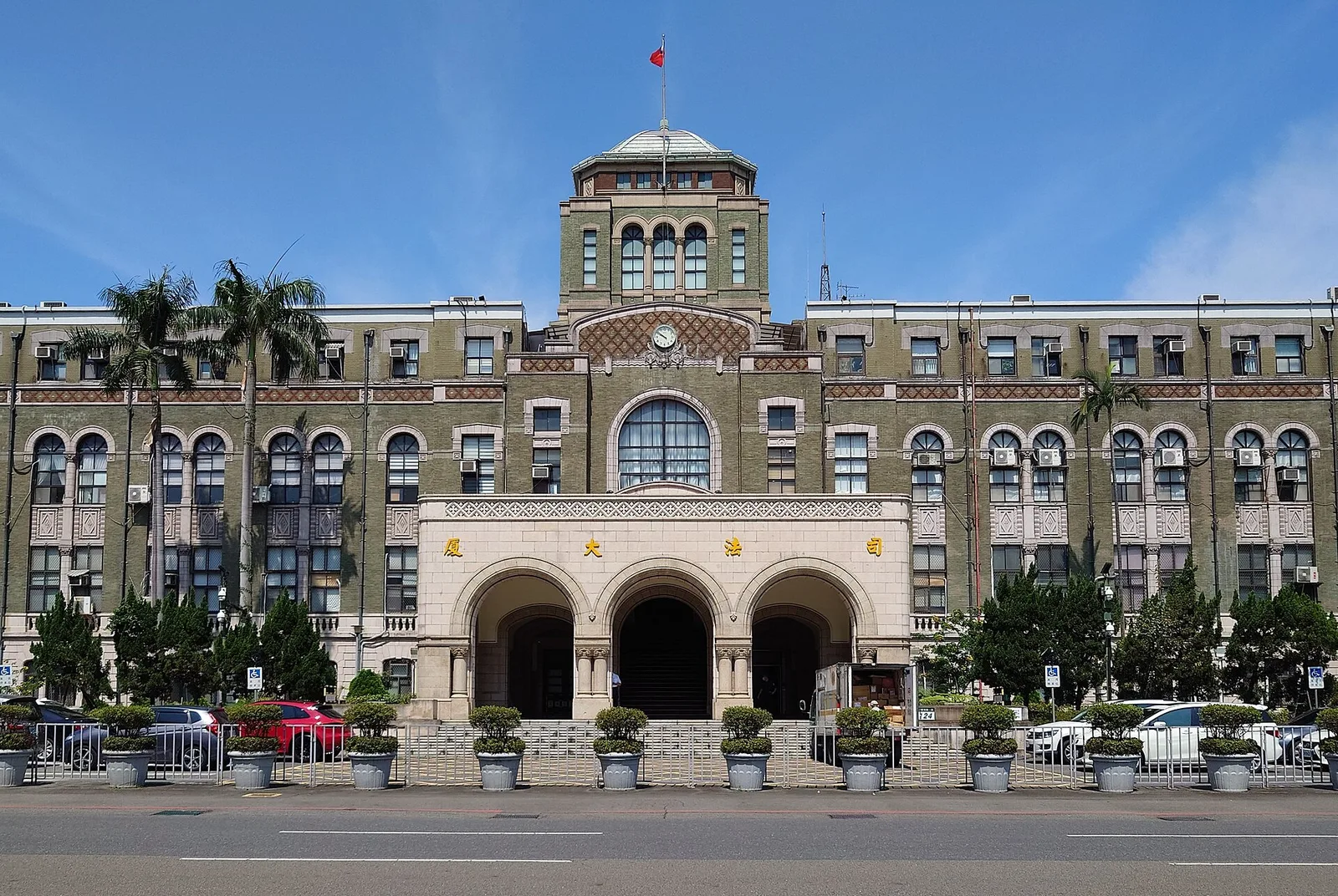
The Judicial Yuan building located in Taipei's Bo-ai Special Zone. Justices review constitutional petitions here; Interpretation No. 721 was released on June 6, 2014. (Yu tptw / Wikimedia Commons, CC BY-SA 4.0)
While the official interpretation reached a single conclusion, the reasoning in the individual opinions varied. Justice Su Yung-chin's concurring opinion looked back at the 2008 (7th) election: out of 17 participating parties, only the KMT and DPP secured at-large seats; among other parties, only the New Party and the Taiwan Solidarity Union (TSU) crossed 3%, "therefore the 5% threshold actually only blocked one seat from each of those two parties"4. The New Party received 4.0% that year and the TSU received 3.5%, both falling between 2.94% and 5%6. Justice Su further noted that in the 8th election four years later, the TSU won three seats and the People First Party (PFP) won two at-large seats, which he argued disproved the claim that the threshold inevitably blocks small parties4.
Justice Lee Chen-shan raised an opposing doubt from the same system. In his concurring opinion, he calculated based on valid votes from the 8th election: crossing 3% required over 394,800 votes, while crossing 5% required over 658,100 votes; even if the threshold were abolished, only four parties would have been able to distribute seats that term. He argued that the interpretation's justification of "a multitude of small parties" lacked empirical support and was "subject to debate"4.
Justice Chen Hsin-min placed Taiwan in an international context. He noted that among 47 countries with party thresholds, 22 set it at 5%, 4 were higher, and 21 were lower; he argued that 5% sits in the middle and "cannot be considered excessive or a violation of the principle of proportionality"4.
Two justices used the same data from the 8th election to reach opposite conclusions: one concluded the threshold didn't block many people, while the other concluded the reasoning for the threshold was untenable. They were discussing elections prior to 2014, when parties being blocked would mostly have only been entitled to one or two seats proportionally. The 13.69% of party votes seen in 2020 was a figure that had not yet appeared when they wrote their opinions.
Lowering the threshold vs. switching to a mixed system: Different calculations for different parties
Because the threshold is written into the Constitution, any adjustment requires a constitutional amendment process. In October 2021, TPP legislators Tsai Pi-ru and Chang Chi-lu held a press conference advocating for changing the electoral system from a parallel system to a "mixed member proportional" (MMP) system, and lowering the threshold for party subsidies from 3.5% to 2%9. An MMP system uses party votes to determine the total number of seats for each party, with regional winners first occupying their party's allocated quota. The TPP estimated at the time that if seats were calculated via MMP, they should have had at least 13 seats, whereas under the current system they only had 5: "This is equivalent to this system confiscating 8 TPP legislators, which is very unfair"9.
Those supporting the retention of the threshold cited the reasoning in Interpretation No. 721: to avoid a proliferation of small parties and the fragmentation of the party system, thereby maintaining legislative efficiency and smooth interaction between the executive and legislative branches4. Justice Lee questioned this prediction, while Justices Su and Chen believed the threshold was highly reasonable. Both sides acknowledged that this threshold prevents certain votes from being converted into seats.
The next time ballots are counted, the threshold remains 5%
From its first implementation in 2008 to 2024, at-large elections have been held for five terms. In 2008, the New Party and TSU were stuck between 3% and 4%; in 2012, the TSU and PFP crossed the threshold; in 2020, four parties shared the 34 seats; in 2024, that number returned to three6432.
The NPP's 353,412 votes in 2024 would equal approximately 0.87 seats if calculated proportionally. These votes were valid when cast into the ballot box and counted during the tally; they were simply excluded at the step of seat distribution. In the next legislative election, the party vote threshold will still be 5%, unless someone completes a constitutional amendment first.
Further Reading: Legislator System · Taiwan Elections and Party Politics · Central Election Commission System · Election Process · Taiwan Referendum System
Image Sources
This article uses 4 Wikimedia Commons images, converted to webp and cached at public/article-images/politics/, uncropped.
- Main entrance of the Legislative Yuan chamber.jpg — Chou Lung, 2015-06-09, CC BY-SA 4.0 via Wikimedia Commons
- 20111223 8th National At-large and Overseas Citizen Legislator Election Bulletin.pdf — Central Election Commission, ROC, 2011-12-23, Page 1, Public Domain via Wikimedia Commons
- 11th Legislative Yuan.svg — Ericliu1912, 2024-01-13, Public Domain via Wikimedia Commons
- Judicial Yuan Building central 20230503.jpg — Yu tptw, 2023-05-03, CC BY-SA 4.0 via Wikimedia Commons
References
- Legal Information Network: Additional Articles of the Constitution of the Republic of China — Original text maintained by the Ministry of Justice; Article 4 stipulates the 113-seat composition starting from the 7th term, the 5% party threshold, and that women shall not constitute less than one-half of the at-large list.↩23
- Wikipedia: 2024 Legislative Yuan Election — Summary of party votes, vote shares, and distributed vote shares for the 11th election; tables note the Central Election Commission as the source; combined and undistributed proportions are calculated based on the table's vote shares.↩23456
- Wikipedia: 2020 Legislative Yuan Election — Summary of the 10th election party vote results, including data such as NPP's 1,098,100 votes, TPP's 1,588,806 votes, and TAP's 447,286 votes; NPP vote shares in info boxes/tables are listed as 7.76% and 7.75% due to rounding differences. Undistributed proportion is calculated based on the four parties that passed the threshold.↩23456
- Presidential Office Gazette No. 7161: Judicial Yuan Interpretation No. 721 — Full text reprinted in the Presidential Office Gazette published on October 8, 2014, including the interpretation, the reasoning, and concurring/dissenting opinions from Justices Su Yung-chin, Lee Chen-shan, and Chen Hsin-min. File is in Word format.↩23456789
- Newtalk: CEC Announces 2024 Legislative Election Seats — Report from the evening of January 13, 2024, regarding the CEC results, listing the 34 at-large seats as being won by the KMT (13), DPP (13), and TPP (8).↩
- Wikipedia: 2008 Legislative Yuan Election — Entry for the 7th election, noting the reduction from 225 to 113 seats, the change of term to 4 years, and party vote shares of 4.0% for the New Party and 3.5% for the TSU.↩23
- Wikipedia: 2016 Legislative Yuan Election — Entry for the 9th election, noting the NPP's first run where they won 5 seats (3 regional, 2 at-large) with a party vote share of 744,315 (6.10%).↩
- Taiwan Insight: A Battle for Survival — The Crossroads of the New Power Party without Huang Kuo-chang — English commentary published by Jonathan Leung on January 4, 2024, analyzing the NPP's survival prospects regarding the 5% threshold following Huang Kuo-chang's departure.↩
- CNA: TPP Calls for Constitutional Amendment to Change to Mixed System and Lower Subsidy Threshold — Report from October 27, 2021, recording TPP legislators Tsai Pi-ru and Chang Chi-lu's advocacy for an MMP system and their calculation that they "should have at least 13 seats" compared to the current "only 5 seats."↩2