
Sunset Rollercoaster: The 14 Years from a Photo Booth Background to Coachella, Singing Taipei Sun in English
30-Second Summary: Sunset Rollercoaster is an independent band formed in Taipei in 2009. They did something few others in the Taiwanese indie scene did: they sang about subtropical Taipei entirely in English. After their debut album Bossa Nova was released in 2011, the band disbanded. In 2015, lead singer Kuo-kuo reformed the group after being discharged from military service due to -1300 myopia and completing his duties as a guitarist for the Algae band Zhang Hsien. The track 〈My Jinji〉 from the 2016 EP JinJi Kikko accumulated over 100 million streams on Spotify1; they became the first Taiwanese band to perform on Audiotree Live in the United States in 2018; and in 2023, they became the first Taiwanese band invited to play on the main stage at Coachella in over two decades2. In 2024, their collaboration AAA with the Korean band Hyukoh was nominated for nine awards at the 36th Golden Melody Awards, winning three. A casually taken Photo Booth background picture became the light of Taiwanese music that the world heard most after 14 years.
In Taipei in 2010, a 19-year-old student sat in front of a MacBook. He had just created a MySpace band page and needed a profile picture. Not knowing what to use, he opened the built-in Photo Booth on his Mac. There was one background image preset: a silhouette of a roller coaster against a sunset. He chose that one.
"The rollercoaster came about like this," Kuo-kuo (Tseng Kuo-hung) said in an interview eight years later3.
That casually chosen background image later became everything for the band: their name, the cover of their first mini EP, and the atmosphere of their entire musical universe. It was not calculated to represent anything, but 14 years later, it represented something no one could have predicted back then. The path of Taiwanese music reaching the world did not come from the K-pop industrial system, nor from government cultural diplomacy; the starting point of the whole thing was a 19-year-old boy randomly selecting an image in his MacBook's Photo Booth.
The Pre-set in the Photo Booth
Sunset Rollercoaster did not appear out of nowhere.
Before forming Sunset Rollercoaster, Guoguo had been in several bands. The earliest was Acid Lips (Sour Lips), a post-punk band from high school. Later, there was "F.L.A.T CLUB" 4, Boyz & Girl, and "Come On! BeiBei!" which recorded an album around the same time. At that time, the drummer for Come On! BeiBei! was Huang Shi-wei, nicknamed "Birdman," and one of the members was Chen Hongli, who later joined Sunset Rollercoaster as a bassist 5.
In 2009, Guoguo formed Sunset Rollercoaster with Kevin Lee (Li Bo-wei, then a student at Taipei Medical University) and drummer Luo Zunlong. Their first performance was on January 29th at Underworld in Shida Road 6. That dingy little bar, which was later redeveloped, was a landmark of the 2000s indie scene in Taipei.
The band name was decided afterward. Guoguo's version in an interview:
"I didn't know what to use for a profile picture on MySpace, so I just used one from a pre-set in my Apple Photo Booth called Sunset Rollercoaster... that's how it came to be." 3
This anti-industrial origin story later defined the band's atmosphere over 14 years. There was no brand consultant, no naming meeting, and no SEO consideration. A default photo from a Photo Booth eventually became the backdrop text on the Coachella desert stage.
📝 Curator's Note: The common narrative of "indie going international" tends to attribute every turning point to "the band making the right strategic decision." But Sunset Rollercoaster's story is actually the opposite: all key moments were unplanned, spontaneous choices. That photo from the Photo Booth was just a casual snapshot in a dorm room; the choice to use English was something Guoguo himself said felt "less awkward"; and Coachella was an invitation sent by the organizers themselves. This band from Taiwan, which is heard around the world, feels the least like it was meticulously designed.
Abbey Road Master, Then Gone
On September 22, 2011, Sunset Rollercoaster self-released their first album, Bossa Nova7.
The album is named after Bossa Nova, but the music itself is closer to a mix of lo-fi surf rock and post-punk. The recording was done at Rooftop Audio in Taipei, and the master tapes were sent to Abbey Road Studios in London, where Steve Rooke personally handled them8. This first album, cobbled together by a group of university students, went through its final processing stage in the same studio that recorded Abbey Road by The Beatles.
Then they disbanded.
Fans thought it was just an unsuccessful small band from Taipei that disappeared after releasing one album. In late 2012, Guoguo joined Algae, a band featuring An Pu as a guitarist (replacing the original member), and toured for four years9. The drummer, Luo Zonlong, went on to form a dark industrial side project called "Fossil" with Guoguo. The band's official website was not updated for four years.
"We wanted to try something else," Guoguo later said in an interview with Bandcamp Daily10.
This four-year silence became the most significant contrast to the later "Coachella myth." The story of Sunset Rollercoaster is not a motivational example of an "indie band making it big from scratch"; rather, it is about "a group of people doing completely different things for four years and then returning having truly matured."
1300 Diopter Vision Notification
One afternoon in 2015, Kuo-guo received a military draft notice.
He was supposed to enlist, but one month before induction, the Ministry of National Defense sent him a discharge notice because of his -1300 diopter myopia. His fate—to shave his head and wear a uniform in less than a month—was decided by an eye exam form.
In 2015, Kuo-guo was 24 years old. He had just finished touring with the band Algae, and Sunset Rollercoaster had disbanded four years prior; he did not have a steady job. The stage experience accumulated over four years performing alongside An Pu, combined with old friends from his alma mater's theater scene who played synthesizers, saxophones, and clarinets, suddenly made Kuo-guo realize he could bring these threads together.
"I decided to take the band seriously," he recalled later11.
On July 1, 2015, Sunset Rollercoaster held its first reunion show at The Wall in Taipei12. Out of the original trio (Kuo-guo, Kevin, Zunlong), only two remained. Kevin did not return, and Chao-ren also did not return. New members included Chen Hongli (bass + synthesizer) and Wang Shaoxuan (keyboard), who were former bandmates from "Come On! BeiBei!", and Huang Haoting (saxophone). With a five-person lineup, the addition of brass instruments and synthesizers gave the band a funky soft rock texture that was unique in the Taiwanese indie scene.
That year, they began making the three songs that would later become Jinji Kikko.
💡 Did you know: During his four years as a guitarist in Algae, Kuo-guo performed on over 100 stages with An Pu (Chang Hsien). After Sunset Rollercoaster's reunion, An Pu and Kuo-guo have never officially collaborated on any songs. Both are iconic indie creators from Taiwan who were once colleagues in the same band but have since taken completely different paths.
Jinji is Not Kumquat
On March 1, 2016, the EP 《JinJi Kikko》 was released13. It features three songs: 〈Burgundy Red〉, 〈My Jinji〉, and 〈New Drug〉.
〈My Jinji〉 became the most popular first. Starting in 2017, Spotify's algorithms began placing this song in Discover Weekly and Indonesian and Korean Indie/City Pop playlists. Within a year, the song surpassed Taiwan14 for monthly listeners in Indonesia. NME later reported that Jakarta, Indonesia, was the city with the most global monthly listeners on Spotify for Sunset Rollercoaster15.
The band's official channel video for 〈My Jinji〉, released in 2020, was a retrospective. The song had already gained popularity through Spotify algorithms for four years before the visual counterpart was "revealed" to global audiences. A lazy afternoon, blown open by a saxophone, represents the two syllables that this band has been heard around the world for over 14 years.
Many people assumed the word "Jinji" meant "kumquat." The band never explained it. However, according to an interview with Guoguo (An Pu), the sound is similar to "Dindi" in the classic Portuguese Bossa Nova song 〈Dindi〉, which means "dear" or "baby"16. The atmosphere of the three songs has a strange resonance with 1960s Brazilian jazz by Antonio Carlos Jobim, yet it is rooted in 2010s Taipei.

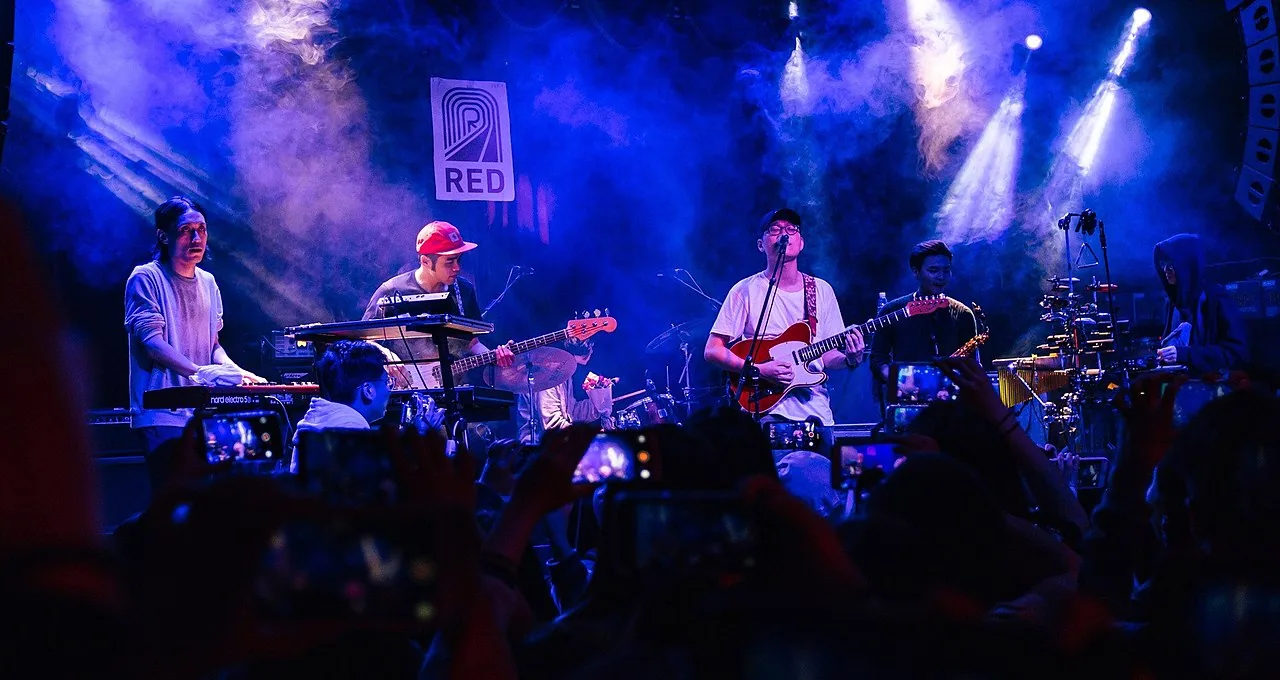
Sunset Rollercoaster at a performance in April 2018. Before the release of 《Cassa Nova》, two years after the EP 《JinJi Kikko》 was released. Photo: Puramyun31, Wikimedia Commons / CC BY 2.5.
The first major overseas performance after the EP's release was SummerStage Taiwanese Waves17 in Central Park, New York, on July 16, 2016. Sunset Rollercoaster performed alongside An Pu and Wang Fu. This marked the first time a Taiwanese band had systematically appeared at SummerStage in Central Park with three groups performing together.
Then, international fans began sending messages.
"I feel like Taipei has a somewhat flat feeling; everyone is similar... the whole city offers a slightly comfortable feeling but one that can never break through its predicament," Guoguo told reporter Jiang Yiting18. Yet, this "flat" city sung in English was heard by audiences worldwide as a Taipei that they thought was flat but was actually complex.
📝 Curator's Note: Why choose English? Guoguo’s answer is counterintuitive to common assumptions. "When you are a band who sings in English, the Western music audience already has the least friction absorbing it. The third thing is that if it is English, your clientele is the whole world."19 This statement resembles a calm calculation by a producer regarding the base of the audience, which is completely different from an ambition to "make international music." Most in the Taiwanese indie scene choose Tâi-gí (Taiwanese), Mandarin, Hakka, or indigenous languages; each language carries an answer about "who I am." Sunset Rollercoaster's answer was: I want to be heard by the whole world, and English is the greatest common denominator. This calculation cannot be placed in the same drawer as the Anglicization of the K-pop industrial system.
The Five Tracks on Audiotree
Chicago, September 26, 2018.
Sunset Rollercoaster entered the recording studio at Audiotree Live and recorded a full session of five songs: 〈Greedy〉, 〈Summum Bonum〉, 〈New Drug〉, 〈My Jinji〉, and 〈I Know You Know I Love You〉. It went live on October 1820. Audiotree is one of the most important in-studio session platforms in the American independent music scene, selecting a few bands each year to record full sessions. Sunset Rollercoaster became the first Taiwanese band invited.
The recording format at Audiotree was a test. A small room, minimal post-production, and live takes uploaded directly—every pitch deviation, pause, or timing issue was visible. The aesthetic stance of this setup was: show me you can do this in the room, not the layered version from a studio. What Sunset Rollercoaster delivered that day was 40 minutes where synthesizers, saxophones, bass, and drums were all breathing together in the same space. The live saxophone solo on 〈Summum Bonum〉 was looser than the studio version, and the synthesizer tone of 〈New Drug〉 carried the subtle reverb inherent to the recording room. After the session went online, it accumulated over 1.1 million views20, marking the first large-scale growth in Sunset Rollercoaster's international fanbase.
The full session on the Audiotree official channel: a small recording room in Chicago, an afternoon in the autumn of 2018. When the saxophone played 〈My Jinji〉, Taiwanese indie music was established live for the first time before microphones in the American Midwest. Before this day, it was data pushed to headphones by Spotify algorithms; from this day on, it became people breathing in the same room.
In March of the same year, they released their second full album, Cassa Nova (Half-Ripe Prince)21. The 9 songs shifted completely from the lo-fi surf rock of Bossa Nova to a disco, funk, and synthesizer-dominated City Pop. The mood of the entire album was like a subtropical afternoon in Japan's Tatsuro Yamashita or Mioko Ōtsuka in the 70s, but with a late-2010s vaporwave coating on the synthesizers.
Throughout 2018, they toured over 100 times, from Tokyo, Seoul, Shanghai, and Hong Kong to Jakarta, Los Angeles, New York, and Mexico City22.
One show was held in a mall parking lot in Jakarta, Indonesia. The audience crowded the stage until it shook, leading to an early finish. This performance was later documented in a reporter's long article as the moment subtropical City Pop was truly rocked by its subtropical audience for the first time23.

A side view of the stage from the same 2018 performance. The band, with its five-member lineup added after a 2015 reformation, incorporated brass instruments, synthesizers, and saxophones into the original three-piece surf rock structure. Photo by Puramyun31, Wikimedia Commons / CC BY 2.5.
BIOS Monthly gave them a description that year: "Wandering Overseas to Earn Money" (飄洋過海來拼酒)24. The band members were clear about their situation during interviews: the Chinese-speaking market was too small to support an all-English band, forcing them abroad to find audiences; and international touring costs were so high that most independent bands hesitated. Sunset Rollercoaster carved out its own path within these two constraints—connecting directly with overseas promoters whenever possible, not relying on Taiwanese agencies as intermediaries, keeping stage setups as simple as possible, and only bringing necessary synthesizers in their luggage. The four characters "Wandering Overseas" (飄洋過海) were later frequently cited in the Asian indie scene to describe a band turning "lack of industrial backing" into a viable business model: geographical movement was merely the surface; the real core was the redefinition of commercial rhythm.
Sonora Stage in the Desert
On July 27, 2019, they performed on the Red Marquee stage at Fuji Rock Festival in Japan25. This is one of Asia's largest rock festivals, and the Red Marquee is the second-largest stage.
On October 30, 2020, they released their third album, Soft Storm26. During a tour in Los Angeles in 2019, the band met an idol from his youth—Ned Doheny, a session musician from the 1970s in the United States who had written for Eagles and Linda Ronstadt. The band invited Ned to come to Taipei on the spot. Ned did come, collaborating with Sunset Rollercoaster on 〈Overlove〉. Then, COVID-19 broke out, halting subsequent recording plans in Los Angeles27.
After Soft Storm was released online, NME ranked it as the fourth best Asian album of 2020. Daniel Peters commented:
"It's a left-turn by a band fully confident in their strengths, looking inward to focus on craft and instinct."28
(A left turn by a band who is completely confident in their strengths, turning inward to focus on craft and instinct.)
On August 21, 2021, they won the Best Band award at the 32nd Golden Melody Awards with Soft Storm. The judges commented: "Breaking the boundaries of Chinese-language music aesthetics, not only are they technically proficient but also influence many young bands; they have international appeal and a sense of the future."29
Two years later, on January 11, 2023, Coachella announced its full lineup for 2023. Sunset Rollercoaster's name appeared on the Sonora stage. The headline from Blow Street Voice that day read:
"For the first time in over twenty years of Coachella, a Taiwanese band is invited to perform on a major stage."30
On April 15, 2023, at 7:55 PM Pacific Daylight Time, at the Empire Polo Club in Indio, California, Sunset Rollercoaster performed on the Sonora stage31. The 9-song setlist began with Shostakovich Waltz No. 2 (a tribute to The Eye of the Needle), followed by 〈Vanilla Villa〉, 〈Burgundy Red〉, 〈My Jinji〉, 〈Summum Bonum〉, 〈Jellyfish〉, 〈I'm a Fish〉, and concluded with 〈Candlelight〉.
The band's official channel video, 〈Vanilla Villa〉Official Video (2019), was the lead single from the EP of the same name and was the first song after the Shostakovich overture on the Coachella 2023 Sonora stage. The MV features a coating aesthetic reminiscent of 70s Japanese sci-fi films, but the narrative is about "aliens falling in love with humans." This album was selected as NME's fourth best Asian album in 2020 and was appreciated by five thousand American fans in the California desert three years later.
"Hello, we are Sunset Rollercoaster from Taiwan, and we are happy to be here tonight," began the band32.
The Sonora stage is one of Coachella's smaller indoor stages, with a capacity of about 5,000 people, but that day, the crowd was packed outside the tent. Most of the European and American fans were generations who discovered 〈My Jinji〉 through Spotify Discover Weekly; they were seeing the person who sang this song for the first time—and that person was Asian, specifically Taiwanese, not Japanese or Korean. A few scattered audience members held up black T-shirts with "SUNSET ROLLERCOASTER" written on them, and several Taiwanese students studying abroad drove across states to see the performance. The guidebook of Taipei, the desert of California, and subtropical City Pop—three lines that shouldn't have intersected stacked into an afternoon inside the Sonora tent.
A week later, on April 22, during Coachella's second weekend, they performed on the Sonora stage again with a 10-song setlist33.
"I feel like there are no bands in Taiwan right now who are as eager to please foreign audiences and seek global recognition like us, so I wanted to test how far we could go," the band described their ambition in an interview with VERSE magazine34.
⚠️ Controversial Viewpoint: The claim that this was "the first Taiwanese band at Coachella for 33 years" was spread by some Chinese-language media copying Taiwan News in 2023, but it is logically impossible: Coachella started in 1999 and was only in its 24th year in 2023. The Blow Street Voice version stating "the first invited in over twenty years" is the correct description. This distortion, where sensational numbers are amplified, is a typical pattern seen after Taiwanese bands gained large-scale visibility in the English-speaking world, with feelings of pride overriding factual verification.
Becoming Your Own Light
In 2017, the South Korean band Hyukoh toured Taipei for the first time. The lead singer Oh Hyuk was recommended by "The Black Skirts" backstage to see Sunset Rollercoaster perform. After watching, Oh Hyuk recognized Guo Guo 35. The two frontmen connected on Instagram, and Guo Guo took Oh Hyuk for a walk around Taipei.
Three years later, on October 5, 2020, Sunset Rollercoaster quietly released the single 〈Candlelight〉, featuring OHHYUK 36. This song, over four minutes long, had Guo Guo's saxophone part intentionally left incomplete halfway through, allowing Oh Hyuk to finish the second half in Korean. There was no press conference and no announcement of an international collaboration; it was simply the two frontmen putting each other's voices into a song for the first time after being friends on Instagram for three years. 〈Candlelight〉 later became the closing track at the Coachella 2023 Sonora stage—something written in DMs three years prior, becoming the final song listened to by five thousand people in the desert three years later.
The official band channel, 〈Candlelight feat. OHHYUK〉Official Video, was uploaded on October 5, 2020. The version where Oh Hyuk continued the second half of Sunset Rollercoaster's song in Korean became the first seed for the entire album AAA, four years before the official collaborative album in 2024.
Over the next four years, this seed slowly grew into a complete album. From 2023 to 2024, Guo Guo and Oh Hyuk met monthly between Jiaxing, Seoul, and Jeju Island to write songs. They wrote eight songs in one year. Without agency-arranged meetings, without cooperation memorandums, and without a preset single schedule, the two frontmen lived in each other's city studios for a week, setting up instruments, drinking, talking about their dreams from the previous night, and then writing a song—much like musicians in the 1970s. Guo Guo later described this process in an interview with Interview Magazine: "We were both lazy, lazily enough to do this because being too diligent would have ruined it." This anti-industrial pace of collaboration is almost a violation of physical laws within the industrial systems of K-pop and Mandarin pop music.
On July 10, 2024, AAA was released, the collaborative album by Sunset Rollercoaster × Hyukoh 37. It features eight songs: 〈Kite War〉, 〈Y〉, 〈Antenna〉, 〈Glue〉, 〈Young Man〉, 〈Do Nothing〉, 〈Aaaannnnteeeeennnaaaaaa〉, and 〈2F Young People>. The entire album did not follow any existing "international collaboration" formula (there was no Taiwanese-Korean duet or bilingual splicing); rather, it was a bridge built by two Asian indie bands between City Pop and alt-rock where none previously existed.
HYUKOH's official channel track "Antenna," which is one of the songs on 《AAA》. The two frontmen from Taipei and Seoul trade vocals in this song; there is no duet or translated subtitles, they simply take turns performing. This arrangement itself is a direct demonstration that "Asian indie can stand on its own without relying on European or American translations."
Jian Miao-ru wrote something at Mingren Hall in 2018, which is now more accurately used to describe 《AAA》: "After digesting the influence of a large amount of Anglo-American rock music... it is both retro and avant-garde. The gentle and smooth vocal style is still very Asian."38
On June 28, 2025, the 36th Golden Melody Awards ceremony was held at the Taipei Arena. 《AAA》 was nominated for nine categories, including Song of the Year, Best Band, Best Album Producer, Best Vocal Album, and Best Music Video. They ultimately won three: Best Music Video, Best Vocal Album, and Best Design Award39. Having a cross-national band's work recognized in the core categories of Taiwan's most credible Chinese music award mechanism—Best Album and Best Producer—is something that has not happened since the Golden Melody Awards began in 1990.
After Sunset Rollercoaster's performance at Coachella, a reporter from VERSE asked Kuoguo one question: Do you think you are "a light of Taiwan" now?
"I don't want to carry the title of 'a light of Taiwan'; I just want to do my own thing and be my own light; that is enough."40
On August 8, 2025, they unexpectedly released their fifth full album, 《QUIT QUIETLY 悄悄消消》41. With 11 songs, it accumulated over five years since 《Soft Storm》, featuring cross-genre collaborations including Wu He, Dou Jingtong, the Brauryang Band, and Yuuma Abe, lead singer of Never Young Beach.
✦ No one in a small bar on Shidao Road in Taipei in 2010 predicted that a silhouette of a roller coaster and a sunset in a Mac's Photo Booth preset would become text on the desert stage backdrop at Coachella 14 years later. No one in the afternoon Kuoguo received his discharge notice in 2015 predicted that a boy with 1300-degree nearsightedness who almost couldn't be drafted, would eventually sing about a hot Taipei afternoon entirely in English, packing an island into two syllables that the world hears most: JinJi.
The sunset of Taipei sung entirely in English, instead made Taiwan the most heard by the world.
That light, from a random Photo Booth background photo, shone onto the desert stage.
Where this story traveled
Further Reading:
- Taiwan Indie Music — The development axis of Taiwanese indie music from "Crystal Records" in the 1980s to Sunset Rollercoaster, Cそうだo, and Kolachi in the 2020s
- Taiwan Music Festival Culture — Changes in the scene of Taiwan's music festivals, from Spring Scream and Daguang Singing to Gongliao Sea Festival
- Taiwan Popular Music — The history of Taiwanese popular music from the Folk Song Movement in the 70s to the streaming era in the 2020s
- Taiwan Music Industry and the Streaming Era — Global reach mechanisms for Taiwanese bands in the Spotify algorithm age
- Chang Hsien and Anpu — Bandmateship during Kuoguo's time as a guitarist in Algae from 2012 to 2016
Image Sources
- Hero and inline images: Three photos from the Sunset Rollercoaster performance on April 6, 2018, taken by Puramyun31 (Wikimedia Commons), licensed under CC BY 2.5 Generic, are provided as (1).jpg, (5).jpg, and (8).jpg. These three photos (shot with a Fujifilm X100F) capture the atmosphere of Sunset Rollercoaster's Taiwanese performance before their 2018 world tour.
References
- 〈My Jinji〉Spotify Official Track Page — A track from the 2016 EP《JINJI KIKKO》, which surpassed one hundred million streams on Spotify as of January 2025, making it a historical record for Taiwanese independent band singles streaming.↩
- Taiwanese Band 'Sunset Rollercoaster' Becomes First Invited to Coachella Main Stage — Reported by Blow Music (StreetVoice) on January 11, 2023. This is the first Chinese report from StreetVoice after the full lineup of Coachella in January 2023 was announced, using 'over twenty years' to describe historical status (not the incorrect figure of '33 years' later circulated by Taiwan News).↩
- National Interview (Part Two) — Published on The Funk Soul Spectre blog on September 14, 2018. National personally explained that the band name Sunset Rollercoaster comes from the Mac Photo Booth preset 'Sunset Rollercoaster' background image used when registering on MySpace, making it the most direct firsthand source of the band's naming origin.↩2
- Fake Artsy Youth Club StreetVoice Band Page — One of the post-punk bands that National was involved with during his high school and university years, representing musical experience before Sunset Rollercoaster formed.↩
- ‘Come On! BeiBei! A Decade Interview’ — Published in POLYSH magazine on September 4, 2016. Mentions that Chen Hongli (who later joined Sunset Rollercoaster as a bassist) and National were old bandmates from 'Come On! BeiBei!' before forming Sunset Rollercoaster, and Birdman (Huang Shih-wei) was also a member of that band.↩
- Underworld 2009 Performance Record — The earliest verifiable performance record for Sunset Rollercoaster appears at the underground venue Shida University Road on January 29, 2009. This livehouse was one of the core venues in the Taipei indie scene during the 2000s before closing due to redevelopment in 2013.↩
- 《Bossa Nova》Bandcamp Official Album Page — The first album self-released by Sunset Rollercoaster on September 22, 2011. The style at the time leaned towards lo-fi surf rock, which is distinctly different from the City Pop style after the reformation in 2015.↩
- VERSE 'Soft Storm from Taiwan' — A feature article on Sunset Rollercoaster in VERSE magazine, detailing the process of having the master for the first album processed by Steve Rooke at Abbey Road Studios in London, UK.↩
- An Pu (Chang Hsien) Wikipedia — Algae Band Member — National joined An Pu's backing band Algae as a guitarist at the end of 2012, replacing the original member Sigan, and the role ended after Chang Hsien announced the tour concluded in early 2016.↩
- Sunset Rollercoaster Bandcamp Daily Interview — Interview by Isabela Raygoza, published on Bandcamp Daily on August 10, 2016. In the interview, National mentioned 'Fossil,' a dark industrial side project he collaborated with drummer Luo Zonlong during the breakup period, and explained that 'we wanted to try something else' was the reason for the disbandment.↩
- ‘Sunset Rollercoaster National: 10 Years of Scenery’ — Published in 500 Magazine (United Daily News) in 2021. In the interview, National recalled the time after receiving a military exemption notice due to having 1300-degree myopia in 2015, when he decided to seriously commit to the band as his career.↩
- martonmart 2015 The Wall Live Documentation — A personal blog record detailing the live specifics of Sunset Rollercoaster's first reformation performance at The Wall in Taipei on July 1, 2015.↩
- 《JINJI KIKKO》Bandcamp Official EP Page — The first EP released by Sunset Rollercoaster after the reformation on March 1, 2016, featuring three tracks: 〈Burgundy Red〉, 〈My Jinji〉, and 〈New Drug〉, marking the beginning of the band's City Pop style.↩
- ‘Taiwanese Ronin Sweeping Asia’ — Written by Jiang Yiting, published by Reporter on June 6, 2019. It details the audience expansion journey of Sunset Rollercoaster in Indonesia, South Korea, and Southeast Asian markets between 2017 and 2019, including a record of the Jakarta mall stage being shaken by the crowd.↩
- Same as [^14]: According to reports citing NME in 2019, Spotify Indonesia Jakarta was the city with the most monthly listeners for Sunset Rollercoaster at that time, marking a true explosion of 'Tropical City Pop' among tropical audiences.↩
- Marie Claire Taiwan's 'Sunset Rollercoaster': A Taiwanese Band That Has Reached International Recognition — This interview clarifies the etymology of 'Jinji,' relating it to Antonio Carlos Jobim's Portuguese Bossa Nova classic 'Dindi' (meaning 'darling'), not the Chinese word for 'kumquat'.↩
- SummerStage Taiwanese Waves 2016 Event Page — The July 16, 2016 event at SummerStage in Central Park, New York, part of the Taiwanese Waves series co-organized by the Ministry of Culture, featuring Sunset Rollercoaster with An Pu and Wang Fu.↩
- Same as [^14]: The reporter's 2019 interview describing Taipei's temperament as 'relatively flat... slightly comfortable, but eternally unable to break through difficulties' is the most important first-person quote regarding Sunset Rollercoaster's sense of city.↩
- Same as [^3]: In an interview with a Chinese national, the original answer to 'Why choose English?' was: 'When you are a band that sings in English, your audience is inherently Western music listeners; it's the most natural absorption for them. The third thing is that if it's English, your clientele is worldwide.'↩
- Sunset Rollercoaster on Audiotree Live YouTube — A full session video of Sunset Rollercoaster recorded at Chicago Audiotree on September 26, 2018, featuring 5 complete songs, uploaded on October 18. It was the first Taiwanese band invited by Audiotree. As of May 2026, it has accumulated over 1.1 million views.↩2
- 《Cassa Nova Half-Ripe Prince》Official Bandcamp Album Page — The second full album, released on March 14, 2018, under the band's own label 'Sunset Music Industry,' featuring 9 songs, with a style shift from lo-fi surf rock to City Pop / disco / funk.↩
- “YouTube Rise... Sunset Rollercoaster World Tour” — Written by Chen Li-yan and published in Mirror Weekly on May 29, 2020. It details Sunset Rollercoaster's world tour of over 100 shows throughout 2018, including China, Japan, South Korea, Southeast Asia, the United States, Europe, Mexico, and others.↩
- Same as [^14]: The reporter's detailed account of Sunset Rollercoaster performing at a mall parking lot in Jakarta, Indonesia, which was cut short due to stage shaking caused by overly enthusiastic audience members.↩
- “Wandering Overseas and Making a Living” — An online magazine interview from BIOS Monthly. It explores the structural issues of Taiwanese indie bands developing internationally from the perspective of international tour costs and the Chinese-speaking market.↩
- Fuji Rock '19 Sunset Rollercoaster Event Page — A performance on the Red Marquee stage on July 27, 2019. Sunset Rollercoaster was one of the first Taiwanese bands to perform on a major stage at the Fuji Rock Festival in Japan.↩
- 《Soft Storm Gentle Storm》Official Bandcamp Album Page — The third full album, released on October 30, 2020, featuring one track, 'Overlove,' in collaboration with American musician Ned Doheny.↩
- Same as [^8]: VERSE magazine detailed the story of how a Chinese national unexpectedly met his idol Ned Doheny (a 1970s American session musician who wrote for Eagles, Linda Ronstadt, etc.) during a LA tour in 2019 and invited him to collaborate in Taipei.↩
- NME '25 Best Asian Albums of 2020' — Written by Daniel Peters for the NME Asia annual ranking. NME ranked Soft Storm as the fourth best album of 2020 in Asia, with commentary emphasizing the band's internal confidence in their style.↩
- “Sunset Rollercoaster: Best Band at the 2021 Golden Melody Awards” — A report from TNL Key Opinion Network on August 21, 2021. It records verbatim the judges' comments regarding Sunset Rollercoaster winning the Best Band award at the 32nd Golden Melody Awards.↩
- Same as [^2]: A report from Blow Street Voice on January 11, 2023, announcing Coachella, which used the description 'the first invited in over twenty years' to describe its historical status.↩
- Coachella 2023 Week 1 setlist — A complete record of 9 songs performed on Stage 9 at Empire Polo Club in Indio, California, from 19:55 PM to 20:40 PM PDT on April 15, 2023, recorded by the setlist.fm community database.↩
- VERSE 'Sunset Rollercoaster Post-Coachella Visit: Becoming Your Own Light' — Includes the opening remarks from the Coachella performance, "Hello, we are Sunset Rollercoaster from Taiwan, and we are happy to be with you tonight," and subsequent interview verbatim.↩
- Coachella 2023 Week 2 setlist — A complete record of 10 songs performed on Stage 10 in Sonora on the second weekend of April 22, 2023, recorded by the setlist.fm community database; the last two songs are "In My Head" and "I Know You Know I Love You."↩
- Same as [^32]: Kuokuo's description of his ambition in the VERSE Coachella post-interview, stating, "I feel like there are no bands in Taiwan right now who are so obsessed with foreign things and want to gain international recognition."↩
- NME 'HYUKOH × Sunset Rollercoaster AAA Interview' — The origin story of Oh Hyuk and Kuokuo's first meeting: In 2017, after The Black Skirts recommended him to backstage during Hyukoh's first Taipei tour, he saw Sunset Rollercoaster.↩
- 〈Candlelight feat. OHHYUK〉Official Video on the Band's Channel — A single released by Sunset Rollercoaster on October 5, 2020, where lead singer Kuokuo invited Oh Hyuk, the lead singer of the Korean band Hyukoh, for a cross-sea feature; this was the first seed for the full collaborative album 《AAA》 in 2024. It was later included in the third full album 《Soft Storm》 released on October 30, 2020, and served as the closing track of the Coachella Sonora stage setlist in 2023.↩
- 《AAA》Official Album Page on Bandcamp — The July 10, 2024 album released in collaboration between Sunset Rollercoaster and the Korean band Hyukoh, consisting of 8 songs, co-released by 'Sunset Music Industry' and Doolset from Korea.↩
- “Ten Years of Maturation, New Subtropical Taiwanese Music (Part 1)” — Written by Jian Miao Ru, published in Mingren Tang (United Daily News) on May 24, 2018. Early reviews described Sunset Rollercoaster's style as "digesting a large amount of Anglo-American rock influences... both retro and avant-garde. The gentle and smooth vocals are still very Asian."↩
- “《AAA》Nominated for 9 Awards at the 36th Golden Melody Awards, Winning 3” — Reported by TNL Key Opinion Network on June 28, 2025. The record notes that Sunset Rollercoaster's 《AAA》 was nominated for nine awards and won three (Best Music Video, Best Album Recording, Best Packaging Design) at the 36th Golden Melody Awards ceremony (Taipei Arena, June 28, 2025).↩
- Same as [^32]: Kuokuo's response to the title "Light of Taiwan" in the VERSE Coachella post-interview: "I don't want to carry any title like 'Light of Taiwan'; I just want to do my own thing and be my own light."↩
- 《QUIT QUIETLY 悄悄消消》Band Official Website Purchase Page — The fifth full album, released without warning on August 8, 2025, consisting of 11 songs, featuring cross-genre collaborations including Wu He, Dou Jingtong, Braruy Dance Band, and Ayumu Abe (lead singer of Never Young Beach).↩