
30-second overview: In May 2001, four students took the stage at the NCCU Golden Melody Awards with a song called "Kui" and won the Band Category's Most Popular Award. That band was called "Sodagreen." Twenty-two years later at Taipei Arena, lead singer Wu Qingfeng took a deep breath and shouted, "We are 'Sodagreen'!" — declaring the end of a four-year legal battle1. In between: the Vivaldi Project carried them through London, Beijing, Berlin, and Taitung; at the 27th Golden Melody Awards, Winter Endless swept five trophies in one night2; a final encore at Liberty Plaza drew a crowd of twenty thousand3; and after 2019 came a cascade of alter-ego acts under the name "Oaeen," trademark lawsuits, criminal indictments, and Lin Wei-che's five consecutive courtroom defeats4. This is the story of a band that walked from a student club into a courtroom, and from the courtroom back to the arena.
In May 2001, at the National Chengchi University (NCCU) gymnasium. On the stage of the 18th NCCU Golden Melody Awards finals, four students stood together. Lead singer Wu Qingfeng, a freshman in the Chinese literature department; bassist Xie Xinyi, business administration; drummer Shi Junwei, sociology; guitarist "Xin-ge," a high school friend of Qingfeng's5. Their name was "Sodagreen." That day, with a song called "Kui," they won the Band Category's Most Popular Award5.
No one imagined that twenty-two years later, when the lead singer shouted "We are 'Sodagreen'!" from the stage of Taipei Arena, he was declaring the end of a four-year legal battle1.
That was the twenty-year arc of a band walking from a student club to a courtroom, and from the courtroom back to the arena.
"Kui": The Band Category's First Place at the NCCU Golden Melody Awards
The 18th NCCU Golden Melody Awards took place in 2001. The venue was the NCCU gymnasium, organized by the university's Student Activities Division and student clubs6. The Golden Melody Awards hold a place in the history of Taiwan's campus music competitions — alongside NTNU's Teacher's Cup and FJU's Fu Jen Star, they are considered the three major campus music awards in Taiwan, running from 1984 to 2026, now in their fortieth year. In the early years they carried the lingering warmth of the folk song movement; around 2000 they transformed into an incubator for indie bands: Cheer Chen, Sticky Rice, Natural Q, and Sodagreen were all heard by the music industry from this stage6.
Four students forming a band for the first time needed a song to compete with. Wu Qingfeng brought out "Kui," a song he had written in his senior year of high school. The song's origin predated the competition itself: in 1999, at the Affiliated Senior High School of National Taiwan Normal University's campus "Tianyun Awards" songwriting category, Wu Qingfeng won first place with "Kui"7. He was seventeen.
On the day of the Golden Melody Awards finals, they performed "Kui." They took home the Band Category's Most Popular Award57.
The "Soda" in Sodagreen was drummer Shi Junwei's idea — the refreshing sensation of fizzy bubbles8. "Green" was Wu Qingfeng's favorite color. The band name was assembled that way, with no profound allusion. In later interviews they admitted it was simply catchy and easy to remember8.
💡 Did you know? Compared to many deliberately conceptual band names, "Sodagreen" is just two members' preferences layered on top of each other — one contributed a flavor, the other a color. The name had no deep meaning, which paradoxically made it a vessel onto which all kinds of interpretations could later be projected. Twenty years later, when the name entered a trademark courtroom, no one argued about "what these three characters originally meant" — the argument was over "who registered it first."
From May 2001 to March 2003, nearly two years, Sodagreen was unstable. The guitarist position rotated through three people: Yanting, Xiaowei, and Hongru5. A student band with constantly changing members was the most common thing in the campus music scene — members studying, interning, finishing military service, living across different campuses, all pulling at whether a band could sustain itself.
Wu Qingfeng's own academic trajectory: after graduating from the Affiliated Senior High School of NTNU, he entered National Chengchi University's Chinese literature department through a recommendation-based admissions process in 20009. The NCCU Memory Network — a university history wiki constructed by the NCCU Library — preserved this record of his admission. During his time at NCCU, he didn't confine himself to the Chinese department alone; he dabbled in radio broadcasting, choir, and record design. Sodagreen's early identity was not rooted in the "NCCU campus folk song" tradition but was closer to the wave of indie bands emerging from Taiwan's university campuses in the late 1990s to early 2000s — labels not necessarily in place, studios not necessarily available, but every campus had a band, and every band was finding its footing on the competition stage.
Xie Xinyi was among the first friends Wu Qingfeng made at NCCU. She studied business administration, and she and Shi Junwei were junior and senior members of the NCCU swimming team — this was an era of layered campus community connections, where bands typically formed through the same group of people linking from one club activity to another and then assembling, a completely different path from the professional model of "the music industry has a need and then goes looking for people"5.
March 2003 was an important milestone in Sodagreen's history. That month, three new members joined one after another: He Jingyang (NCCU Graduate Institute of Public Administration, acoustic guitar, later became the band leader, nicknamed Afu), Liu Jiakai (NCCU Department of Psychology, electric guitar), and Gong Yuqi (Taipei National University of the Arts Graduate Institute of Music, piano and viola, nicknamed Agong)510. The original four plus these three established Sodagreen's six-member lineup.
But there is a small historical discrepancy here. Chinese Wikipedia records He Jingyang's joining date as March 2003, but He Jingyang himself said in a later Yahoo interview that it was "on my birthday in 2004 when Qingfeng sent me a message" that he joined10. The two versions differ by a year, and to date there is no authoritative account that reconciles this discrepancy. That members' memories of a joining date could diverge so much may reflect one thing: during that period, "Sodagreen" was a fluid name rather than a fixed roster — the boundary between who counted as an official member and who was just helping out for one show was blurry.
📝 Curator's note: The six members were spread across the Chinese literature department, business administration, sociology, the Graduate Institute of Public Administration, psychology, and the TNUA Graduate Institute of Music — five departments across two universities. This disciplinary diversity would later be amplified in the Vivaldi Project: a band daring to cross from folk to rock to traditional Chinese instrumentation to classical grandeur may well have been related to the fact that its six members included someone studying sociology, someone studying musicology, someone studying public administration, and someone studying psychology. The word "band" is often imagined as "a group of music majors," but Sodagreen was a counterexample from the very beginning.
Chinese Literature, Business Administration, Sociology, TNUA Music Graduate Institute
Laying out the six members' academic backgrounds produces an interesting picture:
Wu Qingfeng (lead singer, songwriter), born August 30, 1982, from Kaohsiung; graduated from the Affiliated Senior High School of NTNU; NCCU Chinese literature department; studied abroad at the University of Birmingham in the UK for one year starting in 2004. Beginning with his high school Tianyun Awards win for "Kui," his output of lyrics and compositions far exceeded that of a typical rock band frontman9.
Xie Xinyi (bass), born April 16, 1982, NCCU business administration; one of the four founding members; in many interviews she was positioned as the "band's household manager" — handling administration, scheduling, and communication.
Shi Junwei (drums), born August 26, 1979, NCCU sociology department. Yamaha lists him on their Taiwan artists page — one of the few drummers among Taiwanese bands to hold an endorsement relationship with an international instrument brand11. The word "Soda" was his suggestion.
He Jingyang (acoustic guitar, band leader), born April 4, 1982, NCCU Graduate Institute of Public Administration. He later took on the role of Sodagreen's band leader.
Liu Jiakai (electric guitar), born February 5, 1982, NCCU Department of Psychology.
Gong Yuqi (piano, viola), born December 16, 1980, TNUA Graduate Institute of Music — the only member with a formal music degree. He was the one who, during the Vivaldi Project's Winter Endless, secluded himself for three months and single-handedly completed a 70-person orchestral score12.
Lining up the six disciplines: Chinese, business administration, sociology, public administration, psychology, musicology. Three departments in management and policy, two in humanities and social sciences, one in music. This combination would be considered "atypical" for any indie band.
The story of a band's formation tends to be undervalued at this level. The common narrative framework for Taiwan indie bands is "a group of students who love music got together" — but Sodagreen's group originated from the same time period on the NCCU campus, people who knew each other, someone suggesting they sign up for a campus competition. The campus competition was the first motivation; the music came later.
This difference in sequence may seem small, but it affects the entire story that follows. A band that starts from a campus competition and a band that starts from a recording demo relate to the music industry differently. The former is accustomed to the loop of "take the stage, get heard"; the latter is accustomed to the loop of "enter the studio, collaborate with a producer." When Sodagreen was later taken under Lin Wei-che's wing and entered the mainstream, they had already been practicing the "take the stage, get heard" instinct for two or three years — an instinct that couldn't be captured in a demo.
"This Is the One": The Hot Wave Rock Stage at Gongliao Ocean Music Festival

March 12, 2008 — Sodagreen live at The Wall, Taipei. Photo: Wikipedia user Solomon203, CC BY-SA 3.0. Wikimedia Commons.
July 2003. Fulong Beach, Gongliao District, New Taipei City. The 4th Ocean Music Festival.
Sodagreen was still a student band with no album. They signed up for the festival's "Hot Wave Rock" stage — this stage was not on the same tier as the main stage; Hot Wave Rock was a smaller stage for campus and indie bands5. That festival, they were part of the "Yin Xia Tian" farewell tour: they had already played at Ximen, Tainan Wutuobang, Kaohsiung ATT Secret Base, Taichung Laonuo, and Taipei University Expo5. A standard small-venue island-wide tour for a student band — nothing unusual.
But in the audience that day was a man named Lin Wei-che.
Lin Wei-che was by then a veteran producer in Taiwan's music scene. He had been the lead singer of the band Baboo in his early years, moved behind the scenes in the 1990s, and produced for Cheer Chen, Faith Yang, Deserts Chang, and Sodagreen13. Under that small Hot Wave Rock stage at Gongliao, he heard Wu Qingfeng's voice.
He later described his judgment in an interview with Business Today in a single sentence:
"This is the one."13
This moment has been quoted repeatedly, but the details surrounding it are often oversimplified. A more accurate context is this: people in the music industry who had heard Wu Qingfeng's demo had polarized reactions to that voice. Some found it "neither male nor female"; others found it unique. Lin Wei-che later reframed this controversy into a warmer phrase — "now-male, now-female" — and wrote it into Sodagreen's album copy14. The word "now" (忽) is several degrees gentler than "neither" (不).
Lin Wei-che didn't fully accept that voice in one go. In later interviews he recalled that when he first heard Wu Qingfeng's voice, he was actually somewhat repulsed in his mind, but his body was more honest than his mind — his body listened to the entire song before he realized he had already been drawn in. The original source of this account has been passed around the internet several times; a complete version can only be found in secondhand retellings — so this article treats it as background context rather than a direct quotation.
Lin Wei-che decided to sign Sodagreen, bringing them under his independent label, "Lin Wei-che Music Co." The significance of this decision was not apparent at the time, but it would determine Sodagreen's relationship with the mainstream market for the next decade or more — and twenty years later, this decision would come back to question everyone in a different form.
On May 30, 2004, Sodagreen released their first official music at the "School Rock" concert held at NCCU15. Sharing the stage were Cheer Chen and Deserts Chang — two representatives of Taiwan's indie female voices at the time. Sodagreen sharing the stage with them was equivalent to being formally introduced into this circle. What they released was a two-track single, published by Lin Wei-che Music Co., the first official commercial CD since Sodagreen's founding. Lin Wei-che Music Co. later designated May 30 as "Sodagreen Day" — a date that continued through to 2022, when Lin Wei-che published his statement relinquishing the trademark on Facebook, and he also chose May 3016.
On September 3, 2005, Sodagreen released their self-titled debut album Sodagreen. Produced by Lin Wei-che Music Co., with Lin Wei-che as producer, 11 tracks, 53 minutes and 40 seconds17. The pre-order bonus was a copy of Sodazine 1 — a unique early Sodagreen tradition where each album came with a zine compiled by the members themselves, containing lyrics, writing backgrounds, photos, and casual notes. This zine series later became a collector's item among fans.
The debut album was nominated for Best Band at the 17th Golden Melody Awards. They didn't win, but they had been noticed by the Golden Melody system.
📝 Curator's note: The existence of "Lin Wei-che Music Co." as an independent label had meaning in Taiwan's indie music industry of that era. For indie bands at the time, there were a few paths to surviving within the mainstream system: get signed by one of the five major record companies, collaborate with a mainstream management company, or figure it out on your own. "Lin Wei-che Music Co." took a variant of the third path: a veteran producer with mainstream production experience opened a small label and brought in the bands he believed in. This was a relatively avant-garde path at the time, but it also planted a seed of a problem: when the producer is simultaneously the label owner, the contracting party, and the trademark holder, the power dynamic between artist and producer is more intimate and more ambiguous than the typical "artist vs. company" relationship.
"Little Love Song" — lead single from the October 2006 album Small Universe. Written entirely by Wu Qingfeng, published by Lin Wei-che Music Co., it later won Best Composition at the 18th Golden Melody Awards in 2007.
Vivaldi Took Them to London, Beijing, Berlin
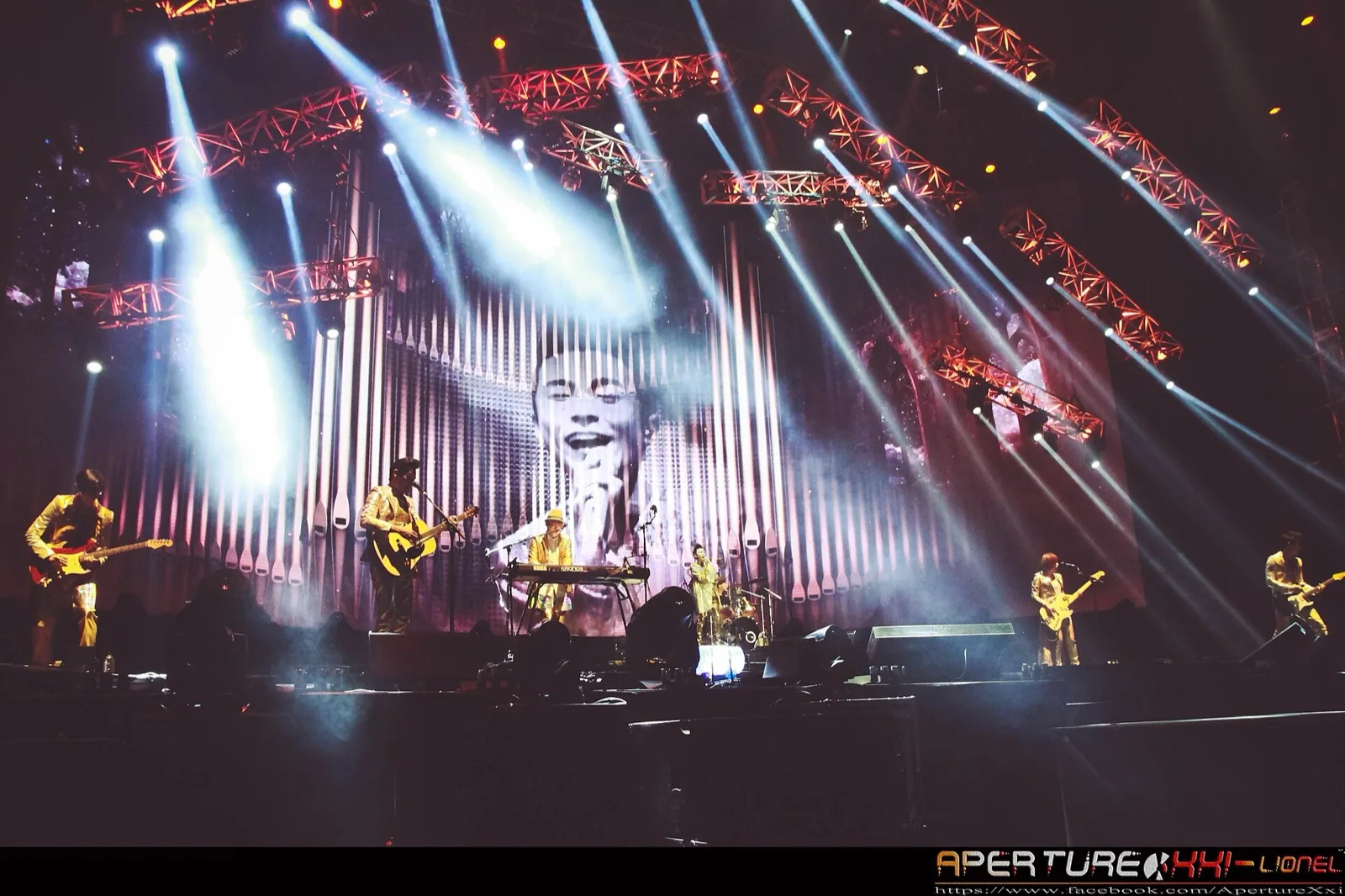
July 2014 — "Audiovisuals and Hallucinations in the Air" 10th Anniversary World Tour, Taipei Arena, three consecutive shows. Photo: Wikipedia user Solomon203, CC BY-SA 3.0. Wikimedia Commons.
On October 20, 2006, Sodagreen released their second studio album, Small Universe18. The title track and "Little Love Song" were the two defining tracks of the album. The lyrics and music for "Little Love Song" were entirely Wu Qingfeng's work; the melody's cleanliness and the lyrics' colloquialism pushed the song onto the must-sing list for Taiwanese college students in that era's KTVs.
At the 18th Golden Melody Awards in 2007, Sodagreen won Best Band for Small Universe, and "Little Love Song" won Best Composer (Wu Qingfeng)2. From being discovered by Lin Wei-che at the 2003 Gongliao Ocean Music Festival to winning their first Golden Melody for Best Band, less than four years had passed.
The third studio album, released the same year, Incomparable Beauty, contained a song called "Four Seasons Rhapsody." This song was later identified as the seed of the Vivaldi Project: the lyrics and melody already carried the embryonic concept of the cycle of seasons, but it had not yet been expanded into a multi-year album series19.
At the 19th Golden Melody Awards in 2008, Sodagreen won Best Band again for Incomparable Beauty2. Winning Best Band two years in a row meant they had moved from "newcomers noticed by the Golden Melody circle" to "a band confirmed by the Golden Melody circle."
What followed was the Vivaldi Project.
The Vivaldi Project — named after Baroque composer Antonio Vivaldi's The Four Seasons violin concertos — was a relatively ambitious undertaking in the history of Mandarin pop music. It comprised four seasons, four cities, four moods, four albums20. The entire series began with the first album in 2009 and concluded with the last in 2015, with two non-Vivaldi albums released in between, spanning a total of six and a half years.
The timeline:
Spring — Sunlight — Released May 8, 2009, Sodagreen's fifth studio album, theme city: Taitung, musical style: "folk spring"21. The recording team swapped the large studio for Taitung's natural environment, integrating it with local musical textures. This was the first Vivaldi Project album and the one that anchored the entire series' concept.
Summer / Fever — Released September 11, 2009, the sixth studio album, recorded at London's Miloco Studios "The Pool" — a legendary recording space acquired in the 1970s by Pink Floyd's Roger Waters and later taken over by Miloco. Sodagreen's expenditure for recording the album there was reported to be close to NT$10 million22. Musical style: rock and Britpop.
Autumn: Story — Released September 18, 2013, the ninth studio album, theme city: Beijing, musical style: "poetic Chinese folk," with heavy use of traditional Chinese instruments such as the guzheng, erhu, and suona in the arrangements23. There was a full four years between Summer and Autumn — during which Sodagreen released a non-Validi album What Are You Worried About (November 11, 2011, the eighth), while Afu (He Jingyang) served military service and Agong (Gong Yuqi) also faced conscription arrangements, forcing the autumn and winter plans to be pushed back5.
Winter Endless — Released November 4, 2015, the tenth studio album, theme city: Berlin, musical style: "solemn classical," recorded in collaboration with the German Pops Orchestra (a 60-person symphony orchestra)24.
Four albums, four cities, four seasons, four musical styles. For an indie band to plan a six-and-a-half-year conceptual series of this scope, there is no other comparison in Taiwan's indie history.
flipermag, in a 2016 comprehensive review of the Vivaldi Project, summed it up in one sentence:
"'Spring' in Taitung belongs to warm folk, 'Summer' in London belongs to passionate rock, 'Autumn' in Beijing belongs to melancholy poetry, 'Winter' in Berlin belongs to solemn classical."20
The production details of Winter Endless deserve a special section. Agong — Gong Yuqi, the only member with a formal music degree — secluded himself for three months and single-handedly completed a 70-person orchestral score12. During the Berlin recording, they collaborated with the German Pops Orchestra's 60-person symphony. A Taiwan indie band recording an entire album with a professional overseas symphony orchestra was an extremely rare undertaking at the time.
💡 Did you know? The second Vivaldi Project album, Summer / Fever, was recorded at London's Miloco Studios at a reported cost of close to NT$10 million22. For an indie band to spend NT$10 million recording an album in London was almost counterintuitive within Taiwan's indie music industry at the time — most indie bands' recording budgets for an album were less than a tenth of that figure. Calling the Vivaldi Project a "luxury" is not an overstatement, but that luxury produced results: six and a half years later, the 27th Golden Melody Awards handed five trophies to Winter Endless in one night.
The results of the 27th Golden Melody Awards in 2016 were the official coronation of the entire Vivaldi Project series:
- Best Mandarin Album: Winter Endless
- Best Band: Sodagreen
- Best Album Producer: Lin Wei-che
- Best Lyricist: Wu Qingfeng ("He Raised His Right Hand and Called the Roll")
- Best Arranger: Sodagreen + Lin Wei-che ("A Gorgeous Sorrow")25
One album, five Golden Melody Awards — this achievement is a rare case in the history of Taiwan's Golden Melody Awards. From the 18th Golden Melody Awards in 2007 to the 27th in 2016, Sodagreen won Best Band three times — a band winning Best Band three times at the Golden Melody Awards means their standing within the mainstream judging system of the Chinese-language music world had solidified.
Music critic Hou-an wrote a review of Winter Endless at the time of its release, containing a line that has been widely quoted by fans:
"Having no answer is usually life's only answer."26
Music critic Jimingshui wrote a comprehensive review of the Vivaldi Project for the independent media outlet Stand News. Placing the entire series within the discussion of Taiwan indie bands "moving from independence to the market," he argued that the relationship between independence and the market is not a black-and-white dichotomy, and that polished packaging and musical craft are not mutually exclusive27.
This line later became the framework through which the Vivaldi Project was understood: Sodagreen didn't "switch" from indie to mainstream — they dismantled the habitual opposition between "indie" and "mainstream market success."
After the Vivaldi Project concluded, Sodagreen announced the "After Summer" farewell tour in the second half of 2016 — five cities, nine shows: Beijing (Sodagreen + Small Universe), Guangzhou (Incomparable Beauty + Spring Sunlight), Hong Kong (Sing with Me + A Decade's Moment), Shanghai (Summer Fever + What Are You Worried About), Wuhan (Autumn Story + Winter Endless)28. Each show was themed around two albums' setlists.
Sodagreen used this tour to correspond with their entire body of work across twelve years — from the 2005 self-titled album to 2015's Winter Endless — and walked toward the moment in 2017 that no one expected would happen.
"Incomparable Beauty" 2007 original MV — from the album of the same name, Sodagreen's third studio album. "Four Seasons Rhapsody" on this album was the germinal starting point of the Vivaldi Project, and it also earned Sodagreen the 19th Golden Melody Award for Best Band in 2008.
Footage from Sodagreen's 2009 recording sessions of Summer / Fever at London's Miloco Studios "The Pool," later released through the official channel. A legendary recording space acquired by Pink Floyd's Roger Waters in his early years, later taken over by Miloco. A Taiwan indie band daring to fly here to record was virtually a singular case at the time.
The Last Encore at Liberty Plaza
2014 — "Audiovisuals and Hallucinations in the Air" 10th Anniversary World Tour live — from the 10th anniversary in 2014 to the last encore at Liberty Plaza in 2017, Sodagreen completed their mainstream heyday. Photo: Wikipedia user Solomon203, CC BY-SA 3.0. Wikimedia Commons.
January 1, 2017. National Concert Hall.
That day, Sodagreen collaborated with the National Symphony Orchestra (NSO) on a concert called "Le Project"29. This made Sodagreen the first Taiwan band to perform a concert at the National Concert Hall — prior to that, the National Concert Hall stage was implicitly reserved for classical music, traditional opera, and crossover arts; pop bands were not on that list.
After "Le Project" ended, the story wasn't over. That evening, Sodagreen paid out of pocket to set up a stage at the National Theater and Concert Hall Arts Plaza (what everyone now knows as Liberty Plaza), opening it up for fans to request songs — they called this the "Last Encore"3. An estimated twenty thousand people gathered outside.
Wu Qingfeng shouted to everyone from that stage:
"Hello, friends across the universe — we are Sodagreen."3
This line would return in another form at the 2023 Pond of Shadows Night concert at Taipei Arena. But on January 1, 2017, in that moment, it was a farewell.
The next day, January 2, 2017, Sodagreen officially announced their hiatus5.
Regarding the reason for the hiatus, the official version at the time was "a three-year break" — this statement was announced to the public by Lin Wei-che on October 1, 201630. The three-year hiatus was supposed to end with a comeback in 2019.
But subsequent events disrupted all plans.
In the second half of 2019, when Sodagreen members attempted to release new music under the name "Oaeen," the legal relationship between them and Lin Wei-che and his companies entered judicial proceedings. During the litigation process beginning in 2020, Wu Qingfeng stated in and out of court: the hiatus "was forced by Lin Wei-che," "he wanted me to not participate in Sodagreen for five years," "he wanted me to leave the band and go solo, which I flatly refused"31. These statements represent one side's account of events during litigation — allegations and defenses within legal proceedings. This article records them as "statements made during litigation" rather than established fact.
Correspondingly, in his 2022 statement relinquishing the trademark, Lin Wei-che described the situation at the time as follows:
"During the worst of the pandemic, I self-isolated at home, quietly reflecting, thinking back on all the moments past and present."32
The two sides' versions differ — this is normal in litigation. What we can confirm is: on January 2, 2017, Sodagreen announced their hiatus; on September 6, 2019, Wu Qingfeng released his first solo studio album Spaceman — positioned as a collection of personal works during the hiatus, not a departure from the band33.
The official hiatus narrative, one-sided statements during litigation, Lin Wei-che's retrospective account — three versions point to different explanations, but they share a common temporal anchor: the last encore at Liberty Plaza on January 1, 2017, was the last step Sodagreen took under the name "Sodagreen." The next time they would use that name on the stage of Taipei Arena would be 2023.
January 1, 2017 — Sodagreen at the Liberty Plaza Last Encore. Approximately twenty thousand people. The next day, they announced their hiatus.
"Someone I Once Regarded as a Father"
In the two or three years following the hiatus, Sodagreen members attempted to release new music under the name "Oaeen." But the legal relationship between "Oaeen" and "Sodagreen" would enter a series of judicial proceedings between 2019 and 2021.
The litigation sequence unfolded as follows[^34]:
| Stage | Date | Content | Result |
|---|---|---|---|
| Civil provisional injunction | From 2019 | Lin Wei-che filed two applications | Both were dismissed |
| Civil first instance | 2020-04-16 | Intellectual Property Court Case No. 108-Min-Zhu-Su-134 | Plaintiff's claim dismissed |
| Criminal indictment | 2020-02-24 | Taipei District Prosecutors Office indicted Wu Qingfeng for copyright infringement (scope: Hunan TV April–September 2019, Kaohsiung Beer Music Festival July–11, Macau, Affiliated High School of NTNU, Gongliao Ocean Music Festival, Chengdu Chaoyin Festival) | Case No. Bei-Yuan-109-Zhi-Su-5 |
| Civil second instance | 2021-04-01 | Intellectual Property Court appeal | Appeal dismissed (NT$5 million damages claim entirely lost; first instance NT$8 million → second instance NT$5 million) |
| Criminal first instance | 2021-06-15 | Taipei District Court criminal first instance verdict | Wu Qingfeng and Harry Kun's Carnival Co., Ltd. both acquitted |
| Criminal appeal | 2021-09-01 | Lin Wei-che's side | Abandoned appeal |
In total: Lin Wei-che suffered four consecutive civil losses plus one criminal loss against Wu Qingfeng — five consecutive defeats34. The Liberty Times report mentioning "Qingfeng has written a cumulative 275 songs" is not within the scope of the infringement alleged in the complaint — 275 is the total number of songs Qingfeng had written as of that point, and should be distinguished from the scope of the litigation35.
On March 30, 2021, shortly before the civil second instance verdict, Wu Qingfeng was surrounded by media outside the court. He said:
"A teacher I had blindly believed in, someone I once regarded as a father — why did it turn out this way."35
The key phrase here is "once regarded as" — the past tense combined with the verb "regarded as," rather than a present-tense construction like "I treated him as a father." Many later secondhand media accounts rendered this as "I always treated him as a father," but comparing with the Liberty Times reporter's live transcript from that day, the original words were "someone I once regarded as a father." This difference is not rhetorical pedantry — "once regarded as" carries more weight than "always treated as"; the former is a death certificate for a relationship, the latter merely an emotional declaration.
Two months later, on May 11, 2021, Wu Qingfeng posted a 4,000-word public statement on Facebook. The statement was fully transcribed by multiple media outlets at the time. It opened with:
"By reason and by sentiment, I owe nothing — I have acted reasonably, lawfully, and with utmost good faith."36
The phrase "by reason and by sentiment, I owe nothing" employs a dual-mirror construction from classical Chinese, placing legal argument and emotional argument on the same plane. Some later secondhand media condensed this into "I have not the slightest remorse" for their headlines, but "not the slightest remorse" is not a verbatim version of the Facebook original. This article uses the Facebook original's "by reason and by sentiment, I owe nothing" as the quotation.
The closing of this 4,000-word statement was:
"Once music loses its soul, only technique remains; and once the law ignores the human heart, producing loopholes, it is nothing but words on a page."36
A musician, in the midst of a trademark lawsuit, placing music and law side by side as two systems capable of losing their humanity — the weight of this line lies in the fact that it is not an accusation against the other party, but an indictment of the entire structure that brought everyone to court.
⚠️ Contested perspective: In June 2025, the Intellectual Property Court ruled in first instance that Lin Wei-che should pay NT$23.55 million in damages — a victory for Sodagreen. But the scope of Sodagreen's original claim alleged misappropriation of concert and copyright revenues totaling nearly NT$470 million37. This battle, beginning with the civil provisional injunction application in 2019 and reaching the 2025 intellectual property damages ruling, has already exceeded six years — and it is not over. The gap between the damages awarded and the amount alleged in the original claim is the part of this litigation that will continue to play out in the coming years.
Dismantling a Band's Name
On August 23, 2019, "Oaeen Co., Ltd." was registered with the Ministry of Economic Affairs38. On July 3, 2020, they officially announced to the public that they would release music under the new band name "Oaeen"; on July 31, they held their first concert under the "Oaeen" name38.
The name "Oaeen" is a deconstruction of "Sodagreen":
- 蘇 = 艹 + 魚 + 禾
- 打 = 扌 + 丁
- 綠 = 糸 + 彔
Taking the three radicals "魚," "丁," and "糸" to form "Oaeen." Written in English as Oaeen — and those five letters were themselves picked out of the old band name "Sodagreen," hiding the name that had been taken from them inside the letters of the new one.
This deconstruction concept did not actually originate in 2019. As early as 2005, before the release of Sodagreen's first self-titled album, they had used this name on their demo discs. In 2016, while Sodagreen was on the After Summer farewell tour, they had also performed under the alter-ego name "Oaeen" on the Ocean Music Festival's small stage — a ritualistic performance of returning to the place where it all began under an "alter-ego name."
The six members' "Oaeen" alter-ego stage names were as follows[^40]:
| Real Name | Oaeen Alter-Ego |
|---|---|
| Qingfeng | Sunrise |
| Xinyi | Scent Me |
| Xiaowei | Eight Women |
| Afu | Ketian |
| Jiakai | Shidou |
| Agong | Jinba |
Each stage name is a recombination or transformation of a radical from the member's real name — "Qingfeng → Sunrise" uses the "sun" (日) from the character 青 combined with the imagery of a peak; "Xinyi → Scent Me" uses the "scent" (香) from the character 馨 combined with the symmetry of 儀; "Xiaowei → Eight Women" is a direct deconstruction. Fans are called "duckweed" (浮萍), and the fan club is called "Pond" (池堂) — the name of the 2023 Taipei Arena concert, "Pond of Shadows Night" (池堂影夜), was derived from the fan club name "Pond."
Oaeen's existence far exceeded the level of a substitute. It is a deconstruction, an alter ego, a protest — when the three characters of "Sodagreen" could not be used due to trademark ownership issues, they took those three characters apart, picked out the radicals, and reassembled them into another name, continuing to make music.
📝 Curator's note: Placing "Oaeen" within the context of Taiwan indie and protest symbolism reveals a spirit connected to the tradition of "homophonic renaming" and "character-deconstruction renaming" commonly used in Taiwan's social movements since the 1990s — the name itself becomes a vehicle of protest. The difference is: social movement deconstructions often take the opponent's name and break it into something unflattering (for example, changing an official name to a pejorative); Oaeen deconstructed their own original name and preserved it — an act of "I'm temporarily hiding my own name, but you can still tell." This gesture is not provocative, but it is resolute — a band stripped of its original name, using the act of deconstruction to continue saying "we're still here."
After Oaeen was established, they launched an even larger project: "re-recording" all of Sodagreen's catalog.
The first re-recording was the Oaeen version of Sodagreen's self-titled debut album, named Different Name Album39. Digitally released on January 14, 2022, with physical release on February 18. The second, Small Universe (Oaeen Version), was released simultaneously.
The re-recording project's premise: each re-recorded album would be made with "double the budget" and contain "double the tracks." The original 11 songs would be expanded to 22, partly newly arranged old tracks, partly previously unreleased B-sides from the same period. The entire project aimed to re-record over 200 songs39 — this figure was the target publicly announced by Oaeen, and should be distinguished from the "275 songs" figure in the litigation scope.
The Vivaldi Project four seasons' re-recordings were also part of the plan, with progress continuing into 2025.
The significance of the re-recording project: during the period from 2019 to 2022 when the name "Sodagreen" had not yet been returned to them, they used the name "Oaeen" to sing all of Sodagreen's songs again, rearrange them again, and re-record them again. "Oaeen" became a legal shell that allowed Sodagreen's songs to continue being performed live, continue being purchased, and continue generating revenue — and every time Oaeen performed a Sodagreen song, it was equivalent to cutting those songs a little further away from their original legal ownership.
"It's Time to Let Go" and "We Are Sodagreen"
On May 30, 2022 — Sodagreen's founding day, the same date as the 2004 NCCU School Rock concert where they released Audiovisuals and Hallucinations in the Air — Lin Wei-che posted a statement on Facebook announcing his relinquishment of all rights to the "Sodagreen" trademark.
The key passages of the statement were as follows32[^42]:
"As this matter has reached where it is today, an inner voice has told me 'it's time to let go.'"
"During the worst of the pandemic, I self-isolated at home, quietly reflecting, thinking back on all the moments past and present. I knew I had to make a decision — to let go of the past, whether good or bad, all the same. So I decided to relinquish ownership of the trademark. And I wish this name a better future."
"The law helps clarify facts, but it also destroys the feelings and trust between people."
"Life is short. I hope everyone stays healthy and safe. Blessings to you all."
The three words "it's time to let go" were widely quoted. But the full context is "as this matter has reached where it is today, an inner voice has told me 'it's time to let go'" — a litigant who had suffered five consecutive courtroom defeats describing the decision to relinquish the trademark as guidance from an "inner voice." This statement was published in full by CNA, Blow, Marie Claire, and other media outlets.
The legal process of handling the trademark was not as dramatic as the statement. The "Sodagreen"-related trademarks relinquished by Lin Wei-che totaled six — five of which were applied for by Lin Wei-che Music Co. between 2007 and 2008 and transferred to the company in 2013; the other was directly applied for by the company in March 201340. Lin Wei-che relinquishing the trademark did not mean Sodagreen members automatically acquired it — after he relinquished it, someone needed to re-apply. The final result: the Taiwan Intellectual Property Office (TIPO) announced on October 1, 2022, that the band name "Sodagreen" was acquired by "Sodagreen Co., Ltd." for a 10-year trademark term41.
February 18, 2023. Taipei Arena.
The concert Sodagreen held under the "Oaeen" name was called Pond of Shadows Night — "Pond" was the fan club's codename, "Shadows Night" evokes the imagery of evening. Two shows, twenty thousand audience members1. When the lead singer took the stage and took a deep breath, what he shouted was:
"Hello, friends across the universe — we are 'Sodagreen'!"1
This line had appeared once before at the 2017 Liberty Plaza Last Encore. That time was a farewell. The 2023 Pond of Shadows Night at Taipei Arena — this time, it was a return.
Three months later, on May 30, 2023 — again May 30 — Sodagreen held a free concert titled Sodagreen Round 2 at the Chiang Kai-shek Memorial Hall. Wu Qingfeng said from the stage[^45]:
"We've waited a long time — six years, I suppose — and we can finally say it: we are Sodagreen."
The "six years" is counted from January 2, 2017, the day the hiatus was announced, to 2023.
After their return, Sodagreen's international tour resumed. March 22–24, 2024 — three shows at Hong Kong Coliseum — this was the first stop of the A Moment in Twenty Years comeback tour42. April 20, 2025 — London's OVO Arena Wembley — Sodagreen's first arena-level concert in London. May 29, 2025 — Tokyo43.
💡 Did you know? Sodagreen's first overseas performance was on August 11, 2007, at "This Summer Extra Green" at the Republic Polytechnic Cultural Centre in Singapore44. From Singapore to London's Wembley Arena, this overseas tour arc spanned nearly eighteen years.
A NT$470 Million Lesson: The Trademark Class for Taiwan Indie Bands
In June 2025, the Intellectual Property Court ruled in first instance: Lin Wei-che should pay Sodagreen NT$23.55 million in damages37. The scope of Sodagreen's original claim — misappropriation of concert and copyright revenues — was estimated at nearly NT$470 million. The gap between the NT$23.55 million awarded and the NT$470 million alleged in the original claim is the part of the litigation that will continue to play out in the coming years. Whether Lin Wei-che's side appeals and the outcome of any second instance — as of this article's closing, no final conclusion has been reached.
Sodagreen's entire litigation process has been widely discussed in Taiwan's legal community. Multiple law firms — Copyright Note, Tandem Law, Giant Group Law Firm, KH Cattorney (Attorney Du Yunhao), We Lead Law — have published case analyses of this matter4546. From these analyses, three consensus points in the legal community can be distilled:
First, Taiwan's trademark law follows a registration system. Whoever registers first with TIPO (Taiwan Intellectual Property Office) holds the trademark rights, regardless of "who used the name first" or "who represents the name." Sodagreen had been performing under this name since 2003, but because the trademark was not applied for by Lin Wei-che Music Co. until 2007, the first registrant was Lin Wei-che Music Co.
Second, if a management contract does not specify "trademark ownership" in black and white, the trademark belongs to the registrant — that is, the management company or label, not the artist. Sodagreen's contract with Lin Wei-che Music Co. at the time did not clearly address trademark ownership provisions.
Third, bands should apply for trademarks upon debut — this is the unanimous legal advice for all indie bands. Trademark application fees are not expensive, and the process is not complicated, but it can prevent a protracted legal battle ten, fifteen, or twenty years later.
Attorney Du Yunhao, in his case analysis, specifically pointed out: the key to the second instance ruling was not a popularity determination of "whether netizens could name all the band members," but was based on the "registration system" principle of trademark law47. This reminder is worth noting, because many news reports simplified this debate into "whether netizens support them" or "whether the market recognizes them," but the court's logic does not operate that way.
What has Taiwan's indie music industry as a whole learned from Sodagreen's twenty-year litigation?
The most direct impact: between 2022 and 2025, the number of Taiwan indie bands proactively applying for trademarks at TIPO increased noticeably. Law firms' consulting demand from the music industry also rose. "Applying for a trademark before debut," an action previously considered "too commercial, not indie enough," became a basic form of self-protection.
From this perspective, Sodagreen's four-year litigation cost not only their own time, money, and emotional energy — it was also a legal education for Taiwan's indie bands as a collective. NT$470 million in claimed damages, NT$23.55 million awarded, six and a half years of court proceedings — these were the tuition they paid for the entire industry's lesson.
✦ The first thing a Taiwan indie band should do upon debut is register the band name.
"We Are 'Sodagreen'!"
On February 18, 2023, on the stage of Taipei Arena, Wu Qingfeng took a deep breath and shouted: "Hello, friends across the universe — we are 'Sodagreen'!"
The twenty thousand seats' worth of audience broke down in tears together.
Twenty-two years from that NCCU Golden Melody Awards stage, from the day they formed the band.
The boy who won the Tianyun Awards in high school, who formed a band with his senior classmates as a freshman and signed up for a campus singing competition — he is still singing now. Only this time, he no longer needs anyone else's permission to sing his own "Little Love Song."
Further reading:
- Deserts Chang and Anpu — A contemporary indie female voice, the indie band collective's political statement
- Taiwan Independent Music — The ecology of Taiwan's indie band scene
- Taiwan Music Festival Culture — The Gongliao Ocean Music Festival and the indie band discovery platform
- Mayday — Another iconic Taiwan band, founded in 1997, a contrast in management models
- Pop Music and the Golden Melody Awards — The context of Sodagreen's Golden Melody sweep
Image Credits
This article uses Wikimedia Commons CC BY-SA 4.0 licensed images, all cached at public/article-images/music/ to avoid hotlinking:
- 2014 Sodagreen 10th Anniversary World Tour — Audiovisuals and Hallucinations in the Air (six members cropped) — Photo: Solomon203, 2014, CC BY-SA 4.0
References
- China Times 2023-02-18 Sodagreen Pond of Shadows Night live report — China Times breaking news report, documenting the complete moment of Wu Qingfeng's declaration "We are 'Sodagreen'!" at the 2023-02-18 Pond of Shadows Night concert at Taipei Arena, with the twenty-thousand-strong audience's singalong response.↩
- Sodagreen zh.wikipedia entry (Golden Melody Awards record) — Chinese Wikipedia Sodagreen main entry, fully listing three Best Band wins (18th / 19th / 27th Golden Melody Awards) and the record of Winter Endless winning five awards in one night.↩
- Liberty Plaza Last Encore live report — Juksy street magazine early 2017 live report, documenting the details of the 2017-01-01 "Last Encore" at Liberty Plaza, where band members paid out of pocket to set up a stage after the National Concert Hall "Le Project" concert.↩
- Mirror Media NT$470 million litigation report — Mirror Media 2025-08-19 in-depth report, organizing the scope of Sodagreen's claim against Lin Wei-che for misappropriation of concert and copyright revenues totaling nearly NT$470 million, and the litigation progress.↩
- Sodagreen zh.wikipedia main entry — Chinese Wikipedia Sodagreen complete entry, including founding in 2001-04, six-member lineup established in 2003-03, 2003-07 Gongliao Ocean Music Festival, and complete pre-hiatus chronology.↩
- NCCU Golden Melody Awards official history page — National Chengchi University official university history materials, documenting the complete history of the NCCU Golden Melody Awards from the first edition in 1984 to the present, and past winners.↩
- Wu Qingfeng zh.wikipedia entry — Chinese Wikipedia Wu Qingfeng personal entry, documenting the 1999 Affiliated High School of NTNU Tianyun Awards songwriting category championship, the 2001 NCCU Golden Melody Awards Band Category Most Popular Award, and NCCU Chinese literature department recommendation-based admission academic history.↩
- Marie Claire 50944 Oaeen naming and Sodagreen origin story — Marie Claire 2020 in-depth report, documenting the naming origin of Sodagreen: drummer Shi Junwei proposed "Soda" and Wu Qingfeng's favorite color "Green" combined to form the band name.↩
- NCCU Memory Network Wu Qingfeng entry — National Chengchi University Library-constructed NCCU history wiki, a primary record of Wu Qingfeng's 2000 recommendation-based admission to National Chengchi University's Chinese literature department.↩
- He Jingyang zh.wikipedia entry — Chinese Wikipedia He Jingyang personal entry, documenting NCCU Graduate Institute of Public Administration, joining Sodagreen as acoustic guitarist in March 2003, and the discrepancy with his own account in a Yahoo interview of joining on his birthday in 2004.↩
- Yamaha Shi Junwei artist page — Yamaha Instruments Taiwan official artist page, a primary record of Shi Junwei's identity as a drummer and equipment endorsement, including sociology department academic history.↩
- Sodagreen Winter Endless zh.wikipedia entry — Chinese Wikipedia Winter Endless album entry, documenting Agong (Gong Yuqi) secluding himself for three months to single-handedly complete a 70-person orchestral score, and the production process of collaborating with the German Pops Orchestra's 60-person symphony.↩
- Business Today Lin Wei-che interview — Business Today 2015 in-depth interview, Lin Wei-che's recollection of the moment he discovered Sodagreen at the 2003 Gongliao Ocean Music Festival and his judgment "This is the one" in full context.↩
- Sodagreen zh.wikipedia "now-male, now-female" copy paragraph — Chinese Wikipedia Sodagreen main entry documenting the detail of Lin Wei-che reframing other musicians' "neither male nor female" assessment of Wu Qingfeng's voice into "now-male, now-female" in the album copy.↩
- Audiovisuals and Hallucinations in the Air zh.wikipedia entry — Chinese Wikipedia Sodagreen debut single entry, documenting the 2004-05-30 NCCU School Rock concert and the details of debuting alongside Cheer Chen and Deserts Chang.↩
- Blow (StreetVoice) Lin Wei-che 2022-05-30 full statement — Blow, a music magazine under StreetVoice, published Lin Wei-che's full Facebook statement relinquishing the trademark on 2022-05-30, along with the historical context of "Sodagreen Day."↩
- Sodagreen (self-titled album) zh.wikipedia entry — Chinese Wikipedia Sodagreen debut self-titled album entry, released 2005-09-03, produced by Lin Wei-che Music Co., 11 tracks, 53 minutes 40 seconds, pre-order bonus Sodazine 1 details.↩
- Small Universe zh.wikipedia entry — Chinese Wikipedia Sodagreen second studio album entry, released 2006-10-20, including the songwriting background of "Little Love Song."↩
- Incomparable Beauty zh.wikipedia entry — Chinese Wikipedia Sodagreen third studio album entry, documenting "Four Seasons Rhapsody" as the conceptual seed of the Vivaldi Project.↩
- flipermag Vivaldi Project four-city comprehensive review — flipermag design magazine 2016-08-21 in-depth review, summarizing the Vivaldi Project as "Spring in Taitung folk, Summer in London rock, Autumn in Beijing poetry, Winter in Berlin classical" across four cities and four seasons.↩
- Spring — Sunlight zh.wikipedia entry — Chinese Wikipedia Vivaldi Project first album entry, released 2009-05-08, theme city Taitung, folk spring musical style.↩
- Summer / Fever zh.wikipedia entry and London recording details — Chinese Wikipedia Vivaldi Project second album entry, released 2009-09-11, London Miloco Studios "The Pool" recording expenditure close to NT$10 million.↩
- Autumn: Story zh.wikipedia entry — Chinese Wikipedia Vivaldi Project third album entry, released 2013-09-18, theme city Beijing, arrangements using guzheng, erhu, suona and other traditional Chinese instruments.↩
- Winter Endless and German Pops Orchestra collaboration entry — Chinese Wikipedia Vivaldi Project fourth album entry, released 2015-11-04, Berlin recording and collaboration with the German Pops Orchestra's 60-person symphony.↩
- 27th Golden Melody Awards — National Cultural Memory Bank record — National Cultural Memory Bank's official archival record of the 27th Golden Melody Awards winners, including the complete list of Winter Endless's five awards.↩
- Hou-an music review of Winter Endless musictalk.blog — Music critic Hou-an's lengthy review of Winter Endless on musictalk.blog, 2015-11-07, the original source of the line "Having no answer is usually life's only answer."↩
- Jimingshui music review: From Independence to the Market (Stand News) — Music critic Jimingshui's comprehensive review of the Vivaldi Project published on Stand News, positioning the entire series within the dialectical context of indie bands moving toward the market.↩
- Sodagreen concert list zh.wikipedia — Chinese Wikipedia Sodagreen complete concert chronology entry, including the 2016 "After Summer" farewell tour's five cities, nine shows, and setlist arrangements.↩
- National Symphony Orchestra NSO Le Project official page — National Symphony Orchestra official program page, a primary record of the 2017-01-01 Sodagreen and NSO collaboration "Le Project" concert.↩
- Sodagreen concert list zh.wikipedia — 2016 hiatus announcement — Chinese Wikipedia Sodagreen concert list entry documenting Lin Wei-che's public announcement of a "three-year hiatus" on 2016-10-01.↩
- UDN Time Oaeen reclaiming Sodagreen — United Daily News Time in-depth retrospective report, organizing the Sodagreen members' public statements about the pre- and post-hiatus situation during litigation, including Wu Qingfeng's one-sided accounts outside court and in legal filings.↩
- CNA 2022-05-30 Lin Wei-che relinquishes trademark Facebook statement — Central News Agency 2022-05-30 breaking news, publishing in full Lin Wei-che's Facebook statement announcing relinquishment of all rights to the "Sodagreen" trademark.↩
- Spaceman zh.wikipedia entry — Chinese Wikipedia Wu Qingfeng first solo studio album entry, released 2019-09-06, personal works during the hiatus rather than a "departure from the band."↩
- UDN Stars Lin Wei-che's five consecutive defeats — United Daily News Stars 2011 report organizing Lin Wei-che's four consecutive civil losses plus one criminal loss — five consecutive defeats — in the complete litigation sequence against Wu Qingfeng.↩
- Liberty Times 2021-03-30 Wu Qingfeng statement outside court — Liberty Times 2021-03-30 breaking news, documenting the reporter's live verbatim transcript of Wu Qingfeng's statement to media outside the court: "someone I once regarded as a father."↩
- CTWANT Wu Qingfeng 4,000-word statement summary — CTWANT 2021-05-11 breaking news, fully transcribing Wu Qingfeng's 4,000-word Facebook statement, including the opening "by reason and by sentiment, I owe nothing" and the closing "once music loses its soul" two key verbatim passages.↩
- Mirror Media intellectual property damages ruling NT$23.55 million and NT$470 million litigation — Mirror Media 2025-08-19 in-depth report, documenting the Intellectual Property Court's June 2025 first instance ruling ordering Lin Wei-che to pay NT$23.55 million in damages, and Sodagreen's original claim alleging misappropriation of concert and copyright revenues totaling nearly NT$470 million.↩
- Mirror Media renaming to Oaeen — Mirror Media 2020-07-03 report, documenting the complete timeline of Oaeen Co., Ltd.'s company registration on 2019-08-23 and the public announcement on 2020-07-03 of releasing music under the Oaeen band name.↩
- Marie Claire 63071 re-recording project — Marie Claire in-depth report, documenting the Oaeen re-recording project's premise of double the budget and double the tracks per album, with a goal of re-recording over 200 songs.↩
- Copyright Note trademark dispute analysis — Copyright Note legal professional website's legal analysis of the Sodagreen trademark dispute, including the complete legal history of 6 trademarks applied for by Lin Wei-che Music Co. between 2007 and 2013 and later transferred to the company.↩
- Taiwan Intellectual Property Office TIPO trademark announcement — Taiwan Intellectual Property Office official trademark announcement, 2022-10-01, the Sodagreen band name acquired by Sodagreen Co., Ltd. for a 10-year trademark term — primary announcement source.↩
- Sodagreen concert list — A Moment in Twenty Years tour — Chinese Wikipedia Sodagreen concert list, documenting the 2024-03 A Moment in Twenty Years tour's three Hong Kong Coliseum shows and subsequent 2025 London and Tokyo overseas dates.↩
- LiveNation UK 2025 Wembley Arena — LiveNation UK official ticketing page, the English primary ticketing source for Sodagreen's 2025-04-20 London OVO Arena Wembley show.↩
- Marie Claire Pond of Shadows Night retrospective on Sodagreen overseas tours — Marie Claire 2023 Pond of Shadows Night retrospective report, including the historical record of Sodagreen's first overseas performance on 2007-08-11 at "This Summer Extra Green" at the Republic Polytechnic Cultural Centre in Singapore.↩
- Tandem Law trademark registration system analysis — Tandem Law intellectual property column analysis of the Sodagreen trademark case on 2022-10-12, interpreting the legal logic of the entire dispute from the perspective of trademark law's registration system.↩
- Giant Group Law Firm trademark case analysis — Giant Group Law Firm's legal column analysis of the Sodagreen trademark dispute, discussing the legal principle that if a management contract does not specify trademark ownership, it belongs to the registrant.↩
- Attorney Du Yunhao: Is netizens' inability to name all band members the key to losing the case? — Attorney Du Yunhao's personal legal column article, in-depth analysis that the core of the Intellectual Property Court ruling was not a popularity determination of "whether netizens could name all band members," but was based on the fundamental logic of trademark law's registration system.↩