
Taiwanese Pop Music: The Island That Made Wedding Clothes for the World, Left in the End with Songs Others Cannot Sing
30-second overview: In 1997, Taiwan was Asia's second-largest and the world's 13th-largest record market; 80 percent of the world's Mandopop songs were written, arranged, and recorded here. Eight years later, the market had shrunk to one-quarter of its former size, the production center had moved to China and South Korea, and even Jay Chou at his peak sold only 300,000 copies per album, less than one-third of the million-copy standard of the golden age. Taiwan lost the contest of scale. But when a song elsewhere can be deleted because of one mention of "Tiananmen," one national flag, or one taboo, this island still holds something no one else can take away: freedom. This is a story about "whose voice counts," from 898 songs banned under martial law to the first Taiwanese-language album to win the Golden Melody Award for Album of the Year in 2025.
The day Hou Dejian wrote "Descendants of the Dragon" was December 16, 1978.
That night, the United States announced that it would establish diplomatic relations with the People's Republic of China and sever relations with the Republic of China. A Taiwanese young man in his early twenties sat down and turned the long-standing grief and anger of Chinese people being manipulated by foreign powers into a song1. The chorus he originally wrote was "surrounded on all sides by the sword of slaves." The record company thought it was too sharp and asked him to change it to "the sword of foreigners." He refused. The final version became "the sword of appeasement"2.
The song later changed owners three times. First, it was a song of grief born from diplomatic severance. James Soong, then director-general of the Government Information Office, thought the lyrics were not stirring enough, so he wrote another version praising national self-strengthening and patient endurance, and used it at speeches3. In 1983, Hou Dejian himself went to China. The song was banned in Taiwan and was not unbanned until after the lifting of martial law4. Later still, the lines "black eyes, black hair, yellow skin" were taken up by China as a symbol of blood-based nationalism, singing a different story altogether5.
The meaning of a melody has never been decided by the person who wrote it. It is decided by whoever holds power at the moment. The entire history of Taiwanese pop music is, more or less, a repeated verification of this sentence. It was once the factory that made wedding clothes for the world. Later, it could not even hold on to its own market. In the end, it found that what remained in its hands were the songs other people could not sing.
Lee Chien-fu's original recording of "Descendants of the Dragon." Official Rock Records channel. A song written for a diplomatic break later changed owners three times; that sentence is a miniature of the whole history of Taiwanese pop music.
The Island That Made Wedding Clothes for the World
Start with scale. Only then can one understand why freedom became the "last" bargaining chip.
From the 1980s onward, the entire Mandopop industry chain was highly concentrated in Taiwan: lyricists, composers, arrangers, producers, and recording studios were all here. Singers from Taiwan, Hong Kong, China, Singapore, and Malaysia flew to Taipei to record, then took the finished product home for release. One Jonathan Lee alone held in his hands the signature works of Wakin Chau, Chief Chao, Sandy Lam, and Karen Mok6. This is not Taiwanese self-flattery: systematic industry observation in the British Financial Times orbit and academic journals have both called Taiwan the "epicentre" of Mandopop7. The Bureau of Audiovisual and Music Industry Development under Taiwan's Ministry of Economic Affairs has its own figure: Taiwanese companies once held an 80 percent share of the Mandopop market8.
💡 Do you know how Aaron Kwok became famous? One of Hong Kong's "Four Heavenly Kings" first exploded in popularity after shooting a motorcycle commercial in Taiwan. A Taiwanese record company seized the moment and released his record, after which he became famous back in Hong Kong and across the entire Sinophone world. In that era, Taiwan was a "manufacturing machine" for Mandopop stars: people you thought of as Hong Kong stars often had a whole team of Taiwanese lyricists, composers, and producers standing behind them.
It was an era when selling a million copies was ordinary. Jacky Cheung's 1993 album The Goodbye Kiss sold 1.36 million copies in Taiwan; the description at the time was that, on average, one in every 20 Taiwanese people had bought it9. A-mei's Bad Boy sold 1.38 million copies in Taiwan in 1997, and remains the best-selling studio album in Taiwan's history10.

Teresa Teng, the diva whose songs were sung even across the Strait in the saying "listen to old Deng by day, little Deng by night," was the emblem Taiwan exported across Asia in the million-copy era. Photo: Unknown, early 1980s. Public domain (published in the United States, 1978-1989, with no copyright notice).
Then it collapsed.
Taiwan Panorama put it this way: "Taiwan's total record market output value rapidly shrank from NT$12.3 billion in 1997 to NT$3.15 billion in 2005"11. Mirror Media added the coordinates: "Taiwan in 1997 was once second in the Asian record market, behind only Japan, and 13th in the world record market"12. The chain of causes is clear: CD burners became widespread in 1998, Napster and pirated MP3s went online in 1999, and physical record sales "fell like an avalanche" in 200113. Piracy became so severe that IFPI's Taiwan sales chart was suspended for a time in 1999.
The cruelest comparison was not at the moment of collapse, but ten years later. When the market had only one-quarter left, even the sales figures for kings and queens of pop shrank with it. Taiwan's golden age had seen albums routinely sell a million copies. By Jay Chou's generation, even the peak was only 300,000.
Source: Wikipedia album entries, Taiwan Panorama
📝 Curator's note
The common account often writes this period as "piracy killed the record industry." Piracy was certainly the fuse, but it cannot explain one thing: why did Taiwan not, like South Korea, grow an even larger industry after the collapse of physical records?The real structure was this: Taiwan clung for too long to its position as the "leader of the Mandopop world," put all its chips on the growing Chinese market, and missed the train that turned music into global cultural export. South Korea increased its culture budget from US$14 million to US$84 million between 1998 and 2001, a full fivefold increase14. In 2018, Korean pop music ranked seventh globally, while Taiwan did not even make the top ten15. Both were small markets. South Korea went outward to fight for the world; Taiwan looked inward and waited for China. That difference in thought decided the next twenty years.
Role Reversal: How the Center Moved Away
A center does not simply vanish; it is pulled away by another, larger gravitational field.
By 2018, China's record market had already become the seventh largest in the world and the second largest in Asia according to IFPI certification16. More critical than its ranking, however, was the shift in discourse power. Veteran musician Shao Yide described it as if "two Mandopop worlds now exist: one above the fray... consisting of mass-produced, algorithmically distributed internet 'viral hits'; and one within the temple... where high-quality music is industrially refined."17 Using massive traffic and capital, Chinese platforms sucked the entire industry's center of gravity toward them. Taiwan transitioned from being the hub where "everyone flew in to record" into a supplier that can only make money by going to someone else's home court.
One must be very careful with a certain numerical trap here. The Taiwan Creative Content Agency (TAICCA) announced that the total output value of Taiwan's pop music in 2023 was NT$28.8 billion, higher than the NT$12.3 billion recorded in 199718. At first glance, this looks like a "market recovery surpassing its peak," but these two figures cannot be compared at all. The NT$12.3 billion in 1997 represented pure physical record sales. The NT$28.8 billion in 2023 represents the broad industry, which includes live performances (with box office alone accounting for NT$6.7 billion), copyrights, and digital streaming19.
Source: Guang Hua Magazine (NT$12.3 billion in 1997, NT$3.15 billion in 2005) + TAICCA Industry Survey (NT$28.836 billion in 2023, NT$6.717 billion in live performance box office) <sup id="fnref-11-2"><a href="#fn-11" class="footnote-ref" aria-label="Footnote 11">11</a></sup><sup id="fnref-18-2"><a href="#fn-18" class="footnote-ref" aria-label="Footnote 18">18</a></sup><sup id="fnref-19-2"><a href="#fn-19" class="footnote-ref" aria-label="Footnote 19">19</a></sup>
In other words, while Taiwan's music industry has indeed managed to sustain itself through concerts and copyrights in the streaming era, the former lifeblood—physical records—has not returned. To claim that NT$28.8 billion means "the market is larger than in 1997" is comparing apples to oranges. The honest version is this: Taiwan lost the market it once led across all of Asia, and that is a situation that has not been reversed.
Since the scale hasn't returned, how does Taiwan still hold a place in Mandopop? The answer lies hidden within the songs that people elsewhere dare not sing, or are not allowed to sing.
We, Too, Were Once the Ones Doing the Censoring
To discuss Taiwan's "freedom," one must first acknowledge an unglamorous truth: Taiwan itself was once the party holding the red pen to strike out songs.
During the martial law era, the Taiwan Garrison Command, in coordination with the Ministry of the Interior, the Ministry of Education, the Ministry of National Defense, and other agencies, reviewed songs; a total of 898 songs were banned20. The artist most frequently banned was the Taiwanese-language pop king Wen-hsia, who had 99 songs blacklisted alone21. The reasons for these bans sound almost absurd today: 〈He Ri Jun Zai Lai〉 (When Will My Lord Come Again) was banned because "Jun" (Lord) was suspected of alluding to Japanese militarism. 〈Gan Lan Shu〉 (The Olive Tree) was banned for eight years because it sang of "wandering" and nostalgia. 〈Jin Tian Bu Hui Jia〉 (Not Going Home Today) was banned because the word "home" was interpreted as an allusion to mainland China, violating counterattack policies22. Deng Yu-hsien's composition 〈Ma Ma Wo Ye Zhen Yong Jian〉 (Mother, I Am Also Very Brave) was banned for 33 years23.
Source: CNA "The Silenced Martial-Law Years" (898 songs, Wen-hsia 99 songs) and reports on the chronology of banned songs (〈Ma Ma Wo Ye Zhen Yong Jian〉 33 years) <sup id="fnref-20-2"><a href="#fn-20" class="footnote-ref" aria-label="Footnote 20">20</a></sup><sup id="fnref-23-2"><a href="#fn-23" class="footnote-ref" aria-label="Footnote 23">23</a></sup>
This censorship system had clear legal sources as well as a clear exit timeline. The Publication Act of 1973 and the Radio and Television Act of 1976 served as its basis. Songs had to be submitted for review before release. It was not until 1990 that song censorship effectively ended, with an official announcement made in 199124. The provisions in the Radio and Television Act that restricted dialect programs were not removed by the Legislative Yuan until July 14, 199325. The lifting of martial law itself occurred on July 15, 198726.
⚠️ This point is the most important prerequisite for understanding Taiwan's freedom
Taiwan's freedom of speech was earned step by step. From the lifting of martial law to the end of censorship and the removal of dialect restrictions, it took nearly forty years; in the interim, people were banned, blacklisted, or forced into exile because of a single song.Precisely because Taiwan has paid this price, it understands today exactly what "not being allowed to sing" feels like—because it once stood on the side holding the red pen. This is not meant to negate today's freedom; quite the opposite: only by knowing how freedom was obtained can one realize its weight and avoid taking it for granted.
Singing What Others Cannot
When you place Taiwan's past (as a former censor) alongside its present, a stark contrast emerges.
Today, the other side of the Strait employs a different, even more pervasive system of prior censorship. The National Radio and Television Administration (NRTA) of China conducts pre-approvals of lyrics, albums, and performances; in 2021, it introduced a KTV blacklist to remove songs containing content deemed to "endanger national unity" 27. Because of the song 〈Guangchang〉 (Square), which addresses the June Fourth incident, independent musician Li Zhi saw his works removed from all platforms in 2019 28. Jolin Tsai's 〈Rose Boy〉 (Womxnly), a song advocating for gender equality, was banned in China; even Mayday was once required to change the word "Tibet" in their lyrics to a homophone just to pass the censorship and approval process 29.
This is why "freedom" has become Taiwan's final and most unyielding bargaining chip: some songs can only be sung in Taiwan.
Source: Wikipedia (Descendants of the Dragon, Hou Dejian) + The News Lens (Analysis by Chen Fang-yu) <sup id="fnref-1-2"><a href="#fn-1" class="footnote-ref" aria-label="Footnote 1">1</a></sup><sup id="fnref-4-2"><a href="#fn-4" class="footnote-ref" aria-label="Footnote 4">4</a></sup><sup id="fnref-5-2"><a href="#fn-5" class="footnote-ref" aria-label="Footnote 5">5</a></sup>
And freedom has weight—a weight derived from those who choose to sing and subsequently pay the price.
A-mei sang the national anthem at the 2000 presidential inauguration and was subsequently blacklisted in China for nearly four years; her concerts, commercials, and endorsements were all halted until the ban was lifted in 2004 30. During a 2013 concert in Manchester, UK, Anpu (Chang Hsuan) took a Republic of China flag handed to her by a fan and said, "This is my home's flag," resulting in the cancellation of her three scheduled performances in Beijing 31. Lu Guangzhong and Tzuyu Chou have also faced controversies due to being reported. And then there is Teresa Teng—a diva so beloved that even in mainland China people sang "Listen to Old Deng by day, listen to Little Deng by night"—who, during the 1989 "Sing for Democracy" stage in Hong Kong, sang loudly while holding a sign that read "Against Martial Law." She never performed a single concert in mainland China before her death 32.
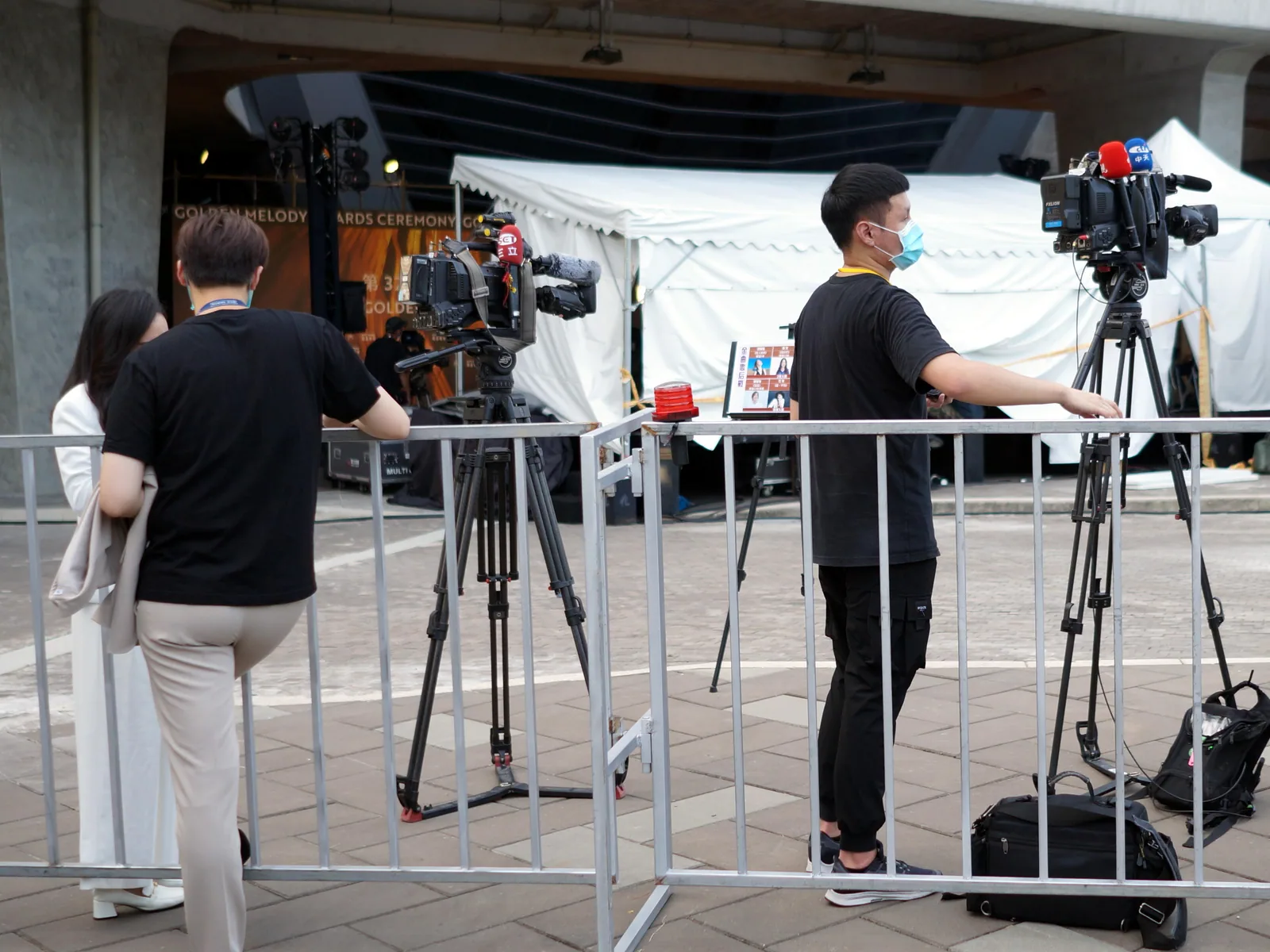
The Golden Melody Awards is the most influential stage for Mandopop; it was here that Panai brought up Tiananmen. Photo: Solomon203, 2021. CC BY-SA 4.0.
💡 Did you know? The best illustration of this occurred on one night during the 2024 Golden Melody Awards. Indigenous singer Panai reminded the audience at the 35th Golden Melody Awards that it has been exactly 35 years since the Tiananmen Square incident, saying, "let's not forget" 33. China immediately removed her works from its platforms. Panai's subsequent response captured the essence of the matter: she said that Beijing's actions only highlighted how precious this freedom in Taiwan truly is 34. The blacklist, instead, became the best proof that "it can be sung here."
When Lai Ching-te delivered his speech at that year's Golden Melody Awards, he said, "Music is life, and music is also unfettered freedom" 35. While this might sound like mere platitude, in the context of Panai being deleted, A-mei being blacklisted, and Anpu being canceled, it serves as an inventory of what remains for an island that has lost its market.
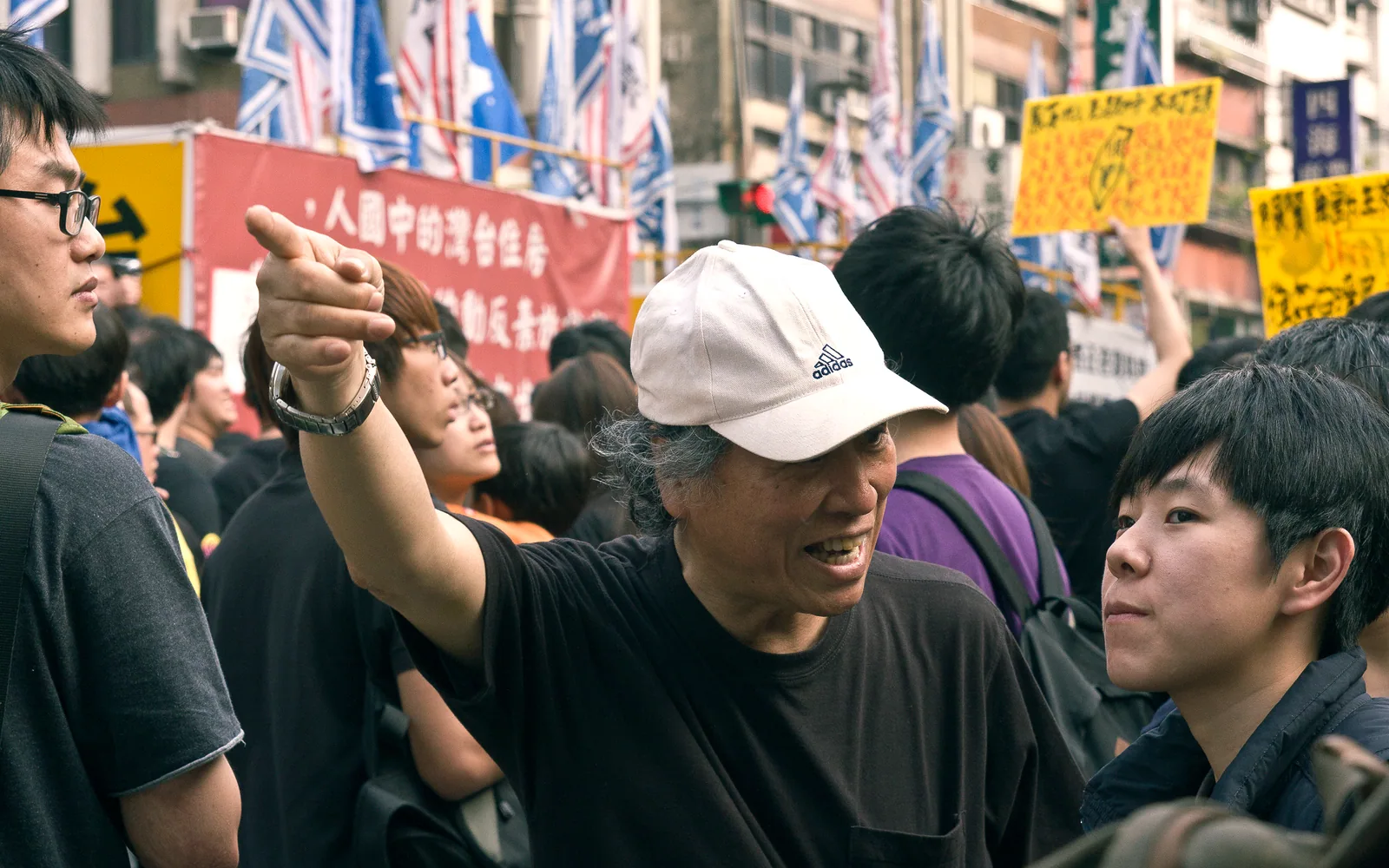
The other side of freedom is the courage to speak out. During the 2014 Sunflower Student Movement, members of the band Fire EX. and students from Taipei National University of the Arts wrote 〈Island's Sunrise〉 (Dao Yu Tian Guang) for the crowds occupying the Legislative Yuan; in late March, 500,000 people sang it together on Ketagalan Boulevard 36. The band released the copyright of the song for non-commercial use, and the following year, it won Song of the Year at the 26th Golden Melody Awards. That a song filled with political demands and born from street protests could be crowned in Taiwan's highest musical temple is something unimaginable on the other side of the Strait.
Fire EX. 〈Island's Sunrise〉 official. Fire EX. official channel. Written for the Sunflower Movement, sung by 500,000 people on Ketagalan Boulevard, winner of Song of the Year at the 26th Golden Melody Awards.
To Make Money, You Have to Go to China
But it would be dishonest to speak too romantically about "freedom." Freedom has a cost, and that cost is incurred every day.
Market gravity is real. In 2023, about 120 Taiwanese bands and singers performed in China, the highest number since 201837. For many musicians, westward expansion to China is a livelihood issue, not a political statement. One manager told The Reporter bluntly: "In Taiwan you can only keep yourself from starving; only by going to China can you really make money, then bring the money back to Taiwan to make music"38.
A new generation of musicians tries to find balance in between. Band vocalist Li Yang-hsuan said, "I would define the Chinese market as a bonus. If our main income all depends on that place, we will be tied down and unable to get away"39. But balance is hard to maintain. Creator Chang Chia-hsiang lamented: "We are increasingly like event PR companies"40. Among Taiwanese bands touring China, some choose silence on sensitive issues. A band manager who had supported Hong Kong and whose works were consequently removed told English-language media that he did not think this counted as self-censorship; it was simply "to ensure the safety of myself and my colleagues"41.
📝 Curator's note
This is the real dilemma of Taiwanese musicians, and it has no clean answer. On one side is "not starving in Taiwan, but not making money"; on the other is "making money in China, but having to keep your mouth shut." To scold those who choose to go west as "bootlickers," or to exalt those who insist on not going as "heroes," is too cheap, because the person making that judgment does not have to pay the rent.The sentence "freedom is Taiwan's last bargaining chip" is true, but it has never been a free chip. Opposite it always stands a larger market, hand extended. What is precious about Taiwan is not that everyone chooses freedom. It is that here, the choice itself is still allowed.
"Singing Our Own Songs" Actually Meant Mandarin
After speaking so much about "freedom," one must loop back and add a bass line that runs from beginning to end: inside Taiwan, there has always been another struggle over "whose voice counts." Whether one can sing outward is one matter. In whose language one can sing is another.
During martial law, what was suppressed was not only politics, but also mother tongues. Between 1951 and 1963, a series of Mandarin promotion policies required schools to strictly prohibit so-called dialects42. Article 20 of the Radio and Television Act (1976) stated in black and white: "Domestic broadcast language on radio stations shall primarily be Mandarin, and dialects shall be reduced year by year"43. In 1972, three television stations were required to broadcast "no more than two Taiwanese-language songs per day"44. Scholar Chen Pei-feng's observation is that Taiwanese-language songs long struggled to survive under the contempt of intellectual elites and state power.
This gives the famous campus folk movement of the 1970s an irony that few people point out.
In 1975, Yang Hsien held the "Modern Folk Song Composition Concert" at Zhongshan Hall in Taipei, setting nine poems by Yu Kwang-chung to music and singing them, all in Mandarin45. The following year at Tamkang University, during a Western folk concert, Lee Shuang-tse threw out the famous line: "Why are you spending twenty dollars to listen to Chinese people sing foreign songs?" (As for the Coca-Cola bottle in his hand, according to Tao Ching-ying's recollection, it was "brought offstage intact" and was not smashed; the "bottle-smashing" was later embellishment)46.
"Sing our own songs" became the slogan of an entire generation. But that "our own," when sung, was overwhelmingly Mandarin. Business Today's retrospective puts it directly: "The folk song movement was actually a Mandarin song movement; Taiwanese-language songs were as rare as phoenix feathers and unicorn horns"47. At the Golden Rhythm Awards, an important stage for folk songs, Chien Shang-jen's "First Month Tune" was almost the only Taiwanese-language entry.
📝 Curator's note
The historical position of the folk song movement is beyond doubt. It did indeed allow Taiwan's young people to begin writing their own songs and move beyond the stage of covering Western and Japanese songs. But if one romanticizes it as the moment "Taiwan recovered its own voice," one misses the most crucial layer: the "self" recovered was a Mandarin-speaking self.The Taiwanese-speaking communities that truly lived on this land and formed a majority of the population remained marginal in this movement. The moving power and blind spot of the slogan "sing our own songs" are precisely the same thing: it proves that even in a posture of resistance, Mandarin hegemony remained the unquestioned default.
From Third-Rate Songs to Album of the Year
The reversal of mother tongues has been a process of returning again and again after collision. No movement can settle it once and for all.
In 1989, Blacklist Studio released Songs of Madness, regarded as the starting point of the "New Taiwanese Song Movement." Its members included Wang Ming-hui, Chen Ming-chang, Chen Chu-hui, and Will Lin48. On December 7, 1990, Lim Giong released "Marching Forward." It sold 400,000 copies and won Song of the Year at the 3rd Golden Melody Awards in 1992, proving that Taiwanese could sing not only sorrowful old songs, but also rock, urban brightness, and youth49. In 1998, Wu Bai's Lonely Tree, Lonely Bird won Best Pop Vocal Album at the Golden Melody Awards and was described as a representative work of the "ten-year revival of the New Taiwanese Song Movement"50.
Lim Giong's official MV for "Marching Forward." Official Rock Records channel. In 1990, it used Taiwanese to sing urban brightness and forward momentum, proving that Taiwanese could sing more than sorrow.
Institutions gradually caught up. In 2005, at the 16th Golden Melody Awards, awards were established for Best Taiwanese, Hakka, and Indigenous-language Album51. In 2017, at the 28th Golden Melody Awards, the language-neutral Album of the Year award was established52.
Then came 2025. At the 36th Golden Melody Awards, Siri Lee's Taiwanese-language album Suí won three awards in one sweep: Album of the Year, Best Taiwanese Female Singer, and Best Taiwanese Album53. The Album of the Year trophy carried special weight: this was the first time a Taiwanese-language album had won the highest language-neutral honor54.
Siri Lee's official "Suí." Official Siri Lee channel. In 2025, this Taiwanese-language album won the Golden Melody Award for Album of the Year, the first time Taiwanese stood atop the highest language-neutral honor.
⚠️ A point that must be stated accurately
What Siri Lee achieved was "the first Taiwanese-language album to win Album of the Year," not "the first mother-tongue album" or "the first non-Mandarin album." Before her, Indigenous-language albums by Sangpuy in 2017 and ABAO, also known as Aljenljeng, in Paiwan in 2020 had already won Album of the Year55. To state the achievement too broadly would instead erase the path Indigenous musicians had already walked. The honest version is: the reversal of mother tongues in the highest hall of the Golden Melody Awards has been a relay, baton by baton. Indigenous languages arrived first; Taiwanese arrived later. Each baton was a recalculation of "whose voice counts."
From "no more than two Taiwanese-language songs a day" in 1972 to a Taiwanese-language album winning Album of the Year in 2025, half a century lies in between, along with an entire turn in language, power, and dignity.
It is also worth puncturing two widespread claims that in fact do not stand.
The first is the idea that "Taiwanese female singers rose in the 1990s." This is a mistaken historical view. Teresa Teng debuted in 1967, won the Golden Bell Award for Best Female Singer in 1980, and was the diva of all Asia. Fong Fei-fei debuted in 1971; Teresa Teng in the 1970s and Fong Fei-fei in the early 1980s were two successive generations of divas who defined the Mandarin music scene56. Tsai Chin became famous in 1979 with "Just Like Your Tenderness." They were already mainstream divas. Female singers did not only "rise" in the 1990s.
The second myth, about Indigenous singers, is more subtle. A-mei is Puyuma, Chang Chen-yue is Amis, and Chen Chien-nien is Puyuma. Their success is often attributed to the idea that "Indigenous people are naturally good singers." Online, there is even a saying: "Attaching the label 'I am Indigenous' is almost equivalent to hanging up a guarantee that 'the singing is excellent'"57. But the perspective of Golden Melody Awards judges was exactly the opposite. Taiwan Panorama quoted judges discussing wins by Chen Chien-nien and Samingad: "It had nothing to do with the fact that they are Indigenous; instead, we saw the originality of the music"58. Reducing a person's talent to bloodline is another form of refusing to treat a person as a person, even when it wears the mask of praise.
Freedom Is the Only Thing Not Taken Away After Losing Everything
Return to Hou Dejian that night.
"Descendants of the Dragon" changed owners three times. Each time it changed hands, it was because someone held power greater than the singer's: the record company, the Government Information Office, the other side of the Strait. Who decides the meaning of a song has always been a question of power, not of music.
Over forty years, Taiwanese pop music has lived out both sides of this truth. It was once the one holding the red pen, banning 898 songs. Later, it put down the red pen and paid forty years of cost in exchange for "not censoring." It was once the factory that wrote songs for the whole world. Later, it even lost its own market to the other side of the Strait. It failed, unlike South Korea, to produce a BTS outward toward the world, and watched helplessly as the center moved away.
In terms of scale, Taiwan has long since ceased to be the largest market in the Sinophone world. That fact will not be reversed. But when a song about June Fourth disappears from every platform across the Strait, when saying "Tiananmen, don't forget" causes a singer to be deleted, when "Tibet" has to be changed into "heart" before it can be heard, the thing Taiwan holds that cannot be lost begins to show its weight.
In 2025, Siri Lee used a Taiwanese-language album to turn songs once dismissed as "songs sung by third-rate people" into Album of the Year. From Wen Hsia's 99 banned songs to this Album of the Year trophy, what happened in between was how an island spent half a century taking the matter of "whether something can be sung" back into its own hands, word by word.
What remains is not scale. It is freedom, the only thing not taken away after everything else was lost. And the most moving part of freedom has never been that it lets people win. It is that it lets people sing what others cannot sing.
Further Reading:
- Taiwan's Folk Song Movement: Whose Songs Were "Singing Our Own Songs"?
- The Evolution of Taiwanese-Language Songs: From a Banned Mother Tongue to Album of the Year
- Pop Music and the Golden Melody Awards: Whose Voice Counts, and Who Decides?
- Taiwan's Music Industry and the Streaming Era: Regaining Blood After the Collapse of Physical Records
- Teresa Teng: The Diva Who Sang Across Taiwan, Hong Kong, and China, Yet Never Performed in China Before Her Death
Image Sources
This article uses three public-domain / CC-licensed images, all cached under public/article-images/music/ to avoid hotlinking source servers. Videos are all standard YouTube embeds from official channels:
- Sunflower Movement crowd (hero) — Photo: tomscy2000, 2014, CC BY 2.0
- Teresa Teng, 1980s portrait — Photo: Unknown, early 1980s, Public domain (published in the United States, 1978-1989, with no copyright notice)
- Television broadcast cameras at the 32nd Golden Melody Awards — Photo: Solomon203, 2021, CC BY-SA 4.0
- Videos: Lee Chien-fu, "Descendants of the Dragon" / Lim Giong, "Marching Forward" (official Rock Records); Fire EX., "Island's Sunrise" (official Fire EX.); Siri Lee, "Suí" (official Siri Lee)
References
- Wikipedia: Descendants of the Dragon — Records the background of "Descendants of the Dragon," written by Hou Dejian on the night of December 16, 1978, when the United States severed relations with the Republic of China and established relations with the People's Republic of China; the motivation was to lament Chinese people's long history of being manipulated by foreign powers.↩2
- Wikipedia: Descendants of the Dragon — Details the sequence of lyric revisions in the chorus, from the original "the sword of slaves" to the record company's proposed "the sword of foreigners" (which Hou Dejian rejected), and finally to the settled version, "the sword of appeasement."↩
- Wikipedia: Descendants of the Dragon — Records that James Soong, then director-general of the Government Information Office, wrote another version beginning "the bell of self-strengthening awakens the national soul..." for official speeches, while insisting that Hou's own version be banned from performance.↩
- Wikipedia: Hou Dejian — Records the full sequence in which Hou Dejian went to China in June 1983, after which "Descendants of the Dragon" was banned in Taiwan and was unbanned after martial law was lifted in 1987.↩2
- The News Lens: When "Descendants of the Dragon" Became a Symbol of Blood-Based Nationalism — Political scientist Chen Fang-yu's 2019 analysis of how the lyrics "black eyes, black hair, yellow skin" in "Descendants of the Dragon" were appropriated by China into a discourse of blood-based ethnic nationalism.↩2
- Wikipedia: Rock Records — Records the industrial ecology of Taiwan as the Mandopop production center in the 1980s, and the history of producers such as Jonathan Lee creating signature works for singers across regions.↩
- Taiwan Insight: Taiwan as the creative heart of Mandopop — The academic platform Taiwan Insight (Koh 2018) analyzes the formation of Taiwan as the "epicentre" of Mandopop, and notes that its roots lay "firmly in the soils of political dissent and a yearning for free expression."↩
- Bureau of Audiovisual and Music Industry Development, Ministry of Economic Affairs press release — Official data stating that Taiwanese companies once held an 80 percent share of the Mandopop market, along with industry statistics such as a 2011 total output value of NT$10.292 billion.↩
- Wikipedia: The Goodbye Kiss — Records that Jacky Cheung's 1993 album The Goodbye Kiss sold 1.36 million copies in Taiwan, the market description that "one in every 20 people bought one copy," and total sales data across Asia.↩
- Wikipedia: Bad Boy (A-mei album) — States that A-mei's 1997 album Bad Boy sold 1.38 million copies in Taiwan, making it the best-selling studio album in Taiwan's history, with Asian sales of about 6 million copies.↩
- Taiwan Panorama, "The Future of Pop Music" — The official publication states verbatim that "Taiwan's total record market rapidly shrank from an output value of NT$12.3 billion in 1997 to NT$3.15 billion in 2005," and that Jay Chou's peak sales were about 300,000 copies.↩2
- Mirror Media / READr record market feature — Gives the market coordinates that "Taiwan in 1997 was once second in the Asian record market (behind only Japan) and 13th in the world record market."↩
- Vocus: The Avalanche of Taiwan's Record Industry — Summarizes the chain of collapse: CD burners becoming widespread in 1998, Napster and pirated MP3s in 1999, and physical record sales "falling like an avalanche" in 2001.↩
- Atlantic Council: Surfing the Hallyu wave — States that South Korea's culture budget increased from US$14 million to US$84 million from 1998 to 2001, a fivefold increase, and compares per capita cultural spending in South Korea and Taiwan (US$145 vs. US$37).↩
- Korean music industry statistics — Statistics showing that Korean pop music ranked seventh globally in 2018, that K-pop's global output value was about US$7.1 billion in 2023, and the contrast that Taiwan was not in the top ten.↩
- Linking Vision: Two Mandopop Worlds — States that China's record market in 2018 was seventh globally and second in Asia according to IFPI, and analyzes the "host-guest reversal" in which Chinese platforms came to dominate the Mandopop industry.↩
- Linking Vision: Interview with Shao Yide — Records veteran music figure Shao Yide's verbatim remark that "there seem to be two Mandopop worlds. One is above the rivers and lakes... internet 'divine songs' produced in batches and distributed by algorithms; the other is in the hall... high-quality music refined through industrialization."↩
- Taiwan Creative Content Agency (TAICCA) industry survey — Officially states that Taiwan's pop music total output value in 2023 was NT$28.836 billion, up 19.79 percent year over year, under a broad industry definition including performance, copyright, and digital.↩2
- Taiwan Creative Content Agency (TAICCA) industry survey — States that in 2023 there were 7,134 live performances, up 31 percent year over year, with ticket sales of NT$6.717 billion, up 131 percent, illustrating the share of live performance within the broad NT$28.8 billion output value.↩2
- Central News Agency: The Silenced Martial-Law Years — States that during martial law, Taiwan Garrison Command and other agencies cumulatively banned 898 songs, that Wen Hsia had the most bans with 99 songs, and cases such as "Olive Tree" being banned for eight years.↩2
- Central News Agency: The Silenced Martial-Law Years — Same source, explicitly listing Taiwanese-language king Wen Hsia as having 99 songs banned, the highest number for any singer in Taiwan.↩
- StoryStudio: A Complete Review of Taiwan's History of Banned Songs — Details the banning reasons for "When Will You Return?" over the suspected allusion in ri jun, "Olive Tree" for homesickness and wandering, and "Not Coming Home Today" for the word "home" allegedly alluding to China and violating the counterattack policy.↩
- Central News Agency: The Silenced Martial-Law Years — Records that "Mother, I Am Brave and Strong Too," composed by Teng Yu-hsien, was banned for 33 years.↩2
- StoryStudio: A Complete Review of Taiwan's History of Banned Songs — States that the legal basis for song censorship was the 1973 Publication Act and the 1976 Radio and Television Act, that songs had to be reviewed before release, that review effectively ended in 1990, and that this was formally announced in 1991.↩
- Taiwan Peace Foundation: The Abolition of Language Restrictions in the Radio and Television Act — Records that the clause restricting dialect programming in the Radio and Television Act was deleted by the Legislative Yuan on July 14, 1993.↩
- Central News Agency: 30th Anniversary of the Lifting of Martial Law — States the historical date on which Taiwan lifted martial law: July 15, 1987.↩
- Variety: China karaoke songs ban — States that China's NRTA conducts prior review of lyrics, albums, and performances, and describes the KTV blacklist that took effect on October 1, 2021, banning content that "endangers national unity" and other categories.↩
- Central News Agency: Li Zhi Removed from All Platforms — Reports that Chinese independent musician Li Zhi's works were removed from all platforms in 2019 because of "The Square," a work about June Fourth.↩
- Taiwan Insight: The Fear Factor — Analyzes three censorship mechanisms China applies to Taiwanese pop music, including Mayday being required to change the lyric "Tibet" to the homophonous "heart" for filing approval, and Jolin Tsai's LGBTQ-themed "Womxnly" being banned in China.↩
- SETN: The A-mei Blacklisting Incident — Reports that after A-mei sang the national anthem at the 2000 presidential inauguration, she was blacklisted by China for about four years, with the ban lifted in 2004.↩
- Public Television Service News: Deserts Chang Flag Incident — Reports that Deserts Chang accepted a Republic of China flag at a 2013 concert in Manchester, England, called it "the flag of my hometown," and subsequently had three Beijing performances canceled.↩
- Epoch Times: Teresa Teng and Democratic Songs for China — Records that Teresa Teng sang at the 1989 "Democratic Songs for China" concert at Happy Valley Racecourse in Hong Kong under a sign opposing military rule, and that she never performed in China before her death.↩
- Taipei Times: Panai at Golden Melody Awards — Reports that Indigenous singer Panai said onstage at the 35th Golden Melody Awards in 2024, "The Tiananmen Square incident is also exactly 35 years old, let's not forget," after which her works were removed in China.↩
- Taipei Times: Panai at Golden Melody Awards — Reports Panai's later response that "Beijing's actions further underscore the precious freedom in Taiwan," saying China's move instead highlighted the preciousness of Taiwan's freedom.↩
- Taipei Times: Panai at Golden Melody Awards — Records President Lai Ching-te's remark at the 35th Golden Melody Awards: "Music is life, and music is also unfettered freedom."↩
- Wikipedia: Island's Sunrise — Records that Fire EX. and Taipei National University of the Arts students created "Island's Sunrise" for the 2014 Sunflower Movement, that 500,000 people sang it together on Ketagalan Boulevard, that the band released the rights free of charge for noncommercial use, and that it won Song of the Year at the 26th Golden Melody Awards.↩
- The Reporter: Echoing Red Chorus — In-depth report stating that about 120 Taiwanese bands and singers performed in China in 2023, the highest level since 2018, and interviewing multiple musicians about the dilemma of going west.↩
- The Reporter: Echoing Red Chorus — Records a music manager's verbatim interview remark: "In Taiwan you can only keep yourself from starving; only by going to China can you really make money, then bring the money back to Taiwan to make music."↩
- The Reporter: Echoing Red Chorus — Records musician Li Yang-hsuan's verbatim remark: "I would define the Chinese market as a bonus. If our main income all depends on that place, we will be tied down and unable to get away."↩
- The Reporter: Echoing Red Chorus — Records creator Chang Chia-hsiang's verbatim lament, "We are increasingly like event PR companies," reflecting how touring in China dilutes creative energy.↩
- Domino Theory: Taiwan's younger musicians and China — Records the verbatim statement of a band manager whose band's pro-Hong Kong work was removed: "I don't believe this is self-censoring, this is to ensure the safety of myself and my colleagues."↩
- Lee Hsiao-feng: Mandarin Policy and Taiwan's Languages — Scholar Lee Hsiao-feng summarizes a series of Mandarin promotion policies, including the 1951 strict prohibition of dialects, 1952 strengthening of Mandarin, and 1963 language guidelines.↩
- Wikisource: Radio and Television Act (enacted in ROC year 64, promulgated in ROC year 65) — Primary legal text; Article 20 states, "Domestic broadcast language on radio stations shall primarily be Mandarin, and dialects shall be reduced year by year."↩
- Wikipedia: Mandarin policy — Cites the 1972 broadcasting regulation requiring three television stations to broadcast "no more than two Taiwanese-language songs per day."↩
- Business Today: The Folk Song Movement Was Actually a Mandarin Song Movement — States the historical fact that Yang Hsien's June 1975 "Modern Folk Song Composition Concert" at Zhongshan Hall set nine poems by Yu Kwang-chung to music, all in Mandarin.↩
- Business Today: The Folk Song Movement Was Actually a Mandarin Song Movement — Records Lee Shuang-tse's famous 1976 Tamkang line, "Why are you spending twenty dollars to listen to Chinese people sing foreign songs?", and Tao Ching-ying's confirmation that the Coca-Cola bottle was "brought offstage intact," with the "bottle-smashing" being later embellishment.↩
- Business Today: The Folk Song Movement Was Actually a Mandarin Song Movement — States verbatim that "the folk song movement was actually a Mandarin song movement; Taiwanese-language songs were as rare as phoenix feathers and unicorn horns," and notes that Chien Shang-jen's "First Month Tune" was the only Taiwanese-language entry in the Golden Rhythm Awards.↩
- Fount Media: The New Taiwanese Song Movement — States that Blacklist Studio's 1989 Songs of Madness was the starting point of the New Taiwanese Song Movement, with members including Wang Ming-hui, Chen Ming-chang, Chen Chu-hui, and Will Lin.↩
- United Daily News: Lim Giong's "Marching Forward" — States that Lim Giong's "Marching Forward" was released on December 7, 1990, sold 400,000 copies, and won Song of the Year at the 3rd Golden Melody Awards in 1992, proving the rock and urban possibilities of Taiwanese-language song.↩
- Fount Media: The New Taiwanese Song Movement — States that Wu Bai's Lonely Tree, Lonely Bird won Best Pop Vocal Album at the 10th Golden Melody Awards in 1998 and represented the "ten-year revival of the New Taiwanese Song Movement."↩
- Wikipedia: Golden Melody Award for Best Taiwanese Album — Records the institutional development in which the Golden Melody Awards established Best Taiwanese, Hakka, and Indigenous-language Album awards at the 16th awards in 2005.↩
- Wikipedia: Golden Melody Award for Album of the Year winners — Records that Album of the Year was established at the 28th awards in 2017, and lists winners including Sangpuy (2017), ABAO (2020), and Siri Lee (2025) by language.↩
- Central News Agency: Siri Lee's Suí Wins Three Awards — Reports that Siri Lee's Taiwanese-language album Suí won Album of the Year, Best Taiwanese Female Singer, and Best Taiwanese Album at the 36th Golden Melody Awards.↩
- Bella: Siri Lee's Album of the Year Is the First Awarded to a Taiwanese-Language Album — Records that Siri Lee's Suí was the first Taiwanese-language album to receive the Album of the Year award.↩
- Wikipedia: Golden Melody Award for Album of the Year winners — The winners list confirms that Sangpuy's Indigenous-language album (2017) and ABAO's Paiwan album (2020) had already won Album of the Year before Siri Lee, making Siri Lee's win a "first for Taiwanese," not a "first for mother tongues."↩
- Wikipedia: Fong Fei-fei — States that Fong Fei-fei recorded her first song in September 1971 and released her first album in 1972, and that she stood alongside Teresa Teng in the 1970s and was a Mandarin pop diva in the early 1980s, confirming that female singers did not only rise in the 1990s.↩
- DailyView: The Label of Indigenous Singers — Records the stereotype that "attaching the label 'I am Indigenous' is almost equivalent to hanging up a guarantee that 'the singing is excellent,'" reducing talent to bloodline.↩
- Taiwan Panorama: Golden Melody Awards and Indigenous Musicians — Quotes Golden Melody Awards judges discussing Chen Chien-nien and Samingad's wins: "It had nothing to do with the fact that they are Indigenous; instead, we saw the originality of the music."↩