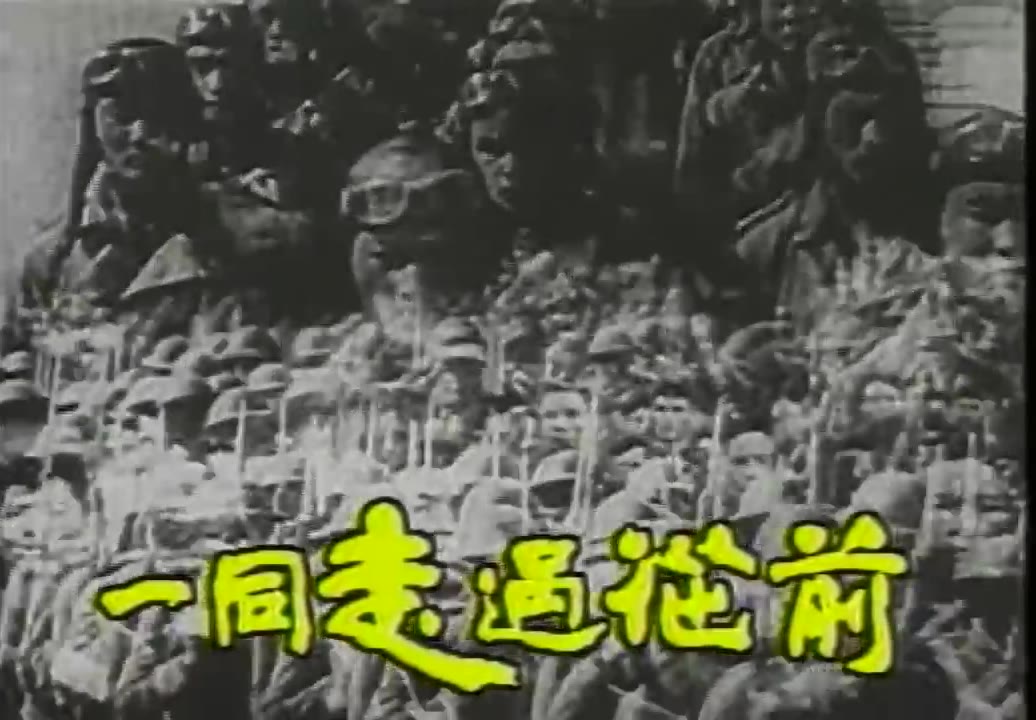
30-Second Overview: 《Walking Through the Past Together》 is a documentary series broadcast by TTV over four consecutive days from July 4 to 7, 1988. The four episodes span from the end of World War II to the passing of Chiang Ching-kuo, with cinematography and editing by photographer Chang Chao-tang. Since its founding in 1981, Common Wealth Magazine has contemplated how Taiwan arrived at its current state and where it is headed; founder Yin Yun-peng chose to release this film on the eve of the opening of the Kuomintang's 13th National Congress. The narration uses the official language of that year, and Chang Chao-tang brought in over sixty people who personally lived through those forty years: Ji Cheng, who was once an adopted daughter; tenant farmers who faced annual rent hikes; and rongmin (veterans) blasting roads in the mountains. Representatives from both the Kuomintang and the Democratic Progressive Party also speak in the same film. A year and a half later, a Chinese pro-democracy activist said he had seen this videotape in Beijing and remembered it as "memories with flesh and blood" 1.
On the Eve of July 22, Yin Yun-peng Chose This Moment
In the July 1, 1988 issue of Common Wealth Magazine (Issue 86), founder Yin Yun-peng wrote a short article inviting readers to turn on their televisions at the beginning of the month. The opening sentence was: "On the eve of July 22, the Kuomintang's 13th National Congress is imminent." Chiang Ching-kuo had passed away six months prior. She described many policies at the time as "still murky and unclear," with power struggles erupting and a sense of unrest permeating society. Common Wealth "specifically chose this moment" to release a television special2.
The special was titled 《一同走過從前》 (Walking Through the Past Together), covering the period from the end of World War II to early 1988. From July 4 to July 7, TTV aired four consecutive days, one episode per day. The final day happened to coincide with the opening of the 13th National Congress3. At that time, there were only three television channels. The cinematography and editing were handled by photographer Chang Chao-tang, while the planning and writing were done by Common Wealth's Sun Man-pin and Li Se2. Across the four episodes, more than sixty named individuals spoke to the camera. Among them were Kuomintang Deputy Secretary-General Ma Ying-jeou, Democratic Progressive Party Chairperson Yao Chia-wen, tenant farmers from Taoyuan, and veterans from Dayuling4. Common Wealth stated it had "condensed forty years into four hours." Today, the four episodes on the official channel run approximately 47 to 50 minutes each, totaling just over three hours5.
Source: Title cards from the four episodes of Common Wealth Magazine's 《一同走過從前》, compiled episode by episode for Taiwan.md. Only unique individuals who spoke on camera are counted, categorized by their 1988 titles as shown on screen: Government officials, KMT party positions, and KMT legislators are categorized under "Government & KMT"; DPP party positions and representatives or activists appearing as non-KMT (Tangwai) figures are categorized under "Tangwai & DPP"; executives of state-owned enterprises are categorized under "Enterprise & Engineering."
In another section of the same magazine issue, Yin Yun-peng listed one by one the unanswered questions of that summer: Would there be a cabinet reshuffle? Would the ruling party undergo reform? Where was the policy toward mainland China headed? The final question was: "After achieving prosperity, where is the nation's goal?"2 To answer where we are going, we must first understand how we arrived at today. This film constitutes the first half of that journey. In her invitation, she stated that the special hoped to "find qualities and spirits worth cherishing" from our shared memory6. Since its founding year, Common Wealth has been asking this very same question.
Driven Out of Military and Diplomacy, the World's Fate Rested on the Path of Economy
Common Wealth was founded on June 1, 1981, nearly ten years after Taiwan's withdrawal from the United Nations and more than two years after the severance of diplomatic relations between the ROC and the United States7. In October 2026, Yin Yun-peng met with Wu Che-yu, the founder of Taiwan.md, and spoke about why she started the magazine back then: "Military and diplomacy had already been driven out by everyone; we were like orphans. We could only rely on ourselves, and the only remaining path was the economy."8 She linked this issue to dignity, saying, "Everyone hopes to live with dignity." At that time, the traditional social hierarchy of scholars, farmers, artisans, and merchants still prevailed, with merchants ranked last. She said Common Wealth therefore "used the term 'entrepreneur' to describe merchants," and gradually, everyone began to act like entrepreneurs8.
Military and diplomacy had already been driven out by everyone; we were like orphans. We could only rely on ourselves, and the only remaining path was the economy.
Source: Oral account from meeting between Yin Yun-peng and Taiwan.md, October 21, 2026
On January 13, 1988, Chiang Ching-kuo passed away. For its February issue (Issue 81), Common Wealth produced a special retrospective series titled 〈Walking Through the Past, Returning to the Future〉. In the preface, Yin Yun-peng wrote that at the moment the guards carried the coffin out of the main hall of the Martyrs' Shrine, "in an instant, the entire nation fell silent." She followed this with a sentence that was later borrowed for a film: "Short-sightedness, pursuit of immediate gains, roughness and instability, lack of appreciation, lack of respect, and an inability to be grateful—all because we are too timid to look back, neglect our memories, and have no history."9
The special series was handled by three young editors who "interviewed over a hundred people from various walks of life," flipping through books and visiting newspaper offices and school archives. Li Se, who wrote about the first twenty years and was born in 1956, reflected on that work: "History is actually written so vividly upon every person and in every hand." Lin Chao-wu, born in Taitung in 1959, who covered the third stage, traveled to Taipei for exams the year he graduated from junior high school; he took a highway bureau bus to Kaohsiung and then transferred to a train, a journey that took nearly fourteen hours. He said his understanding of Taiwan's economic development was "gradually pieced together and built up through these fragmented yet extremely intimate sensations"9.
Regarding the idea of bringing this written special series to the silver screen, Yin Yun-peng said it "only became possible after meeting Chang Chao-tang." Once they started working, Sun Man-pin and Li Se realized that television was far more complex than imagined: "A moving story that can be easily glossed over in two paragraphs in text requires a seamless coordination of vivid images, footage, and sound when put on screen"2.
Chang Chao-tang Goes Looking for the Living
When filming the guide videos for Walking Through the Past in 2016, Chang Chao-tang recalled that before Yin Yun-peng made this film, she had consulted many people, and Lin Hwai-min suggested looking for him. He agreed to try, knowing that "the difficulty lies in the fact that this is a massive undertaking with a huge scope." When he took on the project in 1987, he said he was forty-five or forty-six years old, and perhaps it was precisely that age that allowed him to understand how his previous experiences had come to be10. He first had the written transcripts from Common Wealth, which he called "the skeleton of printed text"; forty years of news footage and visual archives were the muscle; what was ultimately missing was the blood: "It is dead data; how do you find living people?" He wanted people who lived through that era to speak about their feelings and experiences at the time10.
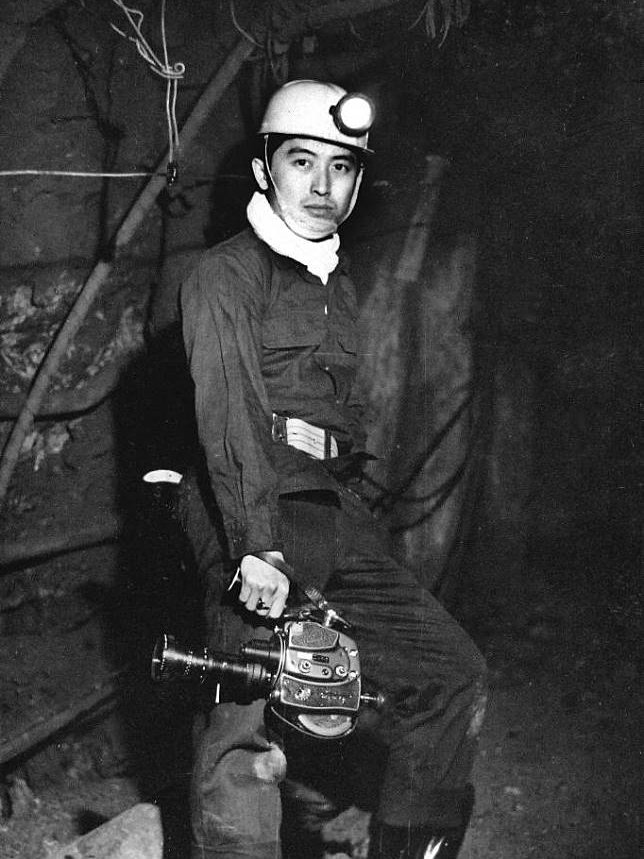
Chang Chao-tang in his youth; Commons describes the photo as taken in March 1970. Photo: Jadegoddess, CC BY-SA 4.0, cropped by this site.
Finding old footage was another challenge. Yin Yun-peng wrote about historical scenes and camera angles, noting that "in Taiwan, where there is a general lack of historical sense and little emphasis on data preservation, finding them is particularly difficult"2. After reading the transcripts, Chang Chao-tang felt that most of the content discussed construction, education, and the economy, with "less mention of culture," so he told Lin Hwai-min, "We need to add more cultural elements"11. Editing became the part of the work he later found most rewarding; he compared filming to going to the market to buy groceries, while editing is like cooking in the kitchen. Relying on his past experience, he blended good ingredients into a delicious dish: "Editing can make a dead horse run like a living one"10.
When the first episode was finished and screened, a friend asked Yin Yun-peng: "Why are there so many sounds of military marches and songs?" She responded publicly in the magazine, stating that one reason was the difficulty of finding grassroots footage, and another was that during the first decade of Taiwan's post-war era, "survival came first, and military priority was paramount." At that time, military parades and songs "originally represented security and excitement"2. The film's opening also acknowledges that it stands in an uncertain era, with the narrator asking: "Where exactly did we transition from, and where are we transitioning to?"12 In the following four episodes, most of those who answer this question are the people Chang Chao-tang sought out.
Ten Years Post-War: From Having Nothing to Owning a Piece of One's Own Land
To describe the poverty of the first few years after the war, the film uses the diary of writer Chung Li-ho: when a pig died in the countryside of Pingtung, the grieving looks on people's faces were more sorrowful than if they had lost their own parents13. Some families, struggling with poverty and many children, gave their daughters away to be raised by others; the young Chi Cheng was one of them. She remembers that when her adoptive mother went out to buy groceries, she feared Chi would sneak back home, so she would tie her hands and feet to a chair. Having learned to sing kua-á-hí (Taiwanese opera) as a child, being tied up made her feel her life story was pitiful; she would cry while singing the songs of the "bitter female" roles14. Chen Ting-nan from Yilan remembers that during 1950 and 1951, every meal at his home was mixed with sweet potato shreds, and only his grandfather, who was in poor health, had a bowl of white rice. The two brothers grew tired of eating sweet potato rice and would scramble for their grandfather's bowl at every meal; eventually, the grandfather simply left plenty of leftovers at each meal so they could share them15.
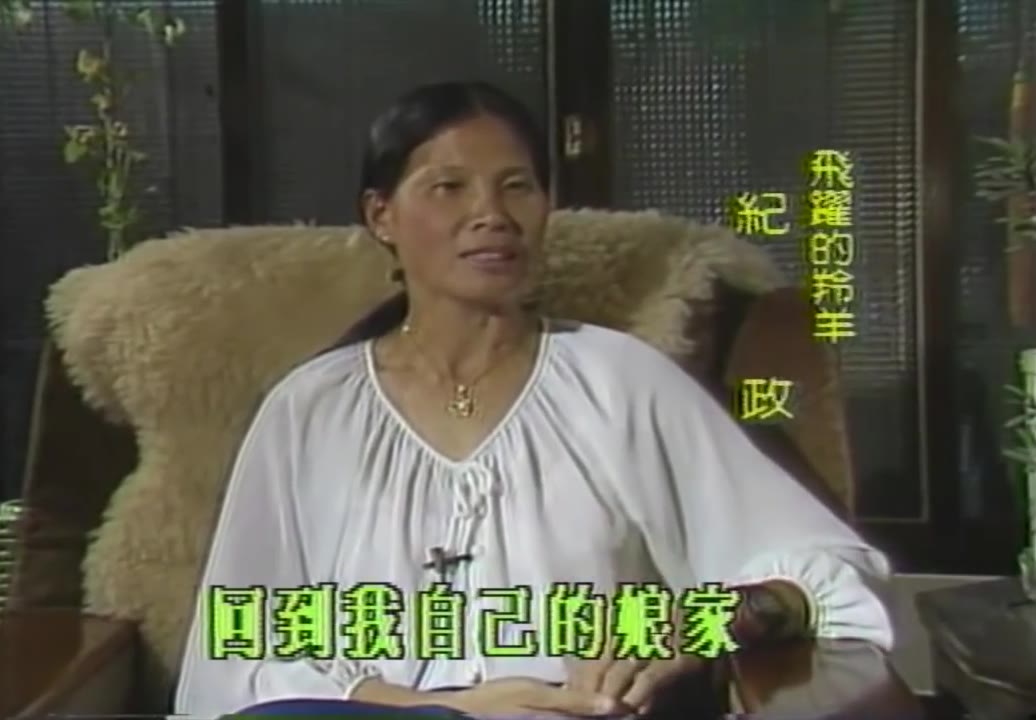
Common Wealth Magazine "Walking Through the Past" Episode 1, interview footage and title card for Chi Cheng (09:01). © Common Wealth Magazine.
At the end of 1949, the Nationalist Government retreated to Taiwan. The following year, Chang Shao-kang's mother traveled to Taiwan alone by boat, while his father remained on the mainland. When the boat leaked at sea, everyone on board threw all their belongings overboard, leaving only a single thermos; everyone took turns using it to scoop water out. At that time, he was still in his mother's womb16. During this same period, tenant farmers in the countryside were waiting for a piece of land of their own. In 1949, the July 375 Rent Reduction Act was implemented; in 1951, public land was released for distribution; and in 1953, the "Land to the Tiller" program began17. Zhuang Lung-ying, a farmer from Taoyuan, said that previously, most fields belonged to the landlords, and lease agreements had to be renegotiated every year. Even if a landlord agreed to renew, they would increase the demand—if it was 4,000 catties this year, it would be 4,500 next year. After the land reforms, each household finally had its own field18.
Those who gained land were the local tenant farmers; the veterans from the mainland, meanwhile, headed into the mountains. Construction on the Central Cross-Island Highway began in 1956; the film notes that from that year onward, three to four thousand veterans worked on construction deep in the mountains19. Chen Chi-cheng, a veteran from Dayuling, spoke of life at the construction site: they would eat breakfast and start work, then there would be blasting at noon—once it exploded, you couldn't be sure if people were still alive or not20. An Tang-hsing, a veteran from Lishan, had followed his father into the fields since childhood, but upon reaching the mountains, he still grew vegetables and flowers. Speaking of his own plot of land, he said: "This piece of land can be passed down; it can pass down my roots"21.
The film focuses its conclusion on one of the veterans who settled in the mountains and on farms. Liu Pi-chia, from a farm in Hualien, did not marry until he was fifty-two; after being discharged from the military, he brought his large family to settle on the farm. More than twenty years ago, Chen Yao-chi, who was studying film at the University of California, chose him as the protagonist for a documentary as his graduation project. That film attracted considerable attention in Taipei's cultural circles, but according to the narration, Liu Pi-chia himself has never seen it to this day. The final shot lingers on him at seventy-two, riding a bicycle along a small path between fields22.
Common Wealth Magazine Official YouTube Channel: Common Wealth Magazine "Walking Through the Past" Episode 1, 〈The Era of Cultivation〉. Chi Cheng, Chen Ting-nan, Chang Shao-kang, Zhuang Lung-ying, and the veterans of the Central Cross-Island Highway all share their stories of the ten years post-war in this episode.
During the Years When the Artillery Fire Hadn't Ceased, Taiwan Began Making Its Own Things
With fields and roads established, the war across the Strait had not yet ended. Facing shortages of supplies, a "hardship-overcoming movement" was launched within the military; writer Sima Zhong-yuan said this spirit continued in the military for decades—while other countries had long since sent their old C-119 aircraft to museums, Taiwan's were still flying23. When Chao Shao-kang was in his third year of junior high school, he often saw reports in newspapers about batches of anti-communist soldiers heading to mainland China, only to be annihilated upon landing. He and several classmates wrote letters saying they didn't want to study anymore and wanted to join the military; a battalion commander replied, advising them that they were still young and should focus on their studies first24. Air combat hero Ouyang Yi-fen said that when they went on missions, they often didn't have time to eat, grabbing a steamed bun before boarding the plane; during the 1956 air battles in the Taiwan Strait, he shot down two MiG fighters25.
On the evening of August 23, 1958, PLA artillery bombarded Kinmen heavily. Chang Kuang-chi, a Chinese-American photographer for NBC, visited Kinmen for interviews more than twenty times. He remembered photographing between bunkers and artillery positions when a row of shells landed on top of a bunker, making his heart nearly leap out of his mouth. During the time the reporter followed supply ships to engage in beach landings, an amphibious vehicle caught fire and sank halfway through; several Chinese and foreign reporters lost their lives. One Chinese reporter drifted at sea for thirty hours before being rescued; from then on, he refused to eat fish, saying that since the fish hadn't eaten him, he wouldn't eat them26.
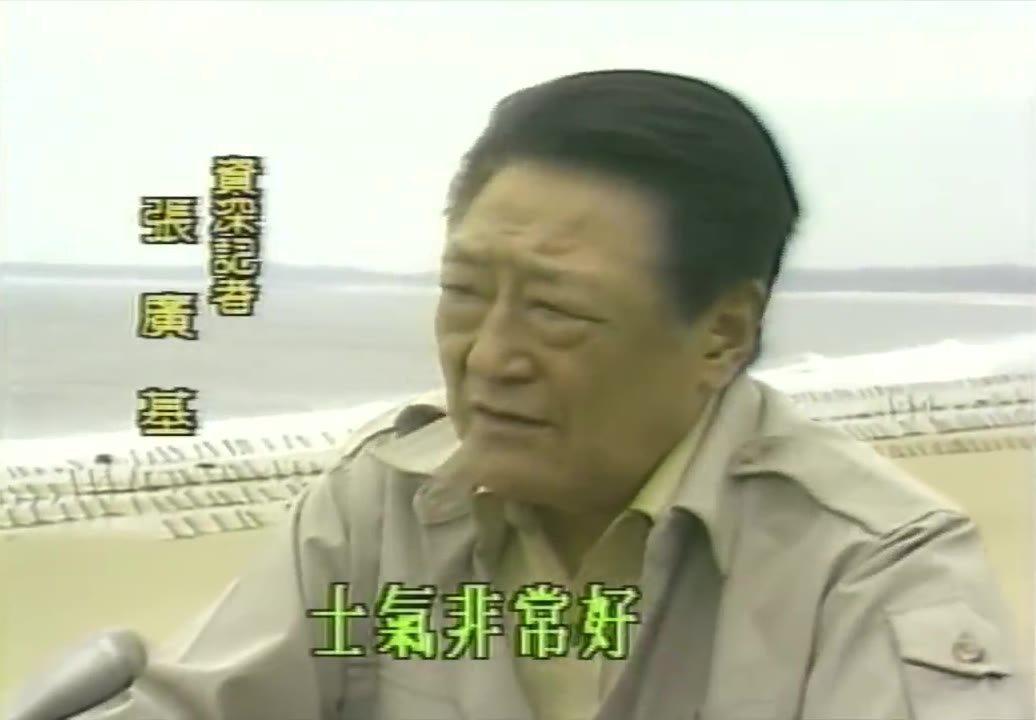
《Walking Through the Past》 Episode 2, Chang Kuang-chi reminisces about the August 23 Artillery Battle on a Kinmen beach (28:10). © Common Wealth Magazine.
During that same period, near Tainan Airport, an elementary school student named Chu Hsin would often run to his classroom window to watch planes returning. His teacher told him that whether they were ours or American, "they are actually all planes made by Americans, not made by our own people." From then on, he vowed to study aviation; many years later, he led a group of young engineers to design the Foetus car27. He wasn't the only one who wanted to make things themselves. The government allocated US-aid cotton to textile mills like Tai Yuen; Tai Yuen's sales team later supported Yulon, founded by Yen Ching-ling in 1953. Wu Shun-wen said her husband believed that only the automotive industry could integrate all mechanical industries; on National Day in 1956, Yulon produced its first jeep28.
After the August 23 Artillery Battle, the Taiwan Strait gradually calmed. The government enacted the Statute for Investment to attract domestic and foreign industrialists to set up factories through tax exemptions and simplified procedures29. As life became slightly more comfortable, Yang Chuan-kuang won a silver medal in the decathlon at the Rome Olympics in 1960. The film mentions that when Ling Bo came to Taiwan for 《Liang Shanbo and Zhu Yingtai》, she was surrounded by fans at Songshan Airport, and it took forty bodyguards forty minutes to push her through the crowd30. In 1962, TTV began broadcasting, marking Taiwan's entry into the television era. The program Stars Gathering sang for fourteen and a half years from its debut until it stopped airing in 1977; the narration states plainly that the cancellation was to coordinate with the government's promotion of "purified songs." The emergence of television also gave a boost to the home appliance industry, laying the foundation for these manufacturers to later produce computer terminals and cathode-ray tubes31.
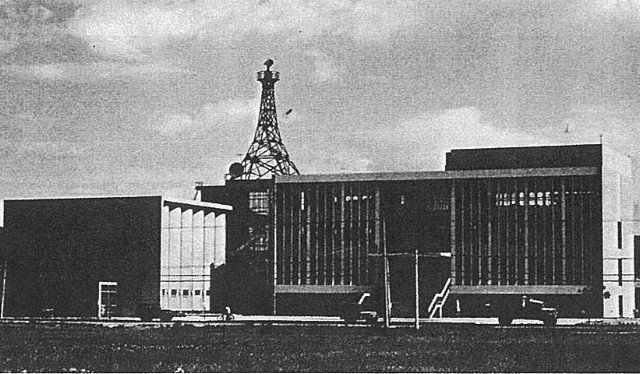
The Taiwan Television Co. building completed in 1962. Image source: Taiwan Television Co., 《Thirty Years of TTV》, marked as public domain by Commons.
US Aid Ends, UN Withdrawal Occurs: A Generation Looks Back at Their Land
In 1965, US aid ceased, and Taiwan had to find its own ways to earn foreign exchange. In 1966, the Kaohsiung Export Processing Zone was established. In his early forties, Chang Yung-fa started from a single old ship and founded Evergreen Marine32. Tens of thousands of children from rural villages left their fields for factories, earning money to send home33. With the implementation of nine years of compulsory education in 1968, Lin Hui-huang, an elderly farmer from Changhua, saw two of his children become PhDs. His eldest son, Lin Shu-chun, was then an associate professor at National Tsing Hua University; he noted that the family could afford it thanks to low tuition fees, as for such a small farming household, tuition of NT$4,000 or NT$5,000 was a significant burden34.
In 1968, the Hongye Little League team from Taitung defeated Japan's Chofu Star team. In the summer of 1972, Taipei City's little league and Meihe Little League both won world championships within a single week; people stayed up late at night watching overseas broadcasts through firecrackers—it was rare good news during those years of successive diplomatic setbacks35. The previous year, the Republic of China had withdrawn from the United Nations. Ou Chin-te, who was studying in the United States, saw Chou Shu-kai announce the withdrawal on television, followed immediately by the PRC representative taking the stage; he felt that they could no longer rely on the support of other countries "unless we devote ourselves to the construction of our own nation"36. The film mentions that over 2,500 people returned to the country within a five-year period; Ou Chin-te was one of them, and upon returning after completing his studies, he joined the expressway engineering projects, traveling daily to survey terrain36.
Common Wealth Magazine Official YouTube Channel: "Walking Through the Past" Episode 3, 〈The Moment of Takeoff〉. Ou Chin-te, Ma Ying-jeou, Wu Mei-yun, Lin Hwai-min, and Huang Chun-ming all appear in this episode; the segment for 〈Beautiful Island〉 begins at 35:39.
Successive diplomatic setbacks also prompted university students to look back at themselves. Ma Ying-jeou said that after the movement to protect Taiwan's sovereignty, intellectuals—who previously spoke only of Saudi Arabia and closed their mouths regarding Camus—began to reflect on their own local culture; subsequently, literature, music, and dance all began to grow indigenous elements37. When Wu Mei-yun told someone abroad that she was from Taiwan, the other person replied they had just seen The King and I; she had no choice but to explain she was not from Thailand. After returning home, she and her friends launched the English version of Han-sheng (Sound) magazine38. Lin Hwai-min said that for his generation of children growing up in Taiwan, rather than staying in the United States to criticize domestic affairs, it was better to return to their own place to do work39. Seeing university students rushing abroad immediately upon graduation, Huang Chun-ming went on to film television series to introduce this land and its people40.
The cultural elements that Chang Chao-tang felt were missing during his script reading are filled in here. In the folk song segment, following Yang Hsien, there is a photo of Li Shuang-ze; the lyric/composition cards state that Chen Hsiu-hsi and Liang Ching-feng wrote the lyrics, and Li Shuang-ze composed the music. This is followed by about fifty seconds of lyric subtitles accompanied by images of paddy fields, rice transplanting, and cattle plowing; although the song title is not displayed in the film, this song is 〈Beautiful Island〉41. Chang Chao-tang later said that at the time it was a banned song, but because it sang of Taiwan's beauty and its people, "it shouldn't have caused any real trouble, so I just used it without worrying at the time." He included it intentionally; folk songs are not just campus folk songs—this kind of song is what truly "relates to the entire land" 11. Both Chang Chao-tang and the introductions from Common Wealth state that this was the first time the song was broadcast on television42.
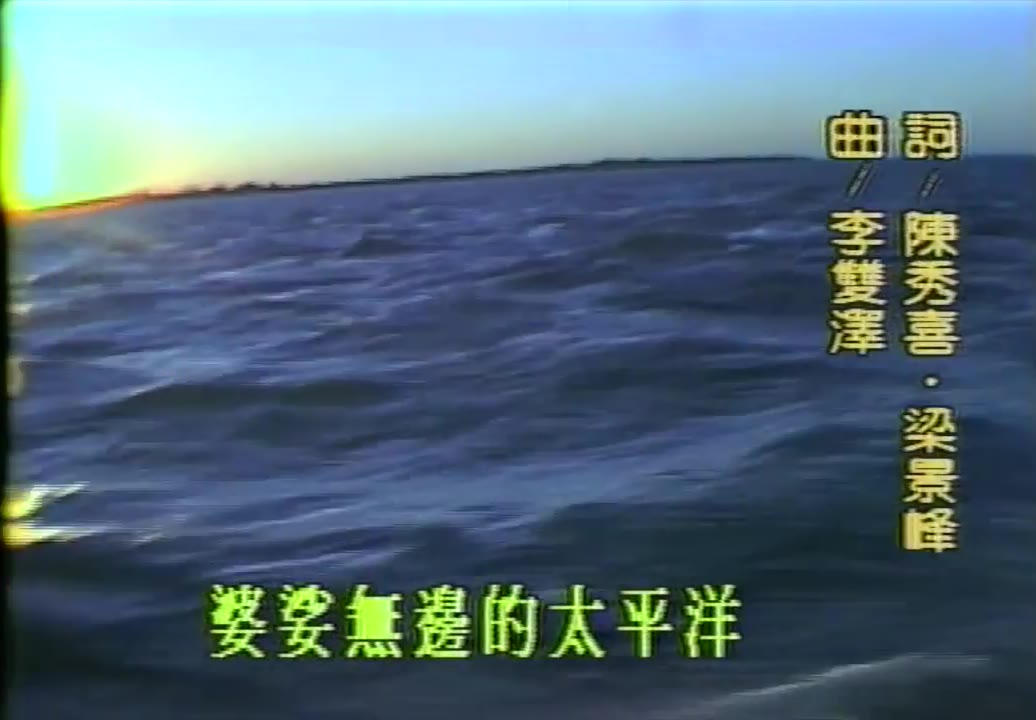
“Walking Through the Past” Episode 3, lyric and composition cards for 〈Beautiful Island〉 (35:50). © Common Wealth Magazine.
From Chiayi on the Night of the Severance of Diplomatic Ties to the Streets after Martial Law Ends
Following the death of Chiang Kai-shek in 197543, the next decade saw a new generation of entrepreneurs shift from footwear and apparel toward electronics. Shih Chen-rong, who grew up in Lukang and helped his mother sell duck eggs as a child, founded Acer with friends; he stated that entrepreneurship required research and development to market one's own brand internationally. Meanwhile, Minister of Economic Affairs Sun Yun-suan decided the government would fund the Industrial Technology Research Institute (ITRI) to introduce integrated circuit technology, which was later transferred to the private sector to establish UMC44. On December 16, 1978, the United States announced the severance of diplomatic ties with the Republic of China. That same night, Cloud Gate Dance Theatre was holding the premiere of 薪傳 (Legacy) in Chiayi. Lin Hwai-min remembers there were six thousand spectators that night: "On stage, sweat and tears flew together; in the audience, eyes were red from crying and hands were red from clapping."45 Later, when a U.S. delegation arrived in Taiwan, crowds outside Songshan Airport rushed toward the vehicles at night; the film displays only a single line of text over this footage without any narration46.
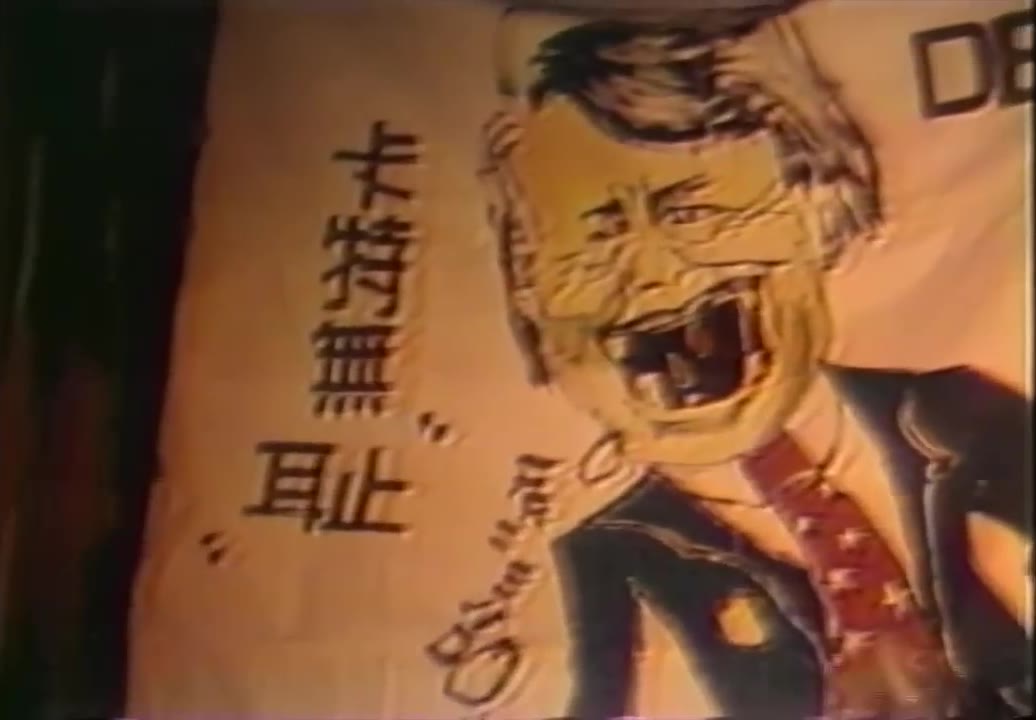
Episode 4 of "Walking Through the Past Together": A protest banner outside Songshan Airport the night the U.S. delegation arrived in Taiwan, December 1978 (16:50). © Common Wealth Magazine.
One year after the severance of ties, opposition figures held a march in Kaohsiung that escalated into the Formosa Incident, leading to the arrest and imprisonment of figures such as Huang Hsin-chieh, Yao Chia-wen, and Lu Hsiu-lien47. In 1984, Sun Yun-suan stepped down from his position as Premier due to illness; subsequently, the Shintien financial scandal led to the downfall of two consecutive Finance Ministers48. In 1987, the government lifted martial law and ended the ban on political parties. On December 25 of that year, Chiang Ching-kuo attended the 40th Anniversary of Constitutional Reform in a wheelchair; the narration notes he listened silently to the protests from the Democratic Progressive Party. Eighteen days later, he passed away, and Lee Teng-hui succeeded him as President in accordance with the Constitution49. Forty years pass here, reaching 1988, the year the film begins.
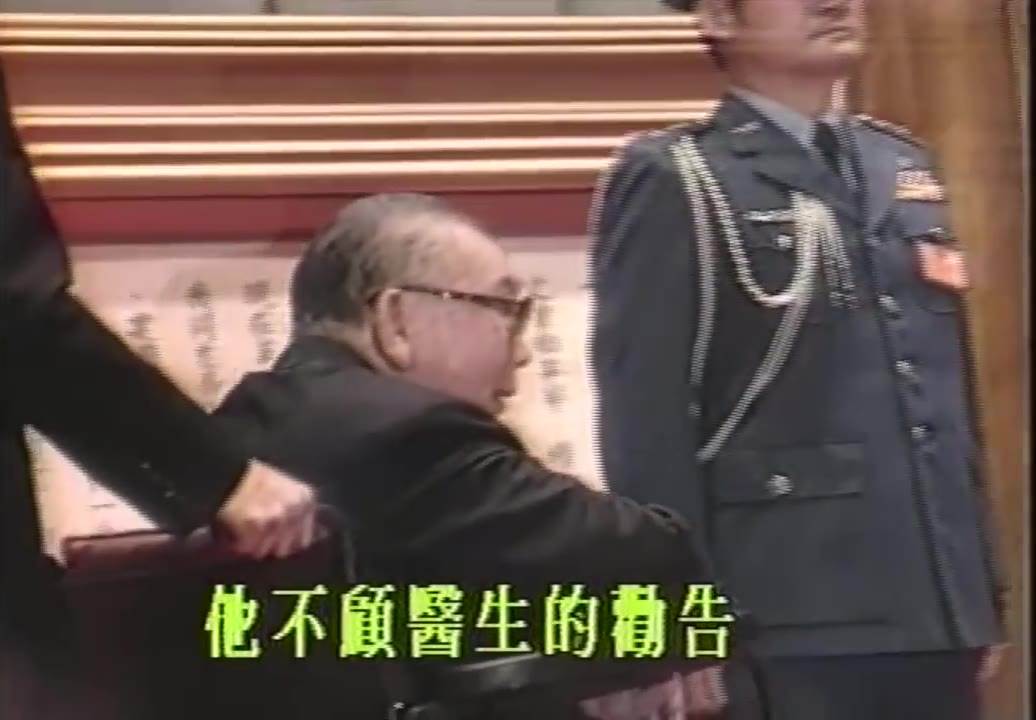
Episode 4 of "Walking Through the Past Together": Chiang Ching-kuo attending the 40th Anniversary of Constitutional Reform in a wheelchair on December 25, 1987 (27:36). © Common Wealth Magazine.
At this point, the film turns to discuss the price of success50. The Zhuang family from Taoyuan, who had waited for their own farmland years ago, reappear on screen; this time, they speak of how young people are all flocking to factories, earning less than NT$10,000 a month from farming, and hope the government does not focus solely on industry while leaving agriculture so far behind50. Huang Chun-ming compares academic advancement to a factory production line, where upon graduation, students are "labeled" with brands like NTU, NCCU, or Fu Jen51. Chen Ting-nan, who used to scramble for white rice from his grandfather as a child, is now the Magistrate of Yilan County; he says the people on the streets are being somewhat excessive and that the government's response was also slightly hypersensitive, noting that for society to progress, one must endure this growing pain52.
Yin Yun-peng previously wrote a list of these "side effects of success" in the July issue, beginning with: "Many of today's problems are, in fact, the side effects of past successes." She wrote all the way from the shrinking size of cultivated land and the pollution of mountains and rivers to the idea that while the people have become wealthy, the government has become poor; her final point was, "Freedom and democracy, but lacking a clear national goal."2 The question she asked in that same issue returns here.
Source: Yin Yun-peng, 〈Inviting You to "Walk Through the Past Together"〉, Common Wealth Magazine Issue 86, July 1, 1988. Two columns are listed side-by-side following the original order; left and right do not correspond item-for-item.
On the Day of the Thirteenth Central Election, TTV Finished Broadcasting Episode 4
When this episode aired on Monday, July 4, 1988, martial law had been lifted for nearly a year, and the press ban had been removed at the beginning of the year. The only three wireless television stations still belonged to the party, the government, and the military53. The four consecutive days of broadcasting coincided exactly with the eve of the first Kuomintang (KMT) National Congress following the death of Chiang Ching-kuo; on the day episode four aired, the Thirteenth Central Election was opening3. The narration used the terminology of that year; regarding the February 28 Incident, there was only one sentence: "Due to the crackdown on smuggled cigarettes, the unfortunate February 28 Incident was triggered, and the military and police suppressed the riots."54 When discussing the Meili Dao (Beautiful Island) Incident, the narrator stated that opposition crowds clashed with the military and police during a parade in Kaohsiung, then proceeded to read out the names of those arrested47.
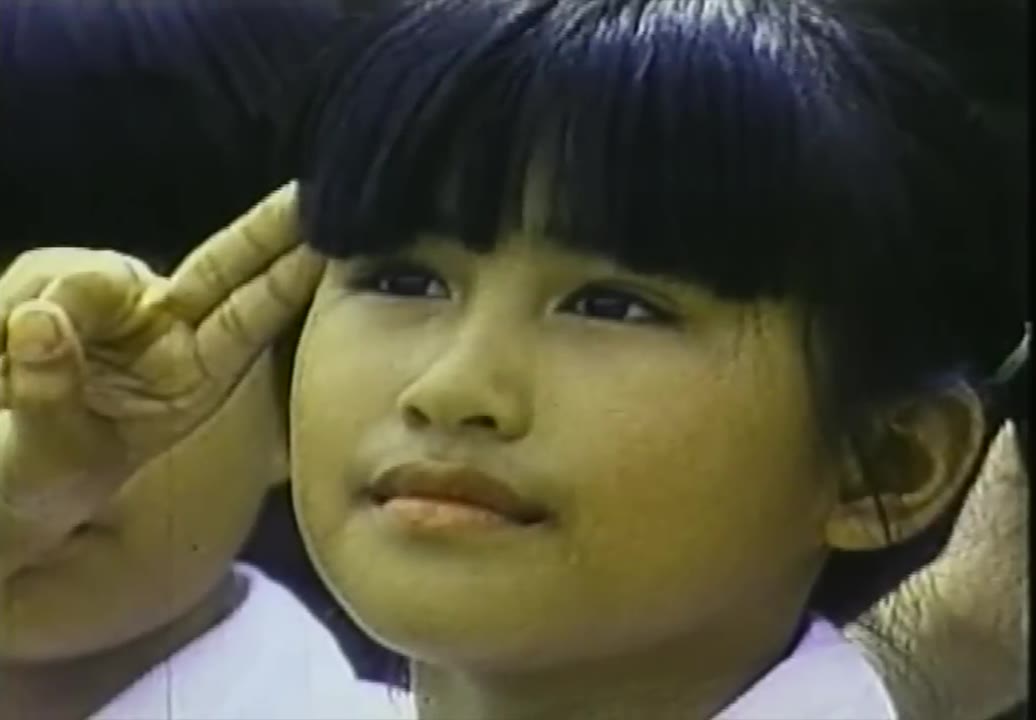
The end of episode four of "Walking Through the Past." After the narrator concludes and the National Flag Song begins to play, a shot shows a young girl saluting (46:44). © Common Wealth Magazine.
The same film gave these named individuals a platform to speak. Yao Chia-wen, whom the narrator had just mentioned, was by then the chairperson of the Democratic Progressive Party (DPP); in the film, he discusses how he worked his way through school at the Directorate General of Telecommunications during his youth, observing the step-by-step commercialization of rural areas through telegraph content55. Lu Hsiu-lien speaks about her advocacy for new feminism starting from the second half of 197156. Huang Hsin-chieh appears during the segment on the 1969 supplemental elections; Kang Ning-hsiang discusses his 1972 election as a legislator under an opposition banner, entering a Congress dominated by veteran members where youth and courage were his primary assets57. On the KMT side, the film introduces Judicial Yuan President Lin Yang-kang, noting that when he first graduated from National Taiwan University, he often walked several hours along rural paths to hold village meetings; former labor union director Lee Huan and KMT Deputy Secretary-General Ma Ying-jeou also appear in the film58.
In her short essay in the July issue, Yin Yun-peng wrote that this special feature was Common Wealth's way of giving back to society for its seventh anniversary, saying, "We welcome your viewing, criticism, and guidance"59. Criticism arrived quickly. A commentator from Mi Zuo published an article in the supplement of the Liberty Times that same month, arguing that because the film looked back over forty years centered on the KMT regime's arrival in Taiwan, the Meili Dao Incident was downplayed and lacked political judgment; furthermore, since the broadcast coincided with the eve of the Thirteenth Central Election, it caused many to look askance and make associations. The same article noted that prominent members of the DPP were given opportunities to appear and speak on camera60.
📝 Curator's Note
The narrator's few sentences and the sixty-plus faces in the film all came from the same editorial office. Common Wealth and Chang Chao-tang used the official language of 1988 to draw conclusions about forty years, yet they also handed the camera to tenant farmers, rongmin (veterans), and the opposition figures whose names the narrator had just read. Both were their choices; if one only praises one aspect and blames the other on "the times," then one has only understood half of this film.
The Videotape Wan Chun-nan Watched in Beijing
A year and a half after the film finished airing, in February 1990, Common Wealth Magazine held a symposium titled 〈Eastern Europe is Changing, Will Mainland China Change?〉. Hosted by Yin Yun-peng, the event was attended by Kang Ning-hsiang and Ma Ying-jeou. Wan Chun-nan, who had founded the Sitong Company in Beijing and was then serving as the Secretary-General of the Democracy in China Federation (an overseas pro-democracy organization), was present. When discussing whether Taiwan's experience would be useful to mainland China, he first mentioned this videotape, adding, "I watched it in Beijing," and stating, "This is the best Taiwan experience" 1.
He continued candidly: "To be honest, many aspects of the Taiwan experience left no impression on me." What stayed with him was the "flesh-and-blood memories" found in this Walking Through the Past Together tape; he noted that the impact of such memories "is far greater than the utility of abstract things" 1. Kang Ning-hsiang chimed in on the spot, saying that because this film had influenced Mr. Wan, it served as a concrete manifestation of the Taiwan experience 1.
"To be honest, many aspects of the Taiwan experience left no impression on me; instead, it was the flesh-and-blood memories in Common Wealth's 『Walking Through the Past Together』."
Source: Symposium Record 〈Eastern Europe is Changing, Will Mainland China Change?〉, Common Wealth Magazine Issue 105, February 1, 1990
The Taiwan experience has also encountered resistance across the Strait: in early January 1989, the Chinese University of Hong Kong held a seminar on cross-strait economic development experiences. Vision magazine recorded that while Taiwanese scholar Yu Tsung-hsien repeatedly emphasized the "fighting spirit" of small and medium-sized enterprises, mainland scholars could only respond: "We understand, but the situation in mainland China is different..." 61. Through that same videotape, what Wan Chun-nan remembered were the living people Chang Chao-tang had sought out back then. The questions Common Wealth asked on behalf of Taiwan—how it reached its current state—ended up in the hands of someone currently asking if mainland China would change.
Common Wealth has later stated multiple times that this tape reached Deng Xiaoping, though the phrasing has varied each time. A 2010 profile of Yin Yun-peng wrote that Deng Xiaoping "once called upon all important officials to watch it together" 62; a 2011 introduction for a new edition of the book stated that "Deng Xiaoping, having obtained the documentary tape through various channels, watched it alongside high-ranking Zhongnanhai officials" 63; and the website marking the 40th anniversary of Common Wealth in 2021 wrote that the film "garnered attention from high-ranking officials on the other side, and even from the top leader, Deng Xiaoping" 64.
Yin Yun-peng's own recollection is even more extensive. During a meeting in October 2026, she mentioned that after the film aired on television, it was "taken by the Ministry of National Defense for a period" to be used in recruit training 8. She also recalled that the four episodes of the videotape were handed over to someone in Singapore, then passed to Wang Tao-han. Wang summoned key Shanghai officials to watch it together, wanting to understand how the Kuomintang, after losing the war and retreating to a small island, could still rise again. Subsequently, another copy was sent to Deng Xiaoping, who watched it with officials from the Taiwan Affairs Office 8.
Source: Common Wealth Magazine Issues 81, 86, and 105; works by Mi Zuo and He Huai-shuo (1990); Common Wealth Magazine Official YouTube Channel; PTS News
Those Final Five Minutes, with Nearly Twenty People Speaking in Turn
In April 2016, Common Wealth uploaded the four episodes to its official YouTube channel and invited Chang Chao-tang to record three introductory guides. By October 2026, the first episode had reached over 180,000 views, while the fourth exceeded 370,00065. In his third guide, Chang told young people who wanted to make films that equipment is not the priority; what matters is the subject matter—having a concern for one's own land is what leads one back to study one's own history66. He passed away on April 2, 2024, at the age of 8167; those people he brought together are still in the video, speaking one by one.
Common Wealth Magazine Official YouTube Channel: "Walking Through the Past" Episode 4, 〈Diverse Challenges〉. The segment where interviewees take turns discussing what to cherish begins at 38:18.
As the film nears its end, the narrator borrows a sentence from Yin Yun-peng's preface in the February issue, attributing society's ailments to a refusal to look back and a lack of history; then asks the audience what is worth cherishing when looking back at the past, and what requires more effort when looking toward the future68. For the next five minutes, there is no narration. Instead, nearly twenty interviewees answer one after another—ranging from former directors of the Food Administration and chairpersons of the Democratic Progressive Party to air war heroes and general managers of foreign companies69.
Lee Lien-chun, a former director of the Food Administration in his eighties, says we must be united; Sun Yun-suan says equality and equitable distribution of wealth are the two most successful policy achievements; Kang Ning-hsiang says we must cherish this land of Taiwan because twenty million people have invested forty years of effort into it. Wei Yung, former chairman of the Research, Development, and Evaluation Commission, repeats three times that there must be no suppression—no suppression of any person, any group, or any opinion; Yao Chia-wen, chairperson of the Democratic Progressive Party, says everyone should open their eyes to society to jointly design a new blueprint. Wang Chi-mei remembers that back then, there was neither money nor technology, yet they still had to forge a path; Ouyang Yi-fen says today's prosperity came at a price and did not simply fall from the sky; Xu Zhuoyun says we can no longer hope for a "patriarch" to come and tell everyone how to maintain order69.
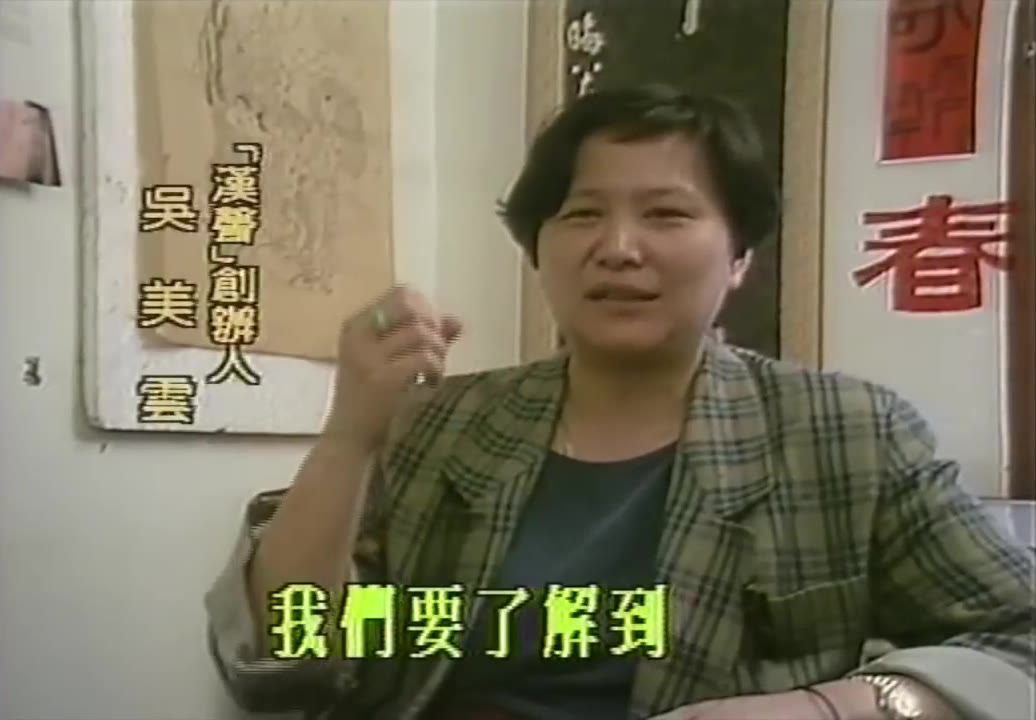
At the end of "Walking Through the Past" Episode 4, Wu Mei-yun answers what should be cherished when looking back at the past (40:16). © Common Wealth Magazine.
On July 7, 1988, the Shih San Quan (Thirteen All) complex opened; on that day, these words finished broadcasting on TTV. That summer, Yin Yun-peng asked: after becoming wealthy, what is the nation's goal? In those final five minutes, Wu Mei-yun, the founder of Han Sheng, spoke about how to find direction by first looking back: "As we move forward, we must know how we came to be"70.
Further Reading:
- Common Wealth Magazine — The producer of this film; from its founding in 1981 to its current economic and social reporting.
- Taiwanese Photography — Chang Chao-tang's journey from the 1965 modern photography duo exhibition to the path of documentary imaging.
- Economic Miracle — Re-examining the forty years mentioned in the film's narration using contemporary data.
- Taiwanese Folk Song Movement — The folk song wave involving Yang Hsien, Li Shuang-ze, and the song 〈Beautiful Island〉.
- Humanities Magazine — Another publication from the late 1980s that used documentary photography to record the grassroots of Taiwan.
Editor's Note: This article is an experiment in collaboration between Taiwan.md and Common Wealth Magazine. Video citations are sourced from the official Common Wealth Magazine YouTube channel.
References
Image Sources
This article uses 8 video stills and 2 public domain/CC-licensed images, all stored in public/article-images/culture/, to avoid hotlinking to source servers:
- Common Wealth Magazine "Walking Through the Past Together" Episode 1 opening, 00:46 — © Common Wealth Magazine (usage license under verification) (Header main image)
- Common Wealth Magazine "Walking Through the Past Together" Episode 1, interview footage of Ji Cheng, 09:01 — © Common Wealth Magazine (usage license under verification)
- Common Wealth Magazine "Walking Through the Past Together" Episode 2, Chang Kuang-chi being interviewed on a Kinmen beach, 28:10 — © Common Wealth Magazine (usage license under verification)
- Common Wealth Magazine "Walking Through the Past Together" Episode 3, lyric card for 《Beautiful Island》, 35:50 — © Common Wealth Magazine (usage license under verification)
- Common Wealth Magazine "Walking Through the Past Together" Episode 4, demonstration banner at Songshan Airport, 16:50 — © Common Wealth Magazine (usage license under verification)
- Common Wealth Magazine "Walking Through the Past Together" Episode 4, Chiang Ching-kuo attending the 40th Anniversary of Constitutional Reform in a wheelchair, 27:36 — © Common Wealth Magazine (usage license under verification)
- Common Wealth Magazine "Walking Through the Past Together" Episode 4 ending, interview footage of Wu Mei-yun, 40:16 — © Common Wealth Magazine (usage license under verification)
- Common Wealth Magazine "Walking Through the Past Together" Episode 4 ending, 46:44 — © Common Wealth Magazine (usage license under verification)
- A young Chang Chao-tang holding a 16mm camera — Photo by Jadegoddess; Commons description records it as March 1970 (filename says 1980); CC BY-SA 4.0; cropped by this site
- The TTV Building completed in 1962 — Taiwan Television 《TTV Thirty Years》 (1992); marked as public domain on Commons
- 〈Eastern Europe is Changing, Will Mainland China Change?〉, Commonwealth Magazine Issue 105, February 1, 1990 — A symposium record from Commonwealth Magazine, hosted by Yin Yun-peng, with participants including Wan Run-nan, Kang Ning-hsiang, Ma Ying-jeou, Wei Yung, and others. When discussing the applicability of Taiwan's experience to Mainland China, Wan Run-nan mentioned seeing the video tape of "Walking Through the Past Together" in Beijing, calling it a vivid and soulful memory; Kang Ning-hsiang and Ma Ying-jeou responded on the spot.↩234
- Yin Yun-peng 〈Inviting You to "Walk Through the Past Together"〉, Commonwealth Magazine Issue 86, July 1, 1988 — A short essay written by the founder of Commonwealth to readers in the month the film was broadcast. It explains the timing of its release on the eve of the 13th National Congress, how the "Television Image Special" evolved from the Issue 81 album, the division of labor between Chang Chao-tang, Sun Man-ping, and Li Se, the difficulties in finding historical footage, her response to a friend asking "Why are there so many sounds of weapons and shields?" during a screening, and lists six success factors and six "side effects of success"; another section on the same page lists pending issues such as cabinet reshuffles, ruling party reform, Mainland policy, and national goals.↩234567
- Broadcast channel and date: Mi-zou's 〈How Did We All Grow Up This Way? Discussing the Problem of Historical Editing via "Walking Through the Past Together"〉 (originally published in the supplement of Liberty Times, July 1988, collected in "The Trance of Media," 1990) is recorded as July 4 to July 7; He Huai-shuo's "Change" (1990) records it as four days starting from July 4; "Recording Taiwan," edited by Li Tao-ming and Wang Wei-ci (National Film and Audiovisual Institute, 2000), and "Contemporary Taiwanese Images," edited by Wang Wei-ci (Tongxi Culture, 2006), both record it as being broadcast continuously over four days on TTV, noting that the final day coincided with the opening of the KMT's 13th National Congress; Wang Wei-ci's book also specifies that this was the National Congress held after the passing of Chiang Ching-kuo.↩2
- Commonwealth Magazine "Walking Through the Past Together" Episode 1 — The titles of the four episodes, according to Commonwealth's official YouTube channel, are 〈The Era of Cultivation: ROC Years 33-44〉, 〈The Years of Hardship: ROC Years 45-53〉, 〈The Moment of Takeoff: ROC Years 54-63〉, and 〈The Challenges of Diversity: ROC Years 64-77〉. Interviewees are identified by vertical text cards on the right side of the screen with their names and titles as of 1988; there are approximately over sixty unique interviewees with varying political stances, ranging from KMT Deputy Secretary-General Ma Ying-jeou and Supreme Court President Lin Yang-gang to DPP Chairperson Yao Chia-wen.↩
- Commonwealth Magazine Official YouTube Channel "Walking Through the Past Together" Four Episodes — The four episodes uploaded in April 2016 have runtimes of approximately 47:48, 49:19, 49:54, and 46:51 respectively, totaling about 194 minutes; Commonwealth Issue 86 described this special as "condensed into four hours," though no public explanation is provided for the discrepancy between the two figures.↩
- Yin Yun-peng 〈Inviting You to "Walk Through the Past Together"〉, Commonwealth Magazine Issue 86, July 1, 1988 — The "Television Image Special" section of this invitation essay states that the special hopes to find qualities and spirits worth cherishing from shared memories and the collectively created Taiwanese experience to forge a broader future.↩
- Diane Ying — Ramon Magsaysay Award — The 1987 Ramon Magsaysay Award winner's page; the English citation records that "Commonwealth," co-founded by Yin Yun-peng, was launched in June 1981, with its first print run of 10,000 copies selling out in two days, focusing primarily on economic and business reporting.↩
- Oral interview with Yin Yun-peng and Taiwan.md, October 21, 2026. Yin Yun-peng discusses the reasons for founding Commonwealth, the intention behind calling businessmen "entrepreneurs," and the whereabouts of the film after it was broadcast. Details such as the Ministry of National Defense using it for recruit training, the video being handed over to Wang Tao-han via Singapore, Wang Tao-han convening Shanghai officials to watch it, and Deng Xiaoping convening Taiwan Affairs Office officials to watch it are currently not found in other public records.↩234
- Yin Yun-peng 〈Reviewing is for the Sake of Looking Forward〉, Commonwealth Magazine Issue 81, February 1, 1988 — The preface to the Issue 81 special album "Passing Through the Past, Returning to the Future," which begins with a scene of guards carrying a coffin out of the Martyrs' Shrine hall; it describes the working methods of three young editors interviewing over a hundred people from various fields and scouring books and archives, while also quoting the reflections of editors Li Se, Su Yu-chi, and Lin Chao-wu.↩2
- (Chang Chao-tang's Guide) 1 "Walking Through the Past Together": Finding the Skeleton, Muscle, and Blood of a Documentary, Commonwealth Magazine Official YouTube, 2016 — Oral account by Chang Chao-tang; quotes are based on the official Traditional Chinese subtitles provided by the uploader: from 00:13 discussing how Yin Yun-peng sought him out after consulting Lin Huai-min; from 00:41 when he answers he is forty-five or forty-six when asked his age; from 00:58 discussing the metaphor of transcripts as the skeleton and visual data as muscle; from 01:46 discussing the metaphor of editing as buying groceries and cooking.↩23
- (Chang Chao-tang's Guide) 2 "Walking Through the Past Together": The first time the song "Beautiful Island" was played on a television program, Commonwealth Magazine Official YouTube, 2016 — Oral account by Chang Chao-tang; quotes are based on official Traditional Chinese subtitles: from 00:12 discussing how the original draft mentioned culture less frequently and he suggested adding cultural elements to Lin Huai-min; from 00:45 discussing how "Beautiful Island" was a banned song at the time and his decision to use it anyway; from 01:14 discussing the reason for intentionally including this song.↩2
- Commonwealth Magazine "Walking Through the Past Together" Episode 1, 03:12 — The opening narration of the first episode starts with Taiwan in 1988 (ROC Year 77), describing a society shrouded in an atmosphere of unrest and noting that some called it a transitional period, before posing a question and inviting viewers to return to history together; quotes are based on burned-in subtitles.↩
- Commonwealth Magazine "Walking Through the Past Together" Episode 1, 08:06 — The narration discusses the large wealth gap, prevalent diseases, and food shortages in the early post-war period, citing the diary of Pingtung writer Chung Li-ho to describe rural poverty, then moves on to discuss impoverished families giving their daughters away for adoption.↩
- Commonwealth Magazine "Walking Through the Past Together" Episode 1, 08:46 — Text card "Leaping Antelope: Chi Cheng"; Chi Cheng recounts being sent away as an adopted daughter in her childhood and being tied to a chair by her adoptive mother to sing and cry while performing opera.↩
- Commonwealth Magazine "Walking Through the Past Together" Episode 1, 09:56 — Text card "Yilan County Magistrate: Chen Ting-nan"; Chen Ting-nan recounts how every meal in his home during ROC years 39 and 40 was mixed with sweet potato shreds, and how brothers would fight over their grandfather's white rice, while the grandfather intentionally left food for them.↩
- Common Wealth Magazine "Walking Through the Past" Episode 1, 20:16 — On-screen text "Legislator Chao Shao-kang"; Chao recounts how his mother traveled to Taiwan by boat in 1950, and when the boat leaked, the entire crew used only thermoses to scoop up water.↩
- Common Wealth Magazine "Walking Through the Past" Episode 1, 32:43 — Narrator explains the three steps Chen Cheng took to implement land reform during his administration: the 375 Rent Reduction Act in 1949, the release of public land in 1951, and the implementation of "Land to the Tiller" in 1953, exchanging landowners' land for industrial company stocks and bonds.↩
- Common Wealth Magazine "Walking Through the Past" Episode 1, 34:10 — On-screen text "Taoyuan Farmer Chuang Lung-ying"; Chuang describes the situation before land reform where tenant farmers had to sign contracts every year and landlords raised rents annually; from 35:00, he discusses how farming households gained their own fields after land reform.↩
- Common Wealth Magazine "Walking Through the Past" Episode 1, 39:00 — Narrator explains that in 1956, US aid funds were used to assist veterans in constructing the Central Cross-Island Highway; from 41:32, he mentions that three to four thousand veterans worked in the deep mountains starting from that year.↩
- Common Wealth Magazine "Walking Through the Past" Episode 1, 42:07 — On-screen text "Dayuling Veteran Chen Chi-cheng"; a veteran who participated in building the Central Cross-Island Highway describes the danger of daily midday blasting at the construction site.↩
- Common Wealth Magazine "Walking Through the Past" Episode 1, 44:33 — On-screen text "Lishan Veteran An Tang-hsing"; An describes farming with his father since childhood and how he eventually obtained his own land in Lishan that can be passed down through generations; quotes are burned into the subtitles.↩
- Common Wealth Magazine "Walking Through the Past" Episode 1, 45:22 — Narrator introduces Liu Pi-chia of the Hualien Farm: from 45:41, he discusses following his unit to Taiwan, marrying at age 52, and settling on the farm after discharge; from 46:05, he mentions how Chen Yao-chi used him as the subject of a documentary for a graduation thesis while studying film at UC; at 46:45, it is noted that Liu has never seen the film; from 47:26, it ends with footage of him riding a motorcycle past fields.↩
- Common Wealth Magazine "Walking Through the Past" Episode 2, 07:28 — Narrator discusses the National Army's hardship-overcoming movement and the election of hardship-overcoming heroes; from 07:40, on-screen text "Writer Sima Zhong-yuan"; he describes how the spirit of overcoming hardships continued in the military for decades, with old aircraft like the C-119 still in service.↩
- Common Wealth Magazine "Walking Through the Past" Episode 2, 10:24 — On-screen text "Legislator Chao Shao-kang"; Chao recounts how, in his third year of junior high, he and his classmates wrote letters to the Anti-Communist Salvation Army requesting to join the military, and how a company commander replied advising them to focus on their studies first.↩
- Common Wealth Magazine "Walking Through the Past" Episode 2, 22:44 — Narrator introduces air combat hero Ouyang Yi-fen, who shot down two MiG fighters during the Taiwan Strait air battles in 1956, noting that they often didn't have time to eat before missions and would just grab a steamed bun before boarding; from 23:02, he recounts that mission.↩
- Common Wealth Magazine "Walking Through the Past" Episode 2, 26:38 — Narrator discusses the Communist artillery bombardment of Kinmen on the evening of August 23, 1958; from 27:40, he introduces NBC Chinese-American photographer Chang Kwang-chi, who visited Kinmen over twenty times for interviews; from 28:09, he recounts interviewing in bunkers and artillery positions, and how an amphibious vehicle caught fire and sank while reporters were rushing to the beach with supply ships.↩
- Common Wealth Magazine "Walking Through the Past" Episode 2, 21:44 — Narrator introduces Chu Hsin, who attended school near a military airport in Tainan as a child and often watched planes returning through his classroom window, later leading young engineers to design the Flying Swallow car; from 22:02, on-screen text "'Flying Swallow' Designer Chu Hsin"; he recounts his teacher saying those planes were all made by Americans; quotes are burned into the subtitles.↩
- Common Wealth Magazine "Walking Through the Past" Episode 2, 14:04 — Narrator discusses how the government allocated US-aided cotton to textile mills like Tai Yuen and Far Eastern; from 15:09, he mentions Tai Yuen's support for Yen Ching-ling in establishing Yulon in 1953; from 15:59, Wu Shun-wen (on-screen text "Yulon Chairman") recounts Yen's idea of integrating the automotive industry with various mechanical industries; at 16:50, he mentions that Yulon produced its first jeep on National Day in 1956.↩
- Common Wealth Magazine "Walking Through the Past" Episode 2, 35:50 — Narrator explains that after the Taiwan Strait situation stabilized, economic goals shifted from stability to development; the government established the Statute for Encouragement of Investment, using tax exemptions and simplified administrative procedures to guide domestic and foreign industrialists to set up factories and invest.↩
- Common Wealth Magazine "Walking Through the Past" Episode 2, 39:35 — Narrator introduces Yang Chuan-kuang winning a silver medal in the decathlon at the 1960 Rome Olympics; from 43:47, he discusses the Ling Bo craze triggered by "The Butterfly Lovers," noting that when Ling Bo arrived at Songshan Airport, he was surrounded by fans and required forty bodyguards to escape over forty minutes.↩
- Common Wealth Magazine "Walking Through the Past" Episode 2, 44:46 — The narrator mentions that Taiwan Television began broadcasting in 1962; from 45:54, it discusses how the "Starry Sky" group sang for fourteen and a half years from the start of broadcasting until they were suspended in 1977 to comply with the government's song purification policy; from 46:26, it discusses how television drove the subsequent production of terminals and cathode-ray tubes in the home appliance industry.↩
- Common Wealth Magazine "Walking Through the Past" Episode 3, 16:02 — The narrator discusses the optimistic shipping market, noting how Chang Yung Fa, in his early forties, founded Evergreen Marine from a single old ship and later pioneered container shipping and global routes.↩
- Common Wealth Magazine "Walking Through the Past" Episode 3, 04:18 — The narrator discusses how US aid ceased around 1965; from 06:01, it mentions the establishment of the Export Processing Zone near Kaohsiung Port in 1966; from 06:25, it describes rural children leaving their fields to work in factories and sending money back home.↩
- Common Wealth Magazine "Walking Through the Past" Episode 3, 04:18 — The narrator discusses how compulsory education was extended from six to nine years, with the first joint junior high school opening ceremony held on September 9, 1968; from 12:10, it introduces Lin Hui-huang's family of elderly farmers in Changhua who produced two sons with doctorates; from 13:00, a title card for "NCTU Associate Professor Lin Shu-chun" describes how low tuition made university affordable for farming families.↩
- Common Wealth Magazine "Walking Through the Past" Episode 3, 21:44 — The narrator discusses how the Hongye Little League defeated Japan's Chofu Star Team in 1968; from 22:25, it describes how in the summer of 1972, Taipei's little league and Meiho's youth league both won world championships within a week, leading citizens to watch overseas broadcasts late at night and set off firecrackers.↩
- Common Wealth Magazine "Walking Through the Past" Episode 3, 24:44 — A title card for "Chief Engineer of the Construction Office, Ou Chin-te" appears; Ou recalls seeing footage of the withdrawal from the United Nations on television while studying abroad; from 25:52, the narrator states that over 2,500 students returned to the country within five years; from 47:55, it introduces his return to join highway engineering projects, with quotes burned into the subtitles.↩2
- Common Wealth Magazine "Walking Through the Past" Episode 3, 27:00 — A title card for "KMT Deputy Secretary-General Ma Ying-jeou" appears; Ma discusses how intellectuals turned back to reflect on local culture following the defense of the Diaoyu Islands movement, leading to the emergence of local works in literature, music, and dance.↩
- Common Wealth Magazine "Walking Through the Past" Episode 3, 27:48 — A title card for "'Han Sound' Founder Wu Mei-yun" appears; Wu describes being mistaken for someone from Thailand while abroad and her motivation for returning to Taiwan to found the English-language magazine 'Han Sound'.↩
- Common Wealth Magazine "Walking Through the Past" Episode 3, 28:58 — A title card for "'Cloud Gate' Founder Lin Hwai-min" appears; Lin discusses the feelings of the generation born after the retrocession and educated in Taiwan toward this place, and their choice to return home to work.↩
- Common Wealth Magazine "Walking Through the Past" Episode 3, 30:20 — A title card for "Novelist Huang Chun-ming" appears; Huang describes how seeing university students go abroad immediately upon graduation motivated him to film television series introducing local land and people.↩
- Common Wealth Magazine "Walking Through the Past" Episode 3, 35:39 — A folk song segment follows Yang Hsien's discussion of modern folk music; from 35:38, a photo of Li Shuang-ze is shown; from 35:46, title cards for 'Lyrics/Chen Hsiu-hsi, Liang Ching-feng' and 'Music/Li Shuang-ze' are overlaid on a sunset over the sea; from 35:47 to 36:35, lyrics are displayed with pastoral imagery, though no song title card is present; based on the lyricist/composer cards and lyrics, it is identified as 'Beautiful Island'.↩
- (Chang Chao-tang's Guide) 2 "Walking Through the Past" Video Description, Common Wealth Magazine Official YouTube, April 19, 2016 — The description written by Common Wealth Magazine for this guide states that 'Beautiful Island' was included in the film and thus broadcast on television for the first time; this claim shares the same origin as Chang Chao-tang's memory, though no contemporary reports are currently available for cross-reference.↩
- Common Wealth Magazine "Walking Through the Past" Episode 4, 04:26 — The narrator discusses the death of Chiang Kai-shek in the spring of 1975, during which 2.5 million people flocked to the Sun Yat-sen Memorial Hall to mourn.↩
- Common Wealth Magazine "Walking Through the Past" Episode 4, 09:56 — The narrator introduces Shih Chen-rong, who was born in Lukang and helped his mother sell duck eggs as a child, before founding Acer with friends; from 10:05, Shih describes his entrepreneurial goal of using research and development and proprietary branding to market internationally; from 10:56, the narrator discusses Sun Yun-suan's decision to have the government fund the introduction of integrated circuit technology via ITRI and transfer it to the private sector to establish UMC.↩
- Common Wealth Magazine "Walking Through the Past" Episode 4, 15:02 — A title card for 'DECEMBER 16 1978' is followed by footage of US President Jimmy Carter reading on television; from 17:36, the narrator introduces Cloud Gate's premiere of 'Tales of the Water Mill' in Chiayi on the day of the diplomatic break; from 17:46, a title card for "'Cloud Gate' Founder Lin Hwai-min" appears, and Lin describes the scene that night, with quotes burned into the subtitles.↩
- Common Wealth Magazine, "Walking Through the Past Together," Episode 4, 16:48 — Footage of crowds on the streets at night, a "Carter is Shameless" banner, and people rushing toward vehicles; on the right, there is only a vertical text card reading "Songshan Airport Protest." This segment has no narration or subtitles; the preceding segment from 15:18 shows the US delegation arriving at the airport at night.↩
- Common Wealth Magazine, "Walking Through the Past Together," Episode 4, 22:15 — The narration in episode four discusses the Formosa Incident; the footage shows night parades in Kaohsiung and scuffles with military and police. From 22:24, a list of those arrested and imprisoned is read aloud, including Huang Hsin-chieh, Yao Chia-wen, Chang Chun-hung, Shih Ming-teh, Lin Yi-hsiung, and Lu Hsiu-lien, followed by a text card for the "Formosa Incident" trial.↩2
- Common Wealth Magazine, "Walking Through the Past Together," Episode 4, 23:36 — The narration discusses how in 1984, Premier Sun Yun-suan stepped down from the front lines due to illness and was succeeded by Yu Kuo-hua; from 24:00, it discusses how the Shih Hsin financial scandal led to the downfall of two consecutive Ministers of Finance.↩
- Common Wealth Magazine, "Walking Through the Past Together," Episode 4, 26:50 — The narration discusses the lifting of martial law and the removal of the ban on political parties in 1987; a text card for the formation of the Democratic Progressive Party (DPP) appears. From 27:32, it describes Chiang Ching-kuo attending the 40th anniversary of constitutional reform in a wheelchair on December 25 and listening silently to DPP protests before passing away eighteen days later; from 28:44, it discusses Lee Teng-hui assuming the duties of the leader in accordance with the Constitution.↩
- Common Wealth Magazine, "Walking Through the Past Together," Episode 4, 30:44 — The narration begins to list the side effects of forty years of rapid development; from 31:07, it discusses how farmland is becoming increasingly fragmented and agriculture is in distress; from 31:26, it introduces the Taoyuan farmers who benefited from land reform and became middle-to-upper-class farming families; from 31:32, interviewed farmers discuss how young people would rather work in factories because farming income is too low.↩2
- Common Wealth Magazine, "Walking Through the Past Together," Episode 4, 33:27 — Text card "Novelist Huang Chun-ming"; Huang Chun-ming uses factory production lines as a metaphor for higher education, where students attach labels of various schools upon graduation.↩
- Common Wealth Magazine, "Walking Through the Past Together," Episode 4, 36:26 — Text card "Yilan County Magistrate Chen Ting-nan"; Chen Ting-nan comments on the street protests before and after the lifting of martial law and the government's handling of them.↩
- Gary D. Rawnsley & Ming-Yeh T. Rawnsley, "Media reform since 1987," China Perspectives 56 (2004) — An English academic paper reviewing the structure of major newspapers and three national wireless television stations held by the party, government, and military prior to the lifting of martial law in Taiwan in 1987, as well as media reform after the removal of the press ban in 1988.↩
- Common Wealth Magazine, "Walking Through the Past Together," Episode 1, 16:40 — The narration in episode one discusses the social situation in 1947; the February 28 Incident is briefly mentioned in a single sentence, followed by the mention of Chen Yi being dismissed due to improper handling, with quotes burned into the subtitles.↩
- Common Wealth Magazine, "Walking Through the Past Together," Episode 3, 08:35 — Text card "DPP Chairperson Yao Chia-wen"; Yao Chia-wen recounts how while working and studying part-time at the Directorate General of Telecommunications, she could see through telegraph content that rural areas were gradually commercializing and international trade was expanding.↩
- Common Wealth Magazine, "Walking Through the Past Together," Episode 3, 32:48 — The narration introduces Lu Hsiu-lien's advocacy for new feminism; from 33:01, a text card reads "Women's Rights Activist Lu Hsiu-lien," and she recounts speaking out against gender inequality and launching the new women's movement starting in the second half of 1971.↩
- Common Wealth Magazine, "Walking Through the Past Together," Episode 3, 42:52 — Text card "Legislator Kang Ning-hsiang"; Kang Ning-hsiang recalls his feelings about being elected as a legislator under the opposition status and entering a parliament dominated by senior members; from 42:34, the narration introduces that Kang Ning-hsiang was elected as an opposition legislator at age thirty-four, in the same cohort as Hsieh Shen-shan who was elected in 1972; from 14:12 in the same episode is the segment on the 1969 additional elections, and from 15:40, a text card for "Former Legislator Huang Hsin-chieh" appears.↩
- Common Wealth Magazine, "Walking Through the Past Together," Episode 1, 29:18 — The narration introduces that when Lin Yang-kang first joined the Nantou County Government after graduating from NTU, he often walked several hours along rural paths to hold village meetings; from 29:41, a text card "President of the Judicial Yuan Lin Yang-kang" recounts the situation at that time; Episode 3 at 39:52 features a text card for "Former Union Director Li Huan"; Episode 4 at 38:47 features a text card for "KMT Deputy Secretary-General Ma Ying-jeou".↩
- Yin Yun-peng, "Inviting You to 'Walk Through the Past Together'," Common Wealth Magazine Issue 86, July 1, 1988 — The final paragraph of the invitation states that this television image special is an attempt by Common Wealth Magazine and a way to give back to society on its seventh anniversary, welcoming viewers' viewing and criticism.↩
- Mi Zao, "Did we all grow up this way? Discussing the problem of historical editing through 'Walking Through the Past Together'," originally published in the supplement of Liberty Times, July 1988, collected in Mi Zao's The Trance of Media (1990). Some arguments in this critique are also found in citations within Recording Taiwan (2000), edited by Li Tao-ming and Wang Wei-tzu, and New Taiwan News Weekly (2007); the full original text is currently unavailable online.↩
- Wang Li-hsing, "Taiwan Experience: From Economy to Politics," View Magazine Issue 32, January 15, 1989 — Describes the discussions at the Chinese University of Hong Kong's seminar on "Cross-Strait Economic Development Experiences" on January 2, 1989; when Taiwanese scholar Yu Tsung-hsien emphasized the hardworking spirit of small and medium-sized enterprises, mainland scholars in attendance expressed that they understood the Taiwan experience but noted that conditions in mainland China were different.↩
- He Chi-yu, "Yin Yun-peng: Hope is Always on the Road," Reposted, 2010 — A profile of Yin Yun-peng written by He Chi-yu, Editor-in-Chief of Parent Magazine (part of the Commonwealth 30th Anniversary interviews), in which the reporter describes how Deng Xiaoping once called important officials to watch this documentary together; the same article was also reposted by travelers.tw in 2011.↩
- "Walking Through the Past Together" 2011 New Edition E-book Introduction, Readmoo — Publisher's introduction for the new edition of the Commonwealth Magazine publication released on June 29, 2011 (ISBN 9789862413661), stating that Deng Xiaoping went through great lengths to obtain the documentary tapes and watched them with high-ranking officials in Zhongnanhai; the same text appears on bookstore pages such as Books.com.tw.↩
- Commonwealth Magazine 40th Anniversary "Trajectory of Progress: 1988" — The 1988 page from the Commonwealth Magazine 40th Anniversary special website, stating that this four-part documentary focusing on Taiwan's economic development history drew significant attention from high-ranking officials across the strait and Deng Xiaoping.↩
- Commonwealth Magazine "Walking Through the Past Together" Episode 4, Commonwealth Magazine Official YouTube — The four episodes were uploaded to the official Commonwealth Magazine channel on April 8, 2016; as of October 21, 2026, views are approximately 182,000 for episode one, 167,000 for episode three, and 375,000 for episode four. Three introductory guides by Chang Chao-tang were uploaded on April 12 and 19, 2016.↩
- (Chang Chao-tang's Guide) 3 "Walking Through the Past Together": Technique is a Process, Story is Everything, CommonWealth Magazine Official YouTube, 2016 — Oral narration by Chang Chao-tang; based on official Traditional Chinese subtitles: from 00:44 discussing that the focus of filmmaking lies in the subject and angle rather than equipment; from 01:36 discussing that only those who care about society and their own land will look back at their history.↩
- PTS News: Photographer Chang Chao-tang Passes Away — PTS News reports that photographer and documentary filmmaker Chang Chao-tang passed away on April 2, 2024, at the age of 81; Focus Taiwan and Mirror Media also reported on the same day.↩
- CommonWealth Magazine "Walking Through the Past Together" Episode 4, 37:36 — The narration in episode four summarizes the sources of social problems; this text is identical to a sentence from Yin Yun-peng's article "Looking Back to Look Forward" (Issue 81, February 1988); from 38:01, the narrator asks viewers what aspects of the past are worth cherishing and what requires effort when looking toward the future.↩
- CommonWealth Magazine "Walking Through the Past Together" Episode 4, 38:18 — From 38:18, interviewees take turns speaking: Li Lien-chun, Sun Yun-suan (38:28), Kang Ning-hsiang (38:36), Ma Ying-jeou (38:47), Wei Yung (38:59), Yao Chia-wen (39:25), Chang Hsiao-yen, Chien Yu-hsin, Wu Mei-yun (40:15), Lin Hwai-min (40:35), Chu Hsin, Wang Chi-mei (41:09), Ouyang Yi-fen (41:28), Hsieh Sen-chung, Ko Wen-chang, Hsu Cho-yun (42:50), Kao Ying-mao, until President Lee Teng-hui at 43:21; Li Lien-chun's age is based on the narration in episode one at 33:37, "eighty-five-year-old Li Lien-chun".↩2
- CommonWealth Magazine "Walking Through the Past Together" Episode 4, 40:15 — On-screen text "'Han Sound' Founder Wu Mei-yun"; Wu Mei-yun discusses that one must know where they came from before moving forward to find direction and avoid losing one's roots; quotes are based on burned-in subtitles.↩