
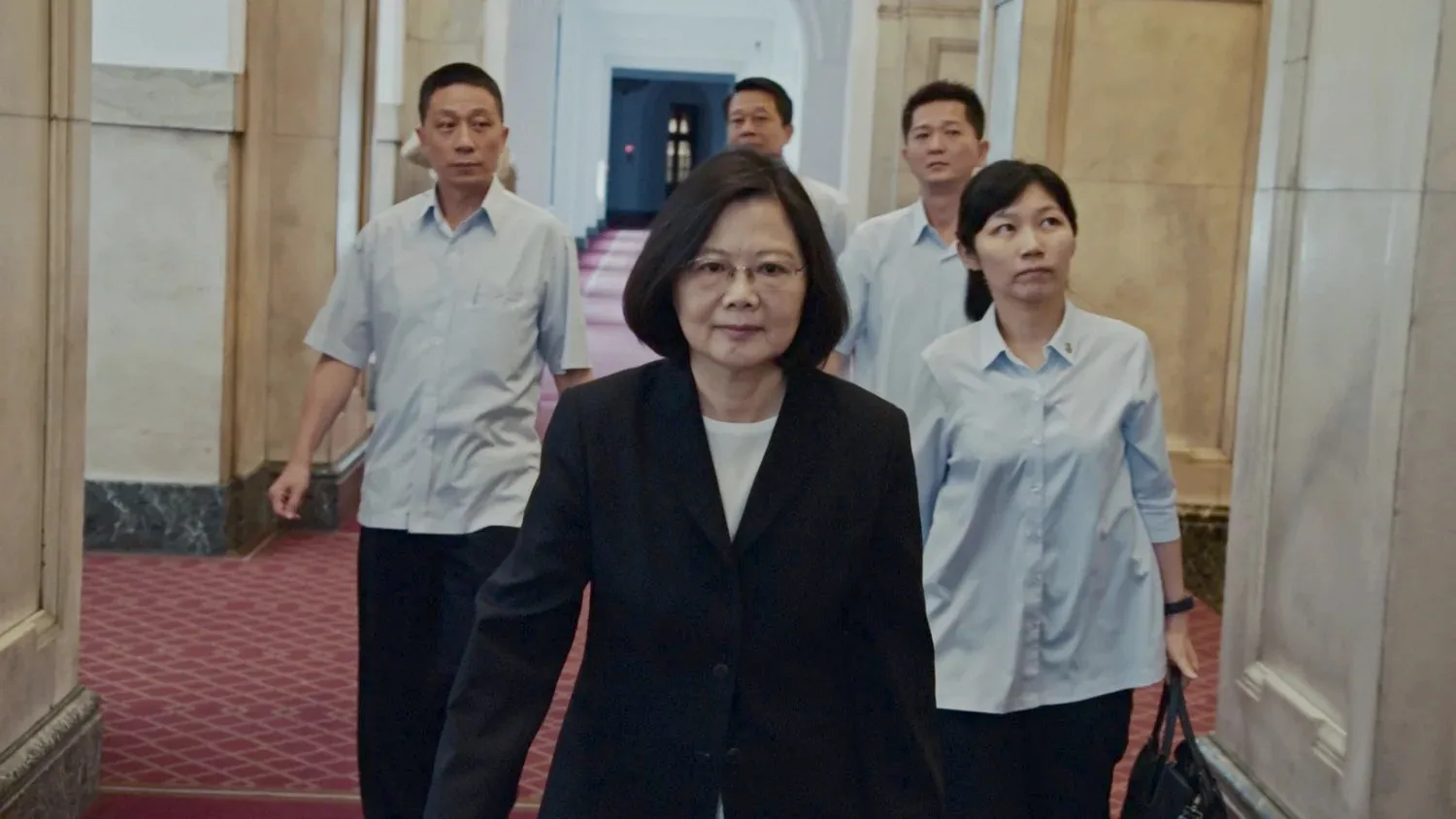
30-second overview: Invisible Nation is a documentary by American director Vanessa Hope, filmed over seven years, with five close-range interviews with then-President Tsai Ing-wen. It pushes before the world's cameras a Taiwan removed from the United Nations, allowed to compete in the Olympics only as "Chinese Taipei," and whose diplomatic allies fell from 22 to 12. The film had its world premiere at the Woodstock Film Festival in 20231, opened in Taiwan theaters in June 2025, grossed more than NT$37.71 million, and became the third-highest-grossing documentary in Taiwan's film history2. But this film, made to let Taiwan "be seen," also has corners its light does not reach. The sharpest questions concern the access it gained through seven years of cooperation with Tsai's office, and the name never mentioned from beginning to end: Chen Shui-bian.
On June 11, 2025, at a Taipei press screening, before the screen had even lit up, the ground began to shake: an earthquake3. Vanessa Hope, the American director who had spent seven years filming Taiwan, stood before a room full of Taiwanese journalists and said: "You're not alone."3
The film she made is called Invisible Nation. Its title names Taiwan's predicament: refused recognition by most countries in the world, kept outside the United Nations, forced in the Olympic arena to fly a flag that cannot carry its own name. A Taiwan that others decided not to see had to rely on an outsider's camera to bring itself into the world's field of vision.
And in that moment, Taipei shaking underfoot became a précis of what the film had spent seven full years trying to say: being seen has never been a status that falls from the sky. It comes when someone is willing, on unsteady ground, to press the shutter.
The Interview the Day Before Departure
Vanessa Hope's connection with Taiwan goes back to 1995. That year she was studying Chinese in Taipei and personally experienced Taiwan's first direct presidential election in 1996, as well as the missiles China fired into waters off Taiwan4. Twenty years later, in January 2016, she watched Tsai Ing-wen win the election and heard crowds at a campaign rally shouting toward the stage, "We are Taiwanese." In her own account, that moment gave her chills, and the idea for the film took root there5.
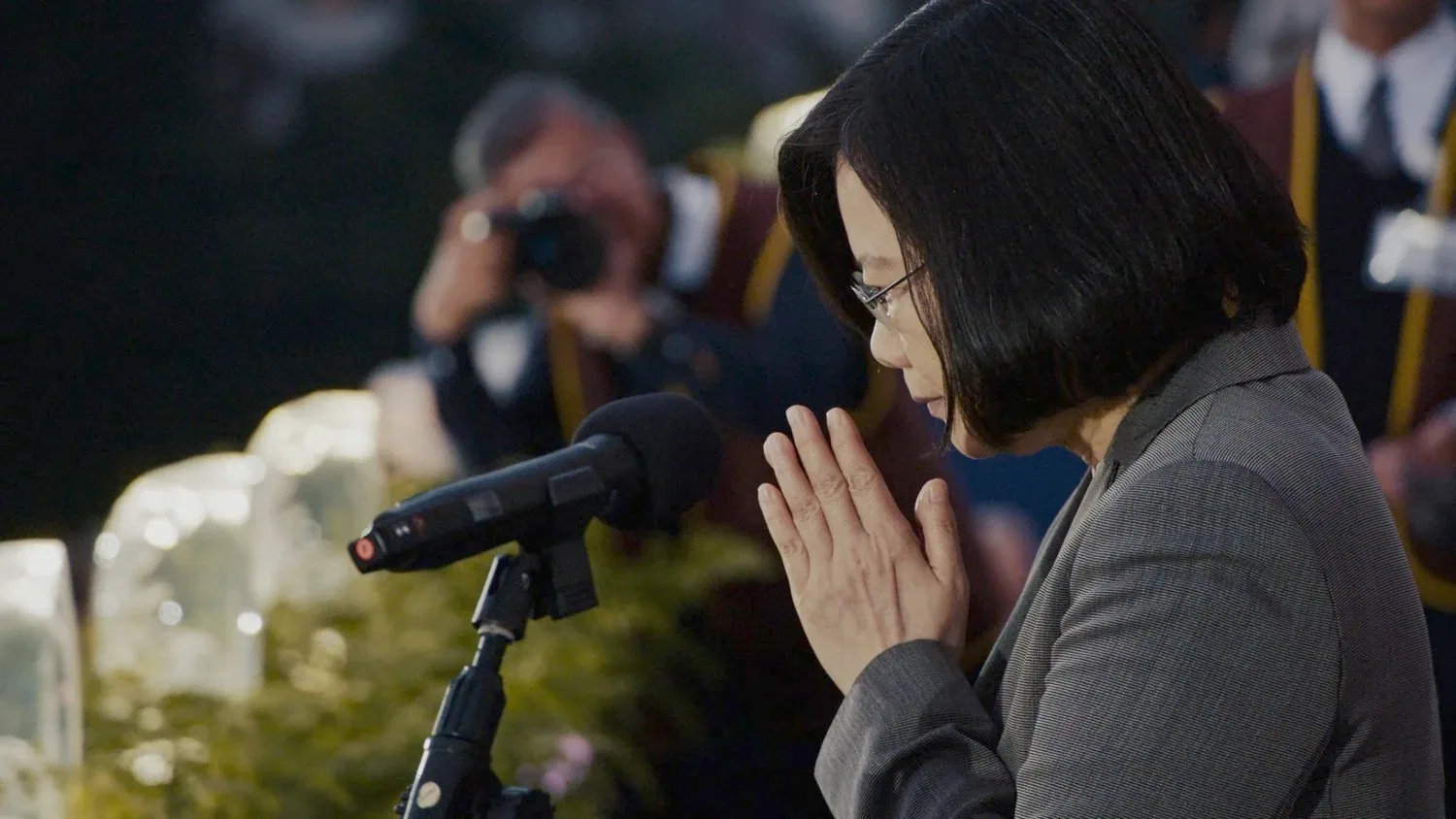
Official still from _Invisible Nation: Tsai Ing-wen clasps her hands at a public event, while another camera in the background is pointed at her. Across seven years, Vanessa Hope's lens often filmed precisely the moments when others were filming Tsai, too. Fair use editorial commentary on Invisible Nation (2023)._
She is a foreigner. Born in New York and based in Los Angeles, Hope is the granddaughter of old Hollywood producer Walter Wanger and actress Joan Bennett; her husband is veteran producer Ted Hope, former head of film at Amazon Studios6. What entitled the American granddaughter of a Hollywood producing family to press the shutter on Taiwan's behalf? That question would later become one of the film's most interesting fissures.
At the end of 2016, she submitted her filming proposal to the Presidential Office and began to wait.
📝 Curator's Note
A documentary about Taiwan was filmed by an outsider; Taiwan's "being seen" was mediated by someone else from the start. This predicament is not unique to this film. For a country denied in diplomacy, getting its voice out often means first passing through a foreigner's camera, a foreign media page, or the selection list of an international film festival. The frame is always in someone else's hands. That is the shared cost borne by countries that must fight to be seen.
The wait lasted more than half a year. Filming began only in May 2017, when Tsai Ing-wen had already been in office for about a year7. The production spanned both of Tsai's presidential terms, and Hope interviewed her five times in all8.
The terms of those interviews contained the film's deepest tension. Hope later recalled that nearly every interview with Tsai Ing-wen was scheduled for the day before Hope was about to leave Taiwan8. Even more crucial was the initial agreement: she could not ask about Cross-Strait relations. That red line loosened only gradually as the situations in Hong Kong's anti-extradition movement, the COVID-19 pandemic, and the Russia-Ukraine war escalated8.
What made the film possible was this unprecedented intimacy. What gave critics their handle was also precisely this intimacy: when more than half your material depends on approval from the Presidential Office, can you still tell the truth about that government? This question runs through every controversy the film would later face.
The Head Blocking Chiang Kai-shek
What Hope filmed were places no other camera had been able to enter.
Interviews inside the Presidential Office, Tsai reviewing documents aboard the presidential aircraft, policy meetings, daily life at the official residence, even Tsai's cat Think Think suddenly wandering into the frame9. One composition was remembered by multiple media outlets: Tsai sits for an interview, her head positioned so that it blocks the portrait of Chiang Kai-shek on the wall behind her10. A dictator deified during the authoritarian era has more than half his face obscured behind the back of an elected president's head.
The film has no narration and no explanatory title cards; it is a purely observational documentary11. Archival footage, animated maps, and interviews interweave a four-century arc of Taiwan: the Dutch, Japanese colonization, the ROC government's 1949 relocation to Taiwan, the shadows of the White Terror and the February 28 Incident, the lifting of martial law in 1987, the first direct presidential election in 1996, and China's missiles11.
The interview list reads like a roll call of Taiwanese democracy: Hsiao Bi-khim, Chen Chu (imprisoned after the 1979 Kaohsiung Incident and now chair of the National Human Rights Commission), Audrey Tang, Freddy Lim (lead singer of the heavy-metal band Chthonic and later a legislator), Ma Ying-jeou, Wu Pei-yi, Chi Cheng, former U.S. House Speaker Nancy Pelosi, and Columbia University professor Andrew Nathan12.
In the film, Chen Chu recalls that their positions back then were treated as "treason," but that those positions have now become an important part of Taiwanese democracy13. In a single sentence, the entire road Taiwan traveled from authoritarianism to democracy is compressed into one person's memory.
✦ The back of an elected woman president's head blocks the portrait of a dictator. The film's most powerful political statement is sometimes not in any line of dialogue, but in a composition.
Tsai Ing-wen's own most frequently quoted line is delivered in English. In the film, she says Taiwan does not need to declare itself an independent state because Taiwan already is an independent nation14. Media outlets around the world quoted that line in their coverage, and it also led to the film's de facto blocking in China.
Official trailer for _Invisible Nation from distributor Abramorama's official channel. Across the film's 85 minutes, Tsai Ing-wen is interviewed between two national flags and reviews documents aboard the presidential aircraft, while archival material and interviews trace Taiwan's four-century arc._
A Bronze Medal That Cannot Bear Its Own Name
If one object in the film could explain what "invisible" means, it would be a bronze medal.
In the film, Chi Cheng, known as the "Flying Antelope," takes out the bronze medal she won in the women's 80-meter hurdles at the 1968 Mexico City Olympics and asks the camera: Is Chinese Taipei the name of a country? It is not15.
Behind that bronze medal lies the entire mechanism by which Taiwan is made "invisible" in the international arena. On October 25, 1971, the United Nations General Assembly passed Resolution 2758 by a vote of 76 to 35, recognizing the government of the People's Republic of China as China's sole legitimate representative in the United Nations and expelling the representatives of Chiang Kai-shek16. The full text of that resolution never mentions "Taiwan" once16. Yet over the ensuing decades, it has been invoked again and again, becoming a legal tool for keeping Taiwan outside every international organization.
So Taiwan can compete in the Olympics only as "Chinese Taipei." The Lausanne Agreement of March 23, 1981 fixed that name, together with a white flag bearing Olympic rings around a plum blossom, the "Plum Blossom Flag"; when athletes win and stand on the podium, the flag anthem is played, not the national anthem17. In 2018, Taiwanese voters sought by referendum to rename the Olympic team "Taiwan," but the proposal was rejected, with 5.77 million votes opposed and 4.76 million in favor18.
The number of diplomatic allies is the starkest scoreboard for this mechanism of "invisibility." When Tsai Ing-wen took office in 2016, Taiwan still had roughly 22 diplomatic allies; eight years later, when she left office, only 12 remained, a total loss of 10 countries during her tenure19.
| 2016 | 2024 | |
|---|---|---|
| Number of diplomatic allies | 22 | 12 |
Source: CNA, Ministry of Foreign Affairs, CNN, 2024
The final blow was especially glaring: on January 15, 2024, two days after Taiwan's presidential election, Nauru announced it was severing relations with Taiwan and switching recognition to Beijing20. China used the timing of diplomatic severance to answer the result of Taiwan's vote.
📝 Curator's Note
The film's real argument is hidden in this curve, and it runs opposite to common intuition. The usual assumption is that "the stronger Taiwan becomes, the more friends it will have." What Hope captured points in the other direction: over these eight years, Taiwan passed Asia's first same-sex marriage law, endured the pandemic, and held one clean election after another, yet its diplomatic allies fell by half. The more convincingly Taiwan practiced democracy, the fewer countries recognized it internationally. Between seeing and being seen, there is no straightforward chain of cause and effect.
The Day the Crowd Shouted "We Are Taiwanese"
Spread out the timeline of Taiwan's democratization and you can see how this country, step by step, filmed itself out of silence.
Hope's camera is trained on the whole democratic arc of Taiwan, not merely Tsai Ing-wen's eight years. After the ROC government relocated to Taiwan in 1949, Taiwan endured 38 years of martial law, from May 20, 1949 until Chiang Ching-kuo lifted it on July 15, 1987. It was one of the longest martial-law orders in the world at the time21. Beneath it lay the wounds of the February 28 Incident and the White Terror: an official Executive Yuan report estimated the death toll of the February 28 Incident at between 18,000 and 28,000, while around 140,000 people were imprisoned during the White Terror period22.
Every node on this line is an act of turning the invisible into the visible. On March 23, 1996, Lee Teng-hui was elected with 54 percent of the vote amid China's missile tests; it was the first time Taiwanese people chose their own president directly23. In March 2014, students occupied the Legislative Yuan for 24 days to oppose the service trade agreement with China; the Sunflower Movement later reshaped the political consciousness of an entire generation24. On May 17, 2019, the Legislative Yuan passed the special law on same-sex marriage, an episode Hsiao Bi-khim recounts in the film; Taiwan became the first place in Asia to legalize same-sex marriage25.
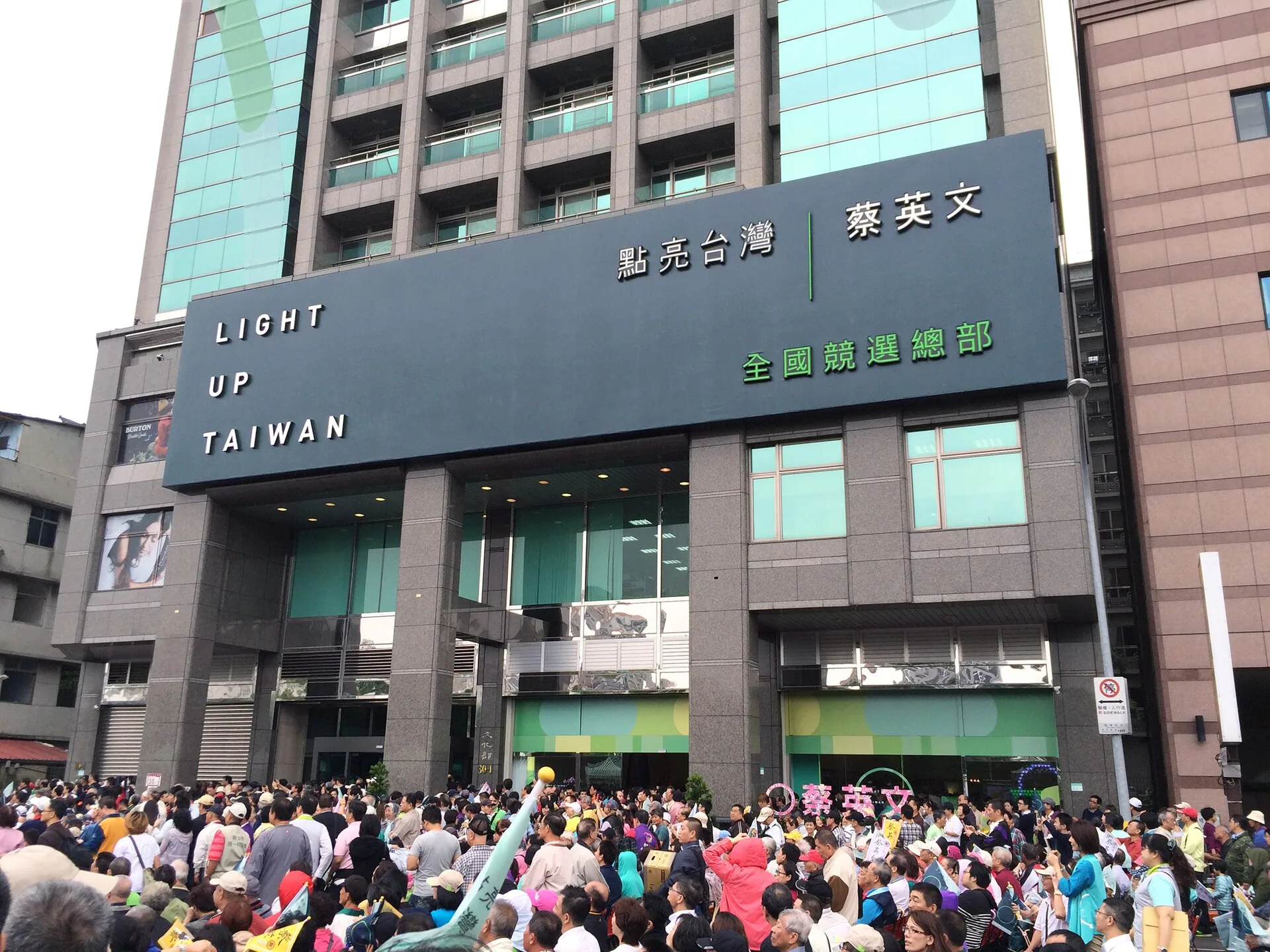
October 2015, supporters at a Tsai Ing-wen campaign rally. Hope says it was the moment during the 2016 election when crowds shouted "We are Taiwanese" toward Tsai that led her to decide to make this film. Photo: MiNe (sfmine79). CC BY 2.0 via Flickr.
The moment that truly ignited Hope was the 2016 campaign rally where the crowd shouted "We are Taiwanese" toward Tsai Ing-wen5. That moment was the act of an entire country naming itself in front of a camera, carrying far more weight than a chronological footnote about one transfer of power.
The film also includes footage that brought tears to many Taiwanese viewers: on the eve of the 2016 election, 16-year-old Taiwanese singer Tzuyu was forced to read an apology on camera after waving the Republic of China flag on a South Korean variety show26. A 16-year-old girl was forced to apologize for her own flag; the next day, Taiwanese voters answered with their ballots. That episode became one of the film's heaviest emotional blows.
Paying to Watch Ourselves

Taiwan poster for _Invisible Nation, released in April 2025. The key visual is Yushan, Taiwan's highest peak, with Tsai Ing-wen, Hsiao Bi-khim, Chen Chu, and other women politicians arrayed at its foot: a country placing its highest point and the people who hold it up in the same frame. Fair use editorial commentary on Invisible Nation (2023). Source: Swallow Wings Films / invisiblenation.net._
On June 13, 2025, Invisible Nation opened in Taiwan theaters2.
What happened next was itself a live verification of the film's argument. It was originally booked in only 65 theaters, but as audiences surged in, the run expanded to 7427. Box office revenue passed NT$10 million in seven days and NT$18 million in ten days, ultimately stopping at NT$37.71 million, making it the third-highest-grossing documentary in Taiwan's film history and the documentary box office champion of 20252.
A society denied in diplomacy used the act of buying tickets to cast one vote after another for its own existence. Tsai Ing-wen herself also recommended the film on social media, emphasizing in particular that it was not a film about her:
"This is not a documentary about me, but a documentary about Taiwan. It depicts how we moved step by step from an 'invisible nation' that was once ignored and suppressed toward the stage of the world."28
She then wrote the film's most moving layer of meaning: "The 'invisible nation' once unseen in the world has instead allowed us to see ourselves, to see the courage of the Taiwanese people, and even more to see the resilience of democratic Taiwan."28
The Film Grew Legs of Its Own
After box office revenue passed NT$30 million, the film began moving into places ordinary documentaries rarely reach.
The first thing Taiwanese journalists noticed was the composition of the audience. Parents brought children into theaters and treated the film as a lesson in Taiwanese democracy; young people also pulled in parents whose political positions differed from theirs, then kept arguing and talking under the arcade after the screening29. Most films rely on opening momentum to drive the first week. This one was pushed forward by viewers one by one after they had seen it, and its run grew stronger as it went.
Then it truly grew legs and walked out of Taiwan on its own. From the second half of 2025 into early 2026, Hope took the film on a campus tour across 11 U.S. states and 19 universities, including Yale, Johns Hopkins, and the University of California, Berkeley. The tour was organized by the Formosan Association for Public Affairs (FAPA)3031. In May 2026, during Asian American and Pacific Islander Heritage Month in the United States, the film aired nationwide on PBS31. A country denied in diplomacy entered living rooms across the United States through a film made by an American.
It went still further when it entered another country's parliament. In November 2024, the film was screened in the UK Parliament. In a coauthored commentary, Lord Alton and Baroness D'Souza wrote that to understand today's world, one must first understand Taiwan32. In one sentence, Taiwan was moved from "a disputed corner of Asia" to an entry point for understanding the entire era.
📝 Curator's Note
There is an irony here worth facing honestly. After the film reached the United States, it was gradually rewritten into another story. Distributor Together Films placed it in an online screening series called "Protect Democracy," running from October 2025 to March 2026; each screening paired Hope in conversation with an American democracy advocate, including Stacey Abrams, who nearly became governor of Georgia33. Taiwan's story was borrowed here as a universal case of "democracy against authoritarianism." Even South Korean director Park Chan-wook endorsed the film, saying Taiwan is a country that deserves far more of the world's attention and unquestionably exists34. One way of being seen by the world, it turns out, is first to turn one's own predicament into someone else's metaphor, and only then receive their eyes.
The honest point is this: it is hard to point to any specific policy, treaty, or diplomatic recognition and say that the film produced it. Its power does not lie on that level. What it did was reignite Taiwanese people's feelings about their own democratic history, open a narrow door through which U.S. academic and policy circles could come to know Taiwan, and give a face to the cold four words "the Taiwan issue": the faces of Tsai Ing-wen, Hsiao Bi-khim, Chen Chu, and Chi Cheng. Before that, Taiwan in those conversations was often merely an abstract equation of chips, geopolitics, and the first island chain. Symbolic weight far exceeds policy weight; that is what it truly changed.
The Man Outside the Frame, Without a Name
Around its Taiwan release, the film also ran into a wave of attacks. Anonymous social-media accounts accused it of being "trash filmed with taxpayer money" and "DPP brainwashing propaganda"35. Producer Isabelle Glachant came forward to refute the rumor in very forceful terms:
"This film took seven years to make. It did not take a single cent of Taiwan's official funding; all production costs were self-raised... Anyone who keeps spreading rumors will be sued!"35
From launch to completion, the film relied on a mixture of support from the Compton Foundation, producer-raised funds, and international public funds. Tsai Ing-wen's government did not pay production costs, and Hope retained final cut8. That wave of attacks therefore had little footing. But the criticism on the other side, harder to answer, is the one the film must truly confront.
The sharpest cut concerns not what it filmed, but what it did not.
Watch the film from beginning to end and one name never appears: Chen Shui-bian, elected in 2000 as Taiwan's first DPP president. That transfer of power was itself an essential page in Taiwan's democratic history; Chen later went to prison in a corruption case. A film about Taiwan's democratization, about "turning the invisible into the visible," skips the person at the center of the first peaceful transfer of power after authoritarian rule36.
This omission was pointed out, independently, by two sides with completely opposite positions. Pro-Taiwan film critic Jay Liu noticed it; pro-Beijing commentator George Koo noticed it too36. When two irreconcilable camps frown at the same time, the blank space outside the frame is no longer a mere oversight.
Some within the pan-green camp were also dissatisfied. Veteran media figure Clara Chou criticized the film as a "ruptured Taiwan," arguing that it skips the tangwai predecessors before Lee Teng-hui and skips Chen Shui-bian, leaving Tsai Ing-wen alone as the endpoint of the entire democratic history37. Producer Isabelle Glachant's response was candid: no film can satisfy everyone. She further explained that the American director's starting point had been "women leaders"; for the director, the true protagonist of the film was always Taiwan as a country, and Tsai Ing-wen was merely the entry point37.
📝 Curator's Note
Here lies a fine irony: a documentary titled Invisible Nation, a film that spends its whole runtime accusing the world of not seeing Taiwan, contains within its own lens an invisible person. Chen Shui-bian's absence comes from the choice of a viewpoint. Once you decide to enter Taiwan's story through the door of Tsai's office, the story will carry the shape of that door. Some people remain inside; some are shut outside. Being seen always carries selection with it. It is always the result of someone choosing a particular angle.
From a purely critical standpoint, the film is not without weaknesses. Jay Liu gave it two stars, saying bluntly that after seven years of relying on cooperation from Tsai's office, it ultimately "devolves into ruling-party propaganda" and becomes the safest, most textbook-like introduction to Taiwan36. The Guardian gave it three stars, faulting it for oversimplifying geopolitics and being "all over the shop"38. Other critics found the score overly sentimental and the film too dependent on interviewees speaking to camera39.
These criticisms deserve to be placed here because they point exactly to the old dilemma of close access: the closer you are to power, the more you can film, but the more others doubt whether you can maintain distance. This contradiction cannot be solved cleanly. It is the structural price the film paid for "being seen."
The Civil Defense Class at the End Is Not Over
The film closes on a group of Taiwanese people attending a civil defense class. After the camera shuts off, that class is not over in real life.
Classes like the one at the end of the film are being held every day. At the end of 2021, legislator Puma Shen and Ho Cheng-hui cofounded Kuma Academy, teaching ordinary people the basics: how to stop bleeding, how to find shelter, and how to identify a piece of disinformation40. In 2022, UMC founder Robert Tsao pledged NT$1 billion, of which NT$600 million went to Kuma Academy40. But between ideals and reality lies a large gap: by September 2024, they had trained roughly 40,000 people, still far from the initial goal of 3 million41. The cost is genuinely painful: in October 2024, China listed Puma Shen and Robert Tsao as "diehard Taiwan independence" figures and imposed sanctions; in 2025, Chongqing police even opened a "separatism" case against Shen42. Teaching people how to survive the worst-case scenario has itself been treated by China as a crime.
The Lai Ching-te administration took over and scaled up this work. After taking office in 2024, Lai established the Whole-of-Society Defense Resilience Committee; Vice President Hsiao Bi-khim serves as deputy convener, and Robert Tsao as an adviser43. A civil defense handbook was delivered to about 9.83 million households; the 2025 Han Kuang exercises became the longest in history, integrating civilian mobilization for the first time, with even PX Mart supermarkets participating in air-raid shelter drills44. Taiwan moved the question of "how to survive" from the documentary's final shot into the living rooms of more than nine million households.
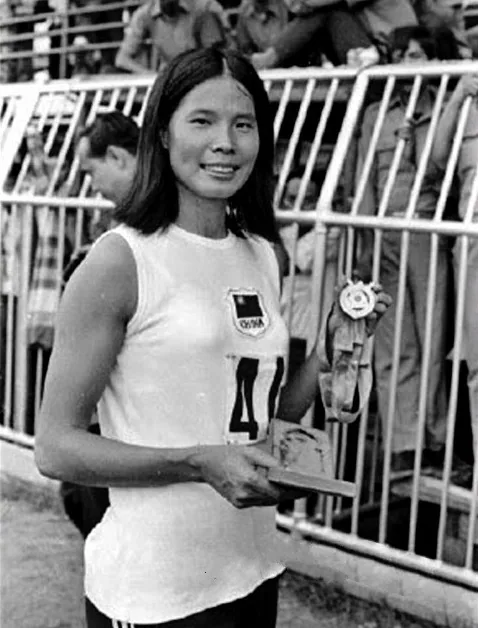
Chi Cheng in 1970, at the peak of her athletic career; that year, she broke three world records in a single week. Half a century later, at 82, she was still working for the right of that bronze medal to bear the name "Taiwan." Photo: public domain (CC0) via Wikimedia Commons.
And the owner of the bronze medal in the film is still fighting for its name today. Chi Cheng has chased that medal's name for almost half her life; the gesture in the film is only one shot in a long-distance run. The 2018 referendum to rename Taiwan's Olympic team failed, but at age 82 she had not stopped, and continued to push for Taiwan to compete under the name "Taiwan" at the 2028 Los Angeles Olympics45. An 82-year-old is still demanding, for a bronze medal she won in her youth, the right to have her own name written on it.
After leaving office, Tsai Ing-wen did not stop either. In May 2025, she flew in person to the Copenhagen Democracy Summit and told a room full of Europeans that Taiwan's security is crucial to regional stability and to defending democratic values amid rising authoritarian pressure46. And in the audience that day sat a familiar face: Vanessa Hope, this time as a forum moderator47. The director who had followed Tsai for seven years with a camera met her again, this time on a stage in another country.
Seeing Is an Act
Invisible Nation does not end in applause or victory.
Its ending hands the camera to a group of Taiwanese people attending a civil defense course48. There is no victorious climax, no grand reunion, only ordinary people on a Taiwan targeted by missiles, denied in diplomacy, and possibly facing war at any moment, learning how to protect one another in the worst-case scenario. It is a heavy and honest closing.
That ending answers the question posed by the title. Taiwan's "being seen" has never been a status bestowed by someone else: not by the United Nations, not by the Olympics, and not by diplomatic allies that sever ties one by one. It is one act after another: Chi Cheng lifting a bronze medal that cannot bear its own name; Taiwanese voters casting ballots the day after 16-year-old Tzuyu was forced to apologize; Tsai Ing-wen telling the camera that Taiwan already is an independent nation; each person among the more than NT$37 million in box office receipts walking into a theater; the ordinary Taiwanese people at the end of the film learning first aid and sheltering. And that class is still not over today: Kuma Academy's classrooms remain open, 82-year-old Chi Cheng is still demanding a name for that bronze medal, and Tsai Ing-wen, out of office, has taken the stage in Copenhagen to keep speaking for Taiwan.
The film itself is one of those acts. It is imperfect: it depended on approval from power, it left a man named Chen Shui-bian outside the frame, and it was slapped from both the left and the right. But it did not turn the camera away. Frame by frame, it filmed a Taiwan the world had decided not to see.
At that June 2025 press screening, the ground shook before the screen lit up. A foreign director told a room full of Taiwanese people, "You're not alone." That an invisible nation can still be seen has never required anyone's permission. It only requires that someone, on unsteady ground, remain willing to press the shutter.
Further Reading
- Tsai Ing-wen — The central figure filmed closely across seven years in this documentary, Taiwan's first woman president, who went from losing by 800,000 votes to winning reelection with 8.17 million
- Sunflower Movement — A key node in the film's democratic arc, the 24 days in 2014 that reshaped a generation's political consciousness
- Chi Cheng — The "Flying Antelope" who takes out her 1968 Mexico City Olympic bronze medal in the film and asks whether "Chinese Taipei" is the name of a country
- Chinese Taipei — The Olympic naming mechanism behind Chi Cheng's "bronze medal that cannot bear its own name"
- Taiwan's unification-independence spectrum — The sovereignty coordinates of Tsai Ing-wen's line in the film that Taiwan already is an independent nation
- Puma Shen — The real-world version of the civil defense class at the end: cofounder of Kuma Academy and a legislator teaching civilians "how to survive"
- Mountain Makers: The Century's Gamble — Another "Taiwan values" documentary released on the same day as this film, telling the story of Taiwan's semiconductor industry
Image Sources
This article uses five images, all cached in public/article-images/ to avoid hotlinking source servers:
- Hero and in-text stills: official stills and Taiwan poster for Invisible Nation (2023, dir. Vanessa Hope), used as fair use editorial commentary for film criticism. Sources: invisiblenation.net / Swallow Wings Films.
- Tsai Ing-wen 2015 campaign rally: Photo by MiNe (sfmine79), CC BY 2.0 via Flickr.
- Chi Cheng 1970 portrait: public domain (CC0), via Wikimedia Commons.
- Video: official trailer for Invisible Nation, embedded from distributor Abramorama's official YouTube channel.
References
- Wikipedia — Invisible Nation — Record that Invisible Nation runs 85 minutes, had its world premiere at the Woodstock Film Festival on September 29, 2023, and had its North American theatrical premiere at New York's Quad Cinema on May 31, 2024↩
- 維基百科 — 看不見的國家 — Compilation of records including the film's June 13, 2025 Taiwan release, final box office of NT$37.71 million, and ranking as the third-highest-grossing documentary in Taiwan film history, with links to original news sources↩
- Yahoo 新聞 — 看不見的國家上映前天搖地動 導演暖心祝福 — On-site report that an earthquake occurred before the June 11, 2025 Taiwan press premiere, and that Vanessa Hope told Taiwan, "You're not alone"↩
- ChinaFile — Vanessa Hope profile — Background on Hope studying Chinese in Taipei in 1995-96, witnessing Taiwan's first direct presidential election and the missile crisis in 1996, and her education at the University of Chicago and Columbia University doctoral program (PhD not completed)↩
- BOMB Magazine — Vanessa Hope by Cat Searcey — Hope's account of getting chills after hearing crowds shout "We Are Taiwanese!" in 2016, which planted the idea for the film, and her description of the film as an effort to "sound the alarm"↩
- Variety — Invisible Nation Taiwan Doc by Vanessa & Ted Hope — Background on Hope as the granddaughter of Hollywood producer Walter Wanger and actress Joan Bennett, and as the wife of veteran producer Ted Hope↩
- The Wire China — Vanessa Hope on Taiwan, the Invisible Nation — Hope's interview account of submitting the proposal to the Presidential Office, waiting for a response, and first filming in May 2017↩
- Taipei Times — Documenting an invisible nation — Firsthand interview on the seven-year production, five interviews with Tsai Ing-wen, "each interview scheduled the day before I was leaving," the initial prohibition on asking about Cross-Strait relations, retention of final cut, and absence of government production funding↩
- Pancouver — Invisible Nation director Vanessa Hope reveals how Tsai boosted pride — Close-access scenes in the film, including interviews inside the Presidential Office, the presidential aircraft, daily life at the official residence, and Tsai Ing-wen's cat Think Think wandering into frame↩
- The Wire China — Vanessa Hope on Taiwan, the Invisible Nation — Observation that in an interview composition, Tsai Ing-wen's head blocks the portrait of Chiang Kai-shek behind her↩
- Real Democracy Movement — Taiwan: Invisible Nation — The film's lack of narration, observational method, and historical arc covering the Dutch, Japanese rule, the 1949 relocation to Taiwan, the White Terror and the February 28 Incident, the lifting of martial law, and direct elections↩
- Variety — Invisible Nation Review — Interviewee list: Tsai Ing-wen, Hsiao Bi-khim, Chen Chu, Audrey Tang, Freddy Lim (lead singer of Chthonic), Ma Ying-jeou, Wu Pei-yi, Chi Cheng, Nancy Pelosi, Andrew Nathan, and others↩
- Variety — Invisible Nation Review — English-rendered quotation from Chen Chu in the film about their positions once being treated as "treason" and now becoming an important part of Taiwanese democracy (the original Chinese phrasing was not found; this article paraphrases)↩
- Variety — Invisible Nation Review — Tsai Ing-wen's English line in the film, "We don't have a need to declare ourselves an independent state — we are an independent nation" (spoken in English in the film; this article paraphrases rather than retranslating it into Chinese)↩
- Variety — Invisible Nation Review — Scene in which Chi Cheng takes out her 1968 Mexico City Olympic bronze medal and asks, "Is Chinese Taipei the name of a country? No" (Variety misspells her as Chen Cheng; the correct name is Chi Cheng)↩
- Full text of United Nations General Assembly Resolution 2758 (Wikisource) — Passed on October 25, 1971 by 76-35-17, recognizing the PRC government as "the only legitimate representatives of China to the United Nations" and expelling Chiang Kai-shek's representatives; the full text does not mention Taiwan↩
- UPI — IOC announces Taiwan to compete as Chinese Taipei (1981) — The March 23, 1981 Lausanne Agreement establishing the Olympic committee name "Chinese Taipei," the Plum Blossom Flag, and the use of the flag anthem↩
- Wikipedia — 2018 Taiwanese referendum — November 24, 2018 referendum on renaming the Olympic team rejected: 5,774,556 opposed (52.3%) versus 4,763,086 in favor (43.1%)↩
- CNN — As Tsai leaves office, Taiwan's map of allies has shrunk — Summary that Taiwan had about 22 diplomatic allies when Tsai Ing-wen took office in 2016, 12 when she left office in 2024, and lost 10 during her tenure (the 21/22 count varies slightly depending on how the Gambia's 2013 severance is counted; this article uses "about 22")↩
- RFA — Nauru cuts diplomatic ties with Taiwan — Nauru announced on January 15, 2024, two days after Taiwan's presidential election, that it was severing ties with Taiwan and establishing relations with Beijing↩
- Washington Post — After 38 Years, Taiwan Lifts Martial Law — Martial law in Taiwan took effect on May 20, 1949 and was lifted by Chiang Ching-kuo on July 15, 1987, lasting 38 years↩
- Wikipedia — February 28 incident — The Executive Yuan's 1992 report estimated the February 28 death toll at 18,000-28,000 (estimates are disputed); the figure of roughly 140,000 imprisoned during the White Terror period appears in White Terror (Taiwan)↩
- Wikipedia — 1996 Taiwanese presidential election — Taiwan's first direct presidential election on March 23, 1996, in which Lee Teng-hui won with 54% of the vote amid Chinese missile tests during the Third Taiwan Strait Crisis↩
- 維基百科 — 太陽花學運 — From March 18 to April 10, 2014, for a total of 24 days, students opposing the Cross-Strait Service Trade Agreement occupied the Legislative Yuan↩
- Library of Congress — Taiwan: Same-Sex Marriage Law Enters into Effect — On May 17, 2019, the Legislative Yuan passed the Act for Implementation of Judicial Yuan Interpretation No. 748 by 66-27; it took effect on May 24, making Taiwan the first in Asia↩
- Wikipedia — Tzuyu Incident — Tzuyu waved the Republic of China flag on a South Korean variety show on November 21, 2015, released an apology video on January 15, 2016 at age 16, and Taiwan's presidential election was held the next day, January 16; the film includes footage of this incident↩
- ETtoday — 看不見的國家加開戲院 — Taiwan box office report that the film was initially booked in 65 theaters and expanded to 74 due to audience turnout↩
- 聯合報 — 蔡英文推薦看不見的國家 — Tsai Ing-wen's verbatim Chinese social-media post around the June 2025 release, including the lines "This is not a documentary about me, but a documentary about Taiwan" and "the 'invisible nation' once unseen in the world has instead allowed us to see ourselves"↩
- 中央社 — 看不見的國家上映 7 天票房破千萬 — Word-of-mouth scenes after the film opened in Taiwan: theaters increasing rather than decreasing, parents bringing children and young people bringing parents with different political views to watch across generations↩
- FAPA — Invisible Nation US University Tour & PBS Broadcast — Record of FAPA organizing Vanessa Hope's tour across 11 U.S. states and 19 universities, including Harvard, Yale, Stanford, and Johns Hopkins SAIS↩
- KQED — Taiwan Documentary Invisible Nation to Air Nationwide on PBS — Official press release on the film airing nationwide on PBS in May 2026 during Asian American and Pacific Islander Heritage Month, reaching about 77% of U.S. media markets↩
- PoliticsHome — Baroness D'Souza and Lord Alton review Invisible Nation — The film was screened in the UK Parliament in November 2024; Lord Alton said, "To understand the world today, we need to understand Taiwan" (this article paraphrases the English original)↩
- Together Films — Invisible Nation: Protect Democracy Screening Series — Distributor Together Films placed the film in the "Protect Democracy" online screening series from October 2025 to March 2026, pairing Hope at each event with American democracy figures such as Stacey Abrams↩
- Invisible Nation official website — South Korean director Park Chan-wook's English endorsement of the film: "Taiwan is not an invisible nation. It is a country that deserves far more of our attention, and one that undeniably exists" (this article paraphrases the English original rather than translating it into Chinese)↩
- 自由時報 — 製片馮賢賢闢謠稅金指控 — Producer Isabelle Glachant's verbatim Chinese response to false accusations that the film used taxpayer money: "It did not take a single cent of Taiwan's official funding; all production costs were self-raised... Anyone who keeps spreading rumors will be sued!"↩
- The Asian Cut — Invisible Nation Review (Jay Liu) — Jay Liu gives the film two stars, criticizes it for relying on cooperation from Tsai's office for seven years and "devolving into ruling-party propaganda," calls it the most textbook-like introduction to Taiwan, and notes that Chen Shui-bian is never mentioned; pro-PRC commentator George Koo independently notes the same omission in Asia Times↩
- 放言 — 看不見的國家斷代爭議 — Clara Chou criticizes the film as a "ruptured Taiwan" that skips tangwai predecessors before Lee Teng-hui and Chen Shui-bian; producer Isabelle Glachant responds that "no film can satisfy everyone" and that "the focus of this film is the country"↩
- The Guardian — Invisible Nation review — The Guardian gives the film three stars, calling it "all over the shop" and saying its geopolitical argument is oversimplified↩
- Screen Daily — Invisible Nation IDFA review — Criticizes the film as "dramatically underpowered," with overly sentimental music and excessive reliance on talking-head interviews↩
- Focus Taiwan — Robert Tsao to donate NT$1 billion for civil defense — UMC founder Robert Tsao pledged NT$1 billion in 2022, including NT$600 million for Kuma Academy; Kuma Academy was cofounded at the end of 2021 by legislator Puma Shen and Ho Cheng-hui to teach civilians bleeding control, sheltering, and disinformation recognition↩
- Taipei Times — Kuma Academy trains civilians for resilience — Record that by September 2024 Kuma Academy had trained about 40,000 people, far below the previously announced goal of 3 million↩
- Hong Kong Free Press — Robert Tsao and Puma Shen hit with Chinese sanctions — In October 2024, China sanctioned Puma Shen and Robert Tsao as "diehard Taiwan independence" figures; Chongqing police opened a "separatism" case against Shen in October 2025, see also Human Rights Watch↩
- Office of the President, Republic of China (Taiwan) — Whole-of-Society Defense Resilience Committee — Official information on the Lai Ching-te administration's establishment of the Whole-of-Society Defense Resilience Committee after taking office in 2024, with Vice President Hsiao Bi-khim as deputy convener and Robert Tsao as adviser↩
- Taiwan News — Taiwan distributes civil defense handbook — Report that the civil defense handbook was sent to about 9.83 million households; for the 2025 Han Kuang exercise as the longest ever and its first integration of civilian mobilization, including PX Mart air-raid shelter drills, see SOFREP — Taiwan's Han Kuang Exercise 2025↩
- FAPA — Let Taiwan Be Taiwan at the Olympics: Taiwan's Olympic Story — Record that after the failed 2018 referendum to rename Taiwan's Olympic team, Chi Cheng, then 81, was still pushing for Taiwan to compete under the name "Taiwan" at the 2028 Los Angeles Olympics↩
- Taipei Times — Tsai urges democracies to stand with Taiwan (Copenhagen) — In May 2025, Tsai Ing-wen attended the Copenhagen Democracy Summit in person and said Taiwan's security is essential to regional stability and to defending democratic values amid mounting authoritarianism (this article paraphrases the English original)↩
- Copenhagen Democracy Summit 2025 — Vanessa Hope (Moderator) — Official speaker page showing Vanessa Hope attending the 2025 Copenhagen Democracy Summit as a forum moderator, appearing at the same event as Tsai Ing-wen)↩
- Taiwan Insight — Invisible Nation documentary is making Taiwan more visible — University of Nottingham Taiwan Insight analysis of the film's heavy closing scene with Taiwanese people attending civil defense training↩