
30-Second Overview: In 2012, Tsai Ing-wen lost the presidential election by a margin of 797,516 votes; eight years later, she won re-election with 8,170,231 votes, setting a record for the highest vote count in Taiwan's history of direct presidential elections. This international trade law scholar, who once admitted to being afraid of talking to people, became Taiwan's first female president and left institutional marks on same-sex marriage, indigenous transitional justice, pensions, and defense reform. She left office with a passing grade: there are historic accomplishments, but also unresolved problems in justice, housing prices, energy, and cross-Strait relations.
On the evening of January 14, 2012, Tsai Ing-wen stood on the stage of her defeat.
She received 6,093,578 votes, falling short of Ma Ying-jeou by 797,561. That night, she told her supporters: "You may weep, but do not lose heart; you may be sad, but do not give up."1 Four years later, she was elected with 6,894,744 votes. Another four years later, the count rose to 8,170,231, becoming the highest record since Taiwan implemented direct presidential elections.2
This experience could easily be written as a "comeback" story. But the questions Tsai Ing-wen truly left behind are more interesting: How did an academic-style politician—one who didn't rely on passionate speeches and once feared speaking to others—get the most voters to hand her their ballots in an era of mass politics?
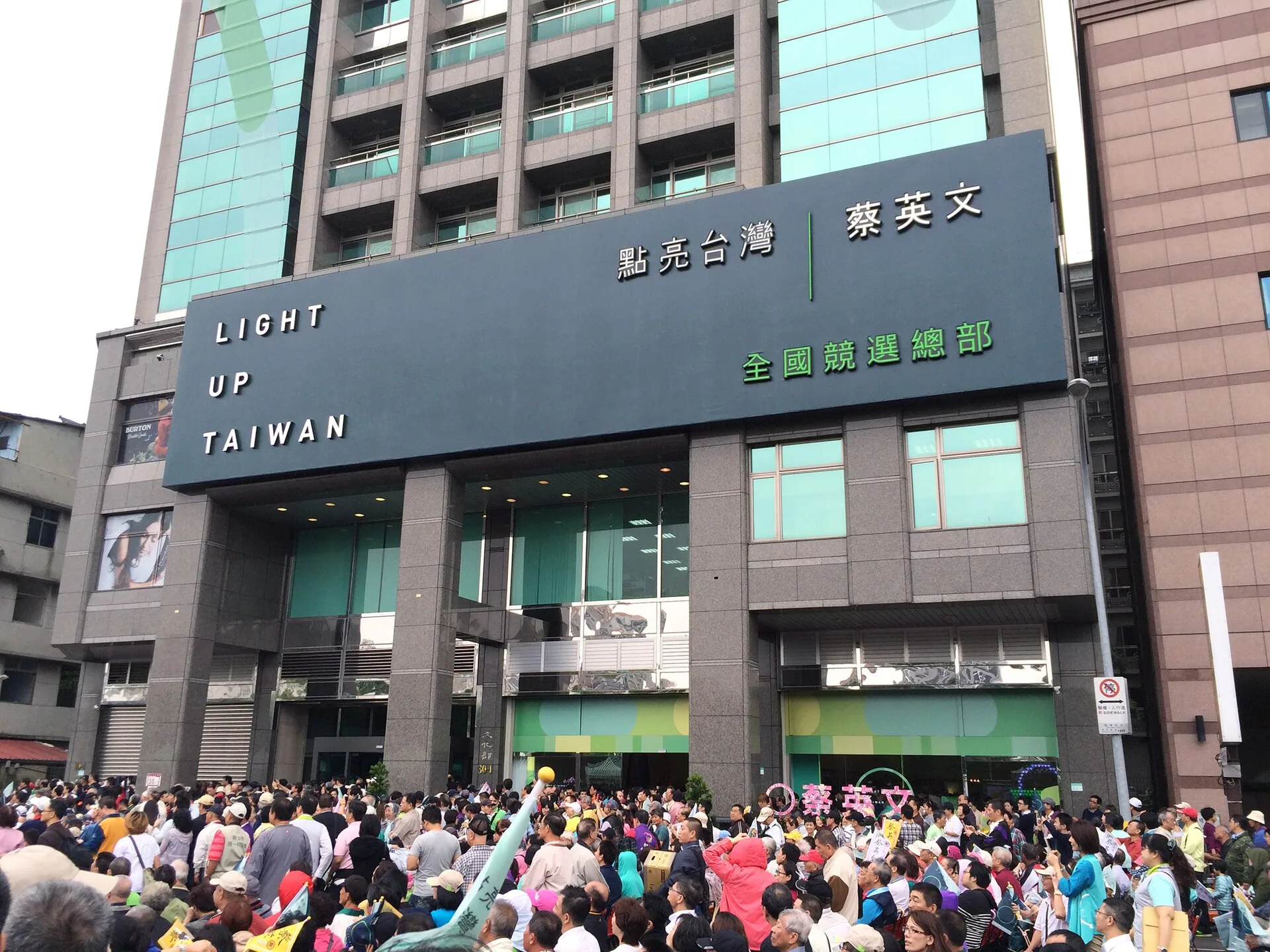
_Tsai Ing-wen at a campaign rally in October 2015. Photo: MiNe (sfmine79), CC BY 2.0 via Wikimedia Commons._
One of Eleven Children, the One Who Bowed Her Head While Walking
Born in Taipei in 1956, Tsai Ing-wen was the youngest of eleven children in the large family of her father, Tsai Chieh-shung. Her family has Hakka, Hokkien, and Paiwan heritage. Regarding the specific generation of her Paiwan lineage—whether from her grandmother or great-grandmother—public records vary, making it inappropriate to assign a precise generation for her.3
After graduating from the Department of Law at National Taiwan University in 1978, she earned an LL.M. from Cornell University and a doctorate in law from the University of London in 1984. Since 2019, her doctoral degree has been a focus of political debate. The London School of Economics and the University of London have both confirmed her academic records, and Taiwanese courts have also affirmed her possession of the doctorate in related litigation.4
After returning to Taiwan, she taught international trade law at a university and joined negotiations for Taiwan's accession to GATT and later the WTO. In 1999, she participated in Lee Teng-hui's discourse on "Special State-to-State Relations." Following the change of government in 2000, she served as the Chairperson of the Mainland Affairs Council. This path followed a consistent logic: first study the rules, then find Taiwan's room for maneuver within the boundaries drawn by great powers.
Documentary filmmaker Vanessa Hope described her as modest, quiet and calm. Tsai Ing-wen herself stated that she never dreamed of becoming president and was even afraid of talking to people in her youth. Gu Li-hsiung recalled that she used to be so shy that she would bow her head while walking to avoid meeting others' eyes.5
The person who once bowed her head to avoid eye contact eventually had to stand before national cameras every day. She did not transform herself into a different type of politician; instead, she brought the familiar tools of law, negotiation, and risk calculation into politics.
The First Female President, Who Rarely Put "Woman" at the Forefront
On January 16, 2016, Tsai Ing-wen was elected as Taiwan's first female president. This "first" was not achieved through marriage into a political family or inheritance. She is unmarried, has no children, and did not enter the center of power as a first lady or a scion of a political dynasty. In a context where Asian female leaders are often framed through their fathers, husbands, or family lineages, this path itself is representative.
However, she rarely used gender as a primary pillar of self-promotion. Her 2016 inaugural address focused on economy, social safety, transitional justice, cross-Strait relations, and diplomacy; it did not use the "female president" label to add romantic packaging to her authority. This restraint came with a cost: when outsiders attacked her based on gender, she often did not engage directly. After she took office, Chinese state media linked her unmarried status with "extreme behavior," and several international media outlets criticized such rhetoric as being sexist.6
Her identity as a woman still emerged from policy and political contexts. The proportion of women in the Executive Yuan during her tenure was not consistently prominent, nor did the Democratic Progressive Party (DPP) abandon its male-dominated factional structure because of her. However, the visibility of the same-sex marriage law, the Anti-Stalking and Harassment Act, and female participation in politics did move forward during her term. Attributing these changes entirely to Tsai Ing-wen's personal achievement would erase decades of advocacy by women's rights groups and legislators. Conversely, removing her role entirely would underestimate the power of a president choosing to sign off at the final political hurdle.
Her public image was often opened by two cats providing a softer window. Tsai Xiang-xiang (Tsai's first name) is a tabby cat rescued near Heping Station in Hualien by Hsiao Bi-khim after Typhoon Soudelor in 2012. Tsai A-chai came from a pineapple field in the Baxiago village of Taitung.3 The cats in campaign videos, promotional items, and social media posts gave an otherwise "cool" political figure a daily point of entry, also becoming a model for how Taiwanese politicians manage their online personas later on.
These images are intimate, but they should not obscure power. Tsai Ing-wen was the caretaker of cats, but she was also the president who managed national security, nominated justices, and appointed the Premier of the Executive Yuan. Describing her only as a "cat lover" would diminish her; portraying her as a heartless institutional machine would be inaccurate. Both images exist simultaneously to reflect how she is remembered by the Taiwanese people.
She also faced a set of aesthetic judgments that male predecessors rarely endured: her hairstyle, clothing, and marital status were frequently treated as political news. Tsai Ing-wen mostly did not retaliate with gendered language but left the response to her performance. This choice allowed her to avoid being framed as a victim, though it may have cost her the opportunity to proactively define discrimination for other female leaders. Silence on her part was both a style and a calculated, albeit costly, political strategy.
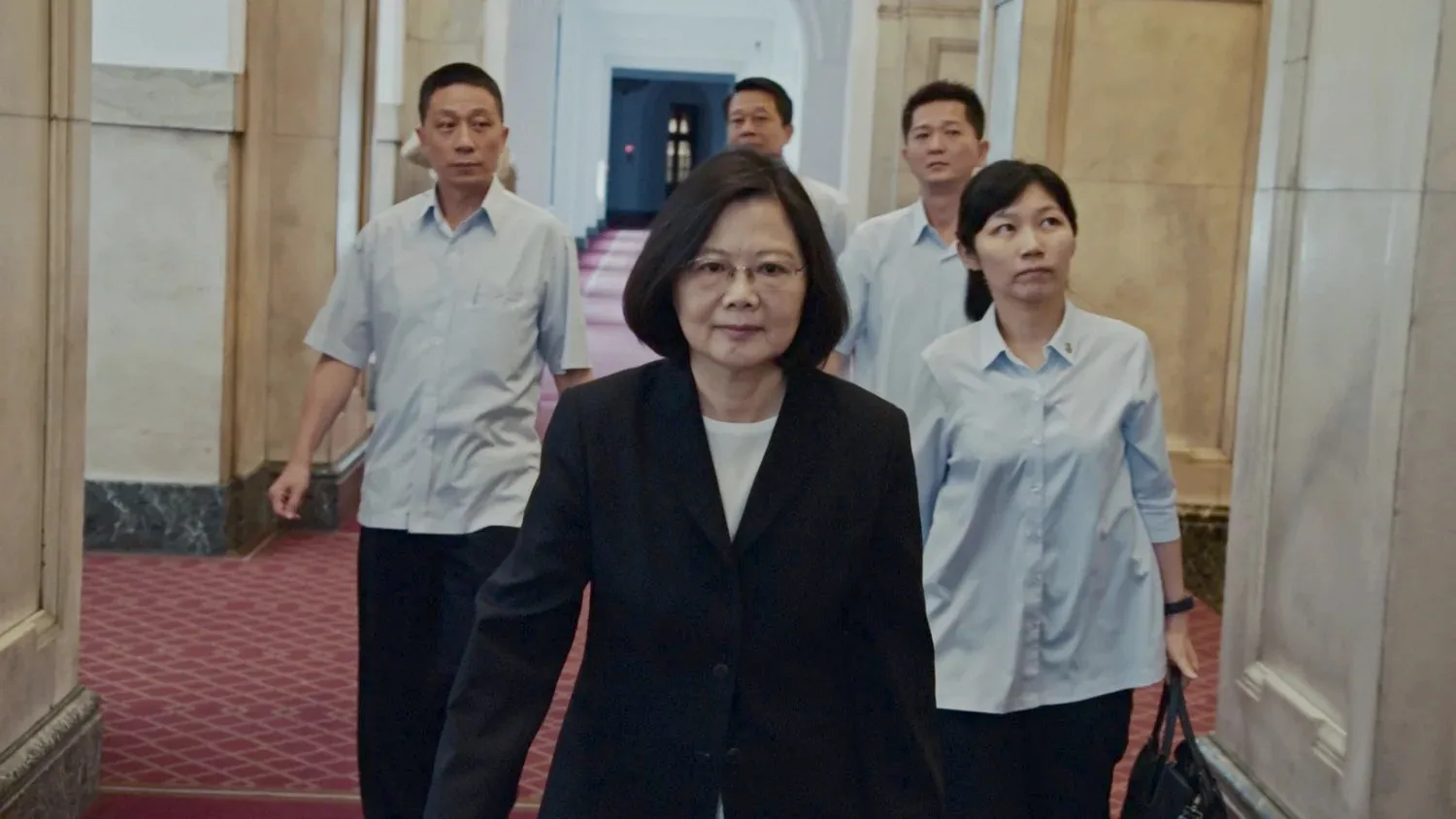
Official still from "Invisible Nation." Tsai Ing-wen is shown walking between security and staff; her private personality and presidential duties are captured in the same frame. Fair use editorial commentary on Invisible Nation (2023).
Taking Over Two Parties That Hit Rock Bottom Twice
In 2008, the DPP suffered a heavy defeat in the presidential election, and Tsai Ing-wen took over as party chairperson for the first time. She resigned after her loss in 2012. In 2014, she returned to the post, and two years later became Taiwan's first female president.
Her first term was not a steady climb. In the 2018 local elections, the number of seats held by the DPP in governed counties and cities dropped from thirteen to six, and she resigned as party chairperson for the second time following the loss. The next January, during Xi Jinping's remarks on the 40th anniversary of the "Letter to Compatriots in Taiwan," he reaffirmed "One Country, Two Systems." Tsai Ing-wen responded that day that Taiwan would not accept it. Rap artist Da Zhi subsequently wrote "Spicy Taiwanese Girl" (辣台妹) based on this; she replied: "I'm probably not a 'spicy girl'... but if Taiwan needs it, we are all on the spicy team, and we'll be as spicy as needed."7
The 2019 Hong Kong anti-extradition bill movement ensured that "One Country, Two Systems" was no longer just an abstract term. Tsai Ing-wen won 57.13% of the vote in the 2020 election, moving from the setbacks of local elections to a record high for a direct presidential election. This turnaround included her political judgment, but also included the situation in Hong Kong and the electoral conditions brought by KMT candidate Han Kuo-yu. Attributing all 8.17 million votes solely to personal charisma would fail to see the sense of risk Taiwanese voters faced at that time.
Two Signatures, With People Left Outside
On August 1, 2016, Tsai Ing-wen apologized to indigenous peoples on behalf of the government at the Presidential Office: "For the hardships and unfair treatment you have endured over the past four hundred years, I apologize on behalf of the government."8
While there was an apology inside the Presidential Office, there were indigenous groups outside who refused to accept it. Subsequently, the Committee for Indigenous Peoples' History Justice and Transitional Justice was established to handle issues such as traditional territories, the identity of the Plain Aborigines (Pinpu), and nuclear waste in Lanyu. However, core demands such as land rights and autonomy did not end with a single apology.
Another signature fell in 2019. On May 17, the Legislative Yuan passed the "Act Governing the Implementation of Interpretation No. 748 of the Judicial Yuan," which took effect on May 24, making Taiwan the first country in Asia to allow same-sex partners to marry. There were 526 registrations on the first day.9
This system was completed in the form of a special law after a majority opposed protecting same-sex marriage under civil law in the 2018 referendum. While supporters celebrated the realization of marriage rights, some criticized that the special law still left a sense of "different names, different systems" as secondary status. Tsai Ing-wen's governance style is often visible here: she pushed a highly contentious issue through the legal threshold; the cost was making both sides feel she hadn't gone far enough or had gone too far.
Pensions, Transitional Justice, and an Uneven Report Card
During Tsai’s administration, reforms to civil servant and military pensions were completed. Related laws for civil servants and public school staff were passed in June 2017, and the military pension reform was passed in 2018. The reforms lowered the income replacement rate for some, triggering long-term protests from retiree groups such as the "Eight Hundred Heroes."10
The "Act Promoting Transitional Justice" was passed in 2017, and the Committee for Promoting Transitional Justice was established the following year. In 2022, when the committee's term ended, the Executive Yuan stated that the opening of political archives, handling of authoritarian symbols, and preservation of sites of injustice would be continued by various ministries. The word "continued" also indicated a limitation: the state began building the system, but did not complete all historical cleaning within a single administration.11
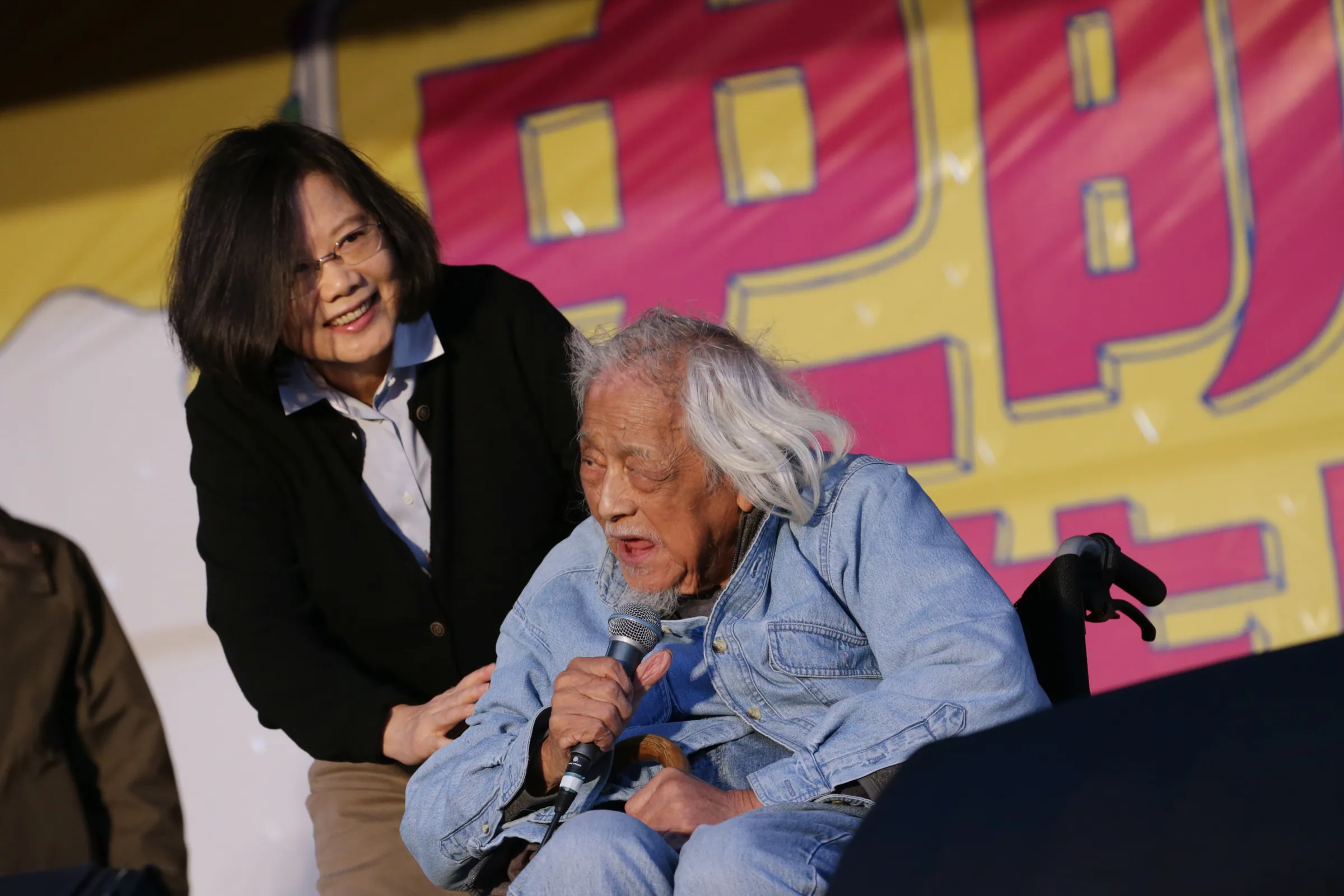
In 2017, Tsai Ing-wen attended the 100th birthday celebration of Shi Ming. Their shared appearance reflects the relationship between the ruling DPP and the independent movement generation—close yet still possessing distance. Photo: Office of the President of the Republic of China, CC BY 2.0. Original links are listed at the end of the image sources.
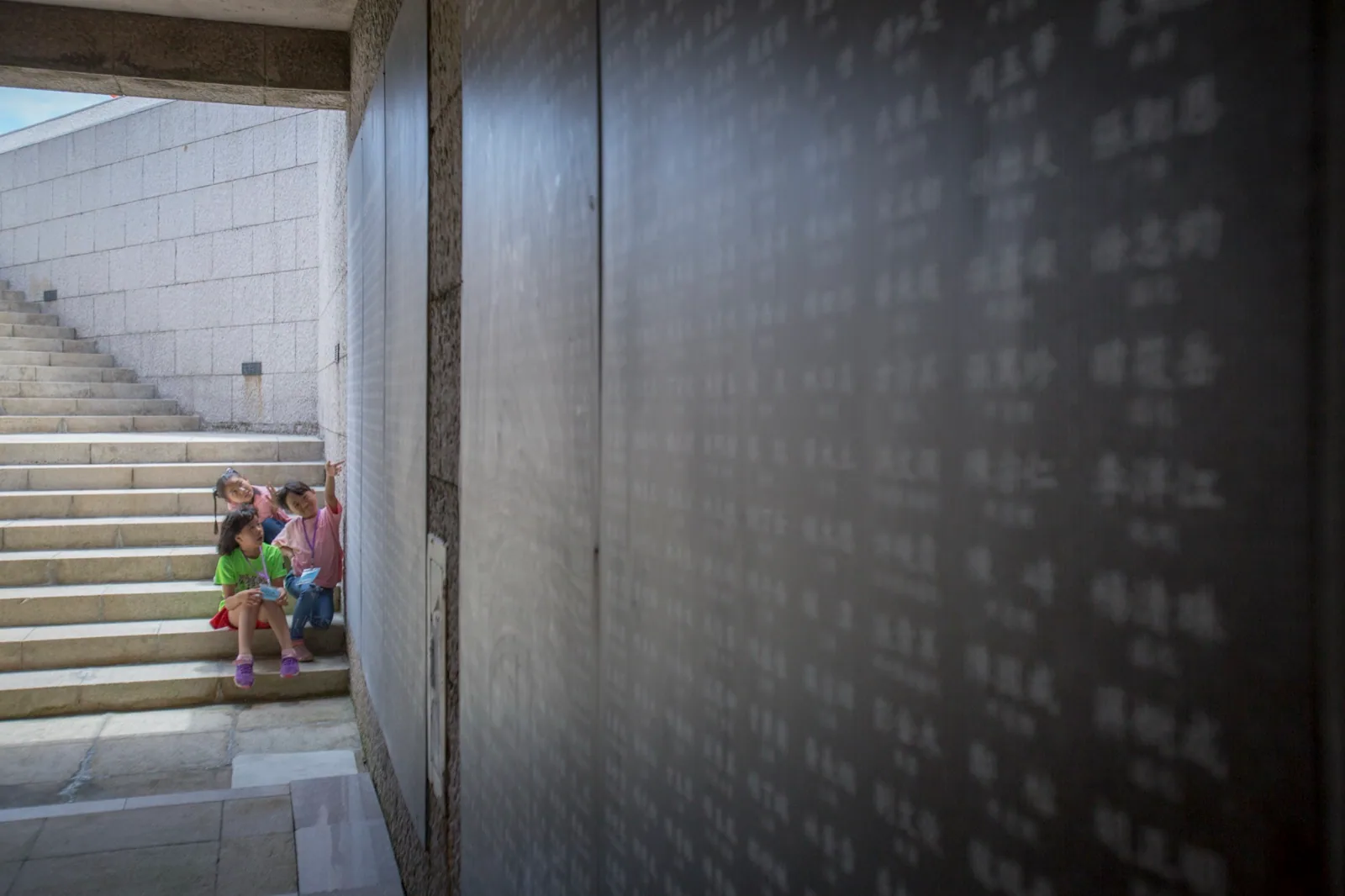
On May 17, 2018, the National Human Rights Museum was inaugurated. Photo: Office of the President of the Republic of China, CC BY 2.0. Original links are listed at the end of the image sources.
The polls before her departure were not a unanimous chorus of praise. A survey by the Taiwan and Democracy Foundation in April 2024 gave Tsai Ing-wen's eight years of governance an overall score of about sixty. Evaluations for national defense, the improper party assets case, and pension reform were higher; dissatisfaction regarding justice, economy, and cross-Strait relations was more prominent.12 Housing costs, energy transition, judicial reform, and labor policies were areas where even supporters were not necessarily satisfied.
📝 Curator's Note
"Quiet" cannot be used to justify the success or failure of policies. What it truly provides as an observation point is seeing how a political figure transforms conflicts into laws, committees, and administrative procedures; systems can be left behind, but they also leave behind what remains unfinished.
Beneath Chip Prosperity, Housing and Energy Have Not Settled Down
Tsai’s eight years also spanned a period of rapid growth in Taiwan's industrial standing. The US-China tech competition and supply chain disruptions during the pandemic led many countries to re-evaluate the importance of TSMC and Taiwan's semiconductor industry. The government promoted the "Three Major Initiatives" to attract investment, and after the US-China trade war, it absorbed some returning Taiwanese businesses. In 2021, Taiwan's economic growth reached 6.62%, and in 2024, the GDP per capita was $33,983.1314
Overall prosperity did not fall evenly into every household. The Central Bank adjusted selective credit controls five times, and the Executive Yuan launched new "New Youth" loans; however, the house price-to-income ratio still left young people feeling that their salaries could not keep up with housing costs. In 2017, the government announced a target of "200,000 social housing units in eight years," later combining direct construction, lease management, and rent subsidies into one calculation. This shift in phrasing also became a focus for opposition criticism regarding whether policies met original promises.15
The costs of energy policy are similarly hidden from single figures. The Tsai administration aimed for a "Nuclear-Free Homeland" by 2025, expanding offshore wind and solar power, yet experienced large-scale blackouts in 2017, 2021, and 2022. Supporters view investment in renewable energy as long-term transition; opponents link power supply incidents, electricity prices, and Taipower's losses to the non-nuclear path. While the causes of blackouts varied and attributing every incident solely to the energy structure is inaccurate, when the government asks industries and families to believe in a long-term transition, stable power supply naturally becomes the most direct political test.16
Tsai often used the term "National Team" to describe the government's ability to coordinate industries. Masks, chips, national defense, and green energy were all placed within this framework. The National Team can concentrate resources, but it also makes it harder for the government to attribute failures to the market: when house prices don't drop, power grids fail, or industrial subsidies are distributed unevenly, voters will still look back to the team captain.
After the Mask National Team, Praise Became Irony
In the early stages of the COVID-19 pandemic, Taiwan moved quickly to implement border quarantine, mask requisitioning, and a real-name system, while integrating information through the Central Epidemic Command Center. The low case numbers and long periods without local infections in 2020 led to international attention on the "Taiwan Model."17
After domestic cases surged in May 2021, controversies over vaccine procurement, testing capacity, and correction of reporting accumulated rapidly. "Proactive deployment" turned from praise into irony. While Taiwan's economic growth reached 6.62% in 2021, the aggregate figures could not offset the individual experiences of families facing infections, business closures, and caregiving pressures.13
This segment serves as a reminder that the results of epidemic prevention cannot be sliced only at 2020 or only at 2021. Early decisions certainly bought time; later gaps clearly cost the government in terms of public trust.
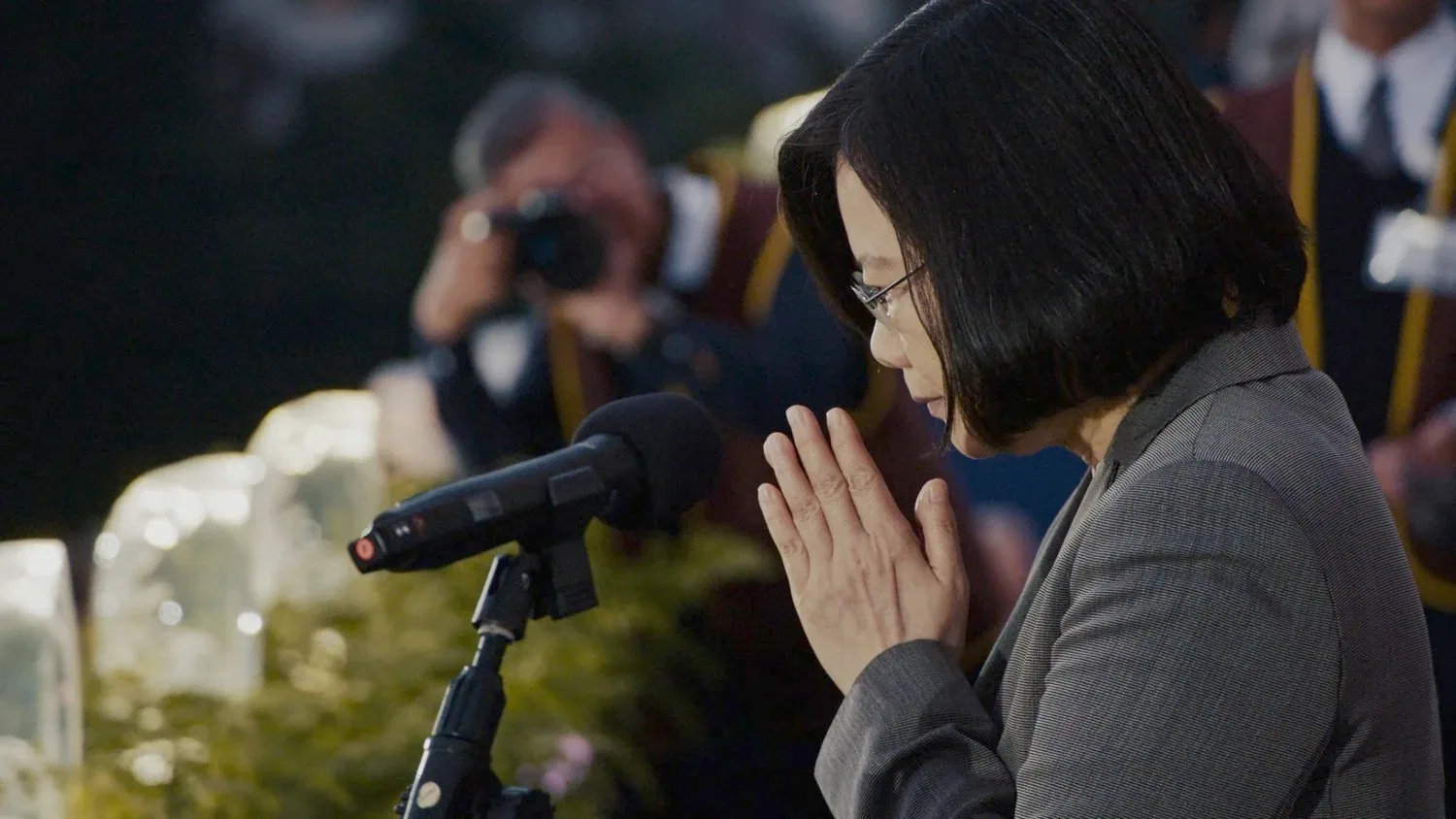
Official still from "Invisible Nation." Ge Jing-wen's lens often captures another camera pointed at Tsai Ing-wen. Fair use editorial commentary on Invisible Nation (2023).
Maintaining the Status Quo, While Preparing for the Worst Day
Tsai Ing-wen did not accept the "1992 Consensus," nor did she declare legal independence. She described her path as maintaining the status quo while increasing defense spending, promoting domestic production of aircraft and submarines, and announcing in 2022 that mandatory military service would be restored to one year, starting in 2024.18
In August 2022, after U.S. House Speaker Nancy Pelosi visited Taiwan, China conducted military exercises around the island. The Ministry of National Defense reported the launch of eleven Dongfeng series ballistic missiles; the Japanese Ministry of Defense identified nine, five of which landed in Japan's exclusive economic zone. These two official accounts differ; one cannot combine "eleven," "nine," and "five" into a single calculation.19 That same year, 564 Chinese military aircraft flew across the median line of the Taiwan Strait, more than twenty-four times the total of previous years before Pelosi's visit.20
Her cross-Strait path received criticism from both sides. The KMT argued that rejecting the 1992 Consensus cut off official communication and intensified hostility; critics from the localist camp argued that "Republic of China (Taiwan)" and maintaining the status quo delayed the issue of sovereignty. The space she chose was narrow: not defining the status quo as a final destination, nor allowing pressure to force Taiwan's decision on an end point.
Within eight years, Taiwan's number of formal diplomatic allies dropped from twenty-two to twelve; meanwhile, informal relations with the United States, Japan, and European countries deepened.21 These two facts must be placed on the table together to see the true shape of Taiwan's diplomacy.
Ten Countries Cut Ties, and a Growing Network of Informal Relations
When Tsai Ing-wen took office, Taiwan had twenty-two diplomatic allies. São Tomé and Príncipe cut ties in late 2016; followed by Panama, Dominican Republic, Burkina Faso, El Salvador, Solomon Islands, Kiribati, Nicaragua, Honduras, and finally Nauru in January 2024. Before her departure, only twelve remained. This was a clear diplomatic setback, reflecting China's long-term strategy of using markets, loans, and political pressure to shrink the space for Taiwan's formal recognition.21
Another map expanded in the opposite direction. The U.S. Congress passed the "Taiwan Travel Act" and the "Taiwan Guarantee Act," increasing the level of interaction between Taiwanese and American officials; the parliaments and executive branches of Japan, Czech Republic, and Lithuania also spoke more openly about Taiwan Strait security and cooperation with Taiwan. Nancy Pelosi's visit in 2022 was both a symbol of elevated relations and a direct trigger for China's large-scale military exercises. Informal relations brought visibility and security cooperation while simultaneously increasing the risk of Beijing's retaliation.
Therefore, "fewer diplomatic allies" and "more international support" are both true, but they measure different things. The former counts the number of countries recognizing the Republic of China; the latter describes substantial links without formal ties. The Tsai administration chose to bet limited resources on the latter; this choice increased Taiwan's exposure in democratic nations without stopping the continued loss of official recognition. How a reader evaluates it depends on whether they believe the core of diplomacy is status, practical cooperation, or both are indispensable.
After Leaving Office, Still Looking at Rules Before Stepping In
On May 20, 2024, Tsai Ing-wen handed over her presidential duties to Lai Ching-te. The DPP's consecutive wins in three presidential elections marked the first such record since direct presidential elections began.
In October of that same year, she visited the Czech Republic, France, and Belgium as a former president, attending an invited reception for members of the European Parliament at the European Parliament building. She was the first outgoing Taiwanese president to enter the seat of the European Parliament, though it was not a formal speech in the European Parliament; her planned trip to the UK did not take place.22
From the WTO negotiation table to a meeting room in the European Parliament, she continued to do similar things: see how far the rules allowed and bring Taiwan to that boundary.
The story returns to the 2012 defeat stage. That "do not give up" was no longer just a word of comfort after eight years as president. Indigenous lands, judicial reform, housing prices, energy, and Taiwan Strait risks were not solved by her; same-sex marriage laws, pension systems, and defense adjustments have become realities that the successor government must continue or address.
When she left the Presidential Office, 8.17 million votes had long become a historical figure. What remained was another, quieter piece of evidence: a politician can leave behind institutions without raising their voice, and those institutions will faithfully preserve what she accomplished—and what she did not.
Further Reading:
- Invisible Nation — A documentary by Ge Jing-wen capturing Tsai Ing-wen's seven years, observing her character and Taiwan's democracy from an external lens.
- Taiwan Same-Sex Marriage and Gender Equality — The full journey from Interpretation 748 and referendums to the passage of the special law.
- Taiwan Indigenous History and Identity Movement — The struggle before the apology, and the land and identity issues still pending after the apology.
- Ma Ying-jeou — The former president who defeated Tsai Ing-wen in 2012 and handed power to her in 2016.
- Lai Ching-te — Tsai Ing-wen's vice president and successor.
Image Sources
- [Tsai Ing-wen presidential campaign, 2016](<https://commons.wikimedia.org/wiki/File:Tsai_Ing-wen_presidential_campaign,_2016_(22116261150).jpg — MiNe (sfmine79), CC BY 2.0.
- [National Human Rights Museum opening ceremony](<https://commons.wikimedia.org/wiki/File:05.17_%E7%B8%BD%E7%B5%B1%E5%87%BA%E5%B8%AD%E3%80%8C%E5%9C%8B%E5%AE%B6%E4%BA%BA%E6%AC%8A%E5%8D%9A%E7%89%A9%E9%A4%A8%E6%8F%AD%E7%89%8C%E5%84%80%E5%BC%8F%E3%80%8D_(27296236457).jpg — Office of the President of the Republic of China, CC BY 2.0.
- [President attending Shi Ming's 100th birthday party](<https://commons.wikimedia.org/wiki/File:11.08_%E7%B8%BD%E7%B5%B1%E5%87%BA%E5%B8%AD%E5%8F%B2%E6%98%8E%E7%99%BE%E6%AD%B2%E7%94%9F%E6%97%A5%E6%9C%83_(38226043862).jpg — Office of the President of the Republic of China, CC BY 2.0.
- "Invisible Nation" official still — Fair use editorial commentary on Invisible Nation (2023).
References
- Central Election Commission: Results of the 13th Presidential and Vice Presidential Elections; Central News Agency: Retrospective on Tsai Ing-wen's defeat speech — Official counts show a gap of 797,561; original speech used "give up" (洩氣).↩
- Central Election Commission: Presidential and Vice Presidential Election Database — 6,894,744 votes in 2016 (56.12%); 8,170,231 votes in 2020 (57.13%).↩
- Central News Agency: Tsai Ing-wen's growth and family; ETtoday: Claims of Paiwan heritage — Public records vary on the generation of lineage; this article only notes "possessing Paiwan heritage."↩2
- LSE: Statement on the PhD of Dr Tsai Ing-wen; University of London: Statement on Dr Tsai Ing-wen's PhD — The institution confirmed the 1984 degree.↩
- CNN: Tsai Ing-wen, the leader who put Taiwan on the map — Her self-description and observations by Gu Li-hsiung and Vanessa Hope should be distinguished.↩
- BBC: China newspaper criticised over unmarried Tsai comments — Criticism regarding gender discrimination after Chinese state media linked her marital status to her political character.↩
- Mirror Media: Tsai Ing-wen discusses "Spicy Taiwanese Girl" and "Spicy Team" — Public response on January 10, 2019.↩
- Office of the President: President apologizes to indigenous people on behalf of government — Transcript and policy commitments from August 1, 2016.↩
- Central News Agency: Same-sex marriage special law passes three readings; BBC: Taiwan legalises same-sex marriage — Passed on May 17, effective May 24; 526 pairs on the first day.↩
- Executive Yuan Pension Reform Office: History of pension reform — Legislation and implementation timeline for civil servants and military personnel.↩
- Executive Yuan: Transition of tasks for the Promotion of Transitional Justice Committee — Task handover in 2022 and subsequent division of labor.↩
- Voice of America: Survey on Tsai Ing-wen's eight years of governance — Citing a Taiwan Democracy Foundation poll from April 2024; a single survey serves as a snapshot of her tenure evaluation.↩
- Executive Yuan Directorate General of Statistics: 2021 Economic Growth Rate — Annual economic growth rate of 6.62%.↩2
- Executive Yuan Directorate General of Statistics: 2024 National Income Statistics — 2024 GDP per capita was $33,983.↩
- Ministry of the Interior, Department of Land Administration: Progress of social housing promotion — Official statistics on direct construction, lease management, and rent subsidies.↩
- Ministry of Economic Affairs: Explanation of energy transition policy; Control Yuan: Investigation into national blackouts — Energy structure goals and blackout incidents should be attributed separately.↩
- Nature Immunology: Taiwan's experience in fighting COVID-19 — Early pandemic measures and governance structure.↩
- Office of the President: Plan to strengthen all-people defense force structure — Announced December 27, 2022; implemented one-year mandatory service starting in 2024.↩
- Ministry of Defense, Japan: Chinese ballistic missile movements in August 2022; Ministry of National Defense, Taiwan: Dynamics of Chinese military exercises — Japan identified 9; Taiwan counted 11; this article retains the discrepancy.↩
- CSIS ChinaPower: Tracking China's Increased Military Activities in 2022 — 564 flights across the median line in 2022.↩
- Central News Agency: Taiwan has 12 diplomatic allies after Nauru cut ties — Reduced from 22 to 12 during Tsai's tenure.↩2
- Central News Agency: Tsai Ing-wen's Europe itinerary — Czech, France, Belgium trip and European Parliament reception; not misidentified as a formal speech.↩
🧬 What Semiont was thinking while writing this