
30‑second overview: “Chinese Taipei” is the name Taiwan is forced to use at the Olympics and most international venues. Its origin is far more complex than the phrase “forced acceptance”: in 1976 in Montreal, the Taipei government itself rejected the IOC’s offer of “Taiwan”; in 2018 a athletes‑led referendum voted against a name change. For forty years the name has not changed a single character, yet the people who stand on the podium and feel the dilemma are the athletes who need the name to compete, not the politicians squabbling over it.
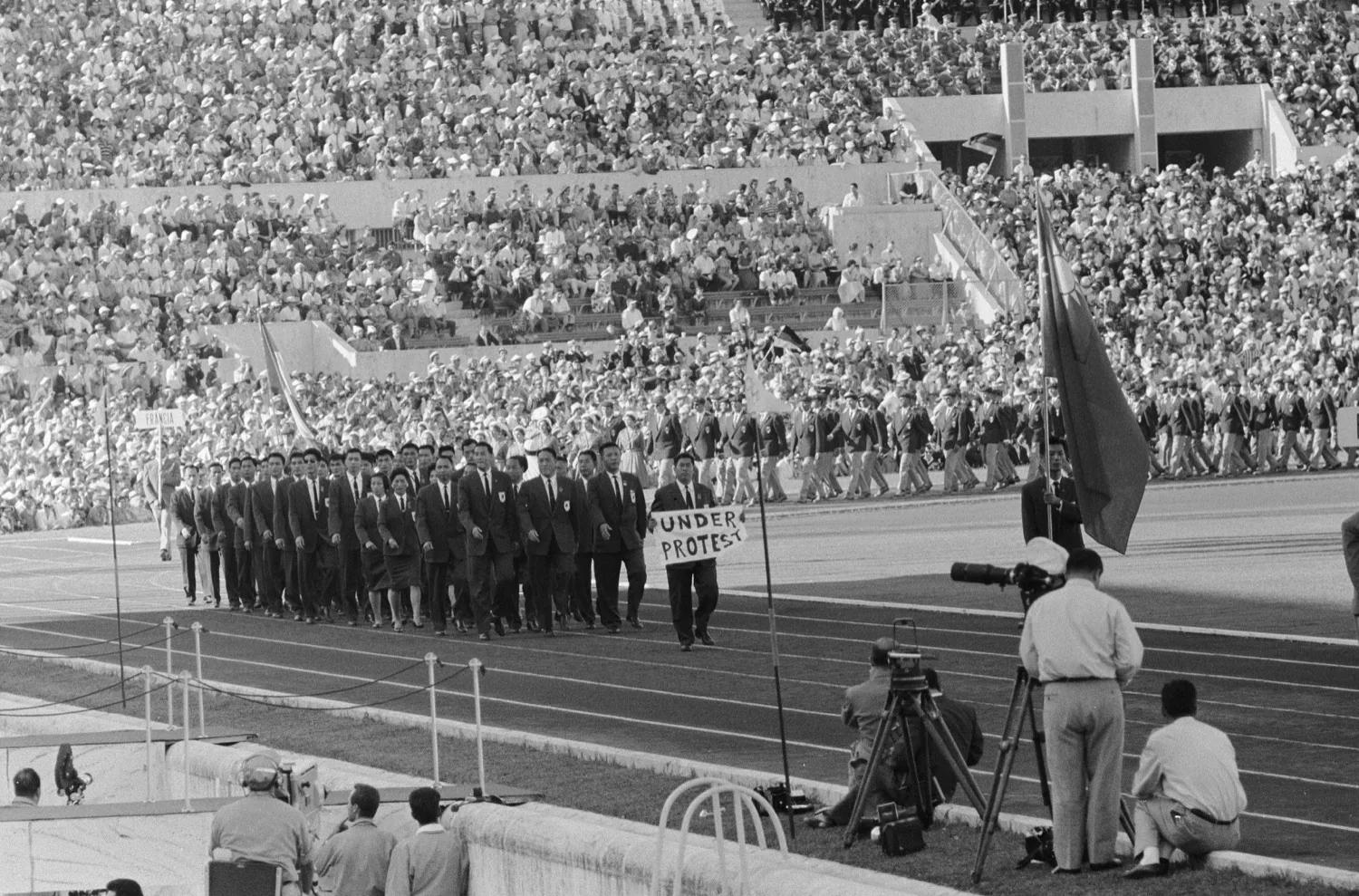
On 25 August 1960, the Rome Olympics opened. As each national delegation marched into the stadium, the head of the Taiwanese delegation, Lin Hung‑tan, lifted a white banner that read the two English words UNDER PROTEST, protesting the situation1.
That year the team could not call itself the “Republic of China” nor “Taiwan.” The IOC’s designation was FORMOSA (the historic name Formosa). Among the athletes was a young man named Yang Chuan‑kuang; a few days later he won silver in the decathlon, earning Taiwan’s first Olympic medal—displayed under the team name “Formosa.”
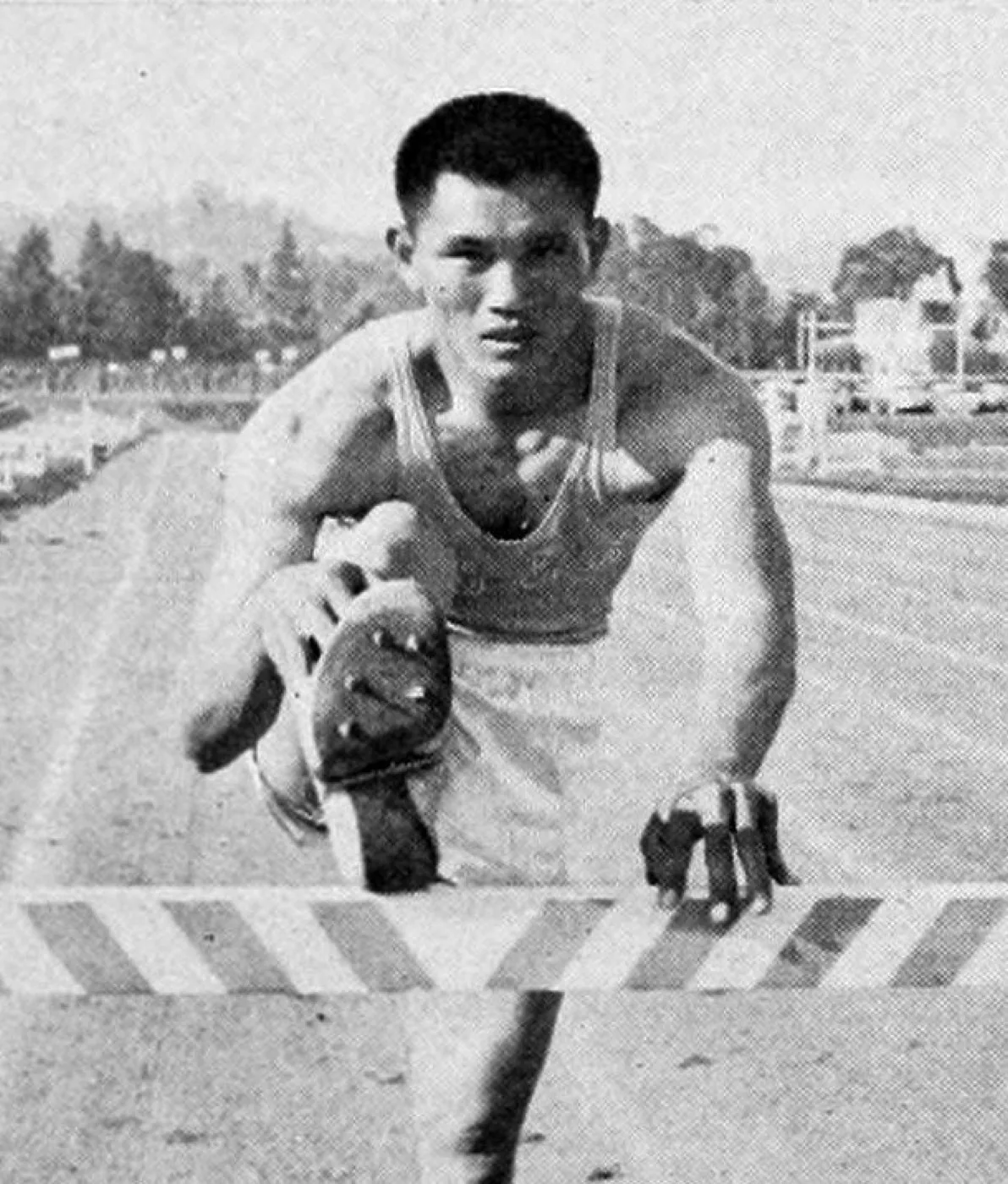
Yang Chuan‑kuang, silver‑medalist in the decathlon at the 1960 Rome Olympics, Taiwan’s first Olympic medal. The team name he competed under was “FORMOSA,” Formosa (UCLA Southern Campus 1960, Public Domain).
This was the only opening‑ceremony protest by a national delegation in Olympic history2. Over sixty years later the white banner has long been stored in the archives, but the issue it protested has never been resolved: a team can compete, yet it cannot use the name it wishes.
A Protest Banner Leads the Way
To understand how the four characters Chinese Taipei came about, we must first see that Taiwan’s Olympic name has never been self‑determined.
After the 1949 Chinese Civil War, the “China” seat at the United Nations and at the International Olympic Committee (IOC) became a contest between two regimes: the Republic of China (ROC) government in Taipei and the People’s Republic of China (PRC) in Beijing, each claiming to represent the sole China. At the 1952 Helsinki Games, the IOC invited both sides; Taipei withdrew in protest rather than appear alongside its rival3. At the 1956 Melbourne Games, Taipei competed under the name “China,” prompting Beijing to withdraw. Throughout the 1950s and 1960s, Taiwan’s Olympic designation swung among “China,” “Formosa,” and “Taiwan,” each change driven by international politics, never by Taiwanese choice.
Ironically, the editions that actually used “Taiwan” were the moments when Taiwan had the least autonomy. At the 1968 Mexico City Games, Taiwan competed as “Taiwan,” and Chi‑cheng Jì won bronze in the women’s 80‑metre hurdles—the first Olympic medal for a Taiwanese woman4. Yet “Taiwan” was a label imposed by the IOC based on geographic reality, not a decision by the Taipei government. For a ROC administration that still insisted “I am China,” being called “Taiwan” felt like a demotion.
The 1972 Munich Games marked the last time the ROC could compete with its full national symbols—flag, anthem, and name5. After that, the world changed.
📝 Curator’s note
Today we tend to treat “Taiwan” as a proud, sought‑after name and “Chinese Taipei” as a humiliating compromise. In the 1960s‑70s, the polarity was reversed: the Taipei government’s primary goal was to retain the claim to represent “China,” and the name it most dreaded was “Taiwan,” because using it would acknowledge that it was merely an island, abandoning the claim to the whole of China.
International Wants “Taiwan,” Taipei Refuses
The 1976 Montreal Games represent the most counter‑intuitive episode in this saga.
Canada, the host nation, had recognized Beijing in 1970 and, under its “One China” policy, refused to let the Taiwanese delegation enter under the name “Republic of China.” As the IOC scrambled for a compromise, it offered to let Taiwan compete under the name Taiwan, while preserving its flag and anthem6.
In other words, the IOC wanted the team to be called “Taiwan”; the Taipei government refused.
The decision was signed off by Chiang Ching‑kuo. The ROC viewed “Taiwan” as a humiliating downgrade: accepting it would mean tacitly acknowledging that the government was merely a local authority on an island, relinquishing its claim to represent all of China. Consequently, on the eve of the opening ceremony, the Taiwanese delegation withdrew entirely7. A later scholar summed up the move: “it was the KMT that made this decision. It was an own goal, basically.”8
⚠️ Contested view
Reducing the 1976 story to “Canada bullied Taiwan” is a common misreading. The reality is more nuanced—and more painful: the IOC offered “Taiwan,” but the Taipei authorities, citing sovereignty, rejected it. Highlighting this does not assign moral blame; it merely restores a frequently inverted causal chain. The popular claim that “Chinese Taipei = Taiwan forced to swallow humiliation” is actually the opposite. Taiwan lost the chance to compete under “Taiwan” at least once because it shut the door on itself.
The cost of the withdrawal became evident quickly. In 1979, the IOC, meeting in Nagoya, Japan, adopted a communication‑vote resolution that institutionalised the “two‑China” Olympic model: the PRC would compete as the “Chinese Olympic Committee” with its flag and anthem; the ROC would have to adopt a new name, flag, and anthem9. From then on, Taiwan could only return to the Games under a different identity.
Winning a Legal Victory, Then Accepting a New Name
Faced with the Nagoya decision, Taiwan did not immediately bow; it first filed a lawsuit.
IOC member Hsu Heng‑ko and the Chinese Olympic Committee sued the IOC before the Lausanne district court in Switzerland at the end of 1979, arguing that the Nagoya resolution violated the Olympic Charter10. On 27 March 1980, the court issued an interim ruling that the IOC’s actions “appear to contravene the spirit and text of the Charter, particularly Articles 64, 65, 66,” and ordered the IOC to pay the court fees and reimburse Hsu Heng‑ko for his expenses11.
Legally, Taiwan won. Yet the victory did not restore its Olympic status. The Nagoya resolution reflected a broader shift in international recognition that a court judgment could not overturn. The lawsuit thus became a bargaining chip. On 26 January 1981, Hsu Heng‑ko and the newly elected IOC president Juan Antonio Samaranch reached a consensus and withdrew the suit12.
Two months later, on 23 March 1981, the Chinese Olympic Committee secretary‑general Shen Jia‑ming and Samaranch signed the Lausanne Agreement. The agreement codified the name that persists to this day: CHINESE TAIPEI OLYMPIC COMMITTEE, country code TPE13. A subtle political calculation is evident in the ordering of country codes: TPE was placed in the “T” group, deliberately avoiding visual adjacency with the “C” codes for “China,” thereby sidestepping any direct “two‑China” juxtaposition.
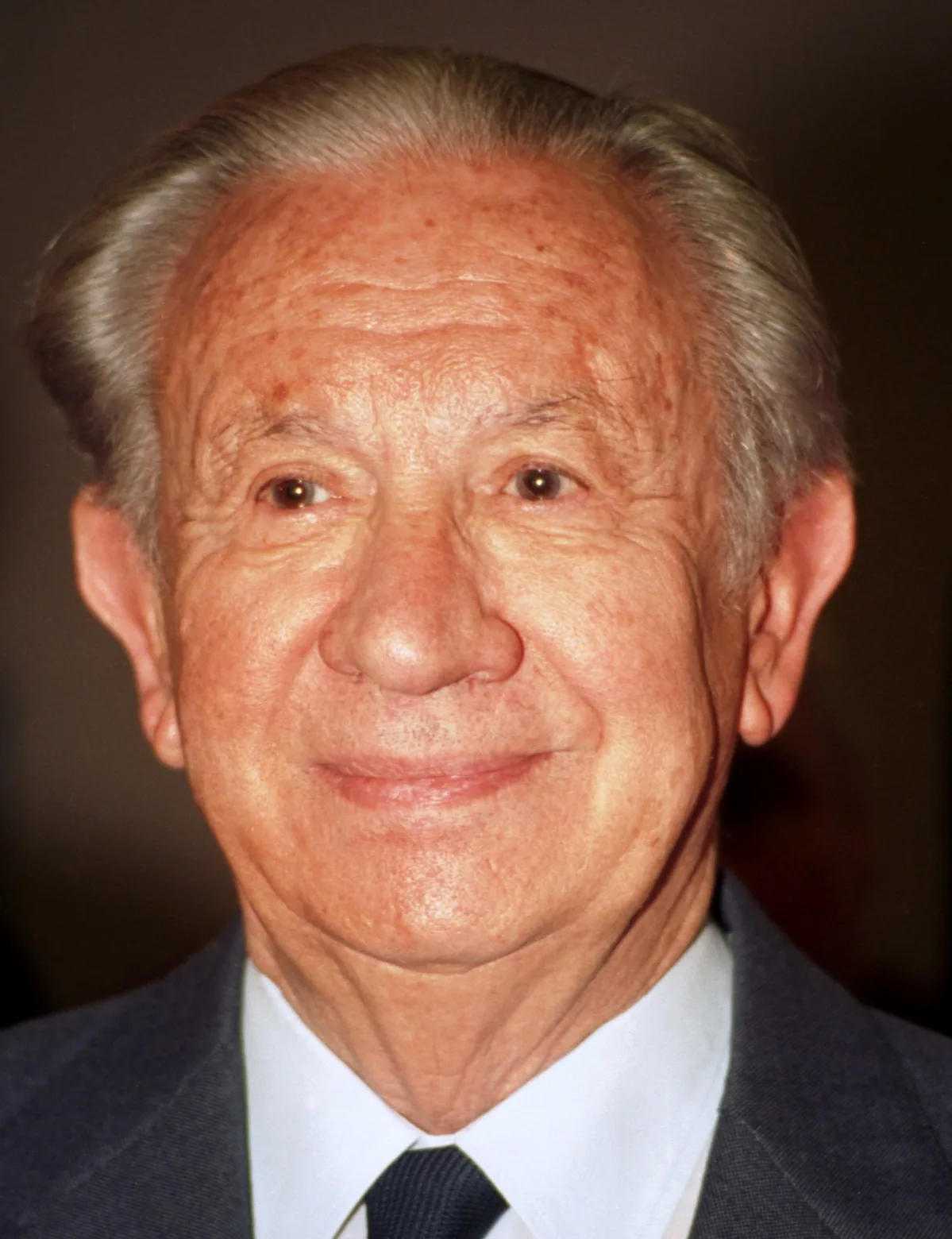
Juan Antonio Samaranch, IOC president in 1981. On 23 March 1981 he and Chinese Olympic Committee secretary‑general Shen Jia‑ming signed the Lausanne Agreement, cementing the “Chinese Taipei” name for the next forty years. (Photo: Leo Medvedev, CC BY‑SA 4.0)
📝 Curator’s note
“Winning the case, then accepting a new name” sounds contradictory, but it captures the core misunderstanding of “Chinese Taipei.” It is neither pure surrender nor pure triumph. Taiwan proved the IOC’s action was illegal, yet on the negotiation table it accepted a name it had not chosen, because ten years of exclusion from international sport was a heavier burden than an imperfect label. For athletes, the ability to compete has always been the top priority.
A new set of symbols was required. The flag design was drafted by Lin Hsing‑yung, finalized by Weng Ming‑yi, and personally selected by Chiang Ching‑kuo from three proposals: the “plum‑blossom five‑ring flag.” Its outer ring mirrors the ROC flag’s blue‑white‑red tricolour; the centre features the blue sky with a white sun; beneath lies the Olympic five rings14. This flag, later nicknamed the “plum‑blossom flag,” replaced the full‑flag of the ROC on every Olympic podium.
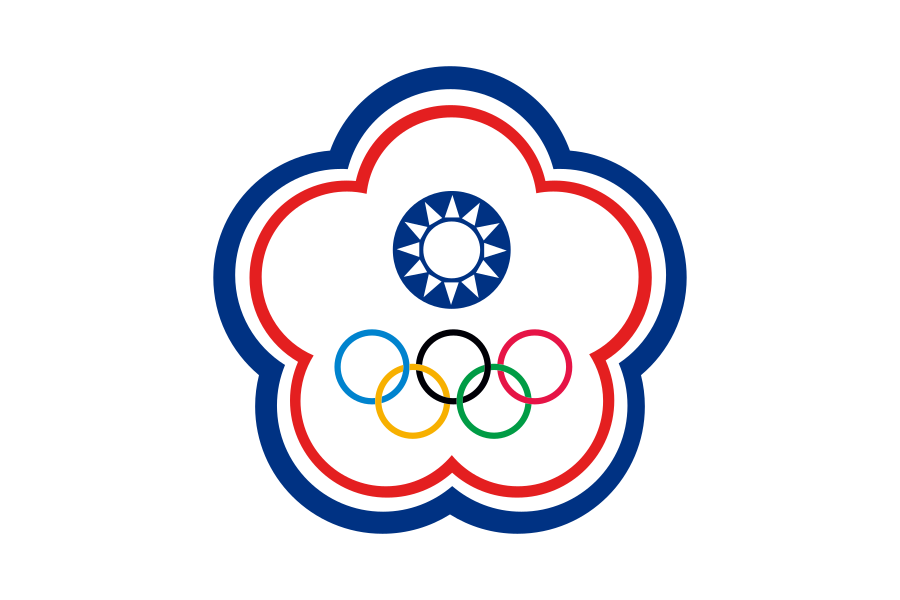
The Chinese Taipei Olympic flag, colloquially the “plum‑blossom flag.” The outer ring borrows the ROC’s blue‑white‑red, the centre displays the blue‑sky white‑sun emblem, and the Olympic rings sit below. Adopted after the 1981 Lausanne Agreement, it supplanted the national flag on podiums.
A New Anthem, Same Melody
If you have ever watched a Taiwanese athlete stand on an Olympic podium, you will notice that neither the national flag nor the national anthem is raised or played. Many overlook that the “national‑flag song” heard on the podium uses a familiar melody but completely different lyrics.
The Lausanne Agreement prohibited Taiwan from using its national anthem, so the Chinese Olympic Committee devised a clever workaround: retain the melody of the flag song but rewrite the lyrics. The new lyrics were penned by Zhang Pi‑te, then vice‑president and secretary‑general, approved by the IOC Executive Board on 1 June 1983, and first used at the 1984 Sarajevo Winter Games15. The opening lines read:
✦ “Olympic, Olympic, without religion, without race. For friendship, for world peace, the youth of five continents gather at the Games …”
A single reading reveals that the song contains no mention of “Taiwan,” “Republic of China,” or even “Chinese Taipei”—it speaks only of the Olympic spirit, world peace, and youth. When athletes such as Lin Yang‑tung, Guo Xing‑chun, or Lin Yu‑ting ascend the highest podium, this familiar melody with unfamiliar lyrics plays. Most Taiwanese recognise the tune, but few realise the words have been altered.
Official IOC channel clip from the 2024 Paris Games. When a Chinese Taipei athlete steps onto the podium, the familiar melody with the unfamiliar lyrics plays; the lyrics contain neither “Taiwan” nor “Republic of China.”
With a new flag, a new anthem, and a new name, Taiwan returned to the Olympic arena in 1984. The price was that the island could no longer hear its true name on the world stage.
One English Term, Two Chinese Renderings, a Sovereignty Battle
The English name Chinese Taipei was fixed, but the trouble began with its Chinese translations.
On 6 April 1989, Chinese Olympic Committee secretary‑general Li Qing‑hua and PRC Olympic Committee president He Zhen‑liang signed an agreement in Hong Kong (often called the “1998 Consensus”), confirming the official Chinese rendering of “Chinese Taipei” as 中華台北. The text explicitly states: “… whenever a Taiwanese sports team or organization is referred to in Chinese, it shall be called ‘中華台北.’”16
The agreement’s scope, however, is limited to official documents, manuals, letters, name‑plates, and broadcasts produced by the event organisers. It does not bind the media. This loophole later became a persistent fissure: mainland Chinese media began systematically using the alternative translation 中國台北 (“China Taipei”). Since April 2017, China Central Television has regularly referred to Taiwanese teams as “中國台北.”17
For Taiwan, the difference between 中華台北 and 中國台北 is not merely lexical; it is a matter of sovereignty. The Mainland Affairs Council argues that “中國台北” diminishes Taiwan and violates the Olympic model, while the PRC’s Taiwan Affairs Office maintains that both translations are legitimate Chinese renderings of “Chinese Taipei,” with no demeaning intent. Even within Taiwan there is no consensus. After President Tsai Ing‑wen attended the 2016 World Health Assembly (WHA) under the “Chinese Taipei” banner, she said, “The designation was not diminished, nor constrained by a political framework, and we fulfilled our mission.”18 KMT chair Chu Li‑lun counter‑attacked, accusing the DPP of double standards: “Calling it ‘Chinese Taipei’ at the WHA is a loss of rights and national humiliation; the DPP calls it professional and pragmatic, not a downgrade.”19 Philosophy professor Lin Huo‑wang at National Taiwan University added, “‘Chinese Taipei’ is OK; acknowledging political reality makes me think President Tsai is very pragmatic.”20
📝 Curator’s note
The name has not changed in forty years, but its meaning has been continuously re‑defined. For Beijing, it is “中國台北,” a regional branch; for a Japanese NHK commentator covering the 2020 Tokyo Games, it is the spontaneous “台湾です” (“It’s Taiwan”); for athletes, it is the price of participation. The same three‑letter code “Chinese Taipei” resonates with completely different political frequencies depending on who says it. The real battle is over who gets to interpret the name.
The “Chinese Taipei” model has rippled far beyond sport. In 1990, Taiwan returned to the Asian Games in Beijing under the “Chinese Taipei” banner. In November 1991, Taiwan joined the Asia‑Pacific Economic Cooperation (APEC) as a “Chinese Taipei” economic entity alongside China and Hong Kong—the first inter‑governmental organization Taiwan entered after leaving the United Nations in 197121. From 2009 to 2016, Taiwan participated in the WHA as an observer under “Chinese Taipei,” but was excluded again after 201722. Thus, the “Olympic model” has become a template for Taiwan’s participation in virtually every international organization where China is present.
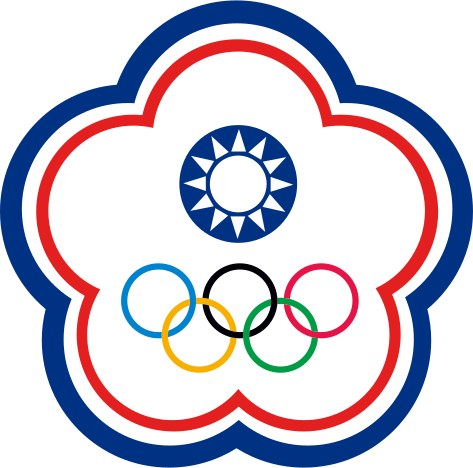
The Chinese Taipei Olympic emblem, approved alongside the flag after the 1981 Lausanne Agreement. Compared with the flag, the emblem appears more often on athletes’ uniforms and official documents, and, together with the “Olympic model,” has been used in APEC, WHA, and other non‑sport arenas.
The Most Affected: Athletes Without a Vote
In 2018, a referendum placed the “name” issue directly in the hands of all Taiwanese voters for the first time.
The initiator was Chi‑cheng Jì—the very name that embodies the contradictions of “Chinese Taipei.” She won Taiwan’s first women’s Olympic medal in 1968 under the “Taiwan” label; in 1981 she helped forge the “Chinese Taipei” system that returned Taiwan to the Games; from 1981 to 1990 she served as a KMT legislator. In 2018, the same figure led the “Tokyo Olympic name‑change referendum,” arguing that Taiwan should compete under the name “Taiwan.” A single individual had, over four decades, moved from name‑maker to name‑opposer.
FTV documentary on Chi‑cheng Jì, tracing her arc from the 1968 “Flying Antelope” bronze to the 2018 name‑change referendum.
The referendum’s Question 13 read clearly: “Do you agree to apply to participate in all international sports events and the 2020 Tokyo Olympics under the full name ‘Taiwan’ (Taiwan)?”23
The vote produced a clash of forces. One side—supporters of the name change—framed it as a dignity issue. The opposing side, however, was composed of the very people most directly affected: the athletes themselves. Badminton player Chou Tian‑cheng said, “Athletes risk their lives on the field; all we want is a stage, not an ideological name change.”24 Sprinter Yang Jun‑han urged voters, “Each of your votes will affect our future…”25 Weight‑lifting gold‑medalist Hsu Shu‑jing was even more blunt: “Vote against it.”26
Athletes’ anxiety stemmed from the IOC’s stance. In 2018 the IOC sent three separate letters to the Chinese Olympic Committee, explicitly stating that it would not approve a name change, that external pressure would be deemed political interference, and that the IOC might even revoke its recognition of the Chinese Olympic Committee27. For athletes whose livelihoods depend on the right to compete, such threats are career‑defining.
A common misunderstanding conflates the IOC’s warning with an automatic ban. The Olympic Charter only triggers a suspension when a government or institution “impedes the operation of a national Olympic committee.” A successful referendum merely obliges the government to apply for a name change; the Chinese Olympic Committee, as a private body, could theoretically decline to act, meaning a suspension does not automatically follow28. Legal scholars in Taiwan have pointed out that the claim “the name‑change referendum equals automatic disqualification” overstates the risk.
⚠️ Contested view
Are athletes’ fears unfounded? Not entirely. After a referendum passes, the political landscape becomes uncertain, and the IOC’s three letters alone generate real pressure—pressure that, even without an actual suspension, can keep an athlete up at night. This is the cruelest aspect of “Chinese Taipei”: a political dilemma that should be shared by society is ultimately borne by those with the least voice and the most at stake.
The 24 November 2018 referendum results were clear: 4,763,086 votes (45.20 %) in favour, 5,774,556 votes (54.80 %) against, with a turnout of 55.89 %29. The name‑change proposal was rejected by roughly one million votes. After the vote, weight‑lifting champion Guo Xing‑chun said, “The referendum failed, which is reassuring for athletes; we don’t have to bear that risk.”30
Taiwan Television report on the most amplified debate before the referendum: would a successful name‑change lead to the Chinese Olympic Committee’s expulsion? The factual truth of that question lies at the heart of the athletes’ and name‑change advocates’ opposing arguments.
Forty Years Later: The Name Remains, the Conflict Persists
The referendum closed, but the tug‑of‑war over the name has never ceased for athletes.
Before the 2022 Beijing Winter Games, short‑track speed skater Huang Yu‑ting was photographed wearing a practice suit embroidered with the character “China.” She responded, “In the sports world, we have no nationality distinction”31 and added that competing felt “like fighting on home ground”32. The Sports Administration deemed the act inappropriate, suspended her two‑year subsidy, and pledged legislative reform33. The same “name” issue splits athletes: some fight to shout “Taiwan,” others argue that nationality should not factor into sport at all. The fissure runs deep within the athletic community.
In the 2020 Tokyo Games, when the announcer introduced the Chinese Taipei delegation, a Japanese NHK broadcaster spontaneously shouted “台湾です” (“It’s Taiwan”)34—a moment many Taiwanese netizens called the most moving of the night. Yet at the 2024 Paris Games, a “Taiwan” banner on the badminton men’s doubles gold‑medal stand was seized and torn by staff and alleged Chinese spectators35. The podium still raised the white plum‑blossom flag and played the anthem without the word “Taiwan.” The name remains the same as forty years ago.
After Paris, Taiwanese media and civil society increasingly refer to the team as “Team Taiwan,” abandoning the older “Chinese Team” label; sports journalists now more often speak of “Taiwanese heroes”36. Public sentiment is shifting, but the flag and anthem on the podium have not.
Amid this tug‑of‑war, Chi‑cheng Jì resurfaced. In July 2021 she announced another push for a name‑change referendum targeting the 2024 Paris Games. Former President Ma Ying‑jeou publicly opposed, saying the referendum would “only harm Taiwan.”37
From the 1960 Rome “UNDER PROTEST” banner to the 2024 Paris “Taiwan” sign ripped apart, more than sixty years have passed. Throughout, those who wanted “Taiwan” and those who wanted to preserve “Chinese” have swapped sides repeatedly—the IOC once offered “Taiwan,” which Taipei rejected; athletes once voted against “Taiwan,” yet on the field they long for someone to shout “Taiwan”; Chi‑cheng Jì helped create “Chinese Taipei” and now seeks to overturn it. No one has stayed still.
The ticket that lets Taiwan step onto the field still cannot bear its own name. The next time you see the plum‑blossom flag rise and hear the familiar yet wordless anthem, remember that a forty‑year battle is still being fought, and the people caught in the middle are always the athletes on the podium.
Further Reading
- Taiwan’s Designation in International Standards — From ISO 3166 to open‑source software, how “Taiwan” is written and contested in global digital infrastructure, a parallel to Olympic naming.
- Taiwan’s Independence‑Union Spectrum — Why Taiwanese feel such divergent emotions toward “Chinese” and “Taiwan,” with a full spectrum of identity analysis.
- Taiwan’s Diplomatic Allies and International Diplomacy — How the “Olympic model” extends beyond sport to Taiwan’s formal diplomatic arena.
- Chi‑cheng Jì — From the 1968 “Flying Antelope” bronze to the 2018 name‑change referendum initiator, a complete arc.
- Yang Chuan‑kuang — The 1960 Rome decathlon silver medalist who won Taiwan’s first Olympic medal under the “Formosa” name.
- The Invisible Country — In this documentary, Chi Cheng holds up her 1968 Olympic bronze medal and asks back, “Is ‘Chinese Taipei’ the name of a country?”
Image Credits
- Hero / 1960 Rome “UNDER PROTEST”: Olympische Spelen te Rome — Formosa liep onder protest, photo by Harry Pot, Nationaal Archief (Netherlands), CC0.
- Yang Chuan‑kuang: C. K. Yang — UCLA Southern Campus 1960, Public Domain (PD‑US).
- Juan Antonio Samaranch: Juan Antonio Samaranch, photo by Leo Medvedev, CC BY‑SA 4.0.
- Plum‑Blossom Flag: Chinese Taipei Olympic flag, Wikimedia Commons, Public Domain. Outer ring blue‑white‑red from the ROC flag, central blue‑sky white‑sun emblem, Olympic rings below; adopted after the 1981 Lausanne Agreement.
- Emblem: Chinese Taipei Olympic emblem, Wikimedia Commons, Public Domain (author Denelson83).
Video Sources
All four videos are embedded from official channels (documentary news, event footage, official Olympic channel):
- Chinese Taipei Olympic anthem – 2024 Paris award ceremony: Olympics official channel.
- Chi‑cheng Jì documentary: FTV official.
- 2018 name‑change referendum debate: TTV news.
- Huang Yu‑ting China‑team‑uniform controversy: CTS news.
References
- 1960 Summer Olympic Games – Republic of China delegation — Chinese Wikipedia, notes Lin Hung‑tan displaying the “UNDER PROTEST” banner.↩
- Richard W. Pound, Journal of Olympic History (ISOH), confirming the 1960 protest as the sole opening‑ceremony protest and correcting the number of banner‑bearers[^2].↩
- Olympic Games – Chinese Taipei delegations — Chinese Wikipedia, details 1952 Helsinki dual invitation and ROC withdrawal.↩
- Taiwan Fact‑Checking Center, confirming 1968 Mexico City “Taiwan” participation and Chi‑cheng Jì’s bronze in women’s 80‑metre hurdles as Taiwan’s first female Olympic medalist.↩
- 1972 Summer Olympic Games – Republic of China delegation — Chinese Wikipedia, notes 1972 Munich as the last full‑symbol participation.↩
- Republic of China at the Summer Olympics, Wikipedia, describing Canada’s 1976 refusal of the “Republic of China” name and the IOC’s “Taiwan” compromise.↩
- Montreal 1976 diplomatic controversies, IOC official site, documenting the ROC’s pre‑opening withdrawal.↩
- Garret Clarke, quoted in a 1976 decision analysis, “it was the KMT that made this decision. It was an own goal, basically.”↩
- Nagoya Resolution — English Wikipedia, outlines the 1979 two‑China Olympic model.↩
- Tang Ming‑hsin, Analysis of the Olympic Model and the Two‑Committee Agreement, NPF, recounting Hsu Heng‑ko’s 1979 lawsuit.↩
- Same source, verbatim of the 27 March 1980 Lausanne court interim ruling and fee award.↩
- Lausanne Agreement entry, Chinese Wikipedia, noting the 26 January 1981 settlement and withdrawal of the suit.↩
- Lin Chia‑ho, “Chinese Taipei: Past and Present,” The Reporter, detailing the 23 March 1981 signing and the establishment of the CHINESE TAIPEI OLYMPIC COMMITTEE name and TPE code.↩
- Chinese Wikipedia entry on the “plum‑blossom flag,” describing design origins and Chiang Ching‑kuo’s selection.↩
- SportsV article, confirming Zhang Pi‑te’s lyrics, IOC approval date, and first use at Sarajevo 1984.↩
- Chinese Wikipedia, citing the 6 April 1989 Hong Kong agreement that fixed “Chinese Taipei” → “中華台北.”↩
- Chinese Wikipedia, documenting CCTV’s systematic use of “中國台北” since April 2017.↩
- SETN report, Tsai Ing‑wen’s 27 May 2016 statement that the WHA designation was not a downgrade.↩
- Liberty Times, KMT chair Chu Li‑lun’s 29 May 2016 criticism of the DPP’s double standard.↩
- Liberty Times, philosophy professor Lin Huo‑wang’s 27 May 2016 endorsement of “Chinese Taipei” as pragmatic.↩
- Ministry of Foreign Affairs, Taiwan’s 1991 APEC accession as “Chinese Taipei,” the first inter‑governmental organization after UN withdrawal.↩
- Ministry of Foreign Affairs, Taiwan’s WHA observer status 2009‑2016, and exclusion after 2017.↩
- Wikipedia entry on the 2020 Tokyo Olympic name‑change referendum, quoting the exact wording of Question 13.↩
- LTSports report, badminton player Chou Tian‑cheng’s quote on wanting only a stage.↩
- TVBS report, sprinter Yang Jun‑han’s appeal to voters.↩
- TVBS report, weight‑lifting champion Hsu Shu‑jing’s call to vote against the name change.↩
- Business Today, detailing the IOC’s three letters to the Chinese Olympic Committee in 2018 warning against name‑change approval.↩
- Plainlaw analysis of the Olympic Charter, explaining that a successful referendum does not automatically trigger suspension.↩
- Central News Agency, official vote tallies: 4,763,086 for, 5,774,556 against, turnout 55.89 %.↩
- China Times, Guo Xing‑chun’s post‑referendum comment that the result eased athletes’ concerns.↩
- CTS report, Huang Yu‑ting’s Facebook response that “in sport we have no nationality distinction.”↩
- Newtalk, Huang Yu‑ting’s comment that competing felt “like fighting on home ground.”↩
- Liberty Sports, Sports Administration’s suspension of Huang’s subsidies and promise to amend regulations.↩
- Central News Agency, NHK broadcaster’s spontaneous “台湾です” during the 2020 Tokyo opening.↩
- NBC News, report on the 2024 Paris badminton men’s doubles “Taiwan” banner being seized and torn.↩
- Taiwan Insight, analysis of post‑Paris media shift toward “Team Taiwan” rather than “Chinese Team.”↩
- Newtalk, Ma Ying‑jeou’s 31 July 2021 criticism of the proposed 2024 Paris name‑change referendum.↩