
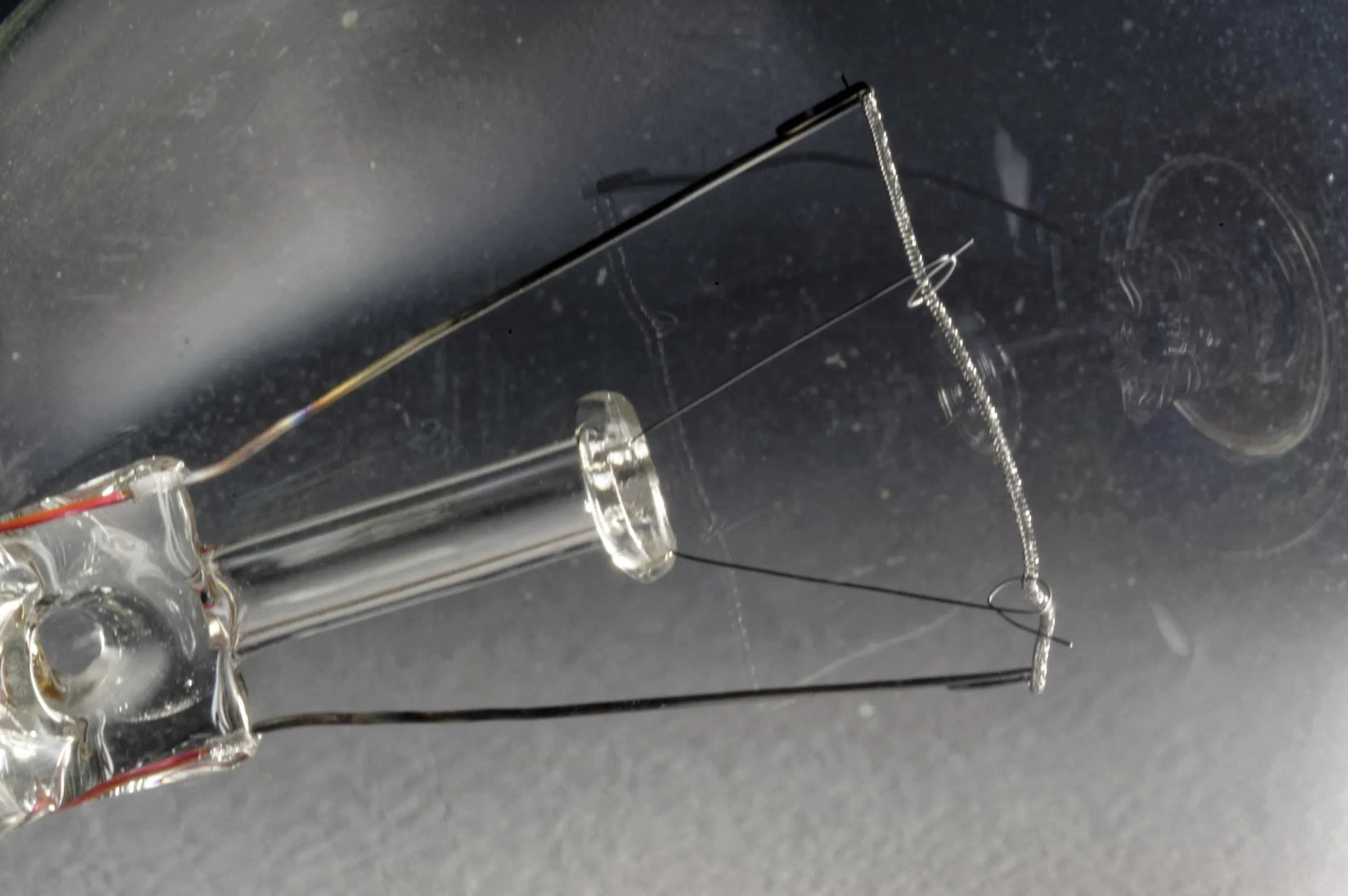
The tungsten filament inside a 60-watt incandescent light bulb. Photo: VSchagow / Wikimedia Commons, CC BY-SA 4.0.
30-Second Overview: Taiwan has no tungsten mines, yet tungsten is everywhere at home—in light bulb filaments, drill bit edges, and wedding ring bands. It is also essential for contact windows in chips and word lines in 3D NAND. Between February and April 2026, China’s exports of tungsten carbide and tungsten powder to Japan hit zero for three consecutive months. On July 1, two Japanese factories holding approximately 25% of global tungsten hexafluoride (WF6) capacity permanently ceased production, a chain reaction triggered by a cross-Strait remark made by Japanese Prime Minister Sanae Takaichi in the Diet in November 2025. Meanwhile, two small factories in Fangliao, Pingtung, leveraged refining skills honed during the scrap-metal era sixty years ago to integrate Taiwan into this globally contested supply chain. The skills remain, but the raw materials, markets, and applications are all controlled by others.
The Name Nobody Asks About in the Tungsten Filament
Hold an old-fashioned incandescent light bulb up to your eye. The thin wire coiled into a helix at the center of the glass bulb is the only tungsten most Taiwanese people ever see up close. The moment you switch it on, it flashes bright before stabilizing. While lit, the entire filament burns at temperatures between 2,200 and 2,500 degrees Celsius1. It is so close, yet almost no one thinks to ask its name while the light is on.
The character "tungsten" (鎢) appears only once in the periodic table for most people, during middle school chemistry class. Its melting point is 3,422°C, plus or minus 15 degrees—the highest of all metals. Its density is 19.25 grams per cubic centimeter, almost identical to gold’s 19.32. In reality, people have used it to forge fake gold bars2. A metal that is both heavy and refractory, drawn into thin filaments to emit light in light bulbs, is how it first entered ordinary households.
It is actually everywhere at home. Tungsten steel drill bits in toolboxes, tungsten steel kitchen knives in drawers, tungsten steel wedding rings on fingers. "Tungsten steel" is a colloquial term referring to a hard alloy made of tungsten carbide sintered with a cobalt binder. Its hardness is second only to diamond. Its selling point is scratch resistance; its drawback is that it cannot be cut or removed3. This is exactly what tool machine masters in Taichung grind every day.
Taiwan produces zero kilograms of tungsten ore. The Ministry of Economic Affairs’ geological resource map mineral list does not include tungsten; the metal minerals it lists are gold, silver, copper, and iron. Industry and media have long described it this way. However, since the Mining Statistical Yearbook cannot be verified page by page, strictly speaking, it is not that official records explicitly declare the absence of tungsten, but rather that records of tungsten deposits cannot be found4.
Source: International Tungsten Industry Association (ITIA), Arblaster 2018, Encyclopedia Knowledge
One more thing is worth stating upfront. The terms "strategic minerals" and "critical minerals" are geopolitical languages systematically used by the United States, the European Union, and Japan only within the last decade. When Taiwan plunged into this industry sixty years ago, it had nothing to do with this language. The motivation then was livelihood; the cost was a river.
So the question can be asked in reverse: How did an island with no tungsten mines appear on the map of global tungsten flows?
From the Cost of Errenxi River, Refining Pingtung’s Skills
The answer starts with that river. In the 1960s, Kaohsiung’s shipbreaking industry imported American scrap cars and electronic equipment ship by ship. Tainan Bay took on the dismantling and smelting. According to Public Television’s Our Island report, tens of thousands of people were involved in this industry at its peak, with some estimates reaching 100,000 people5. The skill of recovering metals from things others threw away was honed over those thirty years.
The cost was recorded in the same ledger. In 1986, oyster shells at the Errenxi River estuary turned green; photos of copper pollution made national headlines. In 1993, the government completely banned scrap metal imports, and the furnaces in the bay finally went out6. The subsequent ledger reads as follows: The Environmental Protection Bureau destroyed all green oysters for public health, providing over NT$800 million in subsidies to local farmers. Starting in 2002, the Errenxi River was officially remediated, costing over NT$2 billion over twenty years7. The former is compensation for aquaculture losses; the latter is river engineering costs. The nature of these two sums is different. As for long-term residents in the area and workers who labored at acid washing and electroplating sites, whether they underwent health tracking or bore legal responsibility for pollution is not visible in public information. Thirty years of cost, and to this day, only half has been settled in the ledger.
The furnaces went out, but the technology survived. What is done in Pingtung today is essentially refining tungsten-containing scrap clean: tungsten-containing scrap hard alloys and tungsten-containing chip swarf are first digested with alkaline solutions into sodium tungstate solution, solvent extraction and crystallization yield ammonium paratungstate (APT), APT is heated to 600°C to decompose into tungsten trioxide, and then reduced with hydrogen in pusher or rotary furnaces at 700–1,000°C to tungsten metal powder2. It is the same path; if the raw material were changed to ore, it would be what global mining companies do. Taiwan takes the scrap route.
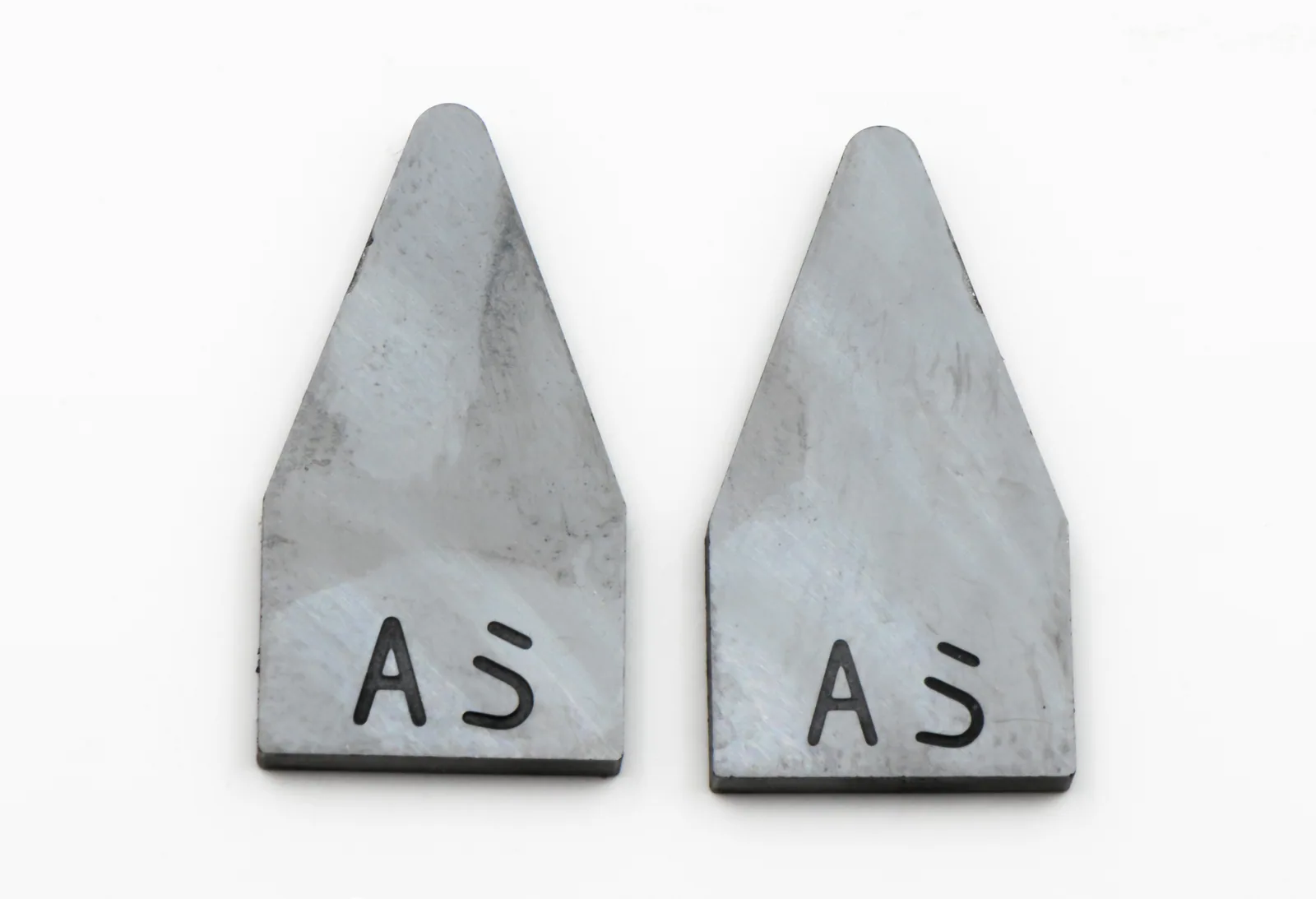
Tungsten carbide cutting tools. The entire precision machinery cluster on Dadaoshan in Taichung makes its living on these cutting edges. Photo: Jacek Halicki / Wikimedia Commons, CC BY-SA 4.0.
The companies doing this are both in Fangliao, Pingtung. Lianyou Metal was established in 2018, with a capital of NT$428 million and 152 employees. Its 2024 revenue was NT$1.1 billion, with an annual recycling capacity of approximately 3,000 tons and a design limit of 5,000 tons8. The Economist’s industry data report reads: "Lianyou Metal is Taiwan’s first company to reduce recycled hard alloys back into tungsten and cobalt metal raw materials, and is currently the world’s largest reprocessed sodium tungstate manufacturer, as well as the only tungsten supplier in Taiwan for TSMC and Apple Corporation."9 A company almost no Taiwanese person has heard of stands at the raw material end of Taiwan Enterprise: TSMC.
The other is Jingyuan, Unified Business Number 54632783. It was registered in June 2014 in Kaohsiung as "Yunde Tungsten Industry Co., Ltd." and later renamed Jingyuan Tungsten Technology. On June 22, 2026, it completed an organizational change, converting from a limited company to a joint-stock company and renaming itself Jingyuan Tungsten-Cobalt Resources, with a total capital of NT$300 million and paid-in capital of NT$150 million10. The company’s website positions itself as "the pioneer and leader in Taiwan producing ammonium paratungstate (APT) and tungsten oxide powder exclusively and professionally"11. The frequently cited "annual production capacity of up to 4,000 tons" comes from the same narrative, without third-party verification, and it is unclear whether it refers to capacity or actual output12.
Both claim to be "the only one," and they do not contradict each other because their product lines differ: one produces sodium tungstate, calcium tungstate, and tungsten carbide; the other produces APT and tungsten oxide powder. Interestingly, both are moving into each other’s territory. Jingyuan announced on January 14, 2026, plans to invest in producing tungsten powder and tungsten carbide powder13, while Lianyou’s expansion plan is to move up the chain to APT, tungsten oxide, and tungsten powder14. The so-called "each being unique" is merely the current division of labor, which can be overturned by the other’s next investment at any time.
The downstream of this skill is the entire precision machinery cluster on Dadaoshan in Taichung that makes its living on tungsten steel cutting tools. In a sixty-kilometer golden valley, approximately 1,500 precision machinery factories are crowded together. Taiwan has long been one of the world’s top two tool machine exporters15. Chips and tool machines usually speak different languages; tungsten is the thread that connects them.
📝 Curator’s Note: The common saying is "Taiwan turns scrap into gold, serving as a model student of the circular economy." This statement reads smoothly, but it reverses the sequence. Taiwan’s sequence was first thirty years of unregulated scrap metal dismantling, then a river with excessive copper, and only then, under the 1993 ban and subsequent environmental regulations, was it forced to refine the same skill to meet semiconductor and aerospace standards. Environmental awareness came later than the technology; this technology was forced out by cost, and that cost ledger has only settled the oyster portion so far.
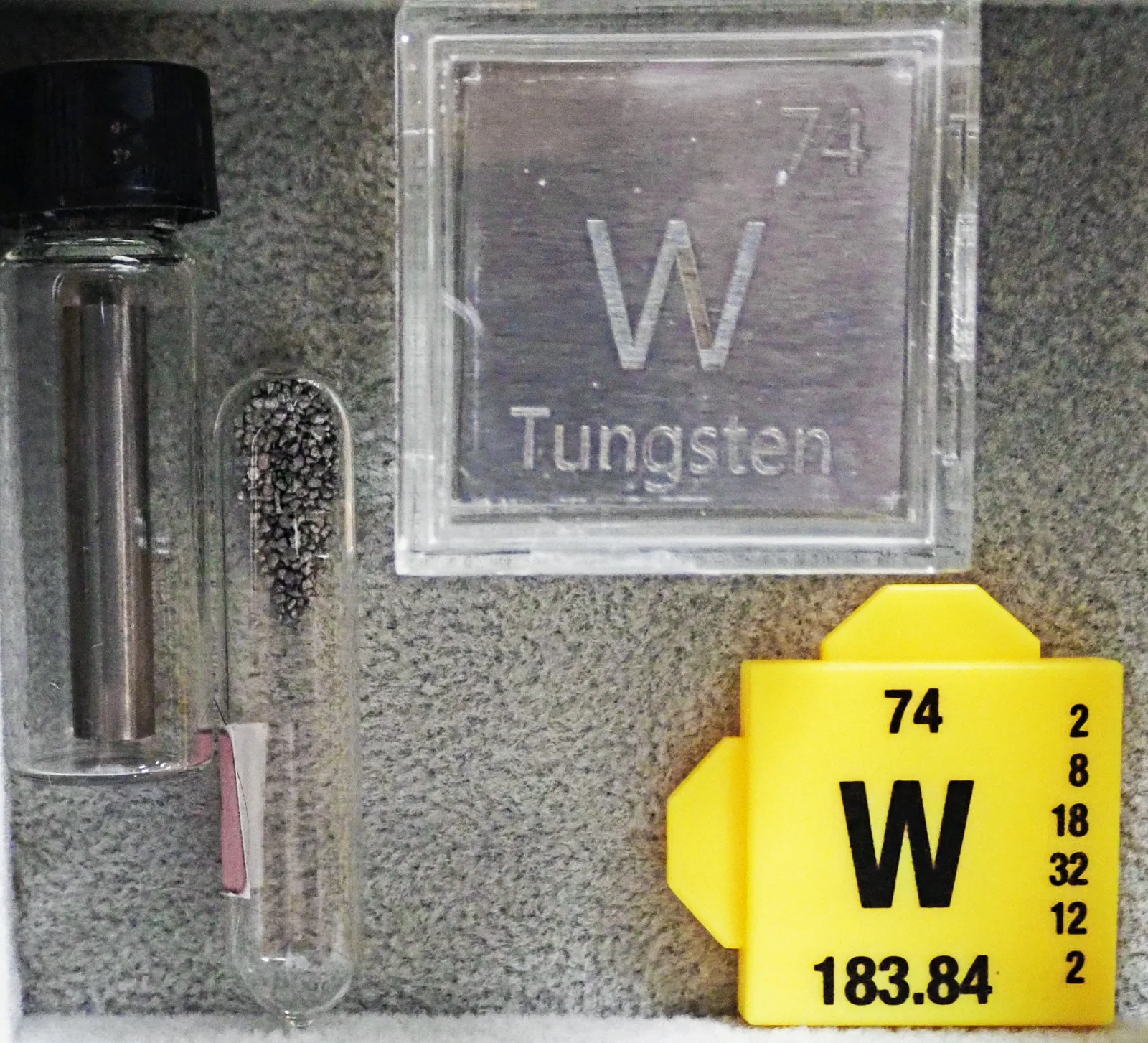
Pure tungsten metal and white tungsten ore samples. Taiwan does not produce this ore, yet it can refine its downstream products. Photo: James St. John / Wikimedia Commons, CC BY 2.0.
The skill exists truthfully. But how much it is worth, and when it is valuable, is never decided by Fangliao.
One Diet Remark, Three Months Later, One Factory Shut Down
On February 4, 2025, China’s Ministry of Commerce and General Administration of Customs issued Announcement No. 10 of 2025, implementing export controls on tungsten, tellurium, bismuth, molybdenum, and indium-related items. Ammonium paratungstate, tungsten oxide, and tungsten carbide were listed directly, effective the day of release16. The reason stated at the beginning of the announcement is only one sentence: "To safeguard national security and interests and fulfill international obligations such as non-proliferation, and with the approval of the State Council, it is decided to implement export controls on the following items." This is standard legal language for such announcements, with no further explanation of what "national security interests" specifically refer to, nor any named countries. The Ministry of Commerce spokesperson’s supplementary statement to the public that day was equally brief: "Implementing export controls on tungsten and related items is an international practice."17
The following events speak for themselves on the timeline. On November 7, 2025, Japanese Prime Minister Sanae Takaichi stated in a Diet Q&A that if China uses warships and force against Taiwan, it might constitute a "survival threat situation" under Japan’s security laws (this is the English translation reported by multiple foreign media, not a verbatim transcript of the Japanese records)18. On January 6, 2026, China’s Ministry of Commerce issued Announcement No. 1 of 2026, banning the export of all dual-use items to Japanese military users and for military purposes, effective immediately19. From February to April 2026, China Customs statistics show that exports of tungsten carbide and tungsten powder to Japan were zero for three consecutive months20. Precision is required here: what hit zero were tungsten carbide and tungsten powder. If looking at the broader category of "tungsten-related products," Japan’s import volume in April decreased by approximately 50% compared to the 2025 monthly average, not hitting zero entirely21. Two different statistical cuts for the same event yield significant differences.
Then comes July 1. Two Japanese companies, Kanto Denka and Central Glass, simultaneously permanently ceased production of tungsten hexafluoride (WF6). Historically, the two combined held approximately 25% of global market share. Their raw material was high-purity tungsten powder, which had been near-zero for several consecutive months22. Tungsten hexafluoride is the carrier that sends metallic tungsten into chips. Shutting down this production line affects TSMC, Samsung, and SK Hynix. The same wave of controls did not similarly impact South Korea’s supply23.
From one Diet remark to two factories closing, eight months passed.
Source: Global Trade Alert, China Ministry of Commerce Announcements
How big the impact is, the industry itself has no consensus. The day after Announcement No. 10 was released, Shanghai Ganglian commented that the focus of this control is on military tungsten products, and military use accounts for only 10–20% of exports; the remaining 80–90% of civilian tungsten products may not be significantly affected. At the time, the industry generally held a reserved attitude, mostly observing24. Looking back from the Japanese scene in 2026, this judgment at least underestimated the effect of "precisely targeting a single country." But it reminds us of one thing: the same announcement, when cited at the moment of control release versus a year later, tells stories of different scales.
Other countries’ reactions are three different tools. The US follows industrial policy and procurement regulations: The US Geological Survey’s Critical Minerals List published on November 7, 2025, listed tungsten alongside gallium, germanium, and niobium as the highest supply risk category25. The Defense Logistics Agency publicly solicited intentions for approximately 1,700 tons of tungsten ore and concentrates. The Pentagon planned a maximum $1 billion critical mineral reserve cap. Both numbers remain at the level of intention and cap26. What actually landed was the $6.2 million allocated on July 23, 2025, under Chapter III of the Defense Production Act to Nevada’s Pilot Mountain tungsten mine project, allowing a military giant that had not mined tungsten domestically for nearly a decade to reopen the mine27. On the regulatory side, DFARS 252.225-7052 takes effect on January 1, 2027: Defense contracts must not use tungsten powder and heavy tungsten alloys if any stage of mining, refining, or separation was completed in China, Russia, Iran, or North Korea28.
The EU’s Critical Raw Materials Act has already listed tungsten as one of 17 strategic raw materials; this is an effective regulation. As for the coordinated strategic reserves and €3 billion scale mentioned in media, only Reuters cited anonymous sources; there are no formal Commission documents29. Japan relies on the Economic Security Promotion Act to list tungsten and other critical minerals as "Specific Important Materials," with JOGMEC responsible for national reserves. The frequently cited "60-day reserve target" comes from think tank interpretations and could not be verified verbatim on the official page30.
Three tools, one anxiety: This metal in hand is not grown in one’s own backyard.
Semiconductors Are Quietly Releasing Their Grip on Tungsten
How tungsten gets into chips. Tungsten hexafluoride decomposes in the chemical vapor deposition (CVD) process, filling contact windows and vias layer by layer with metallic tungsten, and also building the word lines of 3D NAND, the path where data flows vertically in memory31. This via-filling technology has been a standard process since the 0.5-micron generation. The more advanced the node, the higher the aspect ratio of the vias, the more it relies on this filling capability32. Every layer stacked upward in the Semiconductor Industry over these decades relies on this metal to conduct current.
Interestingly, its price.
This next part is most easily ignored. Just as tungsten is pushed to the center stage by geopolitics, the 3D NAND industry is actively replacing it. According to industry analysis, the three major NAND manufacturers have all written molybdenum into their mass-production blueprints, with the first production lines converting in 2026. Molybdenum’s advantage is that it does not require a titanium nitride barrier layer; the entire cross-section can conduct electricity, and the precursor gas contains no fluorine, eliminating corrosion issues. In structures above 300 layers, resistance can drop by more than 50%33. This analysis’s statement is straightforward: Molybdenum is what allows NAND manufacturers to continue stacking, and stacking is the entire business.
This judgment needs a discount. It currently rests on only this one industry analysis, has not undergone peer review, and the actual scale of conversion has no independent academic literature to compare against. The whole matter is still in its early stages. Logic chip contact windows and vias have not yet shown an equally strong alternative trend; tungsten remains mainstream.
But the direction is clear enough: "Tungsten is irreplaceable in semiconductors" has an expiration date. When a country’s industrial anxiety is built on the irreplaceability of a certain material, materials science will answer this in its own rhythm, and its rhythm ignores any export control announcement.
The technology side is already loosening. What about the supply chain structure itself?
The Same Import Chain, Taiwan Is Also Inside It
The structural answer must start with where the raw materials come from. Taiwan has no mines; the two furnaces in Pingtung burn imported recycled materials. According to industry reports, Lianyou’s raw materials come from tungsten recycling plants in the US, Europe, Japan, and the Philippines14. The skill is on the island; the material source is in others’ ports.
In recent years, this material source has become very crowded. Since May 2025, US tungsten prices have risen by over 200%, and tungsten scrap prices have risen by approximately 350%. Data from the UK critical mineral research institution Project Blue shows that US exports of tungsten scrap to recycling hubs like Taiwan, the Philippines, Vietnam, and South Korea have increased simultaneously34. Prices have risen so much that the scene on the ground has changed accordingly: A scrap recycler in New Jersey relayed Chinese buyers’ words—"Meet directly at the Home Depot parking lot"—and took away goods worth over $20,000 on the spot.
Two things are true simultaneously in this statement. Taiwan is the demand side in this chain and also a relay node through which US tungsten scrap flows to China. In Taiwan Foreign Trade and Global Supply Chain, this dual identity is not rare, but it is particularly clear on the tungsten line: Taiwan lacks this material and happens to stand on the path of this material flowing to the other side.
Looking further upstream, the ceiling is also obvious. Recycling supplies approximately one-quarter to one-third of global tungsten demand, with different institutions’ figures ranging between 25% and 35%. The rest still relies on mining35. And who holds the mines is the premise of this entire article: China’s tungsten mine production accounts for approximately 80% of the global total, with proven reserves accounting for about 53%. Vietnam and Russia take a portion36. What Taiwan gets is a midstream segment, and one that requires others to sell scrap to it first before it can start work.
Material source, price, ceiling—none of these are in Taiwan’s own hands. What about the policy side?
Policy Says "Non-Red Supply Chain," but No One Can Calculate How Much Taiwan Buys
This chain is usually unseen. Once pressure falls on a specific operator, the information vacuum is quickly filled by various claims. In July 2026, a tungsten industry executive was murdered at his residence. Police are investigating homicide as the direction, with motives possibly related to financial disputes. Named media statements indicate no evidence shows this case is related to China’s tungsten export controls or supply chain competition37.
On the policy side, declarations exist. In November 2025, the Ministry of Environment and Ministry of Economic Affairs formed the "Taiwan Critical and Strategic Resources National Team," advancing in three stages: inventorying domestic needs, promoting resource retention in Taiwan, and assisting operators in obtaining raw materials and technology upgrades. Tungsten is listed as a critical material38.
Taiwan’s regulations are not entirely silent on this. Article 19 of the Industrial Development Act for Defense Industries is explicit: Key components and raw materials required for the R&D, production, and maintenance of controlled military goods must not come from the Mainland, Hong Kong, or Macau, nor from institutions invested by people or legal entities from these regions in third territories, unless special needs are agreed upon by the competent authority after consultation39. The Legislative Yuan Legal Affairs Bureau also produced a 2023 analysis titled Analysis of Legal Issues Related to Strengthening Critical Mineral Military Supply, using South Korea’s reopening of the Sangdong tungsten mine and the UK’s tungsten mine development as examples, reminding Taiwan that when formulating critical mineral supply strategies, it can no longer use "economic value" as the sole consideration40.
What is missing is the other half: the trackable numbers. How much tungsten, how much APT, from which countries, and what is the dependency on single sources—ordinary people can only go to the Ministry of Finance Customs Administration’s trade statistics database and use interactive forms to extract items one by one. No ready-made compilation exists on public pages41. Whether critical minerals should have strategic reserves, and to what level, no public policy documents can be found. The defense side is the same shape: Laws stipulate who not to buy from, but how much is actually bought from whom is not in public data.
These untrackable parts must be viewed honestly. Untrackable does not mean nonexistent; it may simply mean not publicly available in a retrievable form. But the shape is visible: Taiwan has a negative list in hand, but no positive ledger. China’s controls have at least a reason written on the announcement. Taiwan doesn’t even have a visible number for how much it buys in a year.
Professor Wang Hung-jen of the Department of Political Science at National Cheng Kung University and Director of the National Policy Foundation offered a reminder regarding the "Non-Red Supply Chain" policy, which fits exactly into this gap. He discussed the generalities of rare earth and critical mineral policies, did not name tungsten or any specific operator, but applying it to this line fits almost word for word.
What is truly lacking now is stable material sources, demonstration production lines, long-term orders, and commercial scale
His other statement is more direct: "If democratic countries only have political declarations but fail to truly establish capacity, processing technology, procurement systems, and stable markets, they may still shout 'de-risking' diplomatically while continuing to depend on China industrially."42
The US approach provides a comparative scale. Soliciting intentions for 1,700 tons of reserves is one thing; planning a $1 billion cap is another; actually allocating $6.2 million into Nevada’s mines is a third. Intentions, caps, and allocations are clearly separated, allowing the outside world to see where progress stands. What Taiwan currently lacks is precisely this scale. Declarations have not yet grown into any trackable numbers.
📝 Curator’s Note: The word "strategic" has an invisible cost—it makes a thing appear as if it has already been handled. Before the two furnaces in Pingtung were tagged with national security labels, they did the same work, bore the same environmental costs, and earned the same hard-to-make money. Being seen is through industry being written into the National Team list, or appearing on the front page of the social section one day, rather than someone first calculating the import dependency. An industry waiting to be seen only after being tagged itself indicates it was previously not in anyone’s ledger.
The Skill Others Cannot Take Away, Yet the Skill Others Can Cut Off with One Click
The skill is real: Tungsten-containing hard alloys enter the furnace, alkaline solution pulls out the tungsten, the crystallization tank grows APT, and hydrogen at 700°C reduces it to gray powder. Recovering metal from things others threw away, this capability was honed over sixty years. It cannot be copied by an announcement, nor grown through subsidies within three years. This is the part truly belonging to Taiwan.
The rest is not in Taiwan’s hands. The raw materials are imported scrap; prices are determined by the London and Shanghai price boards. The market threshold is written in the US Department of Defense’s 2027 effective procurement clauses. The application is decided by semiconductor engineers on whether to continue using tungsten or switch to molybdenum. Three things, none of which Taiwan can decide unilaterally.
✦ Tungsten in a chip accounts for less than 1% of manufacturing cost. What stops the entire line is never its price.
Tungsten filaments must burn above 2,200°C to emit light. That temperature is forced by current; the light bulb itself cannot provide it. The temperature of Taiwan’s skill is also forced, burning the thirty-year cost of Errenxi River and the tension tested repeatedly by external politics. It has not finished burning. And no one knows until which day it will break.
Further Reading
- Semiconductor Industry — Tungsten’s position in chips belongs to a small segment of this 50-year long river of materials revolution
- Taiwan Enterprise: TSMC — Where the tungsten sodium refined in Pingtung finally flows
- Taiwan Foreign Trade and Global Supply Chain — Taiwan’s long-term position as both a node and a gap on others’ chains
- Taiwan’s Electricity and Semiconductors — Another resource that is insufficient on the island yet supports the God of War Mountain
- Taiwan’s Robotics Industry — The next stop for the Dadaoshan precision machinery cluster
Image Sources
This article uses 3 CC-licensed images, cached in public/article-images/technology/ to avoid hotlinking to source servers:
- Glühwendel einer 60-Watt-Glühlampe — Photo: VSchagow, 2018-09-15, CC BY-SA 4.0, Wikimedia Commons file Glühwendel_einer_60-Watt-Glühlampe.jpg
- 2023 Noże z węglika wolframu — Photo: Jacek Halicki, 2023-03-25, CC BY-SA 4.0, Wikimedia Commons file 2023_Noże_z_węglika_wolframu.jpg
- Tungsten (Element - 74) — Photo: James St. John, 2024-09-28, CC BY 2.0, Wikimedia Commons file Tungsten*(Element*-_74).jpg
References
- Encyclopedia Knowledge — Tungsten Filament — Chinese popular science entry, recording incandescent light bulb tungsten filament operating temperatures of approximately 2,200 to 2,500°C; not a primary technical document, values for magnitude reference↩
- International Tungsten Industry Association — Properties & Intermediates — ITIA official technical page, recording tungsten melting point 3,422±15°C, density 19.25 g/cm³, and the complete process chain of APT thermal decomposition into tungsten trioxide and hydrogen reduction into tungsten powder (700–1,000°C); the density similarity to gold cross-references English Wikipedia citing Arblaster 2018 metallurgical literature↩2
- Bewise — Materials Technology Data — Taiwan tool manufacturer’s technical page, explaining the hard alloy colloquially called "tungsten steel" is sintered from tungsten carbide and cobalt binder powder, hardness second only to diamond, maintaining hardness above 600°C↩
- Ministry of Economic Affairs Mining Statistical Yearbook — Verified with Geological Cloud Mineral Resource Map, Taiwan’s known metal mineral list includes gold, silver, copper, iron, etc., with no tungsten deposits found; limited by the inability to verify the yearbook PDF page by page, this article adopts the conservative expression "no records of tungsten deposits found"↩
- Public Television Our Island — Scrap Metal and Errenxi River — Records the rise and fall of the Tainan Bay scrap metal industry; the figure of 100,000 people at its peak comes from this report, a single source↩
- Environmental Information Center — Errenxi River Pollution History — Timeline research report on the 1986 green oyster incident and the 1993 complete ban on scrap metal imports↩
- CTWANT — Poisoned Errenxi River Series Reports — Verbatim records the Environmental Protection Bureau destroying green oysters and providing over NT$800 million in subsidies to local farmers, and the 20-year remediation of Errenxi River starting in 2002 costing over NT$2 billion; the nature of the two sums differs, the former is aquaculture loss compensation, the latter is river engineering cost↩
- GQ Magazine — Taiwan Critical Minerals and Recycling Operators — Source for Lianyou Metal’s capital of NT$428 million, 152 employees, annual recycling capacity of approximately 3,000 tons (design limit 5,000 tons), and other company financial and capacity figures↩
- The Economist ESG — You Analysis Industry Data Center Infographic — 2025-07-22 report, verbatim recording Lianyou Metal as the world’s largest reprocessed sodium tungstate manufacturer, and TSMC and Apple’s tungsten supplier in Taiwan; status descriptions like "only one" and "world’s largest" lack independent third-party verification; this article retains their nature when citing↩
- Taiwan Company Network — Unified Business No. 54632783 Registration Data — Cross-verified with TechNews Company Registration Query, five independent commercial registration query platforms consistently record "Yunde Tungsten Industry Co., Ltd. (Established 2014-06-12) → Jingyuan Tungsten Technology Co., Ltd. → Jingyuan Tungsten-Cobalt Resources Co., Ltd. (Reorganized and Renamed 2026-06-22)" as the same unified business number, same legal entity↩
- Jingyuan Official Website — About Us — "The pioneer and leader in Taiwan producing ammonium paratungstate (APT) and tungsten oxide powder exclusively and professionally" is the company’s self-positioning language, not a third-party verification result; this article retains its nature when citing↩
- Liberty Times Net — Taiwan’s Only APT Manufacturer Report — The statement "annual production capacity can reach 4,000 tons" comes from this series of reports and was relayed by multiple media; no third-party independent verification is seen, nor is the distinction between capacity and actual output made↩
- Jingyuan Official Website — Major News — 2026-01-14 announcement, planning investment in producing tungsten powder and tungsten carbide powder↩
- Taiwan Industry Observer — Lianyou Metal’s Raw Materials and Expansion Plans — Blog relay of company statements, recording raw materials mainly from recycling plants in the US, Europe, Japan, and the Philippines, and planning development toward APT, tungsten oxide, tungsten powder, and tungsten carbide; not a verbatim record of a company press conference, a secondary relay↩2
- Taichung City Government Department of Economic Development — Precision Machinery Industry Cluster — Official explanation of approximately 1,500 precision machinery factories in the Dadaoshan Golden Valley; tool machine export rankings vary by annual report scope; this article adopts the conservative description "one of the world’s top two"↩
- China Ministry of Commerce — Announcement No. 10 of 2025 — Released and implemented on 2025-02-04, implementing export controls on tungsten, tellurium, bismuth, molybdenum, and indium-related items; ammonium paratungstate, tungsten oxide, and tungsten carbide listed; the reason "To safeguard national security and interests and fulfill international obligations such as non-proliferation" is standard legal language for such announcements↩
- Xinhua Net — Ministry of Commerce Q&A on Export Controls — Official news agency relay of the Ministry of Commerce spokesperson’s 2025-02-04 response original text↩
- English Wikipedia — 2025–2026 China–Japan diplomatic crisis — Sanae Takaichi’s 2025-11-07 Diet Q&A content relayed by CNN, CSIS, Nikkei Asia, and other多方 reports; this article adopts the relay rather than direct quote, as the verbatim Japanese record was not obtained↩
- China Ministry of Commerce — Announcement No. 1 of 2026 — Released on 2026-01-06, banning the export of all dual-use items to Japanese military users and for military purposes, effective immediately↩
- TrendForce — China’s Zero Exports of Tungsten Carbide and Tungsten Powder to Japan — Citing China Customs Administration statistics, zero for three consecutive months from February to April 2026, consistent with Nikkei Asia reports↩
- 9DASHLINE — China's tungsten export controls on Japan are backfiring — Counter-analysis, pointing out Japan’s April tungsten-related product import volume decreased by approximately 50% compared to the 2025 monthly average; US tungsten scrap exports to Japan surged 24 times; different statistical scope from TrendForce’s "zero"↩
- Chain News ABMedia — Japan’s WF6 Plant Permanent Shutdown — Verbatim recording Kanto Denka and Central Glass permanently ceasing tungsten hexafluoride production from July 1; the two combined hold approximately 25% of global market share; statements like "9 qualified suppliers for TSMC" are analyst commentary relays, not TSMC official announcements; this article does not adopt them↩
- Sinolytics — China-Japan tungsten and chip supply — German China Economic Research Think Tank analysis, recording the selective characteristics of controls and that South Korea’s supply was not affected↩
- SMM Shanghai Ganglian — Tungsten Export Control Industry Commentary — Released 2025-02-05, stating the control focus is on military tungsten products (accounting for 10% to 20% of exports), civilian 80% to 90% may not be significantly affected, industry holds reserved and observing attitudes↩
- USGS — 2025 List of Critical Minerals — Final list of 60 minerals published on 2025-11-07; tungsten listed alongside gallium, germanium, niobium as the highest supply risk category↩
- Fastmarkets — US tungsten supply chain and defense growth — Recording the US Defense Logistics Agency’s solicitation of intentions for approximately 1,700 tons of tungsten ore and concentrates, and the Pentagon’s maximum $1 billion critical mineral reserve cap; both are at the intention and cap level, not completed procurement, and the $1 billion covers multiple minerals, not exclusively tungsten↩
- Globe and Mail (Reprinted by ACCESS Newswire) — DoD awards US$6.2M to Pilot Mountain project — $6.2 million allocated on 2025-07-23 under Chapter III of the Defense Production Act to support Nevada’s Pilot Mountain tungsten mine project; US Department of Defense original press release could not be verified verbatim due to server access refusal; this figure consistently reported by multiple independent financial media↩
- DFARS 252.225-7052 — Restriction on the Acquisition of Certain Magnets, Tantalum, and Tungsten — US government procurement regulation official text, effective 2027-01-01, scope retroactive to mining, refining, separation stages; clause number is 7052 (not 7050 as mistakenly written in some reports)↩
- European Commission — Critical Raw Materials Act — Tungsten listed as one of 17 strategic raw materials is effective regulation content; MINING.COM citing Reuters report on coordinated reserves and €3 billion scale has only anonymous sources, no Commission formal documents seen↩
- ORF — The policy edge of Japan and South Korea in securing critical minerals — Indian think tank policy analysis, recording JOGMEC national reserve system and 60-day target; this number could not be verified verbatim on JOGMEC official page, a think tank relay↩
- globalsemiresearch — Tungsten hexafluoride, the semiconductor bottleneck — Industry analysis, recording WF6 accounts for less than 1% of total manufacturing cost of memory chips; 3D NAND word lines are component structure backbone; not an official announcement or academic journal↩
- Queen's University Belfast QAMEC — CVD Tungsten — Academic research center technical page, explaining WF6 decomposes in chemical vapor deposition to form tungsten via-filling and contact windows; CVD tungsten via-filling is a long-term standard process, not exclusive to advanced nodes↩
- globalsemiresearch — Molybdenum vs tungsten — Industry analysis, recording the three major NAND manufacturers have included molybdenum in mass-production blueprints; first production lines convert in 2026; resistance drops by more than 50% in structures above 300 layers; reliability is a single industry analysis source, no peer review or independent academic literature verification of scale seen; this article’s wording is downgraded accordingly↩
- TechNews — China Sweeps Up US Tungsten Scrap, Prices Rise 350% in One Year — Citing UK Project Blue and Argus Media data, recording US tungsten prices rising over 200%, tungsten scrap rising 350%, US tungsten scrap exports to Taiwan, Philippines, Vietnam, South Korea increasing, and New Jersey recycler relayed transaction scene; GQ Magazine reprinted the same set of original data↩
- ITIA — Supply & Circularity — ITIA official page, recycling supply proportion of global tungsten demand ranges between 25% and 35% across institutions; refer to ScienceDirect related research↩
- NAI500 — 2025 Top Ten Tungsten Producing Countries in the World — Compiling USGS data, global proven reserves approximately 4.7 million metal tons, China approximately 2.5 million tons (about 53%); 2024 global production approximately 81,000 tons, China approximately 67,000 tons; various secondary sources give production share ratios ranging from 79% to 82.7%; this article uses interval expressions↩
- Chain News ABMedia — Related Case Reports — Verbatim statement "Currently no evidence shows [the executive]’s murder is related to China’s tungsten export controls, international tungsten price increases, or strategic metal supply chain competition" (original referred to the deceased by surname; this article uses [Executive] to avoid named identification); ETtoday similarly notes "Currently no direct evidence shows the whole case is related to China tightening tungsten-related product exports last month," and records police investigating homicide direction, project team established. Case under investigation, motive and number of involved parties undetermined; this article does not name the victim↩
- Economic Daily News — Critical and Strategic Resources National Team — Formed in November 2025 by Ministry of Environment and Ministry of Economic Affairs; three stages are inventorying needs, promoting resource retention in Taiwan, assisting operators in obtaining raw materials and technology upgrades; see also Public Television Independent Correspondent Report↩
- National Regulations Database — Industrial Development Act for Defense Industries — Article 19 verbatim: "Key components and raw materials required for the R&D, production, and maintenance of controlled military goods must not come from the Mainland, Hong Kong, or Macau, nor from institutions invested by people or legal entities from these regions in third territories. Unless special needs are agreed upon by the competent authority after consultation with other host agencies." Article 2 defines host agencies as Ministry of National Defense, Ministry of Economic Affairs, National Science and Technology Council; latest amendment date of this act is November 30, 2022 (Republic of China Year 111). The text is a negative list of origin, not involving disclosure obligations for procurement quantity or reserve level↩
- Legislative Yuan — Topic Analysis No. 2103 Analysis of Legal Issues Related to Strengthening Critical Mineral Military Supply — Author Kang Shih-tsung; last browse date on document end is May 30, 2023 (Republic of China Year 112); content uses South Korea’s reopening of Sangdong tungsten mine and UK’s tungsten mine development as examples, pointing out "Critical mineral resources have become important military strategic assets, not solely considered by whether they 'have economic value'," and suggesting amending the consultation object in the proviso of Article 19 of the Industrial Development Act for Defense Industries. Document homepage states "For committee members’ policy-making reference only, does not represent this Yuan’s opinion or stance"; an internal Legislative Yuan analysis, not a committee member inquiry record or Yuan resolution↩
- Ministry of Finance Customs Administration — Trade Statistics Query Instructions — Import/export statistics require interactive form queries item by item; during this article’s verification period, no public compiled figures for tungsten and ammonium paratungstate were obtained; recorded truthfully as not found↩
- Liberty Commentary Net — Wang Hung-jen International Column — Professor Wang Hung-jen of National Cheng Kung University’s Department of Political Science and Director of the National Policy Foundation’s commentary on the "Non-Red Supply Chain" policy; original text broadly discusses rare earth and critical mineral policies, does not name tungsten or individual operators; this article’s citation has explained its scope of application↩
🧬 What Semiont was thinking while writing this