
30-second overview: Semiconductor water use cannot be explained simply by saying “TSMC uses a lot of water.” Wafer fabrication needs ultrapure water to clean wafers, and it also needs recycled water, reclaimed water, wastewater separation, and local water-supply systems. Taiwan’s semiconductor advantage therefore exists not only inside clean rooms, but also in reservoirs, rainfall, drought, agricultural irrigation, reclaimed-water plants, and local governance.
In the spring of 2021, Taiwan faced its worst drought in half a century.
Irrigation was stopped in farmland, water trucks entered science parks, and international media began placing Taiwan’s reservoir levels and global chip supply in the same frame.1 At that moment, the distance between fab and reservoir suddenly became shorter.
A fab looks far away from a reservoir. It sits in a science park, with clean rooms, photolithography areas, exposure tools, chemical lines, and engineers wearing full clean-room suits. Reservoirs sit in the mountains, connected to typhoons, plum rains, rivers, farms, and household water use. But in the semiconductor industry, these two places are actually connected by the same pipeline.
The more advanced chips become and the more precise processes become, the less impurity a wafer surface can tolerate. Water here is cleaning material, process environment, and pollution-control medium at the same time. Semiconductors require large amounts of ultrapure water to wash tiny contaminants, chemical residues, and particles from wafers. WIRED reported that a single fab may use millions of gallons of water per day, and that water plays a central role in cleaning wafers and maintaining process cleanliness.1
So semiconductor water use is not a side topic in environmental news. It is part of Taiwan’s supply-chain position.
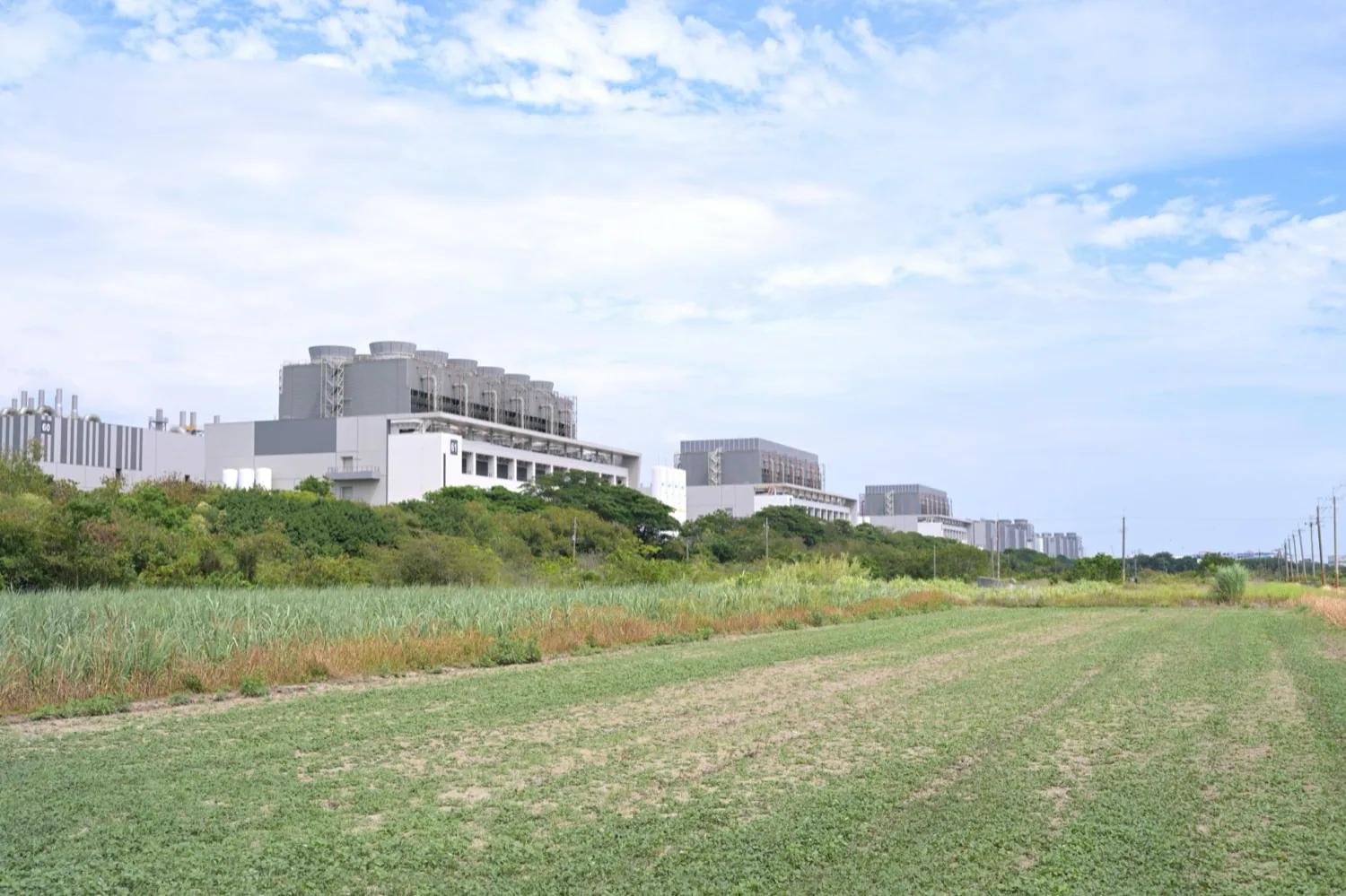
TSMC Fab 18 in Tainan Science Park. Fabs grow beside land, reservoirs, farms, and local infrastructure; supply-chain risk begins becoming concrete here. Photo: 4300streetcar. CC BY 4.0 via Wikimedia Commons.
Water Enters the Process Environment
If a chip is imagined as a miniature city, water is the cleaning system that never stops flowing through it.
During fabrication, a wafer passes through deposition, lithography, etching, cleaning, metrology, and other steps. Each step may leave residues behind. Particles invisible to the naked eye can become defects in nanoscale circuits. Ultrapure water is therefore industrial water that has been treated repeatedly to remove ions, organic matter, microbes, and particles as much as possible.
This water cannot be used straight from the tap. After water enters a fab, it still has to go through filtration, reverse osmosis, ion exchange, ultraviolet treatment, organic removal, and other processes before it becomes the ultrapure water needed for manufacturing. After use, it does not only flow through once. Advanced fabs separate water streams with different contamination levels, treat and reuse them, or send them into wastewater-treatment systems.
WIRED’s reporting noted that semiconductor wastewater can contain acidic waste from lithography, etching, and wafer thinning, hydrofluoric acid, silicon particles, and organic-carbon residues; the industry separates wastewater streams to improve the possibility of reuse.1 This shows that “water use” inside a fab is an extremely complex water-treatment system, far more refined than simply rinsing with water.
Semiconductor water use therefore raises at least three questions. First, where does the factory obtain raw water? Second, how does that water become ultrapure after entering the plant? Third, how is used water recycled, reused, treated, or discharged?
If only the first question is considered, the discussion is simplified into “who took whose water.” But for Taiwan, the harder task is handling all three questions together.
Drought Makes the Supply Chain See Reservoirs
Taiwan usually has a lot of rain, but water resources are not the same as stability.
Rainfall is concentrated in the plum-rain and typhoon seasons. Rivers are short and steep, and water quickly flows to the sea. When typhoons are few and plum rains are weak, reservoir levels in central or southern Taiwan decline, and science parks, agriculture, and household water use enter the same allocation problem.
The 2021 drought made this concrete. Agricultural irrigation could be suspended, water trucks could enter science parks, and fab water use became visible to international media. WIRED noted that Taiwan’s drought brought tensions between farmers’ irrigation and chip manufacturing to the surface.1
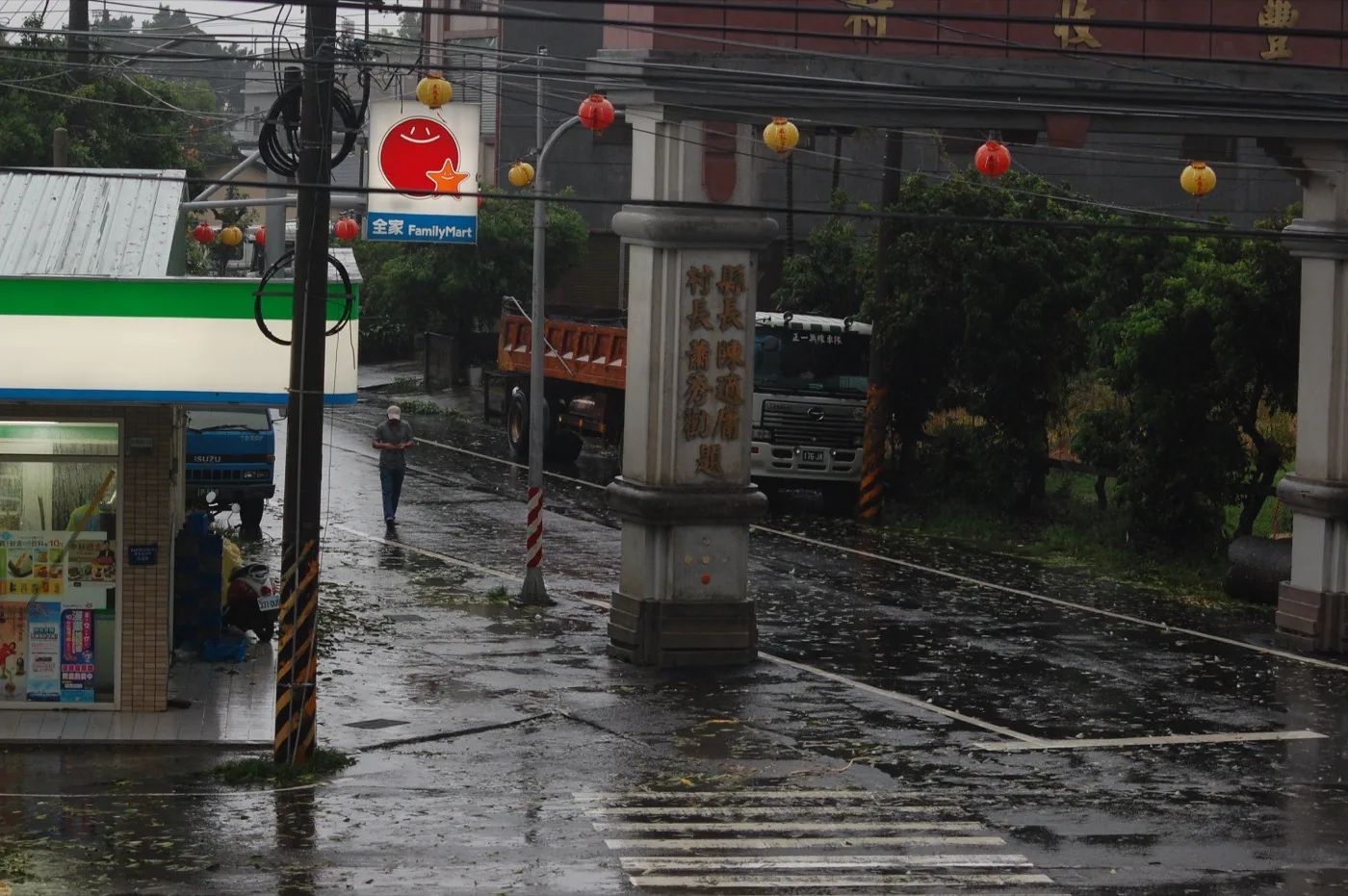
Flooding in Minxiong, Chiayi, after Typhoon Morakot in 2009. Taiwan’s water problem is not only shortage, but also concentrated rainfall, extreme events, and allocation resilience. Photo: zilupe. CC BY 2.0 via Wikimedia Commons.
This story does not need to be written as “farmers versus TSMC.” That would be too simple.
What deserves attention is how Taiwan maintains agriculture, household water, industry, and global supply-chain credibility on the same island. Drought tests not only reservoir capacity, but also whether institutions can prepare early, allocate transparently, and reduce conflict.
For foreign customers, Taiwan’s drought is read as supply-chain risk. For Taiwanese society, semiconductor water use involves industrial policy, agricultural policy, urban growth, and climate change; it does not stop at one company’s sustainability report.
This is why water resources are as important as electricity: both pull the “sacred mountain” down from corporate myth into public infrastructure.
Reclaimed Water Turns Water Resources into Public Infrastructure
The next keyword in semiconductor water use is reclaimed water.
Reclaimed water is produced by treating municipal sewage or industrial wastewater into a water source usable by industry. For semiconductors, reclaimed water can lower pressure on reservoirs and rivers, and it can give factories a more stable source during drought.
But reclaimed water is not free magic. It requires sewage-collection systems, reclaimed-water plants, pipelines, stable water quality, long-term contracts, and local acceptance. It pulls semiconductors from “corporate water use” back into public infrastructure.
A reclaimed-water plant is not simply an auxiliary facility beside a factory. It often involves municipal sewer systems, local governments, central-government subsidies, industrial-district demand, public trust in sewage treatment, and long-term maintenance costs. If the semiconductor industry is to use large amounts of reclaimed water, the city itself must first be able to collect, treat, transport, and monitor that water.
That is why “reclaimed water” is a useful observation point for Taiwan’s semiconductor industry. It is not as dazzling as advanced process nodes, but it reveals whether a society can place high-tech industry inside its own living system.
If reclaimed water works well, fab water use is less likely to directly squeeze household or agricultural water. If it works poorly, semiconductor expansion will be more easily understood as a local burden, deepening social distrust.
Reclaimed Water Is More Than One Extra Source
The most intuitive benefit of reclaimed water is one more water source. During drought, if part of industrial water can come from treated municipal sewage, immediate pressure on reservoirs and rivers can be reduced.
But its value does not stop there.
First, reclaimed water connects the city and industry. Cities produce sewage every day, and industry needs a stable water source every day. In the past, the goal of sewage treatment was to meet discharge standards. If it can be further treated into industrial water, part of the city’s metabolism is connected back into the industrial system.
Second, reclaimed water gives drought allocation more room. When reservoir levels fall, the government does not have to cut only among agriculture, households, and industry. Reclaimed water cannot replace every source, but it can make part of the high-stability demand of industrial water less directly dependent on the rainy season.
Third, reclaimed water forces data to become more transparent. To earn local trust, it must be clear where the water comes from, what standards it is treated to, where it is sent, who pays, how wastewater is monitored, and who is responsible when something goes wrong. The more clearly this information is made public, the less semiconductor expansion has to rely only on corporate promises or government endorsement.
Reclaimed water is therefore not a “patch” for semiconductor water shortage. It is more like an institutional test: can Taiwan combine municipal sewage, industrial demand, local trust, and climate risk into a water-resource system that can operate over the long term?
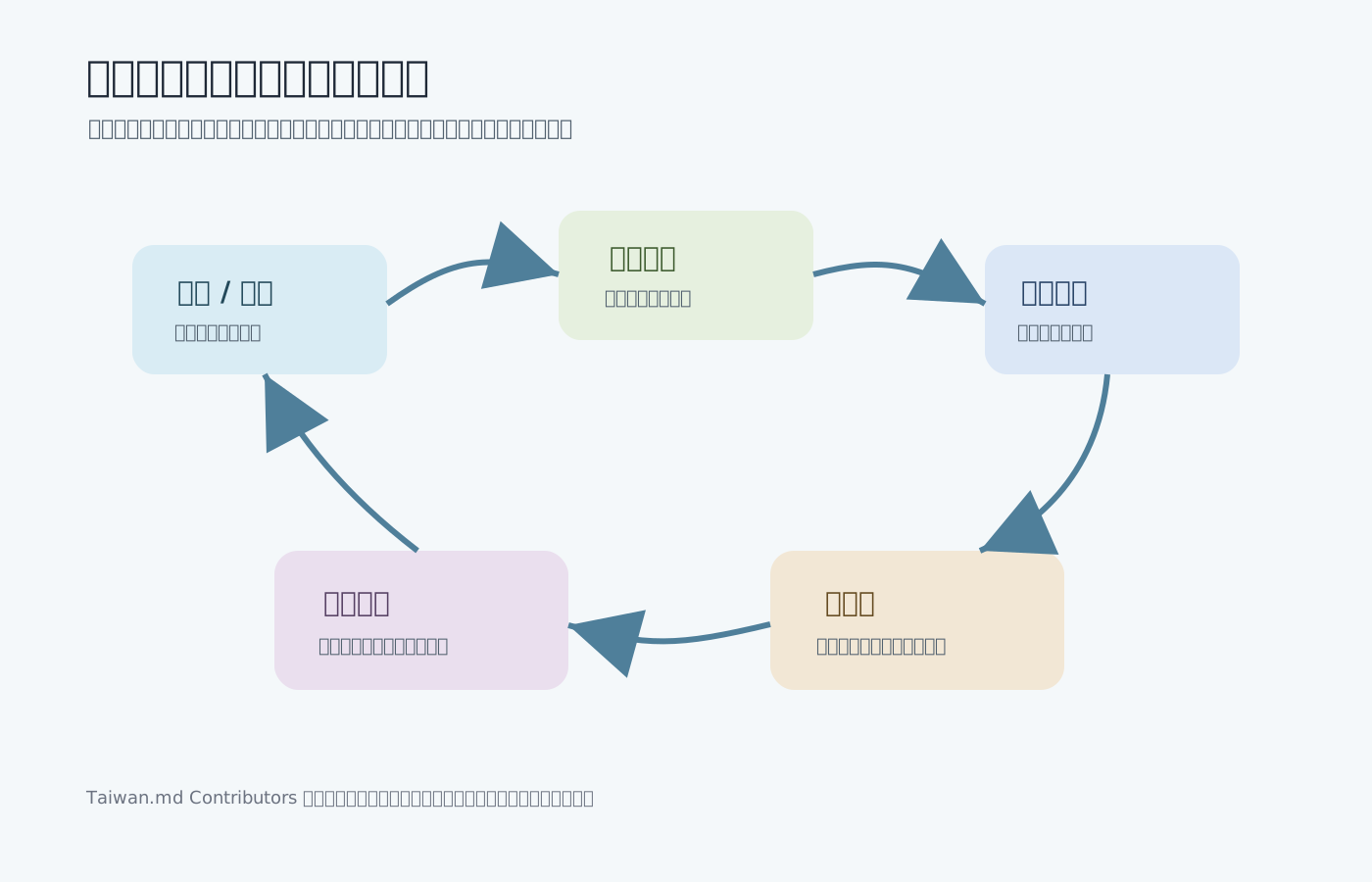
A Taiwan.md self-made diagram. Reclaimed water connects municipal sewage, industrial demand, local trust, and drought response into a system, turning semiconductor water use into a public-infrastructure question.
Overseas Fabs Cannot Escape Water Either
Water resources are not only a Taiwan issue.
Arizona is dry, yet it has become an important base for TSMC’s advanced manufacturing in the United States. TSMC Arizona’s official page says its Phoenix site plans an industrial-water reclamation facility with a goal of more than 90% water recycling and reuse; earlier descriptions also said that part of the plant’s startup water would come from onsite recycling systems.2 These details affect whether overseas manufacturing can be accepted by local society. They are not sustainability fine print inside corporate image-building.
When The Verge reported on Arizona’s semiconductor cluster, it also placed expectations for jobs alongside concerns over water resources, chemicals, worker safety, and whether local residents would truly benefit.3 That is a reminder: moving fabs overseas does not make water-resource issues disappear. It moves them to a new place for renegotiation.
In Taiwan, fabs face plum rains, typhoons, reservoirs, agriculture, and science parks. In Arizona, they face drought, groundwater, urban expansion, and water competition in a desert region. The geography differs, but the question is similar: is a place willing, and able, to bear water-resource pressure for the global chip supply chain?
Overseas manufacturing therefore is not only geopolitics or subsidy policy. It also asks whether the United States, Japan, Germany, India, or other regions are ready to place water, power, land, labor, and local society inside the semiconductor supply chain.
Water Efficiency Does Not Mean Aggregate Pressure Disappears
Semiconductor companies keep raising recycling rates and lowering water use per unit of product. That matters.
But if output increases faster, total water use may still rise. Roussilhe and coauthors, using Taiwanese electronics-component manufacturers as a sample, found that between 2015 and 2020, the sampled companies’ water use grew by an average of 6.1% per year, and placed water, energy, and carbon emissions inside the same context of output growth.4
That reminder matters: efficiency improvement is necessary, but it is not the whole answer.
Whether one island can support global advanced chips depends not only on whether water use per wafer declines, but also on whether science-park expansion, process upgrades, packaging capacity, data centers, and urban water use grow together. Taiwan has to deal with a set of mutually connected questions: engineering efficiency, climate change, and public allocation must be considered together.
Another misunderstanding should also be avoided: water problems do not mean semiconductors must not expand. They mean expansion cannot be decided only by corporate investment; water governance also has to keep up.
If industry treats water saving, recycled water, reclaimed water, wastewater treatment, and local communication only as costs, it will encounter social resistance. If it treats them as part of supply-chain resilience, it has a better chance of staying in Taiwan over the long term.
Who Is in the Same Drop of Water?
The hardest part of semiconductor water use is that the same drop of water is not the same thing to different people.
For a fab, it is process stability. For a farmer, it may be irrigation. For a resident, it is whether water comes out when the tap is opened. For the government, it is reservoir allocation, reclaimed-water investment, and drought response. For a foreign customer, it is whether chips ship on time. For environmental groups, it is river flow, wastewater treatment, and local carrying capacity.
When water is abundant, these differences are less visible. When drought arrives, every use becomes clear.
Good semiconductor water governance should therefore not rely only on water trucks during crisis, nor only on recycling rates in corporate sustainability reports. It needs earlier planning: which science parks are suitable for expansion, where reclaimed-water plants are needed, which industries must use reclaimed water, what data must be public, and how drought-allocation principles can earn social trust.
These questions sound less dazzling than 2nm, CoWoS, or AI servers, but they decide whether high tech can be placed on an island.
Water Resources Bring the Supply Chain Back to the Island
Semiconductors are often written as a globalized industry: American design, Dutch equipment, Japanese materials, Taiwanese manufacturing, Korean memory, and global data centers.
But water resources pull this global supply chain back to one island.
Where does the water come from? Did the typhoon arrive? Are reservoirs sufficient? Does agricultural irrigation need to be adjusted? Can the reclaimed-water plant be completed on schedule? Do local residents trust the factory’s wastewater treatment? These questions do not sound like high tech, but they decide whether high tech can operate stably.
So what “semiconductor water use” really reveals is where the sacred mountain stands.
It stands beside reservoirs, inside river basins, and within reclaimed-water pipelines and local governance. Taiwan turns part of global AI compute into chips, and it also brings the pressure of the global supply chain back to its own hydrological conditions.
That is why semiconductor water use is worth understanding: it turns the most abstract global technology competition back into the question of how one island distributes water.
Further Reading
- AI Hardware Supply Chain — How Taiwan turns cloud demand into machines that can be shipped.
- Taiwan’s Electricity and Semiconductors — The power bill behind the AI supply chain.
- AI Supply Chain Overseas Manufacturing — Why other countries also want to take on parts of manufacturing and infrastructure pressure.
- Science Park Development — How semiconductor clusters grow into Taiwan’s land and cities.
Image Sources
- TSMC Fab 18 and fields at Southern Taiwan Science Park (hero / inline): TSMC Fab 18 and fields May 2025 — Photo: 4300streetcar, Wikimedia Commons, CC BY 4.0. This article uses the cached version at
public/article-images/technology/tainan-science-park-tsmc-fab18-fields-2025.webp. - Flooding in Minxiong, Chiayi, after Typhoon Morakot: 2009-08-09 at a village under the Typhoon Morakot, in Minxiong, Chiayi — Photo: zilupe, Wikimedia Commons, CC BY 2.0. This article uses the cached version at
public/article-images/nature/morakot-minxiong-flood-2009.webp. - Reclaimed water and semiconductor manufacturing water-loop diagram: A Taiwan.md Contributors self-made SVG diagram, CC BY-SA 4.0, stored at
public/article-images/technology/reclaimed-water-semiconductor-loop-en.svg. It explains the relationship among reservoirs, municipal sewage, reclaimed-water plants, fabs, and local governance, and is not an engineering drawing of a specific site.
References
- WIRED: Want to Win a Chip War? You’re Gonna Need a Lot of Water — WIRED’s 2023 reporting on semiconductor manufacturing’s demand for ultrapure water and water-treatment facilities, including tensions between chip manufacturing and agricultural water use during Taiwan’s drought.↩234
- TSMC Arizona — TSMC Arizona’s official page describes the site’s investment, advanced-process plans, water-recycling system, and industrial-water reclamation facility goal, useful as a case of overseas fab water governance.↩
- The Verge: The new silicon valley (literally) — Reporting on Arizona’s expanding semiconductor cluster, including jobs, local development, water resources, environmental concerns, and worker safety, useful for balancing the local-social perspective on overseas manufacturing.↩
- Roussilhe et al.: From Silicon Shield to Carbon Lock-in? — A study of the environmental footprint of 16 Taiwanese electronics-component manufacturers from 2015 to 2020, raising the risk that water use, energy, and carbon emissions increase with output.↩