
30-Second Overview
Morris Chang, who left Texas Instruments at 54 and founded TSMC at 56, survived three major displacements and lived in six cities during his first eighteen years1. On the fourteenth day of his return to Taiwan in 1985, he proposed a business model in the office of Li Kwo-ting that no one in the world had ever attempted: focusing solely on wafer foundry services, not designing proprietary products, and never competing with customers2. Thirty-eight years later, in the first quarter of 2026, TSMC's quarterly revenue reached $35.9 billion (up 40.6% year-on-year), with a market capitalization of approximately $1.7 trillion, and a global market share of over 90% in advanced processes34. On March 3, 2025, Trump announced at the White House that TSMC would increase its investment by $100 billion, bringing total investment to upwards of $165 billion, stating to C.C. Wei: "He is the most important man in this room."5 Yet during the same period, a Zheng family ancestral grave built in 1844 in Baoshan, Hsinchu, was being relocated to make way for a 2nm plant6. Over the past thirty-eight years, this company has become the heart of humanity's digital civilization—but as this heart grows larger, whether the island can bear its cost becomes increasingly uncertain.
An Idea Conceived in 14 Days
On August 21, 1985, the 54-year-old Morris Chang returned to Taiwan to take up the position of President of ITRI (Industrial Technology Research Institute). He had spent 25 years at Texas Instruments, rising from entry-level engineer to Vice President; after leaving TI in 1983, he spent two years at General Instrument. That August, he ended his life in the United States and flew back to the island he had left at age eighteen, carrying unused vacation days with him.
On September 4, the fourteenth day of his return, Executive Yuan Minister Li Kwo-ting invited him to his office and got straight to the point, asking him for a plan that "could allow Taiwan to enter the semiconductor industry."
Chang later recorded this moment in his autobiography[^13]:
"Two weeks later (September 4), Minister Li Kwo-ting wanted to see me. He brought up the matter immediately. I had already spent nearly two weeks thinking about this problem, so at that time, I proposed the concept of a 'Common Wafer Fab'."
The term "Common Wafer Fab" did not exist at the time. Semiconductor companies either designed and manufactured their own chips (like Intel or Samsung) or simply outsourced to Japan. The phrase "specialized foundry" was invented by Morris Chang while sitting at his desk on Chongqing South Road during those two weeks.
To understand why this decision came from this specific person, one must look back to before he was eighteen. Born in Ningbo in 1931, he lived in six cities—Ningbo, Nanjing, Guangzhou, Hong Kong, Chongqing, and Shanghai—attended ten different schools, and survived three major displacements before the age of eighteen1. In 1949, he went to the United States for his studies, eventually entering Texas Instruments, where he rose from entry-level engineer to Vice President over twenty-five years.
His decision to return to Taiwan at 54 was not another flight from danger—it was an attempt to turn this 36,193 square kilometer island into something no one had ever imagined.
I Only Wanted to Survive
On February 21, 1987, TSMC was officially registered. With a capital of $145 million, the Executive Yuan Development Fund held 48.3%, Netherlands' Philips held 27.5%, and Wang Yung-ching's Taiwan Plastics held 5%2. The first wafer fab was established in the Hsinchu Science Park, utilizing 6-inch (150mm) wafers and a 2-micrometer process; it was a facility derived from the second phase of the VLSI project after ITRI learned from RCA in the US, with technology transferred from ITRI and Philips7[^34]. Compared to today's 2nm process, 2 micrometers is a thousandfold difference.
"When I founded TSMC in 1987, the first few years were actually very difficult. How could I have had any vision for ten years later? I only wanted to survive; I only wanted the company to survive!"8
Chang later recalled. Regarding the government's 48.3% investment, he described them as "reluctant investors." Had it not been for Li Kwo-ting's vigorous support, this funding would never have been allocated8.
The greatest challenge in the early days was not technology, but trust. Morris Chang visited semiconductor companies worldwide one by one, attempting to persuade them to entrust their most core manufacturing to a small Taiwanese firm. Most found it inconceivable—entrusting one's lifeblood to a third party? But Chang insisted on two principles that later became his motto[^13]:
"'Never make easy promises to customers; once a promise is made, we will fulfill it at any cost with our full effort' became our motto. 'Not competing with customers' and 'Customers are our partners' also became the mottables of the new company."
The promise of "not having a proprietary brand and never competing with customers" later proved to be TSMC's strongest moat. Because of this wall, companies like NVIDIA, Qualcomm, and AMD dared to hand over all their design blueprints to TSMC.
📝 Curator's Note: Morris Chang did not invent a technology; he invented a division of labor. Before him, chipmakers had to build their own factories. After him, the world's smartest chip designers could focus on design, leaving manufacturing to Taiwan. This division of labor gave rise to the modern landscape of NVIDIA, Qualcomm, and AMD.
No One Realized He Was Indispensable
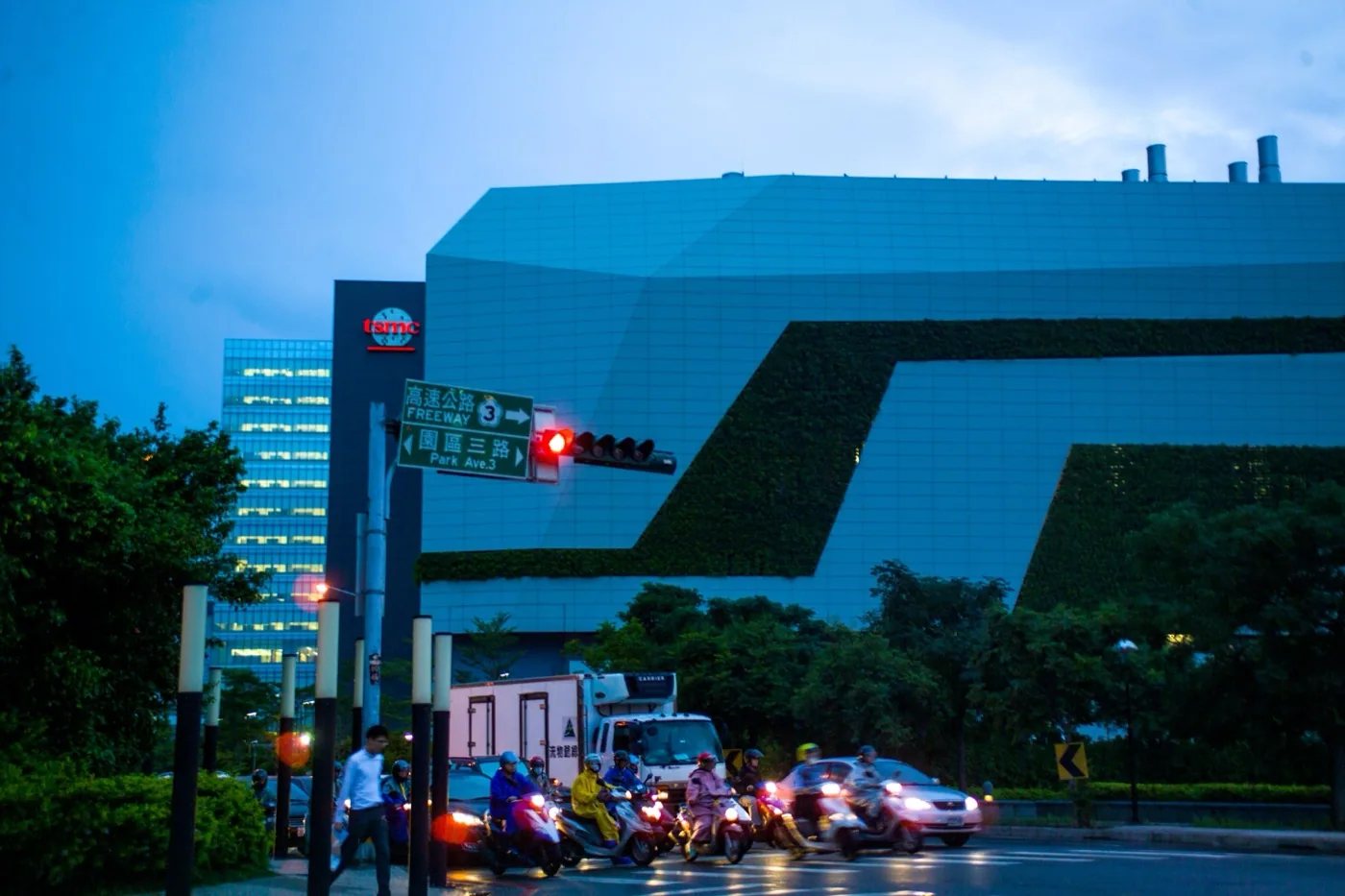
Aerial view of TSMC's factory cluster in Hsinchu Science Park (Tseng Cheng-Hsun, January 2, 2020). Photo: Tseng Cheng-Hsun. CC BY 2.0 via Wikimedia Commons.
The turning point occurred in the late 1990s.
TSMC's first 8-inch fab, Fab 3, ramped up mass production in 1995. By October 1997, Fab 5 in Hsinchu was completed (the company's third 8-inch fab, its first two-story design, with a 0.35-micrometer process) and began mass production in early 199,7[^35]. In December 1999, construction began on the first 12-inch fab, Fab 12, which entered mass production in 20027. At that time, Asia had just experienced the 1997 financial crisis, and most semiconductor companies were scaling back. TSMC expanded against the trend; this decision to "be greedy when others are fearful" laid the foundation for its leadership over the next two decades.
The simultaneous explosion of personal computers and mobile phones in the 2000s caused chip demand to surge. "Fabless" companies—those willing to separate design from manufacturing (NVIDIA, Qualcomm, Broadcom)—began to rise. TSMC's business model shifted from "ununderstood" to "indispensable."
In 2005, Morris Chang retired for the first time, and C.C. Wei took over as CEO. On September 9, 2014, Apple released the iPhone 6/6 Plus; that was the first time Apple's A-series chips were manufactured exclusively by TSMC (at 20nm), officially replacing Samsung9. From then on, every processor in every iPhone has been produced in Taiwan.
In 2018, Morris Chang formally retired, and Liu De-yin and C.C. Wei took over under a dual-leadership system; in 2024, Liu De-yin stepped down, leaving C.C. Wei as sole Chairman and President.
These are not merely chronological entries; they are layers of the same logic: all competitors have fallen behind (IBM, TI, Samsung could not keep up, Intel stalled at 7nm), and the bottleneck for the world's advanced processes is narrowing.
Then came AI.
Those Ten Minutes in 2009
In early 2009, the global financial crisis swept the world.
The then-CEO, C.C. Wei, laid off 840 employees citing "poor performance and failing evaluations," deliberately avoiding the word "layoff." The displaced employees formed a self-help group and protested outside Morris Chang's residence in Taipei.
Morris Chang's wife, Chang Shu-fen, did not sleep all night. The next morning, she went downstairs with security to personally purchase "enough soy milk, sesame pancakes, and fried dough sticks for 30 people" to distribute to the overnight protesters. The employees later told the media[^14]:
"Everyone was deeply moved, and we decided to cancel our planned protest at Ketagalan Boulevard."
On the morning of June 11 that year, during a TSMC board meeting, the 78-year-old Morris Chang proposed the removal of C.C. Wei from the CEO position "[in less than ten minutes](10)" and returned to the role himself.
He later explained why[^14]:
"This is not something we would normally do; at most, we would allow underperforming employees to undergo a six-month improvement period... but even if they pass the probation, we do not fire people."
📝 Curator's Note: Why this cultural rule of "not firing people" became a rule is answered by those ten minutes in 2009. TSMC's rigor lies not in "elimination," but in "providing guidance even if you cannot keep up." But the cost of this promise is that the company must have the capital for rapid expansion to absorb all its employees. When a company can no't expand anymore, this promise becomes its chain.
Water Wagons Carry Water; Farmland Yields to Water
In the spring of 2021, Taiwan suffered its most severe drought in 56 years.
Reservoirs in the Hsinchu Science Park dropped to historic lows. TSMC initiated "water wagons": a 12-ton water truck was quoted at 15,000 TWD per trip11.
At the same time, the government ordered rice paddies in the Taoyuan, Hsinchu, and Miaoli regions to cease irrigation. The farmers' water was yielded to the wafer fabs. The New York Times headline was blunt: "Taiwan's Drought Pits Chip Makers Against Farmers"12.
This is the other side of the "Protector of the Nation Mountain" (護國神山). A single TSMC advanced process fab uses over 150,000 tons of water daily, and its electricity consumption accounts for over 7% of Taiwan's total usage. Between 2015 and 2019, TSMC's own water consumption grew by 70%13. In the environmental impact assessment for the Baoshan Phase 2 expansion, TSMC promised to use 100% reclaimed water, but simply laying the dedicated reclaimed water pipeline to the Hsinchu Science Park would cost over 10 billion TWD, and the government would have to foot the bill.
Former Hsinchu Science Park Bureau Director Li Chieh-mu told Mirror Media in 2021[^25]:
"Water wagons are like using buckets to fight a fire; it is only an emergency measure... if it does not rain again, TSMC will face production cuts."
TSMC has pledged to reach net-zero emissions by 2050 and is investing heavily in renewable energy. Paradoxically: the more robust AI demand becomes, the more advanced processes consume electricity and water. The higher the "Protector Mountain" stands, the longer its shadow grows.
📝 Curator's Note: The term "Protector of the Nation Mountain" (護國神山) is almost a matter of faith in Taiwan—but the other side of faith is the inability to question. When a company becomes so large that the distribution of an entire nation's water and power resources must yield to it, the line between "protection" and "dependency" has blurred.
The Zheng Family's 178 Years
Baoshan Township, Hsinchu County.
In 1844 (the 24th year of the Daoguang era of the Qing Dynasty), Zheng Yong-jin sent his family to build a 4,000-ping Zheng family cemetery here. One hundred and seventy-eight years later, this ancestral grave must yield land for TSMC's 2nm plant6.
The Hsinchu Science Park Bureau negotiated with the Zheng descendants for five years to acquire the 270,00_0-ping site (including the Zheng cemetery). During the negotiation, TSMC "unilaterally hired workers to dig in the cemetery for exploration, driving iron rods and making marks at at least three locations"6. Baoshan residents "protested with white banners." Hsinchu County Councilor Chiu Chen-wei stated directly: "It is like 'annihilating a village' (the Oaki village)6."
The relocation was completed in late May 2025.
This is just one case. TSMC has faced similar large-scale land acquisition and environmental assessment controversies in Baoshan, Hsinchu; Tongluo, Miaoli; Taichung Science Park; Jiayi; and Nanzih, Kaohsiung. Every new plant means a piece of local history must be turned over—it is just that not every piece has descendants who remember the Zheng family's name.
✦ "It is like 'annihilating a village' (the Oaki village)." (Hsinchu County Councilor Chiu Chen-wei)6
The Most Important Man in the East Room of the White House
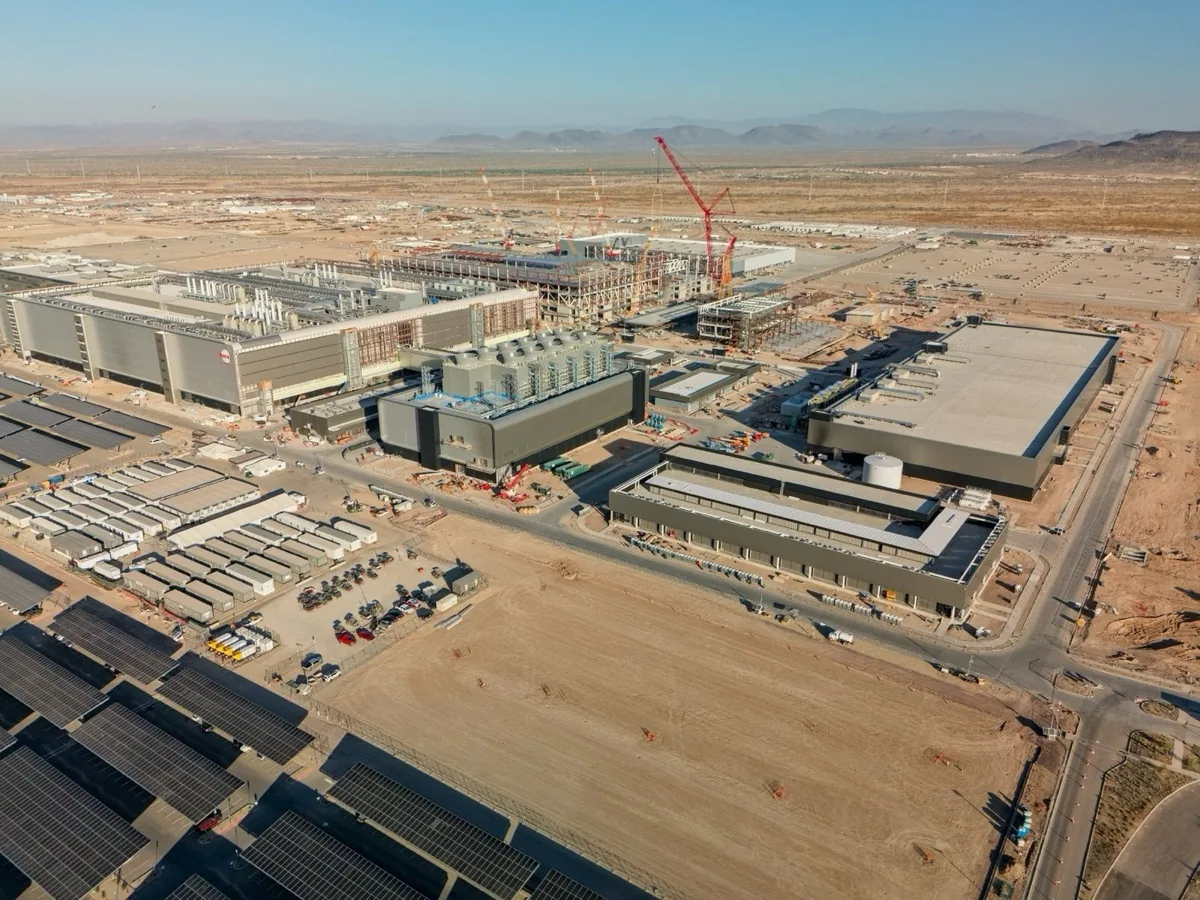
Aerial view of TSMC Fab 21 construction site in Phoenix, Arizona (Hunter Trick, November 5, 2023). Photo: Hunter Trick. CC BY-SA 4.0 via Wikimedia Commons.
The afternoon of March 3, 2025, East Room of the White House, USA.
Donald Trump is on his 43rd day in office. U.S. Commerce Secretary Howard Lutnick, AI and cryptocurrency advisor David Sacks, TSMC Chairman C.C. Wei, and NVIDIA founder Jensen Huang are all in the same frame (Jensen Huang was invited by C.C. Wei "for moral support," though he did not take the stage).
Trump announced: TSTSMC will increase its investment by $100 billion; combined with the previous $65 billion, total investment in U.S. bases is expected to reach $165 billion, with plans for six wafer fabs5. Midway through, he turned to two secretaries and said one sentence[^7]:
"Right now, he's the most important man in the room. I'm sorry, fellas."
C.C. Wei took the stage to explain the plan; the most critical line was verbatim English[^7]:
"In Phoenix, Arizona, with 3,000 employees, we are producing the most advanced chip made on U.S. soil."
This is not an isolated event. In February 2025, Lai Ching-te had already privately visited Morris Chang, C.C. Wei, and Director Lin Chuan in preparation for this announcement14. On January 14, 2026, Trump signed Section 232 semiconductor tariffs, imposing a 25% tariff on all semiconductor imports not investing in the US; however, the same order provided an exemption clause for TSMC's US investments based on "2.5x planned capacity"15. This means: you don't just sell to the US, you produce in the US—the more you move production lines to Phoenix, the less tariffs will touch you.
This binds all advanced processes even more tightly to American soil.
Progress in Arizona is faster than expected. The second phase 3nm plant, originally planned for mass production in 2028, will now begin equipment installation in Q3 2026 and is expected to mass produce in 2027—one year ahead of schedule16. The third phase N2/A16 class has already begun construction in April 2025. In February 2025, Apple announced it would purchase "over 100 million" chips manufactured in Phoenix in 202617.
This is the flip side of the "Silicon Shield" theory. KMT Legislator Ko Chih-en told the Taipei Times in March 2025, verbatim English[^29]:
"The more TSMC produces in the US, the lower Taiwan's geopolitical importance will be, and the less incentive the US will have to help Taiwan."
A 2025 poll by Vista Magazine showed that 64% of Taiwanese people believe investment in the US is weakening the Silicon Shield18. An August 2025 article in MIT Technology Review wrote: "Taiwan's silicon shield could be weakening"19.
The Lai administration's response was "no pressure from the United States." However, an November 2025 headline in Foreign Policy was blunt: "Lai Administration Has Rocky Relationship With Chip Giant TSMC"20.
The TSMC of a Post-Globalization World
October 26, 2024, Hsinchu County Stadium, TSMC Sports Day.
Normally, this should be the most joyful occasion of the year. The 93-year-old Morris Chang (retired for 6 years) stood at the podium to deliver a speech. He did not speak of TSMC's achievements. He spoke of an open warning[^31]:
"In semiconductors, especially in the most advanced semiconductors, globalization is dead, and world free trade is also dead."
"TSMC's success has become a prize that geopolitical strategists must fight for; today, TSMC has truly become a contested battlefield."
"In an environment where globalization is dead and world trade is dead, TSMC's challenge is to continue seeking development."
The founder made such a judgment at his own company's sports day, the very occasion meant for unity. He was not analyzing geopolitics; he was issuing a public warning.
C.C. Wei said another thing during an earnings call on January 15, 2026[^11]:
"I am also very nervous... if we do not evaluate carefully and over-invest, it will be a great disaster for TSMC."
The context of this statement was the risk of an AI bubble. TSMC's 2026 capital expenditure budget is USD 52-56 billion (vs. USD 40.9 billion in 2025 / USD 28.9 billion in 2024)21. In other words, TSMC's annual investment in R&D and expansion exceeds Taiwan's entire national defense budget for a year.
Jensen Huang's response was another kind of warning[^32]:
"I believe that over the next 10 years, TSMC's capacity will likely increase by far more than 100%. This is a very significant investment in the next decade, a massive scale expansion; this will be the largest infrastructure investment and expansion in human history."
The Behemoth in the Numbers
| Metric | Figure (2026 Q1 / Latest) | Source |
|---|---|---|
| 2026 Q1 Revenue | $35.9 billion (up 40.6% YoY) | 3 |
| 2026 Q1 EPS | NT$22.08 (up 58.3% YoY) | 4 |
| 2026 Q1 Gross Margin | 66.2% / Operating Margin 58.1% | 4 |
| 2026 Capex Budget | USD 52-56B (vs 2025: 40.9B) | 21 |
| 3nm share of Q1 Revenue | 25% (vs 6% in 2023-Q3) | 22 |
| 2nm Yield | 70-80% (test chips) | 23 |
| Global Advanced Process Share | Over 90% (3nm) | TSMC Annual Report |
| Global Foundry Market Share | Approx. 54% | TrendForce |
| May 2026 Market Cap | Approx. $1.7 trillion (6th globally) | 24 |
| Number of Employees | 84,512 (as of 2024-12) / Est. 90,000 | 25 |
NVIDIA's AI training chips, Apple's mobile processors, and AMD's server chips are all exclusively manufactured by TSMC. If TSMC's factories were to stop for one week, the global technology industry would grind to a halt.
2nm is expected to enter mass production in the second half of 2026; the dual capacity of Hsinchu Baoshan and Kaohsiung Fab 22 is already fully booked for all of 202623. The 1.4nm (A14) process was officially unveiled at a North American symposium in April 2025, with mass production expected in 2028; compared to 2nm, it promises a 10-15% speed increase or 25-30% power savings, and over 20% more logic density26.
The investment for each generation of process exceeds the previous one: a single 2nm fab costs over $20 billion. As processes approach physical limits, every step forward becomes more expensive, and fewer competitors can keep up.
The Weight of an Island
In May 2026, TSMC's market capitalization was approximately 2.3 times Taiwan's GDP. One company is larger than the entire nation's annual output—there is no second example in the world.
Morris Chang once told The Wall Street Journal that he had "finished," describing himself like a veteran, "not dead, but gradually withering away"27. But what he created far exceeds a single company. Around TSMC, Taiwan has built the world's most tightly integrated semiconductor industry cluster; from equipment to materials to packaging and testing, the entire supply chain is within a hundred-kilometer radius. This density allows TSMC to respond to customer engineering changes within 24 hours—something Samsung and Intel cannot do.
In 1987, Morris Chang said he "only wanted to survive." Thirty-eight years later, the whole world needs TS_MC to survive. What began as one man's struggle for survival has become an island's struggle for survival, and ultimately, a civilization's struggle for survival.
No one planned a transition of this magnitude. Yet, in the greatest drought in 56 years, water wagons continue into Baoshan; on construction sites in Arizona, the third fab has just begun; on the red carpet of the White House, Trump praises the man who left TI at 56 as "the most important man in this this room"—even though that 56-year-old man is no longer in this room.
Further Reading
- Taiwan Enterprises: MediaTek — The world's third-largest mobile chip designer, a local representative of the fabless model, and the complementary twin to TSMC.
- Taiwan Enterprises: ASE Group — The world's largest OSAT (Outsourced Semiconductor Assembly and Test) provider, a critical downstream node in the same supply chain as TSTSMC.
- Taiwan Stock Market and Capital Markets — TSMC's market cap accounts for approximately 35% of Taiwan's total market cap; to understand Taiwan's stocks, one must first understand TSMC.
- Taiwan Industrial Transformation — TSMC is a concrete example of Taiwan's transformation from an OEM island to a technology island.
- Shi Zhen-rong — A director at TSMC for 21 years and the Acer founder whose largest wealth was tied to TSMC stock, yet he is the author of the "U-curve" that urged Taiwan not to rely solely on OEM.
- Semiconductor Industry — The 50-year materials revolution from RCA technology transfer to GaN and quantum packaging; the entire materials science battlefield where TSMC resides.
- Ho Chun-ren — Founder of VISium/VPEC; another path on the same island: also doing wafers, once facing massive debt and delisting, only to climb back into the stock market nine years later.
Image Sources
This article uses 2 images, all cached at public/article-images/economy/ to avoid hotlinking from source servers:
- TSMC Hsinchu Fab Aerial View (hero) — Photo: Tseng Cheng-Hsun, 2020-01-02. CC BY 2.0 via Wikimedia Commons.
- TSMC Arizona Fab 21 Construction Site Aerial View — Photo: Hunter Trick, 2023-11-05. CC BY-SA 4.0 via Wikimedia Commons. ShareAlike 4.0: This work (including derivatives of this image) is licensed under the same license.
References
- Wikipedia: TSMC — Main Wikipedia entry for TSMC, recording the timeline of the first 8-inch fab Fab 5 (1997-10), the start of construction for the first 12-inch fab Fab 12 (1999-12), and mass production in 2002.↩2
- Next Magazine: Why Morris Chang Retook the CEO Role at TSMC 16 Years Ago — In-depth report from Next Magazine (2025-02), recording the 2009 C.C. Wei layoff of 840 employees, the story of Chang Shu-fen's soy milk, the verbatim "less than ten minutes" removal at the June 11 board meeting, and the verbatim explanation of Chang's "not firing people" principle.↩2
- TSMC 2026 Q1 Quarterly Results — TSMC official Investor Relations Q1 2026 report, recording quarterly revenue of USD 35.90B (NT$1,134.10B), up 40.6% YoY, exceeding the upper end of financial guidance.↩2
- ETtoday: TSMC Q1 Revenue Up 35% YoY, EPS 22 NTD—Strongest Ever — Chinese media in-depth report (2026-04-16), recording TSMC Q1 2026 EPS of NT$22.08 (up 58.3% YoY), gross margin of 66.2%, and operating margin of 58.1%, with C.C. Wei's verbatim Chinese statement "no shortcuts" at the earnings call.↩23
- American Presidency Project: Trump-Wei 2025-03-03 White House transcript — Verbatim transcript from the U.S. Presidential Projects website, recording Trump's announcement at the White House on 2025-03-03 regarding TSMC increasing investment by $100 billion, total investment reaching $165 billion, including verbatim English statements: "Right now, he's the most important man in the room" and C.C. Wei's "In Phoenix, Arizona, with 3,000 employees."↩2
- Digital Age: TSMC Water Wagons Combat Largest Drought in 56 Years — Tech media in-depth report (2021), recording a 12-ton water truck quoted at 15,000 TWD per trip, and the 10 billion TWD cost for the Baoshan reclaimed water pipeline.↩2345
- ETtoday: Lai Ching-te privately visits Morris Chang, C.C. Wei, and Lin Chuan ahead of $100B announcement — Chinese media report (2025-03), recording Lai Ching-te's low-profile visit to Morris Chang, C.C. Wei, and Director Lin Chuan in February 2025 in preparation for the $100 billion announcement.↩23
- Foreign Policy: Lai Administration Has Rocky Relationship With Chip Giant TSMC — In-depth analysis from Foreign Policy (2025-11-03), with the verbatim headline "Lai Administration Has Rocky Relationship With Chip Giant TSMC," recording the subtle tension between the Lai administration and TSMC.↩2
- Mirror Media: For TSMC Expansion, Hsinchu Science Park Forcefully Acquires Century-Old Cemetery — In-depth report from Mirror Media (2022-06-28), recording the 270,000-ping land acquisition for the Baoshan 2nm plant, including the 178-year-old (built 1844) Zheng family cemetery, TSMC "unilaterally hiring workers to dig in the cemetery for exploration," and Councilor Chiu Chen-wei's verbatim Chinese statement: "It is like 'annihilting a village' (the Oaki village)."↩
- Wikipedia: Morris Chang — Wikipedia entry for Morris Chang, recording his early life: born in Ningbo in 1931, lived in six cities—Ningbo, Nanjing, Guangzhou, Hong_Kong, Chongqing, and Shanghai—attended ten schools, and went to the US for studies in 1949.↩
- Foreign Policy: Climate Planning Could Doom TSMC Arizona Expansion — In-depth analysis from Foreign Policy (2023-08), recording that a single TSMC advanced process fab uses 150,000 tons of water daily, accounts for 7% of Taiwan's electricity, and saw a 70% increase in water usage between 2015 and 2019.↩
- Mirror Media: Water Shortage Crisis—Will TSMC Face Production Cuts? — Mirror Media report (2021-04), recording former Hsinchu Science Park Bureau Director Li Chieh-mu's verbatim Chinese statement: "Water wagons are like using buckets to fight a fire."↩
- MIT Technology Review: Taiwan's silicon shield could be weakening — In-depth analysis from MIT Technology Review (2025-08), recording academic views on the weakening Silicon Shield and verbatim English statement from Rupert Hammond-Chambers, President of the US-Taiwan Business Association: "Because TSMC is now Taiwan's most recognizable company, it has already been embedded into the concept of Taiwan's sovereignty."↩
- Vista Magazine: 64% Fear Silicon Shield is Crumbling — 2025 poll by Vista Magazine, recording that 64% of Taiwanese people believe US investment weakens the Silicon Shield, while 27.1% believe it strengthens Taiwan-US relations.↩
- White House Fact Sheet: Section 232 Semiconductor Tariffs 2026-01 — Official White House fact sheet (2026-01-14), recording Trump's signing of Section 232 25% semiconductor tariffs, with an exemption clause for TSMC's US investments based on "2.5x planned capacity."↩
- TrendForce: TSMC accelerates Arizona 2nd fab — Same as [^5], recording Arizona Phase 2 (3nm) equipment installation starting in 2026-Q3 and mass production in 2027 (one year early); Phase 3 N2/A16 class construction began in 2025-04.↩
- Wikipedia: TSMC Arizona — Wikipedia entry for TSMC Arizona, recording Apple's February 2025 announcement to purchase over 100 million chips manufactured in Arizona in 2026; progress of Phases 1-3 and employee structure.↩
- New York Times: Taiwan's Drought Pits Chip Makers Against Farmers — In-depth report from The New York Times (2021-04-08), recording the 2021 spring drought where the government ordered irrigation stops in Taoyuan, Hsinchu, and Miaoli rice paddies, farmers yielding water to fabs, and the headline "Taiwan's Drought Pits Chip Makers Against Farmers" along with subsequent Foreign Policy analysis.↩
- Next Magazine: What was Morris Chang thinking when he founded TSMC at 56? — Interview from Next Magazine (202_3-03), recording verbatim Chinese statements: "When I founded TSMC in 1987, the first few years were actually very difficult" and "I only wanted to survive."↩
- TechNews: NVIDIA CEO Jensen Huang hosts banquet with Taiwan supply chain partners — Tech media report (2026-02), recording verbatim Chinese statements from Jensen Huang's visit to Taiwan: "Over the next 10 years, capacity will likely increase by far more than 100%"; "This is a very significant investment in the next decade, a massive scale expansion"; and "Just for NVIDIA, the capacity TSMC provides must be far more than 2x."↩
- Data Center Dynamics: TSMC 2026 capex up to $56B — International data center industry media report from early 2026, recording TSMC 2026 capex rising to USD 52-56 billion (vs 2025: 40.9B / 2024: 28.9B), with 70-80% allocated to advanced processes.↩2
- Yahoo Finance: TSMC Q1 2026 earnings record — International financial media analysis of Q1 2026 revenue structure, recording 3nm share of Q1 revenue at 25% (vs 6% in 2023-Q3—a fourfold increase within three years).↩
- TrendForce: TSMC accelerates Arizona 2nd fab, 2nm sold out — Global semiconductor research institution report (2025-12-18), recording 2nm mass production in Q4 2025, dual sites at Hsinchu Fab 20 + Kaohsiung Fab 22, yields of 70-80%, and expected monthly capacity of 100,000-140,000 wafers by the end of 2026.↩2
- TSMC PR: Fab 5 wins Top Fab 2000 honor — TSMC official press release (2000), recording "TSMC Fab 5 is the Company's third 8-inch fab located in the Science-based Industrial Park in Hsinchu, Taiwan" + "construction of the facility started in November 1995 and was established in October 1997" + "Fab 5 began volume production in early 1998 with 0.35 micron logic technology" verbatim English passages. (Note: Corrected error stating Fab 5 was the first 8-inch fab; Fab 3 was the first).↩
- DigiTimes: TSMC employee count reached 84,512 as of 2024-12 — Chinese semiconductor industry media statistics from early 2025, recording TSMC's employee count at 84,512 (as of 2024-12), with an estimate exceeding 90,000 in 2025.↩
- TSMC press release: A14 (1.4nm) unveiled at North America Symposium — TSMC official press release (2025-04), officially unveiling the A14 (1.4nm) process, expected mass production in 2028, with a 10-15% speed increase or 25-30% power savings relative to N2.↩
- Taipei Times: $100B deal sparks debate — English report from Taipei Times (2025-03-09), recording KMT Legislator Ko Chih-en's verbatim: "The more TSMC produces in the US, the lower Taiwan's geopolitical importance will be" in response to the $100 billion announcement.↩