
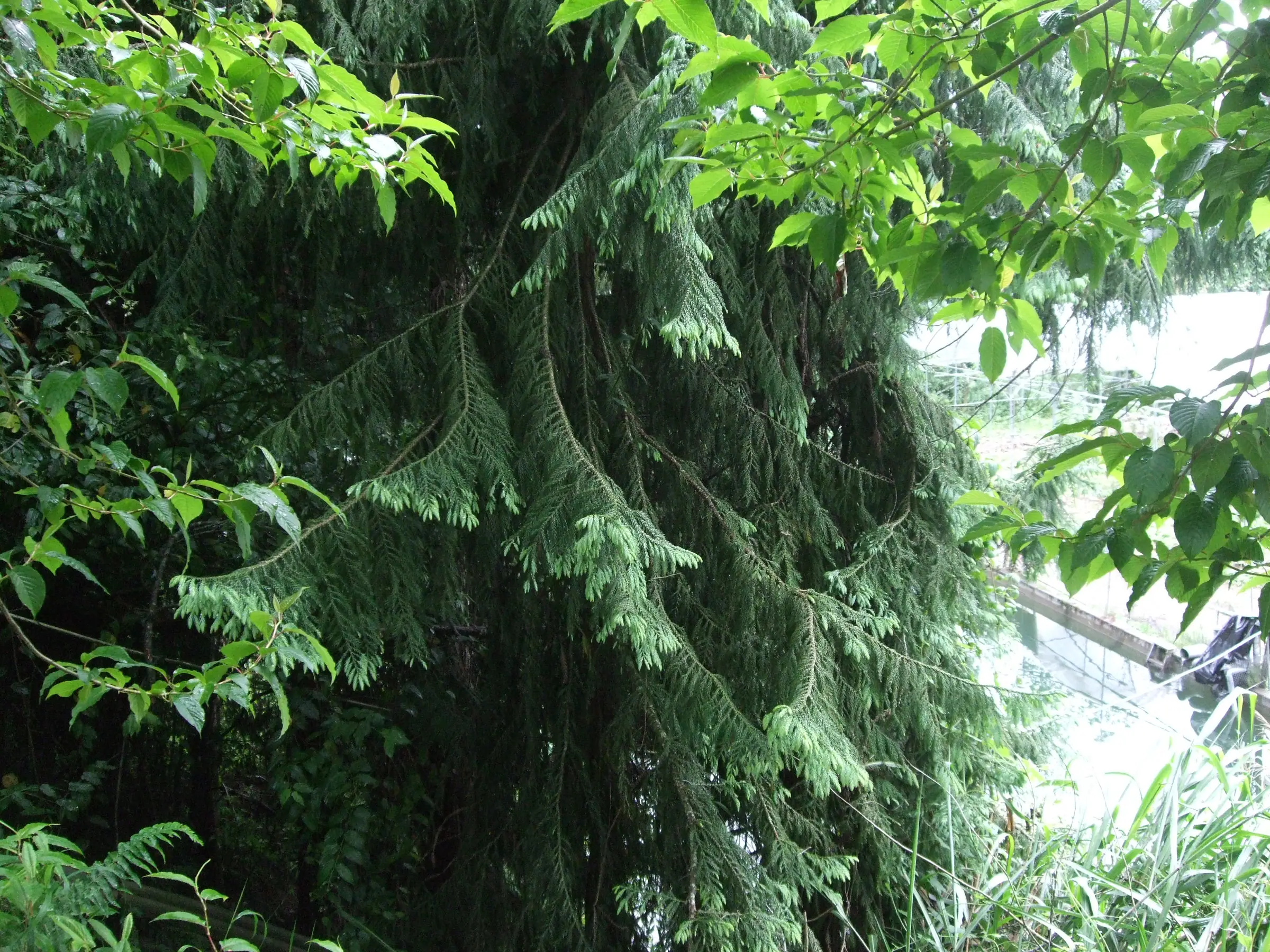
30-Second Overview: Taiwan has a tree 84.1 meters tall, roughly the height of a 28-story building, and it is currently the tallest known tree in East Asia1. It is called the "Daan River Heaven Sword," a Taiwania (Taiwania cryptomerioides) growing in a deep valley near the headwaters of the Daan River at about 1,650 meters above sea level. It is estimated to have lived for seven or eight hundred years2. During the 2023 Lunar New Year, the "Tree Finder" team spent seven days tracing the river upstream, with nighttime temperatures falling to minus 2 degrees Celsius, before climbing into its crown and lowering a tape measure to obtain that number3. The most counterintuitive fact is this: on a country swept by typhoons every year, with fragile geology prone to landslides and floods, height like this should not, in theory, exist. It could grow to 84 meters and live for seven hundred years precisely because it was hidden in a valley humans could barely reach. The same "inaccessibility" that let it escape large-scale logging during the Japanese colonial period and after the war also meant that only after nearly a decade of work and a laser scan of the entire country did we see it for the first time that year4.
At the beginning of the 2023 Lunar New Year, above an unnamed valley deep in the Xueshan Range, several people clung to the crown layer of a Taiwania tree. From the top, they slowly released a tape measure, letting it drop toward the distant forest floor. When the tape stopped, the number was 84.1 meters3.
It was the tallest tree ever recorded in Taiwan, and it is currently the tallest known tree in East Asia1. But what truly gives one pause is how long it had remained hidden. This tree had stood in that valley for at least seven hundred years2, surviving Qing rule, Japanese colonial rule, wave after wave of postwar logging, and the typhoons that sweep across Taiwan every year. We did not finally know it was there until that year.
84.1 Meters, Taller Than the Instruments Guessed
Measuring the height of a tree sounds as if it should be the simplest thing. But the world's tallest trees are precisely the hardest to measure accurately.
The "Tree Finder: Giant Tree Mapping Project" uses airborne LiDAR: an aircraft carries lasers over the forest, and the returning point cloud is used to calculate a canopy height model for each patch of woodland5. In the data, this giant tree, numbered 55214, was estimated at 79.5 meters6. That height alone was enough to put it among Taiwan's tallest trees.
But lasers have blind spots. They fire downward from the sky and register the reflective surface blocked by the outermost leaves of the crown, not necessarily the true highest point. Steep slopes, visual obstruction, and insufficient point density can all cause underestimation. To determine exactly how tall a tree is, the most accurate method remains almost primitively awkward: a person climbs up, lowers a tape measure from the top of the tree to the ground, and measures directly. This method is called a "tape-drop"7.
When team members actually climbed to the top of tree 55214 and lowered the tape, the figure was 84.1 meters, a full 4.6 meters taller than the laser estimate6. In other words, the tallest living thing in Taiwan had even fooled an instrument looking down from the sky, which had made it nearly five meters too short.
That 4.6-meter gap could almost serve as a footnote to the entire story. The project team compared 22 giant trees across Taiwan that exceeded 40 meters and had been climbed and measured in person. The average gap between laser and tape, expressed as RMSE, was 4.55 meters8. The taller a tree is, and the deeper it is hidden, the more instruments tend to underestimate it. The tallest tree is often the one least willing to be seen clearly.
Curator's Note
It is easy to imagine "measurement" as neutral and objective, as if sufficiently advanced instruments can grasp everything. But the pair of numbers 84.1 and 79.5 reminds us of something: even the most precise laser ultimately still required a person to climb to the treetop and lower a tape measure before the matter could be settled. The Heaven Sword is the tallest, and therefore also the hardest to calculate accurately. The tallest life in Taiwan was confirmed by the oldest method.
A Country Where Tall Trees Should Least Exist
Pull the camera back and look at all of Taiwan, and the very existence of the Heaven Sword becomes a mystery.
Taiwan is not a place well suited to producing extremely tall trees. Each year, three to five typhoons make direct landfall. Large trees on high mountain ridges take the first impact: snapped by wind, struck by lightning, or uprooted. Add young geology and steep slopes, and heavy rain often brings large-scale landslides. In such an environment, for a tree to grow beyond 80 meters requires not only several centuries of time, but also several centuries of luck: not being broken by wind, not being cut down, and not being swept away by a landslide9.
That is why Taiwan has surprisingly few supertall trees. Only a handful of giant trees across the country currently exceed 70 meters, and every one of them belongs to the same species: Taiwania10. Why Taiwania, rather than the sacred cypresses many people picture? Here lies a piece of common knowledge that most people remember backward.
The "sacred trees" in our collective memory are almost all red cypress or yellow cypress, such as the Alishan Sacred Tree or the Lala Mountain Sacred Trees: massive, ancient, fenced off, and revered. But red cypress generally reaches only about 65 meters in height11. They were able to become sacred trees and survive to the present for a somewhat brutal reason: red cypress is susceptible to fungal rot, and its heartwood often hollows out into a honeycomb-like structure. The wood then loses commercial value, so during the logging era people did not bother cutting it down, and it was spared11. Taiwania is different. Its trunk is straight, its heartwood is not hollow, and it is excellent building timber. The species' potential height can reach about 90 meters12. It grows the tallest, and for that very reason it was also the most worth cutting.
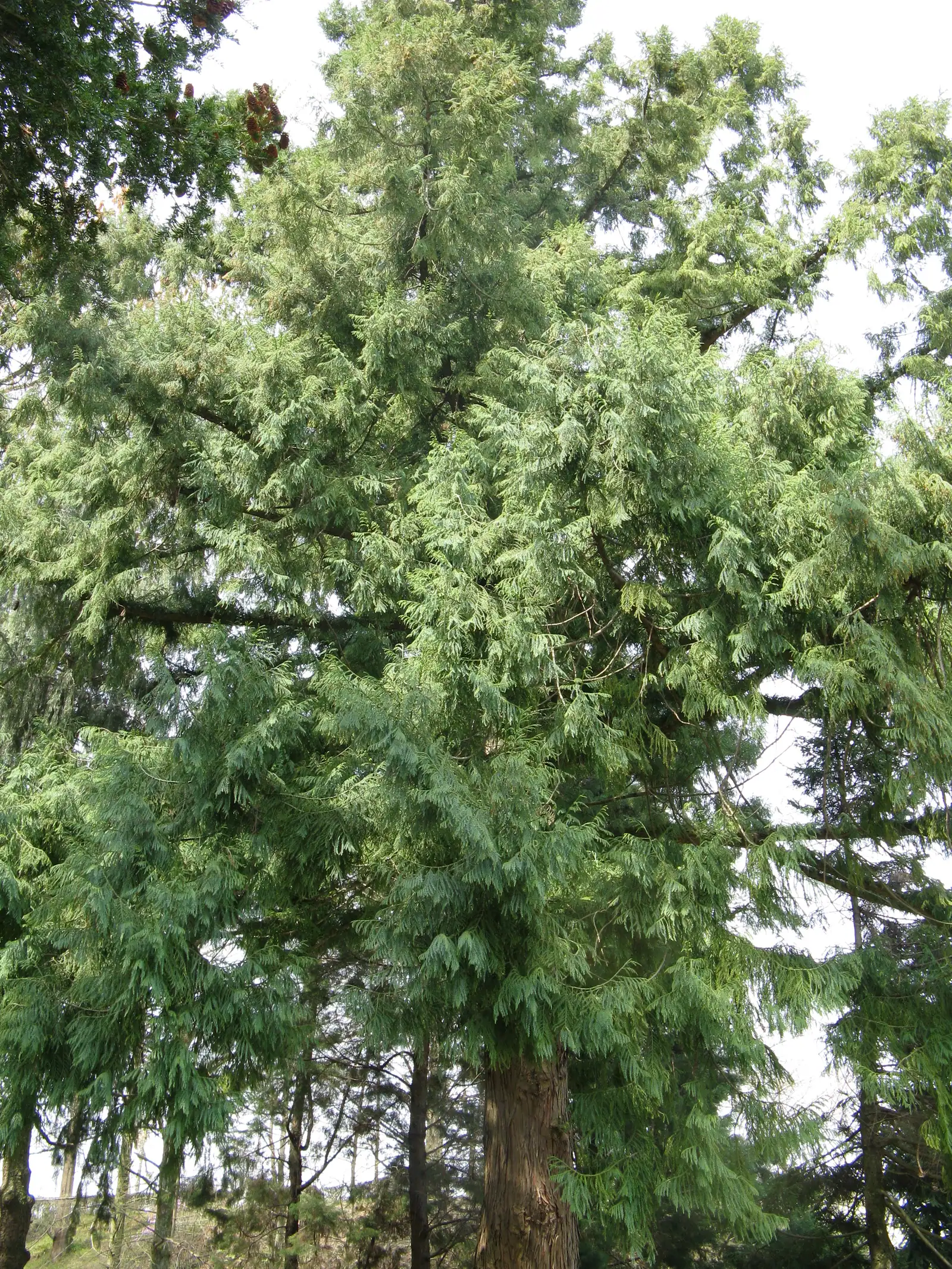
Taiwania foliage and its straight tree form: with a straight trunk and non-hollow heartwood, it is excellent building timber, which also made it especially "worth" cutting during the logging era. Photo: KENPEI / Wikimedia Commons, CC BY-SA 3.0
So why did the tallest Taiwania survive? The answer lies not in the tree itself, but in where it stands.
Hidden Means Surviving
The Heaven Sword grows near the headwaters of the Daan River, in a deep valley at about 1,650 meters above sea level13. To get there, one must trace the Daan River upstream for about 20 kilometers, cross powerful currents, climb over dangerous cliffs prone to rockfall and landslides, first ascend nearly a thousand meters, then descend more than another thousand. This is a route that even experienced mountaineers may not be able to complete14. Researcher Rebecca Chia-Chun Hsu described the settings where such giant trees grow: "The places where these giant trees are located are environments that even experienced mountaineers find very difficult to reach."15
Precisely this "inaccessibility" became its life-saving charm.
From the Japanese colonial period through the postwar era, Taiwan underwent wave after wave of large-scale logging. The cypresses and Taiwania of Alishan, Taipingshan, and Basianshan were hauled down the mountains in vast quantities. But logging equipment has limits to where it can go. It cuts where roads can be built and where timber can be transported out. The sheer-walled valley near the Daan River's headwaters was beyond the reach of timber cableways and trucks, so this 84-meter giant was left behind. It hid deeply enough to survive.
Hsu captured the logic precisely: "The place where the Heaven Sword stands shares traits with previously discovered giant trees: it exists in unlogged primary forest and is located in a valley that can shelter it from typhoons."16 That sentence explains both its height and its lifespan. The valley terrain shields it from direct typhoon winds, so it is not snapped like large trees on ridgelines. The unlogged primary forest gives it the chance to accumulate time into height.
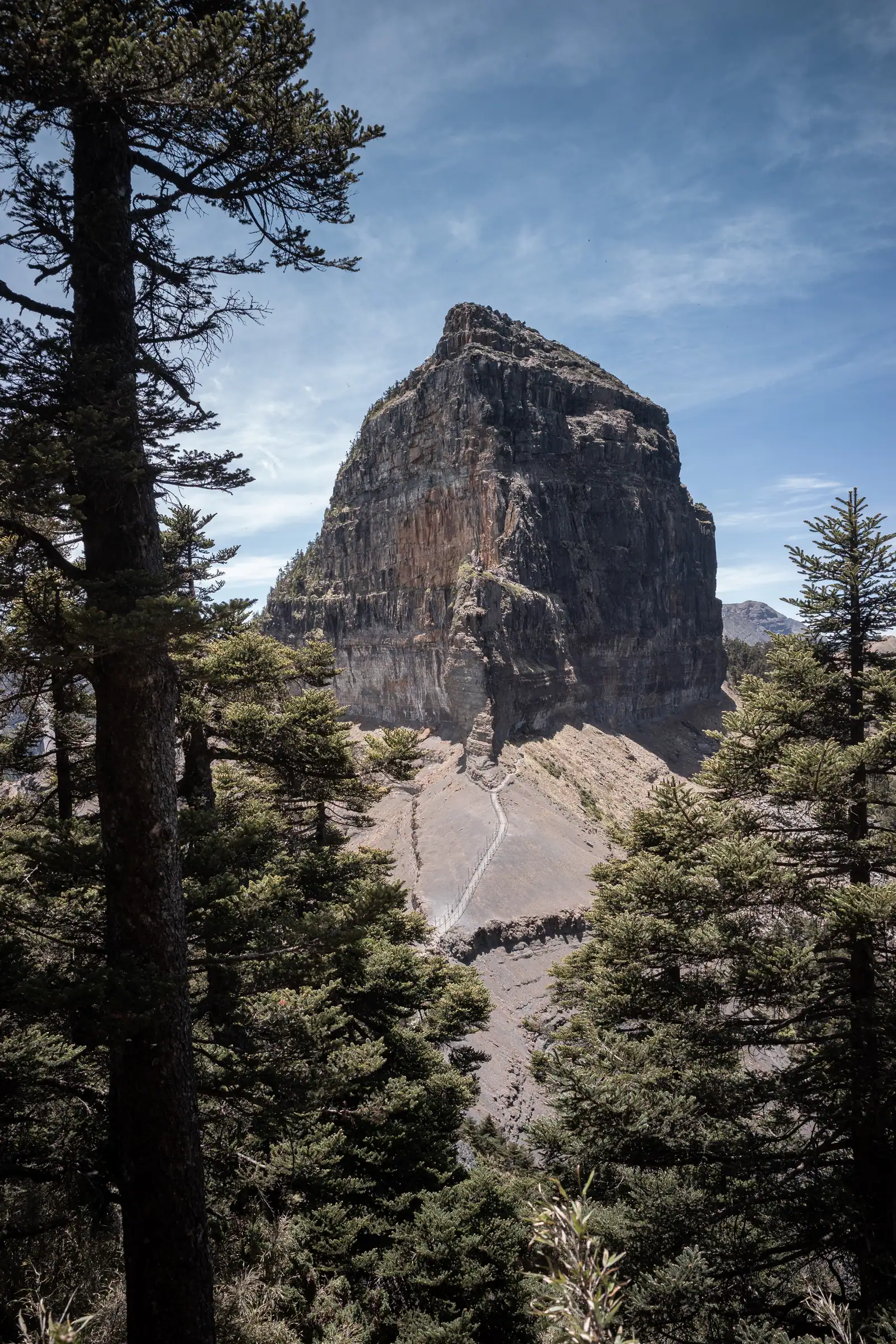
Cloud forest in Shei-Pa National Park: afternoon fog and a highly humid environment with annual rainfall of about 3,000 millimeters are crucial to Taiwania's ability to move water up to an 80-meter crown. Photo: Wikimedia Commons, CC BY-SA 4.0
Scientifically, Taiwania can grow this tall because three conditions stack together. First is the high humidity of the cloud forest zone: Taiwania is naturally distributed at elevations of 1,500 to 2,400 meters, in cloud belts with annual rainfall of about 3,000 millimeters17. Afternoon fog forms there, and fog water can be absorbed directly through leaf surfaces, helping solve the enormous pressure problem of moving water from roots to a treetop 80 meters high. Second is the combination of valley terrain that shelters it from typhoons and pioneer advantages on landslide sites: Taiwania seeds are small and can drift long distances on the wind. Seedlings often land on valley landslides and fallen logs. As a light-loving pioneer species, once a landslide opens a canopy gap and sunlight enters, it races upward18. Third is that hidden means surviving: inaccessible terrain let it escape the human saw.
Red cypress avoided felling through hollow heartwood; Taiwania avoided felling through sheer terrain. Taiwan's two oldest kinds of giant trees escaped the same logging era in two completely different ways.
That seven-hundred-year figure needs to be laid out carefully. The Heaven Sword is "estimated to be about 700 to 800 years old." This figure was calculated from its roughly 8.5-meter girth and the growth rate of Taiwania. It has not actually been dated through core sampling of its annual rings19. Some international reports in 2026 even described it as "nearly a thousand years old"20. This older figure may come from another estimation method. Girth-based age estimates are uncertain: the Shuishan Sacred Tree in Alishan was once estimated at 2,700 years old, but after the Forestry Bureau took an increment core, the figure was revised to 1,081 years, a difference of more than 1,600 years21. So for the Heaven Sword, the more responsible formulation is this: it is estimated at seven or eight hundred years old and may be older, but until someone actually cores its rings, the number carries a question mark.
The Tree Finders, and Eyes That Spent a Lifetime Looking for Trees
The Heaven Sword was "found." And the story of finding it begins on an afternoon when a pair of shoes broke.
In 1994, Hsu made her first Nenggao Historic Trail traverse. On the fourth day, her shoes had already fallen apart. Exhausted, she leaned beside the Qilai Dam to rest, but her gaze was caught by a giant tree across the valley: a Taiwania. Looking at that towering figure, she said that after feeling awed, she suddenly found the strength to keep walking22. She did not yet know that this image would pull her through the rest of her life.
That tree was, in fact, another tree. The Heaven Sword stands at the headwaters of the Daan River: another place, another Taiwania. But the tree across from Qilai Dam in 1994 was the starting point of "seeing." Hsu later studied botany at National Taiwan University, earned a doctorate in Amsterdam, joined the Taiwan Forestry Research Institute to study canopy epiphytes, and became the kind of person whose life is spent dealing with trees high above the ground23.
The systematic search for "Taiwan's tallest tree" truly began in 2014. That year, Hsu's team visited the "Three Sisters" Taiwania in the Qilan Conservation Area, formally setting out on the path of searching for giant trees24. From 2014 onward, they successively located, climbed, and tape-measured 22 giant trees over 40 meters tall8. But finding trees one by one on foot was too slow. Taiwan is too large, and its deep valleys too numerous. Hsu herself said: "Many trees are in uninhabited places. Just cutting through grass and opening a route takes more than ten days."25
The turning point came from a batch of laser data. In the 2010s, Taiwan's Ministry of the Interior successively obtained nationwide airborne LiDAR scans after Typhoon Morakot. From 2016 onward, the team led by Chi-Kuei Wang at National Cheng Kung University's Department of Geomatics also launched a second large-scale scan26. In 2019, Hsu and Wang formally formed the "Tree Finder: Giant Tree Mapping Project," turning laser point clouds into maps of giant-tree hotspots that could be systematically interpreted27.
Lasers alone were not enough. Among the candidate points initially screened by the algorithm, the false-positive rate was absurdly high: more than 90 percent of the "tall trees" flagged by the machine were actually calculation errors28. So in 2020, the project did something very Taiwanese: it uploaded more than 50,000 LiDAR profile images to a citizen science platform and invited hundreds of people to interpret them online, using many human eyes to remove tens of thousands of algorithmic false positives one image at a time28. To encourage participation, the platform also designed achievement badges, and whoever found the tallest tree could even earn the right to name the giant tree29.
Lasers scanned the whole country, citizens' eyes filtered the profiles one by one, and then people climbed to the treetop and settled the matter with a tape measure. The Heaven Sword is the final number produced by this entire technical chain. By the end of 2022, the Taiwan Giant Tree Map had already marked 941 giant trees over 65 meters tall across Taiwan30. Number 55214 was one of those coordinates.
Curator's Note
"Finding the tallest tree in Taiwan" required more than one extraordinary tree. It required an aircraft scanning the whole country, a laser algorithm, hundreds of strangers reading profile images in front of computers, several Indigenous team members who could guide the route, a group of scientists willing to spend seven days tracing a river upstream and climbing a tree, and finally a roll of measuring tape. The Heaven Sword was not "seen" until 2023, but this act of seeing was a collective process in which Taiwan spent a decade learning itself anew.
The Seven Days of Unsheathing
On the second day of the 2023 Lunar New Year, the Tree Finder team set out31.
The target was number 55214, the giant tree that had already been marked on Hsu's survey map for more than half a year. Before departure, she wrote with the kind of obsession that made the trip unavoidable: "Even if I don't get to climb the tree, I have to find a way to see 55214 with light gear."32 She also knew that LiDAR was not infallible: "The original LiDAR data were established from scans at a density of two points per meter, so there remains a very small chance that a tall tree is located in a 'gap.'"33 The tallest tree might happen to fall in a blind spot the laser had missed. No one could say for certain what they would see after climbing in.
Hsu later described the danger of the route this way: they had to trace the river upstream for about 20 kilometers, cross the high-flow Daan River while risking being swept away, then climb a 1,500-meter ridge and traverse steep landslide terrain. During the process, someone was accidentally injured by falling rock. Only at the end did they finally see, in the distance, that slender, towering giant tree34. The entire trip took seven days, and nighttime temperatures once fell to minus 2 degrees Celsius3.
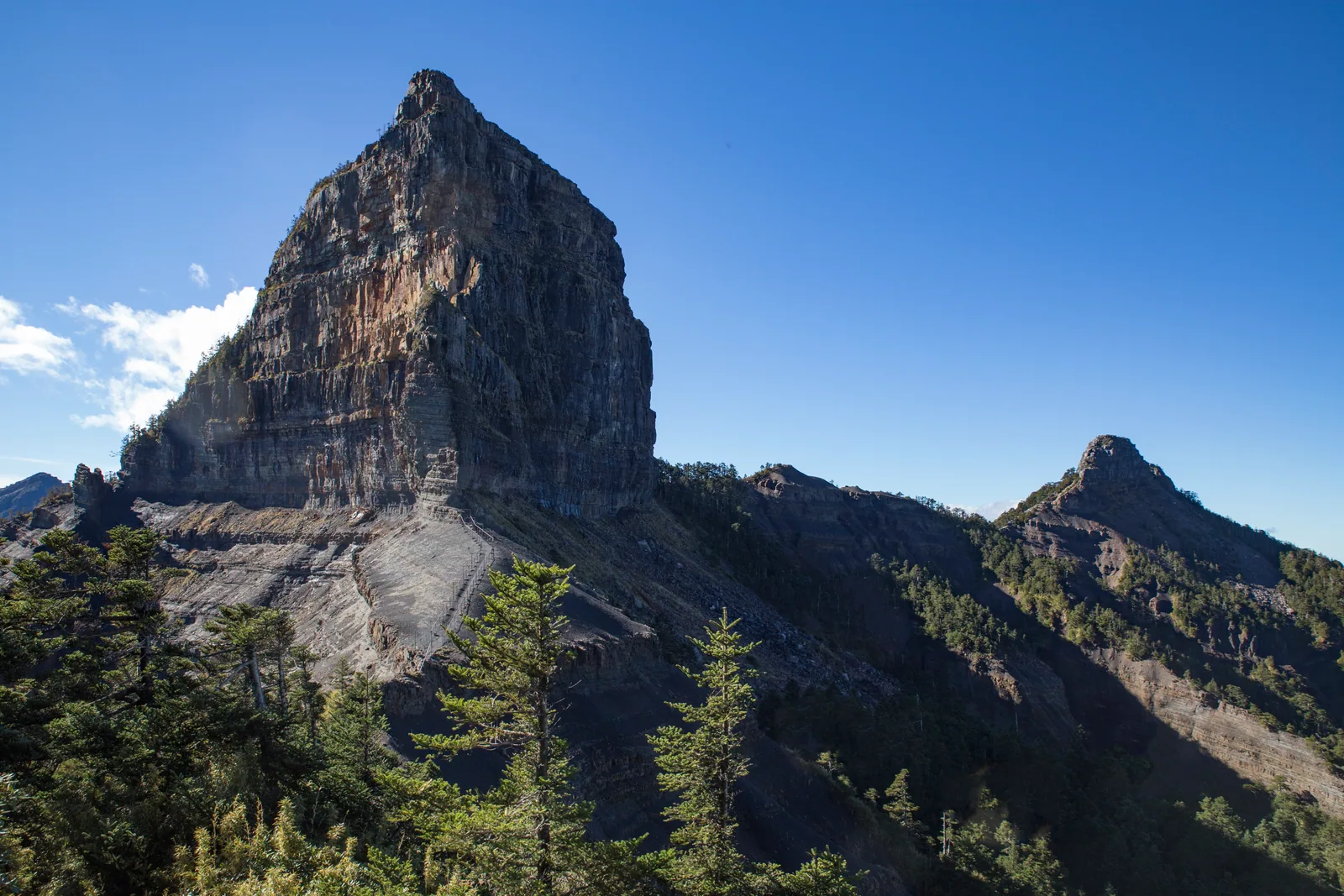
The Daan River originates on the western side of Dabajianshan. The Heaven Sword is hidden in a headwater valley deep in this part of the Xueshan Range, a place almost unreachable by human effort. Photo: Alan Wu / Wikimedia Commons, CC BY-SA 4.0
Seven days, minus 2 degrees, broken shoes, rockfall injuries, and crossings of a rushing river: this is the real cost translated from the words "cannot reach." The same reason the Heaven Sword survived until today also made those who measured it suffer. When team members climbed into the crown and lowered the tape to confirm 84.1 meters, Hsu described it as a tense and joyful moment, especially for the team members who had guessed its true height in advance35.
It naturally took the position of Taiwan's tallest tree. Second place is the Kaa-Lang giant tree in the Zhuoshui River basin, at about 82 meters; third is the Taoshan Sacred Tree in Shei-Pa, at 79.1 meters36. And Taiwan's ten tallest trees are, without exception, all Taiwania37.
Source: Taiwan Forestry Research Institute, Tree Finder: Giant Tree Mapping Project
Placed side by side, the three numbers are not far apart: 84.1, 82, 79.1. But they support a fact few countries can claim: Taiwan is one of the few places in East Asia currently known to grow giant trees over 70 meters tall38. On a typhoon-swept country, those few meters of height were purchased with centuries of concealment.
Administratively, the area where the Heaven Sword stands lies at the junction of the Ministry of Agriculture's Forestry and Nature Conservation Agency Taichung Branch and Shei-Pa National Park39. The research was jointly led by Hsu of the Taiwan Forestry Research Institute and Wang of National Cheng Kung University, with funding from the Ministry of Agriculture and Yuen Foong Yu Consumer Products Co., Ltd.40 In June 2026, the process of searching for and measuring the tree was formally published in the international journal Frontiers in Forests and Global Change8. CNN, Mongabay, and Sci.News reported on it at the same time, allowing this tree that had been hidden for seven hundred years to be seen by the world for the first time41.
Three Names, and One Missing Name
This tree has more than one name. How it was named is itself a quiet story worth pausing over.
The oldest layer is its scientific name. The genus name of Taiwania, "Taiwania," was assigned by Japanese botanist Bunzo Hayata in 1906. The specimen had been collected in 1904 by Government-General engineer Konishi Nariaki at Wusongkeng in Nantou Prefecture. Hayata published it at the Linnean Society of London, naming it after Taiwan42. In botanical taxonomy, this is unique: Taiwania is the only tree genus in the plant kingdom named after "Taiwan"43. But Taiwania is not endemic to Taiwan. Its natural distribution spans Taiwan, southwestern China, northern Myanmar, and Vietnam44. What belongs uniquely to Taiwan is only the genus name. And that imperial-era naming process completely bypassed the knowledge systems of the Indigenous peoples who had long lived on this land42.
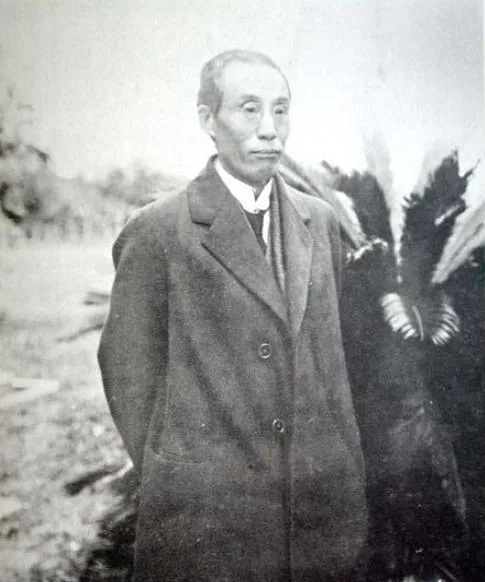
Japanese botanist Bunzo Hayata, who in 1906 named this tree genus "Taiwania" at the Linnean Society of London. It is the only tree genus in the plant kingdom named after Taiwan. Photo: Sasaki / Wikimedia Commons, Public domain
The second layer is a poetic name: "the tree that bumps into the moon." This is the Rukai people's name for the Taiwania species. Standing beneath this kind of conifer giant, one cannot see the crown when looking up, and the human body feels so small. From that experience came a name romantic almost to the point of myth45. But this name belongs to the species as a whole: it is the Rukai name for "Taiwania," from Rukai traditional territory around Great Ghost Lake in southern Taiwan. It is neither the name of the individual Heaven Sword tree nor an Atayal-language name46.
The third layer is "Heaven Sword." During the 2023 expedition, the team passed through Dongyang Mountain and Xishi Mountain, jokingly nicknamed in mountaineering circles as the "Eastern Heretic and Western Venom." After descending into the Daan River valley, they saw an entire stand of giant trees rising together, an atmosphere like the "Mount Hua Sword Summit" in Jin Yong's martial-arts novels, where the greatest masters gather to determine who is first under heaven47. The tallest among them, 55214, was named Heaven Sword. The Heaven Sword comes from The Heaven Sword and Dragon Saber; the words "heaven-leaning" describe an extraordinarily long precious sword48. A very long, sky-piercing, peerless sword corresponds exactly to this sword-like Taiwania towering upward. From "Eastern Heretic and Western Venom" to "Mount Hua Sword Summit" to "Heaven Sword," this is an interlinked set of wuxia imagery, not a casual name. The naming was completed only after the team returned from the expedition. While they were in the mountains, the tree was still called only "55214"49. The person who named it was an Indigenous team member of the Tree Finder group. All public materials say only "an Indigenous team member" and do not record the person's name or nation50.
Place these three names side by side, and a quiet tension emerges. The scientific name came from a Japanese colonial botanist, the poetic name from the Rukai people of the south, and the wuxia name from contemporary Han culture. Each of the three layers has someone speaking. But this tree stands in the upstream core of the traditional territory of the Atayal Beishi group: the Beishi people call themselves Liyung-Painux, meaning "rushing river," and there are 13 Beishi Atayal communities along the Daan River51. In currently public materials, no Atayal-language name for this tree or the land where it stands can be found52.
This does not mean such a name does not exist. The Atayal Gaga oral tradition explicitly includes "ecological and environmental knowledge," and the traditional knowledge system concerning plants and animals in the Daan River basin is alive53. But the Indigenous-language name of this giant tree, located at 1,650 meters above sea level in the far upper reaches of a traditional hunting ground, has not yet appeared in public documents. Perhaps it is because the tree is too deep and too distant; perhaps because oral traditions do not leave a written place name for every tree. So the only honest wording here is: it has not been found in currently public materials, not that it "does not exist." Hsu herself has also especially emphasized the contribution of Indigenous team members in interviews. She said Indigenous people have been involved in the team's expeditions every time, and that the team's ability to survive in the mountains depends on Indigenous local knowledge of the forests54.
Curator's Note
A tree has, at once, a colonizer's scientific name, a southern tribe's poetic name, and a modern wuxia name, yet it lacks the Indigenous-language name of the people whose land lies beneath it. This gap requires no moral verdict from anyone. It simply reminds us that "naming" involves who has the right to speak, whose knowledge is written into documents, and whose voice remains quiet in Taiwan's story. Leaving that quietness honestly in place and letting readers think for themselves is closer to truth than rushing to provide an answer.
After Seeing
After learning that it was there, Taiwan began trying to "see it clearly."
In March 2025, Australian Tasmanian tree-climbing photographer Steven Pearce and his team completed a life-size portrait of the Heaven Sword55. The method was awkward and stubborn: climbing specialists slowly climbed the tree and took photographs one by one at each parallel height, about 120 images in all, then stitched them frame by frame into a complete image of the whole tree from root to crown56. Pearce had previously photographed giant eucalyptus trees in Australia and the United States. Speaking in English, he said this was the most difficult tree-photography trip he had ever climbed, and that Taiwan's forests and scenery were equal to anywhere in the world57.
The most moving aspect of that life-size portrait is scale. When an entire 84-meter tree is presented whole, the person standing at its base looks as small as a comma in a line of text. We are used to looking up at trees, but we rarely have the chance to see a whole tree at once. Only in that moment of seeing the whole does one truly feel the weight of seven hundred years.
Earlier, beginning in 2021, the documentary Island of Sacred Trees followed Hsu's footsteps into the depths of the Xueshan and Central Mountain ranges to film these giant trees58. The Nature Conservation and Environmental Information Foundation (TNF) also made a full official documentary recording the Heaven Sword expedition, following the team through the route of climbing a thousand meters and descending seventeen hundred[^59]:
Official documentary by the Nature Conservation and Environmental Information Foundation (TNF): following the "Tree Finder" team upstream, climbing a thousand meters and descending seventeen hundred, to fully document the expedition to the Daan River Heaven Sword.
(Island of Sacred Trees became controversial in 2026 over rights issues involving a film book of the same title. The publisher and director are still in negotiation59; that belongs to the realm of creative ethics and is unrelated to giant-tree science itself.)
But after seeing comes a harder question: how much longer can these giant trees, now seen, continue to stand?
This is the other side of hidden means surviving. "Inaccessibility" once protected the Heaven Sword from saws, but it cannot hide the tree from climate. Comparing LiDAR data from ten years apart, about 5 percent of Taiwan's 941 giant trees have already disappeared. Wang of National Cheng Kung University warned in English that, at this pace, existing giant trees could die out within the next one or two centuries60. Most giant trees grow in geologically fragile valley terrain, while typhoon intensity and extreme rainfall are increasing. A landslide can directly carry away a tree that has stood for a thousand years. Taiwania itself is also listed by the IUCN as Vulnerable61.
Yet while these giant trees are alive, they are also doing something important for Taiwan. The Tree Finder team surveyed the giant-tree valley where the Taoshan Sacred Tree stands and estimated its carbon storage at about 1,384 metric tons per hectare, close to the giant-tree forests of Tasmania, which have among the highest carbon densities in the world62. A forest hidden in deep valleys, which we have only just learned to see, has quietly stored that much carbon. To see these forests is, in a sense, also to see how much remains in Taiwan's mountain forests that is worth protecting.
It Is Alive Today Because We Could Not Reach It Before
Return to that afternoon in 1994. Hsu, with broken shoes, sitting beside Qilai Dam, was drawn to a Taiwania across the valley and found the strength to keep walking. Thirty years later, she and a group of people scanned all of Taiwan with lasers, had crowds of eyes sift through 50,000 profile images, traced a river upstream for seven days, and lowered a tape measure from the top of another Taiwania: 84.1 meters.
This small country that we thought we had long since understood still hides living beings ten times older than we are and taller than any building here. And it is alive today precisely because we could not reach it before.
That "inaccessibility" was once its life-saving charm, letting it escape large-scale logging, evade typhoons, and stand quietly in an unpeopled valley for seven hundred years. Now, finally, with lasers, citizen science, tree climbing, and the guidance of Indigenous team members, we have crossed that barrier and seen its full form for the first time. Seeing is a kind of arrival; but we must be careful that "seeing" does not become another form of harm.
The Heaven Sword is almost impossible to visit in a single day. Seven days of travel, nights at minus 2 degrees, and rushing water form a natural fence that keeps the possibility of crowds outside. Its best protection may still be that ancient inaccessibility.
And now, above that unnamed deep valley at the headwaters of the Daan River, an 84-meter green long sword still quietly pierces the sky.
Further Reading:
- Brown Fish Owl — Also dependent on mid-elevation old-growth giant trees and streams that have not been concreted over, Taiwan's largest owl lives in the narrowing space where "the giant trees have not yet fallen" and "the streams have not yet been engineered" are still true
- Formosan Landlocked Salmon — Another survivor hidden in Shei-Pa, in the Qijiawan Creek basin: a glacial relict
- Formosan Black Bear — Also dependent on large, rarely visited primary forests, another indicator of the integrity of Taiwan's mountain forests
- Taiwan Forest Ecosystems — The ecological coordinates of cloud forests, the five precious conifers, and giant trees; the Heaven Sword is the highest point of this system
- Taiwan National Parks — Shei-Pa National Park and Forestry and Nature Conservation Agency lands are the final refuges of these giant trees
Image Sources
This article uses five CC / public-domain images, all cached under public/article-images/nature/, stripped of EXIF data, and converted to WebP to avoid hotlinking source servers:
- Taiwania (wild, Nantou) — Shihchuan — Wikimedia Commons, CC BY-SA 2.0 (hero)
- Taiwania foliage and tree form — KENPEI — Wikimedia Commons, CC BY-SA 3.0
- Cloud forest in Shei-Pa National Park — Wikimedia Commons, CC BY-SA 4.0
- Dabajianshan (Daan River headwaters) — Alan Wu — Wikimedia Commons, CC BY-SA 4.0
- Bunzo Hayata — Sasaki — Wikimedia Commons, Public domain
Video: "Taiwan's Tallest Tree" Daan River Heaven Sword Sacred Tree Full Documentary — official channel of the Nature Conservation and Environmental Information Foundation (TNF).
Photos of the Heaven Sword itself, Steven Pearce's life-size portrait, and stills from Island of Sacred Trees are copyrighted materials (and the image rights for Island of Sacred Trees are currently under dispute). This article does not use them. For relevant visuals, see the TNF official documentary above and channels released by the rights holders.
References
- After Decade-Long Hunt, Scientists Find East Asia's Tallest Tree — Sci.News — 2026 report confirming that the 84.1-meter Daan River Heaven Sword is currently the tallest known tree in East Asia; the ten tallest trees are all Taiwania (Taiwania cryptomerioides), nine of them exceeding 70 meters.↩
- It is estimated to be about 700 to 800 years old — Taipei Times, 2023-01-31 — Primary English report stating that the Heaven Sword is estimated at about 700 to 800 years old, has a girth of about 8.5 meters, and is 84.1 meters tall; jointly confirmed by the Council of Agriculture's Taiwan Forestry Research Institute and National Cheng Kung University.↩
- 找到台灣第一高樹 84.1公尺台灣杉「大安溪倚天劍」— 中央社, 2023-12-02 — Primary Chinese report: "seven days crossing mountains and rivers," "after nightfall, low temperatures dropped to minus 2 degrees Celsius," and the tree age is about 700 to 800 years.↩
- How we found East Asia's tallest tree — Frontiers News, 2026-06-05 — Article by the project team describing how steep, inaccessible terrain preserved unlogged primary forest and allowed giant trees to survive; the interdisciplinary team included tree-climbing specialists, ecologists, geologists, and remote-sensing experts.↩
- 空載光達找巨木 全台已定位 941 棵 — 環境資訊中心 — The Tree Finder project uses airborne LiDAR data together with citizen-science interpretation to systematically locate giant trees across Taiwan.↩
- The journey of finding the tallest tree in Formosa Taiwan — Frontiers in Forests and Global Change, 2026 (DOI: 10.3389/ffgc.2026.1746112) — Primary paper: the LiDAR canopy height model (CHM) predicted 79.5 meters, while tape-drop measured an actual height of 84.1 meters, a difference of 4.6 meters.↩
- tape-drop across Taiwan — Frontiers, 2026 (DOI: 10.3389/ffgc.2026.1746112) — The paper states "climbed, and measured via tape-drop": after climbing into the crown, the team lowered a tape from the top for direct measurement, the most accurate method for confirming the true height of giant trees.↩
- Since 2014, a total of 22 trees exceeding 40 m... measured via tape-drop — Frontiers, 2026 (DOI: 10.3389/ffgc.2026.1746112) — Primary paper: since 2014, the team has located, climbed, and measured 22 giant trees over 40 meters; RMSE between LiDAR and actual measurement was 4.55 meters; published on 2026-06-05; authors Rebecca Chia-Chun Hsu, Chi-Kuei Wang, and Chung-Cheng Lee.↩
- 秘境、鬼湖、臺灣杉 — 國家地理雜誌(中文版) — Taiwania habitat "is located deep in the Central Mountain Range and is less affected by typhoons, which may be why this place became a paradise for Taiwania"; explains that large trees on Taiwan's high mountain ridges are easily snapped by typhoon winds, a major reason tall trees are rare.↩
- 全世界擁有超過 70 公尺以上樹木的地方很少,台灣是其中一個 — 自由時報 — Hsu interview: "In fact, there are very few places in the world with trees over 70 meters. Taiwan is one of them, and it is the only one in East Asia"; Taiwan's giant trees over 70 meters are all Taiwania.↩
- 台灣杉與紅檜:為什麼神木多是紅檜 — 健行筆記 — Red cypress is prone to fungal infection, causing hollow heartwood and loss of timber value, so it was cut less during the logging era and survived as sacred trees; red cypress reaches about 65 meters, while Taiwania has much greater height potential than cypress.↩
- 台灣杉 — 維基百科 — Taiwania has a straight trunk and conical crown and is valuable timber; the species' height potential can reach about 90 meters (the second-tallest tree species in East Asia). The 84.1-meter Heaven Sword is the tallest living individual and has not yet reached the species' upper limit.↩
- 大安溪源頭海拔 1650 公尺台灣杉 — 公視新聞網 — Confirms that the Heaven Sword grows in the upper Daan River at about 1,650 meters above sea level; the precise value in the paper's table is 1,656 meters.↩
- 尋找台灣第一高樹 上爬千米下切千七 — 中央社, 2023-12-02 — The expedition route required tracing the river upstream for about 20 kilometers, crossing the Daan River, climbing nearly 1,000 meters and then descending more than 1,000 meters, and traversing dangerous landslide slopes, making it difficult even for experienced mountaineers to reach.↩
- 這些巨木所在的地點,是連資深的登山人士都很難到達的環境 — 環境資訊中心 — Hsu interview quotation explaining that giant trees are mostly hidden in rarely visited deep mountain valleys.↩
- 倚天劍所在位置...存在未經砍伐原始林中,且位於可避颱風的溪谷 — 國語日報 — Primary Hsu quotation identifying the two key traits that allowed the Heaven Sword to survive: unlogged primary forest and valley terrain sheltered from typhoons.↩
- 台灣杉天然分布海拔 1500 至 2400 公尺 — 農業部農業知識入口網 — Official information: Taiwania's natural habitat is at elevations of 1,500 to 2,400 meters, with an annual mean temperature of 11 to 15°C and average annual rainfall of about 3,000 millimeters; it is a cloud-forest species.↩
- 台灣杉是喜陽的先驅樹種 — 國家地理雜誌(中文版) — "Its seeds are small and can drift long distances on the wind. Seedlings are often seen on valley landslide sites or fallen logs. It is a light-loving pioneer species"; explains the mechanism by which Taiwania uses landslide canopy gaps to capture light and grow rapidly upward.↩
- The tree's girth is about 8.5m — Taipei Times, 2023-01-31 — The Heaven Sword's girth is about 8.5 meters; its age of 700-800 years is estimated from girth and growth rate. None of the sources mention core-sampling or annual-ring dating.↩
- Taiwan's tallest tree found with help of citizen science — Mongabay, 2026-06-05 — 2026 international media described the Heaven Sword as "a thousand-year-old fir tree," differing from the Chinese-language media estimate of 700-800 years, possibly due to a different estimation method; also confirms that actual height was nearly 5 meters greater than the LiDAR prediction.↩
- 水山神木樹齡從 2700 年更正為 1081 年 — 農傳媒 — Alishan's Shuishan Sacred Tree was originally estimated at about 2,700 years old, but after the Forestry Bureau took an increment core for dating, the figure was revised to 1,081 years, a difference of more than 1,600 years; illustrates the uncertainty of girth-based age estimates.↩
- 1994 年能高越嶺奇萊壩 — 地球公民基金會講座紀錄, 2021 — Third-person account: "In 1994, during her first five-day Nenggao Historic Trail hike, on the fourth day, her shoes already damaged, she was exhausted and leaned beside Qilai Dam to rest, but was attracted by a giant tree across the valley. While marveling at the tree's height, she suddenly found the strength to move forward." (Narrative prose, not a first-person direct quote.)↩
- 找樹的人:一個植物學者的東亞巨木追尋之旅 — 徐嘉君著, 紅樹林, 2021 — Hsu is a researcher at the Taiwan Forestry Research Institute specializing in canopy epiphytes; she holds a master's degree in botany from National Taiwan University and a doctorate from the University of Amsterdam.↩
- 找樹的人計畫 2014 年起探訪棲蘭三姊妹 — Frontiers, 2026 (DOI: 10.3389/ffgc.2026.1746112) — Primary paper: "Since 2014," the project formally began with the Taiwania "Three Sisters" in the Qilan Conservation Area.↩
- 很多樹都在沒有人煙的地方,光自己砍草開路就要花 10 幾天 — 自由時報 — Hsu interview quotation explaining the difficulty of the early period, when trees were sought on foot.↩
- 空載光達資料 2010 年代陸續取得 — Frontiers, 2026 (DOI: 10.3389/ffgc.2026.1746112) — Primary paper: LiDAR data were "acquired between 2010 and 2016" (from nationwide scanning after Typhoon Morakot); Wang Chi-Kuei's NCKU team launched another scan in 2016.↩
- 找樹的人團隊 2019 年正式組成 — 新頭殼 Newtalk, 2019-12-13 — In 2019, Hsu and Wang Chi-Kuei of NCKU formally formed the "Tree Finder: Giant Tree Mapping Project," using LiDAR data to define giant-tree hotspots; the first results were released in December that year.↩
- 公民科學判讀 5 萬餘張光達剖面圖 — Frontiers, 2026 (DOI: 10.3389/ffgc.2026.1746112) — Primary paper: beginning in 2020, 372 citizen-science volunteers interpreted 57,065 LiDAR profile images online, removing more than 90 percent of the algorithm's false positives.↩
- 找到最高樹木的民眾還能獲得巨木命名權 — 公視《我們的島》 — The citizen-science platform used achievement badges to encourage people to interpret LiDAR images online, and the person who found the tallest tree could earn the right to name the giant tree.↩
- 台灣巨木地圖定位 941 棵 >65 公尺巨木 — 環境資訊中心 — As of the end of 2022, the Taiwan Giant Tree Map had located 941 giant trees over 65 meters tall across Taiwan.↩
- 2023 農曆新年探勘 — Mongabay, 2026-06-05 — Primary source: "Climbers scaled the tree and dropped a measuring tape from the top to the forest floor during the Lunar New Year holiday in January 2023."↩
- 就算沒爬到樹,我輕裝也要想辦法看到 55214 — 環境資訊中心「倚天出鞘記(上)」 — Direct Hsu quotation conveying her determination to confirm 55214; also records that giant tree number 55214 had been marked on her survey map for more than half a year.↩
- 當初光達資料是以每公尺二點的密度掃描建立,仍有極小機率的高樹位於「漏洞」之中 — 國語日報 — Primary Hsu quotation explaining the limitations of LiDAR point density and the possibility that the tallest tree could fall within a laser-scanning blind spot.↩
- 必須溯溪 20 公里...最後終於看見遠處瘦瘦高高的巨木 — 環境資訊中心 — Hsu's account of the expedition: tracing the river upstream about 20 kilometers, crossing the Daan River at risk of being swept away, climbing a 1,500-meter ridge, traversing steep landslides, and one person being injured by falling rock.↩
- The measurement moment was intense but we were very happy when verified — Mongabay, 2026-06-05 — Hsu's English interview quotation describing the moment of height confirmation as tense and joyful, especially for team members who had correctly guessed the true height in advance.↩
- 台灣最高樹排名 — 農傳媒 — Taiwan's tallest tree is the 84.1-meter Heaven Sword; second is Kaa-Lang at about 81-82 meters (Zhuoshui River basin, estimated by drone with a 293-centimeter scale marker); third is the 79.1-meter Taoshan Sacred Tree.↩
- Nine of the ten tallest exceeded 70 m, and all were Taiwania cryptomerioides — Sci.News, 2026 — Taiwan's ten tallest trees are all Taiwania, and nine exceed 70 meters.↩
- 台灣是東亞超過 70 公尺巨木的重要生育地 — 自由時報 — Hsu interview: there are few places in the world with giant trees over 70 meters, and Taiwan is one of the few places in East Asia where supertall giant trees can grow.↩
- 林業及自然保育署臺中分署 — 中國時報, 2026-06-06 — The Heaven Sword's jurisdiction lies at the boundary of the Ministry of Agriculture Forestry and Nature Conservation Agency's Taichung Branch (formerly the Dongshi Forest District Office, reorganized in August 2023) and Shei-Pa National Park; the institutional name should be "Taichung Branch," not "Dongshi Branch."↩
- 研究經費來自農業部與永豐餘消費品實業 — Frontiers, 2026 (DOI: 10.3389/ffgc.2026.1746112) — Paper acknowledgments: "funded by the Ministry of Agriculture of Taiwan (109-3.1-01) and Yuen Foong Yu Consumer Products Co., Ltd."; principal investigators were Hsu of the Taiwan Forestry Research Institute and Wang of NCKU's Department of Geomatics.↩
- East Asia's tallest tree is the 'Heaven Sword' — CNN / Mongabay / Sci.News, 2026-06-05 — After the paper was published in June 2026, CNN, Mongabay, Sci.News, SciTechDaily, and other international media reported on it simultaneously, making it an international scientific event.↩
- 早田文藏 1906 年命名 Taiwania — 環境資訊中心 — Japanese botanist Bunzo Hayata published Taiwania as a new genus at the Linnean Society of London in 1906; the specimen had been collected in 1904 by Government-General engineer Konishi Nariaki at Wusongkeng in Nantou Prefecture. The colonial botanical naming process bypassed Indigenous knowledge systems.↩
- Taiwania 是植物界唯一以台灣命名的樹屬 — 環境資訊中心 — The genus name Taiwania is the only plant genus named after "Taiwan"; the Chinese name "Taiwan shan" was a later translated name.↩
- 台灣杉分布跨台灣、中國、緬甸、越南 — IUCN / Royal Botanic Garden Edinburgh — Taiwania is not endemic to Taiwan. Its natural distribution spans Taiwan, southwestern China (Yunnan, Hubei, Guizhou), northern Myanmar, and Vietnam; its global IUCN assessment is Vulnerable.↩
- 魯凱族稱台灣杉為「撞到月亮的樹」— 公視《我們的島》 — Standing beneath a giant Taiwania and looking upward, one cannot see the crown, and the person feels small; Rukai people therefore call this tree "the tree that bumps into the moon." The location is in Rukai traditional territory around Great Ghost Lake.↩
- 「撞到月亮的樹」是魯凱族對台灣杉樹種的詩稱 — 關鍵評論網 — "The tree that bumps into the moon" is the Rukai people's poetic name for the Taiwania species, not the individual name of the Heaven Sword and not an Atayal-language term; Rukai traditional territory is in southern Taiwan.↩
- 因途經「東邪西毒」,下切大安溪溪谷發現巨木林立,氣勢宛如武俠小說的華山論劍 — 國語日報 — Primary source: the team passed through Dongyang Mountain and Xishi Mountain, jokingly called "Eastern Heretic and Western Venom" in mountaineering circles. After descending into the Daan River valley, they saw giant trees standing together like the "Mount Hua Sword Summit" in a wuxia novel; an Indigenous team member named the tallest giant tree, 55214, "Daan River Heaven Sword."↩
- 倚天,形容寶劍極長 — 維基百科「倚天劍」 — The Heaven Sword comes from Jin Yong's The Heaven Sword and Dragon Saber; the phrase "heaven-leaning" describes an extremely long precious sword. The imagery is of a very long, sky-piercing, peerless sword, corresponding to a sword-like towering Taiwania.↩
- 當時還不叫「倚天劍」的 55214 — 環境資訊中心「倚天出鞘記(下)」 — Confirms that naming was completed only after the expedition returned. While in the mountains, the tree was still referred to only by its LiDAR number, "55214."↩
- 一位原住民隊員以武俠小說意境命名為「倚天劍」— 農傳媒 / 國語日報 — The namer was an Indigenous member of the Tree Finder team, collectively and after the expedition; all public sources say only "an Indigenous team member" and do not disclose the person's name or nation.↩
- 泰雅族北勢群 Liyung-Painux「洶湧的溪流」13 部落 — 國家文化記憶庫 — Primary source: there are 13 Atayal Beishi communities along the Daan River. They call themselves Liyung-Painux, meaning "rushing river," a metaphor for Atayal men's bravery and refusal to retreat; the middle and upper reaches belong to Tai'an Township, Miaoli County, and the lower reaches to Heping District, Taichung City.↩
- 泰雅族北勢群大安溪流域 — 國家文化記憶庫 — Negative finding: after multiple searches of the National Cultural Memory Bank, the Forestry and Nature Conservation Agency, and media sources, no public record has been found of an Atayal-language name for the Heaven Sword tree or its site; this is an absence in the literature, not proof that no such name exists.↩
- 泰雅族 Gaga 口述傳統含生態環境知識 — 國家文化記憶庫 — Primary source: Atayal Gaga oral tradition includes oral arts, cultural customs, ancestral teachings and norms, migration history, and "ecological and environmental knowledge," showing that traditional knowledge systems concerning the plants and animals of the Daan River basin still exist.↩
- We survive because of their local knowledge in the mountains — Mongabay, 2026-06-05 — Hsu's English interview quotation emphasizing that Indigenous people have participated from the beginning of the project, that every expedition includes Indigenous people, and that the team's survival in the mountains relies on their local knowledge.↩
- 台灣第一高樹等身照公開 — 中央社, 2025-03-27 — In March 2025, the team of Australian tree-climbing photographer Steven Pearce (The Tree Projects) completed a life-size portrait of the Heaven Sword. Pearce is from Tasmania and has photographed giant eucalyptus trees in Australia and the United States.↩
- 約 120 張平行高度照片拼接成等身照 — 中央社, 2025-03-27 — Taiwan Forestry Research Institute deputy director Wu Meng-ling explained: "We invited giant-tree life-size portrait specialists and others to slowly climb into the tree, take photographs one by one at parallel heights, and then stitch them together"; about 120 images formed a complete image of the whole tree.↩
- This was the most difficult tree trip I have ever been on — Taipei Times, 2025-03-28 — Steven Pearce's English interview quotation saying this was the most difficult tree-photography trip he had ever climbed, and that Taiwan's forests and scenery are equal to anywhere in the world (English original; Chinese is a paraphrase, not his Chinese wording).↩
- 紀錄片《神木之島》自 2021 年起跟拍 — 環境資訊中心 — Directed by Lee Hsiang-hsiu, the documentary Island of Sacred Trees followed Hsu's team into the Xueshan and Central Mountain ranges to film giant trees beginning in 2021; it was released in May 2026.↩
- 《神木之島》同名電影書授權爭議 — vocus, 2026-05-28 — In May 2026, blogger Hsuehyang publicly stated that director Lee Hsiang-hsiu had published a film book of the same title without authorization from the "Tree Finder" team. Locus Publishing chairman Rex How came forward to mediate; this is a creative-ethics dispute unrelated to giant-tree science, and negotiations are ongoing.↩
- Taiwan's giant trees are under threat: experts — Taipei Times, 2026-06-07 — Comparing LiDAR data from ten years apart, about 5 percent of Taiwan's 941 giant trees have disappeared. Wang Chi-Kuei of NCKU warned in English that giant trees "would die out in the next couple of centuries"; threats include typhoons and landslides.↩
- Taiwania cryptomerioides — IUCN Red List / Royal Botanic Garden Edinburgh — Taiwania's global conservation status is assessed as Vulnerable; its habitat is threatened by climate change, and suitable habitat is predicted to shrink substantially.↩
- 桃山巨木谷每公頃碳儲存約 1384 公噸 — 中央社, 2026-06-05 — The Tree Finder team surveyed the giant-tree valley containing the Taoshan Sacred Tree (4 hectares) and estimated carbon storage at about 1,384 metric tons per hectare, excluding roots, close to the giant-tree forests of Tasmania, Australia, among the world's highest carbon-density forests at about 1,867 metric tons per hectare.↩