
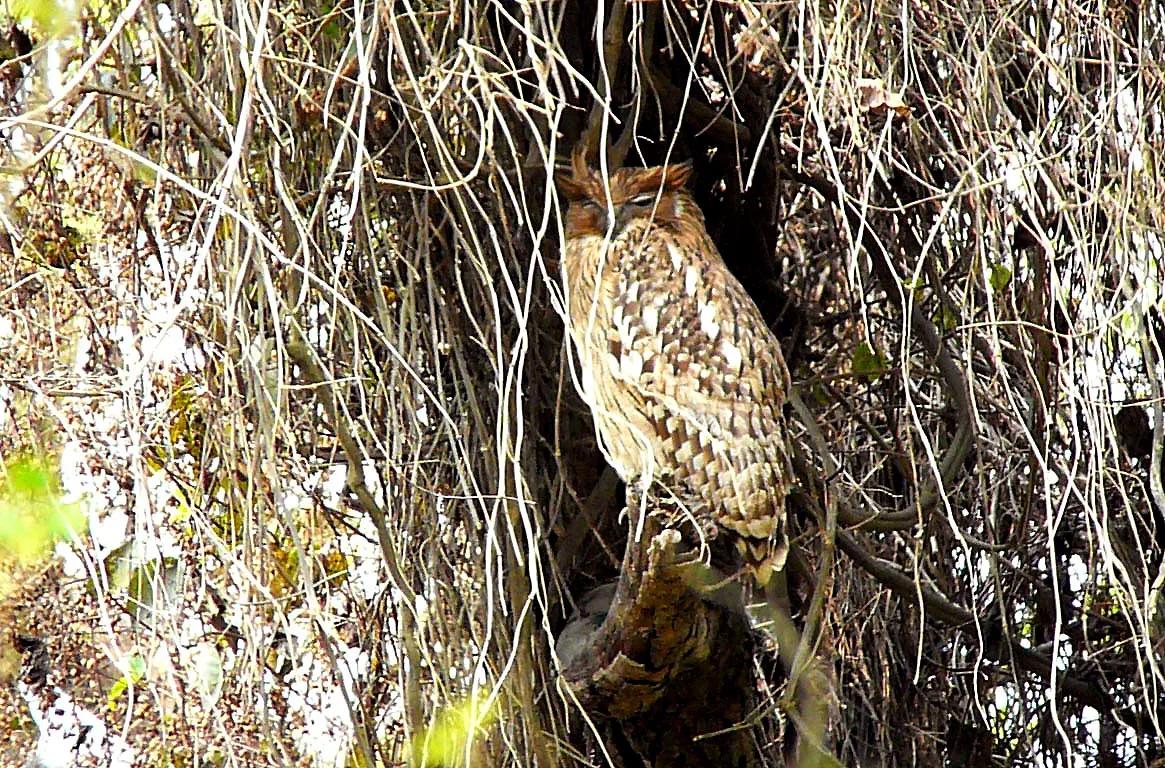
30-second overview: The Tawny Fish Owl (Ketupa flavipes) is Taiwan's largest owl. Its spread wings approach the height of an adult human; its toes are covered in yellow feathers, and the soles of its feet have spicules for gripping slippery prey. It was first recorded only in 1916 by the Japanese scholar Nagamichi Kuroda1, and Taiwan's first precisely located breeding nest was not found until 19942. Sun Yuan-hsun's laboratory at National Pingtung University of Science and Technology has tracked it for thirty years. They found that a pair of Tawny Fish Owls needs 6.2 kilometers of stream, 44.6% surrounded by natural forest, to maintain a territory3. In April 2026, the research team found Taiwan's highest known nest in the hollow of an old Michelia compressa tree with a diameter at breast height of about 1.5 meters beside Qijiawan Creek in Wuling4. Shei-Pa National Park launched a 24-hour nestling livestream, giving the island its first chance to collectively see a strange raptor that is also one of its own.
One day in 1994, Sun Yuan-hsun found a nest in a tree beside Sakatang Stream in Taroko, Hualien. Bird's-nest fern is the largest epiphytic fern on this island; its thick feather-like fronds spread from the trunk in all directions, and the nest had been built in the middle of that clump of ferns. There was only one chick in the nest2. When he returned to the tree, the chick's father had been shot by a hunter, and the mother had abandoned the nest. He brought the chick home, and his wife helped care for it. The young bird later failed to be released back into the wild and was sent to Taipei Zoo, where it was named "Heymei"5.
That was Taiwan's first precisely located Tawny Fish Owl breeding nest. Thirty years later, Sun Yuan-hsun's laboratory has tracked 91 territories, but precisely located nests still number in the single digits36.
The Bird's-Nest Fern at Sakatang That Year
The Tawny Fish Owl entered Taiwan's ornithological history later than one might imagine. In 1916, the Japanese zoologist Nagamichi Kuroda first included it in Taiwan's list of resident birds1. By then, Taiwan had been under Japanese rule for 21 years, and ornithology in the lowlands was already well developed. Yet the Tawny Fish Owl arrived so late that it was only "found" during the golden age of natural history. The reason is not complicated: it is nocturnal, inhabits little-visited stream valleys at low to mid elevations, has a low call and sparse territories, and is difficult even for professional observers to encounter.
By the early 1990s, Sun Yuan-hsun at National Pingtung University of Science and Technology had begun field tracking this bird along several streams on both sides of the Central Mountain Range: Wulai in Taipei, Sakatang in Hualien, and Wuling in Taichung7. Sakatang is part of the traditional territory of the Truku people; the 1994 discovery rewrote every coordinate that followed in Taiwan's Tawny Fish Owl research.
📝 Curator's Note
The name Heymei is a transliteration of Hedwig, the snowy owl in Harry Potter. From that 1994 rescue at Sakatang onward, the bird spent thirty years in the aviary at Taipei Zoo.
Sun Yuan-hsun and successive graduate students went on to publish a series of international papers on Sakatang and Wuling: a 1997 nest note from Sakatang in the Journal of Raptor Research2, a 2006 food-habits study in the same journal8, and a 2013 Forktail paper on the spatial distribution of 91 territories3. The team learned many things over thirty years, but "seeing one with their own eyes" remained rare. According to interview records, members of the laboratory, who were said to "go up mountains and into water without regret," usually met this bird only by hearing the two-syllable duet of "guu—wu," seeing a silhouette under the infrared trigger of an automatic camera, or briefly locking eyes with it at the moment of release after banding7.
Mitten Crabs in the Pellets
The name "fish owl" is misleading.
A food-habits study conducted by Sun Yuan-hsun's team at Sakatang Stream from 1994 to 1999 found that stream fish certainly appeared in the Tawny Fish Owl's diet, including common species such as Opsariichthys pachycephalus, Taiwan shovel-jaw carp, and Taiwan white dace. But the largest biomass in the pellets was instead mitten crabs and toads8. The Taiwanese mitten crab (Eriocheir formosa), various freshwater stream crabs, and the Taiwan toad are large, slow-moving prey, and they were taken at frequencies clearly higher than their relative abundance in the environment. The researchers inferred that when streams flood and water levels rise, fish become harder to catch, so Tawny Fish Owls switch to catching mitten crabs and frogs in rock crevices along the banks8.
Their hunting method also differs from that of other large owls. Tawny Fish Owls have yellow feathers covering their toes, but rough spicules on the soles of their feet, which clamp firmly onto slippery fish and crabs. They share this adaptation with Southeast Asia's Brown Fish Owl and Buffy Fish Owl. The congeneric Blakiston's fish owl (Ketupa blakistoni) is distributed in the Russian Far East and Hokkaido, reaches 71 centimeters in length, and is the world's largest owl9. The Tawny Fish Owl is 48-61 centimeters long and weighs an average of 2,415 grams. It is Taiwan's largest owl, but only medium-sized within the fish-owl genus10.
💡 Did you know?
Among the world's 12 members of the genus Ketupa, only the Tawny Fish Owl has fully feathered toes. The other three fish owls, apart from the Brown Fish Owl, Buffy Fish Owl, and Blakiston's fish owl, have bare toes. Evolutionary biologists infer that this is related to the higher-elevation climate inhabited by the population distributed in Taiwan.
A Stream Not Poured in Concrete
The paper Sun Yuan-hsun's team published in volume 29 of Forktail in 2013 is the single most substantial study of Tawny Fish Owl habitat. They collected coordinates from 91 territories across Taiwan and used GIS to analyze environmental variables[^3]:
| Habitat requirement | Value |
|---|---|
| Elevation range | 48-2,407 meters, with most below 700 meters |
| Territory length along stream | Average 6.2 kilometers, range 5.5-7.7 kilometers |
| Distance from stream | Nests are mostly within 20-550 meters |
| Share of natural forest in territory | At least 44.6% is needed to sustain one pair |
| Nest-tree diameter at breast height | Living trees or standing dead trees over 1 meter |
For readers outside ornithology, these numbers translate into everyday language like this: a 6- to 8-kilometer stretch of stream can support only one pair of Tawny Fish Owls. That stretch of stream must have no concrete embankments, no large-scale river engineering, and nearly half its banks still covered by natural forest. They do not use the surrounding plantation forests, makino bamboo groves, orchards, or villages3.
Territories on the west side of the Central Mountain Range have an average elevation 431 meters higher than those on the east side. The researchers inferred that because early logging and low-elevation development were more intense on the west side, Tawny Fish Owls were forced to retreat to higher remnant stream corridors3. In other words, the places where they can still breed today are themselves an inverse map of the destruction of Taiwan's mountain forests: where their nests remain, mid-elevation forests and streams have not yet been clear-cut or turned into concrete.
Shei-Pa National Park, Taroko National Park, and Yushan National Park, among Taiwan's largest protected areas, have become the last sites of stable Tawny Fish Owl populations11. Many low-elevation stream populations outside national parks have already disappeared.
The Outline of a Dream Bird
In Taiwan's birdwatching circles, the Tawny Fish Owl is one of the few species called a "dream bird": nocturnal, identifiable only by a low two-syllable duet, restricted to remote stream valleys, and unseen even by many people who spend a lifetime birdwatching. In an in-depth report by the Taiwan Environmental Information Center, the researcher Sun Yuan-hsun described his laboratory this way:
"The reason they go up mountains and into water without regret is that the Tawny Fish Owl is cute and mysterious, like a lover."7
Most of the laboratory's work begins after midnight. They replay a recording of the "fish owl mother" call and wait for individuals in the territory to answer. This "playback" survey method was developed by Sun Yuan-hsun in the 1990s and later became a standard tool for nighttime raptor surveys in Taiwan12. As technology advanced, the team added radio telemetry, automatic cameras, and satellite transmitters. In 2009, they successfully banded a female bird called "Sheng-jie" at Yousheng Creek in Wuling for the first time. Beginning in 2024, they installed two raptor perches at Qijiawan Creek, using automatic cameras to record a complete sequence of a Tawny Fish Owl catching a Taiwan white dace and bringing it back to a perch to eat13.
In May 2026, PTS Evening News produced a report describing this thirty-year research effort and Shei-Pa National Park's first 24-hour nestling livestream this year:
PTS Evening News report, 2026-05-03: Shei-Pa National Park's 24-hour livestream of Tawny Fish Owl nestling care fully recorded the process of parent birds caring for two chicks.
Heymei and Ailuo
Heymei, the chick brought home from Sakatang in 1994, entered the bird garden at Taipei Zoo. It lived there for more than twenty years.
For many years, the zoo's aviary tried to pair Heymei with another rescued individual, Ailuo. The problem was not unwillingness. Tawny Fish Owls form year-round pairs and are strongly territorial, and the two birds in the glass enclosure quickly established a bond. The problem lay in reproductive capacity: Heymei laid eggs every year, but almost none hatched. Until one year, they finally succeeded in raising offspring. These two birds, which would never have met again in the wild, accomplished in a glass enclosure what the wild population could not5.
Sun Yuan-hsun left another sentence in an interview, in the context of speaking about Heymei:
"This story may be a lesson in learning to let go."7
"Letting go" in this context means acknowledging that the 1994 rescue extended beyond a single bird. When the father was shot by a hunter and the mother abandoned the nest, rescue meant receiving the subsequent survival form of an injured family. Thirty years later, that pair in the glass enclosure proved one thing: conservation is not always about returning animals to their native habitat. Sometimes conservation means creating a new, sufficiently long home for individuals whose lives have been changed by accident.
The Michelia at 1,800 Meters
Beginning in 2024, Sun Yuan-hsun's student Hung Hsiao-yu took over leadership of the Qijiawan Creek project. In December 2025, he fitted a male bird with a satellite transmitter. In March 2026, the team discovered signs of breeding. On April 10, the nest was located in the hollow of an old Michelia compressa tree at about 1,800 meters above sea level, with a diameter at breast height of about 1.5 meters. It is Taiwan's highest known Tawny Fish Owl breeding record4.
Shei-Pa National Park seized the opportunity and launched the "Wuling Tawny Fish Owl Nestling Care" 24-hour YouTube livestream on April 29, 2026. The phrase "aerial nursery" appeared across major media. The livestream camera followed the two chicks, one 40 days old and 1,212 grams and the other 30 days old and 899 grams, as they peered out from the nest hollow, were fed by their parents, stretched their wings, and practiced flying. They were expected to leave the nest by mid-May[^4]:
The "Wuling Tawny Fish Owl Nestling Care" 24-hour livestream launched by Shei-Pa National Park on April 29, 2026. Inside the hollow of an old Michelia compressa beside Qijiawan Creek at about 1,800 meters above sea level, it follows the growth of two chicks, Dabao and Xiaobao. On May 1, 2026, the larger chick, "Dabao," successfully left the nest and moved to a branch above the tree hollow. The team immediately installed a second camera to track the chicks with a picture-in-picture view 1415.
✦ Taiwan's largest owl was named only in 1916; its first nest was found only in 1994; only in 2026 did the whole island see it together.
The livestream became a public topic across Taiwan, in a sense repairing the long-disconnected relationship between this bird and the island. Most people will never hear its call or see its silhouette in their lifetimes, but now anyone can open a phone and see, inside a Michelia hollow at 1,800 meters, two tawny chicks learning to spread their wings.
The Last Fortress of Giant Trees
The things Tawny Fish Owls need are very concrete, and all of them are disappearing from Taiwan's mountain forests:
- Living trees or standing dead trees with a diameter at breast height of over 1 meter: only sufficiently old trees have natural hollows large enough. During the earlier era of mountain logging, most primary forest was felled; giant trees over 1 meter in diameter at breast height now remain only in national parks, protection forests, and Indigenous traditional territories16.
- Streams that have not been concretized: embankment construction, wild-stream engineering, and reservoir impoundment have changed stream structure and sharply reduced fish resources.
- Continuous belts of natural forest: 44.6% of a Tawny Fish Owl territory must be natural forest. Makino bamboo groves, plantation forests, and farmland do not count3.
Add the reproductive bottleneck, with an average of only one chick per brood, a 60-day nestling period, and extreme dependence on nest trees, and the fall of a single giant tree may break generational continuity in a population. In Taiwan's latest bird red list, released in 2024, the Tawny Fish Owl was assessed as Vulnerable (VU), even though the global IUCN assessment is only Least Concern (LC)1718.
There is also a kind of conflict that is less dramatic but continuously drains the population: among more than 100 cold-water aquaculture ponds across Taiwan, 25 have recorded Tawny Fish Owl predation, and 10 Tawny Fish Owls have drowned in ponds after entering fish farms19. Operators lose about NT$20,000-30,000 each year, a relatively small amount. Sun Yuan-hsun once suggested offsetting this through ecotourism, but few cases have been implemented.
⚠️ Contested View
What is the greatest long-term threat to the Tawny Fish Owl? Conservation discussions do not always give the same answer. Some say it is the scarcity of giant trees and natural tree hollows; others point to the concretization of streams; still others emphasize conflicts with fish farms and leg-hold traps. The three are actually different facets of the same thing: in Taiwan's modernization, the Tawny Fish Owl's home has been squeezed at once along three dimensions: habitat, food, and human tolerance. What needs protection is an entire ecology of "mountain streams not yet poured in concrete," and the Tawny Fish Owl is only one of the rarest residents within that ecology.
One Hundred and Ten Years
First named in 1916, first nest found in 1994, first fitted with a transmitter in 2009, and in 2026, the first satellite signal came from a Michelia hollow at 1,800 meters.
One hundred and ten years have passed. The people studying Tawny Fish Owls have changed generation after generation, and Taiwan's streams have grown shorter, straighter, and increasingly without the sounds of night. Yet every year, someone still walks into a stream valley after midnight carrying an infrared camera, waiting for a bird they have never been able to see completely clearly.
And now, on a Michelia at 1,800 meters, two chicks are learning to spread their wings.
Further Reading:
- Formosan Ornithology — The Tawny Fish Owl was named only in 1916, one of the resident birds "discovered" by natural history only in the late Japanese colonial period; it reveals the temporal structure of ornithological research in Taiwan
- Formosan Landlocked Salmon — The two share the Qijiawan Creek ecosystem; in the same period, Sun Yuan-hsun was commissioned by Shei-Pa to study both species, two ends of the same habitat community
- Formosan Black Bear — Also a species long tracked by the Graduate Institute of Wildlife Conservation at National Pingtung University of Science and Technology; both depend on mid-elevation old-growth and giant-tree environments
- Taiwan Forest Ecosystems — With giant trees over 1 meter in diameter at breast height and the proportion of natural forest at stake, the Tawny Fish Owl is the most dramatic representative of "old-tree birds"
- Da-an River Yitian Sword — Another old giant tree hidden deep in Shei-Pa, surviving precisely because "humans cannot reach it"; the kind of untamed headwater-valley primary forest where Taiwania grows into East Asia's tallest tree is exactly the habitat the Tawny Fish Owl depends on
- Taiwan's National Parks — Shei-Pa, Taroko, and Yushan national parks are the last fortresses of stable Tawny Fish Owl populations, concrete examples of the protected-area system
Image Source
This article uses one CC-licensed image, cached under public/article-images/nature/ to avoid hotlinking the source server:
- Tawny fish owl. Ketupa flavipes - Flickr - gailhampshire — Photo: gailhampshire (Cradley, Malvern, UK), 2009-02-17, CC BY 2.0 via Wikimedia Commons
References
- Avibase - Tawny Fish Owl (Ketupa flavipes) — An international bird database recording the taxonomic history of the Tawny Fish Owl: named by Hodgson in Nepal in 1836 as Cultrunguis flavipes, later transferred to Bubo, and in recent years separated into the genus Ketupa on the basis of molecular phylogenetic studies.↩
- Sun, Y. H., Wang, Y., & Arnold, K. A. (1997). Notes on a Nest of the Tawny Fish-owl (Ketupa flavipes) at Sakatang Stream, Taiwan. Journal of Raptor Research, 31(4) — The complete record of the Tawny Fish Owl breeding nest first discovered by Sun Yuan-hsun's team at Sakatang Stream, Hualien, in 1994; the nest was built in a clump of bird's-nest fern.↩
- Sun, Y. H. et al. (2013). Spatial distribution of the Tawny Fish Owl Ketupa flavipes shaped by natural and man-made factors in Taiwan. Forktail, 29: 48-51 — A GIS analysis of 91 territories across Taiwan, establishing the Tawny Fish Owl's habitat requirements: an average of 6.2 kilometers of stream length and 44.6% natural forest cover.↩
- PTS News Network: Shei-Pa National Park's 24-hour Tawny Fish Owl nestling livestream — On April 10, 2026, National Pingtung University of Science and Technology assistant professor Hung Hsiao-yu located a nest in the hollow of an old Michelia compressa beside Qijiawan Creek in Wuling, at about 1,800 meters above sea level, Taiwan's highest known Tawny Fish Owl breeding record.↩
- Taipei Zoo — Nestling-care record of the Tawny Fish Owls "Heymei" and "Ailuo" — Long-term care records for "Heymei," the individual rescued from Sakatang in 1994 and brought into the zoo, as well as the process by which it paired successfully with Ailuo and raised young.↩
- NPUST Avian Ecology Laboratory — Professor Sun Yuan-hsun — A professor at the Graduate Institute of Wildlife Conservation, National Pingtung University of Science and Technology, who has led thirty years of mid-elevation ecological research on Taiwan's Tawny Fish Owl, Formosan black bear, Swinhoe's pheasant, and other species, with successive students taking over the work.↩
- Taiwan Environmental Information Center: A Regretless Search in the Dark of Night, a Complete Record Peering into the Ecological Mystery of the Tawny Fish Owl — An in-depth interview with members of Sun Yuan-hsun's laboratory, recording the hardships and rewards of thirty years of fieldwork and their "lover"-like affection for the Tawny Fish Owl.↩
- Wu, H. J., Sun, Y. H., Wang, Y., & Tseng, Y. S. (2006). Food habits of Tawny Fish-Owls in Sakatang Stream, Taiwan. Journal of Raptor Research, 40(2), 111-119 — Pellet analysis from Sakatang Stream in 1994-1999, confirming that mitten crabs and toads make up the bulk of biomass in the Tawny Fish Owl's diet, and that stream fish are not the principal food.↩
- Wikipedia: Blakiston's fish owl (Ketupa blakistoni) — The world's largest owl, 71 centimeters long with a 2-meter wingspan, distributed in the Russian Far East, northeastern China, and Hokkaido (150 individuals); the global population is estimated at 1,000-1,500 and is endangered.↩
- Raptor Research Group of Taiwan — Tawny Fish Owl species profile — An authoritative local introduction to the Tawny Fish Owl's size, appearance, distribution, and behavior in Taiwan, including its distinctive adaptations of feathered toes and spicules.↩
- Shei-Pa National Park (2014), Mysterious Bird of the Dark Night: Tawny Fish Owl, book and ecological film — Published by Shei-Pa National Park in 2014, bringing together director Liang Chieh-te, cinematographer Yang Chuan-huai, composer Summer Lei, and printmaker Ho Hua-jen in an ecological record of the Tawny Fish Owl. Shei-Pa, Taroko, and Yushan national parks are the sites of Taiwan's stable Tawny Fish Owl populations.↩
- Macaulay Library — Tawny Fish Owl call recordings — Nocturnal duet recordings of the Tawny Fish Owl preserved by the Cornell Lab of Ornithology, where the two-syllable "guu—wu" call can be heard; the sound source basis of Sun Yuan-hsun's "fish owl mother" playback survey method.↩
- Liberty Times: NPUST Tawny Fish Owl research at Qijiawan Creek records first perch predation on Taiwan white dace — Beginning in 2024, Hung Hsiao-yu installed two raptor perches beside Qijiawan Creek, and automatic cameras recorded for the first time a complete behavioral sequence of a Tawny Fish Owl catching a Taiwan white dace and bringing it back to a perch to eat.↩
- Tawny Fish Owl nestling picture-in-picture view goes online! "Xiaobao" swallows a national-treasure fish whole, mother bird goes upstairs to deliver food to "Dabao" - Liberty Times — Report from May 3, 2026: the earlier-born "Dabao" left the nest on May 1 and moved above the nest site. The Shei-Pa and NPUST team installed a second camera to simultaneously record the growth of both chicks through a picture-in-picture view.↩
- "Dark-night king" Tawny Fish Owl babies are adorable; Shei-Pa invites the public to help "name" them - Liberty Times — Report from May 5, 2026: the Shei-Pa office and NPUST teacher Hung Hsiao-yu launched a naming activity. At this stage the two chicks are temporarily called "Dabao" and "Xiaobao," and on May 10 the team will jointly select five shortlisted proposals.↩
- National Geographic Taiwan: Mysterious Bird of the Dark Night: A Research Review and New Discoveries on the Tawny Fish Owl — National Geographic's synthesis of three decades of research by Sun Yuan-hsun's team, including the 1916 naming history by Nagamichi Kuroda, dependence on giant natural tree hollows, and the isolation of Taiwan's distributed population.↩
- Forestry and Nature Conservation Agency — List of Protected Terrestrial Wildlife — The Tawny Fish Owl is listed under the Wildlife Conservation Act as a Category II rare and valuable protected species; hunting, harassment, and trade are all subject to penalties.↩
- BirdLife International DataZone — Tawny Fish-Owl — The global IUCN assessment is Least Concern (LC), but Taiwan's 2024 bird red list assessed the island population as Vulnerable (VU), reflecting the fragility of an isolated island population.↩
- Sun, Y. H. et al. (2004). Tawny Fish-Owl Predation at Fish Farms in Taiwan. Journal of Raptor Research — A survey of 144 cold-water aquaculture ponds found Tawny Fish Owl predation records at 25 ponds (17.4%) and 10 Tawny Fish Owls drowned in fish ponds; operators lost about NT$20,000-30,000 per year.↩