
Taiwan's Street Trees: A Road Named After Trees, and a Century-Long Unfinished Decision
30-second overview: The trees on Taiwan's streets are the product of decisions: the orderly planning of Japanese colonial officials, post-war mayors' quick-fix achievements, and red cloth that ordinary people tied on themselves. The reasoning has changed several times over, but the trees still stand there shading us. Yet whether a street tree will topple thirty years later, or crack the sidewalk beneath it, is largely determined on the day it was planted in that two-meter-deep, 1.2-meter-wide pit. Taipei had 86,404 street trees in 1984 and 87,754 in 2020—only about 1,000 more in thirty-six years. The Forestry Bureau's 2022 guidelines already explicitly state that heading (severe pruning) is "prohibited except where public safety requires it," yet in 2026, 6,554 people still petitioned for the same thing—because that guideline has no enforcement teeth.
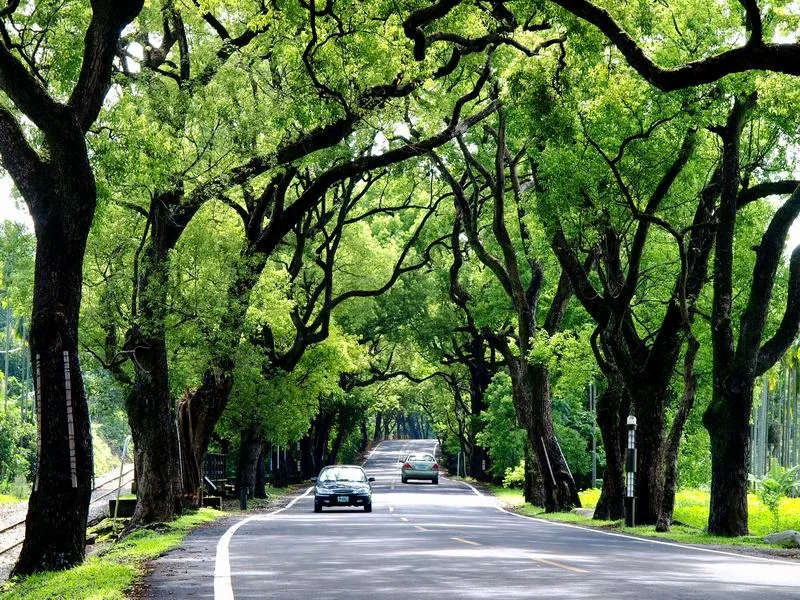
The green tunnel in Jiji, Nantou—camphor trees planted in 1940, stretching about 4.5 kilometers. It still stands today because no one decided to widen this road. Photo: Lin Chen-yu, Wikimedia Commons, CC BY-SA 4.0 (full source credits at end of article).
No. 292, Qiashu Road Section 2 — A Street Address Named After a Tree
At No. 292, Qiashu Road Section 2 in Changhua City, the address plate doesn't mark a house. It marks a tree.
The age of that Alstonia scholaris is a matter of local dispute — no one can pin it down. But the stories the community has passed down are specific: it would transform into a commoner to hire a theater troupe to celebrate its birthday, a merchant who picked up one of its fallen branches once got lost, even its green leaves could cure illness, and temple lore ties it to the legend of the Jiaqing Emperor's tour of Taiwan1. A 2009 measurement recorded more concrete dimensions: height 12.43 meters, circumference 9 meters, crown projection area 333.45 square meters — the only one of Changhua County's 53 registered heritage trees that grows in Changhua City proper2.
The road name on that address plate came from the tree. Qiashu Lane, Qiashu Road — both names derive from it. The road was fitted to the tree, not the tree to the road.
The situation of the several hundred thousand other street trees on Taiwan's streets is the exact opposite: the road is drawn first, the sidewalk width is fixed first, and only the leftover space is allocated to trees.
What does that leftover space look like? In 2013, PTS's Our Island walked Taiwan's streets and recorded the standard: "Most street trees today live in small square pits about 2 meters deep and 1.2 meters on each side"3. Li Youtian, director of the Taiwan Urban Forest Health and Beautification Association, put it more bluntly in 2015: the existing tree pits are "almost only one meter square." He also noted that green building rating standards calculate canopy coverage for shade trees as anywhere from 16 to 36 square meters, yet specify no minimum planting pit area4.
Arborist Hsiao Wen-wei's rule of thumb: a tree's root system width is typically twice the crown spread. As for spacing, "the standard interval for street tree planting is one tree every three meters, but mature trees ideally need five to six meters between them"5. That gap doesn't appear automatically as the tree grows. On the day it's planted, three meters apart; thirty years later, still three meters apart — except the tree now needs twice that space.
Source: PTS _Our Island_, Shih Hsin University _Small World_
Singapore's approach offers a useful benchmark: large shade trees need at least 3 meters of linear growing space, and a single planting pit must be at least 4 meters square6. Taiwan's one-meter-square pit on the street is roughly one-tenth the area.
So the question "Will this tree blow over and crush a car on a typhoon night?" — most of the time, half the answer was already written the day it was planted twenty years ago. The other half accumulates from every pruning afterward, every utility line excavation, every complaint about whether to intervene.
So who decides?
Every Generation Plants Trees for a Different Reason
In 1898, Tashiro Yasusada, working at the Colonial Government's Bureau of Industrial Development, submitted 《Taiwan Road and Street Tree-Planting Theory (with Tree-Planting Opinions for Key Locations)》. Urban researcher Yang Chieh-ying described this document as "marking the beginning of Taiwan's street trees moving toward systematic governance"7. Tashiro later wrote two more books: 《Taiwan Street and Village Tree-Planting Manual》 in 1900, and the two-volume 《Taiwan Street Trees and Municipal Village Tree-Planting Manual》 published by the Taiwan Governor-General's Forestry Bureau in 19208. These three documents span twenty-two years—the first a proposal, the latter two published works.
A proposal is one thing; institutional implementation is another. Historian Wu Ming-yong's research shows that neither the 1898 regulations for the Taipei nursery nor the 1911 Forestry Experiment Station regulations explicitly listed street tree survey and experimentation items. It wasn't until 1921, when the Central Research Institute's Forestry Division was established, that street tree surveys were first formally listed as one of six departmental duties9. Twenty-three years passed between one person proposing a theory and the state apparatus actually adding it to the official task list.
The first visible results appeared in Taipei's Three-Line Road. The Taipei city wall was demolished in Meiji 37 (1904), and the site was converted into a ring road that was completed in 19091011. This road later became known as "the Paris of the East," though this nickname only circulates among tourist guides, blogs, and encyclopedia entries—it cannot be found in Japanese colonial newspapers or official documents, making it more of a later-generation appellation11. The same planning logic of "wide roads lined with orderly rows of trees" was later applied to today's Zhongshan North Road, formerly known as Chokushi Street.
Trees planted on roads were themselves displays of rule. Yang Chieh-ying wrote clearly about royal palms: they were "not only symbols of colonial rule or Japanese imaginings of tropical culture, but also manifestations of tropical colonial governance grounded in scientific knowledge, demonstrating externally the fruits of civilized, progressive administration"7.
It looked like a transplant from Japan proper. Japan's modern street tree development began in Meiji 7 (1874) with black pines and cherry blossoms planted on Tokyo's Ginza Street, twenty-four years before Taiwan12. Yet the two tree species lists barely overlap: Japan's characteristic avenue trees were black pine, cherry, ginkgo, and willow, while Taiwan produced Chinese parasol trees, banyan, royal palms, and royal poinciana. What both shared was "systematic tree-planting through Western-style urban planning"—the administrative logic of the Meiji state—but the trees themselves grew from Taiwan's own soil.
In 1917, coinciding with the opening of Tainan Park, over a hundred royal poinciana saplings were planted on Taisho Street (today's Zhongshan Road), eventually becoming what was called the "Royal Poinciana Flower City"13. Multiple sources agree that royal poinciana was introduced to Taiwan in 1897, though accounts differ on who brought it and from where14.
Source: Eye on the City, Wu Ming-yong (2008), National Cultural Memory Bank, Curio Taiwan, Zhang Jinyu (2009), Central News Agency
When the government changed, so did the reasons. Ren'ai Road was already drawn as a tree-lined boulevard in Taipei's 1932 urban plan15, but after the war its width became a diplomatic facade: it was widened to sixty meters in 1958 as an international reception avenue, and by 1967 the entire length was widened to forty meters, with three sections expanded to one hundred meters, making it Taipei's widest street15. Between the 1950s and 1970s, painter Yan Shui-long, invited by Mayor Kao Yu-shu to serve as municipal advisor, proposed the broad tree-lined boulevards of Dunnan Road and Ren'ai Road, along with the Ren'ai Circle concept16.
As for whether this concept was modeled on Paris's Champs-Élysées, accounts vary. Taipei City Government's Public Works Bureau's own press release uses the phrasing "some say it might be"15, while the popular history media outlet 《Story》 is more direct: "While we might imagine that Yan Shui-long must have seen the Arc de Triomphe and Champs-Élysées during his brief study in France, whether he used this famous Parisian landmark as a design template lacks reliable documentary evidence."16
Yan Shui-long departed for France in August 1930, returned to Japan in autumn 1932, and had no clearly documented Taiwan activities until 193717. Having the opportunity to see something and using it as a design template are two different matters of intensity.
By the 1980s, the reason had become speed. In 1983, Taiwan's Provincial Government declared a greening year, and the black board tree, because it grew fast, turned green quickly, and showed visible results, was planted widely throughout streets. The media later gave it a nickname: the "political tree"18. The nickname is memorable, but the dates are easily distorted by it: the black board tree was actually introduced to Taiwan in 194319, forty years before the "political tree" label took shape in 1983. In 1988 it was even voted as Taichung's city tree by residents. Problems likely emerged gradually a decade after planting: surface roots, odor, seed dispersal, and susceptibility to wind damage18.
📝 Curator's Note
The common narrative is "the black board tree was a mistake," so in recent years it has been banned and removed. Yet in the full nineteen-page peer-reviewed 2009 paper by Jang Chin-yu from Tunghai University's Department of Landscape Architecture, the phrase "political tree" never appears once—the paper's description of the black board tree is neutral botanical description: extremely rapid growth leading to brittle wood and high branch breakage rates after typhoons19. It's easier to place responsibility on the tree species than on "whoever decided to plant a tree that grows to twenty meters in a three-meter planting pit." The same tree in Borneo's rainforest has no wind-throw problems as a giant, and the old black board tree from the Japanese colonial period at Jianguo High School remains structurally intact because of adequate space. The tree hasn't changed; the conditions for planting it have.
Another logic behind tree species selection is the market. Small-leaf alstonia was introduced to Taiwan in 1966 and began to be favored and planted widely islandwide about twenty years later. When Jang Chin-yu conducted surveys in 2006, she found these trees had oddly shaped trunks. After interviewing the director of the Changhua County Horticultural Association, she learned the reason: prices were too high and demand was urgent, so nurseries devised grafting small-leaf alstonia onto alstonia rootstock. "The main reason was to exploit alstonia's rapid growth characteristics, allowing small-leaf alstonia to mature into trees quickly for sale and profit"19.
Decades later, the upper small-leaf alstonia grows faster than the lower alstonia, the graft union swells and protrudes, and the lower trunk visibly narrows. Jang Chin-yu worried that strong winds might cause it to topple at the narrowed point19. A 2020 Taipei City field survey put a scale on this: of the city's 685 alstonia trees, 656 were grafted—a ratio of 95%20.
Singapore was doing something different in the same period. On May 11, 1967, Lee Kuan Yew proposed the "Garden City," which became a top-down national greening policy21. The term was borrowed from Englishman Ebenezer Howard—he used it in 1898 to describe self-sufficient cooperative towns, and Japan's Home Ministry introduced it in 1907, transforming it into commuter suburbs. One name passed through three hands, and each person redefined it according to their own needs. Taiwan's century of tree species succession is another way of writing the same story.
And it's not just government that decides the trees.
A Thousand Years of Worship, No Match for a Land Title
The Alstonia scholaris in Changhua survived to today not by luck alone. There is a temple beside it.
Taiwan's folk veneration of old trees has its own vocabulary: dà-tshhuê-kong (great tree deity), tshhuê-oo-kong (tree king deity), tshhuê-á-kong (tree deity), or simply named after the species—hôo-tshhuê-kong (banyan deity), tshua-tshinn-kong (Alstonia scholaris deity). The core is animistic nature worship—trees over a century old and of massive girth are regarded as possessing spirit and life, and thus receive veneration22.
The practice is woven into daily life. A red cloth is wound around the trunk, an incense burner placed before it, and the tree gains divine status. Parents bring infants to the old tree deity to "adopt as godchildren," outfitting them with a protective amulet called a kinn. Each year they return to the temple to exchange the amulet; when they reach adulthood, a "coming-of-age" ceremony is held. The tree king deity at Tainan's Xigangbao'an Temple traces its origins to the Qing Jiaqing era, and temple records say over two hundred years have accumulated more than one hundred thousand godchildren23. When godchildren return, they bring their childhood baby clothes, which are hung in a "longevity children's clothing box" beside the tree; after the ritual, they change into new adult clothes to take home.
In Puli, Nantou, there stands a thousand-year-old Alstonia scholaris, estimated at over twelve hundred years old—the oldest tree officially recognized by Puli Town Office. The old name of Puli's Tongsheng District was "Alstonia scholaris Foot," a place name derived from this very tree24.
It sounds like a complete protection mechanism: folk practice independent of government or environmental groups, organically cultivating a relationship with the tree spanning centuries. Yet this relationship has its limits.
The three-hundred-ping plot of land where Puli's thousand-year Alstonia scholaris stands is privately owned, with the landowner asking approximately thirty million New Taiwan dollars. The Xingnan Temple management committee launched a "sacred tree land-purchase fund," raising money for three years and collecting over three million. A guesthouse operator, unable to bear the tree king's declining health, personally spent over thirty million to buy the adjacent entire townhouse, demolishing concrete and carports to let the tree breathe—yet lacked the means to purchase the three-hundred-ping plot beneath the tree king25. Faith can unite community sentiment and genuinely raise funds. But against the market price of private land, it yields only one-tenth of what is needed.
The old banyan in Taipei's Beitou faced a different wall. This two-hundred-year-old banyan, which locals call tshhuê-á-kong, stands seventeen meters tall with a trunk circumference of 595 centimeters and a crown spread of 660 square meters—by crown area alone it exceeds the four-hundred-square-meter threshold for nationally protected trees. The Civil Affairs Bureau even erected a marker calling it a "living heritage site." In 2011, its vigor weakened and disease advanced; after the Cultural Bureau's inspection in April, officials judged the growing base insufficient. The neighborhood chief Ong Tsiann-hue told media at the time: "Since the April inspection, the city government's relevant departments have taken no action whatsoever."26
Protection standards met, faith status established, neighborhood chief willing to speak—all three conditions aligned, yet the administrative process never moved.
In the 1970s, due to economic development, road construction, and development—even expansion of the small temples they once depended on—many old trees quietly disappeared from our midst
Government decides where trees are planted; faith decides whether trees are remembered. Whoever decides, we live beside these trees every day.
This Street Changes Its Clothes Four Times a Year
Beyond decisions, there is something the body notices first: seasons. In March, kapok flowers carpet the ground. The orange blossoms fall whole, and stepping on them makes a sound. By April and May, the tree shifts its mode of existence: the fluff begins to fly, clogging air-conditioner filters, blocking drainage holes, triggering allergies. New Taipei and Hsinchu see citizen complaints every year during this season28. The same tree transforms from "most beautiful" to "public grievance" within two months.
May to July belongs to the golden shower tree's rain of gold, with cascades of yellow flowers blanketing the arcade eaves and asphalt29. During the same period, the royal poinciana blooms, coinciding precisely with graduation season. The four characters "royal poinciana in bloom" carry a force for Taiwanese people probably stronger than any other street tree—everyone who went to school in Taiwan has been struck by this phrase once. The royal poincianas on that Tainan street were planted in 1917.
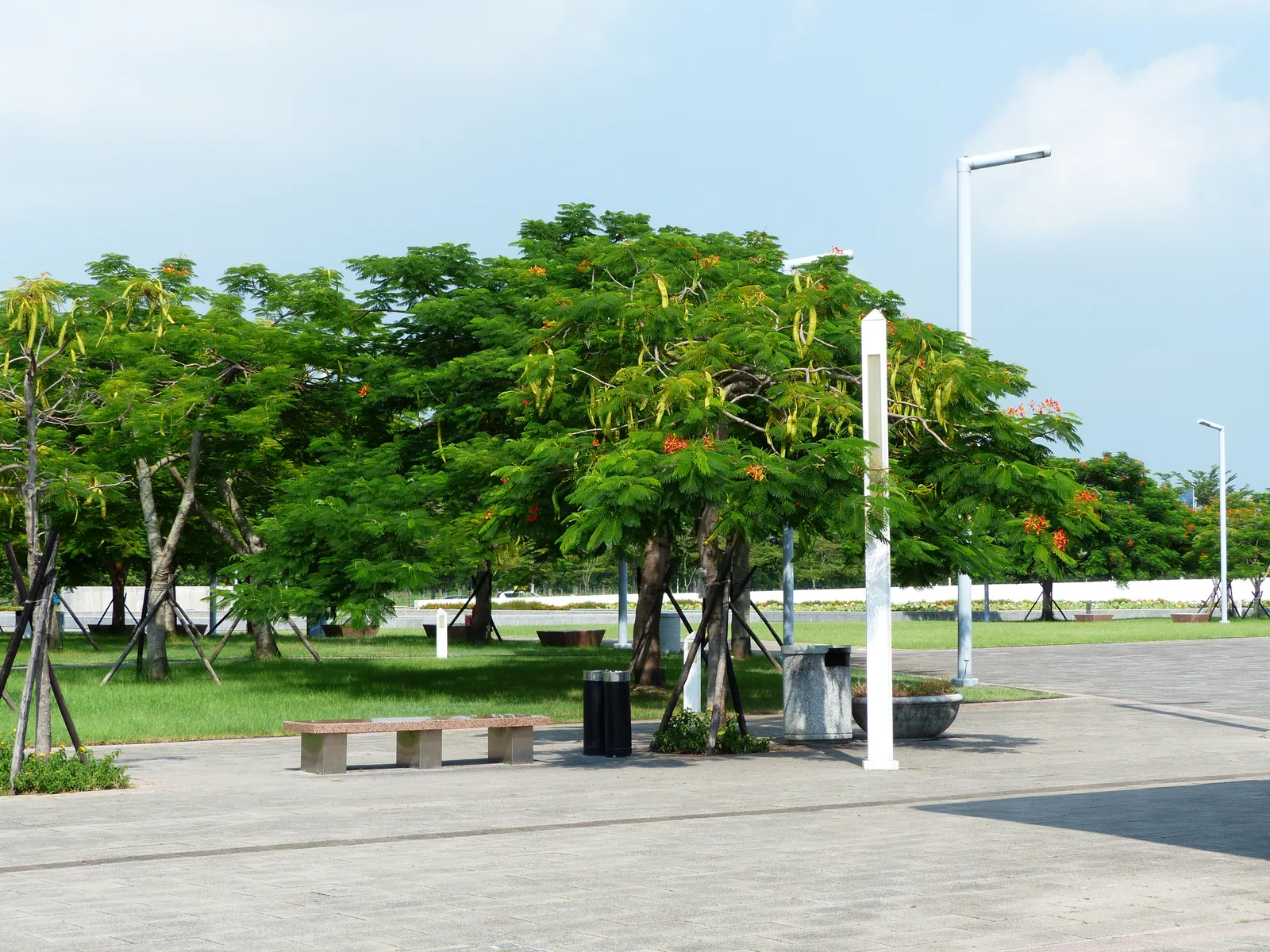
August 2013, royal poincianas at the Taiwan High Speed Rail Tainan Station plaza. The large-scale planting of royal poincianas in Tainan can be traced back to over a hundred trees planted on Taisho Street in 1917. Photo: Genshi Sei, Wikimedia Commons, CC0 1.0 (full source at end of article).
August to October is when the Taiwan rain tree takes the stage, yellow flowers giving way to reddish-brown seed capsules—one of Taiwan's few street trees that changes color entirely. Beneath it runs a complete ecological chain: the red-rumped swallow, the Taiwan rain tree, and the Taiwan leaf-footed bug are all interconnected. This bug's breeding season from November to April often brings it near Taiwan rain trees, with Taiwan's earliest reports dating to mid-December 1999 in Taichung City30.
(The leaf-footed bug, often mentioned alongside it, is a different insect that primarily damages lychee and longan, treating the Taiwan rain tree as a secondary host—for more on its entanglement with fruit trees, see Taiwan's Fruit Kingdom.)
Once tree groves reach a certain age, the street begins to behave like a forest. The camphor and banyan street trees that matured after the 1990s function ecologically like a low-altitude broadleaf forest cut into strips and laid between concrete—this is partly why the black-crowned night heron, originally recorded as "rare," is now increasingly spotted in urban green spaces.
Yet the trees we notice are not the same batch as the trees actually most abundant on the street.
Source: Eye on the City, compiled from Taipei City street tree census data
Taipei has a total of 199 street tree species, with only 75 native species, yet native species account for over 60% of total trees31. "Few varieties" and "many numbers" occurring simultaneously is where this data is most easily misread.
As for banyan at 13.9%, it exceeds the first threshold of the frequently cited "10/20/30 rule": no single species exceeds 10%, no single genus exceeds 20%, no single family exceeds 30%. This rule is often credited to American scholar Santamour, though in his 1990 conference paper he himself said he was uncertain who first proposed the 10% rule32. Research analyzing 108 cities worldwide found that no city fully complies with this standard33. Taipei's overage is the norm, not the exception.
Norm does not mean without cost—when a single species is overrepresented, one disease outbreak or one extreme weather event could affect all the trees on an entire street simultaneously, and this too is a consequence of choices made decades ago when the trees were planted31.
As for why it's cooler under trees, a National Taiwan University horticulture team measured it in a Taipei park in 2010: the air temperature under the canopy was 0.64 to 2.52 degrees Celsius lower than unshaded ground, and soil surface temperature was 3.28 to 8.07 degrees lower, with canopy leaf density contributing most to the cooling effect34. This was measured in a park, not on a street, but it gives a sense of scale to the everyday experience of "walking in tree shade."
Zhang Xiaofeng's essay "Street Trees" was once a lesson in the state-approved textbooks of Taiwan's national language curriculum, and its opening lines are probably among the passages most frequently assigned for analysis of main ideas to people under middle age in Taiwan: "Our home is on the mountain, in the primeval forest where daylight never reaches. Yet here we stand, standing on the edge of this two-lane road—this is undoubtedly a kind of fall."35
The word "fall" is written heavily. But it is not only the trees that bear the cost.
Trees Fall Down, Then We Discover No One Was Actually Managing Them
Liu Xiangming, the neighborhood chief of Dalin Li in Tainan, once described a very concrete gap: the city government prunes street trees once every six months, far short of the frequency at which tree leaves fall36. The area he manages is planted with Washington palms, and their massive leaves drop faster than the twice-yearly pruning can keep up with. This is one neighborhood chief speaking to a city—it can't be generalized to Taiwan's entire pruning cycle—but it points to where public grievance truly grows: in the soil of "no one managing it."
Associate Professor Yang Guo-zhen of Providence University describes the other half: "The most beautiful thing about kapok trees is how the branches extend outward, layer upon layer, so stunning when they bloom. Now the branches can't grow, the flowers can't open, the fruit can't develop—people are really quite awful!"37 The same tree species: residents complain about too much fluff, scholars complain about humans pruning them into unrecognizable shapes. Both complaints are real.
The root damage part has numbers. In 2009, Tunghai University's Zhang Jinyu and Huang Xiaoju surveyed ten species of street trees in Kaohsiung—2,113 trees total—and classified them by root morphology into four types: buttress roots, stem-base aerial roots, shallow roots, and stem-base spreading roots. The conclusion was direct: every surveyed species with a diameter at breast height exceeding ten centimeters damages the tree pit border, and damage severity increases with diameter38. Sidewalks buckling up has nothing to do with a tree's character; it has everything to do with how small a frame it's been squeezed into.
What about moving the trees? In the 1994 Taiwan Route 3 widening project in Miaoli, nearly two hundred old camphor trees were relocated elsewhere. Within three years, 30 percent had died; after more than a decade, only twenty-two remained alive—an 11 percent survival rate. This figure currently traces back to only a single media investigation39.
In 2014, to accommodate the Taipei Dome area expansion and the widening of Guangfu South Road and Zhongxiao East Road, 87 liquidambar, rosewood, and kapok trees on sidewalks and traffic islands needed transplanting40. During the same period, the Songshan Tobacco Factory park area originally had nearly a thousand trees; 780 were transplanted. The contractor promised a survival rate above 80 percent, but public television's follow-up reporting documented "over a hundred dead," including an eighty-year-old camphor tree that died from poor drainage after transplanting41.
PTS 《Our Island》, May 12, 2014: "When Roads Meet Trees | Taipei Dome Tree Relocation Controversy," documenting the transplanting controversy around Songshan Tobacco Factory and on-site work methods.
The gap between plan and reality sometimes shows up the same day. In a 2013 transplanting project at Wenxin Road South Yuan Park in Taichung, MRT Project Director Guo Zhiwen said the transplanting "followed all regulations," but tree-protection volunteers on site witnessed contractors beginning work without any root cutting whatsoever. A volunteer named Angela said two things on the spot: "Too brutal," and "the trees simply cannot survive"42.
As for the disasters themselves, the numbers are a mess.
Source: Liberty Times, The Reporter
An eleven-year-old typhoon, and there's still no agreed-upon answer to "how many trees fell." Many people decide about trees; few bear the consequences. Even the task of recording those consequences has no one to take it on.
City councilor candidate Kao Chia-yu, after a street tree fell and crushed a car, discovered that the fallen tree's root zone contained visible pipes, large stones, concrete backfill, and plastic bags. Her statement was: "While typhoons are natural disasters, if management, construction, or maintenance problems exist ordinarily, responsibility cannot be entirely attributed to natural disaster."45
To ask who should be responsible, the first question is: who manages this tree?
PTS 《Our Island》 Episode 701 "Wronged: Street Trees," aired April 8, 2013. The tree pit specifications and management responsibility issues documented in this episode remain largely valid thirteen years later.
The 2013 《Our Island》 episode concluded: "Currently, street tree management has no unified contact point from central to local government; sometimes a single road's trees belong to different departments, each doing their own thing."46 Thirteen years later, in the Golden Coast area of Tainan, roadside trees might belong to the Highway Bureau, those in parks to the Public Works Bureau, those in parking lots to the Transportation Bureau, and those along levees to the Water Resources Bureau47. Taipei divides them into two major categories by land ownership: street trees fall under the Parks Department, while trees on private land, residential yards, and government/school property are the responsibility of the owner48. The rules have always existed; they just naturally grew into a fragmented shape.
Beyond fragmented rules, there's the matter of personnel. Zhuang Jieren, director of the Kaohsiung Forest City Association, noted in 2023 a striking contrast: "Taipei's Public Works Bureau Parks and Street Lights Engineering Management Office has 1,453 staff, but Kaohsiung's Parks Department has only about 100 people," and those hundred-plus must manage over eight hundred parks and green spaces49. These two figures, without converting to "trees per person," would exaggerate the gap if compared directly, but the direction is clear.
Hsinchu's scale is even smaller: the Parks Department has twenty-four field staff organized into eighteen teams, responsible for nearly 130 parks, green spaces, plazas, and public restrooms. One person may sweep four locations a day, totaling 5,566 ping50. This is cleaning and maintenance, not tree pruning, but it's the same stretched workforce.
| Year | Number of Street Trees |
|---|---|
| 1984 | 86404 |
| 2013 | 90000 |
| 2020 | 87754 |
Source: Eye on the City (1984 and 2020 figures, and description of the 2011–2014 Tree-Lined Avenue Plan period pushing above 90,000)
Zhuang Jieren also said something more concise: "Taiwan's government often removes trees and then 'never plants them back.'"51 Taipei's street trees numbered 86,404 in 1984; the 2011–2014 Tree-Lined Avenue Plan once pushed them above 90,000; in 2020 they were 87,754, recorded as the lowest in a decade31. Thirty-six years, a city whose population and built area have changed dramatically, and the total number of street trees has barely moved.
Professional expertise, though, has grown. Taiwan's first ISA Certified Arborist exam in 2014 had seventeen applicants and seven passed; the candidates included five PhDs and ten master's degree holders52. Chen Hongkai, deputy executive director of the Daan Forest Park Friends Foundation, later left a frequently cited remark: "How well one plants a tree, how kindly a city treats a tree, is an indicator of how far that city's civilization has progressed."53
📝 Curator's Note
In the public reporting on street trees over these past dozen-plus years, there are tree doctors, arborists, neighborhood chiefs, city councilors, professors, tree-protection volunteers, and contractor bosses. Not one piece has the person standing on the lift with the chainsaw telling their own story. Reporting's visual habit points the camera at people with titles—personal biography after professional certification is easy to write; the labor perspective of outsourced work crews is not. How a city treats trees may be the same question as how it treats the people who prune them; it's just that the latter hasn't even been asked yet.
Humans have human rights, but do trees have "tree rights"?
The most unresolved cost among these is: who should decide when to prune, how much to prune, and when to remove. And this question hasn't just started being debated this year.
Rules Written on Paper for Twelve Years, with No Teeth
In late February 2009, before the last old camphor tree at the Songshan Tobacco Factory was moved away, tree-protection activists launched a tree-hugging protest54. In Taichung, Zhang Meihui also spent years petitioning the city government about blackboard trees it wanted to cut down55.
On March 28, 2013, the New Taipei City Government planned to relocate thirty-two old banyan trees inside Banqiao Jiangcui Junior High School. Pan Han-chiang climbed into a tree and stayed there for twelve days; on April 8, police forcibly took him to a hospital56. On August 10, 2014, the Tree Party was founded57.
This is the third kind of person who "decides about trees"—beyond government and faith, it is citizens who put their bodies in front of machinery. And what they have been demanding has barely changed over more than a decade.
In December 2013, Huang Shuru, deputy director of Taipei's Parks and Street Lights Engineering Management Office, publicly admitted that the current street tree pruning standards were set in 2000 and "indeed some parts have become outdated," promising to complete a revised draft within three months. In the same report, city councilor Li Qingfeng tallied 8,635 trees pruned citywide due to transplantation since 2007, with at least 1,017 confirmed dead. Tree-protection groups demanded replacing low-bid contracting with qualification standards; Hsieh Hongming, president of the landscape engineering trade association, offered an industry-speak line: "Cutting all at once won't save money anyway!" Topping-style pruning only causes trees to sprout more adventitious buds58.
The three-month promise stretched past twelve years to 2026.
A national document did appear in between. On January 27, 2022, the then-Forestry Bureau released the 《Ornamental Tree Pruning Operations Guide》, which stated in its first point: given that improper pruning of public trees has become rampant, and "there is no consistent national tree pruning technical standard"59.
The guide was clear about "topping"—the official technical term is "stub cutting," "colloquially called topping pruning," and Appendix 1 stated that excessive and high-intensity internodal pruning is "prohibited except where public safety requires it"59.
In other words, the ban on topping-style pruning was written in black and white in a central government document four years ago. What were the six thousand-plus people petitioning for in 2026?
On June 27, 2026, a proposal titled "Establish National Standards for Tree Pruning and Felling, Prohibit Topping-Style Pruning and Improper Felling" appeared on the Public Policy Online Participation Platform. The proposal's first sentence read: "In recent years, street trees, park trees, and public-space trees across Taiwan's counties and cities have commonly suffered excessive pruning, topping-style pruning, bare-crown pruning, and large-scale felling."60
The first of eight demands called for "establishing unified national standards for public tree pruning, prohibiting unnecessary topping-style pruning, bare-crown pruning, and heavy pruning," registered on July 9 with 6,554 co-signers, jointly administered by the Ministry of Agriculture and the Ministry of Interior, requiring an official response by September 9, 202660.
In the Ministry of Agriculture's preliminary response, one sentence revealed the crux of the matter: the ministry had already issued the 《Ornamental Tree Pruning Operations Guide》, "for agencies to reference and apply"60.
Source: Ministry of Agriculture Forestry and Natural Conservation Administration 《Ornamental Tree Pruning Operations Guide》, Public Policy Online Participation Platform proposal text and Ministry response
Both documents aimed to prohibit the same thing. This proposal did not seek to reinvent a rule; it sought to give teeth to a rule already written.
And "lack of uniformity" was not an implementation oversight—it was the design of the system itself. Article 38-3 of the final section of Chapter 5 of the Forest Law, "Tree Protection," explicitly states that "local governments may formulate implementation standards according to local conditions"61, and the Forestry Bureau's guide also authorized management units to set detailed regulations59. Two documents at different levels both agreed that localities should each set their own.
In July 2026, this erupted in Taipei. Online rumors circulated that the city government had cut over four thousand street trees, with talk of "clearing a path for drones." The Parks Department's July 12 press release provided numbers: 3,164 trees removed last year, over eighty percent (2,630) due to natural death, decay, pests and disease, or natural disaster, plus over 13,225 new trees planted in fiscal years 114–11562. Parks Director Lan Shufan's statement was: should we allow diseased trees to fall just because of malicious drone fantasies by ill-intentioned people; tree pruning is for public safety63.
The city government simultaneously said it would gather evidence against those spreading rumors. Democratic Progressive Party Taipei councilor Zhang Wenjie responded: "What a show of official authority," "Is Taipei City Government really going to sue citizens now! Are you telling everyone they can't supervise Taipei City Government anymore?"64 Mayor Chiang Wan-an was quoted verbatim in this controversy with only four characters: "Handle it according to law"65.
The tree-protection side has names, faces, and over a decade of action history; what the city government can point to is the Parks Director's two sentences plus the mayor's four characters. The distribution of microphones is itself part of this debate.
Sometimes a turning point comes quickly. That same month, the National Health Insurance Administration's Taipei Operations Group, having received public feedback about accessibility needs for people with disabilities and stroller users, announced plans to remove an old Alstonia scholaris tree on Qingdao West Road. Tree-protection action began on July 16, with permit applications for assembly and calls to 1999. Taiwan Tree People Association Secretary-General Pan Han-chiang later described it: "Around 5:30 p.m. that day we got good news—the NHI Administration quickly responded to tree-protection sentiment, corrected course, halted the project, and withdrew the original announcement." The NHI Administration's statement was that it recognized the old tree's value and temporarily canceled the original removal plan66.
The most unlikely voice of any faction in this same debate came from tree doctor Zhan Fengchun. She pushed the question back: rather than argue whether a tree should be felled, we should ask why it reached the point of needing removal. Repeated heavy pruning over time can cause branch decay, thick-branch breakage, even damage to the root system supporting the tree; what should really happen is improvement starting from planting space, pruning methods, and long-term care6768. This framing can be used by tree advocates to criticize mismanagement, and by the city to explain why removal was unavoidable.
PTS 《Our Island》 Podcast video edition, Episode 75: tree doctor Zhan Fengchun discusses why trees fall over and get sick, and what happens before removal.
One allegation in the debate remained unresolved. In May 2020, the Taiwan Ecological Society, Kaohsiung Tree Lovers, Taiwan Tree People, and four other environmental groups jointly released an investigation alleging that thick branches pruned from street trees fetched 1,600 to 2,300 yuan per ton, calling on government to regulate them like driftwood and waste metals69. This was a joint allegation by multiple organizations within the same camp; six years later, there was no official investigation result, nor any traceable follow-up.
One thing was absent from this debate: no named individual or group publicly argued "trees don't matter, they should give way to development or traffic." Voices supporting pruning and removal all used the same framework—the city government spoke of typhoon safety, Taiwan Power spoke of power supply safety, residents petitioned about sidewalks being heaved up, councilors spoke of holding management accountable for negligence. Even those requesting tree removal framed it as protecting people. The real divide between the two sides was not "do trees matter," but "whose safety judgment counts."
📝 Curator's Note
The crown spread of that tree deity in Beitou exceeded the national threshold, had a plaque from the Civil Affairs Bureau, had the neighborhood chief speak up for it, and after the site inspection there was "absolutely no action whatsoever." Taiwan's tree pruning guide says "topping pruning prohibited except where public safety requires it," and the Ministry of Agriculture itself positioned it as "for agencies to reference and apply." These two things seem to belong to one folklore and one administrative law, but they are two faces of the same pathology: the rule exists, the status exists, the discourse exists—there is just no one responsible for making it happen. For over a hundred years, each generation has made decisions about trees; the one baton no one has truly caught is "keep caring for it after you plant it."
The path ahead is not unpaved. Environment Minister Peng Qiming's April 2026 target was for people to walk in tree shade from the MRT station all the way to the office, and the Environment Ministry planned cross-agency collaboration and cooperation with the Meteorological Agency to establish a street tree fall-risk warning system70. National Cheng Kung University Architecture Professor Lin Tzyping discussed the relationship between artificial shade umbrellas and tree planting: artificial shade is a short-term response to care for citizens while trees are still growing, but in the long term, planting trees is the fundamental way to improve urban microclimate71.
Trees need at least ten years to grow enough to provide shade. This is the one adaptation on the Taiwan Climate Crisis and Net-Zero Transition line that cannot wait.
In ten years we will know whether this baton was caught. But some batons have already been caught.
Green Tunnels Grow Only on Roads That Weren't Widened
In Jiji, Nantou, the camphor trees lining Taiwan Route 16 were planted in 1940 and have grown into a green tunnel about 4.5 kilometers long. When you drive through it, light flickers past the windshield in regular intervals, and the temperature inside the car drops on its own—this is something you have to experience with your body passing through, not just by looking.
On Taiwan Route 3 in Gukeng, Yunlin, there are about two kilometers of old mango trees roughly fifty years old, already designated for protection. The mango tree green tunnel in Sinhua, Tainan originally had 541 trees; thanks to local opposition and tree-protection groups, over eighty percent were preserved72. In Taitung, there is also a two-kilometer-long Alstonia scholaris shelter road.
These roads share a peculiar trait: they exist because certain things did not happen. No widening project passed through. No construction required drawing a centerline. No one said in some meeting, "We need to widen this road." They are shapes accumulated from a series of decisions that were never made.
The Jiji camphor trees planted in 1940 still use the core tree species established during the Japanese colonial period—the same species that was once a resource fought over by empires in the mountains (see 19th-Century Camphor Wars), but on streets was only asked to provide shade. The old mango trees in Gukeng and Sinhua are remnants of the old practice of using fruit trees as street trees. They were not luckier than other trees; they simply happened to grow on road segments that no one had decided to remake.
The act of "catching" or "preserving" has two intensities. The stronger kind actively takes responsibility and sees it through: guidelines must have teeth, labor must keep pace, standards must be enforced—this has not yet happened overall. The weaker kind only requires that no one actively destroys it, and this has actually happened on a few roads.
"No one stepped forward to say we need to widen this road" is itself a decision, only it is so quiet that it will never be counted as an achievement, nor will it appear in any site inspection record. Its only evidence is the cool breeze when you roll down your car window.
One road in Changhua acknowledged the name of a single tree; the Jiji road acknowledged the height of an entire row of trees. Between them lie more than a hundred years, multiple rounds of changing rationales, a guideline written "absolutely prohibited" but only for reference, and over six thousand signatures still waiting for a response.
The next tree to be planted at your front door is right now being decided by someone deciding how wide the planting pit should be.
Further Reading:
- Black-capped Night Heron — Street tree groves matured since the 1990s, and how they became an urban habitat for a species of bird
- Zhongshan North Road Shotengai — The 1941 Imperial Messenger Street forty meters wide, planted with camphor and maple trees, another road left behind by Japanese colonial tree-planting planning
- Taiwan's Fruit Kingdom — The entanglement of the red-shouldered bug and the Taiwan rain tree, and the boundary between fruit trees and street trees
- 19th-Century Camphor Wars — The same camphor tree, a globally contested resource in the mountains, shade-providing street tree on the street
- Taiwan's Climate Crisis and Net-Zero Transition — Tree shade as a position and temporal scale in high-temperature adaptation engineering
Image Sources
This article uses 2 CC-licensed images, all cached in public/article-images/lifestyle/ to avoid hotlinking to source servers:
- Jiji Green Tunnel — Photo: Lin Chen-yu, 2017-11-25, CC BY-SA 4.0 (hero)
- THSR Tainan Station Plaza 20130810a — Photo: Hsuan Shih-sheng, 2013-08-10, CC0 1.0 (inline)
References
- Changhua City Qiashu Wang Gong — Wikipedia article entry; the original text states "tree age is subject to various accounts" with no specific figure of "over 1,400 years," nor any narrative of being carried by floods or receiving imperial investiture during a rest stop in the Jiaqing reign of the Qing Dynasty; the legends recorded in the entry include Qiashu Wang Gong incarnating as a commoner and personally hiring a theater troupe for his birthday celebration, a merchant finding his dead branches and becoming temporarily lost, old tree green leaves curing illness, and connection to the legend of Jiaqing traveling in Taiwan—this article has been corrected accordingly.↩
- Changhua County Cultural Bureau: Old Trees and Local Memory — Publication by Changhua County Cultural Bureau, containing 2009 measurement data for Qiashu Wang Gong (tree height 12.43 meters, tree circumference 9 meters, tree crown projection area 333.45 square meters) and context of 53 protected ancient trees managed within the county.↩
- PTS "Our Island" Episode 701 "Wronged: Street Trees" — Aired April 8, 2013; interview and writing by Chen Jiali, cinematography and editing by Chen Zhongfeng; the full program documents on-site specifications of Taiwan's street tree pits (depth two meters, length and width 1.2 meters), soil hypoxia conditions, and fragmented management authority issues—it is the most frequently cited primary video documentation on this topic.↩
- Taiwan Urban Forest Health and Beautification Association: Expanding Tree Pits or Regulating Minimum Planting Pit Area — Article authored by association director Li Youtian in October 2015, pointing out that existing tree pits are "almost only one meter square" and criticizing that green building scoring only counts green coverage area without regulating minimum planting pit area.↩
- Shih Hsin University "Small World": Street Trees Both Friend and Foe, Tree Rights and Human Life Trade-offs Difficult to Balance — November 14, 2024; reporters Cai Yixuan, Lin Zhijun, Li Yishan; includes statements by tree doctor Xiao Wenwei on root system width and planting spacing, and the question of "tree rights"—these are empirical rules from a single practitioner, not peer-reviewed literature.↩
- Eye Bottom City Affairs: Where Should a City's Trees Be Planted to Survive — Independent urban affairs media article, summarizing Singapore's regulations on large tree growing space and single planting pit dimensions (linear space of three meters or more, planting pits at least four meters square), and data on the ratio of above-ground to below-ground parts.↩
- Eye Bottom City Affairs: Green Bombs in the Sky—Large Royal Palms Traversing Vertically in Urban Areas — Article by Yang Jingyi, master's student at National Taiwan University's Graduate Institute of Urban Planning, citing three academic studies by Zhou Xiangyun (2008), Chen Weizhi (2020), and Wu Mingyong (2008), writing out verbatim the title and significance of Tashiro Yasusada's 1898 proposal, and analyzing the dual character of large royal palms as colonial rule display objects.↩2
- National Taiwan University Library Digital Archive: Tashiro Yasusada Collection — Official catalog data confirming that both volumes of "Taiwan Street and Village Tree Planting Essential Guide" (上卷、下卷) were published by the Taiwan Governor-General's Bureau of Forestry in 1920, with digital links to the National Diet Library of Japan; distinguishing these as three different documents from the 1898 proposal and the 1900 "Taiwan Street and Village Tree Planting Essential Guide."↩
- Wu Mingyong "Tashiro Yasusada and the Establishment of Modern Taiwan Street Tree Theory" — Tamkang Historical Journal, Issue 19 (2008), pages 275-289; the paper points out that neither the 1898 Taipei Nursery Regulations nor the 1911 Forestry Experiment Station Regulations listed street tree survey items, with street trees first explicitly listed as one of six departmental tasks only after the Central Research Institute's Forestry Department was established in 1921.↩
- National Cultural Memory Bank: Three-Line Road — National Taiwan History Museum collection description of a Japanese colonial period color postcard, currently the most authoritative institutional evidence for "Three-Line Road's official completion in 1909," tracing the planning basis back to the 1901 Second Urban Improvement Plan and the 1905 Taipei Urban Plan.↩
- Wikipedia: Three-Line Road — Article entry contains the phrase "known as 'the Paris of the East' for its scenic beauty," but this sentence and the two key years 1904 and 1909 have no footnotes in the entry; this article therefore treats this epithet as a later-circulated description.↩2
- Tokyo Metropolitan Government Bureau of Construction: Street Trees of Tokyo — Official webpage of Tokyo Metropolitan Government with a chronological table of street tree history, recording that black pines and cherry blossoms were first planted on Ginza Street in Meiji 7 (1874) as modern street trees, and the process of cultivating ten species including ginkgo and plane trees beginning in Meiji 40.↩
- Curio Taiwan: June 9, 1917, Completion of Royal Poinciana Tree Planting on Tainan's Taisho Street — Japanese colonial history popular media article, recording the planting of over one hundred royal poinciana saplings on Taisho Street (present-day Zhongshan Road) in 1917 to coincide with the opening of Tainan Park, and noting that Tainan's earliest royal poincianas were actually planted at the Anping Customs House and British Consulate.↩
- Wikipedia: Royal Poinciana — Article entry records the introduction in 1897, with the sole supporting source being an offline webpage from Tainan City Government's Agriculture Bureau; there are also two contradictory versions—"purchased by the Mumbai Consulate" and "sent as a gift by someone from Madagascar"—with the only common point being the year 1897, so this article only mentions the year without specifying the route.↩
- Taipei City Government Bureau of Public Works: How Much Do You Know About the Past? The Interesting History of Ren'ai Road's Transformation — Official government press release, recording that Ren'ai Road was planned as a tree-lined road in the 1932 urban plan, widened to 60 meters in 1958 as an international reception avenue, and expanded to 40 meters along its full length in 1967 with three sections widened to 100 meters; the phrasing regarding the Champs-Élysées comparison is "some say it may be."↩23
- Story StoryStudio: The Birth of 'Tianlong Road' — A popular history media article documenting how Kao Yu-shu invited Yan Shui-long to serve as a municipal advisor and the process of proposing the roundabout and tree-lined boulevard concept from the 1950s to 1970s, explicitly noting that 'there is no reliable documentary evidence as to whether this was modeled after this famous Parisian landmark'; the original text lacks the specific year '1970' and the quote 'too wasteful of land,' which this article has corrected accordingly.↩2
- Story StoryStudio: Yan Shui-long's More Than Two Years in France — Documents that Yan Shui-long departed on the Trans-Siberian Railway on August 11, 1930, and arrived in France on the 28th, studying at the Grande Chaumière and the Académie de la Grande Chaumière; the original text states he ended his three-year intensive Paris study abroad experience the following autumn and 'returned to Japan,' beginning Taiwan's traditional handicraft survey from 1937, not 'returning to Taiwan in late 1932,' which this article has corrected accordingly.↩
- Central News Agency: The Rise and Fall of Alstonia scholaris — August 29, 2020 report documenting the origin of the media's common nickname 'political tree,' the 1983 designation by Taiwan Provincial Government's Department of Forestry and Agriculture as the year of greening, the 1988 selection of Alstonia scholaris as Taichung's city tree by citizens, and the timeline of problems emerging approximately ten years after planting.↩2
- Chang Chin-yu, 'On Controversial Street Trees Common in Taiwan' — Journal of Landscape Architecture 15(1):1-19 (2009), peer-reviewed paper from Tunghai University's Department of Landscape Architecture; the full nineteen-page text does not use the term 'political tree,' documenting Alstonia scholaris's introduction in 1943, its brittle wood and typhoon branch-breaking problems, and first-hand interview records of Sapindus saponaria var. mukorossi's introduction in 1966 and grafting-caused basal constriction by nursery merchants.↩234
- Liberty Times: 656 of Taipei's 685 Sapindus saponaria var. mukorossi Are Grafted — August 22, 2020, reporter Yang Hsin-hui; reports on-site statistics revealed through Taipei City Council questioning: of the city's 685 Sapindus saponaria var. mukorossi, 656 are grafted varieties, a ratio of 95%, with Zhongshan District leading at 315; serves as independent cross-verification of Chang Chin-yu's paper.↩
- BiblioAsia: Of Parks, Trees and Gardens — The Greening of Singapore — Official journal article from Singapore's National Library Board documenting the date and location of Lee Kuan Yew's Garden City speech on May 11, 1967, and the tree-planting time series of 55,000 trees in 1970, 158,600 trees in 1974, and 1.4 million trees in June 2014.↩
- Ministry of Interior National Religion Information Network: Tree Deity — Government agency's religious knowledge page explaining names such as 'Tree Deity,' 'Tree King Deity,' and 'Tree Deity,' the nature of animistic natural worship, and the relationship between tree age, tree size, and deification.↩
- Taiwan Good News: Xigang Bao'an Temple Tree King Deity and One Hundred Thousand Godchildren — Local news report documenting the legend of Xigang Bao'an Temple's Tree King Deity originating in the eighth year of Jiaqing in the Qing Dynasty, with the original text marking 1802 CE (differing by one year from the 1803 calculated from the Jiaqing reign, this article does not adopt the precise CE year, only writing 'during the Qing Jiaqing period'), the specific procedures of godchild contracts and coming-of-age ceremonies, and the 'long-life children's clothing box' hung beside the tree; the figures 'one hundred thousand godchildren' and '215 years' are temple statements without independent statistical verification.↩
- Wikipedia: Puli Alstonia scholaris Tree King Deity — Documents this Alstonia scholaris tree at approximately 17 meters tall, 12.3 meters in girth, and approximately 1,200+ years old, with the 2002 town office survey identifying it as the oldest tree in the town, and the origin of the old name 'Alstonia scholaris Foot' for Tongsheng Village; the original article text lacks the precise figure '1,240+ years' and does not mention dioecism or the origin of the 'King Deity' name, which this article has corrected accordingly.↩
- ETtoday: The Land Dilemma of the Thousand-Year Alstonia scholaris Tree King — April 27, 2022, reporter Chen Hsiao-hui; reports that the 300-ping land where the thousand-year Alstonia scholaris is located is privately owned with the landowner asking approximately 30 million NT$, the Xingnan Temple management committee's 'sacred tree land purchase fund' has only raised over 3 million NT$, and the process of a bed-and-breakfast operator spending over 30 million NT$ to purchase and demolish an adjacent townhouse to remove concrete.↩
- Liberty Times: Beitou's 'Tree Deity' in Critical Condition — November 9, 2011 report documenting this 200+ year old banyan tree at 17 meters tall, 595 centimeters in breast-height circumference, and 660 square meters in crown spread, with the Civil Affairs Bureau erecting a monument calling it a 'living historic site,' and village chief Qin Ronghui's public complaint about the city government's inaction after the April inspection.↩
- Council of Agriculture Global Information Network: "Agriculture and Farming News" Volume 233, November Year 100 — Records Weng Jia-jun's account of old trees felled in the 1970s due to economic development, road construction, and temple expansion, verbatim: "In the 1970s due to economic development, road construction and development, and even expansion of the small temples they depended on, countless old trees disappeared from our surroundings without our noticing."↩
- Liberty Times: Kapok Fluff Causes Public Complaint in Hsinchu — Reports on public complaints caused by kapok fluff in Hsinchu from April to May, including allergies, clogged air conditioner filters, and drainage holes, as well as the city government's fruit pod removal operations; New Taipei City experiences similar complaints during the same period each year.↩
- Smiling Taiwan: 6 Ornamental Flowering Trees in Taiwan — Compiles flowering period information such as Cassia fistula's 'golden rain' from May to July and Sapindus mukorossi's August to October flowering and September to November fruiting, serving as the basic timeline reference for the seasonal sensory section; the original text does not list specific months for Delonix regia's flowering period and lacks the term 'graduation tree,' which this article has corrected to a description without specific month notation.↩
- Chang Chin-yu, 'On Controversial Street Trees Common in Taiwan,' Taiwan Sapindus mukorossi Section (see note 19) — the paper documents the large-scale appearance of Riptortus serripes throughout the province causing controversy, with the breeding period from November to April of the following year commonly appearing near Sapindus mukorossi, Taiwan's earliest report approximately in mid-December 1999 in Taichung, and points out that the red-waisted swallow, Sapindus mukorossi, and Riptortus serripes form an ecological chain; Riptortus serripes and Leptoglossus gonagra are different species.↩
- Eye on the City: More Than Just Greening — Authors: zining, Richard, Liu Chang-ching; the article documents Taipei's street trees at 86,404 in 1984, the tree-lined boulevard plan reaching 90,000 during 2011-2014, and 87,754 in 2020 as the lowest in the past decade, and statistics showing that of 199 tree species, only 75 are native but account for over 60% of the total number of trees, with the top five species percentages.↩23
- Garden Professors: Where did the 10/20/30 rule come from? — Essay from an American horticultural scholars' blog collective that traces Frank Santamour's systematization of this rule in his 1990 METRIA conference paper, and cites his own statement "I'm not sure who first proposed the 10% rule," clarifying that he was a popularizer rather than the originator.↩
- Kendal, Dobbs & Lohr (2014), "Global patterns of diversity in the urban forest: Is there evidence to support the 10/20/30 rule?", Urban Forestry & Urban Greening 13(3):411-417 — Analysis of street tree inventories from 151 lists across 108 global cities found that no city fully complies with the 10/20/30 standard, with dominant tree species proportions consistently exceeding the 10% threshold at the species level.↩
- ScienceDaily: Low-tech way to cool subtropical streets — Report on research by Lin Bau-Show and Lin Yann-Jou from National Taiwan University's Department of Horticulture published in HortScience 45:83-86 (2010), measuring air temperature under tree canopies 0.64-2.52°C lower than unshaded areas and soil surface temperature 3.28-8.07°C lower; the study site was Daan Forest Park, an urban park, not a street.↩
- Zhang Xiaofeng "Street Trees" Full Text Transcription — Blog transcription of the complete essay, originally published in Jiuuge Publishing's Zhang Xiaofeng Selected Works; the opening section was once included in the state-compiled junior high school Chinese textbooks; after Taiwan's junior high Chinese curriculum shifted to multiple textbooks in 2002, the selection locations vary across different versions.↩
- Shih Hsin University Small World: Street Trees Both Friend and Foe (same as note 5) — Reporter's paraphrase of interview with Liu Xiangming, village chief of Dalin Village, Tainan, noting that municipal tree pruning occurs twice yearly, far less frequently than leaf shedding; this is a local statement specific to one Tainan village and cannot be generalized to other counties and cities' pruning cycles, and the original text is the reporter's paraphrase rather than direct quotation from the interviewee, which this article handles without quotation marks.↩
- Public Television Service Our Island Episode 701 "Wronged Street Trees" (same as note 3) — Interview with Associate Professor Yang Guozhen from Providence University discussing kapok trees' inability to flower and fruit after excessive pruning; the same episode also includes explanation from Liu Dongqi of National Chung Hsing University regarding camphor tree trunk expansion and soil oxygen deficiency at the root zone.↩
- Zhang Jinyu, Huang Xiaoju "Research on Street Trees in Kaohsiung City and Their Relationship Between DBH and Sidewalk Root Damage" — Journal of Environmental and Ecological Studies 2(1):65-83 (2009). Field survey of 2,113 street trees of 10 species in Kaohsiung City, classifying root types into four categories: buttress roots, stem-base aerial roots, shallow roots, and stem-base expansion types, finding that all surveyed species with DBH over 10 cm damage tree pit borders.↩
- Tree Walker Arboriculture: Tree Transplant Survival Rate — Published August 5, 2025, explicitly marked as citing The Citizen investigative report, documenting that nearly 200 old camphor trees transplanted during the 1994 Taiwan Route 3 widening project in Miaoli had 30% mortality within three years and only 22 surviving over a decade later (11% survival rate); this data set currently traces to only a single original source with no publicly available forestry agency data for cross-reference.↩
- Public Television Service Our Island: April 2014 Songshan Cultural Park Guangfu South Road and Zhongxiao East Road Widening Tree Relocation Controversy — Documents the transplantation of 87 liquidambar, Indian rosewood, and kapok trees from sidewalks and traffic islands beginning April 23, 2014, as part of the Taipei Dome perimeter road widening project, and the long-term presence of Songshan Cultural Park tree protection volunteers at the construction site entrance; source does not itemize individual tree counts by species.↩
- Public Television Service Our Island: When Roads Meet Trees | Taipei Dome Tree Relocation Controversy — May 12, 2014, interviews with Lin Yanru and Zhang Daiping. Documents that the Songshan Tobacco Factory originally had nearly one thousand trees, 780 were transplanted, and "over one hundred died," including an eighty-year-old camphor tree that died after transplantation due to poor drainage, and the contractor's commitment to an 80% or higher tree survival rate.↩
- PeoPo Citizen News: Will Trees Survive This Way of Transplanting? — May 12, 2013, citizen journalist Jelly's on-site documentation at Nanyuan Park on Wenxin Road South, Taichung. Includes tree protection volunteer Angela's statement that the process was "too rough" and "trees simply cannot survive," and direct contradiction between MRT Engineering Director Guo Zhiwen's claim to "follow all regulations" and on-site observations.↩
- Liberty Times: Super Typhoon Bavi Comparable to 2015 Soudelor, Chiang Wan-an: Over 3,000 Street Trees Fell Then — July 8, 2026, reporter Gan Meng-lin. Chiang Wan-an, when interviewed about Typhoon Bavi preparations, mentioned that the meteorological team predicted this typhoon comparable to the 2015 Soudelor typhoon, "over 3,000 street trees fell then"; the original text is indirect attribution to meteorological team prediction, not Chiang's first-person account of personal statistics.↩
- The Reporter: Wu Sheng Essay—The Tragedy of Street Trees — Poet Wu Sheng's 2024 commentary article citing figures of over 10,000 street trees in Taipei, over 15,000 in New Taipei, and at least 13,000 in Kaohsiung damaged by typhoons.↩
- SET News: Is Fallen Tree Crushing Car an Act of God or Human Error — Reports on Councilor Gao Jiayu's on-site findings after a street tree collapse (visible roots surrounded by pipelines, stones, concrete backfill, and plastic bags) and her complete remarks, as well as her three demands regarding street tree health, underground utility line configuration, and pre-typhoon inspection mechanisms.↩
- Public Television Service Our Island Episode 701 "Wronged Street Trees" (same as note 3) — The episode explicitly states "Currently, street tree management from central to local government has no unified contact point; sometimes a single road's trees fall under different agencies, each acting independently," which is the most frequently cited primary source statement on Taiwan's street tree "multi-headed management" problem.↩
- United Daily News: Ropes Strangle Street Trees, Tainan Street Tree Management Multi-headed Management — July 21, 2026, reporters Zhou Zongzhen and Wan Yuzhen. Reports that Tainan's approximately thirty thousand street trees are maintained by different agencies including the Public Works Bureau, Agriculture Bureau, Water Resources Bureau, Tourism Bureau, and district offices, using the Golden Coast area as an example to illustrate how responsibility in a single region is fragmented.↩
- Taipei City Government: How is the jurisdiction of street trees divided? — Official FAQ page of the city government explaining that street trees are managed by the Parks Department under the Taipei City Street Tree Management and Maintenance Ordinance, while trees on private land, residential yards, government and school land, and condominium residential areas are the responsibility of the owners; responsibilities are clear but dispersed.↩
- Central News Agency: Manpower gap between Kaohsiung and Taipei parks departments — July 3, 2023, by reporter Tsai Meng-yu. Records the verbatim statement from Chuang Chieh-jen, director of the Kaohsiung Forest City Association, that 'Taipei's Public Works Bureau Parks and Street Lights Engineering Management Office has 1,453 staff, but Kaohsiung Parks Department has only about 100 people'; this comparison was not converted to a per-tree ratio.↩
- Liberty Times: Hsinchu City Parks Department faces tight frontline staffing — Reporter Hong Mei-hsiu reports that the entire department has only 24 frontline staff organized into 18 teams, responsible for nearly 130 parks, green spaces, plazas and public restrooms, with the mobile team of 3 people covering 42 locations; one staff member must clean 4 locations daily with a total area of 5,566 ping; this concerns cleaning and maintenance work rather than tree pruning.↩
- Shih Hsin University 'Small World': Street trees are both friend and foe (see note 5) — Chuang Chieh-jen, director of the Kaohsiung Forest City Association, stated in an interview that 'Taiwan's government often removes trees and then simply does not replant them,' and proposed a compromise approach of frequent pruning to maintain tree volume when tree pit space cannot be expanded.↩
- Tree Garden: First cohort of certified arborists announced, starting salary 40,000 NT$ per month — Reprint of United Daily News report from December 12, 2014 (reporter Wu Hsin-ning), documenting Taiwan's first ISA arborist examination with 17 applicants and 7 passing, including 5 doctoral and 10 master's degree holders, and Chen Hong-kai's remarks on the domestic landscape and horticulture field still largely relying on apprenticeship systems.↩
- Central News Agency: Three major problems in urban street tree maintenance — September 21, 2018, by reporters Wu Hsin-yun and Chen Yen-chun. Chen Hong-kai, deputy executive director of the Daan Forest Park Friends Foundation, identifies three major problems in street tree maintenance (incorrect maintenance methods, incorrect tree species selection, insufficient root zone space) and leaves the statement 'how well one plants and cares for a tree is an indicator of how far a city's civilization has progressed.'↩
- Focal Point: The past and present of tree protection at Songshan Cultural and Creative Park — Documents the context of the Songshan tree protection movement since 2007 and the tree-hugging protests launched by tree advocates before the last batch of 80-year-old camphor trees were removed in late February 2009; details such as '27-hour standoff,' '80-year-old camphor trees,' and 'large machinery removal' come from a defunct union memorial article with broken links and no archived webpage, so this article does not use them.↩
- Life News: Fearlessly speaking up for 'trees' despite government and corporate pressure — Report from Shih Hsin University journalism department student media, documenting Zhang Mei-hui's continuous advocacy since 2012 against Taichung City Government's plan to cut down blackboard trees, and her involvement in tree protection and catalyzing the formation of Taiwan's tree protection alliance; specific details such as 'saw sounds,' 'over 60 trees,' and 'over 30 trees' cannot be verified in the original text, so this article does not use them; single source from student media.↩
- Wikipedia: Jiangcui tree protection movement — Documents New Taipei City Government's relocation of 32 old banyan trees at Jiangcui Junior High School on March 28, 2013, with Pan Han-chiang and Pan Han-sheng, Wang Chung-ming and others forming a tree protection volunteer team; Pan Han-chiang climbed onto the banyan tree and stayed for 12 days before being forcibly hospitalized by police on April 8; ETtoday's April 8, 2013 report can cross-verify the same timeline.↩
- Wikipedia: Tree Party — Documents the Tree Party's establishment on August 10, 2014, co-founded by Pan Han-sheng, Pan Han-chiang, and Sian Yi-zhe, representing a convergence of three forces: tree protection activists, youth political participation, and animal protection advocacy; the party was dissolved by the Ministry of Interior on April 2020.↩
- Environmental Information Center: No more topping! Taipei City to revise 'street tree pruning standards' within 3 months — December 20, 2013, by reporter Lai Pin-yu. Records Parks and Street Lights Management Office deputy director Huang Shu-ju's admission that current standards were established in 2000 and 'indeed some parts are outdated' with a promise to complete a draft within three months, councilor Lee Ching-feng's statistics that 8,635 trees were pruned due to relocation since 2007 with at least 1,017 confirmed dead, tree protection groups' qualification demands, and Hsieh Hong-ming's statement 'cutting once won't be more economical!'↩
- Ministry of Agriculture 'Landscape Tree Pruning Operations Guidelines' text and section-by-section explanation — Official PDF of 28 pages issued on January 27, 2022 under Lin Zao Letter No. 1111740018. The section-by-section explanation of point one states 'there are no consistent tree pruning technical standards domestically,' chapter two defines heading-back pruning as 'commonly called topping,' appendix one explicitly prohibits heading-back pruning 'except when necessary for public safety,' and chapter one point three authorizes each management unit to establish detailed regulations.↩23
- Public Policy Online Participation Platform: Establish national standards for tree pruning and felling, prohibit topping and improper felling — Proposed June 27, 2026, formally established July 9, with 6,554 co-signers (as of verification date), jointly administered by the Ministry of Agriculture and Ministry of Interior. The page records the original text of eight proposal demands (the first point in full reads 'establish unified national standards for public tree pruning, prohibiting unnecessary topping, heading-back pruning, and severe pruning'), the Ministry of Agriculture's statement that it 'has established the Landscape Tree Pruning Operations Guidelines for agencies' reference and use,' and the two ministries' commitment to publish formal responses by September 9, 2026.↩23
- Forest Law Article 38-3 — National Laws and Regulations Database text, belonging to Chapter 5-1 'Tree Protection' (regulating trees outside forests). The text clearly stipulates that protected trees should be retained in place as a principle, and the final clause authorizes 'local governments to establish implementation regulations based on local conditions.'↩
- Taipei City Government: Online Tree-Cutting Rumors Distort Facts, City Government Launches Evidence Collection — Press release from the Parks and Street Lights Engineering Management Office dated July 12, 2026, explaining that over 80% (2,630 trees) of the 3,164 trees removed last year were due to natural death, decay, pests and diseases, natural disasters, etc., and listing a total of over 13,225 newly planted trees in fiscal years 114-115.↩
- Central News Agency: Parks Department Refutes Drone Rumors — July 12, 2026, reporter Yang Shu-min. Records verbatim statements from Taipei Parks Department Director Lan Shu-fan including "Should we allow sick trees to collapse because of malicious drone fantasies by ill-intentioned people" and "Tree trimming is for public safety," along with data showing Typhoon Conrey toppled 2,800 trees in 2024.↩
- ETtoday: Taipei City Government Threatens to Sue Over Tree-Cutting Rumors — Report dated July 13, 2026, recording complete remarks from Democratic Progressive Party Taipei City Councilor Zhang Wen-jie including "What great official authority" and "Is the Taipei City Government now telling citizens they can't supervise it anymore?" with consistent core quotes across multiple media outlets covering the same event.↩
- UDN: Chiang Wan-an Responds to Tree-Cutting Controversy — July 13, 2026, reporter Lin Li-yu. Chiang Wan-an is directly quoted with quotation marks only for the four words "handle according to law," with the rest being reporter paraphrase; this is his only verbatim statement traceable in this controversy.↩
- Central News Agency: Qingdao West Road Old Camphor Tree Removal Suspended — July 19, 2026 report, recording Taiwan Tree Society Secretary-General Pan Han-chiang's statement "received good news around 5:30 p.m. that day, the National Health Insurance Administration quickly responded to tree-protection public opinion, accepted the change, and suspended the project and removed the original announcement," along with the Administration's acknowledgment of the old tree's value and cancellation of the original plan.↩
- Liberty Times: Taipei Tree-Cutting Sparks Debate, Tree Doctor Points to Long-Term Heavy Pruning as Root Cause of Removal — July 14, 2026, reporter He Yu-hua. Reports tree doctor Zhan Feng-chun's analysis of how repeated heavy pruning causes branch decay, thick branch breakage, and root damage, and her advocacy for improvements through planting space, pruning methods, root environment, and long-term maintenance.↩
- Newtalk: Can Tree-Cutting Be Blamed Only on Management Units? — July 14, 2026 report, a second independent source from the same day as Liberty Times, recording Zhan Feng-chun's argument that "rather than debating whether to fell trees, we should ask why trees reach the point of needing removal," and her analogy comparing polar bears and cacti to appropriate species for appropriate locations.↩
- Environmental Information Center: Street Tree Pruning Wood Can Be Sold for Profit — May 8, 2020, reporter Zou Min-hui. Reports a joint investigation by six environmental organizations including Taiwan Ecology Society, Kaohsiung Tree Lovers, and Taiwan Tree Society, indicating thick branches from street tree pruning fetch 1,600 to 2,300 yuan per metric ton, calling for controls comparable to driftwood and waste metals; no official investigation results or neutral third-party verification found.↩
- Taipei Times: Ministry plans to expand urban tree cover — April 20, 2026, reporter Esme Yeh. Reports Environmental Minister Peng Qi-ming's goal of allowing citizens to walk in tree shade from MRT stations to workplaces, and the Environmental Ministry's plan for inter-agency collaboration and cooperation with the Central Weather Bureau to establish a tree-toppling early warning system; original text does not mention establishing a dedicated tree-planting unit.↩
- Environmental Information Center: No Sun While Waiting at Red Lights, Experts Say Improving Urban Heat Islands Should Still "Be Tree-Based" — July 17, 2026 report, recording complete remarks from National Cheng Kung University Architecture Department Distinguished Professor Lin Zi-ping on the relationship between artificial shade and trees, indicating artificial shade is a short-term measure before trees mature, while long-term tree planting is the fundamental approach to improving urban microclimate.↩
- House Fun: Route 175 South Expansion Postponed, Tainan Xinhua Green Tunnel Preserved — Report on 541 mango trees along the Tainan Xinhua Route 175 South green tunnel, which are largely preserved in place due to postponement of the road expansion project in the downstream section, with over 80% remaining.↩