
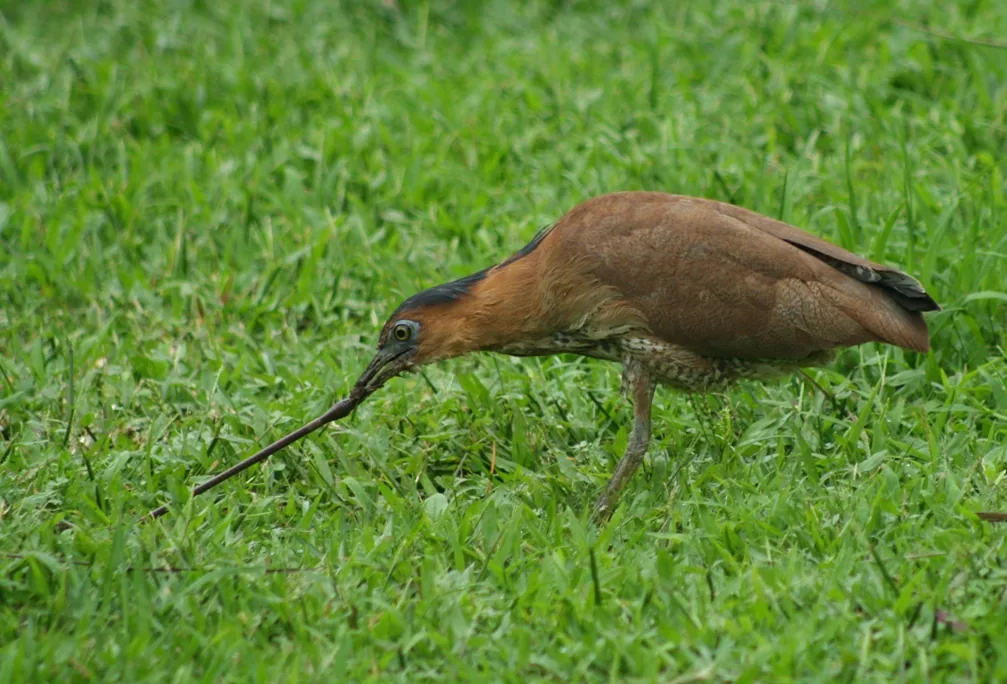
30-second overview: The Malayan Night Heron (Gorsachius melanolophus) appeared in only 25 of the approximately 4,000 bird records logged in Taiwan between 1985 and 1992 — a "rare resident" in the field guides. Today it can be seen every day along NTU's Royal Palm Boulevard and in Daan Forest Park. NTU Forestry Associate Professor Tzung-Su Ding describes it as "an elusive dream species" for birdwatchers across Southeast Asia, and notes that "for some reason, beginning about thirty years ago, Taiwan's Malayan night herons started to grow bold." A truer explanation points elsewhere: Taiwan's densely forested campuses and unsprayed lawns happen to replicate the bird's original low-elevation forest niche. The bird didn't change — the land did.
A Dream Species in Southeast Asia, a Regular Along Taipei's Royal Palms
In June 1865, Tamsui. British naturalist Robert Swinhoe collected a specimen of the Malayan Night Heron and wrote just two words in his record: "rare," followed by a note on its call — "quacks like a duck."1 One hundred and twenty years later, that assessment still stood. Between 1985 and 1992, the Chinese Wild Bird Federation's database accumulated roughly 4,000 bird records, of which the Malayan Night Heron accounted for just 25 entries.2 Field guides of the era listed it as a "rare resident," primarily inhabiting low-elevation primary broadleaf forest.
By the 2010s, this species' situation had completely reversed. NTU Forestry Associate Professor Tzung-Su Ding has remarked that in Southeast Asia, night herons of this type are actually very wary of humans, secretive and hard to find — a "dream species" among birdwatchers. Starting about thirty years ago, Taiwan's Malayan Night Herons began to grow bold, even strolling brazenly along urban roadsides, astonishing foreign researchers.3 "When animals grow bolder, people must become friendlier — only then will the distance between us shrink," Ding said in the NTU Newsletter.3
The question of "why" is precisely what this article sets out to unpack.
📝 Curator's Note
The standard popular science explanation circulating online is: "The Malayan Night Heron adapted to urban life and became unafraid of people." This is narratively convenient, but it reverses cause and effect. The neural reflexes of heron species cannot evolve an entirely new "indifference to humans" trait within thirty years. The truer explanation is that Taipei's green spaces quietly transformed, from the 1990s onward, into functional replicas of low-elevation forest. The bird didn't change — the land did.
From 25 Records to 9,000
The expansion did not happen uniformly. Sightings began rising in the 1990s and accelerated after 2000.4 National Chung Hsing University recorded its first breeding pair in 1994 (Republic of China Year 83), attributing this to the campus's "no-pesticide" policy and long-maintained "organic ecological campus" that produced an abundant earthworm environment; by 2014 the campus population was estimated at more than 30 individuals.5
What truly brought this population into focus was the team led by NTU's Hsiao-Wei Yuan. Starting in 2010, Yuan began systematic ringing on campus, establishing an initial observation sample of 8 nests and 25 birds, and tracking inter-city movements through color-band identification.2 In 2015, the team launched the "Malayan Night Heron Story House" Facebook page; in 2018, they brought online a color-band sighting report platform, turning "where you saw which individual" into a long-term record that all Taiwanese citizens could participate in.4 Taiwan is currently the only place within this species' global range that has a complete citizen science ringing-and-reporting system.
If you only look at the expansion curve, this reads as a story of successful adaptation. But "successful adaptation" is a conclusion, not a mechanism. The mechanism requires digging deeper.
Camphor Trees and Banyans as Five-Meter-High Low-Elevation Forest
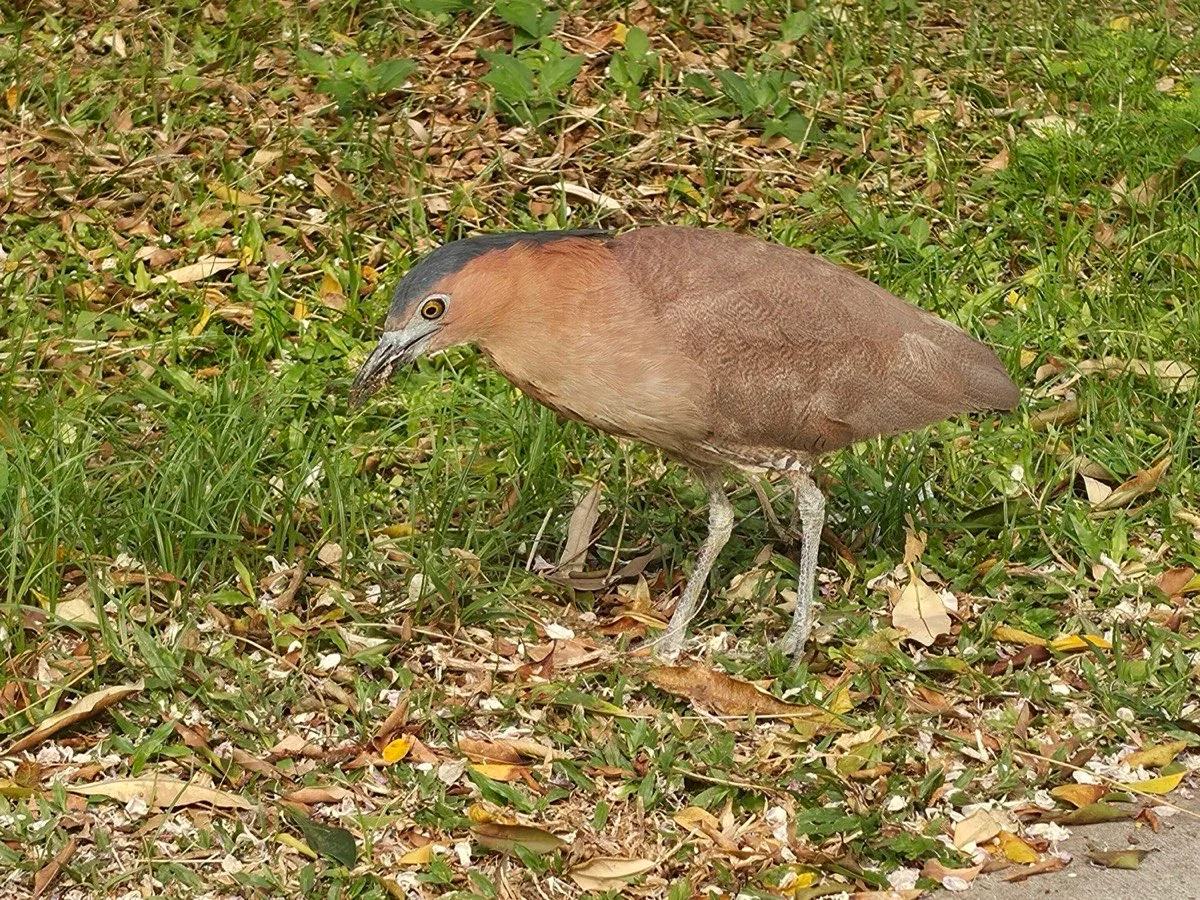
March 2026, a Malayan Night Heron foraging in a Kaohsiung urban green space. From Taipei's expansion south, city parks over thirty years have become its food supply stations. Photo: The Nature Box. Public domain (CC0) via Wikimedia Commons.
The Malayan Night Heron needs two things: tall tree canopy for nesting, and open understory for foraging with its head down. Drawing on breeding-season surveys of several major Taipei parks (Daan Forest Park, Chiang Kai-shek Memorial Hall, Youth Park, NTU, and 228 Peace Memorial Park), the species prefers nest sites at trunk forks, at near-horizontal angles, with canopy cover typically above 70%.6 Yuan's NTU survey identifies banyans as the preferred nest tree and emphasizes that the ratio of trees to lawn is the key factor in habitat selection — density either too high or too low is unsuitable.7
This is precisely the by-product of Taipei's greening. Daan Forest Park, which opened in 1994; the camphor and banyan street trees newly planted along university campuses from the 1990s onward; the mature tree zones around the Chiang Kai-shek Memorial Hall — by the 2000s these had matured into a mixed structure of "dense canopy + open lawn + leaf litter + no pesticides." This structure is functionally equivalent to a cross-section of low-elevation broadleaf forest — just cut into long strips and laid between concrete.
The second key factor is food. Earthworms in pesticide-free green spaces are an uncontested gold mine. Yuan's words in a PTS interview are direct:
"It has something of a monopoly on that resource within the city."3
Taiwan has few bird species that rely mainly on earthworms; the Malayan Night Heron's competitors are almost exclusively small ground birds that also eat earthworms, yet those rarely enter the lawn edges of large parks to forage. A 2011 dietary study by Nakamura and colleagues in Japan's Yaeyama Islands produced an interesting finding: when analyzing the food of Malayan Night Herons through pellets (castings), earthworms are so thoroughly digested that they leave absolutely no residue — meaning the land snails, spiders, freshwater crabs, and insects visible in the pellets are only the tip of the iceberg; the true proportion of earthworms may be even higher, only unquantifiable.8
Predation pressure has also reversed. In the original habitat, the pressure from crested goshawks disappears in urban areas, and the human presence in cities actually deters some predators. Multiple urban breeding-season survey records point in the same direction: the Malayan Night Heron's breeding success rate in Taipei city parks reaches 95.7%, with hatching rates and chick survival both exceeding 90%.6 Compared to forest original habitat, that is a substantial margin.
Two Misreadings of the "Freeze Posture"
"Standing stock-still" is the posture by which the Malayan Night Heron is most known to humans. A student approaches; it doesn't fly away — it stretches its neck straight upward toward the sky, motionless, and waits for the person to pass before resuming normal posture. This is the "One Two Three, Wooden Bird" scene that has been passed by word of mouth through Taiwanese campuses.
This posture has a specific name in ecology: freezing posture or bittern posture. It is an anti-predator instinct shared by all species in the heron family Ardeidae. The American Bittern's standard behavior (bill pointing skyward, feathers compressed, slow side-to-side swaying to track intruders) can be maintained for hours, rendering the bird invisible in a reed bed.9 The Malayan Night Heron inherits the same genetic expression.
The problem is that NTU's Royal Palm Boulevard has no reeds. Wuo-Wuo wrote plainly in their 2018 in-depth report: "When it stands stock-still, it is actually mimicking vegetation, using camouflage to deceive predators."10 It is not unafraid of you — it thinks you cannot see it, deploying an instinct unchanged for tens of thousands of years, misapplied to a concrete environment.
A second common misreading concerns the "neck vibration" during foraging. Taiwanese popular science articles frequently cite the claim that "the Malayan Night Heron vibrates its neck to lure earthworms." But returning to primary research literature, this hypothesis currently has no peer-reviewed source. What can be confirmed is something else: after extracting an earthworm, the Malayan Night Heron strongly shakes its neck to sever the earthworm's head before swallowing it, and uses a serpentine peristaltic motion to push the elongated prey down the esophagus — this is a swallowing aid, not a luring technique.10
💡 Did you know?
All species in the heron family Ardeidae perform the "freeze posture," but each is mismatched to a different environment: the American Bittern evolved in swamp reeds, where this motion achieves perfect concealment; the Malayan Night Heron is transplanted onto urban lawns, where the same motion becomes the "big dumb bird." The behavior is correct — the stage is wrong.
After Rain, Earthworms Surface, Motorcycles Turn the Corner
The other side of expansion is new ways of dying.
After rain, earthworms come to the surface, and Malayan Night Herons stand at the edges of campus lawns, absorbed in foraging. At that moment, the bicycle lanes, the narrow motorcycle paths through campus lanes, and the rear gates open to vehicles — all become lethal corridors. NTU's research team found that roadkill incidents are common on campus roads and in narrow lanes, prompting students to launch a "slow down" sign movement.11 The roadkill.tw network lists the Malayan Night Heron as a focal species.12
Rodenticide is an even more invisible killer. All rodenticides approved in Taiwan are anticoagulants, causing poisoned animals to bleed internally and die within 5 to 7 days. Testing conducted over three years by three institutions including the Wildlife Emergency Rescue Station at National Pingtung University of Science and Technology found that over half of Taiwan's raptors tested positive for rodenticide.13 Although the Malayan Night Heron is not a raptor, it does prey on small rodents and in theory faces the same secondary poisoning risk — yet publicly available detection data currently covers only the raptor level; systematically published data on rodenticide residues within Malayan Night Herons does not yet exist.
Records of deliberate harm are concretely disturbing. In 2019 in Tainan, a Malayan Night Heron was found with half its bill severed, flight feathers on both wings trimmed, and its right leg fractured, abandoned in a park.10 At NTU's horticulture department there was an incident in which a grandfather and grandchild shot at nestlings with a BB gun and used a cloth bag to capture the adult. Rescue statistics from the Taipei and Tainan wild bird associations indicate: "Only 20 to 30 percent of individuals assessed as capable of flying, foraging on their own, and eligible for release actually survive to release."10
Habitat loss is the least noticed yet most critical pressure. When the Jing Hua City building was demolished and the adjacent green space disappeared, territorial disputes among Malayan Night Herons erupted; a patch of rehabilitated green space in the Songshan district disappeared to development, and the local population dropped from "you could see several every day" to "you're lucky if you occasionally see two."10 These cases remind us of one thing: after moving into the city, the Malayan Night Heron did not become a super-adapted urban winner. It depends on an artificially created niche that happens to have formed — and is easily destroyed.
The Reverse Naming of "Big Dumb Bird"
In Taiwanese campuses, almost everyone calls it "big dumb bird" (大笨鳥), "one-two-three wooden bird" (一二三木頭鳥), or "sweet potato bird" (地瓜鳥). A 2024 China Times report points to the origin of this nickname: "high on-screen appearance in campuses and parks, constantly asked 'what bird is this?'"14 Wuo-Wuo's 2018 in-depth article had the direct title "The Big Dumb Bird Isn't Dumb at All" — a sit-and-wait predator has an extremely low miss rate, the Malayan Night Heron has sharp eyes and can sense surface earthworm vibrations, so by any measure it shouldn't be called "dumb."10
Researchers dislike this nickname. The title of Yuan's 2015 lecture on PTS's Humanities Classroom framed the issue directly as "the small nature in everyone's heart" — urban green space observation is the gateway through which urban children first encounter wildlife, and from there comes the beginning of caring about deeper forest conservation.15
Translating "big dumb bird" into "campus wildlife ambassador" is the reverse value of this nickname — a bird that looks dopey and won't fly away when you approach happens to be the entry point through which urban children first meet wild animals. The Taipei City Animal Protection Office and the NTU team have co-organized "Malayan Night Heron Reporting Competitions," encouraging the public to upload sighting locations and color-band combinations to query individual identities.16 Teachers from kindergarten through secondary school have incorporated it into biodiversity lesson plans and made its foraging behavior standard material for campus ecology observation.17
PTS's "Our Island" broadcast episode 1061 on June 29, 2020, 《我們與黑冠麻鷺的距離|在台灣落地生根的稀有留鳥》 ("Our Distance from the Malayan Night Heron | A Rare Resident Bird That Has Taken Root in Taiwan"), brought this bird's story to mainstream media. Taiwan is currently the only place within this species' global range (distributed across India, China, southern Japan, the Philippines, and Southeast Asia) that has a complete citizen science ringing-and-reporting system.3
Conclusion
Expansion is not necessarily adaptation.
From a rare resident in the late 1980s to a campus fixture after the 2010s, the Malayan Night Heron appears to have conquered the city — but what it depends on is a city that happened to be built to resemble low-elevation forest: dense camphor trees and banyans, unsprayed lawns, a breeding environment free of predators, and a monopoly on earthworm resources. Remove any one of these conditions (roadkill, rodenticide, habitat loss), and that over-90% breeding success rate will fall back.
So the next time you see it standing stock-still on the Royal Palm Boulevard, remember: it is not "unafraid of you." It thinks you cannot see it — deploying an instinct unchanged for tens of thousands of years. The city quietly became like its original home. It did not become less of a forest bird.
Swinhoe wrote "rare" in Tamsui 160 years ago. Today we hear the deep "whooo, whooo, whooo" call every day in Daan Forest Park. What happened in between is the story of how an island managed to preserve a small patch of moist forest understory between its concrete.
Further reading:
- Taiwan Bird Window Collision Issue — Malayan Night Heron roadkill is just one facet of urban bird risks; glass curtain walls cause bird deaths at a far more invisible scale each year
- The Ornithology of Formosa — Swinhoe's 1865 entry "Malayan Night Heron — rare" in Tamsui is a founding note in this island's ornithological history
- Taiwan Forest Ecosystems — The Malayan Night Heron's original low-elevation broadleaf forest niche, the point of comparison for understanding its urbanization
- Formosan Rock Macaque — Another case of wildlife entering the human activity zone, the inverse of the Malayan Night Heron expansion: humans keep encountering it on roads
- Endemic Species — The Malayan Night Heron is not a Taiwan endemic, but its urban population expansion in Taiwan is globally unique in scale
Image Credits
This article uses 2 publicly licensed images from Wikimedia Commons, all cached at public/article-images/nature/ to avoid hotlinking source servers:
- Hero: Malayan Night Heron, Taipei Taiwan — Photo: Dr. Raju Kasambe, 2010-05-14, CC BY-SA 3.0. Documentary record of foraging for earthworms in a Taipei city park.
- Inline: Malayan night heron foraging Kaohsiung Taiwan — Photo: The Nature Box, 2026-03-28, Public domain (CC0). A recent record of foraging in a Kaohsiung urban green space.
References
- National Museum of Natural Science Collection — Malayan Night Heron Specimen — Contains the early specimen record collected by Robert Swinhoe at Tamsui in June 1865; the earliest scientific record of the Malayan Night Heron in Taiwan.↩
- NTU Campus Planning Task Force Grant Project Report: "Population Survey and Behavioral Ecology of the Malayan Night Heron on the NTU Campus," Principal Investigator Hsiao-Wei Yuan (January 2011) — Cites research by Shen Rui-zhen and Chen Li-zhen (1996) indicating that the Malayan Night Heron accounted for only 25 of 4,000 bird records in the Chinese Wild Bird Federation's 1985–1992 database; the same report documents the initial ringing of 8 nests and 25 birds on the NTU campus starting in 2010, with color-band tracking methodology.↩
- NTU Newsletter Issue 1279, "NTU Campus Ecology Thriving — A Green Gem in the City" — Primary Chinese source for Forestry Associate Professor Tzung-Su Ding's quoted remarks "when animals grow bolder, people must become friendlier — only then will the distance between us shrink" and the paraphrase that in Southeast Asia it is a "dream species" and "for some reason, beginning about thirty years ago, Taiwan's Malayan night herons started to grow bold"; Yuan's original remark "it has something of a monopoly on that resource within the city" also appears in PTS News, 2021/01/04, "Once a Rare Resident Bird, the Malayan Night Heron Is Now Common in Urban Areas".↩
- Environmental Information Center, "Our Distance from the Malayan Night Heron" — Reports the timeline milestones of Yuan's ringing starting in 2010, the "Malayan Night Heron Story House" launching in 2015, and the color-band report platform going online in 2018; the same article documents the acceleration of sightings from the 1990s onward and notes the possible inverse explanation that destruction of low-elevation forest may have pushed the birds into the city.↩
- National Chung Hsing University Animal Blog — Malayan Night Heron Campus Record — The university's self-reported first record of a breeding pair in 1994 (ROC Year 83), with a 2014 estimate of over 30 individuals on campus, and the causal link drawn between the "no pesticide" + "organic ecological campus" policy and an abundant earthworm environment.↩
- Chang et al. 2020, "Nest-site Selection of Malayan Night Herons in Urban Area" — Urban breeding-season survey documenting the preference for nest sites at trunk forks with near-horizontal angles and canopy cover above 70%, and recording a 95.7% breeding success rate in Taipei city parks with hatching rates and chick survival both exceeding 90%. For a synthesis combining multiple sources in the same direction, see Wuo-Wuo, "The Big Dumb Bird Isn't Dumb at All" and Wikipedia: Malayan Night Heron.↩
- PanSci, "Malayan Night Heron Story House: Tracking the Big Dumb Bird from a Tiny Ring" — Cites Yuan's NTU survey identifying banyans as the preferred nesting tree (76%), the tree-to-lawn ratio as the key factor in habitat selection, and the unsuitability of density either too high or too low.↩
- Nakamura et al. 2011, "Dietary characteristics of Malayan Night Heron in Yaeyama Islands" — Food habits study in Japan's Yaeyama Islands showing that pellet and stomach content analysis is dominated by land snails, spiders, freshwater crabs, and insects; earthworms are so highly digestible they leave no trace in pellets — implying the true proportion of earthworms in the diet may be higher than pellets suggest, yet unquantifiable.↩
- Heron Conservation Behaviour Terminology — The International Heron Conservation Working Group's behavior glossary, defining freezing posture / bittern posture as a shared anti-predator behavior of all Ardeidae, and recording that the American Bittern can maintain it for hours while slowly swaying side to side to track intruders.↩
- Wuo-Wuo, "Malayan Night Heron: Making a Living in the City — Watch Out" — In-depth report on urban Malayan Night Heron survival risks, including the 2019 Tainan abuse case, the BB gun and cloth bag capture incident at NTU's horticulture department, the disappearance of Jing Hua City and Songshan habitats, the 20–30% successful release rate from rescue, and specific cases of roadkill during post-rain earthworm emergence.↩
- Newsmarket, "NTU Malayan Night Heron Roadkill Sparks Slow-Down Sign Movement" — Reports the student-initiated speed reduction campaign at NTU campus, documenting that campus roadkill commonly occurs during post-rain earthworm emergence periods.↩
- roadkill.tw Roadkill Network Focal Species — Taiwan Wildlife Roadkill Observation Network; lists the Malayan Night Heron as a long-term focal species for tracking.↩
- PanSci, "Rat Poison Harms Raptors" — Three-year cumulative testing by three institutions including the Wildlife Emergency Rescue Station at National Pingtung University of Science and Technology found that over half of Taiwan's raptors tested positive for anticoagulant rodenticide; the Malayan Night Heron, which preys on small rodents, faces the same secondary poisoning risk, but published detection data have not yet been made public.↩
- China Times 2024, "'Big Dumb Bird' Malayan Night Heron Constantly in Frame, People Always Ask 'What Bird Is That?'" — Reports that people in campuses and parks commonly use "big dumb bird," "one-two-three wooden bird," and "sweet potato bird" as nicknames, and traces the reasons for these names.↩
- Humanities Classroom, 20150117, "Sustainable Revitalization: The Small Nature in Everyone's Heart — Malayan Night Heron," Lecturer Hsiao-Wei Yuan (PTS Official YouTube Channel) — Yuan's January 17, 2015 lecture on PTS's Humanities Classroom is directly titled "The Small Nature in Everyone's Heart," arguing that urban green space is the gateway through which urban people first encounter nature and go on to care about deeper forest conservation.↩
- Taipei Travel Network, Taipei Pictorial, "Malayan Night Heron Reporting Competition" — Reports the citizen science activity co-organized by the Taipei City Animal Protection Office and the NTU team, encouraging the public to upload sighting locations and color-band combinations to query individual identities.↩
- The News Lens, "Ecological Education Plants Seeds" — Explores the Malayan Night Heron's role in campus ecological education; a common reference for elementary and secondary school teachers' ecology lesson plans.↩