
Taiwan's Climate Crisis and Net-Zero Transition: The Choice of Physical Limits Began the Day Nuclear Three Failed
30-Second Summary: On the evening of August 23, 2025, the referendum on extending the life of Nuclear Three was counted: 4.34 million "yes" votes, 74% approval, and a voter turnout of 29.53%, falling short by 650,000 votes of the threshold. The next day, Lai Ching-te announced the "Three Principles": "Nuclear safety assured, nuclear waste resolved, social consensus." Seven months later, on March 27, 2026, Taipower submitted the application to operate Nuclear Three again to the Nuclear Safety Commission, with a potential restart as early as 202812. Even though the referendum failed, Taipower is moving back toward nuclear power. This represents the deepest contradiction of an island that relies 98% on imports and promises to achieve net-zero by 2050 with a commitment of NT$9 trillion3. The geothermal government target is 200 MW by 2030, but commercial operation was only 7.4 MW at the end of 2025—a deficit of 27 times; Lan Yu Storage Facility holds 97,672 tons of nuclear waste since its activation in 1982, and its relocation deadline has been missed four times45. The energy issue is a physical limits issue.
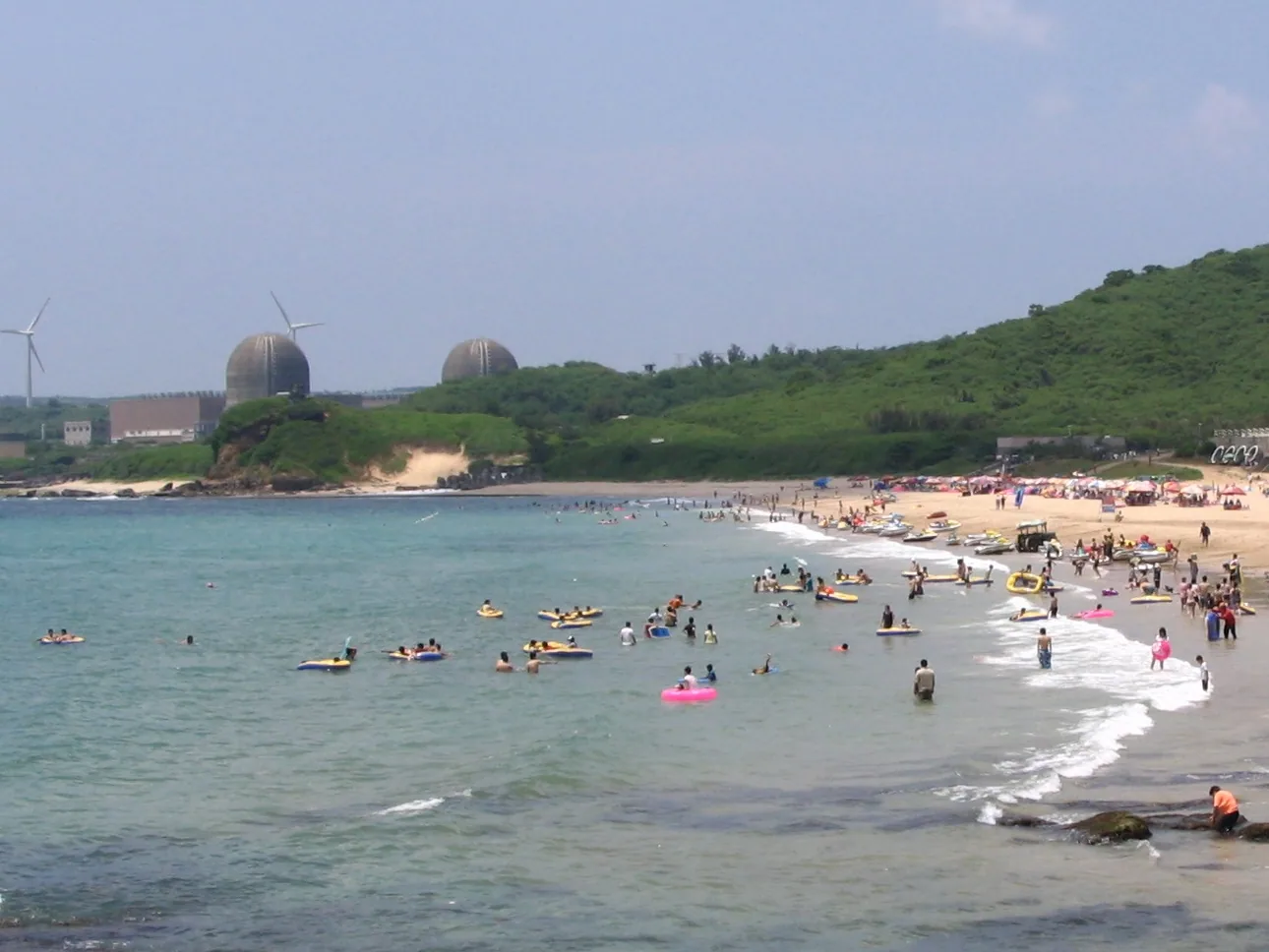
Nuclear Three Plant in Hengchun, Pingtung (Maanshan Nuclear Power Plant), located on the Nanwan coastline. Unit 1 shut down on January 1, 2025; Unit 2 shut down on May 17. Photo: M. Weitzel, CC BY-SA 3.0, via Wikimedia Commons
The Nuclear Three Referendum Day
On the evening of August 23, 2025, when voting concluded across all 22 counties and cities in Taiwan, the results of the Nuclear Three extension referendum were released: 4,342,206 votes in favor and 1,511,693 votes against, resulting in 74.17% approval. However, voter turnout was only 29.53%, which fell short of the required threshold set by referendum law—one-quarter of the total electorate (5.00 million 523 votes)—by a margin of 658,317 votes1. More people voted in favor than against, yet the referendum failed.
📝 Curator's Note: The common interpretation is that "74% approval = clear public support for nuclear energy," but this reverses cause and effect. The design of the referendum law was not meant to count who had more votes; it requires a mobilization threshold—proof that "enough people care." A turnout of 29.53% means that over two-thirds of voters chose not to go out. This is a third, more awkward signal: many people do not hold such strong opinions on energy issues as to be willing to go to the polls.
Two days later, on August 25, President Lai Ching-te held a press conference and responded: restarting nuclear power requires passing three gates—"nuclear safety assurance, resolved nuclear waste disposal, and social consensus"2. This sounds reasonable, but each point is an issue that has remained unsolved for 50 years.
Then came March 27, 2026. Taipower submitted the application plan to operate Nuclear Three again to the Nuclear Safety Council, initiating the safety inspection process following the shutdown of Unit 1 at Nuclear Three, with the inspection timeline estimated at about 18 months, potentially completing the restart as early as 20281. This is a reversal.
From the referendum results to the submission for review, just seven months passed. Nothing changed in between: nuclear waste remains in Lan Yu, no final disposal site has been selected, and social consensus remains divided. Yet, administrative procedures moved forward. This is the question this article seeks to answer: When democratic voting rejects something while the executive branch simultaneously pushes it forward, who is making the energy policy for Taiwan?
Lanyu: 1982 to 2057
To understand the story of Nuclear Plant Three, one must first understand the story of Lanyu.
In 1982, Taipower began storing low-level radioactive waste off the coast of Lanyu in the Dragon Gate Sea. The practice of describing this as a "fish canning factory" later became one of the most frequently cited cases of environmental injustice in Taiwan6. In 1988, the Aturang people launched their first large-scale protest, expressing rejection of nuclear waste through traditional rituals to "exorcise evil spirits," marking the beginning of indigenous environmental movements in Taiwan.
Over the next 38 years, relocation promises have been postponed four times: the government promised removal in 2002 in 1996, with the first postponement occurring in 2002; subsequent postponements happened in 2016, 2019, and 2023. As of 2024, the Lanyu storage facility holds a cumulative total of 97,672 barrels of low-level radioactive waste. The Nuclear Energy Commission has required Taipower to complete the relocation by 2029, but the destination remains undecided4.
If there is another postponement in 2029 (which industry generally expects), Lanyu's nuclear waste will be stored from 1982 until 2057, a total of 75 years. A remote island with a population of 4,000 people has been tasked with holding the byproducts of four national nuclear power plants for longer than the lifespan of most Taiwanese citizens.
⚠️ Controversial Viewpoint: Pro-nuclear advocates often claim that "the waste is technically solvable; it's just political resistance." However, the issue of nuclear waste has always been a temporal one. Lanyu has been dealing with this since 1982—promises have never been kept. In the most optimistic scenario, removal happens in 2029; but what happens after "removing Lanyu"? The site selection for the final disposal facility is still stalled, and local resistance in Daren Township, Taitung County, remains unresolved. Technically feasible $\neq$ politically feasible $\neq$ ethically feasible. Lanyu embodies this gap across all three layers.
PanSci reports that, spent nuclear fuel remains hot and radioactive even after the reactor is decommissioned, requiring at least five years of cooling in the on-site spent fuel pool before it can be moved. The land issue for dry storage facilities at Nuclear Plants One and Two has been stalled for over 11 years, with the New Taipei City government refusing to approve the installation of dry storage facilities, causing spent fuel to remain in the on-site spent fuel pools beyond original design capacity78. The statement quoted by PanSci—"the greatest obstacle to nuclear power life extension is the fate of spent nuclear fuel"—serves as an awkward background note for the application to operate Nuclear Plant Three again, reflecting industry consensus8.
The Physical Limits of Nuclear Waste Disposal
Let the camera zoom in on Olkiluoto Island in southern Finland.
5 kilometers beneath the surface, within a granite layer, a tunnel has been excavated. At the end of this tunnel is Onkalo, humanity's first high-level radioactive waste repository to receive operational approval. In August 2024, the Finnish nuclear safety authority STUK issued the permit; this project, which has been planned since the 1970s, has taken nearly half a century9.
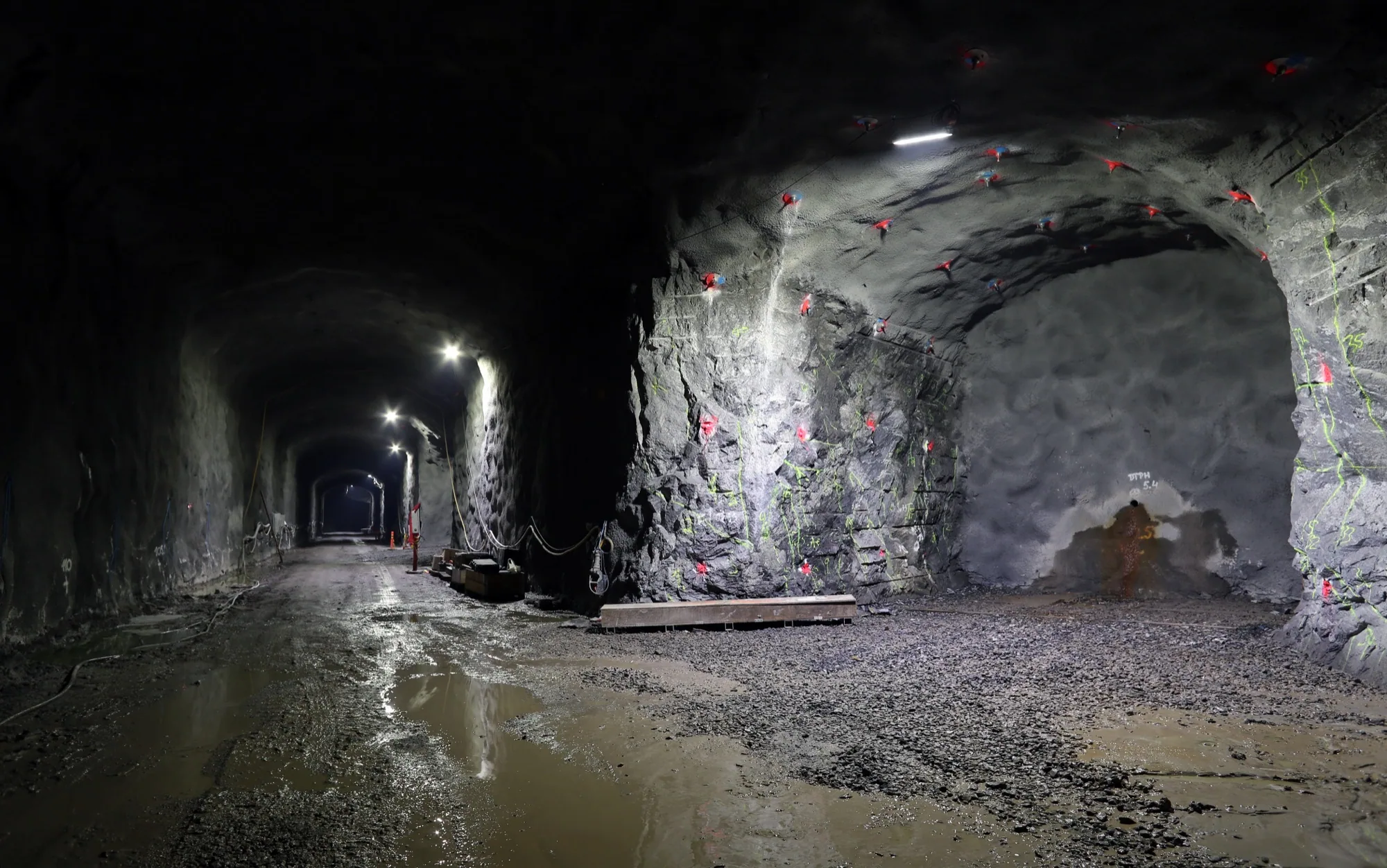
Entrance to the Onkalo high-level radioactive waste repository in Finland, 500 meters beneath a granite layer, granted operational permit in 2024. Photo: kallerna, CC BY-SA 4.0, via Wikimedia Commons
The design goal of Onkalo is to isolate nuclear waste for over 100,000 years. How extreme is this timescale? Human civilization is roughly 10,000 years old; the oldest pyramids are 4,500 years old, and our ancestors had not yet left Africa 100,000 years ago10.
💡 Did you know: The time required to isolate nuclear waste extends "to the end of human memory." The design team for Onkalo spent several years debating one question: how to inform people 100,000 years in the future not to dig here? Because by then, no existing language, symbols, government, or religion would remain. The final solution uses nuclear waste warning signs combined with multilingual warnings, but the designers admit this is only a "message for the next 1,000 years." No one knows what happens after that.
What about Taiwan's repository? Candidate sites for low-level radioactive waste disposal are in Daren Township, Taitung County, but the site selection process has been stalled by local political resistance11. The site selection process for high-level radioactive waste has not even begun. Finland spent 50 years to reach operational testing; Taiwan has zero years.
PanSci also mentioned another "physical limit solution" that was seriously discussed: space disposal of nuclear waste. "The idea of sending nuclear waste into space is physically feasible, but it requires extremely stable and safe rockets; otherwise, if a launch fails, the resulting radiation contamination to Earth would be difficult to estimate"12. The Falcon 9 failure rate for SpaceX is about 1%, meaning one in every 100 launches could send high-level radioactive waste into the atmosphere. It is physically possible, and it is not.
This is the physical limit behind the four words "a solution for nuclear waste." Its timescale is longer than human civilization itself.
Hydrogen Rainbow: Green, Blue, Grey, and Platinum
If nuclear energy is too heavy, can we bypass it?
Over the past five years, hydrogen energy has been viewed as the next wave of energy transition. The issue is that hydrogen gas itself is an energy carrier, not an energy source: it must first be "manufactured" using other energies before it can be used to generate electricity or as fuel. Where it comes from determines if it is truly "clean."
PanSci categorizes hydrogen based on its production method into different colors: "Hydrogen color codes correspond to different production methods: Grey hydrogen (natural gas SMR, emits CO₂), Blue hydrogen (Grey hydrogen + CCS), Green hydrogen (water electrolysis using renewable electricity), and Blue-Green hydrogen (methane pyrolysis, which sequesters carbon without emitting CO₂). From a carbon emission perspective, green hydrogen is the most ideal, but it is also the most expensive" 13.
| Hydrogen Color | Production Method | Carbon Emissions | Cost | Status in Taiwan |
|---|---|---|---|---|
| Grey hydrogen | Steam Methane Reforming (SMR) of natural gas | High (emits CO₂) | Low | Most commonly used in industry |
| Blue hydrogen | Grey hydrogen + Carbon Capture and Storage (CCS) | Medium (reduced after CCS) | Medium-High | No commercialization yet |
| Green hydrogen | Water electrolysis using renewable electricity | Zero | High | Planned by CPC |
| Blue-Green hydrogen | Methane pyrolysis (decarbonized fuel gas) | Zero (produces solid carbon) | Medium | Trial at Xinda Power Plant |
| White/Platinum hydrogen | Natural formation underground | Zero (no manufacturing needed) | To be explored | None |
Taiwan's hydrogen energy trial site is the Xinda Power Plant in Kaohsiung. Taipower and CAS are collaborating to test "decarbonized fuel gas" technology: decomposing natural gas (methane) at high temperatures into hydrogen and solid carbon, a process that does not produce carbon dioxide, with the solid carbon being usable as an industrial raw material 13. The appeal of this technology lies in its ability to utilize existing natural gas infrastructure, avoiding the need to overhaul the entire energy system.
However, hydrogen has its own physical limits. "Although hydrogen is a clean energy, its effect as a greenhouse gas is 11.6 times that of carbon dioxide (GWP100); if it leaks during production, transportation, or use, it can actually worsen global warming" 14. The hydrogen molecule is the smallest molecule in the universe, and leakage rates are inherently high—this is a physical limit of materials science that cannot be completely overcome by engineering efforts.
There is also an emerging category: White/Platinum hydrogen. A 2023 study released by the U.S. Geological Survey (USGS) estimated that naturally formed underground hydrogen stores due to tectonic activity could reach "tens of billions of tons," enough to meet human energy needs for hundreds of years 1415. France and Mali have already conducted commercial explorations. Taiwan is located in an active plate boundary, theoretically holding potential, but there are currently no exploration plans—making it the most distant option from reality.
📝 Curator's Note: The core takeaway for readers regarding the hydrogen rainbow classification is to always question "where does the energy come from" behind the term "clean energy." Green hydrogen is only viable when renewable electricity generation exceeds local demand, a scenario Taiwan has not yet reached. Until then, hydrogen is essentially a showcase of another type of fossil fuel.
Geothermal Taiwan: 33 GW Potential vs. 7.4 MW Reality
If hydrogen energy is a "carrier debate," geothermal is a "depth debate."
Taiwan was originally supposed to be a geothermal powerhouse. Located at the intersection of the Eurasian and Philippine Sea plates, its volcanoes, hot springs, and seismic zones form a natural geothermal resource base. In 1981, the Qingshui geothermal pilot plant in Yilan inaugurated a 3 MW system, which was Taiwan's first geothermal power plant. However, it was closed in 1993 due to technical issues such as subsurface scaling and acid corrosion.
For the next 30 years, geothermal fell into dormancy in Taiwan. It was not until 2020 that the commercial operation of the Qingshui geothermal 4.2 MW system, funded by private investment, restarted, bringing geothermal back into public discussion. In 2024, construction began on the Tǔchǎng geothermal project in Yilan with a capacity of 5.4 MW, scheduled to start in early 2026. The total commercialized geothermal capacity across Taiwan at the end of 2025 is 7.4 MW16.
What about the government's official targets? 200 MW by 2030 and 6 GW (6,000 MW) by 2050. This represents a difference of 27 times from 7.4 MW to 200 MW; and 810 times to 6 GW. This is the timeline for 5 and 25 years.
PanSci citing NTU research points out that "Taiwan's geothermal resources are widely distributed, and according to National Taiwan University research, the potential power generation from deep geothermal (below 5 kilometers in depth) reaches as high as 33,640 MW, equivalent to about 12 nuclear four-unit plants"17. However, this is only a theoretical value. Developing deep geothermal requires Enhanced Geothermal System (EGS) technology, which necessitates drilling several kilometers underground and artificially injecting water to create heat exchange layers. Currently, there are only a few demonstration projects globally, and the technology has not yet been commercialized.
Furthermore, "the development potential of shallow geothermal in Taiwan (within 3 kilometers in depth) is estimated to be no more than 1,000 MW, and several pilot projects are currently underway in Qingshui, Yilan, and Datunshan, Taipei"17. Even if the shallow resources were fully utilized, they would only meet about 3% of Taiwan's total power demand.
The advantage of geothermal is stability. "The advantage of geothermal is that it is not affected by weather like wind or solar; it is a baseload power source that can generate electricity stably 24 hours a day, giving it unique value in the energy mix"18. There are few renewable energies that can replace the baseload function of nuclear power, and geothermal is one of them—provided it can actually be built.
⚠️ Controversial View: The slow development of geothermal in Taiwan is often attributed to "immature technology." However, the conclusion reached by PanSci after interviewing industry professionals is different: the real bottleneck is subsurface uncertainty + financing difficulty. Before a geothermal well is drilled, no one can guarantee that water will come out, how much heat there will be, or for how long. Banks are unwilling to lend, and operators dare not invest. Japan and New Zealand face similar dilemmas, but both countries have government-led funds to share the risk. Geothermal developers in Taiwan currently must use the financing model of solar power: solar power generates electricity as soon as it is installed; geothermal does not. Replicating this funding structure is destined for failure.
CNA's Our Island ran a two-episode series in March 2023 titled "Generating Electricity with Heat," following the national team to Datunshan, Yilan, and Taitung villages, comprehensively covering both the "geothermal exploration" and "local geothermal power generation" aspects:
CNA's Our Island official channel: Episode 1195, "Geothermal Exploration National Team Deploys" (March 6, 2023). Following the exploration teams from the Ministry of Economic Affairs Department of Geosciences, Taipower Research Institute, and Industrial Research Institute in Datunshan and Jiaoxi, Yilan, to see how "geothermal mushrooms" are pieced together from seismic waves, rock samples, and well temperature gradients. The concrete answer to how much heat is in Taiwan's subsurface starts here.
CNA's Our Island official channel: Episode 1196, "Geothermal Power in Villages" (March 13, 2023). This episode presents two levels simultaneously—"energy transition vs. local justice"—following the negotiations in Lize, Yilan; Hongye, Taitung; and Zhonglun, Chiayi. It is one thing to deal with technical issues; it is entirely another matter whether society can move forward.
Marine Energy: The Experimental Stage of the Kuroshio's 9.4 GW
After underground, there is the sea.
The Kuroshio Current in the eastern waters off Taiwan is one of the world's strongest currents. With a flow speed of 1.5–2.5 meters/second and a width of about 100 kilometers, it flows northward year-round. Theoretically, this is an inexhaustible river of energy. The National Taiwan Science Education Institute completed offshore tests with a 100 kW prototype in 2021, marking a milestone in Taiwan's marine energy development19.
PanSci cites the NTSE estimate: "The renewable energy potential around Taiwan's waters is vast; the theoretical potential of marine energy (including current energy, wave energy, and temperature difference energy) is estimated at 9.4 GW. The Kuroshio Current passing off Taiwan's east coast is the most promising source for current energy"19.
Another direction is OTEC (Ocean Thermal Energy Conversion): using the temperature difference between surface warm water (25–28°C) and deep cold water (5°C) to drive a generator. The eastern waters off Taiwan have significant depth differences, making them considered an ideal location for OTEC. "The eastern waters off Taiwan have large depth differences and are theoretically ideal for developing OTEC, but it is still in the experimental stage"20.
However, marine energy faces physical limitations sooner than geothermal: the durability of ocean engineering. Typhoons, salt corrosion, biofouling, and deep-sea maintenance—each is a century-level engineering challenge. Internationally, no commercial OTEC power plants are operating; the leading example of Kuroshio current power generation is the 100 kW demonstration in Okinawa, Japan. Taiwan's 100 kW test was just the beginning; international experience suggests that reaching commercialization from this point takes 15–20 years.
Fourth-Generation Nuclear Energy SMR: The Bet of Bezos
If we look back at nuclear power, could fourth-generation nuclear energy be the answer?
PanSci reports: "The main difference between Natrium reactors and traditional nuclear plants is their coolant. Traditional nuclear reactors use water as a coolant, while Natrium uses liquid metal sodium. Sodium has a high boiling point, allowing it to operate at higher temperatures and improve reaction efficiency; its thermal conductivity is 100 times that of water" 21.
This is the sodium-cooled fast neutron reactor promoted by TerraPower, founded by Bill Gates. In April 2026, TerraPower's Natrium project officially began construction in Kemmerer, Wyoming, and is expected to be completed in 2030 22, one year later than originally planned, but it remains a key milestone for the commercialization of fourth-generation nuclear energy.
The selling point of fourth-generation nuclear energy is "Small Modular Reactors" (SMR): the power generation capacity drops from the traditional 1000 MW class to 100–300 MW, which can be factory-prefabricated and assembled on-site, theoretically reducing costs and shortening construction time.
However, physical limitations still exist. PanSci points out two key risks:
"Fast neutron reactors require high concentrations of uranium fuel, and the breeding reaction generates plutonium 239, which is a critical raw material for manufacturing nuclear weapons. Therefore, how to manage nuclear materials and prevent nuclear proliferation has become a difficult challenge that fast neutron reactors must face" 23.
"The construction of Natrium reactors marks a major advancement in fourth-generation nuclear power technology, but its development also comes with significant challenges" 24. Liquid sodium reacts violently with water and is flammable; the operation and maintenance of these reactors place extremely high demands on materials science, and there is currently no safety data from large-scale commercial operation.
Does Taiwan have an SMR plan? Currently, there are no official plans. Even if evaluation began now, international experience shows that from site selection, environmental impact assessment, safety review, to commercialization, it takes 15–20 years. In other words, fourth-generation nuclear energy is not the answer for net zero by 2050; even in the most optimistic scenario, it won't come online until 2045–2050.
📝 Curator's Note: Fourth-generation nuclear energy is often portrayed in international discourse as "future nuclear power," which can be used as a "good reason to delay current energy transition": If better technology will be available in 15 years, why rush now? This is the most dangerous confusion within the physical limitations. The engineering bottleneck of renewable energy is "we haven't built enough yet"; the bottleneck of fourth-generation nuclear energy is that "safety and non-proliferation data from commercial operation have not yet accumulated." These two timelines cannot replace each other; missing the window for renewable energy construction in 2030 means even SMRs in 2045 cannot save the climate.
Offshore Wind: The Leading Piece in Asia
Let's bring the focus back to what is currently happening.
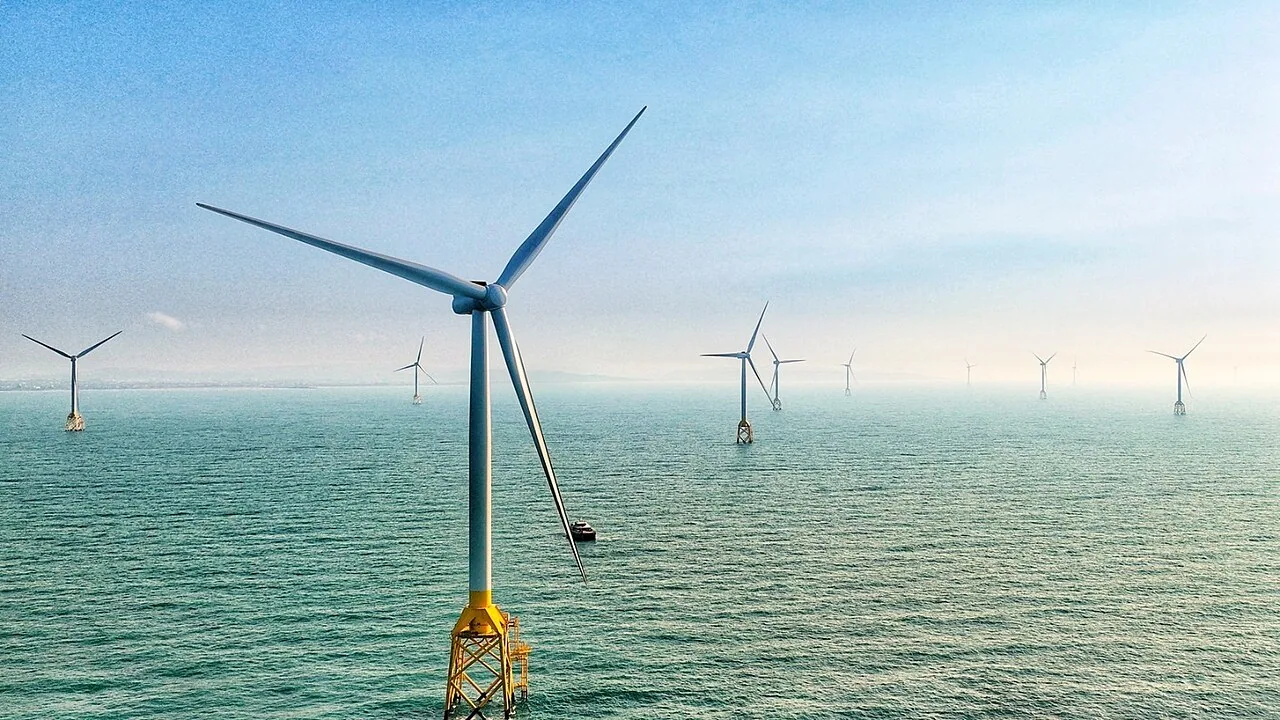
Offshore wind farm in the waters off Miaoli (Formosa 1), commissioned in 2019, is Taiwan's first large-scale offshore wind farm. Image: Ministry of Economic Affairs, Attribution, via Wikimedia Commons
The Taiwan Strait is one of the world's best wind farms. "Due to topographical factors, the Taiwan Strait exhibits a 'channeling effect,' resulting in wind speeds significantly higher than surrounding waters, making Taiwan one of the most potential locations for offshore wind power development globally"25. During winter, the northeast monsoon is squeezed through the strait by the Central Mountain Range and Fujian hills, with average wind speeds of 10–12 meters per second. This geographical reality has made offshore wind a core gamble in energy transition.
From nearly zero in 2016 to an accumulated installed capacity of about 4.5 GW3 by March 2026, Taiwan's expansion of offshore wind is among the fastest in Asia. Ørsted (Denmark) completed the Da-Chunhua Southwest Phase II and Northwest farms off Changhua with a combined construction capacity of 920 MW26. The third phase block development, starting in 2026, has an allocated capacity of 3.6 GW, targeting completion and grid connection between 2030 and 20313.
The government's blueprint is even larger: 13 GW by 2030, aiming for 55 GW by 2050.
However, the wind turbines at sea bring not only electricity but also conflict. In February 2022, over a hundred fishermen from Changhua marched north to protest the Executive Yuan, accusing the government of "making fishermen disappear" for the sake of wind power27. The restricted zones designated for offshore wind farm shipping lanes block the waters where they have worked for generations. In May 2025, a court ruling declared the lane restrictions illegal, marking the first time a Taiwanese court has challenged spatial governance related to offshore wind power28.
Solar power is following a different path. In 2024, solar photovoltaic installed capacity reached 14,281 MW, accounting for 68% of total renewable energy generation, with an output of 14.9 billion kilowatt-hours29. Diverse installation models—rooftop, ground-mounted, floating, and agri-PV—have made solar the mainstay of renewable energy. However, the agri-PV policy has sparked questions about "fake farming, real power generation," forcing the Ministry of Agriculture to strengthen inspections. On an island with only 790,000 hectares of arable land, every piece of land is a political issue.
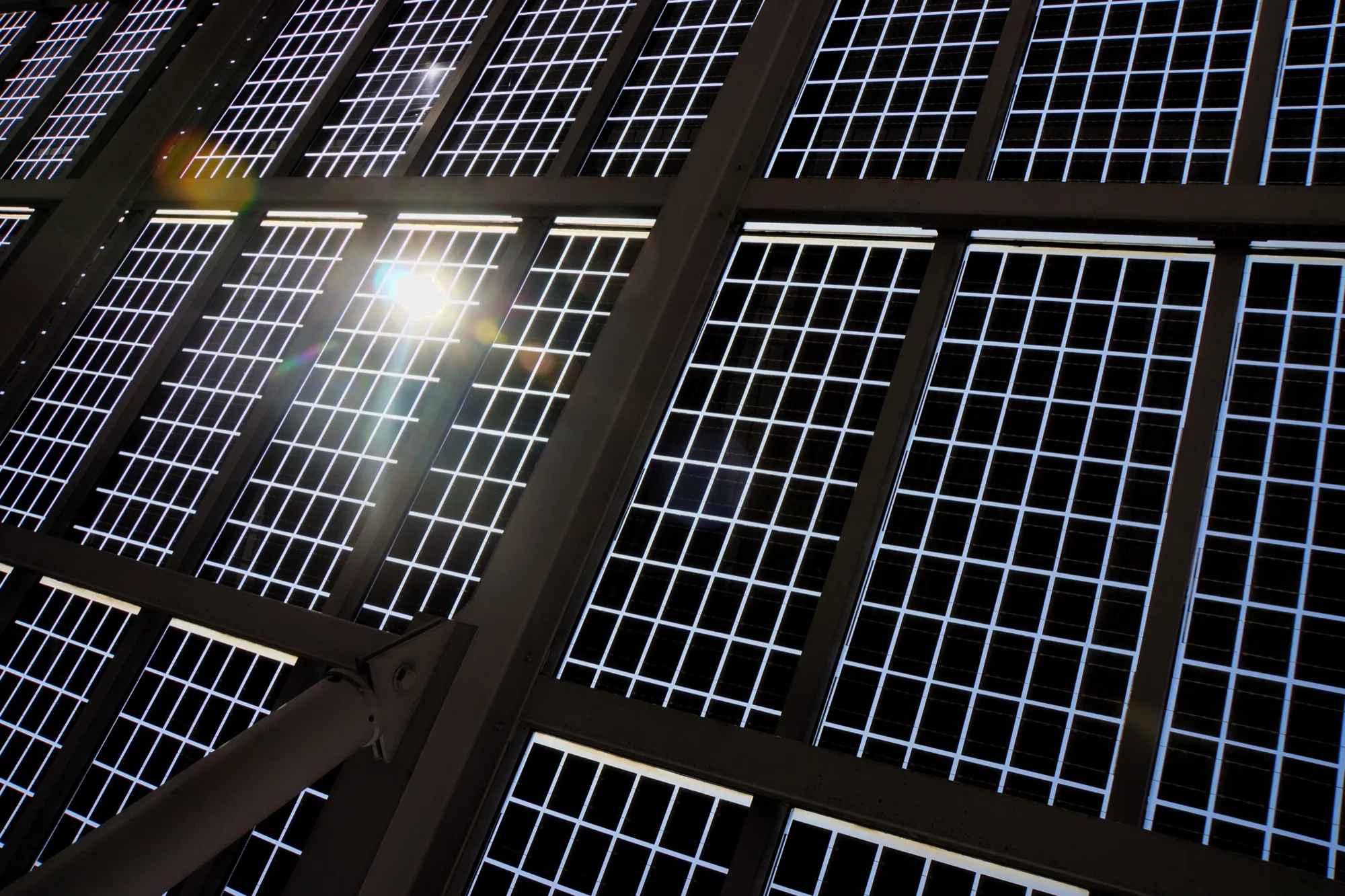
Solar panels on the Xihu Service Area roof. Taiwan's solar photovoltaic capacity reached 14,281 MW in 2024, accounting for 68% of renewables. Image: lienyuan lee, CC BY 3.0, via Wikimedia Commons
Wind and solar are the fastest-developing pieces of Taiwan's energy transition puzzle, but they are inherently intermittent: when the sun sets, there is no power; when the wind stops, there is no power. This is also the most common argument used by pro-nuclear advocates in discussions about the extension of Nuclear Unit 3: "Renewable energy is unstable and requires baseload." The issue returns to geothermal: the pace at which baseload renewable energy can be built is insufficient; the gap between current capacity and the target—a difference of 27 times—is what politically supports the restart timeline for Nuclear Unit 3 in 2028.
The Afternoon of '513
At 2:37 PM on May 13, 2021, an operator at the Luxu North Ultra-High Voltage Substation in Kaohsiung opened circuit breaker No. 3541 when he should have opened No. 354230.
This human error triggered a bus grounding fault, causing four units to trip and resulting in an instantaneous loss of 2.2 GW of generation capacity. Starting at 3 PM, rolling brownouts were implemented across Taiwan in six cycles, each lasting 50 minutes, affecting approximately 4 million households. To make matters worse, solar power generation decreased as the sun set, and drought reduced hydropower output. Full power was not restored until 8 PM after coal-fired units came back online at 7 PM.
On May 17, four days later, Unit No. 1 at Luxu failed again, leading to a second round of power outages. The two incidents collectively affected over 5.62 million households30.
The events of '513 and '517 exposed the fragility of an energy system in transition—a problem far beyond mere human error. The government's solution is energy storage: planning to reach 1.5 GW of battery energy storage by 2025, expanding to 8.6 GW by 2030. However, the cost of energy storage remains high, and the technology is still maturing.
This is the most honest aspect of the energy transition: the old system is no longer sufficient, but the new system is not yet ready. Whether or not the referendum on extending Nuclear Unit 3 passes cannot change this reality; it can only delay or accelerate the time we face it.
Pricing Carbon
On August 7, 2023, the Taiwan Carbon Trading Center was established in the Asia New Bay area of Kaohsiung, with an initial subscribed capital of NT$1 billion and a planned capital of NT$1.5 billion; among this, the Taiwan Stock Exchange invested NT$600 million and the National Development Fund invested NT$400 million31. On December 22 of that year, the first batch of international carbon credits was traded: 45 companies purchased approximately 88,500 metric tons of CO2 equivalent in international carbon credits for over $800,00031.
In 2025, the domestic carbon pricing system officially launched, and Taiwan entered its "first year of carbon pricing" 32. Changhua Cement's energy efficiency improvement project was listed at NT$3,000 per ton, while Hanbao Livestock's biogas power generation project was priced between NT$3,000 and NT$4,000. However, the market is still exploring: trading volume is relatively low, and companies generally feel that domestic carbon credit prices are too high.
At the same time, tech giants such as TSMC and Foxconn are competing on another front. Under the RE100 initiative, these companies have pledged to use 100% renewable energy. TSMC plans to achieve net-zero emissions by 2050. As international clients treat green electricity as a supply chain threshold, securing green power has become an issue of industrial survival, not merely environmental protection.
After the European Union's Carbon Border Adjustment Mechanism (CBAM) officially implemented in 2026, it will increase the carbon costs and reporting pressure for high-carbon products such as steel, cement, aluminum, fertilizers, electricity, and hydrogen exported to Europe 33. Taiwan's manufacturing industry is dominated by energy-intensive sectors; the four industries of steel, petrochemicals, cement, and paper account for 60% of industrial emissions—this represents another physical limit, a timeline set by international trade structure for Taiwan.
In his National Day speech in 2024, Lai Ching-te announced the launch of "secondary energy transformation," covering three major directions: diversified green energy, deep energy saving, and advanced energy storage 34. However, in 2025, the share of renewable energy is still significantly below the original target of 20%; depending on the statistical scope, it ranges from approximately 12.7% to 13.1% 35. The Ministry of Economic Affairs has revised its forecast, estimating that the goal of 20% can be reached starting in November 2026, and around 30% by 2030.
Sea Grass Reefs, the Atayal Indigenous People, and Meinong: Fault Lines in Environmental Justice
Every energy pathway has its opponents, and every opponent has its own history.
Taoyuan Sea Grass Reefs. The 2021 "Cherish the Sea Grass Reefs Referendum" (Case No. 20) opposed Taipower's construction of a third natural gas receiving terminal off Datan Coast, aiming to protect one of the world's largest columnar sea grass reef formations. The referendum did not pass, leading to a compromise plan for the three terminals: extending into port areas and avoiding high-density reef zones. Sea grass reef scholars still argue that the environmental impact assessment was insufficient, but the Environmental Review Committee approved it in 2023. This controversy remains unresolved; it is a physical/ecological intersection where "natural gas must be built to reduce carbon emissions, and sea grass reefs must be disturbed for natural gas."
Lanyu Atayal Indigenous People. The 44-year history of nuclear waste storage, from 1982 to 2026, is Taiwan's longest wound in environmental justice. The Lanyu people continue to protest relocation delays in 2024; in May of the same year, the Nuclear Energy Commission announced that Taipower must complete the relocation by 2029. However, where they will be moved remains unanswered4.
Meinong Anti-Reservoir. The Meinong anti-reservoir movement in the 1990s, which mobilized resistance through "Meinong Yellow Butterfly Festival" and "Hakka Spirit," ultimately forced the withdrawal of the reservoir project, making it a classic example of community-based environmental activism in Taiwan. Reading about Meinong today reveals that its spirit continues to influence other energy battlegrounds: when every wind turbine, every photovoltaic panel, and every transmission line enters a locality, they encounter the response, "We are not opposing energy transition itself; we oppose bearing the cost of transformation."
📝 Curator's Note: Common discussions on environmental justice often stop at "balancing development and conservation," but this framing flattens the issue. The true commonality among the cases of Lanyu, sea grass reefs, and Meinong is: they are all after-effects of decisions made since the 1980s, for which social movements in the 1990s–2020s have paid the price. Before 2050, many new "Lanyu" or "sea grass reef" situations will arise (fishermen in Changhua concerning offshore wind, indigenous people in Yilan regarding geothermal energy, and salt fields in Tainan related to photovoltaics). The real question is whether we can avoid repeating the decision-making model from 1982.
A detailed historical context of environmental justice can be found in Taiwan Environmental Movement History and Marine Pollution Governance and Conservation Challenges in Taiwan.
9 Trillion TWD and Physical Limits
Only by putting all energy sources on one table can the gaps in physical limits become apparent.
| Energy Source | Taiwan Theoretical Potential | 2025 Status | Government Goal / Timeline | Primary Physical Limit |
|---|---|---|---|---|
| Offshore Wind | One of the best globally | 4.5 GW | 13 GW by 2030, 55 GW by 2050 | Maritime engineering / Fisheries conflicts |
| Solar Photovoltaics | Rooftop + Agri-PV coexistence | 14.3 GW | 31 GW by 2030 | Land acquisition / Intermittency |
| Geothermal (Shallow) | ≤ 1,000 MW | 7.4 MW | 200 MW by 2030, 6 GW by 2050 | Subsurface uncertainty / Financing |
| Geothermal (Deep EGS) | 33,640 MW (Theoretical) | Laboratory stage | 2040+ | EGS technology not yet commercialized |
| Ocean Energy | 9.4 GW (Theoretical) | 100 kW trial | 2030+ | Marine engineering durability |
| Hydrogen (Green H₂) | Requires large-scale renewable power | Xindu Power Plant trial | 2030+ | Electrolysis cost / Leakage GWP |
| Nuclear Life Extension | 1,902 MW | Outage in 2025 | Restart as early as 2028 | Nuclear waste / Nuclear safety review |
| Gen IV Nuclear SMR | No local plans | US demonstration in 2030 | 2045+ | Sodium cooling safety / Nuclear proliferation |
This table answers one question: Can Taiwan achieve net-zero by 2050 without relying on nuclear energy?
Technically, yes. The National Development Council's roadmap lists 12 key strategies, estimating an investment of 9 trillion TWD36. However, the requirement is that offshore wind, solar photovoltaics, geothermal, ocean energy, hydrogen, and storage must simultaneously achieve their respective goals. Currently, geothermal lags by 27 times, ocean energy is still at the kW level, hydrogen is still in the trial phase, and storage costs remain high.
Every physical limit represents a timeline.
In Xu Huang-hsiung's model, Taiwan has no winter after 206037. Coastal risk assessments indicate that low-lying western areas face increasing pressure from sea-level rise and storm surges38. From 1911 to 2020, the average annual temperature in Taiwan has risen by 1.6°C, which is about one and a half times the global average during the same period (1.1°C)37.
An Island with 1.5 Times More Warming
In the summer of 2017, Xu Huang-hsiung from the Institute of Ecology and Resources, Taiwan Academy of Sciences, stared at data on his screen, making a prediction that made even some colleagues hesitant to voice: if emission trends did not change, winter in Taiwan might completely disappear after 206037. The number of winter days dropping to zero, with summers extending to seven months.
This is not science fiction. In Taipei, the number of days exceeding 35°C surged from three days in a year during the 1960s to nearly 15 days in recent years39. The situation was more severe in the south; Tainan and Kaohsiung have had over 30 hot days per year.
In the same building, Wang Chung-he of the Institute of Earth Sciences calculated another set of figures. His conclusion was equally alarming: the rate of sea level rise around Taiwan is twice the global average38. Multiple simulations indicate that rising sea levels and storm surges pose a higher inundation risk to low-lying coastal areas in western Taiwan; among the six metropolitan cities, populations and land area exposed in places like New Taipei, Tainan, and Kaohsiung are of particular concern.
The temperament of rain has also changed. While the total rainfall in Taiwan has not significantly decreased, when it does rain, it rains violently. Spring precipitation is declining, and the dry season is drier. In 2021, Taiwan experienced its most severe drought in 56 years; reservoir water levels hit a historic low, forcing TSMC to send water trucks to supplement their factories40. In May of that same year, two major power outages struck the entire island consecutively.
The number of days with torrential rain exceeding 200 mm increased from an average of five days in the 1960s to eight days in recent years. The Morakot Typhoon in Alishan in 2009 set a record of 2,884 mm of accumulated rainfall41, and the water that fell in three days was equivalent to the total annual precipitation of Taipei. During that typhoon, Xiao Lin Village in Jiaoxi, Kaohsiung, was buried by landslides from Hiendu Mountain in the early morning, resulting in 491 casualties42.
"Every chair represents a family." Wang Min-liang, a survivor, later told visitors at the Xiao Lin Memorial Park. He established the Nikko Xiao Lin community and tours across Taiwan with his relatives' Daman (a dance troupe). (Quoted from CCTV's Our Island)
The 2024 National Climate Change Science Report, hosted by Xu Huang-hsiung, points out that extreme precipitation events, which used to occur once every 50 years, may now happen every decade43. Yilan, Tainan, and Keelung are areas with the highest risk of coastal flooding.
As an island population of 23 million people, Taiwan's carbon emissions are disproportionately large: measured in fossil fuel $\text{CO}_2$ emissions, the annual output is about 280 million tons, averaging about 11.7 tons per capita, placing it among the top tier globally; depending on different databases and statistical scopes, its ranking falls within the top twenty worldwide44. Emissions are highly concentrated in energy use and power supply, with the energy sector accounting for the largest share, making the generation structure the core of decarbonization pressure. The root of the problem lies in the power generation structure: in 2024, natural gas accounted for about 42.4%, coal for about 39.3%, with natural gas having surpassed coal for the first time; renewable energy was about 11.6%, and nuclear energy was about 4.2%35. This is an energy system that remains highly dependent on fossil fuels, and 98% of Taiwan's energy relies on imports. Energy security and the climate crisis are the same problem.
Democracy and Physics in Parallel
The August 23, 2025, referendum on Nuclear Power Plant No. 3 pushed all the contradictions of this issue onto the ballot screen.
With 74% approval, a 29.53% voter turnout, failure to meet the threshold, Taipower's submission in March 2026, and the earliest restart in 2028, we also have: Lan Yu storing 97,672 barrels, Finland’s Onkalo taking 50 years, a geothermal differential of 27 times, marine energy still at 100 kW, and fourth-generation nuclear power not until 2045. Every number asks: Can the speed of democracy keep up with the speed of physics?
| Democratic Timeline | Physical Timeline |
|---|---|
| Referendum vote on 2025/08/23 | Lan Yu operational since 1982, possibly still in use until 2057 |
| Press conference on the Three Principles on 2025/08/25 | Nuclear waste isolation for 100,000 years |
| Taipower submission on 2026/03/27 | Finland’s final disposal site takes 50 years |
| Earliest restart in 2028 | Geothermal differential of 27 times |
| Net-zero target by 2050 | Marine energy still in 100 kW testing |
Can 9 trillion TWD buy a different future? No one knows. But we are already seeing the consequences of not spending this money: Xu Huang-hsiung's winterless 2060, Morakot's 2,884 millimeters, the rolling power rationing of 513, the division caused by the seaweed reef referendum, and Lan Yu’s 44 years of waiting.
PanSci Report cites industry consensus, stating that "the fastest progressing global final disposal site is Finland's Onkalo project, which received operational permission in August 2024. This project has been planned since the 1970s and took nearly half a century to reach this stage" 9. Taiwan has not even selected a site for its final disposal facility. Even if Nuclear Power Plant No. 3 restarts in 2028, every new fuel rod generated during the restart period must be stored somewhere.
The 97,672 barrels at Lan Yu will not disappear because the referendum passed or failed. They are there now, likely still there in 2029, and possibly still there in 2057 (if relocation is delayed again).
✦ On August 23, 2025, the referendum failed. On March 27, 2026, Taipower still submitted its documents. Between these two dates, the physical limits have not changed even once. What has changed is whether we are willing to admit that this island, which relies 98% on imported energy, is queuing up to face all the physical limits no one wants to confront.
Further Reading:
- Taiwan and Nuclear Energy Debate — This article discusses energy and physical limits; that piece covers the nuclear debate itself: four decades of anti-nuclear/pro-nuclear conflict, three referendums, and the social struggle over Lan Yu waste.
- History of Taiwan's Environmental Movement — From anti-nuclear to anti-air pollution, how the Indigenous peoples of Lan Yu, the residents of Meinong protesting reservoirs, and the seaweed reef referendum shaped today's energy politics.
- Marine Pollution Governance and Conservation Challenges in Taiwan — The ecological intersection of 80% coral bleaching from Nuclear Power Plant No. 3 discharge, marine waste, and offshore wind power.
- Taiwan's Hot Springs and Geothermal Energy — How the 30 years of geothermal silence—from the failure of Qingshui geothermal in 1981 to the restart in 2024—was formed.
- Environmental Justice and NIMBY Conflicts in Taiwan — Lan Yu, seaweed reefs, Meinong: The politics of distributing the costs of energy transition.
- Taiwan's Industrial Transformation and Upgrading — The energy ledger from high-energy manufacturing to green industry: TSMC’s RE100, CBAM, and protecting sacred mountains.
- Street Trees in Taiwan — The spatial and temporal scale of urban heat island mitigation provided by street tree shade: a minimum of ten years is needed for trees to grow enough to provide shade—this is one adjustment we cannot afford to wait for.
- Agricultural Modernization Development in Taiwan — The pressures of agricultural transformation and land use conflicts behind agri-energy symbiosis.
- Mei Yu (Rainy Season) — Local observations of climate change: "Spring rain does not come, the rainy season is concentrated."
- Taiwan's Oil Price Mechanism and CPC — The tug-of-war between subsidizing fossil fuels and sending energy-saving signals: freezing prices means cheapness is divided by liters; the more you use, the more you save, but no one has a chart to show who used the most in the last half-year.
Image Sources
- Nuclear Power Plant No. 3 Exterior (Maanshan, Hengchun, Pingtung): Maanshan Nuclear Power Plant, Nan Wan (Photo by M. Weitzel, Wikimedia Commons, CC BY-SA 3.0)
- Onkalo Underground Repository (Olkiluoto, Finland): Onkalo spent nuclear fuel repository entrance (Photo by Posiva Oy, Wikimedia Commons, CC BY-SA 4.0)
- Offshore Wind Farm in the Sea off Miaoli: Hai Long offshore wind farm (Wikimedia Commons, CC BY-SA 4.0)
- Solar Panels on a National Highway Service Area Roof: Xihu Service Area solar panels (Wikimedia Commons, CC BY-SA 3.0)
References
- Central Election Commission: Announcement of National Referendum Results for August 23, 2025 — ;CNA: Kaohsiung Nuclear Power Plant Extension Referendum - 'Yes' votes of 4.34 million did not reach the 1/4 threshold and failed;Taipower: Explanation of Kaohsiung Nuclear Power Plant Restart Plan submitted to the Nuclear Safety Commission (2026/03/27) — The Kaohsiung Nuclear Power Plant extension referendum on 2025/08/23 resulted in 4,342,206 'Yes' votes (74.17%) and 1,511,693 'No' votes, with a voter turnout of 29.53%, which did not meet the 1/4 threshold (5,000,523 votes) required by the referendum law, so the referendum failed. Taipower submitted an application for the Kaohsiung Nuclear Power Plant restart plan to the Nuclear Safety Commission on March 27, 2026, with an estimated safety inspection period of about 18 months, and the earliest completion is expected in 2028.↩23
- CNA: Lai Ching-te's Comments After Kaohsiung Nuclear Power Plant Referendum Proposing Three Principles for Nuclear Safety, Waste Disposal, and Social Consensus — On August 25, 2025, President Lai Ching-te issued a formal response to the results of the Kaohsiung Nuclear Power Plant extension referendum, proposing 'Three Principles' for restarting nuclear power: absolute nuclear safety, solvable nuclear waste disposal, and social consensus, and instructed the Ministry of Economic Affairs and the Nuclear Safety Commission to initiate safety inspection procedures.↩2
- Ministry of Economic Affairs Energy Agency: Announcement of Third Phase Selection Mechanism for Offshore Wind Farm Blocks — The Ministry of Economic Affairs announced on March 27, 2026, that as of March 26, 2026, the cumulative installed capacity of offshore wind in Taiwan was approximately 4.5GW, with the third phase allocation being 3.6GW, targeted for completion and grid connection between 2030 and 2031.↩23
- Nuclear Energy Commission: Lan Yu Storage Facility Capacity Announcement (2024) — An official announcement from the Nuclear Energy Commission stating that as of 2024, the Lan Yu low-level radioactive waste storage facility has accumulated a total of 97,672 barrels. Since its activation in 1982, there have been multiple postponements of relocation commitments in 1996, 2002, 2016, 2019, and 2023, and the Nuclear Energy Commission requires Taipower to complete the relocation by 2029. Content Curation Partner per MOU 2026-05-05.↩23
- Ministry of Economic Affairs Energy Agency: Geothermal Power Target and Commercialization Capacity (2025) — Government geothermal power policy targets: reaching 200 MW by 2030 and 6 GW (6,000 MW) by 2050; as of the end of 2025, the total geothermal commercialization capacity in Taiwan is about 7.4 MW, mainly from Qingshui Geothermal in Yilan at 4.2 MW and some small units, which is about 27 times less than the 2030 target.↩
- Wikipedia: Lan Yu Storage Facility — Before the activation of the Lan Yu storage facility in 1982, Taipower claimed to be building a 'fish cannery' for the Atayal residents without fully disclosing the nature of nuclear waste storage; the Atayal tribe initiated the first 'expulsion of evil spirits' protest in 1988, marking the beginning of indigenous environmental movements in Taiwan.↩
- PanSci General Science: Nuclear Power Plant No. 2 Decommissioned, But Nuclear Waste Still Needs to Be Stored for Another 20 Years — Content Curation Partner per MOU 2026-05-05. Nuclear Power Plant No. 2 was officially decommissioned at the end of 2023, but the nuclear fuel rods remain hot and radioactive after reactor decommissioning and must be cooled in the on-site fuel pool for at least 5 years before they can be moved; Daren Township, Taitung County is a candidate site for low-level nuclear waste final disposal, and the site selection process is stuck due to local political resistance.↩
- PanSci: What is the real problem with nuclear power life extension? — Content Curation Partner per MOU 2026-05-05. The land use issue for dry storage facilities at nuclear power plants has been stalled for over 11 years, as the New Taipei City government refuses to approve the installation of dry storage facilities, leading to spent fuel from NPP No. 1 and NPP No. 2 remaining in on-site pools beyond original design capacity; the biggest obstacle to nuclear energy life extension is the disposal of spent nuclear fuel.↩2
- PanSci: If there is nowhere for nuclear waste, are there other methods? — Content Curation Partner per MOU 2026-05-05. The fastest progressing final repository globally is the Onkalo project in Finland, which obtained operating permit in August 2024 after nearly half a century of planning since the 1970s; a final repository must isolate waste for over 100,000 years, a timescale far exceeding the existence of human civilization.↩2
- Posiva Oy: Introduction to Onkalo Final Repository Design — Official statement from Posiva, operating the Onkalo repository in Finland, stating that the design goal is to isolate high-level radioactive waste for at least 100,000 years, incorporating a multi-barrier system (copper casing + bentonite clay + granite layer) and a long-term memory warning system.↩
- Datren Township Office, Taitung County: Issues of Low-Level Waste Final Disposal Site — Datren Township in Taitung County is one of two candidate sites for low-level nuclear waste final disposal (the other being Wukiu in Kinmen County); local public opinion is divided, and there is strong opposition from indigenous tribes, and a site selection referendum has not yet been successfully held.↩
- PanSci: Feasibility analysis of space disposal for nuclear waste — Content Curation Partner per MOU 2026-05-05. Space disposal of nuclear waste is physically possible but requires a very stable and reliable rocket; radiation pollution caused to Earth in case of launch failure is difficult to estimate; with the current failure rate of rockets, there is about one risk per 100 launches, which does not meet engineering practical requirements.↩
- PanSci: Does improved natural gas power generation technology not produce carbon dioxide? Grey hydrogen, blue hydrogen, green hydrogen — Content Curation Partner per MOU 2026-05-05. The color code for hydrogen corresponds to different production methods: grey hydrogen (CO₂ emission from natural gas SMR), blue hydrogen (grey hydrogen + CCS), green hydrogen (water electrolysis using renewable electricity), and blue-green hydrogen (methane thermal cracking with no CO₂ emission); Taipower and CAS have collaborated to test carbon-free hydrogen technology at Xinda Power Plant.↩2
- PanSci: Musk dismisses it; Bezos treasures it! Hydrogen energy — Content Curation Partner per MOU 2026-05-05. Besides green hydrogen, the emerging white/gold hydrogen is naturally formed underground hydrogen, with USGS estimating reserves could reach tens of billions of tons; however, the GWP100 of hydrogen is 11.6 times that of carbon dioxide, and leakage will worsen global warming (the academic community still has a dispute in the range of 7-37 for the GWP figure).↩2
- USGS: Geological Hydrogen — A New Energy Frontier (2023) — A 2023 report by the U.S. Geological Survey on geological hydrogen, estimating that global underground natural hydrogen reserves could reach tens of billions of tons, enough to meet human energy needs for several hundred years; France and Mali already have commercial exploration cases, while Taiwan's plate boundary is active but has no current exploration plans.↩
- CNA: Tuchang Geothermal Power Plant in Yilan starts construction, expected to start in 2026 — The 5.4 MW unit of the Tuchang geothermal power plant in Yilan County was put into operation in 2024 and is scheduled to start in early 2026; it is Taiwan's second commercial-scale geothermal power plant at the MW level; as of the end of 2025, total geothermal commercial capacity nationwide is about 7.4 MW, including 4.2 MW from freshwater geothermal sources and other small units.↩
- PanSci: Is it feasible for Taiwan to develop geothermal power (Part I)? — Content Curation Partner per MOU 2026-05-05. According to research by National Taiwan University, the potential electricity generation from deep geothermal energy (below 5 km) reaches 33,640 MW, equivalent to about 12 Nuke IV plants, but development requires Enhanced Geothermal Systems (EGS) technology which is still in the R&D stage; the potential of shallow geothermal energy (within 3 km) is estimated not to exceed 1,000 MW.↩2
- PanSci: Geothermal advantages and application scenarios in Taiwan — Content Curation Partner per MOU 2026-05-05. Geothermal energy is unaffected by weather and provides stable baseload power 24 hours a day, giving it unique value in the energy mix; however, uncertainty underground makes financing difficult, which is the fundamental bottleneck for geothermal development in Taiwan.↩
- PanSci: The higher the 'sacred mountain' protection, the greater the power pressure: Marine energy in Taiwan is the solution — Content Curation Partner per MOU 2026-05-05. The theoretical potential of marine energy (ocean currents, waves, temperature differences) around Taiwan reaches 9.4 GW; the Kuroshio Current passing off the east coast of Taiwan is the most promising source of ocean current energy, and CAS completed a 100 kW prototype test in 2021.↩2
- PanSci: The possibility of Ocean Thermal Energy Conversion (OTEC) in Taiwan — Content Curation Partner per MOU 2026-05-05. OTEC generates electricity from the temperature difference between surface warm water (25-28°C) and deep cold water (5°C); the eastern waters of Taiwan have a large depth difference and are theoretically ideal, but it is still in the experimental stage with no commercial power plants globally.↩
- PanSci Science: Bill Gates' Fourth Generation Nuclear Power Plant Finally Begins Construction — Content Curation Partner per MOU 2026-05-05. The main difference between the Natrium reactor and traditional nuclear power plants is the coolant: traditional ones use water, while Natrium uses liquid sodium; sodium has a high boiling point and can operate at higher temperatures to improve reaction efficiency, with a thermal conductivity 100 times that of water.↩
- TechOrange: TerraPower Natrium Project Starts in Wyoming in 2026 — TerraPower's Natrium fourth-generation nuclear power plant project is scheduled to officially start construction in Kemmerer, Wyoming in April 2026, slightly later than planned. It is expected to be completed in 2030 and represents a key milestone in the commercialization of sodium-cooled fast neutron reactors globally.↩
- PanSci Science: Nuclear Proliferation Risks of Fourth Generation Nuclear Power — Content Curation Partner per MOU 2026-05-05. Fast neutron reactors require high-concentration uranium fuel, and the breeding process generates Plutonium-239, which is a key raw material for manufacturing nuclear weapons; how to manage nuclear materials and prevent nuclear proliferation is a challenge that fast neutron reactors must face.↩
- PanSci Science: Safety Challenges of Natrium Reactors — Content Curation Partner per MOU 2026-05-05. The construction of Natrium reactors marks an advancement in fourth-generation nuclear power plant technology, but development comes with major challenges; liquid sodium reacts violently with water and is flammable, and reactor operation requires extremely high demands on material science, with a lack of safety data from large-scale commercial operation.↩
- PanSci Science: Offshore Wind Construction is Expensive and Troublesome, Why Does Taiwan Still Need to Develop It Vigorously? — Content Curation Partner per MOU 2026-05-05. Due to topographical factors, the Taiwan Strait forms a 'channeling effect,' resulting in wind speeds significantly higher than surrounding waters, making Taiwan one of the most potential locations for offshore wind power development globally.↩
- PV Magazine: Taiwan solar and offshore wind targets — Reports on Wecsun Energy completing the construction of two phases (Southwest Phase II and Northwest Wind Farm) totaling 920MW, and plans for Taiwan to add 8.2GW of solar and offshore wind by the end of 2026.↩
- Environmental Information Center: Changhua Fishermen Protest Offshore Wind (2022) — Reports on over a hundred fishermen protesting at the Executive Yuan regarding the blockade of generational fishing grounds by offshore wind farm shipping lanes, shouting slogans like 'extinction of fishermen.'↩
- Environmental Information Center: Court Ruling Declares Offshore Wind Shipping Lane Restrictions Illegal (2025) — Taiwan's first court ruling challenging offshore wind spatial governance, which determined that the lane restrictions infringed upon fishermen's rights, causing a stir in the energy sector.↩
- Taipower: Renewable Energy Generation Statistics — Official statistics from Taiwan Power Company, recording historical data on installed capacity and generation volume of various types of renewable energy; in 2024, solar power installed capacity was 14,281 MW with a generation of 14.9 billion kilowatt-hours.↩
- Taipower: Preliminary Investigation into 513 Power Outage Released — ;Ministry of Economic Affairs: Review Report on 513 and 517 Power Outages — Official data explains that the 513 incident involved a misoperation of circuit breaker No. 3541, causing an instantaneous decrease in power supply capacity by about 2.2 GW and affecting approximately 4 million households, and summarizes the 517 event and subsequent review.↩2
- Presidential Office Press Release: Taiwan Carbon Exchange Inaugurated — ;Taiwan Stock Exchange Annual Report 2023;Cennews: Taiwan Carbon Exchange expected to launch at the end of July, operating with North-South division — The Carbon Exchange was inaugurated on August 7, 2023; it has a planned capital of 1.5 billion TWD and an initial paid-in capital of 1 billion TWD, with the Stock Exchange contributing 600 million TWD and the National Development Fund contributing 400 million TWD. The Stock Exchange's annual report also states that the first batch of international carbon credits traded totaled 88,520 tons of CO2e, involving 27 companies (including 45 subsidiaries of financial holding companies).↩2
- KPMG Taiwan: Carbon Pricing Trend Analysis (2025) — Analyzes the market dynamics after the carbon fee system is implemented in Taiwan in 2025, including domestic carbon pricing (Far Eastern Chemical 3,000 TWD/ton, Hanbao Livestock 3,000-4,000 TWD/ton) and the challenge of low trading volume.↩
- Official Page of the EU Carbon Border Adjustment Mechanism — CBAM entered a transitional period in October 2023 and will be fully implemented in 2026, covering six major product categories including steel, cement, aluminum, fertilizers, electricity, and hydrogen.↩
- Reccessary: Taiwan Energy Policy Outlook 2025 — Reports on Lai Ching-te's 'Second Energy Transition' policy direction announced in the National Day speech in 2024: diversified green energy, deep energy saving, and advanced energy storage.↩
- Ministry of Economic Affairs Energy Agency Statistics: Power Generation Structure - By Fuel Type — ;Ministry of Environment Energy Information Platform: Power Structure;Economic Daily: Ministry of Economic Affairs states that renewable energy generation share can reach 20% from November 2026 — According to statistics from the Ministry of Economic Affairs Energy Agency, in 2024, natural gas accounted for approximately 42.4%, coal for about 39.3%, renewable energy for about 11.5% to 11.6%, and nuclear power for about 4.2%; the Ministry of Environment Energy Information Platform shows that the share of renewable energy in the national total power generation in 2025 is 13.1%, while the common metric used in Taipower's system power purchase structure is about 12.7%, indicating different metrics. The Ministry of Economic Affairs stated in May 2025 that it is estimated to reach 20% from November 2026 and about 30% by 2030.↩2
- Presidential Office Press Release: Tsai Ing-wen's Speech on World Earth Day 2021 — Tsai Ing-wen first declared as President that 'Net Zero Transition by 2050 is a goal for the whole world and also a goal for Taiwan,' setting the policy tone for the subsequent National Development Council's Net Zero roadmap.↩
- United Daily News Vision Project: Interview with Xu Huang-hsiung — A team from the Institute of National Taiwan Research Laboratories' Center for Environmental Change analyzed Taiwan's temperature data from 1911 to 2020, pointing out that Taiwan has warmed by 1.6°C in a century, winter days have been shortened by nearly half, and under the worst-case scenario, winter days could reach zero after 2060.↩23
- CSRone Sustainability Think Tank: Interview with Wang Chung-he — Wang Chung-he, a visiting researcher at the Institute of Earth Sciences, has been tracking sea level changes around Taiwan for a long time and pointed out that the rate of sea level rise is higher than the global average; the article uses conservative risk descriptions to avoid simplifying different research scenarios into absolute conclusions.↩2
- Central Weather Administration Climate Change Information Platform — A database of Taiwan's climate observation history, which includes records of temperature, rainfall, and extreme weather events at various stations, including trends in the number of days exceeding 35°C in Taipei.↩
- BBC Chinese: Taiwan's Worst Drought in 56 Years (2021) — Reports on the drought in southern and central Taiwan in 2021, where reservoir water levels dropped below ten percent, leading power companies like TSMC to implement emergency measures using water wheels.↩
- National Disaster Prevention and Relief Technology Center: Morakot Typhoon Disaster Records — Official disaster files recording the cumulative rainfall of 2,884 mm at Alishan station during Typhoon Morakot, which is the highest record in Taiwan's meteorological observation history.↩
- Reporter: Xiao Lin Village Collapse Investigation — A deep investigation into the process of the landslide at Xiandu Mountain in Xiao Lin Village and the full context of 491 casualties, including geological causes and analysis of warning system failures.↩
- Environmental Information Center: 2024 National Climate Change Science Report — Reports on key findings from the latest scientific report hosted by Xu Huang-hsiung: extreme rainfall events that once occurred every 50 years may become events occurring every 10 years, and the number of days with temperatures above 36°C may increase by 75 days.↩
- Executive Yuan Environmental Protection Administration Greenhouse Gas Emission Statistics — Taiwan's official greenhouse gas emission database, which records national emissions lists, departmental emissions, and per capita emissions data for years.↩