
30-second overview: Shilin's old name was "Pattsiran" (Bazhilian/Bazhilin in Chinese transliteration), a Ketagalan word meaning "hot spring"; before Han settlers arrived, this was the land of the Kimassauw community. In 1796, the first year of the Jiaqing reign, Zhangzhou people built a Tianhou Temple on Zhilan Street. In 1859, the ninth year of the Xianfeng reign, Quanzhou people attacked, burning the entire street together with the temple. In the 1860 gengshen year, local gentryman Pan Yongqing (1820-1873) led the village's relocation to Xiashulin, using the rebuilt temple as the center to lay out four squared-off streets: Dadong Road, Danan Road, Daxi Road, and Dabei Road. Small gate barriers were also set at street corners to prevent another Quanzhou attack1. In 1864, the third year of the Tongzhi reign, the temple was rebuilt at its present site. In 1880, the sixth year of the Guangxu reign, it was renamed "Cixian Temple," drawing on the phrase "sincere toward the common people" from the Book of Documents2. In 1909, the Japanese established a market opposite the temple; in 1915, the brick market was completed. Vendors steadily encroached on the temple forecourt until the temple built walls to preserve a narrow strip of land3. Yangming Theater opened on Wenlin Road in 1955. Hot-Star Large Fried Chicken was invented in Taichung in 1992 and entered Shilin Night Market in 1999. In 2002, the Taipei City Government demolished postwar-added sheds; the new market opened in 2011; the underground food court began trial operations on December 24, 20113. In a 2024 tourism survey, Shilin Night Market was overtaken by Raohe Street and fell to second place in Taipei4. But since the moment Cixian Temple moved to its present site in 1864, it has stood at No. 84 Danan Road for 162 years. What this article wants to say is this: at the moment you stand at the entrance to Shilin Night Market at 7:30 p.m. and bite into a fried chicken cutlet, beneath your feet are at once the asphalt of Wenlin Road, the range where the Ketagalan people of the Kimassauw community moved 400 years ago, the site chosen for Cixian Temple 230 years ago, and the grid left by the Japanese vegetable market of 1909. Three layers of time are compressed into 400 meters. No one leads you to see them, but they are all there.
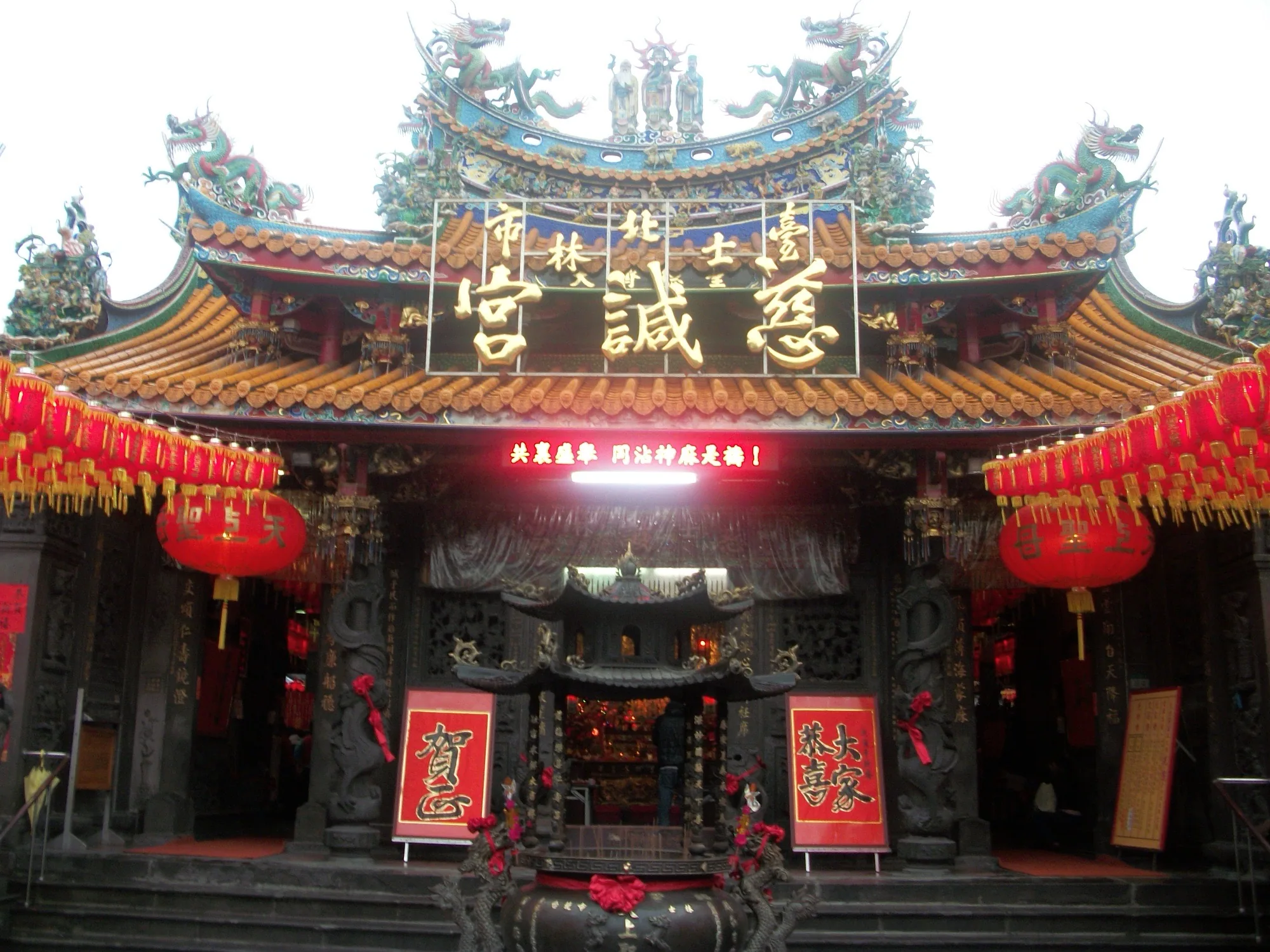
Shilin Cixian Temple Sanchuan Hall. Photo: 龍本, 2010-02-13. License via Wikimedia Commons (CC BY-SA 3.0).
At 7:30 p.m., Cixian Temple's Bell Rings
Walk from Exit 1 of MRT Jiantan Station toward Shilin Night Market, cross the traffic light at Jihe Road, and at around 6:30 p.m. you enter "night-market Taipei." The block enclosed by Wenlin Road, Dadong Road, and Danan Road fills with carts one after another. Charcoal fires for grilled sausages rise; iron griddles for oyster omelets start to heat. Around 7:30, the crowd reaches its first peak: Korean tourists holding phones, Japanese tour groups following a guide's little flag, Southeast Asian families pouring out of Jiantan Station, and Taipei university students walking in from the peripheral transit station. The air is a mixed smell of fried food, sugar, chili, and excrement; watch whether there is a gutter cover by your feet.
If you turn into No. 84 Danan Road at this hour, you will hear another sound.
Cixian Temple's Sanchuan Hall is lit5. The main hall enshrines Mazu, the sea goddess. It is not a festival night, but the temple still has scattered worshippers. Looking out from the temple forecourt, Wenlin Road lies to the east, Dabei Road to the north, Danan Road to the south, and Daxi Road to the west: four streets enclosing the temple as a squared-off center. A person offering incense in the main hall can look up and see the KTV sign diagonally opposite, see the oil smoke from the chicken cutlet stall next door, and hear vendors calling to tourists, "Korean OK."
But most people standing in the center of the forecourt are older residents nearby, young families, and office workers getting off late. To them, the night market is "outside"; the temple is "inside."
How long has worship continued here? In 1796, the first year of the Jiaqing reign, Zhangzhou people built a Tianhou Temple, the predecessor of Cixian Temple, on old Zhilan Street. By 2026 it is 230 years old1. That is 79 years before the Qing court established Taipei Prefecture in 18756, 99 years before the Japanese came to Taiwan in 1895, and 153 years before the Kuomintang government relocated to Taiwan in 1949.
Curator's note: Tourist brochures describe Shilin Night Market as "Taiwan's largest" and "a must-visit for international tourists," and stop there. But that narrative misses one thing: the night market is a byproduct of a 230-year-old temple. When Cixian Temple was rebuilt at its present site in 1864, Pan Yongqing planned the square in front of the temple as a "place for agricultural and fishery trade"7, meaning the temple and the market were originally the same spatial formula. The Japanese establishment of a market opposite the temple in 1909, the postwar night market spilling out around the market, and the touristification that began in the 1990s are all physical consequences of the grid planned in 1860. The night market is the child born from the temple; the child has simply grown much taller than its mother.
The Hot Springs of the Kimassauw Community, Pattsiran, and Shilin
The two characters "Shilin" came later.
Before Han settlers arrived, this land belonged to the Ketagalan Kimassauw community. Wikipedia states this briefly: "Shilin District was originally the settlement of the Pingpu Indigenous 'Kimassauw community'"8. The Kimassauw community, a Chinese-character transliteration with Ketagalan romanizations often seen as Kimassauw, Kimasaon, and other variants, was an important Ketagalan settlement in the northern Taipei Basin8. The area from today's Jiantan Station to Zhishanyan was where they fished, hunted, and cultivated millet.
After Han settlement began, the place was called "Pattsiran" in Chinese transliteration. "Shilin District's old name, 'Bazhilian' (Pattsiran), means 'hot spring' in the Ketagalan language"8; this is Wikipedia's word-for-word explanation. After Pattsiran was transliterated into Chinese characters, it was overlaid with Han descriptions of "dense woods," becoming "Bazhilianlin" and "Bazhilinlin," later simplified into "Bazhilin," "Bazhilian," or simply "Zhilan"8. A Ketagalan word was transliterated by Han settlers into four variants, each adding a little of the settlers' own imagination.
"Shilin" appeared only in the late nineteenth century.
After the Zhangzhou-Quanzhou armed feud of 1859, discussed in the next section, Zhangzhou people fled the original "old Zhilan Street" near today's Shennong Temple and rebuilt in the area called "Xiashulin"9. "Xiashulin" was originally just a description: the wooded tract downstream on the south bank of the Keelung River. But in Minnan, "shulin" (woods) and "Shilin" (forest of scholars) sound the same. Since Pan Yongqing's community, under his leadership, emphasized education, academies, and the civil examination path, local gentry renamed the new street "Shilin," taking the meaning "scholars like a forest"10.
The names of this place have repeatedly been overlaid. The Ketagalan "hot spring" (Pattsiran) became the Han "Bazhilian"/"Zhilan" (transliteration plus wooded imagination), then the refugee new street's "Xiashulin"/"Shilin" (terrain plus scholars), then Shilin Street under Shichisei District, Taipei Prefecture, during Japanese rule (1933), then Shilin Township, Taipei County, after the war (1946), and, after its 1968 transfer into Taipei City, "Shilin District"11.
Seven names, four hundred years, the same land.
1859: Quanzhou People Burned Down Old Zhilan Street
The standard narrative of categorized armed feuds in Taipei casts the 1853 "Ding-Xia Jiao conflict" in Bangka as the protagonist12. People from the Sanyi group (Jinjiang, Nan'an, and Hui'an) fought Tong'an people, who were also from Quanzhou but from a different county, over docks. The defeated Tong'an people fled to Dadaocheng and opened a new commercial port. That storyline is famous.
The Shilin feud came six years later, in 1859, and the opponents were different. The 1859 conflict, in the ninth year of the Xianfeng reign, was Zhangzhou people versus Quanzhou people, crossing county lines rather than merely county against county within Quanzhou. The battlefield was scattered across several Zhangzhou settlements in the greater Taipei Basin: "In the ninth year of the Xianfeng reign (1859), Quanzhou people attacked Zhilan Street (the Shennong Temple area, also called the old street), pillaged and burned it heavily, and the whole street together with Tianhou Temple was destroyed by fire"9.
Where was the street that burned?
It was not where today's Shilin Night Market stands. Before 1859, old Zhilan Street was near today's Shennong Temple, also known as Shilin Shennong Temple and formerly Zhilan Temple, around the intersection of Danan Road and Xiaodong Street13. Shennong Temple itself has an even earlier history than Cixian Temple: when Han settlers entered the area in 1709, there was already a Fude Shrine; in 1741, it moved to the Zhilan Street location because of flooding13. In other words, the 1859 armed feud burned down an old street that had stood there at least since 1741.
How large was the feud? According to the "Record of Warfare and Fire" in the Tamsui Subprefecture Gazetteer: "Fangliao Street (Zhonghe) burned. In the Zhangzhou-Quanzhou armed feud, Zhangzhou people burned Gangzizui (Puqian, Banqiao), Wayo (today's Zhonghe-Yonghe border), and Jialazai (today's Xiyuan and Dongyuan in Taipei) ... then Baicuo Slope (today's Banqiao), Zhilan First and Second Forts (today's Shilin), all had their houses completely destroyed"14. Both sides burned multiple sites across the greater Taipei Basin in simultaneous retaliation, and Zhangzhou bases, including Shilin, were attacked and burned by Quanzhou people.
Afterward, village elders began discussing what to do.
The gentryman Pan Yongqing then stood on Yuanshanziding, today's Zhishanyan, and looked out over the Shilin plain7. He saw that the old street's site was low-lying and flood-prone, as Shennong Temple had already once moved because of flooding, and that it sat on the front line of Zhangzhou-Quanzhou conflict. He proposed relocation: move the whole Zhangzhou settlement to Xiashulin on the south bank of the old Keelung River, where the ground was higher, flooding was less likely, and the river separated it from Quanzhou settlements opposite, making defense easier.
The year 1860, the tenth year of the Xianfeng reign, was a gengshen year, the Year of the Monkey. A local saying held that "a monkey resting in a tree is an auspicious sign"15, and since large-scale armed feud did not erupt again that year, Pan Yongqing judged that the time had come. He first negotiated with Cao Qihe, the major landowner in Xiashulin, to donate land. After the Cao family agreed, the Lin, Yang, and Wei families followed by donating land and building houses. The new street's first act was to build the temple first, reconstructing at the new site the Tianhou Temple burned in 1859. This rebuilt temple was Cixian Temple, completed in 1864, the third year of the Tongzhi reign1.
Curator's note: Standard histories discuss the 1853 and 1859 armed feuds separately, but from Shilin's vantage point, the two are segments in one structural chain. In 1853, Tong'an people were driven from Bangka to Dadaocheng. After they left, Quanzhou power in Bangka became more consolidated. Six years later, in 1859, the consolidated Quanzhou side fought a cross-county war against Zhangzhou people, and Shilin's street was burned in that war. What follows 1853 is 1859. In those six years, northern Taiwan's Minnan ethnic map was reorganized twice, ultimately leaving three separate "cities": Shilin (Zhangzhou), Dadaocheng (Tong'an), and Bangka (Sanyi). That triangular pattern can still be read in Taipei's street texture today.
Pan Yongqing's Grid: The Temple, Market, and Four Main Roads Laid Out in 1860
In Shilin history, Pan Yongqing is usually summarized as "the gentryman who decided to move the village." He was closer to a person with planning vision.
The tourism bureau's official page introducing Pan Yongqing's life writes: "Pan Yongqing, who had a background in design and construction, wanted the whole market street to be square and evenly laid out. He used Cixian Temple as the center, planned the square in front of the temple as a place for agricultural and fishery trade, then set routes, drains, and shop lots, establishing the squared-off Danan Street, Daxi Street, Dabei Street, and Dadong Street"7.
Breaking that passage down, the 1860 plan did four things.
First, it placed the temple at the absolute center. Cixian Temple is at No. 84 Danan Road, with Wenlin Road, widened after the war, to the east; Daxi Road to the west; Danan Road to the south; and Dabei Road to the north. In the 1860 plan, these four roads were called Dadong Street, Danan Street, Daxi Street, and Dabei Street7. From the temple, the distance in any direction is the same. This was a "four-point symmetrical" arrangement commonly found in Zhangzhou-style towns.
Second, the square in front of the temple was a "place for agricultural and fishery trade." In 1860, the people of Xiashulin were still farmers and fishers. The Keelung River was nearby, and the old Keelung River's tributaries and downstream course to Tamsui were navigable; fish catches, rice, and vegetables could come from various places to trade in front of the temple. So the temple and the market were the same physical space. This design directly determined where the Japanese would build the market when they established it there fifty years later, in 1909.
Third, the drains and shop routes were orderly and uniform. Taipei Walker quotes a local cultural historian's observation: "East, west, south, and north are the four major roads and four small streets around today's Cixian Temple. With the temple as the center, a squared defensive layout radiates outward, shaping today's street contours"16. If you walk today along small lanes such as Dadong Road, Xiaodong Street, and Lane 101 of Wenlin Road, you will notice that the spacing between lanes is highly regular, completely unlike Dadaocheng's Dihua Street, which bends along the river. This is the grid left by the 1860 plan.
Fourth, small gate barriers were set at street corners. The same Taipei Walker article writes: "In the past, small gate barriers stood at street intersections to prevent Quanzhou people from attacking"16. These barriers have long since been removed, but today's Shilin Street Fude Temple at the corner of Dabei Road and Wenlin Road is thought to have been rebuilt on the site of one such barrier17.
In other words, Pan Yongqing in 1860 was designing a new town that combined defense, commerce, and faith, not merely rebuilding a street.
The temple was completed in 1864, the third year of the Tongzhi reign1, and only in 1880, the sixth year of the Guangxu reign, was it renamed "Cixian Temple" from the Book of Documents phrase "sincere toward the common people"1. Counting from the old street in 1796, the first year of the Jiaqing reign, Cixian Temple spans 230 years by 2026. Counting from its reconstruction at the present site in 1864, the temple has stood in this place for 162 years. During the Showa period, from 1927 to 1937, it underwent a decade-long major reconstruction: "initiated by reconstruction committee chair Pan Guangkai and executive committee member Ho Ping-kuei, among others, the project was vast and took ten years to complete. The present appearance of Cixian Temple is the result of that reconstruction"1. The temple form you see today was fixed in the late Japanese period, but the temple site and forecourt location were decided by Pan Yongqing's 1860 plan.
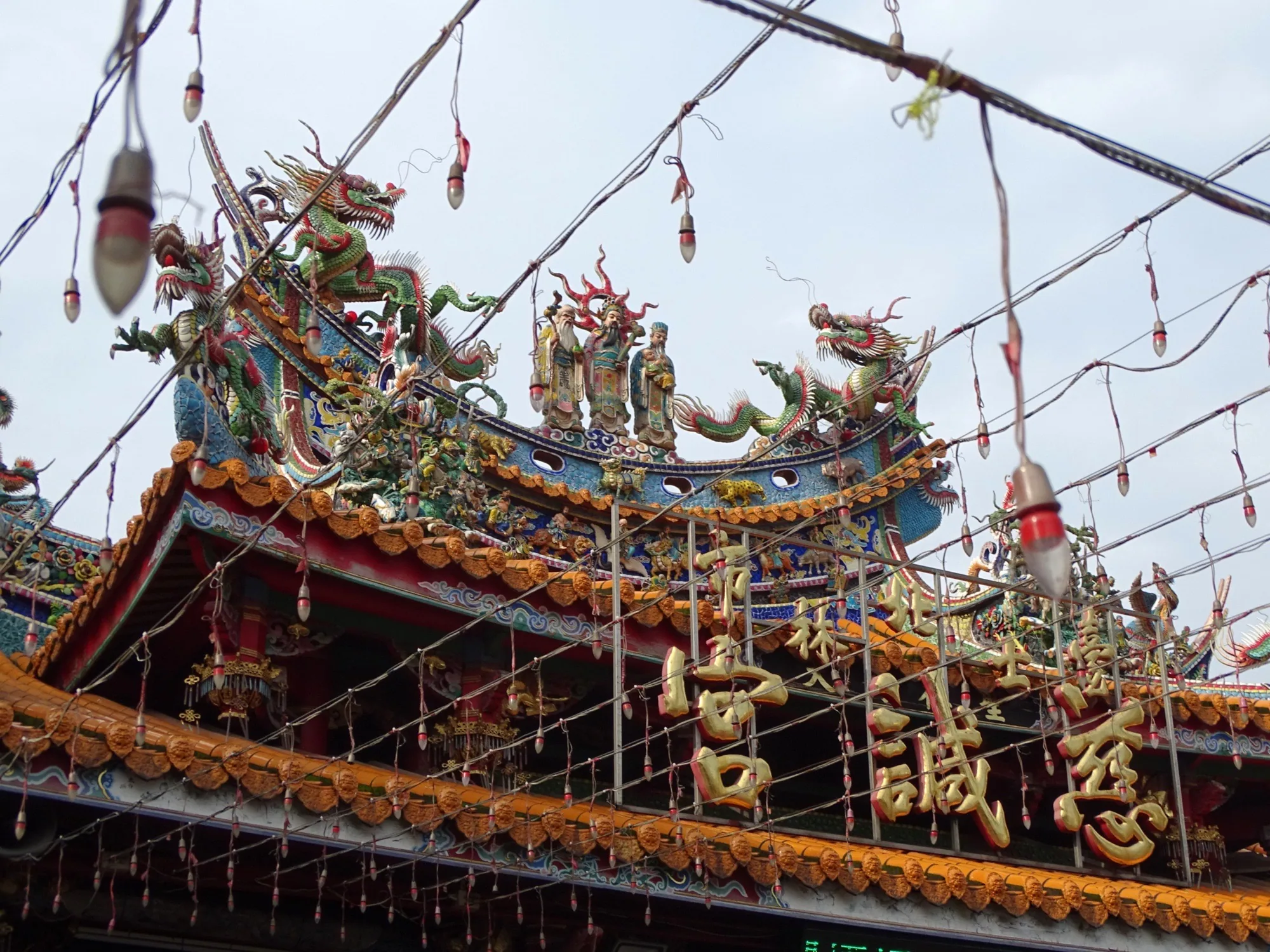
Cixian Temple roof decoration. Photo: Adam Jones from Kelowna, BC, Canada, 2019-05-17. License via Wikimedia Commons (CC BY-SA 2.0).
The 1909 Red-Brick Market, the 1955 Yangming Theater, and the 1992 Large Fried Chicken Cutlet
After the 1860 grid was planned, the next people to change this place were the Japanese.
Japan took control of Taiwan in 1895. In 1909, the Japanese colonial government planned and established "Shilin Market" on Shilin Street, then administratively under the Shilin branch office of Taipei Prefecture3. Where was it? Directly west of Cixian Temple, the location of today's old Shilin Market building. Why choose this place? Because the temple forecourt already had a 49-year tradition of vegetable-market trade. The Japanese did not intend to change that structure; they simply fixed the temporary street market in place by building a structure that met sanitary standards.
Construction began in 1913, and the market opened in 1915, the fourth year of Taisho. "Shilin Market, opened in 1915, was a brick-and-wood-frame building. Its main body was built of red brick, its roof was supported by wooden trusses, and the raised section above served as a ventilation window"3. Parts of this 1915 red-brick market still remain within the Shilin Market complex rebuilt in 2011 and are designated as a municipal historic monument.
But once the market was built, Cixian Temple's forecourt began to be squeezed. "Past trade was mainly concentrated in the square in front of Shilin Cixian Temple. However, market vendors gradually encroached on temple land, so Cixian Temple built walls to preserve the remaining narrow temple grounds, while the outside of the walls could only be left for vendors to use"3. Vendors pressed from the temple forecourt into the market; when the market could not hold them, they spilled back around the temple; the temple had to build walls. This process of physical compression continued throughout the twentieth century.
The second postwar landmark was Yangming Theater.
At 1:30 p.m. on May 15, 1955, it "officially opened after Shilin commercial magnates Zhao Huomu, Su Fuzhong, Chen Chengyan, and others raised more than NT$1 million to build it beside Wenlin Road"18. At the time, Wenlin Road had not yet been widened: "Wenlin Road was then called the 'main road,' but in fact it was still only a small gravel road"18. After Yangming Theater opened, it drew crowds, and vendors began gathering around it. "The business district centered on Yangming Theater gradually grew, becoming today's Shilin Night Market"18.
In other words: the Japanese market of 1909 plus the postwar theater of 1955 formed the real material skeleton of Shilin Night Market. Without those two cores, vendors would not have gathered here.
After the 1980s, Taiwanese-language cinema declined, and Shilin's theaters switched to second-run films. Yangming Theater lasted until September 15, 2019, when it closed and was immediately demolished. The original site was redeveloped into a commercial building with two basement levels and seven above-ground floors18. A 64-year-old theater survived from the era of the main road as a small gravel lane into the era of global chain brands.
The third object is the chicken cutlet.
In 1992, Wang Qinglong set up a roadside stall called "Xiao Wang Large Fried Chicken" near Taichung First Senior High School and the Water Conservancy Building. By using a technique of "making three cuts to spread open chicken breast," he created Taiwan's first large fried chicken cutlet19. In 1999, the stall entered Shilin Night Market under the name "Hot-Star Large Fried Chicken" and "quickly became one of Shilin Night Market's famous snacks"19. From 1999 onward, the chicken cutlet became bound to Shilin Night Market. For Korean tourists, Japanese tour groups, and Southeast Asian families visiting Shilin Night Market, the first "check-in food" is almost always this chicken cutlet larger than a face.
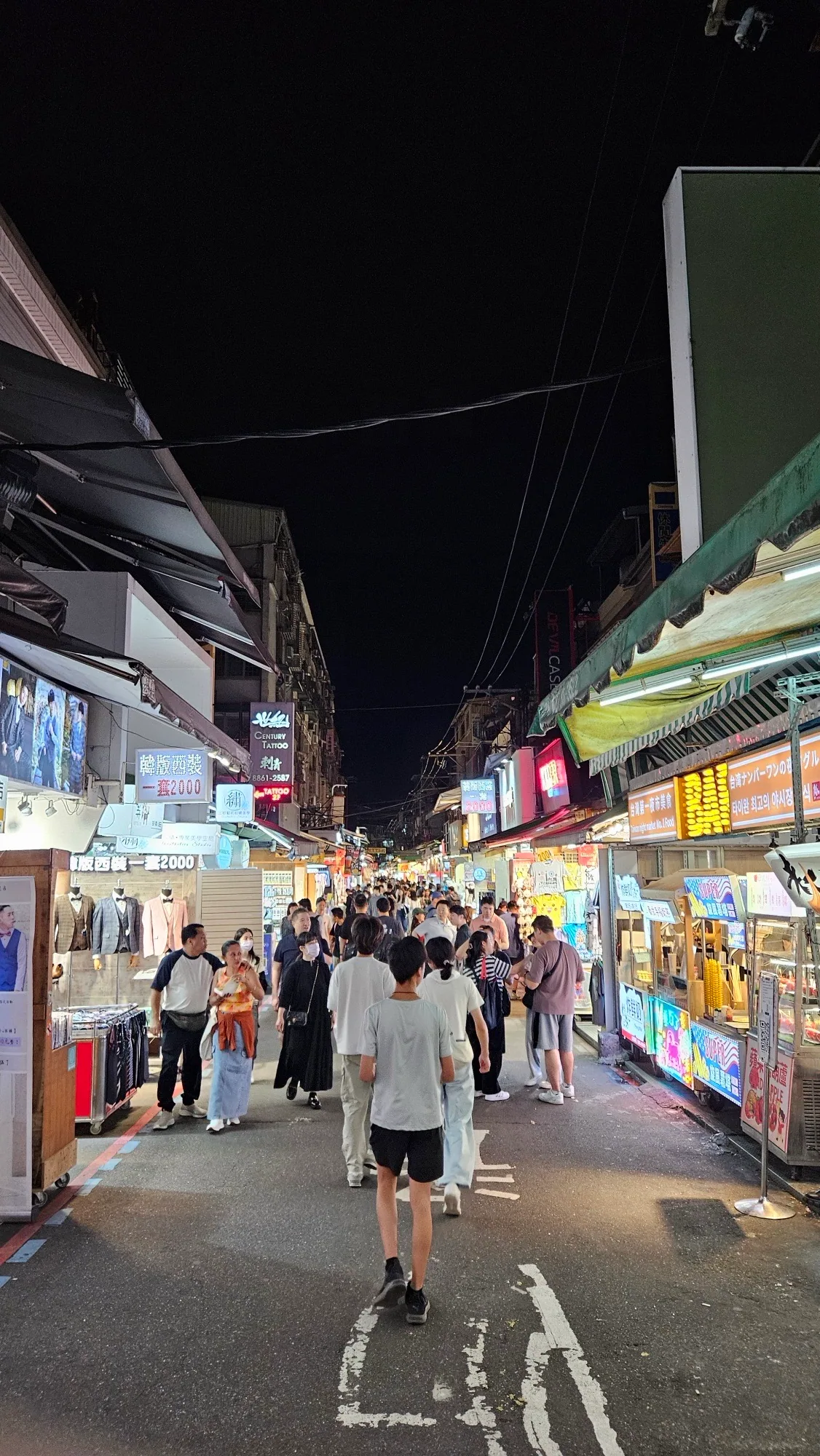
Dadong Road in Shilin Night Market, June 2024. Photo: Ganmatthew, 2024-06-04. License via Wikimedia Commons (CC BY 4.0).
The Old Sheds Demolished in 2002, the New Building Completed in 2011, and the Two Cities of the Underground Food Court
By the end of the twentieth century, the 1915 Japanese-era red-brick market could no longer bear fifty years of accumulated postwar stall additions. Problems of "ventilation, sanitation, environment, and public safety" all reached a breaking point3.
On October 14, 2002, the Taipei City Government began demolishing the postwar-added portions of Shilin Market, preserving and renovating only the Japanese-era red-brick building3. Vendors moved to the "Shilin Temporary Market," located at the intersection of Wenlin Road and Jihe Road, opposite MRT Jiantan Station. This temporary market stood for nine years, until the new market was completed in December 2011.
What did the new market look like?
"After reconstruction, Shilin Market had one above-ground floor and three basement levels. The first floor resembled the appearance of Huaxi Street Tourist Night Market, with fixed steel sheds built in the center. Together with the two original market buildings on both sides designated as historic monuments, it could accommodate 288 stalls. In the morning it served as a fresh-food supermarket; from afternoon to night it was provided to general merchandise, department-store-style, and clothing vendors, with stalls used in shifts. The B1 level had 94 stalls for snack vendors"3.
Two key designs:
First, the above-ground first floor operates in two shifts: "daytime vs. nighttime." In the morning, it sells fresh food to local residents; from afternoon to night, it turns into general merchandise, clothing, and tourist stalls. The same piece of land, two types of people, used in rotation. This two-shift system is a special arrangement not found in Taipei's other night markets.
Second, the B1 level is reserved for snacks. On the afternoon of December 24, 2011, the underground food court began trial operations, "covering more than 300 ping, with 53 shops planned"3. This became what tourists later commonly called the "Shilin Underground Food Court." Chicken cutlets, oyster omelets, spicy cold noodles, herbal pork rib soup, and pan-fried buns were all packed into one basement level, leaving the ground level to other vendors.
But the 2011 reconstruction did not restore Shilin Night Market's tourism status.
The Tourism Administration's 2024 "Survey of Visitors' Expenditures and Trends in Taiwan" showed that "Raohe Street Night Market ranked first at 35.6%, while Shilin Night Market placed second at 31.09%. In the 2023 survey, Shilin still ranked first at 37.86%, while Raohe was second at 28.61%"4. A decade earlier, Shilin Night Market was Taipei's top tourist night market; in 2024 it was overtaken by Raohe Street. There was more than one reason: the rise of the Xinyi commercial district drew away young locals; inconvenient coach and transfer traffic led international tour groups to switch to Raohe; the underground food court's transformation into something like a generic food court lost the raw lane-by-lane feel of the original night market; vendors complained of high rents and storefront pressure4.
On April 17, 2025, the Taipei City Government reopened the underground food court after spending more than NT$100 million on renovations. "After renovation, 35 businesses were planned inside"3. From 53 shops in 2024 to 35 in 2025, it was reduced by one-third. Reports said that in 2025, "foreign-language-speaking tourists made up about 50 percent" of visitors, showing a return, but still "not comparable to the heyday ten years earlier"4.
Curator's note: Shilin Night Market's tourism decline is a mirror reflecting the shifting plates of Taipei's tourism economy, not merely the night market's own problem. After the 2010s era of Chinese tour groups ended, today's international tourists are dispersed across Raohe, Ningxia, Linjiang Street, and even Huaxi Street in Wanhua, among many options. At the same time, the Instagram/TikTok-era logic of "influencer check-in spots" no longer depends on whether a night market can attract "large tour buses." Young people are more interested in dispersed sites such as "lanes only locals know" or "Michelin Bib Gourmand recommendations." Shilin Night Market has changed from "a brand" back into "a district"; to 230-year-old Cixian Temple, this shift is actually closer to a rhythm it knows well. The temple never depends on tourist volume. It is sustained by the daily incense offered by older neighbors nearby. Tourism rises and falls; the temple remains there.
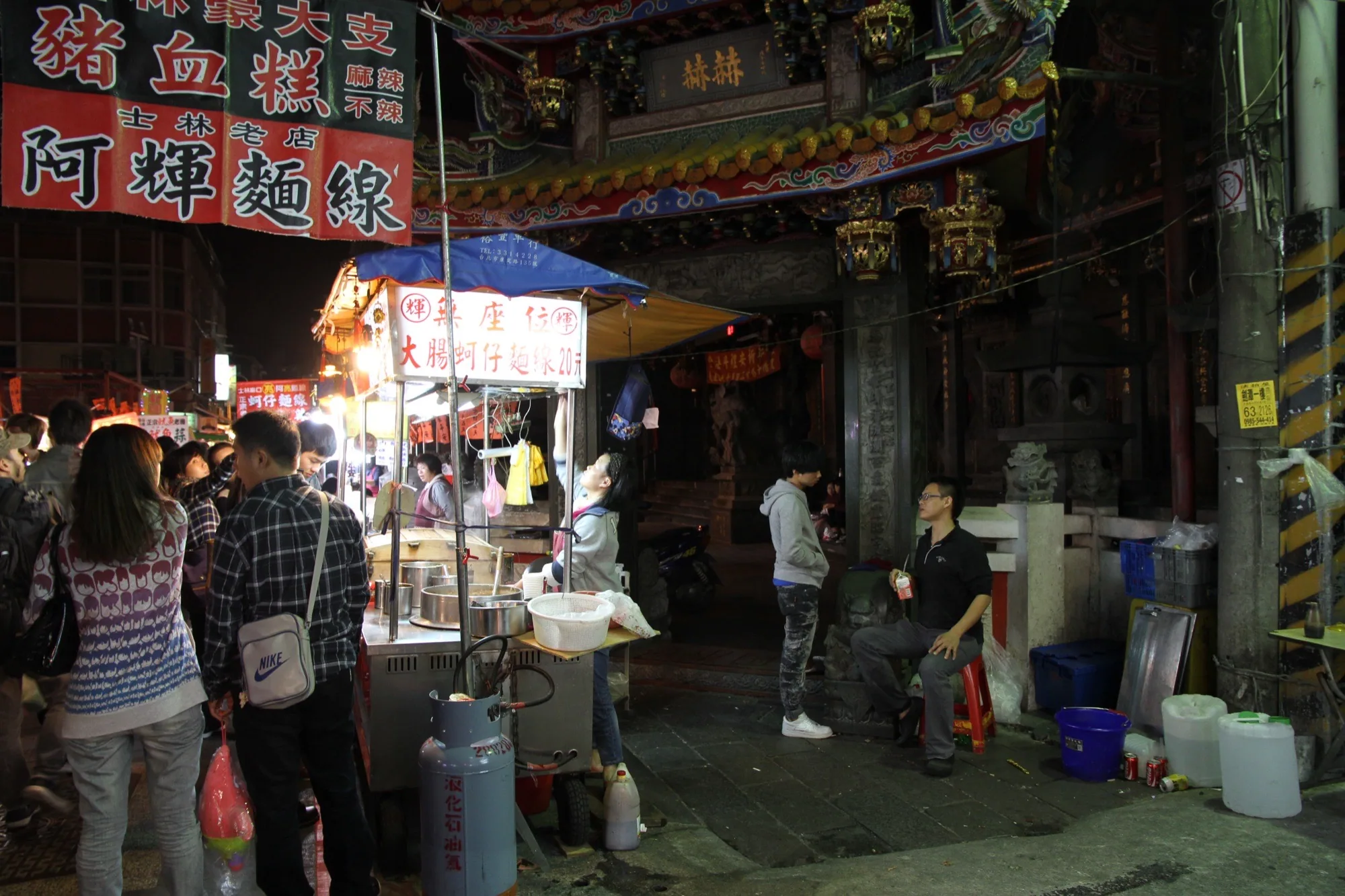
Night market and Cixian Temple side by side, November 2012. Photo: Maya-Anaïs Y., 2012-11-19. License via Wikimedia Commons (CC BY 2.0).
What Locals Will Show You: Shennong Temple, Zhishanyan, and Shilin Official Residence
If you come to Shilin only for the night market and Cixian Temple, you are seeing the Shilin recommended by the tourism bureau.
Locals will take you to three more places.
The first is Shennong Temple (Shilin Shennong Temple, the old street). It is opposite Cixian Temple at No. 84 Danan Road; walk a few more steps east along Danan Road and you arrive at the corner of Xiaodong Street and Danan Road13. Shennong Temple enshrines Emperor Shennong. Its predecessor was a Fude Shrine already present when Han settlers first entered the area in 1709. In 1741, because of flooding, it moved to this site and became the central temple of Shilin's "old street"13. When Quanzhou people attacked in 1859, this temple was burned together with surrounding street houses. It was later rebuilt in the same place and designated a Taipei municipal historic monument in 2005. Walking between Shennong Temple and Cixian Temple lets you see the two timelines of "old street vs. new street": one from 1741, the other from 1864. The two streets are about 400 meters apart, but 99 percent of night-market tourists never walk to Shennong Temple.
The second is Zhishanyan. It is reachable from Jiantan Station by bus or a 20-minute walk, around Section 2 of Zhicheng Road20. Zhishanyan is a small hill about 53 meters above sea level, with three layers of history stacked on it:
- Prehistory: In 1896, Japanese teacher Awano Dennojo discovered a stone axe at the foot of the hill. This was Taiwan's earliest discovered prehistoric site21. Later archaeology confirmed remains on the hill from the "Zhishanyan Culture" and "Yuanshan Culture" 4,000 to 5,000 years ago.
- Japanese period: In June 1895, the Education Department of the Taiwan Governor-General's Office moved from Dadaocheng into Huiji Temple at Zhishanyan and opened the Zhishanyan School in the rear hall. This became, during the Japanese period, "the birthplace of education in all Taiwan"22.
- January 1, 1896: Six Japanese teachers, Katori Michiaki, 38; Sekiguchi Chotaro, 37; Nakajima Chokichi, 25; Katsura Kintaro, 27; Ihara Junnosuke, 23; and Hirai Kazuma, 17, intended to go to the Governor-General's Office for New Year's Day. On the way, they encountered anti-Japanese resisters and were beheaded, in what became known as the "Six Martyrs Incident"22. In 1930, the fifth year of Showa, the Japanese established the Zhishanyan Shrine near the original cemetery site, "designating February 1 each year as the regular festival day," and "turning the 'Six Martyrs' into the spiritual center of Japanese educators across Taiwan: the so-called Zhishanyan spirit"22.
After the war, Zhishanyan Shrine was demolished, but the graves of the Six Martyrs were largely preserved, and the Department of Cultural Affairs later added a monument. When you visit Zhishanyan today, you see Huiji Temple, built in 1752, the seventeenth year of the Qianlong reign; explanatory signs for the prehistoric site; and the Six Martyrs monument. Three layers of history stand side by side on this 53-meter hill. Shilin Elementary School was founded in the same year as the Six Martyrs Incident, 1896; in 1898 it was renamed Bazhilian Public School, in 1921 Shilin Public School, and in 1941 Shilin National School23. It now has a 130-year history and is Taiwan's earliest established national elementary school.
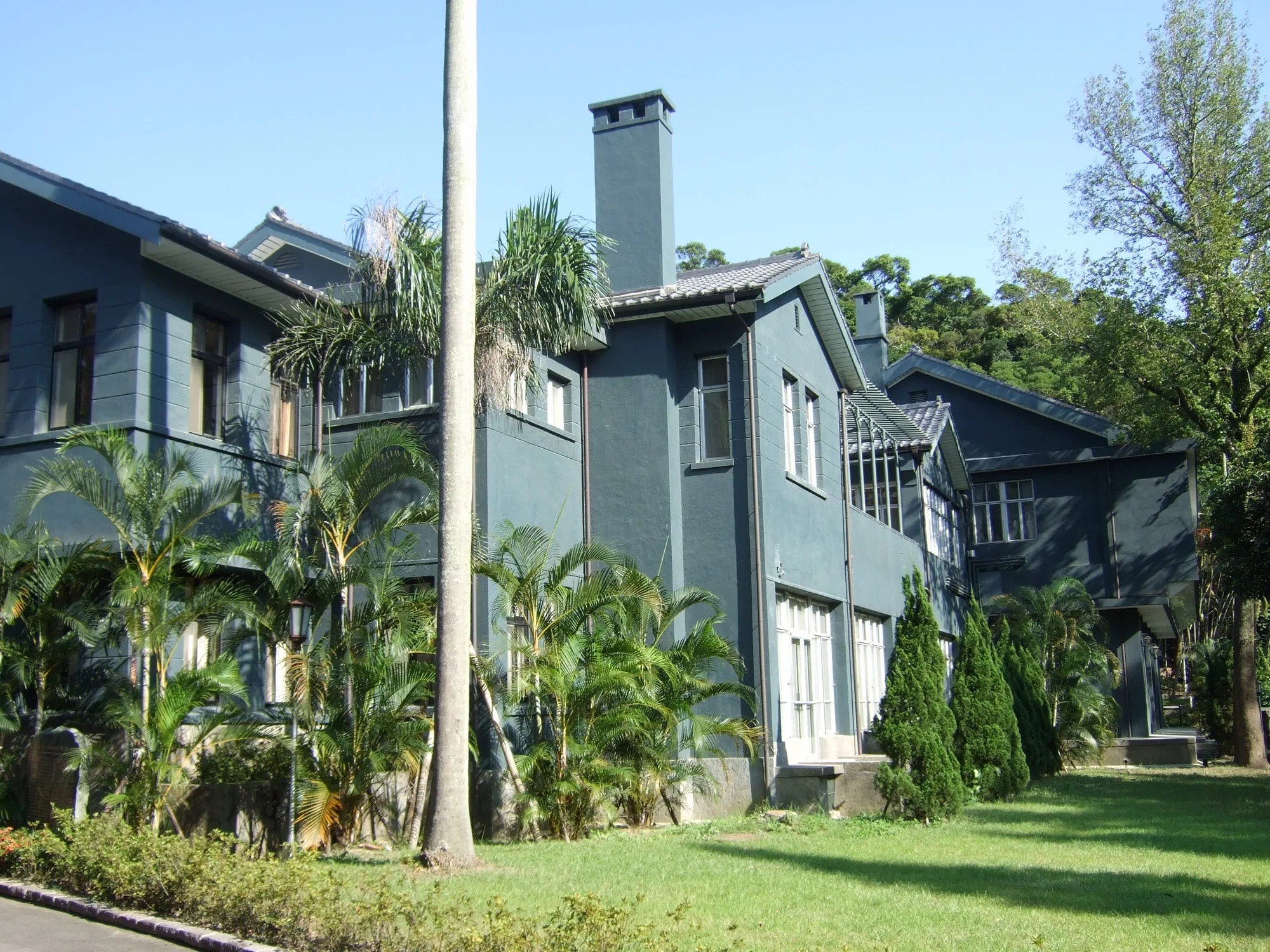
Main building of Shilin Official Residence. Photo: Kuailong. License via Wikimedia Commons (CC BY-SA 3.0).
The third is Shilin Official Residence. Its address is No. 60 Fulin Road, about a 10-minute walk from Jiantan Station24. During the Japanese period, this was the "Shilin Horticultural Experiment Branch." After the war, in 1950, Chiang Kai-shek and Soong Mei-ling moved from the Caoshan Guesthouse to Shilin Official Residence and lived there until Chiang's death in 1975, a total of 26 years24. In 1996, after being closed for 46 years under the martial-law system, the residence opened its park area to the public for the first time, becoming "Taipei City's first ecological park"24. After Soong Mei-ling died in 2003, the main building was left unused, then renovated and opened for reserved visits from 2011 onward.
The entrance hall of the main residence preserves 1950s furniture and arrangements. Visitors can see the living room for receiving foreign guests, Soong Mei-ling's studio, and Chiang's study. But the building's political meaning far exceeds its furniture. The 26 years from 1950 to 1975 are the entire period in the history of the Republic of China when the president's wife lived on this street. To protect the Chiang family at the time, Fulin Road, Section 5 of Zhongshan North Road, and the Shilin Night Market area were all under layered control. Only when it opened in 1996 did this street truly change from a "politically controlled zone" back into a "citizens' street."
Curator's note: Look at these three places side by side: Shennong Temple in 1741, Zhishanyan School in 1895, and Shilin Official Residence in 1950. Roughly every 100 years, a new layer appears. Shennong Temple represents the layer of Han settlement under Qing rule; Zhishanyan School represents the layer of Japanese colonial education; Shilin Official Residence represents the layer of postwar Kuomintang authoritarianism. All three layers are within 1.5 kilometers at the edge of Shilin District, yet 99 percent of night-market tourists will not walk to any of them. Shilin's depth is not inside the night market, but in these corners beyond the night-market lights.
The Temple Is Still There, 230 Years Later
Return to Cixian Temple at 7:30 p.m.
The last wave of tourists has just emerged from Jiantan Station, and stall owners are beginning their second round of business. Thirty people line up at Hot-Star Large Fried Chicken; the oyster-omelet griddle is turning; steam rises from pots of herbal pork rib soup. Looking out from the temple forecourt, Shilin Night Market in 2026 looks different from the Japanese-era red-brick market of 1909. The number of stalls has expanded from about 100 in 1915 to, after the 2011 reconstruction, 288 stalls on the ground level plus 53 on the basement level; later, in 2025, the basement level was reduced to 35 stalls, while most of the ground level remains.
But the temple is still in its original place.
The place where, in 1864, the third year of the Tongzhi reign, Pan Yongqing donated land, Cao Qihe contributed funds, and worshippers joined forces to build the temple1 has lasted 162 years by 2026. Counting from 1796, the first year of the Jiaqing reign, when Zhangzhou people built the first Tianhou Temple on old Zhilan Street, it has been 230 years. The plot beneath the temple foundations, the coordinates of No. 84 Danan Road, has not moved for 166 years, since Pan Yongqing drew the first line in the 1860 gengshen year.
The temple has also watched the night market grow up.
In 1909, when the market was first established, and in 1915, when the brick market opened, the temple watched vegetable-market vendors move from the forecourt into the building opposite. In 1949, as the Kuomintang government relocated to Taiwan, mainlander populations flowed into Shilin, and Wenlin Road began to widen, the temple watched familiar Taiwanese-speaking patrons decrease and Sichuanese and Mandarin-speaking patrons increase. In 1955, when Yangming Theater was completed and postwar second-run cinemas and youth culture entered Wenlin Road, the temple watched students in bell-bottoms gather outside to wait for movie tickets. In 1992, when the first chicken cutlet was invented in Taichung, and in 1999, when Hot-Star Large Fried Chicken entered the market, the temple watched a fried chicken cutlet larger than a face become this city's tourism symbol. In 2002, during demolition; in 2011, during reconstruction; in 2024, when its tourism ranking fell; and in 2025, when the food court was renovated, the temple watched the night market undergo rounds of reorganization.
But the temple still worships the same Mazu. It is the same deity statue invited from Zhangzhou in 1796, rescued from the burned Tianhou Temple in 1859, and reinstalled at the present site in 18641.
Looking north from the temple forecourt toward Dabei Road, you see chicken-cutlet stalls, bubble tea shops, and tattoo shops one after another. Farther out are Wenlin Road, MRT Jiantan Station, the Taipei Performing Arts Center, rebuilt after the former Shilin Temporary Market was demolished, and farther east, Jihe Road.
To outsiders, Shilin is a tourist night market, large fried chicken cutlets, and a second-ranked night market that has "fallen from grace." But for those who live in Shilin, Shilin is another axis: the uncles doing tai chi at Shennong Temple at 8 every morning; the Saturday rituals at Cixian Temple; the climb up Zhishanyan to see a geological section from 4,500 years ago; the annual November flower show in the rose garden at Shilin Official Residence; the aunties at Fulin Road market; the cigarette a Shilin Night Market vendor smokes before going home to sleep after closing at 3 a.m.
This street took shape 162 years ago. From the moment in the 1860 gengshen year when Pan Yongqing placed the temple at the center and drew four main roads, to today in 2026, the temple remains at that same coordinate, already 230 years old.
Next time you stand at the entrance to Shilin Night Market at 7:30 p.m. holding a large fried chicken cutlet, remember to turn the corner and walk 100 meters to No. 84 Danan Road. Cixian Temple's bell is still there, and so is that 230-year-old temple.
Further Reading:
- Taipei City — a 12-district panorama; before Shilin was incorporated into Taipei City in 1968, it was under the Yangmingshan Administration
- Taiwan's Old Street Culture and Commercial Districts — the main file on old street culture; Shilin New Street is one of Taiwan's few complete market streets traceable to an 1860 gengshen-year planning blueprint
- Bangka — a sibling from the same batch 1; the 1853 Ding-Xia Jiao conflict was the prelude to the 1859 Zhangzhou-Quanzhou feud, another corner of the three-market-street triangle
- Dadaocheng — a sibling from the same batch 1; Tong'an people fled here in 1853 to open a commercial port, part of the same structural chain as Shilin's Zhangzhou people fleeing from the old street to the new street
- Ximending — a sibling from the same batch 1; a Japanese-era entertainment district from 1896 versus Shilin's Japanese-era livelihood market from 1909, two kinds of material structures left by the Japanese
- Taiwanese Religion and Temple Culture — Cixian Temple is an important node of Mazu worship in Taipei, standing alongside Dadaocheng Xiahai City God Temple and Bangka Longshan Temple
- The February 28 Incident — the post-1947 context in which many mainlanders moved into Shilin, Wenlin Road was widened, and Shilin Official Residence was established
- Qing Rule — the Qing-era century, 1796-1895, of Han settlement, Zhangzhou-Quanzhou armed feuds, and Pan Yongqing's planning of the new street
- Dalongdong — the defensive center where defeated Tong'an people retreated after the 1853 Ding-Xia Jiao conflict; together with Shilin's 1859 Zhangzhou-Quanzhou feud, it forms one of the ethnic-conflict landscapes of Qing-era northern Taiwan
Image Sources
This article uses five CC-licensed Wikimedia Commons images (hero + four inline), all cached in public/article-images/geography/ to avoid hotlinking source servers:
- File:Shilin Cixian Temple 20100213.jpg — Shilin Cixian Temple Sanchuan Hall, Photo: 龍本, 2010-02-13, CC BY-SA 3.0
- File:2012-11-19 night market and the Shilin Cixian Temple.jpg — Shilin Night Market and Cixian Temple side by side, Photo: Maya-Anaïs Y., 2012-11-19, CC BY 2.0
- File:Shilin Night Market Dadong Road.jpg — Night scene on Dadong Road in Shilin Night Market, Photo: Ganmatthew, 2024-06-04, CC BY 4.0
- File:Shilin Cixian Temple roof 20190517.jpg — Cixian Temple roof cut-and-paste ceramic decoration, Photo: Adam Jones from Kelowna, BC, Canada, 2019-05-17, CC BY-SA 2.0
- File:Chiang Kai-shek Shilin Residence.JPG — Main building of Shilin Official Residence, Photo: Kuailong, CC BY-SA 3.0
References
- Shilin Cixian Temple — Taiwan Religious Culture Map — Official Ministry of the Interior religious cultural heritage page. The original records the full timeline: "Shilin Cixian Temple was founded in the first year of the Qing Jiaqing reign (1796)," "in the third year of the Qing Tongzhi reign (1864), after land was donated by the ancestor Pan Yongqing (1821-1873) and funds were generously contributed by Cao Qihe (dates unknown) and worshippers, Tianhou Temple was relocated and rebuilt at its present site," "in the sixth year of the Guangxu reign (1880), drawing on the Book of Documents phrase 'sincere toward the common people' and the meaning of Mazu's compassion and assistance in bringing harmony to the people, it was named Cixian Temple," "in the second year of Showa (1927), reconstruction was initiated by reconstruction committee chair Pan Guangkai and executive committee member Ho Ping-kuei, among others; the project was vast and took ten years to complete, and the temple's present appearance is the result of that reconstruction," and "in ROC year 74 (1985), it was announced by the Ministry of the Interior as a national Grade 3 historic monument, then after the Cultural Heritage Preservation Act was amended in ROC year 86 (1997), it became a Taipei municipal historic monument."↩2345678
- Shilin Cixian Temple — Wikipedia — Wikipedia records that "Cixian Temple was first built in the first year of the Jiaqing reign during Qing rule (1796)," that it was involved "during the Zhangzhou-Quanzhou armed feuds of the Xianfeng period," that "only in the third year of Tongzhi (1864) was it rebuilt at the present site," and cites official information for the temple address, "No. 84 Danan Road."↩
- Shilin Night Market — Wikipedia — Wikipedia records the full history: "In 1909, 'Shilin Market' was established"; "in 1913, Shilin Market was built"; "in 1915, Shilin Market opened"; "Shilin Market, opened in 1915, was a brick-and-wood-frame building, its main body built of red brick, its roof supported by wooden trusses, and the raised section above serving as a ventilation window"; "on October 14, 2002, because of problems involving ventilation, sanitation, environment, and public safety, vendors from the original Shilin Market moved to the 'Shilin Temporary Market'"; "in December 2011, Shilin Market reconstruction was completed"; "on the afternoon of December 24, 2011, the B1 food court of Shilin Market began trial operations, covering more than 300 ping and planned for 53 shops"; "past trade was mainly concentrated in the square in front of Shilin Cixian Temple, but market vendors gradually encroached on temple land, so Cixian Temple built walls to preserve the remaining narrow temple grounds"; "on April 17, 2025, Shilin Market's B1 food court reopened to the public, with 35 businesses planned after renovation"; and the night market's extent, "east to Wenlin Road, west to Jihe Road, north to the triangular area of Xiaobei Street and Xiaoxi Street."↩2345678910
- Has Shilin Night Market Fallen from Grace? Tourists Switch Here; Latest Data Released — EBC News 2024 + Shilin Night Market Is Back! 660,000 Visitors in One Month — NOWnews 2025 — The Tourism Administration's 2024 Survey of Visitors' Expenditures and Trends in Taiwan states: "Raohe Street Night Market ranked first at 35.6%, while Shilin Night Market placed second at 31.09%. Compared with the 2023 survey, Shilin was still champion then at 37.86%, while Raohe ranked second at 28.61%." Contemporary data also cover the April 2025 reopening after food court renovation and foreign-language-speaking tourists accounting for about 50 percent.↩234
- Taipei: Shilin Municipal Historic Monument Cixian Temple — Vocus Travel Report — Records Cixian Temple's daily opening hours and describes its functions, including the contemporary temple introduction as "a 200-year-old temple in Shilin District, an important site for the North Taiwan Mazu Culture Festival and tourism in Shilin District."↩
- Taipei Prefecture — Wikipedia — In 1875, the first year of the Qing Guangxu reign, Shen Baozhen memorialized to establish Taipei Prefecture, 79 years after Cixian Temple was founded in 1796, the first year of Jiaqing, showing Cixian Temple's relative position on the 230-year timeline.↩
- Reading the City — Pan Yongqing, the Patriarch Who Watched Over Shilin — Taipei City Department of Information and Tourism — Taipei's tourism bureau official introduction to Pan Yongqing's life and the new street plan, including the original text: "gentryman Pan Yongqing (1820-1873)," "in the ninth year of Xianfeng (1859), Quanzhou people attacked Zhilan Street (the Shennong Temple area, also called the old street), pillaged and burned it heavily, and the whole street together with Tianhou Temple was destroyed by fire," and "Pan Yongqing, who had a background in design and construction, wanted the whole market street to be square and evenly laid out. He used Cixian Temple as the center, planned the square in front of the temple as a place for agricultural and fishery trade, then set routes, drains, and shop lots, establishing the squared-off Danan Street, Daxi Street, Dabei Street, and Dadong Street."↩234
- Shilin District — Wikipedia — Wikipedia's official records and place-name research: "Shilin District's old name, 'Bazhilian' (Pattsiran), means 'hot spring' in the Ketagalan language"; it "was the settlement of the Pingpu Indigenous Ketagalan 'Kimassauw community'"; "on July 1, 1968, the Yangmingshan Administration was transferred to Taipei City, and Shilin Township became 'Shilin District'"; and "the whole area covers 62.3682 square kilometers."↩234
- Zhangzhou-Quanzhou Armed Feuds — Wikipedia — Wikipedia records the details and scale of the 1859 Shilin Zhangzhou-Quanzhou armed feud: "In the ninth year of Xianfeng (1859), a major armed feud broke out again. Quanzhou people from Xinzhuang, Bangka, and elsewhere launched a large-scale attack on the Zhangzhou people's Shilin and on Banqiao, Zhonghe, and Yonghe around the Banqiao Lin Ben Yuan family, a Zhangzhou base. Old Shilin Zhilan Street, Gangzizui (Puqian, Banqiao), Wayo (today's Zhonghe-Yonghe border), and Jialazai (today's Xiyuan and Dongyuan in Taipei) were all burned."↩2
- Origin of the Shilin Place Name — Liberty Times Net — Explanation of the evolution from "Xiashulin" to "Shilin": in Minnan, "shulin" and "Shilin" are homophones; with the number of nineteenth-century Shilin-area literati who attained examination degrees, and Pan Yongqing's emphasis on education, the new street was named "Shilin" with the meaning "scholars like a forest."↩
- Taipei City Shilin District Office — Understanding Shilin's Historical Development — Official historical development from the Shilin District Office, including the original text: "Shilin District was originally the settlement of the Pingpu Indigenous 'Kimassauw community'; it was formerly called 'Bazhilian,' translated from the Pingpu language (Pattsiran), meaning 'hot spring,'" and "on July 1, ROC year 57, it was incorporated into Taipei City, and Shilin Township was changed to Shilin District, becoming one of Taipei City's 16 administrative districts."↩
- Ding-Xia Jiao Conflict — Wikipedia — Detailed history of the 1853 Bangka armed feud between Sanyi people and Tong'an people, and its distinction from the 1859 Shilin Zhangzhou-Quanzhou feud. The opponents, years, and places of the two conflicts differed, but structurally they were different segments of the same chain of categorized armed feuds in northern Taiwan.↩
- Shilin Shennong Temple — Wikipedia + Shilin Shennong Temple (Zhilan Temple) — National Cultural Heritage Database — Official history of Shennong Temple, the public temple of Shilin's old street: "its earliest origin can be traced to a Fude Shrine in 1709 (the 48th year of the Qing Kangxi reign)" and "in 1741, it moved to the Zhilan Street location because of flooding." Announced as a Taipei municipal historic monument in 2005, it was the central temple of Shilin's "old street" and forms a dual-temple structure 400 meters from Cixian Temple, the new street temple.↩234
- Song of the Zhangzhou-Quanzhou Armed Feud — iPoem, National Museum of Taiwan Literature — The Tamsui Subprefecture Gazetteer's "Record of Warfare and Fire" records the 1859 greater Taipei Zhangzhou-Quanzhou armed feud: "Fangliao Street (Zhonghe) burned. In the Zhangzhou-Quanzhou armed feud, Zhangzhou people burned Gangzizui (Puqian, Banqiao), Wayo (today's Zhonghe-Yonghe border), and Jialazai (today's Xiyuan and Dongyuan in Taipei) ... then Baicuo Slope (today's Banqiao), Zhilan First and Second Forts (today's Shilin), all had their houses completely destroyed."↩
- New Street — Shilin Elementary School Local Studies Teaching Website — Local history teaching materials compiled by Shilin Elementary School, recording the folk background of the gengshen-year new street plan: "The tenth year of Xianfeng (1860) happened to be the Year of the Monkey. Everyone said a monkey resting in a tree was a good omen, and since no categorized armed feud occurred that year, people regarded it as an auspicious sign and began planning construction of the new street."↩
- Walking Taipei: The Secret in Shilin Night Market's East, South, West, and North — Taipei Walker — Taipei Walker cultural-history feature, including the spatial analysis of the 1860 gengshen-year new street plan: "East, west, south, and north are the four major roads and four small streets around today's Cixian Temple. With the temple as the center, a squared defensive layout radiates outward, shaping today's street contours, and in the past small gate barriers at street intersections prevented Quanzhou people from attacking."↩2
- Shilin Street Fude Temple — udn Blog Cultural-History Record — Location of Shilin Street Fude Temple at Dabei Road and Wenlin Road and the theory that it occupies a former gate-barrier site, used together with Taipei Walker's cultural-history reporting to examine the defensive structure of the 1860 new street.↩
- Taipei's Oldest Existing Movie Theater, Yangming Theater, to Close and Transform — City GVM — Complete history of Yangming Theater, including: "Yangming Theater officially opened at 1:30 p.m. on May 15, 1955, after Shilin commercial magnates Zhao Huomu, Su Fuzhong, Chen Chengyan, and others raised more than NT$1 million to build it beside Wenlin Road"; "Wenlin Road was then called the 'main road,' but in fact it was still only a small gravel road"; "the business district centered on Yangming Theater gradually grew, becoming today's Shilin Night Market"; and "after closing on September 15, 2019, demolition began immediately."↩234
- Hot-Star Large Fried Chicken Company Profile — Hot Star Official Website + From Night-Market Stall to Taiwanese Snack Light Across the World: Hot-Star Large Fried Chicken — Food NEXT — Full brand history and founding dates: "In 1992, Wang Qinglong set up a roadside stall called 'Xiao Wang Large Fried Chicken' near Taichung First Senior High School and the Water Conservancy Building"; he "created the large fried chicken cutlet method of making three cuts to spread open chicken breast"; "in 1999, he set up a Hot-Star Large Fried Chicken stall in Shilin Night Market"; and "in 2003, trademarks were filed in Korea, Japan, Singapore, China, and Hong Kong."↩2
- Zhishanyan Site — Wikipedia + Zhishanyan Site — National Repository of Cultural Heritage — Basic information on the Zhishanyan prehistoric site, geographic location, elevation, and the historical node in which Japanese teacher Awano Dennojo discovered a stone axe in 1896, opening Taiwan archaeology. Includes archaeological dating for the Zhishanyan Culture, Yuanshan Culture, and possibly the earlier Dapenkeng Culture, around 4,000-5,000 years ago or earlier.↩
- Prehistoric Zhishanyan — Online Tour of Zhishanyan — Complete introduction to Zhishanyan's prehistoric cultural layers, including the archaeological stratigraphy of the Zhishanyan Culture (late Neolithic, around 4,000 years ago), Yuanshan Culture (3,200-2,300 years ago), and Dapenkeng Culture (more than 6,200 years ago).↩
- Six Martyrs — Wikipedia — Detailed record of the January 1, 1896 beheading of six Japanese teachers, including their names and ages: Katori Michiaki, 38; Sekiguchi Chotaro, 37; Nakajima Chokichi, 25; Katsura Kintaro, 27; Ihara Junnosuke, 23; and Hirai Kazuma, 17. Also records that "on June 26, 1895 (some say July 12, 1895), in response to the strong cultural and educational atmosphere around Bazhilian, the Education Department of the Taiwan Governor-General's Office deliberately moved from Dadaocheng to Huiji Temple at Zhishanyan and opened Zhishanyan School in the rear hall"; that "in 1930, the Zhishanyan Shrine of several dozen ping was completed near the original graves of the Six Martyrs, with February 1 each year designated as the regular festival day"; that "this was therefore the 'birthplace of education in all Taiwan' during the Japanese period"; and that the "Six Martyrs" were shaped into the spiritual center of Japanese educators across Taiwan, the so-called Zhishanyan spirit.↩23
- Taipei Municipal Shilin Elementary School — Wikipedia + Taiwan's Earliest Elementary School Was Founded in Shilin — CNA Postwrite — Complete school history of Shilin Elementary School: "founded at Zhishanyan in 1895. On January 1, 1896, the Six Martyrs Incident occurred. On April 22, it was renamed 'Zhishanyan School Affiliated with the Japanese Language School'; on June 1, it was renamed 'First Affiliated School of the Japanese Language School'; on October 1, 1898, it was renamed 'Bazhilian Public School'"; "in 1921, it was renamed 'Shilin Public School.' In 1941, it was renamed 'Shilin National School'"; "this school was founded in 1895 as 'Zhishanyan School,' and now has a 130-year history, making it Taiwan's earliest established national elementary school."↩
- Shilin Official Residence — Wikipedia + Chiang Kai-shek and Soong Mei-ling Shilin Official Residence — National Historic Monument Panoramic Guide — Complete history of Shilin Official Residence: during the Japanese period it was originally the "Shilin Horticultural Experiment Branch"; in 1950, Chiang Kai-shek and Soong Mei-ling moved in and stayed until Chiang's death in 1975, a total of 26 years; Soong Mei-ling died in 2003; in 1996, the park area opened to the public, "becoming Taipei City's first ecological park"; and in 2011, the main building itself opened for reserved visits, with full timeline and administrative history.↩23