30-Second Overview: Taiwanese tea culture underwent three astonishing transformations: it unexpectedly rose in the 1930s after being excluded from international tea quotas, with annual exports soaring from 3.29 million kilograms to 5.8 million kilograms; a cup of milk tea redefined drinking culture in the 1980s; and bubble milk tea, which added "small snacks" in 1987, ultimately became a soft power symbol for Taiwan's global conquest.
In 1934, when major tea-producing nations like India and Sri Lanka signed the International Tea Quota Agreement, no one expected that the small island of Taiwan, excluded from the agreement, would usher in the most brilliant golden age in tea history.
That year, Taiwanese black tea exports reached 3.29 million kilograms, standing alongside three giants: Pekoe, Oolong, and Black Tea. By 1937, this figure had surged to 5.8 million kilograms, accounting for 52% of that year's exports. Not only did Taiwanese black tea achieve fame in Asia, but its aroma could be detected as far as Copenhagen, the capital of Denmark, 8,800 kilometers away.
How did a forgotten tea-producing nation find opportunity within restrictions?
This story begins with a Japanese merchant.
Rejected Innovation: The Tea Routes from Siberia to Europe
In 1906, Taiwan began exporting its first batch of black tea to Russia. Interestingly, this tea was "brick tea"—tea leaves pressed into bricks for easier long-distance transport to Siberia—a concept that is hard to imagine today.
The business was led by the legendary merchant Kodama from the Meiji era. This merchant, who hailed from Kumamoto, studied black tea production in his youth, traveled to Hankou, China, to learn brick tea techniques, and even opened a tea shop in Siberia. However, everything changed with the October Revolution in Russia in 1917—the demand for black tea plummeted, quietly closing Taiwan's first period of black tea exports.
The Japanese government was undeterred and decided to shift focus to the European market. However, Taiwanese small-leaf black tea lacked sufficient strength to suit the European drinking style (which involved adding sugar and milk), dominated by Britain. In 1925, Mitsui & Co., from India, introduced Assam tea seedlings, and Taiwan finally had true "large-leaf" black tea.
The turning point was unexpected.
The Accidental Golden Age: The Fish in the Net of International Quotas
In 1930, global tea production was in surplus, causing a collapse in black tea prices. Black tea-producing nations like India and Sri Lanka signed the International Tea Quota Agreement, which regulated production and export volumes from 1933 to 1940.
But Taiwan was excluded from the agreement—this seemingly marginalized decision became Taiwan's greatest opportunity.
While other producing countries were forced to reduce output, Taiwan could push forward with full force.
Kōjirō Nii, known as a "guardian of Taiwanese black tea," came to Yuchi in 1936 and established the Institute of Tea Experimentation at Yuchi. He built large-scale industrial Ceylon-style tea factories, and the production area of Yuchi black tea reached an all-time high of 3,000 hectares.
During this period, Yuchi Township became the homeland of Taiwanese black tea. Besides Yuchi, Kansai in Hsinchu also became a major center for black tea production.
From Export to Domestic Consumption: The Watershed of 1975
1975 was a significant watershed moment for Taiwan's tea industry. The global energy crisis, coupled with the appreciation of the New Taiwan Dollar (NTD), led to the cessation of tea exports. The Ministry of Agriculture began contemplating: how could Taiwanese people drink tea themselves?
At that time, Taiwanese people did not really drink much tea.
Soda and coffee were already more popular beverages among the general public than tea. Only wealthy individuals had a habit of drinking tea. The Ministry of Agriculture decided to focus on health claims, discovering through foreign research that tea was healthier than coffee. In 1975, they held a press conference promoting the relationship between tea and health.
In the same year, Taiwan held its first post-restoration black tea competition—the Xindian Pekoe Tea Competition. Meishan began cultivating high mountain tea. In 1982, the tea production management regulations were abolished, allowing Taiwanese farmers to "produce, process, and sell themselves."
The intense competition between competitions and brands led to a rapid advancement in Taiwan's Oolong tea manufacturing technology.
In the 1980s, the stock market in Taiwan soared past ten thousand points, ushering in an era of "money pouring down one's head." Tea houses sprouted like mushrooms, becoming venues for playing cards, holding meetings, and blind dates. The Zidong Tea House in Taipei and Yangxian Tea House (the predecessor of Chunshuifang) in Taichung were established during this period.
The Cold Drink Revolution: From Milk Tea to Bubble Milk Tea
In 1983, an experiment changed Taiwanese tea culture.
Liu Han-kai, the founder of Chunshuifang, saw techniques for making iced coffee while in Japan. In the summer, he asked his staff to add ice cubes to black tea, but was told, "No one drinks iced black tea!"
After returning to Taiwan, Liu Han-kai bought a shaker and poured black tea, cane sugar, and ice into it. The resulting drink, with its aroma of black tea and dense foam, created the "milk tea" (foamy milk tea).
But the real revolution was yet to come.
In 1987, Lin Xiu-hui, a manager at Chunshuifang at the time, attempted to add "pearls" to the prepared iced milk tea during one of her jobs. This combination of a common Taiwanese snack and fragrant milk tea not only broke down the boundary between "tea drinks" and "snacks," but also received extremely positive feedback from customers after a trial sale.
Chunshuifang's golden ratio of "7:2:1"—tea, ice, foam—became the standard recipe for bubble milk tea.
Interestingly, Hanlin Tea House in Tainan also claimed to have invented bubble milk tea, leading to a decade-long legal dispute between the two establishments. The judge ultimately ruled that bubble milk tea was a new beverage and not a patentable item, making it unnecessary to argue over "who the ancestor was."
The Empire of Drinking Behind the Numbers
Today, the scale of Taiwan's hand-shaken drink industry is astonishing:
- 2024 Hand-shaken Drink Revenue: NT$133.13 billion, setting a new high
- Total Number of Hand-shaken Drink Stores in Taiwan: 16,070, accounting for 57% of all beverage stores nationwide
- Expansion Speed: An average of 40 new stores opened per month
- Average Annual Consumption by Taiwanese People: approx. 107.5 million cups (calculated at NT$50 per cup)
The consumption of hand-shaken drinks in Taichung is particularly surprising—the consumption far exceeds the actual population ratio.
In terms of gender, women consume more than men across all age groups, with women aged 25–34 accounting for about 20% of total consumption. In terms of sweetness preference, over half of consumers choose slightly sweet, followed by unsweetened (39.7%).
Global Conquest: From Taichung to the World
Chunshuifang's bubble milk tea can now sell over 2 million cups per year on average. But more importantly, this milk tea containing "small snacks" has become Taiwan's soft power for conquering the world.
In 2020, Taiwan had over 15,000 hand-shaken drink stores, making it the most densely populated region in the world.
Taiwanese hand-shaken drink brands such as 50 Lan, CoCo Fresh Tea, and Qingxin Fuquan have rapidly expanded overseas, entering markets in Southeast Asia, Europe, and the Americas. Bubble milk tea is not just a long-standing representative of Chunshuifang; it is also an important milestone in promoting tea culture worldwide.
The global hand-shaken drink market in the Asia-Pacific region reached $1.14 billion in 2024, with Vietnam and Taiwan expected to have the largest sales volume. The Chinese market has grown nearly fivefold since the early 2020s.
From Formosa Oolong to Bubble Tea
Looking back at 150 years of tea history, Taiwanese tea culture demonstrates astonishing adaptability and innovation.
In 1869, British merchant John Dodd first transported 210,000 pounds of "Formosa Oolong" from Dadaocheng to New York. At the time, no one imagined that this beautiful island, called "Formosa," would conquer the world a century later with a cup of bubble milk tea.
True sustainability lies not in clinging to tradition, but in continuously redefining the meaning of tradition.
The secret to the success of Taiwanese tea culture may lie in this philosophy of "maintaining the core while being flexible at the boundaries." From traditional Gongfu tea ceremony to modern hand-shaken drink culture, from "Formosa Oolong" to "Bubble Tea," Taiwan has always found a balance between tradition and innovation.
This is not just a story about a cup of tea; it is a story of how an island maintains cultural subjectivity in the wave of globalization while conquering the world through innovation.
Image Sources
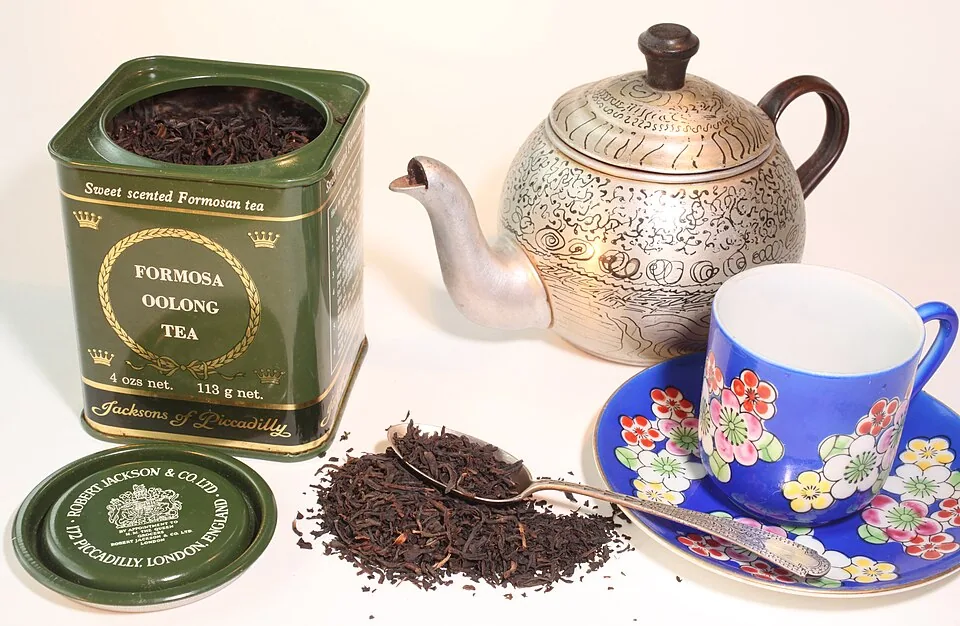
- Hero: Packaging of Formosa Oolong from Jackson's of Piccadilly, UK, photographed by Joost J. Bakker IJmuiden, Wikimedia Commons, CC BY 2.0.
References
- Taiwan Tea History Context - Tea Academy
- The Invention of Bubble Milk Tea - Chunshuifang Official Website
- Frenzy of Drinking: Unmasking Taiwan's Hand-shaken Drinks with Data - LnData
- Taiwanese Tea Industry Development in the Afterglow of "Tea Gold" Economic Transformation - Agriculture Media
- Taiwanese Tea - Wikipedia