
Overseas Expansion of the AI Supply Chain: Taiwan's Capabilities are being Invited Out by the World
30-Second Overview: The overseas expansion of the AI supply chain is not a simple "moving out" or "selling out" of Taiwan. It is the result of Taiwan's manufacturing capabilities becoming so essential to the world that they have entered a new phase: companies want to be closer to customers and markets, governments want to mitigate the risks of being "strangled," citizens care about jobs, wages, utilities, and local life, and foreign partners hope to place critical capacities in locations they can better control. While TSMC is the most prominent leader, it is not just wafer fabs moving abroad; it also includes AI servers, cabinets, power supplies, networking, testing/packaging, facility management, and components. Taiwan is needed, so its capabilities are being invited out; Taiwan is too concentrated, so it is also being dispersed.
In 2025, NVIDIA mapped a Taiwanese supply chain onto the map of the United States.
It announced that Blackwell chips are already in production at TSMC's Phoenix plant, while the manufacturing of AI supercomputers is being handled by Foxconn in Houston and Wistron in Dallas; packaging and testing involve SPIL and Amkor in Arizona.1 This is not the first time Taiwanese companies have expanded overseas, but it clearly illustrates the changes of the 2020s: foreign customers do not just want Taiwan to be able to make things; they also want critical hardware to be made in locations where they have more control.
For a long period, the ideal of globalization was simple: produce items where they can be made best, cheapest, and fastest. Taiwanese companies grew up in this world. Taiwan took orders, China's coast handled mass production, Southeast Asia provided labor and land, while the US and Europe controlled brands, customers, and markets; Japan, the Netherlands, and South Korea guarded materials, equipment, and memory. This division of labor made products affordable and allowed the world to prioritize efficiency over security.
Then, several things happened simultaneously: COVID-19 turned chip shortages into production halts, the US-China tech war turned chips into a national security issue, the Russia-Ukraine war warned nations that energy and supply chains could be weaponized, and AI turned computing power into a new symbol of national strength. In the past, people asked, "Where is it most efficient?" Now, they also ask, "If something goes wrong there, will I be strangled?"
This is the backdrop for the overseas expansion of Taiwan's AI supply chain. Behind the expansion of individual companies lies a global shift to pull the supply chain back from "lowest cost" toward "controllable, trustworthy, and negotiable."
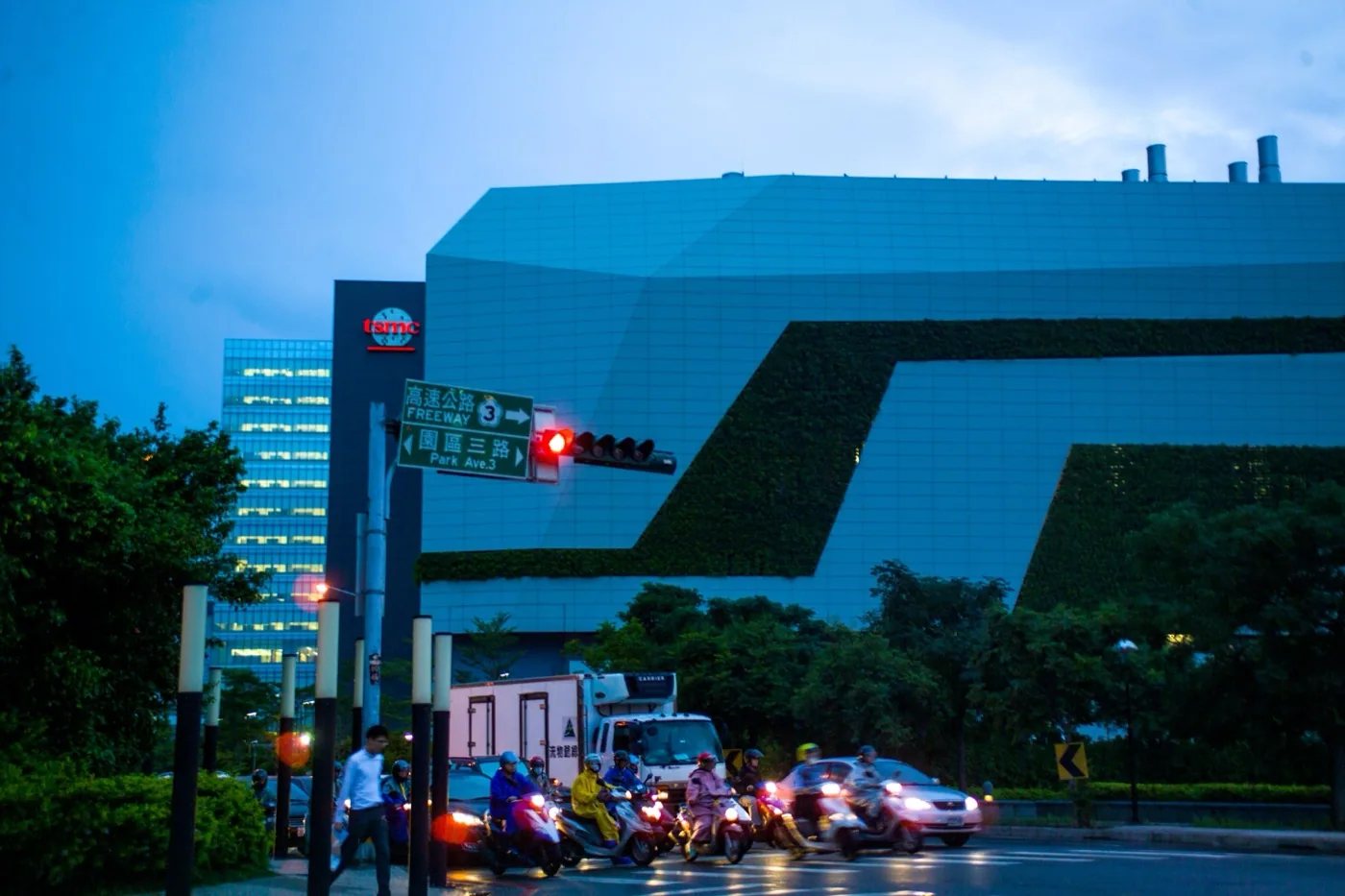
TSMC's Hsinchu Science Park facility cluster. The context for overseas expansion is precisely this high concentration of domestic production being needed by the world and sought by the world to be dispersed. Photo: Tseng Cheng-Hsun (曾成訓). CC BY 2.0 via Wikimedia Commons.
From Globalization to De-risking
Overseas manufacturing is not a new phenomenon. Taiwan's electronics industry has long been accustomed to moving in tandem with customers, wages, land availability, and tariffs.
Since the 1990s, many Taiwanese electronics contract manufacturers moved large amounts of capacity into China. The logic then was globalization: customers needed large-scale, low-cost, timely delivery. China provided land, labor, ports, local government coordination, and a complete supplier ecosystem. Taiwanese companies played the role of managers, engineers, process improvers, and intermediaries between global customers.
However, since the 2020s, the reasons for going abroad have changed. Companies are moving not just for lower costs, but to diversify risks. American customers want products manufactured in the US or friendly nations. India, Vietnam, Thailand, and Mexico provide assembly bases outside of China. Japan and Europe hope to reconnect semiconductor supply chains with automotive and industrial sectors.
This shift is often referred to as "de-risking." It does not necessarily equate to a complete decoupling, nor does it mean every country must make everything for itself. Rather, it is about breaking down a chain that is overly concentrated and over-reliant on a single location into several redundant nodes.
For Taiwan, this is a nuanced moment. Taiwanese companies grew up through globalization; now, they are being pushed by de-risking to redistribute.
AI Pushes the Hardware Supply Chain Across Borders
AI has accelerated the urgency of overseas manufacturing.
A large-scale AI system is not just cloud software. It requires GPUs, CPUs, HBM memory, advanced packaging, substrates, cooling systems, power supplies, network switches, cabinets, data centers, and massive amounts of electricity. These hardware components are bulky, consume high amounts of power, have high costs, and are often tied to national security, data sovereignty, and energy security.
Therefore, customers do not just ask: "Can Taiwan make it?"
They also ask: "Can it be made in a place where I feel more secure?"
In the announcement regarding US manufacturing, NVIDIA stated that it has commissioned over 1 million square feet of manufacturing space in Arizona and Texas; Blackwell chips are already being produced at TSMC's Phoenix plant, while AI supercomputers are being manufactured by Foxconn in Houston and Wistron in Dallas, with packaging and testing performed by Taiwan's SPIL and Amkor in Arizona.1
This list is telling. Wafer fabrication, packaging/testing, full-system servers, cabinets, and testing are all integrated into the "US AI infrastructure" narrative; TSMC is simply the most prominent name among them.
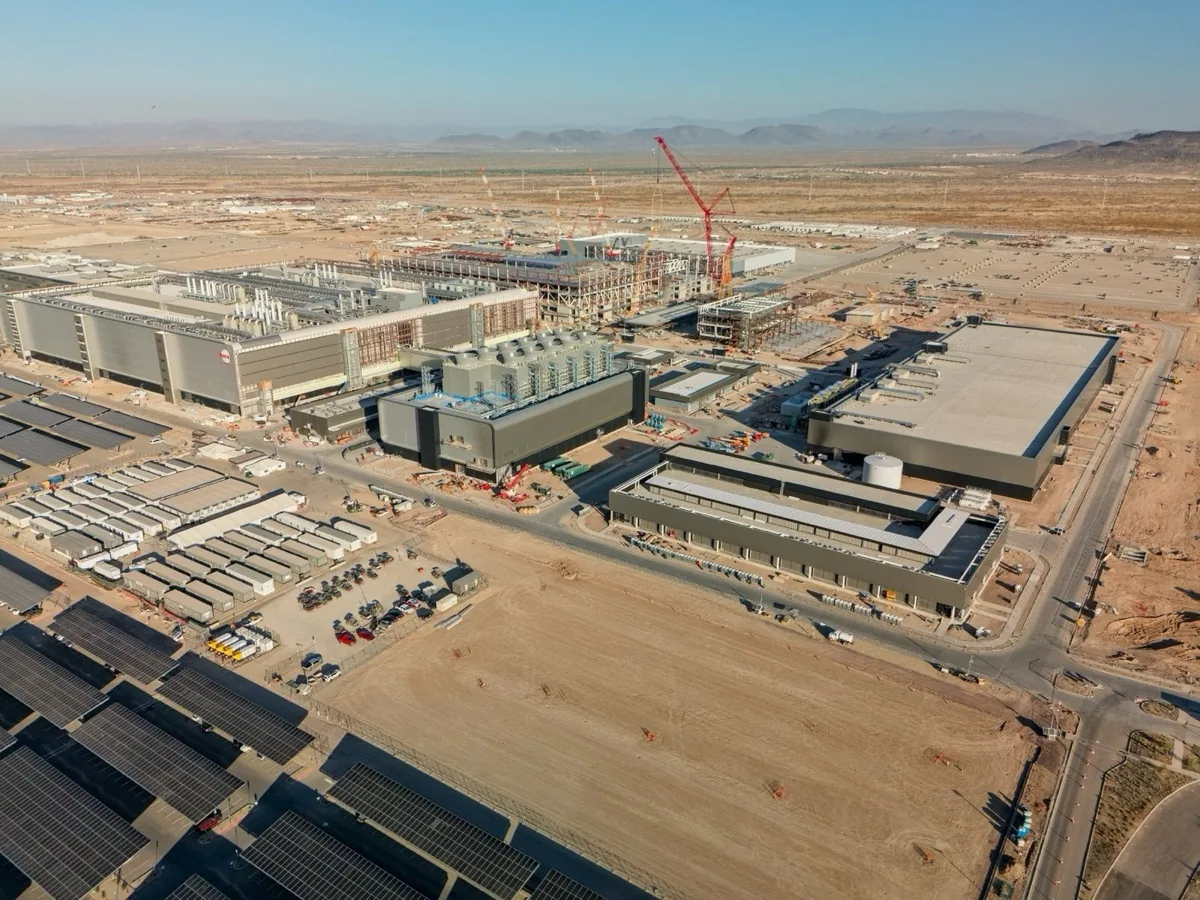
TSMC's Fab 21 construction site in Phoenix, Arizona. Overseas manufacturing lands where buildings, utilities, workers, local society, and supply chains operate together. Photo: Hunter Trick. CC BY-SA 4.0 via Wikimedia Commons.
OpenAI and Foxconn also announced a partnership to design and manufacture AI data center racks in the US, including cabling, networking, and power systems; reports from AP indicate that Foxconn will utilize facilities in states such as Wisconsin, Ohio, and Texas.2 This means "overseas manufacturing" is no longer just about chip production; it involves moving entire sets of AI data center hardware into local markets.
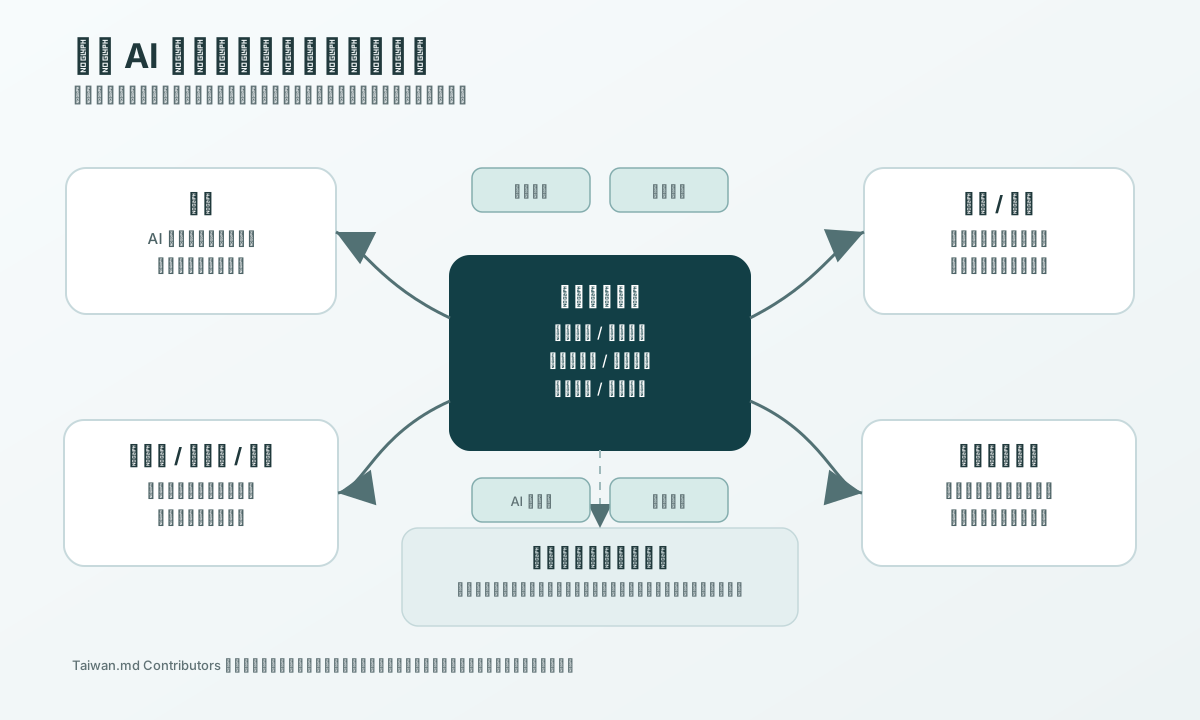
The expansion of Taiwan's AI supply chain is not a single route. Different segments are pulled by different markets: chips and packaging/testing move toward national security and cloud customers; servers, cabinets, power supplies, and cooling systems move with data centers, tariffs, and delivery requirements. Created by Taiwan.md Contributors.
Why Taiwanese Companies Frequently Face the International Market
The domestic market in Taiwan is too small; it was inherently difficult to sustain large-scale hardware companies solely on local demand.
The way Taiwanese companies grew was by first meeting the demands of international customers and then refining themselves into world-class suppliers. TSMC serves global chip designers; Foxconn, Great Diamond (Guangda), Wistron, Inventec, and Pegatron serve global brands and cloud customers; Delta handles power, cooling, and energy management; ASE and SPIL handle testing/packaging; a group of facility management, materials, electromechanical, equipment, and component companies move alongside their major clients.
This gives the Taiwan supply chain a distinct characteristic: it operates for the world, while the local Taiwanese market is only a small portion of its reach.
When the world still believed in globalization, this was an advantage. Taiwanese companies mastered cross-border management, rapid facility setup, customer responsiveness, and supplier mobilization. As the world moves toward de-risking, this remains an advantage, though the questions have become harder. Customers do not just want Taiwanese companies to be capable; they need them to produce the same quality and speed in the US, Mexico, India, Vietnam, Thailand, Japan, Germany, or other locations.
Therefore, "going abroad" is not merely moving factories out. It is also a re-validation of corporate capability: can the engineering management, supplier collaboration, and manufacturing pace forged in Taiwan be replanted in different systems, languages, labor unions, electricity prices, water resources, and labor cultures?
One Overseas Factory, Different Perspectives
Overseas manufacturing is often framed as corporate news: how much a company invested, where they built a factory, when it will reach mass production, and whether revenue can increase.
This is naturally what owners look at first. For an enterprise, going abroad is about business: being closer to customers, avoiding tariffs, securing subsidies, mitigating China-related risks, and establishing secondary production bases under the demands of major clients. If overseas factories can secure orders, retain customers, and enter government procurement, owners will naturally view it as a growth strategy.
However, for the same factory, governments see something else.
For governments in the US, Japan, and Europe, the expansion of Taiwanese firms is understood within the framework of economic security. The U.S. CHIPS and Science Act's subsidies to TSMC in Arizona are intended to ensure advanced chips are produced on American soil, reducing reliance on Asian supply chains. When AP reported that the U.S. government offered up to $6.6 billion in subsidies to TSMC, it was framed within the context of rebuilding domestic advanced chip manufacturing capabilities and ensuring supply chain security.3
For the Taiwanese government, the issue is more nuanced. During an interview with TIME, President Lai Ching-te stated that semiconductors are a global collaborative industry where raw materials, equipment, and technology are distributed across the US, Japan, and the Netherlands; he also noted that if semiconductor companies choose to expand into the US, Japan, Europe, or other countries for their own interests and development, the government fundamentally respects those decisions.4 This means the government cannot view "going abroad" solely as "staying in Taiwan" versus "loss of assets," but must find a balance between corporate growth, international alliances, and core domestic capabilities.
The Public and Foreign Partners are Also Watching These Factories
The public views these factories through another set of questions.
In Taiwan, people might ask: if the most important factories and orders gradually move abroad, will there be fewer jobs in Taiwan? Will wages stagnate? Will the protective effect of our "Guardian Deity" (referring to TSMC) weaken? However, the public may also benefit from another angle: if expansion brings more orders, R&D, management roles, and international cooperation, the Taiwanese headquarters might retain higher-level positions rather than bearing all the pressure of utilities, land, transportation, and housing costs on the island.
In the locations where factories are built, locals will ask: do these high-tech investments truly bring good jobs? Can the local area handle the risks to water, electricity, transportation, housing, and the environment? When The Verge reported on the Arizona semiconductor cluster, it juxtaposed the employment expectations from chip investment with concerns regarding water resources, chemicals, labor safety, and whether local residents would truly benefit.5 This reminds us that after Taiwanese firms go abroad, they will encounter foreign local societies in addition to foreign customers.
The perspective of international suppliers and partners is also different. Companies like NVIDIA, OpenAI, Sony, Denso, Toyota, Bosch, Infineon, and NXP partner with Taiwanese companies because Taiwan fills a gap in their own supply chains. Collaboration allows them to get closer to the computing power, automotive, industrial, or data center markets while reducing single-point dependencies. For them, Taiwanese firms are partners and part of their risk management strategy.
Therefore, overseas factories should not be judged solely by whether "the company made money." They also ask: what security did the government gain? What costs did the public bear? What redundancy did foreign partners acquire? And what core capabilities remain on Taiwan island?
Going Abroad is Not Simply Cloning a Taiwan Factory
Going abroad is easily imagined as "moving the same factory to another country." But for manufacturing, buying land, building facilities, and installing machinery is only the beginning; the real challenge is bringing an entire set of work habits to a new location.
In Taiwan, one phone call can find familiar material suppliers, electromechanical shops, equipment maintenance, logistics, and engineering support. Suppliers know each other's speeds and how to fill in for one another when problems arise. This density belongs to an entire industrial cluster—a rapport built over years by many companies.
Abroad, firms must face different labor markets, union systems, environmental impact assessment procedures, local politics, electricity prices, water costs, engineering talent, and the maturity of suppliers. Some issues can be solved with money; some require time; others may require changing original management methods entirely.
This is why the difficulty of going abroad varies greatly across different segments. AI servers, cabinets, power supplies, cables, and assembly are relatively easier to move along with customers and data centers; wafer fabrication and advanced packaging rely more heavily on supply chain density, engineer training, and long-term yield stability. The world can use subsidies to "invite" Taiwanese companies out, but it cannot immediately replicate the speed of Taiwan's domestic ecosystem.
Therefore, when evaluating overseas factories, one cannot only look at "where production is." More critical questions are: where is the decision-making? Where is the R&D? Where is the problem-solving capability? Can the suppliers keep up? And where will the next generation of technology be developed first? These questions determine whether expansion is an extension of Taiwan's capabilities or a gradual migration of core capabilities elsewhere.
Not All Segments Go Abroad in the Same Way
Within the AI supply chain, different segments have different reasons for going abroad.
Wafer fabrication has the highest capital barriers and involves water, electricity, land, talent, equipment, chemicals, and yield rates. It is difficult to move and most visible to politics. Advanced packaging and testing sit in the middle; they must be close to wafers, customers, and system integration. AI servers, cabinets, and power systems are closer to final data centers and are more sensitive to tariffs, lead times, customer locations, and national security procurement.
Thus, we see different manufacturers moving in different directions.
Foxconn and Wistron are being pulled into the manufacturing of US-based AI supercomputers. Delta is expanding its overseas footprint in power, data center, and industrial power equipment; media reports indicate that after expanding its Plano, Texas site to nearly 1.5 million square feet, it plans to provide localized manufacturing solutions for the U.S.; its Krishnagiri plant in India continues to expand to serve electric vehicle, telecommunications, data center, and industrial customers.67
Wafer and packaging nodes like TSMC, ASE, and SPIL are more directly involved in US, Japanese, and European semiconductor policies. They go abroad to ensure that customers and governments believe that while Taiwan remains a core hub, a portion of its capabilities can be established within the territory of allies.
The same "overseas manufacturing" means different things for the U.S., Japan, and Germany. The U.S. wants AI and national security; Japan wants industrial reconstruction; Europe wants industrial resilience. TSMC serves as the most prominent international interface for Taiwan's supply chain across these diverse demands.
The "Guardian Deity" Pushes Issues to Maximum Intensity
TSMC is the most prominent character in this story, but the expansion of the supply chain does not stop with TSMC.
As a symbol of the "Guardian Deity," TSMC’s overseas manufacturing pushes the issues to their highest intensity. This involves the most complex, expensive, and supply-chain-dependent aspect: wafer fabrication, which is also required to be established within allied territories. When this happens, it becomes even less likely that other segments can remain entirely on the island.
TSMC's official Arizona page notes that investment in the Phoenix site has expanded to $165 billion, planned to include six wafer fabs, two advanced packaging facilities, and an R&D center; one of the wafer fabs began mass production using the N4 process in Q4 2024, with plans for N3, N2, and A16 to follow.8 This is a representative case of the U.S. pulling a portion of advanced AI chip manufacturing into its own territory.
Kumamoto, Japan, represents another demand. AP reports that TSMC plans to produce 3nm chips at its second plant in Kumamoto for use in AI, smartphones, robots, and autonomous driving; Japan values economic security and the reconnection of semiconductor, automotive, robotics, material, and equipment industries.9
ESMC in Dresden, Germany, represents a third logic. The ESMC website states it is a joint venture between TSMC, Bosch, Infineon, and NXP, aiming to establish a wafer fab in Germany to support European industrial, IoT, communication, and automotive markets.10 Europe is concerned with the supply resilience of automotive, industrial, and communication chips; not every node can keep up with Taiwan's pace.
Despite being "overseas manufacturing," what the U.S., Japan, and Germany want is different. The U.S. wants AI and national security; Japan wants industrial reconstruction; Europe wants industrial resilience. TSMC serves as the most visible international interface for Taiwan’s supply chain among these demands.
What Remains in Taiwan After Going Abroad?
The question truly worth asking is: "After going out, what remains in Taiwan?"
Some things can be moved quickly: factories, some production lines, assembly capabilities, customer service, local maintenance, certain testing processes, and logistics. Some things are very hard to move: supplier density, engineer training, the speed of process improvement, a culture of yield optimization, cross-company collaboration, long-accumulated trust, and a group of people who know exactly who to call when something goes wrong.
Taiwan's core value will not disappear immediately just because a few overseas factories appear. However, it will not automatically exist forever.
Overseas manufacturing brings two opposing effects. First, it allows Taiwanese companies to penetrate ally markets more deeply, strengthening mutual interests. Second, it also allows allies to slowly build redundancy, reducing their single-point reliance on Taiwan island. Business owners see growth; governments see security; foreign partners see redundancy; and the public sees both opportunity and anxiety.
Both of these things are true simultaneously.
Therefore, Taiwan cannot view overseas manufacturing solely as a loss, nor can it be seen only as a glory. It is a stress test: if Taiwanese companies take their capabilities abroad, can Taiwan island continue to retain higher-level R&D, processing, packaging, engineering density, talent, and supplier networks?
If the answer is yes, going abroad becomes an extension. If the answer is no, it may become a dilution.
Needed, but also Dispersed
The overseas expansion of Taiwan's AI supply chain makes the phrase "Taiwan is irreplaceable" more complex.
The world indeed needs Taiwan. But the world is also using subsidies, policies, land, utilities, tariffs, and markets to ensure it does not become so dependent on Taiwan.
This is the inevitable counter-reaction after success. When an island becomes a critical node in the global AI supply chain, other nations will naturally seek to pull some of those capabilities closer to themselves.
What Taiwan must do next is ensure that the world still needs Taiwan even after the expansion. Overseas factories can grow in the U.S., Japan, Germany, India, Vietnam, Thailand, or Mexico, but core capabilities must continue to be updated in Taiwan.
This "update" is specific: Taiwan must retain those who can stabilize new processes, resolve packaging bottlenecks, manage server lead times, and ensure suppliers can quickly fill gaps. If these capabilities continue to accumulate, Taiwan will remain the site where the next round of solutions is found. As long as the next difficult problem still returns to Taiwan first to be solved, overseas manufacturing is more like extending Taiwan's reach rather than hollowing out its core.
This is the most critical issue regarding the expansion of the AI supply chain: after Taiwan's capabilities are invited out by the world, can Taiwan continue to grow the next layer of capability for itself?
Further Reading
- AI Hardware Supply Chain — Why the world needs Taiwan to turn cloud demands into machines.
- AI Hardware Supply Chain — From GPUs to cabinets, how Taiwanese ODM/EMS companies handle AI data center hardware.
- Taiwan's Power and Semiconductors — How advanced manufacturing returns to power and energy security.
- Semiconductor Water and Taiwan's Water Resources — How wafer fabs enter the realm of reservoirs, drought, and recycled water treatment.
- Taiwanese Enterprise: TSMC — How TSMC's foundry model rewrote the global semiconductor division of labor.
- Taiwanese Enterprise: Foxconn Precision — From electronics manufacturing to AI servers and data center hardware.
- Taiwanese Enterprise: Delta Electronics — How power, cooling, and energy management became part of AI infrastructure.
- Science Park Development — How Taiwan's semiconductor clusters grew out of land and urban planning.
Image Sources
- TSMC Fab 21 Construction Site in Arizona (hero / inline): 231105-1 TSMC Fab 21 construction — Photo: Hunter Trick, 2023-11-05, Wikimedia Commons, CC BY-SA 4.0. This article uses the version cached at
public/article-images/economy/tsmc-fab21-arizona-2023.webp. - TSMC Hsinchu Science Park Factory Cluster: TSMC fabs in Hsinchu 01 — Photo: Tseng Cheng-Hsun (曾成訓), 2020-01-02, Wikimedia Commons, CC BY 2.0. This article uses the version cached at
public/article-images/economy/tsmc-fabs-hsinchu-2020.webp. - AI Supply Chain Overseas Expansion Route Map: Created by Taiwan.md Contributors as an SVG diagram, CC BY-SA 4.0, stored at
public/article-images/technology/ai-supply-chain-overseas-footprint.svg. Used to illustrate the multiple routes and stakeholder pulls of Taiwan's AI hardware supply chain; does not represent full company distribution or production capacity proportions.
References
- AP: Nvidia plans to manufacture AI chips in the US for the first time — AP reports on NVIDIA producing Blackwell chips and AI supercomputers, naming TSMC Phoenix, Foxconn Houston, Wistron Dallas, and SPIL/Amkor's packaging cooperation in Arizona.↩2
- AP: OpenAI and Taiwan’s Foxconn to partner in AI hardware design and manufacturing in the US — AP reports on OpenAI and Foxconn partnering for AI data center racks, including cabling, networking, and power systems, mentioning Foxconn's U.S. facilities.↩
- AP: Biden administration announces $6.6 billion to ensure leading-edge microchips are built in the US — AP reports on U.S. CHIPS Act funding for TSMC Arizona as a matter of supply chain and national security.↩
- TIME: Read the full interview with Taiwan President Lai Ching-te in TIME Magazine — The Chinese version of the interview where Lai discusses semiconductors as a global industry and government views on expansion to US, Japan, and Europe.↩
- The Verge: The new silicon valley (literally) — Report on Arizona's semiconductor cluster growth regarding jobs, local development, water resources, and environmental/labor safety concerns.↩
- MySA: Plans move forward on $115M electronics factory in Plano — Reports on Delta Electronics expanding manufacturing and office space in Plano, Texas, detailing its existing R&D centers and local production positioning.↩
- Times of India: Delta Electronics pushes for capacity expansion — Reports on the expansion of Delta's Krishnagiri plant in India to serve telecom, data center, EV, and industrial clients.↩
- TSMC Arizona — TSMC official Arizona page detailing Phoenix investment scale, six fabs, two packaging facilities, N4/N3/N2/A16 timelines, and water recycling plans.↩
- AP: TSMC to make advanced AI computer chips in Japan — AP reports on TSMC's plan for a second plant in Kumamoto to produce 3nm chips for AI, smartphones, robots, and autonomous driving.↩
- ESMC: European Semiconductor Manufacturing Company — ESMC website describing the joint venture with TSMC, Bosch, Infineon, and NXP to support European industrial, IoT, communication, and automotive markets.↩