
30-Second Overview: Edward Yang (1947–2007) worked as a submarine software engineer in the US for seven years, giving up everything in his early thirties to return to Taiwan and learn filmmaking. With the precision of an engineer, he hand-drew storyboards and used the calmest camera angles to dissect the confusion of Taipei’s middle class, creating works like A Brighter Summer Day and Yi Yi, which are now listed among the top 100 films in cinema history. He was also the first Taiwanese to win Best Director at Cannes. But this "coldness" came at a cost—he scolded actors until they faced the wall, and his relationship with Hou Hsiao-hsien went from close friends to distant, resulting in Yi Yi not being screened in Taiwanese cinemas for seventeen years during his lifetime. What he filmed was never other people’s stories, but the side of ourselves we cannot see.
In the early 1980s, a tall man walked into the Central Motion Picture Corporation in Taipei. On his T-shirt were printed three names: Herzog, Bresson, Yang1. The first two were Herzog from Germany and Bresson from France, names that cannot be bypassed in the history of world cinema. The third was himself. At that time, he had not yet directed any feature films.
This is the image remembered by screenwriter Wu Nian-zhen: Edward Yang, when he first arrived at CMP, had an unruly and defiant look2. He placed his own name after those of two masters.
That year, Edward Yang was in his early thirties. Four years earlier, he had been in Seattle, writing control programs for US Navy submarines3.
A T-Shirt Placing Himself Beside Masters
He was not formally trained in film. This must be stated first, as it is the key to understanding everything about him.
Edward Yang was born in Shanghai in November 1947 and moved to Taiwan with his family in 1949, growing up in Taipei4. His father had worked in a bank in Shanghai and came from the countryside, Yang said himself5. In 1965, he graduated from Keelung High School, and in 1969, he received a degree in Control Engineering from National Chiao Tung University. He then went to the University of Florida in the US for a master’s degree in electrical engineering6. This was a standard path for scientific elites, the path taken by the best students in Taiwan at that time.
After obtaining his master’s, he actually went to the USC School of Cinematic Arts. He enrolled in 1973 and left in 1974. He gave two versions of the reason. In an interview with Mirror Weekly, he said it was a "diploma mill," where poor students could not afford film stock, so "there was no way to make films, why study!"7. In another interview, his account was more honest and cruel: "I realized I had no talent, no the things needed to enter the film industry, so I dropped out."8
Thus, he returned to the track of an engineer. In Seattle, at the Applied Physics Laboratory of the University of Washington, he designed control programs for US Navy submarines, staying there for seven years9. This was a good job: stable, respectable, and utilizing all his training. In his spare time, he and friends made short films with 16mm film10. His brother, two years his senior, took him to watch film festivals at the University of Washington11. A rational person lived a rational life.
The turning point happened in a cinema. He watched Herzog’s Aguirre, the Wrath of God, a film about a group of Spanish conquistadors going mad in the Amazon jungle. Walking out of the cinema, he felt he was "already another me"12. Years later, he repeatedly mentioned this event: Herzog used the most concise imagery to precisely express feelings deep in the soul, and that a film could be completed by the will of one person13.
For an engineer, this was a message about feasibility. Film did not necessarily require Hollywood’s massive machinery; it could be supported by the logic of one person, like writing code.
In 1981, he returned to Taiwan14.
He gave up his job in Seattle, his visa, and a clearly visible life path. What did he return to Taiwan to do? To learn filmmaking. A person who calculated risks to the extreme made a decision that pulled risks to the extreme.
📝 Curator’s Note
We are accustomed to telling the story of "engineers turning into artists" as a romantic awakening: a boring technician finally finds their soul. But the example of Edward Yang is exactly the opposite. What actually gave him the courage to gamble was an engineering message: Herzog proved to him that a film could be completed by one person. He did not abandon rationality to chase a dream; he used rationality to calculate the feasibility of that dream. He was an engineer his whole life, only changing the problem he solved from submarines to the human heart.
The Blackboard at 69 Ji Nan Road
When Yang returned to Taiwan, he was met by an industry that was loosening.
In the early 1980s, Taiwan’s film box office was dominated by Hong Kong films and Qiong Yao-style literary films, with local production stuck in formulas. Inside CMP, two young planners named Hsiao Hsien and Wu Nian-zhen wanted to find new directors to shoot something different15. In 1982, Sunny Days was released, featuring four new directors each shooting a segment: Tao Te-chen, Edward Yang, Ke Yi-cheng, and Chang Yi. The four segments corresponded to childhood to adulthood16. Yang’s segment was titled "Expectation," about a girl secretly in love with a college student tenant in her home. The New Taiwanese Cinema is generally considered to begin with this film.
He quickly showed differences from others. The Sea of Trees (1983) was his first feature film, starring Sylvia Chang and Hu Yin-meng, with cinematography by Do Chi-fung, who was serving as a film cinematographer for the first time. This decision caused angry reactions from CMP’s internal cinematographers; he withstood the pressure and insisted on using him1718. The runtime was nearly three hours, far exceeding the standards of the time. This was not a person who knew how to compromise.
The New Cinema was not the work of one person. It had a physical base: 69 Ji Nan Road, Section 2, Yang’s home from childhood, a Japanese-style old dormitory allocated by the unit where his father worked. A group of people later written into the history of Taiwanese cinema often gathered there19. On November 6, 1986, Yang’s birthday party was held here20. Inside the house was a blackboard, filled with everyone’s ideas about film and the tentative name for the future company21.
The conversations of that night grew into a document two months later. On January 24, 1987, a manifesto drafted by Chan Peng-chih and signed by fifty film workers was published simultaneously in Wenxing, the China Times Human Interest Supplement, and Hong Kong’s Film Weekly22. It discussed in three sections: our views on film, our fears about the environment, and our hopes for change. This document, later called the "Taiwan Cinema Manifesto," was a collective voice of the New Cinema against the entire system23.
The ideals of the manifesto were not realized; instead, they brought a counterattack from the system. The New Cinema as a movement also came to an end shortly after24. And Edward Yang, standing among this group, was destined by his personality to be a difficult ally.
Guling Street Built in Pingtung
To understand where Yang’s "coldness" truly lay, we must look at the four-hour film he spent five years making.
On June 15, 1961, at 10 PM, near Guling Street in Taipei, a sixteen-year-old boy named Mao Wu stabbed a girl of the same age, Liu Min, seven times with a scout knife; she died on the spot25. Mao Wu was a student in the second year of junior high, Class C. Two months prior, he had been expelled from school after a spring knife was found in his backpack26. The case’s judgment was tossed back and forth for nearly two years, from fifteen years, remanded for retrial to seven years, to the final verdict in February 1963 of ten years, because the perpetrator was a minor and could not legally be sentenced to death27.
This case was close to Yang. In 1959, he entered Keelung High School’s junior high night department, transferred to the day department the following year, and entered the senior high department in 196228. He attended the same school as Mao Wu, just a different cohort. Years later, he told British film critic Tony Rayns that he knew many people close to this boy, so he could study the details of the case quite thoroughly29.
But A Brighter Summer Day never intended to reenact that murder, nor was it nostalgic. What truly captured Yang was the environment itself. He told Tony Rayns that he quickly realized the point was not just what happened to this pair of teenagers29. What he wanted to film was the entire era’s atmosphere that could kill a boy. In 1961 Taipei,外省 families were squeezed into small houses, the shadow of White Terror pressed on every adult, and teenagers clumsily sought a position for themselves in the chaos by forming gangs and adopting江湖 nicknames. The flashlight swinging in the dark in Xiao Si’s hand illuminated the insecurity of an entire generation.
His narrative philosophy was also stated most clearly in this film. He told Tony Rayns: "My philosophy of storytelling is that it’s not interesting when a bad guy kills someone or a good guy does good things; it’s interesting when a good guy does bad things, or vice versa."30 This sentence can almost explain all his films: he never gives you a character you can simply love or hate.
✦ "It’s interesting when a good guy does bad things, or vice versa."
The production method of this film was itself the work of an engineer. Five years of preparation31, one hundred and ten working days of shooting32. The book street in the film was not shot on Guling Street. On the way home from work, Yang caught a glimpse of the roundabout near Changchun Park, close to the Pingtung County Governor’s Residence, through the car window, and decided to rebuild 1960s Taipei there33. The most astonishing part was the cast: he told BFI personally, "75 percent of the cast and more than 60 percent of the crew had never worked on a film before."34 For this, he held acting training classes, grinding a group of amateurs into a cast capable of supporting a four-hour epic.
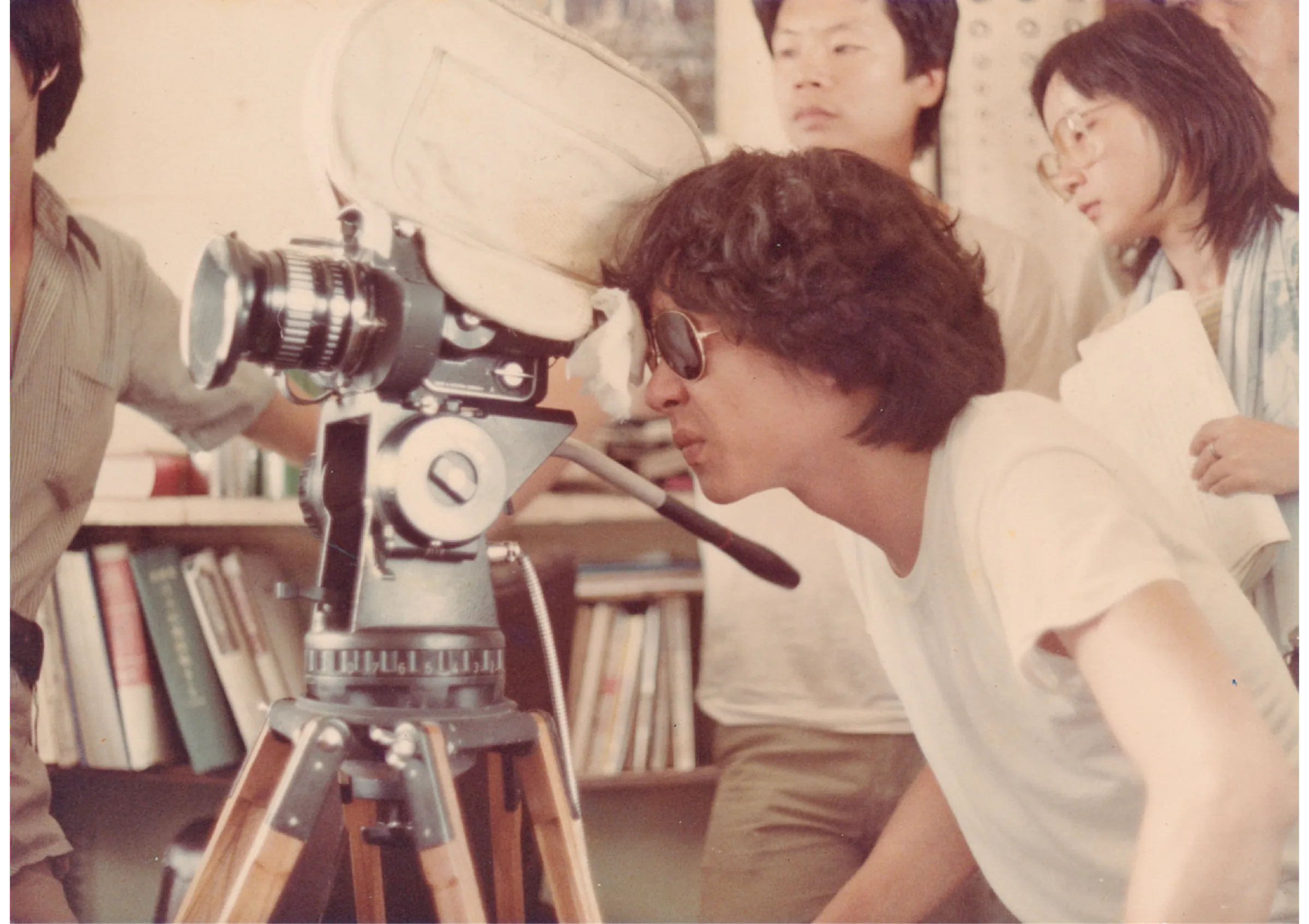
Edward Yang on the set of The Sea of Trees in 1983. This was his first feature film, with a runtime of nearly three hours, far exceeding the standards of the time.
The Thirteen-Year-Old in the Pitch-Black Room
Among the amateurs was a thirteen- or fourteen-year-old boy named Chang Chen35.
He later became an international film star, but when filming A Brighter Summer Day, in his own words, "he didn’t know what filmmaking was at all, completely zero, completely blank!"36 How did Yang extract the expressions he wanted from a blank sheet? Chang Chen recalled a scene: Yang locked him in a pitch-black room, scolded him until he couldn’t speak, made him face the wall for half an hour, and then suddenly called him out of the room and pulled him in front of the camera to shoot. He wanted that naturally流露, frightened expression. "This is a very shocking memory for me," Chang Chen said37.
This was another side of Yang on set. Actor Deng An-ning remembered that trembling atmosphere: the set was silent, then suddenly a loud "F*** you!" Everyone was startled; after scolding, he turned and walked out38. Screenwriter Hsiao Hsien was more direct: Yang almost changed actors halfway through every film, because if a character made him feel wrong, the scene was wasted39.
A person who valued logic over feelings easily became a tyrant on set. His "coldness" really hurt people.
But the same Deng An-ning also remembered that after acting under such high pressure, Yang would come over and pat him: "Deng Zi, good acting!"40 During the time Hsiao Hsien’s mother was in the late stages of cancer, Yang drove him back and forth between the hospital and the set every day41. Actor Hsiao Bi-khim’s description might be closest to the truth. Yang’s way of leading people was "high-density interaction in daily life"; he often kept everyone close, discussing scripts, watching movies, listening to music, visiting exhibitions, reading, and commenting on current events together42.
A person not good at communication, who even stuttered when speaking43, used the clumsiest and most laborious method: living his whole life as a class. Hsiao Bi-khim, Chen Yi-wen, Wang Wei-ming, Yang Shun-ching, Hong Hong, these Taiwanese filmmakers who later stood on their own, were all brought up this way. Years later, Hsiao Bi-khim比喻 at a forum that these people’s credentials were like having attended an extra "Edward Yang School"44.
📝 Curator’s Note
The term "Edward Yang School" sounds warm, but it actually hides a contradiction. A person公认 as not good at communication and with a fiery temper, how could he become a teacher to an entire generation of filmmakers? The answer might be: precisely because he could not lead people in ordinary ways, he could only use the most extreme methods, keeping actors close, forcing truth through high pressure, and then affirming them in the most direct way. He was as merciless in scolding as in praising. This was a seriousness so clumsy that it was exceptionally forceful, unrelated to gentleness. His high standards for film hurt people first, then created them.
Taipei Guest House: The Highest Point and the Lowest Point
If we only look at international honors, Yang’s path was beautiful, one film higher than the next.
- Terrorizers (1986) won Best Feature Film at the Golden Horse Awards, and the following year won the Silver Leopard Award at the Locarno Film Festival in Switzerland45. A Brighter Summer Day (1991) received twelve nominations at the Golden Horse Awards, winning Best Feature Film and Best Original Screenplay, and also won the Special Jury Prize at the Tokyo Film Festival46. This path led to Yi Yi in 2000, for which he won Best Director at the Cannes Film Festival, becoming the first Taiwanese director to receive this award47.
But on the other side of honors was his clarity regarding Taiwan’s film environment, bordering on despair.
In early June 2000, holding the Cannes trophy, Yang returned to Taiwan and held an awards tea party at the Taipei Guest House. A reporter from Kuanghsia Monthly was present and recorded his words: "This is my personal high point since entering the film industry, but psychologically I am very sad, because it is also the lowest point for Taiwan film. Film workers have worked until their hair is white. I hope young people entering the film circle will not have their passion erased by Taiwan’s environment."48
Personal high point, Taiwan film’s lowest point. This sentence was both his pride and his sorrow, and it planted the seed for the next seventeen years, the most confusing thing for Taiwanese audiences.
The opposing voice was always there, and never without target. Art critic Chen Tai-sung criticized his films as having an "artsy tone" that was intolerable, with dialogue like maxims, "one after another 'confessions of truth'"49. Writer Chiang Hsun gave the评语 "bordering on superficial" for A Summer at Grace in the judging panel discussion that year50. Even Hong Hong, who had a minor role in the film, felt those long philosophical monologues were "very dry and boring," inferior to Woody Allen’s subtle touch51. In 1994, A Summer at Grace was in official competition at Cannes; the British film critic circle was confused. Even Time Out admitted that this film "left most of the drowsy British journalists at Cannes baffled"52.
These criticisms actually all pointed to the same place: he was too cold, too fond of reasoning, too much like a person standing outside the crowd with a scalpel. And this was the cost of the method he chose. When you decide to dissect emotions in the most rational way, you must bear the accusation of "standing outside the matter." His coldness came at a cost.
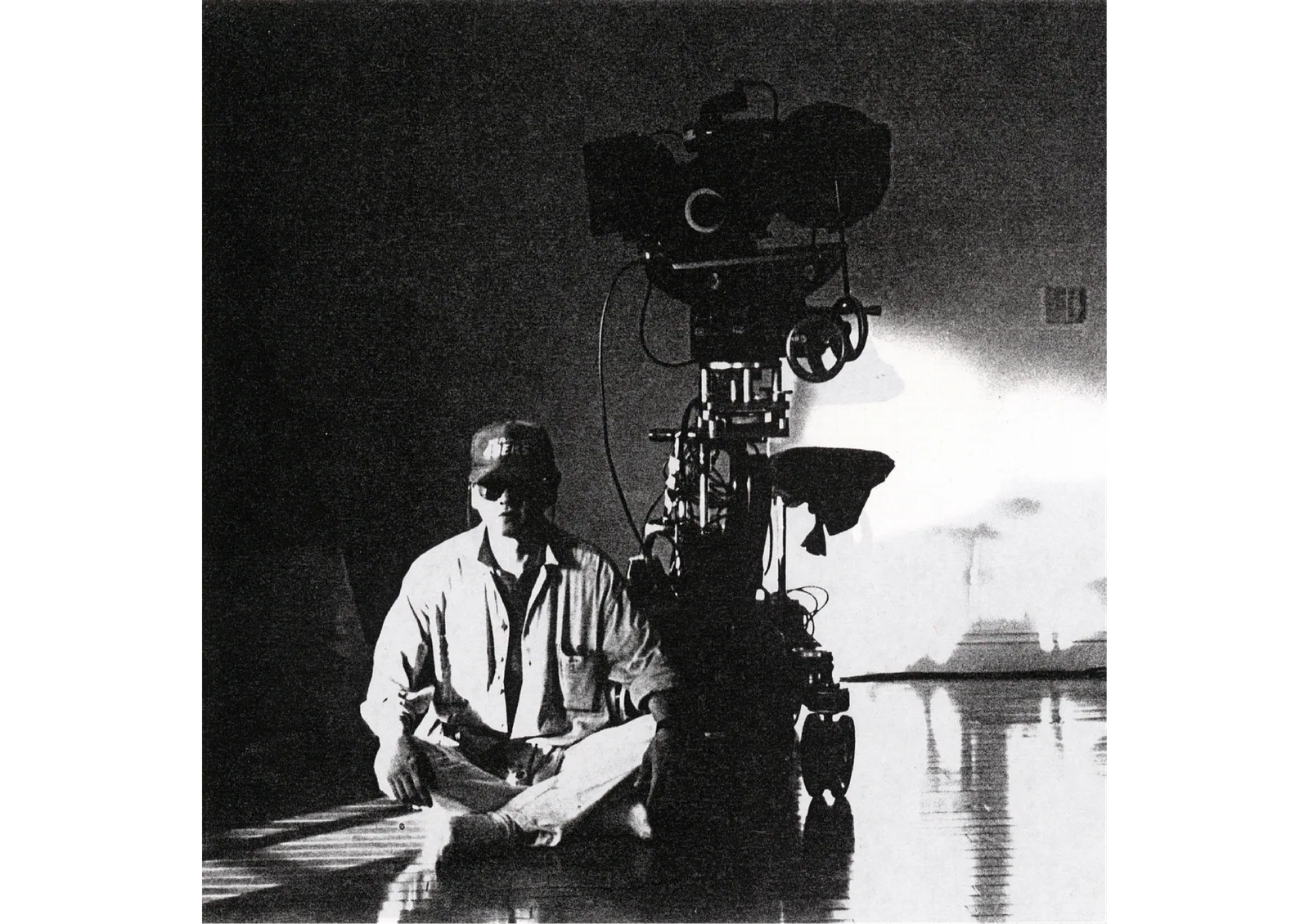
Edward Yang on the set of A Summer at Grace in 1993. This film, criticized for its "artsy tone" and "superficiality," was precisely his representative work pushing rationality to the extreme.
A Film Proving Itself as a Taiwan Film
Yi Yi was Yang’s last completed film, and the sum of all his contradictions.
This film tells the story of a Taipei middle-class family: NJ (the name is an abbreviation of Nian-zhen) played by Wu Nian-zhen, the mother played by Elaine Jin, daughter Ting-ting, and the little boy Yang Yang who takes a camera everywhere to shoot adults’ backs53. It was a Japan-funded work—the producer was the "1+2 Production Committee," with Pony Canyon’s participation, Yang’s own Atom Films production, and producer Mayu Kaii54.
Its evaluation in the world was astonishingly high. It premiered at Cannes on May 14, 200055. In BBC’s 2016 selection of the Top 100 Films of the 21st Century, Yi Yi ranked eighth56. In the British Film Institute’s Sight & Sound 2022 list of the Greatest Films of All Time, Yi Yi tied for ninetieth57. In the New York Times’ 2025 Top 100 Films of the 21st Century, it ranked fortieth58. It entered the Criterion Collection59.
Then there was the confusing thing: this film, which won Yang Best Director at Cannes and was hailed by the world as a masterpiece, was never screened in Taiwanese cinemas during his lifetime60. Taiwanese audiences had to wait until 2017, ten years after his death, to see it in a cinema for the first time61.
This matter is easily written as a romantic story: the master, in a huff, refused to let his hometown see this film. But the truth was much more complex. It was the result of several layers of obstacles stacked together.
The bottom layer was copyright. The copyright of Yi Yi was held by the Japanese producer. In 2001, at the Hong Kong Film Festival, when asked about this, Yang’s answer was平淡 and technical: "It hasn’t been released in Taiwan because no one came to handle distribution; the film copyright is in the hands of the Japanese producer, and distribution fees are too expensive."62 No accusation, just like explaining an administrative trouble. One layer up was the认定 of the News Bureau: because the producing company was Japanese, this film was classified as a non-national film, unable to receive Taiwan’s subsidies, and even travel expenses for film festivals became problematic63. These technical exclusions stacked up layer by layer, finally crushing a person’s willingness to continue pushing. Curator Wang Jun-jie later relayed that Yang felt Taiwanese audiences did not know how to appreciate his works64. Objective obstacles and subjective disillusionment bit together, becoming seventeen years of silence.
This absurdity continued until after his death. In 2017, for the distributor to release Yi Yi in Taiwan, they had to first "prove that the main actors’ nationality was the Republic of China," struggling with the authorities for a while before obtaining the rating certificate, with the final official record stating a contradictory sentence: the producing company of this film is Japanese, but the nationality is the Republic of China65. A film about Taipei, acted by Taiwanese, had to exert such effort to prove it was a Taiwan film.
The Yi Yi 25th Anniversary 4K Restoration Trailer (Janus Films Official). This film, which Taiwanese audiences waited seventeen years to see in cinemas, returned to the Cannes Classics section as a restored version in 2025.
In his seven-and-a-half works lay the spiritual history of Taiwan over forty years since the post-war period. From the repression of the Martial Law era, to the alienation of the city after the lifting of Martial Law, to the spiritual void of the middle class under economic takeoff. Taipei from 1980 to 2000 under his lens became the most honest visual archive of Taiwan’s modernization. What he filmed was always Mandarin-speaking urban middle class; the lens did not extend to factories, fields, or the Taiwan that spoke Taiwanese. This was his choice, and also his boundary.
Edward Yang and Hou Hsiao-hsien: The Gravity of Two Mountains
When talking about the New Taiwanese Cinema, one cannot bypass another name: Hou Hsiao-hsien. The relationship between these two was itself a story of complementarity and estrangement.
How did they meet? Hou Hsiao-hsien’s account was light: "No particular reason, just met. He returned, we talked about films and got along well."66 Chu T’ien-wen remembered that honeymoon period, saying the two were like what Tsai Chin described, "like two people in love," spending every day together when there was nothing to do; that was their best time67. In 1985, when Yang filmed Terrorizers, Hou Hsiao-hsien not only starred but also provided funding. What to do if the money wasn’t enough? Hou Hsiao-hsien’s original words were: "What if the money is spent? Just owe the mother-in-law’s money."68
Terrorizers was only screened in Taipei for four days before being pulled69. Hou Hsiao-hsien recalled this matter with a generous tone: the filming was done, Yang also married Tsai Chin because of this film, still very ambitious, "Next, how well and how amazingly Terrorizers was filmed"70.
But the gravity between the two mountains later became distance. When Hou Hsiao-hsien spoke directly about the reason for the estrangement only once, he said: "It’s quite miserable, after filming they got married, and in the end it just fizzled out. So actually, Hou and I later became a bit distant because of Tsai Chin."71 As for more details, he only left one sentence: "The matter is hard to explain clearly, and it’s hard for you to understand even if explained."72
These two sentences together were more honest than any breakup drama. He admitted the fuse, but refused to explain the full picture. The marriage between Edward Yang and Tsai Chin, which lasted ten years before ending in 199573, was a fact in the context of this estrangement, but it should not be the center of anyone’s story. The two people who were once closest ended up separated by a distance no one could explain clearly—that was all.
Comics Drawn Until the Moment of Coma
To conclude Yang, we must return to the boy at the very beginning.
His first love in this life was actually comics, earlier than film. He said himself that besides film, his other love was comics, Japanese style, the kind with complex narratives74. During his time at Keelung High School, he "serialized" self-drawn WWII comics in class75. Those manuscripts are still there today: crumpled creases, blue ballpoint pen base with pencil lines, in the grids were broken walls and soldiers shooting silently76. When he established his film company, he named it "Atom Films," commemorating Tezuka Osamu’s Astro Boy77.
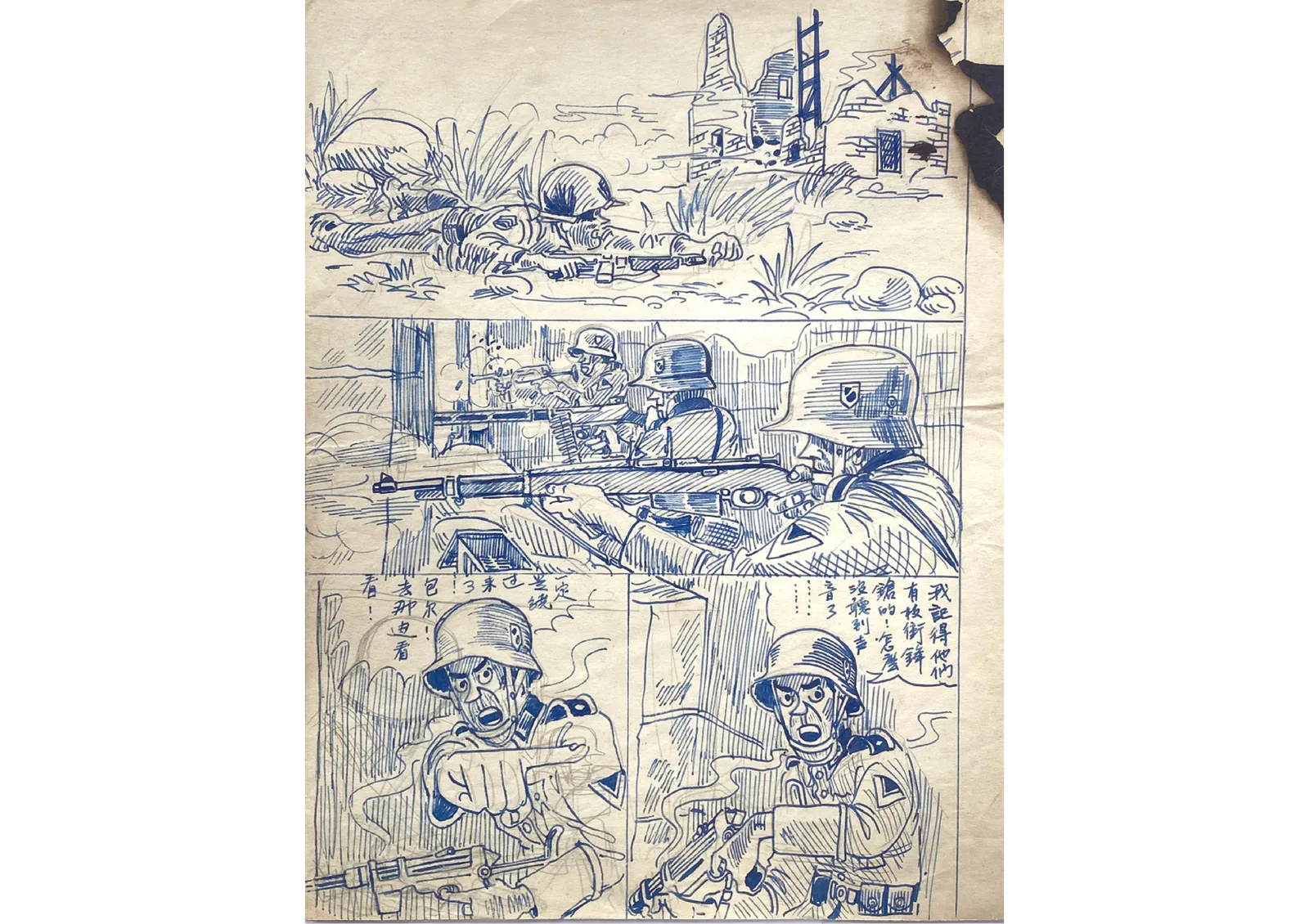
Edward Yang’s hand-drawn WWII comic manuscript from his youth. From the serialization in Keelung High School class to the unfinished animation in his later years, comics were his first love in life, and also his last.
So in his later years, the thing Yang倾盡 all wanted to do, went in a big circle back to animation, back to the enlarged version of his childhood’s first love. This film was called The Wind Rises (or Chasing the Wind), partnering with Jackie Chan, who served as martial arts director, co-producer, and invested his own portrait rights78. The story was set in Kaifeng during the Northern Song Dynasty,取材 from Along the River During the Qingming Festival and Dongjing Meng Hua Lu79. He required the animation to be "one continuous shot," using the most engineer-like obsession to challenge the most difficult technology in animation80. The budget was about twenty-five million US dollars, but in the end, only nine to ten minutes were completed81. Upon learning of his illness, the partner terminated the plan; the company subsequently fell into financial disputes and was liquidated and dissolved82. The project was too massive, unable to hold up83.
In 2000, he was diagnosed with colon cancer. For the next seven years, he concealed his illness, refused visitors, and replied to all concerns with a single "Very good"84. Cancer cells metastasized to his brain, spine, and ribs; he underwent brain surgery three times85.
On June 29, 2007, Edward Yang passed away at his home in Beverly Hills, US, at the age of fifty-nine86. Before passing, he took painkillers, his consciousness was unclear, but he still held a pen, drawing a sketch of an unfinished animation. This film was called Little Friends, about a child and a dog, full of family affection and fatherly love. He emailed the sketch to his old friend Chang Yi, then fell into a coma87.
The boy who serialized comics in Keelung High School class, until the last moment, was still that boy.
In December of that year, the Golden Horse Awards posthumously awarded him the Lifetime Achievement Award, presented by Hou Hsiao-hsien and Chang Chen88. The world had crowned him; this time, Taiwan itself claimed him back. In 2023, the Taipei Fine Arts Museum held the first complete Edward Yang retrospective in the world, titled "Yi Yi Reconstructed"89. His widow, Peng Kai-li, insisted the exhibition must be held in Taipei; the keyword she set for this exhibition was "warmth"90.
The 2023 Taipei Fine Arts Museum "Yi Yi Reconstructed: Edward Yang" Retrospective. This was the first complete retrospective of his work globally, using "warmth" to close the case for the person accused of being too cold.
A person criticized as too cold, too rational, standing outside the matter, was finally closed out by his closest people with the two words "warmth." This was not a overturning of the verdict—he was indeed cold, he did hurt people. It’s just that this coldness was always for one hottest thing.
Seven and a Half: A Spiritual History of Post-War Taiwan
Edward Yang only completed seven and a half feature films in his life (Sunny Days was a collaboration of four people, counted as half). The quantity was not large, but almost every film was a slice of Taiwan’s modernization.
Source: National Film and Audio Culture Center, Golden Horse Awards, BFI
In Yi Yi, there is a widely circulated line: "After the invention of film, human life has been extended by at least three times compared to before."91 This line was spoken by a film character, not Yang himself, but was later cited by countless Taiwanese film fans as his footnote. It can almost describe what Yang did for Taiwan: through film, he saved for us several times the lives we didn’t even see clearly ourselves.
I Film It for You to See
At the end of Yi Yi, the little boy Yang Yang, who always took a camera to shoot adults’ backs92, stood at his grandmother’s funeral and read a letter. The reason he shot backs was because he discovered adults could not see their own backs—so he filmed the unseen side and showed it to adults.
At the end of the letter, Yang Yang spoke to his newborn, nameless little cousin: he felt that he, too, was old.
A child saying "I am old too," the weight of this sentence was Yang’s lifelong self-explanation. He was that Yang Yang holding the camera. He gave up Seattle’s stable engineer life, returned to Taiwan, and with the calmest, most engineering-like method, filmed one by one, filming the back of our own heads that we couldn’t see, and showed it to us.
What he filmed was never others. It was us.
Using the coldest logic of an engineer to film the hottest loneliness of the human heart—this was the pair of eyes Edward Yang left for Taiwan, and also for the world.
Further Reading: Taiwan Film (Edward Yang was one of the two standard-bearers of the New Taiwanese Cinema; here is the map of the entire movement he belonged to), Hou Hsiao-hsien (the other mountain alongside Yang, from close friends to distant), Ang Lee (also brought Taiwan film to the world stage, but the path was completely different), Tsai Ming-liang (after the New Taiwanese Cinema, another way to dissect urban loneliness), Guling Street (the real street where the knife fell, the origin of a four-hour epic).
Image Sources
- Cover Image / The Sea of Trees Set (1983): Central Motion Picture Corporation, Shaw Brothers (Hong Kong), The Sea of Trees production photo, 1983. Provided by Peng Kai-li, deposited at the National Film and Audio Culture Center. Source from TFAM "Yi Yi Reconstructed: Edward Yang" exhibition public image (tfam.museum), Fair use editorial commentary.
- WWII Comic Manuscript (c. 1965-1970): Edward Yang’s hand-drawn WWII comic manuscript from his youth. Provided by Peng Kai-li, deposited at the National Film and Audio Culture Center. Source same as above TFAM exhibition press kit, Fair use editorial commentary.
- A Summer at Grace Set (1993): Atom Films, A Summer at Grace production photo, 1993. Provided by Peng Kai-li, deposited at the National Film and Audio Culture Center (TFAM website also marks c. 1994, here adopting the press kit’s 1993). Source same as above, Fair use editorial commentary.
References
- Chen Wan-jung: We are lucky to be unfortunate — To Edward Yang — Relaying Wu Nian-zhen’s memory: When Yang first arrived at CMP, he wore a T-shirt printing "Herzog, Bresson, Yang" (Herzog, Bresson, Edward Yang), with an unruly and defiant look.↩
- Chen Wan-jung: We are lucky to be unfortunate — To Edward Yang — Same as above, the memory of this T-shirt and that unruly look in Wu Nian-zhen’s memory comes from the circulation context of the oral history in Goodbye, Edward Yang.↩
- Seattle Times: Edward Yang, 59, filmmaker with Seattle ties — Seattle Times 2007 obituary, recording Yang’s tenure at the University of Washington Applied Physics Laboratory, designing control programs for US Navy submarines; NCTU Distinguished Alumni page archive also records "Computer System Design Engineer at University of Washington Applied Physics Laboratory."↩
- Wikipedia: Edward Yang — Chinese Wikipedia Edward Yang entry, recording his basic life skeleton: born in Shanghai on November 6, 1947, moved to Taiwan with family in 1949, grew up in Taipei.↩
- New Left Review: Edward Yang, Taiwan Stories — New Left Review Edward Yang interview, Yang himself spoke about his family background: his father worked in a bank in Shanghai before coming to Taiwan, but came from the countryside; also discussed his love for Japanese comics.↩
- National Chiao Tung University: Distinguished Alumni Edward Yang (Website Archive) — NCTU official Distinguished Alumni page 2022 archive, first-hand recording Yang as a graduate of the Control Engineering Department, Class of '58 (1969), Master’s in Electrical Engineering from the University of Florida, formerly a Computer System Design Engineer at the University of Washington Applied Physics Laboratory.↩
- Mirror Weekly: Yuan Qiong-qiong on Edward Yang’s USC Years — Mirror Weekly verbatim interview, Yang entered USC School of Cinematic Arts in 1973, left in 1974, described by himself as a "diploma mill," "no way to make films, why study!"↩
- Senses of Cinema: Edward Yang (Great Directors) — Film review website Senses of Cinema 2002 Great Directors column (author Saul Austerlitz), quoting Yang’s self-account of leaving USC: dropping out because he felt he had no talent to enter the film industry.↩
- Seattle Times: Edward Yang, 59, filmmaker with Seattle ties — Seattle Times obituary recording his engineer years at the University of Washington Applied Physics Laboratory; from leaving USC in 1974 to returning to Taiwan in 1981, about seven years in Seattle.↩
- Mirror Weekly: Yuan Qiong-qiong on Edward Yang’s USC Years — Same as [^7] special, recording that during Edward Yang’s work in Seattle, he and friends made short films with 16mm film in his spare time, maintaining his feel for film.↩
- Seattle Times: Edward Yang, 59, filmmaker with Seattle ties — Seattle Times obituary recording he went to Seattle to rely on his brother Robert, two years his senior; the two brothers watched University of Washington film festivals together.↩
- 500 Episodes: Wang Yun-yan on Edward Yang and Herzog — United Daily News 500 Episodes special article, relaying Yang’s self-account after watching Herzog’s Aguirre, the Wrath of God that he was "already another me," describing this film’s key trigger for him abandoning engineering for film.↩
- HK01: Edward Yang on the Inspiration of Herzog’s Aguirre, the Wrath of God — HK01 quoting Yang’s 1994 letter to Sight & Sound, Yang himself said Aguirre inspired him to become an independent producer, implying a film could be completed by one person’s will alone.↩
- Seattle Times: Edward Yang, 59, filmmaker with Seattle ties — Seattle Times obituary recording his return to Taiwan in 1981 (English Wikipedia also says 1980, both exist, here adopting the obituary’s claim); after returning, he was invited by Hsiao Hsien to participate in Winter in 1905.↩
- Wikipedia: Sunny Days (Film) — Chinese Wikipedia recording Sunny Days as a work using four new directors under the planning of CMP’s Hsiao Hsien and Wu Nian-zhen, considered the beginning of the New Taiwanese Cinema.↩
- Wikipedia: Sunny Days (Film) — Same as above, the four segments are Tao Te-chen "Little Dragon," Yang Edward "Expectation," Ke Yi-cheng "Jumping Frog," Chang Yi "State Your Name," corresponding to childhood to adulthood, released on August 28, 1982.↩
- Wikipedia: The Sea of Trees — Chinese Wikipedia The Sea of Trees entry, recording this as Yang’s first feature film (166 minutes), starring Sylvia Chang and Hu Yin-meng, co-produced by CMP and Shaw Brothers; Do Chi-fung served as cinematographer for the first time, "this move caused angry reactions from CMP’s internal cinematographers. But Yang, disregarding all pressure, insisted on using Do Chi-fung."↩
- BIOS monthly: Hsiao Hsien on Edward Yang — BIOS monthly Hsiao Hsien interview, describing Yang’s filmmaking like building architecture, starting from the most basic, primitive layer by layer, corroborating his uncompromising stance on aesthetic decisions.↩
- Shihlun: 69 Ji Nan Road — Blog research article, recording 69 Ji Nan Road, Section 2 as a public dormitory where Yang’s father worked, an important gathering place for the New Taiwanese Cinema group.↩
- HK01: Taiwan Cinema Manifesto and 69 Ji Nan Road — HK01 recording the 1986 November 6 Edward Yang birthday party at 69 Ji Nan Road, the brewing starting point for the Taiwan Cinema Manifesto.↩
- Shihlun: 69 Ji Nan Road — Same as above, describing the Japanese-style old house gathering place and the blackboard filled with film ideas and the company’s tentative name, corroborated by memories from Hou Hsiao-hsien and others.↩
- National Taipei University of Arts: "Another Kind of Film" — 1987 Taiwan Cinema Manifesto — NTPU 1980s Taiwan Film Database, recording the manifesto was drafted by Chan Peng-chih, published on January 24, 1987 in Wenxing, China Times Human Interest Supplement, and Hong Kong’s Film Weekly.↩
- National Taipei University of Arts: "Another Kind of Film" — 1987 Taiwan Cinema Manifesto — Same as above, the manifesto discussed film views, fears about the environment, and hopes for change in three sections, with fifty signatories.↩
- HK01: Taiwan Cinema Manifesto — HK01 recording that after the manifesto’s publication, it brought counterattacks from policy, media, and criticism systems; the ideal aspirations were never realized, and Yang’s film box office was never as ideal.↩
- Baoshi Guang: The Real Case of A Brighter Summer Day — United Daily News Baoshi Guang special article, reconstructing the real murder details of June 15, 1961, evening, Mao Wu stabbing Liu Min with a scout knife near Guling Street.↩
- The News Lens: Kuan Jen-yan’s Research on the Guling Street Murder Case — The News Lens Kuan Jen-yan research article, recording Mao Wu as a student in Keelung High School’s second year of junior high, Class C; two months before the murder, he was expelled from Keelung High School after a spring knife was found in his backpack, including verbatim police station confession.↩
- The News Lens: Kuan Jen-yan’s Research on the Guling Street Murder Case — Same as above, recording the judgment chain: first instance fifteen years, remanded for retrial to seven years, final verdict in February 1963 of ten years, because the perpetrator was a minor and could not legally be sentenced to death.↩
- Baoshi Guang: Guling Street and Edward Yang’s Keelung High School Years — United Daily News Baoshi Guang special article, recording Yang entered Keelung High School’s junior high night department in 1959, transferred to day department the following year, entered senior high department in 1962, same school as Mao Wu but different cohort.↩
- BFI: Lonesome Tonight — Tony Rayns on Edward Yang's A Brighter Summer Day — British Film Institute BFI special article, collecting Tony Rayns’s interview with Edward Yang, Yang himself spoke about the distance from the murder case: knowing many people close to that boy, enabling detailed study of the case.↩2
- BFI: Lonesome Tonight — Tony Rayns on Edward Yang's A Brighter Summer Day — Same as above, Yang verbatim to BFI on his narrative philosophy: "it gets interesting only when a good guy does bad things or vice versa."↩
- cheercut: Hsiao Hsien and Hsiao Hsien on Edward Yang — cheercut dialogue record, Hsiao Hsien spoke about the five years between the completion of Terrorizers (1986) and A Brighter Summer Day (1991), corroborating this film’s five-year preparation and one hundred and ten working days of shooting.↩
- Wikipedia: A Brighter Summer Day — Chinese Wikipedia A Brighter Summer Day entry, recording the entire film took one hundred and ten working days to shoot and complete, original runtime 237 minutes.↩
- Island Country Shadows: Guling Street A Brighter Summer Day Pingtung Scenes — Scene research blog, recording the book street in the film was actually the roundabout near Changchun Park, close to the Pingtung County Governor’s Residence; Yang noticed this roundabout through the car window on the way back to the hotel from work.↩
- BFI: Lonesome Tonight — Tony Rayns on Edward Yang's A Brighter Summer Day — Edward Yang personally to BFI: "75 per cent of the cast and more than 60 per cent of the crew had never worked on a film before," corroborating his method of using many amateurs.↩
- Sanli News: Chang Chen on A Brighter Summer Day — Sanli News report, Chang Chen recalled his youth experience filming A Brighter Summer Day (about thirteen or fourteen years old during filming, first-hand sources differ on exact age, so adopting "thirteen or fourteen years old").↩
- Sanli News: Chang Chen on A Brighter Summer Day — Same as above, Chang Chen verbatim self-account of being completely blank and knowing nothing about film when first filming this, corroborating his process of being trained by Yang from an amateur.↩
- A Day Magazine: Chang Chen’s Actor Path — A Day Magazine special article, Chang Chen himself recounted Yang locking him in a pitch-black room, making him face the wall for half an hour, then suddenly pulling him in front of the lens to shoot a frightened expression; it was "a very shocking memory."↩
- The Reporter: Edward Yang and A Summer at Grace — The Reporter in-depth interview, Deng An-ning recalled the high-pressure atmosphere on set: silent, then suddenly a loud "F*** you!"; after scolding, he turned and walked out.↩
- cheercut: Hsiao Hsien and Hsiao Hsien on Edward Yang — cheercut dialogue, Hsiao Hsien spoke that Yang almost changed actors halfway through every film, because if a character made him feel wrong, the scene was wasted.↩
- The Reporter: Edward Yang and A Summer at Grace — Same as above, Deng An-ning recalled after acting under high pressure, Yang came over and said "Deng Zi, good acting!", showing both strictness and affirmation.↩
- BIOS monthly: Hsiao Hsien on Edward Yang — BIOS monthly Hsiao Hsien interview, recording that during the time Hsiao Hsien’s mother was in the late stages of cancer, Yang drove him back and forth between the hospital and the set every day.↩
- The Reporter: Edward Yang and A Summer at Grace — Same as above, Hsiao Bi-khim verbatim spoke that Yang’s way of leading people was "high-density interaction in daily life," keeping actors close to discuss scripts, watch movies, listen to music, read books.↩
- BIOS monthly: Hsiao Hsien on Edward Yang — BIOS monthly Hsiao Hsien interview, describing Yang as a "185-186 cm tall person, not so good with words, stuttering when speaking."↩
- CNA: Hsiao Bi-khim on "Edward Yang School" — CNA report on July 23, 2023 TFAM International Forum, Hsiao Bi-khim described these filmmakers’ credentials as "seemingly having attended an extra 'Edward Yang School'."↩
- Wikipedia: Edward Yang — Chinese Wikipedia recording Terrorizers won Golden Horse Best Feature Film in 1986, Silver Leopard Award at the Locarno Film Festival in Switzerland in 1987.↩
- Wikipedia: 28th Golden Horse Awards — Chinese Wikipedia 28th Golden Horse Awards official nomination and win table, A Brighter Summer Day received twelve nominations, won Best Feature Film (Edward Yang Studio) and Best Original Screenplay, also won Special Jury Prize at the Tokyo Film Festival.↩
- Wikipedia: Yi Yi — English Wikipedia Yi Yi entry, recording Yang won Best Director at the 2000 Cannes Film Festival for this film, the first Taiwanese director to receive this award (Hou Hsiao-hsien won Jury Prize in 1993, and in 2015 became the second Cannes Best Director).↩
- Kuanghsia Monthly: Edward Yang’s Awards Tea Party — Kuanghsia Monthly 2000 report, reporter Teng Shu-fen recorded at the Taipei Guest House tea party Yang’s verbatim speech: "Personal high point" was simultaneously "Taiwan film’s lowest point."↩
- TFAM Journal of Modern Art: On the Artsy Tone and Cinematic Nature of Edward Yang’s A Summer at Grace — TFAM Journal of Modern Art Issue 47 Lin Song-hui paper, quoting art critic Chen Tai-sung criticizing Yang’s films’ "artsy tone," dialogue like "one after another 'confessions of truth'."↩
- TFAM Journal of Modern Art: On the Artsy Tone and Cinematic Nature of Edward Yang’s A Summer at Grace — Same paper, quoting Chiang Hsun’s criticism at the 1994 China Times Evening News final judging panel that A Summer at Grace was "bordering on superficial."↩
- TFAM Journal of Modern Art: On the Artsy Tone and Cinematic Nature of Edward Yang’s A Summer at Grace — Same paper, quoting Hong Hong’s 1995 criticism who had a minor role in the film, believing the film’s long philosophical monologues were "dry and boring," inferior to Woody Allen’s subtle touch.↩
- Time Out: A Confucian Confusion — Time Out film review, verbatim admitting A Summer at Grace in 1994 Cannes "left most of the drowsy British journalists at Cannes baffled" (Time Out admitted itself as an exception).↩
- Wikipedia: Yi Yi — English Wikipedia Yi Yi entry infobox, recording main characters and actors: Wu Nian-zhen as NJ (Jian Nan-jun), Elaine Jin as Min-min, Zhang Yang-yang as Yang Yang, etc.↩
- Wikipedia: Yi Yi — Same as above, recording Yi Yi produced by "1+2 Production Committee," Pony Canyon’s participation, Atom Films production, producer Mayu Kaii, belonging to Japan-funded.↩
- Wikipedia: Yi Yi — English Wikipedia infobox, recording Yi Yi premiered at the 2000 Cannes Film Festival on May 14; the Palme d’Or that year was Dancer in the Dark.↩
- Wikipedia: Yi Yi — Same as above, quoting BBC’s 2016 Top 100 Films of the 21st Century selection, Yi Yi ranked eighth.↩
- BFI: The Greatest Films of All Time — British Film Institute Sight & Sound 2022 Greatest Films of All Time official list, Yi Yi tied for ninetieth (=90), A Brighter Summer Day tied for seventy-eighth (=78).↩
- Wikipedia: Yi Yi — English Wikipedia quoting New York Times’ 2025 Top 100 Films of the 21st Century selection (over five hundred voters), Yi Yi ranked fortieth.↩
- Wikipedia: Yi Yi — Same as above, recording Yi Yi entered the Criterion Collection (spine #339), first released in the US in DVD format in 2006.↩
- La Vie: Yi Yi’s Late Taiwan Premiere by Seventeen Years — La Vie special article, recording Yi Yi was never released in Taiwan’s cinema circuits during Edward Yang’s lifetime, first screened in Taiwanese cinemas in 2017.↩
- La Vie: Yi Yi’s Late Taiwan Premiere by Seventeen Years — Same as above, Taiwanese audiences did not see Yi Yi in cinemas for the first time until 2017 (the tenth anniversary of Edward Yang’s death).↩
- Screen Daily (National Film and Audio Culture Center): Edward Yang Memorial Special — TFAI official publication Screen Daily 2007 Memorial Special, quoting The Epoch Times circa 2001 Hong Kong Film Festival interview, Yang himself verbatim spoke Yi Yi was not released in Taiwan: copyright in the hands of the Japanese producer, distribution fees too expensive.↩
- GQ Magazine: Why Edward Yang’s Yi Yi Could Be So Moving — GQ Magazine special article, recording Yi Yi because the producing party was a Japanese company, was determined by the Executive Yuan News Bureau as not a Taiwan production, thus unable to receive subsidies, and even travel expenses for film festivals became problematic.↩
- Taipei Times: David Frazier on the Edward Yang retrospective — Taipei Times 2023 report, curator Wang Jun-jie relayed Yang’s attitude toward Yi Yi not being released in Taiwan, involving his mindset that Taiwanese audiences did not know how to appreciate his works.↩
- Liberty Times Net: Yi Yi’s Twists in Its 2017 Taiwan Release — Liberty Times Net report, in 2017, for the distributor to release Yi Yi in Taiwan, they had to first "prove that the main actors’ nationality was the Republic of China," struggling with the authorities for a while before obtaining the rating certificate, with the final official record noting "Producing company is Japanese, but nationality is the Republic of China."↩
- ETtoday: Hou Hsiao-hsien, Chu T’ien-wen on Edward Yang — ETtoday interview, Hou Hsiao-hsien verbatim spoke on meeting Edward Yang: "No particular reason, just met. He returned, we talked about films and got along well."↩
- ETtoday: Hou Hsiao-hsien, Chu T’ien-wen on Edward Yang — Same as above, Chu T’ien-wen recalled the Hou-Yang honeymoon period, quoting Tsai Chin’s description "like two people in love," spending every day together when there was nothing to do; that was their best time.↩
- ETtoday: Hou Hsiao-hsien, Chu T’ien-wen on Edward Yang — Same as above, Hou Hsiao-hsien verbatim spoke on funding and starring in Terrorizers: "What if the money is spent? Just owe the mother-in-law’s money."↩
- Wikipedia: Terrorizers (Film) — Chinese Wikipedia Terrorizers entry, recording this film was only screened in Taipei for four days before being pulled, also won the International Critics’ Prize at the Locarno Film Festival.↩
- ETtoday: Hou Hsiao-hsien, Chu T’ien-wen on Edward Yang — ETtoday interview, Hou Hsiao-hsien verbatim recalled after Terrorizers, Yang married Tsai Chin, still very ambitious: "Next, how well and how amazingly Terrorizers was filmed."↩
- Xia Xiaoqiang: Hou Hsiao-hsien on the Estrangement with Edward Yang — Relaying Hou Hsiao-hsien’s only direct statement on the estrangement with Edward Yang: "It’s quite miserable... so actually, Hou and I later became a bit distant because of Tsai Chin." (Original context not marked, credibility medium)↩
- Mirror Weekly: Hou Hsiao-hsien on Edward Yang (Interview Part 2) — Mirror Weekly 2017 verbatim interview, Hou Hsiao-hsien spoke on the past with Edward Yang: "The matter is hard to explain clearly, and it’s hard for you to understand even if explained."↩
- Wikipedia: Edward Yang — Chinese Wikipedia recording Edward Yang and Tsai Chin married in May 1985, divorced in August 1995, lasting about ten years.↩
- New Left Review: Edward Yang, Taiwan Stories — New Left Review interview, Edward Yang himself recounted that besides film, his other love was Japanese comics, especially the kind with complex narratives.↩
- CNA Culture+: Edward Yang’s Comics and Animation — CNA Culture+ special, recording Edward Yang "serialized" self-drawn WWII comics in class during his Keelung High School days, and curator’s relay of his comic enlightenment.↩
- CNA Culture+: Edward Yang’s Comics and Animation — Same as above, describing the WWII comic manuscripts exhibited at the retrospective: crumpled creases, blue ballpoint pen base, broken walls and soldiers shooting silently in the grids.↩
- CNA Culture+: Edward Yang’s Comics and Animation — Same as above, recording Edward Yang’s film company named "Atom Films," commemorating Tezuka Osamu’s Astro Boy.↩
- Wikipedia: The Wind Rises (Animation Film) — Chinese Wikipedia The Wind Rises animation film entry, recording Jackie Chan responsible for martial arts direction, partnering with Edward Yang as co-producer, and investing his own portrait rights.↩
- Wikipedia: The Wind Rises (Animation Film) — Chinese Wikipedia recording The Wind Rises story set in Kaifeng (Bianliang) during the Northern Song Dynasty,取材 from Along the River During the Qingming Festival and Dongjing Meng Hua Lu; CNA also recorded his concept was to tell different characters’ stories through the long scroll of Along the River During the Qingming Festival.↩
- CNA Culture+: Edward Yang’s Comics and Animation — Same as above, recording Edward Yang’s technical obsession requiring "one continuous shot" for The Wind Rises.↩
- Wikipedia: The Wind Rises (Animation Film) — Chinese Wikipedia recording The Wind Rises budget was twenty-five million US dollars, finally leaving only nine to ten minutes of test shooting and later compiled fragments.↩
- Wikipedia: The Wind Rises (Animation Film) — Chinese Wikipedia recording The Wind Rises partner terminated cooperation upon learning of Edward Yang’s cancer; its company Kaijia Entertainment Technology subsequently fell into financial disputes, liquidated and dissolved.↩
- The Epoch Times: Edward Yang Fought Cancer for Seven Years, Still Drawing Film Sketches Before Coma — The Epoch Times July 3, 2007 report (four days after Edward Yang’s death), recording Chang Yi’s statement that The Wind Rises project was too massive to continue.↩
- The Epoch Times: Edward Yang Fought Cancer for Seven Years, Still Drawing Film Sketches Before Coma — Same as above, recording Edward Yang concealed his illness during his seven-year cancer fight, refused visitors, replied to all concerns with "Very good."↩
- The Epoch Times: Edward Yang Fought Cancer for Seven Years, Still Drawing Film Sketches Before Coma — Same as above, recording cancer cells metastasized to his brain, spine, and ribs; Edward Yang underwent brain surgery three times.↩
- Wikipedia: Edward Yang — English Wikipedia recording Edward Yang passed away at his home in Beverly Hills, US, on June 29, 2007, at the age of fifty-nine.↩
- The Epoch Times: Edward Yang Fought Cancer for Seven Years, Still Drawing Film Sketches Before Coma — The Epoch Times first-hand report, recording Edward Yang continuously emailed sketches of Little Friends to Chang Yi before falling into a coma; this animation he hoped to produce in his lifetime, "tells the story of a child and a dog, full of family affection and fatherly love."↩
- Wikipedia: 44th Golden Horse Awards — Chinese Wikipedia 44th Golden Horse Awards entry, recording the posthumous Lifetime Achievement Award for Edward Yang on December 8, 2007, presented by Hou Hsiao-hsien and Chang Chen.↩
- Taipei Fine Arts Museum: Yi Yi Reconstructed — Edward Yang — TFAM official exhibition page, recording the joint hosting with the National Film and Audio Culture Center from July 22 to October 22, 2023, "Yi Yi Reconstructed: Edward Yang," the first complete retrospective in the world.↩
- BIOS monthly: Yi Yi Reconstructed Curator Interview — BIOS monthly curator interview (Sun Song-rong, Wang Jun-jie), recording widow Peng Kai-li insisted the exhibition must be held in Taipei, set the keyword "warmth" for the exhibition, artifacts adopted deposit rather than donation.↩
- HK01: Edward Yang and Yi Yi — HK01 special article collecting Yi Yi’s film line "After the invention of film, human life has been extended by at least three times compared to before"; this was a film line, not a quote from Edward Yang himself in an interview.↩
- BIOS monthly: Edward Yang Classics Re-release — BIOS monthly special article on Yi Yi and other films returning to the big screen, describing Yang Yang’s liking to take a camera to shoot people’s backs, filming the side adults couldn’t see and showing it to them.↩