
Jensen Huang (黃仁勳)
30-second overview: In 1973, nine-year-old Jensen Huang was sent to a boarding school in Kentucky. He cleaned toilets every day, and his roommate was a scarred and tattooed 17-year-old. Fifty-two years later, the company he founded, NVIDIA, became the first company in human history to surpass US$5 trillion in market value. His decisive bet was not the GPU, but CUDA in 2006, when everyone thought he was crazy: a decision whose value would not be proved until the AI revolution arrived a decade later.
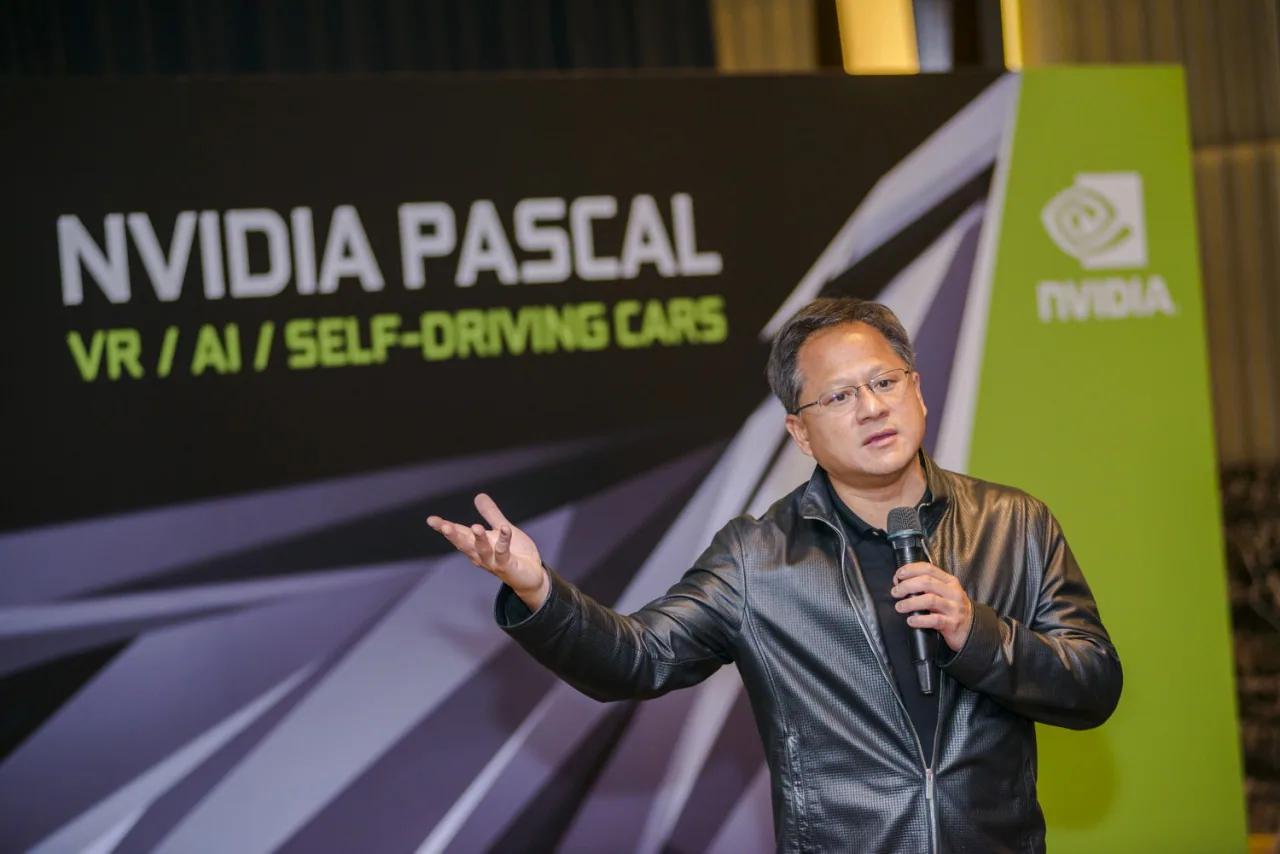
Jensen Huang speaking on the Computex Taipei stage. Between that Kentucky boarding-school student who cleaned toilets and the "AI godfather" facing an audience filled with Taiwan's entire semiconductor supply chain lay fifty years. Photo: NVIDIA Taiwan, CC BY 2.0.
In the autumn of 1973, a small nine-year-old Taiwanese boy who could not speak English walked into Oneida Baptist Institute in Clay County, Kentucky. Founded in 1899, the school was originally established to educate poor children in Appalachia and later also took in adolescents in "difficult circumstances."1 Huang's uncle and aunt mistook it for an elite private school. His parents sold almost everything they owned to pay the tuition.
He was the youngest boarding student in the school's history. His assigned roommate was a "17-year-old boy covered in scars and tattoos."2 There, Huang cleaned the boys' dormitory toilets after school every day and was often bullied. But he struck a deal with his roommate: Huang would teach him how to read, and the roommate would teach Huang weightlifting.
On October 29, 2025, NVIDIA's market value passed US$5 trillion, making it the most valuable company on Earth.3 By May 2026, Huang's net worth had reached about US$182 billion, ranking him seventh in the world.4
📝 Curator's Note
Huang's story has never been a motivational cliché about how "hard work leads to success." Between cleaning toilets and betting on CUDA, there were at least three moments when NVIDIA nearly went bankrupt. The real through line is something else: you have to keep holding on when everyone thinks you are crazy.
Tainan, Bangkok, Kentucky: A Misplaced Childhood
Jensen Huang was born in Taipei in 1963 and grew up in Tainan. His father, Huang Hsing-tai, was a chemical engineer at a refinery; his mother, Lo Tsai-hsiu, was a teacher. It was a middle-class family that spoke Taiwanese. His mother randomly picked ten English words from the dictionary each day to teach her two sons. When Huang was five, the family moved to Thailand for his father's work, and he studied at Ruamrudee International School in Bangkok.
In 1973, large-scale political unrest broke out in Thailand. Huang's parents decided to send their two sons to the United States to live with an uncle and aunt who had just immigrated to Tacoma, Washington. The uncle and aunt enrolled the brothers at Oneida Baptist Institute. In 2019, after becoming successful, Huang donated US$2 million to the school to build a girls' dormitory and classroom building named after him.5
💡 Did you know?
At age 14, Huang appeared in Sports Illustrated as a table tennis player.2 At that boarding school, he joined the swimming team, learned to play table tennis, and found a way to survive through sports.
Two years later, his parents finally immigrated to Beaverton, Oregon, and the brothers left Kentucky. Huang entered Aloha High School, skipped two grades, and graduated at 16. In 2002, looking back on that period, he said: "My memory of Kentucky is more vivid than any other period in my life."
The Boy Who Washed Dishes at Denny's Founded a Company at Denny's
Starting at age 15, Huang worked at a Denny's chain restaurant in Oregon, washing dishes, bussing tables, and waiting tables on the graveyard shift for five years, from 1978 to 1983. He later said the job helped him overcome shyness. After graduating from high school, he chose Oregon State University, where tuition was cheapest, to study electrical engineering, graduating with highest honors in 1984. He was the youngest in his class and "looked like a kid."
After several years as a chip designer in Silicon Valley, working at AMD and then LSI Logic, he met Chris Malachowsky and Curtis Priem on LSI's Sun Microsystems project. The GX graphics accelerator the three designed together was a major success, helping Sun's revenue jump from US$262 million in 1987 to US$656 million in 1990.
In 1992, the three began meeting secretly at a roadside Denny's in East San Jose to draft a startup plan. Huang chose Denny's because it was "quieter than home, and the coffee was cheap." On April 5, 1993, they formally founded NVIDIA.6 The company name came from the Latin invidia (envy), because Priem wanted competitors to be "green with envy." Their startup capital? Each put in US$200, for a total of US$600.
✦ "Jensen Huang washed dishes at Denny's at 15, and at 30 founded what would become the world's most valuable company at Denny's."
Thirty Days from Bankruptcy
NVIDIA's early years were not a success story. They were a near-death story.
The three founders later admitted that they "had absolutely no idea how to run a company."7 Huang botched his pitch to legendary Silicon Valley venture capitalist Don Valentine, but Valentine's Sequoia Capital invested anyway, relying on an endorsement from LSI Logic CEO Wilfred Corrigan.
NVIDIA initially chose to use quadrilaterals for graphics rendering rather than the industry-standard triangle. That technical path was nearly fatal. When the company was close to collapse, Japanese gaming giant SEGA invested US$5 million to keep it alive, giving the team time to pivot. When the RIVA 128 graphics card launched in August 1997, the company had only one month of payroll left in the bank.
From then on, "our company is thirty days from going out of business" became NVIDIA's unofficial motto. For many years afterward, Huang opened internal presentations with that line.
Coining a Term in 1999, Then Betting on a Decade Later in 2006
In 1999, NVIDIA launched the GeForce 256. Huang gave it a new name: GPU, or Graphics Processing Unit. That abbreviation changed the language of the entire industry. NVIDIA went public the same year.
But the decision that truly changed everything came in 2006.
Huang launched CUDA, the Compute Unified Device Architecture: a platform that allowed GPUs not only to draw graphics, but also to perform general-purpose scientific computing. Wall Street did not buy it. R&D costs soared, and the stock price fell. Almost every analyst thought it was a waste of money: who needed to use a graphics card to do math?
📝 Curator's Note
The story of CUDA is the central narrative tension of Huang and NVIDIA. In 2006, he made a bet that would not begin to be validated until 2012: deep learning required massive matrix computation, and the GPU's parallel architecture happened to fit it perfectly. This was not foresight in the simplistic sense. It was a person who had done the right thing at the wrong time, and held on until time caught up with him.
Around 2012, deep learning suddenly exploded in academia. Researchers discovered that the most efficient hardware for training neural networks was NVIDIA GPUs paired with CUDA. From then on, NVIDIA was no longer just a "graphics-card company." It became the heart of global AI computing power. From ChatGPT to autonomous driving, the engine underneath is almost always NVIDIA.
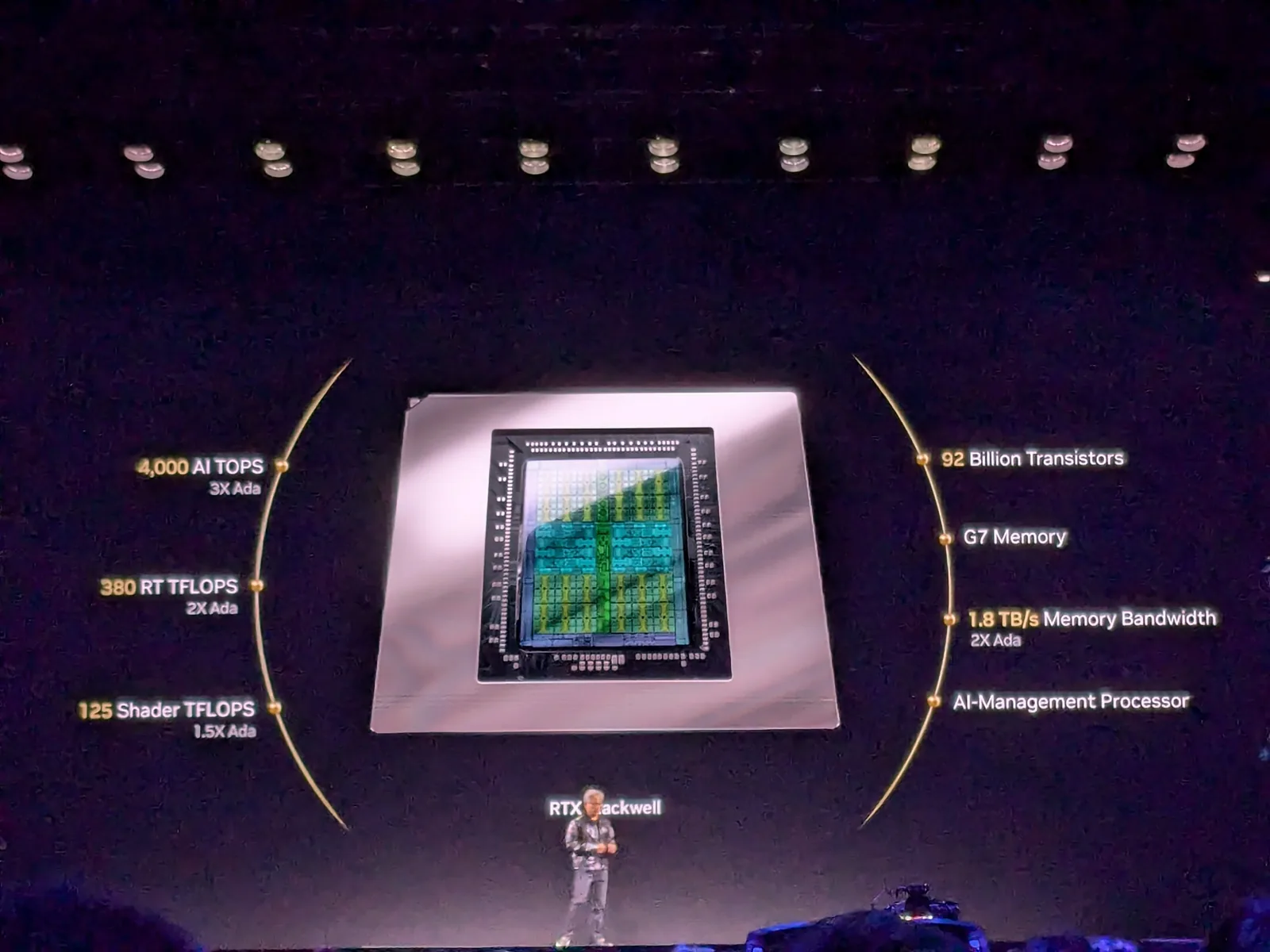
Jensen Huang raising the next-generation Blackwell GPU at CES in 2025. The CUDA bet that everyone mocked in 2006 waited nearly twenty years before the AI revolution finally cashed it in. Photo: Pronoia, CC0.
When Time Finally Caught Up
The breakthrough in 2012 was only the prelude. Over the next decade, Huang's mocked wager paid off at a speed that even he may not have expected.
In 2016, he personally delivered NVIDIA's first DGX-1 AI supercomputer to OpenAI, then an obscure little laboratory. The machine in that car would later help train ChatGPT.8 At the end of 2022, ChatGPT burst onto the scene, and the whole world realized overnight that AI was no longer something from science fiction. To run AI, one essentially needed NVIDIA chips. Demand came in like a tsunami. NVIDIA's data-center business multiplied several times over in just two years, and the company transformed from a maker of video-game graphics cards into the arms supplier for the entire technology industry.
The stock price took off with it. In 2023, NVIDIA's market value passed US$1 trillion; in 2024, US$3 trillion; and on October 29, 2025, US$5 trillion, making it the first US$5 trillion company in human history. Huang himself went from an engineer recognized only by tech enthusiasts to a Time 100 figure, a guest of honor at Davos, and someone heads of state competed to meet. His signature black leather jacket became almost a uniform of the AI age.
📝 Curator's Note
This is worth pausing over for a second. What made these numbers grow so quickly was the decision mocked by all of Wall Street in 2006, and the same person holding on to that decision for sixteen years. He did not suddenly become smart in 2022. He simply never let go of the bet during all those years when everyone thought he was crazy. When the era caught up with him, he happened still to be standing there, waiting.
"Jensanity": A Tainan Kid's Road Home
In June 2024, Huang appeared at Computex Taipei. He was not on the official speaking schedule, but all of Taipei went wild for him. Crowds of fans and paparazzi followed his every public appearance. Taiwanese media called it "Jensanity," a reference to Jeremy Lin's 2012 "Linsanity."
Wearing his signature black leather jacket, he ate street food at night markets, chatted with vendors in Taiwanese, and took photos with passersby. Mark Zuckerberg posted a photo on Instagram of the two swapping each other's signature jackets and wrote that Huang was "like the Taylor Swift of tech."9
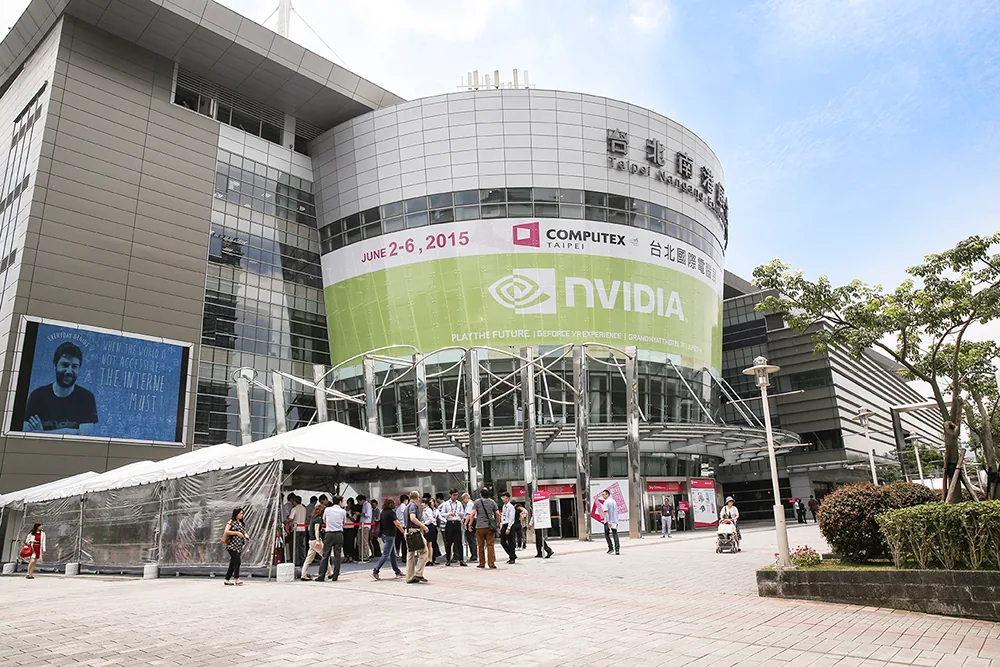
The Computex floor at Taipei Nangang Exhibition Center. Every June, this is the epicenter of "Jensanity" and the first stop on Huang's annual return to Taiwan. Photo: NVIDIA Taiwan, CC BY 2.0.
Jensanity has since become an annual spectacle. On the eve of leaving Taiwan in June 2026, Huang went in and out of Ningxia Night Market three times in the rain and ate at five stalls in a row. A kaoliang sausage cost NT$50; he exclaimed that it was "cheap" and pulled out a NT$1,000 bill, asking not to receive change. When a fruit-stall owner tried to treat him, he "quickly and firmly" placed a NT$1,000 bill on the tray and stood there finishing his mangosteen. While trying peanut ice cream roll, he delivered a food review that later went viral: "Cilantro is unreasonable; peanut candy is reasonable."10
There were also less perfect moments in the night markets and convention halls, which made him look more like an actual person. At Computex, a fan asked him to sign a wallet. Huang opened it, handed all NT$7,700 in cash inside to the show girls nearby, saying as he did so that the man was rich and kind, and before leaving turned back to add a full NT$10,000.11 Another time, a female fan brought Japanese yen bills, a phone, and one item after another for him to sign. By the end, he frowned and blurted out in English, "You're too much trouble."12 A person who can empty a wallet to give money away, and also lose patience when hounded: that is the Tainan kid beneath the black leather jacket, someone who gets tired, gets annoyed, and is also genuinely generous.
His meaning for Taiwan, of course, goes far beyond celebrity effect. NVIDIA's most advanced chips are manufactured by TSMC, and Huang has had more than thirty years of friendship with Morris Chang. In a Computex speech, he showed a map packed with Taiwan supply-chain partners and said, "Taiwan is a world hero." The bond tying NVIDIA's physical existence to Taiwan later led to a NT$4.4 billion land deal, a planned Taipei headquarters,13 and a whole set of power struggles over "who cannot do without whom." That is the story for another article (see NVIDIA in Taiwan). For Huang himself, returning to Taiwan once every quarter and moving between Tainan food stalls and the semiconductor supply chain seems more like the journey of someone long away from home returning to the island where he was born.
One Family, Two Chip Empires
Huang also has a family connection that is not often mentioned: AMD CEO Lisa Su is his relative. More precisely, Su's maternal grandfather was the elder brother of Huang's mother, making Huang Su's first cousin once removed.14 The two separately lead the world's two largest companies in the GPU market, and both companies' chips are manufactured by the same Taiwanese company, TSMC.
Two people from Taiwan built the two most important AI chip companies in the world in the United States, then sent the most crucial manufacturing process back to the island where they were born. Su herself has described the relationship as "some kind of distant relative" connection, and the two had never met before she joined IBM.
Su's life trajectory is almost a mirror image of Huang's. She was born in Tainan in 1969, immigrated to the United States with her family at age three, earned a doctorate at MIT, and in 2014 took over AMD when it was losing ground step by step and was once rumored to be at risk of bankruptcy. She dragged it back from the bottom and turned it into the world's second-largest AI chip company today. Two Tainan kids, one leading NVIDIA and one leading AMD, with headquarters about a five-minute drive apart in Silicon Valley, together nearly monopolize the design of the world's most advanced GPUs. And the chips they design are ultimately sent back to TSMC for manufacturing: after circling more than half the globe, they return to the same island where both were born.
The improbability of this is worth considering. The two central designers of global AI computing power come from the same island, the same family, and even a traceable kinship hierarchy. Taiwan feeds this AI revolution in two layers: first by raising and sending out, one by one, the people who would later design the chips; then by using TSMC's production lines to manufacture those chips, one by one.
The CEO Who Does Not Wear a Watch
Huang's management style does not resemble that of a typical Silicon Valley CEO. He has no fixed office and moves among meeting rooms at NVIDIA headquarters. He has around sixty direct reports; in most companies, the number is usually six to eight. His logic is: "The people who report directly to me should be top experts. They don't need to be coddled."
He also rarely looks at slide decks in meetings. He likes discussing problems in front of everyone, on the grounds that "everyone can learn from everyone else's mistakes." He does not much believe in private one-on-one feedback. He thinks that putting everything on the table makes the whole team stronger together. Under him, there is no such thing as something the CEO should not touch: from the technical details of chip architecture to what a product should be named, he wants a say. Some call it micromanagement. He does not much care. In his imagination, the company is an extension of himself, and he never intended to hide at the top box of the organizational chart.
He does not wear a watch. Asked why, he said: "Because now is the most important time."15
He also does not shy away from saying that NVIDIA's success was bought with pain. He once said: "If we had known in the beginning how much pain and suffering and shame and failure we were going to endure... we probably wouldn't have done it." But he also believes that those years on the verge of collapse forced him to become a better leader.
He states this "philosophy of pain" more bluntly than anyone. At Stanford in 2023, speaking to a group of students who had already won heavily in life, he said he sincerely wished upon them "ample doses of pain and suffering": because people with expectations that are too high often have too little resilience, and in his view resilience is the true foundation of success.16
Curtis Priem recalled: "We listened to Jensen from day one. We told him, you run the company, everything Chris and I don't know how to do."7 Huang was 30 at the time, younger than the other two founders.
Asked how he endured those years when no end was visible, his answer was quintessentially Jensen Huang: there is a lot of suffering in between, but you have to believe what you believe.17 That line could almost serve as a footnote to his entire career: from cleaning toilets, washing dishes, and the dead end of quadrilateral rendering to the sixteen-year wait for CUDA, what set him apart was that he never let go during all those years before the bet paid off.
The Man Who Cleaned Toilets and His NVIDIA Tattoo
In 2024, Huang received an honorary doctorate from National Taiwan University, was named CEO of the year by The Economist, and appeared on the Time 100 list of the world's most influential people. In 2025, he and NVIDIA chief scientist Bill Dally jointly received the Queen Elizabeth Prize for Engineering, alongside AI pioneers Geoffrey Hinton, Yann LeCun, Fei-Fei Li, and others; King Charles III presented the prize in person at St. James's Palace.18
In 2026, many media outlets referred to him directly as the "AI godfather." Every public speech he gave was treated as a signal for the entire industry, and even which leather jacket he wore or what he ate at which night-market stall could make headlines. The engineering student who had skipped two grades at 16 and still looked like a child had reached a position where the whole world strained to hear him speak. His response to all this, still, was to fly back to Taiwan every quarter, duck into Tainan food stalls, and banter with owners in Taiwanese.
Beyond all the titles, however, one detail may say more about the kind of person he is. When NVIDIA's market value passed US$1 trillion, he fulfilled a promise to employees and tattooed NVIDIA's logo on his arm.
Jensen Huang now has a corporate trademark tattooed on his arm. When he was ten, his fully tattooed roommate taught him weightlifting, and Huang taught his roommate how to read. That transaction, separated by a full fifty years, was probably the highest-ROI deal of his life.
Further Reading
- Morris Chang — NVIDIA's most important partner, the founder of TSMC, and a friend of Huang's for more than thirty years, tying together the global AI supply chain
- Taiwanese company: TSMC — the Taiwanese company that manufactures NVIDIA's most advanced chips, and the "world hero" in Huang's words
- Taiwan's semiconductor industry — Huang's and Lisa Su's chips are both manufactured on this island; this is Taiwan's silicon shield
- NVIDIA in Taiwan: The world's most expensive company does not make a single chip itself — the company he founded lives in symbiosis with this island's industries: chips, servers, headquarters, and a NT$4.434 billion land deal
- Chi Huai-Hsin: The Taiwanese Who Taught AI to "Think Step by Step" — another Taiwanese standing at the AI frontier; Huang's chips make AI run fast, Chi Huai-Hsin's chain-of-thought taught AI to reason one step at a time
Image Sources
- Jensen Huang at Computex Taipei — Photo: NVIDIA Taiwan, 2016, CC BY 2.0 (hero, Huang speaking on the Computex stage)
- Jensen Huang holding RTX Blackwell at CES 2025 — Photo: Pronoia, CC0
- Computex Taipei at Taipei Nangang Exhibition Center — Photo: NVIDIA Taiwan, 2015, CC BY 2.0
References
- Oneida Baptist Institute — History — Founded in 1899 in Kentucky's Appalachian region, it began as a Christian boarding school serving poor mountain children and later expanded to take in adolescents in "difficult circumstances."↩
- Sports Illustrated 2002 retrospective report — Describes Huang's roommate at Oneida as "covered in scars and tattoos," and recounts his appearance in the magazine as a table tennis player at age 14. (Indexed via Wikipedia.)↩2
- NVIDIA becomes first public company worth $5 trillion — TechCrunch, 2025/10/29 — On October 29, 2025, NVIDIA became the first publicly listed company in history to surpass US$5 trillion in market value, driven by demand for AI chips.↩
- Jensen Huang — Forbes Profile — Forbes tracks Huang's net worth in real time; the 2026 annual list put it at about US$154 billion in March, while the May 22 real-time ranking rose to about US$182 billion, roughly NT$5.7 trillion, placing him seventh globally.↩
- Jen-Hsun Huang Hall — Oneida Baptist Institute — In 2019, Huang donated US$2 million to Oneida Baptist Institute to build a girls' dormitory and classroom building named after him.↩
- NVIDIA Articles of Incorporation, April 5, 1993 — SEC EDGAR — NVIDIA was formally incorporated on April 5, 1993, according to public SEC registration documents.↩
- Stephen Witt, The Nvidia Way (2025) — An in-depth biography documenting the early chaos in which the three founders "had absolutely no idea how to run a company," Huang's botched pitch to Don Valentine, and Curtis Priem's recollection that "we listened to Jensen from day one."↩2
- NVIDIA delivers first DGX-1 AI supercomputer to OpenAI — NVIDIA Blog, 2016 — In 2016, Huang personally delivered the first DGX-1 AI supercomputer to the then newly founded OpenAI; the machine's computing power later became part of the foundation for training models such as ChatGPT.↩
- Mark Zuckerberg Instagram, March 2024 — Zuckerberg posted a photo of the two wearing each other's signature jackets and called Huang "the Taylor Swift of tech."↩
- Huang visits Ningxia Night Market in the rain and eats at five stalls — United Daily News, 2026/06/04 — On the eve of leaving Taiwan in June 2026, Huang went in and out of Ningxia Night Market three times in the rain and ate at five stalls: he called a NT$50 kaoliang sausage "cheap," pulled out a NT$1,000 bill without taking change, stood at a fruit stall eating mangosteen, and after trying peanut ice cream roll said, "Cilantro is unreasonable; peanut candy is reasonable."↩
- Huang gives all the cash in a wallet to show girls — United Daily News, 2026/06 — At Computex 2026, when a fan asked Huang to sign a wallet, he casually gave all NT$7,700 in cash inside to the show girls and, before leaving, turned back to add a full NT$10,000.↩
- Huang tells a persistent fan, "You're too much trouble" — China Times, 2026/06/04 — At Computex 2026, a female fan presented Japanese yen bills, a phone, and multiple other items one by one for signatures; by the end Huang frowned and blurted out in English, "You're too much trouble."↩
- Jensen Huang signs land-use agreement for NVIDIA Taiwan HQ — Taiwan News, 2026/01/29 — In January 2026, Huang came to Taiwan to sign a land-use rights agreement for the Beitou-Shilin Technology Park and announced plans for NVIDIA's new Taiwan headquarters.↩
- Jensen Huang and Lisa Su family tree — Tom's Hardware — Su's maternal grandfather was the elder brother of Huang's mother; the precise relationship is first cousin once removed, not simply "cousins."↩
- The Wall Street Journal — Jensen Huang Profile, February 2024 — Reports Huang's habit of not wearing a watch and his management philosophy.↩
- Jensen Huang's Stanford advice on pain and resilience — Fortune — Huang's verbatim English line at Stanford, "I wish upon you ample doses of pain and suffering," came in the context that people with high expectations have too little resilience, and resilience is the key to success; the quotation has been cross-cited by multiple media outlets.↩
- Jensen Huang — Lex Fridman Podcast #494 transcript — Huang's verbatim English comment on realizing a vision: "There's a lot of suffering in between, but you've gotta believe what you believe."↩
- NVIDIA Blog: Jensen Huang & Bill Dally awarded Queen Elizabeth Prize for Engineering — The 2025 Queen Elizabeth Prize for Engineering honored contributors to "modern machine learning," with King Charles III presenting the award at St. James's Palace.↩