
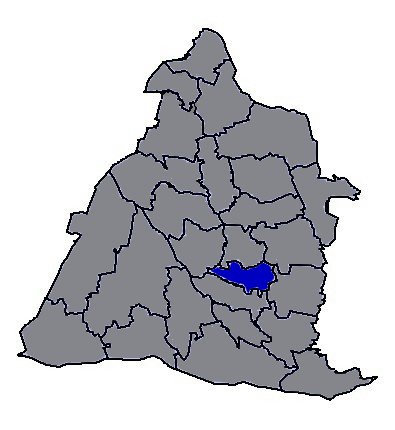
Caption: Map showing the location of Yǒngjìng Township, Changhua County. The image is embedded via external link and not downloaded. 1

Caption: Chen Sī-hóng discussing "Ghost Town" at the 2023 Texas Book Festival. Photo by Dada1960, Wikimedia Commons. The author released the image into the public domain under CC0. The image is embedded via external link and not downloaded. 2
Chen Sī-hóng: The Writer Who Fled from Yǒngjìng to Berlin, Yet Is Always Caught Up by His Hometown
In 1976, Chen Sī-hóng was born in Bādé Xiàng (Virtue Lane), Yǒngjìng Township, Changhua County. He grew up in a farming family, the ninth child, with seven older sisters and one older brother. 3
For the first eighteen years of his life, he was cared for by his family. It was only after moving north to Taipei for university at eighteen that he first realized daily life required his own management. In 2004, he went to Berlin as a special correspondent for Macro TV, eventually making the city his second home. 4
Chen Sī-hóng graduated from the Department of English at Fu Jen Catholic University and the Institute of Drama at National Taiwan University. In addition to writing, he works as a translator, actor, and festival interpreter. These interdisciplinary experiences give his novels a precision akin to linguistic work, the rhythm of dramatic scenes, and a performer’s sensitivity to the body. 5
This life story might look like a successful escape: from the Changhua countryside to Taipei, and then from Taipei to Europe. But Chen Sī-hóng’s novels and essays constantly prove that leaving one’s hometown does not mean shedding it. While he wanted to flee, he simultaneously wrote Yǒngjìng into Ghost Town; while gaining distance in Berlin, he used that distance to resee his family, patriarchy, and his own body.
| Year | Event | Significance |
|---|---|---|
| 1976 | Birth | Born in Bādé Xiàng, Yǒngjìng, Changhua |
| 9 | Birth Order | Seventh of eight sisters, one older brother |
| 2004 | Move to Berlin | Began as a special correspondent |
| 12 | Ghost Town Copyright Languages | National Taiwan Literature Museum data, 2023 |
Source: Readmoo, La Vie, National Taiwan Literature Museum
These four numbers compress his creative path into a readable line: the birthplace provides the homeland, the birth order provides the family structure, Berlin provides the distance, and translation copyrights send local stories to readers further away. 3 4 6 7
"I have always wanted to flee from Yǒngjìng, yet I constantly write about Yǒngjìng." 4
📝 Curator’s Note: Chen Sī-hóng’s contrast is not "country bumpkin becomes international writer," but rather that the further he goes, the more clearly Yǒngjìng follows behind him.
A Family: How It Became the Initial Motive for Writing
In his essays, Chen Sī-hóng looks back at his birth. His father was the eldest son of a farming family, bearing the pressure to produce a male heir. His mother gave birth to seven daughters in a row; only when the eighth child was a brother did the family temporarily cease its expectations. Then, Chen Sī-hóng was born as the ninth child. This is not a simple family tree, but a system that orders male inheritance, female labor, and family values. 3
He views the noise of eleven family members squeezed into a small house in the Changhua countryside as the source of his stories. By age seven or eight, he was already making sentences on the back of expired calendars. In the fourth grade of elementary school, he wrote his first short story. The quarrels, funerals, sibling rifts, and irrational scenes in his later works are not spectacles created out of thin air, but the volume of family life turned up by literature.
This also explains why he does not write "place" as a postcard landscape. Yǒngjìng is not a few old houses, a single old street, or a list of snacks, but a place where, once a person is born, their body is assigned a position. Who is the eldest son, who can inherit property, who must care for others, who can leave—these questions precede literature, but ultimately all enter it.
Fleeing to Berlin: Realizing Distance Is Also a Writing Tool
In interviews, Chen Sī-hóng said that what attracted him to Berlin was not a romantic exoticism, but the fact that it allowed people to live without conforming to a single life template. After moving to Berlin in 2004, he maintained a fixed writing routine: waking up early, writing until noon, cooking, taking a nap, and then exercising. 6
He once described that on his first night in Berlin, he went out for a walk because he couldn’t sleep due to jet lag. From the noisy streets of Taipei during a presidential election to the calm night of a European city, he felt a "huge and concrete loneliness" for the first time, yet simultaneously said he was very happy. 6
This seemingly contradictory sentence approaches the core of Chen Sī-hóng’s work: freedom is not always about being lively, but about being able to bear being alone with oneself. Leaving his homeland gave him space; loneliness allowed him the opportunity to recognize which voices from his family, gender, and place still belonged to him.
"You can be completely outside that box. As long as you don’t disturb others, it’s fine. You can live freely in your own way." 6
📝 Curator’s Note: Berlin did not turn Chen Sī-hóng into another person. It gave him the distance to finally look back and see his original self.
Ghost Town: The Hometown Is Not a Background, But a Character That Chases You
Published in 2019, Ghost Town sets its story in Yǒngjìng, Changhua. In the book, Chen Tian-hóng flees to Berlin, Germany, where the death of his gay partner, his imprisonment, and his return to the hometown after release overlap. The absurd plot, where humans and ghosts coexist, wraps around family memory, small-town transformation, and queer identity. 8
The "ghost" in the novel refers not only to spirits. It also refers to a person who thinks they have left, but is still recalled by family discipline, local gaze, and unprocessed trauma. Mirror Literature later reconstructed the novel’s landscape through a Yǒngjìng walking tour, a route passing Yǒngxīng Pool, Yǒngjìng Elementary School, Yǒng’ān Temple, Chéngjiǎo Mā, Shòuhún Monument, Yǒngjìng Story Wall, and Yǒngjìng Junior High School. Literature here no longer stays only on pages, but invites readers into the intersection of the author’s childhood and the novel. 9
It is important to distinguish: current available work data points to Yǒngjìng, not Èrlín, as the core prototype for Ghost Town. Èrlín is undoubtedly an important place in Changhua, but it belongs to a different local historical context. In 1924, sugarcane farmers in Èrlín and other areas petitioned officials over sugarcane prices. In 1925, Dr. Lǐ Yīng-zhāng led the establishment of the Èrlín Sugarcane Farmers’ Association. On October 22, conflict broke out when the sugar company forcibly harvested sugarcane, forming what is later known as the Èrlín Incident. 10
Mistakenly writing Èrlín as the story setting for Ghost Town would confuse both the novel’s geography and local history. A better reading is to let Yǒngjìng and Èrlín each retain their position: the former is the family homeland Chen Sī-hóng repeatedly writes about; the latter is the social memory left by Changhua’s peasant movement.
From Florida Metamorphosis to the "Summer Trilogy"
After Ghost Town, Chen Sī-hóng shifted his gaze to Florida in 1991. Florida Metamorphosis writes about six sixteen-year-old children participating in an overseas study tour. In the heat and foreign distance, they briefly escape family discipline, but must face buried memories again thirty years later after a tragedy. 4
He calls Ghost Town, Florida Metamorphosis, and The Good Person Upstairs the "Summer Trilogy." The landscapes of the three books are different: Yǒngjìng, Florida, Yuánlín, and Berlin; but summer here is not a seasonal decoration, but a pressure that transforms people. High temperatures make the body sweat, and also cause desires, fears, and secrets wrapped by rules to seep out.
The Good Person Upstairs shifts to a female perspective to observe Yuánlín and Berlin, dealing with female appearance, sex, mother-daughter relationships, and family trauma. In The Three Sisters from Shètóu, he pulls his gaze back to Shètóu, next to Yǒngjìng, writing about three sisters from a jǐtóng (spirit medium) family, using black comedy to handle the sadness and absurdity of a small place. These novels can be seen as a map of Changhua, but are more like a set of emotional maps: where people flee from, and where they eventually return to.
"The least sexy place for everyone now is exactly where I most want to write." 11
This sentence is not adding a romantic filter to local culture. It acknowledges that small places may be conservative, noisy, and hurtful, and also acknowledges that places not considered "story-worthy" by urban culture often hide the most dense lives.
"Absurdity" Is a Counterattack on a Well-Behaved Life
Chen Sī-hóng said he deliberately pursues absurdity because Taiwanese culture places great importance on rules and becoming a well-behaved person. 11 In this context, absurdity is not an escape from reality, but rather pushing reality to a position where readers cannot ignore it.
His characters often do irrational things, but the dilemmas they face are concrete: how parents view their children’s gender, how families distribute care and property, how places treat those who do not conform to norms, and whether people should return after leaving. Magic realism and black comedy keep these questions from being sealed off by didactic tones.
He also brings his drama studies training into his novels. Every character has their own notebook, containing habits, bedsheet colors, shampoo brands, and temples for worship. To him, characters cannot just serve the theme; characters must first become people who quarrel, make mistakes, and change. 11
"Pressure is good for creators; it makes authors less narcissistic. Narcissism is a taboo in writing; a novel must leave the 'I' to take shape." 12
From Taiwanese Awards to World Readers
Ghost Town won the Taiwan Literature Golden Award’s Annual Million-Dollar Prize and the Ministry of Culture’s Golden Tripod Award for Literary Books. The English version was translated by Darryl Sterk (Shí Dài-lún) and supported by the Ministry of Culture’s Translation and Publication Incentive Program. In 2022, the English translation Ghost Town entered the New York Times Fall Book List. 8 Europa Editions’ English publication data also records the book’s promotion in overseas markets. 13
This international publishing experience is more than just "a book translated into English." The National Taiwan Literature Museum points out that translation involves translation, copyright promotion, cover design, publisher marketing, and overseas book reviews. Chen Sī-hóng also said in lectures that a complete English translation helps attract international book agents, literary agents, and copyright buyers. By the end of 2023, Ghost Town had sold copyright in twelve languages, including English, Greek, Polish, Thai, and Korean. 7
There is a contrast worth remembering here: Chen Sī-hóng’s novel writes about a place "no one has heard of," but it does not erase the place to go international. On the contrary, the more concrete Yǒngjìng is, the less presentable the family, the less categorizable the characters, the more likely the story is to cross language boundaries.
"Literature is not a money-losing business." 7
This sentence points not only to writer income, but also to whether Taiwanese literature can be treated as a cultural asset worth translating, investing in, and managing long-term. Starting from the local does not mean being trapped in the local; but going global should not come at the cost of erasing the local.
When "Swim Trunks" Entered High School Textbooks
In August 2026, Chen Sī-hóng’s essay "Swim Trunks" sparked discussion after being selected for the翰林版 (Hánlín Edition) Grade 12 Chinese textbook. The first thing amplified online was the article’s description of mistakenly grabbing a lifeguard’s genitals while drowning; support and criticism quickly split into two sides. 14
There is a basic fact in this event that cannot be omitted: this article is an old work, originally published in Liberty Review early on, later included in the essay collection The Ninth Body. Chen Sī-hóng also stated that the work was authorized by himself. 14 Therefore, the controversy is not just "why does the textbook contain a certain word," but also includes how the publisher selected the text, how reviewers read it, and whether an essay dealing with body anxiety can be fully discussed in the classroom.
When responding to the outside world, Chen Sī-hóng asked readers to read the full text first. He said he hopes the next generation can have less anxiety about their own bodies and grow up happily. 14 On the other hand, some reviewers examined the article’s grammar and textbook appropriateness sentence by sentence, questioning whether it was worth students imitating, and demanding that the text selection and review process be inspected. 15
This controversy is worth preserving, rather than being simplified into "conservative people don’t understand literature" or "textbooks shouldn’t contain vulgar words." Textbooks are a public choice. Once a work enters a textbook, it no longer belongs only to the author and original readers, but must face how teachers guide, how students understand, and how textbooks handle body, sex, shame, and humor.
More importantly, "Swim Trunks" continues Chen Sī-hóng’s consistent writing direction: first putting the body in front of the reader, then asking why we only see that word, but cannot see what the character is afraid of. This does not mean everyone must like this article, nor does it mean textbook selection shouldn’t be criticized; it only reminds us that before criticizing a work, we should at least let the work’s complete context appear.
| Year | Event | Significance |
|---|---|---|
| 1976 | Born in Yǒngjìng | Ninth child in a farming family; family becomes the initial source of stories |
| ~1994 | Moved North for University | From a cared-for son, began learning independent life |
| 2004 | Moved to Berlin | Distance became a method to re-see Taiwan and oneself |
| 2019 | Ghost Town Published | Yǒngjìng entered the core landscape of the long novel |
| 2022 | English Translation Entered NYT Fall List | Local story crossed language boundaries |
| 2026 | "Swim Trunks" Entered High School Textbooks, Sparking Discussion | Literature moved from private reading to public classroom issue |
Source: Readmoo, Mirror Literature, CNA, National Taiwan Literature Museum, Yahoo News, ETtoday
This timeline does not reduce the writer to a resume. It shows how the same action repeats: leaving, gaining distance, looking back to write, and handing private experience over to public reading. 3 4 8 9 14 15
What Does the Hometown Leave Behind?
In Chen Sī-hóng’s works, returning home is usually not a healing, happy ending. Returning to Yǒngjìng might be the mother’s funeral, family quarrels, ancestral land debts, or even a walking tour activity; returning to the body might be admitting oneself to be different from traditional family expectations; returning to literature is handing things that cannot be easily said to characters to bear for themselves.
He once wrote about after his mother’s cremation, the family followed custom and had men use chopsticks to pick up the bones. When he took the chopsticks and saw the absurd gender order, death did not become solemn; instead, it revealed the ridiculousness of the system. This scene is powerful not because it condemns the hometown, but because it lets a person see: some traditions continue only because everyone keeps pretending they are unchangeable. 3
Therefore, Chen Sī-hóng is not simply a "Changhua writer," nor just a "Berlin-based writer." He is more like a constant translator: translating family into novels, translating place into scenes world readers can enter, translating bodily shame into discussable language, and bringing Berlin’s distance back to Yǒngjìng.
📝 Curator’s Note: He writes not of "finally succeeding after fleeing the hometown," but of "willingly looking back and writing the hometown clearly after successfully fleeing."
Conclusion: Leaving Is Not a Full Stop
From Bādé Xiàng in 1976, to Berlin after 2004, to the Yǒngjìng walking tour in Ghost Town, Chen Sī-hóng’s life has been in motion. But his literature is not a straight line leaving the local to arrive at the global, but a circle: leaving gives people distance, distance lets people re-recognize home, and after re-recognizing, it is only then possible to write works that neither embellish nor abandon the hometown.
This is where his work is truly international. Readers may never have lived in Yǒngjìng, Shètóu, or Yuánlín, nor experienced large families, queer identity, or funeral customs, but everyone may have a place they don’t want to return to, yet always returns to in memory.
Chen Sī-hóng calls that place "Ghost Town." Readers may find, by the end, that ghosts are not necessarily the dead; ghosts may be the part of us we think has left, but still speaks inside the body.
Further Reading
- Wú Míng-yī — Another novelist who brought Taiwanese localities into the international literary scene, whose path contrasts with Chen Sī-hóng’s
- Bái Xiān-yǒng — One of the origins of Taiwanese queer literature, understanding the literary genealogy of Ghost Town
- Taiwan Same-Sex Marriage and Gender Equality — The social background of body and gender writing in Chen Sī-hóng’s pen
- Changhua County — The place where Yǒngjìng is located, the geographical context of the Ghost Town prototype
References
- Map showing the location of Yǒngjìng Township, Changhua County, Wikimedia Commons — A map of Yǒngjìng created by Essolo, page explicitly lists CC BY-SA 3.0 license, shareable and adaptable.↩
- Kevin Chen 11 Nov 23 Austin TX, Wikimedia Commons — Archive page for 2023 Texas Book Festival portrait, photographer Dada1960, page explicitly lists author releasing work under CC0.↩
- Many People Say I Don’t Look Like a Country Person, Readmoo — Chen Sī-hóng personally writes about birth, family, mother’s funeral, patriarchal customs, and how Yǒngjìng became a source of writing.↩2345
- Under the Summer’s Scorching Sun, People Become Shapes They Don’t Recognize, Readmoo — Interview compiling Chen Sī-hóng’s Berlin life, Yǒngjìng experience, Summer Trilogy, and Florida Metamorphosis creative background.↩2345
- Chen Sī-hóng, Wikipedia — Biographical entry compiles birth date, education, move to Berlin, creative types, awards, translation, and performance work data.↩
- From Ghost Town to The Three Sisters from Shètóu, La Vie — Interview records his fixed writing schedule, absurd aesthetics, work themes, and self-observation after moving to Berlin.↩234
- Chen Sī-hóng Lectures at NTLM: Discussing Ghost Town’s Advance to the International Literary Scene, National Taiwan Literature Museum — Official cultural institution organizes translation, copyright promotion, international book fairs, 12 language copyrights, and Taiwanese literature IP discussion.↩23
- Chen Sī-hóng’s Novel Ghost Town Selected for New York Times Fall Book List, CNA — CNA reports on Ghost Town’s Golden Award and Golden Tripod Award, English translation publication, NYT book list, and author’s postscript.↩23
- From Berlin to Yǒngjìng: Stepping into Chen Sī-hóng’s Magical Ghost Town, Mirror Literature — Publisher event page lists Yǒngjìng walking tour route, novel landscape, author bio, and local connections between works.↩2
- Ideal and Sacrifice: Taiwan Politics and Peasant Movements in the Collection, Institute of Taiwan History, Academia Sinica — Academic archive page organizes 1924–1925 Èrlín sugarcane farmers’ petition, association establishment, and Èrlín Incident process.↩
- I Want to Deliberately Offend Those Unsexy Places, Openbook — Profile interview provides The Three Sisters from Shètóu creative background, Changhua Trilogy, absurd aesthetics, and Chen Sī-hóng’s verbatim statements.↩23
- I Want to Deliberately Offend Those Unsexy Places, Openbook (Writing and Pressure Quote) — Another segment from the same direct interview, explaining how work pressure lets novels leave the author’s self to take shape.↩
- Kevin Chen on tour, Europa Editions — English publisher article introduces Kevin Chen and Ghost Town’s overseas publishing promotion, available for English readers to verify international communication context.↩
- Textbook Contains "Ji Ji" Breakdown? Author Responds Personally, Yahoo News / Mirror Report — Article reports "Swim Trunks" entering high school textbook, early publication and inclusion context, and Chen Sī-hóng’s response to body anxiety.↩234
- Drowning Grabbed Ji Ji! He Reads Full Text, Lists Four Questions, ETtoday — News presents critical viewpoints in the textbook selection event, including text expression, textbook appropriateness, and questions about text selection review.↩2

