
30-Second Overview: In 1709, Shih Shih-pang dug the Babao Irrigation System, diverting water from the Zhuoshui River to irrigate over 19,000 hectares, completing the project 211 years before Hata Yorichika’s Jiannan Grand Dike. In 1723, the first year of the Yongzheng Emperor’s reign, it was separated from Zhuoluo County. Named "Changhua" with the meaning of "establishing schools and teachers to promote elegant culture," its boundaries stretched "from the Huwei River in the south to the Dajia River in the north." In 1786, during the Lin Shuangwen Rebellion, Changhua County’s city walls were breached, but Lukang held firm; in 1788, the Qianlong Emperor issued an edict to fund the construction of the Tianhou Palace (Xinzu Palace) in Lukang. The Changhua Circular Train Depot opened in 1922. In 1986, Lukang residents launched the Anti-DuPont Movement, Taiwan’s first environmental movement. As of April 2026, Changhua County’s population stood at 1,206,458, just under the 1.25 million threshold required for direct-controlled municipality status.
The Sleepless City of Chrysanthemums, 40 Million Stems Annually
If you ask a Changhua native when Changhua feels most unlike what you imagine, they won’t tell you about the daytime in Lukang Old Street (Lukang’s daytime is for tourists). They will tell you about the night in Tianwei.
The Tianwei Highway Garden is located along both sides of County Road 145. Over 140 businesses are spread across a 3.6-kilometer commercial district. In 2021, the Council of Agriculture designated it as a Leisure Agriculture Area, covering nearly 297 hectares1. Route 1 is the main artery of Taiwan’s western corridor; the Highway Garden is a field of chrysanthemums growing from this artery.
But if you visit at night, you will witness something strange. The entire field of chrysanthemums lights up. Each hectare is illuminated, looking from afar like a galaxy that has landed in the fields.
These are not decorative lights. Chrysanthemums are short-day plants; if daylight exceeds 12 hours, flowering is inhibited. Taiwanese flower farmers use artificial lighting to extend the "day," tricking the chrysanthemums into believing it is still winter, thereby avoiding supply-demand imbalances caused by simultaneous blooming. The entire Tianwei chrysanthemum field stays awake all night, a spectacle locals call the "Sleepless City of Chrysanthemums." The chrysanthemum fields cover 120 hectares, producing 40 million stems of various chrysanthemums annually2.
40 million stems of chrysanthemums. Among Changhua County’s 26 townships and cities, it is only Tianwei Township that carries half of Taiwan’s floral industry by ensuring "the chrysanthemums never sleep." At the same time, the Netherlands’ FloraHolland auction center is using similar strategies to capture the global market. This is Changhua’s contemporary structure: an agricultural powerhouse with a county seat since 1723, finding niches for survival in global agricultural competition every day.
"From the Huwei River in the South to the Dajia River in the North"
In 1723, the first year of the Yongzheng Emperor’s reign (Qing Dynasty), the court made a decision.
The "Chronology of Construction" on the Changhua County Government’s Global Information Network states: "The court divided the hundred-li territory in the middle of Zhuoluo County, cutting off the Huwei River to the south and reaching the Dajia River to the north, establishing Changhua County. The county office was set up in Banxian, now Changhua City, marking the beginning of Changhua’s establishment."3 Wikipedia records similarly: "Given that Zhuoluo County was too vast to govern effectively, the Yongzheng Emperor ordered the establishment of Changhua County in 1723 (the first year of the Yongzheng reign), carving out the land north of the old Huwei River and south of the Dajia River."4
The origin of the name is as follows. The Yongzheng Emperor took the meaning of "establishing schools and teachers to promote elegant culture" and "manifesting the great prosperity of the sea’s edge," naming this land Changhua3. "Banxian" was the Han Chinese transliteration of the Babuzha tribe’s Banxian Society. This ethnic group, along with some branches of the Hoanya tribe, were the original inhabitants of this plain for millennia5. After the establishment of Changhua County, Banxian City served as the county seat, later renamed Changhua.
📝 Curator’s Note: The establishment years of Taiwan’s administrative divisions are often confused. Changhua County was separated from Zhuoluo County in 1723 (the first year of the Yongzheng reign), nearly 90 years before the Gamalan Department in 1812, and 152 years before the Taipei Prefecture reorganized by Shen Baozhen in 1875. In other words, Changhua is one of the earliest counties established in Taiwan. However, the claim "Changhua Plain is Taiwan’s Xth largest plain" is often misreported. The Jiannan Plain, at 4,550 km², is Taiwan’s largest plain; the Pingtung Plain, at 1,210 km², is the second largest6. The Changhua Plain is approximately 900 km², ranking third or smaller. Changhua County itself is the smallest county in Taiwan’s main island (1,074.39 km², Changhua Tourism Information Network states "smallest area, yet享有 the reputation of 'Taiwan’s Granary, Agricultural Powerhouse'"), with plains accounting for 87.68% of the county7. Its agricultural density far exceeds its area.
The boundaries set in 1723 still run today. Changhua County’s 26 townships and cities are divided into three terrain layers: plains (Changhua, Yuanlin, He Mei, Beidou), coastal areas (Lukang, Fuxing, Erlin, Fangyuan), and plateaus (west side of Bagua Mountain). The Bagua Plateau is approximately 210 km², with its highest point, Hengshan, at 440 meters, stretching from the south bank of the Dadu River in the north to the north bank of the Zhuoshui River in the south. The coastal areas feature Wanggong oyster beds and Erlin oyster beds; the plateau offers eagle-watching routes on Bagua Mountain.
Mr. Lin: The 1709 Legend of Babao Irrigation
Before the county was established, this land had already been rewritten by one person.
In 1709, the 48th year of the Kangxi Emperor’s reign (Qing Dynasty), Shih Shih-pang began digging the Babao Irrigation System in the Banxian area, diverting water from the Zhuoshui River. The project was completed in 1719, the 58th year of the Kangxi reign8. Babao Irrigation was completed 211 years before Hata Yorichika’s Jiannan Grand Dike in 1930.
But the project was initially stalled. The legend recorded in Wikipedia states: "It is said that in the early stages of digging the Babao Irrigation, diverting water into the canal repeatedly failed. Legend has it that an old man came to see Shih Shih-pang and provided a water conservancy diagram; Shih Shih-pang followed his method to re-dig the canal and used 'earth engineering methods' for construction, finally succeeding. After the canal was completed, the old man refused compensation and did not reveal his name, only calling himself 'Mr. Lin'; later generations, admiring his virtue, built the Mr. Lin Temple at the head of the Ershui Canal to commemorate him." 8

Babao Irrigation. Photo: Wikimedia Commons contributor, CC BY-SA via Wikimedia.
Mr. Lin’s true identity remains unsolved. But every November, the Babao Irrigation waterway in Yuanquan Village, Ershui Township, hosts the "Running Water Festival," a ritual revived after the 1995 Council of Cultural Affairs’ "Legend of Babao Irrigation" event. The water diver "wears a red headscarf, a straw raincoat, and straw sandals," running barefoot into the newly released water flow according to ancient rites, welcoming the new year’s irrigation water9.
Babao Irrigation, along with Taipei’s Liugong Irrigation and Kaohsiung’s Caogong Irrigation, is known as the "Three Great Irrigation Systems of the Qing Dynasty," with Babao being the earliest. The current Babao First and Second Canals irrigate a combined area of approximately 21,400 hectares10. Today, the three-crop rice harvests of the Changhua Plain, Yuanlin starfruit, Ershui honey pomelo, Tianwei chrysanthemums, and Erlin grapes—all these agricultural densities are built on the 21,400-hectare waterway from 1709. A project supported by an old man in a legend who refused compensation has sustained the land with the highest agricultural density among Taiwan’s 22 counties and cities.
The Babao Irrigation, crossing the border between Nantou and Changhua, is a shared heritage of two counties. Shih Shih-pang’s water source comes from the Zhuoshui River拦河堰 (diversion dam) between Jiji Township and Ershui Township in Nantou County, then diverges into the Changhua Plain.
After the End of "One Capital, Two Lukangs, Three Monga"
Starting the year after the county’s establishment (1724), a port emerged from the maps of the Zhuoluo County Gazetteer: Lukang.
The Zhuoluo County Gazetteer, completed in 1717 (the 56th year of the Kangxi reign), is the earliest record of Lukang appearing on a map. In 1728 (the 6th year of the Yongzheng reign), the Lukang Town Office website records: "In the 6th year of Yongzheng, Changhua County established granaries on the west side of the Rice Market Street in Luzai Port. The gate featured a plaque reading: 'Tianyu Zheng Gong' (Recorded in the Daoguang Edition of the Changhua County Gazette, totaling 16 granaries)." 11 With 16 rice granaries, the Rice Market Street of this port was thus formed.
The true turning point came in 1784. Wikipedia’s original text states: "Its development began in 1784 when the Qing government, imitating the models of Luermen and Xiamen, established a commissioner to manage trade, opening 'Hejian Port, Jinjiang County, Quanzhou Prefecture, Fujian' to 'Luzai Port, Changhua County, Taiwan Prefecture' for mutual trade. Thereafter, merchant guilds gathered, commerce flourished, and it rapidly became the largest port in central Taiwan." 12 During the peak from the Qianlong to Daoguang reigns, Lukang saw "Eight Guilds" merchant houses and 300 merchant ships shuttling back and forth. Lin Zhensong of the Rizhao Hang was the wealthiest merchant in the port. The saying "One Capital, Two Lukangs, Three Monga" represents Taiwan’s commercial map from the late 18th to early 19th centuries.

Lukang Longshan Temple, 2017. Photo: Outlookxp, CC BY-SA 4.0 via Wikimedia.
In 1786 (the 51st year of the Qianlong reign), two things happened simultaneously. One was the relocation of Lukang Longshan Temple to its current site by General Manager Lin Zhensong and Commander Chen Bangguang. Wikipedia records the architectural features: "The caisson ceiling structure above the stage of Lukang Longshan Temple is the earliest and largest preserved work in Taiwan. The Bagua caisson ceiling is set above the stage, creating a resonance effect during performances." The architectural layout of three courtyards and two inner yards with seven bays13 is one of the oldest and most complete Qing dynasty temples remaining in Taiwan. The other was the outbreak of the Lin Shuangwen Rebellion; Changhua County’s city walls were breached, but Lukang did not fall due to its geographical location and commercial power. The Qing court sent Fu Kang’an to land from Lukang to quell the rebellion, a campaign that became the opportunity for the Qing court to re-evaluate Lukang’s strategic status.
In 1788 (the 53rd year of the Qianlong reign), after Fu Kang’an quelled the rebellion, the Qianlong Emperor issued an edict to fund the construction of a Tianhou Palace in Lukang to highlight the miraculous assistance of Mazu. This state-funded temple is called "Xinzu Palace" (Full Name: Imperially Built Tianhou Palace), the only Mazu temple in Taiwan ordered by an emperor and funded by state silver. The shortfall in construction costs was donated by Lin Zhensong of Rizhao Hang14.
📝 Curator’s Note: The historical positioning of the Anti-DuPont Movement is often underestimated. Placing it within the framework of "Changhua’s local issues" is insufficient: this is the beginning of Taiwan’s environmental movement. Before 1986, Taiwan’s social movements mainly revolved around the political system (Dangwai Movement, Formosa Incident); the Anti-DuPont movement pushed "environmental rights" onto the streets for the first time. Subsequent movements like Houjing Anti-Wuhqing (1987), Linyuan Anti-Sanqing (1988), Yilan Anti-Liuqing (1990), and Qigu Anti-Qiqing (1998) were extensions of this line. In 1986, Lukang residents opened another dimension of Taiwan’s civil society with a single "no": not just democracy, but also the environment. The significance of Lukang in 1986 is comparable to Zheng Nanrong and the Dangwai movement of the same period, but the nation remembers the political movement; far fewer remember Lukang.
Then Lukang began to decline. Three blows arrived in succession.
The first was port siltation. Wikipedia’s original text states: "Lukang’s port advantage gradually declined due to siltation. After the mid-Jiaqing period, incoming and outgoing merchant ships gradually shifted to Wanggong Port in the south." 12 The second was the cross-island railway. The cross-island railway was completed in 1908; the route passed through Changhua City but not Lukang. The Lukang Kids website states: "In the Japanese colonial period, Lukang, due to its low administrative level (then a 'Lukang Street,' a grassroots administrative division), and because major public transport systems like Route 1 and the cross-island railway system did not pass through it." 15 The third was the 1934 Japanese colonial port consolidation strategy: the Japanese concentrated port operations in Keelung and Kaohsiung, canceling Lukang’s port functions.
✦ "Later, Lukang reached its peak and then declined. The main reason for its decline was port siltation, making it difficult for ships to dock; furthermore, the cross-island highway and railway did not pass through here, causing inconvenient transportation." (Taiwan Light Magazine Lukang16)
The era of "Two Lukangs" in "One Capital, Two Lukangs, Three Monga" ended by the mid-19th century. Lukang’s most bustling years lasted only 70 years.
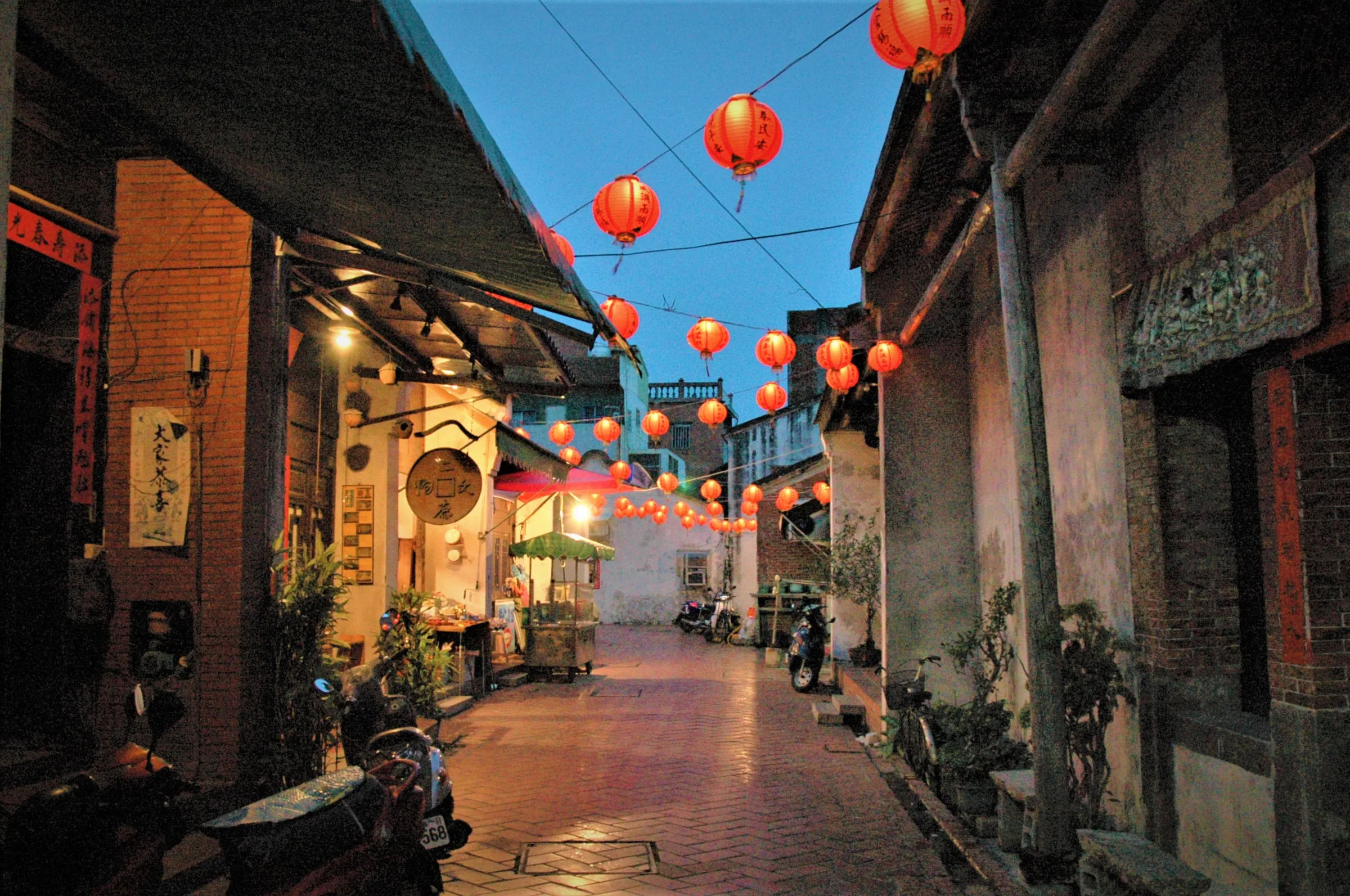
Lukang Old Street alleys. Photo: Wikimedia Commons contributor, CC BY-SA via Wikimedia.
1986: The People of Lukang Said "No"
But Lukang is not finished. It still had a chance to speak.
In 1985, the American chemical giant DuPont planned to build a factory in the Lukang Changbin Industrial Zone to produce titanium dioxide. This was high-pollution chemical production, with raw materials from ore sand and byproducts of sulfuric acid and heavy metal waste liquid. The coastal areas of Lukang are home to Wanggong oyster beds and Fuxing Wetlands; residents feared that marine pollution would directly destroy their fisheries.
The protest ignited in 1986. Lukang residents launched petitions, street movements, and direct confrontations with DuPont. At that time, Taiwan was still under martial law (martial law was lifted on July 15, 1987); residents taking to the streets to protest foreign investment was not easy in that era. In March 1987, DuPont announced its withdrawal from Lukang. That same year, the Executive Yuan established the Environmental Protection Administration (EPA).
The EPA’s Chemical Knowledge Map records: "Taiwan’s first environmental movement to take to the streets—the Anti-DuPont Movement" 17. The same article continues: "After the success of the Lukang Anti-DuPont movement, anti-petrochemical wars ignited successively in various places, including Houjing Anti-Wuhqing, Linyuan Anti-Sanqing, Yilan Anti-Liuqing, and Qigu Anti-Qiqing."
📝 Curator’s Note: The historical positioning of the Anti-DuPont Movement is often underestimated. Placing it within the framework of "Changhua’s local issues" is insufficient: this is the beginning of Taiwan’s environmental movement. Before 1986, Taiwan’s social movements mainly revolved around the political system (Dangwai Movement, Formosa Incident); the Anti-DuPont movement pushed "environmental rights" onto the streets for the first time. Subsequent movements like Houjing Anti-Wuhqing (1987), Linyuan Anti-Sanqing (1988), Yilan Anti-Liuqing (1990), and Qigu Anti-Qiqing (1998) were extensions of this line. In 1986, Lukang residents opened another dimension of Taiwan’s civil society with a single "no": not just democracy, but also the environment. The significance of Lukang in 1986 is comparable to Zheng Nanrong and the Dangwai movement of the same period, but the nation remembers the political movement; far fewer remember Lukang.
40 years later, in 2026, Lukang is still speaking, but the message is different.
Zhang Jingye of Lukang Kids (founded in 2012) said in an interview: "Many people go to cities for work, but we chose our current jobs to stay and live in Lukang." 18 The Lukang Kids website continues: "Besides nostalgic emotions and a substantial cultural foundation, the most critical factor for Lukang to discuss local revitalization is the foundation of 'industry.'" 19 Since 2015, they have co-hosted the "This Autumn Art Festival" with the Save Lukang Movement Association, with the curatorial core of "local participation first, then local art festival." In 2020, they established the "Lukang Future Center" to guide young entrepreneurs to stay in the hometown.
This small town, which defeated the foreign DuPont, now uses the same industrial thinking to retain its youth. In 1986, they drove away pollution; in 2020, they aim to keep jobs. But the difficulty of these two matters is entirely different. The latter has no external enemy to focus on; it must contend with Taichung’s magnetic effect, the salary gap with the north, and the shift of Taiwan’s entire industrial geography.
The Semi-Circle of 12 Railways
If you want to see how a city handles its industrial heritage, go to the Changhua Circular Train Depot.
Another in-depth report in the same series as The Reporter’s Keelung Port’s 130th Anniversary records: "The Changhua Circular Train Depot, opened in October 1922, officially entered its centennial year." 20 In the Japanese colonial period, the circular train depot was the turning center for steam locomotives: 12 railway tracks radiated in a semi-circle, with a turning table of 18 meters in diameter in the center. After trains entered, they turned on the table and then distributed to various tracks for maintenance or supply. Each track’s roof had a coal smoke exhaust pipe because steam locomotive smoke had to be vented upwards.
After the war, Taiwan had six circular train depots (Keelung, Taipei, Hsinchu, Chiayi, Changhua, Kaohsiung); the other five were demolished in the 1990s and replaced with new-style depots. Changhua is the only survivor.
The reason for its survival was protest. The Reporter records: "27 years ago, with a group of partners concerned about railway cultural assets, watching the Chiayi Circular Train Depot being demolished... Reluctant to see the circular depot and turning table demolished and replaced by a new-style depot, they jointly launched the Depot Preservation Movement, finally resulting in the Changhua Circular Train Depot being designated as a County-Level Historic Site in 2000." 20 On August 1, 2022, the Ministry of Culture announced its upgrade to a National-Level Historic Site.

Changhua Circular Train Depot. Photo: Wikimedia Commons contributor, CC BY-SA via Wikimedia.
But the protest is not over. The Changhua Urban Railway Viaduct Project passed its feasibility study in 2021, with a total cost of NT$39.95 billion, of which the central government bears NT$29.63 billion. This project will "exclude the 'coal/water tender,' 'oil depot,' and 'maintenance depot'—three key facilities witnessing the transition from steam power to diesel power to diesel-electric power—from the construction area of the Changhua Railway Viaduct." 20 The main body of the National-Level Historic Site is saved, but the three surrounding key附属 facilities have no place under the viaduct project.
This is the contemporary state of the Changhua Circular Train Depot: a semi-circular building built by the Japanese 100 years ago to turn steam trains, negotiating boundaries in 2026 with a NT$40 billion viaduct project. The water on the turning table continues to turn the current diesel locomotives every day.
1925 Erlin: The Price Japanese Paid for Sugarcane
Changhua has another underestimated thing. It is the starting point of Taiwan’s peasant movement.
In June 1925, Dr. Li Yingzhang (Director of the Cultural Association) established the "Erlin Sugarcane Farmers Association" in Erlin, demanding the Lin Yuanben Sugar Company raise the purchase price of sugarcane and abolish the "Raw Material Collection Zone" system (sugarcane in specific areas could only be sold to designated sugar mills). On October 21, 1925, the Lin Yuanben Sugar Mill sent workers to forcibly harvest sugarcane fields of non-association members. On October 23, a large number of patrol officers surrounded Dr. Li Yingzhang’s clinic and arrested him.
Wikipedia’s Erlin Incident records: "A total of 93 people were arrested" and "Subsequent searches and arrests continued, totaling over 400 arrested." 21 After the incident, local peasant associations were established in Fengshan Street, Madou Street, and other places; in June 1926, the island-wide "Taiwan Peasant Association" was established, Taiwan’s first island-wide peasant organization.
The Erlin Incident is often briefly mentioned in Taiwan history textbooks, but its significance echoes the Anti-DuPont movement. Both movements occurred in Changhua, marking the start of certain social movements in Taiwan: Erlin in 1925 was the beginning of the peasant movement; Lukang in 1986 was the beginning of the environmental movement. Changhua County is a place in Taiwan’s social movement history where "firsts" repeatedly appear. How could an agricultural powerhouse that started digging irrigation canals in 1709 become the starting point of social movements twice? Perhaps precisely because the people of this land have such concrete dependence on water, land, and crops, when these are threatened by outsiders, their reaction is also the fastest.
36 years after the Erlin Incident, Taiwan experienced the post-war era, the February 28 Incident, the White Terror, and the Ten Major Construction Projects. Then another event occurred within Changhua.
The Bagua Mountain Big Buddha: A 22-Meter Cement Bodhisattva
After the war, Changhua did something special. It built a Big Buddha on top of Bagua Mountain.
The time was 1956. The first Changhua County Magistrate, Chen Xiqing, initiated the construction of the "Largest Buddha in the Far East." The project was interrupted by the 1958 Babo Flood and completed in 196122. The Buddha statue is 22 meters high (7 zhang 2 chi), with a lotus seat diameter of 14 meters, made of reinforced concrete. The designer was Lin Qingyao. The interior of the Buddha statue has 6 levels of space, accessible for visitors.
The China Times report records: "After the Big Buddha was completed in 1961," local residents formed a saying: "Changhua has 'wind but no typhoons, rain but no disasters'; everyone firmly believes it is the Buddha’s blessing." 22
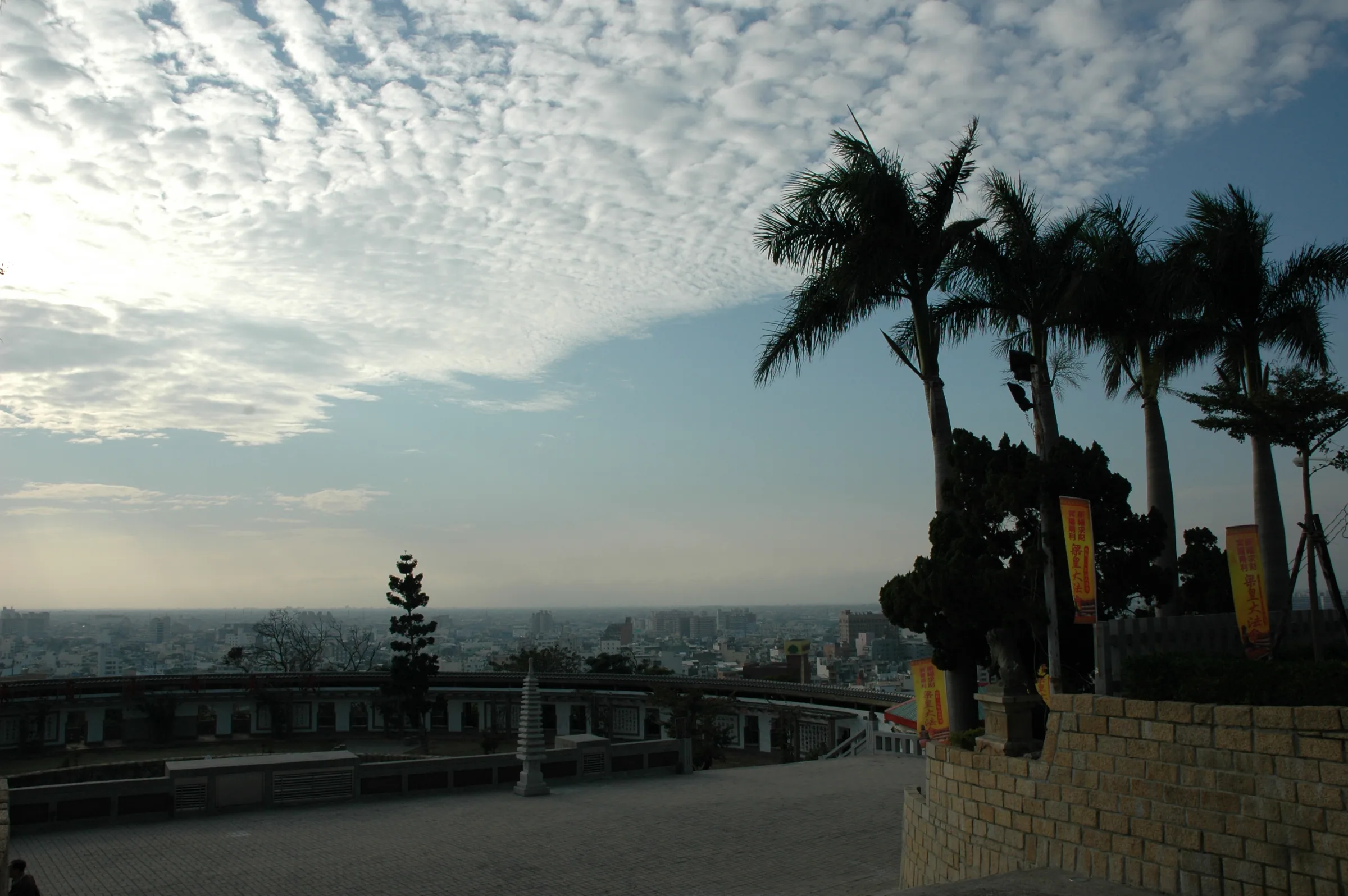
Bagua Mountain Big Buddha. Photo: Wikimedia Commons contributor, CC BY-SA via Wikimedia.
A 22-meter cement Bodhisattva, alongside Lukang Longshan Temple’s 1786 wooden Bodhisattva, Xinzu Palace’s 1788 state-funded Mazu, and the land god temple next to Tianwei’s chrysanthemum fields, the religious objects within Changhua County, from the Qing period to the post-war era, none follow the same timeline. Each is a concrete answer from the people of that time to "what kind of power do we need to be protected by."
✦ "Many people go to cities for work, but we chose our current jobs to stay and live in Lukang." (Zhang Jingye, Lukang Kids18)
1.2 Million People, Falling Below the Upgrade Threshold
In April 2026, Changhua County’s total population was 1,206,458, already falling below the 1.25 million threshold for direct-controlled municipality status23.
⚠️ Note that this number will continue to drop. Changhua County’s population has been continuously declining from 2024 to 2026, estimated to fall below 1.2 million by the end of 2026. Changhua still holds the status of "the county with the largest population outside the Six Direct-Controlled Municipalities (Taiwan’s 7th largest administrative division)," but the framing of "largest population county" and the distance to "upgrading to a direct-controlled municipality" are widening.
Population distribution (as of late October 2024):
- Changhua City: 223,933 people (largest in the county, county seat)
- Yuanlin City: 122,733 people (second largest)
- He Mei Town: 87,509 people
- Lukang Town: Approximately 80,000
The relationship between the county seat, Changhua City, and the second-largest city, Yuanlin City, is often misunderstood. Changhua City is the administrative center; Yuanlin City is the commercial center along the central corridor railway. The station culture of Yuanlin Chicken Leg Bento is completely different from Northern Ribs Bento; Yuanlin Starfruit and Yuanlin Bananas are food cultures grown from agricultural belts. These two cities have asymmetric functions, but their population tug-of-war has lasted for 30 years.
The reasons for population outflow are clear but difficult to solve: Taichung’s "magnetic effect" (young people moving to Taichung for work and residence), low birth rate, few job opportunities, insufficient medical resources. Changhua County lacks a single driving industry like the Hsinchu Science Park. Agriculture, traditional industries (He Mei Textiles, Yuanlin Footwear), and tourism (Lukang, Tianwei) support it on three legs, but each leg is pressed by global competition.
📝 Curator’s Note: The common online narrative is "Changhua is an agricultural powerhouse." This narrative is correct but incomplete. Changhua’s other side is "the central corridor hub that has not yet upgraded to a direct-controlled municipality." Its location (sandwiched between Taichung and Yunlin), its population size (first outside the Six Direct-Controlled Municipalities), and its history (county established in 1723, earlier than the establishment of Taipei Prefecture) all suggest it should have upgraded. But it has never upgraded. In the 2010 Five Municipalities Reform (Taipei remained / New Taipei / Taoyuan not yet upgraded / Taichung merged counties/cities / Tainan merged counties/cities / Kaohsiung merged counties/cities), Changhua was a "just short" candidate; when Taoyuan upgraded in 2014, Changhua was skipped again. The political economy of upgrading involves three dimensions: population, tax base, and administrative resources. The core question is "can the hat of a direct-controlled municipality exchange for resources?" Changhua is sandwiched in Taichung’s shadow; young people work in Taichung, live in Changhua, tax revenue goes to Taichung, population is recorded in Changhua. This is a county that is always "just short."
Bagua Mountain’s Grey-faced Buzzards
If you want to know how a declining agricultural powerhouse coexists with nature, go to Bagua Mountain.
Every March-April, around Qingming Festival, the Grey-faced Buzzard (commonly known as "Southern Road Hawk," "Tomb-Sweeping Bird," "Qingming Bird") migrates north and passes through Bagua Mountain. The number of passing birds can reach 20,000 to 30,000, with a spectacular scene when circling. On March 22-23, 2025, Changhua County held the "Eagle Soaring over Bagua" bird-watching event24.
These raptors fly back from the Philippines and Indonesia to Northeast Asia to breed; Bagua Mountain is their resting station on the western corridor. Under the 22-meter Big Buddha, every spring, 20,000 to 30,000 Grey-faced Buzzards draw arcs in the sky. The Buddha was completed in 1961; the buzzard migration route is tens of thousands of years older. But the juxtaposition of the two (cement Bodhisattva and raptors) is a spring landscape unique to Changhua County.
Returning to the opening scene.
Tianwei’s chrysanthemum fields light up again. Hectare by hectare of artificial lighting turns the entire plain into a sleepless city. The shift change at the Taichung Industrial Park, 150 kilometers away, is stuck in traffic; Yuanlin Station’s chicken leg bento is still being sold; Lukang Old Street closes at 9:30 PM; the circular train depot’s turning table will turn diesel locomotives tomorrow.
Xie Bingying wrote in Rain Port Keelung about the meaning of rain for Keelung people. For Keelung people, rain is part of the body. Changhua people’s relationship with "water" is different; water is the lifeline of agriculture, the legend of the 1709 Babao Irrigation, the 21,400-hectare irrigation area of the Zhuoshui River, the drip irrigation system of Tianwei’s chrysanthemum fields at night. Without water, there is no Changhua’s identity as an agricultural powerhouse.
How this county relates to the rest of the country depends on where you look. From Taipei, Changhua is a collection of three tourism keywords: "Lukang Old Street," "Bagua Mountain Big Buddha," and "Yuanlin Chicken Leg Bento." From Taichung, Changhua is "overflowing residential areas" plus "source of cheap labor." From the perspective of Lukang people in 1986, Changhua is "a place where we can say 'no'." From the perspective of the number 1.206 million in 2026, about to fall below 1.2 million, Changhua is "a place with a county seat since 1723, still learning how to retain its people in 2026."
Next time you go to Changhua, don’t just stroll through Lukang Old Street. Go to Tianwei, preferably around 8 PM. Watch the chrysanthemum fields light up hectare by hectare. Then you will remember one thing: Changhua is the physical structure of Taiwan’s western corridor; Lukang is just a label of one era.
Further Reading
- Taiwan Old Street Culture and Commercial Districts — Contextual comparison of Lukang Old Street’s Qing dynasty port merchant street type with other Taiwan old streets
- Taiwan River Systems and Hydrological Features — How the Zhuoshui River and Dadu River shaped the Changhua Plain, the hydrological background of Babao Irrigation
- Taiwan Agricultural Landscapes and Industrial Distribution — Changhua’s position as an agricultural powerhouse on Taiwan’s agricultural map
- Taiwan Administrative Divisions — Complete administrative history: county established in 1723, changed to Taichung Prefecture in 1920, Changhua County re-established in 1945
- Social Movements and Civic Participation — The position of the 1925 Erlin Incident and 1986 Anti-DuPont Movement in Taiwan’s social movement history
- Environmental Protection and Sustainable Development — The starting point of the 1986 Lukang Anti-DuPont as Taiwan’s first environmental movement
- Taiwan Pastry Culture — Beidou Meatball originated in 1898; Lukang pastry shops have century-long heritage
- Taiwan Sugar Corporation — The Lin Yuanben Sugar Company behind the 1925 Erlin Incident; the Japanese colonial sugar empire
- Keelung City — Another city shaped by a port in the 22 Counties Series; comparing the different fault lines of two "declining port cities"
- Hsinchu County — 22 Counties Series: Hakka villages surrounding science parks form a different population structure in the central corridor compared to Changhua’s agricultural powerhouse
Image Sources
This article uses 5 Wikimedia Commons licensed images (CC BY-SA 4.0), license terms: CC BY-SA 4.0.
The Hero (frontmatter) image uses photographer Outlookxp's Lukang Longshan Temple in 2017, presenting the contemporary appearance of Lukang Longshan Temple after its relocation to the current site in 1786, one of the oldest and most complete Qing dynasty temples in Taiwan. The §Mr. Lin section embeds Babao Irrigation, recording Taiwan’s earliest large-scale irrigation system dug by Shih Shih-pang in 1709. The §After the End of "One Capital, Two Lukangs, Three Monga" section reuses the hero image to strengthen the Longshan Temple narrative rhythm. The §Lukang Old Street Alleys section embeds Lukang Old Street Alley 07, recording 200-year-old urban textures like Touching Breast Alley, Jiuxiang Alley, and Half-Side Well. The §Semi-Circle of 12 Railways section embeds Changhua Roundhouse 07, recording the Changhua Circular Train Depot opened in 1922 and upgraded to a National-Level Historic Site in 2022. The §Bagua Mountain Big Buddha section embeds Changhua Bagua Mountain Big Buddha 31, presenting the 22-meter high, reinforced concrete cement Bodhisattva completed in 1961.
References
- Tianwei Highway Garden Leisure Agriculture Area Designation Announcement — Council of Agriculture 2021 announcement designating Changhua County Tianwei Township Highway Garden as a Leisure Agriculture Area, total area nearly 297 hectares, over 140 businesses distributed on a 3.6-kilometer commercial district road, official record.↩
- Tianwei Highway Garden — Sleepless City of Chrysanthemums — Tourism Bureau Tianwei Highway Garden introduction, chrysanthemum fields area 120 hectares, annual production of 40 million stems of various chrysanthemums, "Sleepless City of Chrysanthemums" night lighting features.↩
- Changhua County Construction Chronology — Changhua County Government Global Information Network official historical record, including 1723 Yongzheng Year 1 "cutting off Huwei River in the south, reaching Dajia River in the north" verbatim + naming origin of "promoting elegant culture" and "great prosperity of the sea’s edge."↩2
- Changhua County (Qing Dynasty) — Wikipedia — Complete administrative history of establishing Changhua County in 1723 (Yongzheng Year 1) from Zhuoluo County by "carving out land north of old Huwei River and south of Dajia River."↩
- Changhua County Penglou Indigenous History — Babuzha (Babuza) Banxian Society, Mazhilin Society, Dongluo Society tribal distributions; Hoanya (Hoanya) inland tribal distributions complete ethnic map.↩
- Pingtung Plain — Wikipedia — Pingtung Plain 1,210 km² "is Taiwan’s second largest plain, second only to Jiannan Plain" verbatim; Jiannan Plain 4,550 km² is Taiwan’s largest plain.↩
- Changhua County Geography Overview — Changhua Tourism Information Network official data, including "terrain divided into plains and plateaus, two major terrains," plains account for 87.68% of the county, total area 1,074.39 km², Bagua Plateau approx. 210 km², highest point Hengshan 440 meters, "smallest area, yet享有 the reputation of 'Taiwan’s Granary, Agricultural Powerhouse'" original text.↩
- Babao Irrigation — Wikipedia — 1709 (Kangxi Year 48) Shih Shih-pang "in Banxian area (now Changhua County) diverted Zhuoshui River water to build canal, project completed in Kangxi Year 58 (1719)," Mr. Lin legend "refused compensation," "called himself 'Mr. Lin'" Ershui Canal head built Mr. Lin Temple complete verbatim record.↩2
- Ershui Running Water Festival Heritage — Revived after 1995 Council of Cultural Affairs "Babao Irrigation Legend" event, according to ancient rites "head tied with red scarf, wearing straw raincoat, stepping on straw sandals" welcoming irrigation water ritual record.↩
- Babao First and Second Canals Irrigation Area — Agricultural Water Management Agency data, current Babao First and Second Canals irrigation area total approx. 21,400 hectares, "largest in early Qing Changhua, also the largest irrigation system in all of Taiwan."↩
- Lukang Town Office — Lukang Origins — "In Yongzheng Year 6, Changhua County established granaries on the west side of Luzai Port Rice Market Street, gate featured plaque reading: Tianyu Zheng Gong (recorded in Daoguang Edition of Changhua County Gazette, totaling 16 granaries)" verbatim source.↩
- One Capital, Two Lukangs, Three Monga — Wikipedia — 1784 Qing court opened Lukang ferry to Hejian Port, "merchant guilds gathered, commerce flourished, rapidly became largest port in central Taiwan" + mid-Jiaqing period port siltation merchant ships shifted to Wanggong Port complete verbatim record.↩2
- Lukang Longshan Temple — Wikipedia — 1647 Quanzhou Sanyi immigrants divided incense from Guanyin, 1786 General Manager Lin Zhensong and Commander Chen Bangguang relocated to current site, stage caisson "earliest and largest preserved in Taiwan" verbatim, three courtyards two inner yards seven bays layout complete architectural history.↩
- Lukang Xinzu Palace (Imperially Built Tianhou Palace) — 1788 Qianlong Year 53 Fu Kang’an quelled rebellion state-funded construction of Tianhou Palace, temple courtyard stele pavilion "Imperially Built Tianhou Palace Stele Record," Taiwan’s only emperor-ordered state-funded Mazu temple construction history.↩
- Lukang Kids Official Website — Lukang Local Revitalization Conditions — "In the Japanese colonial period, Lukang, due to low administrative level (then a 'Lukang Street,' a grassroots administrative division), and because major public transport systems like Route 1 and cross-island railway system did not pass through it" original source.↩
- Taiwan Light Magazine — Lukang Ancient Town’s Present and Past — "Later, Lukang reached its peak and then declined. The main reason for its decline was port siltation, making it difficult for ships to dock; furthermore, cross-island highway and railway did not pass through here, causing inconvenient transportation" verbatim source.↩
- Anti-DuPont Movement — EPA Chemical Knowledge Map — "Taiwan’s first environmental movement to take to the streets—the Anti-DuPont Movement," "After the success of Lukang Anti-DuPont, anti-petrochemical wars ignited successively in various places, including Houjing Anti-Wuhqing, Linyuan Anti-Sanqing, Yilan Anti-Liuqing, Qigu Anti-Qiqing" official historical positioning.↩
- Zhang Jingye Interview — Becomingaces — "Many people go to cities for work, but we chose our current jobs to stay and live in Lukang" Lukang Kids founder original words.↩2
- Lukang Local Revitalization Industrial Foundation — "Besides nostalgic emotions and substantial cultural foundation, the most critical factor for Lukang to discuss local revitalization is the foundation of 'industry'" original source.↩
- Changhua Circular Train Depot Rescue 2.0 — The Reporter — Reporter in-depth report National Historic Site Shrunk under Viaduct Development, including "opened October 1922," "2000 County-Level Historic Site," "2022 National-Level Historic Site," "coal/water tender, oil depot, maintenance depot excluded," "Changhua Railway Viaduct NT$39.95 billion" complete engineering history.↩23
- Erlin Incident — Wikipedia — June 1925 Li Yingzhang established Erlin Sugarcane Farmers Association, Lin Yuanben Sugar Company forcibly harvested, "total arrested 93 people," "total arrested over 400 people," June 1926 established island-wide Taiwan Peasant Association complete incident record.↩
- Bagua Mountain Big Buddha Construction History — China Times — "After Big Buddha completed in 1961," Changhua "has wind but no typhoons, rain but no disasters, all firmly believe it is Buddha’s blessing" verbatim source + 1956 Chen Xiqing initiated, 1958 Babo Flood interrupted, Buddha 22 meters, designer Lin Qingyao complete construction history.↩2
- Changhua County Population Statistics April 2026 — Liberty Times Net — Changhua County April 2026 total population 1,206,458, already fallen below upgrade threshold 1.25 million, estimated end of 2026 fall below 1.2 million official data.↩
- Eagle Soaring over Bagua Bird-Watching Event — Grey-faced Buzzard (Southern Road Hawk) annually March-April Qingming period northward migration passes through Bagua Mountain, passing number reaches 20,000-30,000, March 22-23 2025 "Eagle Soaring over Bagua" bird-watching event official record.↩