
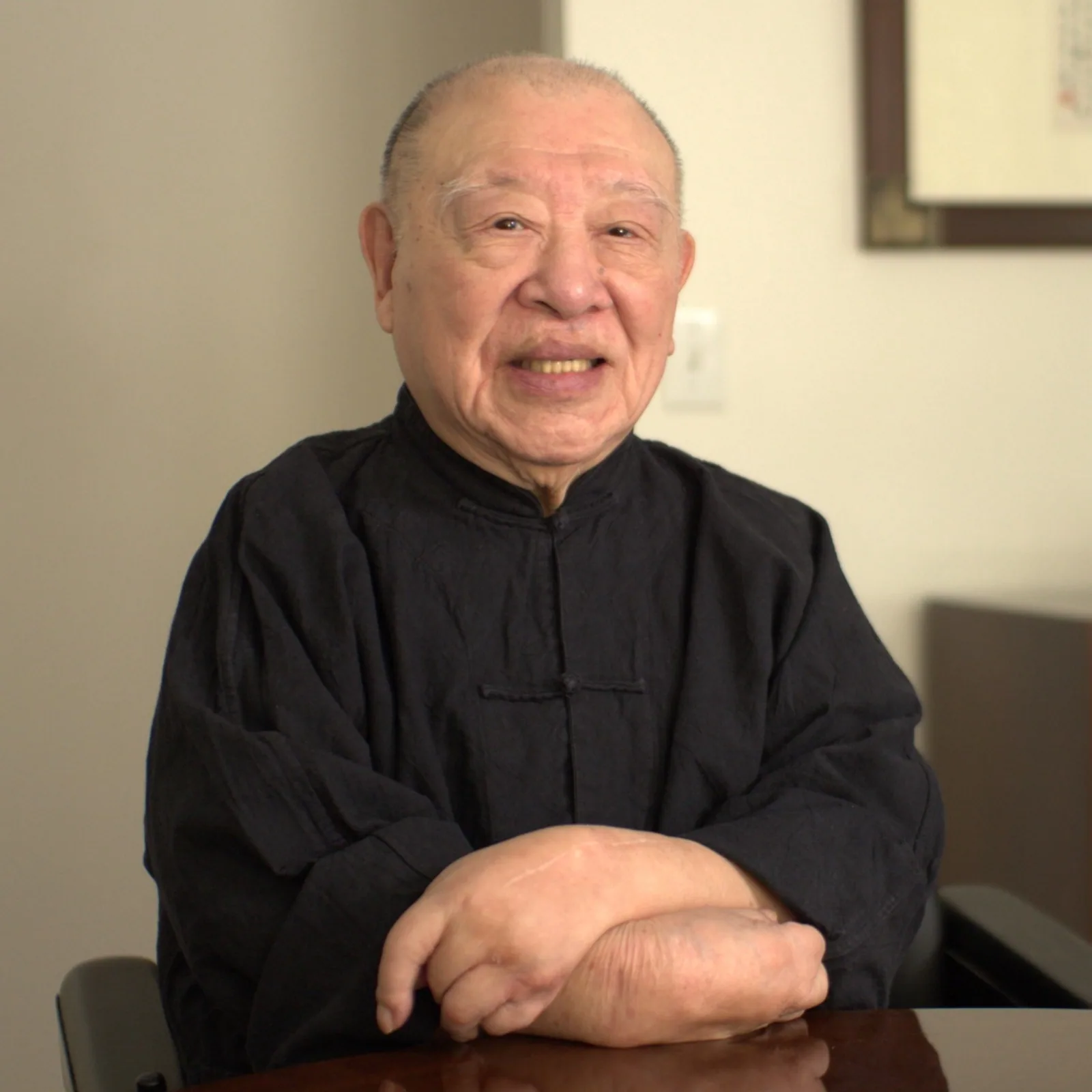
30-second overview: Born in Xiamen in 1930, Hsu Cho-yun came to Taiwan with the Nationalist government in 1949 and moved to Pittsburgh in 1970. Born with limb disabilities and a lifelong wheelchair user, the historian nevertheless typed nearly forty books with the only two fingers through which he could still exert force. He was elected to the 13th class of Academia Sinica academicians in 1980 and received the sixth Tang Prize in Sinology in 2024—the first laureate, under a strict definition, to have emerged from Taiwan. He donated the entire NT$50 million award to establish the Hsu-Sun Scholarship.1 His eldest sister, Hsu Liu-fen, was Wang Leehom’s grandmother, while his second-eldest sister, Hsu Wan-ching, was Li Chien-fu’s mother. One family headed by a Republic of China Navy rear admiral from Wuxi thus connected a University of Chicago Sinology classroom, the chair’s office of National Taiwan University’s Department of History, the words and music of “Descendants of the Dragon,” and the kinship term “maternal granduncle,” searched more than two thousand times without generating a single click.2 Hsu died in Pittsburgh on August 3, 2025, at the age of 95. When the Central News Agency interviewed him at 94, he said: “At the moment I draw my last breath, I will still be learning.”3
In June 2024, a Central News Agency reporter flew to Pittsburgh to interview Hsu Cho-yun, who had just learned that he would receive the sixth Tang Prize in Sinology. At 94, he sat in a wheelchair with both hands bent inward. His eyesight had deteriorated to the point that he could no longer turn the pages of a book himself, and he depended almost entirely on his wife, Sun Man-li, for mobility and daily assistance.4
Yet every morning, he still sat down at his computer and used the only two fingers through which he retained enough strength to type, continuing to read and write. The book he was working on was Jingwei Huaxia: a history of ancient China exceeding 300,000 Chinese characters, written over three years and revised through eight drafts. In the end, those two fingers typed the entire manuscript.5
When the reporter asked how he felt about receiving the prize, Hsu did not speak about the honor itself. He said: “At 94, I want to submit my answer sheet to society. I hope society will say to me: You have passed. But I cannot tell myself that I have passed. At the moment I draw my last breath, I will still be learning.”3
One year later, on August 3, 2025—the early morning of August 4 in Taiwan—Hsu died in his sleep in Pittsburgh at the age of 95. His final Weibo post, published on July 24, recalled the War of Resistance Against Japan in 1938, the eve of the Battle of Taierzhuang, and the moment Sichuan troops passed through Shashi. The following day, his grandnephew Wang Leehom posted a social-media tribute to his “seventh granduncle.”6
📝 This article was rewritten in response to Google Search Console data, not news of Hsu’s death: English-language searches for “Hsu Cho-yun Wang Leehom” generated more than two thousand impressions each week and zero clicks. Readers wanted to understand the family relationship between Wang and the historian, but Taiwan.md had never built that bridge. This article expands from their genealogy to the family of a Republic of China Navy rear admiral from Wuxi, the words and music of “Descendants of the Dragon,” the University of Chicago training that brought social-science methods into historiography, and the long river of The Everlasting River, which sought to “place China back within the world.” Together, these threads reopen Hsu’s life and work to a new generation of readers.
Twins on Gulangyu, Xiamen, and Wartime Flight Through Shashi, Hubei, Sichuan, and Chongqing
Hsu Cho-yun and his twin brother, Hsu Yi-yun, were born on September 3, 1930, on Gulangyu in Xiamen, Fujian.7 Their ancestral home was Wuxi, Jiangsu. Their father, Hsu Feng-tsao, was a Republic of China Navy rear admiral who had participated in the 1911 Revolution. Their mother, Chang Shun-ying, came from an official family in Wuxi. Educated herself, she was not only a wife and mother but also the spiritual center that held the large family together.8
One twin, the younger brother Hsu Yi-yun, was born able-bodied. The other, the elder brother Hsu Cho-yun, was born with deformities in all four limbs; his hands and feet turned inward, and even limited walking required two crutches. Such a contrast between twins is exceedingly rare in medicine.9 For a family in 1930s China, it meant that through decades of relocation, war, and displacement, Hsu Cho-yun would always be the child who had to be carried, supported, and cared for.
In 1935, after their father was reassigned, the family moved from Xiamen to Shashi in Hubei. Two years later, the Marco Polo Bridge Incident erupted, thrusting seven-year-old Hsu into one of the most turbulent periods in modern Chinese history. The family subsequently moved repeatedly as refugees among Shashi, other parts of Hubei, Sichuan, and Chongqing. This uprooted childhood became one of the underlying tonalities of his lifelong historical writing.10
📝 Hsu’s final Weibo post returned to the eve of the Battle of Taierzhuang: “I watched these young soldiers walk past me one by one. At that moment, I changed from a child into an adult. I vaguely understood that these young soldiers passing through Shashi were heading straight from Xinyang to Taierzhuang—and that, in the end, not one of them would make it home. Not a single one would return.” Beneath it, he added: “A child becomes an adult not through age, but through a change in state of mind.”11 He published the post on July 24, 2025. Ten days later, he died in Pittsburgh. He spent his life writing about ancient China, Han agriculture, and Western Zhou feudalism, yet both the beginning and end of his life remained joined to that riverside road in Hubei in 1938.
Amid war, his limited mobility paradoxically gave Hsu more time to read. He later described himself as “a fortunate man”: “I met good teachers when I studied and a good wife when I married. Even my congenital disability benefited me—it gave me more time at my desk.”12
In 1949, the Hsu family came to Taiwan with the retreating Nationalist government, and nineteen-year-old Hsu entered the Department of History at National Taiwan University. Intellectuals of that generation carried their scholarship across the Taiwan Strait from China, reestablishing in Taipei academic traditions that had taken shape in Beiping and Shanghai. In this environment, Hsu built the Sinological foundation that would allow him to engage Western scholarship.13
Under Herrlee G. Creel at the University of Chicago: Bringing the Social Sciences into Chinese History
Hsu graduated from NTU’s Department of History in 1953 and earned a master’s degree from its Graduate Institute of Liberal Arts in 1956. That year, he traveled to the United States for advanced study at the University of Chicago, lived at the Chicago Theological Seminary, and studied under Sinologist Herrlee G. Creel.14
American scholarship on China was then undergoing a methodological transformation. Traditional Sinology had centered on textual interpretation, philology, and evidentiary scholarship. “China Studies,” by contrast, was beginning to introduce tools from the social sciences—including sociology, anthropology, economics, and political science—and to treat China as an object of analysis within modern academic disciplines. Hsu received his doctorate in 1962, precisely at this turning point.15
His dissertation was subsequently revised as Ancient China in Transition: An Analysis of Social Mobility, 722–222 B.C., published by Stanford University Press in 1965. The book used quantitative methods to analyze social mobility during the Spring and Autumn and Warring States periods: which aristocratic families disappeared from the political stage, which rising classes advanced through military achievement or learning, and how the social structure loosened on the eve of Qin-Han unification. After reading it, Harvard Sinologist John K. Fairbank called it “a little classic.”16
📝 The book also planted a methodological seed in Taiwan’s historical profession. Hsu was 32 when he returned to Taiwan in 1962. He first served at Academia Sinica’s Institute of History and Philology, where he had held a concurrent assistant research fellowship since 1956 and was promoted to associate research fellow in 1962. In 1964, he simultaneously became a professor and chair of NTU’s Department of History, serving through 1970.17 During those six years, he did something that would profoundly reshape historical scholarship in Taiwan: he brought social-science methods, schools of thought, and research questions into Taiwan’s history classrooms. As department chair, he organized workshops and international conferences, introduced methodological debates from American historiography at NTU, and trained a cohort of students who would later occupy important positions in historical scholarship across Taiwan, China, and Hong Kong.18
Three representative works that he subsequently completed—Han Agriculture: The Formation of the Early Chinese Peasant Economy (University of Washington Press, 1980),19 Seeking Antiquity (Linking Publishing, 1982),20 and The History of the Western Zhou (Linking Publishing, 1984)21—can be understood as three applications of this methodology:
| Work | Period addressed | Methodological instrument |
|---|---|---|
| Han Agriculture | Han dynasty | A quantitative reconstruction of the mutually reinforcing relationship among peasant life, market-economic networks, and intensive agriculture |
| Seeking Antiquity | Antiquity through the Qin and Han | The evolution of a civil bureaucracy linking the paired domains of center and locality, politics and society |
| The History of the Western Zhou | Western Zhou | The role of lineage groups in constructing the origins of a “Huaxia” consciousness |
Hsu described the questions addressed by these three books as the “three primary colors of Chinese culture”: not three unrelated studies, but three cross-sections of the same fundamental questions pursued continuously by one historian over thirty years.22
Half a Century in Pittsburgh: A Macrohistorical Method That Rejected Sinocentrism
In 1970, at the age of forty, Hsu immigrated to the United States with his wife Sun Man-li and their eight-month-old only child, Leo Hsu, joining the University of Pittsburgh’s Department of History.23
He spent twenty-eight years at Pittsburgh from 1970 to 1998, advancing from visiting professor (1970–72) to tenured professor (1972–82) and university professor (1982–98). After retiring in 1998, he remained university professor emeritus until his death. The University of Pittsburgh retained his title for a total of fifty-five years.24 At the same time, he never left Taiwan’s academic community. He served as a corresponding research fellow at Academia Sinica’s Institute of History and Philology from 1981 to 1997 and, after 1989, held a succession of distinguished research appointments through 2006. Academia Sinica in Taipei, the Pittsburgh campus, and lecture circuits across Taiwan, China, and Hong Kong formed the three coordinates of the latter half of his academic career.25
In Pittsburgh, he undertook two structural projects. The first was to continue deepening the methodology of applying the social sciences to Chinese history. The second was to deploy that method at a larger scale: not merely to examine one dynasty or China alone, but to compare China within the history of world civilizations.26
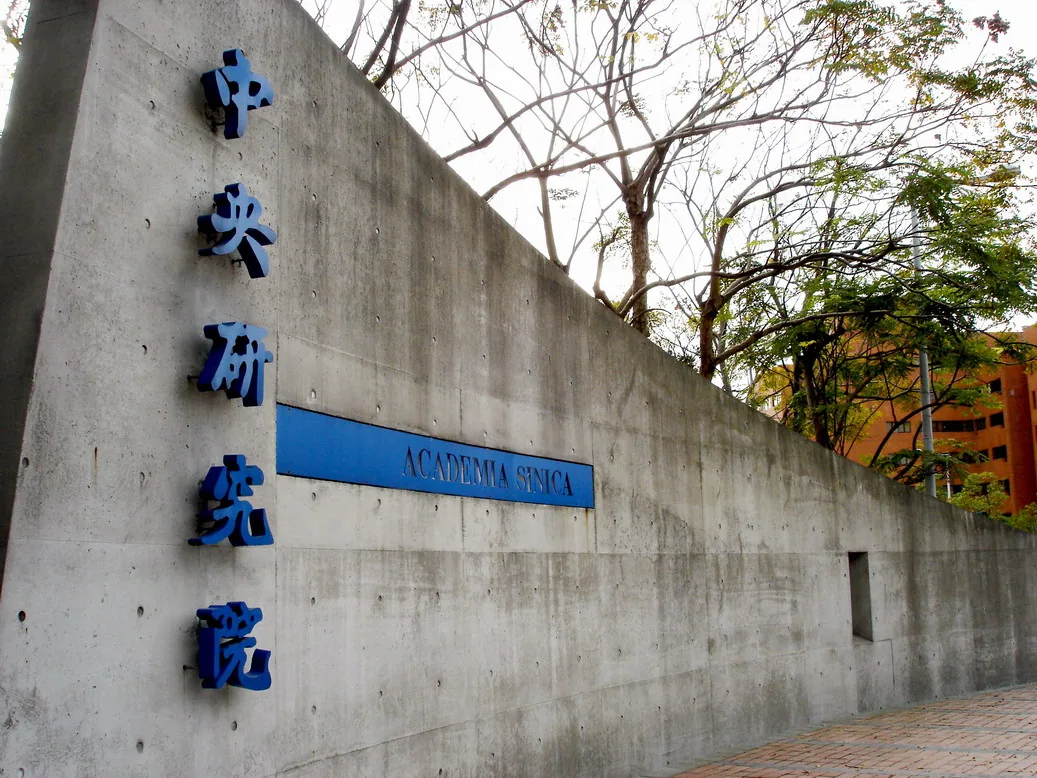
Academia Sinica’s Nangang campus—the long-term home of the Institute of History and Philology, where Hsu Cho-yun began working in 1956, and the academic base from which he was elected to the 13th class of academicians in 1980. Photo: KaurJmeb, 2005-12-20. CC BY-SA 3.0 via Wikimedia Commons.
In 1980, at age fifty, he was elected an academician in Academia Sinica’s 13th class, within the Humanities and Social Sciences Division.27
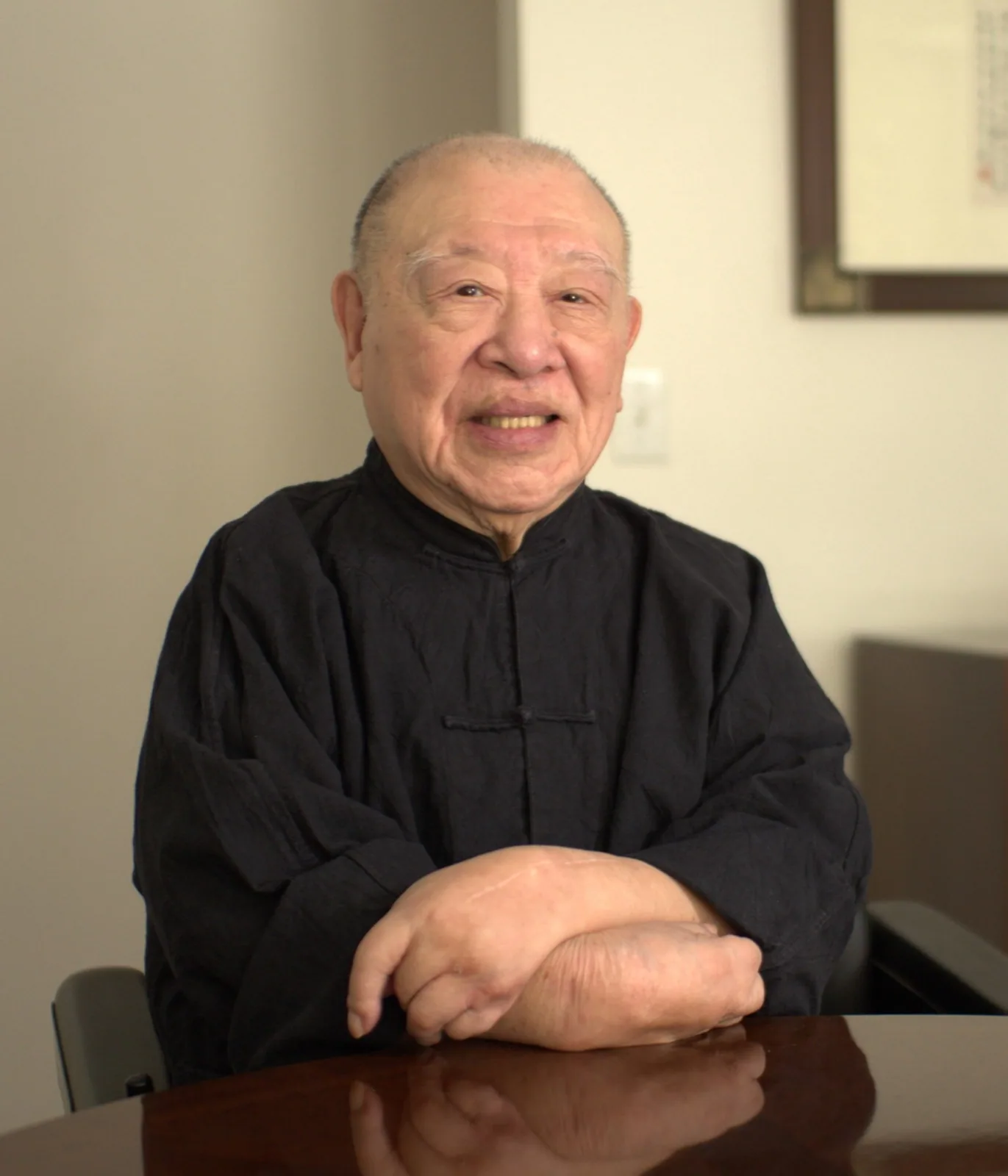
_Official late-life portrait of Hsu Cho-yun from Academia Sinica. Photo: Academia Sinica(中央研究院), after 1980. Attribution license via Wikimedia Commons._
📝 The term “macrohistory” later became most closely associated with Ray Huang, but Hsu’s macrohistory was of a different kind. Huang asked why China had been unable to move beyond traditional modes of governance, as in 1587, A Year of No Significance and China: A Macro History. Hsu asked how Chinese civilization was itself shaped through contact with other civilizations—the steppe, India, Islam, and the West—while also shaping them in turn. His central conviction was a rejection of Sinocentrism: understanding China required placing it back within the context of world history, not treating it as a self-contained, isolated, closed system evolving solely according to its own internal logic.28
In 1989, Hsu helped establish the Chiang Ching-kuo Foundation for International Scholarly Exchange. Its creation followed a 1986 joint petition to President Chiang Ching-kuo from Hsu, Yu Ying-shih, Kwang-chih Chang, and other professors of Chinese heritage teaching in North America. Concerned about the decline of overseas Sinological research, they proposed that Taiwan fund an international academic grant-making institution to advance the field.29 After the foundation was established on January 12, 1989, Hsu served as chair of its American Regional Committee, a position he retained until shortly before his death—a tenure of thirty-six years.30
Among the students Hsu trained during his Pittsburgh years were Wang Fan-sen, who later directed Academia Sinica’s Institute of History and Philology and served as the academy’s vice president, and Tu Cheng-sheng, who served as minister of education and director of the National Palace Museum.31 Together with historians of his generation such as Hsing I-tien and Chen Jo-shui, with whom he collaborated over many years, “Hsu Cho-yun’s student circle” formed a highly influential network in the historical profession across Taiwan, China, and Hong Kong from the 1980s through the 2010s.
The Family Tree: From Hsu Feng-tsao to Wang Leehom, Three Generations of Sinophone Cultural Elites
Hsu Cho-yun was the seventh of nine siblings. This was why Wang Leehom called him his “seventh granduncle” in his tribute.32
Laid out in full, the family history forms an overlooked map of Taiwan’s postwar culture:
| Birth order | Name | Principal identity | Link to the next generation |
|---|---|---|---|
| Eldest sister | Hsu Liu-fen | Economics graduate of Tsing Hua University; chair of the Department of Accounting and Statistics at Taipei College of Commerce; author of Principles of Accounting and an English-Chinese/Chinese-English accounting dictionary33 | → Married Wang Hsin-ming → son Wang Ta-chung, a neurologist → grandson Wang Leehom34 |
| Second-eldest sister | Hsu Wan-ching | Graduate of National Southwestern Associated University | → Married Li Mo, a former deputy minister of education and economic affairs → son Li Chien-fu, original singer of “Descendants of the Dragon”35 |
| Seventh, elder twin | Hsu Cho-yun | Academician of Academia Sinica and historian | Subject of this article |
| Seventh, younger twin | Hsu Yi-yun | Chemical-engineering scholar and former chair of the Atomic Energy Council, Executive Yuan36 | — |
| Others | — | — | — |
In other words, Hsu played two roles within the family: he was Wang Leehom’s “seventh maternal granduncle” and Li Chien-fu’s maternal uncle. Wang and Li are cousins: Hsu Liu-fen was Wang’s grandmother, Hsu Wan-ching was Li’s mother, and the two women were sisters.
The Hsu family came from an official lineage in Wuxi. Their father, Hsu Feng-tsao, was a Republic of China Navy rear admiral, while their mother, Chang Shun-ying, came from a scholarly family. In the next generation in Taiwan, their descendants spread across accounting, the offices of deputy ministers, academia, the popular-music industry, and nuclear policy. By the third generation, the family connected to the words and music of the 1980 song “Descendants of the Dragon”—written and composed by Hou Dejian and first performed by Li Chien-fu, the son of Hsu Cho-yun’s sister Hsu Wan-ching—and to Wang Leehom, a defining figure in 2000s Sinophone popular music. These were two branches of the same Wuxi family.37
📝 This family line merits serious treatment for reasons beyond celebrity gossip. It precisely illustrates how a second-generation waishengren intellectual family that came to Taiwan with the Nationalist government in 1949 dispersed its cultural capital, within three generations, across several of postwar Taiwan’s most important fields: scholarship through Hsu Cho-yun, education policy through Li Mo, the accounting profession through Hsu Liu-fen, nuclear technology through Hsu Yi-yun, and popular music through Wang Leehom and Li Chien-fu. Roots in China, growth in Taiwan, academic training in the United States, and circulation throughout the Sinophone world: one family, five outlets.
On August 5, 2025, Wang Leehom posted a social-media tribute to his “seventh granduncle,” recounting the childhood of his father, Wang Ta-chung, a neurologist and graduate of NTU’s medical school:38
“My father’s warmest childhood memories included the bedtime stories his seventh uncle read to him. His seventh uncle, Hsu Cho-yun, had been frail and sickly since childhood and was born with disabilities, but his inner world was extraordinarily rich and his wisdom was beyond compare.”
“Although he was the seventh of nine siblings and his body was impaired, what he left the world was the towering figure of a great man seen from behind.”
“He may have been small and thin in stature, but his spirit stood as tall as a mountain. Everything he left behind will never be forgotten. Mr. Hsu Cho-yun, may you rest in peace. Thank you, Seventh Granduncle. May God bless you and grant you rest.”
The detail about bedtime stories was later amplified by numerous media outlets. Every evening, Hsu would invent another installment for his young nephew, Wang Ta-chung. Many were improvised and concealed lessons about life.39 An uncle unable to run or jump with his own legs held his young nephew through stories. Decades later, that nephew’s son spoke to global Sinophone audiences through popular music. From the generation of Republic of China Navy rear admiral Hsu Feng-tsao to that of Golden Melody Award-winning singer Wang Leehom, one man stood between them, writing Chinese history with two fingers. The line itself is a microcosm of twentieth-century Chinese diaspora history.
A June 2024 Central News Agency interview: at his Pittsburgh home, Hsu Cho-yun said, “At the moment I draw my last breath, I will still be learning.” This was how he understood “submitting his answer sheet” to society upon learning that he would receive the sixth Tang Prize in Sinology.
The Everlasting River: Writing China as a Great River for an Age of Ordinary Readers
In 2006, Hansheng Publishing in Taipei released The Everlasting River: Transformations and Developments in Chinese History and Culture.40
The 270,000-character book was Hsu’s history of China for an “age of ordinary people.” In his preface, he wrote: “Readers today differ from those of the past. In this age of ordinary people, nearly everyone with at least a high-school education may take an interest in history. This book is a history written for this generation of Chinese readers.”41
📝 Making scholarship accessible to ordinary people is a higher demand, not a lowering of standards. Writing for high-school graduates while still earning the approval of university professors is a rare ability in any language. The strategy of The Everlasting River was to abandon a linear chronology organized around dynastic succession and instead make the “expansion and contraction of culture” its central axis. Chinese civilization appears as a great river, growing from a trickle into a torrent, absorbing tributaries along the way while also changing course, flooding, and running dry.
Hsu began with the questions ordinary readers actually ask. What did common people eat in medieval China? How did the cultures of the Yangtze and Yellow River regions differ? Why did Taiwan not appear in Chinese history until the modern period? What did Confucius mean by ren, or humaneness? Why did China not undergo Western-style industrialization? Each question could have become an accessible scholarly essay in its own right, but Hsu wove them together into a single book.42
After publication, The Everlasting River circulated widely in Taiwan, Hong Kong, China, and overseas Chinese communities, selling in the millions over the following two decades. Simplified-character editions were successively introduced by SDX Joint Publishing and Guangxi Normal University Press in China.43 It was a popular work, but one accepted by scholars as well: a history book that professors and high-school graduates could both read was a rare achievement in the twenty-first-century Chinese-language world.
Hsu then used the same civilizational macrohistory framework to write three companion volumes:
Self and Other: The Boundaries Between the Internal and External in Chinese History (2009, China Times Publishing / Chinese University Press)[^44]: This book directly addressed the historical question of how China defined itself and others. Hsu proposed six systems for analyzing the formation and dissolution of relations between “self” and “other”: interactions between China and other nations; between the Chinese heartland and peripheral peoples; between the central state and local society; between upper and lower social strata; within networks of market exchange; and between mainstream “orthodoxy” and cultural challengers labeled “heterodox.” His language was measured: “In the ‘internal/external’ and ‘self/other’ relations of complex systems, the most important distinction lies not in ethnicity, but in cultural cognition.”44 Against the intensely contested political identities of Taiwan, China, and Hong Kong in 2009, this was a deliberate effort to create historical distance.
Discourses on Huaxia: The Transformation of a Complex Community (Guangxi Normal University Press, 2015)[^46]: This book advanced the argument one step further. Hsu maintained that China should not be defined through a “freeze-frame”—what it looked like under one dynasty at one point in time—but understood as a “process”: how China changed. He analyzed this process as the dynamic interweaving of four variables: political authority, economy, society, and cultural ideas.
Jingwei Huaxia (CITIC, 2023; expanded Hong Kong edition from Joint Publishing, 2024)[^47]: This was the last major book Hsu completed, at age 93, by typing with two fingers and revising the manuscript eight times. When Xu Zhiyuan interviewed him in Pittsburgh in 2019 and returned in 2023, the book was still being written. The expanded traditional-character edition published in 2024 added two long essays totaling approximately 20,000 Chinese characters, on “the Great Flood” and “interactions between the northern steppe and the Central Plain.”45
📝 Together, these four books constitute one historian’s comprehensive examination of the concept of “China.” They move from the river metaphor of The Everlasting River, through the internal and external boundaries of Self and Other and the process-based definition in Discourses on Huaxia, to Jingwei Huaxia and its expanded geographical vision from continent to ocean. In his later years, Hsu explicitly recast “Chinese history” as “the history of China’s relationship with the world.” This was also the assessment offered by the 2024 Tang Prize selection committee: “Professor Hsu’s historiography reveals the broadest patterns. His specialized studies of ancient China uncover essential questions in long-term history, while his interpretations of general history emphasize cultural accommodation and exchange and seek China’s place in the world.”46
A Guide to the Works: Forty Books, Five Approaches
Hsu wrote nearly forty books over his lifetime, covering ancient history, Han society, Western Zhou feudalism, overseas Sinology, questions of Chinese identity, observations of contemporary America, and late-life reflections on finding inner stability. First-time readers need not begin with his dense academic monographs. The following guide suggests five approaches, arranged by reading sequence:
1. An introduction: Chinese macrohistory for ordinary readers
- The Everlasting River: Transformations and Developments in Chinese History and Culture (Hansheng, 2006)[^40]: His most widely circulated book. Its 270,000 Chinese characters present a cultural history of China without dynastic boundaries, viewed through the expansion and contraction of civilization and the metaphor of a great river.
2. Advanced reading: civilization’s internal and external boundaries
- Self and Other: The Boundaries Between the Internal and External in Chinese History (China Times Publishing, 2009)[^44]: An examination of Chinese identity through a six-system framework.
- Discourses on Huaxia: The Transformation of a Complex Community (Guangxi Normal University Press, 2015)[^46]: A process-based definition of “China” through the interweaving of political authority, economy, society, and culture.
- Jingwei Huaxia (expanded Hong Kong edition, Joint Publishing, 2024)[^47]: Revised eight times, with an expanded framework “from continent to ocean.”
3. Representative academic works: bringing the social sciences into Chinese history
- The History of the Western Zhou (Linking Publishing, 1984; second edition, 1986; revised third editions, 1990/1993; expanded Beijing edition from SDX Joint Publishing, 1994; new expanded edition, 2020)[^21]: A study of how lineage groups constructed the origins of “Huaxia” consciousness.
- Han Agriculture (English edition, University of Washington Press, 1980; later translated into Chinese as Han Agriculture: The Formation of the Early Chinese Agricultural Economy)[^19]: A quantitative reconstruction of Han peasant life and networks of market exchange.
- Ancient China in Transition (Stanford University Press, 1965)[^16]: A revision of his dissertation and a quantitative analysis of social mobility during the Spring and Autumn and Warring States periods, praised by John K. Fairbank as “a little classic.”
- Seeking Antiquity (Linking Publishing, 1982)[^20]: The evolution of the central and local civil bureaucracy from antiquity through the Qin and Han dynasties.
4. Autobiography and late-life thought
- The Course of the Heart (Wenxing, 1964; Biography Literature, 1979; Xiamen University Press, 2015)[^50]: An autobiography written at age 34, tracing his intellectual journey from Xiamen to Taipei and Chicago.
- Sixty Years of Change in America: Observations of a Chinese (Linking Publishing, 2019)[^51]: His account of half a century in the United States and diagnosis of American society.
- Turn Inward and Settle Yourself (Beijing Daily Press, 2022, written with Feng Junwen)[^52]: Reflections composed at age 89, offering a book of inner grounding for a restless age.
5. Popular works and interviews
- The five-volume Hsu Cho-yun Talks About History series[^53]: A popular presentation of his macrohistorical approach.
- Ten Days of Conversations with Hsu Cho-yun: The Contemporary World Order and Humanity’s Future (Hong Kong Joint Publishing)[^54]: A collection of his late-life reflections on the global order.
📝 If you can read only one book, begin with The Everlasting River. To understand his historical method, the preface to the expanded edition of The History of the Western Zhou is more powerful than the book itself. For his overall view of China, Self and Other is the most concentrated. To understand Hsu as a person, read The Course of the Heart together with Turn Inward and Settle Yourself.
The 2024 Tang Prize: Donating the Entire NT$50 Million Award to Establish the Hsu-Sun Scholarship
On June 20, 2024, the Tang Prize Foundation announced the recipient of the sixth Tang Prize in Sinology: Hsu Cho-yun. The award totaled NT$50 million, including a NT$10 million research grant.47
Under a strict definition, he was the first Tang Prize in Sinology laureate to have emerged from Taiwan. The first five laureates—Yu Ying-shih of Harvard, Stephen Owen of Harvard, Naoki Hazama of Kyoto, Wang Gungwu of Singapore, and Erik Zürcher of Leiden—had all completed their secondary education and foundational university training overseas. Hsu, by contrast, came to Taiwan with the Nationalist government in 1949, graduated from NTU’s Department of History in 1953, and earned a master’s degree from NTU’s Graduate Institute of Liberal Arts in 1956. He was a scholar who had genuinely “grown up in Taiwan.”48
⚠️ The Tang Prize selection committee’s citation directly identified the core of Hsu’s historical work: “Professor Hsu’s historiography reveals the broadest patterns. His specialized studies of ancient China uncover essential questions in long-term history, while his interpretations of general history emphasize cultural accommodation and exchange and seek China’s place in the world. His writings convey concern for country, nation, and humanity as a whole. He is a broadly learned historian who combines erudition with a commitment to improving the world.”46
The action that received even wider coverage, however, was what Hsu did next. He donated the entire NT$50 million award to establish the Hsu-Sun Scholarship, supporting young doctoral researchers in Sinology around the world.1 The scholarship was jointly named for Hsu and his wife, Sun Man-li, recognizing the support she had provided throughout fifty-five years of his academic career.
📝 The significance of this act extended beyond generosity. Hsu had helped establish the Chiang Ching-kuo Foundation in 1989 and spent decades overseeing grants for Sinological research in North America. Cultivating the next generation of Sinologists was one of his lifelong projects.29 Donating the entire Tang Prize transformed the question of “what his generation had accomplished” directly into “whether the next generation would have the opportunity to continue.” For a 94-year-old historian with failing eyesight who depended entirely on others for mobility, it was the most concrete act of intellectual succession available to him.
On September 28, 2024, the sixth Tang Prize laureate in Sinology delivered the lecture “Finding a Path Through a World in Confusion.” Hsu spoke by video rather than appearing in person, addressing the place of macrohistorical methodology in the contemporary world. Source: Tang Prize Foundation official YouTube channel.
Tang Prize Week took place in Taipei in late September 2024. Unable to attend for health reasons, Hsu delivered his laureate lecture, “Finding a Path Through a World in Confusion,” by video. That same month, Thirteen Invitations assembled Xu Zhiyuan’s two interviews with Hsu in Pittsburgh, beginning in 2019, into the first episode of its eighth season. The subject Hsu discussed most was his unease about the contemporary world. He saw the fractures in American society, confusion in China, and anxiety in Taiwan. Describing the current international order, he said that he “could not help thinking of the late Qing.”49
A Cross-Strait Academic Bridge: Maintaining Distance Beyond Sinocentrism
One of Hsu’s most frequently cited positions in his later years was his criticism of Sinocentrism.50
“I hope I will no longer hear rhetoric about how ‘awesome China is,’” he said.51 This position made him “not Chinese enough” in the eyes of Chinese nationalists and “too Chinese” to some historians centered on Taiwan. Yet this was precisely the position he sought: instead of choosing a side within any nationalist narrative, he used the longer timescale of “China’s relationship with the world” to examine contemporary Cross-Strait political anxiety.52
⚠️ A remark from his September 2024 interview with the Central News Agency was widely quoted: “Trump’s talk of ‘protection money’ resembles the behavior of thugs in the foreign concessions.”53 He made the comment around the time of his sixth Tang Prize laureate lecture. Hsu compared the contemporary American posture toward its allies to that of foreign powers in China’s treaty-port concessions during the late Qing. The analogy was itself an application of his macrohistorical method: viewed on the scale of a great river, present anxiety about the international order has historical points of comparison.
Hsu always retained a distinctive emotional attachment to Taiwan. In his 2024 Central News Agency interview, he told a Taiwanese reporter:3
“Taiwan fills me with longing and regret. I have always hoped that one day the waters of the Taiwan Strait will be calm, that brothers on both sides will shake hands, and that neither side will remain hostile or divided from the other.”
“I have no regrets. I should fulfill this responsibility for Taiwan.”
Before his death, he had purchased a burial plot in Wuxi and arranged for his gravestone to be carved in advance, hoping to be interred with his parents. “Fallen leaves returning to their roots” was his chosen conclusion for his own life.54 On the gravestone, he quoted Lu You’s poem “To My Son”: “I grieve only that I shall not see the Nine Provinces united.” Commentators on both sides of the Taiwan Strait read different meanings into the line. Some interpreted it as regret over the absence of Chinese unification. Others saw a deeper sorrow: that no political narrative could ever contain the displacement of his entire life.
📝 It was an extraordinarily difficult position to occupy. Hsu attended university in Taiwan, earned his doctorate in the United States, spent half a century in Pittsburgh, reached a million readers in China through The Everlasting River, and held the status of an Academia Sinica academician in Taiwan. Each identity placed expectations on him, yet none could contain him completely. In the end, he chose the words “I should fulfill this responsibility for Taiwan.” He defined that responsibility himself, across the levels of political position and national identity: to use a historian’s long timescale to offer people in Taiwan, China, and Hong Kong a common temporal measure through which to understand one another.
Hsu repeatedly said: “History tells us that whenever a civilization is at its strongest, it is also nurturing the crisis within it. Conversely, whenever it is at its weakest, it is often burying the seeds of renewal.”55 He spent his life writing Chinese history, but what truly concerned him was the act of looking between the upper and lower reaches of the river. Dynastic strength and decline were only the surface. What a 95-year-old historian typed with two fingers was a temporal sedative for a restless age.
Death at 95, Leaving a River for Future Readers
On August 3, 2025, Hsu died in his sleep in Pittsburgh, United States, at the age of 95. His wife, Sun Man-li, was at his side.56
In its press release, Academia Sinica offered this assessment of its 13th-class academician: “Academician Hsu Cho-yun mastered both Chinese and Western learning and was a world-renowned leader in historical scholarship. He specialized in ancient Chinese, social, and cultural history, producing abundant and profoundly original work. His vision was expansive: he examined ancient Chinese history through the lens of world history without allowing China to delimit his inquiry.”25 The PRC’s Taiwan Affairs Office took the unusual step of publicly describing his death as “regrettable.” This simultaneous mourning on both sides of the Taiwan Strait was itself the final footnote to the distinctive position Hsu had occupied.57
On August 5, Wang Leehom posted a tribute to his “seventh granduncle.” That same day, Li Chien-fu commemorated his “uncle.” The original singer of “Descendants of the Dragon” and the singer-songwriter of “Because Love Is in the Heart”—descendants of the same Hsu family home in Wuxi—said farewell across three generations to the boy who had once walked with two crutches.58
In early August, the University of Pittsburgh’s Department of History published a brief “In Memoriam” titled “Renowned Historian Passes Away at 95.” The university where Hsu had spent fifty-five years sent him off with that concise headline.59
Yeh Kuang-shih, a former minister of transportation and a collaborator at the Chiang Ching-kuo Foundation, recalled his final meeting with Hsu: “Hsu Cho-yun was not only a great scholar; his conduct and way of dealing with people were also extraordinary. He was an essential driving force behind the establishment of the Chiang Ching-kuo Foundation.”60
Hsu left nearly forty books. His earliest, The Course of the Heart, appeared in 1964, when he was 34. The expanded edition of his last, Jingwei Huaxia, appeared in 2024, when he was 94. Across sixty years, he followed the same great river of Chinese history, first with a pen and later with two fingers.
✦ In 1938, Sichuan troops passed before him on Linjiang Road in Shashi, Hubei, on their way to Taierzhuang.
In 1949, the flag of the Nationalist government flew in the wind above the deck at Keelung Harbor.
In 1962, in a University of Chicago library, he first applied social-science methods to the Spring and Autumn and Warring States periods.
In 1980, in an Academia Sinica conference hall, he was elected to its 13th class of academicians.
In 2006, the first printing of The Everlasting River appeared in the window of a Hansheng bookstore.
In 2024, at his desk at home in Pittsburgh, he typed the eighth draft of Jingwei Huaxia with two fingers.
On July 24, 2025, he wrote on Weibo: “A child becomes an adult not through age, but through a change in state of mind.”
On August 3, 2025, he drew his final breath in his sleep.
“At the moment I draw my last breath, I will still be learning.” He said it in an interview at 94. One year later, it came true.
What he left was a river that continues to flow, without a final answer.
Further reading:
- Jay Chou — A defining figure of the same generation in Sinophone popular music, and a contemporary of Hsu Cho-yun’s grandnephew Wang Leehom
- Yoga Lin — A generational cross-section of Sinophone popular music, positioned against Wang Leehom’s generation
- Chen Chien-nien — Another long-timescale narrative about a cultural figure in the People category
- _Waishengren_ — The postwar Taiwanese context of second-generation waishengren intellectual families who came to Taiwan in 1949, including the family of Hsu Cho-yun, Hsu Liu-fen, and Hsu Wan-ching
- The February 28 Incident — A historical turning point confronted by intellectuals of Hsu’s generation after coming to Taiwan
- Samuel Yin: The Science Prize He Built Costs More Than a Nobel — Founder of the Tang Prize, whose sixth Sinology Prize went to Hsu Cho-yun in 2024; Hsu donated the entire NT$50 million award to establish the Hsu-Sun Scholarship
Image Sources
This article uses two Wikimedia Commons-licensed images: two crops from the same portrait of Hsu Cho-yun and one photograph of an Academia Sinica building. All are cached under public/article-images/people/ to avoid hotlinking to the source server:
- Cho-Yun Hsu 許倬雲 — Photo: Academia Sinica(中央研究院), after 1980, Attribution license, Wikimedia Commons File:Cho-YunHsu許倬雲.jpg. Original image: 2205×2572 portrait. This article uses (a) a hero version, cropped to a 1600×1600 square, and (b) an inline version, retaining the original 0.857 aspect ratio and resized to 1371×1600. Credit source: https://academicians.sinica.edu.tw/index.php?r=academician-n%2Fshow&id=21
- Academia Sinica — Photo: KaurJmeb, 2005-12-20, CC BY-SA 3.0, Wikimedia Commons File:Academia Sinica.JPG. Exterior of Academia Sinica’s Nangang campus, 1037×778 landscape, used as a spatial anchor for the Institute of History and Philology, where Hsu worked from 1956 to 1971, and Academia Sinica, which elected him to its 13th class of academicians in 1980.
References
- Tang Prize laureate Hsu Cho-yun donates award to establish the Hsu-Sun Scholarship - United Daily News — A September 28, 2024, United Daily News report stating that Hsu donated the entire NT$50 million sixth Tang Prize in Sinology award, including its NT$10 million research grant, to establish the Hsu-Sun Scholarship with his wife Sun Man-li in support of young Sinology doctoral researchers worldwide.↩
- Taiwan.md SC 7d opportunities cluster snapshot — dashboard-analytics.json 2026-05-16 — Seven days of Google Search Console data show that three query variants combining “hsu cho-yun” and “wang leehom” generated approximately 2,954 impressions and zero clicks: “hsu cho-yun” “wang leehom,” 1,561 impressions; “wang leehom” “hsu cho-yun,” 1,103 impressions; and “cho-yun hsu” “wang leehom,” 290 impressions. This was the week’s largest unmet Search Console opportunity, showing that English-language readers were explicitly searching for the relationship between the two without finding relevant content.↩
- Tang Prize in Sinology laureate Hsu Cho-yun remains devoted to learning at 94 despite limited mobility - Central News Agency — A June 20, 2024, Central News Agency interview conducted at Hsu’s Pittsburgh home, documenting his response upon learning that he would receive the sixth Tang Prize in Sinology and his daily life, including the direct quotations “At 94, I want to submit my answer sheet to society,” “At the moment I draw my last breath, I will still be learning,” and “Taiwan fills me with longing.”↩
- With Taiwan in his heart, master historian Hsu Cho-yun dies at 95 - United Daily News — An August 4, 2025, report describing how Hsu’s wife, Sun Man-li, assisted him in daily life during his later years, when his eyesight had deteriorated so severely that he could no longer turn pages himself, yet he continued reading and writing every day.↩
- Jingwei Huaxia, expanded traditional-character edition - Hong Kong Joint Publishing — The publisher’s page for the July 2024 expanded edition records that Hsu “rose to the challenge in his nineties and revised the manuscript eight times.” He also wrote two new essays totaling approximately 20,000 Chinese characters on “the Great Flood” and “interactions between the northern steppe and the Central Plain.”↩
- Historian Hsu Cho-yun dies at 94; before his death, cites regret that he would not see “the Nine Provinces united” - Ming Pao — An August 5, 2025, report compiling details of Hsu’s death, including the verbatim content of his final Weibo post on July 24, 2025, his decision to purchase a burial plot in Wuxi as an act of “fallen leaves returning to their roots,” and his use of Lu You’s line “I grieve only that I shall not see the Nine Provinces united” as a grave inscription.↩
- Hsu Cho-yun - Wikipedia (Chinese) — Biographical information including his birth on September 3, 1930, on Gulangyu in Xiamen, Fujian; ancestral home in Wuxi, Jiangsu; twin brother Hsu Yi-yun; father Hsu Feng-tsao, a Republic of China Navy rear admiral; and mother Chang Shun-ying’s origins in an official Wuxi family.↩
- Cho-yun Hsu - Wikipedia (English) — Additional family background and biographical chronology, including his father’s identity, his mother’s family, education in 1953, 1956, and 1962, appointments at Academia Sinica from 1956 to 1971 and the University of Pittsburgh from 1970 to 1998, and a list of major works.↩
- Master historian Hsu Cho-yun: physically disabled, uncompromising in love - NetEase — A long biographical report covering the medically rare physical contrast between the twins, the family’s agrarian and scholarly background, and Hsu’s marriage to Sun Man-li in 1969.↩
- Master historian Hsu Cho-yun dies; spent part of childhood in Chongqing - Chongqing Morning Post PDF — A full-page memorial published on August 5, 2025, reconstructing Hsu’s move from Xiamen to Shashi after his father’s reassignment in 1935 and the family’s flight through Hubei, Sichuan, and Chongqing after the Marco Polo Bridge Incident in 1937.↩
- Scholar | The late Hsu Cho-yun: My true belonging is the eternally unceasing China of history - China Digital Times — A compilation preserving the verbatim Chinese text of Hsu’s final Weibo post, dated July 24, 2025, recalling Sichuan troops passing through Shashi before the 1938 Battle of Taierzhuang and reflecting that “A child becomes an adult not through age, but through a change in state of mind.”↩
- The Course of the Heart - Books.com.tw — Publication information for Hsu’s 1964 autobiography, first issued by Wenxing and later reissued by Biography Literature and Xiamen University Press, including his self-description as “a fortunate man” and details of his wartime childhood displacement.↩
- Hsu Cho-yun - Wikipedia (Chinese) — See [^7]; records his arrival in Taiwan with the Nationalist government in 1949 and entry into National Taiwan University’s Department of History.↩
- Academician profile - Academia Sinica — Academia Sinica’s official profile recording Hsu’s complete educational chronology: BA in history from National Taiwan University in 1953, MA from NTU’s Graduate Institute of Liberal Arts in 1956, and PhD in the humanities from the University of Chicago in 1962.↩
- Creel Center for Chinese Paleography - University of Chicago — The official website of the center named for Herrlee G. Creel (1905–1994), a foundational scholar of Chinese paleography; the center was established in 2006.↩
- Ancient China in Transition - Cho-yun Hsu (Stanford University Press, 1965) — Records the revision of Hsu’s dissertation as Ancient China in Transition: An Analysis of Social Mobility, 722–222 B.C., published by Stanford University Press in 1965 and praised by Harvard Sinologist John K. Fairbank as “a little classic,” establishing Hsu’s reputation in English-language scholarship.↩
- Biographical account of Academician Hsu Cho-yun - Yu Chi-chung Cultural and Educational Foundation — A complete professional chronology, including service as assistant research fellow at Academia Sinica’s Institute of History and Philology from 1956 to 1962, associate research fellow from 1962 to 1967, research fellow from 1967 to 1971, associate professor in NTU’s Department of History from 1962 to 1964, and professor and chair from 1964 to 1970.↩
- Academia Sinica News | A master historian passes: Academician Hsu Cho-yun dies — Academia Sinica’s official August 4, 2025, press release, including its verbatim assessment that Hsu “mastered both Chinese and Western learning and was a world-renowned leader in historical scholarship,” as well as a record of his contribution as NTU history chair in bringing social-science methods into historical study.↩
- Books.com.tw - Han Agriculture: The Formation of the Early Chinese Agricultural Economy — Bibliographic information for the Chinese and English editions. The English original, Han Agriculture: The Formation of the Early Chinese Peasant Economy, was published by the University of Washington Press in 1980.↩
- Books.com.tw - Seeking Antiquity — Bibliographic information for Seeking Antiquity, first published by Linking Publishing in 1982 and reissued in 1984, 1989, 2006, 2014, and 2022; a collection encapsulating Hsu’s methodology in studying the evolution of central and local civil bureaucracies from antiquity through the Qin and Han.↩
- Books.com.tw - The History of the Western Zhou — Bibliographic information for Hsu’s representative study of lineage groups and the origins of “Huaxia” consciousness, first published by Linking Publishing in 1984, followed by a second edition in 1986, revised third editions in 1990 and 1993, an expanded Beijing edition in 1994, and a new expanded edition in 2020.↩
- Hsu Cho-yun - Wikipedia (Hong Kong traditional Chinese) — Records Hsu’s “three primary colors of Chinese culture” framework: Western Zhou lineage groups, the civil bureaucracy examined in Seeking Antiquity, and the mutually reinforcing relationship between intensive agriculture and market exchange in Han Agriculture.↩
- Hsu Cho-yun’s wife Sun Man-li: Husband and wife are good friends - NetEase — A biographical account of Sun Man-li, including her birth in the winter of 1943, her earlier role as Hsu’s student, their twelve-year age difference, marriage on February 9, 1969, the birth of their only son Leo Hsu in November 1969, and the family’s move to Pittsburgh in 1970.↩
- Hsu Cho-yun Papers, 1970–2008 | Digital Pitt — The University of Pittsburgh collection records Hsu’s full tenure as visiting professor from 1970 to 1972, tenured professor from 1972 to 1982, university professor from 1982 to 1998, and university professor emeritus from 1998 until his death.↩
- Academia Sinica News | A master historian passes: Academician Hsu Cho-yun dies — See [^18]; provides Academia Sinica’s full official assessment and chronological record.↩
- Master historian Hsu Cho-yun dies: A restless age needs clear-minded thinkers committed to the world - HK01 — Commentary summarizing Hsu’s shift in Pittsburgh toward a framework comparing China with world civilizational history and his methodological rejection of Sinocentrism.↩
- Academician profile - Academia Sinica (id=21) — See [^14]; confirms that Hsu was elected to Academia Sinica’s 13th class in 1980.↩
- Self and Other: The Boundaries Between the Internal and External in Chinese History - Books.com.tw — Bibliographic information recording Hsu’s six-system analysis of “self/other” relations and his rejection of Sinocentrism, emphasizing cultural cognition over ethnic division.↩
- Chiang Ching-kuo Foundation for International Scholarly Exchange - Wikipedia — Records the foundation’s establishment on January 12, 1989, following a 1986 petition to President Chiang Ching-kuo by Hsu Cho-yun, Yu Ying-shih, Kwang-chih Chang, and other professors of Chinese heritage in North America, as well as Hsu’s long service as chair of its American Regional Committee.↩
- Background — Chiang Ching-kuo Foundation — The foundation’s official history, identifying Hsu Cho-yun, Yu Ying-shih, Kwang-chih Chang, and other scholars among its founders and documenting Hsu’s long leadership of the American Regional Committee until shortly before his death.↩
- Wang Fan-sen - Wikipedia — Records Wang’s relationship to Hsu, his service as director of Academia Sinica’s Institute of History and Philology and vice president of the academy, and his status as one of Hsu’s academic successors in Taiwan. Tu Cheng-sheng, another member of the same scholarly circle, served as minister of education and director of the National Palace Museum.↩
- Wang Leehom mourns Hsu Cho-yun: Seventh Granduncle’s wisdom was beyond compare - Ming Pao — An August 5, 2025, reproduction of Wang Leehom’s verbatim Weibo tribute, including the term “seventh granduncle” and the detail that Hsu was the seventh of nine siblings.↩
- How prominent is Wang Leehom’s family? A history professor’s forty-year investigation - Business Today — A December 19, 2021, report drawing on research by historian Wu Ming of National Chengchi University. It identifies Wang’s grandmother Hsu Liu-fen as Hsu Feng-tsao’s eldest daughter, an economics graduate of Tsing Hua University, chair of the Department of Accounting and Statistics at Taipei College of Commerce, and author of Principles of Accounting and an English-Chinese/Chinese-English accounting dictionary.↩
- Wang Leehom’s “academician granduncle” was the late master historian Hsu Cho-yun - Liberty Times Entertainment — An August 2025 report tracing Wang’s maternal family line from his grandmother Hsu Liu-fen to his father Wang Ta-chung, a neurologist and NTU medical graduate, and then to Wang Leehom, while confirming that Hsu Cho-yun was Hsu Liu-fen’s seventh brother.↩
- Wang Leehom and Hsu Cho-yun are both relatives of Li Chien-fu - China Times — A June 3, 2015, report identifying Li Chien-fu’s father as Li Mo, a former deputy minister of education and economic affairs, and his mother as Hsu Wan-ching, Hsu Cho-yun’s second-eldest sister and a graduate of National Southwestern Associated University. Hsu was Li’s maternal uncle, and Li and Wang Leehom are cousins.↩
- Hsu Cho-yun - Wikipedia (Chinese) — See [^7]; records that Hsu’s twin brother, Hsu Yi-yun, was a chemical-engineering scholar who served as chair of the Atomic Energy Council, Executive Yuan.↩
- “Descendants of the Dragon”—Li Chien-fu | NTU audiovisual focus — National Taiwan University Library’s entry for the Taiwanese campus folk classic “Descendants of the Dragon,” written and composed by Hou Dejian and first released by Li Chien-fu in 1980. Li was Hsu Cho-yun’s nephew, the son of his sister Hsu Wan-ching.↩
- Master historian Hsu Cho-yun dies; Wang Leehom mourns granduncle: “May you rest in peace” - United Daily News — Reproduces Wang Leehom’s complete verbatim Weibo tribute, including the lines about his father’s warm childhood memories of bedtime stories read by his seventh uncle and Hsu’s small stature but mountain-like spirit.↩
- Wang Leehom mourns “Seventh Granduncle” Hsu Cho-yun: He was a giant in our hearts - Meihua News — A report adding the family’s account that Hsu invented a continuing story for Wang’s father every night, often improvising narratives that contained lessons about life.↩
- Books.com.tw - The Everlasting River: Transformations and Developments in Chinese History and Culture — Bibliographic information for the 270,000-character, 480-page book published by Hansheng in Taipei in 2006, priced at NT$450 and written as a cultural history of China for an “age of ordinary people.”↩
- The Everlasting River - Douban — Includes Hsu’s verbatim preface: “Readers today differ from those of the past. In this age of ordinary people, nearly everyone with at least a high-school education may take an interest in history. This book is a history written for this generation of Chinese readers.”↩
- The Everlasting River: Transformations and Developments in Chinese History and Culture - PanSci — Introduces the book’s strategy of replacing a linear narrative of dynastic succession with the “expansion and contraction of culture,” making it Hsu’s representative work of accessible historiography.↩
- The Everlasting River - Hsu Cho-yun | Readmoo — Records the book’s broad circulation in Taiwan, Hong Kong, China, where SDX Joint Publishing and Guangxi Normal University Press issued simplified-character editions, and overseas Chinese communities.↩
- Book review by To Yiu-ming: Only inclusion and interaction can bring lasting national peace - Radio Free Asia — Quotes Hsu’s central argument in Self and Other: “In the ‘internal/external’ and ‘self/other’ relations of complex systems, the most important distinction lies not in ethnicity, but in cultural cognition.”↩
- Thirteen Invitations, Season 4, Episode 8: Hsu Cho-yun—Today people face a crisis of meaning; we need foresight beyond what we can see - YouTube — Tencent News’ official Thirteen Invitations channel. Xu Zhiyuan’s first 2019 interview with Hsu in Pittsburgh and his second interview in 2023–24 were assembled into a master-conversation series; Jingwei Huaxia was completed between the two visits.↩
- Academia Sinica Academician News | Academician Hsu Cho-yun receives the sixth Tang Prize in Sinology — Academia Sinica’s official June 20, 2024, press release, including the Tang Prize selection committee’s verbatim assessment that Hsu’s specialized studies uncovered essential questions in long-term history, while his general histories emphasized cultural accommodation and exchange and sought China’s place in the world.↩
- Tang Prize in Sinology awarded to historian Hsu Cho-yun, first Taiwan-educated laureate - Central News Agency — The official June 20, 2024, announcement that Hsu would receive the sixth Tang Prize in Sinology and its NT$50 million award, including a NT$10 million research grant, making him, under a strict definition, the first laureate to have emerged from Taiwan.↩
- Congratulations to distinguished alumnus Professor Hsu Cho-yun on receiving the Tang Prize in Sinology - National Taiwan University — NTU’s June 20, 2024, announcement honoring Hsu, who earned a BA from its history department in 1953, an MA from its Graduate Institute of Liberal Arts in 1956, and served as history department chair from 1964 to 1970.↩
- Tang Prize in Sinology laureate Hsu Cho-yun discusses Trump and America: “I cannot help thinking of the late Qing” - Global Views Monthly — A September 2024 interview documenting Hsu’s use of the late Qing as a macrohistorical analogy for the contemporary international order and the context of the 2019 and 2023 Pittsburgh interviews in the eighth season of Thirteen Invitations.↩
- Hsu Cho-yun: I hope I will no longer hear rhetoric about how “awesome China is” - Think Hong Kong — A long April 2021 interview presenting Hsu’s criticism of Sinocentrism and preserving his verbatim statement that he hoped no longer to hear such rhetoric.↩
- Same as [^58] — “I hope I will no longer hear rhetoric about how ‘awesome China is’” — Hsu’s verbatim late-life public position extending the frameworks of Self and Other and Discourses on Huaxia into a critique of contemporary Chinese nationalism.↩
- Commentary | Who under heaven does not speak of China? Hsu Cho-yun and the everlasting river - DotDotNews — A September 2025 commentary discussing Hsu’s late-life refusal to choose a side within any nationalist narrative and his distinctive position between Chinese nationalists and Taiwan-centered scholars.↩
- On Trump’s “protection money” rhetoric, Tang Prize laureate Hsu Cho-yun says: “Like thugs in the foreign concessions” - Central News Agency — A September 28, 2024, report on Hsu’s interview around the time of his sixth Tang Prize laureate lecture, comparing Trump’s rhetoric toward allies with the conduct of foreign powers in China’s late-Qing concessions—an application of his macrohistorical method to the contemporary international order.↩
- Same as [^6] — Historian Hsu Cho-yun dies at 94; before his death, cites regret that he would not see “the Nine Provinces united” — Ming Pao’s report that Hsu had purchased a burial plot in Wuxi, prepared his gravestone, and cited Lu You’s line “I grieve only that I shall not see the Nine Provinces united.”↩
- Hsu Cho-yun | Author - Global Views/CommonWealth Publishing — Hsu’s author page preserving the complete verbatim maxim he repeatedly cited: “History tells us that whenever a civilization is at its strongest, it is also nurturing the crisis within it.”↩
- Historian Hsu Cho-yun dies at 95; specialist in Chinese history received Tang Prize in Sinology the previous year - Central News Agency — An August 4, 2025, obituary recording that Hsu died in his sleep in Pittsburgh with his wife Sun Man-li at his side, and preserving former transportation minister Yeh Kuang-shih’s tribute.↩
- Master historian and Academia Sinica academician Hsu Cho-yun dies; PRC Taiwan Affairs Office calls death “regrettable” - United Daily News — An August 2025 report on the unusual public tribute from the PRC’s Taiwan Affairs Office, creating a rare instance in which both sides of the Taiwan Strait mourned the same scholar.↩
- Li Chien-fu - Wikipedia — Records Li’s identity as the original 1980 singer of “Descendants of the Dragon,” his parents Li Mo and Hsu Wan-ching, his uncle-nephew relationship with Hsu Cho-yun, and his cousin relationship with Wang Leehom.↩
- In Memoriam - Cho-Yun Hsu | Department of History — The University of Pittsburgh Department of History’s official memorial, confirming that Hsu “taught at Pitt in History and Sociology from 1970 through the late 1990s” and his fifty-five-year relationship with the institution.↩
- He once donated NT$50 million: Historian Hsu Cho-yun dies; Yeh Kuang-shih recalls their “last meeting” - CTWANT — An August 2025 report preserving former transportation minister and Chiang Ching-kuo Foundation collaborator Yeh Kuang-shih’s verbatim tribute that Hsu “was not only a great scholar; his conduct and way of dealing with people were also extraordinary” and that he was an important force behind the foundation’s establishment.↩