
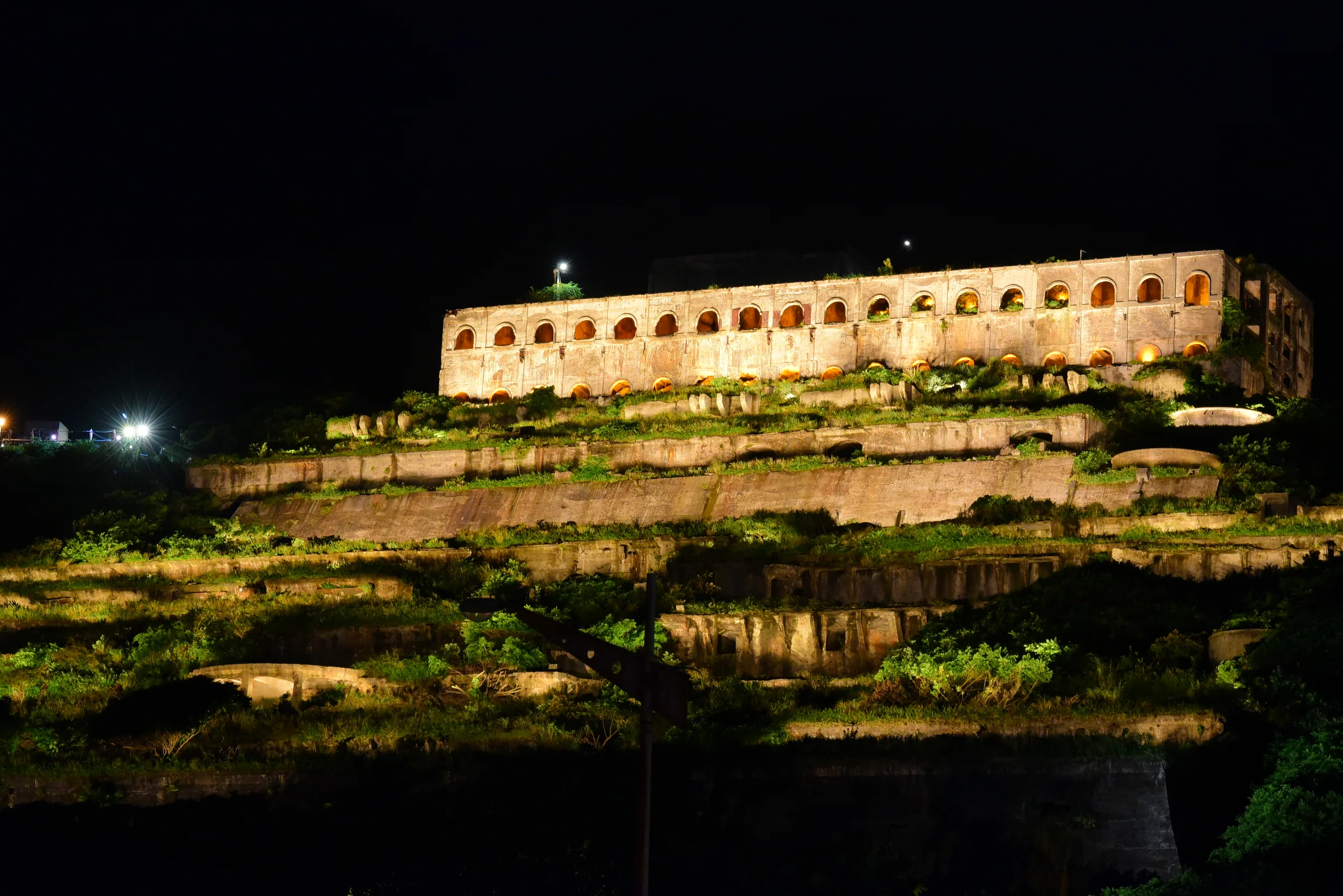
Kinkaseki: Many Layers of Life Piled on a Mountain, from Alluvial Gold and POWs to Arsenic-Contaminated Soil
On November 14, 1942, 523 Allied prisoners of war entered a village in the northeastern corner of Taiwan called Kinkaseki 1. Most of them were soldiers from the British Commonwealth—Britain, Australia, New Zealand, Canada, and South Africa—who were marched from the POW camp in Changi, Singapore, to dig copper in the deepest tunnels of this mountain. The Japanese military called it "Mi-ei Prisoner Labor Camp," locals called it "Tuk-pi-a-ji Liau" (literally, 'Big Nose Village' in Tâi-gí), and the prisoners themselves called the mine pit "Hell Hole." Some survived there for nearly three years before leaving; others never made it out 1.
This is one layer of Kinkaseki’s life, a layer that most generations of Taiwanese do not know. What most people remember about Kinkaseki is the 220-kilogram gold bar they can touch, the orange lights illuminating the Thirteen Layers ruins at night, and the spectacular sea view seen while passing through Jiufen. These are all true. However, this mountain holds several other layers that you cannot see beneath your feet.
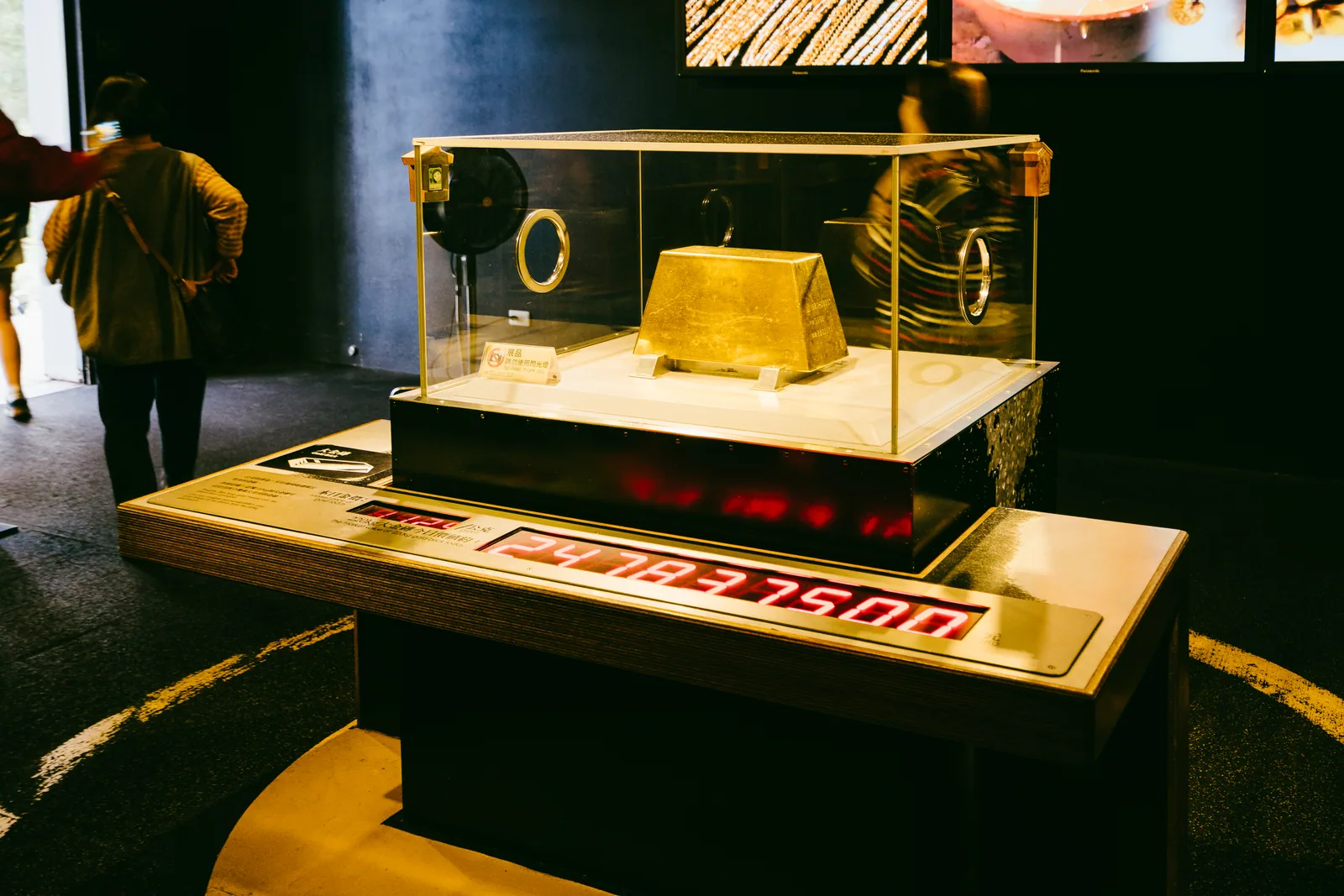
The 220-kilogram gold bar that can be touched in the museum is the first impression Kinkaseki gives most people. Photo: Wei-Te Wong / Wikimedia Commons, CC BY-SA 2.0
30-Second Overview: Kinkaseki is many layers of life piled on one mountain: the alluvial gold from the Keelung River in 1890; the gold rush dream with eighty thousand people flocking in the 1930s; the over five hundred foreign POWs digging copper in the tunnels in 1942; the local miners who traded their lungs for gold; those who fell silent under Wang Tong-ging's lens; the orange lights illuminating the Thirteen Layers in 2019; and the arsenic-contaminated soil beneath the feet of today's tourists. This article aims to lay out these layers together. Because if you only look at the gold, only look at the night lights, or only look at the sea view, you will miss the true weight this mountain has carried.
The Gold Dust in the River, the Golden Gourd on the Summit
The story of Jinguashi began with a river. In 1890, workers from the Keelung River Railway Bridge construction discovered gold dust in the river; news spread, and prospectors searched upstream for the source2. In 1893, they found a gold deposit on a mountain summit. The large ore, which resembled a pumpkin and was called Tâi-gí (Taiwanese) "jin-gua," led this mountain and settlement to be named "Jinguashi" 3.
However, before the mountain could become wealthy, its fate was rewritten. In 1895, Taiwan was ceded to Japan; in September of the following year (Meiji 29, 1896), the Taiwan Governor's Office promulgated the Taiwan Mining Regulations, which explicitly stated in Article 2 that "mining operations are limited to Japanese nationals" 4. This clause effectively shut the door on local people legally mining the island overnight. At the end of 1895, the government issued only about two thousand gold mining permits, and in January 1896, private gold mining was halted under the pretext of protecting rivers and forests 4. Subsequently, the Governor's Office divided the entire mining area into east and west halves using the north-south ridgeline passing through Jīlóng Mountain (now Keelung Mountain). On October 8, 1896, Fujita Satoro's Fujita Group acquired the Ruifang mine in the west; on October 26, the Tanaka Chōbei from the Fushen mine acquired the Jinguashi mine in the east 5.
📝 Curator's Note: This ridgeline division was very clear, yet it separated two settlements into vastly different destinies over a century. Jiufen in the west later gained fame through the film In the Mood for Love, while Jinguashi in the east gained recognition through a light show—but that is a story for another time. What this cut truly severed was the narrative of "local people mining and getting rich": from then on, gold was mined by foreign capital using foreign technology, eventually flowing to Tokyo. The golden age of Jinguashi did not entirely belong to the local people from the beginning.
In 1904, Mine No. 3 dug up sulfide copper ore, changing the gold-silver deposit into a gold-silver-copper deposit, adding another resource the mountain could provide 2. What truly propelled Jinguashi to its peak was the relay of capital. In 1925, Gotō Shintarō raised two million yen to buy the mining rights from the Tanaka Group and became president; by April 1933, he sold the mine for a high price of twenty million yen to the Japanese Mining Company (Nippon Zaibatsu), becoming a millionaire overnight and earning the nickname "Gold Mountain King" 6.
The Nippon Zaibatsu that took over entered with massive capital and immediately did two things: upgrade equipment and build an entirely new concentration plant, which is the huge ruin built against the mountain by the sea in Shuinandong today, commonly known as "Thirteen Layers" (though it actually has eighteen stories) 7. After large-scale extraction using new technology, Jinguashi's gold output reportedly peaked at nearly seventy thousand taels in 1938, earning the reputation of being the "Number One Gold Mine in Asia," and attracting about eighty thousand prospectors at one time 3. Scholar Zhang Yixi clearly points out in her study of mining history for the Gold Museum that what earned Jinguashi the title of "First Gold Capital of East Asia" was actually the period of the Nippon Zaibatsu after 1933, not Gotō Shintarō personally 5. It was the capital of the zaibatsu that provided the power to squeeze the maximum from this mountain.
Over a Hundred Meters Below Sea Level: Lunchboxes, Silicosis, and What Cannot Be Said Underground
The "Golden Age" sounds beautiful, but the miners who actually went underground traded their bodies for gold.
The vertical distribution of the Kinkaseki main ore body, extending from Mount Daiganka at an altitude of about 600 meters down to 130 meters below sea level8, has not ended. In other words, the miners had to work by descending from the mountain to a place lower than the sea. Underground, it was hot and oxygen-deprived, with the constant risk of rockfalls; the most common occupational disease was silicosis: workers who operated pneumatic drills for many years inhaled fine quartz dust bit by bit, causing their lungs to harden little by little.
In these workplaces where they faced death daily, language became a safety valve. Before entering the mine, miners would worship Guan Gong, and there were also a set of taboos underground—a psychological defense mechanism developed by this high-risk industry. As for the miners' lunchboxes, they later became a tourist attraction: three bowls of white rice served with some pickled melon and salted egg. The rice needed to be plentiful because physical labor consumed energy quickly; the side dishes had to be very salty because so much sweat was shed underground, requiring salt replenishment. Today, tourists queue at the Gold Museum to buy "miner's lunchboxes" for photos, rarely thinking that the full bowls of white rice and the salty side dishes were calculated based on the bodies sweating at the bottom of the mine.
The position of the miners is actually underrepresented in the Gold Museum. The mining history truly written by the miners themselves is not in Kinkaseki but in nearby Mōdòng. Retired miner Chou Chao-nan pays a monthly annuity of three thousand five hundred yen to rent a locker room, preserving the memories of the miners bit by bit. This is an autobiography left by local laborers for future generations, and it is not entirely the same story as the official narrative of the "Golden Age."
Over Five Hundred Foreigners Mined Copper on This Mountain
If local miners were exchanging lungs for gold, then after the Pacific War broke out, a group of foreigners came to this mountain and exchanged lives for copper.
After the Pacific War began, gold was designated as a non-defense material, and Kinkaseki switched to copper mining. On October 20, 1942, a transport ship named England Maru, carrying about one thousand prisoners of war (POWs) primarily of British nationality, departed from Singapore and arrived in Keelung on November 6 9. On November 14, 523 POWs (34 officers and 489 soldiers) entered Kinkaseki Village and began their ordeal that lasted for some people for three years 110. The Japanese military referred to the location as a "British POW labor camp," while the prisoners called the copper mine pit beneath them "Hell Hole."
Welshman Jack Edwards was one of those who survived. Before his capture, he was a sergeant in the Royal Signals Corps and was sent here after the fall of Changi. He later recorded the days in the pit in his memoir, Banzai, You Bastards!: four people per group had to produce 24 tons of copper ore daily by walking up and down the steep 1,881-step incline to the working face; failure to meet the quota resulted in beatings 11. The POWs wore hats made of cardboard, poor-quality lanterns, and sandals. These details later appeared verbatim in the indictment at the war crimes trials as evidence of "severe lack of protective equipment" 12.
How many died depends on how you count. A 2025 paper by Oxford University scholar Venables published in Medical History calculated that a total of 91 deaths were recorded for Kinkaseki, approximately 63% (57 people) of whom were related to beri-beri, a direct consequence of severe malnutrition 13. The records from the Hong Kong War Crimes Trials state 84 deaths, but that statistic only covered until late February 1945, missing about three months of actual camp operation 10. The two figures are not contradictory; they simply cover different time windows. Looking at Taiwan as a whole: years of research by Hank Mac confirmed that the Japanese military established sixteen POW camps in Taiwan, holding over 4,300 Allied POWs, with approximately 430 total deaths, most of which occurred in Kinkaseki 1415. The overall death rate among Taiwanese POWs was about one-tenth, far lower than the "forty percent" often heard. That forty percent is the figure for the entire Far Eastern theater (including harsher battlefields like the Thai-Burma Death Railway), not just Kinkaseki or Taiwan 16.
📝 Curator's Note: It is worth pausing here. The reputation of the Kinkaseki POW camp is not based on having the highest death rate among single camps—the malaria mortality rate at Pingtung Camp was actually higher. Kinkaseki gained its notorious reputation because it processed the largest cumulative number of people (over 1,100 POWs in total), had the worst environmental conditions in the pit, and many seriously ill prisoners were transferred to other camps like Baihe or died elsewhere, not being counted among the local Kinkaseki deaths 17. Therefore, the calculation that "523 people were reduced to 89" is flawed: those 89 people refer to "the number remaining at the camp when Japan surrendered," not the sole survivors. The definition of the numbers requires more care than the numbers themselves.
Two Doctors Who Rescued People in Hell
The brightest light in a hell is often the person willing to save others. Before and after the Kinkaseki POW camp, there were two military doctors who took turns.
First was Captain Peter Seed of the Royal Army Medical Corps, who was initially the only medical officer in the camp. In August 1943, Major Ben Wheeler from a different POW camp in the Taipei area was transferred to take over; he was the only Canadian at Kinkaseki13. Under conditions of extreme drug scarcity, Wheeler performed several near-impossible feats. He made a wooden frame for a paralyzed POW, allowing other prisoners to take turns massaging his legs to maintain muscle tone, and then let him rehabilitate by pedaling on a "bicycle" that Wheeler had made himself; eventually, this man was able to stand up and walk again18.
The most dramatic incident involved the rescue of Seed. In March 1945, Seed himself fell critically ill with beriberi and dysentery, near death. Wheeler performed eight small transfusions for him in succession, using blood donated by POWs, which pulled him back from the brink13. The squad leaders at Kinkaseki later signed a certificate to thank both Wheeler and Seed, expressing gratitude that "many lives have been saved despite limited medical resources" 13. Another officer who worked with him, George Blair, could only offer one assessment of Wheeler: "one of the finest men I have ever met."19
Wheeler's daughter, Anne Wheeler, later filmed her father's POW experiences in the 1981 Canadian documentary A War Story. Her father never mentioned this period to her; she reconstructed the events that happened on the mountain based on his diaries.
The Wall, Seventeen Meters Long and Inscribed with Names
This piece of history almost vanished completely. It was unearthed from the weeds by a Canadian.
Michael Hurst is a Canadian who has lived in Taiwan for a long time. At the end of 1996, he learned that Kinkaseki once had a notorious Japanese prisoner-of-war camp. He and several companions visited the Copper Mine area where the POW camp was located. The elderly residents there enthusiastically helped him search for traces of the past 17. Two months before the monument was erected, he personally spent ten days meticulously searching through the overgrown ruins of the camp, the paths the prisoners walked, and the mine entrances 17.
On November 23, 1997, the memorial was officially unveiled. On that day, over one hundred relatives and supporters gathered in the park located on the former camp site to commemorate the thousand-plus Kinkaseki POWs and all those imprisoned in other POW camps across Taiwan 20. Most movingly, three actual Kinkaseki survivors attended: Les Davis, Jack Edwards, and George Williams 20. The three veterans returned to the place where they were once confined to dedicate this monument for all who survived and those who did not return. The ceremony concluded with the sounds of "Taps," a minute of silence, and "Reveille" 20.
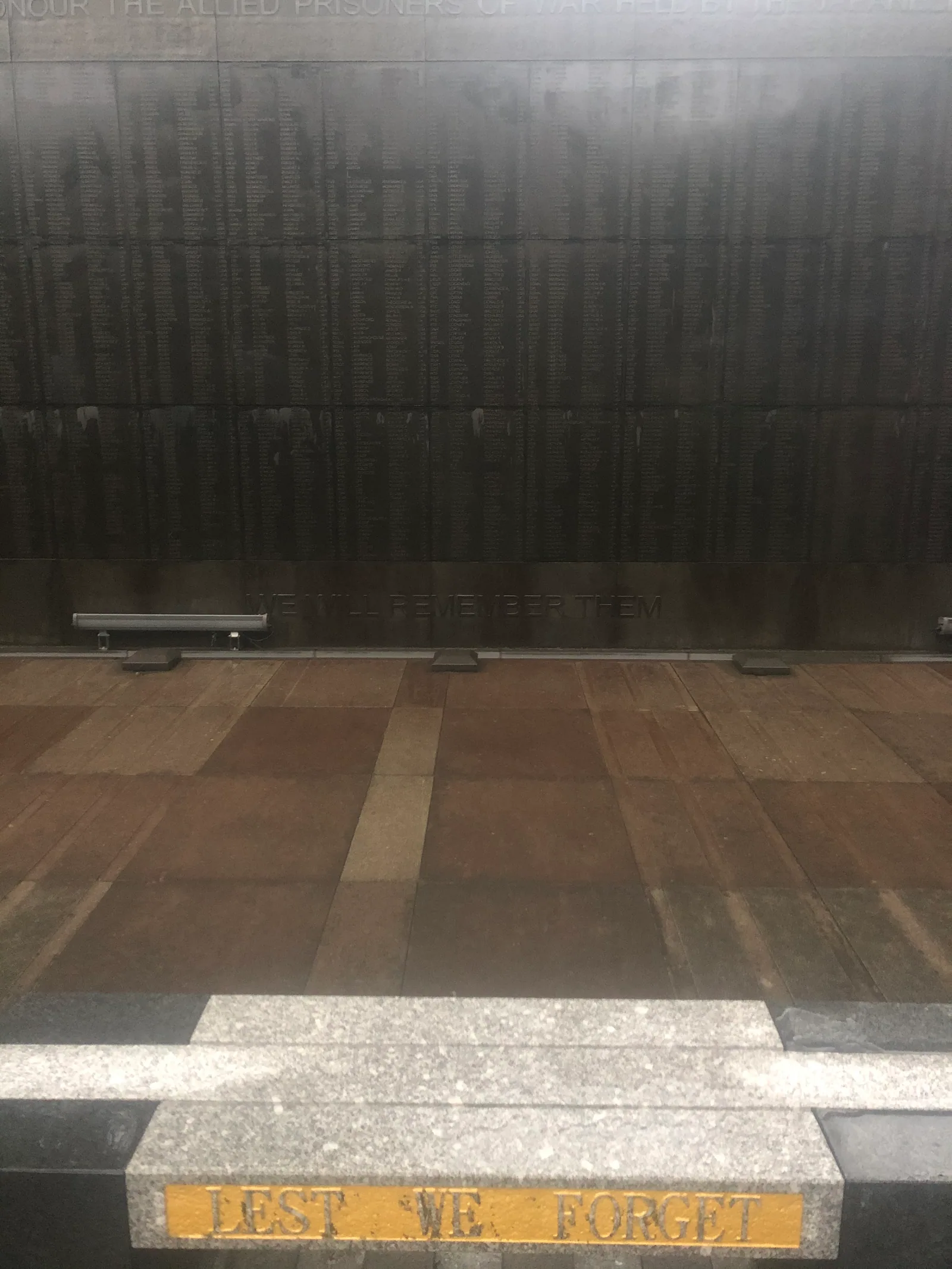
Memorial in Allied POW Camp Park. Photo: 121kao / Wikimedia Commons, CC BY-SA 4.0
Hurst did not stop there. In 1999, he established the "Taiwan POW Camps Memorial Society." Over the next two decades, he identified all four thousand three hundred seventy prisoners who were in Taiwan, interviewed between five hundred and eight hundred veterans and their families, and wrote Never Forgotten, a book over six hundred pages long 1410. Today, when you walk into this memorial park, you will see a name wall about seventeen meters long and over two meters high, inscribed with the names, ranks, and nationalities of every prisoner who was held in Taiwan 21. The park also features a bronze sculpture titled "Mates," completed in 2011: two emaciated prisoners, one supporting the other's shoulder, captioned "Without a mate, no Prisoner of War could survive." 22
📝 Curator's Note: What needs to be understood most about this entire endeavor is the line that Hurst himself drew. He once said, "We are not doing this out of hatred for the Japanese; we are doing it so these suffering people know they were not forgotten." 23 This sentiment forms the core of the monument. Another statement by Hurst explained why this history remained silent for so long: "People knew all about the Bridge on the River Kwai, but very few knew about Taiwan's POW camps." 24 The history of the prisoners in this mountain was long overshadowed by the fame of the Taiwan-Burma Railway.
The post-war investigation spread out the accountability and revealed its complexity. On May 28, 1947, the Hong Kong Fifth War Crimes Tribunal rendered a verdict on the Kinkaseki case (WO235/1028). All nine defendants were employees of the Japanese Copper Mine Company, not military personnel 12. The mine general manager, Toda Mitsugu, was sentenced to only one year because the defense successfully argued that the prisoners were "forcibly sent to his mine by the military," and his role was merely "supervision" rather than direct employment; in contrast, the foremen who beat the prisoners with bare hands or iron hammers, Nagai and Zushi, each received ten years 12. The foremen who administered the violence were sentenced more heavily than the mine general manager. A simple declaration that "the Japanese are guilty" cannot encapsulate this scene; it leaves behind a true and messy answer regarding where the responsibility truly lies.
Jack Edwards's story has another ending. After the war, he joined a POW investigation team in Hong Kong. In 1946, he returned to Kinkaseki and discovered File No. 2701 in a tunnel: according to his own memoirs, this was the only surviving copy of the secret order that stated, "If the Allies land on the Japanese mainland, massacre all prisoners without leaving a trace" 11. It took him forty-five years to finish that memoir. In his later years, he said something that perhaps should be remembered most about this entire mountain: "The Allies rebuilt Japan, Germany, and Italy. Nobody rebuilt our lives. The tears and nightmares will remain 'til death. I'm willing to forgive. None of us should forget." 11
Wang Tong's Museum, Twelve Years Earlier, Spoke of "Silence"
The same mountain can have two completely different narratives. One is for ticket sales; the other is closer to the truth, and it predates the former by twelve years.
In 1992, director Wang Tong brought Kinkaseki to the big screen with Silent Hill (《無言的山丘》). This film was the third part of his "Taiwan Modern Trilogy" (the first two being Straw Man and Banana Paradise), telling the story of two brothers, Ah-Chu and Ah-Ai, who fled after suffering harsh labor exploitation and harbored dreams of getting rich by going to Kinkaseki to mine gold 25. The film was shot on location in Kinkaseki, with two romantic storylines running parallel: Ah-Chu falls for the widow A-Rou, while Ah-Ai loves the courtesan Fu Mei-Tzu 26. At the 29th Golden Horse Awards that year, this film swept six awards: Best Picture, Best Director, Best Original Screenplay, Best Art Direction, and Best Costume Design, in addition to the popular vote for Best Picture 25 (strictly speaking, the official Golden Horse categories are five, with the popular vote being a separate mechanism, so some materials refer to "five major awards" as referring to the same thing).
Twelve years later, on November 4, 2004, the Museum of Gold opened on the same mountain. It was Taiwan's first museum conceptualized as an ecological museum, packaging the area into a place worthy of remembrance with the warm nostalgia of "Golden Years" 27.
On this single mountain, there are those who were "drowned by gold" in Wang Tong’s lens, and the "Golden Years" displayed in the museum's windows. Neither narrative is wrong; this mountain has been both. Looking further out reveals more clarity: the Japanese Wikipedia entry for "Kinkaseki Mine" thoroughly details mining technology and management systems, even listing the number of workers of various nationalities in 1939, yet it makes no mention of prisoners of war or forced labor 28. On this one mountain, across Japanese, Chinese, and English contexts, three stories have grown up with almost no intersection.
Guan Gong Remains, Shrine is Left with Only Ruins
The gods worshipped by miners and the gods worshipped by colonizers—one remains alive, while the other is left only as a stone pillar. This mountain has stratified its beliefs.
In Jin-gua-shi, two religious buildings coexist, yet their fates are vastly different. One is the Kuanji Tang (Quanzai Hall), dedicated to Guan Sheng Di Jun: brothers Huang Shi-chun and Huang Ren-xiang first established a makeshift shrine in the Shiyi area in 1896 to worship Guan Sheng Di Jun; it was formally named "Kuanji Tang" in 1900, and the temple was built at its current location in 1902 29. On June 2, 1991, a bronze statue of Guan Sheng Di Jun weighing over 25 tons and standing 35 daich'i tall was installed on the temple roof. It is said to be the largest Guan Gong statue in Southeast Asia (though the official page of the Golden Museum conservatively refers to it as "the largest in all of Taiwan") 30. Before entering a mine shaft, miners worshipped Guan Gong; this was less about faith and more like psychological management when facing high risks.
The other is the Japanese Golden Shrine. It was established on March 2, Meiji 31 (1898), by Tanaka Chōbei, a mine operator. It primarily enshrined three deities: Daikokun-no-mikoto, Kinzan-no-mikoto, and Saruta-no-mikoto. A grand mountain god festival was held every July 15th during the summer, featuring fireworks, singing and dancing, theater, and sumo, where miners and residents gathered to celebrate 31. However, after the Japanese left, this shrine also fell into disrepair, now standing with only a few isolated stone pillars and torii gates on the mountainside.
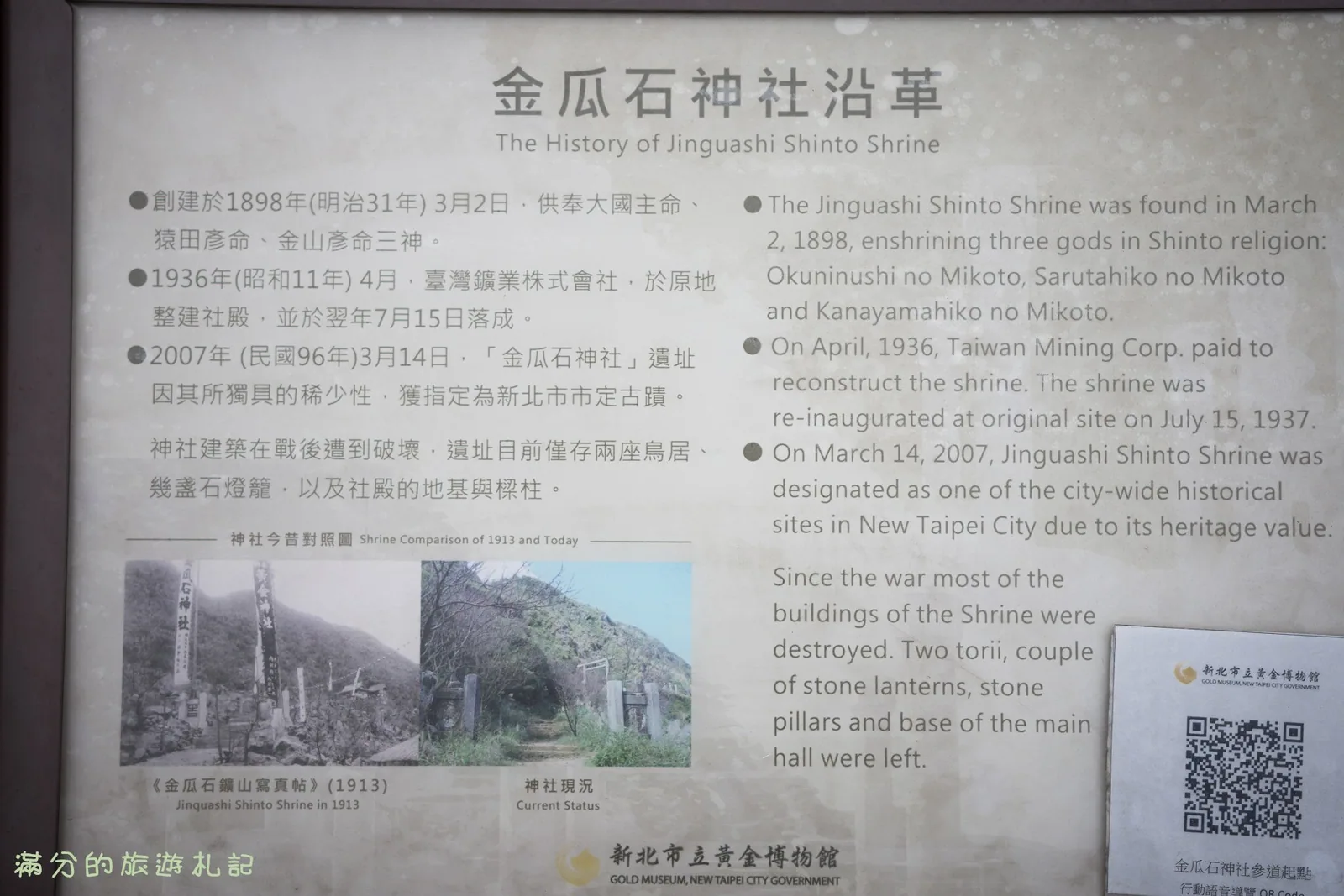
The ruins of the Golden Shrine, where only stone pillars remain on the mountainside. Photo: fullfen666 / Wikimedia Commons, CC BY-SA 2.0
📝 Curator's Note: The two temples—one alive and one dead—have nothing to do with which faith is superior. Kuanji Tang survived because it lived alongside the local people; the Guan Gong it worshiped was the god that the miners here relied on daily. The Golden Shrine collapsed because, from beginning to end, it was built by colonial capital "to stabilize the human heart." When that capital withdrew, it lost its reason for existence. On the same mountain, what remains and what decays often depends on whether it is truly what the local people need.
Not far from Kuanji Tang is another building constructed for a visit that never happened: the Taishi Guest House.
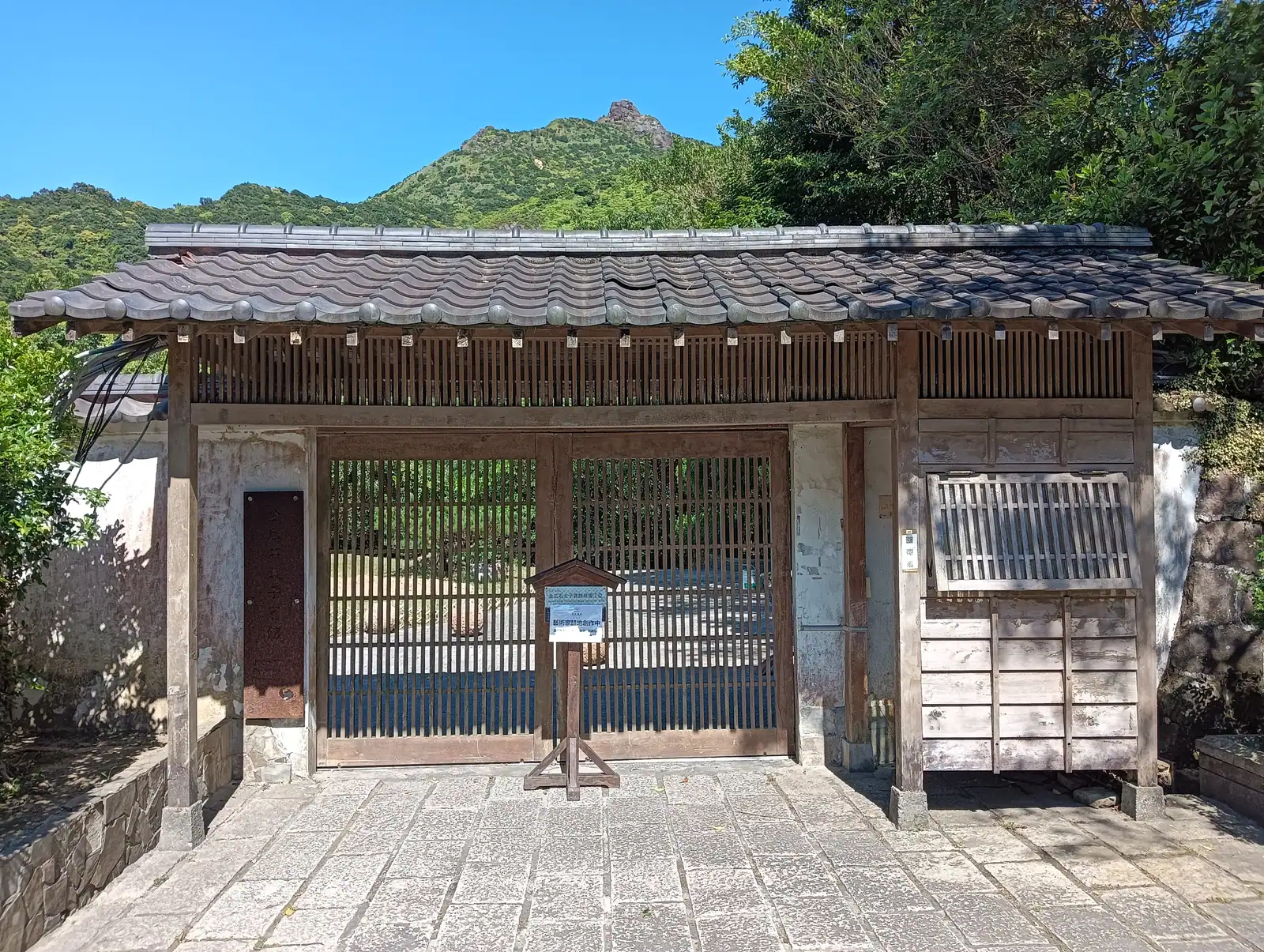
The exterior of the Taishi Guest House, a Sino-Western eclectic schoolhouse style building. Photo: Allervous / Wikimedia Commons, CC BY-SA 4.0
In 1922, Tanaka Mining Co., Ltd. built this temporary residence to host Crown Prince Hirohito (who later became Emperor Shōwa), who was scheduled to inspect the mining operations. However, the Crown Prince never came (rumor has it that he backed out because some miners suffered from deep-sea diver's illness and coughs resembling malaria, but this is not officially recorded) 3. This Sino-Western eclectic schoolhouse style building is now a designated historic site in New Taipei City. What the Taishi Guest House truly represented was a class hierarchy of colonial capital: the highest rank was the Taishi Guest House for hosting distinguished guests, followed by the mine manager's dormitory, and finally the "Four Connected Units" for ordinary Japanese staff—four units connected, each with its own entrance hall, living room, kitchen, and bathroom. Even the homes of the Japanese staff were like this; the wooden board houses where local miners lived were another world entirely.
Where the Orange Lights Shine, Beneath Lies Unwashed Soil
The last breath of this mountain is what it looks like today: a tourist hotspot and an unhealed wound. When most visitors look down from the observation deck, they mistake two different things for one.
In 1987, when international copper prices collapsed, the company managing the site, Gold Mining Company (Taikin), went bankrupt. The population of Kinkaseki plummeted from tens of thousands to fewer than two thousand, mostly elderly residents. This mountain lay dormant for over thirty years until it was re-illuminated during the Mid-Autumn Festival in 2019. On the night of September 13th that year, Taipower held a "Lighting Up Thirteen Layers" ceremony at the Shuinan Valley Ruins (Thirteen Layers Site), with international lighting master Zhou Lian overseeing the event. Using approximately 360 fixtures with 15 different wattages and angles, the massive ruins built into the mountain were bathed in an amber-orange glow 32. Zhou Lian is the president of BPI Lighting in New York, whose works include the Statue of Liberty in the United States and the Natural History Museum of New York. Since then, from 6 p.m. to 9 p.m. every night, Thirteen Layers has been lit on schedule, making the Shuinan-Jin-gua-shi area a popular Instagram secret spot 33.
However, what Chairman Yang Wei-fu of Taipower said during the lighting ceremony is the key to this matter: "The smelter left over from when we took over Taikin in 1987 was previously listed as a contaminated site, and after being sealed for 33 years, we hope to revitalize cultural assets through public art." 34 This statement uniquely acknowledged two things simultaneously: that the location is a cultural asset, and that it is a polluted site. The title of Taipower's official press release was even more direct: "First case of soil contamination land combined with cultural heritage revitalization" 35. The orange lights use a distant viewing approach, allowing the public to continue appreciating the beauty of this mountain town, but the contaminated soil itself remains sealed and is not open to the public.
This leads to the two distinct issues that must be separated.
The first is Yin-Yang Sea. When visitors look down from the observation deck, they see the sea surface in Shuinan Valley half yellow and half blue. Many people assume this is pollution discharged from the mine. However, this is primarily a natural phenomenon. Associate Professor Yu Bing-sheng of the Institute of Resource Engineering at National Taipei University of Technology published an academic paper studying this phenomenon as early as 1998: the Kinkaseki area naturally contains large amounts of iron pyrite, and the dissolved iron ions from weathering flow down streams to the sea outlet. Upon encountering slightly alkaline seawater, they rapidly oxidize into insoluble ferric hydroxide colloidal particles that float only within about three meters on the surface, forming a stratification of "yellow above, blue below" 36. His conclusion was clear: "This is a natural geological reaction, not pollution." 37
The strongest counterevidence is that Thirteen Layers smelter has been closed for over thirty years, yet the color of Yin-Yang Sea has never disappeared: "Thirteen Layers smelter has been shut down for over 30 years, and Yin-Yang Sea has not disappeared." 37 If the yellow were residue from factory emissions, it should have faded over time. (A candid addition: public sources like Wikipedia use conservative terminology, stating "natural and man-made jointly caused," but do not specify research supporting this compromise.)
The second is the real wound: the soil beneath the smokestacks. Unlike Yin-Yang Sea, the three abandoned smokestacks next to the Thirteen Layers site are artificial structures built during the Japanese colonial period to emit toxic smoke from copper smelting. Official testing of the soil here confirms that it contains heavy metals such as arsenic and copper above standard levels; this is genuine man-made pollution. This site was designated a "Contaminated Site" by the Environmental Protection Bureau of New Taipei City in 2010, according to the Soil and Groundwater Pollution Remediation Act; Taipower subsequently submitted a health risk assessment and control plan, and it was officially physically sealed in May 2016, with iron fences installed at three entrances 38. As of 2026, this site remains closed and inaccessible, and there has been no public news of remediation completion or deregistration 36. The Thirteen Layers illuminated by the orange lights stands above this unwashed soil.
This mountain is not dead. In the summer of 2026, Kinkaseki is hosting a Mine Art Season themed "Mineral Vein of Time: Gold of the Future," with artists Zhou Xue-han and Kang Ya-zhu exhibiting works in this mountain town 39. Every November, the International War Memorial Park also holds an Allied POW remembrance ceremony because November 14th is the day the prisoners arrived at Kinkaseki; on November 9, 2025, representatives from the US, UK, Australia, New Zealand, Canada, and the Netherlands attended to lay flowers and mourn 21. Kinkaseki is not a dead ruin; it is a mountain that people continue to remember.
Standing at the Entrance of Benshan Wukang, Looking at the Entire Mountain
Today you can walk into Benshan Wukang, put on a miner's hard hat, and walk 70 meters down the tunnel. The temperature inside is consistently 18 degrees 40. Exiting the entrance, you see the ruins of the Golden Shrine above, Thirteen Layers by the sea below, and a name wall inscribed with names as you turn around.
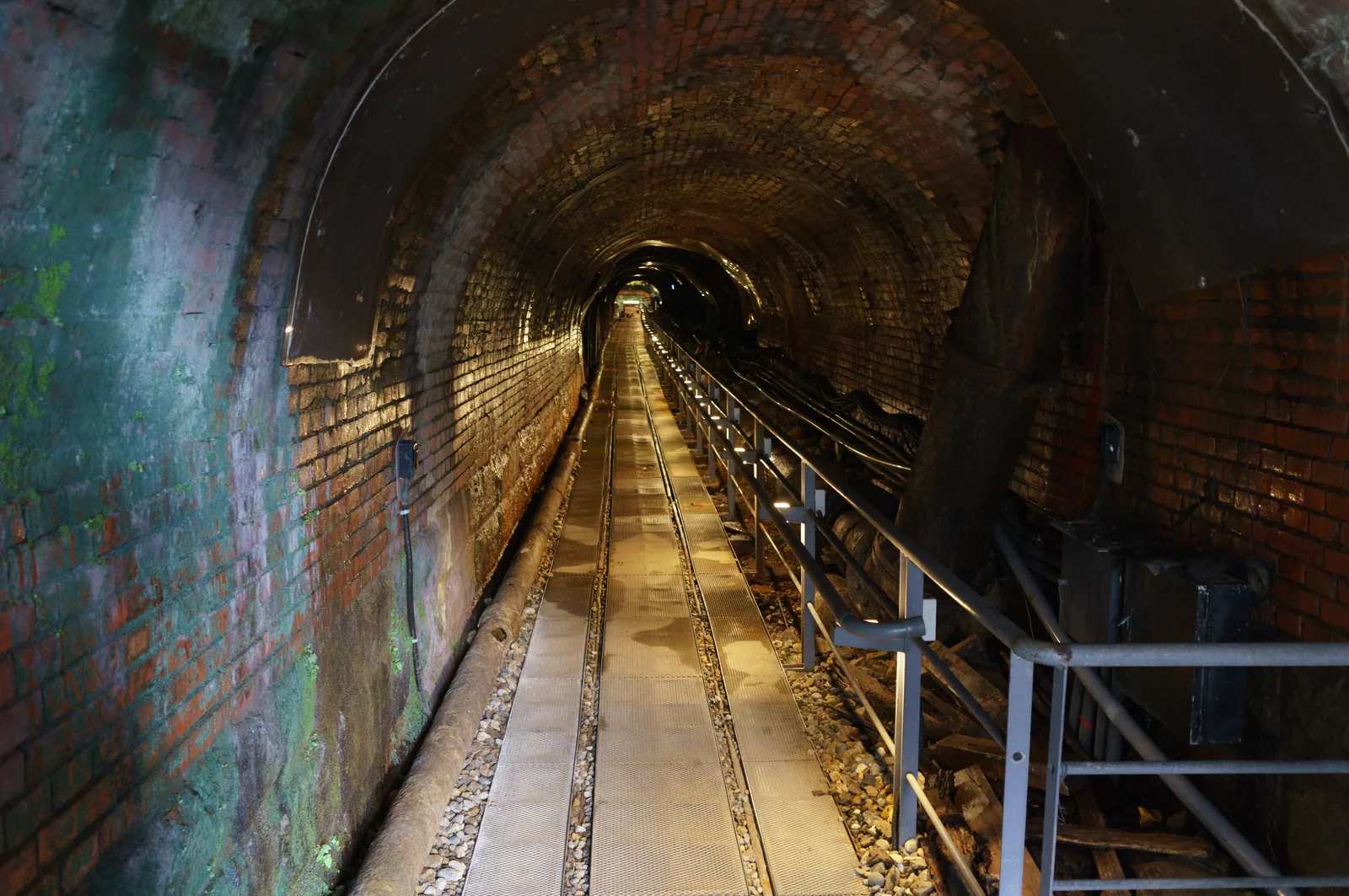
The tunnel section open to visitors at Benshan Wukang. Photo: eugene_o / Wikimedia Commons, CC BY 2.0
Return to November 1942. The 523 foreign prisoners of war who entered Kinkaseki, the local miners who mined for gold with their lungs, and the prospectors who found placer gold in the river long before—they all stood on the same mountain. This mountain's name contains "gold," but what it has endured is far more than just gold: the placer gold from the river in 1890, the dream of eighty thousand miners in 1938, the over five hundred POWs digging copper in the tunnels in 1942, the local miners who mined with their lungs, those who collapsed silently under Wang Tong-ging's gaze, the orange lights illuminating Thirteen Layers in 2019, and the arsenic soil beneath the feet of visitors today.
Under every beautiful photo you take at Kinkaseki, there is a layer of life piled up. The beauty of this mountain is real, and its suffering is real, and they are the same thing. Next time you come, besides taking pictures of the orange lights, perhaps you could walk along that name wall. Not many names will be recognizable, but each one was a life endured by this mountain.
Further Reading: Japanese Colonial Period in Taiwan | Keelung City | Worship of Guan Yu | Economic Miracle (The complete context of the Taiwan Gold Mine's post-war national capital management) | Alishan: The Empire's Forestry and the Mountain of Gao Yi-sheng, History of Forest Development in Taiwan (A sister piece belonging to the Japanese imperial resource colonization system)
Image Sources
- Hero (Thirteen Layers Night View): 2019 The Lighting Show at 13 Levels, Jinguashi Gold Ecological Park — Photo by Taiwankengo, Wikimedia Commons, CC BY-SA 4.0.
- Inside Benshan Fifth Tunnel: 2017-10-24 Benshan Fifth Tunnel of the Jinguashi gold mine — Photo by eugene_o (originally posted on Flickr), Wikimedia Commons, CC BY 2.0.
- Ruins of Golden Shrine: New Taipei - Jinguashi Shrine (32321306791) — Photo by fullfen666 (originally posted on Flickr), Wikimedia Commons, CC BY-SA 2.0.
- Allied POW Memorial Park: Monument in the peace park — Photo by 121kao, Wikimedia Commons, CC BY-SA 4.0.
References
- Taiwan POW Camps Memorial Society — Kinkaseki Camp — Official page of the Taiwan POW Camps Memorial Society, which states that "on November 14, 1942, 523 Allied prisoners arrived at Kinkaseki Village, beginning three years of hardship for some," serving as a primary authoritative source for the arrival date of Kinkaseki POWs.↩23
- StoryStudio: History of Mining in Gongguan — A popular media resource on Taiwanese history that traces the complete context from the discovery of gold in Keelung River in 1890, the mining of arsenical copper ore at Benshan No. 3 Pit in 1904, the construction of a flotation mine by Japanese industry in 1933, and the peak production year in 1938.↩2
- Wikipedia: Kinkaseki — A compilation of information including the origin of the place name (mountain shape resembling gold), the gold peak of nearly 70,000 taels in 1938, the gathering of 80,000 people, and rumors about the unvisited Taizi Hotel, along with official and academic references.↩23
- Huang Shaoheng: 'Mining Industry in Taiwan During the Early Japanese Rule (1895-1912)' — An academic research PDF commissioned by the New Taipei City Gold Museum, which quotes Article 2 of the "Taiwan Mining Regulations" from 1896 verbatim: "mining operations are limited to Japanese nationals," and includes gold production statistics from 1895-1908.↩2
- Zhang Yixi: 'A Study on the History of Kinkaseki Mines During the Japanese Rule Period (Meiji and Taisho Eras)' — An academic study commissioned by the New Taipei City Gold Museum, which records the ridge division dates—Fujita Group acquiring Ruifang on October 8, 1896, and Tanaka Group acquiring Kinkaseki on October 26—and clearly states that the epithet "First Gold Capital of East Asia" belongs to the period of Japanese industrial conglomerates after 1933.↩2
- Wikipedia: Nobutaro Kougoku — A timeline detailing how Nobutaro Kougoku acquired Kinkaseki mining rights for two million yuan in 1925, became a millionaire by selling it to the Japanese Mining Company for twenty million yuan in April 1933, and earned the title "King of Gold Mines."↩
- Wikipedia: Shuinandong Smelter Ruins — Records that the Thirteen Tiers (a colloquial name, actually eighteen stories) was built by the Japanese Mining Company in 1933 and completed in two phases in 1935-1936; it also explains that the smokestack is actually three, and it was sealed by the Cultural Affairs Bureau and Environmental Protection Bureau in 2016 due to arsenic and copper exceeding limits.↩
- Geological Knowledge Service Network of the Ministry of Economic Affairs, Geological Survey and Mining Management Center — An official page from a government geological unit, which states that the Benshan ore vein "extends vertically from Dajinwa Peak at an altitude of 600 meters to below sea level by 130 meters without ending," and provides official statistics on gold, silver, and copper production.↩
- CombinedFleet.com — England Maru — A database of Japanese wartime shipping records that clarifies the two voyages of the England Maru to Taiwan; it records the second voyage carrying Kinkaseki POWs, which departed from Singapore on October 20, 1942, and arrived in Keelung on November 6.↩
- Digital Archive of Private Materials 1937-1949: 4370—Allied POWs Imprisoned by the Japanese in Taiwan During WWII — A primary Chinese historical document that records the dispersal of 523 POWs at Kinkaseki (34 officers + 489 soldiers), 84 deaths recorded in the Hong Kong War Crimes Trials (statistics from July 1942 to February 1945), and details such as Wheeler's non-anesthetic shaving operations.↩23
- Wikipedia: Jack Edwards (British Army soldier) — Records that survivor Jack Edwards walked 1,881 steps daily, was allocated rations from 24 Japanese mining carts, discovered the secret massacre order No. 2701 at Kinkaseki in 1946 as a member of the war criminal investigation team (Wikipedia notes this is from Edwards' memoir), wrote "Banzai, You Bastards!", and includes his complete quote: "The Allies rebuilt Japan, Germany, and Italy; no one rebuilt our lives. Tears and nightmares follow us to death. I am willing to forgive; none of us should be forgotten."↩23
- Hong Kong War Crimes Trials Collection — Case WO235/1028 — Official trial records from the University of Hong Kong, which state that nine Japanese mining employees were defendants in the Kinkaseki case, sentenced on May 28, 1947; General Manager Toda Mitsugu was sentenced to one year, while foremen Nagai/Zushi were each sentenced to ten years, and includes accusations from the indictment regarding dangerous environments within the pits and poor quality cardboard helmets.↩23
- Katherine M Venables, "Doctors in the Japanese POW camps in Taiwan", Medical History 2025;69(2):277-304 — A peer-reviewed medical history paper by an Oxford University scholar that statistically records 91 deaths at Kinkaseki during its entire period (with 63% related to beriberi), and details the handover between doctors Peter Seed and Ben Wheeler, and Wheeler's treatment of Seed with blood transfusions for two consecutive weeks.↩234
- CNA: Hank Mac and Taiwan POW Camp History — An exclusive interview from CNA detailing how Hank Mac lived in Taiwan for over thirty years, spent more than twenty years identifying all prisoners of war, interviewed over 800 veterans and their families, wrote 'Never Forgotten,' and provided statistics on over 4,300 prisoners and sixteen known POW camps across Taiwan.↩2
- dark-tourism.com — Kinkaseki — An international dark tourism resource that records a total of 430 deaths across fourteen POW camps in Taiwan, most occurring at Kinkaseki, and over 1,100 POWs having been in or passed through the Kinkaseki camp, detailing the objects within the memorial park.↩
- COFEPOW — The Taiwan POW Camps Memorial Society — The official page of a descendant organization of Allied POWs from the Far East; it states that the Taiwanese POW death rate was "over 10%" (430/4300+), which is a key comparative source for clarifying that the "forty percent mortality rate belongs to the broader Far East, not exclusively Taiwan."↩
- Taiwan POW Camps Memorial Society — The Society — Official society page, detailing how seriously ill prisoners of war were transferred to other camps like Baihe (where '15 POWs died due to malnutrition, illness, and overwork in Kinkaseki'), explaining the discrepancy between local deaths in Kinkaseki and original numbers.↩23
- The Globe and Mail: Canadian historian on a mission to honour survivors of Japanese POW camps — A report from a major Canadian newspaper describing how Canadian medical officer Ben Wheeler treated paralyzed prisoners, enabling them to walk using wooden frames and self-made 'bicycles'.↩
- George Blair Paper (Related Medical History Research) — A peer-reviewed medical history paper where George Blair, a camp doctor in Taipei, described Ben Wheeler as 'one of the most remarkable people I have ever seen,' and clarified that Blair was stationed in Taipei, not Kinkaseki.↩
- Taiwan POW Camps Memorial Society — The Kinkaseki Memorial Dedication — Official society records detailing the dedication ceremony on November 23, 1997, which had over 150 attendees, with three Kinkaseki survivors—Les Davis, Jack Edwards, and George Williams—present, along with details of the 'Last Post' and a moment of silence.↩23
- New Taipei City Tourism Website: International War End Peace Park — An official tourism page providing information such as memorial services held every November due to the arrival of POWs on November 14th, and the attendance of international representatives in 2025.↩2
- dark-tourism.com — Kinkaseki (Mementos) — Describes the bronze sculpture 'Mates,' completed in 2011 (two emaciated prisoners supporting each other), with the inscription, 'Without a mate, no Prisoner of War could survive.,' and a name wall about seventeen meters long and an eternal flame.↩
- BBC Chinese: WWII Allied POW History in Taiwan (Interview with Hank Mac, 2015) — A BBC Chinese report containing Hank Mac's statement that 'we do this not out of hatred for the Japanese, but to let these suffering people know they have not been forgotten,' which serves as a key neutral reference point in this article.↩
- Taipei Times: Hell Camp remembered (2005) — A primary English report that quotes Hank Mac's famous line, 'People knew all about the Bridge on the River Kwai, but very few knew about Taiwan's POW camps,' and describes artifacts excavated from the camp area and monuments in various locations.↩
- Golden Horse Film Festival Official: Silent Hill — The official page of the Golden Horse Executive Committee, stating that 'Silent Hill' is the third film in Edward Tsai's trilogy on modern Taiwan, set during the Taisho era, filmed in Kinkaseki, and includes a plot summary: 'A-Chu and A-Ai, who fled from unbearable labor exploitation, traveled to Kinkaseki with dreams of getting rich by mining.'↩2
- Wikipedia: Silent Hill — Contains the complete list of the 29th Golden Horse Awards (five official competition awards + Audience Award for Best Picture), two intertwined love stories (A-Chu x Widow A-Rou, A-Ai x Prostitute Fu Mei-Zi), and other film festival accolades.↩
- New Taipei City Museum of Gold: Our Vision — The museum's official page stating that it is 'the first museum in Taiwan with the concept of an ecological museum, since opening in November 2004,' and explaining its philosophy of combining community preservation of Kinkaseki with the natural ecology and historical memory of the Shuannan Valley area.↩
- Wikipedia: Kinkaseki Mine — A Japanese Wikipedia article that thoroughly details mining technology, management systems, and statistics on the number of workers from various nationalities in 1939, but completely fails to mention prisoners of war or forced labor, which is verifiable evidence of narrative gaps across English/Chinese/Japanese contexts.↩
- Wikipedia: Quanji Hall (Kinkaseki) — Details the complete timeline of Quanji Hall: the establishment of a straw hut by brothers Huang Shih-Chun and Huang Ren-Xiang to worship Guan Sheng Di Jun in 1896, its naming as 'Quanji Hall' in 1900, and the construction of the temple at the current site in 1902.↩
- New Taipei City Museum of Gold: Quanji Hall — The museum's official page stating that the Guan Sheng Di Jun statue weighs 25 tons, is 35 tail high, and was enshrined on June 2, 1991, with the official conservative claim being 'the largest Guan Gong statue in Taiwan' (while 'largest in Southeast Asia' is a widely circulated rumor).↩
- New Taipei City Gold Museum: Jin-gua-shi Shrine Ruins — The official museum page states that the Golden Shrine was 'built on March 2, Meiji 31 (1898), by mining operator Tanaka Chobei,' and enshrines Daiguo, Kinshan, and Enda deities, with a mountain god festival held every July 15th.↩
- ETtoday Travel Cloud: Lighting Up Thirteen Layers — A travel media report detailing the Mid-Autumn Festival lighting on September 13, 2019, which 'featured about 360 fixtures with 15 different wattages and angles,' overseen by international lighting master Zhou Lian, and lit every evening from 6 to 9 PM starting the next day.↩
- New Taipei City Tourism Website: Shuinan Valley Refining Site Ruins (Thirteen Layers) — The official tourism page confirms that Thirteen Layers is illuminated at a fixed time slot every evening from 18:00 to 21:00.↩
- Epoch Times: Taipower Lights Up Thirteen Layers Ruins (2019-09-13) — A firsthand report quoting Taipower Chairman Yang Wei-fu, who said, 'After taking over the refining site left by Taiwan Gold Company in 1987, this building was listed as a contaminated site and sealed for 33 years; we hope to revitalize cultural assets through public art.'↩
- Taiwan Power Company: Taiban's 'City of Sky' Public Art Lighting Up Thirteen Layers Ruins During Mid-Autumn Festival, Pioneering the Integration of Contaminated Land and Cultural Heritage Revitalization — A press release from Taipower, whose title itself is a framework sentence officially acknowledging both the contaminated site and cultural heritage status.↩
- FUNIT: Yin-Yang Sea and Thirteen Layers Pollution Review — A firsthand report from Channel News Asia stating that the smokestack was 'announced by the Taipei County (now New Taipei City) Environmental Bureau as a pollution control site in 2010,' followed by fencing and monitoring after Taipower's 2013 control plan approval, which also summarized the natural causes of Yin-Yang Sea; no news of remediation completion was found at the time of writing.↩2
- Liberty Times: Yin-Yang Sea is a Natural Phenomenon, Not Pollution (2019-08-19) — A firsthand report quoting Associate Professor Yu Bing-sheng from the Institute of Resource Engineering at National Taipei University of Technology, who stated, 'This is a natural geological reaction, not pollution,' and added, 'Thirteen Layers refinery has been closed for over 30 years, and Yin-Yang Sea has not disappeared.'↩2
- TVBS: Jin-gua-shi Smokestack Sealed (2016-05-12) — A firsthand report confirming the physical sealing of the smokestack in May 2016—all three entrances were fenced within a week, and the entire plant was fenced off three months later.↩
- CNA: 2026 Mining Art Season 'Mineral Vein of Time: Gold of the Future' (2026-07-04) — A press release stating that the theme for the 2026 Mining Art Season is 'Mineral Vein of Time: Gold of the Future,' with the New Taipei City Government Cultural Affairs Bureau as the curator, featuring Zhou Xuehan's annual artist work Copy: Jin-gua-shi and Kang Ya Zhu's Searching for Forgotten Times in Muna.↩
- Wikipedia: Ben Shan (Wukang) — It states that Ben Shan Wukang is about 295 meters above sea level, ceased mining in 1972, and the tunnels, which are 70 meters long before being opened to the public after planning by the Gold Museum, maintain a temperature of about 18 degrees year-round.↩