
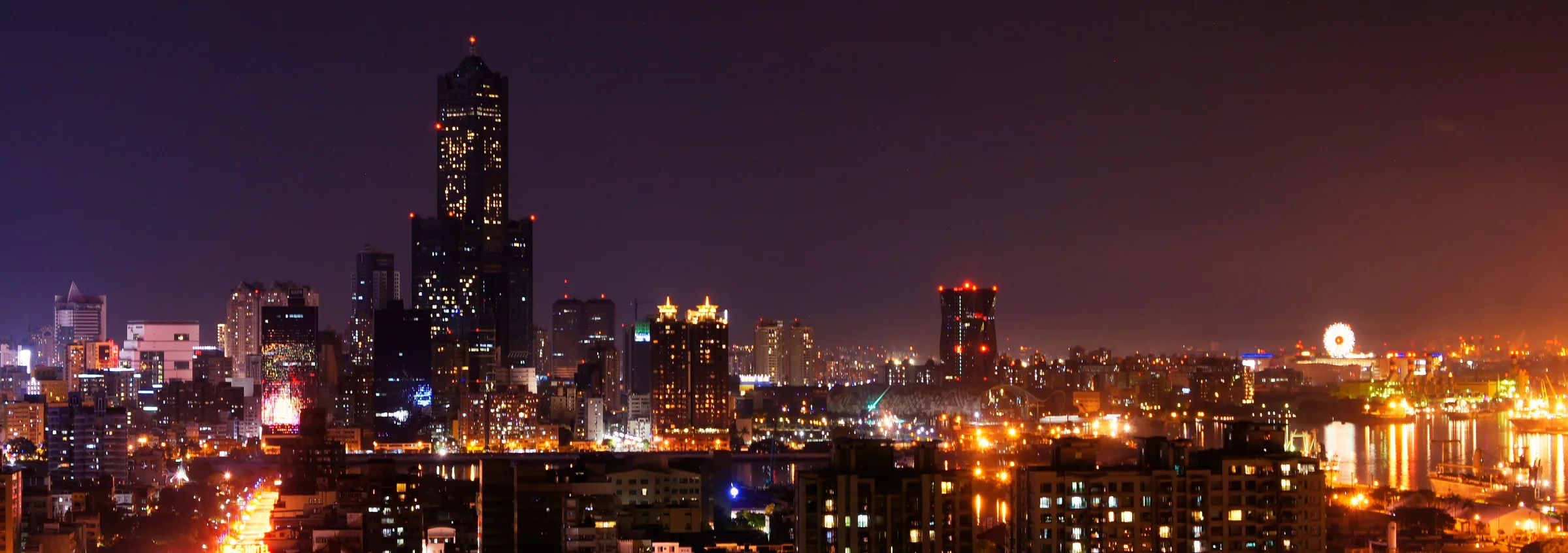
Kaohsiung City: The Year It Became a Special Municipality, and Eight People from Kaohsiung Were Imprisoned in Taipei
30-Second Overview: On July 1, 1979, Kaohsiung was upgraded to Taiwan's second special municipality, following Taipei in 1967. On December 10 of the same year—World Human Rights Day—a speech by Beautiful Island magazine at Daguangpu Roundabout turned into a conflict under tear gas. The military court verdict on April 18, 1980, sentenced Shih Ming-te to life imprisonment, Huang Hsin-chieh to fourteen years, and Yao Chia-wen, Chang Chun-hung, Lin Yi-hsiung, Lü Hsü-lien, Chen Chu, and Lin Hung-hsien to twelve years each. In the early morning of February 28, 1980, at the Lin residence located at No. 16, Lane 3, Section 3, Xinyi Road, Taipei City, Lin Yi-hsiung's mother and twin daughters were murdered. The wounds on Section Three are all related to this newly upgraded special municipality of Kaohsiung. With 2.71 million people scattered across 38 districts, the administrative coordinates of a special municipality encompassing Rukai and Bunun tribes, steel smokestacks, and aluminum roofs exist. This article aims to convey that Kaohsiung is a wound in Taiwanese democracy and the physical embodiment of this island's industrialization.
4:30 AM at Qianzhen Fishing Port
If you ask a person from Kaohsiung, "When is Kaohsiung most charming?", they won't tell you about Liuhe Night Market (which is for tourists). They might tell you about the Qianzhen Fishing Port at 4:30 AM, or the Cijin Ferry at 5 AM.
The Qianzhen Fishing Port in Qianzhen District is Taiwan's largest deep-sea fishing base. Tuna longliners leave from here, traveling to the Indian Ocean, Atlantic Ocean, and South Pacific, returning after six months to a year. The fishermen are mostly Indonesian or Filipino, speaking a mix of Tâi-gí (Taiwanese), English, and their native languages. In the days of unloading, the port is piled high with frozen tuna; the fish are bigger than people and are moved one by one onto the auction floor. The tuna that Taipei sushi restaurants will prepare tonight might have been caught off the coast of Madagascar two weeks ago.
The Cijin Ferry runs every three minutes, from Cijin to Qixing, a five-minute trip, with a fare of NT$40. The morning service starts at 6 AM, but office workers are already queuing before dawn. With 28,000 people in Qixing, there is no bridge connecting it to the mainland (cars use the port tunnel); the ferry is the only link between this sandbar and the Kaohsiung urban area.
This is modern evidence of Kaohsiung as a major port city. The historical glory of being upgraded to a special municipality in 1979, the industrial glory of China Steel Corporation building its plant in 1971, and the shipping glory of being one of the world's top three container ports for seven consecutive years from 1993 to 1999—all of that is history. But while the capital is still asleep, Kaohsiung has already started moving things for the whole world.
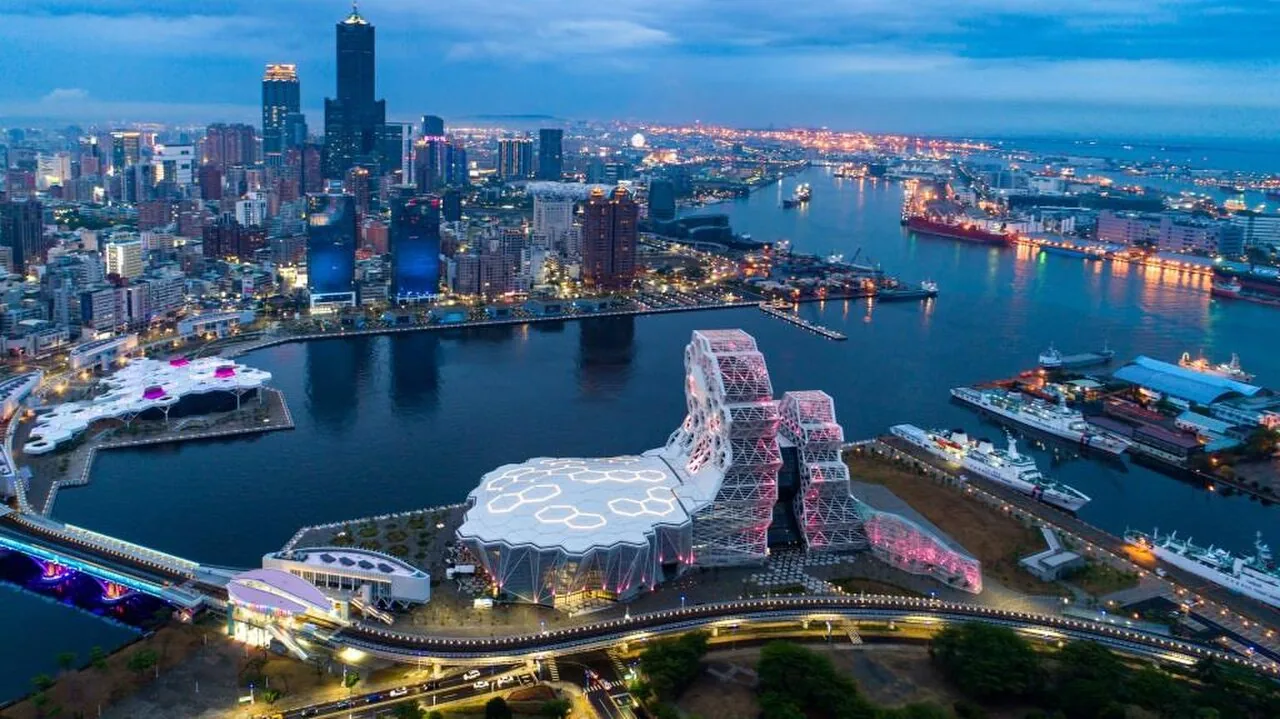
Kaohsiung Port Area 1 Commercial Zone, 2021. Photo: Wikimedia Commons contributor, CC BY-SA via Wikimedia.
Takau, Taku, Kaohsiung: The Renaming in 1920
Four hundred years ago, at the foot of Dagou Mountain (now Shoushan), there was a Makadai tribe settlement surrounded by bamboo groves. The tribe members called it "Dagou" (Takau) using a phonetic approximation from Minnan, meaning "bamboo grove" 1. Han Chinese began to arrive sequentially after the Qing court established Fengshan County in 1684; initially as a fishing village, it later became a port.
After the Treaty of Tianjin in 1858, Dagou opened as a port in 1863. The British consulate was established in Chaoshuantou (now Gushan), and it became one of the treaty ports opened by the Qing court to foreign powers, alongside Xiamen and Fuzhou. In 1899 (Meiji 32), Goto Shinpei, the fourth governor-general during Japanese rule, toured South Taiwan and decided to develop Dagou Port. Due to insufficient funds, the construction was not officially started until the first phase in 1908 2.
In October 1920, Governor-General Kenjirō Takeda of Japanese rule abolished the county system and renamed "Dagou Street" as "Kaohsiung Street." The characters "Kaohsiung" were taken from the phonetic approximation takao in Japanese. Whether this has any relation to Mount Kaohsiung in Kyoto is still a subject of academic debate 1. But from that moment on, the city was no longer called Dagou.
In 1924 (Taishō 13), Kaohsiung Street was upgraded to "Kaohsiung City." The city hall was located where the Daian Temple in Guabo Street (Yancheng District) is today. When it became a city, the population exceeded 35,000 people; by 1940, it had grown to 160,000, making it Taiwan's second-largest city, second only to Taipei 1. Modernization in Kaohsiung during Japanese rule was concentrated in Hamaxi (a Taiwanese phonetic transcription of the Japanese hama-sen), with Yancheng, Gushan, Zuoying, and Lingya developing sequentially. The city hall, banks, and trading companies were clustered in Hamaxi and Yancheng.
📝 Curator's Note: Most residents of Kaohsiung today do not use the name "Dagou," but it is embedded in the texture of place names and food. "Shoushan" (壽山) on Dagou Mountain was changed after Emperor Hirohito visited in 1923 during Japanese rule; "Chai Shan" (柴山), referring to the macaques, is another local saying for Shoushan. The sound "Dagou" remains in early documents between Tainan and Kaohsiung, preserved in the oral memory of the Makadai tribe before they were Sinicized, and it persists among a group of cultural workers from the 2000s who use "Dagou" as a title (such as the Dagou History and Culture Association or the Dagou Kaohsiung History and Culture Network) to resist the resurgence of the Taishō naming. It takes a hundred years for a city to change its name once; it might take another hundred years to change that name back.
The Army Descended from Shoushan in March 1947
Following the events in Taipei on February 28, 1947, the situation spread to Kaohsiung in early March. At that time, the commander of the Kaohsiung Fortress was Peng Meng-chi (1908–1997), a general in the Army from Wuchang, Hubei Province, who was stationed on Shoushan.
"As early as March 4, the Commander of the Kaohsiung Fortress, Peng Meng-chi, decided to use military suppression methods,"3. On the morning of March 6, seven negotiating representatives—including Mayor Huang Chung-tu and City Council Chairman Peng Qingkao (the father of surgeon Peng Ming-min)—went to Shoushan as scheduled to negotiate a peaceful resolution with Peng Meng-chi. "As soon as they entered the meeting room, Tu Guangming, Fan Cangrong, and Tseng Fengming were arrested,"3.
"After capturing the negotiating representatives, Peng Meng-chi decided to advance the suppression action from the 7th, ordering the army to descend the mountain for suppression that afternoon at two o'clock,"3.
What happened after two in the afternoon is recorded in these sections:
"The army surrounded Kaohsiung Train Station from Sancuocuo. The public and travelers rushed away before the station; the army also shelled passengers hiding in underground passages, resulting in countless casualties,"3.
"The troops attacking the city hall first threw grenades and killed anyone they saw. Representatives and citizens waiting for news of negotiations in front of the city hall... suffered heavy casualties, with about fifty or sixty people killed,"3.
The defense of Xiongzhong was another aspect of this massacre. "On March 4, students formed a self-defense force (Xiongzhong Self-Defense Force), led by Kaohsiung First Middle School (now Xiongzhong) in Taiwan Province... The purpose was to maintain security near the school and use Xiongzhong as a temporary shelter for foreign residents whose lives were threatened,"3. A group of high school students sheltered attacked neighbors within the school while using books as shields against the army.
The three representatives, Tu Guangming, Fan Cangrong, and Tseng Fengming, were executed by firing squad at Kaohsiung Fortress on March 9. Peng Meng-chi was later promoted and highly valued by Chiang Ching-kuo, becoming the Commander-in-Chief of the Army in 1957 and a general of the first rank in 1966. His title during the 1947 Kaohsiung incident was "Kaohsiung Butcher." The same man later rose through the ranks of Taiwan's military and political system.
This was one wound that Kaohsiung had before the Beautiful Island Incident in 1979.
1968 Export Processing Zone, 1971 China Steel, 1973 Lin-Yuan Petrochemical
Two decades passed, and by the late 1960s, Kaohsiung had become another city.
"In December 1966, Taiwan passed the Regulations for Establishing Export Processing Zones, selecting the Qianzhen District of Kaohsiung Port to establish the Kaohsiung Export Processing Zone"4. This was one of Taiwan's first and among the world's earliest export processing zones, combining free trade zone and industrial park functions with tax incentives, a single window, and fast customs clearance. The first factory moved in in 1968, employing many young female workers from Tainan, Pingtung, and Chiayi, earning over NT$1,000 per month and living in dormitories of four or eight people. These workers were later called the "Processing Zone Aunts," and their grandchildren now work at TSMC.
Refineries were even earlier. The CPC Kaohsiung Refinery, located at the foothills of Banping Mountain in Nanzi District, covers an area of 262 hectares. Its predecessor was the "Dai Nippon Teikoku Navy Sixth Fuel Plant Kaohsiung Site" during World War II, which was taken over and repaired by the CPC in 1947. "The first light crude cracking plant (No. 1) was commissioned in 1968 and closed in 1990; the second light crude cracking plant (No. 2) was commissioned in 1975 and closed in 1994; the fifth light crude cracking plant (No. 5) was commissioned in 1994 and closed in 2015"5. The refinery "subsequently housed dozens of large factories, becoming an officially recognized major pollution area"5.
On December 3, 1971, China Steel Corporation was formally established6. The first oil crisis in 1973 caused a global economic downturn, leading Chiang Ching-kuo to propose the "Ten Great Construction Projects," which included China Steel. Phase one of the project was completed in 1977, and steel production began. Today, China Steel is still in Xiaogang, with an annual crude steel output of about ten million tons, primarily producing steel plates, wire rods, hot-rolled, and cold-rolled products6. The supporting Lin-Yuan Petrochemical area was established in 1973, and together with the Nanzi refinery and Xiaogang China Steel, it formed the three heaviest gears of Taiwan's post-war heavy industry.
In 1965, the government issued the "Regulations for Promoting the Recycling of Old Ships," leading to ship dismantling in Qianzhen and Caoya areas. "Around 20,000 workers dismantled ships at the docks daily, achieving a dismantling rate of up to ten thousand tons of steel plates per day, earning Taiwan the reputation of the world's 'Shipbreaking Kingdom'"7. Kaohsiung set the world record for shipbreaking volume in 1973. In 1986, an oil tanker at the Daren Palace Shipbreaking Industrial Zone exploded due to residual oil in its bilge, killing 16 people and injuring hundreds. "The Kaohsiung Port Authority reclaimed the Daren Shipbreaking Professional Zone in 1989, converting it into a fifth container terminal. In 1990, the shipbreaking industry was officially forced out"7. An industry that was once number one globally disappeared within twenty years.
✦ "It subsequently housed dozens of large factories, becoming an officially recognized major pollution area." (Reporter in The Undying Chemical Zombie5)
Kaohsiung residents have a very divided memory of this history. From 1971 to the 1980s, heavy industry was both the pride and the breadwinner of Kaohsiung. But during the same period, local residents began noticing that the ash falling from their rooftops was particularly thick, and fishermen in Dalinpu started finding fewer fish in their nets. Then came 1987.
The Vote That Lingered: 61% to 39%
"In June 1987, the plan for CPC's 'Fifth Light Cracking Plant' was officially released in the media"8. Residents of Houjin immediately organized upon learning that the government planned to build a Fifth Light plant on top of existing First and Second Light facilities.
"A villagers' meeting was held on August 5, 1987, establishing the 'Anti-Fifth Light Self-Aid Committee'"8. Starting in August, residents continuously surrounded the factory, taking turns guarding the CPC gate to block construction vehicles from entering. This movement occurred alongside the lifting of martial law that year and was Taiwan's first large-scale environmental protest post-war.
"On May 6, 1990, Taiwan held its first public referendum on the Fifth Light plant. The voting results were: with a voter turnout of 66%, those firmly against the Fifth Light won with 4,499 votes (61%) over the 2,900 who agreed to negotiations"8.
The referendum did not stop the Fifth Light plant.
"On September 14, 1990, Chairman Hao Po-tsu promised that CPC would relocate the plant in 25 years and provide a feedback fund of NT$1.5 billion to Houjin residents, setting a record for the highest anti-pollution compensation in Taiwan"8. Eight days later, "on September 22, 1990, Minister of Economic Affairs Hsiao Wan-chang announced that construction of the Fifth Light plant would begin"8.
The 25 years promised by Hao Po-tsu coincided with 2015. The Fifth Light plant actually ceased operations on November 1, 2015, fulfilling the promise, but for a whole generation, Houjin residents had grown up breathing in the air from the Fifth Light plant. From the surrounding efforts in 1987 to the shutdown in 2015, this movement is known as the "28-Year Anti-Fifth Light Movement"8.
📝 Curator's Note: Common environmental narratives focus on political alignments such as "green governance." However, the story of Houjin's resistance against the Fifth Light plant is more like another structure: it is a story of a small village trading 25 years of patience for a factory to close. There was no moment of victory in between; every year involved losses—the Fifth Light plant was still built, exhaust fumes were still emitted, and residents' health was still affected. The factory only closed after 25 years of losses. What distinguishes Taiwan's environmental movement from other social movements is its time scale: it is measured by "generations," not by "terms." After the Houjin case, Dalinpu spent more than 30 years protesting for relocation9, and Executive Yuan Premier Lin Chuan-tsai publicly apologized there in 2016. Winning is not about winning a single movement, but about ensuring that the next generation does not have to breathe the same air.
The Tear Gas of Daguangpu Roundabout on International Human Rights Day
Returning to 1979.
On July 1, "Kaohsiung City, which was originally a county-level city in Taiwan Province, merged Xiaogang Township of Kaohsiung County and was upgraded to a municipality, becoming the second special municipality in Taiwan" 10. The first special municipality was Taipei City, which was upgraded in 1967. Kaohsiung was the second, with a 12-year gap between them. It had 11 districts (including the newly established Xiaogang District) and a population of about one million, making it the largest industrial center in Southern Taiwan at the time.
In the same year, January 1979, the United States severed diplomatic relations with the Republic of China. Kaohsiung was upgraded on July 1; Beautiful Island Magazine was founded in August, with Huang Sin-chieh as publisher, Hsu Shin-liang as president, and Shi Ming-te as general manager. The magazine became a flagship for opposition movements. In early December, opposition figures applied to hold a rally and march in Kaohsiung on December 10 (United Nations Human Rights Day) under the name "Human Rights Memorial Committee," demanding the lifting of martial law and the release of political prisoners. The authorities did not approve it.
On the evening of December 10, "as the originally planned venue, Fulin Park, had been sealed off, opposition figures decided to move to the roundabout where Zhongshan Road and Zhongzheng Road intersect" 11. The rally site was first near the Xinxing Roundabout on Zhongshan Road in the Xinxing District, before moving to Daguangpu Roundabout, which was one of the most important roundabouts in downtown Kaohsiung at the time.
"The crowds participating in the march were surrounded by thousands of riot police near Daguangpu Roundabout and the conflict finally erupted after being subjected to intense spotlights, tear gas, and shield advances" 12.
The conflict continued late into the night. Three days later, on the morning of December 13, at six o'clock, the Military Intelligence Command launched a mass arrest across the island. Chen Chu, Lin Yi-hsiung, Lü Hsu-lien, and Chang Chun-hung were arrested sequentially in the early morning. Huang Sin-chieh was arrested at the Legislative Yuan on the morning of December 14. Shi Ming-te fled for 26 days and was captured at a private residence on January 8, 1980. A total of 152 people were involved.
✦ "On April 18, the military court delivered its final verdict; all eight defendants were found guilty. Shi Ming-te was sentenced to life imprisonment, Huang Sin-chieh received fourteen years, and Yao Chia-wen, Chang Chun-hung, Lin Yi-hsiung, Lü Hsu-lien, Chen Chu, and Lin Hong-hsien each received a fixed term of 12 years." (Wikipedia article on the Beautiful Island Incident 12)
The military trial lasted for 9 days starting from March 18, 1980. The defendants hired 15 defense lawyers, including Jiang Peng-chien, Hsieh Chang-ting, You Ching, Chen Shui-bian, Su Tsz-chang, and Chang Chun-shiu. Chen Shui-bian was responsible for defending Huang Sin-chieh. After this, all these lawyers became key figures in the opposition movement: Chen Shui-bian later became president, Hsieh Chang-ting, Su Tsz-chang, and Chang Chun-shiu served as Premier, and You Ching served as the mayor of Taipei County, while Jiang Peng-chien was the first chairman of the Kuomintang.
"The voices demanding the lifting of martial law, the end of party bans, and a full election of central representatives were further publicized through the military trial" 13. The Democratic Progressive Party was established on September 28, 1986, and martial law was lifted on July 15, 1987. From the tear gas at Daguangpu Roundabout in 1979 to the lifting of martial law in 1987, this period of seven and a half years was the most critical part of Taiwan's democratic transition. The starting point of this transition was not Taipei, but Kaohsiung.
Xinyi Road, Taipei City, February 28, 1980
Before the military trial even began, events had spiraled into deeper tragedy.
On February 28, 1980 (the anniversary of the February 28 Incident), a blood case occurred at the home of Lin Yi-hsiung, who was awaiting trial in the Jingmei Military Detention Center. The location was No. 16, Lane 31, Section 3, Xinyi Road, Taipei City, which was Lin Yi-hsiung's residence in Taipei. "Lin Yi-hsiung, along with his mother You A-mei and twin daughters Lin Liang-jun and Lin Ting-jun, were stabbed to death" 14. His nine-year-old eldest daughter, Lin Huan-jun, was stabbed six times but survived after shielding herself with her schoolbag.
The Lin residence blood case happened in Taipei, not Kaohsiung, and not Yilan. Lin Yi-hsiung was from Wujie, Yilan. After being arrested during the Beautiful Island Incident in 1979, he was held at the Jingmei Military Detention Center in Taipei. On the day of the incident, he was in Jingmei, far from the scene. "This case has never been solved. And because the maximum criminal prosecution period of 25 years has passed, finding the true culprits and bringing them to justice is impossible" 14.
The connection between this case and the Beautiful Island Incident in Kaohsiung lies in the timeline; the location was 350 kilometers from Kaohsiung. The Lin residence blood case occurred 19 days before the military trial began, representing one of the cruelest pages of the White Terror and a shared scar memory for all those involved in Taiwan's democratic movement. The tear gas at Daguangpu Roundabout in 1979, the blood on Xinyi Road in Taipei on February 28, 1980, and the verdict from the military court on April 18, 1980—three wounds all relate to this newly upgraded municipality of Kaohsiung.
The red ribbons from the upgrade celebration had not yet been taken down when the political history of this city was carved with a wound.
Beautiful Island Station, The Dome of Light
Twenty-nine years passed.
On September 14, 2008, the Orange Line of the Kaohsiung MRT opened, and "Beautiful Island Station" was activated on the same day 15. This station name was deliberately chosen by the Kaohsiung City Government to designate the location of the Daguangpu Roundabout. A turn later, "The Dome of Light" is located in the R10/O5 mezzanine level.
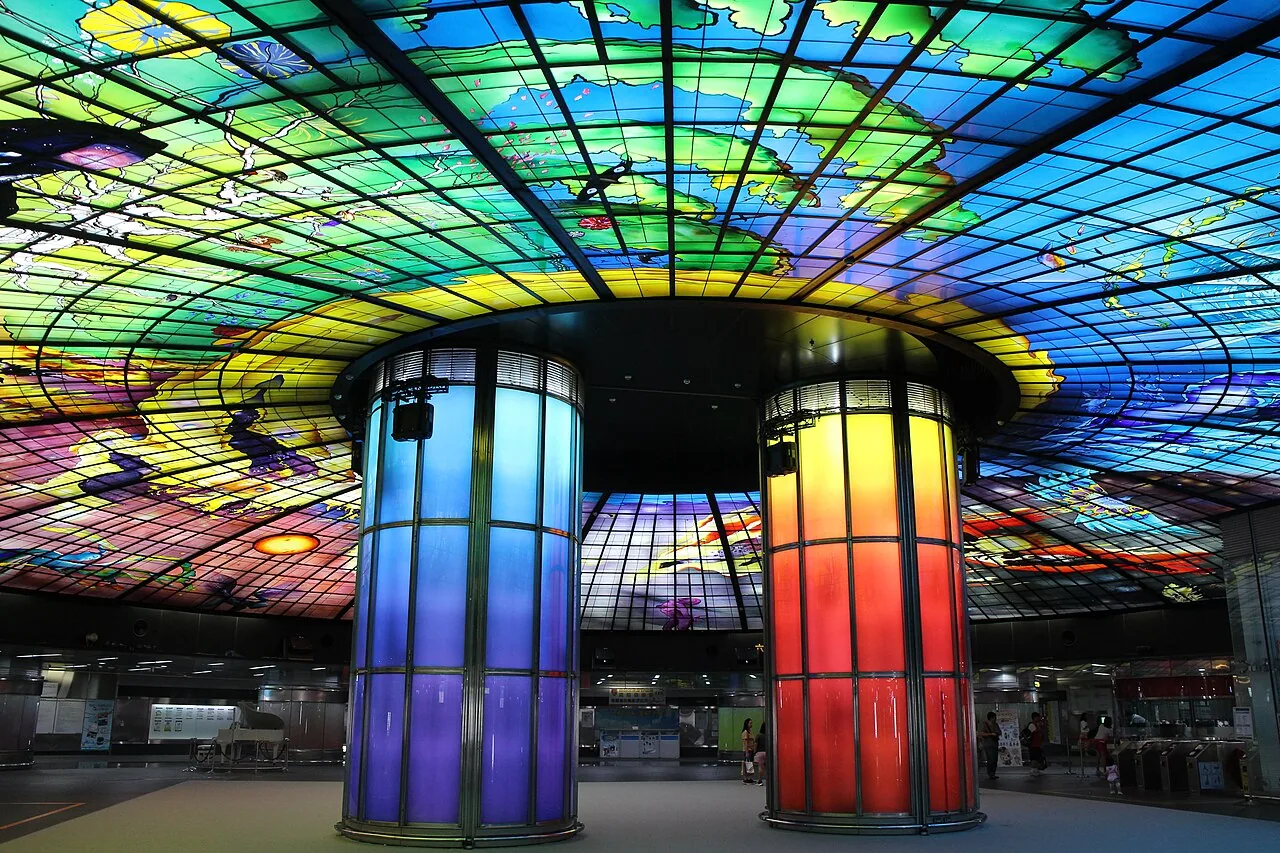
Beautiful Island Station's Dome of Light, 2024-09-19. Photo: Wikimedia Commons contributor, CC BY-SA via Wikimedia.
The Dome of Light was "hand-painted by the internationally renowned artist Master Narcissus Quagliata over four and a half years, with a diameter reaching 30 meters and an area of 660 square meters" 15. Master Narcissus Quagliata (born in Rome in 1942) is an authority on contemporary glass art. The dome is composed of 4,500 pieces of stained glass, divided into four sections: water (gestation), earth (growth), light (glory), and fire (destruction and rebirth). In 2012, the American travel website BootsnAll ranked Beautiful Island Station as the second most beautiful among the top 15 metro stations globally.
From the Daguangpu Roundabout to Beautiful Island Station, this transformation took 29 years. On December 10, 1979, people were prosecuted here for a demonstration; on September 14, 2008, it became home to a world-class art installation. The physical location of the roundabout did not change, but its meaning was rewritten twice by the people of Kaohsiung.
📝 Curator's Note: Turning a site of past conflict into an artistic station is the response of the people of Kaohsiung to 1979. It is a form of rewriting memory. The 228 Peace Park in Taipei and the Taipei Human Rights Park use commemoration—monuments, statues, exhibitions—to tell readers, "Something happened here." Beautiful Island Station in Kaohsiung does something else: it is everyday life. More than thirty thousand people board and alight at this station every day; whether they look up at the Dome of Light is irrelevant; what matters is that the name has been embedded into the skeletal structure of the city's metro network. How a city handles its historical wounds is seen in whether it turns that location into a place everyone passes through daily.
38 Districts: From Qijin Sandbar to the Bunun Indigenous Peoples
On December 25, 2010, there was another upgrade.
"On December 25, 2010, Kaohsiung City's original land area of 153 square kilometers was merged into Kaohsiung County, increasing the total land area to 2,951 square kilometers, and the original population of Kaohsiung City, 1.52 million people, was included in Kaohsiung County, bringing the total population to 2.77447 million" 16.
"The 11 original districts of Kaohsiung City were merged with the 27 townships and cities of Kaohsiung County to form 38 districts (including 3 indigenous mountain areas)." 17
From that day on, "Kaohsiung City" became a city extending from Qijin Sandbar all the way to the foot of Yushan. The original 11 districts of Kaohsiung City formed the urban core: Yancheng, Gusan, Lingya, Xinxing, Qianjin, Qianzhen, Sanmin, Nanzi, Zuoying, Qijin, and Xiaogang. The 27 townships and cities of the original Kaohsiung County were located in the periphery: Fengshan, Daliao, Tiosung, Renwu, Dasha, Gaomei, Luzhu, Hunei, Yong'an, and Qiechian; further north were Qiaotou, Yanshao, Dashi, Dasha, Tianliao, Alian, Mituo, and Zigan; to the east were Meinong, Qishan, Neimen, Shanlin, Liugui, and Jiaxian; and in the deepest parts were the three indigenous mountain areas: Maolin, Taoyuan, and Namaxia.
The story of each district is different. Qijin District, with 28,000 residents, is a sandbar 11.3 kilometers long, where ferries are the main means of transportation in and out. Maolin District, with 1,867 residents, is the least populous district in Kaohsiung City, primarily inhabited by the Rukai people, with elevations rising from 200 meters to over 1,000 meters. Fengshan District, with 355,183 residents, is the most populous district in Kaohsiung City; it was formerly the county seat of Kaohsiung County and became the second-largest population area in Taiwan after the merger in 2010 18. The three districts have a population difference of 190 times, yet they are all administratively called "a certain district of Kaohsiung City."
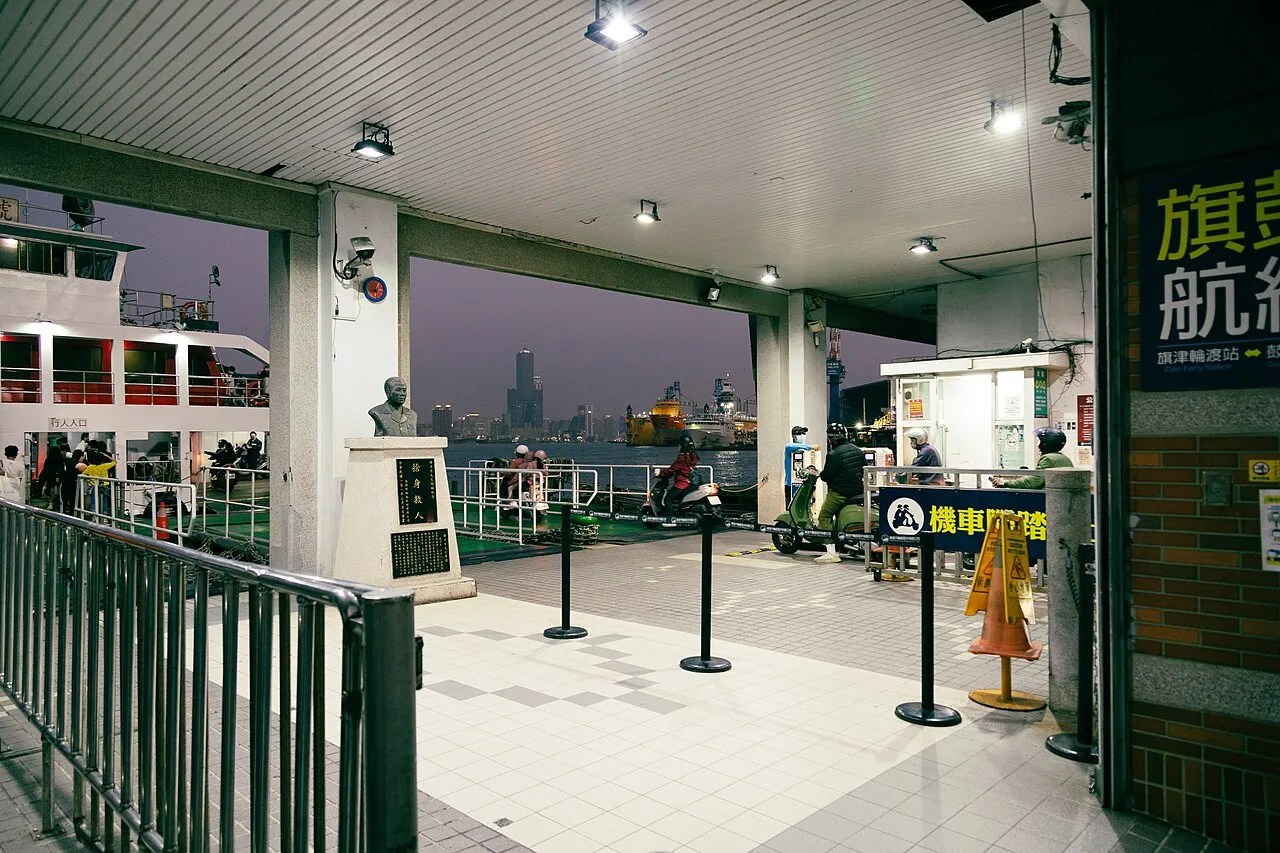
_An overhead view of Qijin. Photo: Wikimedia Commons contributor, CC BY-SA via Wikimedia._
The Three Mountain Areas: Rukai, Bunun, Kanakanavu, and La'aruwa
Maolin District, located in the southeastern mountains of Kaohsiung, is primarily inhabited by the three communities of the Rukai people: Maolin, Donna, and Wanshan. The Rukai language spoken in each community has dialectal differences, and the stone-house cluster in Donna Village is the most complete 19.
Taoyuan District, distributed along the upper reaches of the Laonong River, is primarily inhabited by the Bunun people, and it is also a traditional territory of the La'aruwa people. The La'aruwa people (Hla'alua) were long mistakenly considered a branch of the South Tsou tribe until the "Republic of China government recognized the La'aruwa as the 15th indigenous group in Taiwan and the Kanakanavu as the 16th group on June 26, 2014" 20. Today, there are about 400 La'aruwa people, mainly distributed in Gaodong Village and Taoyuan Village of Taoyuan District.
Namaxia District, situated along both banks of the Nanzi Xian River, is home to the Bunun and Kanakanavu people. There are about 350 Kanakanavu people today, primarily residing in Dakanuwali and Maya'li of Namaxia District. The name "Namaxia" comes from a legend: "Hundreds of years ago, a young man named 'Namaxia' discovered a giant eel blocking the river water, endangering the tribe, and the people named the Nanzi Xian River after him to commemorate him" 21. In 2008, Sanmin Township was renamed Namaxia Township, and in 2010, it was upgraded to Namaxia District.
The names "La'aruwa" and "Kanakanavu" were only officially recognized as distinct tribes on June 26, 2014. Before that, their ancestors had been recorded for over a hundred years as a branch of the "Tsou tribe," which scholars referred to as "South Tsou." Before renaming, they were represented by others; after renaming, they spoke for themselves.
Meinong: The Right Cluster of Liuhai
Following the Nanzi Xian River downstream from Namaxia, one encounters Meinong. Meinong District is the only typical Hakka village in Kaohsiung, administratively belonging to Kaohsiung City but culturally part of the "Right Cluster" of Liuhai.
Liuhai is a collective term for Hakka communities in southern Taiwan, divided into Xianfeng Cluster, Qian Cluster, Zhong Cluster, Hou Cluster, Zuo Cluster, and Right Cluster. The "Right Cluster" covers all or most of Meinong District, Liugui District, and Shanlin District, some parts of Jiaxian District, and parts of Qishan District. During the Zhu Yigui Incident in 1721, Hakka villages along the lower Tamsui River jointly organized self-defense militias, "collectively promoting Li Zhisan as Grand President and dividing into six groups (Liuhai) to defend their homeland" 22, and this organizational structure later became part of the cultural identity of the Hakka communities.
But this story is not limited to the militia in 1721. Meinong has another, more recent history.
"At the first 'Meinong Reservoir Public Hearing,' convened by the Meinong Township Office and local associations at the end of 1992, an event known as the 'Meinong Anti-Reservoir Movement' erupted" 23. The government planned to build a reservoir upstream of the Meinong River to supply water to the Kaohsiung area, but the dam site was located on a fault line and would damage the subtropical mother forest ecosystem of Huangdie Cui Valley, impacting traditional Hakka culture in Meinong.
The movement lasted eight years. "On March 18, 2000, Chen Shui-bian was elected president and subsequently announced that the Meinong reservoir would not be built during his term" 23. The Meinong Love Village Advancement Association became a model for the sustainable development of Hakka communities in Taiwan and also spurred a return movement among a generation of young Hakka people. Today, the paper umbrellas, woven mats, Hakka cuisine, and tobacco houses under Moonlight Mountain in Meinong are the results of this township's own choices, not decisions made by others.
Namaxia and Taoyuan Buried in That August Disaster
From the official naming and anti-reservoir movements, back to a more immediate wound.
On August 8, 2009, Typhoon Morakot struck Taiwan. On that day, "the cumulative rainfall in Jiaoxiang Township was as high as 1,856 millimeters" 24, a figure nearly equivalent to seven-tenths of the average annual precipitation in Taiwan. Landslide warnings began emerging from the mountainous areas early on the 8th, but communication was severed, and external parties could not immediately grasp the actual disaster situation.
The most severe was Xiaolin Village. "The village destruction event in Xiaolin Tribe, Jiaoxiang Township, Kaohsiung County, where 474 people were buried alive," 25. The tribal structure of Xiaolin Village, built on the mountainside, was completely covered by a landslide; "during the August 88 Water Disaster caused by Typhoon Morakot, over six hundred households in Xiaolin Village, Jiaoxiang Township, Kaohsiung County, were destroyed by landslides." The survivors from Xiaolin later relocated in three batches to Shansulin Daai Park, Wuli Pu Xiaolin Village, and Xiaolin Er Village, but the tribe's original geographical context could never be recovered.
The three indigenous mountain areas—Namaxia, Taoyuan, and Maolin—were also severely affected. The connecting road was cut off, bridges were destroyed, and the tribes were isolated from the outside world for several days. New permanent housing in Namaxia is located in Shansulin District; some members of the original tribe chose to return to the mountains to rebuild, while others remained in the valley below. From that year onward, the tribe became two: one in the ancestral home, and one in the permanent housing.
📝 Curator's Note: Conventional disaster narratives focus on "death toll," "reconstruction progress," and "government efficiency." However, the impact of the 88 Water Disaster on the ethnic groups of Kaohsiung's mountains was deeper: the severance of the tribe's geographical connection. The rituals, land knowledge, and language transmission of the Bunun, Kanakanafu, La'aruwa, and Rukai peoples were all tied to specific geographic locations: which stream upstream held ancestral spirits, which mountain was taboo, and which hunting ground belonged to which family. Once relocated, this foundation for carrying geographical knowledge was broken. Seventeen years after Morakot, the population of the three mountainous areas in Kaohsiung continued to drift down into the valleys; the new generation of tribal children attended schools in Shansulin and Qishan, waking up not from stone houses. Reconstruction in the disaster-stricken areas is physical; how long will it take for cultural loss to be recognized?
The Two Lines of the Aihe River
From the mountains back to the city, there is one river's story.
The Aihe River originates from Bagualaotai Pond in Renwu District, flows through Kaohsiung City, and empties into the sea at Qianzhen District, with a total length of 16.4 kilometers 26. During the Japanese colonial period, it was called "Dagou River" or "Kaohsiung River"; after the war, it was renamed "Aihe." After the 1960s, Kaohsiung underwent rapid industrialization, and because sewage systems were not widespread, industrial, agricultural wastewater, and domestic sewage were discharged directly into the Aihe. The Aihe became one of Taiwan's most severely polluted urban rivers; its dark gray water floated with oil slicks, emitting a pungent chemical odor when approached.
However, attitudes toward urban rivers in Taiwan began to change around the time of the lifting of martial law in 1987. Media reports presented a contrast: "Aihe remediation successful, Tamsui River still foul" 27, even though the success at that time was only preliminary. Real remediation accelerated after Lai Ching-te was elected Mayor of Kaohsiung in 1998: "the sewage collection rate increased from 6% upon taking office to 25%," and landscape improvements were made around the Aihe, including the construction of water-friendly embankments, the renovation of the Film Library, and the introduction of the Love Boat.
In 2001, Taiwan Lantern Festival was held in Kaohsiung (for the first time outside Taipei), making the lantern festival by the Aihe a yearly event. "After the 2000s, the Aihe successfully transformed into an important tourist attraction in Kaohsiung, gradually shedding the stereotype of being an 'industrial hub and cultural desert' for many years" 28.
But industry did not leave. CSCO remains in Xiaogang, refineries are in Nanzi, petrochemical plants are in Linyuan, and thermal power plants are in Dalinpu. The success of Aihe remediation was only one aspect of this city's transformation; the other aspect is that Dalinpu is still waiting for relocation.
"The coastal industrial zone has CSCO, CPC, Taipower, and many related downstream industries, with hundreds of companies and numerous smokestacks surrounding settlements like Dalinpu" 9. Residents "have struggled for over 30 years"; in 2016, Premier Lin Chuan publicly apologized to Dalinpu, acknowledging the polluted environment and initiating a relocation survey. However, the environmental review controversy surrounding the relocation plan has not concluded even by 2026.
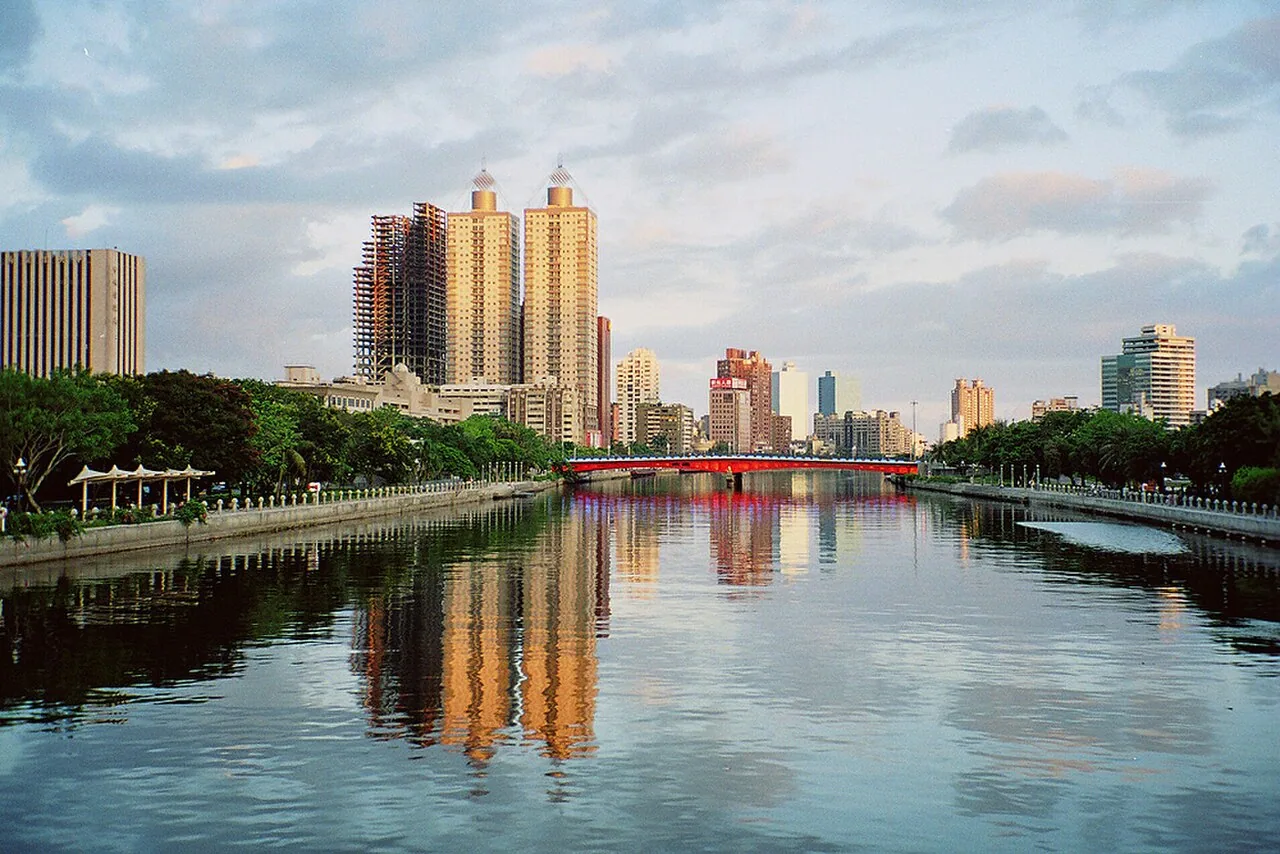
Aihe (Kaohsiung River), remediated tourist riverbank. Photo: Wikimedia Commons contributor, CC BY-SA via Wikimedia.
The two lines of the Aihe: on one side is the story of tourism, lantern festivals, and the Love Boat—a success story of remediation; on the other side are the stories of Dalinpu, Nanzi's aftereffects, Linyuan petrochemicals, and 30 years of struggle for relocation. The same city is doing two things at once: one that can become a tourist photo, and another that only exists in environmental review reports.
Weiwu Performing Arts Center: 4,500 Panels Under an Aluminum Alloy Roof
The Weiwu Performing Arts Center opened on October 13, 201829. Located in Fengshan District, the site was originally a "Army Recruit Training Center" (which moved out starting in 1979). During martial law, for Kaohsiung residents, the name "Weiwu Camp" evoked memories of "where my son went to serve." Dutch architect Francine Houben used the old banyan tree clusters at Weiwu as inspiration, connecting four performance halls with a flowing aluminum alloy roof.
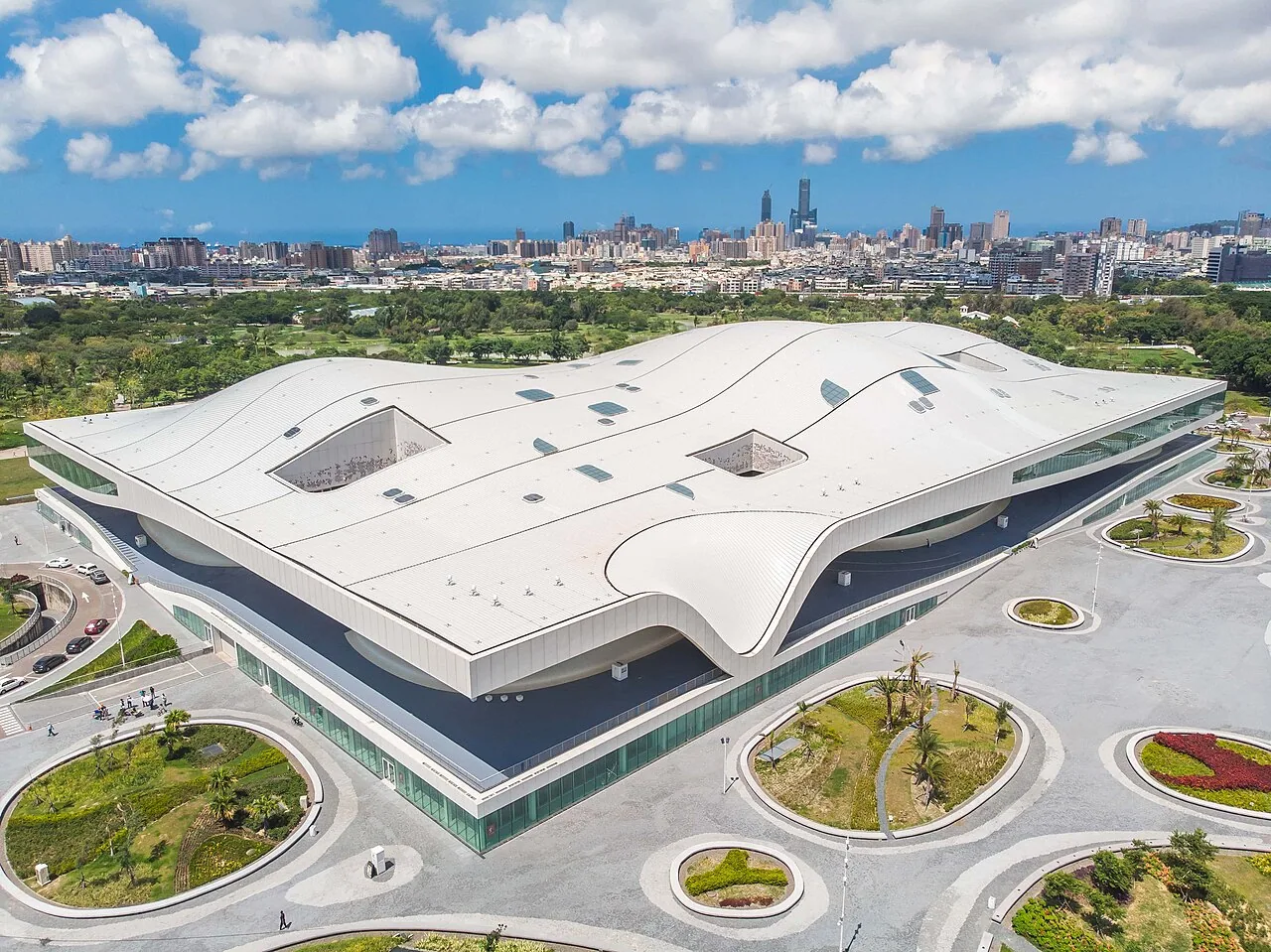
Weiwu Performing Arts Center. Photo: Wikimedia Commons contributor, CC BY-SA via Wikimedia.
"With a site area of 9.9 hectares and a building area of 3.3 hectares, the roof features a curved surface measuring 35,000 square meters, assembled from 4,500 aluminum alloy panels, making it the largest integrated performance venue under a single roof globally"29. The center houses 2,236 seats in the opera house, 1,981 seats in the concert hall, 1,209 seats in the theater, and 434 seats in the performance hall. In 2019, Time magazine selected Weiwu for its list of "World's Best Attractions."
The story of this site—from a recruit training center to a world-class performing arts center—is similar to the story of Beautiful Island Station: Kaohsiung residents have re-written military memories from the martial law era into artistic memories. A city's history of martial law does not disappear; it can be repurposed.
The year Weiwu opened was also the 39th anniversary of the elevation of the county to a special municipality and the 39th anniversary of the Beautiful Island Incident. From the Daguangpu roundabout to Beautiful Island Station, from the Weiwu military camp to the Weiwu Theater, this city spent nearly 40 years stitching its wounds into its own shape.
2.71 Million People in 38 Districts
In April 2026, Kaohsiung City had a population of 2.71 million, making it the third-largest special municipality in Taiwan (after New Taipei and Taipei) 30. Fengshan District was the most populous with 355,000 people, while Maolin District was the least populated with 1,867 people. The 2.71 million residents were spread across 38 districts covering an area of 2,951 square kilometers, from Qijin Sandbar to the Namaxia Indigenous community, with elevations ranging from 0 meters to over 3,000 meters.
Population structure: Hokkien speakers are the majority (since Han migration established Fengshan County in 1684), Hakka speakers are centered in Meinong (the right part of Liuhui), and the Makadai people were originally indigenous inhabitants of the "Eight Communities of Fengshan," who lived on the plains for a thousand years. After Sinicization during the Qing dynasty, they integrated into the Hokkien population group; former residents from outside Taiwan are concentrated in Zuoying military housing villages (the largest cluster of such villages after WWII, formerly naval bases) and Guomao Community (a state-subsidized housing project built on a large former military village); mountain indigenous peoples are concentrated in Maolin (Rukai), Taoyuan (Puyuh/Bunun, La'aruwa), and Namaxia (Bunun, Kanakanafu).
Compared to Keelung with 360,000 people, Kaohsiung is more than seven times larger; compared to Taipei with 2.4 million people, Kaohsiung has slightly more. However, the uniqueness of this city lies not in its population size, but in its scope: the West Coast Bay, Namaxia Indigenous community, Qijin ferry crossing, and Meinong paper umbrellas coexist within the same administrative coordinates. It is the only special municipality in Taiwan that simultaneously includes urban core areas, heavy industrial zones, Hakka enclaves, and three indigenous groups from mountainous regions.
✦ "The 11 original districts of Kaohsiung City and the 27 townships and towns of the former Kaohsiung County were merged into 38 districts (including 3 mountain indigenous areas in special municipalities)." (Wikipedia article on administrative divisions of Kaohsiung City 17)
2018 "Han-flow," 2020 Recall
A new chapter was added to the political history of this city after 39 years of administrative elevation.
"On November 24, 2018, Han Kuo-yu defeated Chen Chi-mai in the Nine-in-One election with 892,545 votes and a 53.87% vote share to become the third Mayor of Kaohsiung City, and he was inaugurated on December 25 of that year" 31. Han Kuo-yu's victory overturned 20 years of ruling by the Democratic Progressive Party in Kaohsiung. The term "Han-flow" swept from south to north that year; his speaking style, slogans ("Goods can go out, people can come in, Kaohsiung makes great wealth"), and image were completely different from previous mayors of Kaohsiung.
But this reversal was short-lived. In May 2019, Han Kuo-yu announced his candidacy for the 2020 presidential election and was criticized as having "no civic focus." Following the defeat in the January 2020 presidential election to Tsai Ing-wen, Kaohsiung residents began signing petitions for a recall.
"The recall vote was held on June 6, 2020, with 939,090 votes in favor and 25,051 votes against, resulting in a voter turnout of 42.14%" 32.
"Han Kuo-yu became the first mayor of an administrative city to be recalled from office under the Republic of China" 32.
The 939,090 "yes" votes were nearly 50,000 more than the 892,545 votes he received during his election in 2018. The same group of Kaohsiung residents had elected and then recalled the same person within two years. A reporter's headline stated plainly: "The first local official in Taiwan's history to be recalled" 33.
The recall was not the focus of this article. The focus is that the recall on June 6, 2020, and the Daguangpu Ring Road on December 10, 1979, and the Beautiful Island Station on September 14, 2008, are part of the same political narrative in the same city. Kaohsiung residents do not trust "gods." In 1979, they stood up against martial law; in 2020, they stood up to recall the incumbent mayor. The physical manifestation of public opinion in this city is more direct than in any other city in Taiwan.
At 4:30 AM, Black Vultures Behind CSCO Smokestacks
Returning to the opening scene.
At Pre-Zhen Fishing Port at 4:30 AM, tuna longliners were unloading cargo; at 5 AM, the Gushan Ferry transported the first batch of commuters from Qijin; at 6 AM, Beautiful Island Station, under the dome of light, was completely clean before the rush hour crowds arrived; and at 7 AM, an early morning bus from Zuoying High-Speed Rail Station took a group of people north to Taipei for work.
Two kilometers away, white smoke billowed from the smokestacks of CSCO Xiaogang Plant. A little further, the water of Houjin Creek slowly flowed toward Kaohsiung Port. The smell of this water is different from when residents of Houjin protested the plant in 1987 until the shutdown of Fifth Refineries in 2015. A little further still, Dalinpu had not yet been resettled.
Farther away, the mornings of Malulin, Taoyuan, and Namaxia, inhabited by the Rukai, Bunun, Kanakanafu, and La'aruwa tribes, above 1,000 meters in elevation, were just beginning. Residents of permanent housing built after the 88 Water Disaster woke up in the cedar forests, while indigenous peoples who remained in their ancestral villages awoke on the mountains.
So many things happened in this city at once in the morning because the 2010 county-city merger placed areas that previously belonged to different geographical units into a single administrative framework. The area from Qijin Sandbar to Namaxia Tribe is the most concrete physical manifestation of Taiwan's administrative elevation.
From Taipei, Kaohsiung is an industrial port city combined with a democratic event and a military base (Weiwu Performing Arts Center). From the ocean, Kaohsiung is where grandchildren of female workers from the 1968 Export Processing Zone work at TSMC; it is where sons of people from the 1990 Houjin referendum are professors; and one of the lawyers from the 1979 Daguangpu tear gas incident later became a president. From Pre-Zhen Fishing Port at 4:30 AM, Kaohsiung is a port city where the entire world is asleep, but this city has already started working.
Next time you go to Kaohsiung, don't just visit Liuhe Night Market or Building 85. Try taking the Gushan Ferry at 5 AM to Qijin to see fishing boats docking. Or take the Kaohsiung MRT Red Line to R8 Sanda Business District, then transfer to the Orange Line to Beautiful Island Station (R10/O5) and look up at the dome of light. Or go even farther by renting a car from Meinong to Namaxia, driving through the mountains along the Nanzi Creek. Then you will remember one thing: the wound this city left on December 10, 1979, the reflection from the aluminum roof of Weiwu Performing Arts Center in 2018, the official naming of the 15th and 16th tribes in 2014, and the 930,000 votes in the recall election in 2020—all circulate within this city of 2.71 million people.
Kaohsiung is not the lower body of Taiwan. Kaohsiung is a city where post-war industrialization, democratization, and cultural transformation of Taiwan physically coexist across three layers of history.
Further Reading
- Keelung City — The port that was surpassed by Kaohsiung in the "22 Counties and Cities" series, viewed alongside Kaohsiung as two ends of the "North-South Reversal of Taiwan's Economic Center."
- Pingtung County — Neighboring county in the "22 Counties and Cities" series: The 1874 Budanshe Incident, the coexistence of Hakka Six Tuai "Left Tuai" and Kaohsiung's "Right Tuai," and the simultaneous flooding of Linbian and Kaohsiung mountainous areas during the 2009 Typhoon.
- Taipei City — The first municipality upgraded in 1967, 12 years before Kaohsiung was upgraded in 1979; the Lin Residence Blood Case occurred on Xinyi Road in Taipei City in 1980.
- 228 Incident — The suppression order given by Fort Kaohsiung Commander Peng Meng-chi on March 6, 1947, and the Xiongzhong Defense War.
- Beautiful Island Incident — A key event in the opposition movement at the end of martial law on December 10, 1979, in Dagangpu.
- Taiwan's Democratic Transition — The transition process spanning seven and a half years from the Beautiful Island Incident in 1979 to the lifting of martial law in 1987.
- Kaohsiung Export Processing Zone — The Former Tainan Export Processing Zone in Kaohsiung in 1966 was the physical starting point of Taiwan's economic miracle.
- History and Naming Movement of Indigenous Peoples of Taiwan — Official recognition of the Kanakanafu Tribe (the 16th tribe) and the La'aruwa Tribe (the 15th tribe) in 2014.
- Hakka Culture and Language — The Hakka enclave of Right Tuai (Mei Nong, Liu Gui, Shanlin) in Kaohsiung.
- Morakot Typhoon Disaster — The destruction of Xiaolin Village by Typhoon Morakot in 2009, and heavy damage to three areas in Namaxia, Taoyuan, and Maoling mountains.
Image Sources
This article uses 6 images licensed under CC from Wikimedia Commons, with the hero image cached in public/article-images/geography/ to avoid hotlinking to source servers.
Hero (frontmatter): Night skyline of Kaohsiung, Taiwan 2014, a view of Love River and the city center from the direction of Building 85 in Kaohsiung City. Photo: hngyue photography, CC BY-SA 2.0.
Scene §Qianzhen Fishing Port: Port of Kaohsiung first harbor commercial area 2021, a view overlooking the First Harbor Area of Kaohsiung Port. CC BY-SA.
Scene §Formosa Boulevard Station: Dome of Light at Formosa Boulevard Station 2024, the Dome of Light at Formosa Boulevard Station. CC BY-SA.
Scene §No. 38 District: Cijin Island, Kaohsiung, a view overlooking Cijin Sandbar. CC BY-SA.
Scene §Love River: Kaohsiung Love River, the scenic riverbanks after the Love River remediation project. CC BY-SA.
Scene §Wei-Wu-Ying: Wei-Wu-Ying Center for the Arts 01, the exterior of the National Center of Arts in Kaohsiung. CC BY-SA.
Licensing Terms: CC BY-SA 2.0, CC BY-SA 3.0, and CC BY-SA 4.0.
References
- Kaohsiung City History - Wikipedia — A complete historical record of the place name, from the Makadai tribe's 'Takau', to its renaming as Kaohsiung Street in 1920 (Taisho 9), elevation to Kaohsiung City in 1924 (Taisho 13), and becoming Taiwan's second-largest city with a population of 160,000 in 1940.↩23
- History of Kaohsiung Port - Taiwan Port Corporation Kaohsiung Branch — Official primary source material detailing the planning of Takau Port by Goto Shinpei in 1899, the start of the first phase of port construction in 1908, and the complete timeline of subsequent expansion projects.↩
- The Kaohsiung Massacre of March 6, 1947 - Ju Zhen Taiwan — A detailed timeline of the suppression incident in Kaohsiung on March 6, 1947: the capture of Shou Shan negotiation representatives, the army descending from the mountain at 2 PM, the encirclement and shelling of the train station by Sanquecuo, the deaths of fifty or sixty people with hand grenades from the city government, and a complete record of the defense by Xiongzhong Self-Defense Forces protecting foreign nationals.↩23456
- Kaohsiung Export Processing Zone Completion - Executive Yuan Precious Historical Materials Exhibition — Official primary source material detailing the passage of the 'Export Processing Zone Establishment Regulations' in December 1966, which designated the Xinzhen District of Kaohsiung Port Area as the first export processing zone.↩
- The Undying Chemical Zombie - Reporter — An in-depth report on the Kaohsiung Refinery by a reporter, including complete annual timelines for Light Refineries (1968-1990), Heavy Refineries (1975-1994), and Fifth Refineries (1994-2015), and the core quote that 'dozens of large factories became the officially certified largest pollution area.'↩23
- China Steel Corporation Company Profile - CSCO Official Website — The official complete corporate history, established on December 3, 1971, with the completion of the first phase project and steel production in 1977, currently having an annual output of about ten million tons of rough steel (steel plates, wire rods, hot-rolled, cold-rolled) at Xiaogang.↩2
- History of Ship Breaking in Kaohsiung - StoryStudio — A complete history of rise and fall: the 'Incentive Measure for Importing Old Ships' in 1965, the Qucheng Caoya ship-breaking center, 20,000 workers dismantling ten thousand tons of steel plates daily, the first globally in 1973, the explosion of the Canary oil tanker in Daren in 1986 resulting in 16 deaths, the Bureau's takeover of the specialized area in 1989, and the exit of the ship-breaking industry in 1990.↩2
- Anti-Fifth Refineries Movement - Wikipedia — A complete 28-year struggle timeline: the plan announcement in June 1987, the establishment of the Relief Committee by villagers in Houjin on August 5, 1987, a referendum result of 61% to 39% against on May 6, 1990, the promise of relocation (1.5 billion in compensation) by Hao Bo Village on September 14, 1990, and the announcement of construction by Hsiao Wan-chang on September 22, 1990, with a halt on November 1, 2015.↩23456
- Dalinpu Environmental Refugees - Reporter — An in-depth report on Dalinpu by a reporter, including the settlement surrounded by CSCO, Sinopec, Taipower in the coastal industrial zone, residents' struggle for over 30 years, and the complete history starting with Lin Chuan's public apology and village relocation investigation in 2016.↩2
- History of Kaohsiung City's Elevation to a Special Municipality - Executive Yuan Archives Administration — Official archival records showing that on July 1, 1979, Kaohsiung City (a county-level city in Taiwan Province) was incorporated into Xiaogang Township, Kaohsiung County, and elevated to the second special municipality of the Republic of China.↩
- 美麗島事件 - National Human Rights Memory Bank — Official digital exhibition from the National Human Rights Museum, including the original text: 'Because the originally planned Ferris Wheel Park was blocked, opposition figures decided to move to the intersection of Zhongshan Road and Zhongzheng Road' and 'The voices demanding the lifting of martial law, the opening of party restrictions, and the full election of central representatives were instead further propagated through military trials.'↩
- 美麗島事件 - Wikipedia — A complete event record: the conflict at Daguangpu Roundabout on December 10, 1979; the mass arrest on December 13; the military trial on March 18, 1980; the April 18 verdict (Shih Ming-teh acquitted, Huang Hsin-chi 14 years, Yao Chang-lin Lu Chen-lin 12 years), and the complete record of the 15 defense lawyers (including Chen Shui-bian, Hsieh Chang-ting, Su Tsz-chang, Chang Chun-shiu, You Ching, Jiang Peng-jian).↩2
- Same as [^11], verbatim from the 'Beautiful Island Incident' entry in the National Human Rights Memory Bank.↩
- Lin Residence Blood Case - Wikipedia — A complete event record of the Lin Yixiong residence blood case at No. 16, Lane 3, Section 3, Xinyi Road, Taipei City on February 28, 1980: his mother You A-mei and twin daughters Lin Liangjun and Lin Tingjun were stabbed to death; the eldest daughter Lin Huanjun survived after being stabbed six times while protecting her schoolbag; Lin Yixiong was awaiting trial in Jingmei Military Detention Center at the time; the case remains unsolved 25 years later, exceeding the statute of limitations. The location is confirmed to be Taipei, not Kaohsiung or Yilan.↩2
- Beautiful Island Station Light Dome - Kaohsiung MRT Company — Official architectural data: the Orange Line opened at Beautiful Island Station on September 14, 2008; the Light Dome was personally created by Narcissus Quagliata over four and a half years, measuring 30 meters in diameter and covering an area of 660 square meters, divided into four zones of water-earth-fire light using 4,500 pieces of colored glass.↩2
- 2010 Kaohsiung City-County Merger - Kaohsiung City Government Civil Affairs Bureau — Official statistics from the county and city merger on December 25, 2010: The original city's area of 153 square kilometers plus the original county's land area dramatically increased to 2,951 square kilometers, and the original city's population of 1.52 million was included in the total county population reaching 2,774,470.↩
- Administrative Divisions of Kaohsiung City - Wikipedia — A complete history of the administrative divisions, where the original 11 districts of Kaohsiung City and the 27 townships/cities of Kaohsiung County merged into 38 districts (including 3 indigenous mountain areas: Maolin, Taoyuan, Namaxia).↩2
- Phoenix District Population Statistics, Kaohsiung City - Kaohsiung City Government Civil Affairs Bureau — Official data from the 2026 population census: Phoenix District has 355,183 people (most), and Maolin District has 1,867 people (least).↩
- Lower Three Communities of Rukai Tribe - Indigenous Peoples Commission — Official tribal data regarding dialect differences among the three communities—Maolin, Dona, and Wanshan—and the stone house clusters (Dona community has the most complete ones).↩
- Official Recognition of La'aruwa Tribe and Kanakanafu Tribe - Executive Yuan — The official announcement on June 26, 2014, by the ROC government recognizing the La'aruwa Tribe as the 15th indigenous tribe in Taiwan and the Kanakanafu Tribe as the 16th.↩
- Origin of Place Names in Namaxia District - Namaxia District Office, Kaohsiung City — Official documentation regarding the oral history where the legend of 'Namaxia' originates from a young man named Namaxia who discovered a giant eel blocking the stream, endangering the tribe; the community was named after him. In 2008, Sanmin Township was renamed Namaxia Township, and in 2010, it was upgraded to Namaxia District.↩
- Liuhai - Hakka Affairs Council — The complete history of the Hakka self-defense forces (Liuhai) who organized from Hakka settlers along the Tamsui River after the Zhu Yigui Incident in 1721, dividing into six groups (Liuhai) to defend their homeland, corresponding to today's administrative districts (Pianfeng, Qianfeng, Zhongfeng, Houfeng, Zuohui, Youfeng).↩
- Mei Nong Dam Opposition Movement - Wikipedia — A complete history of the environmental movement: The first public hearing for the Mei Nong Reservoir was held by Meino Township at the end of 1992; an 8-year 'small town vs. enemy' struggle; the dam site is built on a fault line, damaging the Huangdie Cui Valley ecosystem; and after Chen Shui-bian was elected in March 2000, he announced that no Mei Nong Reservoir would be built during his term.↩2
- 88 Water Disaster - Wikipedia — A detailed record of the heavy disaster in the mountainous areas of Kaohsiung County following Typhoon Morakot on August 8, 2009, where Jiaxian Township recorded a cumulative rainfall of 1,856 millimeters over 72 hours.↩
- Xiaolin Village Destruction - Sanli News Network — A complete review of the Xiaolin village destruction incident in Xiaolin Village, Jiaxian County, Kaohsiung, during the '88 typhoon in August 2009: Over six hundred households were buried by landslides, with 474 people trapped (including some missing).↩
- Aihe Water System - Kaohsiung City Government Water Bureau — Official water system data stating that the Aihe River originates from Bagualaotai Pond in Renwu District, flows through the urban area of Kaohsiung before emptying into the sea at Qianzhen District, and has a total length of 16.4 kilometers; it was called Dagou River/Kaohsiung River during Japanese rule.↩
- Aihe Water Improvement History - Kaohsiung City Government Works Bureau — A complete timeline of the improvement: In the 1960s, sewage from industrialization was discharged directly without proper treatment; initial improvements were made in 1987 (compared to the Tamsui River); the sewage collection rate increased from 6% to 25% during Mayor Chang-ting's term in 1998; and the construction of waterfront protection and the renovation into a movie library introduced 'Love Boat.'↩
- Aihe Tourism Transformation - Kaohsiung Magazine — Official magazine records showing that the Taiwan Lantern Festival was first held in Kaohsiung in 2001, and after the 2000s, the Aihe River successfully transformed into an important tourist attraction in Kaohsiung, 'gradually shedding the stereotype of being an 'industrial hub, cultural desert' from many years ago.'↩
- Weiwu Performing Arts Center - Wikipedia — Complete data: Opened on October 13, 2018; formerly a military recruit training center (relocated in 1979); designed by architect Francine Houban; the site is 9.9 hectares, with a building area of 3.3 hectares; its curved roof, assembled from 4,500 aluminum alloy panels, is the largest integrated performance venue under a single roof globally; it houses an opera house with 2,236 seats, a concert hall with 1,981 seats, and a theater with 1,209 seats, and a performance hall with 434 seats. It was selected by Time in 2019 as one of the world's best destinations.↩2
- Kaohsiung City Population Statistics - Kaohsiung City Government Civil Affairs Bureau — Official population statistics for April 2026: The city has a population of 2.71 million, ranking as the third largest municipality in Taiwan (after New Taipei and Taipei); Phoenix District is the most populous with 355,000, and Maolin District is the least populous with 1,867.↩
- Han Kuo-yu - Wikipedia — A record of a political figure who defeated Chen Chi-mai to become the third Mayor of Kaohsiung City with 892,545 votes and a 53.87% vote share in the September 1, 2018 election, inaugurated on December 25, and whose declaration of candidacy for the 2020 presidential election in May 2019 caused criticism of "careless governance."↩
- The Recall Election of Kaohsiung Mayor Han Kuo-yu - Wikipedia — Complete results of the recall vote on June 6, 2020: 939,090 votes in favor, 25,051 votes against, and a voter turnout of 42.14%, documenting Han Kuo-yu as the first metropolitan mayor in the Republic of China to be recalled.↩2
- The Recall of Han - Reporter — An in-depth report on the recall case, including the title "Taiwan's First Local Chief Executive Recalled" and an analysis of the subsequent impact of the recall case on Taiwan's democratic system.↩