

30-Second Overview:
In 2009, photographer Chien Pei-ling (Cat Lady) walked into a forgotten mountain town along the Pingxi Line that had been abandoned for 19 years after the Ruisan coal mine ceased operations in 1990. Her camera turned Houtong into one of CNN's "six best cat-watching destinations in the world" in 2013.
But the "Cat Paradise" label bred Taiwan's largest cat dumping ground — a 2012 feline distemper outbreak that killed multiple cats within a week, at least 10 cat abuse cases in 2013, and a 2022 abandonment case fined NT$110,000. In 2014, Cat Lady quit, leaving behind the words: "Endlessly exploiting the cats, exploiting me, exploiting Houtong."
In January 2026, TNVR brought the cat population from 200–300 down to 30-something, and Mirror Weekly reported it under a "village extinction" frame. But what disappeared wasn't the cat village — it was the "single influencer IP propping up local revitalization" model.
On July 24, 2014, "Cat Lady" Chien Pei-ling left a message on Facebook: "Endlessly using these articles to exploit the cats, to exploit me, to exploit Houtong — in the end it's a soap opera of gossip chain explosions. Who suffers? The cats suffer. The people of Houtong who struggle every day to make a living suffer." She followed it with: "Starting in July, we are officially withdrawing from here."1
That was the fifth year of Houtong's "cat village" brand. She had been involved since October 2009, when she launched the "With Cats by Your Side, Houtong Is Most Beautiful" campaign — five years of dedication. In between, in November 2013, CNN Travel listed this mountain town among the "six best cat-watching destinations in the world."2
After she left, Houtong continued to "develop very well, even better and better"3 — that's what she herself later said in an interview with Culture Journal. But the second half of what she said was: "Only when people are taken care of can the animals possibly be better."3
The tension in this story isn't in the romance of "the cat village saving the mountain town," nor in the elegy of "village extinction." It's this: the camera that saved the mountain town also fed the cat dumping ground. And the TNVR that came afterward was left to patch up this "good intention that couldn't stop."
The Day the Last Fire Tag Hung at Ruisan Main Pit
To understand everything that happened in Houtong afterward, you have to start here.
On May 1, 1990, the Ruisan Main Pit officially closed.4 On that day, the miners hung up the last "fire tag" — a wooden placard marking which miners were still inside the pit and which had come out. "As long as the person is here, the tag is here" is the core phrase on the wall of the Houtong Miners' Cultural History Museum today.5
The history of the Ruisan Mining Company can be traced back to 1920. That year, the Yilan Line railway section from Ruifang to Houtong opened, and the Keelung Coal Mining Corporation built a modern coal preparation plant on the east side of Houtong Station (the predecessor of the later Ruisan coal preparation plant).6 In 1934 (Showa 9), the Mitsui conglomerate deemed the mine exhausted and abandoned extraction. Mining magnate Lee Chien-hsing leased the operation and established the "Ruisan Mining Company," becoming its general manager.7 From 1934 to 1990, Ruisan dug coal in this valley for 56 years.
1970 was the peak of this settlement. The Ruisan Main Mine reached its zenith, with peak production accounting for one-seventh of Taiwan's total coal output.4 Over 1,500 miners worked the pit, with 500 entering daily. The entire town, including surrounding mining settlements, had a population that reached as many as 25,000 at its peak.8
By May 1, 1990, this settlement had been thinned layer by layer by mountain fires, mining disasters, and coal seam depletion. After production ceased, miners dispersed, the population aged, and shops closed. "Except for the cats, you couldn't see many young people" — this is how Chien Pei-ling described the scene on her first visit to Guangfu Village in 2009.9 There were 19 years of blank space in between.
📝 Curator's Note: Ruisan ceased production in 1990; Cat Lady visited in 2009. For those 19 years, no one wrote about Houtong. The structural problem with the "cat village saves the mountain town" narrative is that it pretends those 19 years of memory can be covered over by a photographer's lens.
A Photographer's Lens Walks Into Guangfu Village, 2009
Chien Pei-ling, born in Taoyuan in 1969, is a photographer; her husband is a veterinarian.10 In 2007, she first visited Guangfu Village in Houtong to gather material for her husband's website, and from 2008–2009 she intensively documented the area and spread the word through her blog.10 In her lens, street cats wove through the ruins of the mining village, and elderly residents sun-dried in alleyways. There were no tourists, no shops, no tourism infrastructure.
On October 31, 2009, the "With Cats by Your Side, Houtong Is Most Beautiful" cat-loving event was held in Guangfu Village — this was the starting point of the "Houtong Cat Village" brand.11
From this starting point, the curve shot upward.
- January 2010: approximately 500 visitors per month12
- Second half of 2010: tens of thousands per month
- November 2013, after the CNN list was published: annual visitors approaching 1 million12
- 2016: approximately 870,000
- January–September 2017: a further 12% increase over the same period the previous year12
The New Taipei City Government took over and expanded the initiative. The Cat Lady's project was elevated into a government brand. On March 30, 2013, the world's first human-cat shared overpass, the "Cat Bridge," was completed at a cost of NT$18 million.3 A 60-meter bridge spanning the train station, its exterior evokes a coal mining tunnel in coffee-brown cat form, and it won a Golden Quality Award in engineering.13
The headline of that CNN article was "Six travel hotspots where cats rule."2 The article described Houtong's real attraction as "a 120-strong cat colony."2 The same list included: Largo di Torre Argentina in Rome (an ancient ruin cat sanctuary), Tashirojima in Miyagi Prefecture, Japan, Ainoshima in Fukuoka, Kalkan in Turkey, and the Hemingway House in Florida.
📝 Curator's Note: The words CNN used were "rule," "outshine," "lure" — vocabulary that turns cats into spectacle. Every problem in the story that follows is connected to this framing. The cats of Tashirojima are descendants of domestic cats introduced in the 1600s for silkworm pest control; the islanders never developed tourism, with no shops or restaurants. Houtong's cats were "manufactured" by tourism.14
The Mountain Town the Camera Saved, the Cat Dumping Ground the Camera Fed
Within 2–3 years after the CNN listing, Houtong entered a period of mass abandonment.15
On July 7, 2012, feline distemper broke out. Within a week, three adult cats plus several kittens died, suspected to have been infected by abandoned cats brought in as disease vectors — at the time, most street cats had not been fully vaccinated.16
In June 2013, at least 10 cat abuse cases occurred.15 "Cat abuse incidents were frequently reported in the cat village. Many stray cats disappeared without explanation; some were found injured or had been abused to death, and some cats were even found disemboweled."15
In April 2022, a cat abandonment case was captured on surveillance camera. A woman surnamed Huang, who found her cat too aggressive, abandoned it in Houtong with her boyfriend, then falsely claimed the boyfriend had acted alone. The animal protection office reviewed surveillance footage and discovered it was a joint act. Each was fined NT$30,000. Huang was fined an additional NT$80,000 for failing to vaccinate against rabies and failing to spay, for a total of NT$110,000.17
The reason "the house cat was too aggressive" placed alongside that NT$110,000 fine is the structural flip side of the "Cat Paradise" brand — it tells every cat owner who can't cope: there's a place you can dump it.
Veterinarians have warned for years that many tourists, trying to lure cats closer, feed them high-salt, high-phosphorus meat paste treats, which places enormous strain on cats' kidneys, causing many to suffer kidney failure at a young age.18 The average lifespan of a stray cat is only 3–5 years (compared to 12–16 for a house cat), and Houtong's damp, cold winters frequently give cats respiratory infections.15
Local volunteer Sister Ka (the village chief's wife) once told tourists in an in-depth Wuo-Wuo report, "Don't feed high-salt treats." The tourist's retort was: "Then tell the vendors downstairs not to sell them, and we won't buy them!"19 Xiao Pei, a volunteer with the Black Coal Cat Rescue, quoted her father's words from years ago: "Dogs are fed this way all the time — how much can a cat eat."19
Those rescue volunteers aren't tourism operators. They are people who live in this valley and watch cats die of kidney failure one by one.
Academic research has documented this tension. Lin Hung-chi's The Rise of Cat City: The Construction of Cat Tourism Landscape in Houtong, New Taipei City (National Taiwan University master's thesis, 2016) points out that the commodification/symbolization/anthropomorphization process of the cat economy "marginalizes certain residents, other animals (such as dogs), sick and abandoned cats, as well as mining village memory and identity."20
Why Cat Lady Quit — "Houtong Was Never a Cat Paradise"
Returning to that July 2014 Facebook post.
The full version reads: "Endlessly using these articles to exploit the cats, to exploit me, to exploit Houtong — in the end it's a soap opera of gossip chain explosions. Who suffers? The cats suffer. The people of Houtong who struggle every day to make a living suffer." "Starting in July, we are officially withdrawing from here."1
What happened in between?
In 2014, she was criticized for "sending cats to shelters" and "exploiting cats without saving them." Five years of dedication accumulated to that summer, and she chose to withdraw.21
In a September 2014 post-departure interview, she said a sentence that was overlooked for a long time: "The cats in Houtong were always street cats, not house cats. You can't impose the care standards of house cats onto street cats."22
The significance of this sentence is that it overturns the entire premise that "Houtong should be a cat paradise." The world of street cats is different from that of house cats — street cats are feral by nature, unvaccinated, uncollared, with short average lifespans. Imposing "house cat care standards" onto street cats is itself an illusion created by the tourism narrative.
She later said in an interview with Culture Journal: "I once thought I was indispensable, but after withdrawing I discovered that Houtong was still developing very well, even better and better." "Only when people are taken care of can the animals possibly be better."3
Reading these two passages together — "I was indispensable vs. getting better and better" + "Only when people are taken care of can the animals possibly be better" — is her reflection on the romantic narrative of "a single camera saving a mountain town." A camera can save a mountain town, but a camera can't finish patching up the good intentions it spawned.
Keelung River valley landscape, overlooking the mountain town from observation stairs near Houtong — the Pingxi Line railway runs through the valley, with mountain ridges fading into clouds in the background. The fate of this mountain town, from Ruisan's 1990 closure to Cat Lady's 2009 lens to the 2026 cat population of 30-something, is inseparable from this river, this railway, and these mountains. Photo: CharlieDigital. CC BY-SA 4.0 via Wikimedia Commons.
TNVR Patches Up — From 189 Cats Sterilized to the Cat Office's "Dorayaki" as First Director
In June 2015, the New Taipei City Animal Protection and Health Inspection Office began conducting TNVR (Trap, Neuter, Vaccinate, Return) on Houtong's street cats and maintaining a registry.23
The progress curve looked like this:
- November 2015: 189 cats sterilized23
- First half of 2016: 240 cats on record (showing abandoned cats were still flowing in)23
- June 2017: 274 cats (abandoned cats continued to flow in)23
- April 2024: 172 cats on record24
- January 2026: 30-something cats25
It took 8 years to go from 274 to 30+. This was achieved through sterilization, adoption, and the passage of time as cats aged naturally.
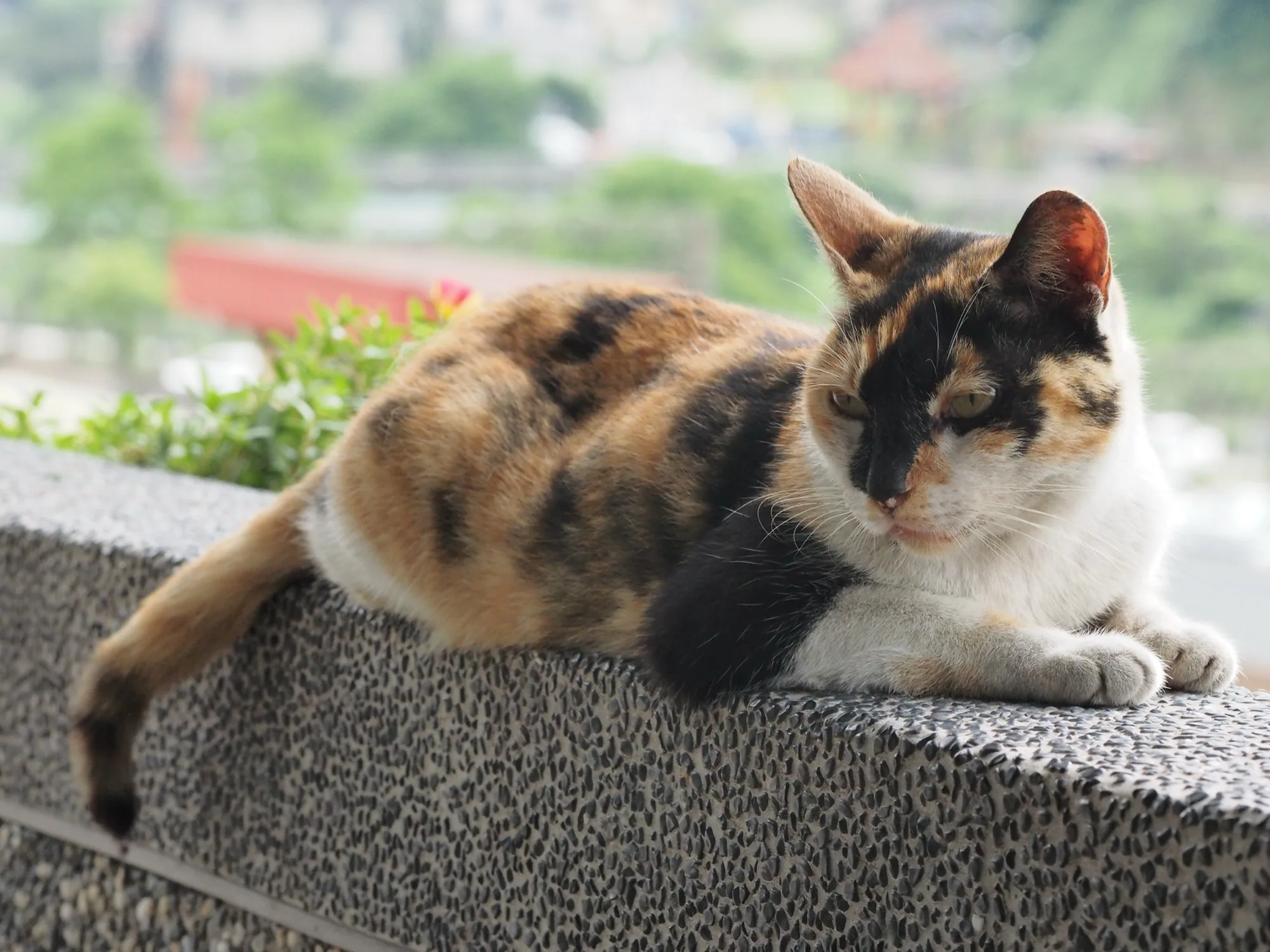
A Houtong street cat in 2015 — a calico looking back at the camera on stone steps. From the New Taipei City Animal Protection Office's TNVR launch in 2015 to the present, every registered cat has a number and a microchip record. This is what Houtong's mountain town can truly leave behind, beyond the "Cat Paradise" brand. Photo: Sun Taro. CC BY-SA 2.0 via Wikimedia Commons.
In 2021, the New Taipei City Animal Protection Office established the "Houtong Cat Office Preparatory Office" in a former Taiwan Railways Administration dormitory, with an exterior painted in "Ruifang Gold" tones echoing the mining landscape.26 It was officially unveiled on April 29, 2024, with an orange cat named "Dorayaki" voted in as the first director.27 At the time, there were 172 registered cats.
The exterior features an electronic display showing the cats' locations, and the interior links to eight animal shelters for adoption. The name "Cat Office" places "office" (local government unit) alongside "cat" — treating stray cats as "residents" in the local administrative sense.
On March 26, 2025, the Cat Bridge underwent major renovation and reopened. Work included bridge reinforcement, steel beam replacement, painted aluminum panel updates, component rust removal and repainting, lighting improvements, and restoration of cat platforms and seating.28 Due to TRA safety regulations, most work was done at night (1:00–4:00 AM), with only 3 hours of work time per day.
📝 Curator's Note: The "fire tag" was a wooden placard miners hung at the pit entrance, marking whether a person was still inside. The "microchip" is the digital marker TNVR implants in every registered cat. Both transform things that can't be turned into tourist spectacle (miner life and death / street cat lives) into visible proof of existence.
But in early 2026, an unexpected counter-signal emerged. The Cat Office, operated by a private contractor commissioned by the city government, saw the "contractor terminate the agreement early" due to environmental management controversies25 — "after the site closed, care and tourism routes also experienced a disconnect."25 The entire TNVR + adoption + education infrastructure requires sustained manpower and funding, and this part hasn't been sustained by local residents the way the Miners' Cultural History Museum was.
"Cat Village Disappearing" vs. "The Cat Office Should Breed" — The Polarized Split of 2026
On January 21, 2026, Mirror Weekly reported "Houtong Cat Village Faces 'Extinction'! From a Peak of 300 Cats Plummeting to Only 30," citing three main reasons: TNR sterilization policy, natural cat aging, and tourists feeding unknown meat paste affecting cat health.25 In the same month, TVBS, ETtoday, TaiSounds, and CTWANT followed up.29 A Day Magazine on January 23, 2026, took an even sharper stance: "Houtong Cat Village Is About to Disappear: Once Named a 'World Cat-Watching Destination' by CNN, But Animals Should Never Be Human Toys."30
Guangfu Village Chief Zhou Jin-yi proposed a solution — the Cat Office should be responsible for breeding cats, implanting microchips, and managing them.31
This proposal immediately drew backlash from the animal protection community and the public.
People who had already adopted cats said: "If the Cat Office is an animal protection education base that also does TNR and adoption for stray cats, starting to breed cats for the sake of a 'feature' already violates the original purpose of the Cat Office's establishment." "The decrease in Houtong's cat population means fewer and fewer cats are living as strays. I don't understand why this good thing is seen as failing to meet social expectations."31
Chen Chung-hsing, Deputy Director of the Animal Protection Division at the Ministry of Agriculture, stated: "Generally speaking, cats cannot be privately bred unless an application is submitted to the local animal protection authority with a detailed breeding plan and facility management plan. It must also comply with the 'Specific Pet Industry Management Regulations,' and only after approval can breeding proceed."31 The legal framework clearly blocks the direction of "breeding cats to restock."
The significance of this split isn't about who's right or who's wrong. It's that it formally lays open the question of "what exactly is Houtong."
If Houtong is a "cat village" — then the cat population dropping to 30 is a crisis, and the village chief's breeding proposal is logically valid (even if legally impermissible).
If Houtong is a "TNVR policy implementation base + animal protection education center" — then the cat population dropping from 300 to 30 is a policy success, and the village chief's proposal violates the original intent.
If Houtong is a "mining heritage settlement + mountain town" — then cats are just one identity this place has had over the past 17 years, and the next identity needs to grow from the Miners' Cultural History Museum, the coal preparation plant, and the river valley landscape.
Three answers correspond to three different "next steps."
Miners' Cultural History Museum, Coal Preparation Plant 2022 + 2025, Four Keelung River Settlements
Clues to the next identity are already there.
In 2019, retired miners including Zhou Chao-nan pooled their monthly pensions of a little over NT$3,000 to lease and renovate the former Ruisan Main Mine office, serving as their own guides, and established the "Houtong Miners' Cultural History Museum."32 They wrote the slogans and life wisdom passed down orally inside the pit onto the walls — "Work carefully in the pit, for yourself, for the mine, for your family." "Going into the pit to dig coal — your life is half at risk. The half at risk is about fighting; if you fight, one dies; if you don't fight, the whole family dies." "When the acacia wood screams, people need to get out fast."5 Those are the real voices of this valley from before 1990.
In September 2022, the Ruisan Coal Preparation Plant, after three years of restoration in the spirit of "restoring the old as old," reopened. It won the 2022 Golden Quality Award in Public Works and attracted nearly 500,000 visitors in its first year.33 In 2025, Phase II restoration broke ground, with a total budget of NT$114 million (NT$57 million central + NT$57 million local), focusing on restoration of machinery relic spaces and outdoor environmental beautification.34
Placing "Miners' Cultural History Museum (self-built) + Coal Preparation Plant (joint central-local investment) + Cat Bridge (NT$18 million) + Cat Office" side by side — the infrastructure investment accumulated in Houtong over the past 16 years represents one of the few complete samples of a Phase 1 (viral fame) → Phase 2 (patching up) → Phase 3 (multiple identities) cycle among Taiwan's mining heritage settlements.
Zooming out further, looking upstream along the Keelung River, you can see four sister settlements with different choices:
Jinguashi took the "Gold Ecological Park" eco-museum path (starting 2004), integrating Japanese-era dormitory districts, mining heritage, and natural ecology into an eco-museum.
Jiufen took the "shopping street tourism" path, where old street and coal mining memories are layered over with teahouses, taro ball shops, and the ghost of Miyazaki's Spirited Away.
Pingxi took the "sky lantern blessing" path, transforming from a mining settlement into a New Year's Eve blessing landmark, but facing transition pressure in 2026 over environmentally sustainable materials.
Houtong took the "single influencer IP" path — a photographer's lens saved a mountain town, and then TNVR had to come patch up this "good intention that couldn't stop."
None of them is the "right answer." The four are four samples of local revitalization at Taiwan's mining heritage settlements.
📝 Curator's Note: What makes Houtong special is that it's the only one that clearly went through the complete cycle of Phase 1 (viral fame) → Phase 2 (patching up), leaving a record that can be learned from. Including what was done right (TNVR control + coal preparation plant rebirth + self-built cultural history museum) and what was done wrong (abandonment waves + tourist harm + Cat Lady's exhaustion from being exploited).
From Fire Tag to Microchip, the Mountain Town's Next Identity
On the day the Ruisan Main Mine closed in 1990, miners hung up the last fire tag. "As long as the person is here, the tag is here" is the museum's core phrase today — a wooden placard witnessing whether a person survived.
When the Cat Office opened in 2024, every registered cat was implanted with a microchip — a digital version of the fire tag.
But by 2026, Houtong has only 30-something "cat fire tags" still transmitting signals.
The miners' tags were proof of whether a person was alive or not; the cats' microchips are a record that "we know this life is still here." Both transform things that can't be turned into tourist spectacle (miner life and death / street cat lives) into visible proof of existence.
What truly disappeared wasn't the cat village — it was the "local revitalization model propped up by a single influencer IP."
When Cat Lady withdrew in 2014, she said "only when people are taken care of can the animals possibly be better." The "people" she was referring to then were the people of Houtong crushed by the tourism narrative over five years — including herself.
The next identity — perhaps the Miners' Cultural History Museum sustained by Zhou Chao-nan and his peers, perhaps the 2025 Phase II of the coal preparation plant, perhaps something not yet invented — needs to grow from beside these 30-something microchips. Starting not from the cat village, but also not from erasing the cats' existence. It's about letting this mountain town, beyond "cats," recover the memories ignored for 19 years before 1990, and the possibilities not yet unfolded after 2026.
It's the same water of the Keelung River.
Further Reading:
- Jinguashi — Sister settlement upstream on the same Keelung River, mining heritage transformed via the "Gold Ecological Park" eco-museum path
- History of Taiwan Railways — The Pingxi Line railway, opened in 1920, is the physical backbone of the tourism corridor linking Houtong, Pingxi, Jingtong, and Shifen
- Stray Animal Culture in Taiwan — The Taiwan context of TNVR policy implementation; Houtong is one of the few successful cases
- Zoos and the Ethics of Exhibition Animals — "Cat tourism" and the same animal ethics tensions as zoos and aquariums
- Sky Lanterns — The Pingxi Sky Lantern Festival faces the same "local economy vs. animal protection / environmental responsibility" tensions in mining heritage settlement transformation
Image Credits
This article uses 3 Wikimedia Commons CC-licensed images, all cached in public/article-images/geography/ to avoid hotlinking:
- Keelung River Valley Mountain Town Landscape (hero) — Photo by CharlieDigital (Wikimedia Commons), April 1, 2016. License: CC BY-SA 4.0.
- Houtong Street Cat Close-up (scene-mid 1) — Photo by Sun Taro (Wikimedia Commons), May 3, 2015. License: CC BY-SA 2.0.
- Houtong Street Scene Silhouette (scene-mid 2) — Photo by lienyuan lee (Wikimedia Commons), 2015. License: CC BY 3.0.
References
- Cat Lady's Facebook Withdrawal Statement — Liberty Times Transcript — July 24, 2014: Chien Pei-ling's original Facebook post with "endlessly exploiting the cats, exploiting me, exploiting Houtong" and "starting in July, we are officially withdrawing from here," quoted verbatim in the Liberty Times report.↩2
- CNN — Six travel hotspots where cats rule — CNN Travel, November 2013: original article listing Houtong among the "six best cat-watching destinations in the world," alongside Rome's Largo di Torre Argentina, Japan's Tashirojima, Ainoshima, Turkey's Kalkan, and Florida's Hemingway House.↩23
- Cat Lady's Post-Withdrawal Reflections — Culture Journal — Post-withdrawal reflection interview, including the original quotes "I once thought I was indispensable" and "only when people are taken care of can the animals possibly be better."↩234
- Ruisan Main Mine Closure on May 1, 1990 — PTS Our Island — PTS Our Island report on Ruisan Mining's official closure on May 1, 1990, peak production in 1970 accounting for one-seventh of Taiwan's total output, and over 1,500 miners (correcting v1's "July closure").↩2
- Houtong Miners' Cultural History Museum Pit Slogans and Tours — Museum Island — 2023 in-depth Museum Island interview including "as long as the person is here, the tag is here," "work carefully in the pit," "when the acacia wood screams" — complete collection of miners' orally transmitted slogans, guided by Zhou Chao-nan.↩2
- Ruisan Coal Preparation Plant History — National Cultural Memory Bank — National Cultural Memory Bank detailed account of 1920 Yilan Line opening + Keelung Coal Mining Corporation building a modern coal preparation plant + 1934 Lee Chien-hsing leasing and reorganizing Ruisan Mining, complete timeline.↩
- Lee Chien-hsing Wikipedia — Mining magnate Lee Chien-hsing's family background: leasing the mining rights Mitsui abandoned in 1934 to establish Ruisan Mining Company.↩
- Houtong Population Curve and Coal Era — Li Wen Blog — Rapid growth after the 1920 coal preparation plant during the Japanese colonial period; peak population of 25,000+ during the 1960s–70s mining boom; dropped to under 1,000 after 1990 closure.↩
- Wikipedia — Houtong Cat Village — Includes Chien Pei-ling's first visit to Guangfu Village in 2009, the October 31, 2009 "With Cats by Your Side, Houtong Is Most Beautiful" campaign launch, at least 10 cat abuse cases in June 2013, early abandonment waves, and complete background.↩
- Wikipedia — Chien Pei-ling — Cat Lady Chien Pei-ling: born in Taoyuan in 1969, photographer, husband is a veterinarian, first visit to Guangfu Village in 2007 for material, intensive documentation from 2008–2009, complete background.↩2
- Wikipedia — Houtong Cat Village (same as ^9) — Record of the October 31, 2009 "With Cats by Your Side, Houtong Is Most Beautiful" cat-loving event launch.↩
- GVM City Studies — Houtong Visitor Curve — Complete curve data from approximately 500 visitors in January 2010 to nearly 1 million visitors in 2017.↩23
- New Taipei City Tourism — Houtong Cat Bridge — Completed March 30, 2013, NT$18 million cost, world's first human-cat shared overpass, coal mining tunnel imagery + coffee-brown cat form, Golden Quality Award in engineering, complete details.↩
- The Pet City — Japanese Cat Islands vs. Houtong Comparison — Tashirojima: domestic cats introduced in the 1600s for silkworm pest control / Ainoshima: symbiosis with sardine fishery from 1617 / "Islanders never actively developed tourism" contrasted with Houtong's tourism-spawned cat population.↩
- Wikipedia — Houtong Cat Village (same as ^9) — Includes early abandonment waves causing mass street cat infections and deaths, at least 10 cat abuse cases in June 2013, average street cat lifespan of 3–5 years, complete data.↩234
- Environmental Information Center — Houtong Feline Distemper Outbreak, July 2012 — July 7, 2012: three adult cats plus several kittens died within a week, suspected to have been infected by abandoned cats brought in as disease vectors, complete report.↩
- CNA — Ms. Huang's Cat Abandonment Case Total Fine of NT$110,000 — April 2022: Ms. Huang, who found her cat too aggressive, abandoned it in Houtong with her boyfriend, captured on surveillance camera; animal protection office checked app records; total fine of NT$110,000, complete timeline.↩
- GVM City Studies — Tourist High-Salt Treats and Kidney Failure — Veterinarian warnings about high-salt/high-phosphorus meat paste treats straining cats' kidneys, many cats suffering kidney failure at a young age, complete background.↩
- Wuo-Wuo "The Beauty and Sadness of Cat Village" Series — Local volunteer Sister Ka vs. tourist "then tell the vendors downstairs not to sell them" dialogue; Black Coal Cat Rescue volunteer Xiao Pei's "dogs are fed this way all the time, how much can a cat eat" quote; in-depth series report.↩2
- Lin Hung-chi — The Rise of Cat City: The Construction of Cat Tourism Landscape in Houtong, New Taipei City — National Taiwan University master's thesis, 2016; academic analysis of cat economy commodification/symbolization/anthropomorphization + "marginalizes certain residents, other animals (such as dogs), sick and abandoned cats, mining village memory and identity," complete argument.↩
- Cat Lady's July 2014 Withdrawal Controversy — Housefun — Chien Pei-ling's five years of dedication led to withdrawal intentions after controversy (accused of exploiting cats / unwilling to save cats / sending cats to shelters), complete background.↩
- Cat Lady's September 2014 Post-Withdrawal Interview — Housefun — Post-withdrawal position: "The cats in Houtong were always street cats, not house cats," distinguishing street cat vs. house cat conceptual correction.↩
- TaiSounds — Complete Houtong TNVR Data — New Taipei City Animal Protection Office launched TNVR in June 2015, completed 189 sterilizations by November 2015, 240 cats in first half of 2016, reached 274 in June 2017, complete curve data.↩234
- CNA — Cat Office Unveiled April 29, 2024 — Officially unveiled after three years of preparation; orange cat "Dorayaki" voted first director; 172 registered cats at the time.↩
- Mirror Weekly — Houtong Cat Village Faces "Extinction" — January 21, 2026 report: "from a peak of 300 cats plummeting to only 30," three reasons (TNR sterilization + natural aging + tourist feeding harm) + "Cat Office contractor terminated agreement early" + "care and tourism routes experienced a disconnect," complete current situation.↩234
- New Taipei City Animal Protection Office — Houtong Cat Office Preparatory Office — Established in 2021, former TRA dormitory, exterior "Ruifang Gold" tones echoing mining landscape, background.↩
- CNA — Cat Office "Dorayaki" First Director (same as ^24) — Same article includes exterior electronic display showing cat locations + links to eight animal shelters for adoption function description.↩
- New Taipei City Tourism — Cat Bridge 205 Renovation and Reopening — March 26, 2025 major renovation and reopening, nighttime construction 1:00–4:00 AM, 3 hours of work time per day, complete engineering record.↩
- TVBS — 200 Cats Now Only 30 — January 2026 follow-up report on "cat population plummeting" frame, with TVBS / ETtoday / TaiSounds / CTWANT reporting in parallel the same month.↩
- A Day Magazine — Houtong Cat Village Is About to Disappear — January 23, 2026 sharp-positioned in-depth commentary: "animals should never be human toys" frame.↩
- UBrand — Should the Cat Office Breed Cats — Guangfu Village Chief Zhou Jin-yi's proposal "the Cat Office should be responsible for breeding, microchip implantation, and management" + public rebuttal "violates the Cat Office's founding purpose" + Ministry of Agriculture Deputy Director Chen Chung-hsing's statement "cats cannot be privately bred," complete controversy collection.↩23
- Smile Taiwan — Houtong Miners' Cultural History Museum — 2023 Smile Taiwan quarterly report on retired miners including Zhou Chao-nan pooling monthly pensions of a little over NT$3,000 to lease and renovate the former Ruisan Main Mine office, serving as their own guides, complete story.↩
- UDN — Ruisan Coal Preparation Plant Phase I Reopening — Opened September 2022, three years of "restoring the old as old" restoration, 2022 Golden Quality Award in Public Works, nearly 500,000 visitors in the first year, complete record.↩
- UDN — Coal Preparation Plant Phase II Groundbreaking — 2025 Phase II restoration groundbreaking, total budget of NT$114 million (NT$57 million central + NT$57 million local), focus on machinery relic space restoration and outdoor environmental beautification planning.↩