
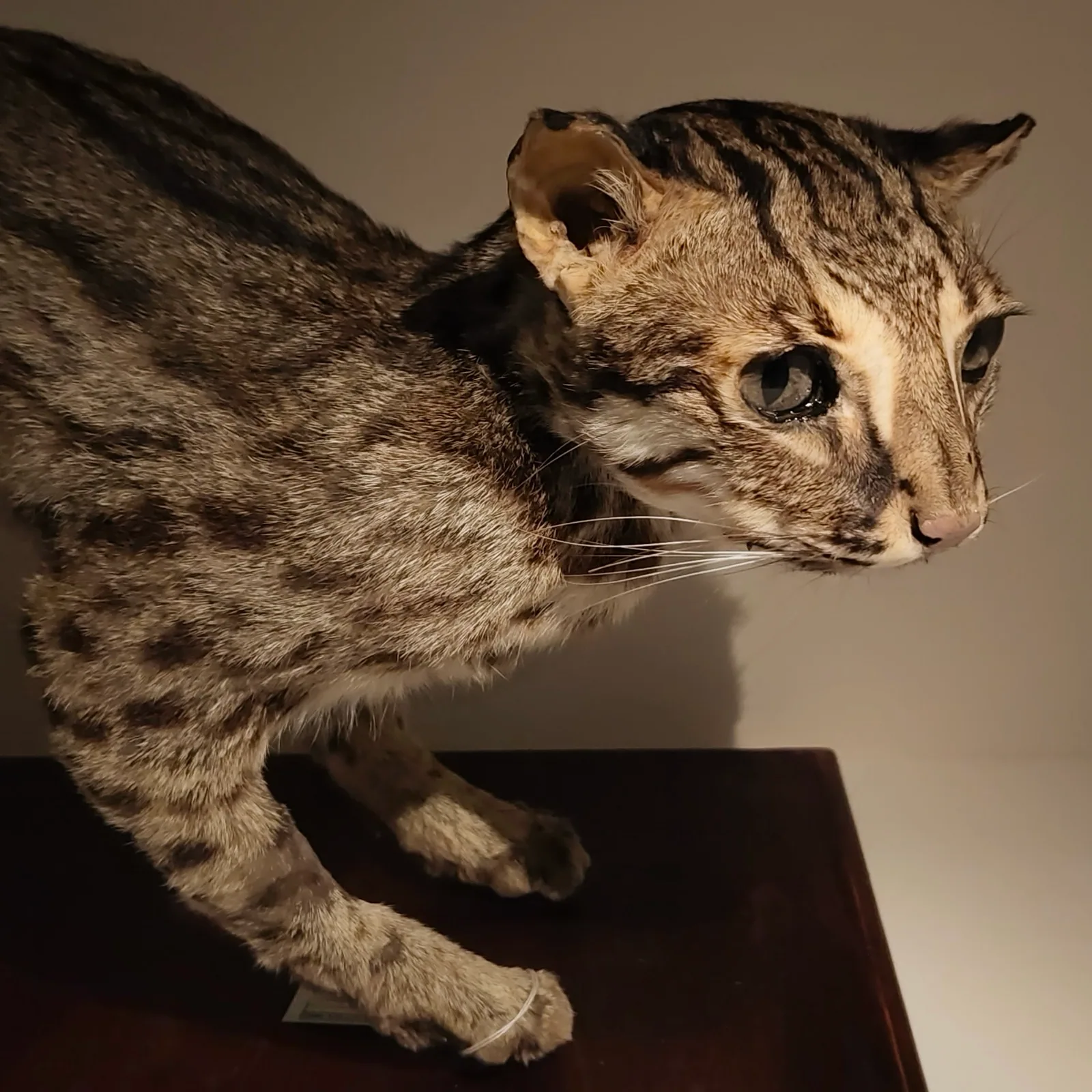
30-second overview: In 2013, the year Twelve Nights was released, tens of thousands of shelter dogs in Taiwan were still euthanized each year. On February 6, 2017, Taiwan became East Asia’s first zero-culling country. Eight years later, at six o’clock on the evening of May 11, 2023, a rewilded young leopard cat was bitten to death by a free-ranging cat in Miaoli, reducing by one a species with only 400 to 600 individuals left across Taiwan. The Ministry of Agriculture’s 2022 survey found 159,697 free-ranging dogs nationwide1, with stray cats likely adding several hundred thousand more. Animal protection advocates and wildlife conservationists stand on the same mountain, yet see completely different worlds. In fact, they are looking at the same problem: owners who do not sterilize their animals, people who abandon them, and people who feed them on the mountain’s edge. This article does not take sides. It is about a question this island is still learning how to answer.
Why It Matters
Taiwan’s stray animal story is a mirror.
It reflects how a society moved from the indifference of “out of sight, out of mind” toward an awakening that “their lives are lives too.” That process was driven from the bottom up by a film, groups of volunteers, and wave after wave of social-media movements. It shows something about Taiwanese society: when citizens decide to care, institutions are forced to catch up2.
But there is another side in the mirror. Eight years after zero culling, the density of free-ranging dogs on the streets has not meaningfully fallen, records of leopard cats killed by dogs in the low-elevation foothills have continued to accumulate, and among individuals tracked by the Ministry of Agriculture’s Biodiversity Research Institute, more than half of recorded deaths were dog-related3. Animal protection groups and wildlife conservation scholars began clashing in the media. Critics asked: “Have we used a well-intentioned policy to shift costs onto voiceless wild animals?” Supporters asked: “Are we supposed to go back to an era when tens of thousands of dogs were killed every year?”
How a country treats the most voiceless lives often says something about how it treats all marginal beings. But this time, the most voiceless may not be the dogs on the street.
Twelve Nights: A Film That Changed a Country
The Countdown in the Shelter
Before 2013, Taiwan’s public animal shelters operated a cruel but “legal” system: after stray animals were captured and sent to a shelter, if no one reclaimed or adopted them within 12 days, they would be euthanized.
It was not only the sick who died. Those no one wanted died.
Every year, tens of thousands of healthy dogs and cats reached the end of that 12-day countdown. Shelter staff cared for animals while also carrying out euthanasia, and many ultimately broke down themselves. Some veterinarians resigned because they could no longer bear the daily pressure of killing; some even developed post-traumatic stress disorder.
Giddens Ko’s Gamble
On November 29, 2013, a documentary was released.
Twelve Nights was directed by Raye Huang and produced and financed by the well-known writer Giddens Ko4. Ko was famous for writing about killers, romance, and youth; he had not originally been an animal protection advocate. But he had adopted a dog rescued from a shelter. He said, “I could not pretend I did not know.”
The film has no narration and no sermonizing. The camera simply stays inside the shelter, quietly recording the dogs’ 12 days.
When they first arrive, they still wag their tails, thinking someone is taking them home.
On the third day, they begin to stop eating.
On the seventh day, their eyes change.
By the twelfth day, many viewers can no longer see the screen through their tears.
Twelve Nights grossed more than NT$50 million at the box office, an astronomical figure for a documentary. More importantly, it turned “shelter euthanasia” from an issue within animal protection circles into a source of public anger.
Director Raye put the entire film on YouTube in 2020, and it remained freely available on the official Twelve Nights channel through 2025 — the reasoning: let these 92 minutes keep doing what they are meant to do; every additional viewer is one more dog that might be adopted:
Twelve Nights official channel: full documentary (92 min.) directed by Raye in 2013, produced by Giddens Ko. No interviews, no narration — just 12 days of a countdown assembled in footage. This film turned “public shelter euthanasia” from an animal-protection issue into a national issue, providing the popular-opinion basis for the 2015 legislative amendment and 2017 zero-culling policy.
From Tears to Law
In January 2015, the Legislative Yuan passed amendments to the Animal Protection Act on third reading, explicitly stipulating[^4]:
Public animal shelters shall stop administering humane treatment (euthanasia) to sheltered animals, with a two-year grace period.
On February 6, 2017, “zero culling” formally took effect.
One film, two years of advocacy, one law. Taiwan’s stray animal history was divided into “before Twelve Nights” and “after Twelve Nights.”
Fanfan’s Ear: A Mark on the Street
If you see a dog or cat on a Taiwanese street with a small notch missing from one ear, that is the mark of a story. It is the sign left by TNR, not an injury.
TNR stands for Trap, Neuter, Return: stray animals are captured, sterilized, ear-tipped for identification, and then returned to where they were found. Later, the official version in most counties and cities added vaccination, becoming TNvR; the additional “v” stands for Vaccinate. The logic is simple: if you cannot kill them all, then stop them from reproducing. After one generation, two generations, three generations, the population will naturally decline.

_Stray cats that have completed TNR surgery have one ear tip clipped as a marker. This ear-tip mark allows volunteers and animal protection officers to identify from a distance that “this one has already been sterilized,” avoiding repeated capture. Photo: Yu Tae-wook, 2016. License via Wikimedia Commons._
Taiwan’s TNR was first promoted spontaneously by private animal protection groups, operating in a legal gray area. After the 2015 amendment to the Animal Protection Act, TNR was finally formally incorporated as a policy tool5. County and city governments began allocating budgets and cooperating with animal protection groups to carry out large-scale TNR.
The Unwritten Rules of Community Cats and Dogs
Behind TNR lies an entire system of community ecological management. Surgery is only the starting point.
In many Taiwanese communities, there are so-called “feeders,” residents who regularly feed stray animals. They place food at fixed times and fixed locations every day. Between these feeders and TNR volunteers, there is an informal but long-running cooperative system:
- Feeders observe the animals and report new faces
- Volunteers bring humane traps, capture the animals, and send them for sterilization
- After sterilization, the animals are returned, and feeders continue caring for them
- If an animal is suitable, volunteers take photos and look online for adopters
This system has no official documents, yet it quietly operates in countless Taiwanese communities. Its driving force is each auntie’s inability to look away.
After Zero Culling: The Problems Really Began
The Real Weight of a Beautiful Promise
The spirit of zero culling is moving, but reality soon bared its teeth.
No longer culling meant that animals in shelters only entered and did not leave unless they were adopted. But not every dog is “cute” enough to be adopted. Those too old, too large, too aggressive, or not appealing enough in appearance may end up living in the shelter forever.
Exploding shelter capacity was the first problem. Taiwan has 32 public shelters, many of which already had insufficient space. After zero culling took effect, some shelters held two to three times their approved capacity. Too many dogs were packed into metal cages, and fighting, infectious disease, and stress behaviors began spreading6.
The Nantou County Stray Dog Care Association pointed out that the Nantou shelter has long been over capacity, and official announcements suspending the intake of new dogs and cats have become routine6. Some people began asking: “Is letting them live in suffering really more humane than euthanasia?”
There is still no standard answer to this question. But it has forced Taiwanese society to face a deeper issue: whether we have the capacity to pay for our own good intentions.
The Invisible Wounds of Shelter Workers
Few people notice that shelter workers bear the heaviest burden in this entire system.
Before zero culling, they were forced to carry out euthanasia and were called “executioners.” After zero culling, they had to care for more and more animals in overloaded environments and were criticized with “why don’t you take better care of them?” No matter how policy changed, the people on the front line were always attacked from both sides.
In 2016, Chien Chih-cheng, a veterinarian at Taoyuan City’s Xinwu Animal Protection and Education Park, chose to end her life after enduring long-term psychological pressure from euthanasia and public criticism7. The drug she used was the same one she normally used to euthanize animals.
The incident shook Taiwanese society. People suddenly realized that while they argued over animal rights, almost no one had ever truly cared about the mental health of those asked to implement the system.
📝 Curator’s note: The legal basis for zero culling is written very briefly: “stop administering humane treatment to sheltered animals,” twelve Chinese characters in the original statute. But behind those twelve characters were the breakdowns of shelter staff, the exhaustion of private rescue volunteers, and the strained budgets of nonprofits. The cost of a law is never only what is visible at the moment it passes.
“Adopt Instead of Buying”
The Social Engineering of a Slogan
In Taiwan, the phrase “adopt instead of buying” has penetrated public consciousness to roughly the same degree as “keep garbage off the ground.” You may not follow it, but you have certainly heard it.
What the phrase changed was overall social perception, including consumer behavior. Ten years ago, keeping a purebred dog was a status symbol. Now, if you brag on social media about just spending NT$80,000 on a French bulldog, you may be roasted in the comments until you delete the post. Conversely, if you post a photo of a mixed-breed dog brought home from a shelter, the comments will fill with hearts and “that’s wonderful.”
This is a reversal of social values launched by no single person but participated in by everyone.
The term “mix” (mikesi, from “Mix,” meaning mixed-breed dog) is itself a product of Taiwan’s animal protection culture. Invented by online communities, it repackaged “mixed breed” into something with a name, an identity, and a life worth remembering8.
The Pet Shop Dilemma
Pet shops’ display-and-sale practices remain under the scrutiny of animal protection groups, because impulse consumption is often the first step toward abandonment. Legal businesses are strictly regulated, but illegal breeding operations, commonly called “breeding factories,” still exist. There, female dogs are treated as production machines, litter after litter, until their bodies can no longer withstand it. Retired breeding dogs are rescued by animal protection groups if they are lucky; if not, they are abandoned in the mountains and become new stray dogs.
This is a policy whack-a-mole. Every time one operation is shut down, another opens somewhere else.
School Dogs and School Cats: A Distinctive Form of Life Education
Taiwan has an educational practice rarely seen elsewhere in the world: allowing stray animals to live on school campuses.
These dogs and cats, from shelters or the street, are adopted by schools and become “school dogs” or “school cats.” They have their own beds, students responsible for caring for them, and sometimes even their own Instagram accounts.
This is living life education, far more concrete than the five Chinese characters in a textbook that say “love and protect animals.”
Children learn that:
- When the animal does not want to be touched, you cannot touch it
- When the animal is sick, it needs to see a doctor, and seeing a doctor costs money
- When the animal grows old and dies, you must learn to face loss
Around 700 schools across Taiwan have school dogs or school cats9. In 2019, the Ministry of Education even held an “Outstanding School Dog Campus” selection10.
In an education system that places heavy weight on exam scores, making room for a stray dog to teach children what “responsibility” means is itself something deeply Taiwanese.
The Death of a Leopard Cat: Two Hours Between Life and Death
The story begins at six o’clock in the evening on May 11, 202311.
That day, residents in Miaoli found an orphaned young leopard cat. The person who found it even sent photos to county government staff. In the photos, the young leopard cat was healthy and fluffy, its pupils still bright.
Two hours later, the young leopard cat was sent to the wildlife rescue station of the Endemic Species Research Institute.
The cause of death was an attack by a free-ranging cat; it had died from massive bleeding in the neck11.
“This is the everyday life of Taiwan’s wild leopard cat population, of which only about 400 to 600 remain.” That is how PanSci’s 2023 in-depth report described it11.
Nor is it only leopard cats. The same report noted that as many as half of protected pangolins admitted to rescue stations had tail injuries from bites by free-ranging dogs11. When pangolins encounter danger, their instinct is to curl into a ball with their scales facing outward. For predators, the scales are hard to bite through. But the tail, which cannot retract into the scales, becomes the entry point for canine teeth.
They Outnumber Any Native Carnivorous Mammal
In 2022, the Ministry of Agriculture’s national free-ranging dog population survey released one number: 159,697 dogs1.
That number exceeds the population of any native carnivorous mammal in Taiwan11. On this island, free-ranging dogs have become the medium-sized carnivore with the highest density.
A 2017 study in Biological Conservation found that free-ranging dogs have become a major threat to at least 188 endangered species worldwide12. In Taiwan, Academia Sinica’s Catalogue of Life in Taiwan also updated dogs and cats in 2022 from “alien species” to “invasive alien species”13. This is a legally significant reclassification.
In 2019, Professor Yen Shih-ching of National Tsing Hua University published a study in Scientific Reports showing that in the Greater Taipei area, including Yangmingshan National Park, the presence of free-ranging dogs did indeed reduce wildlife diversity14. “Pangolins, masked palm civets, muntjacs, wild boars, ferret-badgers, small Indian civets, and hares, among other animals, must avoid contact with free-ranging dogs in order to survive,” PanSci summarized11. On Shoushan in Kaohsiung, the muntjac population has even faced a localized extinction crisis because of free-ranging dogs11.
Qiug哥, Amber, Xihu哥, Yong哥
These are the names of leopard cats.
They were tracked individuals released by the Ministry of Agriculture’s Biodiversity Research Institute, each carrying a transmitter. Then they died.
- Qiug哥: Released in Jiji around the Mid-Autumn Festival in 2022 and died 15 days later. Swabs from surface wounds tested positive for canine nucleic acid; the body had multiple traumas and severe internal bleeding3
- Amber: Tracked for 217 days, then killed by dogs in an open grassland at the end of 2022. “There were no trees at the death site where it could hide,” said Lin Yu-hsiu, a leopard cat researcher at the Biodiversity Research Institute
- Xihu哥: Died in the Zhuoshui River channel in Zhushan, near many traces of human feeding
- Yong哥: Suspected to have been fatally chased and bitten by dogs allowed to roam by local residents. The responsible owner was an elderly person living alone; the dogs had no pet registration and were not sterilized
As of August 2023, among the leopard cats released and tracked by the Biodiversity Research Institute, 15 had died, and 8 of those deaths were caused by dog attacks3. The overall statistics: 21 confirmed cases of leopard cats killed by dogs, plus 4 suspected cases3. During the same period, from 2019 to August 2023, there were 124 recorded leopard cat roadkills3. In other words, dog attacks have already become the second leading cause of death for leopard cats, after roadkill.
💡 Did you know? A leopard cat attacked by free-ranging dogs may survive with an invisible time bomb inside it. Research by Chen Chen-chih of National Pingtung University of Science and Technology found that the canine parvovirus positivity rate among live leopard cats was 30.6%, while among carcasses it was as high as 59.2%15. Even more alarming: leopard cats infected with canine parvovirus had a 25-fold higher risk of roadkill15. The virus slows their reactions, impairs their balance, and reduces their ability to avoid cars. In other words, the virus does not necessarily kill them directly, but it pushes them into the middle of the road.
Dogs at 91% of Activity Sites
The Leopard Cat Association of Taiwan used automatic cameras to conduct a survey in leopard cat activity hotspots. The result was concise enough to make calm difficult:
At sites where leopard cats were photographed, dogs also visited 91% of them; only 9% of sites were safe.16
Leopard cat researcher Lin Yu-hsiu put it even more bluntly: “All the dogs seen along the Maoluo River were unsterilized. Not a single one had an ear tip clipped.”3 Ear tipping is the mark of TNR. If a dog appearing in the mountains has no ear tip, it means that dog has never been incorporated into management by any official or private organization.
“Because humans refuse to bear the burden, we throw all of it into places without people, and wildlife bears it instead,” Lin Yu-hsiu said3.
That sentence needs to be read again.
Zero culling protects the animals inside shelters, the animals people can see. But those thrown into the mountains, abandoned at the end of farm roads, or left with “kindness” at trailheads are not recorded, not numbered, and not included in any statistics. After “humans refuse to bear” them, they become costs shifted from cities to forests.
The Counterproductive Effects of Feeding
Many people who feed stray animals do so because they cannot bear to watch them suffer. But scientists have found a counterintuitive fact.
“Once you feed them, you allow dogs to survive well. But at the same time that dogs survive well, wildlife cannot survive well. So feeding, in fact, makes the problem worse,” said Chen Mei-ting, secretary-general of the Leopard Cat Association of Taiwan3.
PanSci’s 2023 in-depth report also noted: “When humans carry out TNR on stray cats in cities and continue supplying food, the number of cats not only does not decrease, but increases instead. A stable food supply eliminates the pressure on cats to forage and instead attracts new cats from the surrounding area.”11
“Our compassion for strays will be directly transformed into cruelty toward wildlife; it gives them more strength and more capacity to compete with wild animals.”11
TNR Is Not a Cure-All
Eight years after zero culling, TNR and TNvR have become the mainstream tools for managing dog populations.
But the scientific community has long questioned their effectiveness.
Research by Chen Chen-chih, associate professor at the Institute of Wildlife Conservation at National Pingtung University of Science and Technology, found that dog population dynamics are extremely complex, with frequent emigration and immigration. As many as 52.9% of individual dogs appeared in only one survey period during the study and then disappeared or died15. “Even if you can raise the sterilization rate very high for a period of time, it will fall again very quickly,” Chen said15.
“Simply doing TNR may have very limited effect, while requiring a great deal of time, money, and effort to achieve a very, very limited result.”15
Lin Yu-hsiu’s criticism is sharper: “TNvR, which has become the main dog population management tool after the current zero-culling policy, is unlikely to be effective. It may even itself be a practice that weakens owner responsibility. Unless we reexamine current policy tools and more actively confront source control and feeding problems, it will be impossible to reverse a losing situation for humans, dogs, and wildlife alike.”3
Yuguang Island: A Case Both Successful and Failed
Yuguang Island in Tainan is often cited as proof that TNvR can succeed.
The island originally had more than 80 free-ranging dogs. With assistance from the city government, a TNvR program began in 2011. By 2015, the free-ranging dog population had fallen below 5011.
It sounds like a neat victory.
But PanSci’s report added the second half of the sentence: “The good times did not last. The later impression of this ‘dog island’ as a place where stray dogs were returned instead turned it into a site where owners secretly abandoned dogs. Because it was difficult to prevent outside free-ranging dogs and abandoned dogs from moving in, reducing the birth rate was useless.”11
Yuguang Island tells us one thing: TNvR is not a standalone solution. It is more likely to work only when paired with a small population and a closed area.11
Taiwan’s low-elevation foothills have no closed areas.
TNSA: Replacing R with S+A
In recent years, more and more animal protection and wildlife conservation scholars have argued that TNR should be upgraded to TNSA: replacing “Return” with “Shelter + Adoption”11.
The logic is this: sterilization only addresses the birth rate. It does not address the fact that, after being returned to the original habitat, the animals continue attacking wildlife. Only sheltering and adoption truly remove the problem from the ecosystem.
But TNSA presupposes an extremely difficult condition: there must be enough shelter capacity, and adoption culture must be able to support it. Most of Taiwan’s current 32 public shelters are already over capacity. Although the adoption rate has risen from 16% in 2012 to more than 80% in recent years, large numbers of dogs still spend the rest of their lives in shelters each year.
Changing R to S+A means building more shelters, or sharply reducing the number of returned animals and accelerating adoptions. Either path requires money, people, and political will.
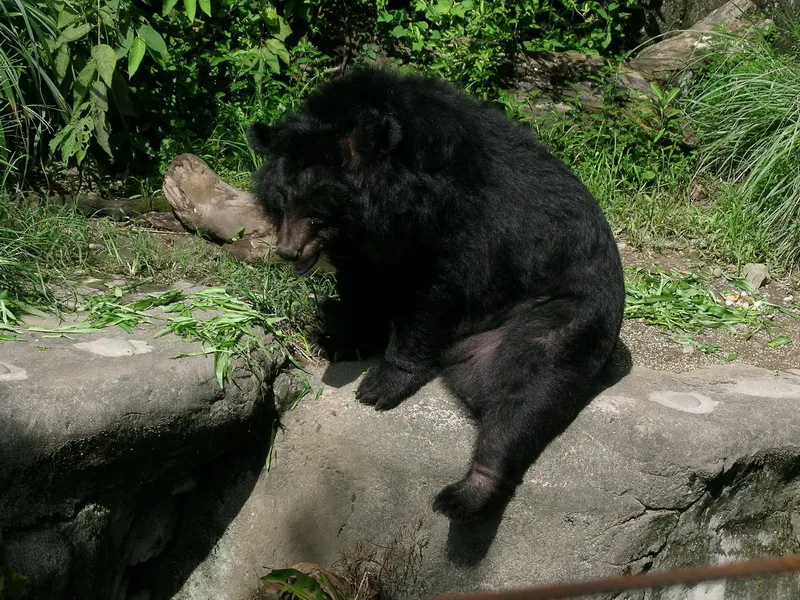
The Formosan black bear is an indicator species of Taiwan’s mountain forest ecosystems, identifiable by the white V on its chest. In an April 2025 statement, the Forestry and Nature Conservation Agency said that the Formosan black bear population has “increased by severalfold compared with 20 years ago” and that its “frequency of occurrence below 1,200 meters above sea level has also significantly increased”17. But low elevations are precisely where free-ranging dog density is highest. Photo: smartneddy, 2007. License via Wikimedia Commons.
The Gray Zone in the Policy Triangle
Eight years after zero culling, Taiwan has slowly come to see one thing clearly: this issue does not fall under only one competent authority.
- Animal Protection Department, Ministry of Agriculture (formerly the Bureau of Animal and Plant Health Inspection and Quarantine): responsible for the Animal Protection Act, public shelters, and TNR policy
- Forestry and Nature Conservation Agency, Ministry of Agriculture (formerly the Forestry Bureau): responsible for the Wildlife Conservation Act and free-ranging dogs on national forest compartments
- Ministry of Environment / National Park Service: responsible for ecological management inside national parks such as Yushan, Taroko, Shei-Pa, and Kenting
The problem is that free-ranging dogs do not follow road signs. A dog can walk from a township road into a national forest and then from the national forest into a national park. Every change in land jurisdiction changes the competent authority, and each agency’s responsibilities both overlap and leave gaps.
The Ministry of Agriculture’s animal protection division listed five work items: “feeding management with prohibition as the goal, community communication, household dog management, community free-ranging dogs, and relocation of feral dogs.” The Forestry and Nature Conservation Agency also promised: “If the area in this project is a forest compartment under its ownership or jurisdiction, it will be handled as a priority, such as through patrols or reporting.”11
That is what is written on paper. In practice, PanSci’s report summarized reality in one sentence: “In the gray zone between the Wildlife Conservation Act and the Animal Protection Act, existing management measures also lack enforcement capacity.”11
Miaoli’s Two Inspectors
The most concrete expression of this gray zone is enforcement capacity.
Miaoli County has the highest leopard cat density in Taiwan, and it is also where free-ranging dogs are most easily abandoned in the low-elevation foothills. But Chang Chun-yi, director of the Miaoli County Animal Protection and Health Inspection Office, gave one number: Miaoli County has only 1 to 2 animal protection inspectors3.
“Basically, just handling the reports and complaints received every day may already be more than we can finish,” Chang said3.
Owners who do not sterilize their animals can be fined tens of thousands of New Taiwan dollars, equivalent to one or two months’ salary for most people. But Chang admitted: “The person issuing the ticket is under great pressure.” Everyone in a township knows one another. If you fine a neighbor’s dog today, you still have to keep living together tomorrow.
“As long as someone is feeding them, it may start with one or two dogs, then become three or five, and then become a whole group. The more they are fed, the more there are,” Chang said3.
Five Years at Yongheshan Reservoir vs. 50% to 90% Sterilization on the Owner Side
Near Miaoli’s Yongheshan Reservoir, nearly 1,000 free-ranging dogs were captured and relocated over the past five years3. But Chang Chun-yi was candid: “The pace of capture and sterilization falls far behind the pace of dog reproduction caused by feeding by kind-hearted residents, as well as abandonment, free-roaming ownership, and other factors.”3
Lin Yu-hsiu also pointed out the counterproductive effects of government relocation operations: “Originally, a dog captured might have been a solitary individual. But the government may release 7 to 9 dogs at once. We are instead restoring their wolf-like instinct to form packs!”3
What about the source?
The HOTAC Animal Protection Association conducted household sterilization surveys from 2020 to 2023 in leopard cat hotspots in Miaoli and Taichung. It visited more than 4,600 households and recorded about 8,000 dogs, with each household keeping an average of one to two dogs3.
- Initial sterilization rate for female household dogs: 50% to 60% in places such as Yuanli, Houli, and Waipu3
- After repeated visits and intervention by the association: household dog sterilization rates rose to 90%3
- But 10% of owners still refused sterilization3
- Dogs brought forward during visits that already had microchips: only 3% to 4%3
“According to residents’ reports of where the dogs came from, nearly half either came on their own or were picked up outside,” said HOTAC project manager Chang Yi-hao3.
These numbers tell us: owner sterilization rates, pet registration rates, and abandonment rates are the source. Zero culling addresses the fate of dogs already captured and sent into shelters, but it does not address why those dogs were cast out in the first place.
The Trolley Problem: Animal Protection and Wildlife Conservation Face the Same Question
At this point, we must address a narrative trap: portraying “animal protection” and “wildlife conservation” as two opposing camps.
In fact, neither side is monolithic.
Diverse voices on the animal protection side:
- Chen Yu-min, deputy executive director of the Environment & Animal Society of Taiwan, has said: “As for hotspot removal, I think this is the government’s way of appeasing both sides. In the long term, it will not succeed.”3 She then asked: “Returning to the largest premise: should dogs be roaming outside?”318
- Chiang Yi-ju of the Taiwan Society for the Prevention of Cruelty to Animals worries about whether dogs captured afterward can be adopted, and who will ensure their quality of life after sheltering
- Huang Tai-shan of the Taiwan Cat Dog Human Association has said: “When people make many claims in a state of ignorance about stray cats and dogs, those claims may not solve the problem and may instead create problems”
Diverse voices on the wildlife conservation side:
- Lin Yu-hsiu, a leopard cat researcher at the Biodiversity Research Institute, argues that TNvR weakens owner responsibility and needs to be reexamined
- Chen Mei-ting, secretary-general of the Leopard Cat Association of Taiwan, believes feeding is the root cause that makes the problem worse
- Chen Chen-chih of National Pingtung University of Science and Technology says TNR has limited effect because dog population dynamics are too complex
PanSci’s 2023 report framed this opposition from PanSci’s perspective:
“In this complex issue battlefield, it appears that the wildlife conservation and animal protection camps have long been competing against each other. But if we set aside the binary framework, both sides are in fact people who care about animals. Years of disputes between different routes have left the situation completely deadlocked, and both sides have become increasingly polarized.”11
PanSci cited a metaphor: “The Ministry of Agriculture is as if trapped in a trolley problem! This shows that the free-ranging dog issue has long since exceeded the scope of a scientific problem and become a political problem.”11
The original trolley problem is this: a runaway train is heading toward five workers. You can pull a switch to divert it onto a track with only one worker, but doing so would actively kill that one person. Taiwan’s version is this: zero culling saved dogs in shelters, but the same well-intentioned track ran over species in the mountains that would not be seen.
⚠️ Contested view: This article does not take sides. But if readers still ask after finishing it, “So do you support animal protection or wildlife conservation?” then the question itself is the “binary framework” PanSci described. There are five variables that can actually move: owner sterilization rates, pet registration rates, penalties for abandonment, feeding management, and shelter capacity. Move any one of them, and the numbers for both animal protection and wildlife conservation will improve together.
The Jaipur Story in India
Jaipur, India, is often cited as an international success story for TNvR.
Over the eight years from 1994 to 2002, Jaipur carried out TNvR on nearly 25,000 free-ranging dogs. Sixty-five percent of female dogs were sterilized and vaccinated. The population ultimately fell by 28%11—not 100%, but local human rabies cases fell to zero11, making it a celebrated case from that perspective.
Jaipur’s key factors were: (1) eight years of political will, (2) high sterilization coverage, (3) integrated management with rabies vaccination, and (4) small, relatively closed urban areas.
Every one of those conditions is harder to achieve in Taiwan than in Jaipur.
✦ “Politics is compromise. Perhaps we should not pursue the best solution, but a relatively better one that allows us to keep going. Complex problems have no simple answers.” — Concluding words of PanSci’s 2023 in-depth report11
The Height of the Mountains and the Height of Dogs

Yushan Main Peak, 3,949 meters above sea level, one of the main habitats of the Formosan black bear. Photo: PirateTseng, 2024-10-29. License via Wikimedia Commons.
The Forestry and Nature Conservation Agency’s April 2025 statement noted that the Formosan black bear population has “increased by severalfold compared with 20 years ago” and that its “frequency of occurrence below 1,200 meters above sea level has also significantly increased”17. The same statement acknowledged that although the black bear “remains listed as an endangered wild animal, the population is no longer in danger of extinction”17.
But low elevations are precisely where free-ranging dog density is highest.
Zero-culling policy protected the dogs inside shelters. The same well-intentioned track also shifted certain costs from the city onto unseen species in the mountains.
Striking Facts
The numbers behind Taiwan’s stray animal issue are often more startling than intuition would suggest. From street density to policy milestones, these data sketch the scale and depth of Taiwan’s animal protection movement, as well as what it still has not solved.
Zero culling has been in place for eight years. Twelve Nights was released thirteen years ago. The Animal Protection Act has existed for twenty-eight years. But the numbers below tell us that this island’s relationship with this issue is far more complex than any single policy can explain.
Here are several key facts worth noting:
- 🐕 Taiwan has about 159,697 free-ranging dogs nationwide, according to the Ministry of Agriculture’s 2022 survey1, exceeding the number of any native carnivorous mammal in Taiwan
- 🐈 Cumulative leopard cat deaths caused by dogs: 21 cases as of August 2023, confirmed, plus 4 suspected cases3
- 📊 Dogs visit 91% of leopard cat activity sites, leaving only 9% of sites safe16
- 🦠 Leopard cats positive for canine parvovirus have a 25-fold higher risk of roadkill15
- 🎬 Twelve Nights grossed more than NT$50 million, making it one of the highest-grossing documentaries in Taiwanese history
- ✂️ More than 100,000 TNR surgeries are performed across Taiwan each year
- 🏫 About 700+ schools have school dogs or school cats
- 🌏 Taiwan is the first country in East Asia to implement a zero-culling policy5
- 🌍 In 2022, Academia Sinica’s Catalogue of Life in Taiwan updated dogs and cats from “alien species” to “invasive alien species”11
- 🐕🦺 Miaoli County has only 1 to 2 animal protection inspectors3 to handle the free-ranging dog problem across the entire county
- 📋 Globally, 188 endangered animal species identify free-ranging dogs as a major threat, according to a 2017 Biological Conservation study11
A Question This Island Has Not Finished Answering
Taiwan’s stray animal story is not a story about a “problem solved.”
It is a story about “a society learning to care.” From the shock of Twelve Nights, to the promise of zero culling, to the everyday practice of TNR, to the things school dogs teach children, every step has been imperfect, and every step has carried costs. But every step has genuinely moved forward.
It is just that when the 2017 law placed a full stop, no one wrote the questions that came after it: “What about the mountains? What about the leopard cats, pangolins, muntjacs, and masked palm civets?”
At six o’clock on the evening of May 11, 2023, that young leopard cat was still alive. In the photo sent to the county government, its eyes were still bright. Two hours later, it was gone.
Those street dogs, with one ear tip missing, lie in the sun outside breakfast shops. They do not know that they were once protagonists in policy debates, documentaries, and social media. Nor do they know that somewhere on a mountain trail, a species with only about 500 individuals left in all of Taiwan lost one more because human kindness had been shifted into the forest.
The next question this island must answer is not “animal protection vs. wildlife conservation.” It is how owner sterilization rates can go from 90% to nearly complete, how penalties for abandonment can actually be issued, how feeding management can keep “compassion” from becoming cruelty toward wildlife, how shelter capacity can catch up with the needs of TNSA, and how gaps in the policy triangle can be closed.
Complex problems have no simple answers. But the question has already been written.
Further Reading:
- Leopard Cat Conservation in Taiwan — The protagonist species in the 21 dog-kill cases discussed in this article, with fewer than 500 individuals remaining across Taiwan and habitat in the low-elevation foothill mosaic
- Formosan Black Bear — An indicator species of the Yushan ecosystem and another front line after free-ranging dogs spread into low-elevation areas
- Taiwan’s Pangolins — Half of the individuals admitted to rescue stations have tail injuries caused by free-ranging dog bites
- Bird Window Strikes in Taiwan — Another invisible cost imposed on wildlife by human-built environments
- Zoos and the Ethics of Performing Animals — Another side of animal welfare: the dilemmas that arise when humans decide on behalf of animals
- Controversies Over Veterinary Drugs in Taiwan — Ten years into zero-culling policy, the next question this island must face is: what happens when they are sick but cannot access medicine?
Image Sources
This article uses 4 public-domain / CC-licensed images, all cached under public/article-images/society/ to avoid hotlinking source servers:
- Chinese leopard cat specimen — Photo: 丘崈, 2026-02-15, CC0 1.0 public domain, Chinese leopard cat specimen in the collection of the National Taiwan Museum
- Ear-tipped stray cat after TNR — Photo: Yu Tae-wook, 2016-11-18 (cropped 2021-06-18), CC0 1.0 public domain
- Frontal photo of a Formosan black bear — Photo: smartneddy, 2007-08-05, CC BY-SA 3.0
- Yushan Main Peak — Photo: PirateTseng, 2024-10-29, CC BY-SA 4.0
References
- Ministry of Agriculture — 2022 National Free-Ranging Dog Population Survey Report — Results of the 2022 national sampling survey: an estimated 159,697 free-ranging dogs across Taiwan, the latest large-scale official statistics for this issue.↩23
- Ministry of Agriculture Animal Protection Information Network — Explanation of zero-culling policy — Official policy explanation of Taiwan’s 2017 implementation of zero culling, including the context of the Article 12 amendment to the Animal Protection Act and supporting measures.↩
- WuoWuo — An Underestimated Threat: Special Report on Dogs Killing Leopard Cats — WuoWuo’s 2023 in-depth series integrating Ministry of Agriculture Biodiversity Research Institute tracking data and interviews with scholars and practitioners, including Lin Yu-hsiu, Chen Chen-chih, Chen Mei-ting, Chang Chun-yi, and Chang Yi-hao, covering the specific cases of Qiug哥, Amber, Xihu哥, and Yong哥 as well as Miaoli’s enforcement capacity.↩2345678910111213141516171819202122232425
- Twelve Nights — Wikipedia — A 2013 documentary directed by Raye and produced by Giddens Ko, recording the 12-day countdown of stray dogs in shelters and directly helping drive the 2015 amendment to the Animal Protection Act.↩
- Laws & Regulations Database of the Republic of China — Animal Protection Act (2015 amendment) — The Animal Protection Act amendment passed on third reading on January 23, 2015; Article 12 stipulates that public shelters would stop humane treatment beginning in 2017.↩2
- Statement by the Nantou County Stray Dog Care Association — Cited by the Environment & Animal Society of Taiwan, describing the long-term overcapacity of the Nantou shelter and the normalization of suspending new dog and cat intake, revealing the shelter-capacity dilemma after zero culling.↩2
- Reporting on the Chien Chih-cheng incident — Environment & Animal Society of Taiwan — The May 2016 incident involving Chien Chih-cheng, a veterinarian at the Xinwu animal protection park, exposed the long-term psychological trauma endured by shelter workers and helped spur mental health counseling resources for shelter veterinarians.↩
- Animal Protection Information Network — Special topic on mixed-breed adoption culture — Policy promotion and social education resources in Taiwan’s animal protection policy concerning mixed-breed dogs and mikesi adoption culture.↩
- Ministry of Education — Campus Animal Protection Program — Policy basis for school dogs and school cats at more than 700 schools across Taiwan; the “Outstanding School Dog Campus” selection has been held since 2019.↩
- Ministry of Agriculture Animal Protection Information Network — Outstanding School Dog Campus selection — A campus life-education selection jointly promoted by the Ministry of Education and the Council of Agriculture, now the Ministry of Agriculture; about 700+ schools across Taiwan have school dogs and cats.↩
- PanSci — What Makes the Stray Dog and Cat Issue Complex? How Can We Save Stray Dogs and Cats and Endangered Wildlife? — A 7,114-word in-depth report published by PanSci on November 12, 2023, serving as a core reference for this article’s sections on the death of the leopard cat, 91% of activity sites, TNR not being a cure-all, the policy triangle, and the trolley problem. This citation follows the Taiwan.md × PanSci Content Curation MOU of 2026-05-05 and includes direct verbatim quotation.↩2345678910111213141516171819202122
- Doherty et al. (2017), "The global impacts of domestic dogs on threatened vertebrates," Biological Conservation 210: 56–59 — Original international journal article identifying free-ranging dogs as a major threat source for at least 188 endangered animal species worldwide; the academic source cited by PanSci.↩
- Academia Sinica — Catalogue of Life in Taiwan, TaiBNET — Updated by Academia Sinica in 2022, officially changing dogs and cats from “alien species” to “invasive alien species,” the first time Taiwan’s official classification system placed companion animals in an invasive-species category.↩
- Yen et al. (2019), "Pets and pests: A meta-analysis of the influence of free-ranging domestic dogs on wildlife populations," Scientific Reports 9: 15314 — Study by Yen Shih-ching and colleagues published in Scientific Reports on the impact of free-ranging dogs on wildlife diversity in the Greater Taipei area, including Yangmingshan National Park.↩
- Research by Chen Chen-chih, National Pingtung University of Science and Technology — Assessment of Dog Impacts on Leopard Cat Populations — Cited in WuoWuo’s special report; findings include canine parvovirus positivity rates of 30.6% in live individuals and 59.2% in carcasses, a 25-fold increase in roadkill risk after infection, and the disappearance of 52.9% of individual dogs after only one survey period.↩23456
- Leopard Cat Association of Taiwan automatic camera survey — Automatic camera network survey results cited by WuoWuo’s special report: 91% of activity sites where leopard cats were photographed also photographed free-ranging dogs; only 9% were safe sites.↩2
- Central News Agency — Forestry and Nature Conservation Agency: Formosan black bear numbers have increased; population no longer at risk of extinction — April 23, 2025 statement by the Ministry of Agriculture’s Forestry and Nature Conservation Agency, saying the Formosan black bear population has “increased by severalfold compared with 20 years ago” and that its frequency of occurrence below 1,200 meters has significantly increased.↩23
- Environment & Animal Society of Taiwan official website — Position papers and arguments by Chen Yu-min, deputy executive director, and others on TNR / TNvR and source responsibility among owners, arguing that policy should return to owner management rather than hotspot removal.↩