
30-second overview: Gongguan began in the Qianlong reign of the Qing as a "public house" built by Quanzhou Anxi migrants in Quanshanbao to handle trade between Han settlers and Indigenous peoples and to collect tenant rents; the place name has been used for more than two centuries1. On March 16, 1928, the Japanese established the empire's sixth imperial university, Taihoku Imperial University, on the southern edge of this land. Its first president was Shidehara Taira, and the Faculty of Science and Agriculture began classes on April 12. North of the campus gate, the area around Wenzhou Street, Qingtian Street, and Yongkang Street, called Shōwa-chō and Tomita-chō under Japanese rule, was planned after the 1922 neighborhood-name reform as a faculty housing district for the imperial university3. After the war in 1945, the imperial university was renamed National Taiwan University, and the dormitories were taken over for postwar Chinese migrant scholars. Wenzhou Street became a material landscape of postwar Taiwan liberalism and the White Terror2. On November 20, 1949, Free China was founded in Taipei; on September 4, 1960, Lei Chen was arrested; and Yin Hai-kuang was placed under house arrest in the Japanese-style dormitory at 1-1, Alley 16, Lane 18, Wenzhou Street until he died of stomach cancer in 19694. Wistaria Tea House in Lane 16, Section 3, Xinsheng South Road went from the official residence of Customs Administration director Chou Te-wei in 1950 to Taiwan's first humanities-oriented teahouse in 19815. In the 1972-1975 NTU Department of Philosophy Incident, the Kuomintang purged 13 faculty members6. In December 1999, the MRT Xindian line opened, and Gongguan Circle became the dinner ATM for NTU students7. What this article wants to say is this: the Japanese Empire's laboratory, martial-law-era underground salons, and contemporary students' fried chicken cutlets compress three centuries of Taiwan into 500 meters.
Wenzhou Street at 6:30 in the Evening
If you ask an NTU student studying in Gongguan what is special about Wenzhou Street, nine times out of ten they will tell you, "Nothing special, really."
But ask a 70-year-old retired NTU professor, and they will say: 6:30 in the evening.
At 6:30 in the evening, outside Tai Jingnong's former residence at 25 Wenzhou Street, students from NTU's Department of Chinese Literature have just turned in from Section 3, Xinsheng South Road after class. They carry guitars, hold laptops, and bite into pepper buns bought at Gongguan Circle8. Tai Jingnong, the calligrapher who chaired NTU's Department of Chinese Literature for 20 years, Lu Xun's last student, and the writer whose characters were assembled to form the six-character inscription "National Taiwan University" on the campus gate, moved into this Japanese-style dormitory, built between 1935 and 1940, only on May 7, 1990. On November 9, he died of esophageal cancer at NTU Hospital9. Students rarely look up when they pass. They do not know that this old wooden house with an irimoya hafu roof was designated a "commemorative building" only in 20209.
Walk 200 meters north to Lane 18, Wenzhou Street, and at the entrance you will see a small sign for "Yin Hai-kuang's Former Residence." Follow the lane in, turn into Alley 16, and at the end is the Japanese-style dormitory built in 1945: the chair where Yin Hai-kuang sat from 1956 until shortly before his death in 1969 is still in the living room104. After the 1960 Lei Chen case, intelligence officers were stationed for long-term surveillance of this small house. Today the former residence is open free of charge from 1 p.m. to 5 p.m., Tuesday to Saturday; it is closed Monday and Sunday, and reservations are required4.
Walk another 300 meters south to 1, Lane 16, Section 3, Xinsheng South Road. That is Wistaria Tea House. It was an official residence built in the 1920s under Japanese rule; in the 1950s Chou Te-wei brought Hayek's The Constitution of Liberty into it; in 1981 Chou Yu turned it into a teahouse; and in 1997 it was listed as a municipal historic site5. The wistaria trellis at Wistaria Tea House is still in the front yard. It was planted in 1950, the year Chou Te-wei's family of seven moved in, making it the same age as the Republic of China government's retreat to Taiwan.
Along the 500-meter road from NTU's Xinsheng South Road entrance to the end of Wenzhou Street, the doorways of three former residences from three different ages all sit on the same axis. Between them are Gongguan Circle, Tingzhou Road, Section 4 of Roosevelt Road, and NTU's Royal Palm Boulevard.
After walking these 500 meters, you notice one thing: the material formula the Japanese planned in 1928 for an "imperial laboratory" -- campus gate + Royal Palm Boulevard + faculty housing district + surrounding small market streets -- has not been completely demolished over the past century. After the war, scholars turned Japanese-style dormitories into living rooms for underground salons; a philosopher under house arrest taught logic inside one; dismissed academics kept writing books. Then, after the MRT opened in 1999, NTU students came up to eat dinner. Five hundred meters hold down three centuries.
Curator's note: Gongguan plays a different role in the historic-district series from Dadaocheng, Bangka, and Ximending. Dadaocheng emerged through commerce in 1851, Bangka reached its Qing-era height in 1738, and Ximending became a Japanese-period entertainment district in 1896. All three are "market-type" districts, whose material core is commerce and temples. Gongguan is a "campus-satellite type": the entire district is the physical extension of the university established in 1928. South of the campus gate, Roosevelt Road is a commercial belt; north of the gate, Wenzhou Street, Qingtian Street, and Yongkang Street form a scholars' residential belt. This three-layer structure of "campus + dormitories + commercial district" survives intact nowhere in Taiwan except Gongguan. NTU's Royal Palm Boulevard, the Japanese-style dormitory cluster on Wenzhou Street, fried chicken cutlets on Tingzhou Road, and Treasure Hill's illegal housing converted into an artists' village are actually four physical layers of the same empire-martial law-contemporary narrative.
The "Gongguan" of Quanshanbao Was a Tax-Collection House
To understand Gongguan, one must first know that there are actually many places in Taipei with this name. There are "Gongguans" across northern, central, and southern Taiwan because the term referred to houses used to collect tenant rents during Qing rule11. Taipei Gongguan's story begins in the Qianlong reign of the Qing: large numbers of Quanzhou Anxi migrants entered Quanshanbao, an old place name for the southeastern mountain area of Qing-era Taipei, for land reclamation. Their settlement leaders set up a gongguan here, "a house for handling trade between Han settlers and Indigenous peoples, as well as the payment of tenant rents"1. From that moment on, the three characters "Gongguan" were tied to the idea of a "Han frontier / tax-collection station."
But the story did not begin with the Han. In 1729, the seventh year of the Yongzheng reign, when the Hakka leader Liao Jian-yue led a group to reclaim Quanshan and establish Linkou Village, in today's Shuiyuan and Gongguan area, this land was originally within the territory of the Xiulang community of the Ketagalan people. The result was a conflict with Xiulang, with several hundred casualties1. Five years later, Quanzhou Anxi migrants entered the Wenshan area from Dajialabao, expelled the Hakka settlers, and established Gongguan Village. During the five years between 1729 and 1734, this street witnessed three-way armed conflict among Hakka, Hoklo, and Ketagalan communities, with hundreds killed or wounded. This history predates the 1853 Bangka Ding-Xia conflict by 124 years, but because no written record preserves the details, only the three characters "Gongguan Village" remain as a monument.
Gongguan's administrative boundaries are more complicated than one might imagine. It simultaneously crosses Zhongzheng District, Da'an District, and Wenshan District; formerly it belonged to Guting and Jingmei districts1. NTU's main gate is in Zhongzheng District, Royal Palm Boulevard is in Da'an District, Treasure Hill is in Zhongzheng District, Tingzhou Road is in Zhongzheng District, Wenzhou Street is in Da'an District, and Toad Mountain is in Wenshan District. One place name crosses three administrative districts because "Gongguan" was originally a "border-crossing public house": its geographical essence was a functional building on a boundary, not the core of any single administrative district.
Curator's note: Gongguan is more like a functional landscape than a single administrative place name. Under Qing rule it was a tax-collection station; under Japanese rule, the back door of an imperial university; after the war, a scholars' residential district; today, a commercial district. Every era has treated this land as "boundary + passage": from Ketagalan territory to Han-settled land; from Bangka's commercial district to the deep mountains of Wenshan; from inside Taipei city to beyond the Xindian River; from an imperial research district to a mass student-consumption district. The 500-meter scale is just enough to hold the dual quality of "boundary + passage." Any longer and it loses the sense of contact; any shorter and it lacks the feel of a route.
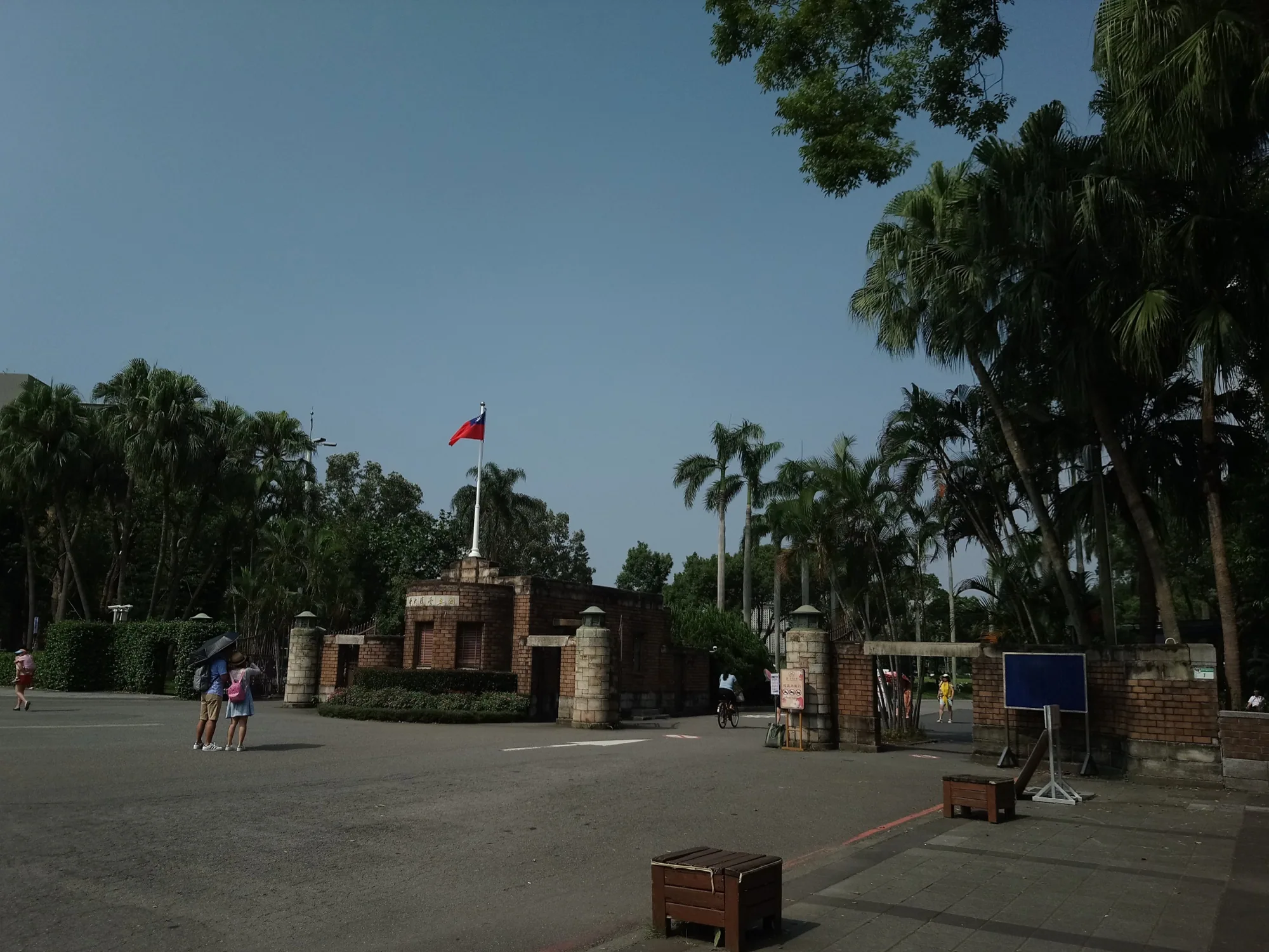
September 2017, National Taiwan University gate. Photo: 寺人孟子, 2017-09-24. License via Wikimedia Commons (CC BY-SA 4.0).
The Imperial Opening Ceremony of 1928
On March 16, 1928, the Japanese Empire's sixth imperial university was formally established on Taipei's southern outskirts.
It was originally going to be called "Taiwan Imperial University," but the Japanese feared that this name might be read as "the university of a Taiwan Empire," so it was ultimately named "Taihoku Imperial University"2. The first president was Dr. Shidehara Taira, whose term ran from March 1928 to September 1937, a full nine years2. At the beginning there were only two faculties: the Faculty of Liberal Arts and Political Science and the Faculty of Science and Agriculture, plus an affiliated specialized division of agriculture and forestry. Classes formally began on April 1 that year2.
The imperial university was sited in Gongguan not because the land had any preexisting academic foundation. It was because in 1922, Taishō 11, the Japanese carried out a large-scale "neighborhood-name reform" in eastern Taipei: fifteen large districts in the western half were redivided into 64 chō, while this farmland east of Xinsheng South Road, originally called Shimo-uchipu, was designated as new neighborhoods such as Shōwa-chō and Tomita-chō3. The name "Shōwa-chō" reveals its planners' intention: it was a high-end residential district planned at the beginning of the Shōwa era, whose first year was 1926.
After the imperial university was established, the Shōwa-chō and Tomita-chō area two kilometers north of the campus gate immediately became the faculty housing district of Taihoku Imperial University. During the 17 years from 1928 to 1945, 95 to 99 Japanese-style wooden residences were built along this axis. Most were detached houses, each 30 to 60 ping, with front and back yards, one or two wooden stories, Japanese black-tile roofs, and clapboard siding known as shitami itabari. This became the physical skeleton of the Japanese-style dormitory cluster that can still be seen today on Wenzhou Street, Qingtian Street, and the eastern side of Yongkang Street12.
Curator's note: When that first group of imperial-university professors moved into Wenzhou Street in 1928, they could not have imagined that Japan would surrender 17 years later. The official residences and housing built by the Taiwan Government-General under Japanese rule met two kinds of fate after the war: some were demolished and rebuilt under urbanization pressure from the 1950s to the 1980s, with large numbers disappearing around Section 1, Zhongshan North Road and Chang'an East Road; others were taken over by postwar Chinese migrant scholars and became postwar cultural salons, as on Wenzhou Street, Qingtian Street, and the eastern side of Yongkang Street. Why did the Gongguan-Wenzhou Street area survive? Because the land's functional attribute did not change. In 1928 it was a university faculty housing district; after 1945 it was still university faculty housing, now for NTU; after 1949 it became housing for postwar Chinese migrant scholars, still university professors. Three regimes succeeded one another, but the land's "functional formula" did not change: it remained a low-density, high-knowledge-concentration residential district around a university. Unchanged function = no need to demolish the material form = a hundred years without being flattened by Xinyi District-style capital.
In 1949, Wenzhou Street Became a "Postwar Chinese Migrant Scholars' Village"
On November 15, 1945, the Republic of China government took over Taihoku Imperial University, first renaming it "National Taipei University" and, a few days later, "National Taiwan University"2. The former imperial-university faculty dormitories immediately faced the question: who would live there now?
In March 1946, NTU's public-property management office began allocating Japanese-style dormitories, including 25 Wenzhou Street, as housing for newly appointed professors in the departments of Chinese literature, foreign languages, and philosophy9. In 1949, the Republic of China government retreated in full to Taiwan, accompanied by more than 100,000 postwar Chinese migrant intellectuals: Lei Chen, Hu Shih, Hsia Tao-ping, Mao Zishui, Fu Ssu-nien, Tai Jingnong, Yin Hai-kuang, Chou Te-wei, Hsu Dau-lin, and Chang Fo-chuan. Some of these names later taught at NTU; some became officials; some ran magazines; some moved across several axes at once.
Their homes mostly fell north of Gongguan, around Wenzhou Street, Qingtian Street, Yongkang Street, Lishui Street, Chaozhou Street, and Jinhua Street: the Japanese-style dormitory cluster left behind from the Japanese-period Shōwa-chō and Tomita-chō area. This land had two special conditions. First, it was within walking distance of NTU and National Taiwan Normal University, convenient for teaching. Second, the Japanese-style dormitory structure of earthen-floored entry space, vestibule, reception room, and study was especially suited to scholars' lives of study plus living room.
There have long been two explanations for the postwar naming of Wenzhou Street. One says that during the 1947 address reorganization, the city government named it after Wenzhou in Zhejiang Province; many postwar Taipei street names were taken from Chinese cities, such as Hangzhou South Road, Shantou Street, and Wuchang Street. The other says that many of the postwar Chinese migrant scholars who moved in were from Wenzhou, Zhejiang, and habitually called the street where they lived "Wenzhou Street," after which the city government incorporated the name. Neither account has a single documentary conclusion, but between 1947 and 1949 the neighborhood name "Tomita-chō" was indeed replaced by "Wenzhou Street."
Yet Wenzhou Street's real historical role lies not in what the street was called, but in how, after the war, it became the cradle of Taiwan liberalism.
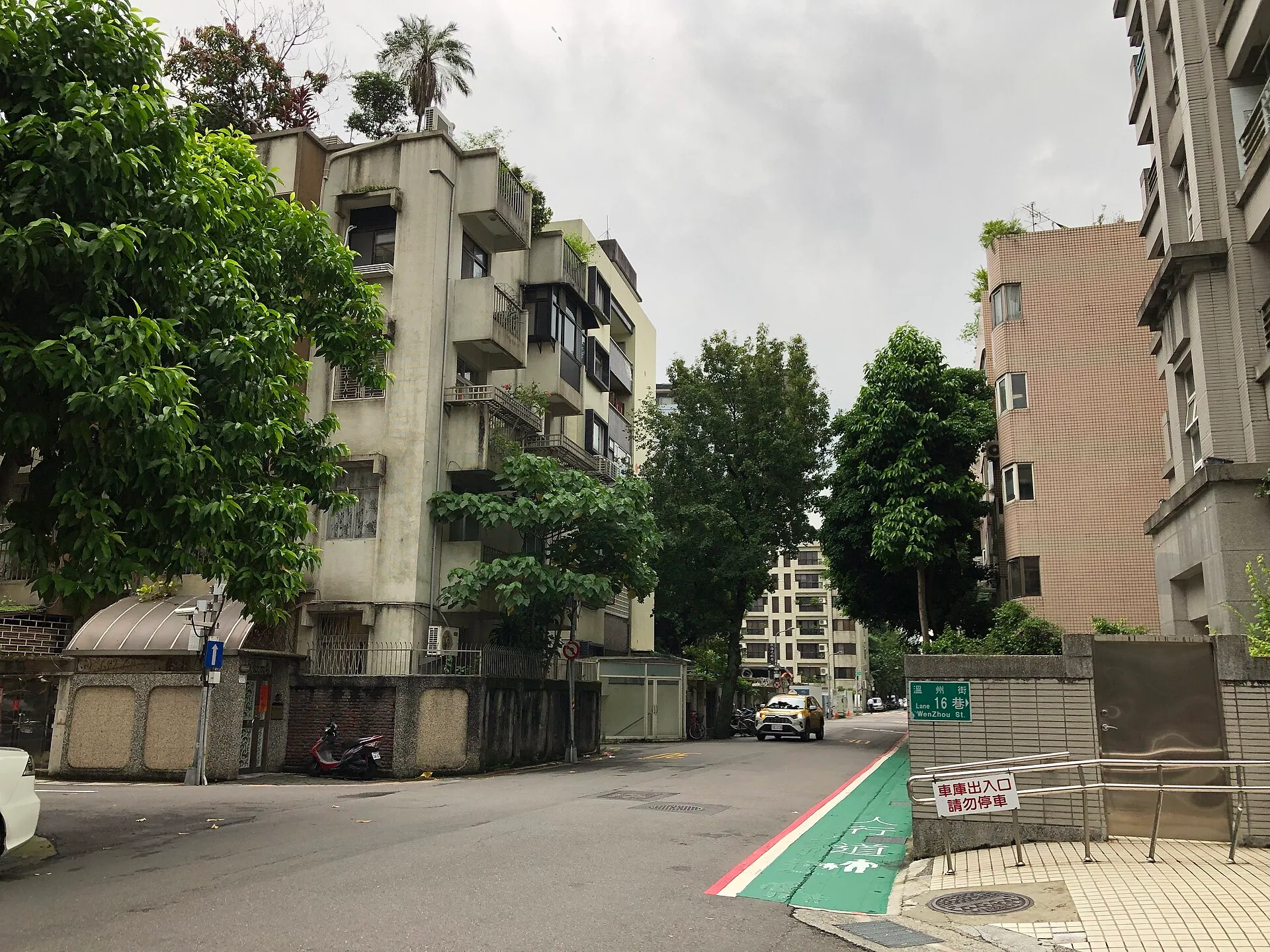
August 2021, Lane 16, Wenzhou Street. Photo: Kiyoteru Awaji, 2021-08-09. License via Wikimedia Commons (CC BY 4.0).
Wistaria Tea House: The Official Residence of 1950, the Teahouse of 1981
In September 1950, the Ministry of Finance allocated the Japanese-style high-ranking official residence at 1, Lane 16, Section 3, Xinsheng South Road, built in the 1920s, to Chou Te-wei, then director of the Customs Administration5. Chou's family of seven moved in.
Chou Te-wei was an unusual figure. Trained as an economist, he studied in Britain and Germany in the 1930s and was taught at the London School of Economics by Nobel laureate Friedrich August von Hayek5. After returning to Taiwan, with one hand he translated Hayek's The Constitution of Liberty, an 800,000-character work; with the other, he regularly hosted academic salons in this official residence on Xinsheng South Road. Meeting once every two weeks, the regular participants included Yin Hai-kuang, Chang Fo-chuan, Hsu Dau-lin, and Hsia Tao-ping, along with more than ten others: Taiwan's liberal scholars of the 1950s, who "systematically introduced Hayek's thought"5.
"Zundexing Studio" was the study name Chou Te-wei gave this residence. The 1958 exchange-rate reform plan led by K.Y. Yin "was completed by Chou Te-wei in this official residence"5.
After Lei Chen was arrested and Free China ceased publication on September 4, 1960, this salon became an even more sensitive presence. Yin Hai-kuang retreated to the small house in Lane 18, Wenzhou Street, where he continued to be watched; Chou Te-wei's living room was also within the field of vision of the intelligence agencies. But the salon did not stop. In 1963, part of the official residence was expanded into a second floor, adding space for receiving guests; that floor later became second-floor seating for the 1980s teahouse.
After Chou Te-wei retired and went to the United States in 1975, his youngest son, Chou Yu, took over the old house5. Chou Yu was then participating in the Kaohsiung Incident-era dangwai movement, and frustrated dangwai figures gathered here one after another. A 1950s liberal salon became, in the second half of the 1970s, the living room of dangwai youth culture.
On January 18, 1981, Chou Yu turned this old house into Taiwan's first humanities-oriented teahouse, "Wistaria Tea House"5. The name "wistaria" came from the wistaria vine planted in the yard in 1950. Founder Chou Yu wrote of "the rediscovery of the natural spirit and the recreation of the humanistic spirit." In 1981, Chiang Ching-kuo was still president and martial law had not yet been lifted; saying the four Chinese characters for "humanistic spirit" in public was not without cost.
But Wistaria Tea House opened on Xinsheng South Road. Saturday afternoons became a regular gathering time for dangwai cultural figures. Hu Shih had been there; Li Ao had been there; Chen Ku-ying had been there; editors of Contemporary magazine had been there. Much of the most important cultural discussion around the lifting of martial law in Taiwan in the 1980s and 1990s happened on the wooden floor of this building's second story.
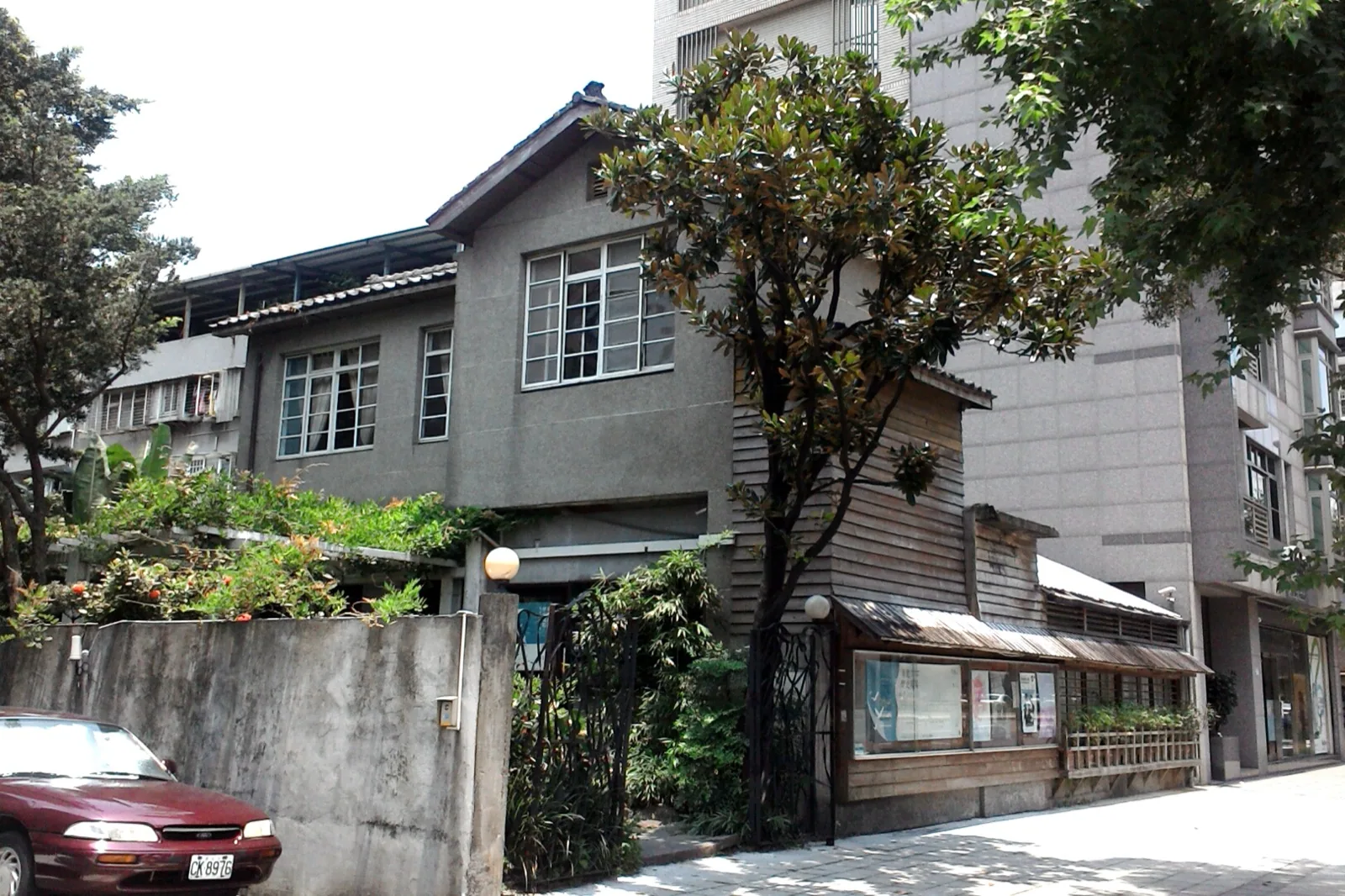
May 2017, exterior of Wistaria Tea House. Photo: 寺人孟子, 2017-05-06. License via Wikimedia Commons (CC BY-SA 4.0).
On July 8, 1997, the Taipei City Government approved Wistaria Tea House as part of the first group of municipal historic sites5. Fifteen days later, on July 23, the Taipei District Court ruled that the Japanese-style bungalow portion should be returned to the Ministry of Finance's Keelung Customs. At the end of 2001, the Customs Administration transferred Wistaria Tea House to the city government as municipal property, making public commissioned operation possible for its revitalization5. Today's Wistaria Tea House remains at its original location, 1, Lane 16, Section 3, Xinsheng South Road. From Chou Te-wei in 1950, Chou Yu in 1981, historic-site status in 1997, and public-private operation in 2001, 70 years of stories are pressed beneath that wistaria trellis.
Curator's note: What makes Wistaria Tea House most special is that its function has never fundamentally changed. In 1950 it was a liberal salon; in 1975 it was a dangwai meeting place; in 1981 it was a humanities-oriented teahouse; in 2026 it is still a place where cultural workers talk over afternoon tea. Compare this with the tea-merchant mansions of Dadaocheng: tea trade in 1891, warehouses after the war, museums after 1990. Each era changed the function. Wistaria Tea House is instead "the same house doing the same thing for 70 years": a group of people sitting down to talk. This kind of functional continuity is almost impossible to find elsewhere in postwar Taipei. The reason is that this salon has never depended on commerce: in 1950 it was an official residence, supported by the state; in 1981 the teahouse did not charge high prices, almost like a subsidy; after 1997, municipal public-private operation supported it with public resources. It has never been cut off by market pressure.
1960 Lei Chen, 1969 Yin Hai-kuang: House Arrest in Lane 18, Wenzhou Street
On November 20, 1949, Free China magazine was founded in Taipei. Its publisher was Hu Shih, nominally; its actual organizer was Lei Chen; and its main writers included Hsia Tao-ping, Mao Zishui, and Yin Hai-kuang413. Yin Hai-kuang, a young man from Hubei not yet 30, born Yin Fusheng, had only recently moved from Nanjing to Taiwan with the Central Daily News. In his luggage were Jin Yuelin's logic lecture notes and his notes on Carnap's analytic philosophy.
Free China ran for ten years and nine months, publishing 260 issues in all13. In its early period, the magazine positioned itself as a member of the anti-communist camp. But Yin Hai-kuang gradually transformed its editorial column into a space for "using logic and empirical facts to test the Kuomintang's own governance and propaganda"4. He wrote "Anti-Communism Is Not a Talisman for Dark Rule," pulling "anti-communism" down from a political totem into a policy that could be examined. He wrote editorials criticizing party-state education, the China Youth Corps, and military interference in speech. In 1950s Taiwan, these articles were taboos among taboos. The White Terror was at its height, and Lei Chen, Fu Cheng, and Hsia Tao-ping weighed every day in the editorial office which sentence might get the magazine raided.
The watershed was 1960. Chiang Kai-shek sought a third presidential term by amending the Temporary Provisions Effective During the Period of Communist Rebellion. Free China published editorials in succession, including "A Final Loyal Warning to President Chiang" and "Why We Urgently Need a Strong Opposition Party," and began organizing a "China Democratic Party" with local Taiwanese political figures such as Li Wan-chu, Kao Yu-shu, and Kuo Yu-hsin4.
On September 1, 1960, Yin Hai-kuang wrote the editorial "The Great River Flows Eastward and Cannot Be Stopped" in Free China, volume 23, issue 5, describing democratization as an irreversible historical tide. Three days later, in the early morning of September 4, 1960, the Taiwan Garrison Command arrested Lei Chen on charges including "knowing of a communist spy and failing to report" and "propagandizing for communist bandits," sentencing him to ten years1314. The magazine ceased publication, and the opposition party died before birth.
Because Yin Hai-kuang held the status of an NTU professor and already had international academic visibility, he was not imprisoned. But from then on he was systematically stripped of all public space for speech.
He retreated to 1-1, Alley 16, Lane 18, Wenzhou Street, Da'an District, Taipei: a Japanese-style dormitory built in 19454. Intelligence personnel were stationed for long-term surveillance. His National Science Council research grant was withdrawn; the Ministry of Education, under the pretext of appointing him to a ministry committee, tried to transfer him away from NTU's Department of Philosophy; later even his promotions were deliberately blocked.
Yet this small house instead became the densest liberal classroom in postwar Taiwan. At NTU he taught courses including "Logic," "Logical Empiricism," "Russell's Philosophy," "Modern Symbolic Logic," and "Philosophy of Science." Outside class, he brought students home for discussions, training them in a whole system of logical positivism: how to distinguish emotive language from cognitive language, how to see through the rhetorical structures of political propaganda, and how to identify falsifiable conditions for a belief4. Lin Yusheng, Chang Hao, Chen Ku-ying, and Li Ao were all part of this circle.
In 1965, Yin Hai-kuang published his career-defining work, The Prospects of Chinese Culture. In 1966, it was banned by the authorities. In April 1967, he was diagnosed with stomach cancer. That same year, Harvard University invited him to the United States to study modern Chinese thought, but the Kuomintang government refused to let him leave Taiwan4. On September 16, 1969, he died of stomach cancer at NTU Hospital, aged 49. His wife, Hsia Chun-lu, and only daughter, Yin Wen-li, buried his ashes in Nangang.
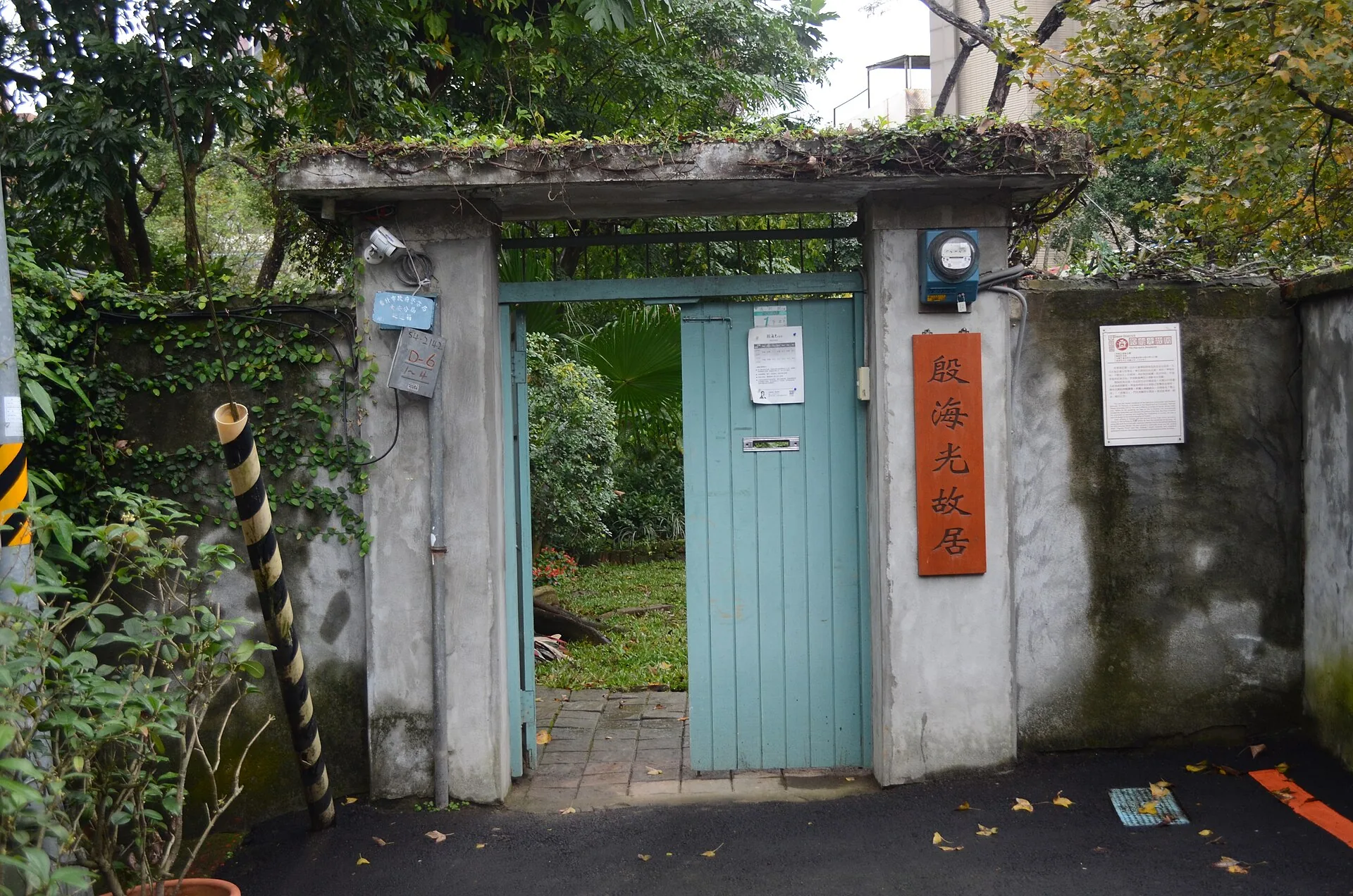
February 2016, gate of Yin Hai-kuang's Former Residence. Photo: 林高志, 2016-02-02. License via Wikimedia Commons (CC BY-SA 4.0).
After his death, the former residence was nearly demolished. Not until May 2003 did the Taipei City Government designate it a municipal historic site4. After the Yin Hai-kuang Foundation was established in 2008, it took over operations. The residence became one of the few thinkers' memorial spaces in Taiwan that is open to the public and preserves its original appearance: inside remain his desk, mimeographed lecture notes, and the original living-room space where he spoke with students4.
Curator's note: The physical details of Yin Hai-kuang's former residence deserve an extra second of attention. This small house, built in 1945, was a late-Japanese-period imperial-university faculty dormitory: wooden, one story, about 30 ping, with front and back yards. A philosopher under house arrest had limited things he could do in this 30-ping space, but he did one thing: he turned the living room into a classroom. Around that square table in the living room, between 1960 and 1969, sat at least Lin Yusheng, Chang Hao, Chen Ku-ying, Li Ao, Hsu Fu-kuan when he occasionally visited, and more than ten young people who later became central figures in Taiwan's intellectual history. What they learned at that square table was not merely the abstract proposition of "liberalism," but the methodology of how to use logic to verify any claim. NTU philosophy students can still read Yin Hai-kuang's lecture notes today. Those notes were spoken at that square table.
The 1972-1975 Philosophy Department Incident: 13 Liberal Professors Purged
After Yin Hai-kuang died in 1969, his students Chen Ku-ying and Wang Hsiao-po continued teaching in NTU's Department of Philosophy. In 1971, the Baodiao movement erupted. Chen Ku-ying served as an adviser to the student magazine University News and the NTU Forum Society, becoming one of the most outspoken liberal teachers on campus.
The incident began on December 4, 19726.
That day, NTU's University Forum Society held a "nationalism symposium" to discuss an article then causing a public sensation, "The Voice of a Petty Bourgeois," a text written under the pseudonym "Lonely Shadow" and expressing the "orphaned loyalist" position, widely regarded as having been prompted by Kuomintang authorities. Philosophy associate professor Chen Ku-ying strongly rebutted the argument of "The Voice of a Petty Bourgeois," and was opposed in discussion by Feng Hu-hsiang, then a second-year graduate student in the philosophy institute6. Chen publicly accused Feng Hu-hsiang of being a "professional student": a student party worker inserted into the campus by Kuomintang intelligence units to monitor other students. Fourth-year philosophy student Chien Yung-hsiang immediately supported Chen.
Feng Hu-hsiang complained to president Yen Chen-hsing. NTU's Office of Student Affairs issued a document requiring acting philosophy department chair Chao Tien-yi to remove Chen Ku-ying from his adviser duties, while Chien Yung-hsiang was given one major demerit for "absurdly slandering a classmate"6.
Second stage: February 12, 19736.
Chien Yung-hsiang and archaeology and anthropology graduate student Huang Tao-lin were summoned for questioning by the Taiwan Garrison Command. The next day, February 13, the Garrison Command searched Chen Ku-ying's residence. NTU philosophy associate professor Chen Ku-ying and philosophy lecturer Wang Hsiao-po were detained by the Garrison Command on the charge of "propagandizing for communist bandits." Although Chen Ku-ying and Wang Hsiao-po were soon released on bail guaranteed by NTU president Yen Chen-hsing, Chen was not given an NTU appointment letter after the semester ended, and Wang was no longer reappointed after June 19746.
Third stage: from June 1973 onward6.
Feng Hu-hsiang, who received a zero on his final exam in logic and believed he had been deliberately targeted, petitioned repeatedly. Philosophy department chair Chao Tien-yi was judged to have handled the matter improperly and was removed. Newly appointed visiting associate professor Sun Chih-shen took over as acting chair, labeled multiple professors "fellow travelers of the communist bandits," and recommended that several faculty members not be reappointed.
The incident widened. Ultimately, a total of 13 people were suspended[^6]:
Chen Ku-ying, Wang Hsiao-po, Yang Fei-hua, Hu Chi-chun, Li Jih-chang, Chen Ming-yu, Liang Chen-sheng, Huang Tien-cheng, Kuo Shih-yu, Chung Yu-lien, Huang Ching-ming, Chao Tien-yi, and the American visiting professor Robert Marsh.
After the final wave of dismissals in June 1975 was handed down, including Huang Tien-cheng and Kuo Shih-yu, the entire faculty structure of the philosophy department had been purged6. NTU's philosophy graduate institute suspended admissions for one year as the conclusion of the "rectification."
The incident is understood as having been launched by the Chinese Nationalist Party's intelligence system to suppress the student-movement tide that rose out of the Baodiao movement; the Garrison Command also intervened in the matter6. In 1997, the incident was officially redressed6.
Curator's note: The deepest harm of the Philosophy Department Incident was not that 13 people were dismissed. It was that after this incident, National Taiwan University's Department of Philosophy never again formed a liberal school of the same density as in the Yin Hai-kuang period. Chen Ku-ying went into exile in the United States, later taught at Peking University, and did not return to NTU until the 2010s; Wang Hsiao-po moved to Chinese Culture University; Chao Tien-yi transferred to Providence University in Taichung. The liberal backbone of NTU philosophy that Yin Hai-kuang built through the 1950s and 1960s was cleaned out within three years. The "nationalism symposium" that triggered the 1973 incident took place in the law college area 200 meters inside the campus gate. Walking from the point where the incident erupted back to Yin Hai-kuang's former residence takes only eight minutes. But after the incident, there was never a second Yin Hai-kuang teaching logic in the living room of Lane 18, Wenzhou Street. A line of transmission was broken within 500 meters.
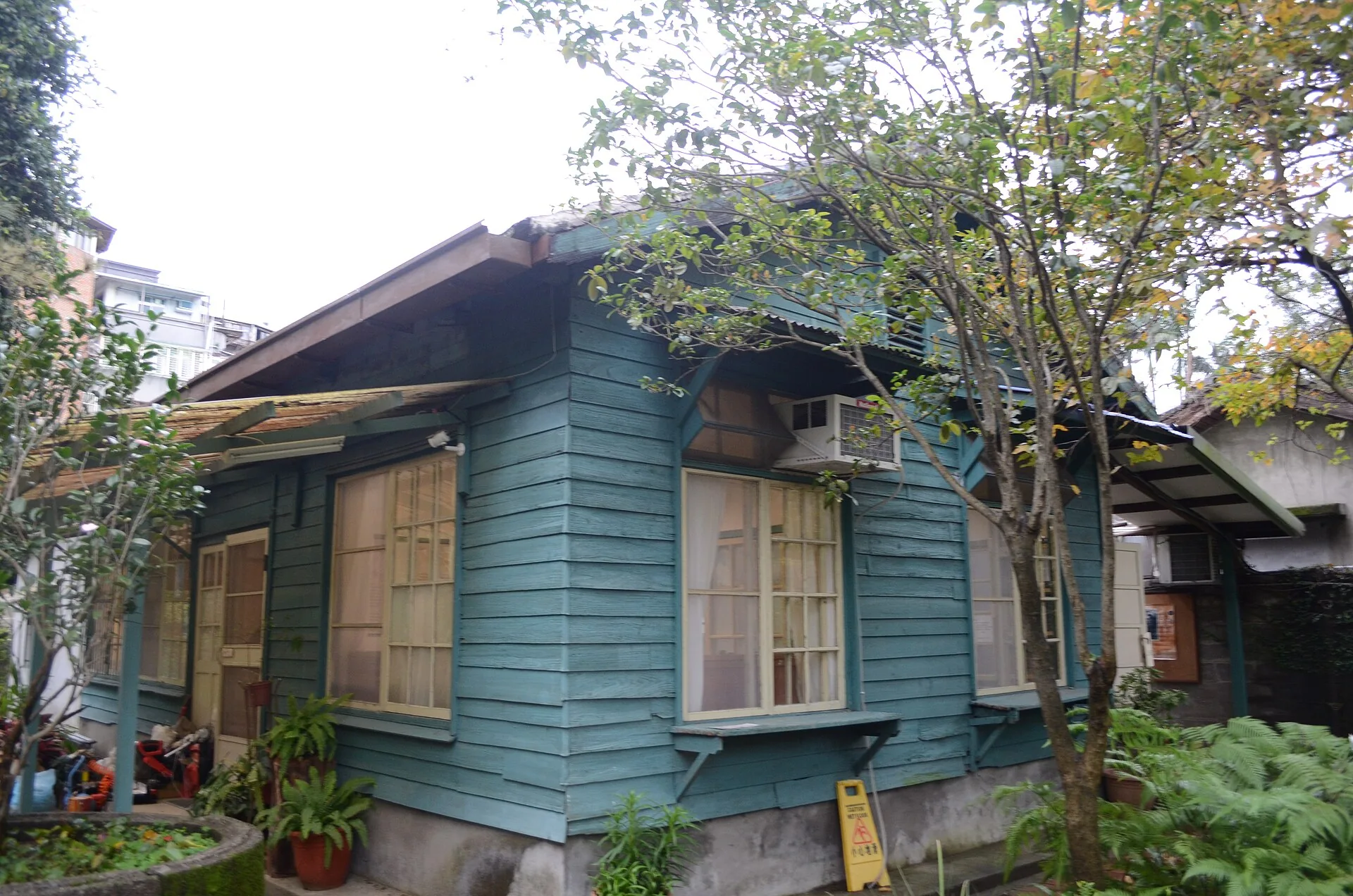
February 2016, back garden of Yin Hai-kuang's Former Residence. Photo: 林高志, 2016-02-02. License via Wikimedia Commons (CC BY-SA 4.0).
1990 Tai Jingnong, 2020 Commemorative Building: 25 Wenzhou Street
After the Philosophy Department Incident had purged the liberals, Wenzhou Street's scholars' village did not become quiet. Two streets away, Chinese literature professor Tai Jingnong still lived at 25 Wenzhou Street after retiring in the 1980s.
Tai Jingnong (1903-1990), courtesy name Bojian, was from Huoqiu, Anhui9. He was one of the six gentlemen of the Weiming Society after graduating from Peking University's Faculty of Letters in the 1920s, and was both student and friend to Lu Xun; Lu Xun mentioned "Jingnong" many times in his diary. After the War of Resistance broke out in 1937, Tai moved through Chongqing and Baisha Women's Normal College to teach. He came to Taiwan after the war in 1946, was appointed professor in NTU's Department of Chinese Literature in 1948, and from 1950 became department chair, a post he held for 20 years9.
Tai Jingnong's calligraphy is another main thread. From childhood he copied stele scripts including Zhang Heinu, Zhang Menglong, Liqi, and Si San Gong Shan; in running-cursive script he learned from Ni Yuanlu, Bada Shanren, and Xu Wei. He mastered seal, clerical, cursive, running, and regular scripts9. The six characters "National Taiwan University" on the pillars of NTU's campus gate were assembled from Tai Jingnong's calligraphy9. Every student who passed through that gate in the 1928 imperial-university era, every student who attended NTU after the war in 1949, and every NTU first-year student in 2026 has seen six characters handwritten by this Anhui man born in 1903.
Tai Jingnong's Wenzhou Street timeline is unusual. He came to NTU in 1948 and, from 1949 onward, lived for decades in another dormitory on Lane 18, Wenzhou Street. Only in May 1990 did he move to 25 Wenzhou Street, the old dormitory closer to the campus gate9. But only half a year after moving in, on November 9, 1990, he died of esophageal cancer at NTU Hospital, aged 879. He named his study "Longpo Zhangshi." Zhangshi abbreviates "a room of one square zhang," a Chan Buddhist term for a small hut that can contain a thousand people.
In 2020, NTU once intended to demolish the Japanese-style dormitory at 25 Wenzhou Street, built between 1935 and 1940. In May 2020, the Taipei City cultural-heritage review committee convened, and all 17 attending committee members agreed to register Tai Jingnong's former residence as a "commemorative building"9. Restoration of the main house was completed in November 2022. A commemorative exhibition opened at the end of 2024.
Curator's note: The registration of Tai Jingnong's former residence as a "commemorative building" came behind a controversy in early 2020 over "NTU wanting to tear down its own history." NTU had originally wanted to demolish this old house and build a new structure. Many cultural figures rushed to call for preservation, and in the end the cultural-heritage review committee unanimously approved preservation by a 17-0 vote9. But the price of this victory was yet another cultural-heritage protection campaign after Yin Hai-kuang's former residence. From Yin Hai-kuang in 2003 to Tai Jingnong in 2020, Wenzhou Street has had to fight a new "preservation battle" every decade or so. The street's material heritage has always been threatened by redevelopment pressure; each preservation is an individual case, not systematic protection. Of the original 95 to 99 buildings in the whole Shōwa-chō Japanese-style dormitory cluster, perhaps only 30 to 50 remain in their original locations today. Most have already been rebuilt into apartment blocks.
Treasure Hill: From Hillside Illegal Housing to Artists' Village
Walk south from NTU's main gate, pass Siyuan Street and the bank of the Xindian River, and you will see a hillside. On the slope is an unimaginably dense cluster of illegal buildings called Treasure Hill1516.
The character yan in the Chinese name Baozangyan means "built against a cliff." Treasure Hill Guanyin Pavilion was first substantially renovated in the 56th year of the Qianlong reign, 1791, with east and west side halls added15. Located below Fuhe Bridge, beside the Xindian River, and leaning against Hukong Mountain, a spur of Toad Mountain, it is one of Taipei's oldest Buddhist temples. It was once a public temple for the Wenshan area and a faith center for Quanzhou Anxi migrants in this district. It is "also historical testimony to Anxi people's opening of Guting, Gongguan, and Jingmei"15.
Treasure Hill's illegal settlement formed in the 1960s. "In the 1960s, the ban on illegal construction loosened, and the military command tacitly accepted the fact that postwar Chinese migrant residents were building illegally around Treasure Hill"16. Postwar Chinese migrant veterans and rural-to-urban migrants from southern Taiwan looking for work in the north built dense sheet-metal and brick houses along the hillside. "By the end of the 1980s, the settlement had reached nearly four hectares in scale and housed more than 200 households"16.
In July 1980, the Taipei City Government formally moved Treasure Hill out of water-source protection land and into Urban Planning Park No. 297 in the waterfront zone, placing the entire area under threat of demolition and relocation16. More than a decade of demolition controversy followed.
In 1999, when Lung Ying-tai served as director of Taipei City's Department of Cultural Affairs, she proposed the concept of an artists' village as Treasure Hill's future operating direction16. It was announced as a historic building in 2004. On October 2, 2010, "Treasure Hill Artist Village" formally began operations16. In 2011, it was announced as Taipei's first historic settlement; in 2018, it was announced as a settlement building complex16.
Today's Treasure Hill, together with 44 South Village and Bopiliao, is one of Taipei's three major cases of illegal housing converted into cultural-creative precincts. But Treasure Hill differs from the other two: it kept original households. "Art-residence cohabitation" is Treasure Hill's official strategy. Illegal-building residents were not all relocated; some stayed and continued living there, sharing the hillside with resident artists. Walk into Treasure Hill at dusk on a weekend, and you will see the lights of artists' studios alongside an elderly woman drying quilts at her own doorway.
Curator's note: Treasure Hill's relationship to the Gongguan-Wenzhou Street axis is that of twins below and above the hill. Gongguan-Wenzhou Street was the legal residential district planned by the imperial university in 1928; Treasure Hill was an illegal settlement of the martial-law era from the 1960s to the 1980s. One was a state-planned scholars' village; the other was a cluster of illegal households tacitly allowed by the state. But the two share things in material form: both are dense low-rise residential areas; both rely on the crowd network of Gongguan Circle to sustain livelihoods; both faced redevelopment pressure after the 1990s; both survived through cultural-heritage protection movements. If Gongguan-Wenzhou Street is the "legal material heritage" planned under Japanese rule, then Treasure Hill is the martial-law era's "illegal material heritage." Both are historical evidence of marginal states; only legality differs.
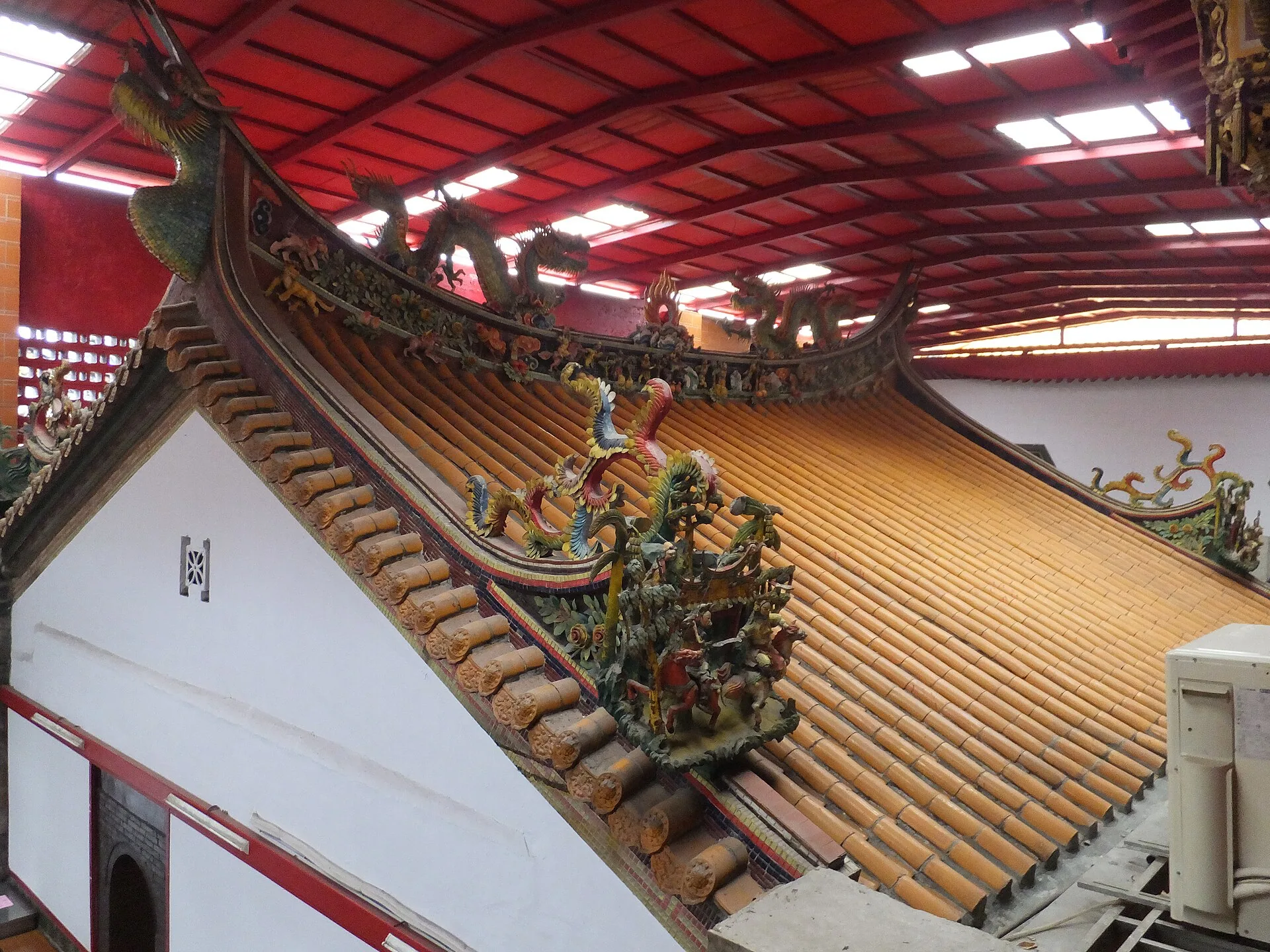
March 2016, Treasure Hill Guanyin Pavilion. Photo: panoramio user, 2016-03-16. License via Wikimedia Commons (CC BY 3.0).
After 1999, Gongguan Became NTU Students' Living Room
On December 24, 1999, Taipei MRT's Xindian line opened. Gongguan Station officially began service7.
From this moment, Gongguan's role from the previous century was completely reversed. A landscape that had been "boundary + passage" became the student-consumption hub of southern Taipei because one MRT stop connected it with Taipei Main Station, Dongmen, and Zhongxiao Fuxing.
Shuiyuan Market, established after the war in 1953, was named because it was located in Japanese-period Suidō-chō, Taipei's water-source area17. After the Shuiyuan Building was constructed in 1980, vendors moved into the building, but the market's food ecology did not move away. In the 1990s and 2000s, Shuiyuan Market and the snacks in the lanes on both sides became the area with the second-highest density of street food in Taipei, after Shilin Night Market. Five minutes from NTU's Royal Palm Boulevard to Shuiyuan Market, and another five minutes to Gongguan Circle: these ten minutes are the dinner route of NTU students.
The bookstore ecology also took shape in the 1980s and 1990s. In 1982, Chen Lung-hao founded Tonsan Publishing House, "with the purpose of publishing and circulating books of the left, the non-mainstream, and those speaking for disadvantaged groups"18. In 1984, Tonsan Bookstore was established, and "for many years, with the style of a professional humanities and social-sciences bookstore, it became a symbol of progressive thought on the island and a must-visit place for idealistic students"18. In the basement of Lane 333, Section 3, Roosevelt Road, Tonsan Bookstore was a spiritual base for the generation of NTU student activists in the 1990s and 2000s. In 2002, the owners of Mollie Used Books, Tsai Mou-lang and Tai Li-chen, opened their first store near NTU in the Gongguan commercial district, later expanding to the NTNU branch, Taichung, and Kaohsiung19.
Gongguan's special quality lies in the fact that all six material layers of "campus + dormitories + bookstores + snacks + market + Treasure Hill" exist within 500 meters, and they are all linked to one another.
Curator's note: Gongguan's food map is very different from other Taipei commercial districts. It is not a tourist district like Ximending, not a club district like Xinyi, not a youth-culture cafe district like Yongkang Street. It is an NTU student ATM: average prices of NT$80-150, large portions, places where one can sit and read, and 24-hour operation. Why did it grow this way? Because it serves students from NTU, National Taiwan University of Science and Technology, and National Taiwan Normal University's Gongguan campus: about 50,000 people across three universities, each needing one to two meals a day in Gongguan on average. Long-term, dense student consumption pressure means Gongguan's shops cannot set high prices and cannot become purely tourist-oriented; they must be "inexpensive + large portion + fast." The Japanese-period imperial university's two-layer structure of "campus + dormitories" was joined after the war by a layer of scholars' salons, after 1980 by a bookstore layer, and after 1999 by a mass-consumption layer. Only with all four layers stacked together did the density of 2026 take shape.
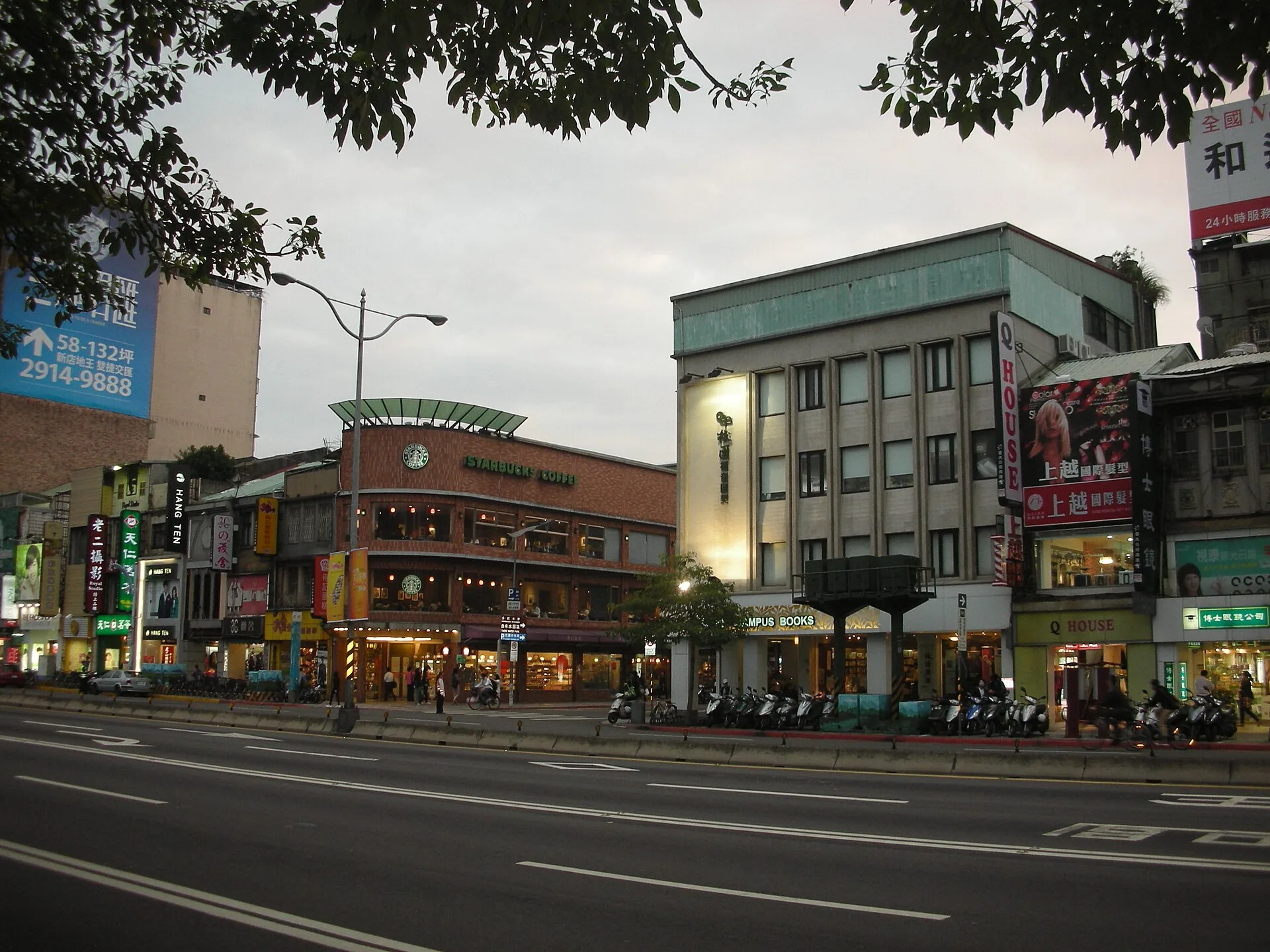
October 2011, Gongguan commercial district, Taipei. Photo: panoramio user, 2011-10-31. License via Wikimedia Commons (CC BY-SA 3.0).
Three Centuries in 500 Meters, on the Same Axis
On the morning of April 1, 1928, when the first class of Taihoku Imperial University's Faculty of Science and Agriculture met, an imperial-university professor stepped out of the newly built Japanese-style dormitory at 25 Wenzhou Street and walked five minutes to the campus gate. He did not know that 22 years later Japan would surrender, and that this dormitory would be taken over by a new government and allocated to a postwar Chinese migrant scholar named Tai Jingnong.
One afternoon in 1956, Yin Hai-kuang left the NTU campus gate carrying a stack of logic lecture notes and walked eight minutes to 1-1, Alley 16, Lane 18, Wenzhou Street. Intelligence personnel pretended to buy cigarettes at the grocery store at the lane entrance. He opened the unlocked wooden door of his house. The students coming that afternoon were Lin Yusheng and Chang Hao. They would discuss Carnap's analytic philosophy. Thirteen years later, he would die in that small house.
On the afternoon of January 18, 1981, Chou Yu hung the three-character sign "Wistaria Tea House" at 1, Lane 16, Section 3, Xinsheng South Road. The wistaria trellis in the front yard, planted by his father in 1950, was already 31 years old. Chiang Ching-kuo was still in the Presidential Office, and martial law had not yet been lifted. But the teahouse opened.
One afternoon in May 1990, the 87-year-old Tai Jingnong moved from his old dormitory in Lane 18, Wenzhou Street, to his newly allocated residence at No. 25. In "Longpo Zhangshi," he inscribed his study name. Half a year later, he finished his life at NTU Hospital.
At 6:30 on some evening in 2026, an 18-year-old NTU Chinese literature student leaves class at the College of Liberal Arts, exits the campus gate, and walks eight minutes north along Section 3, Xinsheng South Road to 25 Wenzhou Street. She pauses for one second outside Tai Jingnong's former residence to look at the wooden old house with its irimoya hafu roof, then keeps walking north to Gongguan Circle to buy a portion of Blue Dragonfly salted crispy chicken and a cup of frog-hits-milk.
She does not know that the 500 meters she just walked layer the scholars' dormitories planned by the Japanese Empire in 1928, the living room of a philosopher under house arrest, the study of a calligrapher who spent 27 years as chair of the Department of Chinese Literature, and the wistaria trellis of the first humanities-oriented teahouse. She only knows: should today's salted crispy chicken come with Thai basil?
✦ An imperial-university professor's dormitory became an NTU professor's dormitory, then the living room of a philosopher under house arrest, then a teahouse in 1981, then a commemorative building glanced at by passing students in 2026. On this 500-meter axis, three centuries of Taiwan have not changed the land beneath them.
Gongguan's central tension is this: the material formula Japan's empire planned in 1928 as a "laboratory + faculty housing + surrounding small market streets" became, a century later, the cradle of postwar Taiwan liberalism, then the most irreplaceable consumption ecology for contemporary students. The material foundation that was originally an "other's academic district" -- campus gate + Royal Palm Boulevard + dense Japanese-style dormitories + lane-scale shops -- unexpectedly allowed Lei Chen, Yin Hai-kuang, Chou Te-wei, Tai Jingnong, and Lin Yusheng in the 1950s and 1960s to write the most important intellectual history of postwar Taiwan here; allowed the 1972-75 Philosophy Department Incident to happen here; allowed Wistaria Tea House to open here in 1981; allowed Tonsan Bookstore to survive here after 1990; and allowed NTU students in 2026 to eat dinner here.
Dadaocheng is a commercial street sustained by the tea trade of 1860; Bangka is a Qing-era peak district sustained by Longshan Temple from 1738; Ximending is a Japanese-period entertainment special district from 1896. Only Gongguan is the "functional city around a university" that the Japanese left behind in 1928, and only Gongguan has kept this DNA unchanged for 100 years. Three centuries within 500 meters. Next time you pass NTU's Xinsheng South Road entrance, stop for 30 seconds and look at the irimoya hafu roof at 25 Wenzhou Street. A century ago, the ground beneath your feet was an imperial-university professor's dormitory; 70 years ago, it was a living room under house arrest; 45 years ago, it was a newly opened teahouse; only 26 years ago, the MRT arrived. One axis, three centuries, unchanged.
Further Reading:
- Taipei City: Three Times in One City, Longshan Temple of 1738 Watching Taipei 101 of 2004 -- Gongguan's cross-boundary position across 12 districts, spanning Zhongzheng, Da'an, and Wenshan, placed alongside the four timelines of Bangka, Dadaocheng, and Xinyi
- Taiwan's White Terror -- The martial-law-era purge context of the 1960 Lei Chen case, Yin Hai-kuang in 1969, and the 1972-75 NTU Department of Philosophy Incident
- Martial Law Period -- The political background of 1949-1987 and the legal framework behind Lei Chen's 11 years in prison
- Yin Hai-kuang: The Philosopher Who Planted Liberalism in Taiwan in Lane 18, Wenzhou Street -- The most representative resident of the Gongguan-Wenzhou Street axis, with the full arc of his life from arriving in Taiwan in 1949 to dying of illness in 1969
- Taiwanese Magazines: From _Free China_ to _Benesse_ -- The 1949-1960 publication history of Free China and the media-politics context under martial law
- Dadaocheng -- A batch 1 historic-district sibling: an 1851 tea-commerce street whose logic of street formation is completely different from Gongguan's 1928 imperial-university establishment
- Bangka -- A batch 1 historic-district sibling: a Qing-era peak district sustained by Longshan Temple from 1738, in contrast to Gongguan Village's Qing-era function as a frontier station
- Ximending -- A batch 1 historic-district sibling: an 1896 Japanese-period entertainment special district, one of two spatial planning types the Japanese created in Taipei alongside Gongguan's 1928 imperial university
- Yongkang Street -- Together with Gongguan, it sustains the NTU and NTNU faculty-student consumption circle: two material nodes from scholars' dormitories to students' dining tables
- Guling Street -- A sister landscape of postwar Chinese migrant scholars and used-book culture, forming a second postwar Chinese migrant intellectual settlement alongside Gongguan's Wenzhou Street scholars' residences
- Treasure Hill -- An illegal settlement 800 meters south of Gongguan that became an artists' village, representing another kind of "marginal space" from the same era as Gongguan's 1969 student-movement world
Image Sources
This article uses seven CC-licensed images, all cached in public/article-images/geography/ to avoid hotlinking source servers:
- 國立台灣大學校門.jpg -- Photo: 寺人孟子, 2017-09-24, CC BY-SA 4.0
- 台北市 公館商圈 Gongguan - panoramio.jpg -- Photo: panoramio user, 2011-10-31, CC BY-SA 3.0
- 紫藤廬 20170712.jpg -- Photo: 寺人孟子, 2017-05-06, CC BY-SA 4.0
- 殷海光故居.jpg -- Photo: 林高志, 2016-02-02, CC BY-SA 4.0
- 殷海光故居 9100.jpg -- Photo: 林高志, 2016-02-02, CC BY-SA 4.0
- WenZhou Street, Taipei (at Lane 16).jpg -- Photo: Kiyoteru Awaji, 2021-08-09, CC BY 4.0
- 寶藏巖 Treasure Hill Temple - panoramio.jpg -- Photo: panoramio user, 2016-03-16, CC BY 3.0
References
- Gongguan (Taipei) -- Wikipedia -- The Taipei Gongguan entry records that "during the Qianlong reign of Qing rule, large numbers of Quanzhou Anxi migrants entered Quanshan for land reclamation, and the settlement leaders built a gongguan here as a house for handling trade between Han settlers and Indigenous peoples and for paying tenant rents; the place name 'Gongguan' came from this"; that "Gongguan is a place name in Zhongzheng District, Da'an District, and Wenshan District, Taipei, Taiwan (formerly under Guting District and Jingmei District)"; that in Yongzheng 7 (1729), the Hakka leader Liao Jian-yue led settlers into Quanshan, clashed with the Ketagalan people of the Xiulang community, and caused several hundred casualties; that five years later Quanzhou Anxi migrants expelled the Hakka and established Gongguan Village; and that the area has the consumer market of students from National Taiwan University, National Taiwan University of Science and Technology, and National Taiwan Normal University's Gongguan campus.↩234
- Taihoku Imperial University -- Wikipedia -- The Taihoku Imperial University entry records its formal founding on March 16, 1928 under Imperial Ordinance No. 30; the change from the originally proposed name "Taiwan Imperial University" to "Taihoku Imperial University"; first president Shidehara Taira's term from March 1928 to September 1937; the initial faculties of Liberal Arts and Political Science and Science and Agriculture, the latter beginning classes on April 1, plus the affiliated specialized division of agriculture and forestry; and the detailed process by which the Republic of China government took it over on November 15, 1945, reorganized it as "National Taipei University," and soon renamed it "National Taiwan University."↩23456
- Shōwa-chō (Taipei) -- Wikipedia + Tomita-chō (Taipei) -- Wikipedia -- In the 1922 (Taishō 11) neighborhood-name reform, 15 large districts in western Taipei were reorganized into 64 chō, while 10 large districts in the eastern half retained their original form. Shōwa-chō was named because it was planned in the early Shōwa years and became a residential district after the establishment of Taihoku Imperial University. Tomita-chō was located in Taipei's southeastern corner, bordering Suidō-chō to the east, corresponding today to the area around Section 3 of Xinsheng South Road, Sections 3-4 of Roosevelt Road, and Section 3 of Keelung Road in Da'an District, Taipei. The Taipei city gazette of August 16, 1941 abolished "Da'an First District" and "Da'an Second District" and established "Horikawa-chō District," "Shōwa-chō District," and "Da'an District."↩2
- Yin Hai-kuang's Former Residence -- Department of Cultural Affairs, Taipei City Government -- The official Department of Cultural Affairs page records the address "1-1, Alley 16, Lane 18, Wenzhou Street, Da'an District, Taipei"; the background as a Japanese-style dormitory built in 1945; that Yin Hai-kuang "originally taught at nearby National Taiwan University"; that after the 1960 Lei Chen case, he was "blocked by the government, unable to continue teaching at the university, with his writings banned, and monitored for life"; that he died in 1969; that "in May 2003, Mr. Yin Hai-kuang's former residence was formally designated a municipal historic site"; that "since restoration in 2008, it has insisted on free public admission and emphasized its quality as a 'public good'"; and the opening hours of "Tuesday to Saturday, 13:00-17:00," among other core facts.↩234567891011
- Wistaria Tea House -- Wikipedia -- The Wistaria Tea House entry records that it was "built in the Taishō era" (the 1920s), with the earliest traceable date being a 1921 electricity bill; that the building was originally the official residence of Taiwan Government-General official Asaka Teijirō; that "in 1950, then Customs Administration director Chou Te-wei moved in with his family of seven"; that "Chou Te-wei, who advocated liberalism, used this house in the 1950s as a cultural salon, regularly inviting Yin Hai-kuang, Chang Fo-chuan, Hsu Dau-lin, Hsia Tao-ping and more than ten others to academic seminars"; that "the exchange-rate reform plan led by K.Y. Yin in 1958 was completed by Chou Te-wei in this official residence"; that after Chou Te-wei moved to the United States in 1975, Chou Yu took over the dormitory; that "Wistaria Tea House opened on January 18, 1981"; that on July 8, 1997, it was approved as part of the first group of municipal historic sites; and that at the end of 2001, after the Customs Administration transferred Wistaria Tea House to the city government as municipal property, it could be revitalized through public commissioned operation. It also records the academic context of Chou Te-wei's study under Hayek and translation of The Constitution of Liberty, and Yin Hai-kuang's translation of The Road to Serfdom under his encouragement.↩2345678910
- NTU Department of Philosophy Incident -- Wikipedia -- The entry records the incident period as "December 1972 to June 1975"; that within National Taiwan University, in the name of "anti-communism," Chinese liberal scholars in NTU's Department of Philosophy were purged; the full list of 13 dismissed people -- Chen Ku-ying, Wang Hsiao-po, Yang Fei-hua, Hu Chi-chun, Li Jih-chang, Chen Ming-yu, Liang Chen-sheng, Huang Tien-cheng, Kuo Shih-yu, Chung Yu-lien, Huang Ching-ming, Chao Tien-yi, and American visiting professor Robert Marsh; the December 4, 1972 NTU University Forum Society "nationalism symposium," where Chen Ku-ying strongly rebutted "The Voice of a Petty Bourgeois" and clashed with Feng Hu-hsiang, publicly accusing Feng of being a "professional student," with Chien Yung-hsiang supporting Chen on the spot; Feng's complaint to president Yen Chen-hsing; the February 12, 1973 questioning of Chien Yung-hsiang and Huang Tao-lin by the Garrison Command; the next day's Garrison Command search of Chen Ku-ying's residence; the detention of Chen Ku-ying and Wang Hsiao-po by the Garrison Command on charges of "propagandizing for communist bandits"; the arrival of newly appointed visiting associate professor Sun Chih-shen as acting department chair; the one-year suspension of admissions to the NTU philosophy graduate institute; and the 1997 redress.↩2345678910
- Taipei MRT Ximen Station -- Wikipedia -- The Bannan line's "Taipei City Hall-Ximen" segment and the Banqiao line's "Ximen-Longshan Temple" segment formally opened on December 24, 1999. Gongguan Station belongs to the Xindian line (green line) and likewise opened when the Xindian line began service in 1999, becoming a key node in the MRT-ization of southern Taipei.↩2
- NTU Gongguan Commercial District Travel Guide -- ezTravel -- Gongguan commercial district is located in southern Taipei, with its main commercial range covering Roosevelt Road, Tingzhou Road, and Xinsheng South Road. It is near National Taiwan University, National Taiwan Normal University, and other university campuses. From the 1950s, Southeast Asia Theater served as a student dating spot; after the MRT opened in the 1990s, the district became southern Taipei's student-consumption hub.↩
- Tai Jingnong -- Wikipedia + Bureau of Cultural Heritage, Ministry of Culture: Tai Jingnong's Former Residence + History of Tai Jingnong's Former Residence -- National Taiwan University -- Tai Jingnong (1903-1990), courtesy name Bojian, was from Huoqiu, Anhui; one of the six gentlemen of the Weiming Society; both student and friend to Lu Xun; appointed professor in NTU's Department of Chinese Literature in 1948; department chair for 20 years from 1950. The former residence's address is "25 Wenzhou Street, Longpo Village, Da'an District, Taipei"; the building was constructed between 1935 and 1940 in irimoya hafu form; in March 1946 it was allocated by the public-property management office to National Taiwan University; Tai Jingnong moved to this assigned residence in May 1990; on November 9 of the same year he died of esophageal cancer at NTU Hospital in Taipei, aged 87; the characters "National Taiwan University" on the NTU gate were assembled from Tai Jingnong's calligraphy; in May 2020 all 17 attending members of Taipei City's cultural-heritage review committee agreed to register Tai Jingnong's former residence as a "commemorative building"; and restoration of the main house was completed in November 2022.↩234567891011
- Hsiao Wen-chieh Column: The Shōwa-chō University Residential Settlement -- ARTouch -- Scholar Hsiao Wen-chieh's in-depth report describes the spatial context of Yin Hai-kuang's Former Residence at 1-1, Alley 16, Lane 18, Wenzhou Street, located in a small lane reached only after several turns; the historical scene in which "about 60 years ago, young disciples came to ask Mr. Yin Hai-kuang about philosophical questions and the political situation, while military police and agents also watched here"; and the value of the entire Shōwa-chō university residential settlement as a White Terror cultural-heritage landscape.↩
- There Are "Gongguans" Everywhere: A Market Place Name Found in Northern, Central, and Southern Taiwan -- TVBS -- The report notes that the place name "Gongguan" is found across northern, central, and southern Taiwan, mainly originating in the Qing-era function of public houses used for collecting tenant rents and managing trade between Han settlers and Indigenous peoples. Taipei Gongguan, Miaoli Gongguan, Pingtung Gongguan, and other places of the same name all share this origin.↩
- Rescuing Old University Dormitories: Hopes to Preserve the Wenzhou Street Settlement and Hua Nan New Village -- Environmental Information Center -- The report describes the current condition of surviving Japanese-style dormitory clusters in Taipei, noting that "Qingtian Street has already been designated a protected settlement landscape" while "the preservation proposal for Wenzhou Street is still under review"; that Wenzhou Street's Japanese-style dormitory cluster faces demolition and development threats, with many old houses gradually disappearing; and that the Taihoku Imperial University faculty dormitory cluster is "extremely rare among existing Japanese-style dormitories in Taipei, with orderly architectural layout and careful material selection, including exposed brick, stone steps, washed-stone wall bases, floor tiles, and hinoki beams and columns."↩
- Free China (magazine) -- Wikipedia -- The Free China entry records its founding in Taipei on November 20, 1949; publisher Hu Shih, nominally; actual organizer Lei Chen; main writers Hsia Tao-ping, Mao Zishui, and Yin Hai-kuang; a total of 260 issues; the Taiwan Garrison Command's September 4, 1960 arrest of Lei Chen and others on suspicion of rebellion, using Yin Hai-kuang's editorial "The Great River Flows Eastward and Cannot Be Stopped" in volume 23, issue 5; the magazine's closure; and Lei Chen's ten-year sentence, serving 11 years from 1960 to 1970.↩23
- Lei Chen -- Wikipedia -- The Lei Chen entry records that on September 4, 1960, the Garrison Command arrested Lei Chen on charges of "harboring a communist spy" and "knowing of a communist spy and failing to report"; that he had been organizing a "China Democratic Party" to compete with the Kuomintang; and that he spent 11 years in prison until his release in 1971. The Lei Chen Incident is one of the most representative political-suppression cases of the martial-law period.↩
- Treasure Hill -- Wikipedia -- The Treasure Hill temple entry records that "in Qianlong 56 (1791), Treasure Hill underwent its first major renovation, adding east and west side halls"; that it is "located below Fuhe Bridge, beside the Xindian River, and leaning against Hukong Mountain (a spur of Toad Mountain), one of Taipei's oldest Buddhist temples"; that it "was once a public temple for the Wenshan area and a faith center for Quanzhou Anxi migrants in this district"; and that "in Jiaqing 3 (1798), devotee You Dachuan purchased paddy fields in today's Nanshijiao and donated the annual yield of five shi of grain as lamp offerings for Treasure Hill," among other temple history.↩23
- Treasure Hill Settlement -- Wikipedia -- The Treasure Hill Settlement entry records that "after a major renovation in early 1973, it opened to worshippers and religious activity gradually resumed; at the same time, postwar Chinese migrants began constructing illegal buildings on the hillside behind the temple"; that "in the 1960s, the ban on illegal construction loosened, and the military command tacitly accepted the fact that postwar Chinese migrant residents were building illegally around Treasure Hill"; that "by the end of the 1980s, the settlement had reached nearly four hectares in scale and housed more than 200 households"; that in July 1980 it was placed in Urban Planning Park No. 297 and faced demolition; that in 1999 Lung Ying-tai, as culture commissioner, proposed the artists' village concept; that in 2004 it was announced as a historic building; that on October 2, 2010, "Treasure Hill Artist Village" formally began operations; that in 2011 it was announced as the first historic settlement; and that in 2018 it was announced as a settlement building complex.↩234567
- Shuiyuan Market -- Taipei City Market Administration Office -- The Taipei City Market Administration Office page on Shuiyuan Market records that the market was established in 1953; that it was named because it was located in Japanese-period "Suidō-chō" (Taipei's water-source area); and that in 1980 (ROC year 69) the Shuiyuan Building was constructed to house vendors. The market itself is a gathering place for southern Taipei snacks.↩
- Friendly Store: Tonsan Bookstore -- Department of Social Welfare, Taipei City Government -- The Tonsan Bookstore entry records that "Tonsan Publishing House founder and editor-in-chief Chen Lung-hao began in 1982, with the purpose of publishing and circulating books of the left, the non-mainstream, and those speaking for disadvantaged groups"; that "in 1984, continuing the publisher's direction and spirit, Tonsan Bookstore was established"; and that "for many years, with the style of a professional humanities and social-sciences bookstore, it became a symbol of progressive thought on the island and a must-visit place for idealistic students," with its historical context at Lane 333, Section 3, Roosevelt Road.↩2
- Mollie Used Books -- Wikipedia -- The Mollie Used Books entry records that "Mollie's used bookstore originated in the 1980s as a three-square-meter used-book stall at Taipei's Guanghua Market"; that "in 2002, owners Tsai Mou-lang and Tai Li-chen opened Mollie's first storefront near National Taiwan University in the Gongguan commercial district"; and that it later expanded to five branches.↩