
30-second overview: In 1787, Qing Emperor Qianlong issued an edict renaming “Zhuluo” as “Chiayi,” meaning “to commend their loyal righteousness in defending the city to the death.” It is the only city in Taiwan personally named by an emperor. In 1908, in rice paddies 3.3 kilometers southwest of the city, the Japanese erected the world’s first Tropic of Cancer monument. In 1931, Chiayi Agriculture and Forestry’s mixed squad of Han Taiwanese, Indigenous Taiwanese, and Japanese players reached the Koshien runner-up position. On March 25, 1947, the painter Chen Cheng-po was bound and executed by firing squad in front of the train station; his body was left in the street for three days. Today Chiayi City has 260,000 people, 60 square kilometers, and no high-speed rail station. It is a specimen of Taiwan’s mid-sized cities. Four nationally significant stories all took place within these 60 square kilometers.
Four Hundred Years at the Central Fountain
If you arrive in Chiayi by train, you will see it after walking just 100 meters out of the station. The Central Colorful Fountain sits at a traffic circle where Wenhua Road, Zhongshan Road, Gongming Road, and Guanghua Road intersect. Built in the 1970s during Mayor Hsu Shih-hsien’s tenure, the fountain changes lights every few minutes, with its highest jet of water reaching 20 meters.1
Its liveliest moment comes on the night before elections. Every candidate brings supporters around this traffic circle for a campaign rally, with drum troupes, campaign vehicles, and microphones drowning one another out. In other cities, election rallies usually take place in stadiums or plazas. Chiayi people choose a traffic circle because this traffic circle has been the center of their city for 300 years.
During the Qing period, this location was called “Taozaiwei,” the end of the Chiayi city wall. In 1704, the 43rd year of the Kangxi reign, county magistrate Song Yongqing built Zhuluo City here with wooden palisades and established east, west, south, and north gates. It was “the earliest city stockade built among the one prefecture and three counties of the time.”2 During Japanese rule, the 1906 earthquake nearly destroyed the old city. The following year, the Japanese carried out urban improvements, straightening streets, laying out right-angled intersections, and planning a circular plaza. Today’s Central Fountain stands at the center of that original circular plaza.3
Beneath the fountain’s water jets lie three layers of history: the city wall of Han migrants, the Japanese urban improvement project, and the postwar civic plaza of Taiwanese residents. Chiayi people rarely spell out these layers, but every time they walk around this traffic circle, they are stepping across these 300 years.
Defending a City for Two Months in Exchange for a Name
What made this city truly remembered in history was the siege of 1786.
In November of that year, the 51st year of the Qing Qianlong reign, Lin Shuangwen rose in rebellion, and northern and southern forces converged to besiege Zhuluo City. The population inside the city, once a small settlement of migrants from Zhangzhou and Quanzhou, became a fortress defended by thousands working together. During the siege, food ran out. Lian Heng’s General History of Taiwan described the hardship of defending the city: “Zhuluo was besieged ever more tightly, with no food to be obtained; they dug up tree roots and boiled soybean meal to stave off hunger, yet their will to defend grew only firmer.”4
Two months later, Qing reinforcements lifted the siege. Qianlong thought the city had held out with such extraordinary resolve that he issued an unprecedented edict granting it a new name. The Chiayi City Government’s historical overview quotes the edict: “The Qing state, following the intent of ‘commending their loyal righteousness in defending the city to the death,’ issued an edict on the third day of the eleventh month of the following year, changing the name from ‘Zhuluo’ to ‘Chiayi.’”5
This is the only county seat in Taiwan personally named by an emperor. The four characters “to commend their loyalty and righteousness” defined a city. Most other county and city names came from Indigenous-language transliterations, geographic features, or administrative naming. Keelung means “a prosperous base”; Changhua means “to make imperial transformation manifest.” Only Chiayi has a name that is itself a compressed political history.
From that moment on, Chiayi had a double identity. It was a city the Qing court was willing to remember with an imperial edict, but the high point of its history also stopped there.
📝 Curator’s note: Open any county or city history and the name usually turns out to be a geographic or political label. But the name “Chiayi” is an edict, a retrospective commendation by the Qing court to a group of people who defended a city. The problem is this: a city singled out for praise by an emperor is not necessarily remembered by history afterward. More than two centuries after Qianlong renamed it, when Taiwanese people hear “Chiayi,” their first associations are often turkey rice, the gateway to Alishan, or “my older brother brings back two boxes of square crackers when he comes home from Taipei.” The phrase “to commend their loyalty and righteousness” has long been worn smooth by time, but the city has never taken it down. The name granted by the emperor still hangs above the door; only the people inside have changed, generation after generation.
The Tropic of Cancer Rose Out of the Rice Paddies
In April 1908, the 41st year of the Meiji era, the Japanese erected a large stone tower in rice paddies 3.3 kilometers southwest of Chiayi City to celebrate the completion of the north-south trunk railway through Taiwan. The entry in the National Cultural Memory Bank states it plainly: “It was the first-generation Tropic of Cancer landmark, and also the first Tropic of Cancer monument established anywhere in the world.”6
This fact has two layers of meaning. First, the Tropic of Cancer is a physical coordinate produced by the 23.5-degree tilt of Earth’s rotational axis. It exists at every longitude, but before 1908 no country had considered this invisible line worth monumentalizing. The Japanese chose to do so as part of the commemoration of Taiwan’s railway completion, turning “modern geographical science” into a symbol of colonial modernization. Second, Chiayi thereby became “the starting point of southern Taiwan.” South of the Tropic of Cancer is the tropics; north of it is the subtropics. Chiayi is the nearest city to this dividing line.
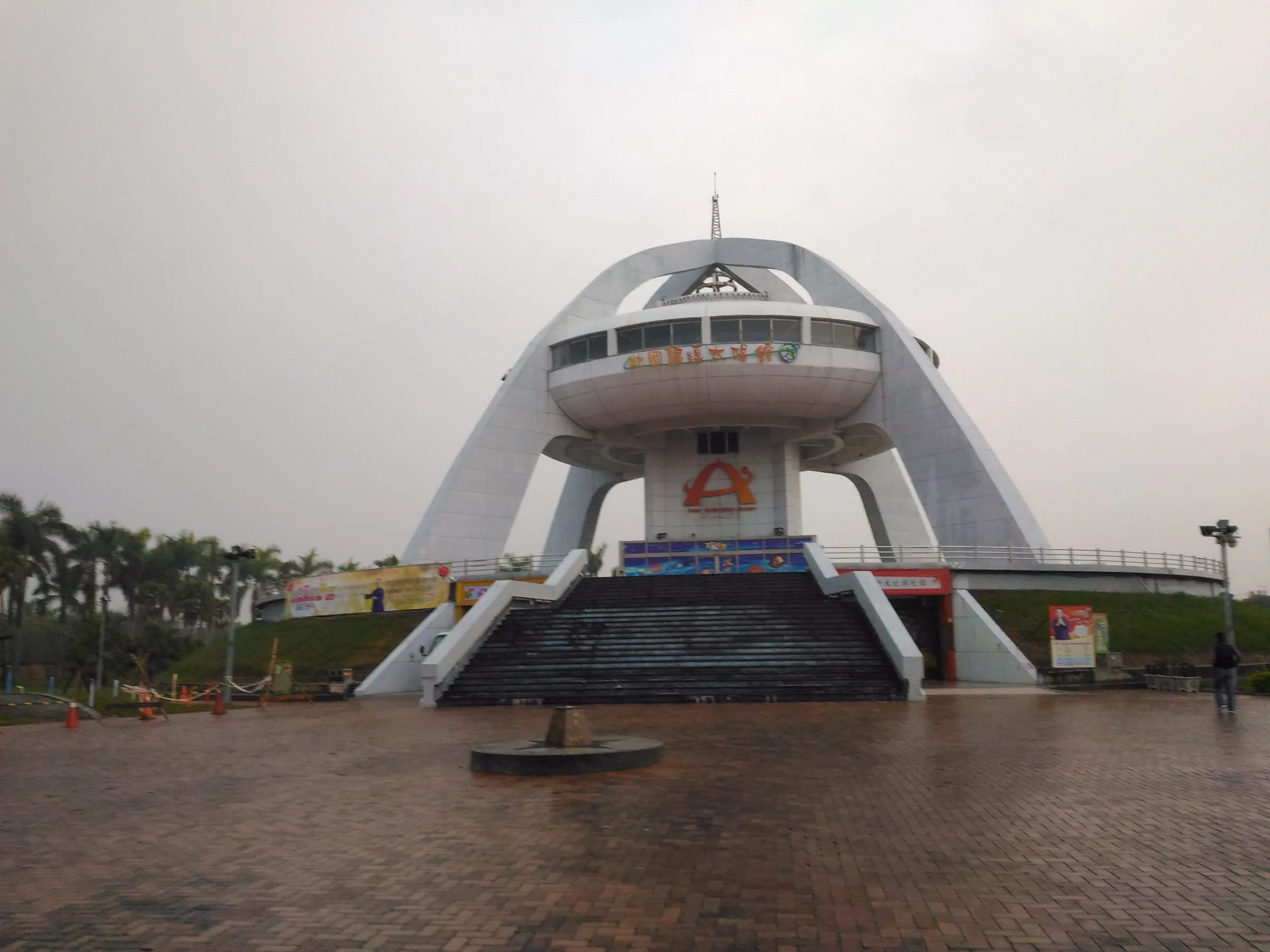
The sixth-generation Tropic of Cancer monument, 2016-01. Photo: B2322858, Public Domain via Wikimedia.
This monument has spent more than a century in Chiayi people’s hands. The first generation was destroyed by a typhoon in 1912; the second was provisionally rebuilt with bamboo and timber in 1915; the third was completed in 1926, after Crown Prince Hirohito passed through Shuishang during his 1923 visit to Taiwan, saw the crude bamboo-and-timber tower, and ordered that it be rebuilt.7 The fourth generation was rebuilt around the mid-1930s and later destroyed in the 1941 Caoling earthquake. The fifth generation was completed in 1942 and renovated into a small park by the Chiayi Air Force in 1968. The sixth generation was completed in 1995 and later renovated into the Tropic of Cancer Solar Exploration Center seen today.8
Chiayi people have a distinctive attitude toward the monument. It lies outside the city and, strictly speaking, belongs to Shuishang Township in Chiayi County, but every generation of Chiayi residents has taken out-of-town friends to see it. The tower’s design has changed repeatedly, from stone tower to steel frame to modern architecture, but its location has not moved in a century. A typhoon can knock it down and it can be rebuilt; an earthquake can destroy it and it can be built again. The point is that the line at 23 degrees 27 minutes north latitude continues to pass through Taiwan, and the city that first commemorated this fact anywhere in the world is here.
Alishan Turned This City into the Wood Capital
What made Chiayi truly prosper in the 20th century was the timber of Alishan.
In 1899, the Japanese discovered that Alishan contained rich primeval cypress forests and began railway planning. Construction was undertaken in 1906 by the private Fujita-gumi and nationalized in 1910. In December 1912, the forest railway from Chiayi to Erwanping opened, spanning 66.6 kilometers; in 1914 it was extended to Alishan.9 That same year, the Chiayi Sawmill began operation. It was the largest government-run timber industrial park by area under the Japanese government during the colonial period. It “used the most advanced European and American equipment, had an almost fully automated production process, and enjoyed the reputation of being the ‘finest sawmill in the East.’”10
The quality of Alishan cypress was so high that its impact extended beyond Taiwan: “These fine building materials were used to build the great torii gate of Meiji Shrine and to repair the Buddhist halls of the national treasure Horyu-ji.”11 Every red cypress log transported down from Alishan was first sent to the Chiayi Sawmill for cutting, then loaded onto ships bound for Japan. Chiayi became the distribution hub for timber from the Alishan forest. In 1935, in this city of 70,000 people, “one-tenth of the population worked in the timber industry, and it was then the fifth most populous and prosperous city in Taiwan.”11
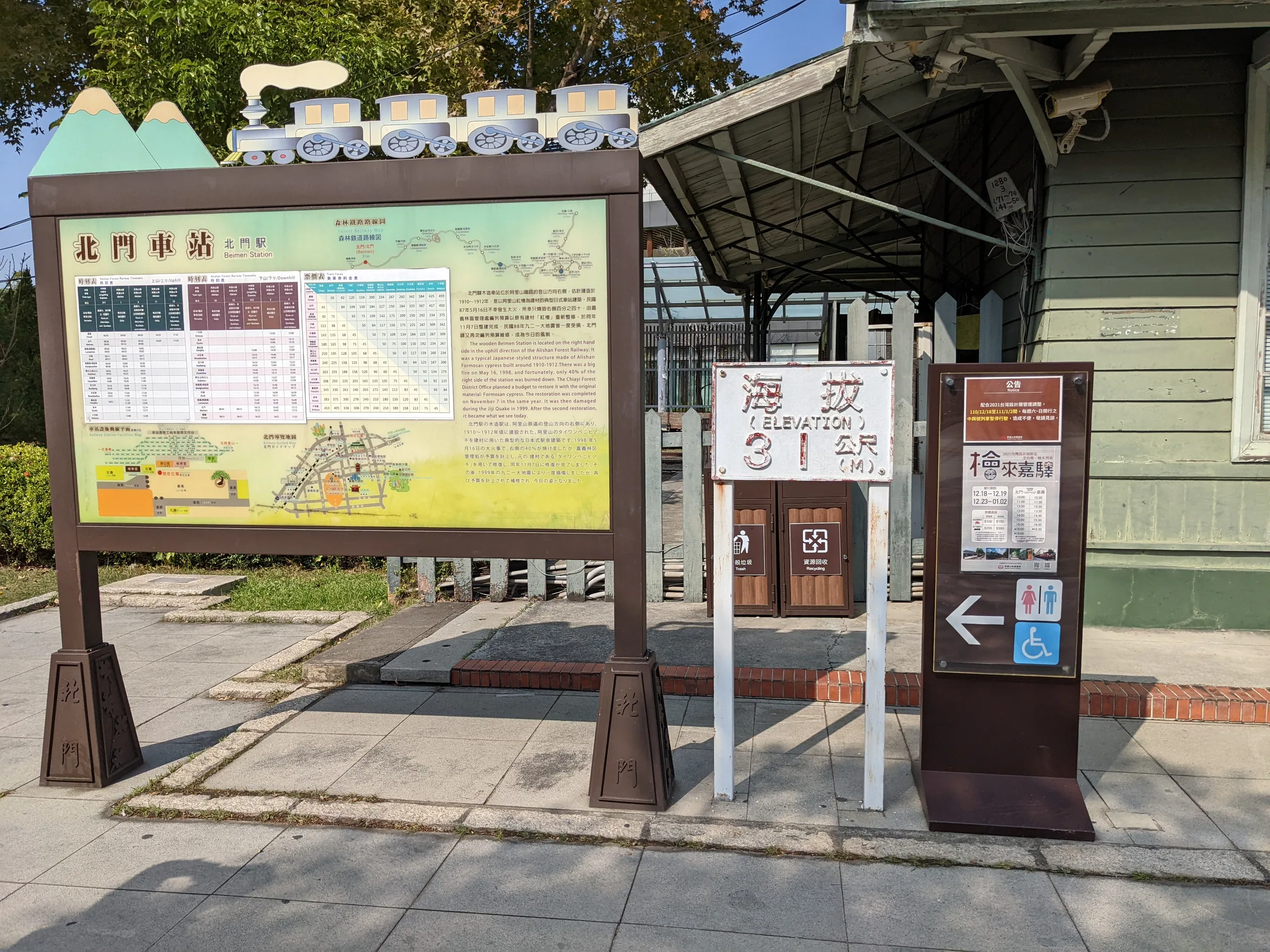
Beimen Station, 2021-12. Photo: Honmingjun, CC BY-SA 4.0 via Wikimedia.
Beimen Station, the starting point of the Alishan Railway, was in an area that “was once the largest timber trading market in all Taiwan.”12 Walk into Beimen Station today and the exterior of the wooden station still looks as it did in 1912. Although half of the building was destroyed by fire in 1998, it was renovated and restored that same year by the Chiayi Forest District Office. The station building was constructed from Alishan’s own red cypress, and the timber may be more than 1,000 years old. Using thousand-year-old trees to build a station, and then using that station to transport even more thousand-year-old trees down the mountain: that was the cycle of Alishan forestry during Japanese rule.
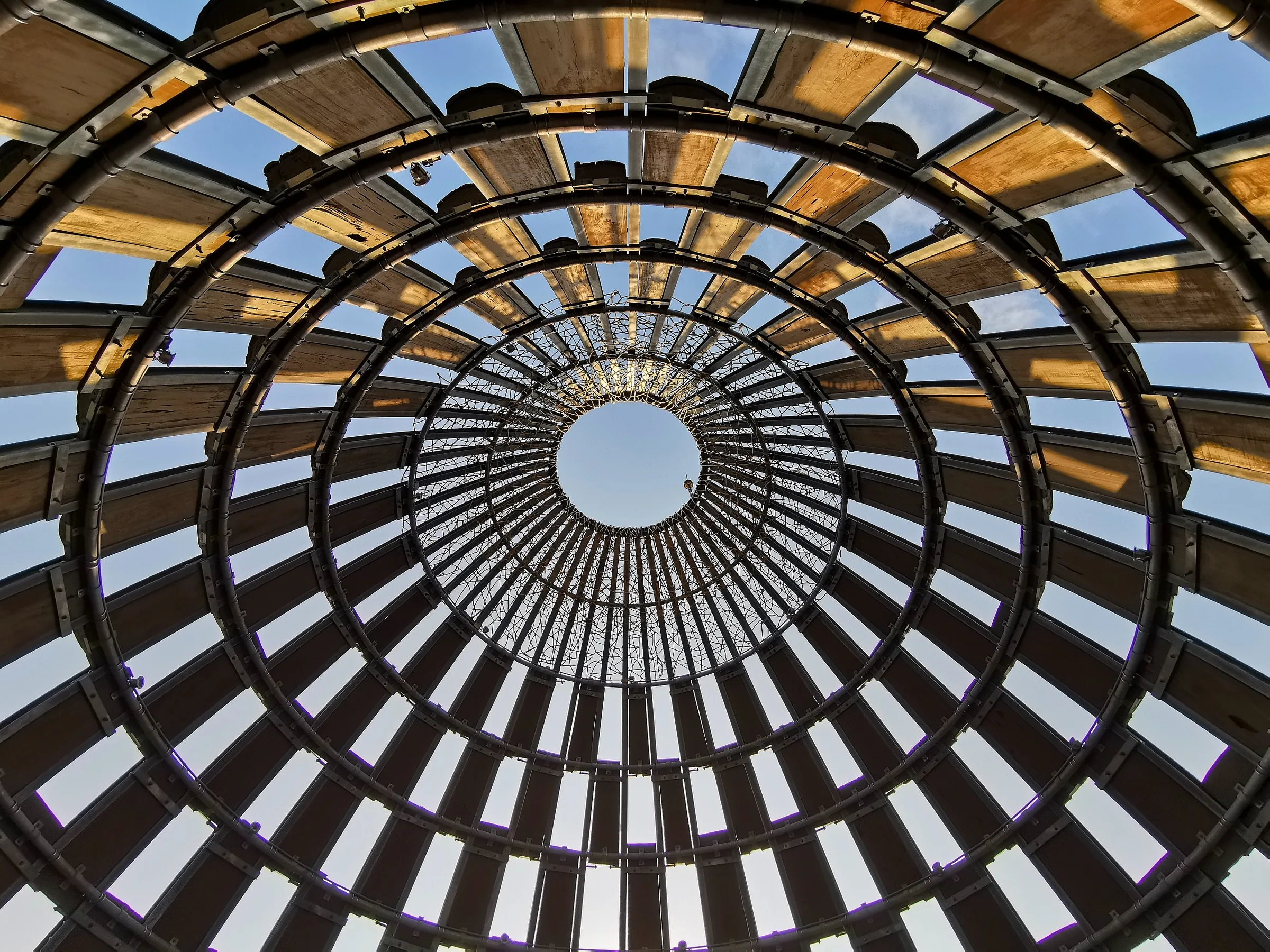
Song of the Forest, 2020-10-11. Photo: Mearchan, CC BY-SA 4.0 via Wikimedia.
The era of the wood capital began with the opening of the Alishan Sawmill in 1914 and ended in 1963, when the government fully halted large-scale logging in the Alishan forest. It lasted exactly 50 years.11 After the late 1960s, Alishan forestry gradually declined. Loggers, sawmill workers, and transport workers around the forest operation changed trades one after another, but timber did not entirely leave Chiayi. It became the city’s material inheritance. Smile Taiwan records that Chiayi City today “still preserves more than 6,000 wooden houses, the highest density in the country.”11 Each one is a material trace of the “wood capital era.” The city government’s recent “Wood Capital Renaissance” brand is built on these 6,000 old wooden houses.
✦ “These fine building materials were used to build the great torii gate of Meiji Shrine and to repair the Buddhist halls of the national treasure Horyu-ji.” (Smile Taiwan, “Chiayi Wood Capital” series)11
Alishan timber built Tokyo’s great torii gate and repaired Nara’s Horyu-ji. Chiayi people rarely mention this, but when you pass the commemorative stone near Beimen Station marking the sister-railway relationship between the Alishan Forest Railway and Japan’s Kurobe Gorge Railway, one sentence reminds you: this city was once a key node in the Japanese empire’s timber supply chain.
Koshien’s Mixed Squad
In the summer of 1931, Chiayi produced a baseball team.
Chiayi Agriculture and Forestry School, known as Jianong or KANO, competed for the first time as Taiwan’s representative in Japan’s National High School Baseball Championship, the summer Koshien tournament. What was most unusual was the team’s composition: Japanese, Han Taiwanese, and Taiwanese Indigenous players mixed together. This was unprecedented in a period when baseball teams in Taiwan were typically dominated by Japanese in the north. Coach Kondo Hyotaro came from the Koshien powerhouse Ehime Prefectural Matsuyama Commercial School. Taiwan Baseball Wiki records that after he came to Jianong, the team “began to reveal its brilliance.”13
On the day of the final, August 21, Jianong pitcher Wu Ming-chieh, who had pitched four consecutive games, was already exhausted. Taiwan Baseball Wiki preserves a verbatim account of the game: “In the final on August 21, Jianong pitcher Wu Ming-chieh, who had pitched four consecutive games... in the end the team lost 0-4 to Chukyo Commercial School from Aichi Prefecture and settled for runner-up.”13
Their opponent, Chukyo Commercial, later became the only school in Koshien history to win three consecutive championships, from 1931 to 1933, and it remains the high school with the most Koshien wins. That summer, Jianong lost by four runs to the future strongest school in Koshien history.
The historical significance of this game does not lie in winning or losing. It is one of the earliest concrete examples of three ethnic groups cooperating within the framework of “colonial modernity.” A baseball game showed the world that Han Taiwanese, Indigenous Taiwanese, and Japanese players could fight side by side on the same field, something official propaganda could not have written into existence at the time. In 2014, Wei Te-sheng’s film KANO brought this myth back into Taiwan’s 21st-century collective memory, but Jianong’s story had always continued by word of mouth among Chiayi people. The school still exists today, upgraded into National Chiayi University, and the baseball field beside the original campus is now the KANO Park area.
A Body on Chiayi’s Streets for Three Days
In March 1947, Chiayi produced another story.
After the February 28 Incident erupted across Taiwan, on March 2 in Chiayi several dozen young people who had come south from Changhua and Taichung “called on residents between the train station and the fountain,”14 meaning the Central Fountain at the beginning of this article. Crowds attacked Mayor Sun Chih-chun’s official residence and the police station. On March 5, Chiayi city councilor and Youth Corps secretary Lu Bing-qin went up to Alishan to ask Tsou youths to come down the mountain and help maintain order. Tsou township chief Gao Yisheng, whose Tsou name was Uyongu Yatauyungana, sent Tang Shou-ren to lead Indigenous youths down the mountain and station themselves at Chiayi’s Horyu-ji. That same day, militia forces attacked Shuishang Airport and the Hongmaopi arsenal, with around 300 casualties.14
During the airport siege, the two sides held several rounds of negotiations. On March 8 and 9, the Chiayi side sent negotiators to the airport, but the representatives were detained, and only three female committee members were released. On March 11, “one battalion of the 430th Regiment of the Army’s 21st Division arrived at the airport, and southern reinforcements reached Chiayi.”14 On March 18, Chen Fu-chih, chair of the Chiayi branch of the February 28 Incident Settlement Committee, was “paraded through the streets and then executed by firing squad in front of Chiayi Railway Station.”14
Seven days later, on March 25, four Chiayi city councilors were taken to the square in front of the train station: Chen Cheng-po, a painter and the first Taiwanese artist selected for Japan’s Imperial Art Exhibition with a Western-style painting, in 1926; Pan Mu-chih, a Japanese-educated physician; Ke Lin, owner of the Chingsheng Theater; and Lu Bing-qin, a dentist. The Reporter’s “Chiayi February 28 Photo Special” records: “On March 25, Chen Cheng-po, Pan Mu-chih, Ke Lin, and Lu Bing-qin were executed by firing squad.”14
Chen Cheng-po was 52 when he died, born on February 2, 1895, and executed on March 25, 1947, by Western age reckoning. The Chen Cheng-po Cultural Foundation chronology records him as “aged 53,” using traditional East Asian age reckoning.15 An English report in Taiwan Gazette records one detail: “The Kuomintang forbade families from collecting the corpses immediately, so Chen's remains were left to decompose on the street for three days.”16 The Kuomintang barred families from immediately collecting the bodies. Chen Cheng-po’s remains lay on the streets of Chiayi for three days.
In front of the same square where this city’s station, completed in 1933 as “the first steel-frame reinforced-concrete station on the north-south trunk line” and hailed as “the most modern reinforced-concrete railway station on the whole island,”17 stood as a symbol of modernity, the bodies of Taiwanese elites lay for three days in 1947. A city’s modernization and political violence were compressed into the same square.
Chiayi Railway Station, 2006-08-24. Photo: Bigmorr, CC BY-SA 3.0 via Wikimedia.
The fate of the Chiayi school of painting is bound to Chen Cheng-po’s death. Since the middle of Japanese rule, Chiayi had been known as the “painting capital.” At the first Prefectural Exhibition in 1938, “Chiayi painters accounted for 20 percent of those selected,” and Taiwan Nichinichi Shinpo ran the headline “Chiayi Is the Painting Capital; Those Selected Account for 20 Percent.”18 Lin Yu-shan, 1907-2004, born Lin Ying-kuei on Meijie Street in Chiayi City, was selected for the first Taiwan Fine Arts Exhibition in 1927 with Water Buffalo and Great South Gate. Together with Chen Chin and Kuo Hsueh-hu, he was known as one of the “Three Youths of the Taiwan Exhibition.”18 From the Chunmeng Painting Society in 1928, the Chiayi Calligraphy and Painting Self-Encouragement Association in 1931, and the Moyang Society in 1934, the Chiayi school of painting grew into the city with Taiwan’s highest selection rate for the Imperial Art Exhibition.
After Chen Cheng-po’s death, the story of the painting capital continued. In October 2020, the Chiayi Art Museum opened southeast of the Central Fountain. Its predecessor was the Chiayi branch of the Monopoly Bureau for tobacco and alcohol, completed in 1936, a municipal historic site designed by Japanese architect Umezawa Sutejiro.19 Buildings from 1936, 1954, and 1980 were merged and reborn. Its address number is a memorial to the generation of painters that included Lin Yu-shan, Chen Cheng-po, and Chang Li Te-ho.
Chiayi Art Museum, 2020-08-12. Photo: Chiayi City Government, government open data attribution.
U.S. Aid Chickens and the High-Speed Rail Station “Not in Chiayi City”
For outsiders, the fastest association with Chiayi is turkey rice, but this dish actually appeared only after the war, and its first bite was not turkey.
The Chiayi tourism bureau’s website states it clearly: “According to oral accounts by Chiayi elders, its earliest origin dates to 1949, when Lin Tian-shou, a chef at an old shop in First Market, had a sudden idea. He shredded chicken bought for religious offerings, placed it over white rice, and drizzled it with braising sauce to create chicken rice. Finding the texture distinctive, he formally began selling chicken rice on Zhongshan Road.”20
When Lin Tian-shou opened his shop in 1949, the meat on the plate was broiler chicken, not turkey. Turkey did not arrive in Chiayi until the era of U.S. aid. The Chiayi tourism bureau’s records likewise state: “Taiwan originally did not raise turkeys. After the end of World War II, many U.S. military personnel stationed in Taiwan brought large numbers of turkeys into Chiayi City and Shuishang Township in Chiayi County, opening the delicious source of ‘turkey rice.’”20 During the U.S. aid period from 1951 to 1965, Taiwan imported white-feathered turkeys from the United States, replacing the original black-feathered turkeys and increasing both breeding volume and quality. Turkeys were large, cheaper than domestic chickens, and high in nutritional value. In the materially scarce postwar era, they gradually replaced the broiler chicken in Lin Tian-shou’s shop and became Chiayi’s distinctive everyday protein.
The evolution from “shredded chicken rice” to “turkey rice” followed a curve of more than a decade. StoryStudio has summarized this history: “Turkey rice did not appear out of thin air. Its predecessor was ‘shredded chicken rice.’ In the early postwar period, because of inflation and soaring prices, material conditions in Taiwanese society were generally low, and chicken was an ingredient many families could eat only during holidays and festivals.”21 Lin Tian-shou’s “Fountain Chicken Rice,” which began with broiler chicken in 1949, stood beside the Central Fountain traffic circle on Zhongshan Road, taking its name from its location. It later became one of Chiayi chicken rice’s representative old shops and Taiwan’s earliest corporatized chain chicken rice brand.
Outsiders coming to Chiayi for turkey rice tend to follow two routes: Liuzhangli Turkey Rice in the West District, Ahongshi in the East District, and Simple Turkey Rice in the East District are tourist queue shops. Chiayi locals each have their own stalls. The area around the Colorful Fountain usually has the highest concentration of tourists, while locals often take detours to small shops around Xinyi Road and the part of Wenhua Road near Beimen Station. The ratio among turkey, rice, braising sauce, and fried shallots is the criterion for judgment. Sauce recipes, including the proportion of minced pork in the braising sauce and the way the shallots are fried, form each shop’s fingerprint.21
After eating, outsiders who want to take the high-speed rail back north discover another fact: Chiayi City has no high-speed rail station.
THSR Chiayi Station is in Taibao City, Chiayi County, not in Chiayi’s urban core. This is an unusual structure in Taiwan’s administrative divisions: Chiayi City is completely surrounded by Chiayi County. After Chiayi City was separated from Chiayi County and upgraded to a provincial city in 1982, the Chiayi County Council voted that same year to move the county seat to Dongsiliao Farm in Taibao Township, after “county councilors from the coastal area temporarily proposed an additional motion for Taibao Township,” which passed with 27 votes, more than half the council.22 In 1991, the Chiayi County Government formally moved to the “Xianghe New Village” county administrative district in Taibao; Taibao Township was reorganized as Taibao City.22
Then Chiayi County magistrate Tu Te-chi had one comment on the outcome of city-county separation: “It was originally a modestly well-off household; now it has become two poor households.”22 When Chiayi City was upgraded, its population was 250,000. By 2026 it was 260,000, and “its population and industrial scale can be said to have remained unchanged for decades, with no obvious transformation.”22 Over those 30 years, the city’s population peaked at 274,212 in April 2009, then fell to 261,626 by April 2026, a decline of about 12,600 over 17 years.22
When the high-speed rail opened in 2007, Chiayi Station was built in Taibao. It is about 10 kilometers in a straight line from Chiayi’s urban core, with no rail system, Taiwan Railways or metro, connecting it. Travelers must transfer to BRT or take a taxi for about 15 minutes to reach downtown Chiayi. Seventeen years later, by 2026, this still has not improved. This is a case in which the “nearest provincial capital” is absent from the most important transportation node within its own county territory. Between the city named by an emperor and the 21st century’s most advanced transportation system lies a single BRT route.
Peach City’s Traffic Circle, the Same Place for Three Hundred Years
Return to the Central Fountain at the beginning.
During the Qing period, it was the end of the city wall at Taozaiwei. During Japanese rule, it was the circular plaza of the urban improvement plan. In the 1970s, it became the Colorful Fountain under Mayor Hsu Shih-hsien. Every decade or so its form changes, but the traffic circle’s location has never moved. Looking north from this circle, one sees Chiayi Railway Station, designed by Ujiki Takeo in 1933, and the square where Chen Cheng-po was executed in 1947. Looking east, one sees the Monopoly Bureau building constructed in 1936, now the Chiayi Art Museum opened in 2020. Looking south, one sees the entrance to Wenhua Road Night Market. Looking west, one sees the urban texture that grew along the Alishan Forest Railway after it opened in 1912.
Four directions, four histories, all taking this traffic circle as their point of origin.
Chiayi people do not emphasize this much. They know Taipei does not see Chiayi. Whenever Taipei people mention Chiayi, they think of it as a transfer point, the high-speed rail stop they did not get off at. But Chiayi people do not much need Taipei to see them. They have the moment the Tropic of Cancer rose out of the rice paddies; the thousand-year-old Alishan red cypress that became the great torii gate of Tokyo’s Meiji Shrine; the mixed squad of three ethnic groups that reached Koshien in 1931; the square where no one could collect bodies for three days in 1947; the plate of rice that evolved from broiler chicken to turkey in 1949; and 6,000 old wooden houses still standing.
These do not need the frame of “the provincial city most easily overlooked” as contrast. Nor do they need Taipei’s recognition.
📝 Curator’s note: Chiayi’s position is distinctive. It lies slightly south of the center of Taiwan proper, at 23 degrees 27 minutes north latitude, and the world’s first Tropic of Cancer monument stands 3.3 kilometers outside the city. Geographically, it is Taiwan’s physical coordinate of the “north-south divide”: north of the Tropic of Cancer is subtropical; south of it is tropical. But Chiayi people’s identity has never been “southern” or “northern.” They are “Peach City people.” During the Qing period, Zhuluo City was shaped like a peach, and this nickname continues to be used today. When outsiders argue over whether Chiayi counts as southern or central Taiwan, Chiayi people answer: “Peach City.” The emperor-granted name “Chiayi” is official memory; “Peach City” is civic everyday life. Behind a city’s name there are actually two layers: the layer for history is called Chiayi; the layer for itself is called Peach City.
Next time you go to Chiayi, do not rush to eat turkey rice and get back on the high-speed rail. Walk out of the train station and first circle the Central Fountain once. Watch the fountain jets shift between colors. Count how many exits this traffic circle has: four. See which segment of history each exit leads to: the 1933 train station, the 1936 art museum, Wenhua Road Night Market, and the Alishan Railway. Then you will remember one thing: Taiwan is not only the north and the south. In Taiwan’s middle stands a city personally named by an emperor, and it has stood beside this traffic circle for 300 years.
Since Qianlong gave her the name “Chiayi,” she has never left her place.
Further Reading
Local Chiayi contexts:
- Chen Cheng-po — the painter who died in front of Chiayi Railway Station in 1947, and the first Taiwanese selected for Japan’s Imperial Art Exhibition with a Western-style painting in 1926
- Chiayi Turkey Rice — the full food history of a dish that evolved from broiler chicken to turkey beginning in 1949, from U.S. aid white-feathered turkeys to Chiayi’s distinctive everyday cuisine
- Alishan: The Empire’s Forest and Gao Yisheng’s Mountain — the mountain that turned Chiayi into the wood capital, and the Tsou communities that came down the mountain in 1947 to help maintain order
Larger historical coordinates:
- February 28 Incident — the historical context of Taiwan’s 1947 political tragedy, in which Chiayi was one of the cities with the most intense conflict
- A Century of Change in Taiwanese Watercolor Painting — the place of the Chiayi school of painting in Taiwanese art history, from the Imperial Art Exhibition to the Prefectural Exhibition
- Taiwan Baseball Culture — the coordinates of Jianong’s 1931 Koshien runner-up finish in Taiwanese baseball history
- Taiwan Railway History — the broader context in which the 1908 completion of the north-south trunk railway gave rise to the Tropic of Cancer monument
- Taiwan Forest Development History — the broader scale of 50 years of Alishan forestry, 1914-1963
- Chiayi County — batch 2 of the 22 Counties and Cities series; the county that completely surrounds this city, separated from it in 1950 and moved its county seat to Taibao in 1991, forming the other half of this article’s narrative
- Keelung City — the first article in the 22 Counties and Cities series, another port city pressed down by the framework of the capital; useful for comparing the different fault lines of two mid-sized cities
Image Sources
This article uses five Wikimedia Commons images. The hero image in the frontmatter is Sixth Generation Tropic of Cancer in Chiayi, the sixth-generation Tropic of Cancer monument, completed in 1995 and located in Shuishang Township, Chiayi County. Photo: B2322858, Public Domain.
The section “Alishan Turned This City into the Wood Capital” includes two images: Beimen Railway Station 01, Beimen Station, the starting station of the Alishan Forest Railway, opened in 1912. Photo: Honmingjun, CC BY-SA 4.0. And Song of Forest - Alishan Forestry Village, the “Song of the Forest” installation at Hinoki Village, formerly the official dormitory complex of Alishan Forestry from 1914 to 1943. Photo: Mearchan, CC BY-SA 4.0.
The section “A Body on Chiayi’s Streets for Three Days” includes two images: Chiayi Railway Station, the second-generation Chiayi Railway Station, designed by Ujiki Takeo in 1933. Photo: Bigmorr, CC BY-SA 3.0. And Chiayi Art Museum, Chiayi Art Museum, opened in October 2020, formerly the Chiayi branch of the Monopoly Bureau for tobacco and alcohol, completed in 1936. Photo: Chiayi City Government, government website open data declaration.
References
- History of Chiayi City Central Fountain — Chiayi City Government Tourism Website — The Colorful Fountain was built in the 1970s during Mayor Hsu Shih-hsien’s tenure. Its fountain includes 14 variations and reaches up to 20 meters; it is located at the intersection of Wenhua Road, Zhongshan Road, Gongming Road, and Guanghua Road.↩
- Historical Development of Chiayi City — Chiayi City Government Official Website — Official historical record that in the 43rd year of the Qing Kangxi reign (1704), county magistrate Song Yongqing built Zhuluo City with wooden palisades and established east, west, south, and north gates, “making it the earliest city stockade built among the one prefecture and three counties of the time.”↩
- Keyboard Chiayi Mini Trip: Japanese-Era Urban Improvement — StoryStudio — Record of the 1906 Chiayi earthquake nearly destroying the old city, urban improvements beginning in 1907, streets being straightened into right-angled intersections, and a circular plaza being planned as part of the city’s reconstruction.↩
- Lian Heng, General History of Taiwan, juan 33, “Biography of Lin Shuangwen” — The original passage on the difficulty of defending Zhuluo, “with no food to be obtained; they dug up tree roots and boiled soybean meal to stave off hunger, yet their will to defend grew only firmer,” cited in The Lin Shuangwen Rebellion — StoryStudio.↩
- Historical Development of Chiayi City: Zhuluo Renamed Chiayi — Chiayi City Government Official Website — The official version quoting the Qianlong edict issued on the third day of the eleventh month in the 52nd year of his reign, changing the name from “Zhuluo” to “Chiayi” under the intent of “commending their loyal righteousness in defending the city to the death.”↩
- Tropic of Cancer Marker, First Generation — National Cultural Memory Bank — Ministry of Culture entry stating that in 1908, the 41st year of Meiji, the Japanese established a large Tropic of Cancer marker 3.3 kilometers southwest of Chiayi City to celebrate the completion of the Taiwan north-south trunk railway, and that it was the world’s first Tropic of Cancer monument.↩
- Tropic of Cancer Marker — Wikipedia — Chronology of the monument: first generation erected in 1908 and destroyed by a typhoon in 1912; second generation provisionally built with bamboo and timber in 1915; Crown Prince Hirohito passed through Shuishang during his 1923 visit to Taiwan and ordered rebuilding; the third generation, a traditional Japanese round structure, was completed in 1926.↩
- Six-Generation History of the Tropic of Cancer Monument — Shuishang Township Office, Chiayi County — Complete six-generation record: the fourth generation rebuilt around the mid-1930s and damaged in the 1941 Caoling earthquake; the fifth generation completed in 1942 and renovated into a small park by the Chiayi Air Force in 1968; the sixth generation completed in 1995 and later renovated into the Tropic of Cancer Solar Exploration Center.↩
- History of the Alishan Forest Railway — Alishan Forest Railway and Cultural Heritage Office — Railway construction history: Japanese discovery of Alishan’s primeval cypress forest in 1899; Fujita-gumi construction in 1906; nationalization in 1910; December 1912 opening of the 66.6-kilometer Chiayi-to-Erwanping line; 1914 extension to Alishan.↩
- Introduction to the Chiayi Sawmill — Alishan Forest Railway and Cultural Heritage Office — Official introduction noting its 1914 opening, status as the largest government-run timber industrial park by area under the Japanese government during Japanese rule, use of the most advanced European and American equipment, nearly fully automated production, and reputation as the “finest sawmill in the East.”↩
- Chiayi Wood Capital: A City of Wooden Houses in Time — Smile Taiwan — In-depth Smile Taiwan report on Alishan cypress being used to build the great torii gate of Meiji Shrine and repair Horyu-ji’s Buddhist halls; one-tenth of the city’s 70,000 residents working in timber in 1935; the 50-year wood capital era from 1914 to 1963; and more than 6,000 wooden houses still standing today, the highest density in Taiwan.↩
- History of Beimen Station — Alishan Forest Railway and Cultural Heritage Office — Official materials noting construction from 1910 to 1912, use of Alishan red cypress, designation as a municipal historic site in 1998, a fire that same year that burned half the building, restoration by the Chiayi Forest District Office, and the area around Beimen Station once being Taiwan’s largest timber trading market.↩
- Chiayi Agriculture and Forestry Baseball Team — Taiwan Baseball Wiki — Complete record of Jianong’s first participation as Taiwan’s representative in the 1931 summer Koshien tournament, coach Kondo Hyotaro, the mixed roster of Japanese, Han Taiwanese, and Indigenous Taiwanese players, and the August 21 final in which Wu Ming-chieh, after pitching four consecutive games, lost 0-4 to Chukyo Commercial and finished runner-up.↩
- Chiayi February 28 Photo Special — The Reporter — Chronological report of March 2, 1947 mobilization between the train station and fountain; March 5 Lu Bing-qin asking Tsou youths to come down the mountain; March 11 arrival of 21st Division reinforcements in Chiayi; March 18 execution of Chen Fu-chih; and the March 25 execution without public trial of Chen Cheng-po, Pan Mu-chih, Ke Lin, and Lu Bing-qin in front of Chiayi Railway Station.↩
- Chen Cheng-po Chronology, 1895-1947 — Chen Cheng-po Cultural Foundation — Born February 2, 1895 in Chiayi County, Tainan Prefecture, Taiwan Province under Qing rule; admitted in 1924 to the Teacher Training Department of Tokyo Fine Arts School; selected for the seventh Imperial Art Academy Exhibition in 1926 with Outskirts of Chiayi; and on March 25, 1947, “implicated in the February 28 Incident, publicly shot dead in front of Chiayi Station, aged 53,” using traditional East Asian age reckoning.↩
- The 228 Massacre in Chiayi — Taiwan Gazette — English original recording that “The Kuomintang forbade families from collecting the corpses immediately, so Chen's remains were left to decompose on the street for three days.”↩
- Chiayi Station, Second Generation, 1933 — Wikipedia — Architectural history of the second-generation Chiayi Railway Station, completed in 1933, designed by Ujiki Takeo, and described as “the first steel-frame reinforced-concrete station on the north-south trunk line” and “the most modern reinforced-concrete railway station on the whole island.”↩
- Life of Lin Yu-shan and the Chiayi School of Painting — Wikipedia — Lin Yu-shan, 1907-2004, born on Meijie Street in Chiayi City; selected for the first Taiwan Fine Arts Exhibition in 1927 with Water Buffalo and Great South Gate as one of the “Three Youths of the Taiwan Exhibition”; the 1938 first Prefectural Exhibition headline in Taiwan Nichinichi Shinpo, “Chiayi Is the Painting Capital; Those Selected Account for 20 Percent”; and the organizational history of the Chiayi school of painting, including the Chunmeng Painting Society in 1928, Chiayi Calligraphy and Painting Self-Encouragement Association in 1931, and Moyang Society in 1934.↩
- Architecture and History of Chiayi Art Museum — Chiayi Art Museum Official Website — Official introduction noting the October 6, 2020 opening, predecessor as the 1936, Showa 11 Chiayi branch of the Monopoly Bureau for tobacco and alcohol, municipal historic site status, Japanese architect Umezawa Sutejiro’s design, and the fusion of three buildings from 1936, 1954, and 1980.↩
- Origins of Chiayi Chicken Rice — Chiayi City Tourism Website — Official origin account stating, “Taiwan originally did not raise turkeys. After the end of World War II, many U.S. military personnel stationed in Taiwan brought large numbers of turkeys into Chiayi City and Shuishang Township in Chiayi County, opening the delicious source of ‘turkey rice,’” together with the 1949 story of Lin Tian-shou founding the dish with broiler chicken at First Market on Zhongshan Road and later replacing it with turkey after U.S. aid white-feathered turkeys became widespread.↩
- That Moment: Chiayi Turkey Rice — StoryStudio — Account stating, “Turkey rice did not appear out of thin air. Its predecessor was ‘shredded chicken rice.’ In the early postwar period, because of inflation and soaring prices, material conditions in Taiwanese society were generally low, and chicken was an ingredient many families could eat only during holidays and festivals,” plus analysis of the four differentiating elements: turkey, rice, braising sauce, and fried shallots.↩
- The Struggle over the Chiayi County Seat: 1982 Taibao vs. Minxiong — Medium, Yutaida Miscellany — Analysis of the county-city separation impact: 1982 county council vote in which Taibao Township won with 27 votes; 1991 move of the Chiayi County Government to Taibao’s Xianghe New Village and upgrade to Taibao City; 1992 upgrade of Puzi Township to Puzi City; former county magistrate Tu Te-chi’s statement, “It was originally a modestly well-off household; now it has become two poor households”; and the population peak of 274,212 in April 2009 falling to 261,626 by April 2026.↩