
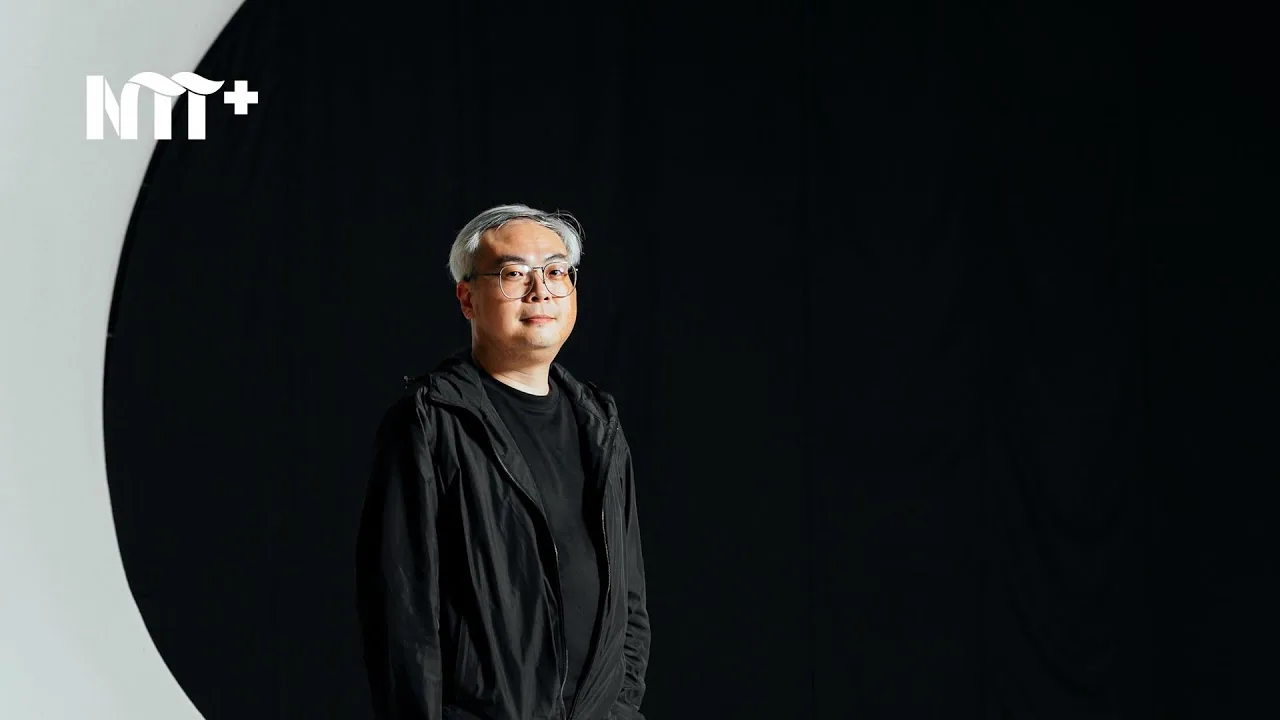
Yeh Ting-Hao: The Audiovisual Artist Who Forced Accidents Out of "Incorrect" Uses of Technology, Leaving Behind an Entire Ecosystem at 43
30-Second Overview: Yeh Ting-Hao (1981-2024), whom friends called PUTA, was born in Taoyuan, majored in computer animation in the Department of Applied Arts at Fu Jen Catholic University, and earned a master's degree from the Graduate Institute of Art and Technology at Taipei National University of the Arts1. In 2007, he worked with Yao Chung-Han, Wang Chung-Kun, and Niu Chun-Chiang to move Lacking Sound Festival from a TNUA dormitory corridor onto the stage of Nanhai Gallery2; in 2013, he formed the audiovisual duo HH with Yao Chung-Han, and in 2017 released the techno album remotion, made with fluorescent lights3; in 2017 he also joined Chen Pin-Chen in building a Chinese-language community around the node-based programming software TouchDesigner4; in 2018 he took over Fluid Noise from Yao Chung-Han, turning it from a performance unit into a promotional organization "cultivating a new generation of audiovisual creators"5. Throughout his life he said he was "more interested in producing accidental effects through the 'incorrect' use of technology"6, yet he spent the great majority of his time on the work of "correctly teaching others how to use tools." He died prematurely on November 12, 2024, at the age of 43, leaving behind the infrastructure of Taiwanese audiovisual art as a whole.
Before November 12, 2024, Yeh Ting-Hao's name was one that only people inside the field would recognize.
Audiences at Lacking Sound Festival knew him. Students who had taken his courses in the Department of New Media Art at Taipei National University of the Arts knew him. Programming beginners who had asked him questions in the TouchDesignerTW community knew him. People who had heard HH play techno at parties knew him. His colleagues in the Department of Communications Design at Shih Chien University knew him. But for the overwhelming majority of people on the island, the three Chinese characters "葉廷皓" were not a name they would remember.
On November 12, he left. The next day, HH, the audiovisual duo to which he belonged, wrote a single sentence on its Facebook fan page: "Puta 2024.11/12, has become a star in the sky."7 He was 43.
At that moment, the entire Taiwanese audiovisual art scene felt as if someone had pressed stop.
The independent music news outlet Blow StreetVoice published a report later that day with the blunt headline "HH Member and New Media Artist Yeh Ting-Hao Reported to Have Died Suddenly"7. At the end, the article quoted a social media post by music critic sonicdeadhorse: "On the day he collapsed he was supposed to come to Legacy to see Lily Chou-Chou; if nothing had happened yesterday he probably would also have gone to the Tizzy Bac shareholders' meeting. I hope everyone can remember this world-class audiovisual artist who loved Taiwanese music, liked Shintaro Sakamoto, liked NUMBER GIRL, liked Wonfu, and himself looked like a slightly swollen Ryuichi Sakamoto: Yeh Ting-Hao."7
That was not an artist's memorial tribute. It was a friend writing about a friend. In one short paragraph, it held five bands, the look of a face, two events he had planned to attend, and a tomorrow that never happened. After reading it, you realize there had been a person in this world for whom every trivial detail connected to "PUTA the person" was worth explaining to the outside world.
Taoyuan, Fu Jen, TNUA: A Computer Animation Student Enters the Experimental Sound Scene
Yeh Ting-Hao was born in Taoyuan in 19811. He studied in the Department of Applied Arts at Fu Jen Catholic University, majoring in computer animation1.
Between Fu Jen's applied arts program and the Graduate Institute of Art and Technology at Taipei National University of the Arts, he made a choice that looked strange at the time but, in retrospect, became the clue to his entire life: he moved toward sound.
In mid-2000s Taiwan, taking training in "computer animation" into real-time image work, and pairing real-time images with experimental sound, was not a path that had already been laid. At the time, Taipei's experimental sound scene was only just beginning to develop a community structure: in 2005, Yao Chung-Han, Wang Chung-Kun, and Chang Yung-Ta founded i/O Sound Lab at TNUA8. This group quickly became the core through which students in TNUA's Graduate Institute of Art and Technology curated for one another and performed with one another. Yeh Ting-Hao joined during this period.
📝 Curator's Note
The conventional account traces Taiwanese sound art back to the experimental music label Noise, founded by Wang Fujui in 1993, and Lacking Sound Festival back to Yao Chung-Han's 2007 initiative at Nanhai Gallery. That version is not wrong, but by focusing entirely on "who did what first," it misses a more important observation: Taiwanese audiovisual art was more like something made by a community, and that community grew almost entirely inside the TNUA Graduate Institute of Art and Technology building. Yeh Ting-Hao represents this kind of "second-generation core raised within the circle"; he was the key node that turned all the lines into a three-dimensional structure.
In July 2007, Yao Chung-Han pushed the energy of this circle onto a fixed presentation platform: Lacking Sound Festival (LSF). At Nanhai Gallery, Lacking Sound Festival operated by the rule of "one event per month, two artists per event"29. Its early planning team consisted of Yao Chung-Han, Wang Chung-Kun, Yeh Ting-Hao, and Niu Chun-Chiang, all four of them students or graduates of TNUA's Graduate Institute of Art and Technology29.
From the beginning, Yeh Ting-Hao's role in this team was never simply that of "the person performing on stage." In 2008, after Lacking Sound Festival had been running for a year, Yao Chung-Han handed the organizer role to him10. He did it for one year, then passed it to Wang Lien-Cheng in 2009-2010, before Yao returned in 2010-2012. This relay itself was a signal: Lacking Sound Festival was taking an institutional route in which the organizer role rotated, allowing the presentation platform to stay alive.
That same year, 2008, the first edition of TransSonic, the sound art festival curated by Wang Fujui, began. Years later, Yeh Ting-Hao described the division of labor at the time in an interview: "That major event was called TransSonic; it ran for three or four consecutive years."11 The first edition was the result of work and collective brainstorming by Wang Fujui together with Yao Chung-Han, Wang Chung-Kun, Chang Yung-Ta, and Yeh Ting-Hao12. The five names appeared side by side, pushing the same circle onto a more formal presentation platform closer to the system of the Taipei Fine Arts Museum.
First Cross-Disciplinary Stops: YiLab, Naxs Corp, and More Than a "Visual Supplier"
Beginning in 2009, another line of Yeh Ting-Hao's work formally took shape: real-time image collaboration across dance and theater.
The earliest record is Loop Me, a 2009 work by choreographer Su Wen-Chi's YiLab13. After that came ReMove Me in 2011 and W.A.V.E in 201314. Su Wen-Chi is known for crossing new media and dance; her company YiLab, founded in Taipei in 200515, positioned itself around "exploring the boundary between dance and new media." Yeh Ting-Hao's entry into this collaborative chain was not the job of "the person who plays projections live." His responsibility was the programming task of interweaving the movement trajectories of dancers' bodies with the real-time computational logic of lighting and sound.
From 2015 onward, he joined another cross-disciplinary line: Naxs Corp's virtual reality performance project Render Ghost16. The work began by winning the top prize at the sixth Taipei Digital Art Performance Award in 201517, and later went through versions v2, v3, and v4, shown respectively at Shuiyuan Theater, Taipei Rehearsal Room, and the National Taiwan Museum of Fine Arts1617. Naxs Corp brought VR into live performance, and Yeh Ting-Hao remained the key real-time image programmer on that team.
📝 Curator's Note
Why are these cross-disciplinary works so important in Yeh Ting-Hao's career? Because they prove one thing: real-time image as an independent medium has its own narrative logic, and is not visual decoration attached to performance. When Su Wen-Chi wants a dancer and a beam of light to "respond to one another," that light cannot be prerecorded; when Naxs Corp wants VR audiences and dancers to "physically coexist in the same virtual space," that virtual space must compute in real time with the dancers' movements. Yeh Ting-Hao broke this technical threshold open for more choreographers, theater directors, and visual artists to use. That gesture itself was the prototype for his later work with TouchDesignerTW, Fluid Noise, and workshops.
HH: An Audiovisual Duo Founded in 2013, and a Techno Album Made with Fluorescent Lights
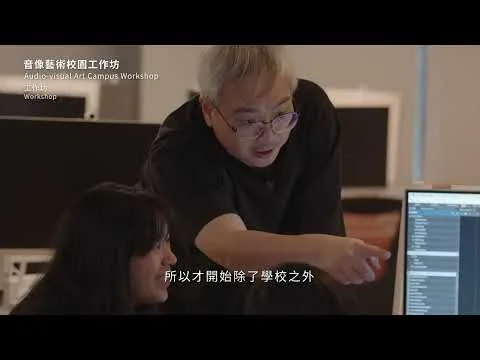
A segment from the 2024 NTT residency documentary _Reverberation of Illusions: Yeh Ting-Hao adjusts the real-time image system on site. Full attribution appears in "Image Sources" below._
Yeh Ting-Hao's own representative work was not inside a dance company. It was in HH.
HH's formation had a specific scene. In 2011, Yeh Ting-Hao held the solo exhibition Harmonious World in Taipei and invited Yao Chung-Han to assist with one of the works18. That was the first time the two made a special performance combining noise and real-time images. The next year, 2012, Yao received an invitation from an art exhibition in Hong Kong. In an interview, he explained: "In 2012, for an exhibition in Hong Kong, the Digital Art Center asked me to perform at the opening. I used that opportunity to try making techno. I knew Yeh Ting-Hao had always been making images, so I invited him to collaborate."11
From that invitation onward, HH formally became a fixed duo. 2013 is generally recognized as the year the group was formed111819.
HH's division of labor was clear. Yao Chung-Han was responsible for writing electronic music centered on techno, while Yeh Ting-Hao handled the real-time images, visualizing the sound and occasionally participating in arrangement11. But behind this division of labor was a very specific aesthetic tendency: Yao's techno "retained a large amount of noise elements," giving the techno "an even greater mechanical feel"11, in a direction completely different from club dance music intended to let people zone out.
"In general, we lean more toward techno. The sonic elements are simple, geometric, simple, pure, so real-time images have more room to work and the burden on equipment is smaller," Yeh explained in an interview with Roomie19. But that was only a description on the technical level. At a deeper level was his own view of "liveness": "I had an original intention in HH, which sounds very old-fashioned: I wanted to make visible sound, to use visual images as visualized sound."19
The phrase "visible sound" was later taken up by TNUA's Department of New Media Art in its memorial article after his death, where it was treated as the motto of his life20.
In 2017, HH finally released its first album, remotion3. The album's producer was Lu Luming, who is skilled in handling glitch sounds3. Media reports clearly explained the album title's origin: "remotion" abbreviates remote + emotion, and in Old English carries the meaning of "departure"21. HH explained it this way: "Through the perception of hearing and vision, remotely controlling the audience's emotions, so that the audience rises and falls with the rhythm of the work."21 In an interview, Yeh himself put it more plainly: "We often hear that 'music has an infectious power, it has an infectious power live.' I interpret that as music being strong enough to 'remote-control' the audience."19
DigiLog Sound Lab described the album in its release preview as "a dance-music album made with fluorescent lights"21. That phrasing was not exaggerated. The basis of Yao's creation was that "when fluorescent lights are switched on and off, or when they are broken, that distinctive sound became his creative inspiration"21. In HH's live performances, entire arrays of fluorescent lights would appear on stage, flashing on and off in sync with the music21. This was the visual grammar HH established in performance spaces.
And what technical tools did HH use? Yeh described them himself: they would write and stretch Max/MSP themselves to match an experimental spirit. The software can read arbitrary files and identify the code as sound, and could even take the entire Microsoft Word application, throw it in, and directly generate sound material19.
This is the most concrete display of Yeh Ting-Hao's philosophy of "incorrectly using technology": opening Word as if it were an audio file.
"More Interested in Producing Accidental Effects Through the 'Incorrect' Use of Technology"
This sentence, which Yeh Ting-Hao left in The News Lens's interview with HH, was later quoted by many people: "Every kind of technology of course has its correct way of being used, but we are more interested in producing accidental effects through the 'incorrect' use of technology."6
This is his most frequently quoted self-description. But between it and his actual mode of work lay a contradiction.
If you are "more interested in the incorrect use of technology," then logically you should become an artist who stays in your own studio, making one experimental work after another. Yeh Ting-Hao did not take that path. Almost everything he did was "teaching others how to correctly use technology":
- From 2017 onward, he co-ran the TouchDesignerTW group with Chen Pin-Chen and held countless promotional workshops422. TouchDesigner is a node-based visual creative programming environment; he took it from a high-threshold tool inside the academy and broke it down for designers, visual workers, and theater technicians.
- In 2018, he took over Fluid Noise, which Yao Chung-Han had founded in 20115, transforming it from a performance unit centered on "Lacking Sound Festival serial performances" and "Fluid Noise 02/03/04" into a cultivation platform that was also an "experimental sound and image promotion project." Fluid Noise's explicit mission was stated plainly: "to connect domestic and international creators and groups, focusing on cultivating a new generation of creative, critical, and production talent"5.
- In 2018, during his C-LAB Creators residency, he simultaneously planned the workshop series "A/V Intensive Course: Experimental Sound and Image Promotion Project"523.
- From 2019 onward, he co-curated the Experimental Audiovisual Art Festival with Lacking Sound Festival5.
- From 2020 onward, he was a part-time lecturer in Shih Chien University's Department of Communications Design, and in 2024 was promoted to full-time1. He was also a part-time lecturer in the Department of New Media Art at TNUA24.
In an interview with CLABO, Yeh explained why he moved onto this educational path. He found that students in TNUA's Department of New Media Art "were completely lacking the basic abilities they should have had in software previously studied at school," so he adjusted his teaching strategy to first strengthen the fundamentals. He chose audiovisual art as the central axis for very practical reasons: "commercial applicability, low creative cost, and a low entry threshold"5.
📝 Curator's Note
Put these two lines side by side and it becomes clear: his own creative philosophy was "being more interested in the incorrect use of technology," while all of his educational work was "first teaching students to use technology correctly." This arrangement was a practical calculation: one must first have the foundation of "correct use" before "incorrect use" can become a meaningful deviation. A student without TouchDesigner training will not know what it feels like to "deliberately use TouchDesigner wrong"; without a basic concept of Max/MSP, one cannot throw Word into it and open it as an audio file. Yeh Ting-Hao's life choice was to first be the person who laid the foundation.
The CLABO interview recorded his original intention for this path: "to create more companions who invest themselves in audiovisual creation"5.
That sentence can serve as a footnote to his whole life.
The 2023-2024 Residency: Two Works, One Unfinished Future
The later stage of Yeh Ting-Hao's career concentrated around two representative works, both of which occurred in 2023-2024. One was the National Taichung Theater residency work Reverberation of Illusions; the other was the solo exhibition Subconscious Machine at the National Taiwan Museum of Fine Arts.
In 2023-2024, Yeh Ting-Hao was selected as a National Taichung Theater artist-in-residence25. Over more than a year of residency, he refined Reverberation of Illusions into maturity. The work was performed seven times in NTT's Playhouse from August 31 to September 8, 202426. The Playhouse is an atypical presentation space inside the curved architecture of NTT designed by architect Toyo Ito. Inside it, Yeh created an "audiovisual concert combining enveloping projection with multichannel speaker configuration"26.
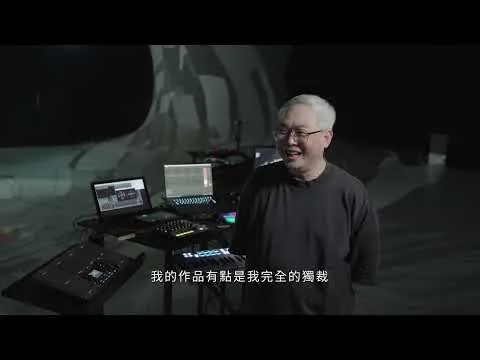
_Reverberation of Illusions in the Playhouse: an audiovisual concert with enveloping projection and multichannel speakers computed in real time. Full attribution appears in "Image Sources" below._
In the production team, Yeh Ting-Hao was the lead artist. Golden Melody Award-winning producer Cheng Ko-Chun (sonicdeadhorse) handled music production, live programming, synthesizer, and guitar, performing live in real time on a foundation of electronic music and generating images in real time26. Chen Pin-Chen was responsible for image technology integration and execution; this partner had already co-run TouchDesignerTW with Yeh for seven years. Producer Wu Po-Shan coordinated the whole project26.
At the core of Reverberation of Illusions was a live-computed audiovisual experience that would never repeat itself: in a curved architectural space, sound and light shuttled and flowed, and audiences were enveloped by sound and image in sync. In the 2022 National Culture and Arts Foundation grant completion statement, Yeh described the principles of this series: "using programmatic computation to correlate and transform hearing and vision, allowing audiences to see sound and hear images," and "based on differences produced by the intervention of performers and audiences, generating real-time computational experiential results that will never repeat"27.
📝 Curator's Note
Yeh Ting-Hao's representative work was never a fixed object. His representative work existed on the level of "what happened in that moment, in that space, among that audience, with that group of performers." This is also why so little image documentation remained after his death: the fullest record of a performance of Reverberation of Illusions would not be a video or a photograph, but the 400 versions felt separately by the 400 audience members in the Playhouse at the time, versions that would never happen again.
On October 5, 2024, Yeh Ting-Hao's final solo exhibition, Subconscious Machine, opened in the Multi-Screen Image Area of the National Taiwan Museum of Fine Arts28. The exhibition ran until December 22.
It was his first work in the context of AI-themed creation, and became his last.
Curator Chiu Chih-Yung, a professor at National Tsing Hua University's Institute of Technology and Art who had co-curated "Scenery of Dataflow" with him in 2023, recorded Yeh's view of AI in an interview with VERSE. "Everyone now is trying to use AI to draw the correct thing. When we (technological artists) use this material, what we may be seeking is to use AI to draw things that do not exist in this world, for example, deliberately asking AI to draw... a person with 20 fingers."29
The entire work Subconscious Machine was the full realization of this philosophy: it focused on exploring and debating the operating processes of AI language and image models such as ChatGPT and Stable Diffusion, presenting how, after training on massive datasets, models generate "seemingly real results" according to human prompts, and the "AI hallucination (Hallucination of AI)" produced in this process2830.
Yeh personally guided audiences on the opening day, explaining that "Subconscious Machine was his first work in the context of AI-themed creation" and that "the focus of the creation lay in asking questions about the current social condition"30.
He did not know that he would no longer have the chance to make a second or third work in this series.
The exhibition opened on October 5. He died on November 12. The exhibition was still running, and would continue until December 2228. For more than a full month, visitors entered that room at the National Taiwan Museum of Fine Arts every day, looking at Yeh Ting-Hao's final experiment in AI hallucination. He himself was already gone.
"PUTA Did Not Teach Us to Make Works; He Taught Us How to Feel the World"
After Yeh Ting-Hao's death, institutions throughout Taiwan's audiovisual art scene gradually published memorial essays and commemorative posts.
C-LAB Future Vision Lab's memorial post on Threads was brief: "Known among friends as puta, the new media artist Yeh Ting-Hao devoted himself tirelessly over many years to creation, teaching, and different collaborative projects, and from the early days of the FUTURE VISION LAB presentation program until now, gave much support in technology and cultivation; at the same time, he also left behind many brilliant digital and audiovisual works, allowing us, living in the digital age, to continue remembering him in different forms. Thank you, puta 🖤"31
The phrase "from the early days of the FUTURE VISION LAB presentation program until now" refers to C-LAB's 15-meter-diameter dome theater, the C-LAB Dome: Taiwan's only large-scale mobile outdoor immersive experience space, equipped with an 8K×8K immersive image projection system and a 25.4-channel surround sound environment32. From the launch of this project in 2020, Yeh was a technical companion inside it, helping batch after batch of young artists install their works in this highly specific venue. He was not necessarily the lead artist, but he was almost certainly helping on site.
The title of the memorial feature by TNUA's Department of New Media Art was "Yeh Ting-Hao PUTA: Continuing Breath in the Digital Universe Through the Languages of Light and Sound"20. In the article, one passage, recorded by the department as a student memory, reads: "PUTA did not teach us to make works; he taught us how to feel the world."20
This sentence may not be traceable word for word to an individual student's personal post. It appears within the narrative frame of the official memorial article by TNUA's Department of New Media Art. But the fact that it could become the department's collective memory of him is itself information: Yeh Ting-Hao did not take the teacher's route of "the task is complete once students learn a piece of software." He was the kind of teacher who spent time accompanying students as they thought through "why this work has to be made."
On November 13, the National Taiwan Museum of Fine Arts also published a post. It recorded this sentence: "Friends in the art world who knew Yeh Ting-Hao well affectionately called him PUTA; he was a brilliant star of the young creative generation."33
Each institution's memorial had its own formulation, but there was one common point: all of them were describing that "this person is no longer here, but the things he did remain."
What He Truly Left Behind Was Infrastructure
So what did Yeh Ting-Hao truly leave behind?
If he is assessed only through the dimension of "representative works," you would see only one HH album, remotion; seven performances of Reverberation of Illusions; and one exhibition of Subconscious Machine that lasted a little over two months. In the world of new media art, that volume is not especially abundant. Compared with Wang Lien-Cheng, who won the Lumen Prize and the Taipei Arts Award grand prize, or Yao Chung-Han, who made a main exhibition at Jut Art Museum, Yeh's accumulated personal solo output was not large.
But if you switch dimensions and ask, "How many of the things he initiated later continued to live?", the answer is completely different:
| Initiated / Taken Over by Yeh Ting-Hao | Current Status |
|---|---|
| Lacking Sound Festival (2007) | Entered dormancy after its 100th edition in 2016, but remains an important chapter in Taiwan's sound history9 |
| TransSonic (2008) | Continued and transformed by Wang Fujui into multiple sound art presentation projects, including Altering Nativism Sound Cultures and B!AS among others12 |
| HH audiovisual duo (2013) | Formally ended with Yeh Ting-Hao's death, but left behind the album remotion and years of live performance records |
| TouchDesignerTW (2017) | Still operating, and Taiwan's largest Chinese-language TouchDesigner community4 |
| Fluid Noise (taken over in 2018) | Still operating, and a core organization for experimental audiovisual promotion in Taiwan5 |
| Experimental Audiovisual Art Festival (2019-) | Co-curated with Lacking Sound Festival and now an annual fixed event5 |
| C-LAB Future Vision Lab (2020-) | Continues to hold dome theater presentation programs and to cultivate a new generation of audiovisual creators3132 |
This table is Yeh Ting-Hao's true representative work.
The things he did shared one pattern: identify a field that no one had yet built up, whether audiovisual art promotion, a Chinese-language TouchDesigner community, or an AV creator cultivation platform; turn it into an organization with structure, capable of sustained operation and capable of being handed to others; then, once the organization stood firm, pass it to the next person.
📝 Curator's Note
The conventional artist narrative prefers the structure of "what great works did he make to have his name remembered?" Yeh Ting-Hao's story does not fit that version. His working logic was closer to that of an ecologist: first observe what the ecosystem lacks, then plant a tree. This tree does not have to be the tallest or strongest above ground; it only needs to exist, reproduce, and allow other organisms to live beneath it. Lacking Sound Festival, Fluid Noise, TouchDesignerTW, the Experimental Audiovisual Art Festival, and C-LAB Future Vision Lab: each was a tree he planted. When he left at 43, this forest had already become a complete ecology.
From a child in Taoyuan in 1981 to his death at 43 on November 12, 2024, almost everything that happened in between had to do with "putting tools into more people's hands." His own deepest interest was in "producing accidental effects through the 'incorrect' use of technology"6, but he spent the great majority of his time on the work of "first teaching everyone to use technology correctly."
Behind this choice was an unspoken calculation: he knew the talent pool in Taiwan's audiovisual art scene was too small; without building up the infrastructure, even the most gifted individual creators could not sustain an ecosystem. So he chose to first be the person who laid the foundation.
In the National Taichung Theater documentary for Reverberation of Illusions, the last few things Yeh said were about precisely this: art requires a whole community of people thinking together, doing together, and together making certain things become possible. It is not the solitary achievement of one person.
On the night of November 12, 2024, his friends, colleagues, and students wrote countless passages on Facebook, Threads, and Instagram. One of them was written by sonicdeadhorse: "I hope everyone can remember this... world-class audiovisual artist who himself looked like a slightly swollen Ryuichi Sakamoto: Yeh Ting-Hao."7
"World-class audiovisual artist" is a title few people in Taiwan can bear. But the point of sonicdeadhorse's sentence was not the three words "world-class"; it was "I hope everyone can remember."
PUTA is gone. But the ecosystem he planted is still operating. Memories of Lacking Sound Festival are still being told; HH's remotion can still be played on Apple Music; the TouchDesignerTW community is still accepting new members; Fluid Noise is still planning a new year's Experimental Audiovisual Art Festival. The next generation of Taiwanese audiovisual artists is growing up inside these organizations. They may never have met PUTA himself, but they are still his students' students.
"We are still working hard." He said this in an interview while he was alive34.
The person who worked hard is no longer here. But the tools he left behind, the communities he built, the students he trained, and the presentation platforms he helped bring into being are still working hard. That is what he truly left behind.
Further Reading:
- Taiwanese New Media Art — Four decades of Taiwanese new media art, from Wang Fujui and Huang Wen-Hao in the 1980s to Yeh Ting-Hao and Wang Lien-Cheng in the 2020s
- Wang Fujui — Founder of the experimental music label Noise in 1993, a spiritual mentor of Taiwanese sound art, and Yeh Ting-Hao's teacher at TNUA's Graduate Institute of Art and Technology
- Wang Lien-Cheng — Yeh Ting-Hao's same-generation comrade in i/O Lab, the 2009-2010 successor organizer of Lacking Sound Festival, and winner of the London Lumen Prize in 2017 for Reading Plan
- Taiwanese Soundscape — The evolution of Taiwan's soundscape, from sound to audiovisual art and from noise to generative art
- Digital Wasteland — A same-generation Taiwanese new media art criticism platform that recorded key works and discourse from Yeh Ting-Hao's generation
- Taiwanese Electronic Music and Party Culture — The Taiwanese techno and experimental electronic sound party scene in which the duo HH was situated
Image Sources
This article uses three still images from the official NTT documentary, 《Echoes of Illusion》 (幻象的殘響), under fair use editorial commentary. All are cached in public/article-images/art/ to avoid hotlinking to source servers:
- yeh-ting-hao-reverberation-hero-2024.jpg — 1280×720 hero, the first frame still from the documentary. Photo: NTT Official Channel of the Taiwan National Theatre, Fair use editorial commentary on Yeh Ting-Hao's NTT residency work.
- yeh-ting-hao-reverberation-scene1-2024.jpg — 480×360 scene-mid, a live tuning shot of Yeh Ting-Hao. Photo: Same as above.
- yeh-ting-hao-reverberation-scene2-2024.jpg — 480×360 scene-mid, a clip from the immersive projection performance. Photo: Same as above.
Image Sourcing Notes
As a contemporary sound artist, most visual records of Yeh Ting-Hao—including personal portraits, early performances, and other works (such as The Unconscious Machine, Light Flow, or O.S.C.)—are found on private websites, Instagram, Facebook, or institutional performance pages; these are all copyrighted original materials. Wikimedia Commons API searches (using "Yeh Ting-Hao," "Yeh Ting-Hao," "Lacking Sound Festival," and "Taiwanese sound artists") yielded 0 hits, with no public domain/CC images available. Apart from the three NTT documentary stills mentioned above, this article does not include other visual materials. Readers can find visual records of Yeh Ting-Hao via the following links:
- Full documentary 《Echoes of Illusion》: YouTube — The Taiwan National Theatre Residency Artist Yeh Ting-Hao's Documentary _Echoes of Illusion_ (NTT Official Channel of the Taiwan National Theatre)
- HH’s album remotion: Apple Music / StreetVoice
- Fluid Noise project records: DAC.Taipei Yeh Ting-Hao Puta entry
- NMA Special Feature on Yeh Ting-Hao: Yeh Ting-Hao PUTA: Breathing in the Digital Universe with Light and Sound
References
- 葉廷皓 — 維基百科 — The Chinese Wikipedia entry for Yeh Ting-Hao, recording his dates (1981-2024-11-12), nickname PUTA, birth in Taoyuan, computer animation major in Fu Jen Catholic University's Department of Applied Arts, master's degree from TNUA's Graduate Institute of Art and Technology, part-time lectureship in Shih Chien University's Department of Communications Design from 2020 to 2024, and promotion to full-time lecturer in 2024. The Wikipedia entry was last revised on March 6, 2026.↩234
- 失聲祭 — 台灣當代藝術資料庫 TCAA — The Taiwan Contemporary Art Archive entry on Lacking Sound Festival, recording that i/O Lab was founded at TNUA in 2005 by Yao Chung-Han, Wang Chung-Kun, and Chang Yung-Ta, later joined by Yeh Ting-Hao, Wang Lien-Cheng, and Huang Chung-Ying, and that in July 2007 it launched Lacking Sound Festival at Nanhai Gallery, with the performance rule of one event per month and two artists per event.↩23
- Remotion — HH 的專輯,Apple Music — The Apple Music digital streaming page for remotion, the first album by the duo HH (Yao Chung-Han + Yeh Ting-Hao), released in 2017.↩23
- C-LAB 未來媒體藝術節:TouchDesigner 新媒體互動集線器 — C-LAB's page for the TouchDesigner promotion project held November 2-7, 2021, recording that Yeh "began co-running the TouchDesignerTW group with Chen Pin-Chen in 2017 and held multiple promotional workshops," and listing Yeh as a speaker for two talks.↩23
- 從籌辦演出轉往 Audiovisual Art 創作者的培育 — CLABO 實驗波 — A CLABO Magazine interview with Fluid Noise and Yeh Ting-Hao, recording that Fluid Noise was founded by Yao Chung-Han in 2011 and transferred to Yeh Ting-Hao as director in 2018; its activities include Lacking Sound Festival serial performances (2011-2013), Noise X Beats (2012), Fluid Noise 02/03/04, A/V Intensive Course, and Fluid Noise Internship vol. 1.↩23456789
- 等待重拍來臨:專訪音像雙人組 HH — The News Lens 關鍵評論網 — The News Lens's interview with HH, in which Yeh Ting-Hao says: "Every kind of technology of course has its correct way of being used, but we are more interested in producing accidental effects through the 'incorrect' use of technology."↩23
- HH 成員、新媒體藝術家葉廷皓驚傳離世 享年 43 歲 — Blow 吹音樂 — Blow StreetVoice's November 12, 2024 report, recording HH's Facebook post "Puta 2024.11/12, has become a star in the sky," and quoting sonicdeadhorse's memorial post calling Yeh a "world-class audiovisual artist" and recording his unfinished plans: that he "was supposed to go to Legacy to see Lily Chou-Chou" and to the "Tizzy Bac shareholders' meeting."↩234
- 王仲堃 — 非池中藝術網 — Artist entry for Wang Chung-Kun, recording the context in which i/O Lab was founded at TNUA in 2005 by Yao Chung-Han, Wang Chung-Kun, and Chang Yung-Ta, and was later joined by members including Yeh Ting-Hao, Wang Lien-Cheng, and Huang Chung-Ying.↩
- 「台灣最道地的聲音快炒」:失聲祭第 100 回前的反思與展望 — The News Lens — The News Lens's retrospective report on Lacking Sound Festival's 100th edition, recording that Lacking Sound Festival was founded in 2007 at Nanhai Gallery by Yao Chung-Han and the TNUA team, entered dormancy after completing its 100th edition in 2016, and that the January 22, 2016 event featured the new media group "XXXXX," comprising Wang Fujui, Lu Yi, Yao Chung-Han, Yeh Ting-Hao, and Wang Hsin-Jen.↩23
- 葉廷皓 — 維基百科 — The Chinese Wikipedia entry for Yeh Ting-Hao, recording that he served as organizer of Lacking Sound Festival in 2008, followed by Wang Lien-Cheng in 2009-2010 and Yao Chung-Han's return in 2010-2012.↩
- 等待重拍來臨:專訪音像雙人組 HH — The News Lens — The News Lens interview with HH records Yao Chung-Han's memory: "In 2012, for an exhibition in Hong Kong, the Digital Art Center asked me to perform at the opening... I used that opportunity to try making techno. I knew Yeh Ting-Hao had always been making images, so I invited him to collaborate." The same piece records Yeh's statement that "that major event was called TransSonic; it ran for three or four consecutive years," HH's retention of "a large amount of noise elements" to make techno "even more mechanical," and the duo's division of labor.↩2345
- 藝術家特寫 王福瑞 — 現代美術期刊 PLUS — A feature on Wang Fujui in Taipei Fine Arts Museum's Modern Art journal, recording that the first edition of TransSonic in 2008 was jointly conceived and curated by Wang Fujui with Yao Chung-Han, Wang Chung-Kun, Chang Yung-Ta, and Yeh Ting-Hao, and that Wang Fujui began curating the TransSonic sound art presentation in 2008.↩2
- Loop Me — 台灣當代藝術資料庫 TCAA — TCAA work entry for Yeh Ting-Hao's Loop Me, dated 2009, a cross-disciplinary collaboration with Su Wen-Chi's YiLab (per DAC bio).↩
- 葉廷皓 — DAC.Taipei 臺北數位藝術中心 — DAC.Taipei's entry on Yeh Ting-Hao / Fluid Noise Puta, recording his participation in dance and theater productions including YiLab's Loop Me, ReMove Me, and W.A.V.E, as well as Naxs Corp's Render Ghost.↩
- Su Wen-Chi — Wikipedia 英文版 — The English Wikipedia entry for Su Wen-Chi, recording that YiLab was founded by Su Wen-Chi in Taipei in 2005 and positioned around cross-disciplinary research between dance and new media.↩
- 葉廷皓 — DAC.Taipei 臺北數位藝術中心 — DAC's entry on Yeh Ting-Hao records his participation in Naxs Corp's Render Ghost v1-v4 productions (2015-2018).↩2
- NAXS Group — Render Ghost v2 — Naxs Corp's official page for Render Ghost, which won the top prize at the sixth Taipei Digital Art Performance Award in 2015, with later v2-v4 versions shown at Shuiyuan Theater, Taipei Rehearsal Room, and the National Taiwan Museum of Fine Arts.↩2
- 葉廷皓 Yeh Ting Hao — 非常廟藝文空間 VT artsalon — VT artsalon's artist page for Yeh Ting-Hao, recording that during the 2011 solo exhibition Harmonious World, he invited Yao Chung-Han to assist with a work, marking the origin of the two artists' first collaboration.↩2
- 在派對現場,打造「看得見的聲音」:HH 二人組 — Roomie — Roomie's interview with the duo HH (Yeh Ting-Hao + Yao Chung-Han). Yeh Ting-Hao is directly quoted: "In general, we lean more toward techno. The sonic elements are simple, geometric, simple, pure, so real-time images have more room to work and the burden on equipment is smaller." "I had an original intention in HH, which sounds very old-fashioned: I wanted to make visible sound, to use visual images as visualized sound." "In previous performances, the content actually changed every time. We were not trained in an orthodox way, and are not quite the same as people who make music in the so-called usual sense." "We often hear that 'music has an infectious power, it has an infectious power live.' I interpret that as music being strong enough to 'remote-control' the audience." The interview also describes how Max/MSP can take the entire Microsoft Word application, throw it in, and directly generate sound material.↩2345
- 【追思專題】葉廷皓 PUTA:以光與聲的語言,延續在數位宇宙中的呼吸 — 北藝大新媒體藝術學系 — The official memorial feature by TNUA's Department of New Media Art, describing that "for those who knew him well, PUTA was not only an image poet on stage, but a soul constantly exploring the relationships among 'sound, light, machines, and people,'" and recording collective student memories including "PUTA did not teach us to make works; he taught us how to feel the world." It also records that Yeh's teaching included TouchDesigner, real-time image computation, and interactive design.↩23
- 用日光燈做的舞曲專輯 — HH 將發表首張專輯 remotion — DigiLog 聲響實驗室 — DigiLog's release preview for HH's remotion, recording that remotion = an abbreviation of remote + emotion, with the Old English meaning of "departure"; HH "remotely controls the audience's emotions through auditory and visual perception"; producer Lu Luming is skilled in handling glitch sounds; Yao Chung-Han uses the sounds of fluorescent lights being switched on and off or breaking as creative material; and live performances use fluorescent light arrays combined with the music as visuals.↩2345
- TouchDesigner 互動媒體設計入門 — Derivative 官方 — A Taiwan workshop page recommended by TouchDesigner developer Derivative, recording that Yeh Ting-Hao had co-run the TouchDesignerTW group with Chen Pin-Chen (Yea CHEN) since 2017 and held multiple promotional workshops.↩
- 葉廷皓 — DAC.Taipei 臺北數位藝術中心 — The DAC entry for Yeh Ting-Hao records that during his 2018 C-LAB Creators residency, he planned the workshop series "A/V Intensive Course: Experimental Sound and Image Promotion Project."↩
- 葉廷皓 YEH,Ting-Hao — 北藝大新媒體藝術學系兼任講師頁 — TNUA Department of New Media Art part-time faculty page, listing Yeh as a part-time lecturer.↩
- 葉廷皓 — 臺中國家歌劇院藝術家介紹 — National Taichung Theater artist introduction page, recording Yeh Ting-Hao as a 2023-2024 artist-in-residence. The bio describes him as "a new media art creator and educator, skilled in programmatic moving image, experimental sound, and performing arts. His works mostly focus on the relationship between sound and image, merging prefabricated and real-time events, taking an aesthetics of error as a point of departure, and attempting to find parody and dialectics belonging to the new media era."↩
- 2024 夏日放/FUN 時光—2023-2024 歌劇院駐館藝術家葉廷皓《幻象的殘響》— 臺中國家歌劇院 — NTT's event page for the residency work Reverberation of Illusions, recording seven performance times (2024/8/31 14:30 and 19:30; 9/1 14:30; 9/6 19:30; 9/7 14:30 and 19:30; 9/8 14:30), the Playhouse venue, and the production team: lead artist Yeh Ting-Hao, music producer / live programmer / synthesizer and guitar Cheng Ko-Chun, image technology integration and execution Chen Pin-Chen, and producer Wu Po-Shan. The work "combines enveloping projection and multichannel speaker configuration" and creates "an audiovisual symphonic concert of sound and light shuttling and flowing" in a "curved architectural space."↩234
- 幻象共鳴—生成式沉浸音像計畫|葉廷皓|國藝會補助成果檔案庫 — National Culture and Arts Foundation grant archive, 2022 regular second-round grant of NT$180,000, implementation period October 1, 2022 to September 30, 2023. The project description states: "using programmatic computation to correlate and transform hearing and vision, allowing audiences to see sound and hear images," and "based on differences produced by the intervention of performers and audiences, generating real-time computational experiential results that will never repeat." Presentation records include Pandora's Illusion: Echo Oscillation from July to September 2022, a test venue for Dream Reality in Kaohsiung, and residency testing at the National Taichung Theater Playhouse.↩
- 國美館 2024 藝術跨域創作案「葉廷皓:下意識機器」 解讀 AI 幻覺,探索機器潛意識裡的世界 — 國立臺灣美術館新聞稿 — National Taiwan Museum of Fine Arts press release from October 5, 2024, recording that the exhibition ran from October 5 to December 22, 2024, in the museum's Multi-Screen Image Area, with the opening ceremony hosted by deputy director Wang Chia-Cheng and a personal guided tour by artist Yeh Ting-Hao. The exhibition focused on AI language and image models such as ChatGPT and Stable Diffusion, presenting the phenomenon of "AI hallucination (Hallucination of AI)."↩23
- 國美館「臺灣國際光影藝術節—數據光景」:科技藝術的提問是,有沒有「20 隻手指頭的人」? — VERSE — VERSE's curatorial interview on the 2023 Scenery of Dataflow at NTMFA, recording Yeh Ting-Hao's own statements: "This is now a technological society; actually data is everywhere, only we do not necessarily see it, so we ask artists to make a transformation, to turn this data we cannot see into things that are easier to read." "Algorithms do not completely follow the artist's will; they automatically search for data materials to input and produce images, or produce sound—this is actually what we call generative art." "When I see a very strong linkage between vision and hearing, there is a feeling of great satisfaction... I cannot describe it, it is just a sense of 'this is right!'" "The most fundamental essence of technological art and media art is the question that artists pose to everyone when artists and everyone else face new technologies together." "Everyone now is trying to use AI to draw the correct thing. When we (technological artists) use this material, what we may be seeking is to use AI to draw things that do not exist in this world, for example, deliberately asking AI to draw... a person with 20 fingers." "Taiwan's media artists are not inferior to overseas creators, so judging by results, Taiwan is absolutely suited to this kind of artistic development." "No matter how technology changes, what can think human thoughts for human beings is still 'human beings'; this is something that cannot change in the short term."↩
- 【藝術文化】葉廷皓最後展作《下意識機器》 透過 AI 探索人造真理 — 自由藝文網 — Liberty Times arts report from November 19, 2024, commemorating Yeh Ting-Hao's death on November 12 and continuing to report on Subconscious Machine at NTMFA through December 22; it paraphrases Yeh's opening-day guided tour, where he said "Subconscious Machine was his first work in the context of AI-themed creation" and "the focus of the creation lay in asking questions about the current social condition"; an NTMFA representative said, "Friends in the art world who knew Yeh Ting-Hao well affectionately called him PUTA; he was a brilliant star of the young creative generation."↩2
- 新媒體藝術家|葉廷皓(1981-2024)— C-LAB Future Vision Lab Threads — C-LAB Future Vision Lab's memorial post on Threads: "Known among friends as puta, the new media artist Yeh Ting-Hao devoted himself tirelessly over many years to creation, teaching, and different collaborative projects, and from the early days of the FUTURE VISION LAB presentation program until now, gave much support in technology and cultivation; at the same time, he also left behind many brilliant digital and audiovisual works, allowing us, living in the digital age, to continue remembering him in different forms. Thank you, puta 🖤"↩2
- 葉廷皓 X 賴宗昀—衍聲像 LIVE 版 — 臺灣當代文化實驗場 — C-LAB Future Vision Lab event page for Yeh Ting-Hao and Lai Tsung-Yun's Intertextuality of Audio and Visual LIVE, held November 14-15, 2020, at the plaza in front of the War Room Building. The work concept was "transforming absolutely abstract sound into images, and using immersive projection to construct flat imagery into an enveloping volume," and "using spectral analysis to drive the rhythm of images, while also using algorithms to generate sound from images, making sound and image influence one another."↩2
- 國美館 2024 藝術跨域創作案「葉廷皓:下意識機器」— 中央社訊息平台 — Central News Agency press-release platform, again confirming the exhibition period from October 5 to December 22, 2024, in NTMFA's Multi-Screen Image Area, and noting that the artist was skilled in creative programming, experimental sound, and performing arts, was a 2023-2024 artist-in-residence at the National Taichung Theater, and taught in Shih Chien University's Department of Communications Design.↩
- 等待重拍來臨:專訪音像雙人組 HH — The News Lens — In The News Lens interview, when discussing the difficulty of HH's visual presentation, Yeh Ting-Hao said with a wry smile, "We are still working hard." The ideal state was for image and sound to be seen together.↩