

30-second overview: The Reporter is Taiwan's first nonprofit online investigative newsroom sustained by citizen donations. When it went online in December 2015, it had only 4 recurring monthly donors, a number founder Ho Jung-hsing did not dare let his colleagues know1. Ten years later, in October 2025, that number had grown to about 8,000, with 10,000 as the next goal2. It produced the Blood-Stained Fishing Grounds trilogy, which pursued reporting across three countries3; covered the debt-bonded migrant-student labor case that led to a five-year, six-month sentence for a Chung Chou University of Science and Technology executive4; and published the Chokubi Phenomenon series, after which the Ministry of Health and Welfare revised the rules so that only doctors who had completed PGY training could practice aesthetic medicine5. Its publicly stated discipline has only three lines: "no ownership, no intervention, no clawback"6. The costs The Reporter cannot cut are exactly the things people least want to pay to read in the algorithmic age. Taiwan has used monthly deductions of NT$200 or NT$300 from strangers' accounts to renew investigative journalism from a money-losing business into a public good that is constantly being sustained, even as it burns through resources ever faster.
The Number They Dared Not Say: 4
Ho Jung-hsing later admitted on Facebook that in The Reporter's first month online, it had only 4 recurring monthly donors, and he did not dare let his colleagues know that number7.
That was the month after the site formally launched on December 16, 20158. On September 1 of the previous year, Journalists' Day in Taiwan, Ho and co-founder Chang Tieh-chih held a press conference in Taipei announcing that they would build an online media outlet that accepted no funding from any government or political party, no commercial advertising of any kind, and relied only on reader donations9. Taiwan had never had anything like it. Media outlets all had owners: some were listed companies, some were political parties, some were families with business interests in China. No media outlet had "donors" as its owner.
Ho was 49 at the time and had just left his post as editor-at-large at CommonWealth Magazine10. Going further back, in 1995 he initiated and served as the founding president of the Association of Taiwan Journalists11, at a time when Taiwan was still dealing with "party, government, and military withdrawal from the media" and fighting for journalists' right not to be used as propaganda tools. He had been a journalist for 20 years. After those 20 years, he chose to stake that career on the number "4."
Barry Lam personally donated NT$5 million to establish The Reporter Cultural Foundation12. Shih Hsin University visiting professor Weng Hsiu-chi became the first board chair, serving from September 2015 to August 201813. Ho later described the foundation's role bluntly in the official FAQ: "With the foundation as an umbrella and firewall, it can block external interference and ensure the media outlet's independent operation"14.
The number 4 later became the story The Reporter itself most often told. Ten years on, in a tenth-anniversary podcast released in October 2025, Ho summarized the head-count curve in one sentence: "Recurring monthly sponsors also went from only 4 people in the first month online to now receiving the trust of 8,000 supporters each month"15. In a Facebook post that same month, he wrote: "Ten years ago I often encouraged myself with 'from ruins, a flower blooms; in troubled times, protect one patch of field.' I never expected that ten years later, the original 4 donors would have bloomed into a small garden of about 8,000 recurring monthly donors"16.
Then he added a line that many people later overlooked, but that was in fact the most important signal in the whole post: "We hope all readers and donors will walk with us, so that The Reporter's recurring monthly donors can move toward 10,000 people"17.
8,000 is not the endpoint. 10,000 is. And 10,000 has not yet been reached.
No Ownership, No Intervention, No Clawback
The Reporter's official "About Us" page condenses its promise to donors into three verbs: no ownership, no intervention, no clawback18.
"No ownership" means donors do not receive shares or decision-making power over editorial direction because of how much they donate. "No intervention" means donors cannot issue instructions about the content, timing, or direction of individual reports. "No clawback" means that after a donation comes in, the money belongs to the cost of The Reporter's journalism; it will not be returned for any reason and will not be treated as leverage that can be withdrawn at any time.
These three lines read like corporate CSR copy, but the real problem they aim to solve is the structural problem that has entangled Taiwan's media industry for 30 years: owners intervene, advertisers pull ads, and governments leak information strategically. Almost no commercial media outlet in Taiwan can completely escape at least one of these three lines. The Reporter's solution is to sever all three from the source through organizational structure: no shareholders, no advertising, no government procurement projects. Moral appeals cannot save a structure; organizational design is what can hold it.
The detail that Barry Lam personally donated NT$5 million to establish the foundation is official, first-hand public information19. A later market version claimed that Lam's initial donation was NT$20 million, but that number has never been officially confirmed and is closer to market rumor; the hard fact that can be confirmed is NT$5 million20. What matters is the three-part design of "personal donation + foundation holding structure + no advertising"; the size of the number itself is secondary. Even after Lam later became vice chair of a Democratic Progressive Party think tank, the foundation's bylaws did not allow him to issue instructions on a single report.
The official FAQ contains another passage explaining why the outlet does not display pageviews: "We hope to move beyond the myth of pageviews, because traffic is not entirely equal to reporting value, nor is it equal to trust and impact"21. In the world of online media in 2026, this has become an extremely rare discipline. Most news sites show real-time reader counts, social-share counts, and comment counts under each article, and newsrooms use those numbers to decide what to write next. The Reporter's newsroom does not have that screen.
At the end of August 2018, former education minister Huang Jong-tsun took over as the second board chair22. Board transitions, editor-in-chief handovers, and executive-director role changes are normal in this organization, but the three lines of the "three noes" principle have never changed. They have become a house rule carved into the doorframe: everyone who enters this organization to work knows there are three things they cannot touch.
The Fishers' Eyes: More Than 100 Interviewees, One-Seventh Overseas
If one wants to explain why The Reporter is expensive, the Blood-Stained Fishing Grounds trilogy is the most direct answer.
Source: The Reporter's Blood-Stained Fishing Grounds series hub
The first installment, published in 2016, was titled "Fabrication, Exploitation, Blood-Stained Fishing Grounds"23. It reported on the exploitation of foreign fishers aboard Taiwan's distant-water fishing vessels. Most of these fishers came from Indonesia and the Philippines. Brokers brought them onto boats; once they went to sea, they were away for months or even a year. Captains confiscated their passports, brokers skimmed layers from their wages, working hours exceeded 18 hours, food was so poor that workers became ill, and after deaths at sea, bodies were thrown overboard. These realities had long existed in the distant-water fishing industry, but Taiwanese society had almost never seen a complete investigative report on them.
The second installment, in 2018, expanded the focus from exploitation aboard vessels to "maritime human trafficking"24. Reporters followed the trail to land-based brokers who deceived people in their hometowns and put them on boats, completing the entire chain of exploitation. The third installment, released in September 2020, was "Unfinished Distant-Water Governance: From Illegal Shark Fins and Forced Labor to the Death of an Observer"25. It shifted the focus to the oversight mechanism itself: observers stationed on distant-water vessels to monitor operations had died at sea, and the causes had never been clarified.
Lee Hsueh-li later recalled the workload of the series on Medium: "More than 100 interviewees, with one-seventh of them from abroad, including observers from Kiribati and other central and western Pacific island countries and their families, officials from U.S. customs agencies that detained Taiwanese fishing vessels, EU officials, and others"26.
Unpack that number: among more than 100 interviewees, roughly a dozen or more were overseas, spread across island countries in the central and western Pacific, the United States, and Europe. The travel, translation, and cross-border coordination costs for a single investigative project already far exceed the budget of a single commercial-media article. The Reporter did it three times.
The way this cost was recovered was not traffic. In 2017, Blood-Stained Fishing Grounds won three top prizes at the Society of Publishers in Asia Awards for Editorial Excellence: Excellence in Human Rights Reporting, Excellence in Investigative Reporting, and Excellence in Information Graphics for "The Big Tuna Behind Taiwan's Distant-Water Fishing Industry"27. The title borrowed a homophone from the Taiwanese proverb toa-boe loo-mua (a big-shot eel), replacing the "tail" with the giant tuna; the willingness to take this much care packaging a hard investigation across three countries into a single graphic was itself a cost.

The Reporter's information graphic "The Big Tuna Behind Taiwan's Distant-Water Fishing Industry" won the Excellence in Information Graphics top prize at the 2017 SOPA Awards for Editorial Excellence. Turning an investigation into a graphic like this is one of the costs it is willing to pay. Image: The Reporter, fair use (editorial commentary).
The Kind of Reporting That Gets Officials Sentenced
The impact of investigative journalism should be measured by whether social structures actually change after publication. The Reporter spent years tracking the debt-bonded migrant-student labor trap, a concrete case that can be followed all the way to court judgments.
The basic facts were these: brokers brought Southeast Asian students to Taiwan in the name of "studying in industry-academia cooperation programs," but in practice sent them into factories as low-paid manual laborers. Tuition and dormitory fees were recorded as high-interest loans, and before graduation the students could never pay them off, which effectively bound them to factories to work without real freedom. This structural trap involved four sides: local governments in central Taiwan, private universities of science and technology, labor brokers, and processing factories.
On June 26, 2024, the Changhua District Court delivered its first-instance judgment: former Chung Chou University of Science and Technology executive Chai Fang-wu, described by PTS PNN as a "former vice president" and by several media outlets in second-instance coverage as a "former dean of student affairs," with inconsistent title usage across sources, was sentenced to five years and six months for violating the Human Trafficking Prevention Act; former extension-education center director Lan Su-ling received five years; and former Miaoli County Government Labor and Youth Development Department deputy director Tu Jung-hui was sentenced to seven years under the Anti-Corruption Act for profit-seeking conduct28. The two second-instance tracks were decided separately: on June 2, 2026, the Taichung Branch of the Taiwan High Court reduced Chai and Lan's sentences to three years and six months and four years, respectively; Tu Jung-hui's profit-seeking case had earlier been upheld at seven years by the Taichung Branch of the Taiwan High Court in March 202629.
| First instance (2024) | Second instance (2026) | |
|---|---|---|
| Chai Fang-wu | 5.5 | 3.5 |
| Lan Su-ling | 5 | 4 |
| Tu Jung-hui | 7 | 7 |
Source: Changhua District Court first instance, Taichung Branch of the Taiwan High Court second instance
After the judgment, The Reporter did not write a self-congratulatory version claiming that "this publication's reporting brought justice." It simply added the facts of the judgment to the original tracking page, with the differences between the first and second instances attached. This is one form of discipline in how the newsroom handles its own impact: what it wrote, what it verified, and what the court ultimately ruled are placed separately, leaving readers to judge causality for themselves.
Another more frequently cited case is the 2025 Chokubi Phenomenon series. On October 15, 2025, The Reporter published "The Chokubi Phenomenon: The Trend and Concerns Behind Young Doctors in Taiwan, South Korea, and Japan 'Skipping PGY and Going Straight into Aesthetic Medicine'", pointing out that nearly 10 percent of physicians practicing aesthetic medicine in Taiwan had not completed the two-year post-graduate year general medical training (PGY)30.
Less than a month later, on November 14, 2025, the Ministry of Health and Welfare preannounced legal amendments; on November 26 it reached consensus with 40 medical groups; and on January 1, 2026, the new system took effect. Physicians who graduated after 2019 and had not completed two years of PGY could no longer practice aesthetic medicine31. From publication to implementation of the new system: 78 days.
But there is an important discipline here: The Reporter itself has never written that "this publication's reporting directly caused the Ministry of Health and Welfare to amend the law." It can only say that the Chokubi Phenomenon series sparked policy discussion and may have been one factor leading to amendment. The amendment resulted from interactions among the Ministry of Health and Welfare, legislators, medical groups, and medical-ethics opinion; investigative reporting was one trigger, not the sole cause. That sense of distance matters. One of the easiest ways for investigative media to die is to overclaim their own impact and eventually believe the claim themselves.
The Reporter's official-channel video "Aesthetic-medicine偷拍 Storm: What Is Wrong with Taiwan's Aesthetic-Medicine Regulation?" extends Chokubi Phenomenon into a broader follow-up on regulatory gaps in aesthetic medicine.
The Newsroom That Does Not Display Pageviews

The Reporter's official slogan, "Open the Door to Participation, Speak Collectively," points to its most fundamental difference from commercial media: revenue comes from readers' collective participation, not advertising and not an owner. Image: The Reporter, fair use (editorial commentary).
There is no screen displaying pageviews in The Reporter's newsroom. That fact is itself a product-design decision and an extension of organizational discipline32.
In September 2018, Ho Jung-hsing handed the editor-in-chief role to Lee Hsueh-li and became full-time executive director33. In August 2023, Fang Te-lin was promoted to editor-in-chief, while Lee Hsueh-li became chief operating officer34. All three editors-in-chief were promoted from within. This is rare in Taiwan's media industry, where editor-in-chief transitions often involve parachuting in a senior reporter from outside. The advantage of internal promotion is cultural continuity; the downside is that organizations can easily become closed in on themselves. The Reporter chose the former.
Several newsroom disciplines have been publicly described as house rules: do not mix emotional judgments about interviewees into reports; do not use sensational verbs such as "shocked," "explosive revelation," or "burst into tears"; do not use inverted sentence structures to manufacture suspense; present quotations as close to verbatim as possible. Placed inside the Chinese-language online media environment of 2026, this discipline is almost a counter-current practice. Commercial media pages from the same period were full of traffic bait such as "the internet was stunned" and "people stared blankly."
Pageviews are not unimportant. In advertiser-driven media, pageviews are the core revenue indicator. But The Reporter's revenue does not come from advertising, so pageviews do not directly determine its survival. What determines its survival is the number of recurring monthly donors, the campaign conversion rate of one-time donations, and fundraising by the foundation board. The shared feature of these three indicators is that none of them rises simply because an article headline is more sensational.
This also explains why The Reporter's headlines tend to be longer and more direct. It does not need to compete with algorithms for eyeballs. It is building a relationship with those 8,000 strangers whose accounts are charged every month. The essence of that relationship is: "You trust me to spend this money on things you cannot see, but that you believe society needs."
The Year of Aquarius
Any investigative media outlet that survives for ten years will have mistakes it must account for. The Reporter's three relatively major controversies have all been publicly recorded by the organization.
On June 21, 2017, The Reporter published Chang Tzu-wu's "When Fang Si-chi Became Real: Interviewing the Author's Close Friend and Editor on Lin Yi-han's Publication Process." Through an anonymous "well-known publishing house," the article discussed Lin Yi-han's publication process, describing how an editor-in-chief had signed a contract and then terminated it, and had made requests of the manuscript based on market considerations. Aquarius Publishing recognized itself as the subject; publisher Chu Ya-chun was publicly tried by internet users and at one point attempted to jump from a building, but was fortunately rescued35.
On June 26, 2017, the editorial department issued an apology. The original wording was: "The report was based on interviews with the book's author before her death and on communication records left by the author and publisher, but did not interview the parties involved in those records, failing to fulfill the journalistic norm of balanced reporting"36.
This statement is worth reading word by word. It did not use common evasions such as "if offense was caused" or "if anyone felt discomfort." It acknowledged a specific procedural error: "did not interview the parties involved in those records." In journalism, this is called the principle of balance: in any accusatory report, the accused party must have an opportunity to respond. The Reporter skipped that procedure in this article. The reason may have been the sensitivity of the issue, time pressure, or a lapse in judgment, but whatever the reason, a procedural error is an error.
In the 2020 case involving Carry Masks mixing non-medical masks made in China into its products, The Reporter also issued a statement, acknowledging that its earlier related reporting had not covered the later疑雲 over mixed-in masks: "Regarding Carry Masks' involvement in mixing in non-medical masks made in China, although the time of the alleged conduct came after the reporting at the time, we still feel deep regret and remorse, and also humbly review ourselves"37.
In June 2023, The Reporter senior reporter Fang Hui-chen publicly accused Storm Media chair Wang Chien-chuang of sexual harassment; Wang denied the allegation and counter-accused her38. The subject of the incident was not inside The Reporter, but because a reporter became a public accuser in the media industry's #MeToo wave, The Reporter had to deal with the question of "the distance between a reporter's public speech and the organization's stance."
Taken together, these three incidents show one commonality in how The Reporter handles mistakes: acknowledge procedural errors, leave a written record, and do not delete the article. This approach does not make controversy disappear, but it allows readers ten years later to go back and clearly examine what happened. The existence of the archive itself is one of this media outlet's disciplines.
No Villain, the Whole System Is Bleeding
2025 was one of The Reporter's densest years of output. Looking across the 14 major special reports that the organization compiled at the end of the year, one shared narrative motif emerges: the whole system is bleeding, but there is no clear villain39.
Take a few examples. "The Disappearing Resident Physicians" asks why hospitals cannot retain resident physicians under a National Health Insurance system with spending in the trillions of New Taiwan dollars. No one in the institutional design maliciously drives them away, but every small gear turns in a way that pushes them out: reimbursement is too low, shifts are too many, training quality declines, and career ceilings are too low40. "The Longevity Code" and "Glimpsing 3.0 at the End of Long-Term Care 2.0" address the next wave of pressure on Taiwan's long-term care system after society becomes super-aged; what is truly crushing this already underdesigned system is the demographic structure of society as a whole, which is hard to attribute to a single official's dereliction of duty41. "FORMOSAT-8" and "Clairvoyance in Space" deal with the progress and limits of Taiwan's autonomous satellite program. Beyond the technical details, the deeper issue is the political economy of how a country decides industrial priorities under limited resources42.
This kind of "no villain" investigative journalism is actually the hardest to sell in the audience market. Audiences like stories with clear antagonists: a corrupt official, a bad boss, an out-of-control doctor. That lets readers quickly form an emotion, press like, and share. But this kind of structural depletion has no face to identify. After reading, readers often do not know what they can do and cannot find a simple outlet for "what can I do about this?"
The Reporter's choice to invest large reporting resources in this type of reporting runs strongly against algorithmic intuition. This is also why it has to be a nonprofit model. Under similar cost pressures, commercial media automatically choose issues with clear villains, because that kind of report is easier to sell.
At the 24th Excellent Journalism Awards in 2025, The Reporter won three awards at once: the Explanatory Reporting Award for the Ruins Youth duology, "Gazing into the Abyss"; the Podcast News Program Award for The Real Story, its third consecutive win; and the Financial and Economic News Award for "One Phone Call into Debt Quicksand: Revealing the High-Interest Structure and Exploitation Behind 'Financing Leasing'"43. At the 2025 SOPA Awards for Editorial Excellence, The Reporter won six more, including the top prize for Excellence in Exclusive News for "The Child-Hunting Storm", for which a reporter went undercover for eight months; the top prize for Excellence in Reporting on Women's Issues for "Seeking a Child Through Surrogacy"; and the top prize for Excellence in Economic Reporting for "MIT Machine Tools Flow into Russia's Military Industry"44.
2022 was the year with the most awards since its founding, with 41 awards in total45. Awards serve two functions for nonprofit media. First, they provide donors with a verifiable signal: "Your money is being spent on work that peers recognize." Second, they provide feedback for individual journalists' careers. The latter is especially important, because The Reporter's salary levels cannot compete with the tech industry. A major reason reporters stay is that "here, I can make work that will be remembered."
Readers Aged 10 to 15
In 2022, The Reporter launched an independent sister publication, The Reporter for Kids, targeting readers aged 10 to 15, with the slogan "Understand the World x Participate in the Future"46.

The Reporter for Kids launched in 2022, sending out the mascot "Reporter Kid" to accompany readers aged 10 to 15 as they "understand the world and participate in the future." One answer to the donor base ten years from now lies in this layer of foundational work. Image: The Reporter, fair use (editorial commentary).
Director Yang Hui-chun's career spans three generations of children's and youth news in Taiwan, including time at Children's Daily News, Min Sheng Daily, and Apple Daily47. In public settings, she has admitted more than once that The Reporter for Kids' real competitors are short-video platforms such as TikTok and YouTube48.
That choice of competitor is realistic. Children aged 10 to 15 may spend far more time every day scrolling short videos than reading any long article. To win a share of that attention market, the basis is content credibility and rereadability; in stimulation, one can never beat the next video pushed by the algorithm.
The Reporter for Kids has publicly listed three editorial principles: "no inverted sentence structures, neutral wording, and no emotionalized language"49. On the surface, these three lines are written for editors; in practice, they are written for parents and teachers. When a 12-year-old reads a report about Cross-Strait relations or disadvantaged families, whether parents are willing to let the child keep reading depends on whether the article treats the child as an independently thinking person, rather than as a target to be indoctrinated into some position.
In 2024, The Reporter for Kids' "The Crevice of Life: Taiwan's First Boy with Blood Cancer to Fight for His Own Right to Medical Care" won the Short In-Depth Reporting Award in the television and online audiovisual category at the 23rd Excellent Journalism Awards50. For a youth media outlet founded only two years earlier to win this award was itself a response to the idea that "children's and youth news can reach the standard of professional in-depth reporting awards."
The Reporter for Kids has another strategic meaning: the donor base ten years from now. Today's 12-year-old readers will be 22 in ten years and 32 in another ten. If they have continued to encounter the quality of The Reporter's work while growing up, they will be much more likely to become recurring monthly donors in the future than adult readers who must be educated from zero. Where will the final 2,000 people needed to go from 8,000 to 10,000 come from? This layer of foundational work in The Reporter for Kids is one answer.
When United-Front Work Learned the Language of Influencers
In April 2026, The Reporter launched a new major special report: "Analyzing United-Front Concentric Circles: Holger Chen's China Trip and the 'Influencers' Around Him"51.
The report's real angle is the structural shift in united-front methodology in the latter half of the 2020s: from propaganda exported by traditional official media to infiltration hidden inside everyday algorithmically recommended content through unofficial actors such as Taiwanese YouTubers and Chinese "influencers." It is talking about something that already exceeds the old topic of "China's united-front work against Taiwan" itself.
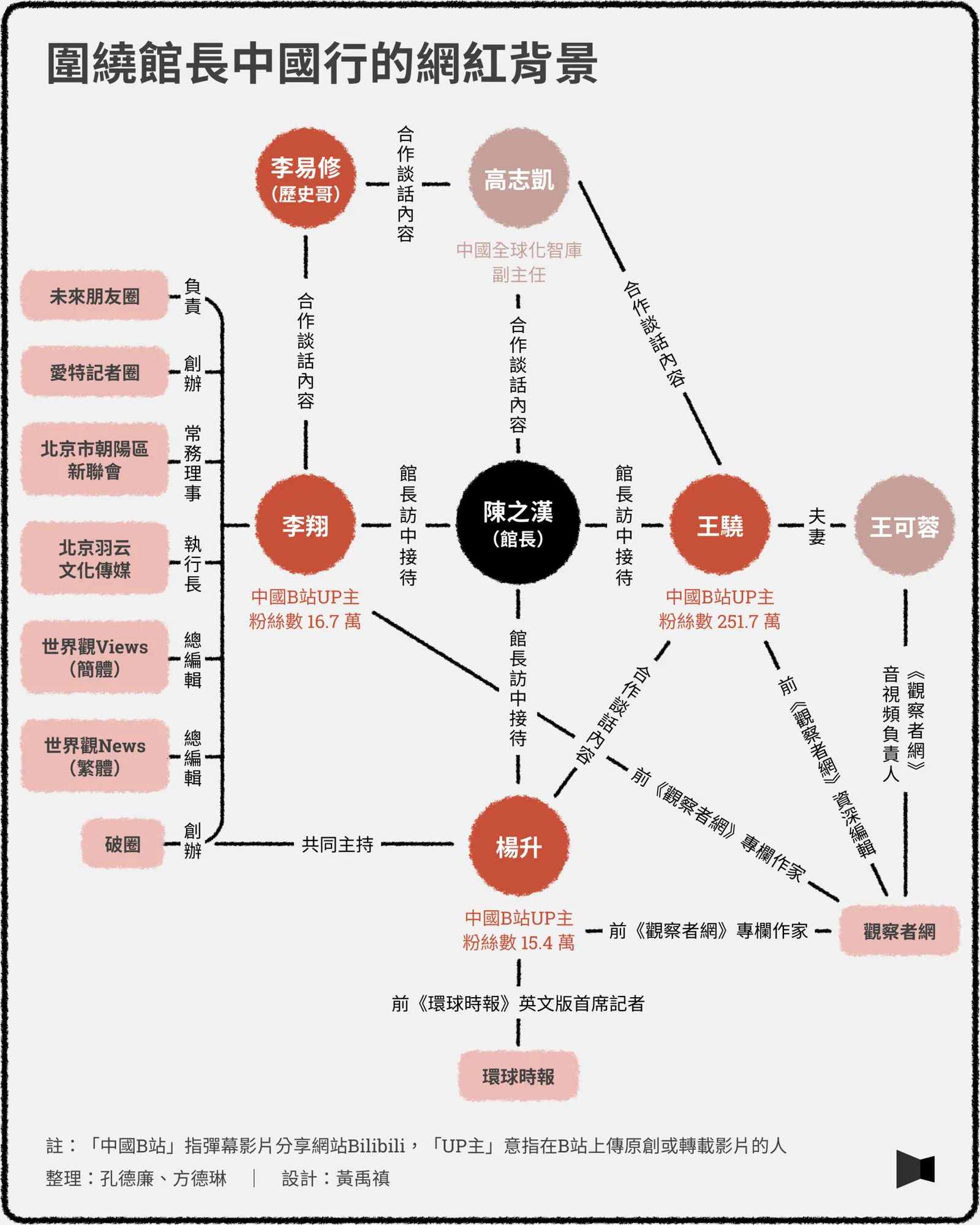
The Reporter linked the Chinese influencers, think tanks, and media behind Holger Chen's China trip into a "united-front concentric circles" relationship map. The labor of flattening an invisible network into view is exactly where investigative journalism burns money. Image: The Reporter (design: Huang Yu-chen; compilation: Kung Te-lien and Fang Te-lin), fair use (editorial commentary).
The accompanying podcast went online on June 11, 2026, with a blunt title: "Official Media Step Back, Influencers Log On? Why Has China's Taiwan Work Turned Toward Influencers and Everyday Content?" (S6EP27)52. There were three guests: The Reporter senior reporter Kung Te-lien, commentator Lee Hou-chen, and SimpleInfo Design co-founder Chang Chih-chi53.
One line in the program summary was widely cited: "China's Taiwan work is using semi-official roles represented by Chinese influencers, the 'new social stratum,' to conduct from online platforms a 'gray-zone strategy' different from traditional propaganda"54.
The concept of gray-zone strategy originally came from international relations scholarship, where it describes means of conflict between peace and war: harassing military actions, coast guard vessel slicing tactics, information warfare, economic coercion, and so on. The Reporter extends this framework downward to the level of content platforms: through large volumes of influencer content that appears everyday, life-oriented, and entertaining, favorable impressions of China seep bit by bit into the eyes of Taiwan's younger generation. This is much harder to detect than traditional official propaganda, because it does not look like propaganda.
The investigative cost of this special report included tracking specific YouTubers' China itineraries, comparing posting timelines, interviewing researchers of relevant systems, and handling the personal-safety risks reporters face when working on sensitive cross-border issues. These are not topics beside which commercial-media advertisers want their brands to appear.
If Blood-Stained Fishing Grounds in 2016 represented The Reporter's early awareness of "people who will be ignored," the 2026 united-front concentric-circles report represents its awareness of "structures that will be ignored": the former made invisible exploitation visible; the latter identified propaganda that does not look like propaganda. The trajectory of the decade is consistent along this axis.
A Small Garden of 4 -> 8,000 -> 10,000 People
From December 4 to 7, 2025, The Reporter held its tenth-anniversary special exhibition in Hall 4A at Huashan 1914 Creative Park in Taipei55. From March 19 to 22, 2026, the exhibition moved to Warehouse B6 in the Penglai Area of Pier-2 Art Center in Kaohsiung56. Both were free.
The exhibition laid out representative reports from the past ten years, award records, field photographs, and newsroom workflows. For a nonprofit media outlet, this was a large-scale accounting to donors. The 8,000 recurring monthly donors, plus irregular one-time donors, plus continuing individual donors such as Barry Lam, send money into this media outlet's account every month. They have never held a shareholders' meeting and have never demanded dividends. The meaning of the tenth-anniversary exhibition was to give these 8,000-plus strangers one chance to enter a physical space and see what their NT$200 or NT$300 each month had produced.
Ho Jung-hsing said something in the tenth-anniversary podcast that is often overlooked: "Ten years ago, we thought surviving three years would already be impressive; ten years later, more people know The Reporter, but new challenges keep coming, and it has not gotten easier"57.
The Reporter's official-channel anniversary self-narration video explains in its own voice why this media outlet chose the difficult path of nonprofit investigative journalism.
The NT$200 Deducted at the Start of Every Month
What are the new challenges? Financially, fundraising income has grown year by year: about NT$34.47 million in 2022, about NT$35.75 million in 2023, and about NT$44.79 million in 2024. The 2025 fundraising period will not be settled until mid-202658. The growth on the books looks stable, but labor costs, cross-border reporting costs, AI-tool adoption costs, and cybersecurity protection costs are all rising faster over the same period. The cost of an eight-month undercover investigative project was not on the same scale in 2015 and 2025.
| Year | Fundraising income |
|---|---|
| 2022 | 3447 |
| 2023 | 3575 |
| 2024 | 4479 |
Source: The Reporter public fundraising-results reports (2025 fundraising period not yet settled)
In terms of head count, a portion of recurring monthly donors naturally drops off every year. Some people's economic circumstances change, some change jobs or bank accounts, and some no longer remember why they began allowing the deduction in the first place. To maintain net growth, the annual rate of new donors must far exceed attrition. From 8,000 to 10,000, the real number to make up is far more than 2,000, because every year a batch of donors naturally leaves. New additions must first fill that hole before net growth can even be discussed.
Looking outward, the conditions of the whole information ecosystem are also deteriorating. A 2025 survey showed that about 96 percent of people in Taiwan felt disinformation was widespread59. In the same year, the Reuters Institute's Digital News Report showed that overall trust in news among people in Taiwan was only 33 percent60. In this low-trust environment, the threshold will only keep rising for a media outlet whose core product is "credible in-depth reporting" to persuade readers to hand over money.
Source: NTU Center for Resilient Society 2025 (as reported by The News Lens), Reuters Institute Digital News Report 2024
The arrival of AI tools is a newer variable. When large language models can generate a long article that appears investigative in three seconds, and when social-platform algorithms cut long-form attention into even smaller fragments, the unit of time represented by the phrase "eight months undercover" is itself being pushed to the margins by the technological environment. Whether The Reporter can survive the next ten years will depend on whether it can keep helping society understand that the value of some things lies not in how fast they are produced, but in how they are produced.
The question for the next decade is not "can it be done?" Ten years have already proved survival is possible. The question for the next decade is whether civil society is willing to renew the subscription. That renewal decision will not happen in a single large fundraising campaign. It happens at the beginning of every month, at the moment NT$200 is deducted from each donor's account: whether they decide not to cancel, not to let the card fail, not to forget.
Ten years ago, Ho Jung-hsing encouraged himself with "from ruins, a flower blooms; in troubled times, protect one patch of field." Ten years later, the small garden that grew from 4 people into 8,000 has emerged. Whether it can survive another ten years, whether it can grow to 10,000 people, whether this flower will dry out in the next wave of algorithms: the answer is not inside this media outlet. It is in the hands of everyone in Taiwan who has ever clicked on a The Reporter article.
Reframing "I pay NT$200 every month" from "doing a good deed" into "paying a verification cost on behalf of society as a whole" is the idea The Reporter has left behind after ten years that Taiwan most needs to carry into the next decade.
Further Reading
- Taiwanese Media and Press Freedom — A panorama from the withdrawal of party, government, and military forces from media to the current media ecosystem.
- Public Television Service — Another public-media path: a broadcasting version of a "public good" supported by statutory budgets.
- CommonWealth Magazine — Where Ho Jung-hsing worked before leaving the editor-at-large post; a representative Taiwanese commercial business and finance media outlet.
- Cognitive Warfare — United-front work, AI disinformation, and gray-zone strategy, providing background for The Reporter's 2026 united-front special report.
- Poisoned Potato Cognitive Warfare — A concrete case study of a cognitive-warfare incident.
- PTT Bulletin Board System — Taiwan's public sphere from the pre-social-network internet era, in the same lineage as The Reporter around the idea that platforms are not necessarily neutral.
Image Sources
This article uses 5 official The Reporter brand assets and work images under fair use (editorial commentary on The Reporter's work), all cached in public/article-images/society/ to avoid hotlinking source servers; it also embeds 2 videos from The Reporter's official YouTube channel.
- The Reporter brand identity image — The Reporter, Fair use (hero)
- "Open the Door to Participation, Speak Collectively" identity slogan — The Reporter, Fair use
- "The Big Tuna Behind Taiwan's Distant-Water Fishing Industry" information graphic (2017 SOPA Excellence in Information Graphics top prize) — The Reporter, Fair use
- United-front concentric-circles special-report relationship map (2026) — The Reporter (design: Huang Yu-chen; compilation: Kung Te-lien and Fang Te-lin), Fair use
- The Reporter for Kids launch promotional image (2022) — The Reporter, Fair use
Embedded videos (The Reporter's official YouTube channel):
- Aesthetic-medicine偷拍 Storm: What Is Wrong with Taiwan's Aesthetic-Medicine Regulation? — The Reporter
- The Reporter's Anniversary: Speak Out Loud! — The Reporter
References
- Ho Jung-hsing Facebook post, 2025-09-14: "In The Reporter's first month online, there were only 4 recurring monthly donors. I did not dare let my colleagues know this number." See facebook.com/twreporter/posts/1235665585269425.↩
- The Reporter tenth-anniversary Podcast, 2025-10-08: "Recurring monthly sponsors also went from only 4 people in the first month online to now receiving the trust of 8,000 supporters each month." See twreporter.org/a/podcast-2025-10-09.↩
- Blood-Stained Fishing Grounds trilogy hub, twreporter.org/topics/unfinished-far-sea-fishing-governance. The third installment, "Unfinished Distant-Water Governance," was published in September 2020.↩
- PTS News Network (PNN), 2024-06-26: "Debt-Bonded Migrant-Student Labor Case Sentenced; Former Chung Chou University of Science and Technology Vice President Sentenced to 5 Years and 6 Months," news.pts.org.tw/article/702271. The title differs across sources; this article uses "former Chung Chou University of Science and Technology executive."↩
- Ministry of Health and Welfare press release, 2025-11-26: "New aesthetic-medicine management system reaches consensus with 40 medical groups; starting January 1, 2026, those who have not completed PGY may not practice aesthetic medicine."↩
- The Reporter official page "About Us, Donor Covenant," twreporter.org/about-us.↩
- Same as [^1] — Ho Jung-hsing's tenth-anniversary FB post, verbatim: "I did not dare let my colleagues know this number."↩
- INSIDE report, 2015-09-01: "The Reporter announced its founding on Journalists' Day; the website formally went online on December 16," inside.com.tw/2015/09/01/the-reporter.↩
- Business Next report, 2015-09-01: "The Reporter holds press conference announcing its founding," bnext.com.tw/article/37251.↩
- Ho Jung-hsing left the editor-at-large post at CommonWealth Magazine in 2015 and was 49 when he founded The Reporter. Sources: The Reporter "About Us" and cross-checks with multiple media outlets.↩
- Official history of the Association of Taiwan Journalists: founded in 1995, with Ho Jung-hsing as initiator and founding president.↩
- Barry Lam personally donated NT$5 million to establish The Reporter Cultural Foundation. Sources: The Reporter official FAQ and cross-checks with multiple reports from the time. A separate market claim says the initial donation was NT$20 million; this has not been officially confirmed.↩
- Weng Hsiu-chi served as the first board chair from 2015-09 to 2018-08 and was a visiting professor at Shih Hsin University. Source: The Reporter organizational-history page.↩
- The Reporter official FAQ, twreporter.org/about-us: "With the foundation as an umbrella and firewall, it can block external interference and ensure the media outlet's independent operation."↩
- Same as [^2] — The Reporter tenth-anniversary Podcast, 2025-10-08: "Recurring monthly sponsors also went from only 4 people in the first month online to now receiving the trust of 8,000 supporters each month."↩
- Same as [^1] — Ho Jung-hsing FB tenth-anniversary post, the self-encouraging line "from ruins, a flower blooms; in troubled times, protect one patch of field."↩
- Same as [^1] — Ho Jung-hsing FB declaration of the goal of "moving toward 10,000 people" (reached 8,000 in 2025-10, not yet 10,000).↩
- Same as [^6] — The three noes principle, "no ownership, no intervention, no clawback," appears on The Reporter's official "About Us" donor-covenant page.↩
- Same as [^12] — Barry Lam's personal donation of NT$5 million to establish the foundation is tied to the three-part "no ownership" design.↩
- Same as [^12]; NT$5 million is the official first-hand public figure, while NT$20 million is market rumor.↩
- The Reporter official FAQ, twreporter.org/about-us: "We hope to move beyond the myth of pageviews, because traffic is not entirely equal to reporting value, nor is it equal to trust and impact."↩
- Huang Jong-tsun took over as the second board chair on 2018-08-28. Source: The Reporter organizational-history page.↩
- Fabrication, Exploitation, Blood-Stained Fishing Grounds, the first installment of the series, was published in 2016. Hub: twreporter.org/topics/unfinished-far-sea-fishing-governance.↩
- The second installment of Blood-Stained Fishing Grounds, "Maritime Human Trafficking (Storm)," was published in 2018, URL slug: slave-fishermen.↩
- "Unfinished Distant-Water Governance: From Illegal Shark Fins and Forced Labor to the Death of an Observer," published in September 2020. Same as [^3].↩
- Lee Hsueh-li article, The Reporter Open Lab Medium, 2021-09-17: "More than 100 interviewees, with one-seventh of them from abroad." medium.com/twreporter.↩
- The Reporter 2017 awards page, twreporter.org/a/awards-2017. Three SOPA top prizes: Excellence in Human Rights Reporting, Excellence in Investigative Reporting, Excellence in Information Graphics ("The Big Tuna Behind Taiwan's Distant-Water Fishing Industry," twreporter.org/a/infographic-far-sea-fishing-gcs; the title is a homophone of the Taiwanese proverb toa-boe loo-mua).↩
- Same as [^4]. First-instance judgment date: 2024-06-26, Changhua District Court. Chai Fang-wu: 5 years and 6 months; Lan Su-ling: 5 years; Tu Jung-hui: 7 years.↩
- Chai Fang-wu and Lan Su-ling second instance: Central News Agency report, 2026-06-02, "Debt-Bonded Migrant-Student Labor Case Second Instance; Chung Chou University of Science and Technology's Chai Reduced to 3 Years and 6 Months," cna.com.tw/news/asoc/202606020054.aspx. Tu Jung-hui's profit-seeking case was a separate second-instance case; in March 2026 the Taichung Branch of the Taiwan High Court upheld the seven-year sentence and deprivation of civil rights for four years. See Liberty Times, news.ltn.com.tw/news/society/breakingnews/5380999.↩
- The Reporter, 2025-10-15: "The Chokubi Phenomenon: The Trend and Concerns Behind Young Doctors in Taiwan, South Korea, and Japan 'Skipping PGY and Going Straight into Aesthetic Medicine'," twreporter.org/a/chokubi-phenomenon-in-taiwan-korea-and-japan.↩
- Ministry of Health and Welfare public timeline: amendment preannounced on 2025-11-14, consensus reached with 40 medical groups on 2025-11-26, new system effective 2026-01-01. This article positions The Reporter's reporting as "one trigger of policy discussion," not the sole cause.↩
- The newsroom's not displaying pageviews is a public editorial principle, seen repeatedly in official interviews and internal introductions. Same as [^21] as an extension of the discipline.↩
- In September 2018, Ho Jung-hsing handed the editor-in-chief role to Lee Hsueh-li and became full-time executive director.↩
- In August 2023, Fang Te-lin was promoted to editor-in-chief, and Lee Hsueh-li became chief operating officer.↩
- Liberty Times, 2017-06-21 to 2017-06-26 series of reports: the Aquarius Publishing publisher Chu Ya-chun incident. news.ltn.com.tw/news/life/breakingnews/2111771.↩
- The Reporter editorial-department apology, 2017-06-26, original wording: "The report was based on interviews with the book's author before her death and on communication records left by the author and publisher, but did not interview the parties involved in those records, failing to fulfill the journalistic norm of balanced reporting." The original report was titled "When Fang Si-chi Became Real: Interviewing the Author's Close Friend and Editor on Lin Yi-han's Publication Process."↩
- The Reporter's 2020 statement on the Carry Masks case: "Regarding Carry Masks' involvement in mixing in non-medical masks made in China, although the time of the alleged conduct came after the reporting at the time, we still feel deep regret and remorse, and also humbly review ourselves."↩
- In June 2023, Fang Hui-chen publicly accused Storm Media chair Wang Chien-chuang of sexual harassment; Wang denied the allegation and counter-accused her. The subject of the incident was not inside The Reporter, but the reporter personally became publicly involved in the media industry's #MeToo wave.↩
- The Reporter 2025 recommended reports page, twreporter.org/a/2025-recommend-reports. The organization listed 14 major special reports.↩
- The Disappearing Resident Physicians series was one of the major 2025 special reports on Taiwan's trillion-NT-dollar National Health Insurance issue. Same as [^39].↩
- The Longevity Code and Glimpsing 3.0 at the End of Long-Term Care 2.0 were 2025 special reports on aging. Same as [^39].↩
- FORMOSAT-8 and Clairvoyance in Space were 2025 special reports on Taiwan's national space program. Same as [^39].↩
- Excellent Journalism Award Foundation 24th award list, feja.org.tw/80348. The Reporter won the Explanatory Reporting Award, Podcast News Program Award, and Financial and Economic News Award.↩
- The Reporter 2025 awards page, twreporter.org/a/awards-2025. Six SOPA awards, including the top prize for Excellence in Exclusive News for The Child-Hunting Storm (eight months undercover), the top prize for Excellence in Reporting on Women's Issues for Seeking a Child Through Surrogacy, and the top prize for Excellence in Economic Reporting for MIT Machine Tools Flow into Russia's Military Industry. The awards-2025 page's H1 and URL title are not synchronized on the total award count (H1 says 24, URL title says 20); this article follows the page H1 wording, "more than twenty awards."↩
- The Reporter organizational history: in 2022 it won 41 awards in total, the most since its founding.↩
- The Reporter for Kids launched in 2022, targeting readers aged 10-15, with the slogan "Understand the World x Participate in the Future."↩
- Yang Hui-chun serves as director of The Reporter for Kids and previously worked at Children's Daily News, Min Sheng Daily, and Apple Daily.↩
- Yang Hui-chun has said in multiple public interviews that The Reporter for Kids' real competitors are TikTok and YouTube.↩
- The Reporter for Kids editorial principles: "no inverted sentence structures, neutral wording, and no emotionalized language."↩
- "The Crevice of Life: Taiwan's First Boy with Blood Cancer to Fight for His Own Right to Medical Care" won the Short In-Depth Reporting Award in the television and online audiovisual category at the 23rd Excellent Journalism Awards.↩
- The Reporter, 2026-04: "Analyzing United-Front Concentric Circles: Holger Chen's China Trip and the 'Influencers' Around Him," twreporter.org/a/united-front-work-powered-by-holger-chen-and-china-influencers.↩
- The Real Story Podcast S6EP27, released 2026-06-11. twreporter.org/a/podcast-2026-06-12.↩
- Same as [^52]. Guests: Kung Te-lien (The Reporter senior reporter), Lee Hou-chen, and Chang Chih-chi.↩
- Same as [^52] program summary.↩
- The Reporter tenth-anniversary special exhibition, Taipei stop: Hall 4A, Huashan 1914 Creative Park, 2025-12-04 to 12-07, free admission. 10th.twreporter.org.↩
- The Reporter tenth-anniversary special exhibition, Kaohsiung stop: Warehouse B6, Penglai Area, Pier-2 Art Center, 2026-03-19 to 22, free admission (ended).↩
- Same as [^2]: "Ten years ago, we thought surviving three years would already be impressive; ten years later, more people know The Reporter, but new challenges keep coming, and it has not gotten easier."↩
- The Reporter public fundraising-results reports (fundraising income, New Taiwan dollars): about NT$34.47 million in 2022, about NT$35.75 million in 2023, and about NT$44.79 million in 2024. The 2025 fundraising period runs until mid-2026 and has not yet been settled, so it is not listed. The market claim of "annual revenue exceeding NT$90 million" refers to total organizational revenue including licensing and grants, which differs from the official fundraising-income category and is not mixed here.↩
- 2025 disinformation survey: about 96 percent of people in Taiwan felt disinformation was widespread (the original survey was by the NTU Center for Resilient Society and was reported by The News Lens). thenewslens.com/article/267704.↩
- Reuters Institute Digital News Report 2024 Taiwan: overall trust in news was 33 percent. reutersinstitute.politics.ox.ac.uk/digital-news-report/2024/taiwan.↩