
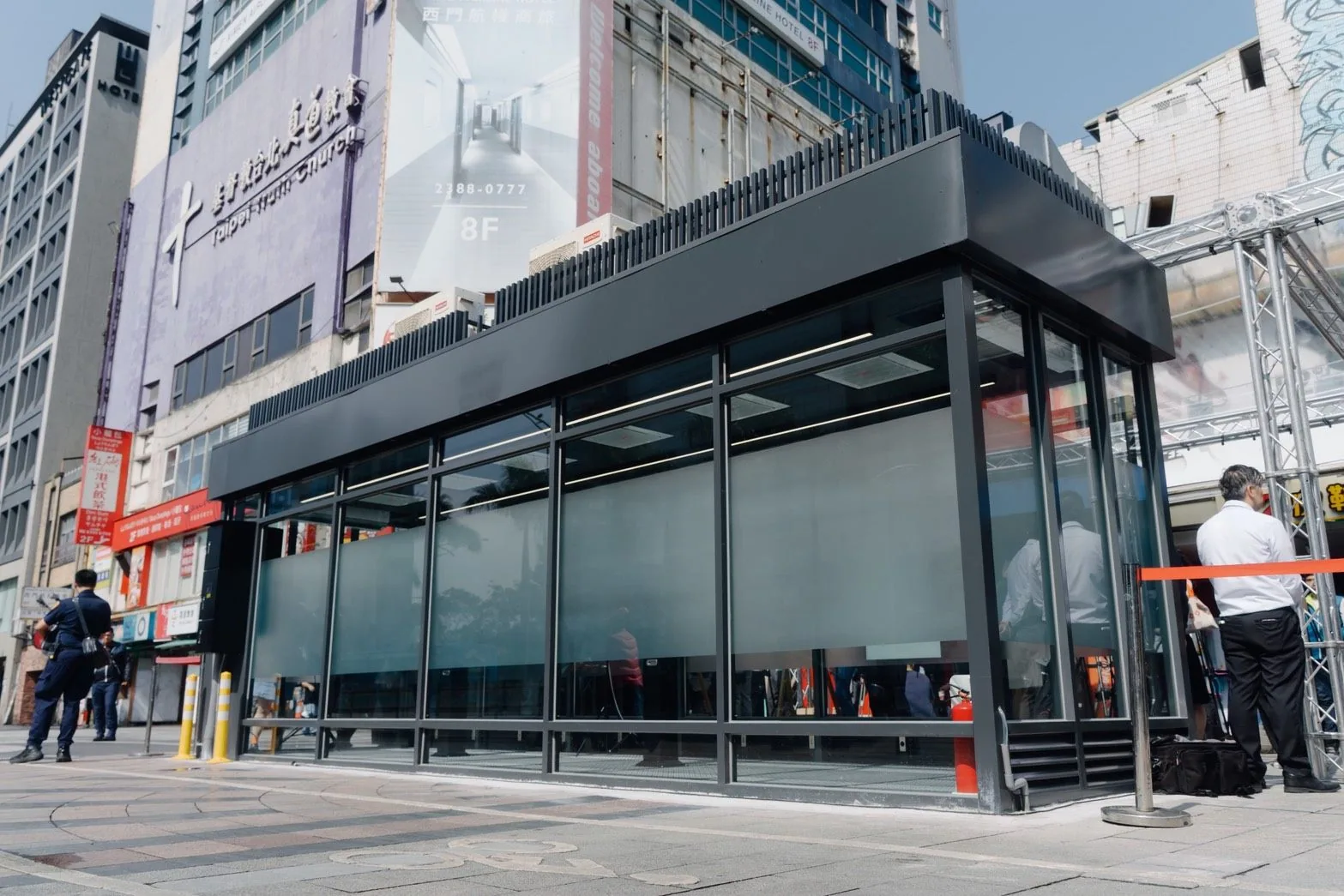
Ximen MRT Exit 6, Taiwan’s first outdoor negative‑pressure smoking room: a black‑framed transparent glass box standing on the sidewalk. Photo: Hua Hua Daily / Reporter Chang Hsiang‑ying (fair use editorial commentary).
30‑second overview: Taipei has written “principle‑prohibited, exception‑allowed” into the streets: outdoor smoking is banned throughout Ximending and the Zhongshan area, while the city has erected Taiwan’s first batch of outdoor negative‑pressure smoking booths, using exhaust fans to create an indoor‑outdoor pressure differential so smoke only flows in, not out. Supporters say people can finally breathe easily; even anti‑tobacco groups oppose it, arguing that the more comfortable the booth, the further it strays from the original goal of getting people to quit. A visible glass box holds a fight that has lasted forty years and has now moved outdoors.
A Transparent Box Parked by the Arcade
On May 7 2026, between the Chengdu Yang‑fang ice stand and the original flagship store of Taiwan Salt‑Fried Chicken, a transparent box appeared on the sidewalk outside Exit 6 of Ximen MRT. About 16 square metres—someone on Dcard measured it and said it is “almost the size of a parking space.” Inside are four filter layers (oil filter, primary air filter, activated carbon, PM2.5); smoke enters, gets washed layer by layer, then exits through an angled vent. Opening hours run from 8 a.m. to midnight, with a sign at the door: “No entry for those under 20 or pregnant women.” This is Taiwan’s first outdoor negative‑pressure smoking room1.
The term “negative pressure” sounds like lab jargon, but it is actually a counter‑intuitive physical phenomenon. As early as 2008, when the Sheraton Hotel installed a qualified indoor smoking room, its PR manager Bai Jing‑hui described it to TV reporters this way: “The feeling of negative pressure is that when you open the door, the air inside does not rush out; instead, outside air rushes in.”2 The exhaust fan lowers the air pressure inside the box relative to the outside, so when the door opens, outside air flows in and the smoke is trapped inside. This principle is the same as that used in negative‑pressure isolation wards for infectious diseases in hospitals.
A city aiming to become “smoke‑free” first builds a glass box for smoking on its busiest street corner—seems contradictory, doesn’t it? That breathing‑transparent box is actually Taipei’s most concrete embodiment so far of re‑inserting a legal but harmful cigarette into the public‑space contract, as the city negotiates the terms of that agreement. Following the smoke from office ashtrays to this glass box reveals a city that has spent forty years on the issue and still hasn’t finished the discussion.
Yet this box has been misbehaving from the start. After just three days of use, one of its manual doors wouldn’t seal properly and kept popping open; the Public Works Bureau said it had already adjusted the door track3. A booth that claims to maintain negative pressure through sealing can’t even shut its door. This tiny gap perfectly foreshadows the later debate: the claimed seal versus the real leak—an endless tug‑of‑war.
Air Used to Be Free
To understand why a street‑side smoking booth became a big deal, we must go back to the era when smoke was just part of the air. Before 2009, offices, trains, KTVs, and restaurants in Taiwan were filled with cigarette smoke. The Tobacco and Wine Monopoly’s “Changshou” cigarette, launched in 1958, remained the market leader for years and still accounted for 76 % of Taiwan’s cigarette sales in 1987—that is, three out of every four smokers smoked Changshou4. The Songshan Tobacco Factory, begun in 1937 by the Taiwan Governor‑General Monopoly Bureau, at its peak employed two thousand workers and produced over NT$21 billion annually, operating until 19985. Tobacco was once a state‑run business, and smoking was the background hum of daily life on this island.
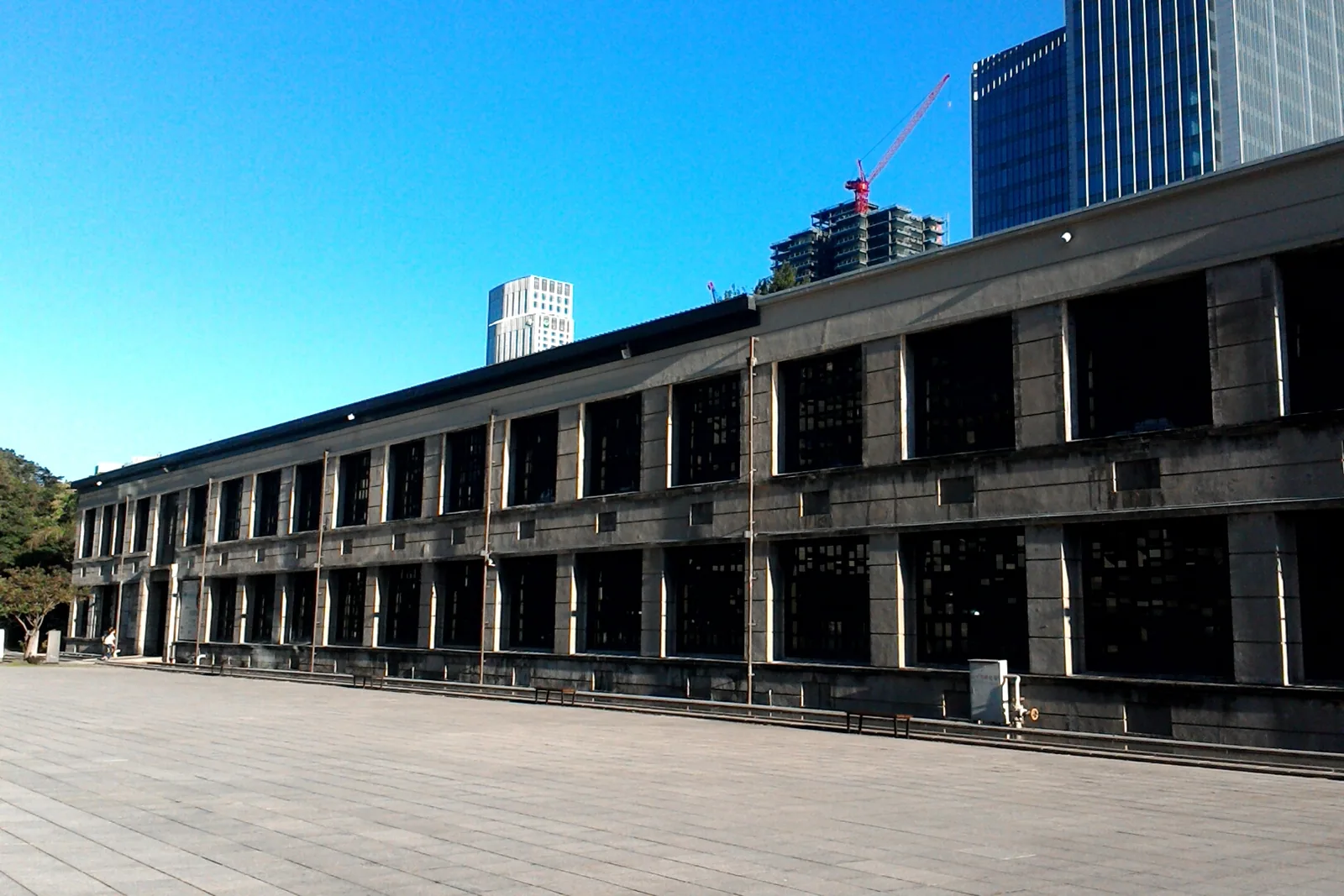
Songshan Tobacco Factory cigarette‑production plant: built in 1937 by the Taiwan Governor‑General Monopoly Bureau, taken over after the war by the Tobacco and Wine Monopoly, operated until 1998 and now part of the Songshan Cultural Creative Park. Tobacco was once the state’s business. Photo: Shr‑person Meng‑zi / Wikimedia Commons, CC BY‑SA 4.0.
This background hum began to shift when one person had a lung lobe removed. Yan Dao started smoking at age 12; at 52 he had his right upper lobe excised due to tobacco‑related disease, and after leaving the hospital he secretly vowed to work on tobacco‑harm prevention6. On May 19 1984, his friend Dong Zhiying, to thank him for resolving a legal dispute, offered US 2.5 million (about NT$100 million at the era’s exchange rate); Yan Dao instead suggested using the money to found a foundation dedicated to tobacco‑harm prevention7. Thus the Dong Foundation was born.
That same April, actor Sun Yueh was filming Old Mo’s Second Spring in southern Taiwan. After a take, he habitually reached for a cigarette to light, saw two uniformed students walking toward him, and thought: “Sun Yueh! Your smoking harms others—do you still want to smoke?” He quit his 38‑year smoking habit, volunteered at the Dong Foundation, and promoted a slogan many still remember: “Everyone has the right to refuse secondhand smoke.”8 That sentence shifted the question from “Should you quit smoking for your own health?” to “Does your smoke harm the people around you?” This reframing is the starting point of all outdoor‑smoking bans forty years later.
From that slogan to law took thirteen years. The Tobacco Harm Prevention Act was promulgated in March 1997 and took effect in September 1997; it was amended in 2007, and from January 11 2009 indoor public and workplaces with three or more people went completely smoke‑free; on March 22 2023 it was expanded again to include kindergartens, colleges, bars and nightclubs, completely banned e‑cigarettes, and raised the legal smoking age to 209. Each expansion shrank the permissible smoking area by one notch.
Source: National Laws Database, Ministry of Health and Welfare, Central News Agency
The tobacco business also withdrew step by step. Taiwan joined the WTO in 2002, the Tobacco and Wine Monopoly was reorganized into Taiwan Tobacco and Liquor Corporation, ending forty years of monopoly10; in 2016 tobacco farmers and the corporation reached an agreement, the last batch of tobacco leaves was cured in spring 2017, and tobacco‑leaf farming in Taiwan entered history11. Something that once dominated the air and filled the treasury has been gradually pushed out of public space.
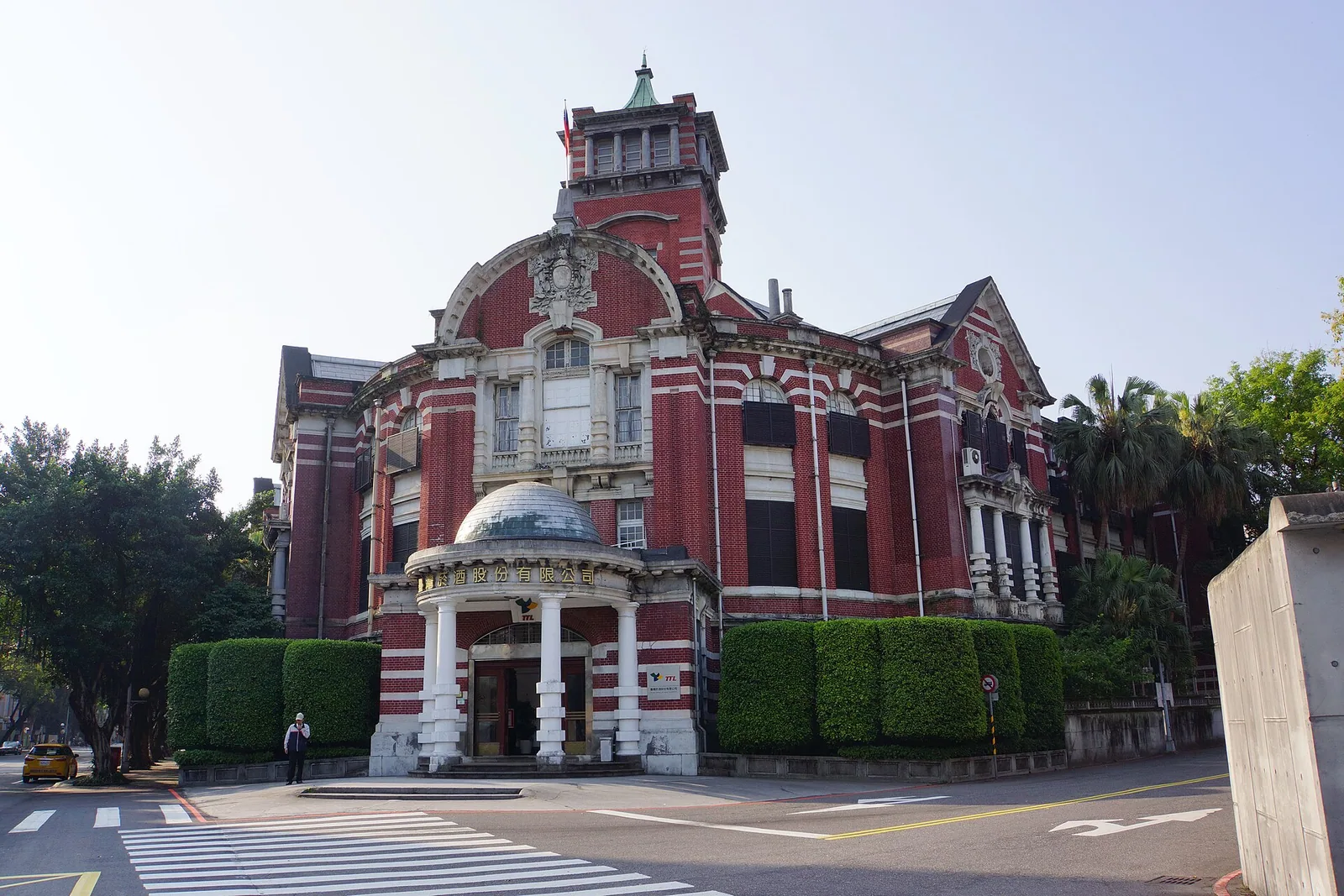
Original Taiwan Provincial Tobacco and Wine Monopoly Bureau building, now the Taiwan Tobacco and Liquor Corporation; tobacco was once the state’s monopoly business, lasting until 2002 when Taiwan joined the WTO and the monopoly loosened. Photo: lienyuan lee / Wikimedia Commons, CC BY 3.0.
Indoors Won, Outdoors Still Unsettled
By the 2020s this campaign looks like a clear victory on paper. The smoking rate among adults aged 18 and over fell from 21.9 % in 2008 to 12.8 % in 2024—a drop of over forty percent, the lowest since 199012. Secondhand‑smoke exposure in indoor workplaces also dropped from 32.1 % in 2008 to 22.1 % in 202013. Hundreds of thousands fewer smokers mean ashtrays have practically vanished from offices.
But split the secondhand‑smoke numbers and you see two opposite trends. Indoor public‑place secondhand‑smoke exposure plunged from 27.8 % in 2008 to 3.2 % in 2024—indoor battle essentially won. Yet outdoor locations without a smoking ban rose from 36.2 % in 2008 to a peak of 58.5 % in 2013, then fell to 48.9 % in 2024, still leaving nearly half exposed12. Smoke hasn’t disappeared; it’s just been pushed outside.
| Year | Indoor public places | Outdoor non‑ban locations |
|---|---|---|
| 2008 | 27.8 | 36.2 |
| 2024 | 3.2 | 48.9 |
Source: Health Promotion Administration Adult Smoking Behavior Survey
Ask where people most often encounter this smoke, and the answer is specific. In the 2024 survey, the most common places to encounter secondhand smoke were “on the road, on the street, in arcades and other outdoor passageways,” accounting for 27.9 %, far ahead of second place—parks (7.7 %) and convenience‑store arcades (7.7 %)14. Put another way, indoor smoking bans pushed smokers out the door, and the arcade became the new smoke corridor. Walking through Ximending, you are forced to become a “breath‑holding expert”—the data show no exaggeration.
📝 Curator’s note: Worth pausing to examine the underlying mechanics of this policy. Previously outdoor policy meant “draw a no‑smoking zone”: assume everywhere is smokable, then carve out a few no‑smoke spots. The current administration’s smoke‑free city flips that presumption: outdoors, smoking is prohibited by default, and only “listed” designated spots are allowed. On the same sidewalk, the default shifts from “smokable” to “non‑smokable.” Adding more signs is merely cosmetic; what’s truly rewritten is who owns the city’s air.
Principle‑Prohibited, Exception‑Allowed
After the flip, the remaining question is where the few remaining smokers should go. The city’s answer is “distribution management”: ban outdoor smoking outright, but guide smokers to designated smoking areas or rooms15. Starting June 1, Ximending and the Zhongshan district went completely smoke‑free outdoors, with violations punishable by up to NT$10,000; simultaneously the city’s designated smoking areas grew to 183 spots, then to 201 by the end of May, among which this batch of Taiwan’s first outdoor negative‑pressure smoking rooms is included16.
The negative‑pressure principle was explained clearly by Lin Hui‑zhong, chief secretary of the Public Works Bureau’s New Engineering Division, on the launch day: “The facility adopts ‘negative‑pressure airflow control technology,’ using exhaust fans and pressure adjustment to make indoor pressure lower than outdoor atmospheric pressure, creating a physical barrier where air can only flow inward and cannot escape outward, effectively reducing smoke leakage.”15 These boxes vary in size; the largest, on Zhonghua Road, holds 16 people1; a smaller one, such as the one at Exit 4 of Ximen Station, is 2 × 8 metres, and the Research, Development and Evaluation Commission chair Yin Wei says “more than ten people can stand inside at once”17.
Why does this design become “negative pressure” rather than Osaka’s fully enclosed smoking booth? Behind it lies a technical detour. Taipei originally wanted to copy Osaka’s sealed model, but the central government blocked it with the reasoning: “Four sealed walls count as indoor, and the Tobacco Harm Prevention Act forbids smoking indoors.”18 Hence the airflow‑control, non‑fully‑sealed “negative‑pressure” design emerged as a workaround to avoid being classified as indoor. The technology itself isn’t new. Japan’s 2020 Health Promotion Act already set a legal baseline for enclosed smoking rooms: entrance‑exit wind speed must be at least 0.2 m/s; Tokyo even added stricter supplementary rules19. Taipei’s true innovation isn’t the negative‑pressure filtration itself, but turning it into a free piece of street furniture that stands in the city.
As for cost, the city has not released a itemized budget. In legislative questioning it cited a planning estimate of roughly NT$1.5 million per unit, projecting total expenses of about NT$100 million by end‑June20. On the other side, the National Congress of Parent‑Teacher Associations chairman Tao Lian‑sheng questioned the cost‑effectiveness from a cost‑benefit angle: outdoor smoking rooms require independent compartments, independent air‑conditioning, negative‑pressure design, and automatic doors; “if the ‘cannot smell smoke’ effect isn’t achieved, yet tens of thousands to hundreds of thousands of NT dollars are still spent, the cost‑benefit is clearly poor.”21 One set is the city’s planning baseline; the other is a parent‑group’s critical estimate. Though the numbers differ in nature, both point to the same question: Is this box worth it?
Even the Anti‑Smoking Camp Is Fighting
If the only opposition came from parents complaining about the cost, the picture would be simple. What makes this complicated is that the anti‑smoking camp itself has broken into open argument — not over whether to fight tobacco, but how.
The Taiwan Anti‑Smoking Alliance and the Dong Foundation hold a clear line: they oppose building enclosed, negative‑pressure smoking rooms outdoors. Lin Ching‑li, director of the Dong Foundation’s Tobacco Control Center, argues for an “inside‑out” approach: “First achieve one‑hundred‑percent indoor smoke‑free, then designate outdoor smoking points.” She states bluntly: “A smoke‑free city should make things inconvenient for smokers, not blanket the city with smoking kiosks.”22 In their logic, the more comfortable the smoking room, the more it paves the way for smoking — drifting further from the original goal of helping people quit. This isn’t a new position; as early as 2011 the Dong Foundation criticized Taoyuan Airport’s plan to bring back indoor smoking rooms.
Source: Taipei City Council interpellation and parent‑group cost‑benefit estimates (CNA etc.) + Taiwan Anti‑Smoking Alliance and Dong Foundation positions<sup id="fnref-20-2"><a href="#fn-20" class="footnote-ref" aria-label="Footnote 20">20</a></sup><sup id="fnref-21-2"><a href="#fn-21" class="footnote-ref" aria-label="Footnote 21">21</a></sup><sup id="fnref-22-2"><a href="#fn-22" class="footnote-ref" aria-label="Footnote 22">22</a></sup>
NTU Hospital Family Medicine attending physician and Taiwan Medical Alliance for Tobacco Control Secretary‑General Kuo Fei‑ran goes a layer deeper. In a contributed article he cites the WHO Framework Convention on Tobacco Control, noting that no ventilation, air‑filtration equipment, or designated smoking room can prevent secondhand‑smoke exposure: “There is no safe level of exposure to secondhand smoke.”23 His sharpest line targets the side‑effect of the box’s very existence.
Strongly support a smoke‑free city, but don’t set up outdoor enclosed smoking rooms; don’t claim that because a smoking room has negative pressure and filtration there’s no secondhand smoke; don’t promote a wrong concept for a good‑hearted purpose.
📝 Curator’s Note: Kuo’s remark hides a mechanism that is easy to miss. A futuristic‑looking glass box touting “four‑stage filtration” implies “equipment equals safety”: when you see the smoke sucked into a high‑tech box, you instinctively feel the secondhand‑smoke problem has been handled. Scientifically, that reassurance doesn’t hold. The 2006 U.S. Surgeon General’s Report concluded that even separately enclosed, separately exhausted negative‑pressure smoking rooms cannot stop secondhand smoke from seeping into adjacent areas.24 The WHO and ASHRAE take the same position. The glass house is both a considerate compromise and a potential guardrail that lets people lower their guard — both things can be true at the same time.
The Kyoto Study That Was Actually Measuring Something Else
The debate has reached the point where both sides bring out evidence, and the study most often cited happens to be a perfect example of “the same data being described as two different things.”
The Anti‑Smoking Alliance quoted at a press conference a 2023 study from Kyoto Women’s University finding that “high‑spec‑equipment enclosed smoking rooms” had PM2.5 concentrations exceeding air‑quality warning levels, with readings even 5 metres outside the entrance exceeding standards25. That sounds like a direct hammer blow to negative‑pressure smoking rooms. But tracking down the original paper reveals its title is actually “Passive Smoking Conditions Around the Outdoor Smoking Area of Kyoto Station,” and the subject was an open‑air smoking corner at Kyoto Station that has partial dividers but no doors or ceiling; the study measured PM2.5 at distances of 3 metres and 10 metres to the east26. It did not measure an enclosed room; it measured an open‑air spot with a roof overhang and four‑sided ventilation.
That gap is significant. A sealed negative‑pressure room and an open‑air smoking shelter are two different physical structures. Professor Yamada Hiroshi of the Industrial Medical University, in an interview, directly called that Kyoto Station spot an “open‑air smoking corner” and criticized installing such a corner under a large roof as unreasonable, saying it should be at least 25 metres from non‑smokers’ flow27. Put differently, the anti‑tobacco side wanted to use this study to prove “even enclosed rooms can’t block smoke,” but the study itself shows “even a sheltered open‑air corner lets smoke escape.”
Both sides cite the same research, yet they are measuring different things. Interestingly, this information gap itself loops back to the same honest reminder: the problem isn’t only whether there is enclosure, but whether the airflow design is adequate—whether sealed or open, smoke will linger if the airflow is off. To truly validate a negative‑pressure sealed room, one must return to the consistent conclusion of the CDC, WHO, and engineering societies, not rely on a secondhand‑described outdoor study that’s gone astray. The anti‑tobacco position is correct, but the evidence they picked is wrong—a common occurrence in public debate.
Whose Arcade?
Turning the lens from data and papers back to the street reveals a more complicated crowd. Those invited into the glass box, or those expelled from the arcade, are not a monolith.
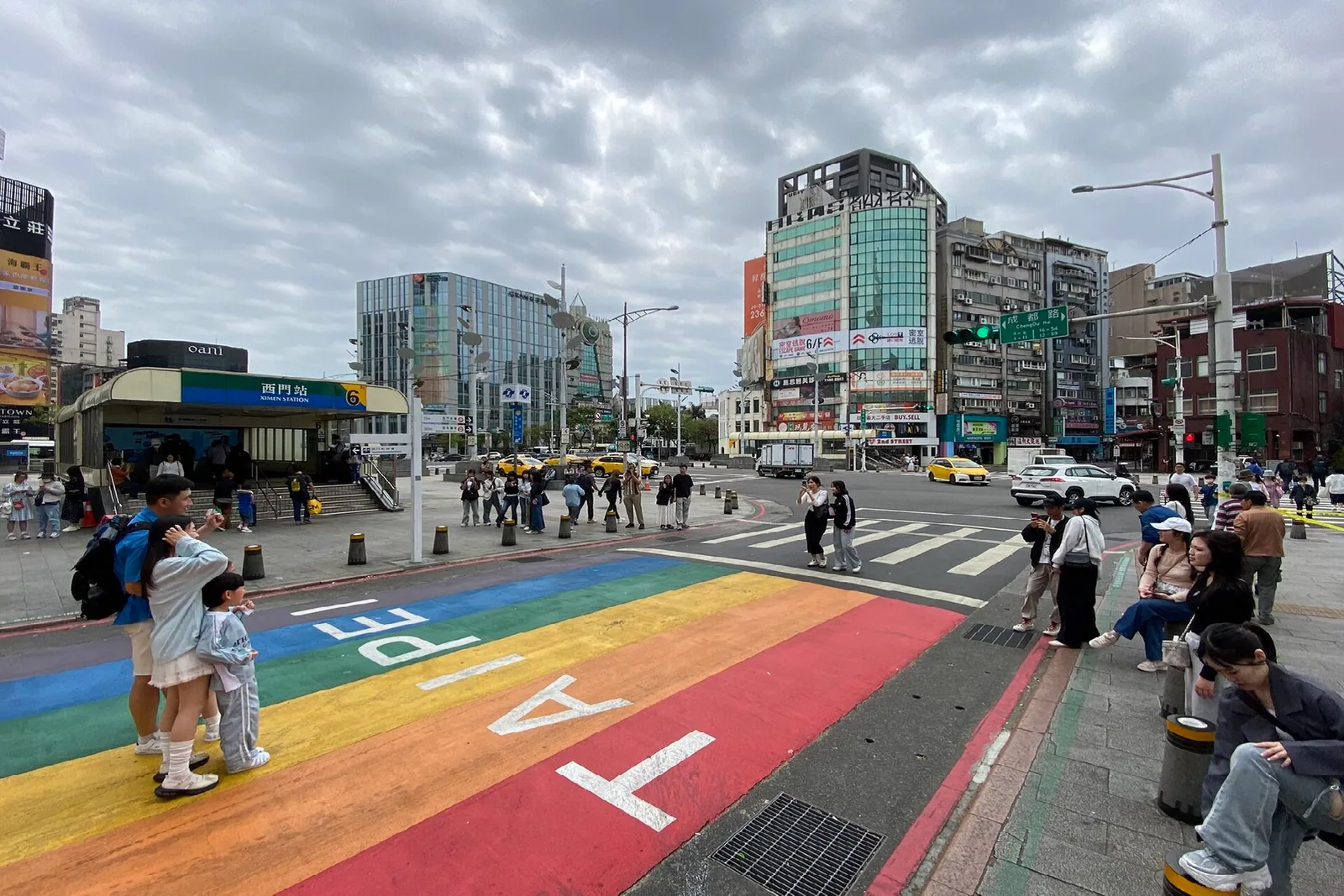
Ximen pedestrian zone: the first batch of Taiwan’s outdoor negative‑pressure smoking rooms is located in this densest‑traffic area. Who has the right to light a cigarette here is the core of the debate. Photo: Bigmorr / Wikimedia Commons, CC BY‑SA 4.0.
Some welcome it. In a street interview by the China Times in Ximending, a smoker with experience said “It’s good for non‑smokers—it won’t affect them inhaling secondhand smoke”; a female smoker said she used to encounter kids or parents pushing strollers when smoking on the roadside, but now having a fixed smoking area reduces mutual friction28. Others feel pushed too far. A smoker complained on Dcard that the smoking room is even smaller than imagined—almost just a parking‑space size—wondering if they have to queue for a smoke and still be bound by opening hours29. The city replied that Japanese negative‑pressure smoking rooms also close at 10 or 11 p.m., and that all smoking rooms are within a three‑to‑five‑minute walk of each other30.
Interestingly, a reply to that “like a parking‑space” complaint said: “Do you know how non‑smokers feel normally?”29 One sentence puts both grievances side‑by‑side: smokers feel they’re being shoved into a tiny, distant box, while non‑smokers feel they’ve been squeezed by smoke for decades and never had much room to stand. The same glass box shows one side cramped space, the other side belated fairness.
Stepping back further reveals that smoking itself follows a class line. Among adult males, those with junior‑high‑school education or lower have a smoking rate of 35.8 %, three times the 11.9 % rate for those with college or higher31. In the 30‑to‑49 age bracket, the rate for junior‑high‑or‑lower climbs to 50 %, nearly double the 27 % rate for college‑or‑higher.
Source: Ministry of Health and Welfare (adult male smoking rate, six‑year anniversary of Tobacco Harm Prevention Act)
📝 Curator’s note: This three‑percent‑gap line conceals an unpleasant cycle. A large share of the tobacco‑health surcharge—levied per thousand cigarettes—flows back to subsidize the disadvantaged: tobacco taxes pay health‑insurance premiums for 446,000 economically struggling people and help keep the nation’s 13 public relief institutions running32. Put another way, the lowest‑SES group smokes the most, and the extra tax they pay per pack circles back to subsidize the medical safety net that includes themselves. This isn’t a simple right‑or‑wrong formula; readers should chew on it: when we usher smokers into a glass box, those who end up inside are often the people who already occupy the city’s margins.
Local shopkeepers and village heads worry about more practical management issues. The Ximen Pedestrian Zone Street‑Area Development Promotion Association chair Liu Jia‑xin responded to the smoke‑free commercial zone call, but also said “Daytime probably won’t bring management problems; I’m more worried about nighttime”; Ximen Village head Ye Min‑hui pointed out the many homeless people in Ximending, fearing “future management will indeed be the biggest challenge”33. These are anticipatory remarks heard in interviews, not yet‑occurred facts, yet they truthfully reflect the everyday issues a policy that concentrates people in a fixed space will face.
Tokyo Built It Too, Then What?
Taipei isn’t the only city wrestling with this. Diverting smokers into special spaces has long been a shared language among many Asian cities—just with different local flavors.
Japan moved earliest and most fragmented. Tokyo’s Chiyoda Ward enacted an ordinance in October 2002 to fine street smoking ¥2,000, one of Japan’s earliest street‑smoking penalties; Shibuya Ward followed in 2019, banning smoking in all public places34. The fragmentation lies in the fact that the Tokyo Metropolis has no citywide rule; its 23 wards each set their own, so the same cigarette may be legal on one street and become a ¥2,000 violation upon crossing into the next ward. By contrast, Taipei currently applies a single standard city‑wide, avoiding that cross‑ward confusion.
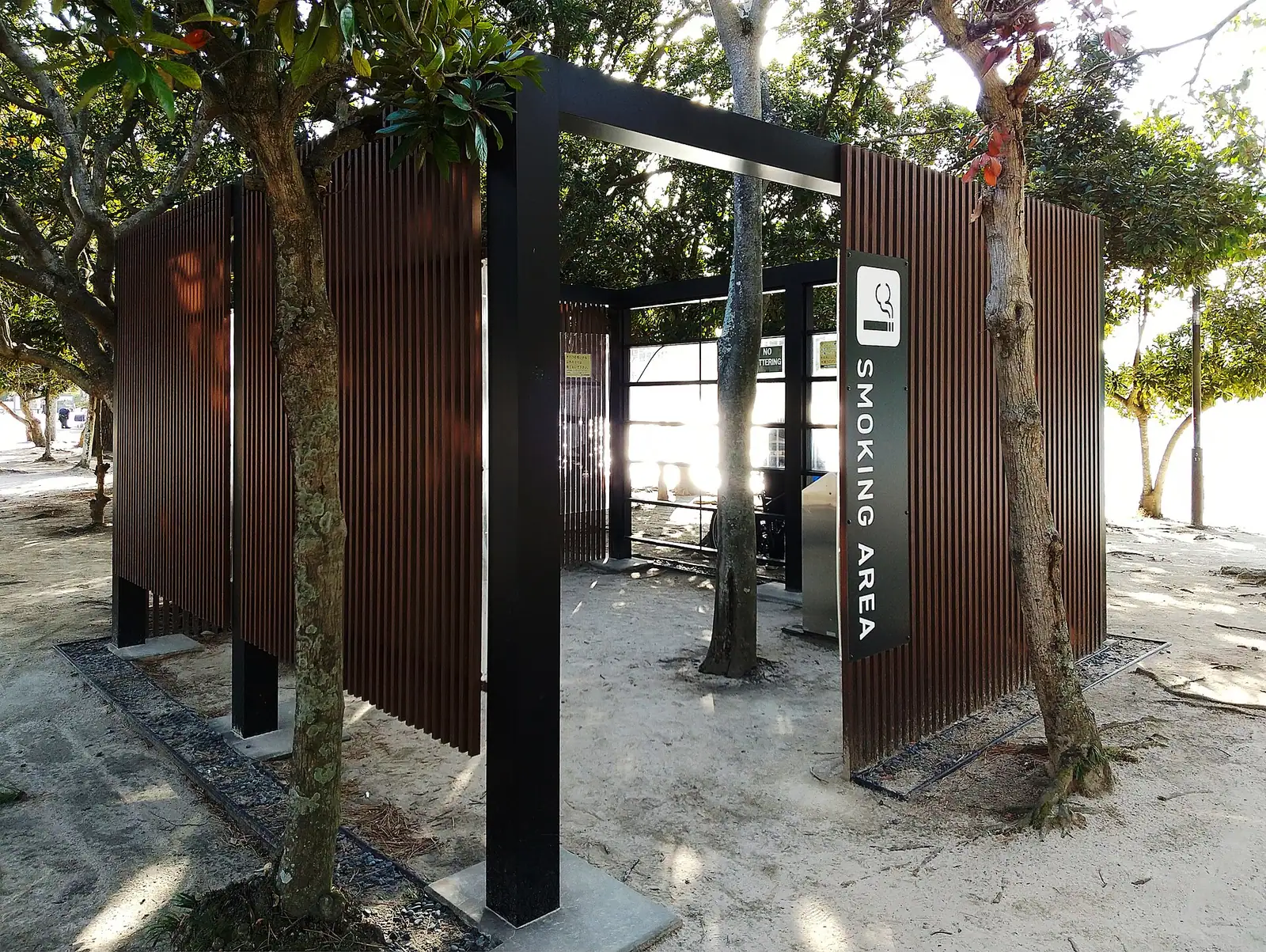
Fukuoka Ohori Park’s outdoor smoking area uses a wooden lattice to create a semi‑open corner, quite unlike Taipei’s fully glass‑walled, negative‑pressure‑reliant box. Photo: Hirho / Wikimedia Commons, CC BY 4.0.
Other cities have their own formulas, but differing currencies and mechanisms make direct size comparisons inadvisable.
Source: Various municipal / health‑authority announcements
Singapore’s approach paints “yellow boxes” on the ground of hawker centres and coffee‑shop exteriors; smokers must stand entirely inside the box. The bustling Orchard Road corridor has been a no‑smoking zone since 1 Jan 2019, with only a handful of designated smoking spots permitted35. Hong Kong raised its statutory no‑smoking‑area fixed fine from HK$1,500 to HK$3,000 on 1 Jan 2026 and added a “no smoking while queuing” rule36. France went further, banning smoking from July 1 2025 in parks, beaches, school gates, and other child‑frequented outdoor spaces37. The smoking‑free frontier is creeping into ever‑more granular everyday scenes worldwide.
Taipei’s own wording is “nationwide first,” meaning the first outdoor negative‑pressure smoking room in Taiwan; English‑ and Chinese‑language media have not called it a “world first”38. This modest claim holds up: as of the current verification scope, no other government has installed this kind of mechanical negative‑pressure booth on a street. As for the oft‑cited warning “Tokyo 80 % violation,” tracing the source leads to a Kobe University team’s article in BMC Public Health measuring the non‑compliance rate of indoor restaurants and bars in Tokyo, Osaka, and Aomori prefecture under the 2020 smoking ban (78.4 %), not the violation rate of outdoor smoking spots39. The two aren’t directly comparable, but both point to the same reminder: no matter how finely the rules are written, the real test always comes at enforcement.
Corpse‑Vape Pods, and the Unfinished Ledger
The battlefield of tobacco is still shifting. While Taipei debates the glass box for paper cigarettes, the next showdown has already changed opponents.
As paper cigarettes fade, e‑cigarettes have quietly grown among teenagers. Junior‑high e‑cigarette use rose from 1.9 % in 2018 to 3.9 % in 2021; senior‑vocational‑high use rose from 3.4 % to 8.8 % over the same period, while paper‑cigarette use among that cohort declined40. Taiwan banned e‑cigarettes outright in 2023; heated‑tobacco products take a different route, passing health‑risk evaluation and becoming legal for sale in convenience stores starting October 202541. The latest 2026 move, spurred by the so‑called “corpse‑vape pods” containing etizolab, saw the Executive Yuan pass a draft amendment to the Tobacco Harm Prevention Act on June 25 that would raise penalties for possession or use of e‑cigarettes from NT$2,000–10,000 to NT$30,000–100,000, make manufacturing and trafficking a criminal offense punishable by up to seven years imprisonment, though the bill is still under legislative review and has not yet passed third reading42.
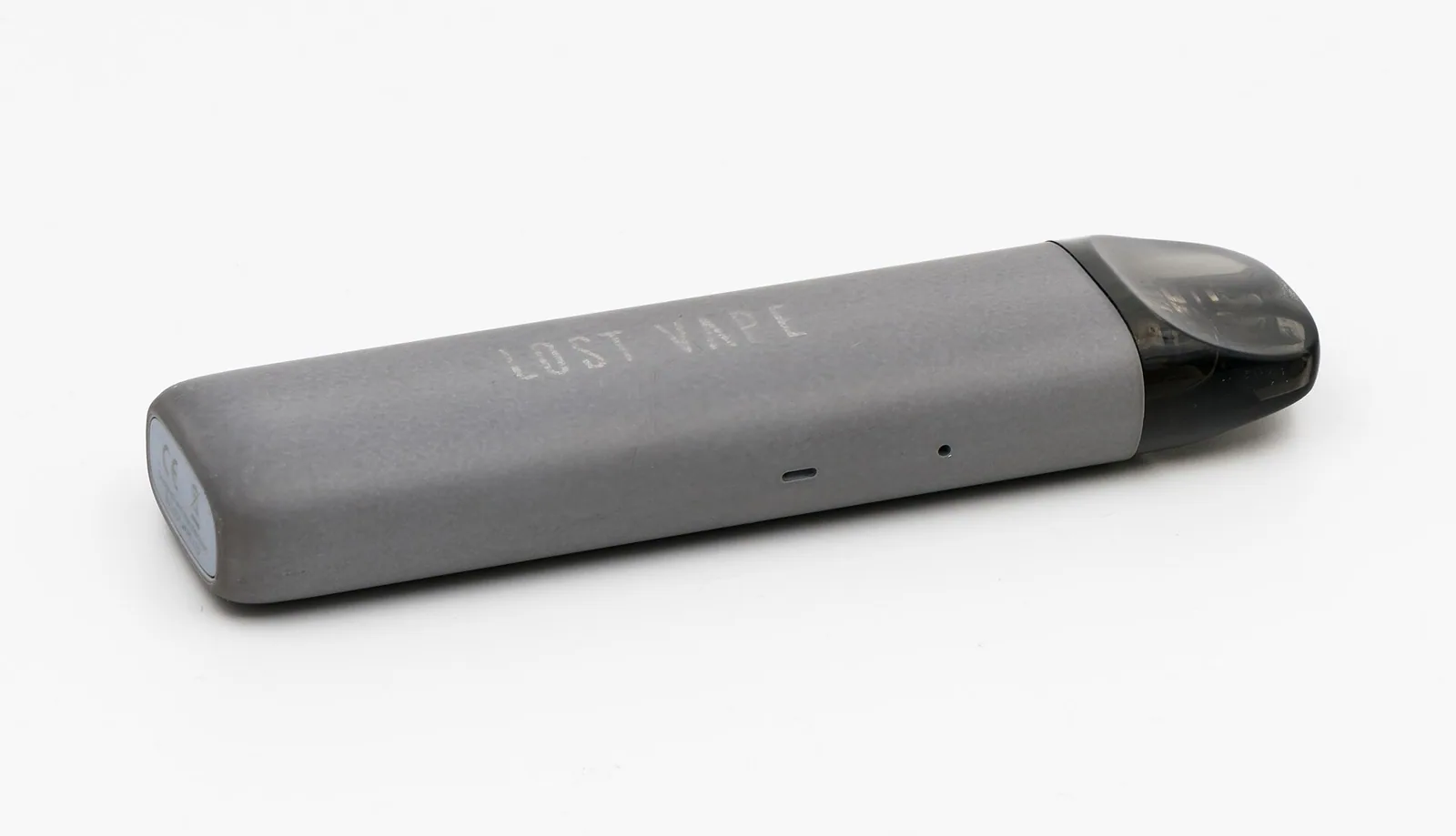
E‑cigarettes are the new front in the tobacco‑harm war: Taiwan banned them in 2023, yet youth use keeps climbing, and now the “corpse‑vape pod” toxin has prompted another round of legal amendments. The cigarette changed its shell, but the fight isn’t over. Photo: Jacek Halicki / Wikimedia Commons, CC BY‑SA 4.0.
Civil society keeps pushing forward. In September 2025 a member of the public submitted a proposal on the Public Policy Online Participation Platform to “ban pedestrian smoking,” arguing that even walking while smoking should be prohibited; it quickly gathered enough signatures43. The places where tobacco can exist have shrunk from indoors to the arcade, and now into that glass box; today even lighting up while walking draws calls for a ban. The available smoking space continues to contract.
Return to the transparent box at Ximen MRT Exit 6. The person inside complains it’s too cramped and has to stub out when the time limit hits; the person outside finally can walk the arcade without holding their breath. The city calls this a thoughtful act of distribution; anti‑tobacco advocates call it a compromising betrayal; family‑medicine doctors warn the biggest danger is that it leads people to think “having filtration means no secondhand smoke.” Four groups look at the same box and see four truths—and perhaps that’s why it’s made of glass: so everyone can see who is watching whom, and who is being watched, all laid bare.
Smoke has never truly vanished. It drifted from office ashtrays to the arcade, then into this breathing glass box; now it’s wearing an e‑cigarette shell and drifting toward the next unfinished fight. Forty years ago, when Yan Dao lost a lung lobe, Taiwan’s air was still free; forty years later, a legal but harmful cigarette has been placed back into the city’s still‑unsettled public‑space contract. That transparent box on Ximen Street isn’t a period—it’s merely the most visible shape of the negotiation so far.
Further reading :
- Ximending — This Taiwan‑first outdoor negative‑pressure smoking room stands at the Ximen MRT exit street; a former Japanese‑era entertainment district turned commercial circle, how it became the trial ground for the new policy
- Taiwan Public Health and Disease Prevention System — Tobacco‑harm prevention is part of Taiwan’s public‑health long march, sharing the same “collective health first” logic with the epidemic‑prevention system
- Taiwan Environmental Justice and NIMBY Disputes — Whether smoking rooms should be built whose doorstep, whether vagrants will gather—essentially a street‑scale NIMBY (not‑in‑my‑backyard) problem
- Martial Law Period — The era when Changshou cigarettes held a 70 % market share and the Tobacco and Wine Monopoly monopolized tobacco and alcohol, exactly the period when the state ran daily life
Image Sources
This article uses 6 images, all cached at public/article-images/society/ to avoid hotlinking the source servers:
- Hua Hua Daily / Reporter Chang Hsiang‑ying — Ximen outdoor negative‑pressure smoking room street scene (hero), fair use editorial commentary
- Shr‑person Meng‑zi / Wikimedia Commons — Songshan Tobacco Factory cigarette‑production plant north side, CC BY‑SA 4.0
- lienyuan lee / Wikimedia Commons — Original Taiwan Provincial Tobacco and Wine Monopoly Bureau building, CC BY 3.0
- Bigmorr / Wikimedia Commons — Ximen pedestrian zone street corner, CC BY‑SA 4.0
- Hirho / Wikimedia Commons — Fukuoka Ohori Park outdoor smoking area, CC BY 4.0
- Jacek Halicki / Wikimedia Commons — Disposable e‑cigarette pod, CC BY‑SA 4.0
References
- People News: Taiwan’s first outdoor negative‑pressure smoking room launches — Reporter Lin Wei‑cheng, May 7 2026, includes four filter layers, largest unit on Zhonghua Road holds 16 people, opening hours 8 a.m.–midnight, five installation sites and penalties.↩2
- TVBS: Only two qualified negative‑pressure smoking rooms in Taiwan — December 12 2008, Sheraton Hotel PR manager Bai Jing‑hui describes negative‑pressure airflow verbatim, notes that Taiwan then had about 4.2 million addicted smokers and only two qualified smoking rooms.↩
- Liberty Times: Ximen negative‑pressure smoking room malfunctions after three days of use — May 12 2026, Legislative Yuan questioning, Health Bureau Director Huang Jian‑hua says hardware management will keep improving, Public Works Bureau says door track already adjusted.↩
- United Daily News: Once the long‑running top cigarette brand in Taiwan, the Monopoly’s “Changshou” — Nostalgia column, records Changshou market share 72 % in 1974 (single source) and 76 % in 1987.↩
- Cultural Affairs Bureau, Ministry of Culture: Songshan Tobacco Factory — Monument registration, notes factory began 1937 under the Governor‑General Monopoly Bureau, peak workforce ~2,000, ceased production 1998, 2011 Songshan Cultural Creative Park operation.↩
- Wikipedia: Yan Dao (entrepreneur) — Notes Yan Dao started smoking at 12, had right upper lobe removed at 52 due to tobacco harm, founded Dong Foundation in 1984.↩
- Story Studio: Who exactly is the Dong in the Dong Foundation? — Feature article, explains Dong Zhiying gave NT$2.5 million to thank Yan Dao for solving a legal dispute; Yan Dao suggested turning it into a tobacco‑harm‑prevention foundation.↩
- Chinese Quit‑Smoking Website: Our beloved Uncle Sun — Dong Foundation system site, records Sun Yueh’s 1984‑April filming inner monologue and the “Everyone has the right to refuse secondhand smoke” slogan (note: not “Refusing secondhand smoke is everyone’s right”).↩
- Ministry of Health and Welfare: Tobacco Harm Prevention Act new version takes effect March 22 2023 — Official announcement, cross‑checked with National Laws Database, confirms enactment dates for 1997, 2009‑01‑11, 2023‑03‑22 and the expansions of indoor smoking ban, total e‑cigarette ban, and smoking‑age increase to 20.↩
- Key Commentary Network: Why did the Taiwan Provincial Tobacco and Wine Monopoly Bureau end its 40‑year monopoly? — Records the two dates: WTO accession January 1 2002, Monopoly reorganization July 1 2002 into Taiwan Tobacco and Liquor Corporation.↩
- Confluence News: Tobacco and Liquor Corp. stops purchasing tobacco leaves, Taiwan tobacco‑leaf farming enters history — 2016 tobacco‑farmer agreement, Jan‑Mar 2017 final harvest and curing of tobacco leaves.↩
- Health Promotion Administration: National Adult Smoking Behavior Survey Results — Primary statistics: adult smoking rate 21.9 % (2008) → 12.8 % (2024), down 41.6 %; indoor public‑place secondhand smoke 27.8 % → 3.2 %; outdoor non‑ban secondhand smoke 36.2 % → 58.5 % → 48.9 %.↩2
- Ministry of Health and Welfare: Don’t Let Tobacco Harm Become a Workplace Hazard — Records indoor workplace secondhand‑smoke exposure dropping from 32.1 % (2008) to 22.1 % (2020).↩
- Central News Agency: Outdoor secondhand smoke near 50 %, proposal to ban pedestrian smoking reaches threshold — November 20 2025 report, cites HPA 2024 survey: most common secondhand‑smoke locations are roads/streets/arcades 27.9 %, far ahead of parks (7.7 %) and convenience‑store arcades (7.7 %); also notes the “ban pedestrian smoking” online petition reached signature threshold.↩
- Taipei City Government: Mayor Chiang Wan‑an inspects Taiwan’s first outdoor negative‑pressure smoking room — City press release, New Engineering Division chief secretary Lin Hui‑zhong explains negative‑pressure airflow control technology verbatim, also outlines the “distribution management” policy core and the 96.2 %/~80 % public approval.↩2
- Central News Agency: Taipei’s outdoor negative‑pressure smoking rooms launch with 183 designated smoking areas — Reporter Chen Yu‑ting, May 7 2026, lists the 183 designated smoking areas and the five negative‑pressure smoking rooms; Ximending went fully smoke‑free June 1, max fine NT$10,000 — see Focus Taiwan; the 201‑area figure is the post‑May 30 Taipei‑Info update.↩
- United Daily News: Addicts in despair, city responds to smoking‑room specs — Research, Development and Evaluation Commission chair Yin Wei answers: the Ximen Station Exit 4 smoking room is 2 × 8 metres, fits more than ten people at once; the Zhonghua Road largest unit holds 16 people — see People News report (^1).↩
- United Daily News: Taipei’s outdoor smoking rooms hit a snag, central reply: “Four sealed walls count as indoor” — February 2 2026, records central government’s reply and the Research, Development and Evaluation Commission’s reference to Japan Osaka, explains how the negative‑pressure design sidesteps the “indoor” classification.↩
- Ministry of Health, Labour and Welfare (Japan): Measures against secondhand smoke (technical standards for dedicated smoking rooms) — Japan’s 2020 Health Promotion Act, effective April 2020, requires entrance‑exit wind speed ≥0.2 m/s for enclosed smoking rooms; Tokyo added even stricter supplementary rules for volatile‑organic‑compound removal rates ≥95 % (see tobacco‑equipment‑industry‑trade‑association).↩
- ETtoday: Taipei City Council discusses cost of negative‑pressure smoking rooms — May 15 2026, city cites planning estimate of roughly NT$1.5 million per unit, projecting total cost ≈NT$75 million by end‑May and ≈NT$100 million by end‑June; Central News Agency same‑day report cross‑checks the numbers (CNA).↩2
- Central News Agency: Anti‑Smoking Alliance opposes outdoor enclosed smoking rooms — May 7 2026 press release verbatim, National Congress of Parent‑Teacher Associations chair Tao Lian‑sheng questions cost‑benefit: outdoor smoking rooms need independent compartments, independent air‑conditioning, negative‑pressure design, automatic doors; if the “cannot smell smoke” effect isn’t achieved yet tens‑to‑hundreds of thousands of NT dollars are spent, the cost‑benefit is clearly poor.↩2
- Taiwan Awakening News: Lin Ching‑li advocates inside‑out tobacco ban — Dong Foundation Tobacco‑Harm Prevention Center director Lin Ching‑li: “implement indoor total smoking ban first from the inside out, then open designated outdoor smoking spots,” and “a smoke‑free city should make smoking inconvenient, not install smoking pavilions everywhere”; cross‑checked with United Daily News.↩2
- Free Talk: Kuo Fei‑ran op‑ed: Don’t set up outdoor enclosed smoking rooms — Kuo Fei‑ran’s signed op‑ed cites WHO FCTC Article 8, arguing any ventilation, filtration, or designated smoking room cannot prevent secondhand‑smoke exposure — “there is no safe level of secondhand‑smoke exposure.”↩
- U.S. CDC: Ventilation and secondhand smoke — Summarizes the 2006 Surgeon General’s report, WHO 2007, ASHRAE 2010 conclusions: even independently sealed, independently vented negative‑pressure smoking rooms cannot block secondhand smoke from leaking into adjacent areas.↩
- People News: Kuo Fei‑ran criticizes outdoor enclosed smoking rooms — June 1 2026, Kuo Fei‑ran’s “do not, for a good purpose, spread mistaken ideas” verbatim; same article contains the Anti‑Smoking Alliance’s citation of the Kyoto Women’s University study.↩
- Kyoto Women’s University Academic Repository: Passive smoking conditions around the outdoor smoking area of Kyoto Station — Paper title confirms subject is the “outdoor” smoking area of Kyoto Station, measuring PM2.5 at 3 m and 10 m to the east, not an enclosed room.↩
- Kyoto News (notobacco.jp reprint): Complaints about the smoking area in front of Kyoto Station — March 14 2024, describes the structure as roughly 2 metre high dividers with no door or roof; Industrial Medical University professor Yamada Hiroshi calls it an “open‑air smoking corner” and argues it should be at least 25 metres from non‑smoker flow.↩
- China Times: Ximending street interviews on June 1 smoke‑free debut — Reporter Gamei Gang, June 1 2026, includes smoker quote: “Good for non‑smokers—won’t affect them inhaling secondhand smoke”; female smoker quote: fixed smoking area reduces mutual friction with kids/stroller parents.↩
- United Daily News Oops: She complains the Ximen smoking room is too small and time‑limited — Pulls anonymous Dcard post (social media, not street interview): complains the smoking room is smaller than imagined—about a parking‑space size—questions if queuing is needed and if bound by opening hours; netizen reply: “Do you know how non‑smokers normally feel?” verbatim.↩2
- United Daily News: Addicts in despair, city responds to smoking‑room distance and hours — Research, Development and Evaluation Commission chair Yin Wei replies: Japanese negative‑pressure smoking rooms also close at 22:00 or 23:00; all smoking rooms are within a three‑ to five‑minute walk of each other.↩
- Ministry of Health and Welfare: Six‑year anniversary of Tobacco Harm Prevention Act implementation — reducing health inequality — Records adult male smoking rate by education: junior‑high‑or‑below 35.8 %, college‑or‑above 11.9 % (the former is triple the latter); males aged 30‑49: junior‑high‑or‑below 50.0 %, college‑or‑above 27.0 % (1.9 ×).↩
- National Health Insurance Administration: Allocation and execution rate of tobacco‑health surcharge — Official data: tobacco surcharge subsidizes health‑insurance premiums for 446,000 economically disadvantaged people and underwrites the operation of the nation’s 13 public relief institutions.↩
- United Daily News: Ximen negative‑pressure smoking room, shopkeepers and village heads discuss management worries — Ximen Pedestrian Zone Street‑Area Development Promotion Association chair Liu Jia‑xin: “Daytime probably fine, more worried about nighttime”; Ximen Village head Ye Min‑hui: “future management will indeed be the biggest challenge” (interview expectations, not yet‑occurred facts).↩
- Chiyoda Ward Office: Roadside smoking penalty disposition — Chiyoda Ward enacted Japan’s earliest street‑smoking fine ordinance October 2002, ¥2,000 fine; Shibuya Ward rule see Shibuya Ward website.↩
- NEA Singapore: Orchard Road No Smoking Zone — Orchard Road designated no‑smoking zone since 1 Jan 2019, only a handful of designated smoking spots permitted; ground‑level “yellow box” (Yellow Box) and 5‑metre‑from‑entrance no‑smoking are standard Singapore practice — see NEA smoking‑prohibition page.↩
- Hong Kong Government News Bureau: Smoking control amendment ordinance takes effect Jan 1 2026 — Statutory no‑smoking‑area fixed fine raised from HK$1,500 to HK$3,000, plus added “no smoking while queuing” rule.↩
- Euronews: France to implement smoking ban in public spaces with children — Effective July 1 2025, bans smoking in parks, beaches, school gates, and other child‑frequented outdoor spaces; violators fined €135.↩
- Taipei City Government Health Bureau: Nationwide first negative‑pressure smoking area press release — Official wording uses “nationwide first” (scope limited to Taiwan); English media likewise only say “Taipei’s first”; no “world first” found.↩
- Kataoka et al., BMC Public Health (2024) — Kobe University team study, 78.4 % is the non‑compliance rate of indoor restaurants and bars in Tokyo, Osaka, and Aomori prefecture under the 2020 smoking order, not the outdoor smoking‑spot violation rate.↩
- Health Promotion Administration: 2021 youth e‑cigarette use spikes to 6.6 % — Junior‑high e‑cigarette use 1.9 % (2018) → 3.9 % (2021); senior‑vocational‑high 3.4 % → 8.8 % (2021); paper‑cigarette use moved in the opposite direction.↩
- ETtoday Health Cloud: Heated tobacco to hit shelves as early as Oct 11 — HPA 2025‑07‑29 approved two vendors, 14 items conditionally cleared, 8 tobacco‑stick items and 3 device models to take effect Oct 11 2025, convenience‑store rollout to follow.↩
- Health Promotion Administration: Executive Yuan council passes draft amendment to Tobacco Harm Prevention Act — June 25 2026 draft, responding to “corpse‑vape pod” etizolab: possession/use penalties raised to NT$30,000–100,000, manufacturing/trafficking made criminal, max seven‑year imprisonment; as of verification still in Legislative Yuan, not yet passed third reading — see Central News Agency for cross‑check.↩
- Central News Agency: Outdoor secondhand smoke near 50 %, proposal to ban pedestrian smoking reaches threshold — September 26 2025, proposal “ban pedestrian smoking” submitted on Public Policy Online Participation Platform, already passed signature threshold.↩
🧬 What Semiont was thinking while writing this