
30‑second overview: Su Beng (birth name Shih Chao-hui, 1918–2019) was a leading figure of the Taiwan independence movement and author of Four Hundred Years of Taiwan History. He was born in Shilin, Taipei, studied at Waseda University, joined the Chinese Communist Party’s anti‑Japanese and revolutionary activities in China, but became disillusioned after witnessing the bloodshed of land‑reform campaigns and concluded that “Taiwanese cannot be bound together with Chinese.” In 1949 he escaped back to Taiwan, plotted to assassinate Chiang Kai-shek, and after the plot failed he smuggled himself to Japan in 1952, beginning a forty‑one‑year exile. In Ikebukuro, Tokyo he opened a noodle shop called “Shin Chinmi,” selling dumplings by day and writing Taiwanese history by night. The shop’s revenue funded the independence movement and the underground network. In 1993 he returned to Taiwan under the guise of the “last black‑list member,” became the most respected elder of the pro‑independence camp, and died in 2019 at the age of one hundred.12
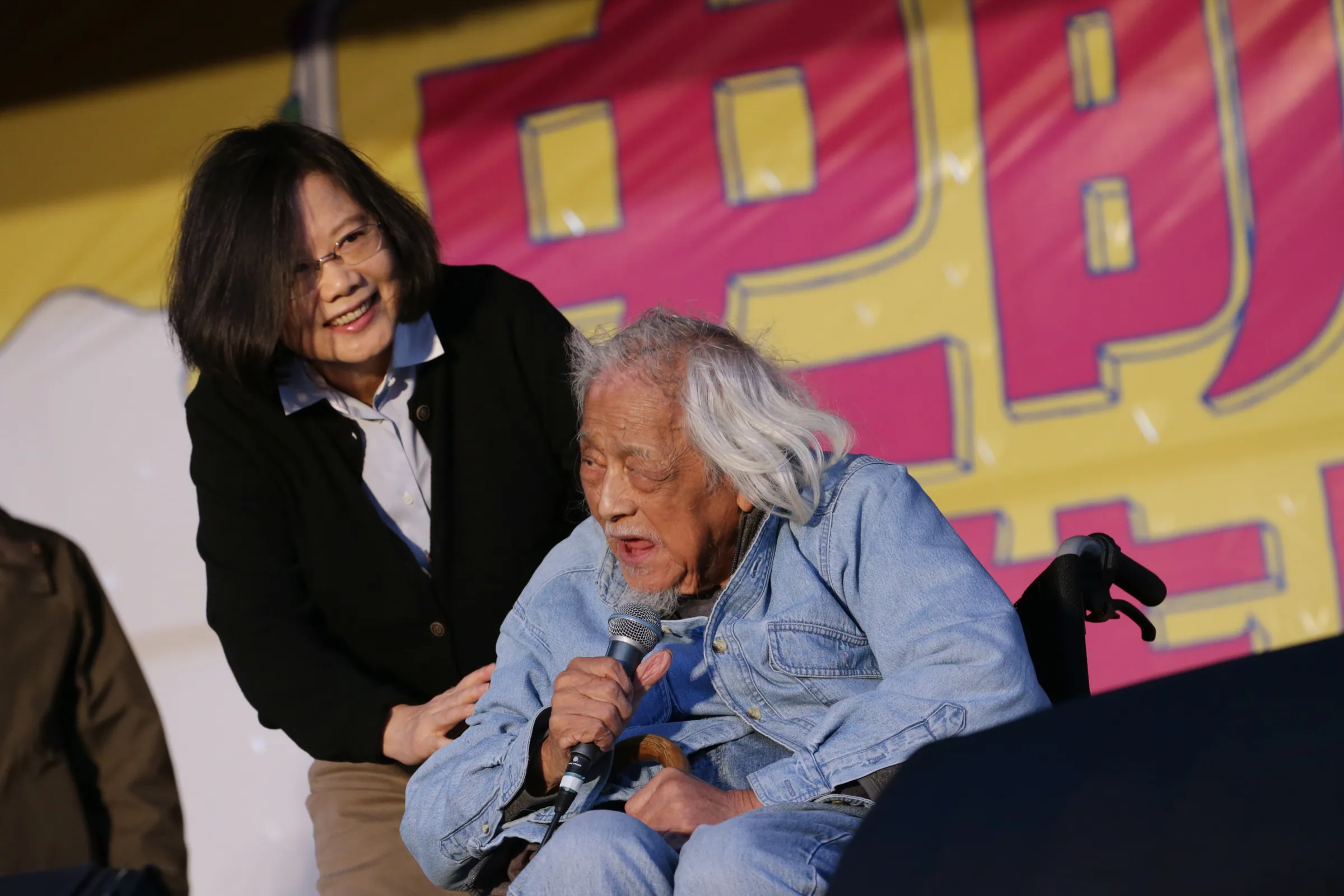
2017 – various groups celebrated Su Beng’s centennial in advance; President Tsai Ing-wen attended. Photo: Presidential Office, CC BY 2.0 via Wikimedia Commons.
A Dumpling Shop That Hid an Entire Revolution
At the west exit of Ikebukuro Station in Tokyo once stood a five‑story Chinese‑cuisine building called “Shin Chinmi.” The shop sold dumplings, siu mai, and simple wheat noodles, and its business became lucrative enough for the owner to accumulate substantial assets.1
That owner was Su Beng. The true purpose of the noodle shop was hidden on the upper floor. By day he bustled in the kitchen; by night he climbed to the roof and wrote Taiwanese history page by page in Japanese. Part of the shop’s earnings covered his living expenses; the larger portion funded the Taiwan independence movement.1 A seemingly ordinary dumpling shop was, in fact, a logistical base for the revolution.
In the bustling Ikebukuro commercial district, few customers realized that the plate of dumplings they ate was, in a sense, also supporting a distant independence struggle. Su Beng layered the everyday life of his restaurant with the everyday work of revolution in the same building: the first floor provided livelihood, the roof housed ideals, and he alone shuttled between them. This intertwining of commerce and belief sustained all of his subsequent actions for decades.
To understand why the shop existed, we must travel back far—to Yan’an in China, to a period when a Taiwanese youth once sincerely believed in the Chinese revolution.
From Yan’an to Disillusionment
Su Beng, birth name Shih Chao-hui, was born in 1918 in Shilin, then part of Taipei Prefecture (now Shilin District, Taipei City). He attended Taipei First High School and entered the Department of Political Economy at Japan’s Waseda University in 1937.1
After graduating from Waseda in 1942, a classmate introduced him to China. At that time, socialism and the Chinese Communist Party’s anti‑Japanese revolution offered many Taiwanese intellectuals, who were under Japanese colonial rule yet opposed Japanese militarism, an idealistic path. In 1943 he went to Yan’an and the Taihang Mountains for training; because he spoke Japanese, the CCP assigned him to underground intelligence work in Shanghai, Beiping, and elsewhere under the alias “Lin Tuo.”1 He was then a Taiwanese youth who believed in socialism and was willing to risk his life for the Chinese revolution.
The turning point came after World War II. Following Japan’s defeat, the second Chinese civil war erupted. He joined CCP guerrilla forces, but during that period he personally witnessed the mass meetings and executions of the CCP’s land‑reform campaigns. He also sensed the discriminatory treatment and suspicion directed at Taiwanese members of the party—a phenomenon he later called “Han racialism.” The gap between his ideals and reality gradually eroded his youthful faith. In 1947 he heard news of the 228 Incident in Taiwan; the blood of his homeland on one side and the purges he experienced on the other merged, leading him to a lifelong conclusion: Taiwanese cannot be bound together with Chinese; Taiwan must decide its own destiny.13
In May 1949, taking advantage of Mao Zedong’s inspection tour, he forged a travel permit and escaped the liberated zone, breaking through blockades and returning to Taiwan via Qingdao. A man who had once been ready to die for the Chinese revolution now turned onto the opposite path. This shift from “Chinese revolutionary” to “Taiwanese nationalist” is the key to understanding Su Beng’s life. His belief in Taiwan independence grew out of the soil of China: after seeing the purges and divisions, he decided that Taiwan must separate from China.
Plotting Chiang’s Assassination, Fleeing to Japan
Back in Taiwan, Su Beng faced the island under Chiang Kai‑shek’s military rule following the 228 Incident. Fresh from the purges and civil war in China, he was no stranger to authoritarian brutality and did not trust moderate petitions to move mountains. His response was therefore radical: organize armed resistance and launch a revolution, confronting the ruling power in the most direct way. In an era when merely uttering “Taiwan independence” could lead to execution, this was a life‑or‑death path.
From 1950 onward he and several comrades formed the “Taiwan Independence Revolutionary Armed Force,” gathering more than thirty youths in the Shilin‑area villages of Shuangxi, Caoshan, and Dahu, Miaoli. They collected over twenty rifles left by the Japanese army, hiding the weapons in the Shih family orange orchard on Yangmingshan, preparing to assassinate Chiang Kai‑shek.1 In a time when political prisoners were routinely shot, choosing an armed route meant staking every participant’s life on the table. The plan collapsed at the end of 1951 when the weapons were discovered; Su Beng was placed on a wanted list and forced to flee.
The method of escape the following year became the most frequently recounted episode of his legend. In May 1952 he hid in the stifling banana cargo hold of the freighter “Tianshan Lun,” slipping from Keelung to Kobe, Japan. Upon arrival he was briefly detained by Japanese police on illegal‑entry grounds, but in November he was released on political‑asylum grounds.1 From that moment he became a wanted man on Taiwan’s list, a stateless exile who could survive only by his own efforts. This exile lasted forty‑one years.
_Four Hundred Years of Taiwan History_
Exile was not romantic. Without a nationality’s protection and with a wanted notice over his head, he had to rebuild his life from scratch in a foreign land. In that circumstance he set his lifelong “right‑hand work”: earn a living, organize, and write, shouldering the seemingly endless goal of Taiwan independence.
During his Japanese exile Su Beng split his revolutionary activity into two strands: action and thought. The thought strand eventually grew into his most important work.
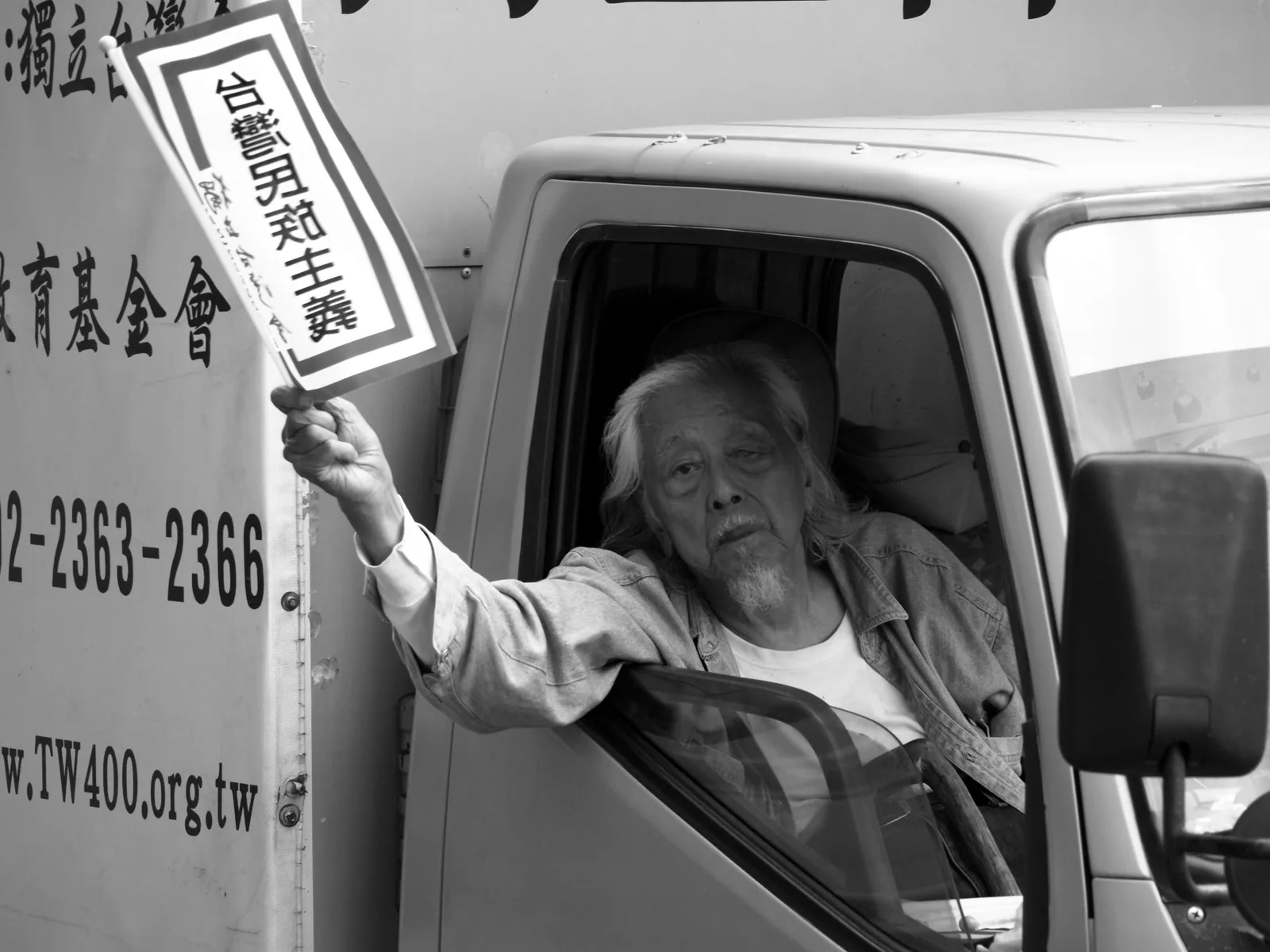
Elderly Su Beng still appeared on streets and podiums as “Ōri‑san.” Photo: Siegfy, CC BY‑SA 2.0 via Wikimedia Commons.
First, where the money for the action strand came from. Upon arriving in Tokyo, Su Beng and his Japanese partner Heiga Kyoko pushed a food cart selling noodles and dumplings in Ikebukuro, starting from the bottom. As business grew, he purchased the building at the west exit of Ikebukuro Station in 1960, constructing a five‑story “Shin Chinmi” Chinese‑cuisine restaurant that sold dumplings, siu mai, and simple wheat noodles, accumulating roughly five hundred million yen in assets.1 This money was not for personal enjoyment; it became the budget for the revolution—Shin Chinmi functioned as both the overseas treasury and office of the Taiwan independence movement.
The thought strand culminated in Four Hundred Years of Taiwan History. Noticing that many independence activists knew little about Taiwan’s own past, he spent three years writing the book in Japanese on the roof of Shin Chinmi, publishing it in Tokyo in 1962; six more years later he produced a Chinese version released in 1980, followed by an English edition in 1986.14 The book’s distinctiveness lies in its protagonist: whereas most prior Taiwanese histories focused on the succession of ruling dynasties, Su Beng turned the lens onto the ordinary Taiwanese people who were ruled and exploited, describing how they survived four hundred years on the island and what was taken from them. It aimed to awaken a sense of “Taiwanese nation” – that Taiwan’s people constitute a group with their own history and the right to self‑determine. This “Taiwanese nationalism” later became one of the most influential intellectual resources for the independence discourse.45
During this period Shih Chao-hui adopted the name “Su Beng,” meaning “to make history clear.”1 In 1967 he founded the “Independent Taiwan Society” (Independent Taiwan Association) in Tokyo, publishing the monthly Independent Taiwan and using Shin Chinmi as a training and funding base, while extending underground contacts back to the island. Thus the dumpling shop simultaneously fed customers and nourished a revolution with no visible endpoint.
Four Hundred Years of Taiwan History was once banned in Taiwan, yet it circulated covertly within the opposition movement and underground independence circles, becoming an entry point for many to awaken to Taiwanese consciousness. The “four hundred years” in the title refers to the long span of foreign rule—from the 17th‑century Dutch, Zheng, Qing, and Japanese administrations to the Nationalist government—over which successive external powers governed Taiwan. Su Beng argued that throughout those four centuries Taiwan’s people were ruled by others, and now it was time for Taiwan’s people to govern themselves. This historiography later permeated the independence movement and local discourse, turning “Taiwanese nationalism” from a slogan into a historically grounded, debatable framework.45
The Independent Taiwan Society was more than a propaganda outfit. Su Beng trained a cadre of underground workers in Japan, arranging for personnel and publications to be smuggled back to Taiwan under martial law, establishing secret contact points on the island. This underground line carried extreme risk; capture meant a charge of rebellion. For Su Beng, writing history and running underground networks pointed to the same goal: reconstruct Taiwan’s past on paper while advancing its future in reality.1
One often‑overlooked aspect is Su Beng’s frugality. Although Shin Chinmi generated roughly five hundred million yen, he left almost nothing for himself. In his later years he lived modestly, channeling most of his lifetime savings and royalties into the independence cause and related foundations. For him, every yen earned by the dumpling shop ultimately funded a future he believed in.13
The Last Person on the Blacklist
Taiwan lifted martial law in 1987, yet Su Beng remained classified as a rebel. In 1991 the “Independent Taiwan Society case” saw several members arrested for studying Su Beng’s writings, becoming a late‑stage White Terror incident that sparked public protest.1
On 26 October 1993, at age seventy‑five, Su Beng returned to Taiwan under the designation “the last person on the blacklist,” ending forty‑one years of exile. Upon arrival he was arrested by the security headquarters in front of the Xinying toll station on the Zhongshan Expressway, later released on a NT$100,000 bail; his past actions were never prosecuted.1
The title “the last person on the blacklist” itself reflects a chapter of Taiwan’s history. During the martial‑law era many overseas independence activists were placed on a “blacklist” that barred them from returning home; as Taiwan democratized, those on the list gradually came back, and Su Beng was the final, most dramatic case. At seventy‑five he caught the last train home before the regime he had opposed all his life fully loosened its grip.
The documentary Revolution in Progress (directed by Chen Li‑kuei) records Su Beng’s life.
After returning to Taiwan Su Beng did not retire. At the end of 1996 he founded the “Taiwan Public Radio” in Taipei, hosting the program “I Love Taiwan” to discuss history and current affairs; he drove an “Independent Nation‑building Propaganda Fleet” on the streets, broadcasting “Taiwanese nationalism” and turning the historiography from Shin Chinmi’s roof into a mobile loudspeaker. In 2004 he cast his first vote with a Republic of China ID, voting for Chen Shui‑bian – a symbolic act for a man who had spent forty‑one years in exile and once lacked any household registration.1
He remained on the front lines of street activism. In 2005, after China passed the Anti‑Secession Law, the eighty‑seven‑year‑old Su Beng joined National Taiwan University students in a twelve‑day sit‑in protest. In 2009 he undertook the “Unhappy, Come Out and Walk” island‑wide pilgrimage, trekking 505 km from Hengchun, Pingtung to Taipei over twenty‑six days. During the 2014 Sunflower Movement, the ninety‑six‑year‑old Su Beng rode a wheelchair into the Legislative Yuan to visit the occupying students. He thus became a familiar figure in Taiwan’s street movements: a cap‑wearing elder revolutionary affectionately called “Ōri‑san,” whose age only increased his presence at the youngest protest sites.
In his later years Su Beng was especially popular with young people. He shunned the aura of an elder, stood alongside students, listened to them, and constantly encouraged the younger generation to learn their own history and muster the courage for action. Many of the Sunflower generation first became aware of the independence movement’s depth through this centenarian “Ōri‑san,” realizing that the cause was not merely textbook material but a lifelong practice by real people. An elderly man born under Japanese rule, still speaking with a Japanese accent, appearing in 21st‑century protests surrounded by twenty‑year‑olds shouting “Ōri‑san”—that image alone explains why he is remembered.
Leaving a Seat
After President Tsai Ing-wen took office in 2016, she appointed Su Beng as a senior adviser to the Presidential Office. The appointment carried strong symbolic weight: a man once hunted by the government, who plotted to overthrow those in power, was, in his final years, hired as a top‑level adviser by the Republic of China’s president. The intervening years trace Taiwan’s transition from authoritarianism to democracy, reclassifying a “rebel” as a “senior adviser.” In 2017 localist groups celebrated his centennial early along Keelung Road, with President Tsai personally attending.1
On the night of 20 September 2019, shortly after 11 p.m., Su Beng died at the affiliated hospital of Taipei Medical University from multiple organ failure, aged one hundred and three (traditional East Asian age reckoning; actual age one hundred). From his 1918 birth to that night, his life spanned Taiwan’s entire twentieth century—from Japanese rule, the 228 Incident, martial law, exile, to democratization—each era he lived through personally.26 President Tsai, in her condolence remarks, said Su Beng used to join her for New Year’s Eve dinner each year, encouraging her to stay strong; she added, “Next year’s New Year’s Eve, I will still leave a seat for him, commemorating his lifelong dedication to Taiwan.”2
News of Su Beng’s death sparked numerous spontaneous memorials across Taiwanese society. For independence supporters he was a generational “Ōri‑san”; for many other Taiwanese he was a legend who lived to a hundred while still fighting for the same cause. Director Chen Li‑kuei’s documentary Revolution in Progress had already, before his death, turned his long‑term revolution into a repeatedly viewable visual record.7
Su Beng’s life remains controversial and is bound to be remembered differently by various camps. Chinese state media, upon his death, called him “a life lived in vain.” Pro‑unification voices reject his stance, some critique his early armed tactics and question how a former CCP trainee could turn against it. Within Taiwan’s pro‑independence camp he is revered as a “lifelong revolutionary” and a spiritual symbol; writer Yen Chieh‑ya noted that Su Beng’s “independence” was largely built on “recognizing the CCP” after his disillusionment. His “independence” order is reversed: only after seeing the reality on Chinese soil did he choose Taiwan.
What Su Beng left Taiwan with is a way of seeing itself. His “Taiwanese nationalism” emphasizes affirming Taiwanese people as a collective with the right and ability to decide their own future, appealing to identification rather than hatred. When he passed, media outlet Initium described his “Taiwanese nationalism” as a “door not yet finished”—it opened a possibility for Taiwan, but whether to walk through and how remains a task for future generations.5
Regardless of one’s position, few deny his consistency. From Yan’an’s disillusionment, to Ikebukuro’s dumpling shop, to the streets of Taipei with a propaganda vehicle, he spent a lifetime answering the same question: Who are the Taiwanese, and can they determine their own destiny? His Four Hundred Years of Taiwan History provides a readable, debatable starting point for that question—just as the title of his documentary suggests, it is a “revolution in progress,” a revolution still unfinished and awaiting the next generation.
Further Reading
- Taiwan Independence Spectrum — Understand where Su Beng’s independence stance sits on Taiwan’s political spectrum.
- 228 Incident — The pivotal historical trauma that propelled Su Beng toward armed resistance.
- Taiwan White Terror — Context for the “Independent Taiwan Society case” and Su Beng’s exile era.
Image Sources
- Hero photo: Presidential Office, Wikimedia Commons, CC BY 2.0. Original file: President attending Su Beng’s centennial birthday.
- Portrait in text: Siegfy, Wikimedia Commons, CC BY‑SA 2.0. Original file: Taiwan independence “father” Su Beng portrait.
- Video: Documentary Revolution in Progress (directed by Chen Li‑kuei), YouTube, embedded as inline external link.
References
- Su Beng — Wikipedia (Chinese) — Index of birth name Shih Chao-hui, lifespan (1918–2019), Waseda, Yan’an training, alias Lin Tuo, Taiwan Independence Revolutionary Armed Force, assassination plot, 1952 smuggling to Japan, Shin Chinmi, Independent Taiwan Society, 1993 return, and later life.↩
- Su Beng dies at 103; Tsai Ing-wen: “I will still leave a seat for him at New Year’s dinner” — Liberty Times report 2019, confirming death date, age, and President Tsai’s quoted tribute.↩
- Life and Ideology of Taiwan’s Left‑Wing Revolutionary Su Beng — New Bloom Magazine profile, supplementing Su Beng’s left‑wing thought, disillusionment with the CCP, and post‑return positioning.↩
- Four Hundred Years of Taiwan History — Wikipedia (Chinese) — Confirms Japanese edition 1962, Chinese edition 1980, English edition 1986, and the work’s “Taiwanese people’s historiography” purpose.↩
- Unfinished Progress: Su Beng’s “Taiwanese Nationalism” — Initium Media 2019 commentary on Su Beng’s nationalist ideas and their intellectual legacy.↩
- Taiwan Independence “Father” Su Beng Passes Away — United Daily News 2019, cross‑checking death details and late‑life political focus.↩
- Taiwan Hero Su Beng Documentary — Revolution in Progress — Documentary preview, recording Su Beng’s life and Taiwan independence movement trajectory.↩