
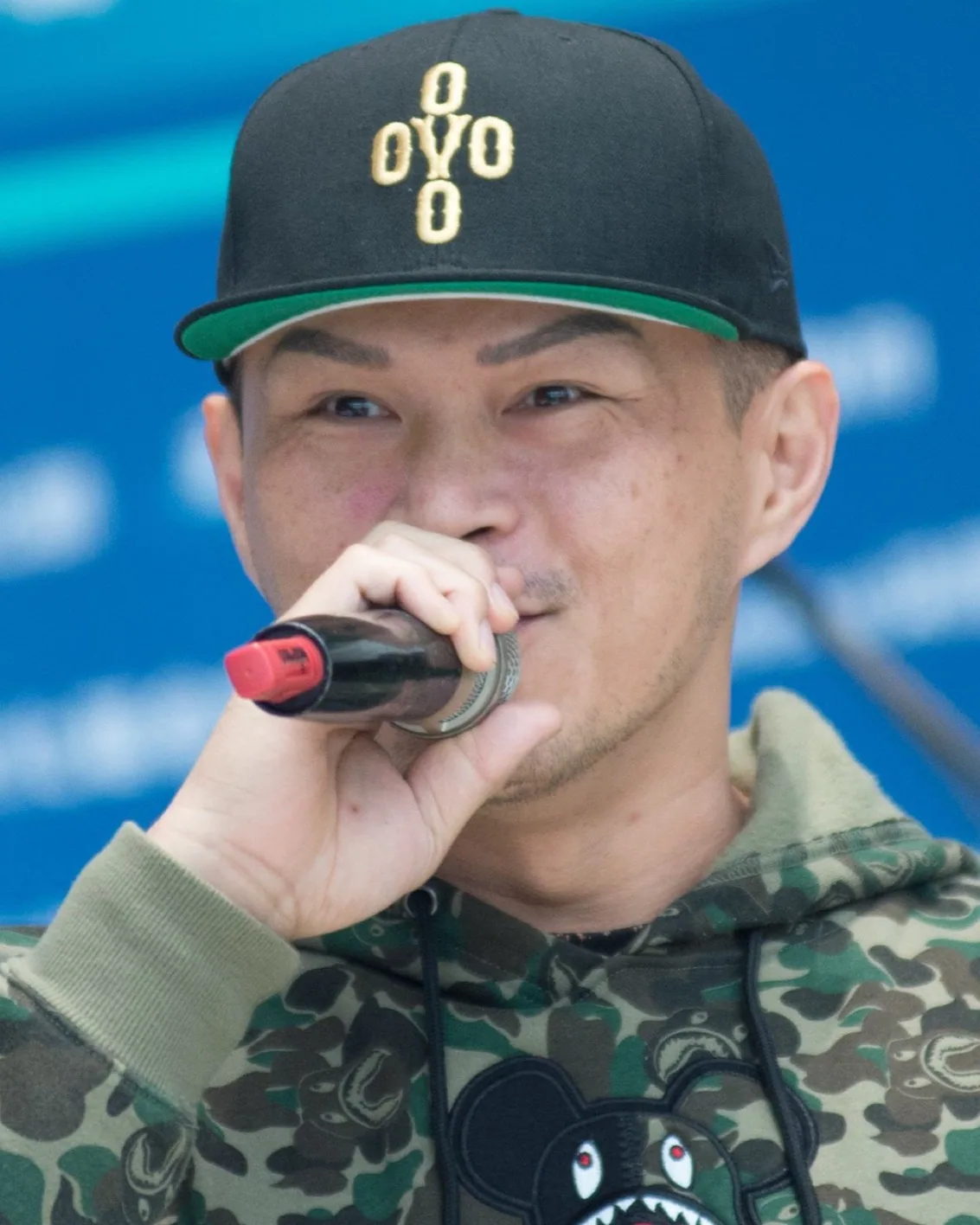
30-Second Overview: Dwagie (Dwagie, real name Tseng Kuan-jung) is a Taiwanese rapper from Tainan and the founder of Renren Yougong Lian Music Studio. In the late 1990s, he met MC HotDog on the Master U message board; moving from underground demos to nightclub performances, he joined Rock Records' "Great Circus" music studio. When Shé Càn Lián Huā (some sources write Shé Càn Lián Huā) was released in 2002, it was discussed within the context of early Mandarin-market full-length rap albums; 〈Taiwan SONG〉 used a Taiwanese accent as an auditory marker of Taiwanese identity. After 2003, he returned to Tainan to establish Renren Yougong Lian, allowing a recording and practice space to grow into a Southern hip-hop hub. In 2011, the album Ren (Person) featured collaborations with Chang Hsu, Lin Chang-tzu, Wen Xia, and the 14th Dalai Lama, bringing human rights, religion, animal rights, and political concerns into the vocabulary of Taiwanese rap. By The Rap Era, he took on the role of judge and "Principal," passing the experience accumulated from the early underground scene to the new generation. 12[^<0xE2><0x80><0x8A>3]3
The Underground Era Beginning with the MU Message Board
The places where the Taiwanese hip-hop scene first recognized Dwagie were internet message boards, record stores, and the subcultural corners of Tainan.
In an interview with the Central News Agency (CNA), he recalled encountering US West Coast hip-hop works like Snoop Dogg's Doggystyle at record stores in his early years. In Tainan, local venues such as POP Artist Shop and Dongfang Cike allowed him to see how subcultures could congregate. Later, while studying in Taipei, he met MC HotDog on the Master U message board; the two moved from forum gatherings, basketball, and parties to exchanging creative works, gradually becoming one of the core groups of early Taiwanese underground rap. 12
During that era, Taiwan's hip-hop scene had not yet matured into an industry. An article excerpted by Roomie from Hip-hop Kids: Stories of Taiwanese Rap notes that after 1998, Rock Records noticed MC HotDog during live performances at the @live nightclub in Taipei, subsequently establishing the "Great Circus" music studio, with members including Hotdog, Dwagie, Xiao Si, 168, and Charles. Record companies were still groping for ways to produce, price, and promote rap. Underground demos, campus intranets, live performances, and the mainstream record industry briefly intersected during those years. 2
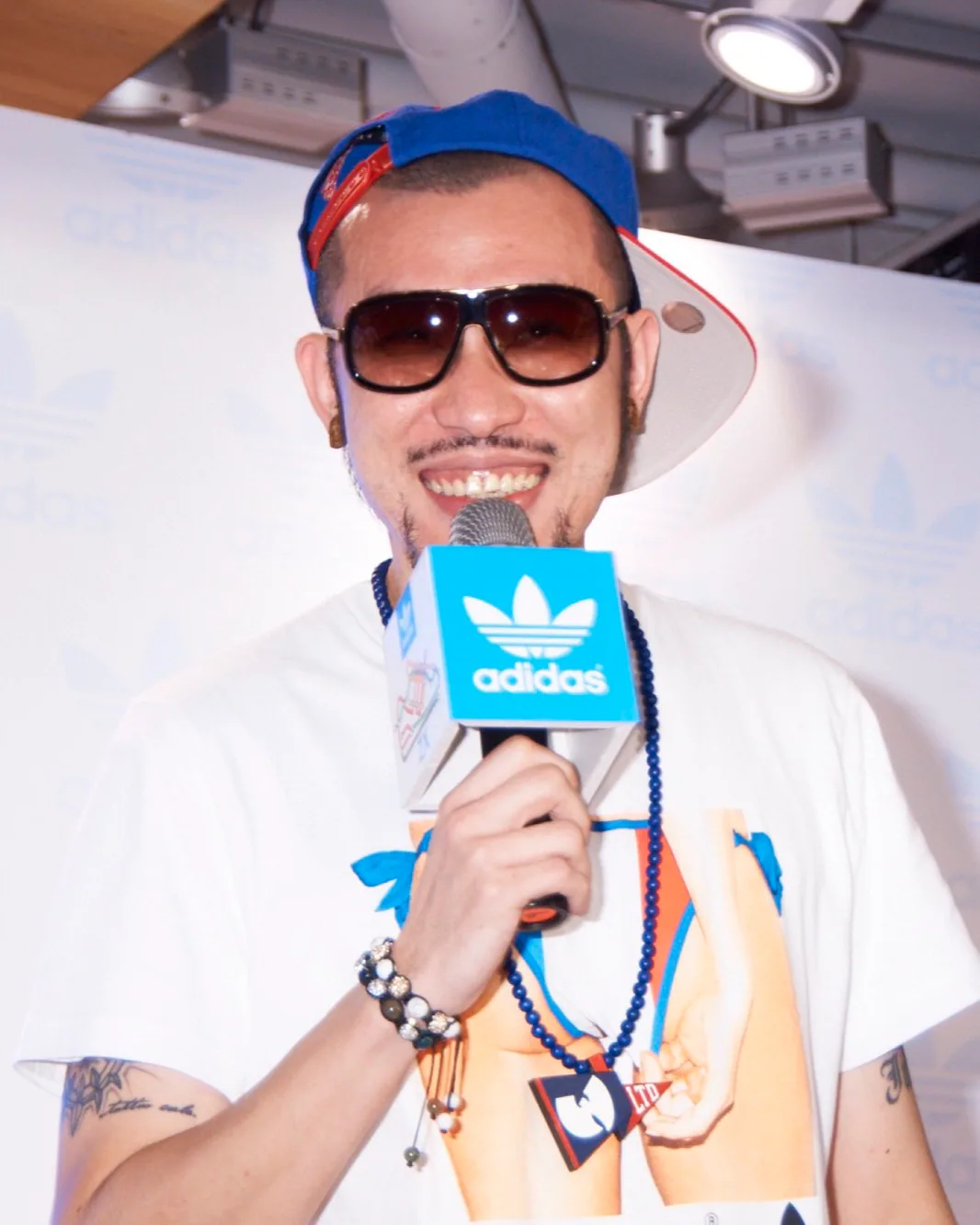
MC Hotting, 2012 performance. Dwagie and Hotdog met during the Master U and Rock Records era; their underground years constitute a key memory before Taiwanese rap entered the mainstream market. Photo: Chiu Yu-feng, CC BY-SA 4.0 via Wikimedia Commons.
In August 2002, Dwagie released Shé Càn Lián Huā. Roomie's excerpt places it in the final stage of Rock Records: this work is listed last in the Rock Records album numbering, and at the time, it was packaged by promotion as a pioneering work for full-length rap albums in the Mandarin market. 2 Rather than treating such promotional claims as unverified rankings, it is better to look at the historical position they indicate: when Taiwanese rap was not yet fully understood by the mainstream market, Dwagie used a full album to integrate Tâi-gí (Taiwanese), Mandarin, skits, rhyme experimentation, local consciousness, and international hip-hop forms.
The Sound of 〈Taiwan SONG〉
The most memorable work in Shé Càn Lián Huā is 〈Taiwan SONG〉.
It is often simplified into a political statement, but more importantly, it is a sonic method: Dwagie uses a Taiwanese accent, a Tainan cadence, and call-and-response shouting to transform "Taiwan" from a concept into an audible timbre. Within the context of Taiwan's hip-hop and rap development, 〈Taiwan SONG〉 is simultaneously a song of local consciousness and a linguistic experiment. Tâi-gí here carries the rhythm, aggression, and sense of mass mobilization for rap, no longer just an emotional embellishment borrowed for Mandarin pop songs. 24
Dwagie Official MV: 〈Taiwan SONG〉.
In 2017, he was invited to perform 〈Taiwan SONG〉 during the NBA Brooklyn Nets' "Taiwan Culture Night" home game, recorded by Taiwanese media and online archives as a representative event of a Taiwanese rapper performing in an NBA arena. 5 This moment perfectly illustrates Dwagie's contradictory position: a song grown from Tainan accents, Tâi-gí lyrics, and Taiwanese consciousness became a sonic flag for overseas Taiwanese cultural events when performed in a US professional basketball arena.
Returning to Tainan to Open a Training Studio
After Shé Càn Lián Huā, Dwagie did not only move toward the Taipei entertainment market. He returned to Tainan to build up Renren Yougong Lian.
In his CNA interview, he stated that Renren Yougong Lian did not start as a grand cultural project, but rather as a place for hip-hop enthusiasts to record and practice, and for students to learn rap. After 2003, this gathering and teaching space gradually grew into a Southern hip-hop hub. Summer rap classes, the recording studio, events, and a network of members made Tainan another production base for Taiwanese rap. 1
The uniqueness of Renren Youguna Lian lies in its role as a simultaneous site for education, performance, production, local gathering, and a bridge for newcomers; its scale is more diverse than a simple record label and more public than a personal studio. Later, the Taiwanese hip-hop scene often referred to Dwagie as "the Principal," a title derived from his seniority and lineage, as well as his long-term way of intertwining rap teaching, studio management, and scene cultivation.
Taiwanese rap is often imagined as a culture emerging from Taipei intranets, riverside message boards, nightclubs, and campus clubs; what Dwagie and Renren Yougong Lian provided was the Tainan route: a group of people practicing in tea shops, recording studios, classes, and events, bringing Southern accents, Tâi-gí, and local experiences into hip-hop.
After Ren, the Microphone Leads to Public Issues
The 2011 release of Ren (Person) was a significant turning point in Dwagie's creative path. According to CNA, this album included collaborations with Chang Hsu, Lin Chang-tzu, Wen Xia, and the 14th Dalai Lama; the title track 〈Ren〉 brought religion, human rights, animals, and life concerns into the work. 1[^ $\text{3}$]
Ren was later nominated for Best Mandarin Album at the 23rd Golden Melody Awards and won Best Album and Best Hip-Hop Album at the 3rd GIME Awards. 5 While the awards were not the most prominent part of Dwagie's work, they allowed this gritty, highly political rap style—laden with Tâi-gí and Taiwanese consciousness—to enter a position recognizable by the mainstream music establishment.
Dwagie Official MV: 〈Ren〉, featuring the 14th Dalai Lama in the MV.
When PTS's Who Wants to Have Dinner introduced Dwagie, it placed him in the context of "using a microphone to speak the truth about society," also recording his long-term vegetarianism and focus on animal and marginalized issues. 6 During a 2019 World Animal Rights Day event, the Environmental Information Center reported that he led the public in reading a declaration of animal rights and performed songs regarding slaughter and leather products. 7
These public issues make it difficult to relegate Dwag $\text{ie}$'s music solely to the entertainment market. He understands hip-hop as a sonic tool capable of intervening in reality; human rights, Taiwanese identity, animal rights, and care for the marginalized have all become part of his work and public image.
Politics also brings costs. In late 2016, media reported that a list of blacklisted Taiwanese artists was circulating in China; while the authenticity of the list was not officially confirmed at the time, Dwagie responded after being named, stating that since he long discusses human rights, politics, and universal values, he is inherently at odds with the CCP's stance, adding, "It doesn't matter if I earn a little less money." 8 This response is often cited because it states Dwagie's position very directly: rap must preserve freedom of speech, even if that compresses certain markets.
Body, Family, and the Side Beyond "Hardness"
Dwagie's stage image can easily be summarized in a few words: large physique, heavy voice, direct lyrics, and clear political stance. These traits are true, but looking only at this side misses why he turned hip-hop into education and public advocacy.
When PTS's Who Wants to Have Dinner introduced his family background, it mentioned that his father is a police officer, his mother is a teacher, and his siblings have entered public service roles such as police and firefighting. 6 When placed within his music, this family background creates an interesting contrast: he raps hip-hop that is perceived as rebellious, profane, underground, and anti-authoritarian, yet the most everyday professional imagery surrounding him consists of institutionalized roles of care and order, like police, teachers, and firefighters.
PTS also recorded that he practiced Judo during his student years but later suffered an injury; this physical experience led him to transition from sports to music. 6 The stage name "Dwagie" thus carries a sense of physicality: rap relies on words and the brain, but also on breath, lung capacity, rhythm, emphasis, and the physical pressure of a live performance. From 〈Taiwan SONG〉 to 〈Ren〉, his most recognizable element often lies in this heavy yet precise physical rhythm.
Consequently, when he later became a long-term vegetarian and involved in animal rights, his originally "hard" power shifted in another direction. For Dwagie, rap can insult, it can declare a stance, but it can also speak for lives that cannot speak. This shift makes his public image difficult to confine to a single label: he is simultaneously an aggressive rapper, a "Principal" teaching students how to rap, an advocate appearing at animal rights sites, and a creator who puts religion and life issues into his albums.
Later Albums: Politics, Language, and Genre Experimentation
After Ren, Dwagie's work did not stop at a single formula. His discography—including Bù Tīng (2013), Yìng (2016), Dark Web (2018), Burning Rap Soul (2019), Sound, Politics, and Music (2020), Taiwan Captain (2021), and Ài (2023)—shows his creativity spanning political rap, Tâi-gí, hardcore, social issues, and personal life experiences. 5
During the Bù Tīng period, he collaborated with American rapper Nas on a title track, creating a direct link between Taiwanese rap and international hip-hop icons. 5 Yìng was nominated for Best Mandarin Male Singer at the 28th Golden Melody Awards and won the Jury Award at the 8th GIME Awards; Dark Web was nominated for Album of the Year, Best Tâi-gí Album, and Best Tâi-gí Male Singer at the 30th Golden Melody Awards. 5 These awards should not be read merely as a successful resume; more importantly, they indicate that the scope of institutional recognition is gradually expanding. Dwagie's work moves between Mandarin albums, Tâi-gí albums, hip-hop genre awards, and mainstream singer awards, constantly pushing the boundaries of different classifications in Taiwanese rap.
In 2021, Taiwan Captain brought Tâi-gí and the memories of public figures to the forefront. Research notes indicate that this album is primarily in Tâi-gí and paid tribute to figures such as Chi Chia, Wang Chien-ming, and Lee Teng-hui through its songs. This writing style continues a long-standing creative habit of Dwagie: besides writing about himself, he writes about figures, events, and value conflicts within Taiwan's public memory into his songs. Tâi-gí here becomes a narrative language capable of carrying biography, politics, tribute, and debate.
"The Same Seed" and the Rap Era
After 2017, Chinese hip-hop exploded due to Chinese talent shows, bringing more attention to Taiwanese rap as well. Discussing this wave of change in his CNA interview, Dwagie used a metaphor very suitable for describing himself: "The same seed, when planted in different soils, grows into different forms." 1
This sentence responds, on one hand, to the differences between the cross-Strait markets, and on the other, returns to the essence of Taiwanese rap itself: the seed of American hip- $\text{hop}$, when entering Taiwan, is reshaped by Tâi-gí, Hakka, Indigenous languages, the differences between Northern and Southern scenes, post-democratization identity politics, and the history of intersection between independent music and social movements. Dwagie's own path is how this seed grows in the soil of Tainan.
In 2021, The Rap Era premiered; produced by Sanli TV and MTV, it aired on platforms such as TTV, MTV, and MyVideo, with mentors/judges including Leo Wang, Dwagie, Razor Chiang, and Khaim. 9 For many young listeners, Dwagie is no longer just an OG from the early underground lists, but a judge, teacher, and "Principal" on screen. This transition is symbolic: Taiwanese rap, which once relied on message boards, intranets, and underground demos to find like-minded people, has finally grown to use television programs as an entry point for the new generation.
Dwagie's role in the program was not limited to judging. He represents a memory of early Taiwanese hip-hop: Tainan, Tâi-gí, politics, Renren Yougong Lian, and the long road from underground to mainstream. As the new generation of rappers showcases flow, battles, language, and attitude before the camera, Dwagie's presence reminds the audience that talent shows are merely new entry points; much earlier, people were already cultivating Taiwanese rap in very small venues.
The Past was Such, the Future is Unknown
The title of the 2019 CNA interview was "The Past was Such, the Future is Unknown." This fits Dwagie perfectly. It does not sound like a veteran who has established his position announcing his next plan, but rather like someone who, after twenty years, begins to feel that energy, time, and responsibility are all changing. 1
In that interview, while discussing young singers, teaching, and the exposure brought by the Chinese hip-hop craze, Dwagie also spoke about how much longer he could continue. This is a sense of reality for a middle-aged musician: the early underground scene was sustained by passion, but later came studios, students, albums, programs, and public issues, each adding weight. As the title "Principal" becomes more stable, the creator himself must face one question: how to continue writing his own songs while leading others, teaching, and responding to public events.
This is also what differentiates Dwagie from a simple "political rapper" label. Political voicing becomes news, but teaching and scene cultivation are slow work; news events are easily remembered, whereas the process of a recording studio, a summer course, and a group of young people slowly becoming rappers is harder to write into headlines. What Dwag $\text{ie}$ truly leaves behind is a set of songs with clear stances, as well as a way of sustaining a scene: someone opens the door in Tainan first, so that those who follow have a place to enter and practice.
Tainan, Tâi-gí, and Publicity
The most important thing about Dwagie is not whether he always represents the highest technical skill of Taiwanese rap, nor whether every political statement he makes receives universal agreement. A more stable historical position is that he binds three things together: Tâi-gí rap, the Tainan space, and public issues.
He allows Tâi-gí rap to become a declaration of identity; he allows Tainan to grow into a Southern base like Renren Yougong Lian; and he allows rappers to place human rights, animal rights, Taiwanese identity, and social issues at the core of their creation, rather than remaining solely within the performance and entertainment markets.
In the story of Taiwanese hip-hop, Hotdog is often placed in the position of Mandarin rap entering the mainstream market, Song Yü-ting (Sogardi) is often placed in the position of lyricism and life narratives, and Soft Lipa and Yan She are often placed in the position of poetry and jazz. Dwagie's position is grittier and more public: he brings the microphone to Tainan, to the streets, and alongside international media and political issues, prompting Taiwanese rap to ask a much harder question very early on: what language, what accent, and what attitude should this island use to speak for itself.
This question also ensures that Dwagie's work always carries a sense of friction. Those who like him often see him as one of the few willing to sing about Taiwanese identity, human rights, and animal rights very directly; those who do not may feel his politics are too strong, his tone too harsh, or his stance too preemptive. This division itself is Dwagie's position in Taiwanese popular culture: he is difficult to frame as a purely entertaining figure, and difficult to organize into a single social activist role. His songs have stage presence and rhythm, but also slogans, attacks, tributes, and convictions; his studio produces music, but also provides teaching and scene cultivation.
Therefore, looking back at Dwagie, the best entry point remains the music. Political events will pass in waves, and public controversies will constantly change, but the Tainan accent in 〈Taiwan SONG〉, the attempt of Shé Càn Lián Huā toward a full-length rap album, and the Southern scene slowly nurtured by Renren Yougong Lian's training studio are the most stable parts of his legacy in Taiwanese hip-hop history. It was a process of a Taiwanese rapper singing foreign forms into a local voice, and the process of Taiwanese rap transforming from underground to a public language.
Further Reading:
- Development of Taiwan Hip-hop and Rap — The context of Taiwanese rap from Song Yü-ting, Hotdog, and Dwag $\text{ie}$ to Leo Wang, Khaim, and the new generation.
- Taiwanese Independent Music — How independent labels, local scenes, and non-mainstream music sustain another path for Taiwanese music.
- Golden Melody Awards — Observing changes in Taiwanese music genres and linguistic politics through pop music awards.
- February 28 Incident — One of the Taiwanese historical and political memories frequently touched upon in Dwagie's works.
Image Sources
- Hero photo of Dwagie: Chiayi City Government, Wikimedia Commons, attribution required (Government website open data declaration). Original file: National Chihyi Three-day New Year Festival invites Golden Bell hosts (Dwagie).
- MC HotDog 2012 performance photo: Chiu Yu-feng, Wikimedia Commons, CC BY-SA 4.0. Original file: 2012 Super Slipper.
References
- 〖Interview〗Dwagie / The Past was Such, the Future is Unknown — CNA 2019 cultural interview, summarizing Dwagie's early contact with hip-hop, meeting MC HotDog, Rock Records, Renren Yougong Lian, Ren, and his views on the development of Taiwanese hip-hop.↩23456
- Taiwan Hip-hop Archaeology | When signing Hotdog and Dwagie, Rock Records had no idea how to do rap — Roomie reprint of an excerpt from Yan She's Hip-hop Kids: Stories of Taiwanese Rap, explaining the underground era of Master U, Rock Records Great Circus studio, Hotdog, and Dwagie, as well as the position of Shé Càn Lián Huā in Taiwanese rap history.↩2345
- Renren Yougong Lian Music Studio — Wikipedia — Chinese Wikipedia entry for Renren Yougong Lian, summarizing the studio's establishment, Tainan scene, teaching, and members as a supplementary index.↩
- Development of Taiwan Hip-hop and Rap — Existing article on Taiwan.md, summarizing Tâi-gí rap, 〈Taiwan SONG〉, Renren Yougong Lian, and the context of Taiwanese hip-hop.↩
- Dwagie — Wikipedia — Chinese Wikipedia entry for Dwagie, used as an index for works, TV programs, collaborations, awards, and performance events; key narratives are cross-referenced with CNA, Roomie, PTS, etc.↩2345
- Playing by different rules to have a different vision: Dwagie — PTS Who Wants to Have Dinner 11 program introduction, recording Dwag $\text{ie}$'s family background, long-term vegetarianism, animal care, and his public image of intervening in social issues via the microphone.↩23
- Taipei and Kaohsiung respond to World Animal Rights Day; large pig face appears at Huashan Meadow — Environmental Information Center 2019 report, recording World Animal Rights Day activities, Dwagie leading the reading of the animal rights declaration, and his musical participation in animal rights advocacy.↩
- Reports say CCP blacklisted 55 artists; Vivien Hsu and Wu Nien-jen named — Da Yì Yuàn 2016 report, recording the circulation of a list of blacklisted Taiwanese artists and Dwagie's response; the authenticity of the list is treated as "reported" and "unconfirmed."↩
- The Rap Era — Wikipedia — Chinese Wikipedia entry for the program, summarizing The Rap Era broadcasting platforms, hosts, and mentor information including Leo Wang, Dwagie, Razor Chiang, and Khaim, serving as a source for basic program data.↩